
Chapter 9
In This Chapter
 Defining open-form poetry
Looking at examples of successful open-form poems
Taking three approaches to writing open-form poetry
You’re probably familiar with the words free verse. They conjure up long, flowing lines across the page, ebbing and flowing like emotions themselves. That certainly seems to be the case with English poet D.H. Lawrence’s “Bavarian Gentians,” an almost hallucinatory poem about a deep blue flower:
Bavarian gentians, big and dark, only dark
darkening the day-time, torch-like with the smoking blueness of Pluto’s gloom,
ribbed and torch-like, with their blaze of darkness spread blue
down flattening into points, flattened under the sweep of white day

Pluto was the god of the underworld in Roman mythology; a gentian is a kind of flower, usually with deep blue leaves; and Bavarian means coming from Bavaria, a region in the south of Germany.
Most people believe that free verse doesn’t have to have rhyme or rhythm. You can just write — no more of those tightly constricting forms. But take another look at Lawrence’s poem: It has plenty of echoing sounds (“the smoking blueness of Pluto’s gloom”), plenty of rhythm (“Bavarian gentians, big and dark” or “darkening the day-time, torch-like with the smoking blueness”). Lawrence’s poem doesn’t have meter, but it has plenty of rhythms. And plenty of patterns, too: repetitions (“dark, only dark / darkening the day time”), consonant sounds, choirs of vowels (“down flattening into points, flattened under the sweep of white day”). What a feast — and how worked it is: You can tell that, for all the spontaneous, incantatory (chant-like) quality of these lines, a poet with a remarkable ear slaved over this passage.
So free verse isn’t that free and easy after all.
To cut through all this misunderstanding surrounding the term free verse, maybe not calling it free verse would be best. In this book, we refer to it as open-form poetry, a name deriving from the theories of Black Mountain poet Charles Olson, who spoke of “open verse.” The term open-form poetry makes two points that the term free verse doesn’t:
 As soon as you start writing a poem, you’ve chosen a form. You can’t help it.
As soon as you start writing open-form poetry, you discover rules you’re imposing on yourself.
In this chapter, we put together some guidelines for writing open-form poetry. We discuss why your attitude and approach are principal parts of writing open-form poetry, as well as point out some of the pitfalls awaiting the open-form poet. Even though open-form poetry allows for a great degree of independence and self-expression, poets who choose the open-form have to earn every ounce of freedom by showing the greatest attention to detail in their poems.
Understanding Open-Form Poetry
The word open in the term open form has a positive meaning (what it is) and a negative meaning (what it’s not) — and we cover both in the following sections.
What open-form poetry is
Open form allows poets to do nearly anything that can be done with language — the poet has more options with this kind of poetry. Open forms have rhythm, music, and even some rhyme, but the poet keeps those aspects changing and changeable throughout the poem.
When writing open-form poetry, you’re trying to be open to how your mind works — your individual set of memories, associations, and subconscious cerebral murmurs. You’re trying to pay attention, through the poem, to something you can’t actually see directly (according to famed poetic theorist Sigmund Freud): the backstairs workings of the subconscious mind.
Poets today speak of zigs and zags — sudden swings in tone, feeling, and subject. Here are a few, courtesy of U.S. poet Charles North in his poem “Shooting for Line”:
In short, we hold certain truths to be self-evident but the
answers in code in the glove compartment,
and they eat up the presumed distance and the leftovers
like an unenacted crime bill or Sophocles’ Oedipus at Colonus.
It seems likely no one leaves all hope behind, a calling card
fringed in tears and a raised border
but the wounds are bathed in salt, also the cocker spaniel.
What do you see in this poem? The Declaration of Independence, Greek tragedy, automobile interiors, a dog. This is what people mean when they use the words zig and zag to refer to poetry — North’s poem changes subject in virtually every line.

Some poets say it’s not them doing the zigging and zagging; it’s the poem, or the subconscious mind working in the poem. So pay attention when zigs and zags beg to happen in your own poetry. If a word, image, or zig occurs to you — no matter how seemingly mundane, irrelevant, inappropriate, frightening, or contradictory it may be — consider using it. It popped up for a reason — or maybe no reason at all — but that’s what makes it interesting.
Many poets speak of “trusting the poem” — being faithful to the way the poem “opens up” as you write it, not editing out things you don’t like, are afraid of, or find irritating, rude, or distressing. If new pathways come up, explore them. Be not afraid.
What open-form poetry isn’t
Open forms allow you to do nearly anything you can do with language. The operative word there is nearly.There are, in fact, things you don’t do if you’re writing in open forms. Open forms are not closed — meaning you don’t restrict the lines to only one shape, length, or musical rule. No traditional sonnets, ballads, or rhyme schemes can be found in open-form poetry. Sure, you can have a line or two of iambic verse — as long as they’re there for a reason. Think about why those lines should be iambic. Ask yourself whether the iambic verse contributes anything. If the answer is “no,” consider a different form.
Knowing the Rules of the Open Form
The open form is a form. When you use the open form, you start to impose on your poem — and yourself — all sorts of rules. You won’t know what they are until you get there, however, because each poem is its own form.
Think of open-form poetry as a way of thinking — an especially intense awareness of every single aspect of the poem, from subject and tone to music and rhythm, from the physical shape of the poem to the length (in space and in time) of the lines, from the grammar you use to the parts of speech. As the poet Charles Olson wrote, the poet “has to behave, and be, instant by instant, aware.”
When you write an open-form poem, try to be very conscious. Everything in the poem, every feature, every aspect, must have a reason for being there. Be conscious of the following:
Economy. Cram as much energy as possible into each word. Cut everything that doesn’t absolutely need to be there.
Grammar and syntax. Are you always using complete sentences? Well, that’s fine — but you could also do it another way. Decide whether you have a reason to write in complete sentences for this poem. If you can come up with a reason, fine. If not, consider alternatives — bursts of words, single words, word fragments. And who says you have to use “proper” grammar? Or punctuation? Try breaking a few rules, if that improves the poem.
Parts of speech. Some teachers say you shouldn’t use adjectives or adverbs; they prefer nouns and verbs instead. That’s an excellent starting point: Use only the words you need. If all you’re doing is prettifying something, forget it. Use adjectives only when they’re surprising (“your green voice”), contradictory (“aggressive modesty”), or give information the reader simply can’t get elsewhere (“It was a Welsh ferret” — how else would we know a ferret was Welsh?).
Rhythms. Look at the rhythms in your lines. Does the rhythm of the line contribute to its meaning? Anything sing-songy? If so, is it good that it’s sing-songy? Often, open-form verse falls into iambs (a group of syllables consisting of an unstressed syllable followed by a stressed syllable, as in “alas!”) and dactyls (one stressed syllable followed by two unstressed, as in “penetrate”). Don’t let this happen unless there is a reason for it.
The physical lengths (the number syllables and the actual length) of the lines you use. Avoid falling into exactly the same lengths. Every length should have a reason behind it.
The length (in time) it takes to read each line aloud. If each line takes about the same number of seconds, figure out whether there’s a reason for it. If there isn’t, consider other shapes and lengths.
Line endings. Poets realize that line endings carry a certain emphasis or pressure. Your lines should end where they end for some reason. The way a line ends — where, and after what word or punctuation mark — should be the best way to end. Do you want a pause there? What’s going to happen when your readers go to the next line? Something unexpected? Some surprise? Read a lot of open-form verse, and you’ll notice that poets use a great deal of enjambment, winding the words around the ends of lines in gorgeous and meaningful ways.
As an example of a successful open-form poem, one in which each aspect of the poem is meaningful, each word bristling with released energy, we offer these lines by Lorine Niedecker:


You could read this poem literally: The main events of the year were the book I published and a plumbing job I had to get done. But you probably can feel more in there. For example, notice the following:
The odd echo between published and plumbing.The words share four sounds (p, l, short u, short i) and the same rhythm, a trochee (DUH-duh). With so much in common, the two get associated somehow in your brain. How are publishing and plumbing related? It may be just literal: They were the two big events of the year. Then again, what sort of plumbing is the poet talking about? Does she mean pipes and water? Or could the word plumbing be a metaphor for what you do when you write poetry — plumb (search deeply) your emotions and experience? What if the book was what took a lifetime, and the deep trickle was what became the poems? (You can come up with other possible readings as well. Plumbing, some may say, has overtones of sex or bodily functions.)
Rhyme and rhythm! You see rhyme and rhythm both in the intriguing juxtaposition between published and plumbing and between weep and deep. And hear the rhythms, especially the last three lines:
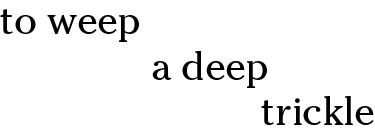
The first two are iambs (duh-DUH), and the last one is a trochee (DUH-duh), with a very short last syllable. There’s a reversal, a dwindle at the end. It even looks like a trickle.
The shape of the poem in space and time. The poem gets smaller, both in terms of the number of syllables and the length of the lines (in both time and space — it takes less time to say trickle than it does to say a deep). The last three lines are two syllables, so you could say the poem trickles to its ending. Also, the poem tapers to an end, like a plumb (a lead weight attached to a line to show the vertical). Plumbs are used by architects, surveyors, construction workers, and, yes, plumbers.
If you come away with an impression of pain or perhaps sorrow, the summary of a year and also a lifetime, of long, hard work to write and to “plumb” — well, then, you have to say that this is a superb little poem.
Niedecker appears very conscious of every element of her poem, down to the dash in the middle, which seems as though she’s about to explain what she means by plumbing — but doesn’t really. That’s open-form poetry as a way of thinking.
Using the Open Form in Your Own Writing
Poets have described open-form verse in various ways. In the following sections, we suggest ways to use those ideas as a basis for your own poetry.

What kind of open-form verse you write depends on you. Practice with these different approaches. They may seem difficult or nutty at first, but after a while you’ll start thinking in one of them, or in an open form all your own. And you’ll find that you may work harder with your open-form poems than you ever anticipated. In the end, open form is both a challenge and a pleasure.
Going for the breath: Framing individual lines
As you read poetry, you become sensitive to the way you breathe. You read a group of words and then pause before reading another group of words — it’s just natural. Pay attention to that when you write poetry as well. Let those natural pauses determine where lines end. The breath, as it’s called in the poetry world, is a natural way to frame individual lines. It will be different from poem to poem, from line to line, but it can help guide both your writing and your reading.
Our guess is that Lorine Niedecker (in the poem earlier in this chapter) is using the breath as the measure of her open-form lines. How do we know? We don’t. But read the poem aloud. There seems (to us) to be a very strong pause — almost as you may have with an intake of breath — between the lines. Reading straight through seems very unnatural — each line is roughly “equal to a breath,” as some poets say.
Not all poets have the same length of breath. Some poets use a long, rolling breath, rather like a song or incantation. Beat poet Allen Ginsberg once wrote of himself, “My breath is long — that’s the Measure, one physical-mental inspiration of thought contained in the elastic of a breath.” One of Ginsberg’s great inspirations was fellow poet Walt Whitman. You can hear the length of the long, rolling breath in the lines of Whitman’s poem, “O You Whom I Often and Silently Come”:
O you whom I often and silently come where you are that I may be with you,
As I walk by your side or sit near, or remain in the same room with you,
Little you know the subtle electric fire that for your sake is playing within me.
Like Ginsberg, you can regard your breath as your personal measure. Listen to your breath as a source of rhythm, pace, tone, and inspiration — a word based on the Latin word inspirare, meaning “to breathe in.” Whitman’s breath is different from Niedecker’s, which is different from Lawrence’s (earlier in this chapter).
How can you use the breath in writing open-form poetry? In revision, do the following:
Read aloud an open-form poem you’ve been working on, paying close attention to the breath as you read. If you pause naturally in mid-line, break the line there. If you can’t get a line to fit with a breath, something may be wrong with the way it’s written. Think about it, and try some revisions that may help the line “find” a breath-length that fits naturally.
Vary the breath rhythms throughout the poem. Don’t keep them all the same length.
Check to be sure the breath contributes to the sense of the lines. Does it? If not, determine why not. Rework the length of the lines until you feel the breath and the lines work together.
As in all open-form poetry, take special care with line endings! Line endings generate much of the tension, much of the specialness that makes open-form verse verse. Slave over your line endings!
Treating the page as a field
Poets speak of the page as a field, a place in which each part of the poem starts to have a meaningful relation to each other part. The fun part is that you get to decide what the different aspects of the field will mean. In the following sections, we cover three ways you can use the page as a field in your own open-form poetry.
Make the form of each stanza meaningful
One way you can use the page as a field is to make the form of your stanza, and the movements of the lines in that form (left, right, up, down), meaningful in and of themselves. A good example of this kind of field-writing is the three-line stanza of William Carlos Williams. He made up an open-form stanza that he called the variable foot. It plays by some interesting rules:
Each stanza contains three lines.
Each line is indented from the previous one, moving left to right.
Each indentation is meaningful. It signals a shift in thought, as the mind builds on what was just said or goes in a new direction.
Each line is a unit of sense. That is, each line makes a statement or an important part of a statement.
Each line has one beat (one major rhythmic stress, related to the unit of sense).
Each third line propels the reader into the next stanza somehow.
Here is the beginning of Williams’s famous poem “The Descent”:
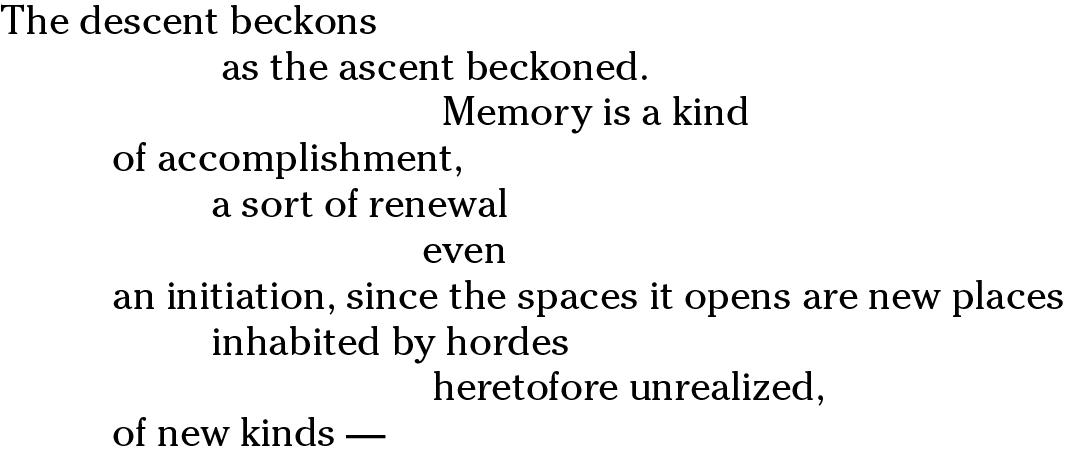
Williams is saying some beautiful things here. As a reader, you don’t know yet what he means by “ascent” and “descent,” although they may mean something simple like “success” and “failure,” or “happiness” and “sorrow.”
Do you feel the beats in his lines? Each line is one unit of sense and gets one beat. So the sixth line, even, gets one beat, and so does the much longer, prosy seventh line. Can you feel why? Perhaps out of sheer excitement, out of discovery. The speaker just said that memory is a “sort of renewal,” which is easy enough to see — but then a new thought occurs — memory is even an initiation! Why is it an initiation? Maybe because memory opens up new spaces for you, filled with “hordes” of new things you never knew. No memory is ever alike; as you change, memory changes and teaches you new things. So “even” deserves its beat, for sheer excitement, and the next line, which is what “even” introduces, is all one beat as well.
Each third line propels you into the next stanza. The poem has both a left-to-right movement and a downward movement — a descent! It’s like a stairway. You can see how Williams planned his stanza out — not according to rhyme or meter, but according to the way he wanted his argument to move.
Manage the relationships of the words and syllables
A second way to treat the page as a field is defined by Charles Olson, who spoke of the field as “the place where all the syllables and all the lines must be managed in their relations to each other.” Olson imagined that all the words in a poem created a tension with one another, like the particles in an atom or the parts of a suspension bridge. The poet manages the relationships of the words and syllables, feels the tension, and orchestrates it.
Kathleen Fraser’s “Vanishing Point: Third Black Quartet” is the tenth section of a beautiful poem titled “Wing.” In “Vanishing Point,” Fraser uses the page as a field in this way. You can almost feel the words vibrating in their tense interrelations:
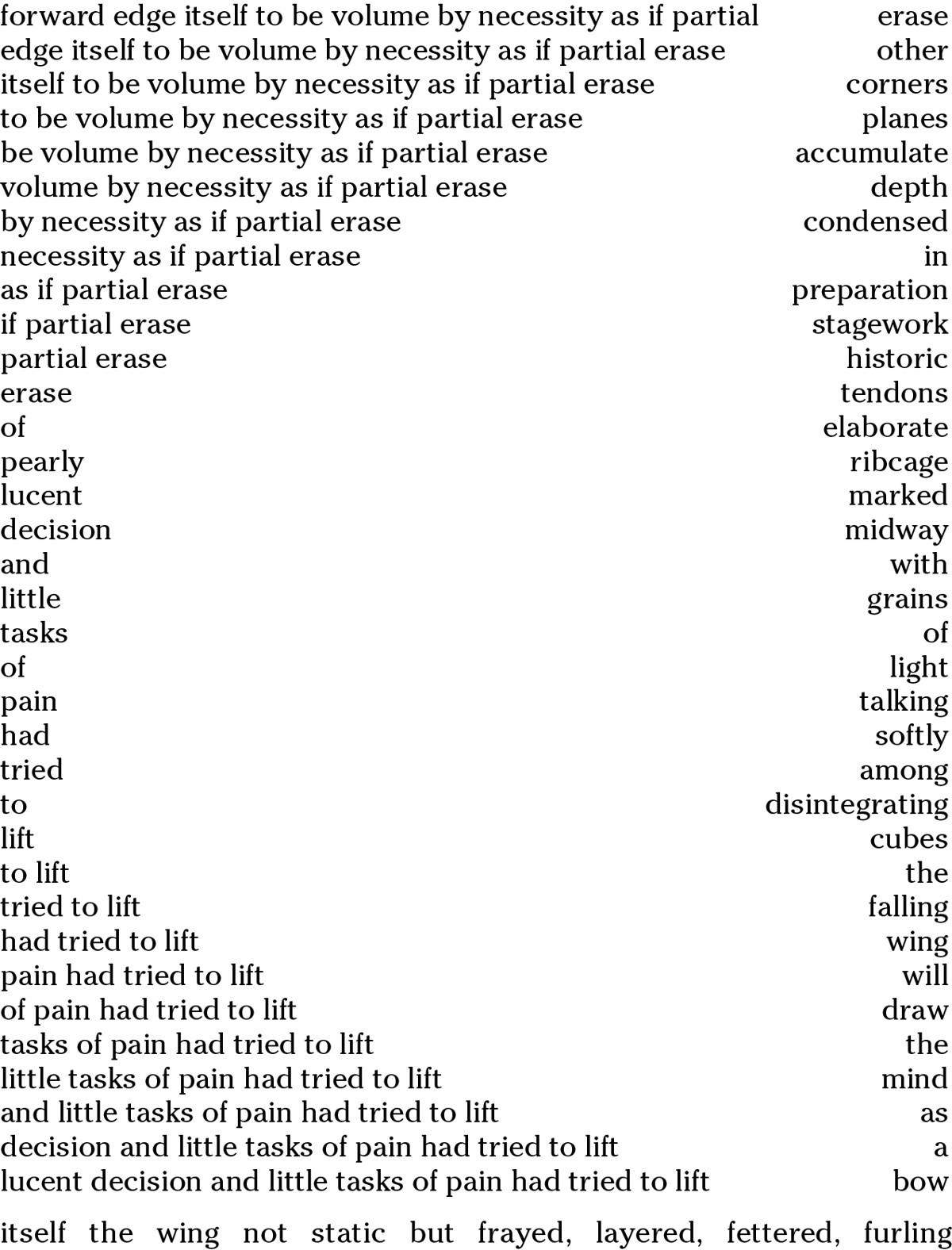
Fraser, clearly conscious of all the elements in this poem, has created a shape that’s brand-new. You can read this poem in many ways — it’s impossible to read this poem in one “correct” order. You can start almost anywhere and get different strings of words (the exquisite “little tasks of pain” or the “falling wing will draw the mind as a bow”). The left edge appears to melt away as you read down (“as if partial erase”). You can read down from the upper right corner, or across the space (“tendons of elaborate pearly ribcage”). You remember the title and think of the many physical “vanishing points” in the poem. And notice the shape of the white space in the center of the poem: It resembles a wing, which recalls that this is part of a work with the title “Wing.”
Fraser has thought it all through, has created all the relations — without using a single complete sentence and only two commas! Surprising meanings erupt from the unexpected combinations of words — such is the energy she has created in this field.
Fraser’s poem shows you how very formal an open-form poem can be.
Plan the meanings of different parts of the page
You can also write with the page as a field by planning the meanings of different parts of the page. You can draw lines, boxes, or circles to separate different parts of the page and say what will happen in each part. Treating the page as a field immediately makes space meaningful. It’s like marking out the field for a new kind of sport. When play starts, you’re bound by the rules you’ve made up and the lines you’ve drawn. Within those lines, however, almost anything can happen. Open form, indeed.
Treating white space as time
You may have seen poems that were groups of words scattered all over the page. One way to approach a reading of such a poem is to treat white space as time — by pausing before continuing to the next word you encounter. The larger the space between words, the longer the pause.
Try this principle with the following, the ninth poem in a series titled “29 Songs” by Objectivist poet Louis Zukofsky:
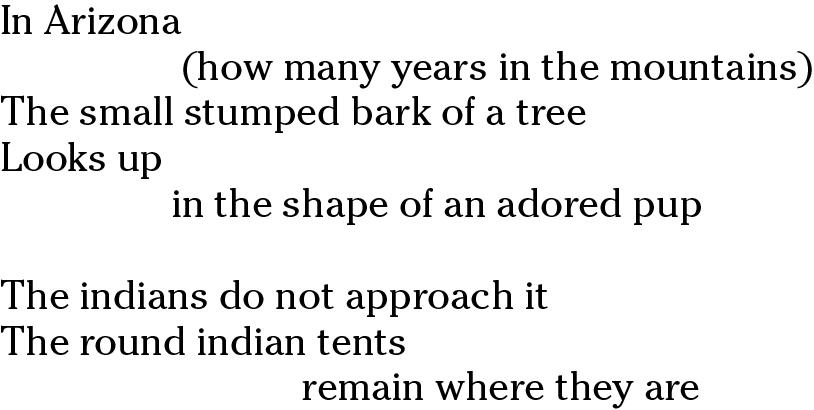

You pause longer between the first and second lines than you would between the second and third lines, and even longer between the two stanzas. If you treat white space as time, you’ll begin to sense a rhythm to the poem closely tied to the way the lines are laid out.
Treating white space as time is one of the best ways to write open-form poetry. Take special care with line endings: On which word will the line end? To what word will it lead? How much space or time is there before the next word?
When writing your own open-form poetry, you can treat white space as time by doing the following:
Vary the spatial relationships of the lines. The pauses should be a variety of lengths — all having to do with the sense and impact of the verse.
Use enjambment to wrap the sentences around the ends of lines.
Read your verse aloud constantly as it develops. Rearrange lines and line breaks if the reading doesn’t feel right.
Cut everything you don’t absolutely need. Because pauses will be directing the reading, you may decide (as many poets do) that you don’t really need punctuation (which usually directs your pauses). Let it go!