
Chapter 10
In This Chapter
 Exploring traditional forms of poetry
Respecting the tradition of formal poetry
Making sense of the rules for the ballad, the psalm, the sonnet, the ghazal, and the tanka
When you think of poetry, you may think of ballads, sonnets, rhyming couplets, iambic pentameter, A-B-A-B, verses, stanzas, and refrains. And what you’re thinking of are traditional forms of verse — forms that have come down through the centuries, each form with its own rules and challenges. Open-form verse (covered in Chapter 9) is different every time you use it — in essence, you create a form each time you write an open-form poem. But with traditional verse forms, you accept measures, restrictions, and laws others have made, or ones that have accrued through the years.

No matter what kind of poetry you end up writing, knowing how to write in traditional forms can be a great benefit. Almost all of these forms remain vibrant today — poets are still singing loud and strong through them, making them do modern tricks. Practicing traditional forms is an excellent way to:
 Work on the craft of poetry.
Begin a writing session.
Break writer’s block.
Write good poems.
You’re never done working with the traditional forms — you can always beginning afresh. Remember: Writing poetry is a lifelong apprenticeship, one to be savored.
Respecting the tradition
As a poet, you’ll write the way you want to write — and that’s great. But when you’re starting out, and when you’re trying traditional forms, take the forms seriously and (at least at first) follow the rules strictly. Start by trying to find the perfect rhyme (instead of something that comes close), and try not to vary many feet in your chosen meters.
Later, you can vary the rules — write a sonnet that doesn’t rhyme or one that doesn’t use meter, mess with the rhyme schemes, or use slant rhyme, daring to rhyme shoe with snow, for example (slant rhyme is an excellent way to tune your ear). But first experience the way traditions help you organize your poems and reach for language you rarely use. Let the old forms stretch you in new directions.
Ballads
Traditional ballads are stories told in verse — often stories of a romantic or lurid sort. Ballads still are being written today, especially in the form of popular songs.
Ballads take many forms. A popular one is the four-line stanza in which the first and third lines are written in iambic tetrameter (four iambs) and the second and fourth are written in iambic trimeter (three iambs), with a rhyme scheme of ABXB (the third line, X, need not rhyme or may rhyme with A).
Here’s what two such stanzas may sound like:

The winter moon had tipped and spilled
Its shadows on the lawn
When Farmer Owen woke to find
His only daughter gone;
She’d taken all the clothes she had
Against the biting cold,
And in a note to him she wrote,
“I’ve taken all your gold.”
Stick to this stanza type and write a ghost story, mystery, suspense tale, news event, or heroic story (stories of the Knights of the Round Table and Robin Hood were written in this form). Make the story and the language as modern as you can. You’ll see that this sturdy little form is excellent for carrying a tale.
Psalms
The Hebrew poets who compiled the Psalms worked with a very interesting verse form. It consisted of distichs, verses of two lines. The lines could be of almost any length. The first line was a statement, and the second built on that statement, usually in one of three ways:
Sameness: The poet can amplify the first half by restating all or part of it in some way, as in Psalm 102:
I am like a pelican in the wilderness;
I have become like an owl among the ruins
Antithesis: The poet can state something in the second half that opposes the statement in the first half, as in Ecclesiastes 3:4:
A time to weep
and a time to laugh
Complement: A complement balances two halves of a statement, as in Proverbs 19:21:
A man may have many plans in his mind
but the counsel of the Lord — that will stand
You, too, can write a psalm. The rules are few. Pick a very mundane event in your life and write it down straightforwardly in all the first (left-hand) lines of the distichs, leaving the second (right-hand) lines blank, like this:
Today I came down to breakfast
And I was hungry
So my mother brought me some cornflakes
She poured them in a bowl
And gave the bowl to me
Now fill in the second lines. Use sameness, antithesis, and complement. Amplify, illustrate, question, comment, contradict the first halves in as many ways as you can think of:
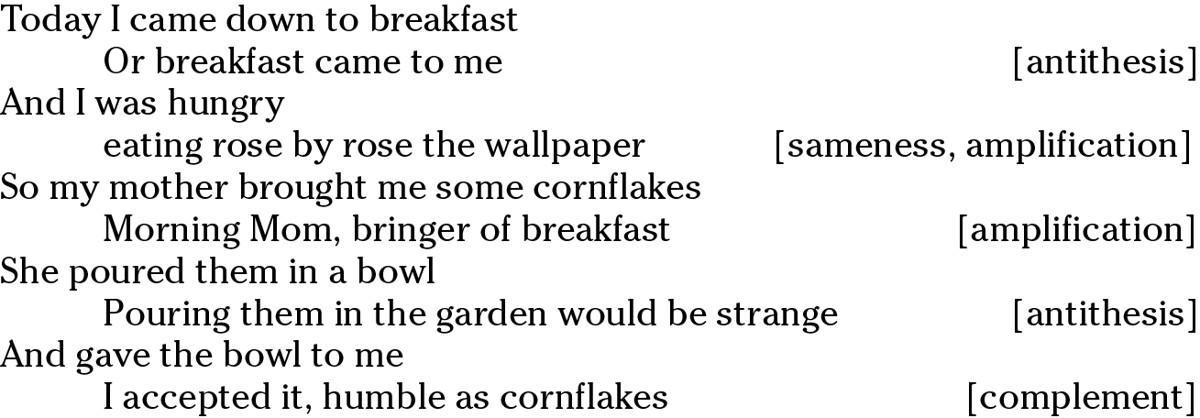
The fun (and hard) part is to create second lines that echo material in the first lines but also transform that material. You may find your second lines becoming surreal or humorous or divergent. The right-hand lines don’t have to make sense or be logically related to the left-hand ones.

Psalm-writing is a good way to get invention juices flowing, and it can yield interesting poems. Have fun with it. Break your own rules now and then. The idea is to think divergently.
Sonnets
Time to pay your dues. Try writing a sonnet.
Here are the rules:
It must consist of 14 lines.
It must be written in iambic pentameter (duh-DUH-duh-DUH-duh-DUH-duh-DUH-duh-DUH).
It must be written in one of various standard rhyme schemes.
If you’re writing the most familiar kind of sonnet, the Shakespearean, the rhyme scheme is this:
A
B
A
B
C
D
C
D
E
F
E
F
G
G
Every A rhymes with every A, every B rhymes with every B, and so forth. You’ll notice this type of sonnet consists of three quatrains (that is, four consecutive lines of verse that make up a stanza or division of lines in a poem) and one couplet (two consecutive rhyming lines of verse).
Ah, but there’s more to a sonnet than just the structure of it. A sonnet is also an argument — it builds up a certain way. And how it builds up is related to its metaphors and how it moves from one metaphor to the next. In a Shakespearean sonnet, the argument builds up like this:
First quatrain: An exposition of the main theme and main metaphor.
Second quatrain: Theme and metaphor extended or complicated; often, some imaginative example is given.
Third quatrain: Peripeteia (a twist or conflict), often introduced by a but (very often leading off the ninth line).
Couplet: Summarizes and leaves the reader with a new, concluding image.
One of Shakespeare’s best-known sonnets, Sonnet 18, follows this pattern:
Shall I compare thee to a summer’s day?
Thou art more lovely and more temperate.
Rough winds do shake the darling buds of May,
And summer’s lease hath all too short a date.
Sometime too hot the eye of heaven shines,
And often is his gold complexion dimmed;
And every fair from fair sometime declines,
By chance, or nature’s changing course, untrimmed;
But thy eternal summer shall not fade,
Nor lose possession of that fair thou owest,
Nor shall death brag thou wanderest in his shade,
When in eternal lines to time thou growest.
So long as men can breathe or eyes can see,
So long lives this, and this gives life to thee.
The argument of Sonnet 18 goes like this:
First quatrain: Shakespeare establishes the theme of comparing “thou” (or “you”) to a summer’s day, and why to do so is a bad idea. The metaphor is made by comparing his beloved to summer itself.
Second quatrain: Shakespeare extends the theme, explaining why even the sun, supposed to be so great, gets obscured sometimes, and why everything that’s beautiful decays from beauty sooner or later. He has shifted the metaphor: In the first quatrain, it was “summer” in general, and now he’s comparing the sun and “every fair,” every beautiful thing, to his beloved.
Third quatrain: Here the argument takes a big left turn with the familiar “But.” Shakespeare says that the main reason he won’t compare his beloved to summer is that summer dies — but she won’t. He refers to the first two quatrains — her “eternal summer” won’t fade, and she won’t “lose possession” of the “fair” (the beauty) she possesses. So he keeps the metaphors going, but in a different direction. And for good measure, he throws in a negative version of all the sunshine in this poem — the “shade” of death, which, evidently, his beloved won’t have to worry about.
Couplet: How is his beloved going to escape death? In Shakespeare’s poetry, which will keep her alive as long as people breathe or see. This bold statement gives closure to the whole argument — it’s a surprise.
And so far, Shakespeare’s sonnet has done what he promised it would! See how tightly this sonnet is written, how complex yet well-organized it is? Try writing a sonnet of your own.
Poets are attracted by the grace, concentration, and, yes, the sheer difficulty of sonnets. You may never write another sonnet in your life, but this exercise is more than just busywork. It does all the following:
Shows you how much you can pack into a short form.
Gives you practice with rhyme, meter, structure, metaphor, and argument.
Connects you with one of the oldest traditions in English poetry — one still vital today.
Writing experimental sonnets
Poets have begun to take the sonnet in some new places. David Trinidad’s “Monster Mash” is a Shakespearean sonnet (it rhymes and maintains recognizable iambic pentameter) — while creating a poem with nothing but the names of old horror movies:
Frankenstein, Godzilla, The Blob, Phantom
of the Opera, The Wolf Man, The Hunchback
of Notre Dame, Children of the Damned, Them,
Queen of Outer Space, Creature from the Black
Lagoon, Curse of the Cat People, The Mum-
my, The Green Slime, The Brain that Wouldn’t Die,
Invaders from Mars, It! The Terror from
Beyond Space, Dr. Cyclops, Freaks, The Fly,
Bride of Frankenstein, The Invisible
Man, The Mole People, Dr. Jekyll and
Mr. Hyde, Mothra, The Incredible
Shrinking Man, Dracula, The Crawling Hand,
Attack of the Fifty-Foot Woman, King
Kong, Tarantula, 13 Ghosts, The Thing.
Today, poets are using traditional forms in nontraditional ways. When you feel comfortable in a form, explore new avenues with it yourself.
Ghazals
The ghazal (pronounce it “guzzle” with a slight gargle on the g) is one of the few Arabic verse forms to have a big impact in the West. It came into European poetry through 19th-century German poets and got into English-language poetry in the late 1960s. Here are the rules:
Every line must have the same number of syllables. American and English writers usually settle on iambic pentameter or something close, but you can choose any number of syllables you like.
The ghazal is a series of couplets (at least five, but there’s no upper limit).
The first couplet rhymes. For example:
October: the horizon, grey and wide, Is staggering — you’re dancing in the tide.
The closing words of the second half of the second line are repeated in the second line of each succeeding couplet. It could be the last word, or a several-word phrase — it’s up to you. This is called the radif. Here, our radif is “dancing in the tide,” which has to appear at the end of the second line of each succeeding couplet.
The remaining couplets don’t have to rhyme, and they can shift around in subject and tone. Make them as independent as you want, but always, come back to that radif (“dancing in the tide”).
The makhta, or the poet’s signature (first name, last name, or both) appears somewhere in the last couplet.
Here’s an example of a ghazal we wrote ourselves, following all of these rules:
October: the horizon, grey and wide,
Is staggering — you’re dancing in the tide.
My uncle died and left me twenty sheep
Stacked in my basement. Dancing in the tide
Of debts, divorce announcements, and debris,
I chuck it all, go dancing. In the Tide
There was a lottery coupon, and I won.
Now all my friends come dancing in the tide.
As ocarina orchestras obfusc,
Maureen Watts goes dancing in the tide.
Poets love the ghazal because it’s both free and patterned. It’s halfway between a traditional, rhymed form and a free, associative one. Closed, yet wide open. Get in and drive it anywhere!
Tankas
The Japanese tanka is a verse form from classical Japanese poetry. Even older than its better-known cousin, the haiku, the tanka is a quiet, meditative form focused on the natural world and the poet’s emotions. A tanka is essentially a haiku (three lines consisting of 5, 7, and 5 syllables each), except with two more lines of 7 syllables each. Traditionally, the tanka begins with an observation of a natural scene:
Invisible hands
caress my face; have I walked
through a spider’s web
woven this morning to catch
flies writhing with my surprise
Many poets find that the tanka falls naturally into a haiku followed by a couplet. The haiku tends to focus more on observation, the couplet on reflection. But you don’t have to observe this movement in your own writing. The tanka is a syllabic form, so just follow these simple rules:
Avoid end-rhyming the lines.
Vary the rhythms from line to line.
Use enjambment to keep sentences and clauses twisting around the ends of the lines.
Avoid ending too many lines in a row with a one-syllable word.