
Part III
In this part . . .
In these chapters, we give guidance, advice, and encouragement to anyone interested in writing poetry. Here you’ll find discussions of the attitude, discipline, and habits you need to become a practicing poet. We show you how writers get from first thoughts to actual poetry.
You’ll find out how to write in free verse (which we call open-form poetry) as well as how to write in five popular traditional forms. Then, generous sorts that we are, we offer a range of exercises to stoke the creative fires and help you find the kind of poetry you’d like to write. We follow that with chapters on how to read your poetry at public readings, open mikes, and poetry slams, as well as the best way to seek publication for your poetry.
Whether you’re already a poet or on your way to becoming one, you’ll find the tips, advice, and suggestions you need in the chapters in this part.
Chapter 8
In This Chapter
 Developing good habits as an aspiring poet
Organizing your writing time
Recognizing inspiration when you feel it
Turning raw material into poetry
Staying in touch with what’s happening in the poetry world
Meeting other poets
So who gets to be a poet? Anyone who wants to be. Anyone willing to read, write, work, and live with poetry. There is no entrance fee, no initiation ritual, and, last we looked, you can’t get kicked out of the club.
So how do you go about doing this poetry thing? Should you jot down thoughts as they come, on old receipts, napkins, scraps of newspaper? (Some fine poets, such as Frank O’Hara of the New York School, did it that way.) Or will you lose all those scraps of paper? Should you be more methodical? Write every day. Keep a journal. Revise and revise. Stay current with the latest in the poetry world. Become part of a community of poets. Find a mentor who will read your poetry and give you good criticism.
Something more along the lines of the methodical route will likely serve you best. So in this chapter, we suggest ways to corral inspiration and turn it into poetry.

Ignore any advice in this chapter if it doesn’t work for you. These aren’t rules; they’re guidelines. Pick and choose! Build a modus operandi (a “way of working”) all your own.
How to Live If You Want to Be a Poet
No one way of life works for every poet. But poets do tend to share a few traits:
 They have passion. Poets care about something very much, and this passion drives their work. Passion for what? It could be passion for making words, or passion for a way of seeing. Or it could be a commitment to a public theme of some kind — or just a passionate attachment to life itself. So find a reason to care and something — many things — to care about.
They think like poets. What kind of thinking is that?
• They like to play with words. They pay attention to the beauty, quality, and specificity of words. They love the pleasure of using the “right” word and the equal pleasure of using the surprising word.
• They think in images, metaphors, and music.
• They find ways “behind the scenes” of their conscious minds; that is, they seek divergent ways of thinking, forms of writing that shake them loose from habits and ruts.
They read a lot and write a lot.
They are sensitive people and do many things to enhance their awareness and sensitivity. What kind of things? They read, they write, and they practice paying attention. Some poets explore alternative consciousness, which leads them into meditation, religion, drugs, and so forth. We don’t necessarily recommend any of these directions; we only want to point out where poets have gone in search of inspiration.
They are open to experience. Curiosity makes the poet. It means that whatever you encounter, you do so with your eyes open.
They work hard to improve. This work involves two major disciplines: revision and learning from criticism.
They associate with other poets whose work they admire.
Reading Like a Poet
A poet who doesn’t read is like a composer who doesn’t listen to music. To quote the marvelous poet and teacher Gerald Stern, “The great writer who doesn’t read — il n’existe pas!” (meaning, “He doesn’t exist”). So read a lot, and then read some more. Here are some things to read, along with the reasons why:
Classics in poetry and fiction, to learn the traditions of literature.
Journals of art and culture, to learn what’s happening in the arts.
The latest in fiction and nonfiction, to find out what writers are creating right now.
The newspaper and major current-events journals and magazines, so you know what’s happening in the world.
Poetry, lots of poetry, different kinds of poetry, poetry from all over. Reading a variety of verse — in different styles, from different periods and countries, by different kinds of people, about a variety of subjects — will show you the huge range of possibilities for poetry, help keep your mind wide open (essential for a poet), and also help you train your ear and eye, understanding how poetry works and building your personal tastes.
Junk, grocery-store paperback novels, relaxation reading, because it doesn’t hurt.
Some aspiring poets are afraid to read — especially poetry. They’re afraid of being influenced too much by other minds and voices. But we say you should risk it. You have to hear those other voices, get a taste for those other minds, to know what’s happening in the world of poetry, so you can speak to the present. Don’t be afraid that other people are better than you are. Remember what the jazz guitarist John Scofield says regularly to his students: “If you want to improve, get out and play with people who are better than you are.” Makes sense, doesn’t it?
Writing Like a Poet
Have you ever heard someone describe himself as an athlete, only to add that he hasn’t touched the basketball court (or football field or swimming pool) in 30 years? Well, we have news for that guy: He’s no athlete. He’s just a person who likes to talk about being an athlete.
Similarly, there’s no way you’re a poet unless you find the time to write poetry and work at it — and not just making poems but also revising them. If you’re serious about being a poet, you can’t just write poetry in bits and pieces — you have to schedule time to write.
Finding the right time and place to write

Carry around a tape recorder or a notebook. Use these tools as storage space for the stuff that rains down on your brain during the day — all the little ideas and phrases and words that occur to you, but that you would forget if you didn’t jot them down. Then transfer that material from your notebook into a journal during your writing time.
How long do you need to set aside? At least an hour. And if you care about poetry, you won’t cheat yourself out of the time you need to write it. Decide the following:
When you’re at your best. Are you a morning, noon, or night person? Many poets get up very early — early morning is a poetic time (birds are singing, garbage collectors are banging, and so on). Others wait until the depths of night. Know what works best for you.
What setting is best. A quiet library? A park bench? A crowded café? Most folks need the following:
• A quiet place, somewhere free of distractions and interruptions.
• Good lighting, which can help your vision and your mood.
• Writing tools, such as a computer, pens, pencils, paper, a dictionary, poetry books, and so on.
• Comfort foods and comfort sounds. Some people need music; others can’t work with it on. Some folks find that a snack nearby aids inspiration. Pay attention to what you require, and make sure you have it.

The way poets write
Each poet has his or her own way of composing poetry. Here are six interesting poetic m.o.’s:
The Roman poet Virgil was said to walk through his gardens all day long, and by sunset, if he’d had a good day at work, he had produced . . . a single line.
Elizabethan and Jacobean poet Ben Jonson said he would write out a prose paragraph stating the poem’s content, and then sit down and write the poem. Now that’s discipline!
Renaissance English poet John Milton went blind in 1651, yet he didn’t start creating Paradise Lost in earnest until 1663. How did he do it? He dictated it to a secretary. So if someone says, “Milton wrote Paradise Lost,” you can be irritating and reply, “No, he composed it.”
Modern American poet Theodore Roethke had an interesting use for his bed. Whenever he got stuck while writing a poem, he would hop into bed, and when he felt he had solved his poetic problem, he would get up and start to write again.
Frank O’Hara, a poet of the New York School, wrote a whole book of poems titled Lunch Poems. O’Hara, seldom known to turn down a party, would have lunch with his New York pals, then return to his job at the Museum of Modern Art, put a piece of paper in his typewriter, type out a poem, and then get back to his “real job.”
African American poet Maya Angelou has a very idiosyncratic way of setting up her “office.” She rents a hotel room, then leaves her house at 6:00 a.m. and tries to get to “work” (in her hotel room) at 6:30. She lies across the bed to write, so she has a permanent callus on one elbow. She insists that everything is taken off the walls. “I go into the room,” she writes, “and I feel as if all my beliefs are suspended. Nothing holds me to anything. No milkmaids, no flowers, nothing. I just want to feel and when I start to work I’ll remember.”
Recognizing inspiration
For 5,000-plus years, poets have described an agitated, exalted state, a peak experience, white-hot, out of which they created poetry. No doubt about it, this happens. Shakespeare appears to have written the first draft of Hamlet in about six weeks. (Doesn’t it make you sick?) Rainer Maria Rilke, after working on his incomparable Duino Elegies for more than 20 years, finished them in an attic study in two of the most famous weeks of poetic inspiration. Sylvia Plath’s last six months alive, during which she wrote the poems in the collection Ariel, were of that white-hot variety, all original, tortured, supremely inspired verse.
Some think inspiration is the voice of the Divine whispering directly into our souls. Others believe it’s the individual’s mind (yours!), working subconsciously, stitching experience, memory, desire, and language into a crazy quilt that the poet somehow discovers and turns into poetry. Many creative people talk about access to the subconscious, even access to childhood — you eventually trust your subconscious to come up with what you’re looking for, to solve problems. One good reason to have regular working habits, then, is to visit your subconscious regularly, give it a chance to read itself, so to speak, crystallize what’s welling up in there. Regular work habits make you better at reading what your subconscious is up to. Yet the subconscious doesn’t keep office hours: It can also be dreamlike and elusive, so carry a pen and notebook with you wherever you go.
Sometimes you know you’re inspired: You taste that elevated, breathless excitement. At other times, however, inspiration sneaks up on you. Unless you’re very sharp, you may not even realize it’s happening. Many of us, after all, just think, not especially paying attention to ourselves, just watching our mental movies. Then, maybe, we snap out of it: “Hey! Wait a minute! What was that again?”
Be awake to your own processes. Just as an athlete gets to know her body and its ways, get to know when your mind is most open to the muse.
When is inspiration likely to happen? Almost any time. But poets have often written about the following situations, which seem to lead to moments of intense creativity:
Whenever you’re alive. From overpowering elation to quite modest events (say, a wheelbarrow wet with rain, something the American poet William Carlos Williams created a famous poem about), connections and realizations could happen anytime. Sometimes the words and impressions come at the very moment of experience; some poets say they need to write them down before the ideas fade. Others find having the experience and recollecting it later works best for them.
Between waking and sleeping. Some folks keep notebooks by the bedside, to capture their thoughts when they’re in transition from conscious to subconscious states and vice versa. Many people jot down dream material (and daydreams as well), scrawling in notebooks in the middle of the night.
While listening to music. Because music involves your emotions and experience in extremely complicated ways, taste in music (like taste in poetry or any art) is intensely personal. Many people feel that listening to music allows them to access their memories, dreams, and mental associations.
During diversions. When you’re really concentrating hard on something (a math quiz, or a tangled bike chain, or sawing at a tree limb 40 feet above the ground, or watching an exciting hockey game), your subconscious mind may try to slip in an image, a phrase, or an idea while you’re not looking.
The subconscious often tries more than once. You may miss its suggestions the first time. But it may try again, like a distant phone ringing. If the same image or word or notion keeps surfacing now and then, pay attention to it. If you know that’s how inspiration happens, you’re one step closer to using it in your verse.
Empty page, full imagination: Getting started
Some people can just turn to a clean page and start writing. If you’re like that, fine. Get going. God bless.
Other people are stymied by the empty page. If you’re part of this group, waiting for inspiration can keep you from writing. Sometimes, sitting down and writing anyway, even when you can’t think of anything to write about, is important — think of it as exercising muscles you’ll need later. Besides, some of your best writing can come to you when you feel like you’re plodding along in a rut, without anything to say.
Some poets need warm-up exercises for their minds and bodies. If you need a warm-up, give one or more of the following a try:
Free-write. Free-writing is a technique pioneered by Peter Elbow, a well-known teacher of writing. It’s simple to do: Just put pen to paper and write. What you write doesn’t matter. If you can’t think of anything to say, write, “I don’t have anything to say, I don’t have anything to say.” Ten to fifteen minutes of free-writing often loosens people up, and you may discover you’ve written something interesting — in spite of yourself.
Rewrite a famous poem. Go to your favorite anthology, select a poem, and put it in different words. Poet, teacher, and anthologist J.D. McClatchy recommends writing out the poem you’ve chosen — triple-spacing the poem on the page — and writing a response in between the lines. Then erase the original and work on your response to it as a separate poem — one you’ve created.
Try one of the Surrealist games. Cut words out of a newspaper, draw them out of a hat, and arrange them in any way you want. Then write a poem reversing the words.
If you’re itching to start, start. Write what you’re on fire to write. That’s what this time and place are for. If you want to be extremely methodical, you could establish a pattern and do it the same way every time, like this:
1. Begin with some exercises or copy material from your daily notebook into your journal.
Feel free to expand or work on anything as you do so.
2. Read the previous day’s work aloud.
3. Revise your previous work.
4. Generate new writing.
Keeping a journal
A journal is a single, locatable repository for your writing, a stockpile of raw material for future poetry. What can you put into a journal? Here are some examples:
Drafts and revisions of poems. A journal can be your “workshop,” where you go through the process of going from first thoughts to more finished versions of poems. Keep track of your versions (some poets number them; some use different colored pens or pencils; some simply start a new page when they start a new version). Watching your poems grow and develop will, in itself, reveal to you how your poetry takes shape.
Pasted-in newspaper articles, magazine art, drawings, and “found” objects. Maybe you’ve come upon someone’s family photograph in the street, and that photograph suggests a poem to you.
Poems you’ve read and loved. Why not build your own personal anthology? That in itself could yield inspiration.
Exercises in traditional forms. Write sonnets, ballads, haiku, ghazals, and other tightly formal poems. Pay your dues! Master these forms even if you’ll never use them. They teach you the foundations of your craft. (Turn to Chapter 10 for information on how to write these traditional forms of poetry.)
Lists of subjects to write about. Just list them. Someday you could return to this list, select an item, and write a poem around it.
Sentences and phrases. Phrases (“smooth as sippin’ whiskey”) or sentences (“The only reason I have this job is to have this job”) you overhear during the day, or fragments, thoughts, and ideas that just occur to you all make great candidates for entry into your journal.
Words you never heard of before. Expand your understanding of your chosen material: words. Write down words you’d like to use someday in a poem (like frangible) or sentences made up of unfamiliar words, just for their sound (“The frangible zerk mewled at the eumoirous thyristor”). Journals can be where you become more familiar with the possibilities of language.
Metaphors. When nice metaphors occur to you with no poem around them (“the sea is the eyelid of the shore”), put them in your journal. They may come in handy later.
Moving from journal entry to poem
Some journal entries are complete poems the moment you write them. They just drop down out of nowhere, right into your brain. But most journal entries aren’t poems just yet — they’re the raw material for poetry, the stuff poetry is made of.
So how do you know when your journal entry has become poetry? You never know for sure, actually. Many poets keep working and reworking their poems forever. But distinguishing between a journal entry (in which you just say something) and a poem (in which you use language and thought to make something new happen) is important.
Here’s a passage from a journal:
I’m feeling mad today because I love this guy and he isn’t really being that responsive. I mean, he gives me signals like he’s interested, but then he acts as if he hasn’t got a clue.
Sure, you may be able to imagine situations in which this could be poetry. (A couple of examples: What if this were your dog talking? What if this prose passage came smack in the middle of a Shakespearean sonnet?) But most of the time, entries like this are only the beginning of something poetic. Arranging them in lines can’t hide that fact:
I’m feeling
mad today because I
love
this guy and he isn’t
really being that
responsive. I mean, he
gives me signals like he’s
interested, but then he
acts as if he
hasn’t
got a clue.
Even though we’ve arranged this into interesting lines, it’s still prose — just chopped up prose. In this new form, the words are more fun to read — a few of the lines even rhyme — but it’s still not poetry yet. You’re looking at the ore, not the processed gold (ore is good, gold is better).
In poetry, some event takes place. Something happens to the reader. What that something is (a revelation, an epiphany, a redirection, a surprise, a paradox, an outrage, a jest) and how it happens is up to the poet. So as you read poems (and write ones of your own), allow room for both discovery and rediscovery of these events. Robert Frost wrote, “For me, the initial delight is in the surprise of remembering something I didn’t know I knew.” Emily Dickinson famously said she knew she was reading poetry “if I feel physically as if the top of my head were taken off.” Poetry is thatstartling, that surprising; it can change the way you see things.
In the journal entry, you know the writer is feeling “mad” because she says so. But do you really feel it? On a scale of one to ten, with ten being a poem in which you can really feel the poet’s anger, her passage is maybe a three. You can guess she really wants this guy to open up to her. But you’re guessing at her emotions, not knowing them.
Using her journal as a jumping-off point, the writer later came up with these lines:
I am a car bomb triggered to
your front door come
out come out
Now she’s a lot closer to poetry. Why? Because she has found a metaphor for her emotional state. Her love is a car bomb. Think that metaphor through:
Car bombs are a form of attack often aimed at one person. So is this woman’s love, evidently. And this is more explosive than saying, “I’m feeling mad.”
The writer is triggered to his front door. How is she “triggered”? Our guess: Perhaps because she is so attuned to his movements, so sensitive that any move he makes is meaningful.
The last words, “come / out come out,” reveal that she really does want the guy to “come out,” by showing his feelings to her. But if he does come out — blam! — she explodes. So there is some nice ambivalence (the coexistence of opposing or very different emotions) going on: The speaker seems to be feeling frustration and even anger (that she cannot connect somehow with this man), but the explosion suggests there may be some relief (in the release of the pent-up emotions?) as well.
The poet went from a straightforward journal entry to a few lines in which an event took place. Her progress suggests a few things about getting from journal entry to poem:
Think in images and metaphors. This poet’s first good move was to find a metaphor for her emotional state: the car bomb. The metaphor says a lot more, and a lot more powerfully, than three lines of prose did.
Concentrate on showing rather than telling.This poet’s second good move was to realize that simply declaring “I’m feeling mad today” didn’t bring her emotional state alive. She had to find a way to bring the reader into her anger and frustration. Often, this means you won’t name the feeling or meaning you’re getting at. As songwriters have known for years, many of the most effective love songs never mention the word love. Instead, they find other ways to involve the reader. Poetry often works by indirection. (As Emily Dickinson puts it, “Tell all the Truth but tell it slant.”) In our example, the poem never mentions the word love, yet you get more of her passions than you would have if the word love had come bopping in.
Think with music, rhythm, and form. Another interesting move the poet made was to drop all punctuation. That approach makes you, the reader, work a little to group the words into understandable units — and maybe become a little more conscious of each word. She could have written:
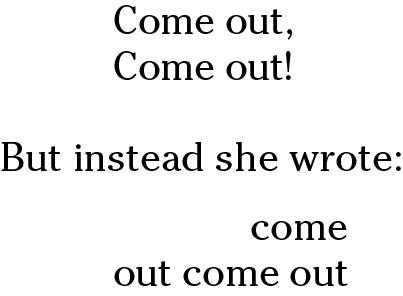
which slows you down a little and forces you to punctuate the phrase in your mind (and give it the tone carried by an absent exclamation point). It maybe even leads to a smile when you realize who’s talking, to whom, and why. She has involved you more. And that’s what most poets want to do.
Choosing subjects
As you forge a personality as a poet, you’ll find that what you write about and the form you write in are almost as important as how you write.
If you’re struggling for things to write about, check out the following lists of subjects from two separate journals.
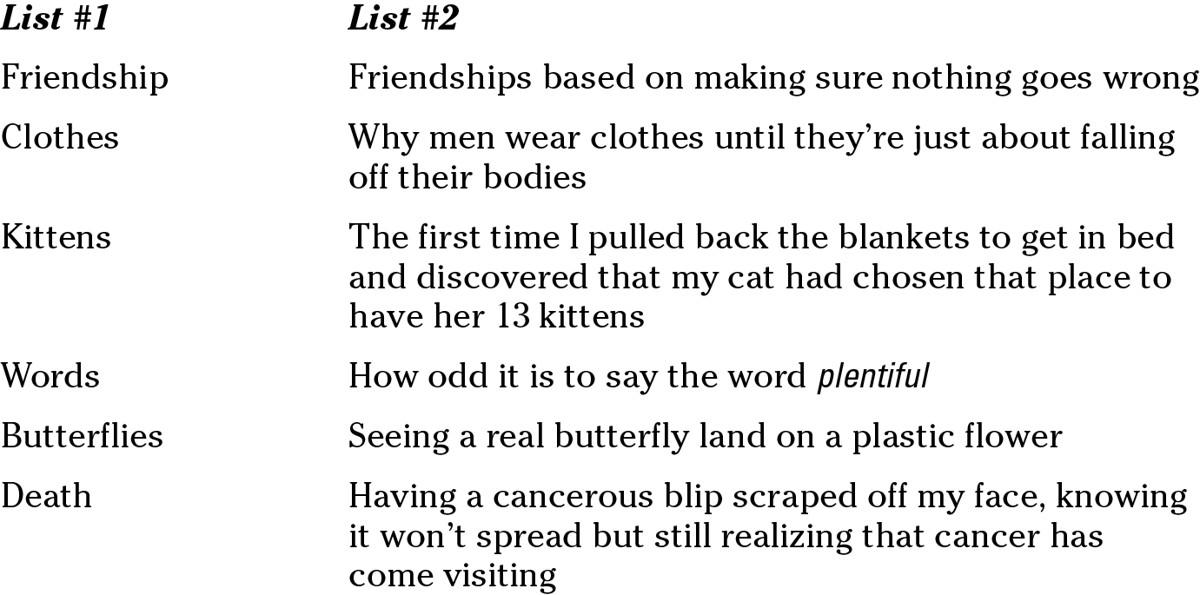
Compare the two lists. The prize goes to List #2, of course. Why? Because it’s more specific. Friendship is fine, but what about friendship? What kind of friendship? When you come up with abstractions as subjects or titles for poems, stop and think about whether you’re dwelling on generalities or saying things people have said before. You may have a lot of new things to say about friendships based on making sure nothing goes wrong, however, so that topic is a stronger one.
Write about anything you want, but when considering subjects for your poems — and when stockpiling subjects in your journal — follow these suggestions:
Choose limited subjects over broad ones. Not clothes (broad) but how men wear clothes until they’re almost falling off (amusingly limited).
Choose concrete and specific subjects over abstract and general ones. Not death (abstract) but a cancerous blip (chillingly concrete). Not words (general) but the word plentiful (specific).
Choose original subjects over those you’ve seen before. There are, we’re guessing, about 12,571,813 poems about cats, give or take a few. Many of them are identical. But how many are there about cats giving birth in your bed?
Making these choices can help you write better poems — and discover better subjects.
Rewriting until it hurts a lot better
Some poets want their poetry to be the red-hot, first burst from their minds. In the words of Allen Ginsberg, “First thought, best thought.” They’re wary of tampering too much with the material they’ve produced in the initial heat of creation. But we’ve rarely met poets, no matter how devoted to inspiration and the authentic, who didn’t revise like obsessed demons. The superb poet James McMichaels once read a six-line poem to his class, after which he said, “I’ve revised this thing 300 times, and it still isn’t ready.”
Inspiration is usually just the beginning of a poem. Ezra Pound compared the making of poems to sculpture: You start out with something promising and keep refining, chiseling away, getting rid of anything you don’t need. Dorothy Parker called it “killing your babies.” (Sweet metaphor, huh?)
Be ready to cross out anything if it doesn’t work — anything, no matter how reluctant you may be to part with it. And follow these three guidelines for revision:
Treat everything you write as provisional. Nothing is set in stone; everything is subject to change at any time.
Be tough with yourself. Cut out anything that:
• You’ve seen in print before (the “George Orwell rule”).
• Seems trite or obvious.
• Doesn’t need saying or has been said or implied elsewhere in the poem.
Never keep something in your poem just because it helps you make a rhyme or fills out a meter. Find a different solution instead of retaining anything second-rate.
Your subconscious is very useful in revision. For example, if you’re writing a poem and it’s time to go to bed, you may close your journal, yawn, and turn in. But your subconscious is still working on that poem all the time, even while you’re sleeping. If your subconscious feels something in the poem isn’t working, that realization will occur to you here and there, sometimes consciously (as when you read it and immediately think, “That isn’t working”) and sometimes subconsciously (as when the offending word or phrase just keeps coming to your attention). Pay attention when such things happen; the subconscious is very often right.
Make revision a large part of your daily writing routine. Revision is hard work, and it brings with it some disheartening moments. Sometimes, when you’ve revised, hardly any poem is left. But you learn a great deal as you revise — about the poem in front of you, about yourself, and about poetry in general. You don’t necessarily figure out how to write as you write the first time, but you may figure out how to write as you rewrite. So be open to revision — it’s how you and your poems get better.
From “Bed” to “The Bed”: A case study in revision
The poet Linda Jarkesy kept track of her revision history with a poem originally titled “Bed” and later retitled “The Bed.” Here is her first draft:

I dream myself
a cool white bed. It is nothing
like the bed I sleep in now,
(which is hardly a bed,
being a futon),
but a huge bed, with
a smooth wood frame.
The headboard
and footboard curve back, away
from each other.
The bed sits in the middle of a room,
a big room,
with sun-streaked wood floors, and
bare white walls, and open windows.
There is nothing else in the room,
but through the window you can hear
a sound, which could be
waves breaking on the shore, could be
winds whistling through the pines.
The dream
isn’t about the bed. It’s
not about sleeping, either, nor
about having sex in the bed (although
that could be imagined) — it’s really about
simplicity, about a lack of clutter, about
perfection.
Now here is the poem in its fourth and final draft. Read the two drafts together and compare them to note the changes Jarkesy made.
I dream myself
a cool white bed. Its frame
is made of smooth,
light wood. Pale
silk sheets stretch taut
against the mattress.
The headboard and footboard
arch back, sweeping
away from each other.
The bed
rests on a sun-streaked floor.
Through a window,
you can hear a sound,
which could be
waves breaking
over rocks.
Or wind,
or the low rush of traffic
on a city street.
There is nothing else.
It is just the room,
the bed,
the sound,
and the air — a tinge
of cold — and all of it
shimmering, shimmering.
Jarkesy says that she wrote “Bed” in “one quick spurt,” but after deciding she wasn’t thrilled with it, she put it aside. She came upon the poem about a year later. “I realized,” she writes, “that there was still something in the image of the bed that was holding my interest.” So she set about to revise the poem and improve it.
So what exactly did Jarkesy change about the poem? Here are a few of the improvements:
She cut out every detail and word she didn’t absolutely need. Whatever was attracting Jarkesy, it was, as she writes, “largely hidden by the many extraneous details that the first draft included. The poem needed a lot of pruning if it was ever going to be successful, so I set to work. . . . The first step was to cut lines: in particular those that felt like authorial intrusions (‘which is hardly a bed, being a futon’), as well as those that felt repetitious or merely boring (‘a big room’).”
Jarkesy says she also “thought about line breaks and the shape of the poem.” Note how she shortened and rebroke lines. Jarkesy writes, “The central image of the poem — that of the white bed — was quite sparse. I wanted the poem to reflect that sparseness, both in its short lines and in the cleanness of its language.”
She listened to her subconscious. Jarkesy was on the track of whatever was attracting her. At first, she wasn’t sure what that something was, but as she worked, it became clearer: That sparse feeling was what was attracting her. At one point, she realized she had gone too far, so she added in a few details (such as “the low rush of traffic / on a city street” and the “silk sheets”).
She changed the title. The title went from “Bed” to “The Bed.” Ask yourself what difference this subtle change makes to you as the reader, and how it changes your feelings about the poem.
She decided to show rather than tell. Jarkesy took the poem to a writing workshop to get other writers’ reactions, and one writer pointed out that the last seven lines were “doing far too much explanatory work in giving the reader an analysis of the image” presented in the rest of the poem. “What the poem needed,” Jarkesy tells us, “was to stay with the image, to allow the reader to do her own imaginative work with the language.” So Jarkesy crafted a new last stanza, with the lovely final line.
The resulting poem is a lot better. It invites you in and presents a spare but intriguing image. Instead of telling you what it means, the poem allows you to use your own imagination. It’s mysterious but full of sensual images and details. And Jarkesy’s good work paid off. The final version was printed in the Spring 2000 issue of the Denver Quarterly.
Getting Connected to the World of Poetry
Poets stay in touch with what’s going on in the poetry world. And it definitely is its own world, with news, announcements, stars, breakthroughs, controversies, and a history as old as civilization. Being part of this world — meeting people who like to write, read, and listen to poetry, and who are, in fact, passionately committed to these things — is an excellent way to learn more, make friends in the art, and meet mentors (experienced poets and teachers who act as guides or counselors). Poetry need not be isolating — in fact, it can lead you to a fascinating community of like-minded artists.
How do poets stay connected to the world of poetry? Here are some ways:
They read. Just as car mechanics read the latest Auto Mechanic, many poets read the latest American Poetry Review, Conjunctions, New American Writing, Poetry Flash, Poets & Writers, The Poetry Project’s Newsletter, or other journals related to the poetry scene. See what other people are writing and how they’re writing it. Some poems you’ll like, some you won’t — but all will be instructive. Also, read the reviews in journals, such as those in Poetry, The Hudson Review, or The New Criterion. These reviews are influential, much-read discussions of recent books of poems, and they’re a great way to discover how poetry is getting talked about.
They get Web-smart. The Internet is a poetry asylum; become an inmate. Consult Appendix C for poetry-oriented Web sites.
They attend poetry readings. Readings happen at colleges and universities, museums, bookstores, bars, coffeehouses, and writing centers. Go. Better yet, go and read your own poetry at open-mike readings.
They take courses. Many colleges and universities offer creative writing courses. So do some community centers, such as your local YWCA. Find out what’s available in your community and take advantage of it.
They go to workshops. A workshop is a small group session given by an experienced poet, who discusses the work of the group and invites discussion of that work. Usually, you have to send in a set of poems as an application and pay a fee to attend. Workshops are offered by colleges, universities, some bookstores and coffeehouses, and community arts centers. Some are even offered by writers in their homes. Workshops offer an intensive critique of your own poetry and that of other people. They are a good way to learn a lot at one time — and they bring you into contact with an experienced teacher and other writers.
They meet other poets. Perhaps you know some guitarists. When they get together, all they want to do is look at one another’s guitars. Poets are into their art, too. When they congregate, they like to talk about what they’ve liked and disliked recently, who’s publishing, what they’re working on, what problems they’re working out. Many writers like to be part of such a scene, because they can learn a lot from their peers.
Don’t fear your fellow writers. They’re fascinating folks, with an interest in common. So where can you go to find other poets? College, university, or nonprofit writing centers; bookstores or coffeehouses; the Internet. Knowing that a lot of other people share your interests and your dilemmas is a good feeling, so make the effort to get to know other poets.