Chapter 11
In This Chapter
 Practicing your poetry
Breaking logjams in your writing
Thinking divergently, with a poet’s mind
In this chapter, we give you a series of writing exercises geared toward poets. They come from experienced teachers of creative writing — Charles Bernstein, Maxine Chernoff, Kelly Holt, Daniel J. Langton, Bernadette Mayer, Brighde Mullins, and Eileen Myles — who throughout their careers have designed these exercises for their students to help them:
 Get started and get their invention flowing.
Practice writing.
Rid themselves of habits and ruts.
Start thinking with a poet’s mind.
You’ll find many ideas here, but you don’t need to try them all. Simply read through them, start anywhere, and try one that appeals to you.
Writing in a Journal to Improve Your Poetry
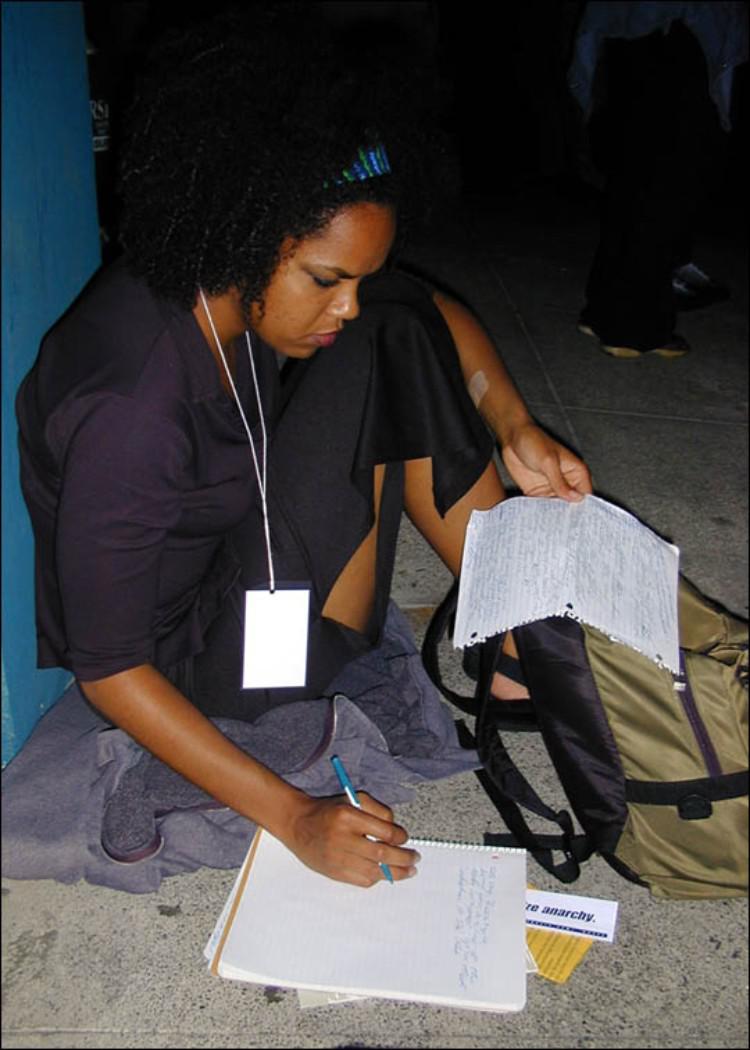
You can write in a journal, like Walida Imarisha in Figure 11-1, to help improve your poetry. Here are some subjects to use as journal topics:
Food
Finances
Writing ideas
Love
Beautiful and/or ugly things you’ve seen
A daily history of your own writing life
Reading/music/art you encounter each day
Weather
Descriptions of people you see
Subway, bus, car, or other trips (for example, writing about the same bus trip you take every day)
Pleasures and/or pains you’ve experienced
Mail (sent, received, snail-mail, e-mail, imaginary mail, other people’s mail)
Answering machine messages/telephone calls
The body
Dangers
[Exercise contributed by Bernadette Mayer]
|
|
© David Huang

Dedicate a journal to one subject alone (for example, many poets keep dream journals, recording images and events in their dreams), or mix it up.
Discovering Your Own Poetry
Poets need to be objective, to see their poems from outside of themselves. To find out more about what you do in your poems, make some analytical lists. Look for patterns and habits, and think about ways to break out of them or vary them. Try sitting down with your poems and listing the following:
The colors that appear directly or in hints. Compare this list to the colors you never use, and look for patterns.
The body parts mentioned in your poems. See if you put an emphasis on one part of the body (if you do, it is usually the face or the head).
Plants or flowers (which can be tied to the colors you use). Again, look for patterns.
Animals. Are the animals you discuss in your poems rare in your life (such as tigers) or common (such as dogs)? Are they usually alive or usually dead? Are there preferences you hadn’t noticed before (insects over mammals, for instance)?
[Exercise contributed by Daniel J. Langton]
Underline every noun in your poems. Then underline every adjective. Is there a pattern in the nouns or adjectives you use? Many beginning poets have an adjective describing every noun. Is this the case in your poems? Does the last word of each line turn out to be a monosyllable? Beginning poets attempting rhyme tend to have this pattern as well. Find ways to avoid or vary any pattern or habit that resembles a “rut” or has no poetic reason for existing.
Using Description in Your Poetry
This exercise helps you focus on description. Select an object outside — a building, statue, street sign, or billboard, for example — that you pass frequently. Then describe it in the following different ways:
Describe it in such a way that others hearing your brief account are able to draw it (an exact visual take).
Describe it using point of view, first from far away, then from up close.
Describe its relation to the landscape.
Describe how it changes over time, with shifts in the weather, and at different times of day.
[Exercise contributed by Brighde Mullins]
You can also try looking in a mirror and describing what you see, without using the word I or any adjectives. Concentrate on nouns, verbs, and comparisons.
Generating Material with Divergent Thinking
Poets find new words for new ideas and new attitudes toward their experiences — and that takes divergent thinking. Here are some exercises that encourage you to think in unaccustomed ways and create new material for poetry.
Finding your own way of writing
Reading aloud from a text that is full of rich description can be a great help to your own writing. The best texts for this purpose are often travel or nature writings. Take five to seven minutes to write down words, phrases, and sentences that really strike you. Steal freely. You’re gathering material to write with.
Now write a poem out of those words. Repeat, delete, or change the order of the words you’ve harvested as you please — but don’t add anything that was not in your original list. Invent a title for the poem in your own words.
This exercise helps you see that your way of writing is exactly that — a way of your own. You don’t even need a subject matter to write. When you have words, you can have your way with them. Your way is how you move through language and manipulate it — it’s your signature. Understanding that can open a lot of doors.
[Exercise contributed by Eileen Myles]
Experimenting with different forms
Get out your trusty book of poetic forms. Now write a poem in a different form each day for 30 days, following the order as they’re covered in the book, moving from A to Z. Think of this exercise as your very own short course in poetic technique!
Working with various topics
Choose a topic, and write an essay in which you get your ideas about that topic as clear as possible. Keep the essay to one paragraph. Then turn that block of prose into a poem.
Rewriting well-known texts
Try selecting a well-known text, such as “The Pledge of Allegiance,” and substituting each word in it with the word seven entries down in your dictionary. So the line
I pledge allegiance to the flag
might become
Iamb Pleiades allegretto toady theater of war flagellate

With exercises like these, which produce chance poetry, the idea is to get your invention flowing and create new resources. Nothing obliges you to use any of what’s generated. But if something intrigues you, build on it, explore, see where it leads.
[Exercise contributed by Bernadette Mayer]
Pulling from a grab-bag of ideas
Here’s a grab-bag of poem ideas to try. Write a poem:
Made up entirely of the first or last lines of famous poems.
Of 26 words, in which each word begins with a letter of the alphabet. (You can also scramble the order.)
In which all the words in each line start with the same letter. This can be combined with the preceding idea.
Consisting entirely of overheard conversation.
That does not mention any objects.
That contains everything you hear or that happens to you over the course of a limited amount of time (for example, 15 minutes, 1 hour, 1 day).
Composed of everything on your answering machine or voice mail over the past week.
Composed entirely of excuses. Make the excuses relate to things you wouldn’t make excuses for: “I’m sorry my nose is in the front of my head, but you see, I ___________.”
[Exercise contributed by Charles Bernstein and Bernadette Mayer]
Using techniques of chance and collage to compose poetry
This exercise is called variously “Tzara’s Hat” (named after the Dada poet Tristan Tzara, who invented it) or “Exquisite Corpse.” Cut words out of newspapers or magazines and throw them into a hat. Fish out the first 20 and arrange them — in the order in which you fished them out — into a poem:
Health bullets vulnerable next covering for statistics
On hockey licensed victims’ LaBella proportion stops
Cuba hits dead
Propelled family anything
Write a response in the same number of lines, words, or syllables. One possibility is to reverse the words and phrases, either verbally or in some conceptual way:
Malaria wounds are invincible, the last opening; five myths
Off the unauthorized criminals of baseball. ElFeo promotes lopsided
Florida, gets smacked by the inhibited corpses
Of vacuum orphans.
The point of collage exercises (like the preceding one) is to create combinations of words, phrases, and sentences that may generate new material for your poetry. Use some of what you generate, all of it, or none of it. Or, if something gives you an idea, start writing.
Mistranslating from other languages
Mistranslation is a technique pioneered by, among other groups, the Teacher’s and Writer’s Collective in New York. A similar exercise also appears in The Oulipo Compendium, edited by Harry Mathews.
Select a poem in a foreign language, one you can pronounce but not necessarily understand, and approximate the sound of the poem in English words (so, for example, the French word blanc becomes blank in English, and toute becomes toot). Here’s an example of a poem to start with (Alfred De Vigny’s “Les Destinées”):
Le moule de la vie étair creusé par nous.
Toutes les passions y répandaient leur lave,
Et les événements venaient s’y fondre tous.
You could use this poem to create a new one:
Lame-mule day. Larva eat air. Cruise, ape. Our new
Toot lay passion? Sí. Hear a panda on Lou. Laugh!
Hey! Lazy venom! Aunt Vinny! Aunt Ziff! Auntie Ray, too.
Rewrite it to suit your own style.
Try picking a book at random and using its title as the key phrase for an acrostic, going letter-by-letter down the left edge of the page. For each letter in this key phrase, go to the corresponding page number in the book. (A = page 1, B = page 2, and so on), and copy the first line or sentence on that page as the first line of the poem. Continue through all the letters in the key, leaving stanza breaks to mark each new key word. Variations include
Using the author’s name rather than the book title.
Using a friend’s name — or your own.
Using a different book for each letter or word in the acrostic key.
[Exercise contributed by Charles Bernstein]
Thinking about your life’s transitions
Take 15 or 20 minutes to write about some transition time you’ve experienced today. That may include
Your commute from work to school.
Getting from your house to the bus stop.
Driving.
Waiting in a train station.
Choose a particular moment in your chosen transit — it can be as short as the time it takes a traffic light to change. Reflect on it. Warp the speed at which it took place. Then elongate that moment into the length of a poem or paragraph.
[Exercise contributed by Kelly Holt]
Getting ideas by taking a walk
Take a walk and make a poem out of it. Walk 14 blocks and write a line for each block — a walking sonnet. Or write one poem per mile. Take notes and create a poem. Write down all the text you observe on a walk (street signs, shop names, billboards, advertisements on buses, and so on), and write a poem using only that material.
[Exercise contributed by Charles Bernstein and Bernadette Mayer]
Using language from one subject to write about another
Try using language from one subject area to write about another subject that is very much unrelated to it. For example, use science terms to write about childhood, or philosophic language to describe a shirt.
[Exercise contributed by Bernadette Mayer]
Revising Your Poetry
You may wonder why we include exercises for revision in a chapter on writing, but revision is one of the most important aspects of creation. So getting some practice with it — and seeing revision from several possibly unexpected angles — is a good idea.
Hiding half of your poem from sight
Take one of your poems and fold it in half horizontally, so you can see the top half of the poem but not the bottom half. Rewrite the half you can’t see — without looking at the original. Compare the original to your revision. Which one is shorter, more compressed? If the new half is better, keep it. You can also pick and choose between the virtues of the two versions. As a variation, fold the poem vertically, and rewrite the left or right half.
[Exercise contributed by Maxine Chernoff]
Reworking poems you don’t like
Select one of your poems that you’re dissatisfied with. Read it through. Now put it away. Try to write the same poem again without referring to the older version. You often get a new and better poem this way.
[Exercise contributed by Maxine Chernoff]
If you’ve written a poem, but you don’t know what to do with it to revise it and make it better, take your first or second draft and put it into three or four different poetic forms:
Turn it into a block of prose.
If you’ve used short lines, reformat them into longer lines.
If you’ve used long lines, reformat them into shorter lines.
Reformat the piece into stanzas of two lines or three lines.
Rewrite the poem in an extremely constricting form, such as a sonnet.
The point of this exercise is to look at the poem in another way. How does each reformation change the poem? What does it add or take away? Which of the forms works best, and why? What new ideas do you get from seeing the poem anew?
[Exercise contributed by Kelly Holt]
Collaborating with Other Writers
Experiment with collaborative writing with a group of other writers. (These exercises also make good party games when poets get together.) Here are some examples:
Keep a public journal, posted on either a common message board on the Web or a paper pinned up in a common room. Everyone can write his own contributions daily. As a variation, each contributor makes an entry, but leaves it somehow incomplete (writing only half a phrase, leaving a word out, or asking a question). The next contributor must finish the incomplete entry and write a new incomplete entry. Or two writers can alternate days to write in the journal.
Have 14 poets each write one line of iambic pentameter (without consulting one another). Collect the lines, throw them into a hat, and select the lines at random. Voila! A collaborative sonnet. Try different arrangements of the lines.
Write a verse novel together. Make up an incomplete story with three characters with names and descriptions, plus a situation, such as a kidnapping or some other mystery — but don’t establish complications or resolutions. Now, each writer writes a “chapter” of no more than 30 lines, employing all the characters, in whatever form she wishes. Collect and order the chapters, read the novel, then have each person write a “final chapter” of 30 lines. Collect, read, select, and combine.
Have everyone write on the same topic and then choose bits from everyone’s poetry and combine them into one big poem.
Have one poet write a poem, printing it out with extra space between each line. The other poets now write lines in the blank spaces.
Have one poet write a poem. Then the other poets reverse the poem (writing the opposite of the words and statements found in the poem) or rephrase the poem using different or outlandish language (get out that thesaurus!).
Have one person write an incomplete poem, leaving holes that other writers must fill in. As a variation, have someone select a poem and write it out — leaving out three or four words per line. Indicate the part of speech of each missing word. The other poets in the group have to come up with words to fill the blanks. Read the new version aloud.
Have one poet bring in material from dreams and the others write poems in response.
Take a long walk with a group of other poets. Everyone takes notes and makes the notes into poems. Mix and match, toss into “Tzara’s Hat,” or play other collaborative games.
[Exercise contributed by Charles Bernstein and Bernadette Mayer]
These exercises are a tour of the many aspects of the poet’s art. Moving through them will challenge various aspects of your talent, and perhaps help you identify your strengths and areas where you can improve. They’re also enjoyable in and of themselves — writing poetry is one way you can mix work and pleasure.