
Part II
In this part . . .
Here we take a look at poetry’s history and heritage. Putting on our running shoes, we sprint through the 5,000 years of recorded poetry — taking you with us every step of the way. En route we discuss some of the most important movements and poets during each period and around the world. Our time travel ends in the 20th century with a discussion of ten important Modernist poets, as well as a glimpse at some of the movements that made this the Century of Poetry.
Chapter 6
In This Chapter
 Identifying the different periods of poetry
Knowing the great poets from each period
Figuring out where to find great poetry from every era
In this chapter and the next, we tell the story of 5,000 years of poetry in about 7,000 words. In this chapter, we take on the first 4,700 years — a tough job, so we have to move fast. But we at least want to give you the general idea of where poetry has been and where it’s going. We divided the past 5,000 years into 11 periods of poetry — somewhat of an arbitrary division, but one that helps explain where poetry has been and where it’s going. We define each period and recommend some of the finest poets of each era.
Your assignment, should you choose to accept it: Pick one poet or poem mentioned in each era — and read! These writers were speaking to their own times, but they all have something to say to you today.
The Pre-Homeric Period (3,000 B.C.– 1,000 B.C.)
Some scholars say the oldest poetry was sung. Some think it grew out of religious rituals. Still others think it grew out of the work life. Whatever its source, poetry bore a close connection with music, an imprint it still bears today.

If you’re interested in reading poetry from the Pre-Homeric Period, check out the following:
 Ancient Egyptian Poetry and Prose, edited by Adolf Erman, translated by Aylward M. Blackman
Gilgamesh: A New Rendering in English Verse, translated by David Ferry
Gilgamesh: A Verse Narrative, translated by Herbert Mason
Mesopotamian poetry
The earliest poetry we know of comes from around 5,000 years ago, from the Mesopotamian culture. The Mesopotamian people are the ones who invented cities, the wheel, the circular clock, and writing. They developed the cuneiform script, triangular indentations made in rolls of clay. Only in the last 150 years or so did we discover and learn to translate this poetry, which concerns mostly the gods and myths of the Mesopotamian people. These poems were probably already ancient when they were set down in writing, so you are seeing even further into the past than 3,000 B.C.
Mesopotamian poetry apparently was meant to be sung to a harp or a lyre. The earliest poet for whom we have a name is Enheduanna, high priestess of Nanna, the moon goddess of Mesopotamian religion. Enheduanna was a powerful, astonishing poet. Reading her words is exciting because they are the earliest we can trace (so far!) to a person with a name.
Here is a passage in which Enheduanna praises the daughter of Ishtar:

You are lofty like Heaven. Let the world know!
You are wide like the earth. Let the world know!
You devastate the rebellious land. Let the world know!
You roar over the land. Let the world know!
Listen for the songlike qualities — the repetitions (“You are . . . You are . . . You . . . You . . .”), the parallelisms (thoughts expressed in the same grammatical form, as “You are lofty . . .,” “You are wide . . .,” “You devastate . . .,” and “You roar . . .”), the refrain (“Let the world know!”). Such clues suggest that this poetry may have been sung by bards or choirs.
The Greats: Gilgamesh is a series of epic tales about a real-life king who founds the city of Uruk. The two most famous episodes of this first of all epics concern Gilgamesh’s descent into the underworld, in search of his dead friend Enkidu, and an episode in which the world is covered by a flood.
Egyptian poetry
The poets of ancient Egypt kept going for a long time. Their poetry (3100–30 B.C.) spans about three millennia, and it comes in many forms. It covers myths and gods and adds something new: personal poetry about attraction and courtship. Egyptian poetry is full of playful, flirtatious, desirous speakers longing for the objects of their affections, as in the following example:
Only one, matchless sister,
Prettier than anyone —
Look: like the Star-Girl rising
To begin a blessed year.
Walks in the glow of her skin.
Lovely eyes she looks through;
Lovely lips she speaks with
And not a word too much.
Long neck, glowing
Nipple, sapphire hair,
Arms honey-gold;
Her fingers, lotus blossoms;
Firm midriff, dulcet bottom,
Her legs a book of her beauty;
Walks earth with pretty step
And her hug snares my heart.
Men turn their necks away,
Dazzled with her countenance.
Man who clasps her, happy
As the richest, readiest boy.
Watch her: she’s going somewhere
Like a goddess, the Only One.
The Greats: The Book of the Dead, a profound meditation on death and what happens afterward. Also the astonishing Hymn to the Sun by King Amenhotep IV.
The beginnings of poetry in India
Around 1,500 B.C., Sanskrit-writing scribes in what is now called India began to set down the Vedas, epic religious hymns concerning the deities and religious ideas of the Aryans, a tribe that invaded the Indian subcontinent around 2,000 B.C. These epics were called Vedas, from the word veda,meaning “knowledge.” Over almost 1,000 years, a series of Vedas grew that became the great foundation of both Hinduism and the Buddhist tradition.

Mouth-to-mouth poetification
How did poetry get passed along before there was writing? By the human memory and the human voice. Folklorists and anthropologists call this process oral transmission. Poetic history is full of incredible feats of memory. The Mahabharata, the sacred epic of India, is perhaps the longest poem ever, yet it was not published until the 19th century, some 3,500 years after its composition! Millions of people simply remembered all or parts of it. To qualify for the position of scribe to some of the potentates of India, you had to be able to recite thousands of lines from the ancient Vedas by memory. Many scholars believe that several of the world’s great epic poems — including The Iliad and The Odyssey by Homer, The Song of Roland (the French national epic), and The Poem of the Cid (the Spanish national epic) — were originally orally composed and passed along.
In the 19th century, two scholars heroically rescued orally-transmitted epics from oblivion. The Serbian epic known as The Battle of Kosovo memorializes a terrible battle on the Field of Blackbirds in 1389, when the Turks overwhelmed the Serbs. Thanks to Vuk Stefanovic Karadzic, who collected scraps and shards of the epic by interviewing monks, shepherds, and traditional singers known as guslari, the epic cycle was collected and published. The Finnish doctor and poet Elias Lönnrot roamed throughout Finland for 20 years, collecting remembered scraps of Finnish epic and lyric poetry, which he finally published as the Kalevala (1849).
There’s still a lot of orally transmitted poetry in Asia, Africa, and elsewhere — even though some of it is printed, rap music is essentially an oral form. (And don’t forget American Cowboy poetry, much of the earliest of which was sung on the range.) In the early 20th century, scholars discovered Balkan shepherds who were able to recite thousands of lines of poetry from memory while they tended their sheep — a clue to the way The Odyssey and much other great poetry survived the ages.
Here are a few lines from the Vedic account of creation:
There were no things;
There was no nothing;
There was no atmosphere
Nor the heavens beyond the air.
What was concealed?
Where was it hidden?
Who guarded it?
Was it hidden beneath the waters?
Was it the unfathomable deep?
The last and latest parts of the Vedas are called the Aranyaka and the Upanishads. Together, they are known as the Vedanta (“the end of the Veda”). The Vedas are the beginning and the bedrock of all Indian poetry.
Alongside the Vedas and probably just as old is the Mahabharata. The tales and precepts in this poem are the basis for Hinduism This vast epic concerns a war between the Kurus (forces of good) and the Pandus (forces of evil). (Yes, they’re relatives.) All Indians know stories from the Mahabharata. It contains tales of the most familiar figures in ancient Indian mythology, including the god Vishnu, the creator/destroyer Shiva, and the hero Rama. Within this mega-epic are two super-epics:
Bhagavad-Gita (Song of the Blessed One):Its main figures are the hero-warrior Arjuna and his chariot-driver, who is really the god Krishna. (Make sure you tip that man!)
Ramayana:This epic tells the story of Rama, his wife Sita, and their battles against the forces of evil.
Sanskrit became the basis of Indian literature, philosophy, law, and culture. Poetry in Sanskrit was written for 2,500 years. Much poetry in Sanskrit is philosophical and scholarly, but there is some luscious love poetry as well and a strong tradition of poetry by women.
The Biblical/Homeric Period (1,000 B.C.–400 B.C.)
The poetry from the Biblical/Homeric Period is well-known around the world — but you may not have ever thought of it as poetry before. Read on to find out more.
If you’re interested in reading more poetry from this era, check out the following books.
The authorized King James Bible is the traditional source for the poetry of the Old Testament. Try to find an edition that renders the poetry in lines.
The Bhagavad-Gita, translated by Juan Mascaró.
The Iliad, by Homer, translated by Robert Fagles.
The Odyssey, by Homer, translated by Robert Fagles.
The Psalms, translated by Nicholas de Lange and edited by Peter Levi.
Biblical poetry
Poetry from this period, comprising maybe the best-known of all ancient poetry, makes up a good part of the Old Testament. This rich poetic culture was at its height for 600 years (1000–400 B.C.).
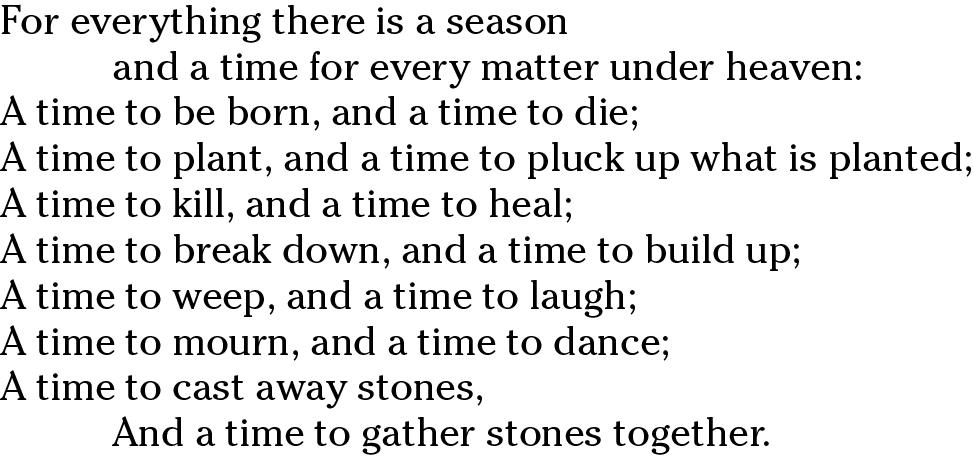
Most English-speaking people know the Psalms from the King James Bible. Here is a passage from the book called Ecclesiastes (3:1–5) or Koheleth.
So that’s where that song came from. . . .
Notice the sober grandeur, balance, and clarity of this passage. The grandeur comes through in the sweeping vision of so much of human life; you can feel the balance as the poet works with pairs of opposites (birth/death, planting/ harvesting, killing/healing, and so on). And the clarity comes through in the simple, straightforward language. That’s why so many readers have felt this passage resonates with truthfulness.
The Greats: Great philosophic poetry (in Ecclesiastes), religious tales (the Book of Job), prophetic books (Isaiah, Amos, Micah, and others), and beautiful erotic poetry (known as the Song of Songs or the Song of Solomon) are excellent examples of biblical poetry. The authorized King James Bible is the traditional source for the poetry of the Old Testament.
Homeric poetry
The word Homeric refers to Homer, traditionally supposed to be the author of The Iliad and The Odyssey. These two epic poems have been translated extremely well several times — never better than in the last 20 years — and they’re works you should definitely add to your must-read list.
The Iliad is the story of the Trojan War. The Trojans and Greeks fight for nine years, until the episode of the Trojan horse, through which Troy is invaded and destroyed. The Odyssey (which has been called the best story of all time) tells of the postwar wanderings of Odysseus. He has a series of adventures with an unforgettable gallery of gods and magical beings. Meanwhile, his faithful wife, Penelope, waits for him at home on the island of Ithaca. You may prefer reading these works in school with the help of an instructor; or you may just want to look for a good translation and start reading yourself.
The Iliad is not just a war story. Each battle scene, each death is singular, with a pathos all its own — as in this one, in which an unlucky young soldier is felled by Agamemnon:
Then wide-ruling Agamemnon ripped the spear
From his hands, wrenched it away, wild as a lion,
Struck the boy on the neck with his sword,
Relaxed his limbs. So he fell there, slept a bronze sleep,
Unlucky boy, far from his wedded wife
Who helped the townspeople so, far from her
Of whom he’d had no joy yet. Yet
For her sake he had given up much.
In a few lines, you get a young man’s life in the moment of his death.
The beginnings of Chinese poetry
Chinese history has been dominated by a series of dynasties, in which a single family has provided a line of rulers. The Zhou Dynasty (1066–256 B.C.) saw the first emergence of literature and culture in China. The first important anthologies of Chinese verse were in circulation around 500 B.C.China’s first great poet, Ch’ü Yüan, emerged at this time. Tradition has it that he wrote Nine Classic Songs and the lovely lament Li Sao (Falling into Trouble).
During what’s known as the Eastern Zhou (770–256 B.C.), two great religious leaders/philosophers/poets emerged. The first was Lao Tzu (his name means “Old Master”), reputed founder of Taoism. The book known as the Tao Te Ching or The Way of the Tao is associated with him, although it may well be an anthology. Many of its compressed, poetic sayings resonate in the mind:
Rule a large nation
As you’d cook a small fish
You have to guess what he means. One good guess: Rulers should rule gently, with care, and not overdo it.
Confucius (Chinese name: K’ung Fu-tse) lived from 551 to 479 B.C. and became an important teacher, administrator, and jurist. He was also crucial for the history of Chinese poetry, because he collected and edited much of the ancient Chinese writings.
The Classical Period (750 B.C.– A.D. 476)
The term classical usually refers to the highpoints of Greek and Latin poetry. The story of these two great languages and cultures makes up a golden millennium in recorded history.
Check out the following books to read more from this period:
7 Greeks, translated by Guy Davenport
The Aeneid, by Virgil, translated by Robert Fitzgerald
Archaic Greek Poetry: An Anthology, translated by Barbara Hughes Fowler
The Erotic Poems, by Ovid, translated by Peter Green
The Essential Horace: Odes, Epodes, Satires, and Epistles, translated by Burton Raffel
Metamorphoses, by Ovid, translated by Rolfe Humphries
The Nature of Things, by Lucretius, translated by Frank O. Copley
The Poems of Catullus, translated by Peter Whigham
Sappho: A New Version, translated and with an introduction by Willis Barnstone.
Seven Famous Greek Plays, edited by Whitney J. Oates and Eugene O’Neill, Jr.
Greek poetry
Classical Greek poetry is a treasure-trove of good things. Many readers feel that the Greek poets, among the first poets in Western European history, set a standard for creativity and excellence that has yet to be equaled.
Lyric poets
The Greek lyric poets flourished for eight centuries. One of the earliest and best is Sappho, who lived around 600 B.C. Almost all that remains to us are fragments — bits of her poems quoted by later writers. In those fragments, we hear a fresh, direct, and almost contemporary voice.
Here, Sappho tells a woman she’s in love with that she envies the man sitting next to her:
He is more than a hero
He is a god in my eyes —
the man who is allowed
to sit beside you — he
who listens intimately
to the sweet murmur of
your voice, the enticing
laughter that makes my own
heart beat fast. If I meet
you suddenly, I can’t
speak — my tongue is broken;
a thin flame runs under
my skin; seeing nothing,
hearing only my own ears
drumming, I drip with sweat;
trembling shakes my body
and I turn paler than
dry grass. At such times
death isn’t far from me
Magic, isn’t it, to hear such a strong voice from 2,600 years ago?
The Greats: In addition to Sappho, other luminous lyric poets of this period include Anacreon, Pindar, Theocritus, Callimachus, and many others.
Dramatists
The Greek dramatists wrote their plays in verse so powerful that the plays of Sophocles (Oedipus Rex; Antigone; The Trojan Women), Aeschylus (The Oresteia Trilogy), Euripides (The Bacchae; Medea), and Aristophanes (Lysistrata; The Frogs) are still being produced today. If you ever have the opportunity to see any of these plays performed, take advantage of it.
Latin poetry
One of the towering presences in classical Latin poetry is Virgil, who wrote The Aeneid (very much a Roman version of The Odyssey), as well as philosophical poems about farming (the Georgics) and herding sheep (the Eclogues). Many fine translations of The Aeneid exist.
Another great epic poet is Lucretius, who wrote On the Nature of Things, a wild and wildly beautiful philosophical poem that seeks to explain everything from the gods to vision to human history.
Latin, unlike Greek, was not a language naturally given to beauty or delicacy. It was given to sentences like “the farmer and his wife have bought the horses” or “the walls of the city soon were destroyed by Caesar’s brave men.”

Yet Latin lyric poetry is a wonderful thing. Three poets in particular are worth your attention:
Catullus: He wrote poetry to his beloved Lesbia.
Horace: Horace was perhaps the greatest of all Latin lyricists and wrote a wide range of philosophical, erotic, and descriptive poetry.
Ovid: His Metamorphoses tries to explain the universe as a place of endless transformations. Ovid’s erotic poetry (the Amores, the Book of Love, and others) is some of the best out there, in our humble opinion.
The poetry of India
The Gupta Empire (A.D. 322–550) is sometimes called the “Golden Age of India.” It spread across northern India and involved a revival of Hinduism and the establishment of standards for literature and art. Among the most famous poets of this era is Kalidasa, who wrote plays and poems still performed today.
Dark and Golden Ages (A.D. 476–1000)
The Roman Empire began to crumble a few centuries into the Christian era, and the Goths, Visigoths, Ostrogoths, Lombards, and everyone else except the Green Bay Packers overran the Romans, leading to a period known as the Dark Ages in Europe. Much good poetry was written in this era; in Europe, most of that poetry was in Latin. The era was anything but dark, however, for poetry in the Middle East and Asia. This period witnessed golden ages in Japanese and Chinese verse, as well as a poetic Renaissance in Arabic verse.
If you’re interested in reading more poetry from the Dark Ages and Golden Ages, check out any of the following:
Beowulf, translated by Seamus Heaney
Beowulf and Other Old English Poems, translated by Constance B. Hieatt
Ten Thousand Leaves: Love Poems from the Manyoshu, translated by Harold Wright
Three Chinese Poets: Translations of Poems by Wang Wei, Li Bai, and Du Fu, translated by Vikram Seth
Classical Arabic Poetry, translated by Charles Greville Tuetey
The Manyoshu and Japanese poetry
Japan saw two great ages of poetry and two great anthologies: the Manyoshu, which includes the work of Kakinomoto Hitomaro and Yamanoe Okura, and the Kokinshu, which includes the work of Ono no Komachi — one of the best female poets in history — and Ariwara Narihira.
The Manyoshu contains some of the finest love poetry in history. It’s also a wonderful document of a thriving poetic culture. Schools of verse arose. Poetic competitions, something like the contemporary slams (see Chapter 12 for more information), were established, complete with prizes and revered poets as judges. Groups of poets wrote cycles of poetry together, including the playful tanka chain, an intricate braid of poems in which poets responded to one another’s work. In this era, the long Japanese tradition of poetry by women reached the first of many high points.
This anonymous poem from the Manyoshu, written in the voice of a mother whose son is going on a journey, gives some idea of the delicate depth of Japanese poetry of this period:
If snow falls on the far field
where travelers
spend the night,
I ask you, cranes,
to warm my child in your wings.
The Manyoshu is still widely considered to be the apex of classical Japanese verse.
Arabic poetry
Arabic poetry was vital even before the advent of Islam. Around A.D. 550, Imr El-Qais, “The Wandering King,” wrote his influential odes in the anthology Mu’allaqah (Necklace-Beads). Here are a few lines of his, from “The Great Ode,” one of the earliest and most famous of all Arabic poems. The speaker, torn with love for a woman, watches her pack up to leave and realizes it’s hopeless:
Here was the place I watched her Load her camels for going. Here, by thorn trees Was I stung, tears as bitter as colocynth.
Two friends waited, already swaying on camelback.
Man — they called to me — don’t let this grief kill you.
Better to bear with patience what pain may come.
Colocynth is a bitter fruit with an appearance somewhat like watermelon. It’s used as a purgative.
With the establishment of Islam, Arabic became a transnational language of poetry, law, religion, and culture from the Middle East to Asia. Muhammad (A.D. 570–632) was the prophet and founder of Islam. The holy book of Islam, the Koran, is filled with sacred poetry. It is the basis for much Islamic law and life.
The golden age for classical Arabic poetry spanned 600 years (A.D. 600 to 1200). At its height, it was being written from Spain to India. The great poets’ verses have become sayings and idioms far and wide. The written poem is often considered an artwork in and of itself. Many are the verses of intense desire, the desert landscapes, the laments for great kings and fallen warriors.
Two great poets of the early Islamic era are Umar Ibn Abi Rabiah and Al-Khansa, the major female poet in classical Arabic. During the dynasty of the Ummayad caliphs in Damascus, Syria (A.D. 661–750), Arabic poetry reached new heights; during this period, the ghazal (pronounced guzzle) was introduced. This playful, sensuous verse form, excellent for love poetry and mystical poetry, spread throughout the Middle East and Asia, and today it is practiced all over the world.
During the dynasty of the Abbasids, centered in Baghdad (A.D. 750–1055), Arab poets encountered the influences of Greek, Roman, and Persian poetry. Great poets included Al-Mutanabbi and the Syrian poet Abû-l-`Alâ’ al-Ma’arrî. One of the great poets of the “golden age” of Arabic verse was Muhammad ibn Ghalib al-Rusafi (who died in 1177), still one of the most popular of all poets in the Arab world. Ghalib was a master of the ghazal.
Po’ Li Po
The famous Chinese T’ang poet Li Po (A.D. 701– 762) lived a life of carefree wandering and spontaneity. He was said to embody the Taoist and Zen ideal of wu-wei (literally, “doing nothing”). A self-proclaimed kinsman of imperial princes, he was at one time appointed as a court poet to the emperor, but he lost his position because of his wild, drunken behavior. Yet he wrote surprisingly insightful, highly imaginative poems during his drunken bouts. He wrote often of longing and nature: The moon appears in over a third of his poems. As irony and (some might say) poetic justice would have it, Li Po drowned one evening when he fell out of a boat. He was trying to embrace the moon.
China: The T’ang Dynasty
The T’ang Dynasty (A.D. 618–907) was the setting for what’s known as the “golden age” of Chinese poetry. Tu Fu is one the best-known poets in the world, as are Li Po, Wang Wei, Po Chü-i, and Li Ho. The emperor Xuan Zong was a great patron of poets.
Other fine poetry was written in the Han, Sung, and Ming dynasties.
Old English
What people now refer to as Old English (also known as Anglo-Saxon) first appeared in anonymous stone inscriptions from around the 600s. Most of this poetry is anonymous.
Beowulf, an epic, is one of the finest poems you can find. It tells the tale of a warrior, Beowulf, and his showdowns with a series of monsters. The most famous of these is Grendel, who has the bad luck to get into Beowulf’s clutches. Old English verse was alliterative, that is, it was based on repetition of initial consonant sounds. Here, the first two half-lines repeat the initial s sound, the second line has two m sounds in it, and so forth.
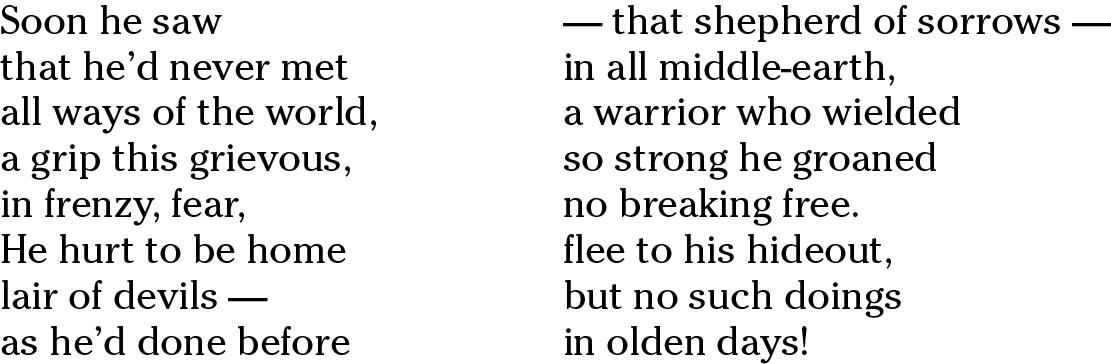
The period also produced shorter poems, such as “Caedmon’s Hymn,” “The Battle of Maldon,” “The Wife’s Lament,” “The Wanderer,” and “The Dream of the Rood.” The riddle was another favorite form for Old English poets.
The Middle Ages (1000–1450)
The Middle Ages was dominated, in Europe, by the Catholic Church and its official language, Latin. Yet it was during this period that European poets began to write extensively in their native languages. The modern European languages all had their beginning (as literary languages, anyway) during this time.
French got up and running with the epic battle poem The Song of Roland. German produced both courtly love poetry and chivalric romances such as Parzifal and Tristan und Isolde.
Courtly love poetry concerned personal love and was written by and for people belonging to the courts of kings and nobles. Some scholars believe that the love poetry of the 12th century — especially that of the Provençal poets, such as Bertran de Born and Arnaut Daniel — may have helped create our very concept of love as it is now known and practiced.
The chivalric romances were tales of knights and their kings and damsels. They spread throughout all the languages of Europe, and they gave us the tales of King Arthur and the Round Table.
Italian had a true golden age, with the lyric poetry of Petrarch. And perhaps the finest poet of the age, Dante, wrote The Divine Comedy. In this epic religious poem, the speaker finds his way into a guided tour through Hell, Purgatory, and Paradise:
In the midst of the road of our lives,
I found myself on a darkened path
With the right way lost.
Ah! It is so hard to say how savage
And bitter and rough that road was
That as I think of it, the fear returns.
In English, Geoffrey Chaucer wrote The Canterbury Tales and Troilus and Criseyde.
In the Middle East, this era was the highpoint of Arabic and Persian poetry, including the work of Omar Khayyam, Rumi, and Hafez in Persian, and Ghalib in Arabic verse.
A special word on the The Rubaiyat of Omar Khayyam. Its English translation by the Victorian writer Edward FitzGerald contains four lines that are among the most famous in English:
A Book of Verses underneath the Bough,
A Jug of Wine, a Loaf of Bread — and Thou
Beside me singing in the Wilderness —
O, Wilderness were Paradise enow!
FitzGerald’s translation started a wave of new interest in Persian verse — a wave still flowing today.
In China, the Sung Dynasty (960–1280) ushered in a great era of innovation in forms and styles. One of the finest of Sung poets is Hsin Ch’i-chi.
In Japan, one of the masterpieces of world literature, Monogatari or Tales of Genji, was written by Lady Murasaki Shikibu. Not only is Tales of Genji one of the earliest novels in history — but also it included a great deal of influential poetry. Genji inspired the long tradition of occasional journals — in both prose and poetry — kept by women. As a craze, it lasted for 200 years, but the poetic journal is still practiced today.
Another great anthology of Japanese verse, the Shin Kokinshu, appeared in 1265. In the 1300s, the great dramatic tradition of the Noh play began.
The Greats: The Song of Roland; The Poem of the Cid; the Nibelung cycle; Tristan und Isolde; Parzifal; Bertran de Born, Arnaut Daniel, Walther von der Vogelweide, Giovanni Boccaccio; Francesco Petrarca; Dante; Geoffrey Chaucer, Omar Khayyam, Rumi, Hafez, and Ghalib.
If you want to read more from this era, turn to any of the following:
The Canterbury Tales, by Geoffrey Chaucer, translated by Nevill Coghill
The Inferno of Dante: A New Verse Translation, translated by Robert Pinsky
Lyrics of the Troubadours and Trouvères: An Anthology and a History, translated by Frederick Goldin
The Nibelungenlied, translated by A.T. Hatto
The Rubaiyat, by Omar Khayyam, translated by Edward FitzGerald
Selections from the Canzoniere and Other Works, by Francesco Petrarca, translated by Mark Musa
The Song of Roland, translated by Patricia Terry
The Tale of Genji, by Lady Murasaki Shikibu, translated by Arthur Waley
Tristan, by Gottfried von Strassburg, translated by A.T. Hatto
The Renaissance (1450–1674)
The Renaissance (French for “rebirth”) was a period of rebirth of interest in the Greek and Latin writers, and an explosion of knowledge in the arts and sciences. The Renaissance started in Italy, moved to France, and worked its way northward. In Italy, great epic poems emerged, as well as many fine lyric poets, including Michelangelo himself. In Spain, an incredible period of dramatic poetry, or plays in verse, started up in the 16th century. Lope de Vega is probably the best known poet from that period. The great French dramatic poems were written in the 17th century by Racine, Corneille, and Molière.
Here are some books worth consulting for a taste of the Renaissance:
Edmund Spenser’s Poetry, 3rd Edition, edited by Hugh Maclean and Ann Lake Prescott
Elizabethan Drama: Eight Plays, edited by John Gassner and William Green
English Renaissance Poetry: A Collection of Shorter Poems from Skelton to Jonson, edited by John Williams
Le Cid, by Pierre Corneille, translated by Vincent Cheng
Life Is a Dream and Other Spanish Classics, edited by Eric Bentley, translated by Roy Campbell
Phaedra: Tragedy in Five Acts, 1677, by Jean Racine, translated by Richard Wilbur
The Portable Milton, edited by Douglas Bush
The Riverside Shakespeare, 2nd Edition, edited by G. Blakemore Evans
The Sonnets, by William Shakespeare
Tartuffe: Comedy in Five Acts, 1669, by Molière, translated by Richard Wilbur
The English Renaissance
The English Renaissance brought the world such writers as Shakespeare and Sir Walter Raleigh, but at least 30 or 40 other first-rank poets were working in England as well, many of whom were very good playwrights, too. Dramatic, lyric, epic, and historical poetry all flourished. Many of the poetic forms we find most familiar today became firmly established among English poets. Blank verse (unrhymed iambic pentameter) was the form in which Shakespeare and many of his fellow dramatists wrote their plays. Ballad forms were used both in folk poetry and in the songs and madrigals so popular at the time. And the sonnet was an international craze; poets wrote tens of thousands of them in most of the major European languages.
The Greats: The Renaissance produced so many great poets that we can’t possibly list them all here. If you want to get a true feel for the Renaissance, read Shakespeare, as well as the poetry of Sir Philip Sidney, Edmund Spenser, John Donne, Ben Jonson, and George Herbert. The highpoint and end of the English Renaissance was John Milton’s Paradise Lost, a vast religious epic. You could fill a good-sized bookstore with the great dramatic poetry of the period. Try Christopher Marlowe’s Faust; Shakespeare’s Romeo and Juliet, Hamlet, or The Tempest; Ben Jonson’s Volpone; Pedro Calderón de la Barca’s Life Is a Dream; Pierre Corneille’s Le Cid; Jean Racine’s Phèdre; and Molière’s The Misanthrope. And even with all that, you’ve only just gotten started.
Renaissance poetry around the world
Across the Atlantic, people were writing poetry in the English colonies of North America, including Mistress Anne Bradstreet (1612–1672), who published her first book of forthright, charming poems in 1650. She thus became the first published “American poet.” In “A Letter to her Husband, absent upon Publick Employment,” she compares their union to that of turtle-doves or the fish called mullets:
Together at one Tree, oh let us brouze,
And like two Turtles roost within one house,
And like the Mullets in one River glide,
Let’s still remain but one, till death divide.
Bradstreet’s fresh directness — a way of turning the ordinary experience of household, family, and self into poetry — foretold the future of American verse. She began a line of American women poets that would include, among many others, Emily Dickinson and Sylvia Plath.
As for South America, before the Spanish and Portuguese conquerors overran the continent, immemorial poetic cultures already were in full flower. In what is now Guatemala, the Quiche Mayans compiled the Popul Vuh, an account of the history of the Mayans from the creation of the world to the year 1550. Defeat and genocide inspired some beautiful poems, including those of the 16th-century Mayan text known as Chilam Balam:
Before the conquerors came
there was no sin,
no sickness, no aches,
no fevers, no pox.
The foreigners stood
the world on its head,
made day become night.
There were no longer
any lucky days
after they came into our lands.
A great deal of Spanish American poetry meditates on the pre-Columbian, the mysteries and wisdoms of indigenous peoples. From Mexico to Brazil, the facts of a violent colonial past, along with the rainforest and the jungle, are still realities in poetry today.
This period was a crucial one for poetry in India. The Mughal Empire (1526–1857) not only spread Islam throughout the subcontinent but also introduced Arabic and Persian poetry, which had a huge impact on poetry in several languages.
Japanese poetry saw the birth of one of its greatest practitioners during this period. Matsuo Basho (1644–1694) became a recognized master of the form known as the haiku. He became a celebrated teacher and judge of poetry, and his poetic journals, interspersing prose commentary with wonderful haiku, remains a favorite throughout the world.
The 18th Century
The Renaissance’s span of 200 years encompassed rapid changes in the way poets in Europe thought and wrote. The 18th century was dominated by an intellectual movement known as the Enlightenment — so named because people were placing greater and greater confidence in the power of human reason to improve life and discover the truths of nature. As of 1700, the age of science and technology had just begun. The Industrial Revolution was ahead, as was the American Revolution, the world wars, the Internet age, and much else. Poetry benefited from all these developments, and poets developed new ways to express life in their changing circumstances.
Some readers think that, coming between the vastness of the Renaissance and the brilliance of the Romantic era, Enlightenment poetry is a disappointment. Not so! We like the stateliness and balance of the poetry of the Enlightenment.
Listen to these lovely couplets from Alexander Pope’s Essay on Criticism, a long poem on how to form judgments about poetry. He’s recommending that the first thing any poet (or critic of poets) should do is be awake to Nature:
First follow Nature, and your judgment frame
By her just standard, which is still the same;
Unerring Nature, still divinely bright,
One clear, unchanged, and universal light,
Life, force, and beauty must to all impart,
At once the source, and end, and test of art.
You can feel the Enlightenment’s quest for clarity and perfection in verse. The form here is rhymed couplets, very stately, very regular. Enlightenment poets shared the Englightenment faith that clear-sightedness and reason could lead to a new era of understanding. That’s the “universal light” provided here by Nature — it’s the truth itself. Both poets and scientists alike strove toward that light in this era.
In Japan, the haiku tradition was upheld by two of the very greatest of poets, Yosa Buson and Issa Kobayashi.
The Greats: In addition to the poets and poems already mentioned, the poetry of the Irishman Jonathan Swift (the same man who wrote Gulliver’s Travels), the poetry of Samuel Johnson, John Dryden, and Alexander Pope, and the satires of France’s Voltaire are all standouts of the Enlightenment.
For more poems from the Enlightenment, check out the following books:
The Norton Anthology of English Literature, Volume 1, edited by M.H. Abrams
The Essential Haiku: Versions of Basho, Buson, and Issa, translated by Robert Hass