
CHAPTER SEVEN
Whenas in silks my Julia goes,
Then, then (methinks) how sweetly flows
The liquefaction of her clothes
Next, when I cast mine eyes and see
That brave vibration each way free;
O how that glittering taketh me!
The seventeenth century English writer Robert Herrick clearly appreciated the special, and obviously rather sexy, qualities of silk. He was far from alone and the British, like other European nations, were enthusiastic buyers of the material. Silk was introduced into Britain in the Medieval period and was at once appropriated for the upper classes. Probably no one else could afford silk, but there were rich merchants who might have thought it appropriate to dress themselves and their families with the luxurious material. A Sumptuary Law of 1363 put a stop to that, specifying exactly who could and could not wear silk. It was totally forbidden for anyone under the rank of knight, and even knights were regulated. A knight worth 500 marks or more could wear what they liked. Those who couldn’t meet that standard were told that their wives could not wear silk veils, and the poorest were expressly forbidden from wearing purple silk. As in the Chinese court centuries before, silk was an indicator of rank and importance. There was one exception to the rules on who could wear silk in Elizabethan England; actors were permitted to dress in finery to portray the nobility on stage – but could not wear the same outside the theatre. We know that actors did indeed wear silk on stage. In his biography of Shakespeare, Will in the World, Stephen Greenblatt quotes the will of the actor Augustine Phillips in which among other bequests he left one of his apprentices his black taffeta suit. Shakespeare himself managed to purchase a coat of arms for his father, on the grounds that he was a man of independent means who had also held office as the bailiff of Stratford on Avon. Consequently, the playwright and actor could strut his stuff in whatever finery he had.
Silk production did take place in a very small way in England in the Middle Ages, mainly with the weaving of ribbons and small items, but even then it was considered necessary to protect the infant industry by means of a ban on silk imports in the fifteenth century. A similar edict against wearing silk was issued by James III of Scotland in 1472 on the grounds that the country could not afford to import such luxuries. Wearing of silks was again limited to knights worth £100 – though, curiously, silk could be worn by heralds and minstrels. There was also in Scotland opposition to silks from the stern clergy. The General Assembly of the Kirk in 1575 declared, ‘We think all kinds of broidering unseemly’. It wanted all the clergy and their wives to dress soberly. ‘Their whole habit be of grave colour as black, russet, and grey or sad brown.’ At this time, however, it seems there was no actual silk being manufactured in Scotland, but was all imported, mainly through the port of Leith.
The industry in England received a boost in the 1580s when war broke out between Spain and the Netherlands. Protestant Dutch weavers, fearing that the might of Spain might overwhelm their country and enforce conversion to Catholicism, moved to London. They settled in the Spitalfields area, originally Spittle Fields, named after the spittle or hospital of the priory of St. Mary’s Spittle, founded in 1197. It was developing as an industrial region outside the city walls, and therefore not subject to the City Laws and restrictions. The weavers soon established a familiar system, based on masters, journeymen and apprentices. The industry became officially recognised in 1628, when silk weavers were incorporated as a City Company. By 1680, the London Weavers’ Company had established control over all weaving in the capital and it grew and developed over the next fifty years to the point where it had almost 6,000 members. They were able to lay down strict rules, particularly on apprenticeship. The boy, and they were all males, had to serve a full seven years before qualifying as a journeyman, when he would be allowed to take on work in his own right from one of the masters.
An article on the Spitalfields weavers by Clare Browne details the work of a typical firm of mercers, Francis Rybot and Nicholas Jourdain, who had premises in Raven Row, close to the present Liverpool Street station. Rybot had a trade card describing himself as Weaver and Mercer who ‘makes and sells all sorts of rich brocaded silks’. It is unlikely that the partners would have actually woven the cloth themselves, but they would have employed a local pattern drawer to produce an appropriate design and then this would be passed to a master weaver specialising in that sort of cloth – for example he listed damasks and satins among the varieties on offer. They would have sold some of the material from their own shop ‘At the sign of The Cat’, while some would be sent to locations outside London.
In spite of a modest increase in local production, most silk cloth was imported, largely from France and Italy. James I felt that Britain could compete by developing its own silk worm farms. He ordered a large number of trees for a special Mulberry Garden, very close to the site now occupied by Buckingham Palace. It covered four acres and was tended by the King’s Mulberry Men. He also issued an edict that landowners should plant the trees at a rate of six shillings per thousand trees. Unfortunately, the trees he had imported were the black mulberry variety, not the white that the silkworms favoured. It may have been royal ignorance, though it has been suggested that perhaps the French, eager to keep up their trade, deliberately sent him the wrong variety. The king also attempted to persuade farmers in the British colonies of America to abandon what he famously regarded as the pernicious weed, tobacco, in favour of raising silk moths and sending the cocoons back to Britain. The scheme never met with great enthusiasm. In any case, sericulture did not get established in Britain to any meaningful extent, and when an industry did develop, it relied entirely on importing the raw material.
In the early days, all the various processes that preceded weaving – throwing, twisting and doubling – were carried out in London. It is surprising to find that the oldest method of throwing was still being used in the same way in the nineteenth century. The process was described in Lord Shaftesbury’s Royal Commission on child labour of 1841:
For twisting it is necessary to have what are called designated shades which are buildings of at least 30 or 35 yards in length, of two or more rooms, rented separately by one, two or four men having one gate and a boy called a helper … the upper storey is generally occupied by children, young persons or grown women as ‘piecers’, ‘winders’ and ‘doublers’ attending to their reels and bobbins, driven by the exertions of one man … he [the boy] takes first a rod containing four bobbins of silk from the twister who stands at his gate or wheel, and having fastened the ends, runs to the ‘cross’ at the extreme end of the room, round which he passes the threads of each bobbin and returns to the ‘gate’. He is despatched on a second expedition of the same kind, and returns as before, he then runs up to the cross and detaches the thread and comes to the roller. Supposing the master to make twelve rolls a day, the boy necessarily runs fourteen miles, and this is barefooted.
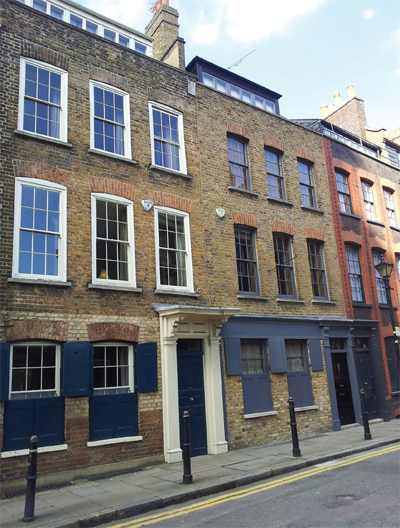
Silk weavers’ houses in Fournier Street, Spitalfields, with the typical workshop garrets at the top.
The process is very basic. Once the boy has attached the threads to the cross, the master turns the wheel, and this imparts the necessary twist.
The weavers from the Netherlands were joined by another, even greater influx of refugee weavers at the end of the seventeenth century. Religious bigotry was once again the cause for bringing skilled workers to Britain, this time from France. In 1598, the Edict of Nantes had allowed a certain amount of freedom to French Protestants to practise their religion. Louis XIV however was a staunch Catholic and in 1685 he revoked the Edict. The French Protestants who supported the reformed form of their religion, as opposed to the Lutherans, were known as Huguenots. Faced with being forced to convert to Catholicism or risk prosecution, many fled to England, skilled weavers amongst them. Almost all they were able to bring with them was specialist knowledge and expertise, but they received a very warm welcome. Using a system called the King’s Briefs a subscription was set up to provide funds for their immediate needs. An Order in Council of April 1687 called for a general subscription in the whole country that raised £200,000. That is equivalent to a colossal £30 million at today’s value. The sum was large, but so was the problem. It was estimated that around 13,000 Huguenot refugees settled in London. But the knowledge they brought with them was invaluable. They introduced a wide variety of products which had previously only been made in their home cities, Lyon and Tours, such as velvets, brocades and watered silk. Not only did they make these and other cloths themselves, but also taught the techniques to the existing body of Spitalfields weavers. This earned them praise in Stow’s Survey of London, a publication which had first appeared at the end of the sixteenth century as a ward by ward survey of the city and which appeared in numerous editions at various intervals. This comment on the Huguenots was part of the entry on Spitalfields:
Here they found quiet and security, and settled themselves in their several trades and occupations, weavers especially. Whereby God’s blessing surely is not only brought upon the parish by receiving poor strangers, but also a great advantage hath accrued to the whole nation by the rich manufactures of weaving silks and stuffs and camlets, which art they brought along with them. And this benefit also in the neighbourhood, that these strangers may serve for patterns of thrift, honesty, industry and sobriety as well.
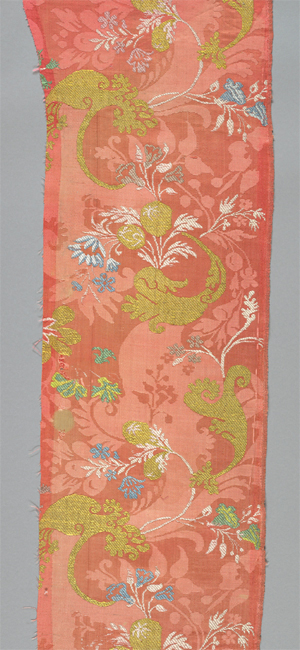
An English figured silk waistcoat panel from the early eighteenth century in the Smithsonian Design Museum.
One type of cloth that became very popular was figured silk. It was said to have been introduced by three specific weavers – Lauson, Manscot and Monceaux – while the designs were all supplied by the artist, Beaudoin. Another refugee workman brought with him the technology for adding lustre to silk taffeta. This must have been especially galling to the manufacturers of Lyon as black lustrings had been such a major part of their export trade to London that the cloth actually became known as English taffeta. Now the material could be made to the same high standard in Spitalfields. By 1692, the trade had become so well established that a charter was granted to the newly formed Royal Lustring Company. To add insult to injury as far as the French were concerned, the new Company managed to persuade parliament that the local product was now so good that imports from France should be prohibited as they were no longer needed. It is a rather odd argument – if the English material was that brilliant why did it need protecting from foreign competition?
The London silk workers had always struggled to compete with imports from France, and as early as 1696, measures were taken to protect the home industry, by either applying high taxes or even by outright banning of imports. An Act of that year bemoaned the loss of revenue caused by importing silk cloth and claiming it was no longer necessary as it could now be manufactured in England by ‘the Royal Lustring Company to as great perfection as in any other country’. But high import duties might have deterred legal trade, but there was still an unsatisfied demand for luxurious French silks and the same Act deplored ‘the importation of such foreign silks without paying the duties charged thereon which have been frequently eluded by the subtle practices of evil disposed persons.’ Or in plain English – when tariffs are high, smugglers thrive.
To many, smuggling seemed a harmless enough activity, to which the community turned a blind eye, as Kipling wrote in A Smuggler’s Song:
Five and twenty ponies
Trotting through the dark –
Brandy for the Parson. ‘Baccy for the Clerk
Laces for a lady, letters for a spy.
Watch the wall my darling while the Gentlemen go by.
But they were by no means all gentlemen, nor indeed gentle men. There seems to have been a distinction between the smugglers of the south west of England and those of the south east. The former seem often to have been fishermen making a bit on the side and otherwise were regarded as respectable members of the community. Those of the south east were often very different, in effect well organised criminal gangs. The south west was not a wealthy area, and tobacco and brandy probably were the most commonly smuggled goods as in the Kipling poem. The market for smuggled silk was in the wealthier area of London and its surroundings, and it was through the south east ports that most of the silk was brought in.
The most infamous of the south east smugglers were the Hawkhurst Gang of Kent. They were ruthless, violent and – although it was difficult to prove against them – were said to threaten death to anyone who informed on them, and almost certainly did carry out that threat. They were brazen, well-armed and defied authority. But in 1747, a young army officer formed a band of vigilantes at a nearby town, calling themselves the Goodhurst Band of Militia, which sounded very respectable, though in fact they had no legal standing at all. That would have not been any great concern to the local authorities who, unable to deal with the gang themselves, were happy to see anyone take them on. A pitched battle was fought in which three smugglers were wounded, and the head of the gang, Thomas Kingsmill, with two companions, captured. Kingsmill was handed over to the authorities, tried, convicted and hanged. It was the end of the Hawkhurst Gang. It was not the end of smuggling of silk from France, but in spite of that, the home industry continued to grow.
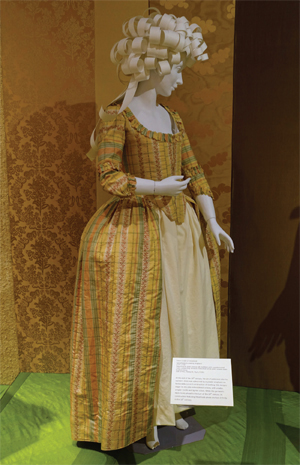
Late-eighteenth century silk taffeta dress manufactured in Spitalfields.
There are still signs of the presence of the weavers in Spitalfields in their distinctive houses, with garrets illuminated by long windows that shed light on the looms. The houses may look grand, but much of the space was taken up for working. A later report described the weavers as usually having two looms, one for himself and one for his wife. As they produced a family, the children were soon set to work, and by the time they were big enough to work a loom, generally at the age of thirteen or fourteen, they too were taught weaving. Eventually, the home might contain up to four looms. With a growing family, the younger children had beds tucked away in corners of the workshop. The houses rarely included any facilities for warping, so this had to be done by specialists, who received the patterns from the master, and arranged the threads in the correct order, and wound them on to the roller for the back of the loom. It was the weaver himself who had to pay for this, not the master. There was also a profitable side-line. Many of the houses had bird traps on the roof, and the songbirds caught were then sold. There are examples of traditional weavers’ houses in Fournier Street and Wilkes Street, and their previous occupants would be astonished, and possibly rather disgusted, to discover the prices being asked for their old homes and workshops.
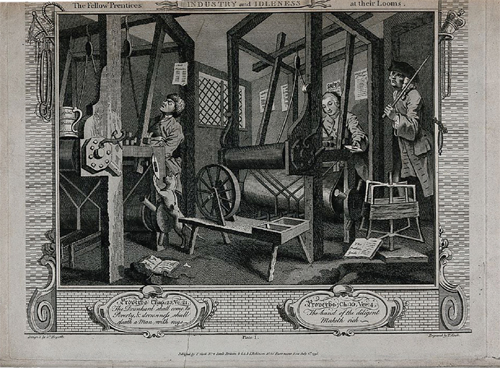
Hogarth’s illustration of the idle and good apprentice – one asleep, the other hard at work in Spitalfields, engraved in 1749.
Silk remained an expensive, luxury textile largely because of the high cost of imported yarn. The price was lowered in the early years of the eighteenth century and the story of how it happened is surrounded in mystery and adventure, involving industrial espionage, smuggling and assassination. Just how much of the story is true is a matter of conjecture. It was already known in Britain that the Italians were using machinery to throw and spin silk, but it was said that the details of how the machines worked was a closely guarded secret. The Lombe family were weavers and it was John Lombe who, at the age of 24, was sent by his older brother Thomas to Piedmont to investigate the machinery. He pretended to be an ordinary workman looking for a job and managed to get taken on at one of the spinning mills. While there, he took surreptitious notes and, as soon as he felt he had enough information, made his escape back to England. Once back home, he and his brother set about building a water-powered mill on an island in the River Derwent in Derby and installed the new machinery. The mill was a great success, but the Piedmontese were reportedly furious. They hired a girl who took a position in the Lombe household, where gradually over a period of time she added poison to John Lombe’s food. He died in 1722 in mysterious circumstances after a long and painful illness, but everyone in Derby was convinced that he had indeed been poisoned.
How much truth is there in the story? Thomas Lombe, when applying for a patent for the machine, claimed that bringing the machine into the country had cost a great deal both in terms of money and dangers. He repeated the same claims when he later applied for an extension to his patents, this time producing a document in Italian that confirmed a death penalty for anyone who attempted to take the details of the silk machines out of the country. That all seems to tie in with the lurid tale of skulduggery. On the other hand, details of Italian silk machines were available in book form, and a copy of the relevant book was deposited in the Bodleian Library in Oxford. It is of course highly unlikely that Derbyshire weavers regularly used the Bodleian and even if they had seen the book, the description was in Italian and was probably too vague for them to use as a model. Whatever embellishments have been added to the basic story, it remains true that the Lombes did succeed and, although John died young, Thomas became a wealthy man and was later knighted.
William Hutton wrote about the mill in his History of Derby published in 1785. He described the mill as containing three engines: the first to wind, the second to twist and the third to double. In the following short extract, he is describing the winding process:
The threads are continually breaking; and to tye them is principally the business of children whose fingers are nimble. The machine continually turns the round bobbin or small block of wood, which draws the thread from the slip (skein) … one person commands from twenty to sixty threads.
Hutton had himself been one of those children, whose nimble fingers were employed, and he did not enjoy the experience:
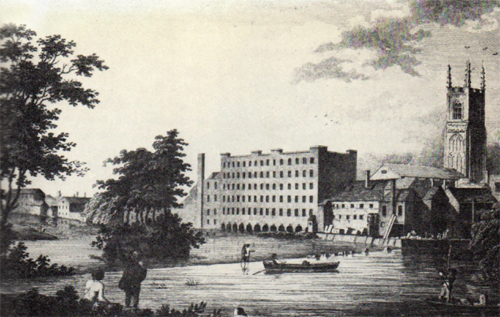
Derby silk mill, with the small original Crotchett silk mill to the right.
All the visitors who have travelled to Derby for half a century, from Gregory to Gough, give us a description of the silk-mill. But it is doubtful whether an adequate idea can be formed of that wonderful machine when described by an author who does not understand it himself. Some have earnestly wished to see this singular piece of mechanism, but I have sincerely wished I never had seen it. I have lamented that while almost every man in the world was born out of Derby it should be my unhappy lot to be born in. To this curious, but wretched place, I was bound apprentice for seven years, which I always considered the most unhappy of my life … My parents, through mere necessity, put me to labour before Nature had made me able. Low as the engines were, I was too short to reach them. To remedy this defect, a pair of high pattens were fabricated, and lashed to my feet which I dragged after me till time lengthened my stature. The confinement and the labour were no burden; but the severity was intolerable, the marks of which I yet carry and shall carry to my grave.
Hutton gave only perfunctory details of the workings of the mill. The building was five storeys high, the top three storeys being used for winding and the two lower floors for throwing and doubling. Power was supplied by an imposing water wheel, 23ft in diameter and 6ft wide. The machines themselves were circular, between 12 and 15ft in diameter and 19ft 8in high. The twist mill consisted of four rounds of spindles, mounted one above the other. Power from the wheel was transmitted through gearing to a vertical axis that ran up through the different floors. The inner framework was turned by the wheel; the outer frame was stationary. Throwing involved unwinding the silk from one rotating bobbin and passing it through a flyer to give twist and winding on to a second set of bobbins. The actual mechanism for getting all the parts to move in the correct way was complex and distinctly clumsy. Once the Lombe patent expired, several manufacturers began improving on the original design.
The Derby silk mill is often referred to as Britain’s first textile factory, but in fact a mill had already been built on the Derwent in Derby in 1702 for silk throwing. It was three storeys high and contained Dutch doubling machines. It was the brainchild of a barrister ‘Thomas Crotchett’ and the actual job of constructing the mill was entrusted to the engineer George Sorocold. It is generally considered not to have been very efficient. Commentators noted that the mechanism was quite crude, nevertheless when Lombe came to build his mill, he chose the site next to the Crotchett mill, which he incorporated into the new system – and although the old machinery was said to be less perfect it remained in use until 1802. And Lombe must have been sufficiently impressed to employ Sorocold as the engineer for his own enterprise. The modest Crotchett mill can be seen rather overwhelmed by the grandeur of the Lombe mill in the illustration (p 103). It seems that Crotchett deserves more credit than he is usually given – and might well stake a claim to having beaten Lombe to the honour of establishing the first textile mill in Britain. The production of cloth, however, still remained up to individual weavers, such as those of Spitalfields.

Derby silk mill photographed before it was severely damaged by fire in 1910.
Early in the eighteenth century, the Spitalfields weavers had tried to get French imports banned to protect their trade, but then a new rival appeared on the scene. The British originally went to the Far East in the hope of joining the highly lucrative trade in exotic spices but discovered that the Dutch had got there first and more or less monopolised the business. Unable to get a foothold in the Spice Islands, they went instead to India. They then looked around for items that might be bought and shipped to Britain to make a profit. They found that the Indians had perfected a method of creating colourful cotton cloths, by adding a mordant to the cloth that could hold a dye. They then created patterns that could be placed on the cloth, so that the exposed sections could take the dye. Later, a technique was developed by printing the cloth using carved wooden blocks. The block cutters didn’t even need to own workshops. They simply turned up with blocks of wood and cutting tools at wherever the cloth was being made, and carved whatever patterns were required. Craftsmen still do this today, and it is amazing to see just how quickly a pattern can be carved by eye alone. In the process I was watching, the pattern being printed was a very popular one ‘The Tree of Life’. The colourful, patterned cloth made by selective dyeing was known as ‘chint’, later Anglicized to ‘chintz’. And because much of the cloth was sent out from the port of Calicut, many of the cloths were given the name calico, though with several variations in spelling.
At first, the new materials were used for quilts and bedspreads, but by the beginning of the eighteenth century, the advantages of a light, colourful and – in comparison with silk – affordable material brought about a major change. The Indian materials started to be used for dresses and became immensely fashionable to the considerable dismay of the silk weavers. They found a champion in Daniel Defoe, now mainly known as the author of Robinson Crusoe but in his day a highly respected political commentator. In 1719, he wrote a number of pamphlets lambasting the taste for cotton. The following extract is typical:
The general fantasies of the people running upon East India goods to that degree that the chintz and painted calicoes which before were only made use of for carpets, quilts, &c, and to clothe children and ordinary people, became now the dress of our ladies, and such is the power of a mode as we saw our persons of quality dressed in Indian carpets, which but a few years before their chambermaids would have thought too ordinary for them.
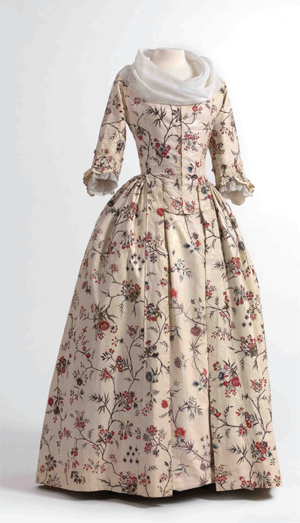
In the eighteenth century, new materials arrived in Britain to challenge silk; a cotton dress in Indian Chintz on display in the Fashion Museum, Antwerp.
There were even popular broad sheet ballads, decrying the new fashions, such as one called the Ballad of Spitalfields or the Weavers Complaint against the Calicoe Madams. It is rather long, but a couple of verses give the flavour. It starts with a verse about the good old days, then continues:
But now we bring Home
The Froth and the Scum
To Dress up the Trope like a gay-Dame
And Ev’ry She Clown
Gets a Pye-spotted Gown
And sets up for a Calicoe Madam
O! Tawdery Calicoe Madam.
Were there ever such Fools
Who despising the Rules.
For the common Improvement of Nations,
Tye up the Poor’s Hands
And search foreign lands,
For the Magpie Ridiculous Fashions
For the Magpie Ridiculous Fashions.
Where Defoe’s sarcastic comments and ballads had little effect, the Spitalfields weavers took matters into their own hands in 1719. On 13 June of that year, a crowd estimated at some 4,000 silk weavers took to the streets and attacked women wearing calico, spattering their clothes with ink or, more dangerously, nitric acid to rot the cloth. The Mayor of London called in the military to help quell the riot and the Horse Grenadiers managed to capture two men and marched them off to the Marshalsea Prison. But as soon as they had gone, the riots broke out again. The troops returned and more arrests were made. A body of weavers then attempted to release their comrades. At first, the soldiers repelled them by firing blank cartridges into the crowd, and when that looked to be ineffective, one of the Guards fired ball shot. Three weavers were wounded, and the rest dispersed. Over the next couple of days, six weavers were tried and sent to Newgate Prison for felony. At least one lady went into print to condemn ‘a gang of audacious rogues to come and fall on us in the streets, and tear the clothes off our backs, insult and chase us, and tell us we shall not wear what they do not weave; is this to be allowed in a Nation of Liberty.’
In fact, this was something of a false alarm as the silk industry was actually prospering and by 1721 was officially described as being ‘one of the most considerable branches of manufactures of the kingdom’. And the government gave positive help to the industry by helping to fund part of the duty that had to be paid when importing the raw material. They also imposed high duties on imported silk cloth and goods. This, however, did not prevent the materials arriving in Britain illegally, and silk smuggling became a highly lucrative business. But that alone did not satisfy the weavers, who found French silks outselling their own wares, while at the same time they were suffering from increasing poverty. There was a specific problem facing the weavers. A lot of the work involved creating elaborate patterns, using draw looms. Setting up such a loom could take as much as three weeks, during which time they were paying an idle draw boy and not earning any money. To make matters worse, the elaborate cloths were only produced in short lengths, typically just enough to make four gowns. Then as now, a lady who had paid a great deal of money for an expensive and elaborate cloth for her new dress did not take kindly to seeing dozens of other ladies wearing the same pattern. By the 1760s, with wages low and smuggling rampant, the trade was in a desperate state, with over 7,000 looms idle. The weavers got together that year and presented the owners with a Book of Prices, setting out what they felt were fair returns for different types of material. As the prices were somewhat higher than the masters were paying at the time, the Book was rejected. It marked the start of a period of prolonged violence that grew worse over the next few years.
By 1763, with no relief in sight and no rise in wages, the weavers began attacking masters who were considered particularly harsh. One such event was described in The Gentleman’s Magazine of November 1763. The men ‘in riotous manner broke into the house of one of their masters, destroyed his looms, and cut a great quantity of silk to pieces, after which they placed an effigy in a cart, with a halter about his neck, an executioner at one side, and a coffin on the other, and after drawing it through the streets they hanged it on a gibbet, then burnt it to ashes.’
By the beginning of January 1764, the trade depression had deepened and weavers petitioned parliament to impose a double tax on imported silk. That idea was rejected, but the tax on silk thread brought in for the weavers was reduced and certain silk imports – stockings, ribbons and gloves – were banned. A fund was set up to relieve the worst of the weavers’ poverty and mercers promised to reduce their stock of imported silks. None of this made a real difference apart from creating a temporary lull in the violence, and soon the demand to stop imports was renewed. It was rejected once again in May 1765, and among the leaders opposing any change in the law was the Duke of Bedford. He had his own interest to look after as he had connections with the East India Company and was enjoying a handsome income from importing Indian cotton. The crowds who had gathered outside parliament to harangue the Lords were quickly dispersed by the military, but the angry mob set off for Bloomsbury and the Duke of Bedford’s house. Seeing exactly what was likely to happen, the Duke called in the military, and troops arrived on horseback just in time to prevent the weavers storming the house.
The authorities were by now seriously alarmed by the growing anger in Spitalfields and the surrounding weaving districts, and had troops permanently stationed there, like an occupying army. It did little to improve the air of desperation among the suffering families. Ever more draconian measures were introduced to support the masters, reaching a deadly climax in 1765, when a law was passed declaring that breaking into a house to cut up silk or damage looms was a felony punishable by death. In response, secret societies were set up. They were similar to those of the earlier Luddites who had tried to get justice by threatening to break up the machines used for knitting stockings in Nottinghamshire unless the masters agreed to obey the law of the land and stop employing apprentices instead of journeymen to do the work. The weavers attempted to ensure that no weavers worked for lower rates and demanded subscriptions from the masters. They used the threat of machine breaking and cloth cutting to try and force through their demands.
Attempts to prosecute the militant weavers generally came to nothing, largely because the fear of reprisals prevented witnesses appearing in court. One manufacturer, who was vehement in his opposition to the whole idea of raising wages, was Lewis Chauvet who owned a factory in Spitalfields. He offered a reward of £500 to anyone prepared to give evidence against the weavers. This encouraged one master weaver and his wife to come forward and identify John Villers and John Doyle as ringleaders of the cutters. They were arrested, tried and inevitably found guilty and sentenced to death. Public executions were normally held at Tyburn, but this time the authorities decided there would be far more impact if the hanging took place in Bethnal Green in the heart of the silk weaving region. The event caused outrage, and the unfortunate man given the job of erecting the gibbet was stoned and abused by the crowd. On the day of execution, the actual hanging was brought forward secretly for fear of the crowd that was threatening to develop. In those brutal days, the bodies were left hanging for hours before their relatives could claim them.
Now another small master ‘Daniel Clarke’ came forward with two names. His house had been broken into some weeks before and when questioned at the time had stated quite categorically that he had no idea who the intruders were. Now he named them as John William Eastman and William Harfield. Whether this sudden return of memory was due to a brave decision to tell the truth and risk the wrath of the mob or the Chauvet pieces of silver was never clear, though most of the residents of Spitalfields had no doubts on the subject. The two accused were duly hanged – this time at Tyburn; the authorities had at least learned one lesson. If Clarke had testified for money, he did not live long to enjoy it. He was spotted in the street and pursued by a mob, mainly of women and children, who caught him, threw him into a flooded gravel pit and pelted him with stones. He emerged, but promptly collapsed and died. Once again, the authorities acted swiftly. Quite how they decided who out of that great crowd should be charged is a mystery, but two men were selected: Henry Stroud and Eastman’s brother-in-law, Robert Campbell. They were charged with murder and hanged. They were desperate times and the brutal action of the authorities did little to help calm the situation.
Something like normality was restored with the passing of the first Spitalfields Act in 1773, which set the prices for the different categories of silk by an agreement between journeymen and masters. A series of similar Acts followed, which stabilised the relationship between masters and men, but worked against the long-term interests of the industry. If the price was fixed for a certain class of weaving, then there was no incentive for the master to modernise his methods, for any changes he made would have no effect on the price. But the textile world in other parts of Britain was changing rapidly, and the Spitalfields Acts only applied locally.
One of the innovations that speeded up work on the loom was the invention of the flying shuttle by John Kay of Bury in 1733. Previously, the shuttle had been passed from one side of the loom to the other by hand which, in the case of broadcloth, required two weavers. In the new technology, the hands of the weavers were replaced by two leather drivers, or pickers on a metal rod. The shuttle was put on wheels and it shot from one side of the loom to the other. All the weaver had to do was jerk a string attached to the pickers. This obviously increased efficiency, but as time went on, the supply of thread was not keeping pace with the increased speed of weaving. This was particularly true of the burgeoning cotton industry. The answer was to take the early production stages of carding and spinning away from the home and into the factory. The first successful water powered cotton mill was built by Richard Arkwright at Cromford in Derbyshire in 1771. In spite of fierce opposition from the domestic spinners of Lancashire, who burned down the first Arkwright mill to be built in their area, the mills proliferated, and the days of cottage industry spinning and carding were over. New machines, such as the spinning jenny, steadily increased efficiency. By the end of the century, water-power was being replaced by steam-power in the textile mills of the north. The other major change – the introduction of the power loom – has already been described.
These technological changes did not affect the silk weavers of Spitalfields directly. The power looms were too violent in their action for the delicate silk threads. But in the long term, the developments in the north were to make a huge difference. The silk weavers were not producing for a mass market. Fashions were changing in Georgian England, where a new, loose neo-classical look was becoming dominant. Heavy brocades and velvets were out and light, colourful fabrics were in. This was a fashion that the cotton industry was able to supply at a far lower cost than the handloom weavers of London. They could have continued supplying the most exclusive fabrics, but for two pieces of legislation that completely changed the economic climate. In 1824, under Free Trade legislation, the Spitalfields Acts were repealed and price fixing was ended. The following year the ban on imported French silks was lifted, and at once the market was flooded with attractive new, reasonably produced materials. It was a watershed that marked the beginning of the end for silk weaving in Spitalfields. But it did not mark the end of the silk industry in the country as a whole. Where the Spitalfields Acts did not apply, there was no brake on innovation and change.