
Seek root causes over quick fixes.
We’re living in this era of Dashboards, which I want to qualify is insane. This presents the illusion of knowing what’s going on. Like everything else electronic, it’s hypnotic. This is what globalization has done. We believe that leaders need to know petty information and because we’re accountable for it, we get this miniscule look at what’s actually going on for children.
—Margaret Wheatley, Keynote at British Columbia School Superintendents Association (BCSSA), November 21, 2019
In this chapter, we shift from the concept of street data to the practice, learning how to facilitate an equity transformation cycle that fundamentally shifts our ways of working together. What would this look like, and how does it differ from current models of improvement? What are the steps? How would you know if you were making a difference for children at the margins? On this leg of our journey, we grapple with the limitations of popular models—like improvement science—to solve complex equity challenges while digging further into the levels of data.
Since No Child Left Behind gave way to murkier reform waters, improvement science has gained traction as a problem-solving approach in education. Championed by the Carnegie and Gates Foundations, improvement science encourages practitioners to test new ideas in rapid cycles—often referred to as plan-do-study-act (PDSA)—in which they develop a change idea, test it, collect data on it, and reflect on whether it worked. Employed at various levels to “achieve positive results reliably and at scale” (REL West, 2017), improvement science (and the affiliated term “continuous improvement”) has become the dominant improvement model we currently operate under as a field. It’s worth noting that continuous improvement is actually a business term drawn from the influence of total quality management (TQM) in the 1980s and that many educators and scholars are reading and writing in opposition to the privatization and commercialization of public schooling.
While its goals sound good at face value, a closer look reveals potential problems. First, you may have noticed that “plan” (develop a change idea) comes two steps before “study” (collect data). When pursuing equity, how can we plan anything responsive without first listening to those at the margins? Where does the voice of the learner—adult or student—fit into this process? Second, the language of “reliability” and “at scale” signals the econometric framework that I wrote about in Chapter 1: a narrow conception of knowledge and data rooted in Western empiricism. Finally, the model itself is equity neutral, without a clear antiracist stance. Presumably, one could develop an idea and set a goal about anything, collect whatever sort of data he or she sees fit, and onward.
For our purposes in this book, we are striving to address deep-seated, seemingly intractable equity challenges that have persisted for decades, with roots that burrow down for centuries—issues emerging from systemic racism, implicit bias, and white supremacy culture in schools. We cannot plan-do-study-act our way out of these challenges.
Improvement science has its merits, for sure. But the tendency to oversimplify “improvement” and seek incremental change over deep transformation makes it a mismatch for equity work. Equity challenges are complex challenges. They arise from the interplay of systemic oppression—when laws and policies lead to unequal treatment and disadvantaging of a specific group of people based on their identity (gender, race, class, sexual orientation, language, etc.)—with the personal and interpersonal domains of identity, behavior, culture, mental models, and psycho-emotional experiences. They arise through microaggressions and macro-forces that sift children into purportedly “good” and “bad” schools and neighborhoods.
Hold for a moment the idea that the least enfranchised communities—those with “bad test scores” and little access to opportunity—possess vast cultural wealth, despite the deficit narratives used to describe them. Yet our improvement paradigms have us chasing after satellite data gains and quick, external fixes instead of cultivating deep, local knowledge. To transform our schools, we need a nuanced and antiracist way to engage in “improvement” (or perhaps we need to dump that word altogether). We need mechanisms for listening to elders, community leaders, and students and families at the margins who can collaborate with us to reimagine outdated approaches. We need to position teachers and principals as change agents rather than consumers of curricula and programs, zigzagging from one intervention to the next.
DEEP LISTENING: A CORE STANCE FOR SCHOOL TRANSFORMATION
Our guiding principle for Chapter 4 is seek root causes over quick fixes. To embody this principle, we have to learn to slow down and engage in deep listening. By inverting our dominant approach to data and listening to the voices, narratives, and perspectives at the margins, we begin to humanize the process of data-gathering. This is a key point because, in the street data framework, the ends do not justify the means: Our approaches to data collection are just as important as any insight, understanding, or actions that emerge. Listening deeply and responsively will help us build relational capital and trust and shift the culture as we gather data.
Street data helps us resist the Great White Hope and Lone Ranger of Color tropes and, instead, take a stance of deep listening and learning. At the root of this shift is a willingness to lean into humility and courage. Rather than fear feedback on our practice, we begin to actively solicit it. Rather than become defensive in the face of hard-to-hear data, we build our muscle at taking it in. This simple pivot in perspective interrupts the tendency toward solution-itis—let’s fix an ill-defined problem without consulting those most impacted—that upholds white supremacy and maintains unequal power dynamics in schools. When we ground our leadership moves at the street level, we get critical insight into what’s working and what’s not.
In the street data framework, listening signifies a deep commitment to two things: the technology of skillful listening and an orientation to authentic, present, mindful engagement with stakeholders. Listening tours have become a popular tool of the new leader, and while they seem promising, they carry a risk of becoming a transactional strategy to check off one’s to-do list (see Jamila’s description of doing equity and superficial equity, pp. 32–33). The antidote to this is cultivating a practice of deep listening, which is described in Chapter 5 of The Listening Leader (Safir, 2017b). Here are a few tips to deepen your listening as you flip the dashboard.
· Locate the margins of your community. Whose voices are most unheard and yet potentially most instrumental to solving the equity challenges you face? For example, who are the elders in your community whose wisdom is untapped? Think of paraprofessionals: cafeteria workers, custodians, and security guards who interact with children every day and often come from the same communities as students. When is the last time you invited a paraprofessional to sit and authentically share his or her insights about your school’s equity issues?
· Cultivate awareness of your personal biases. Whose voices do you tend to gravitate toward and why? What internal scripts are running in your brain about particular students, groups of students, families, or colleagues? Challenge those by stating an explicit intention to yourself: “I commit to listen deeply to students and parents about whom I may carry some judgment. I commit to stay open to new learning and insight.”
· Find a culturally appropriate way to capture listening data. For some folks, taking notes on a computer as you listen may feel perfectly fine. For others, the computer itself smacks of bureaucracy and power. Know your audience. If uncertain, ask the person, “Do you mind if I take notes once in a while? Would a computer be distracting?” If real-time notes aren’t appropriate, practice mindful listening and set aside ten minutes after the session to jot down key data points. I often coach educators to listen for emotional peaks, which may be revealed through upticks in volume or shifts in tone and body language.
· Pay close attention to nonverbal cues. Robert Mehrabian’s groundbreaking research on nonverbal communication revealed that in any exchange involving emotion, 38 percent of meaning is conveyed through tone, 55 percent through body language, and only 7 percent through words (Mehrabian, 1981). As you gather street data via listening, develop awareness of your own and other people’s tone and nonverbal cues as windows into emotional experience. Notice, for example: Are the speaker’s arms or legs crossed? Is their face tight and brow furrowed? Or does this expression seem open and relaxed? How are you seated vis-à-vis the speaker, and does your body convey openness and an invitation for authentic sharing?
· Remember your purpose—healing plus understanding. Street data is distinct from other forms of data-gathering in that the process itself can be healing. It is an opportunity to build trust and relational capital with people at the margins of your community. Street data is not a technical approach; rather, it is an adaptive, human-centered data dance that unfolds fluidly through caring, inclusive, and culturally sustaining interactions.
If we conduct a listening campaign or observe a group of students in ways that are cold, transactional, or technocratic, we have failed to use the street data methodology with fidelity. Instead, this method demands that we constantly seek to align our means with our ends by modeling curiosity and deep listening in service of equity.
Listening Dyads: A Street Data Staple

Street data can surface intense emotion. As we take in the impact of inequities on our students and begin to examine our own biases and practices, we may drop into a stress response pattern: fight, flight, or freeze. Listening dyads are a powerful tool for emotional reflection and self-regulation that can disrupt our default responses. A dyad is a two-person structure, originally developed by Julian Weissglass at the National Coalition for Equity in Education, with a stated purpose of benefitting the speaker (not the listener) as they reflect and construct meaning. Dyads follow four guidelines:
· Equal time for each speaker (because everyone deserves to be listened to)
· No interruptions or breaking in with personal stories (because people have the capacity to solve their own problems, given time and space)
· Double confidentiality (don’t share what you hear or return to your partner later to probe their share because people need to know they can be completely authentic)
· No complaining about mutual colleagues (because this is an opportunity for self-reflection and finger-wagging can lead the listener to feel defensive)
A dyad prompt aims to create space for emotional release, reflection, and healing. Sample prompts could be: What thoughts and feelings does this street data bring up for you? What was the experience of listening deeply to your students like for you? Share a time when you got feedback on your practice that was hard to hear. How did you metabolize and move through that moment?
 Description
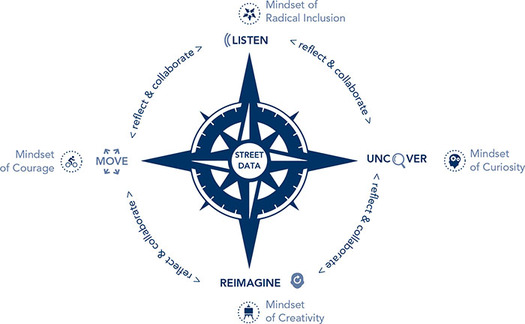
Figure 4.1 Equity Transformation Cycle
Copyright © 2021 by Shane Safir. All rights reserved. Reprinted from Street Data: A Next-Generation Model for Equity, Pedagogy, and School Transformation by Shane Safir and Jamila Dugan. Thousand Oaks, CA: Corwin Press, Inc., www.Corwin. com. Reproduction authorized only for the local school site or nonprofit organization that has purchased this book.
The equity transformation cycle (ETC) is the central process tool in this book. The cycle represents a fluid yet structured process that is grounded in core values—radical inclusion, curiosity, creativity, and courage—and centers street-level data. As you move through the cycle, you will learn to listen deeply to voices at the margins, uncover the root causes of inequities, reimagine your current approaches in partnership with key stakeholders, and move a change agenda with courage. In the rest of this chapter, we will unpack what an equity transformation cycle looks, sounds, and feels like. Allow me to point out a few features before we dive in.
First, a note on the word choice of “transformation”: It pained me to select a noun here! I agonized over the sound of “inquiry,” “improvement,” and “change” but ultimately landed on transformation. As I write this, I hear the words of my colleague and dear friend Denise Augustine in my ear. Denise, a leader for Indigenous education with the Ministry of Education in British Columbia, firmly rejects the term “improvement” as connoting incremental change in the face of generational challenges. Improvement feels like we are tinkering around the edges of systemic realities that trace back to slavery, restrictive immigration laws, Native American genocide and dispossession, and centuries of exclusionary policy. We don’t need improvement. We need an approach that fundamentally and radically transforms the experiences of children and families at the margins. This is the purpose of centering street data in a process of transformation.
Second, you’ll notice that the cycle is nonlinear because, guess what, complex change is nonlinear! Linearity, the governing principle of the Western improvement model, seeks simple cause and effect relationships. We seek deep understanding of human stories and root causes of inequity. Notice that the arrows in between cycle phases go both directions to signal that the process is nimble and built for the unpredictable rhythm of complex change. You might think you’ve moved past the listening stage and are ready to uncover root causes, then realize you haven’t listened deeply enough. You might imagine your next move and then realize, wait! I didn’t drill down far enough to uncover the underlying root causes. This is the emergent nature of working toward equity.
Third, the model is built for short, six- to eight-week cycles that work at every level of the system—the classroom, the school, the district, or even the region/province/state—though it can be adapted to design spiraling quarterly or semester-long cycles. Like design thinking, the cycle helps us iterate on our ideas and build our collective capacity to respond to changing street-level conditions. The entire process is undergirded by the idea of emergence—the theory that simple rules interact with one another in complex ways to shape a change process, the outcome of which cannot be predicted. (Think of a chess game. There are basic, universally known rules, but when two players sit down to engage in a strategic game of chess, the result cannot be predicted; it is always emergent.)
The idea of throwing yourself into a change process with no known outcome and just a line of inquiry may feel uncomfortable and revolutionary all at once—a blast of fresh air on the stale econometric framework, which assumes we can data-fy and plan our way into new results. By contrast, emergence calls on us to slow down, listen deeply to those at the margins, bring folks to the table to reimagine the landscape with us, and move in partnership to build a new reality. It is a liberatory change model, freeing us from the fantasy of control while pushing us to maximize our influence in service of equity and antiracism.
Finally, you’ll note that collaboration and reflection are embedded in every step of the journey. No one ever reached an equity or social transformation goal alone. We need a village. We belong to a village, with children at the center. Who is your village with whom you will build the courage and vision to do this work?
The equity transformation cycle represents a shift from evaluating outcomes to valuing well-being (value being the root word of evaluate). Note that Chapter 8 will unpack the cycle in more depth with many concrete examples. At the heart of this process lies the ultimate goal of well-being—a state in which educators and students experience healing, agency, joy, and connection as they dismantle oppressive practices and structures and cultivate deep learning for all. If we do not value healthy, thriving communities of adults and children, what really is the point?
LISTEN: THE MINDSET OF RADICAL INCLUSION

Whatever the problem, community is the answer. How we are together in our relationships is the solution. When people are anxious and scared, we withdraw from one another. Listening helps us lean in and hold one another.
—Margaret Wheatley
Equity-centered transformation always, always, begins with deep listening. Not with planning an intervention to do, study, and act on, but with the choice to listen deeply to the least heard and most marginalized voices in your community—be that a classroom, school, district, or state. Here, we use the word listening in the broadest sense: as a physical, emotional, cognitive, and even spiritual act rather than a clinical method of “gathering data.” Remember: Deep listening is the core stance of this chapter and your superpower as you seek root causes over quick fixes.

Figure 4.2 The Chinese Character for Listening
The Chinese character for listening includes five parts: the ear, the eyes, one undivided attention, the heart, and king. When we listen at the margins, we open our hearts to what is said, what is not said, what is seen and expressed nonverbally, what is perceived on the level of neuroception,1 and what is felt by the listener and speaker alike. Far from a passive act, listening is a dynamic exchange that brings humanity to the process of school transformation. We listen to ensure that the solutions we devise are shaped by voices at the margins rather than our projection of what people might need (the trap of false generosity). As you can imagine, this kind of listening requires great skill and emotional intelligence, areas we will explore throughout the book.
1 Neuroception is a scientific term describing how our neural circuits perceive and distinguish, often automatically, whether situations or people are safe, dangerous, or life-threatening.
Our guiding mindset at this stage is radical inclusion, which scholar Ortiz Guzman describes as “the intentional act of interrupting inequity where it lives … Recognizing the multiplicity of stories, truths, their proximities, their intersections, and the people who own the stories, are requisites for equity design work” (Ortiz Guzman, 2017, p. 45). In practicing this mindset, we commit to identify and include the voices of those who may have never had a seat at the decision-making table but whose experiences and perspectives matter. This might be your kindergarteners who “can’t sit still,” frequently suspended boys, students with attention issues, long-term English learners (LTELs), refugee families, Black mothers, LGBTQ or non-binary students, young staff of color, community leaders, elders, and many others.
Whoever we need to listen to, radical inclusion connects us to an internal source of compassion that, as Buddhist nun Pema Chodron writes, is less about “our service of those on the margins, but in our willingness to see ourselves in kinship with them” (Boyle, 2010). It’s important to acknowledge that many of us may be grown-up versions of the children we want to better serve. We may carry our own wounds from experiencing exclusion, racism, and other forms of oppression as students, and listening will inevitably surface emotion around those memories. Rather than stuff or sanitize the emotion, we can learn to heal and harness it.
The listening stage invites us to be humble, acknowledging that our best-honed leadership and instructional tools may not hold the solutions we need. It also invites us to stand in solidarity with folks at the margins. In his beautiful article “Note to Educators: Hope Required When Growing Roses in Concrete,” Jeff Duncan-Andrade explores the idea of audacious hope, which “demands that we reconnect to the collective by struggling alongside one another, sharing in the victories and the pain. This solidarity is the essential ingredient for ‘radical healing’ (Ginwright, 2009)” (Duncan-Andrade, 2009).
Just like the equity traps and tropes Jamila described in Chapter 2, each phase of the cycle contains micro-traps that we have to train ourselves to resist. First and foremost, our approach to listening is at least as important as the time we set aside to do it. If we listen to a student or parent in transactional ways, for example, we run the risk of alienating and further marginalizing the person. Transactional listening can look like
· Forgetting to frame the listening with a clear “why” (“My purpose in this listening session is to …”) and close with authentic appreciation (“Thank you/I want to honor you for …”)
· Taking notes so diligently that you never look up, make eye contact, and take in nonverbal cues as critical street data
· Conveying a lack of warmth and care through aloof facial expressions or body language
· Allowing ego to inflect our listening and becoming defensive in the face of hard feedback (we will explore this further in a Chapter 8 discussion of white supremacy culture)
Another pitfall we must guard against is listening with unchecked implicit biases or a narrow cultural frame. Listening provides an opportunity to practice self-awareness. Before engaging in this stage, ask yourself: What assumptions, stereotypes, or deficit-based scripts am I holding right now? How can I press pause and open up new ways of thinking and understanding? What are the limitations of my own cultural frame, and how can I listen for the assets and cultural wealth that the speaker possesses? This takes practice, and it won’t be perfect, but cultivating a practice of mindful listening will help a lot.2
2 I discuss mindful listening in Chapters 1 and 5 of The Listening Leader (Safir, S. [2017]. The listening leader: Creating the conditions for equitable school transformation. San Francisco: John Wiley & Sons).
The listening phase of the cycle may emerge from satellite or map data, or it may erupt from an inciting incident—for example, a racist event that has rocked your classroom, school, or district. However you begin, ask these three questions:
1. What is the equity challenge we need to address right now, and why does it matter?
2. Who is most impacted by this challenge?
3. How will we listen deeply to their voices and experiences?
Street-Level Incidents
An equity transformation cycles often begins with a crisis event, like the three below, all based on actual events. Think about who you would need to listen to in each scenario and how you would model the stance of deep listening.
A group of teachers in a predominantly white town with an increasing Latinx population dress up as Mexican caricatures for Halloween, with ponchos, sombreros, and fake mustaches. Four of them pose as panels of the proposed border wall, on which they have plastered “Make America Great Again.” Rather than go underground, they post public pictures on Facebook. Latinx and other local families are enraged and start a petition.
A district reels as Black and Asian students come forward with multiple stories of racist taunts by peers that went unchecked by adults or peers.
A transgender male high school student stops attending school because his history teacher refuses to call him by male pronouns and his chosen name, despite the fact that it is listed on the attendance rolls.
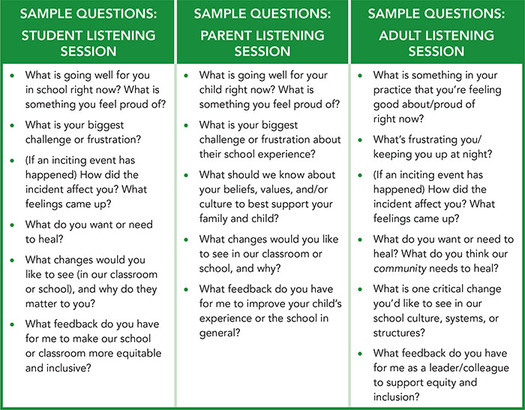
In addition to listening campaigns and shadow days (both described in Chapter 3), you can organize focus groups, audio or video interviews (recorded with permission, of course), and/or empathy interviews (see Chapter 8). You can also bring student and other stakeholder voices into the public arena by facilitating a panel or fishbowl discussion, as depicted at the end of Chapter 3. Here are sample questions you can adapt for listening to students, parents, and colleagues.
|
Sample Questions: Student Listening Session |
Sample Questions: Parent Listening Session |
Sample Questions: Adult Listening Session |
|
|
|
Voices From the Street Students and Caregivers

According to the most recent U.S. Department of Education Office for Civil Rights data, from kindergarten to twelfth grade, Black girls are seven times more likely than white girls to be suspended from school and four times more likely to be arrested at school. (For more on this, read Monique W. Morris’s book Pushout: The Criminalization of Black Girls, 2016.) Latinx girls are more than 1.5 times as likely as white girls to receive an out of school suspension, and Native American girls are suspended at three times the rate of white girls. These are the satellite data.
The story of Alyssa, a bright, socially conscious eighth-grade Black girl overcoming learning and mental health challenges exemplifies the impact of systemic racism, implicit bias, white supremacy culture, and intersecting systems of oppression. After an altercation with a classmate involving a verbal threat but no physical harm, Alyssa was suspended for nearly three weeks despite the fact that physical incidents by non-Black peers had been met with minimal punishment. When she returned, Alyssa was made to jump through multiple hoops, switch her entire course schedule, and barred from extracurricular activities, including her beloved Black Student Union (BSU). Rather than listen to Alyssa and her family, engage her and the peer in restorative processes, or dig for root causes leading to the argument, the school responded in transactional ways that left Alyssa feeling hurt, disenfranchised, and marginalized.
I had the opportunity to listen deeply to Alyssa and her mom Jackie (both pseudonyms) and want to share with you the type of rich, meaningful street data that comes from orienting ourselves to this stance. I asked them both what happened, how Alyssa’s identities shaped her experience, how the school’s response impacted her social, emotional, and academic well-being as well as her sense of belonging and efficacy, and finally, what both women wished the school would have done differently. Below are some of the responses I heard from Alyssa and her mom. When you finish reading, use the Reflect and Collaborate questions that follow to make meaning of the data. Then, imagine that you are beginning an equity transformation cycle in which you will next analyze the data to uncover root causes, reimagine your school’s response in partnership with Alyssa and her family, and move forward in a courageous, antiracist manner.
Alyssa’s Words (student)
It was a really stressful situation. I had no idea what was going to happen; I thought I was going to be expelled…. I knew that they were doing an investigation of sorts, but I didn’t really know what was going on with that. One time I was like, “Mom, why am I not in the conversation? I was in the incident, so why am I not in conversation?”
They pulled me out of my old class, which ironically had most of the Black girls in the grade in it. They pulled me out of the yearbook club and the band…. It was really hard, especially the first few weeks … it was actually so bad that I literally wouldn’t even go to class because I didn’t know the kids in my class that well and, well, because I have social anxiety.
I used to hide in the bathrooms and wait until the teacher came out and yelled at me for skipping class. Then I’d go to class and obviously I didn’t have good grades because I wasn’t participating in class. Yes, at that point it was pretty low, and the school still didn’t seem like they were going to put me back in my old class. The BSU progressed and did their thing, and they (the administration) asked me not to be a part of it.
The argument was because of a race issue … That was the issue at heart. I thought if the school could understand that, then maybe they could understand why I was that mad and why it was that big of a deal, but to isolate me from essentially all other students that look like me only made it a worse experience for me.
Well, this incident wouldn’t really have happened if I was not Black. It’s hard to say, but it did feel like they, as a school, didn’t really care about having a safe space for the Black students at the school as much as they cared about saying, “Hey, we have a Black Student Union and we’re a diverse school.” … They know who I am, they really know me…. This is not the first time that I’ve discussed racial issues. They should have included me in that because I’m more than capable of discussing it, like a normal person.
I’ve always considered myself a smart person, not in a cocky way, but there’s been a lot of instances where I’m trying to explain a concept to a kid my age and they just don’t understand it. I know that I’m very conscious of the world and this society and stuff and the way that things work in America…. I just really wanted to graduate, maybe not with perfect grades but with maybe higher grades or with some fun experience that I got to do at the school…. It felt like that was taken away.
(Here, I asked Alyssa what she wished the school had done differently.) I don’t know why I have to say this, but I wish they would’ve actually talked to me and listened to what I’m saying and understand that I have feelings too. In a way, I ended up being a victim of the situation in the end, even though I was not seen that way … Just look at both sides of the story I guess.
I think they let me speak, but it felt after I spoke, they just didn’t care what I said. Just take into account all different perspectives and also understand that as a Black kid in America, a lot of people don’t really look like you, and a lot of people don’t really like you just because of the way that you look. That’s why you actually might want a space at school where you can meet up with other kids that do look like you and do know what you’re experiencing and just understand each other and have a safe space like that.
Jackie’s Words (mother)
I think the way in which the school responded was in this way that didn’t, one, look at what the impetus was leading to the pain that Alyssa was experiencing and what they could do about that…. The result was a lot of changing of course. One thing that was so striking from the start is that when they initially called us, they didn’t just frame it as a conflict between the two girls, but they made it sound as if she was dangerous, and they framed it that way for the other family as well. That immediately set this on a course that was hard to recover from. And, having been on the other side of the equation when my child was injured by another child, I had never heard that characterization before. At first they were like, “She did something bad; she’s going to be out of school for a day.” Then it was, “No, she’s going to be out of school for three days.” Then it was like, “Oh no, we’re not sure, we’re doing another investigation. We’ll let you know when you can come in. You can come in on this day—Oh, actually, we don’t want to have you come in. We just want to talk with any other professionals that happened to be talking with her.”
I kept asking these questions like, “What is happening?” They were like, “We’re just doing our investigation.” Alyssa kept asking us, “What is happening?” I said, “They’re doing their investigation.” She said, in a really mature way, “How are they doing an investigation when they’re not talking to me?” We’re like, “Good point.” My spouse calls them up and says, “If you’re doing your investigation, I think you should talk to my daughter. She would like to share what happened from her perspective.” He took her in to be able to share, but it never occurred to the school to even speak with her.
She was at a place where she didn’t have very many friends, and so removing her from one group both had the effect of impacting her academics and impacting her social and emotional state. We kept underscoring to the school, “This may not seem evident to you, but this is really devastating for this child in this moment, and here’s why.” They refused to hear any of it. I requested that there be a restorative justice process. They said, “Yes, that sounds great. We will do that.” When she finally went back to school, the restorative justice process was supposed to start. We had started working on it … We met with the restorative justice consultant over Thanksgiving. The other family was also supposed to meet with the person over Thanksgiving but decided they didn’t want to do the restorative justice process.
I think that was a critical moment, because in my mind, that was the moment where the school (by virtue of a set of values and policies informed by those values) should have said, “To be a part of our school community, when we have issues we need to resolve between young people, we ask them to participate. This is what you sign up for when you sign up for this school, so you can’t opt out,” especially when the restorative justice office was a gatekeeper to resolution so that Alyssa would be able to go back to her former life.
She had to drop out of all of her clubs and activities because of the experience. She was switched from the classroom because of this experience. There was no schoolwork being done. It had a deleterious effect on her academics; it had a deleterious effect on her personal relationships, on her social life; trying to go back to school and be with her friends was really difficult. It was just really difficult all around. She felt socially isolated because of this experience. This is a kid who fell into a very deep depression, requiring meds, a kid who has really struggled….
I think, in a lot of ways, it has made her question her trust in adults, made her question her trust in white adults, made her question her trust in authority figures, and made her really skeptical about who she can trust to actually take care of her and what people’s fundamental motives are when they are engaging with you…. I think for her it underscored that actually when you’re Black, you’re treated differently. When you’re female, you’re treated differently. When you’re young, you’re treated differently.
(Here, I asked Jackie what she wished the school had done differently.) Well, let me just say that all of this could have been avoided in my utopian world. What would have happened is that there would have been a space for Black students to have, in these predominantly white schools, a place of solace because then all of this would have been avoided.
The reason all of this came up is because Alyssa was advocating for that kind of space, and the school was not active in actually trying to support that in happening. This conflict emerged between these two girls about it, which the school, because of their own racial position and uncertainty about what to do, didn’t know how to resolve. I think that’s a really important part of the story, of where the school owns some responsibility to get clear about how they want to deal with issues of race and justice, because they had no view on that and were afraid to do something that would offend people, as opposed to looking at what are the needs of their students, and why, and how could they get some clarity around how to support the needs of those students.
They actually elevate this idea that every situation is different, and so we take it on a case by case basis … taking it on a case by case basis, you leave yourself open to bias because there are no consistent practices or values or policies that undergird how you address issues. “Well, we can’t really compare this to that. It’s very individualized.” Well, yes. Individualization has been used to lock people out of opportunity for centuries.
Reflect and Collaborate: Guiding Questions
· What stands out from the listening data? What are the patterns and themes?
· What is most painful to hear? Sit with and acknowledge your own emotions and where you feel them in your body.
· What new questions emerge from this data?
· What additional listening might we need to do and with whom?
· How does what I heard help me understand the satellite and map data?
UNCOVER: THE MINDSET OF CURIOSITY

In the next phase, we probe all the available street data to uncover the root causes of our equity challenge. It is critical to do this in a collaborative fashion by studying the data with a team. By listening deeply to voices at the margins, we have disrupted the improvement habit of diving into planning before gathering street data. Even at this stage, however, it’s easy to jump into a solution space before we have thoroughly explored the data. Uncovering helps us slow down, reflect, and value the street data by making it the centerpiece of team conversations. A good team meeting will help us stretch our thinking and assumptions.
At this stage, we can also bring forward complementary forms of street data to comb through: artifacts, observation notes, video clips, and more. Say, for example, we are a group of seventh-grade teachers who have identified fluent writing as an equity challenge for our English learners. We just completed empathy interviews with eight students to understand their self-perception around writing. We asked the students to share their best and worst writing experiences, how they feel about themselves as writers, a piece of writing they feel proud of, and a writing role model. For today’s team meeting, we have assembled short writing samples for each student (artifacts). In addition, each of us has captured observation notes over the past week on the two students we interviewed, focusing on behaviors they exhibit when we assign writing tasks (engagement, avoidance, stop-and-start, etc.). We now have a rich array of street data to examine for root causes.
The critical mindset at this stage is curiosity: setting aside our preconceived notions, checking our confirmation biases, and thinking hard before coming to any conclusions. As we study the data, we try to uncover patterns, hidden stories, and misconceptions while maintaining a stance of wonder: What does the street data reveal and not reveal? What underlying patterns are becoming visible? What more is there to this story? Uncovering root causes and hidden truths is such hard work. How do we retain what educational justice organizer Jitu Brown calls “ferocious humility” (Brown, 2019), recognizing how much we don’t know? We stay curious. Curiosity helps us sharpen our brains to analyze street data with cognitive discipline—to look and listen for deeper meaning.
The biggest pitfall at the uncover stage is a failure to slow down and engage in the messy meaning-making required to dig up root causes. It is so easy to defend our current ways of doing things—to boomerang back, as Jamila said, from the edge of what it might mean to transform our practices. It’s much easier to continue with business-as-usual than to push and pull and probe with our colleagues to figure out what is really going on underneath the surface. Here, collaborative discussion protocols are our friends, helping us stay focused and disciplined as we build our capacity to have rigorous street data conversations.
Two protocols will serve you well at this stage: the iceberg and peeling the onion. Designed by systems theorist Peter Senge, the iceberg helps us move from an event we might typically react to into the deeper waters of patterns, trends, systemic structures, and mental models that shape our thinking (Senge, Kleiner, & Roberts 1994). When we encounter an iceberg, only a small portion (that which surfaces above sea level) is visible from a distance. In our iceberg metaphor, this surface level corresponds to events—what just happened? Beneath the water lie deeper levels of inquiry—the patterns, trends, and systemic structures forming barriers to equity—what has been happening? Have we been here or somewhere similar before? What forces are at play that contribute to these patterns? Finally, at the ocean’s base, we encounter mental models —personal, internal representations of reality that people use to interact with the world around them, constructed by individuals based on their unique life experiences, perceptions, and understandings of the world (Jones et al., 2011). Here, we might ask, How does our thinking allow this situation to persist?
Moving through the iceberg never fails to yield insight into root causes. Give your team sufficient time to work through this tool, at least forty-five minutes to an hour. To see one depiction of the iceberg model, visit http://www.ascd.org/ASCD/pdf/journals/ed_lead/el200910_kohm_iceberg.pdf.
Peeling the Onion also provides a structured way to look at a problem without immediately trying to solve it. It includes a series of timed steps that help you get to the heart of an issue. You can find a detailed version of this protocol at http://schoolreforminitiative.org/doc/peeling_onion.pdf.
Reflect and Collaborate: Guiding Questions
· What were our assumptions going in, and how does the street data challenge them?
· What is most surprising in the street data?
· What root causes are revealing themselves as we analyze the array of street data?
· What invisible mental models may be shaping the outcomes we currently have?
· What entry points are emerging for disrupting business-as-usual and trying something really different?
REIMAGINE: THE MINDSET OF CREATIVITY

As I wrote in Chapter 1, the test-and-punish era incarcerated the imagination in many school communities, driven by a top-down accountability system that marginalized student and educator expertise. The third phase of equity-centered transformation invites us to reimagine our current reality with a mindset of creativity. When we engage in this phase, we aspire to knock down the psychic walls that keep us boomeranging back to the same responses and strategies we’ve been using. Now that we have centered voices from the margins and begun to uncover root causes, we have an opportunity to radically reshape our pedagogy, leadership, and school culture. We can’t do this in an echo chamber, however; transformational, antiracist thinking will emerge from convening a range of perspectives around the table or even flipping the table altogether!
How do we push ourselves beyond the usual solutions and the curse of knowledge—that phenomenon where technical expertise becomes a barrier to innovation? We bring the stakeholders we initially listened to into the conversation as co-designers and co-dreamers. (And yes, I mean the kindergarteners you did listening sessions with! I mean the LGBTQIA students who shared their stories and insights on what needs to change. I mean younger BIPOC staff who perhaps weren’t nominated to the leadership team but have a vision of how to move forward.)
For example, imagine sitting in a circle with five of your adorable kindergarteners who have had a hard time sitting still during whole-class instruction. You have done listening sessions with students and parents as well as captured video (with parental permission) to observe how the students engage during guided instruction. You have uncovered their assets as learners as well as some initial root causes: The students describe feeling “wiggly” in their bodies when they have to sit for carpet time. In circle, you ask the students to co-design some new approaches with you:
· When you feel wiggly in your body, what kinds of movements do you want to make? (Students could draw or write their response before sharing verbally.)
· What’s great about feeling wiggly, and what’s difficult about it for you?
· If you had a magic wand to change one thing about carpet time, what would it be?
· Where and how could we make movements in class so that we don’t accidentally hurt others?
· What do you want me to say or do to help you when you feel wiggly?
The reimagine phase is about inquiry with those at the margins, not inquiry for, which can default into a dangerous type of paternalism or white saviorism. The powerful approach of participatory action research (PAR) can support our efforts here by empowering marginalized community members to learn and apply research techniques in order to uncover innovative solutions to community challenges. The branch of youth participatory action research (YPAR) brings youth and adults together in partnership to improve the conditions of young people’s lives and communities. YPAR is anchored in the belief that students are valuable experts with potential to become changemakers and connected to the notion of creating “third spaces” in which students develop hybrid identities that lead to greater engagement and achievement (Gutiérrez, 2008). In Chapter 5, we will return to this theme.
To reimagine, we must convey to everyone assembled that no idea is too “out there” and we are seeking to use all means at our disposal to create new ways of being and learning together. We can stimulate creativity in the physical materials we offer people (markers, pipe cleaners, paint, chalk, three-dimensional papers, etc.), in the design of the meeting space (circles and small groups, chart paper, lots of wall or whiteboard space for visualizing and mapping ideas, etc.), and in the agenda (movement, music, art, meditation, and other non-traditional learning modalities to foster healing and stimulate the group’s creative juices).
Process Tips for the Reimagine Stage
Begin by setting up conscious agreements for the data conversation. A few that Jamila and I employ in our workshops include: make space, take space; listen and speak with heart and integrity; assume positive intent but think about your impact; notice your discomfort and stay curious; keep our most marginalized students at the center. Once you have established agreements, you can
· Review street data trends, patterns, and any root causes that have been revealed
· Ask participants to explore their thoughts and feelings about the data through a journal reflection, a listening dyad, or a walk and talk activity (A sample prompt might be, What emotions does this data raise for you?)
· Engage the group in a visioning activity, either all together or in small pods (See Reflect and Collaborate questions following.)
· Continue to pose questions to stimulate dreaming (See following questions.)
· Have each group share their ideas, asking others to reflect back what resonates
· Facilitate a dialogue about cross-cutting themes and exciting ideas
· Set clear next steps that might include further street data-gathering
The biggest pitfall at this stage is reverting to the same strategies you’ve been using because they’re familiar, comfortable, or don’t shake the table. At the reimagine phase, the rubber meets the road as you move from analyzing street data toward action; it can be incredibly seductive to stay the course with past practices, even dysfunctional ones. Doing something really different may be terrifying enough to elicit resistant responses like “Why not retain our one hundred-point scale grading system? You want me to eliminate the zero and shift to criteria-based rubric grading? No way!” This is why we need additional stakeholders at the table—parents, students, paraprofessionals, teachers who aren’t usually consulted—to hold our feet to the fire. With openness and the right set of voices in the mix, we can reimagine the current landscape.
Reflect and Collaborate: Guiding Questions
· What are the people we listened to telling us they want and need?
· In what new directions do the root causes begin to point us?
· What creative ideas and approaches are naturally emerging from the data and dialogue?
· What would success look like if we moved in these directions?
· What do you feel excited to do or try next?
MOVE: THE MINDSET OF COURAGE

We all know what it’s like to set an intention to transform a habit or pattern but then default into old ways of being. Change is hard. Just because we’ve reimagined the landscape of possibility doesn’t mean we have fortified ourselves to act. The final stage of equity-centered transformation, therefore, is to move on your emerging ideas with a mindset of courage. That’s right. Strap on your bike helmet, climb onto your bicycle (or into your mobile wheelchair), and pound the pavement. To move signifies the need to act without complete information or the perfect design and is captured in a team agreement developed by my colleague John Watkins for the Deeper Learning Dozen, a project he runs: “Accept non-closure … but not non-action” (Watkins, n.d.).
When we commit to move, no matter what the outcome, we commit to be courageous in the face of inequity. We will meet with resistance, recalcitrance, defensiveness—all of those things that stymie progress. But as Frederick Douglass wrote, “If there is no struggle, there is no progress" (Douglass, 1857). It’s time to be bold and try something new. Remember that the solution to an equity challenge is unknown and emergent. It can only be revealed by continuing to gather street data, uncover root causes, and reimagine our systems, structures, and ways of being together.
Reflect and Collaborate: Guiding Questions
· What is the team’s call to action now, emerging from the data?
· What will you try and do together in the next four to six weeks?
· How will you know it has succeeded or failed as an experiment? What additional data will you gather?
· What will help you be courageous together and stay the course?
IF LOVE WERE TO GUIDE US
As you think about how to flip the dashboard, pound the pavement, and center street data in your efforts to pursue equity—consider these wise words by author adrienne maree brown who reminds us that love is the center of the work:
If love were the central practice of a new generation of organizers and spiritual leaders … we would see that there is no such thing as a blank canvas, an empty land or a new idea—but everywhere there is complex, ancient, fertile ground full of potential. We would organize with the perspective that there is wisdom and experience and amazing story in the communities we love … we would want to listen, support, and grow … we would understand that the strength of our movement is the strength of our relationships, which could only be measured in their depth. Scaling up would mean going deeper, being more vulnerable and more empathetic. (a. m. brown, 2017, pp. 9–10)
GETTING UP CLOSE AND PERSONAL: REFLECTION QUESTIONS

1. Share your reactions to the equity transformation cycle (listen, uncover, reimagine, move). Which phase feels most intuitive to you? Which feels like a stretch, and why?
2. What do you see as the key differences between improvement science (plan-do-study-act) and the street data model?
3. Reflect on a time when you tried to plan-do-study-act. What might have gone differently if you had used the equity transformation cycle instead?
4. How will you develop your practice around the core stance of deep listening? When does it get hard for you to listen deeply, and how can you stay grounded in this stance?
5. Set ONE next step in your journey as a street data educator.
Descriptions of Images and Figures
Back to Figure
The equity transformation cycle is described as follows:
In the center is a star-shaped structure with the text: street data surrounded by the four core values along with respective icons. The details of the core values in clock-wise direction are as follows:
· Listen (An icon for hearing): Mindset of radical inclusion (An icon of a group of hands meeting at the center).
· Uncover (An icon of a lens): Mindset of curiosity (An icon of a human head with cog wheels).
· Reimagine (A refresh icon): Mindset of creativity (An icon of a board on a stand).
· Move (An icon of four arrows diverging in four directions): mindset of courage (An icon of a person riding a bicycle).
The text: reflect and collaborate is seen between the core values.