
The BALMA Project (Balboa High School and Marin Academy): In 1998, four years before No Child Left Behind transformed the American educational landscape, Shane was a young teacher launching the Law Academy program at a diverse urban public high school. At a summer workshop on project-based learning, she met a phenomenal woman educator of Afro-Cuban descent from Marin Academy, a nearby private school serving affluent, predominantly white students. Together, they hatched the BALMA project, inviting their students from vastly different worlds to meet, connect, and investigate equity in education. The project unfolded over several months and included reciprocal site visits, an overnight retreat at Marin Academy, shared readings and discussions, and a final multimedia presentation of learning to over two hundred people from both communities. Through this story, which was made into an Emmy-nominated PBS documentary called Making the Grade (Bay Window, 1999), Chapter 5 redefines student success and examines the transformative impact of deep-learning experiences that are shaped by a pedagogy of voice.
Equity work is first and foremost pedagogical.
You teachers were like, “I’m not going to sit up here and just talk about my life and tell you that my path is your path. I’m going to listen to you and you’re going to tell me your narrative.” That showed me that it’s not just about educating. It’s not just about academia, right? There’s academics, and there’s educators … the difference is that educators, they give the power to you. They don’t just teach you and expect you to follow that path with no questions asked.
—Krishtine de Leon (aka Rocky Rivera), BALMA graduate, hip-hop journalist and MC; winner of a contributing editor position on MTV’s docu-series I’m From Rolling Stone
When we did this project, affirmative action had just been dismantled. The question hanging in the air was, “If you had access [as a low-income student of color], will you be able to be on par?" Not only were our students on par, but they outperformed, and not only outperformed, but made changes to the system, to the institution, and played a significant role while they were there.
—Rex de Guia, BALMA project teacher
I was lucky to become a teacher in 1997, before the test-and-punish era dawned and stripped so many educators of a sense of agency and possibility. I was lucky to have professors in my teacher preparation who pushed me to define my pedagogical philosophy—to say what I believed about teaching and learning and stand firmly in those beliefs. I remember being asked to write a paper on what social justice teaching meant to me: Was it convincing students to take up a cause, or building a classroom environment in which they discovered their own voices and causes? I struggled with this question at first, but as I read the research and saturated myself in seminal work like Cherry A. McGee Banks and James Banks’s “Equity Pedagogy” (1995), I knew. My job was to help young people find their voices, not stamp them with mine. This was before the standardized testing movement had convinced us that learning could be captured, like a Polaroid snapshot, in a number. This was before terms like “teacher-proofing” and “pacing guides” and “scripted curricula” had entered the popular educational lexicon.
As a young teacher in the late 1990s and early 2000s, I was standing on the shoulders of giants—part of a long legacy of educators who sought to disrupt the social order by emancipating the brilliance of students the world said weren’t good enough, smart enough, or worthy of an intellectual life.
I was standing on the shoulders of Paolo Freire, the Brazilian educator who popularized the theory of critical pedagogy and whose Pedagogy of the Oppressed (Freire, 1970) radicalized how I understood my role in the classroom.
I was standing on the shoulders of John Dewey, Deborah Meier, and a century of educators who argued that democracy depends on giving students the chance to grapple with ideas and construct knowledge through hands-on learning experiences.
I was standing on the shoulders of more than a century of Black educators and scholars—from Mary Jane Patterson and Fanny Jackson Coppin to Edmund Gordon, Jacqueline Irving, Geneva Gay, and Gloria Ladson-Billings—who, despite a racist academy, radical exclusion, and relentlessly hostile environments, insisted their students were brilliant and had the right to learn.
This powerful legacy reminds me of our chapter principle: Equity work is first and foremost pedagogical. I believe we have lost something intangible since testing overtook the educational psyche: our collective imagination. The ability to dream and manifest a different way of teaching, learning, and being together persists and chafes against the status quo in classrooms everywhere; yet it is often a lonely pursuit—going against the grain of state, district, and school policies that functionally incarcerate our imagination. If we don’t seize this moment to transform our fundamental approaches to teaching and learning, we will navel-gaze and boomerang ourselves into the same played-out approaches and results: a pedagogy of compliance for children at the margins and “success” for the privileged.
If we accept that success can be defined by a metric—if we hold true that a child’s test scores or grade point average are determinants of her future—we will find ourselves forever suspended in a hamster wheel, chasing external solutions, curricula, and validation. But if we believe that every student is more than a number (or a “trauma” story)—is in fact a complex, layered human being with endless potential, brilliance, and access to community cultural wealth—we can choose a pedagogy of voice that transforms everything from our classrooms to our adult cultures to our policies. Such a pedagogy says, “I see you. I believe in you. You are safe to grow and thrive here. I want to hear your voice.”
MEASURING WHAT MATTERS: THE CORE STANCE OF AGENCY
For me, growing up in San Francisco, I feel like so many of us hadn’t left our own community. So many of us hadn’t seen the resources and what other people were experiencing in other parts of California, and many of them not far away. The BALMA Project was empowering. It helped me take ownership of my own education. Even though you had to look at structural inequalities and systemic injustice, you felt empowered knowing that you didn’t have to sit silently with it. It riled you up to have a sense of activism, a sense of purpose, and a sense of feeling empowered.
—Taina Gomez, BALMA graduate, deputy public defender at Solano County Public Defender’s Office
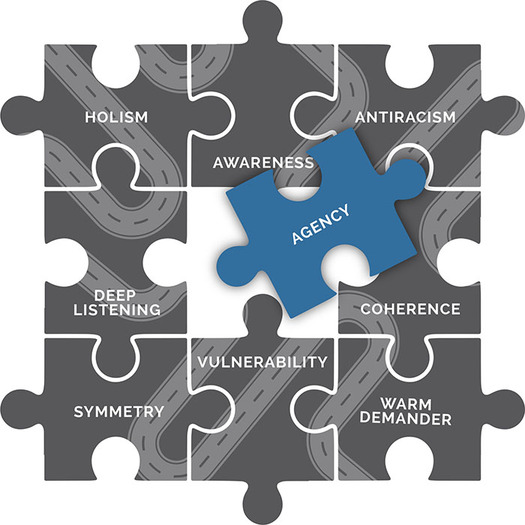
Agency is the core stance of this chapter. Our equity efforts truly begin when we redefine success as the cultivation of student agency and realign our measures of success to this goal. This requires an explicit shift from satellite data to street data. To make such a shift, we must grapple with why voice and agency matter, particularly for historically marginalized students, and how to reshape our curriculum and pedagogy to these ends. Let’s look at the BALMA project for insight.
The BALMA project was a social experiment where three teachers—one white (myself), one Afro-Cuban (Lisa), and one Filipino (my teaching partner, Rex de Guia)—linked arms to pull back the curtain on educational inequity and empower our students as changemakers. Through this experience, our students developed college literacy and critical thinking skills; wrote incisive essays about the opportunity gaps they were witnessing, drawing on the work of James Baldwin, Paolo Freire, and bell hooks; and created reflective art pieces about who society was molding them to be versus who they wanted to become. As they developed collective efficacy, they designed and led a community forum with over two hundred people from San Francisco and Marin counties to share their findings and attended school board meetings to demand structural change.
In short, they developed a profound sense of agency by connecting to each other and to something larger than themselves. Each of the examples above—essays, reflections, public speaking, community advocacy—provided us, their teachers, with rich street data on learning. None of them could have been captured in a “metric.”
 Description
Figure 5.1 Agency Framework
Copyright © 2021 by Shane Safir. All rights reserved. Reprinted from Street Data: A Next-Generation Model for Equity, Pedagogy, and School Transformation by Shane Safir and Jamila Dugan. Thousand Oaks, CA: Corwin Press, Inc., www.Corwin. com. Reproduction authorized only for the local school site or nonprofit organization that has purchased this book.
If we are serious about creating equitable school systems, we need to stop measuring children on norm-referenced tests and start measuring what matters: student agency. Agency is the idea that people have the capacity to take action, craft and carry out plans, and make informed decisions based on a growing base of knowledge. In the social ecology of the classroom, agency is about connection to self, peers, adults, the community beyond the classroom, and ultimately the world. Agency doesn’t emerge in a vacuum, nor does it flourish in a traditional classroom where the teacher is positioned as a content expert dishing out knowledge. It emerges in a learning space where power is distributed, knowledge is democratized, diverse perspectives are welcomed, and children are intellectually and emotionally nourished.
Let’s think about agency in relationship to four domains: identity, mastery, belonging, and efficacy. To experience agency, you must first feel that your core identity—your ways of being, learning, and knowing in the world—is valued. Tunison (2007) notes that “lack of identity, lack of voice, and low self-esteem” can damage the learning spirit—an Indigenous concept that spirits travel with individuals and guide their learning, providing inspiration and the unrealized potential to be who we are. Author and founder of the abolitionist teaching movement Bettina Love defines spirit murdering in schools as “the denial of inclusion, protection, safety, nurturance, and acceptance because of fixed, yet fluid and moldable, structures of racism” (Love, 2013).
The second component of agency is mastery, framed as the ability to build knowledge and demonstrate understanding as a learner. To experience mastery, students must be able to show what they know in nontraditional ways. Pencil-and-paper tests not only trigger acute anxiety for many learners, they also lack the nuance and texture of street data. In reality, they are micro-versions of standardized tests that function like satellite data inside the classroom. Why did the student solve the problem the way they did? How were they feeling when they took the test? What happened earlier that day or morning that may have impacted their performance? With traditional assessments, we are left guessing. Project-based learning, performance assessment, and discussion-based classrooms, on the other hand, create an infrastructure for students to explore, construct, reflect on, and publicly demonstrate knowledge. Students become agents in their own learning rather than consumers of curriculum. For example, when our BALMA students presented their findings to a community forum of two hundred people, they enjoyed an authentic audience to share their learning with. This held them accountable and raised the stakes on their work in the best possible way.
At my second teaching job in Oakland, California, I was asked to create a graduate capstone project for seniors. I was teaching ninth and twelfth graders, almost exclusively Black, Latinx, Southeast Asian, and first generation to college students. My seniors would be the first class to present and defend their capstones to a committee of teachers, peers, and community members. I vividly recall Alberto—a young man who had left behind a life of stealing, stripping, and reselling Honda vehicles to become a budding scholar—presenting his capstone in a beautiful guayabera shirt, translating each part into Spanish for his proud mamá. I was Alberto’s advisor and English teacher, so I had the privilege to coach him through the process. He had meticulously prepared, did a fantastic job, and when the committee announced that he had passed his capstone, he broke down in tears. Why? He felt an overwhelming sense of agency in having shared his knowledge publicly in ways that honored his family, heritage, and language. What test could possibly capture that?
The third component of mastery is belonging, which is encapsulated in the statement, “I see myself, and I am seen and loved here.” Belonging emerges in a classroom characterized by deep and caring relationships. Author Zaretta Hammond frames relationships as the onramp to learning, particularly for marginalized students who may have little reason to trust their educators (Hammond, 2014). Herb Kohl describes the phenomenon of “willed not learning,” whereby students resist being intellectually vulnerable in the face of teachers who don’t authentically care about them (Kohl, 1995). Deep learning can only happen in a classroom where a child feels a sense of belonging.
Despite piles of research on the importance of relationships and connectedness to the neuroscience of learning, many Black and brown students experience an acute lack of belonging when they enter their school buildings. According to Californians for Justice, a youth organizing group, one out of every three California students cannot identify a single caring adult on campus. I have worked with districts where that number rose to 50 percent. Meanwhile, 30 percent of African American students and 22 percent of Latinx students in California enter high school only to drop out before graduating, a data point replicated in high-poverty regions across the nation. We have a crisis of alienation in our schools, driven at the highest levels by the insidious messages of satellite data, in effect: “You are not achieving on these measures; therefore, we have to fix you with interventions. By extension, you don’t really belong to this academic community. You are a problem to be solved, a gap to be filled.” It hurts my heart to write those words because I know that so many young people experience school this way.
Fostering a sense of belonging does not mean plastering our classrooms and school walls with ethnically diverse posters and inspirational sayings or celebrating “diversity days”—the so-called Heroes and Holidays approach (Lee, Menkart, & Okazawa-Rey, 1998). Rather, it demands rigorous attention to systemic racism, school and classroom cultures, and the micro-interactions that characterize a student’s passage through the school day. This is why shadowing a student delivers such powerful street data: It gives us a ground-level view of the ways in which children are included, excluded, marginalized, or just plain invisible in their learning environments.
Finally, agency is about nourishing students’ sense of efficacy—a feeling that “I can make a difference here.” Collective teacher efficacy, the shared belief among teachers in their ability to positively affect students, has emerged in John Hattie’s research as the number one influence on student learning (Hattie, 2008). For our purposes of assessing student agency, efficacy means the learner’s ability to set an intention and produce a desired result, and it is absolutely critical to healing from and transforming oppression. Scholar Shawn Ginwright describes the importance of helping young people take “loving action, by collectively responding to political decisions and practices that can exacerbate trauma” (Ginwright, 2018). Taking action via project-based learning, peer surveys, organizing a walkout, or building a resource for your community vests students with a sense of power and control over their lives, which research has shown is one of the most significant factors in restoring well-being for marginalized groups.
How Can We Measure Agency? Three Ideas

1. Administer a ten-question pre- and post-survey on 1–4 Likert scale, from strongly disagree to strongly agree.
· My culture, identities, and ways of being are valued here.
· My ways of learning are valued here.
· My ways of knowing and understanding the world are valued here.
· I have opportunities to build and construct my own knowledge.
· I have opportunities to demonstrate understanding to peers and teachers.
· I have opportunities to demonstrate understanding to the community or groups of people beyond my classroom.
· I see myself represented in the staff, curriculum, and school culture.
· I feel seen and loved by my teachers.
· I feel seen and loved by my peers.
· I feel like I can make a difference here.
Elementary Version: 5 Questions
· I feel important here.
· Everybody knows my cultural identity and how to pronounce my name.
· I get a lot of chances to show what I know here.
· I feel like my teacher cares about me.
· I feel like my classmates care about me.
2. Conduct agency interviews with a sample of students, asking the following:
· To what extent do you feel your ways of being and learning are valued here?
· How often do you have opportunities to construct your own knowledge (versus taking notes or digesting information provided by the teacher)?
· How often do you have opportunities to demonstrate your understanding in a way that’s different from a test or quiz? What is that experience like?
· To what extent do you feel like you belong here? Why or why not?
· To what extent do you feel seen and loved here? Why or why not?
· When is the last time you felt that you could make a difference here about something that matters to you? What was that like?
· What ideas do you have to make our school a place where you feel a greater sense of power and agency?
Elementary Version
· Does this class help you feel smart? Why or why not?
· When is the last time you came up with your own idea in this class, and how did it feel?
· What’s your favorite way to show what you know?
· Do you like coming to this class? Why or why not?
· Do you feel loved by your teacher and peers? Why or why not?
· If you could wave a magic wand to make something different here, what would it be?
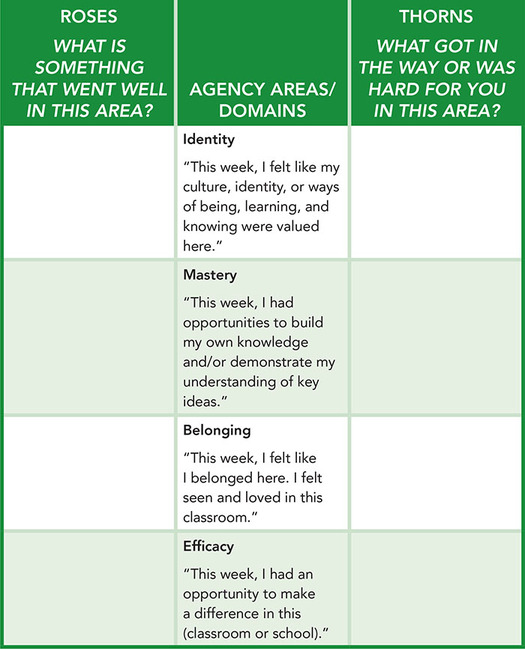
3. Have students regularly complete a single-point rubric1 reflection on agency:
|
Roses What is something that went well in this area? |
Agency Areas/Domains |
Thorns What got in the way or was hard for you in this area? |
|
Identity “This week, I felt like my culture, identity, or ways of being, learning, and knowing were valued here.” |
||
|
Mastery “This week, I had opportunities to build my own knowledge and/or demonstrate my understanding of key ideas.” |
||
|
Belonging “This week, I felt like I belonged here. I felt seen and loved in this classroom.” |
||
|
Efficacy “This week, I had an opportunity to make a difference in this (classroom or school).” |
1 According to blogger Jennifer Gonzalez, a single-point rubric breaks down the components of an assignment into different criteria but only describes the criteria for proficiency; it does not attempt to list all the ways a student could fall short, nor does it specify how a student could exceed expectations (Gonzalez, 2014).
TOWARD A PEDAGOGY OF VOICE
Reorienting ourselves from test scores to student agency requires a pedagogical reorientation that transforms power in the classroom and ignites the natural curiosity and intellect of young people. Critical pedagogy, a teaching approach popularized by Paolo Freire, helps students question and challenge the status quo, develop habits of mind that go beneath surface meaning, uncover root causes of oppression, engage in deep thinking, and create counternarratives about their lived experiences. It is a practice that cultivates critical consciousness in students whose voices and ideas have been marginalized. Culturally responsive education invokes a pedagogy that recognizes the importance of including students’ cultural references in all aspects of instruction and calls for deep cognitive engagement of learners whose culture and experiences have been relegated to the margins (Ladson-Billings, 1994).
A pedagogy of voice emerges at the intersection of critical pedagogy and culturally responsive education, offering an instructional technology and way of being that shifts the locus of learning and power to the student. A pedagogy of voice transcends numbers and metrics to create street-level learning experiences that foster healing, cognitive growth, and agency. It centers street data through dynamic student dialogue and rich student work, and it decenters compliance, grading, the quest for “answers,” competition, and all the other features of dominant classroom culture that uphold the testing-industrial complex.
To cultivate student voice, we must first feel a sense of agency as educators. We have to free our minds from the persistent narrative that test scores and even grades tell a legitimate story about our students’ success. We have to free our own learning spirits to be bold and experimental—to try pedagogical approaches that feel new, edgy, and perhaps uncomfortable. We have to be willing to flip our pedagogy and instructional leadership to center student and teacher voices, just as we flipped the dashboard to center street data. This requires that we recognize the features of a pedagogy of compliance that still operate inside many classrooms and professional-learning spaces.
A pedagogy of compliance continues to dominate the majority of American classrooms, particularly at a secondary level, characterized by lecture-style instruction, students in rows looking toward the teacher as knowledge expert, and teachers carrying the cognitive load. This model minimizes instructional conversation between teacher and student and among students. According to a Gallup poll, only 53 percent of our nation’s students report they are engaged in their formal learning, as measured by three factors: enthusiasm for school, whether they feel well known, and how often they get to do what they do best. Latinx and African American teens are especially disconnected (Gallup, 2014; Annie E. Casey Foundation, 2012). Compliance-driven pedagogy leads to student disengagement.
Freire described the compliance approach as a banking model of education, which positions the teacher as subject and active participant and the students as passive objects. Education is viewed as a process of depositing knowledge into students’ brains, with little to no attention to students’ preexisting knowledge and cultural schema. The purpose of the banking model is to develop students into “adaptable, manageable beings…. The more completely they accept the passive role imposed on them, the more they tend simply to adapt to the world as it is and to the fragmented view of reality deposited in them” (Freire, 1970). Compliance is the end game. Table 5.1 frames the shift from a pedagogy of compliance to a pedagogy of voice.
Table 5.1 Shifting From a Pedagogy of Compliance to a Pedagogy of Voice

|
From a Pedagogy of Compliance … |
… to a Pedagogy of Voice |
|
|
Primary Form of Data |
Tests and quizzes (traditional assessments) |
Street data (formative assessments, performance-based assessments) |
|
Core Belief |
Hierarchy of power: teacher wields expertise and distributes “content” |
Democratization of power: teacher and students build knowledge together |
|
Core Instructional Approach |
Lecture-style dissemination of information |
Active learning through inquiry, dialogue, projects, simulations, etc. |
|
Roots in Critical Pedagogy |
Freire’s banking model of education |
Freire’s problem-posing model of education |
|
Roots in Culturally Responsive Education |
Rests on invisible norms of dominant culture (quiet, compliant, task oriented, individualistic) Views marginalized students through a deficit lens: What gaps can I fill? |
Rests on foundation of collectivist cultures (collaborative, interdependent, relational) and includes students’ cultural references in all aspects of learning Views marginalized students through an asset lens: What gifts do you bring? |
|
Views Students as … |
Vessels to fill with information |
Culturally grounded critical learners |
What if shedding the pedagogy of compliance and embracing a pedagogy of voice were easier than it appears? What if we could subscribe to a few simple rules that, if held with fidelity, would produce the kinds of dynamic, holistic, and equitable classrooms we dream of and long for? I am a big believer in simplexity, a term coined by global thought leader Michael Fullan as a way to navigate complex realities with simple rules. Fullan’s advice is to identify a small number of core factors (6 or so) that constitute your focus (the simple part), recognizing that the challenge is how to make them coalesce in actual learning spaces (the complex part) (Fullan, 2009).
Six simple rules guide a pedagogy of voice that will release you from the shackles of compliance:
· Talk less, smile more
· Questions over answers
· Ritualize reflection and revision
· Make learning public
· Circle up
· Feedback over grades
If you are a teacher struggling to break free from traditional methods, breathe these ideas in and let them settle in your mind. If you are already living inside the pedagogy of voice and want to bring your colleagues along with you, use these ideas as an invitation to conversation. If you are an administrator working to transform instruction, adapt these ideas into an instructional vision, use them to structure coaching and adult learning, and shape them into a public narrative about where you want your school to go. Let’s dig in.
SIMPLE RULE 1: TALK LESS, SMILE MORE
In Lin Manuel Miranda’s musical Hamilton, politician Aaron Burr is mentoring the young Hamilton, in a bar no less. His main piece of advice is to talk less, smile more, and not let people know what his beliefs and views are. If I could write the perfect lyric to capture the pedagogy of voice, this would be it! Colleagues, if you can change one thing tomorrow—whether you’re a classroom teacher, teacher leader, coach, or administrator—try to talk less, smile more, and design lessons and professional learning that allow learners to discover what they think and feel.
Why does this matter? As long as we do the talking and make knowledge deposits into the learner’s brain, we are carrying the cognitive load. We are doing the thinking. We retain power and inhibit the growth of agency. Shift the thinking and cognitive load to the learner by designing curriculum (and adult learning) around probing, reflective questions with ample time for discussion. My personal rules of thumb are as follows:
· Never talk more than ten to fifteen minutes without pausing for information processing and/or reflection.
· Design lessons and adult learning so that learners are engaged in conversation with each other at least 75 percent of the time.
· During that time, circulate, coach, and ask more questions. Model a culture of inquiry.
What about the “smile more” part of Aaron Burr’s advice, you might be wondering? Here, we turn to the power of nonverbal communication to foster or shatter a child’s experience of belonging. When we smile and use tone and other nonverbal cues to convey warmth, we signal to students that they are safe, welcome, and able to take risks. (Note: This doesn’t mean we never model gravitas or firmness in our demeanor.) For students who have been personally and educationally marginalized, this is crucial. Think about a classroom in which students have experienced trauma, including microaggressions by peers and/or teachers. The teacher’s emotional tenor will be at least as important as the content they share. Talking less and smiling more helps us communicate to every child, “You are seen and loved here.”
SIMPLE RULE 2: QUESTIONS OVER ANSWERS
Children are naturally inquisitive. A recent study led by British child psychologist Dr. Sam Wass found that children ask an average of seventy-three questions per day (Steingold, 2017)! Good questions are important, interesting, and don’t have a clear answer. Unfortunately, far too many students are still required to sit quietly and absorb information from their teachers. Those children who dare to ask questions risk being pathologized as “disruptive” and “off-task.” This is especially true for many Black students whose brilliance and curiosity is filtered through a lens of racism and bias.
In order to shift the cognitive load, we have to create a culture of inquiry in our classrooms and professional-learning spaces. This means that we begin to prioritize questions over answers. I remember watching Danfeng Koon, a founding math teacher at the school I led, circulate around her ninth grade algebra classroom as students labored in small groups. When stumped by a new concept, a student would pop his hand in the air, sending out an SOS to Danfeng, who would slowly and calmly approach the table. The student would pitch a question, and Danfeng—without fail!—would respond with another question. What do you think? Who else could you ask? What are different ways to approach that problem? She held a firm belief: Never tell students something they can figure out on their own. A simple rule.
In the BALMA project that opened this chapter, we spiraled students through many layers of questions. On the project level, we asked, What can we learn about equity in education through a private-public school collaboration? As students from the two schools came together and witnessed extreme opportunity gaps in their respective experiences, we asked, What are you learning and discovering? What thoughts and feelings are emerging for you? And what do want to do about it? We also had them apply the learning inside their own school buildings, exploring the question, What types of pedagogy are happening down the hall, and how are students impacted? As students learned about Freire’s banking and problem-posing models of education, I arranged for them to observe other classrooms and take copious notes on what they saw (street data!). When they came back to my class, I drew a Freirean spectrum on the board and had each student ethnographer locate the pedagogies they had observed, justifying their responses with evidence.2
2 To state what I hope is clear, do this activity with full transparency and permission from your colleagues.
I think about questions through the lens of fractals—those never-ending patterns that replicate across different scales. When you embrace a pedagogy of voice, you commit to investing your energy in developing sharp, intriguing, rich questions at every level of the learning experience. Table 5.2 outlines different ways to think about this.
Table 5.2 Questions as a Fractal Pedagogy

|
Unit of Inquiry |
Example(s) |
|
Students pose their own questions. |
|
|
Students ask each other questions. |
|
|
Students ask you questions. |
|
|
Teacher poses questions to the class. |
|
|
Teacher structures an assessment, task, project, or unit around an essential question. |
|
The best learning is driven by students’ authentic questions—the kinds of wonderings that keep them up at night and light their cognitive fires. As an educator and instructional leader, you have the power to model relentless curiosity and the power of inquiry. Design learning experiences that allow students to begin to discover their own ideas. Stay tethered to our goal of student agency by ritually asking the following questions:
· “What matters to you about this content/project, and why?” (identity)
· “What is getting in the way of your learning/engagement, and how can I best support you?” (belonging)
· “What is the evidence for the claim you’re making?” (mastery)
· “What ideas do you want to contribute to this discussion/project? What action do you want to take?” (efficacy)
SIMPLE RULE 3: RITUALIZE REFLECTION AND REVISION
Centering student voice doesn’t mean we stop giving feedback, but it does mean we shift our role from expert lecturer to expert coach, charged with the cognitive apprenticeship of students. Reflection and revision are two of our strongest tools in this regard and help students at the margins accelerate their skills over time. Scholar Linda Darling-Hammond has written about a culture of revision and redemption that characterizes equitable classrooms:
Another important characteristic of schools with an adaptive pedagogy is a learning environment where teachers are aware of what students are thinking, and where the curriculum does not move on when students do not learn immediately. Unlike the traditional “teach, test, and hope for the best” approach, … adaptive teachers don’t say, “You got a C-” on this assignment and then move on to the next unit without looking back. Instead, they give students the opportunity to tackle difficult tasks without fear of failure by promoting a culture of revision and redemption that encourages students to attempt challenging work, provides continual opportunities for practice and revision, and supports students in developing the courage and confidence to work continuously to improve in their successive efforts. (Darling-Hammond, 2002, p. 28–29)
Reflection and revision can take place daily, weekly, and throughout a unit of instruction. Here are a few ways to operationalize this simple rule:
· Teach reflection and revision as explicit skills and processes. Consider this core content and model it in your instruction. Be vulnerable in sharing times when you have had to revise a piece of work to make it better. Reflect publicly on instructional mistakes you make.
· Begin a class period with time for students to reflect in writing and/or a turn and talk: What did you learn yesterday that stuck with you? What’s a concept that still feels confusing?
· Use the traffic light strategy for students to signal how well they understand the current content. Give each student a red, yellow, and green square of paper or mini-plastic cups. Have them put the color on top that indicates where they’re at: green for “I’m good,” yellow for “I sort of get it, but have some questions,” red for “I’m lost! SOS!”
· End each week with a reflection protocol: What did I learn this week? What’s one thing I feel proud about? What’s one thing I’m still struggling with? Have them share their responses in small, ongoing peer groups and close with each student giving the peer to their left or right an appreciation.
· Provide students with graphic organizers and structured protocols for giving each other feedback on their work. Teach them to sandwich feedback! “What I loved about this piece of work was … One question I had was … One suggestion I have is …”
· Whenever possible, make time for one-on-one conferencing with students around their work. Conferences can provide the most impactful learning moments.
SIMPLE RULE 4: MAKE LEARNING PUBLIC
You were courageous to take some kids that were very city-oriented to other areas, trusting us. You trusted us to run a classroom of juniors as mentor seniors, right? You said, “Here’s your parameters; now create your lesson plan.”
—Damien Padilla, BALMA graduate, union organizer, and grassroots safety lead, Pacific Gas & Electric
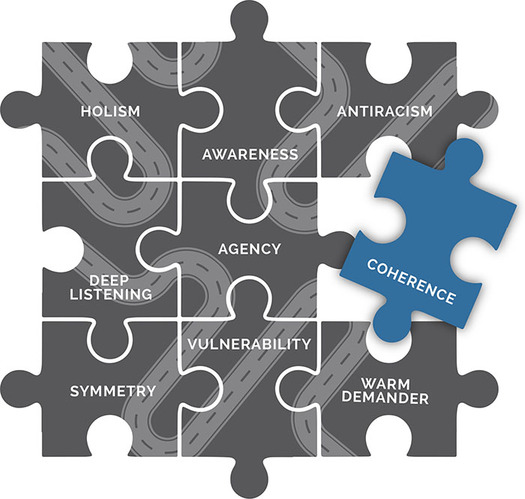
One of the quickest ways to embrace a pedagogy of voice is to put students in the driver’s seat by having them design and teach lessons. On a macro-pedagogy level, you can build units and projects around culminating exhibitions and/or performance-based assessments. To cultivate agency, we have to stop being the only audience for student work. We must create authentic ways for students (and adult learners) to share the knowledge they are building. Student work is the yin to the yang of student voice. Public learning, which contributing author Carrie Wilson will apply to an adult-learning context in Chapter 7, is most impactful when situated in a holistic performance assessment system that is based on common, school-wide standards and integrated into daily instructional decisions. Such a system shows students what they need to do by providing models, demonstrations, simulations, and exhibitions of the kind of high-quality academic work they need to produce. More on this in Chapter 6 when we discuss coherence!
Here are a few features of public learning that you can begin to experiment with in your classroom, grade-level team, department, school, or district:
· Portfolios of student work that showcase in-depth study via research papers, original science experiments, literary analyses, artistic performances or exhibitions, mathematical models, and more
· Rubrics that represent explicit, shared standards against which to assess student work and performance
· Oral defenses by students to a committee of teachers, peers, and, potentially, community members that allow educators to listen for in-depth understanding
· Multiple opportunities for students to revise their work, redeem their academic status, and grow their skills in order to demonstrate learning (Adapted from Darling-Hammond, 2002, p. 16)
SIMPLE RULE 5: CIRCLE UP
The structure of compliant classrooms is painfully predictable: students in rows, plugged into individual desks like widgets, taking notes from a sage-on-stage up front. This scene implicitly communicates to students that their voices don’t matter, their cultural schema and knowledge are tangential at best, and their job is to get “filled up” by the expert at the helm. By contrast, reshaping our classrooms and adult-learning spaces into circles communicates equality of voice and membership in the community. Circles represent the village coming together for dialogue and signal to the learner: “You belong here, just as everyone around you belongs here. I want to see your face and hear your voice.”
My colleague Perry Smith, an education leader in British Columbia, notes that circles are an Indigenous structure used for thousands of years across North America and the world. Rooted in Indigenous ways of knowing, circles surface in ceremony, gatherings, events, the cyclicality of verses in songs, and even the shape of the drum. In Perry’s words, “All the power in the world comes from the circle. When we sit in a circle, there is no head. Everyone is equal” (P. Smith, 2020). Disrupt the pedagogy of compliance by reshaping your classroom around the circle. Use circles to design the following:
· Socratic seminars
· Concentric circle activities: An inner group of learners faces outward, and an outer group faces inward, forming discussion pairs. One circle rotates each time the teacher offers a new prompt or question for dialogue.
· Science lab experiments or mathematical modeling where students huddle around a table
· Design-build projects where students huddle around materials and a design challenge
· Literature circles where students engage over time in academic discussion of a shared text, with their questions driving discussion
Circles are an adaptable shape and the signature structure of a democratic classroom. They transform power, allowing each student to find their voice and including the teacher in a non-hierarchical community of learning and practice.
SIMPLE RULE 6: FEEDBACK OVER GRADES
Finally, a pedagogy of voice requires us to break the stranglehold that grading has over classrooms across the country. As a parent and educator, I see teachers lost in algorithms, equations, and formulas that strip critical judgment out of teaching and learning. Grading echoes the econometric framework of testing, presuming that we can encapsulate learning in a number or a letter. Street data reminds us that our primary task as educators is to provide regular feedback to students so they can grow, not to evaluate them in order to anoint them academically capable or not.
Feedback can be its own equity trap and trope, contributing to distrust or diminished confidence for BIPOC students if not delivered with care. Claude Steele and his colleagues coined the term wise feedback to describe a way of providing students of color with structured, empowering explanations that mitigate stereotype threat and reduce the possibility that feedback is experienced as biased (Cohen, Steele, & Ross, 1999). This process includes three instructional elements: Describe the nature of the feedback being offered; emphasize and explain the high standards used to evaluate the student work, and organize the feedback; explicitly state a belief that the student has the skills needed to meet those standards.
Feedback helps us remember that learning is messy, in the best possible way! Every moment in the classroom is an opportunity to gather street data on the cognitive complexities of learning—the aha moments, the stumbling blocks, the bursts of creativity, the spirals of self-doubt and shame, the neurological effects of stress and trauma. Rather than contribute to our understanding of what’s getting in the way for students, grades often create added stress and emotional pressure, particularly for children with learning differences and those struggling to catch up to grade level.
My colleague Joe Feldman’s masterful book Grading for Equity (Feldman, 2018) takes up this topic in-depth (I highly recommend it), but I’ll offer a few tips in the spirit of simple rules:
· Stop grading homework. Homework should be framed as low-stakes practice on new skills, not a hammer to promote compliance or punish children who struggle to get it done.
· Stop measuring participation. Participation grades are rife with bias, inviting unconscious discrimination against students with attention challenges or cultural/communication styles that don’t mirror the teacher’s. Participation is notoriously hard to measure, so just don’t. As a footnote, reimagine all behavior charts. They are often punitive, shaming, and biased.
· Allow late work. One principal I know established a three-day grace period for every student for every assignment. He explained it like this: “The penalty for not doing the assignment is doing the assignment!”
· Allow redos and retakes. Any student should be able to retake a major assessment for a full new grade as long as they are coming to school and putting in basic effort. This tacks to the culture of revision and redemption we discussed earlier.
· Use descriptive, criterion-based rubrics instead of points. Points promote a culture of bean-counting and competition, whereas rubrics, when well-crafted, promote reflection.
· Use grades to summarize student achievement over time, after the child has had ample opportunities to redo and revisit, not to punish or change student behavior.
· Eliminate the zero. It severely disadvantages learners who are struggling for a variety of reasons and breeds hopelessness.
· Make time for narrative feedback and student conferencing, whenever possible. If your student load is too high, teach students to do this with each other in structured peer conferences.
The six simple rules cut across micro- and macro-pedagogies, from small moves at the interpersonal level to big moves in curriculum and assessment design. Put together, they will help you shape a pedagogy of voice that generates rich street data and cultivates the most important measure of all, student agency.
THE BALMA PROJECT, REVISITED
In this chapter, we connected the concept of street data to the instructional core, positing that equity work is first and foremost pedagogical. We reframed success through the lens of student agency, imagining what it would be like to measure identity, mastery, belonging, and efficacy rather than test scores. And we explored six simple rules of a pedagogy of voice that will help us break free from the compliance mindset sewn by the testing era. The implications of these shifts are monumental. Access to a pedagogy of voice and agency can change a student’s life trajectory.
I recently had the opportunity to sit down with five BALMA project students who are now adults with careers, families, and lives of their own. Taina Gomez (2019), now a public defender, shared this:
Our teachers inspired us to believe that we could do anything. They inspired us to believe that we were worthy and smart and capable. I think they saw something wonderful in us…. [The BALMA project] helped us see beyond our own communities, that there is this huge big world out there and despite the obstacles that we faced, some of which we had no control over, we could overcome…. I was able to be the first one in my family to go on to college. I obtained a full tuition ride to UC Berkeley, and I was able to go on to law school afterwards.
The BALMA project was simply one project that allowed students to find their voices, become agents of change, and develop critical consciousness around culturally and personally relevant issues. Our day-to-day lessons emerged from the micro-pedagogies of relationship, belonging, inquiry, feedback, discussion, field research, and taking action. Teachers across the country and globe build learning experiences like this every week. As I look back, a thought arises in me: This felt like the practice of freedom.
GETTING UP CLOSE AND PERSONAL: REFLECTION QUESTIONS

1. Share a passage that struck you. Reflect on the feelings it brought up and its implications for your practice.
2. What are your reactions to the idea of measuring student agency in the areas of identity, belonging, mastery, and efficacy? What would this look like in your role and context?
3. Which of the six simple rules for a pedagogy of voice most resonate with you and why?
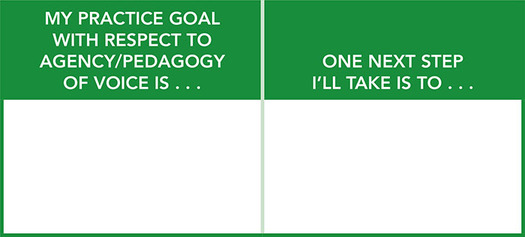
4. Set a practice goal for yourself, either around moving toward student agency as a core stance and metric or around a pedagogy of voice. Write your goal below, alongside one concrete next step you’ll take.
|
My practice goal with respect to agency/pedagogy of voice is … |
One next step I’ll take is to … |
Descriptions of Images and Figures
Back to Figure
The agency framework is described as follows:
The innermost heart has the text agency followed by the four components in the outer hearts. The details of each component are as follows:
· Identity: My ways of being, learning, and knowing are valued here.
· Belonging: I see myself, and I am seen and loved.
· Mastery: I can build knowledge and demonstrate understanding.
· Efficacy: I can make a difference.
To the right of the heart shapes are four dials showing the levels of the four components and the details are as follows:
· Identity: higher level.
· Belonging: lower level.
· Mastery: moderate level.
· Efficacy: higher level.