
Less is more; focus is everything.
We are combating the narrative of the system. The system was created to keep our voices down, and so in all shape or form, when we’re doing something that is flipping the script, we still have to speak louder in more persuasive ways…. We flipped the script on an age-old institution that really thought that learning started with just adults. That whole idea of sage on the stage and students as an empty sieve.
—Han Phung, assistant superintendent, large urban school district
In Chapter 5, we laid out a pedagogy of voice, grounded in six simple rules and oriented toward a measurement that truly matters: student agency. In this chapter, we explore an essential question: How do you bring an entire school or system toward a pedagogy of voice? Put differently, how do you get past the outlier syndrome, where a few exceptional teachers work their magic in a handful of classrooms—those proverbial “pockets of excellence”? Showcasing outliers is not a sustainable change strategy nor one that will increase equity for students at the margins. We need a change strategy that deepens learning and transforms instruction across the system … but how?
To explore this question, we will examine a missing link in many transformation efforts: what Fullan and Quinn call a “focusing direction” (Fullan & Quinn, 2015). You will begin to invite colleagues into critical conversations around
· What really matters to us here, in this community, right now?
· What is our equity imperative—our call to action that courageously names the racism and inequity inside our own buildings?
· What is a vision and set of assessment principles we can stand behind?
What if your community took the time to build a graduate profile (no matter what level of the system you’re working at) and authentic assessment approach that offered a counternarrative to the pedagogy of compliance and a systematic way to gather street data? Imagine what is possible for our students if we liberate ourselves from the dominant satellite paradigm. Those of us who teach children at the margins have been sold a bill of goods about the need to fill, fix, intervene, script, pace, and instruct our students into “proficiency.” As a result, many children have become what Zaretta Hammond calls “dependent learners” (Hammond, 2014) rather than the creators, thinkers, dreamers, designers, and intellectuals they were born to be. Many educators have internalized mindsets and biases that are hard to shake, from compliance pedagogy to punitive discipline to a focus on control over connection. We may police the bodies of Black and brown students in tacit consent with systemic oppression. Think of Grace, a fifteen-year-old Black girl with ADHD who was literally sent to juvenile detention for not doing her online homework (Cohen, 2020).
What gives me hope is that it is possible to transform our ways of thinking, teaching, and being with students. We are made for rebirth and renewal, constantly changing and growing. As author Glennon Doyle writes, “We can do hard things” (Doyle, 2020). So take a deep breath and walk the path with us as we share stories of schools and districts moving toward agency and pedagogy of voice. Find quiet moments to lean into your imagination. Dream of classrooms that don’t exist yet or that only exist in pockets. Believe in the impossible.
THE CORE STANCE OF COHERENCE
Our leadership stance for Chapter 6 is coherence. Coherence comes from a Latin word meaning “to stick together.” Co signifies with, and coherence literally translates into the act or state of binding one thing with another. In education, I think of coherence as the need to slice right through the old paradigm—testing, benchmarks, grades, seat time—to allow something much deeper to emerge and bind people: shared vision. Fullan and Quinn define coherence as “a shared depth of understanding about the purpose and nature of the work … in the minds and actions, individually and especially collectively” (2015, pp. 1–2). They assert that coherence is not the same as structure, alignment, or strategy. We won’t arrive at coherence just by rearranging the deck chairs of our organizational charts or writing a new strategic plan.
In a phenomenal article, “Making the Complex Work of Teaching Visible,” scholar Pam Grossman argues that to restore teaching as a profession, we need common language around the work teachers do as well as vision. She describes the lack of shared language for teaching as an existential dilemma for the profession:
The problem, though, is that teachers have never had much consensus around matters of teaching practice. All too often, teachers have been portrayed and even valorized as isolated artisans, each doing their own thing in the classroom … we must redouble our efforts to develop a language of teaching that captures the specifics of teaching’s intellectual and relational work … In particular, we need better ways to capture how teachers create trusting relationships with students—both when teachers and students share racial or linguistic identities and when they do not . . . Similarly, as we try to prepare teachers to address inequity in their classrooms and schools, we need richer ways to describe what the complex work of addressing inequality in learning opportunities in the classroom look like.” (Grossman, 2020, para. 12)
Coherence is foundational to both systems change and social-emotional well-being. In its absence, educators lack a sense of direction and struggle to develop agency. There are simply too many things coming at them at once—all with a stated urgency—and it becomes overwhelming and, in turn, paralyzing. The same holds true for students who receive competing messages about what matters. What does it mean to do well in math? What does it mean to write well, to be a good citizen, to “participate” in class? What does it mean to earn an A? If those messages vary from classroom to classroom—and I would argue that they do in most schools—students experience fragmentation, diminished well-being, and a loss of agency.
Coherence, engendered over time through broad stakeholder engagement, offers an antidote to program-itis, that phenomenon whereby layer upon layer of underfunded mandates are piled on teachers as demands to personalize learning for an increasingly diverse student body mount (Berry, 2020). By investing in rich human conversation around the purpose and nature of the work, we accomplish a few crucial things:
· Focus: The ability to know where we are going as a community and reinforce it consistently through our messages. (Less is more; focus is everything.)
· Holism: A tenet of Indigenous epistemology discussed in Chapter 1, holism helps us account for the whole of the system and the individual learner—the emotional, spiritual, physical, intellectual, and cultural dimensions—rather than fragment people into parts.
· Well-being: An experience of holism as integration of mind, body, spirit, and identity. We can’t transform instruction if we are cognitively and emotionally overloaded by competing initiatives, nor can students develop agency and thrive in such a context. Our primitive brains kick into high gear to protect against stress.
To achieve coherence, we need a shared vision. We need to imagine a world that may not exist yet and set forth to manifest it. I invite you to consider three questions:
· What is the truest, most beautiful and holistic portrait of a graduate you can imagine?
· What is the truest, most beautiful way for students to demonstrate their knowledge you can imagine?
· What is the truest, most beautiful antiracist classroom you can imagine?
BUILDING A GRADUATE PROFILE
A graduate profile is an accessible, succinct description of what every graduate must know, understand, and be able to do. While typically articulated with seniors in mind, you can create a graduate profile at any level of the system: fifth grade, eighth grade, even kindergarten! Some people call this 21st century skills. Some call it Habits of Mind or Habits of Mind, Work, and Heart (shout-out to Deborah Meier, my mentor, friend, and the founder of Central Park East and Central Park East Secondary School whose groundbreaking work in this arena transformed the field!). Some call it Profile of a Learner. It doesn’t matter what you call it. It matters that you create it, in partnership with colleagues and ideally students, so that you can tell a story about what matters in your community. This story serves to cultivate student and adult agency by reorienting everyone toward a powerful set of localized indicators.
Ideally, a graduate profile exemplifies holism, speaking to cognitive, emotional, spiritual, and even physical domains. This signals to students that you value every part of their development and view them as interrelated. Holism requires practice, so that we begin to integrate these new ways of knowing, learning, and being until we can ultimately embody them as deep knowledge. When you adopt a graduate profile, the implication is that people at every level of the system are practicing these core skills and competencies—students and adults alike. A graduate profile, along with an authentic assessment system, forms the central storyline of transformation and guides the collection of street data.
Han Phung is the assistant superintendent of middle schools in the San Francisco Unified School District (SFUSD), a large, rapidly changing metropolitan system. SFUSD has built a six-part graduate profile that tells a story about what it means to graduate from this school district (see Figure 6.1). Han, in turn, chose to focus her middle school network on one aspect of the graduate profile: sense of purpose, sense of self (think of the spiritual and emotional domains of holism) (see Figure 6.2). She made this choice for developmental reasons: Middle schoolers live and breathe in that awkward transitional space between childhood and adolescence. They desperately need to think about their sense of purpose and self! She also made it for coherence: Schools need a less-is-more approach, and she wanted to start somewhere instead of everywhere.
 Description
Figure 6.1 SFUSD Graduate Profile
Student Photo by Alexandre Debiève at https://unsplash.com/@alexkixa
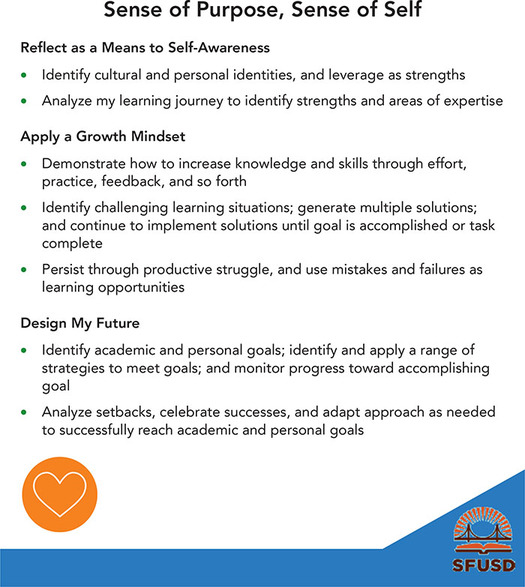
Figure 6.2 SFUSD Middle School Network Focal Domain of Graduate Profile
If you are interested in an elementary-level example of a graduate profile, see Appendix 6.1.
It is possible that you already have a graduate profile in place, either district or schoolwide. If so, that’s great! Think for a moment about the degree to which this document actively guides curriculum, instruction, assessment, and adult learning. We hope the questions below will help you strengthen implementation of this tool. When developing a graduate profile, here are a few considerations, adapted from the work of Envision Learning Partners (ELP).1
1 Envision Learning Partners is an organization that has been supporting schools, districts, and states around performance assessment for ten years.
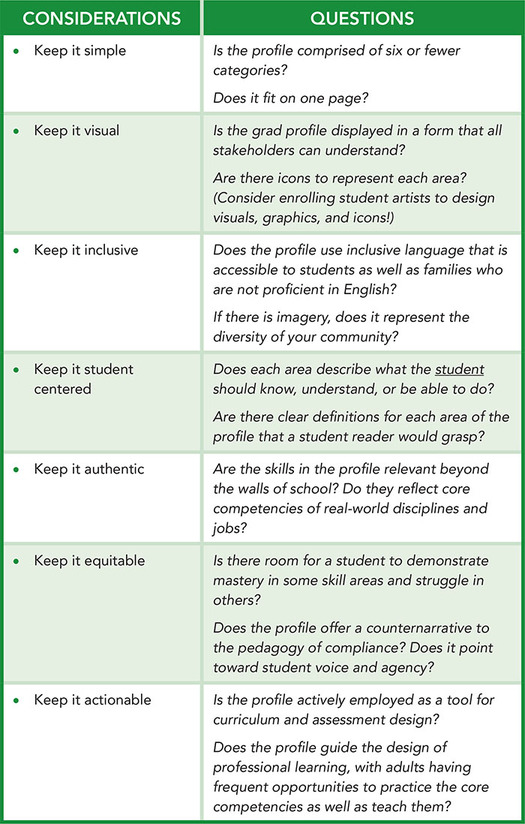
|
Considerations |
Questions |
|
Is the profile comprised of six or fewer categories? Does it fit on one page? |
|
Is the grad profile displayed in a form that all stakeholders can understand? Are there icons to represent each area? (Consider enrolling student artists to design visuals, graphics, and icons!) |
|
Does the profile use inclusive language that is accessible to students as well as families who are not proficient in English? If there is imagery, does it represent the diversity of your community? |
|
Does each area describe what the student should know, understand, or be able to do? Are there clear definitions for each area of the profile that a student reader would grasp? |
|
Are the skills in the profile relevant beyond the walls of school? Do they reflect core competencies of real-world disciplines and jobs? |
|
Is there room for a student to demonstrate mastery in some skill areas and struggle in others? Does the profile offer a counternarrative to the pedagogy of compliance? Does it point toward student voice and agency? |
|
Is the profile actively employed as a tool for curriculum and assessment design? Does the profile guide the design of professional learning, with adults having frequent opportunities to practice the core competencies as well as teach them? |
Building a graduate profile takes time, but it is time worth spending. Ultimately, it will point the community toward a pedagogy of voice, providing a local framework for deep learning. Think of this as an iterative process, and engage as many stakeholders as possible (including students!) at every stage. Figure out how you will seek and gather feedback in the form of map and street data (surveys, focus groups, student panels, etc.). Surface questions throughout to mobilize a process of wonder and learning, not just produce a document.
Street Data Check Graduate Profile

How is the graduate profile driving the system toward coherence? Here are some ways to monitor the living, breathing street-level impact of a graduate profile.
· Hallway/classroom walls artifact scan: Walk and visually scan the hallways with a notebook or phone camera in hand to capture street data. What evidence do you see (or not see) of the graduate profile and student work linked to the profile domains?
· Classroom observations: Listen in on student-to-student dialogue in the classroom and take notes. To what extent are students using the language of the graduate profile? (e.g. “My purpose in this project is to …” “I am using a growth mindset to …”)
· Quick student interviews: During learning walks, sit with individual students for a few minutes to ask, How is this lesson connected to the graduate profile? Which of the core competencies are you learning through this unit or project? For elementary students: What are you learning today, and why does it matter?
· Project exhibitions: Invite families and caregivers in once or twice a year for an evening exhibition. Ask visitors to explore how each project demonstrates the student’s movement toward the graduate profile.
Voices From the Street Students

Danielle “Dani” Martin is a twelfth-grade student at Impact Academy in Hayward, California, who participated in a collaborative process to revise her school’s graduate profile. As part of the process, Dani did listening sessions with seven peers to gather street data on their perspectives and then presented her findings to adults and peers. Here are her words:
I reached out to my friends who don’t want to do work, who I myself have to push them to do the work. I also reached out to people who just don’t do anything—no parents around, no nothing, don’t have the motivation to do anything.
I reached out to two 11th graders, four 12th graders, and two alumni. I decided to ask them, “Do you know what the mission and vision is for Impact?” … Also, I asked them a few questions about, “What do you want to take away from Impact after you graduate?” Some people said public speaking skills, good study habits, social skills, collaborating with coworkers, knowing what credit cards are, debit cards, communication. One of my closest friends, who loves to walk into class very late, told me that he wants to take away social skills so he could talk to more people.
One of my classmates sent me another long essay saying what she thought we should focus more on “adulting” so she doesn’t have to lean on her parents after all of the hard work that they have done for her. She wants to prove to her parents that, “I can do this now. I can help you now instead of you helping me” … showing a little bit of independence.
Also, I reached out to the alumni and I asked, “How do you know how to do these things, like bills and taxes? How do you pay for your school?” He (one alumnus) was like, “Oh, not by myself.” I asked, “Do you wish that Impact taught that (financial skills)?” “Yes,” he said. Sometimes people, when I bring out the fire and ask, “Do you think after high school … you’re prepared for the real world?” [they] say, “Kind of, but I would like there to be more financial skills.”
We’ve sent out surveys, plenty of surveys, and they’re just one-word answers like, “I don’t know what to do with my future. I don’t know what I want to do.” If students like us here use our own power: knowing your own friendships, knowing the people around you, knowing your environment … That is what I did. I knew that I’m actually here for a reason to make something better.
What I did was I contacted people who are different than me and who we want to change the different generations going to Impact … So then the next generation, we have to prepare them. They prepare the other generations. We have our own power to connect to people that we have relationships with. Teachers, you may have good bonds with some of the students, but they might not open up as much as they would with other students.
A note on this story: You may be wondering, If students collect this type of powerful street data, what comes next? How can these data inform future actions on the part of the school community? We will explore these questions in Chapter 8, but for now, the lesson is this: Have students gather street-level data from other students. They may hear and learn things that we would not hear and learn as adults. To practice the mindset of radical inclusion, as the organization in which Dani’s school sits did, be sure to invite students to share, present, and make meaning around the data they collect, alongside their educators.
BUILDING A PERFORMANCE-BASED ASSESSMENT SYSTEM
Once you have prototyped a graduate profile, the question becomes, how will students demonstrate evidence of the holistic competencies and their growing sense of agency: identity, belonging, mastery, and efficacy? This is the moment when we give ourselves permission to shed everything we have been taught about assessment for the last twenty years and embrace some of the most promising, research-based work in the field. Scholar and policy leader Linda Darling-Hammond has long championed performance assessment—the demonstration and evaluation of applied skills in authentic settings—as a strategy for equity and deep learning. In a recent report, Darling-Hammond and her colleagues at the Learning Policy Institute described how performance assessments, coupled with rich curriculum and quality instruction, drive improvements in teaching and learning.
As states, districts, and schools are expanding instruction to include the competencies associated with college, career, and civic readiness, they are also developing ways to measure mastery of these deeper learning and higher-order thinking skills. These measures include performance assessments, such as portfolios, capstone projects, and senior defenses, alongside classroom performance. Meanwhile, more than nine hundred colleges have made standardized tests optional in their admissions processes and are looking for more effective ways to recognize an array of student accomplishments. As a result of these converging trends, a growing number of colleges are seeking more ways to include these broader portfolios of student work in their admission processes. (Guha et al., 2018)
In performance assessments, students use higher-order thinking skills to create a product, complete a real-world process, and publicly demonstrate their learning. Tasks range from in-class constructed responses (e.g., a reflective writing prompt on a New York Times article) to complex design challenges (e.g., create a policy framework to combat homelessness, make COVID-19 predictive models). Students can demonstrate their learning through multiple modalities, including the option of using multiple languages to make their learning/thinking visible. When I taught Macbeth to mostly Arabic-speaking high school students in Amman, Jordan, I had my students select, stage, costume, and perform scenes to an audience of about sixty peers and educators. I encouraged them to include Arabic phrases if they wanted to as well as local cultural referents, and the result was a set of incredibly dynamic, engaging, and sometimes-funny scenes!
As curriculum designers with an eye toward student voice, we can develop tasks like this that reflect the mindsets and habits of professionals in the field: scientists, performers, engineers, authors, nurses, mental health experts, historians, mathematicians, and others. This shift from students as consumers of information to practitioners of field knowledge is especially significant for Black, brown, and Indigenous students, signaling that they belong to a larger intellectual community from which many have been excluded by white supremacy.
Performance assessment reorients us from a pedagogy of compliance toward a pedagogy of voice. At full maturity, these assessments move beyond presentation of learning to defense of learning. A defense involves a student revising and preparing over weeks or even months to share polished pieces of academic work before a committee or “panel.” Panels typically include peers, teachers, a significant adult, and a community member. At June Jordan School for Equity, the school I helped to found and lead, students did a low-stakes defense at the end of tenth grade to transition from “Junior Institute” (ninth and tenth grade) to “Senior Institute” (eleventh and twelfth grade) and a higher-stakes defense at the end of twelfth grade in order to graduate. If they didn’t pass the assessment, they had to further prepare and come back to try again. Failure was not an option. Should failure ever be an option?
Our graduate profile at the time was rooted in six Habits of Mind, captured in the acronym PROPEL: perspectives, relevance, originality, precision, evidence, and logical reasoning.2 Teachers used the PROPEL habits to develop shared rubrics across all grade levels, customized by content area, that helped students self-assess and revise their work. This included the schoolwide defense rubric in Figure 6.3, which shows the 5-point longitudinal scale we used to describe growth over time from ninth through twelfth grade. As technical as all of this sounds, live defenses can be profoundly emotional experiences, as they manifest transformational moments of student agency. Watching a student discover the power of their own voice while publicly defending their ideas is magical. I recall dozens of times I witnessed students and family members in tears at the accomplishment of passing a defense.
2 You might notice that our Habits of Mind sat largely in the cognitive domain of holism. It’s worth noting that the school later developed a companion set of core values called RICH—respect, integrity, courage, and humility—which integrated the emotional and spiritual domains as well.
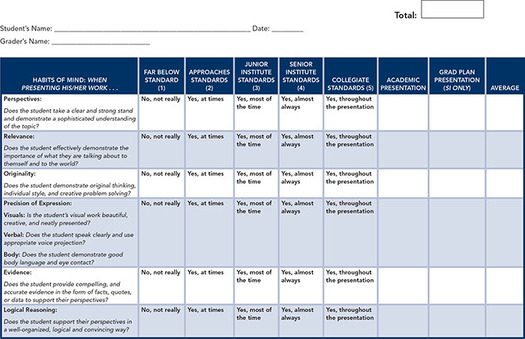
Figure 6.3 Portfolio Defense PROPEL Rubric
Like any pedagogical approach, performance-based assessment can be implemented poorly or in ways that feel transactional rather than transformational. To distinguish high-quality performance assessment, Envision Learning Partners articulates the four criteria in Table 6.1. Notice that the descriptions offer a rich roadmap to gathering street data, from tasks that ask students to demonstrate real-world skills to exemplars of student work to moments of teacher and student reflection. The macro-pedagogical shifts embedded in a move to performance assessment will pave the way toward the micro-pedagogical shifts embedded in a pedagogy of voice.
Table 6.1 Four Criteria for High Quality Performance Assessment
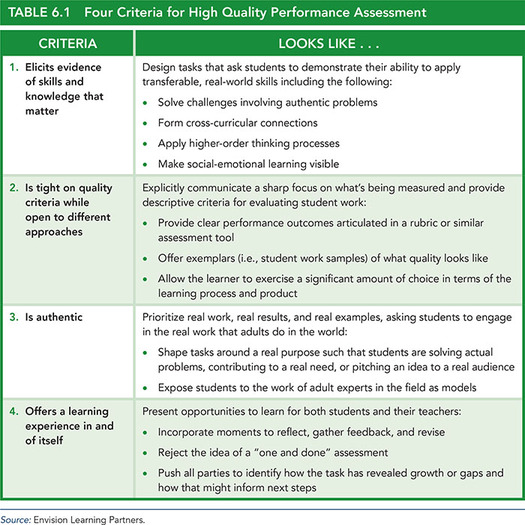
|
Criteria |
Looks like … |
|
1. Elicits evidence of skills and knowledge that matter |
Design tasks that ask students to demonstrate their ability to apply transferable, real-world skills including the following:
|
|
2. Is tight on quality criteria while open to different approaches |
Explicitly communicate a sharp focus on what’s being measured and provide descriptive criteria for evaluating student work:
|
|
3. Is authentic |
Prioritize real work, real results, and real examples, asking students to engage in the real work that adults do in the world:
|
|
4. Offers a learning experience in and of itself |
Present opportunities to learn for both students and their teachers:
|
Source: Envision Learning Partners.
In addition to building coherence, performance assessment provides a dynamic vehicle for street data cycles, which we will revisit in Chapter 8. When a student stands up to present their academic work, we have an incredible opportunity to listen deeply, uncover the students’ strengths and struggles, reimagine our curriculum and pedagogy, and move with an antiracist and student-centered lens. The fact that caregivers, peers, and community members sit in on student panels to offer feedback and pose questions exemplifies the mindset of radical inclusion. Can you imagine a parent sitting in to engage with their student on a standardized test?
When it comes to cognition, performance assessments epitomize high-quality street data. Each task offers its own rich landscape of insight into a learner’s cognitive processes, values, misconceptions, academic identity, and more. To give you a taste of how exciting this approach can be, I want to bring in the voice of Abby Benedetto, one of the smartest educators I know, to share her perspective on portfolio defenses.
Voices From the Field Educator Abby Benedetto

Yvonne, what is the battle you are fighting with the slingshot? As a young Latinx woman, first in her family to graduate from high school and attend college, Yvonne had chosen the metaphor of an Aztec warrior’s slingshot as the frame for her high school journey. Now a senior presenting her portfolio defense to a panel of her teachers and peers, she paused. With emotion heavy in her voice, she explained that it was the battle she had been fighting all of her life—trying to shoot down the stereotypes attached to her as an immigrant, a child in a single-parent household living in poverty, and a woman of color. For Yvonne, completing her defense was proof enough to vanquish those stereotypes for the moment. The slingshot metaphor was culturally meaningful for her, and even now … seven years later, I still remember how she wove it through her defense masterfully.
I think I can accurately say that I have never heard of someone being moved to tears by the power, the personal meaning, and the transformation they experienced while completing a standardized test. Over the past fourteen years, witnessing hundreds of student defenses, tears happen more often than not—both on the part of the presenting student as well as the audience. Defenses challenge students to bring their whole selves into the room in deeply rigorous and reflective ways. Yvonne, who is now twenty-five, still remembers exactly what she wore on the day of her defense and where each adult in the room was sitting as we listened to her showing us what she knew and who she was because of that knowledge. Find me any twenty-something who could do the same for the day they bubbled in answers for a state standardized test.
For students from the most marginalized populations, Portfolio Defense infuses equity into the most high-stakes assessment within a system by providing a container for self-authorship: Students choose how they want to portray themselves and what evidence they want to use to support that portrayal. This honoring of voice and story is deeply powerful and offers a different way to think about the type of data we can gather from assessment—data that represents the lived student experience as they move through their learning journey.
Yvonne is now thriving at a San Francisco-based media company that promotes health and wellness. She graduated from UC Berkeley, paving the way for her younger siblings to pursue higher education as well. She has been asked to speak to educators across the country about her experience of doing a portfolio defense. What she says again and again is that the process prepared her for college and life beyond K–12 schooling. In Yvonne’s words, “There was no better preparation for who I have become.”
· Teaching Channel original video featuring Yvonne: https://www.youtube.com/watch?v=PufMWeaHfaM
· Follow up video from Hewlett when she was finishing Cal: https://hewlett.org/students-journey-self-regulation-paved-way-success/
Street Data Check Performance-Based Assessment
How are performance assessments driving the system toward coherence? Here are ways to gather street data on the impact of performance assessment on equity and learning.
· Performance Task Artifact Probe: Review a collection of performance tasks from different content areas. To what extent are students being asked to demonstrate the skills of the graduate profile in every discipline? Is the profile living more in some areas than others?
· Rubric Artifact Probe: Schedule time with each grade-level team or department to review the assessment tools they are using to evaluate students on the skills of the graduate profile. Are there shared rubrics across content areas or at least common language? If not, what is a next step in this direction?
· Student Reflection Survey: Conduct a survey and follow-up interviews with students about the extent to which reflection, key to a pedagogy of voice, is a ritualized component of their assessments. How often are teachers asking you to reflect on what you’re learning in connection with the graduate profile? For elementary students: How often do you get to think and talk about what you’re learning and why it matters?
· Student Exit and Alumni Interviews: Schedule interviews with students who have just completed a performance assessment as well as with alumni. How do you feel your experience of completing a performance assessment (e.g., portfolio defense) prepared you for college and/or life beyond high school? How did it impact your identity as a learner? In what ways did or didn’t it foster a sense of agency? What could we do to better prepare you?
· Teacher Agency Focus Groups: Pull together a diverse group of teachers to hear their authentic perspectives on the move toward performance assessment. Ask, What excites you about the move toward performance assessment? What feels scary or daunting? What support do you need to move in this direction?
MAKING A PEDAGOGY OF VOICE COME ALIVE IN YOUR COMMUNITY
The work of developing a graduate profile and performance assessment system builds momentum toward a pedagogy of voice. It’s hard to teach lecture-style in rows if students are publicly accountable for demonstrating their learning on shared school or districtwide criteria! If you are a teacher, use the power of shared vision to begin to shift your practice toward the six simple rules in Chapter 5. If you are a coach, principal, or other administrator, begin to align coaching conversations and professional learning to the graduate profile, the design of and reflection on performance assessments and related curricula (projects, unit assessments, etc), and the constant opportunities for teachers to collaboratively plan, share, and refine lessons that promote voice and agency.
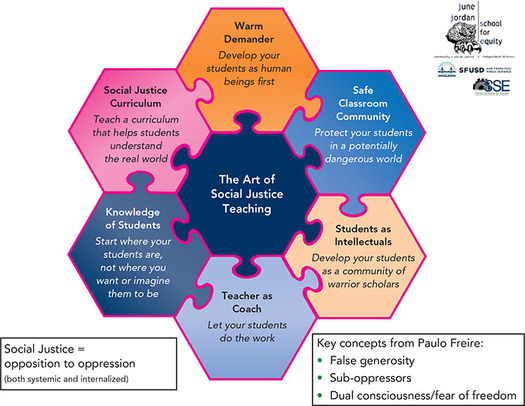
While I hope the pedagogy of voice resonates with you, I also want you to feel empowered to make those ideas your own. Taking time to prototype a local, community-responsive instructional vision can be a powerful exercise in and of itself. Let me tell you a story about that…. When I left the principalship of June Jordan School for Equity, the school was beginning to launch what they called a Pedagogy Project to capture video clips of strong instruction. This seed germinated over several years to eventually blossom into the Art of Social Justice Teaching (AOSJT), a framework describing JJSE’s unique pedagogy. The staff worked hard over time to develop shared language for teaching and learning through staff retreats, small working group meetings, peer observations, student observations, and more. Ultimately, both the process and the product led to greater coherence across the school. The AOSJT framework came to anchor classroom walk-throughs, teacher evaluation, and collaborative lesson-planning, becoming a touchstone for the ongoing work of transformation. Figures 6.4 and 6.5 show AOSJT juxtaposed with detailed descriptors of each element. Visit Appendix 6.2 to see student-created descriptors of the Art of Social Justice Teaching that came from student-led classroom observations.
I want you to hear directly from Matt Alexander, the former JJSE principal who drove this process after I left. Pay attention to:
· How the staff came together to articulate which teaching and learning practices they wanted to focus on and why
· How the staff engaged in public learning (a subject that is covered in depth in the following chapter), inquiring: When I use these practices, what’s actually happening for kids? What street data do I need to determine that?
· How the process itself was iterative and at least as important as the product
· How Matt naturally incorporates the pedagogy of voice
 Description
Figure 6.4 Six Key Aspects of Social Justice Pedagogy
Source: June Jordan School for Equity.
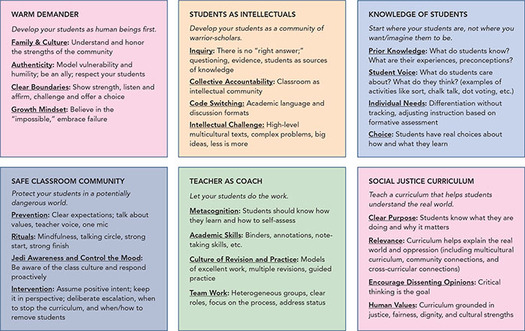
Figure 6.5 Six Aspects of Social Justice Pedagogy
Voices From the Street Former Principal Matt Alexander
Me: You helped lead the creation of the Art of Social Justice Teaching framework. What was your purpose?
Matt: Good teachers everywhere are already doing this work. We need common language and a forum to talk about it. Both new and veteran teachers will benefit from making the invisible visible, and making teaching public creates real accountability.
Me: How did you make the process meaningful for new teachers and veteran teachers?
Matt: It was for both! To the extent that teaching is really complex and an art form, even veteran teachers are constantly screwing up. I think sometimes there’s this narrative about teaching, that it’s all or nothing or that a teacher is good or bad. Even great teachers have crappy lessons, a lot of the time, or they handle a situation badly. The issue is trying to get more consistent. It’s not good or bad. It’s like, “How do we make our practice more consistent on a daily basis?”
Me: Why is this process of creating a local instructional vision important?
Matt: Although we’ve moved away from No Child Left Behind, those values have become embedded. I feel like the teacher ed programs have bought into that. I mean, look—just even one thing is that they’re always talking about learning objectives for every single lesson. Learning objectives are fine; that’s great. You should have an idea of what you want students to learn, but it starts to produce this whole mentality that you can pour knowledge into someone’s head and measure it. If you have thirty different people in a classroom—thirty different humans—why would they all learn the exact same thing from a lesson? Why would you even expect them or want them to? It’s just much more complicated than that.
Me: The AOSJT framework was just germinating when I left June Jordan in 2008. Tell me about the process you used as an instructional leader to get the staff to construct this vision.
Matt: We really spent four years working on this, and the process was in many ways more important than the product. We started with a summer all-staff retreat that we called “Vision of Teaching and Learning.” We had teachers brainstorm high-leverage instructional practices that would meet our equity challenges: In groups of three, they had to come to consensus on the top five practices.
After the retreat, a smaller group looked at all these lists and started to consolidate so that by the fall, we had the essential elements of JJSE teaching and learning. For the next few years, it was a constant iterative process. We were constantly asking, “What are the elements of good teaching and learning?” We began the Pedagogy Project, capturing video clips of classrooms where the elements felt alive. We started to do peer observations and think about evidence to find specific examples of these practices. By 2014, we had really refined the framework, and we had video examples of each of the six elements.
Me: What are your biggest takeaways from this process?
Matt: I think we have to move past the place where the instructional vision is “whatever it takes to get students to do better on these tests.” For some school leaders, there is no instructional vision yet. It’s not about re-imagining; it’s imagining it for the first time. But that’s cool! You have to have something that you’re all working toward. Once you have that, then you can do the street data cycles you are writing about. Then come back around to reimagining again. This might mean making sure your instructional vision has a strong enough lens of equity.
Me: What were some of the key leadership moves you used in this process? Can you isolate two or three or them?
Matt: I think three key leadership moves were (1) I did not try to impose an instructional vision on staff but rather expected them to develop and articulate a common vision that was student centered and justice oriented. My job was to hold the frame and provide support for the process, not to tell them what good teaching looks like, since they were the ones doing the work every day in the classroom. (2) I asked that classrooms be public spaces, where staff, students, and parents were welcome as observers at any time (exceptions were made for sensitive discussions). This allowed us as a school community to talk openly about instructional practice and created authentic relational accountability. (3) I focused on the positive and building on teachers’ strengths, including highlighting everyone’s successes in all-staff emails. Feedback from classroom visits focused on how to do more of what was working rather than dwelling on failures or missed opportunities. Because of this approach, teachers were more able to be vulnerable about their practice and, when they needed help seeing an important growth area, to receive critical feedback with humility.
FROM MANY TO FEW: WALKING THE PATH OF TRANSFORMATION
Common Core State Standards, Next Generation Science Standards, college entrance requirements, SATs, APs, standardized testing … the list is dizzying. It’s hard enough for adults to keep all of these things in our brains; there’s no way students should have to. Luckily, there is another path—building coherence by embracing focus, holism, and well-being over scattered initiatives, fragmentation, and distress. Like equity, coherence is not a destination to be measured; it’s a complex, adaptive process of collaboration, dialogue, and alignment. To build instructional coherence and transcend pockets of excellence, we have to do the slow, steady work of charting a vision and reorienting our assessment and pedagogy. Like Jamila taught us in Chapter 2, there are no shortcuts. It’s about the process. It’s about the conversations. It’s about the adult-learning culture.
A good graduate profile captures the important cognitive, social, and emotional competencies that every learner needs to develop in a simple list: “This is what you need to focus on. You just need to get good at these things. And if you do, we believe you will develop the foundational skills that allow you to thrive and begin to create the life that you want after high school.”
A strong performance-based assessment system shifts our lens from breadth—or content coverage—to depth. It empowers students at the margins as agents of learning, gives them a public platform to reflect and show growth, and exemplifies radical inclusion by engaging parents, peers, and community members in the process. Finally, all of this is designed to move you closer and closer to a pedagogy of voice—antiracist classrooms where children feel increasingly liberated to think, feel, and dream.
Here is my advice: Start anywhere, but do it together. Engage every educator on campus—custodians, paraprofessionals, security, and others have a role to play as well. Engage students in the coherence-building process as I have tried to model in this chapter. Engage parents and caregivers as much as possible. Be willing to learn, fail, motivate each other, and stay the course.
Getting Up Close and Personal: Reflection Questions

1. On a scale of 1 to 10 (10 is high), how would you assess the current level of coherence in your school, district, or organization?
2. Which of the pathways to coherence—developing a graduate profile or a performance-based assessment system—do you feel compelled to work on next and why?
3. What were your key takeaways from the story of June Jordan School for Equity’s design of the Art of Social Justice Teaching framework as a local approach to pedagogy of voice?
4. What type of courage will it take for you and your community to move in this direction, and how will you strengthen your resolve and moral imperative to do so?
5. Set a clear next step for your work to build coherence. Reflect in writing on the courage it will take for you to move forward on this journey.

|
My next step to building coherence in my context will be … |
Support I’ll need/people I need to collaborate with include … |

Descriptions of Images and Figures
Back to Figure
The graduate profile reads as follows:
At the center there is the photo of a student.
The surrounding components are:
Career and Life Skills:
1. I can manage time and resources to complete projects and tasks.
2. I can communicate effectively to authentic audiences.
3. I can self-advocate.
Global, Local, and Digital Identity:
1. I can take action for my community and my planet.
2. I can interact with cultural competence and antiracism.
3. I can practice multilingualism.
4. I can practice digital citizenship.
Content Knowledge:
1. I can think critically.
2. I can engage in inquiry (research).
3. I can compose evidence-based arguments.
4. I can analyze complex texts across the disciplines (literacy).
5. I can apply disciplinary knowledge, practices, and language in authentic contexts.
Sense of Purpose, Sense of Self:
1. I can reflect as a means to self-awareness.
2. I can apply a growth mindset.
3. I can design my future.
Leadership, Empathy, and Collaboration:
1. I can lead with and for equity.
2. I can empathize with others.
3. I can apply cooperative processes for effective collaboration.
Creativity:
1. I can create a product or engage in a performance that expresses a viewpoint or meets a need.
2. I can engage in a creative and problem solving process.
3. I can skillfully apply the techniques of creative media or design/engineering skills.
Back to Figure
The list titled Sense of Purpose, Sense of Self reads as follows:
Reflect as a Means to Self-Awareness:
· Identify cultural and personal identities, and leverage as strengths.
· Analyze my learning journey to identify strengths and areas of expertise.
Apply a Growth Mindset:
· Demonstrate how to increase knowledge and skills through effort, practice, feedback, and so forth.
· Identify challenging learning situations; generate multiple solutions; and continue to implement solutions until goal is accomplished or task complete.
· Persist through productive struggle, and use mistakes and failures as learning opportunities.
Design My Future:
· Identify academic and personal goals; identify and apply a range of strategies to meet goals; and monitor progress toward accomplishing goal.
· Analyze setbacks, celebrate successes, and adapt approach as needed to successfully reach academic and personal goals.
At the bottom of the page there is an outline of a heart and the logo of the SFUSD.
Back to Figure
The infographic reads as follows:
The center piece of the puzzle: The Art of Social Justice Teaching.
The surrounding pieces:
1. Warm Demander: Develop your students as human beings first.
2. Safe Classroom Community: Protect your students in a potentially dangerous world.
3. Students as Intellectuals: Develop your students as a community of warrior scholars.
4. Teacher as Coach: Let your students do the work.
5. Knowledge of Students: Start where your students are, not where you want or imagine them to be.
6. Social Justice Curriculum: Teach a curriculum that helps students understand the real world.
Two boxes below read:
1. Social Justice = opposition to oppression (both systemic and internalized).
2. Key concepts from Paulo Freire:
1. False generosity.
2. Sub-oppressors.
3. Dual consciousness/ fear of freedom.