
13

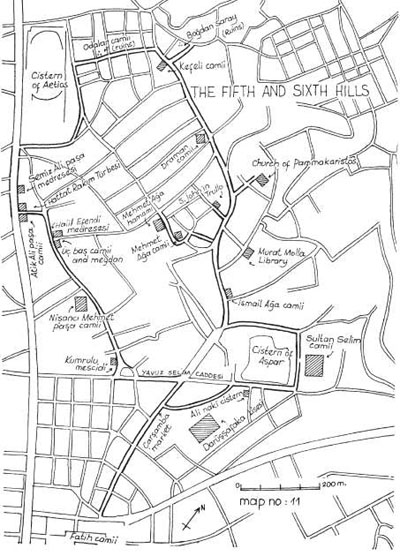
Our present tour takes us from the Fatih district on a circuit around the Fifth and Sixth Hills of Stamboul. Here we escape from almost all indications of a modern city and stroll through districts that have changed far less than in the tourist centres of Istanbul. Tourists rarely come here, for with one or two exceptions the monuments, though often interesting historically and architecturally, are not of the first importance. We come upon colourful street-markets, picturesque byways and plane-tree-shaded squares reminiscent of Ottoman Istanbul. An exploration of this out-of-the-way part of the town is rewarding as much for its village-like atmosphere as for the occasional Ottoman mosque or Byzantine church that lies hidden away down its back streets, or perches grandly on some terrace overlooking the Golden Horn.
Our starting-point will be the outer courtyard of Fatih Camii, from where the first part of our stroll will take us along the southern slopes of the Fifth and Sixth Hills, after which we will circle back in a clockwise loop. We leave through the gate to the right at the western end of the courtyard. This brings us to Darüşşafaka Caddesi, which extends north-west towards the Fifth Hill. This avenue takes us through the lively district of Çarşamba, which takes its name from the bustling open market that throngs its streets on that day. This is a travelling market that sets up its stalls and barrows in different parts of the town on different days; thus there are neighbourhoods in Istanbul named after almost all of the days in the week.
A few hundred metres along Darüşşafaka Caddesi we see off on the right the famous institution from which the avenue takes its name, the Darüşşafaka Lisesi. Darüşşafaka, founded in 1855, is an orphanage which has one of the finest secondary schools in Turkey. The school has moved to another location and its original home in Çarşamba is now empty.
KUMRULU MESCİDİ
Soon after passing Darüşşafaka we reach Yavuz Selim Caddesi and turn left. We walk along this avenue for about 150 metres and then turn right at the first through street. A short way along on the left we come to a little mosque called Kumrulu Mescidi, the Mescit of the Turtle-Dove. The mosque takes its name from a fragment of Byzantine sculpture used in the adjoining çeşme, showing two turtledoves drinking from the Fountain of Life. This mosque is of interest principally because its founder and builder was Atik Sinan, the Chief Architect of Sultan Mehmet II and the designer of the original Mosque of the Conqueror. Atik Sinan’s tombstone is to be seen in the garden of the mosque, with an inscription which tells us that he was executed by Fatih in 1471.

Continuing on the same street we come on our left to the beautiful mosque of Nişancı Mehmet Paşa. This is one of the very best of the classical mosques – and it is not by Sinan. (The mosque is, of course, popularly ascribed to Sinan, but is does not appear in the best texts of the Tezkere, the list of his works.) The identity of the architect, unfortunately, is not known, but it was built for the Keeper of the Seal (Nişancı) Mehmet Paşa between 1584 and 1588. From a distance one sees the elegance of line and the masterly arrangement of the upper structure: the great dome surrounded by the eight little weight-turrets (the continuation of the columns that support the dome arches), the eight semidomes of two sizes, and the minaret unusually close to the dome base – an excellently proportioned distribution of curves and verticals. One enters through the usual charming courtyard, the arches of which are of the ogive type; under the porch of five bays an inscription with the tuğra of Mustafa III records a restoration in 1766, presumably after the very severe earthquake of that year.
The plan of the mosque is an interesting variation of the octagon inscribed in a square. Eight partly-engaged columns support the dome arches; in the axes there are four semidomes, while in the diagonals four smaller semidomes serve as squinches instead of pendentives. The eastern semidome covers a projecting apse for the mihrab, while those to north and south also cover projections from the square. The western corners of the cross so formed are filled with small independent chambers; above on three sides are galleries. The whole arrangement is original and masterly; nor are interesting details wanting. In the corners of the east wall are two charming little kürsüs or platforms, access to which is gained by staircases built into the thickness of the wall from the window recesses. In the voussoirs and balustrades of these platforms, in the window frames, and elsewhere throughout the mosque, an interesting conglomerate marble of pale violet and grey is used; and for the columns which support both platforms and galleries there is another conglomerate marble of tawny brown flecked with yellow, gray, black and green. The arches of the galleries, like those of the courtyard, are of the ogive type. As a whole, the mosque is a masterpiece; it is as if the unknown architect, in the extreme old age of Sinan, had decided to play variations on themes invented by Sinan himself and to show that he could do them as well as the Master. In the little graveyard behind the mosque is the small and unpretentious türbe of Nişancı Mehmet Paşa.

Leaving Nişancı Mehmet Paşa Camii and continuing along in the same direction we soon come to a small square called Üç Baş Meydanı, literally the Square of the Three Heads. The square takes its name from Üç Baş Camii, the tiny mosque we see to the right of the square. Evliya Çelebi tells us that the mosque received this odd name “because it was built by a barber who shaved three heads for one small piece of money, and, notwithstanding, grew so rich that he was enabled to build this mosque; it is small but particularly sanctified.” A more prosaic explanation is given in the Hadika, a comprehensive description of the mosques of Istanbul written in 1780; there we learn that the founder, Nureddin Hamza ben Atallah, came from a village in Anatolia called Üç Baş. (But then from where did the village get its name?) An inscription over the gate gives the date of foundation as A.H. 940 (A.D. 1532–3). The mosque is of no interest except for its name.
Opposite the mosque there is a ruined medrese, founded in 1575 by a certain Halil Efendi. In the centre of the square is an old çeşme, the beautifully written inscription on which indicates that it was founded by one Mustafa Ağa in 1681. We have lingered over these oddments because the district is picturesque.
ZİNCİRLİ KUYU CAMİİ
Continuing on in the same direction as before, we take the next turning on the left and find a little mosque called Zincirli Kuyu Camii. This was built around 1500 by Atik Ali Paşa, whose larger and better known mosque is next to Constantine’s Column. Zincirli Kuyu is a small rectangular building of brick and stone construction covered by six equal domes in two rows of three supported by two massive rectangular pillars; its original porch of three bays had disappeared but has been poorly reconstructed. The mosque is interesting as being a tiny example of the Ulu Cami type of mosque borrowed from Selçuk architecture and fairly common in the first or Bursa period of Ottoman architecture. The type consists of a square or rectangular space covered by a multiplicity of equal domes supported by pillars or columns; it can be very large and impressive, as in the Ulu Cami of Bursa with its 20 domes. On the small scale of Zincirli Kuyu it is rather heavy and oppressive.
Opposite Zincirli Kuyu is a small baroque türbe dated A.H. 1241 (A.D. 1825). Here is buried the famous calligrapher Hattat Rakkım, who designed the beautiful inscription on the türbe and sebil of Nakşidil Valide Sultan. The interior of the türbe is decorated with photographs of his work.

Beyond the türbe in the main street is an attractive medrese of the classical period, which has been restored and converted into a children’s clinic. This medrese, also called Zincirli Kuyu, was founded by another Ali Paşa who was Grand Vezir in the reign of Süleyman the Magnificent. Because of his great girth he was called Semiz Ali, that is Fat Ali, or sometimes Kalın Ali, Ali the Bear. He was one of the great characters of his time and was known for his wit and conviviality as well as for his honesty, a pleasant contrast to his predecessor Rüstem Paşa. Ali Paşa was a Dalmatian by birth and had been educated in the Palace School at the Saray, later becoming in turn Ağa of the Janissaries, Beylerbey of Rumelia, Second Vezir, and finally Grand Vezir. Since he died in office in 1564, the medrese must have been built before that time. It is a work of Sinan but presents no special features except the two symmetrical entrances on either side of the dershane.
CISTERN OF AETİOS
Continuing along the main avenue for about 100 metres we come to one of the three huge ancient open cisterns. Its attribution was for long in doubt, but it has been identified with great probability as that built by a certain Aetios, a Prefect of the city, in about A.D. 421. Large as it is, it is yet the smallest of the open cisterns in the city, measuring 224 by 85 metres; it was probably about 15 metres deep. Like the others, it was already disused in later Byzantine times and was turned into a kitchen garden. It now serves as a sports arena known as the Vefa Stadium.
PANAGHİA URANON CHURCH
If so inclined, one may now pursue, part way down the valley that divides the Fifth from the Sixth Hill, the traces of some very ruined and insignificant Byzantine churches, scarcely worth the trouble of finding except for the fun of the search. We descend the flight of steps at the south-east end of the stadium and continue ahead on Kelebek Sokağı. At the end of the street we turn left on Kurtağa Çeşme Caddesi, after which we take the third turning on the right on to Dolmuş Kuyu Sokağı. Along this street there were formerly the exigious remains of two Byzantine churches, known locally as Odalar Camii and Kasım Ağa Mescidi, but these have now virtually disappeared. They have been identified as belonging to the Byzantine Monastery of the Theotokos of Petra, but the identification is highly uncertain.
About 150 metres along this street we see on the left the Greek church of the Panaghia Uranon, Our Lady of the Heavens. This church is Byzantine in foundation, but the structure in its present form is due to a complete rebuilding in 1843. Some architectural fragments of the Byzantine church can be seen built into the walls of the church.
KEFELİ MESCİDİ
A little farther along we turn right on Draman Caddesi, where almost immediately on our right we come to a Byzantine building converted into a mosque. This is known as Kefeli Camii or sometimes as Kevevi Camii; it is in fairly good condition and is still in use. It is a long narrow building with two rows of windows and a wooden roof; the entrance is now in the middle of the west wall. As in the cases mentioned above, the identification is much in dispute; it may have belonged to the Monastery of the Prodromos in Petra, and it was probably not a church but a refectory, since it has but one apse and is oriented north instead of east. It has been dated variously from the ninth to the twelfth centuries.
BOĞDAN SARAY
If on leaving Kefeli Camii we turn right and take the first street to the left almost opposite the mosque, and then again the first on the left, we soon come to the ruined crypt of a tiny Byzantine building. It goes by the lordly name of Boğdan Saray, or Moldavian Palace, because from the sixteenth to the eighteenth century it served as the private chapel attached to the palace of the Hospodars of Moldovia. It appears to date from the twelfth or thirteenth century and to have been dedicated to St. Nicholas, but it was probably not originally a church, since it is oriented to the north, but a funerary chapel. And indeed three sarcophagi were found in the crypt during some very clandestine (and unpublished) excavations carried out in 1918. At the beginning of the present century it had an upper storey with a dome, but this has now disappeared. All that remains is a tiny barrel-vaulted room, with a pretty little apse at the end.
DRAĞMAN CAMİİ
We now return to Draman Caddesi and turn left. We will stroll along this avenue, which changes its name several times, for most of the remainder of our tour. The neighbourhood through which we are walking is one of the more picturesque in Istanbul, albeit somewhat broken-down.
About 200 metres beyond Kefeli Camii we see on our right a small mosque on a high terrace reached by a double staircase. This is Drağman Camii, which is a minor work of Sinan. Unfortunately it was very badly restored some years ago and has lost any interest it may have had. It was of the rectangular type covered by a wooden roof and preceded by a wooden porch, now (hideously) rebuilt in concrete. Originally it was the centre of a small complex consisting of a medrese and a mektep, both presumably by Sinan. The medrese has perished but the mektep remains, though in ruins: a fine domed building to the north-east of the mosque. Although the mosque itself is disappointing, the high terrace, the mektep and the wild garden and graveyard are attractive.
Inscriptions show the complex was founded in 1541 by Yunus Bey, the famous interpreter (drağman, or dragoman) of Süleyman the Magnificent, of whom Bassano da Zara tells us that he was a Greek from Modon and that he “possessed the Turkish, Greek and Italian languages to perfection.” In collaboration with Alviso Gritti, bastard son of the Doge of Venice, he wrote in the Venetian dialect a brief but very important account of the organization of the Ottoman government. He also seems to have served on at least two occasions as the representative of the Grand Vezir Ibrahim Paşa to the Venetian Republic.
CHURCH OF THE THEOTOKOS PAMMAKARİSTOS
We now return to the main avenue, which here changes its name to Fethiye Caddesi, and continue on in the same direction for about 200 metres. Then, just before the road bends sharply right, we turn left and almost immediately come to a Byzantine church standing on a terrace overlooking the Golden Horn. This is the church of the Theotokos Pammakaristos, the Joyous Mother of God. Since the church sits in the middle of a large open area, one can walk around it and look at it from all sides, unlike most of the other Byzantine churches in the city. The south and east façades are especially charming with their characteristic ornamental brickwork, the marble cornices beautifully and curiously inscribed, the three little apses of the side chapel, and the multiplicity of domes on high and undulating drums.

The building consists of a central church with a narthex; a small chapel on the south; and a curious “perambulatory” forming a side aisle on the north, an outer narthex on the west, and two bays of an aisle on the south in front of the side chapel. Each of these three sections was radically altered when it was converted into a mosque in 1591. The work of the Byzantine Institute has at last cleared up many of the puzzles arising from the various periods of construction and transformation. It now appears that the main church was built in the twelfth century by an otherwise unknown John Comnenus and his wife Anna Doukaina. In form, the church was on the ambulatory type, a triple arcade on the north, west and south dividing the central domed area from the ambulatory; at the east end were the usual three apses, at the west a single narthex. At the beginning of the fourteenth century a side chapel was added at the south-east as a mortuary for Michael Glabas and his family; this was a tiny example of the four-column type. In the second half of the fourteenth century, the north, west and part of the south sides were surrounded by the “perambulatory”, which ran into and partly obliterated the west façade of the side chapel. When the building was converted into a mosque, the chief concern seems to have been to increase the available interior space.
Most of the interior walls were demolished, including the arches of the ambulatory; the three apses were replaced by the present domed triangular projection; and the side chapel was thrown into the mosque by removing the wall and suppressing the two northern columns. All this can scarcely be regarded as an improvement. Indeed, the main area of the church has become a dark, planless cavern of shapeless hulks of masonry joined by low crooked arches. This section has now been divided off from the side chapel and is again being used as a mosque.
The side chapel has been most beautifully restored, its missing columns replaced, and its mosaics uncovered and cleaned. The mosaics of the dome have always been known, for they were never concealed, but they now gleam with their former brilliance: the Pantocrator surrounded by 12 Prophets; in the apse Christ “Hyperagathos” with the Virgin and St. John the Baptist; other surfaces contain angels and full-length figures of saints. Only one scene mosaic survives: the Baptism of Christ. Though much less in extent and variety than the mosaics of Kariye Camii (see Chapter 14), these are nevertheless an enormously precious addition to our knowledge of the art of the last renaissance of Byzantine culture in the early fourteenth century.
The Church of the Pammakaristos remained in the hands of the Greeks for some time after the Conquest; in fact, in 1456 it was made the seat of the Greek Orthodox Patriarchate after the Patriarch Gennadius abandoned the Church of the Holy Apostles. It was in the side-chapel of the Pammakaristos that Mehmet the Conqueror came to discuss questions in religion and politics with Gennadius. The Pammakaristos continued as the site of the Patriarchate until 1568; five years later Murat III converted it into a mosque. He then called it Fethiye Camii, the Mosque of Victory, to commemorate his conquest of Georgia and Azerbaijan.
CHURCH OF ST. JOHN IN TRULLO
Returning to Fethiye Caddesi we follow it in the same direction for a short distance and then take the first turning on the right. We there find ourselves face to face with a charming little Byzantine church which has recently been restored. It is called Ahmet Paşa Mescidi and has been identified with almost virtual certainty as the Church of St. John the Baptist in Trullo. Nothing whatever is known of the history of the church in Byzantine times. Three years after the Conquest, in 1456, when Gennadius transferred the Patriarchate to the Pammakaristos, he turned out the nuns there ensconced and gave them this church instead. Here they seem to have remained until about 1586, when the church was converted into a mosque by Hirami Ahmet Paşa, from whom it takes its Turkish name. The tiny building was a characteristic example of the four-column type of church with a narthex and three semicircular apses, evidently of the eleventh or twelfth century. Until a few years ago it was ruined and dilapidated, but still showed signs of frescoes under its faded and blotched whitewash. The original four columns, long since purloined, have since been replaced with poor columns and awkward capitals, and the restored brickwork is also wrong.
MEHMET AĞA CAMİİ
Returning to the main avenue, we take the next right and at the end of the short street we see a small mosque in its walled garden. Though of modest dimensions, this is a pretty mosque and interesting because it is one of the relatively few that can be confidently attributed to the architect Davut Ağa, Sinan’s colleague and successor as Chief Architect to the Sultan. Over one of the gates to the courtyard is an inscription naming Davut as architect and giving the date A.H. 993 (A.D. 1585), at which time Sinan was still alive. The founder Mehmet Ağa was Chief of the Black Eunuchs in the reign of Murat III.
In plan the mosque is of the simplest: a square room covered by a dome, with a projecting apse for the mihrab and an entrance porch with five bays. But unlike most mosques of this simple type, the dome does not rest directly on the walls but on arches supported by pillars and columns engaged in the wall; instead of pendentives there are four semidomes in the diagonals. Thus the effect is of an inscribed octagon, as in several of Sinan’s mosques, but in this case without the side aisles; it rather resembles Sinan’s mosque of Molla Çelebi at Fındıklı on the Bosphorus (see Chapter 21). The effect is unusual but not unattractive. The interior is adorned with faience inscriptions and other tile panels of the best Iznik period; but the painted decoration is tasteless – fortunately it is growing dim with damp. Mehmet Ağa’s türbe is in the garden to the left; it is a rather large square building.
Just to the south outside the precincts stands a handsome double bath, also a benefaction of Mehmet Ağa and presumably built by Davut Ağa. The general plan is standard: a large square camekân, the dome of which is supported on squinches in the form of conches; a cruciform hararet with cubicles in the corners of the cross, but the lower arm of the cross has been cut off and turned into a small soğukluk which leads through the right-hand cubicle into the hararet; in the cubicles are very small private washrooms separated from each other by low marble partitions – a quite unique disposition. As far as one can judge from the outside, the women’s section seems to be a duplicate of the men’s.
LIBRARY OF MURAT MOLLA
Returning once again to the avenue, which here changes its name to Manyasizade Caddesi, we continue along in the same direction and take the next left. A short way along to the right we see the fine library of Murat Molla. Damatzade Murat Molla was a judge and scholar of the eighteenth century who founded a tekke, now destroyed, to which he later (1775) added a library that still stands in an extensive and very pretty walled garden. The library is a large square building of brick and stone supported by four columns with re-used Byzantine capitals – the whole edifice indeed is built on Byzantine substructures, fragments of which may be seen in the garden. The corners of the room also have domes with barrel vaults between them. In short, it is a very typical and very attractive example of an eighteenth-century Ottoman library, to be compared with those of Atif Efendi, Ragıp Paşa and others of the same period. Like these, it is constantly in use.
ISMAİL EFENDİ CAMİİ
We now return to Manyasizade Caddesi and at the next corner on the left we come to Ismail Efendi Camii. This is a quaint and entertaining example of a building in a transitional style between the classical and the baroque. It was built by the Şeyh-ül Islam Ismail Efendi in 1724. The vaulted substructure contains shops with the mosque above them, so constructed, according to the Hadika, in order to resemble the Kaaba at Mecca! We enter the courtyard through a gate above which is a very characteristic sibyan mektebi of one room. To the right a long double staircase leads up to the mosque, the porch of which has been tastelessly reconstructed in detail (e.g., the capitals of the columns!), but the general effect of which is pleasing except for its glazing. On the interior there is a very pretty – perhaps unique – triple arcade in two storeys of superposed columns repeated on the south, west and north sides and supporting galleries; perhaps because of these arcades the dome seems unusually high. At the back of the courtyard is a small medrese, or more specifically a dar-ül hadis, school of tradition. It has been greatly altered and walled in, but it is again being used for something like its original purpose, a school for reading the Kuran. All-in-all this little complex is quite charming with its warm polychrome of brick and stone masonry; it was on the whole pretty-well restored from near ruin in 1952.
CISTERN OF ASPAR
Returning once again to Manyasizade Caddesi, we continue along for a few paces and then take the next left into Sultan Selim Caddesi. As we walk along we now see on our right a great open cistern, the second of the three ancient Roman reservoirs in the city. This is the Cistern of Aspar, a Gothic general put to death in the year 471 by the Emperor Leo I. This is the largest of the Roman reservoirs; it is square, 152 metres on a side, and was originally ten metres deep. Some years ago one could still see its original construction in courses of stone and brick, with shallow arches on its interior surface. Up until 1985 the cistern was occupied by a very picturesque little farm village whose house-tops barely reach to the level of the surrounding streets, but then the houses were demolished to convert the cistern into a market area. Nevertheless, it is a superb setting for the great mosque of Sultan Selim I that looms ahead at the far end of the cistern.
MOSQUE OF SULTAN SELİM I
The mosque of Sultan Selim I rises on a high terrace overlooking the Golden Horn with an extensive and magnificent view. And the building itself, with its great shallow dome and its cluster of little domes on either side, is impressive and worthy of the site. The courtyard is one of the most charming and vivid in the city, with its columns of various marbles and granites, the polychrome voussoirs of the arches, the very beautiful tiles of the earliest Iznik period in the lunettes above the windows – turquoise, deep blue, and yellow – and the fountain surrounded by tapering cypress trees. The plan is quite simple: a square room, 24.5 metres on a side, covered by a shallow dome, 32.5 metres in height under the crown, which rests directly on the outer walls by means of smooth pendentives. The dome, like that of Haghia Sophia, but unlike that of most Turkish mosques, is significantly less than a hemisphere. This gives a very spacious and grand effect, recalling a little the beautiful shallow dome of the Roman Pantheon. The room itself is vast and empty, but saved from dullness by its perfect proportions and by the exquisite colour of the Iznik tiles in the lunettes. The mosque furniture though sparse is fine, particularly the mihrab, mimber, and sultan’s loge. The border of the ceiling under the loge is a quite exceptionally beautiful and rich example of the painted and gilded woodwork of the great age; notice the deep, rich colours and the varieties of floral and leaf motifs in the four or five separate borders, like an Oriental rug, only here picked out in gold. To north and south of the great central room of the mosque there are annexes consisting of a domed cruciform passage giving access to four small domed rooms in the corner. These served, as we have seen elsewhere in the earlier mosques, as tabhanes, or hospices, for travelling dervishes.
The mosque was finished in 1522 under Süleyman the Magnificent, but it may have been begun two or three years earlier by Selim himself, as the Arabic inscription over the entrance portal would seem to imply. Although the mosque is very often ascribed to Sinan, even by otherwise reliable authorities, it is certainly not so, for not only is it too early but it is not listed in the Tezkere. Unfortunately the identity of the actual architect has not been established.
In the garden behind the mosque is the grand türbe of Selim I, octagonal and with a dome deeply ribbed on the outside. In the porch on either side of the door are two beautiful panels of tilework, presumably from Iznik but unique in colour and design. The interior has unfortunately lost its original decoration, but it is still impressive in its solitude, with the huge catafalque of the Sultan standing alone in the centre of the tomb, covered with embroidered velvet and with the Sultan’s enormous turban at its head. As Evliya Çelebi wrote of this türbe: “There is no royal sepulcher which fills the visitor with so much awe as Selim’s. There he lies with the turban called Selimiye on his coffin like a seven-headed dragon. I, the humble Evliya, was for three years the reader of hymns at his türbe.”
Selim I, son and successor of Beyazit II, was 42 years old when he became Sultan and ruled for only eight years. (There is a suspicion that Selim ordered the assassination of his father, who died soon after he was forced from the throne.) Nevertheless, during his brief reign he doubled the extent of the Ottoman Empire, conquering western Persia, Syria, Palestine, Arabia and Egypt. After his capture of Cairo in 1517, Selim took for himself the title of Caliph, and thenceforth the Ottoman Sultans assumed the titular leadership of Islam. The Sultan was known to his people as Yavuz Selim, or Selim the Grim, and beheaded his Grand Vezirs at the rate of one a year. The last two years of his reign were spent preparing for a great campaign into Europe, which was cut short by his sudden and premature death in 1520. For long afterwards a cynical Turkish proverb maintained that “Yavuz Selim died of an infected boil and thereby Hungary was spared.”
Facing Selim’s türbe is another in which are buried four children of Süleyman the Magnificent. This too has a pretty and almost unique feature: the circular drum of the dome, set back a little from the octagon of the building itself, is adorned with a long inscription carved in the stonework. The porch here too has panels of faience, hexagonal tiles with stylized floral motifs set separately on the stone. This türbe was built in 1556, probably by Sinan, although there is a problem here since two of the princelings buried in the türbe died about 40 years before that time.
Standing in the garden near Selim’s türbe is the tomb of Sultan Abdül Mecit, who died in 1861; for a building of this late date it is simple and has good lines. Abdül Mecit chose this spot for his türbe because of his admiration for his warrior ancestor. Unlike Selim, Abdül Mecit’s conquests were confined to the Harem, where he fathered 42 children with 21 wives. Among the major accomplishments of Abdul Mecit is that he sired the last four Ottoman Sultans, among the worst in the long history of the Empire.
The mosque was formerly surrounded by the usual buildings of the külliye: an imaret, a medrese and a mektep. Of these only the last remains, a little domed building at the south-west corner of the outer courtyard.
CISTERN OF PULCHERİA
Leaving the mosque by the gate through which we entered, we turn left so as to walk along the north side of the Cistern of Aspar. We then turn right at the next corner into Yavuz Selim Caddesi, which borders the eastern side of the cistern. Just opposite the south-eastern corner of the cistern, at the corner of Yavuz Selim Caddesi and Ali Naki Sokağı, we find another ancient cistern, this one covered. Its name and origin are unknown, though it has been identified without any serious evidence as that of the Empress Pulcheria, wife of the Emperor Marcian. In any event, its fine workmanship seems to indicate an early date, perhaps fifth or sixth century. The interior has columns of granite or marble, in four rows of seven, with Corinthian capitals and imposts. The cistern has been restored and is now open to the public.
Continuing on past the cistern we come to Yavuz Selim Caddesi, down which we walked at the beginning of our tour. Turning left here, we walk back to our starting-point at Fatih Camii, strolling once again through the picturesque district known as Wednesday.