
14

The Church of St. Saviour in Chora, called in Turkish Kariye Camii, is after Haghia Sophia the most interesting Byzantine church in the City; not so much for the building itself, pretty as that is, as because of the superb series of mosaics and frescoes which it preserves and which have been magnificently restored and cleaned by the Byzantine Institute of America*. The name of the church “in Chora” means in the country because the very ancient monastery to which it was attached was outside the Constantinian walls; later when it was included within the Theodosian walls, the name remained (compare St. Martin’s in the Fields or St. Germain des Près) but was given a symbolic sense: Christ as the “country” or “land” of the Living and the Blessed Virgin as the “dwelling-place” of the Uncontainable, as they are referred to in the mosaics in the church.
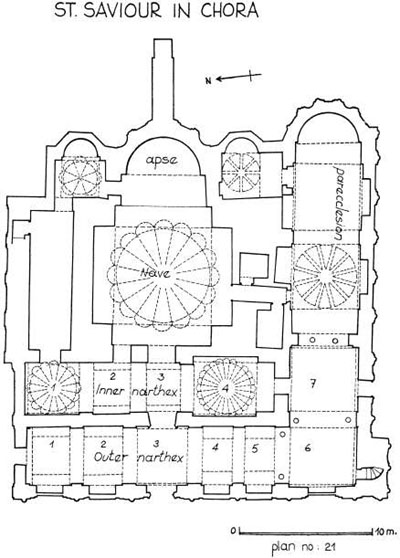
No trace remains of the original ancient church, nor is anything certain known about its origin. The present building in its first form dates only from the late eleventh century and was built by Maria Doukaina, mother-in-law of the Emperor Alexius I Comnenus, between the years 1077 and 1081; it was probably of the “four-column” type so popular at that time. But it did not last long in its original form; perhaps because of the slipping of the foundations at the east end, the apses appear to have collapsed, and the opportunity was taken to remodel the building. At the east the present wide central apse with its deep barrel-vault was erected; the walls of the nave were retained, but the piers were added in the corners as supports for the arches of a much larger dome; there was a narrow side chapel to the south, traces of which remain in the passages and gallery between the nave and the present, later, side chapel. This elaborate remodelling was apparently carried out by Maria Doukaina’s grandson, the Sebastokrator Isaac Comnenus, third son of Alexius I, early in the twelfth century.
A third period of building activity some 200 years later, after the Latin occupation, gave us the church as it now is. At this time the nave area was left essentially unchanged except for redecoration. But the inner narthex was rebuilt, the outer narthex and the parecclesion or side chapel were added, the small side apses reconstructed, and the northern passage with its gallery was built in its present form. In addition to all these structural alterations, the whole of the present decoration of the church, its marble revetment, its mosaics and its frescoes, is the work of this period, from 1315 to 1321. The man to whom we owe all this was the Grand Logethete Theodore Metochites, whose mosaic portrait we will see over the door from the inner narthex into the nave. The church was converted into a mosque by Atik Ali Paşa in the early sixteenth century. The paintings were never wholly obliterated, though in the course of centuries they were covered with plaster, paint and dirt, and many were shaken down by earthquakes. They have now been brilliantly restored, as far as genuine restoration is possible.
THE MOSAICS
The mosaics and frescoes are far and away the most important and extensive series of Byzantine paintings in the city and among the most interesting in the world. Notice that they are of almost exactly the same date as the work of Giotto in Italy and though quite unlike Giotto’s work in detail, they seem to breathe the same spirit of life and reality, so typical of the dawn of the Renaissance; they are a far cry from the formal and stylized painting of the earlier Byzantine tradition. To view them intelligently, as the artist intended them to be seen, one must follow their iconographic order; they fall naturally by position and theme into six groups:
|
I. |
Six large dedicatory or devotional panels in the outer and inner narthexes |
|
II. |
The Ancestry of Christ in the two domes of the inner narthex |
|
III. |
The Cycle of the Life of the Blessed Virgin in the first three bays of the inner narthex |
|
IV. |
The Cycle of the Infancy of Christ in the lunettes of the outer narthex |
|
V. |
The Cycle of Christ’s Ministry in the vaults of the outer narthex and the fourth bay of the inner narthex |
|
VI. |
The three panels in the nave |
I. Dedicatory and devotional panels
1. Christ Pantocrator
In lunette over door to inner narthex
The church was dedicated first to Christ Pantocrator (the Almighty). The inscription reads: “Jesus Christ, the land (country, dwelling-place) of the Living” – with a play on the name of the church and a reference to Psalm 116:9: “I will walk before the Lord in the land of the living.”
2. The Virgin with Angels
Opposite the above, over entrance door to the building
Secondly the church was dedicated to the Blessed Virgin. Here she is praying in an attitude characteristic of the type known as the Theotokos of the Blachernae; Inscription: “The Mother of God, the dwelling-place of the uncontainable” – with the same play on the name of the church and a reference to the mystery of the Incarnation.
3. Theodore Metochites presenting his Church to Christ
Inner narthex in lunette over door to nave
Theodore offers a model of his church to the enthroned Christ. He is dressed in his official robe: the extraordinary turban-like hat was called a skiadion, literally a sunshade! Christ has the same inscription as in the outer narthex; Theodore’s reads: “The Founder, Logothete of the Genikon, Theodore Metochites.”
4. St. Peter
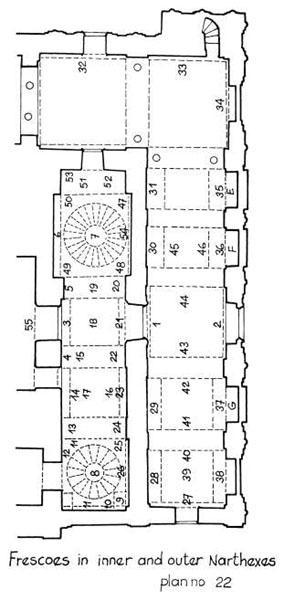
5. St. Paul
To left and right of door to nave
6. The Deesis
Right of the door in east wall of south bay
(A Deesis is a representation of Christ with his mother on his right and – usually, though not here – St. John the Baptist on his left.). Here Christ is of the type known as Chalkites from the famous icon over the main gate to the imperial palace. Below are the figures of two donors (very unusual in a deesis). At the Virgin’s right stands “The son of the most high Emperor Alexius Comnenus, Isaac Porphyrogenitus”: this is Isaac Comnenus, third son of Alexius I, who was probably responsible for the rebuilding of the church in the twelfth century. The inscription of the other figure is partly lost: what remains reads “... of Andronicus Palaeologus, the Lady of the Mongols, Melane the nun.” This was either Maria, half-sister of Andronicus II, known as the Despoina of the Mongols, who founded the still extant church of St. Mary of the Mongols (see Chapter 15): or else another Maria, an illegitimate daughter of Andronicus II, who also married a Khan of the Mongols of the Golden Horde: in either case she took the religious name of Melane.
II. The Genealogy of Christ
In the two domes of the inner narthex
|
7. |
Southern dome: in the crown a medallion of Christ Pantocrator and in the flutes two rows of his ancestors, from Adam to Jacob in the upper zone, in the lower the 12 sons of Jacob and some others. |
|
8. |
Northern dome: in the crown a medallion of the Blessed Virgin with the Christ child; below in the upper zone 16 kings of the house of David, in the lower 11 figures representing “other ancestors outside the genealogy”. |
III. Cycle of the Life of the Blessed Virgin
In the first three bays of the inner narthex
The Cycle of the Life of the Virgin is based mainly on the Apocryphal Gospel of St. James, better known as the Protoevangelium, which is at least as old as the second century, and gives an account of her birth and life from the rejection of the offerings of Joachim, her father, to the birth of Jesus. It was very popular in the Middle Ages and is the source of many cycles of pictures both in the East and the West; compare Giotto’s cycle in the Arena Chapel at Padua, painted at about the same date as these, and representing many of the same scenes. Here there were 20 scenes, of which 19 are completely or partially preserved.
9. Joachim’s Offerings Rejected
First bay, NW pendentive of dome
Zacharias the High Priest before the altar raises his hands in a gesture of refusal. (The rest of the scene in the NE pendentive is lost: it must have shown Joachim and his wife Anne bearing offerings. Their offerings were rejected because they had borne no children.)
10. Fragmentary Scene
In lunette of north wall
Probably Joachim and Anne returning home: only a maid looking out of a doorway is preserved.
11. Joachim in the Wilderness
In SE pendentive
Ashamed at the rejection of his offerings, Joachim goes into the wilderness to pray for offspring.
12. The Annunciation to St. Anne
In lunette of east wall
(Left half of scene lost.) The right half shows the angel of the Lord announcing to Anne that her prayer for a child has been heard.
13. The Meeting of Joachim and Anne
In east soffit of arch between first and second bays
Anne informs Joachim on his return from the wilderness of the annunciation of the angel. The scene is inscribed “The conception of the Theotokos”.
14. The Birth of the Blessed Virgin
In east lunette of second bay
15. The First Seven Steps of the Virgin
In east soffit of arch between second and third bays
She took her first seven steps when she was six months old.
16. The Virgin blessed by the Priests (west side)
17. The Virgin caressed by her Parents (east side)
Two scenes in domical vault of second bay
Note the pair of magnificent peacocks in the pendentives, representing incorruptibility.
18. The Presentation of the Virgin in the Temple
In domical vault of third bay
The scene is inscribed “The Holy of Holies”. At the age of three the Virgin was presented as an attendant at the Temple, where she remained until she was about 12.
19. The Virgin receiving Bread from an Angel
In east soffit of arch between third and fourth bays
While she remained in the Temple she was miraculously fed by an angel.
20. The Instruction of the Virgin in the Temple
In west soffit of same arch
The central figures of the scene have unfortunately been destroyed.
21. The Virgin receiving the Skein of Purple Wool
In lunette above door from outer narthex
The priests decided to have the attendant maidens weave a veil for the Temple; the royal colours, purple and scarlet, fell to Mary by lot.
22. Zacharias praying before the Rods of the Suitors
In west soffit of arch between second and third bays
When the time came for the Virgin to be married, Zacharias the High Priest called all the widowers together and placed their rods on the altar, praying for a sign showing to whom she should be given.
23. The Virgin entrusted to Joseph
In west lunette of second bay
When the rods were returned to the widowers, Joseph’s rod began to sprout with green leaves and the Virgin was awarded to him.
24. Joseph taking the Virgin to his House
In west soffit of arch between first and second bays
Here they are just leaving the Temple; the youth is one of Joseph’s sons by his former wife.
25. The Annunciation to the Virgin at the Well
In SW pendentive of dome in first bay
26. Joseph taking leave of the Virgin; Joseph reproaching the Virgin
Two scenes in west lunette of first bay
Joseph had to go away for six months on business; when he returned he found the Virgin pregnant and was angry (until reassured by a dream, as in the first scene of the next cycle).
IV. The Cycle of the Infancy of Christ
Each of the 13 extant or partly extant Infancy scenes occupies a lunette of the outer narthex, proceeding clockwise round all seven bays. In the soffits of the arches are saints, while in the domical vaults are the scenes of Christ’s Ministry, which will be described later. The Infancy Cycle is largely based on the canonical Gospels and most of the scenes are inscribed with quotations which sufficiently identify them.
27. Joseph Dreaming
The Virgin With Two Companions
The Journey to Bethlehem
Three scenes in north lunette of first bay
First scene inscribed: “Behold, the angel of the Lord appeared to him in a dream, saying: Joseph, thou son of David, fear not to take unto thee Mary thy wife: for that which is conceived in her is of the Holy Ghost.” (Matt. 1:20)
Second scene uninscribed.
Third scene inscribed: “And Joseph also went up from Galilee, out of the city of Nazareth, unto the city of David, which is called Bethlehem...” (Luke 2:4)
28. The Enrolment for Taxation
In east lunette of first bay
Inscription: “... (because he was of the house and lineage of David) to be taxed with Mary his espoused wife, being great with child.” (Luke 2:4–5, continued from above)
29. The Nativity
In east lunette of second bay
Inscription is simply the title The Birth of Christ. To the shepherds the angel says: “Fear not: for behold, I bring you good tidings of great joy, which shall be to all people.”
(Luke 2:10)
30. The Journey of the Magi
The Magi before Herod
Two scenes in east lunette of fourth bay
Inscription: “And behold, there came wise men from the East to Jerusalem, saying: Where is he that is born King of the Jews?”
(Matt. 2:1–2)
31. Herod enquiring of the Priests and Scribes
In east lunette of fifth bay
Partly destroyed. Inscription (mutilated): “And when he had gathered all the priests and scribes together he demanded of them where Christ should be born.” (Matt. 2:4)
One now turns the corner, into the seventh bay: the lunette above the door to the inner narthex, now blank, probably contained the Adoration of the Magi. The lunette above the columns and arches that lead to the Parecclesion retains traces of the Return of the Magi.
32. The Flight into Egypt
In south lunette of seventh bay
Main scene destroyed, only title remaining. On right of window scene of Fall of Idols from the Walls of an Egyptian Town as the Holy Family passes by (from an apocryphal source).
33. The Massacre of the Innocents
In west lunette of sixth bay
Inscription: “Then Herod, when he saw that he was mocked of the wise men, was exceeding wroth, and sent forth and slew all the children that were in Bethlehem, and in all the coasts thereof, from two years old and under.” (Matt. 2:16)
34. The Massacre continues
In west lunette of sixth bay
Central part and inscription destroyed.
35. Mothers mourning their Children
In west lunette of fifth bay
Inscription: “In Rama was there a voice heard, lamentation, and weeping, and great mourning.” (Matt. 2:18)
36. The Flight of Elizabeth
In west lunette of fourth bay
Inscription is the title. The scene, from the Protoevangelium 22:3, depicts Elizabeth with her baby son, John the Baptist, born about the same time as Christ, seeking refuge from the massacre in the mountains which open to receive her.
37. The Return from Egypt
In west lunette of second bay
Inscription: “Being warned of God in a dream, he (Joseph) turned aside into the parts of Galilee: and he came and dwelt in a city called Nazareth.” (Matt. 2:22–3)
38. Christ taken to Jerusalem for the Passover
In west lunette of first bay
Inscription: “Now his parents went to Jerusalem every year at the Passover.” (Luke 2:41)
End of the Infancy Cycle.
V. The Cycle of Christ’s Ministry
This cycle occupies the domical vaults of all seven bays of the outer narthex, as well as parts of the south bay of the inner narthex. Unfortunately, all but one of the vaults in the outer narthex are very badly damaged, many scenes being lost or reduced to mere fragments. The series begins in the vault of the first bay.
39. Christ among the Doctors (north side)
40. John the Baptist bearing witness of Christ (I) (south side)
In vault of first bay (fragments only)
41. John the Baptist bearing witness of Christ (II) (north side)
42. The Temptation of Christ (south side)
In vault of second bay
The first scene is inscribed: “This was he of whom I spake, He that cometh after me is preferred before me: for he was before me.” (John 1:15)
The four scenes of the Temptation are accompanied by a running dialogue between Christ and the Devil (from Matthew 4:3–10): (1) Devil: “If thou be the Son of God, command that these stones be made bread.” Christ: “It is written, Man shall not live by bread alone, but by every word that proceedeth out of the mouth of God.” (2) Devil: “All these things will I give thee, if thou wilt fall down and worship me.” Christ: “Get thee behind me, Satan!” (The Devil has offered “all the kingdoms of the world” represented by six kings in a walled town.) (3) “Then the Devil taketh him up to the holy city (and setteth him on a pinacle of the temple).” (4) Devil: “If thou be the Son of God, cast thyself down.” Christ: “It is written, thou shalt not tempt the Lord thy God.”
43. The Miracle at Cana (north side)
44. The Multiplication of the Loaves (south side)
In vault of third bay
Both badly ruined. The first illustrates John 2:1–11; the second Matthew 14:5–21.
45. Christ healing a Leper (east side)
46. Christ walking on the Water (west side)
In vault of fourth bay (fragments only)
The vaults of the fifth, sixth, and seventh bays have almost completely lost their mosaics. The fifth vault is entirely empty. In the sixth can be made out fragments of Christ healing the Paralytic at Capernaum and Christ healing the Paralytic at the Pool of Bethesda; while in the north-east pendentive is the Paralytic carrying off his Bed, and in the north-west pendentive is part of Christ conversing with the Samaritan Woman. In the seventh vault is a fragmentary Christ calling Zacchaeus from the Sycamore Tree.
One now re-enters the inner narthex where the last eight scenes of Christ’s Ministry, almost all well-preserved, are to be found in the pendentives, vaults and lunettes under the southern dome that contains the Ancestors of Christ. The inscriptions in this series are merely the titles of the scenes.
47. Christ healing the Blind and Dumb Man (Matt. 12:22)
In SW pendentive
48. Christ healing the two Blind Men (Matt. 20:29–30)
In NW pendentive
49. Christ healing Peter’s Mother-in-Law (Matt. 8:14–15)
In NE pendentive
50. Christ healing the Women with the Issue of Blood
(Matt. 9:20–2)
In SE pendentive
51. Christ healing the Man with the Withered Hand
(Matt. 12:10–13)
In soffit of south arch, east side
52. Christ healing the Leper (Matt. 8:2–3)
In soffit of south arch, west side
53. Christ healing... (inscription and half mosaic lost)
In southern lunette
54. Christ healing various Diseases (Matt. 15:30)
In western lunette
End of the Cycle of Christ’s Ministry
VI. The panels in the nave
55. The Dormition (Koimesis) of the Virgin
Over the central door from the narthex
The Virgin lies dead on her bier. Behind stands Christ holding her soul, represented as a babe in swaddling clothes. Over Christ’s head hovers a six-winged seraph. Around stand the apostles, evangelists and early bishops. The idea is taken from an apocryphal work, Concerning the Koimesis of the Holy Mother of God, ascribed to St. John the Divine.
56. Christ
In panel at left of bema
Inscription as in outer narthex. Christ holds the Gospels open to Matthew 11:28: “Come unto me, all ye that labour and are heavy laden, and I will give you rest.”
57. The Virgin Hodegitria
In panel at right of bema
Inscription as in outer narthex. The type is that of the Hodegitria, the Guide or Teacher, the original of which was supposed to have been painted by St. Luke from life.
THE PARECCLESION: THE FRESCOES
The superb fresco decoration of the parecclesion or side chapel to the south of the church was the last part of Metochite’s work of redecoration to be carried out, probably in 1320–1. The great but unknown master artist of these frescoes was probably the same as the one who did the mosaics in the rest of the church. The decoration of the chapel is designed to illustrate its purpose as a place of burial. Above the level of the cornice the paintings represent the Resurrection and the Life, the Last Judgement, Heaven and Hell, and the Mother of God as the Bridge between Earth and Heaven. Below the cornice is a procession of saints and martyrs, interrupted here and there by tombs. We shall deal first with the upper series of frescoes beginning at the east, then list the saints below cornice level, and finally say a few words about the tombs.
I. Scenes of Resurrection
1. The Anastasis
In the semidome of the apse
This scene, called Anastasis (Resurrection) in Greek, is known in English as the Harrowing of Hell. Christ has broken down the gates of Hell which lie beneath his feet; Satan, bound, lies before him. With his right hand he pulls Adam out of his tomb; behind Adam stand St. John the Baptist, David, Solomon and other righteous kings. With his left hand he pulls Eve out of her tomb; standing in it is Abel and behind him another group of the righteous. This is surely one of the great paintings of the world.
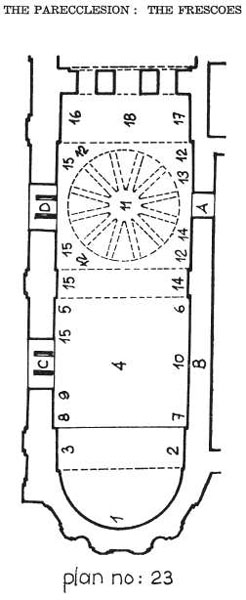
2. Christ raising the Widow’s Son
North side of bema arch
The inscription is the title. The story is only told by Luke (7:11–15).
3. Christ raising the Daughter of Jairus
South side of bema arch
Inscription illegible but doubtless the title. The story is in all three Synoptic Gospels, perhaps best in Mark (5:22–4, 35–43). In crown of arch the Archangel Michael in a medallion.
II. The Last Judgement: Heaven and Hell
4. The Second Coming of Christ
In vault of eastern bay
This vast scene occupies the whole vault; the title is inscribed at the centre. It represents the Doctrine of the Last Things; death, judgement, immortality in heaven or dam nation in hell. In the crown is the Scroll of Heaven (Apocalypse 6:14). In the eastern half sits Christ in Judgement. To the souls of the saved he says: “Come, ye blessed of my Father, inherit the kingdom prepared for you from the foundation of the world.” (Matt. 25:34) To the condemned souls on his left he says: “Depart from me, ye cursed, into everlasting fire, prepared for the devil and his angels.” (Matt. 25:41) Below to left a River of Fire broadening to a lake in which are the damned. Below Christ the Etimasia or empty throne prepared for the Second Coming: Adam and Eve prostrate before it. Below this the Weighing and Condemnation of Souls. The western half of the vault is occupied by the Choirs of the Elect in clouds.
5. The Land and Sea giving up their Dead
In SW pendentive
No inscription; cf. Apocalypse 20:13.
6. An Angel conducts the Soul of Lazarus to Heaven
7. Lazarus the Beggar in Abraham’s Bosom
8. The Rich Man in Hell
In NW, NE and SE pendentives
The scenes illustrate Luke 16:19–26: the Rich Man had refused alms to Lazarus in this world; he went to hell and appealed to Lazarus in heaven for water but was refused.
9. The Torments of the Damned
In lunette of south wall, eastern half
Four rectangular panels identified as: (upper left) The Gnashing of Teeth; (upper right) The Outer Darkness; (lower left) The Worm that Sleepeth Not; (lower right) The Unquenchable Fire.
10. The Entry of the Elect into Paradise
In lunette of north wall
The Elect are led by St. Peter towards the Gate of Paradise, guarded by a Cherub; the Good Thief welcomes them and points to the enthroned Mother of God.
III. The Mother of God and Her Prefigurations
This cycle, in the western dome and bay, represents the Blessed Virgin and a series of five episodes from the Old Testament which came to be symbolically interpreted as prefigurations or “types” of the Virgin and the Incarnation.
11. The Virgin and Child with Angels
In the western dome
The Virgin and Child in the crown surrounded by the heavenly court of angels in the spaces between the ribs.
12. Four Hymnographers
In the pendentives of the dome
These poets were chosen because in their hymns, verses of which are inscribed on their scrolls, they referred to the prefigurations of the Virgin depicted below. (NE) St. John Damascene; (SE) St. Cosmas the Poet; (SW) St Joseph the Poet; (NW) St. Theophanes.
13. Jacob’s Ladder; Jacob wrestling with the Angel
In western half of north lunette
The ladder or bridge to heaven as a prefiguration of the Virgin. Inscribed: “And Jacob took one of the stones of the place, and put it at his head, and lay down to sleep in that place; and behold, a ladder fixed on the earth, whose top reached to heaven, and the angels of God ascended and descended on it. And the Lord stood upon it.” (Genesis 28:11–13). Note that the Lord, here and elsewhere, is represented by the Virgin and Child.
14. Moses and the Burning Bush; Moses hides his Face
In eastern half of north lunette and on soffit of arch
The burning bush that was not consumed as a prefiguration of the Virgin. First scene inscribed: “Now Moses came to the mountain of God, even to Choreb. And the angel of the Lord appeared to him in a flame out of the bush … Put off thy shoes from off thy feet, for the place where upon thy standest is holy ground.” (Exodus 3:1–2, 5). Second scene, on adjacent arch, inscribed: “And Moses hid his face; for he was afraid to look upon God.” (Exodus 3:6).
15. The Dedication of Solomon’s Temple
Four scenes on south wall
The Ark of the Covenant as a prefiguration of the Virgin. First scene, in west half of south lunette of east bay, is inscribed: “And it came to pass when Solomon was finished building the house of the Lord, then he assembled all the elders of Israel in Sion, to bring the Ark of the Covenant to the Lord out of the City of David, that is Sion, and the priests took up the Ark of the Covenant as a prefiguration of the testimony.” (I Kings 8:1–4). Second scene, on soffit of arch, inscription lost but probably continuation of verse 4: “and the holy vessels that were in the tabernacle of testimony.” Third scene, on east half of south lunette, inscribed: “and the king and all Israel were assembled before the Ark.” (v 5). Fourth scene, on west half of south lunette, inscribed: “And the priests bring in the Ark of the Covenant, into the oracle of the house, even into the holy of holies, under the wings of the cherubim.” (I Kings 8:6)
16. Isaiah and the Angel
In south soffit of western arch
The inviolable city as a prefiguration of the Virgin. The inscription on Isaiah’s scroll is almost illegible but probably reads: “Thus saith the Lord concerning the king of Assyria: ‘He shall not come into this city’.” (Isaiah 37:33)
17. Aaron and his Sons before the Altar
In north soffit of western arch
The altar as a prefiguration of the Virgin. Inscription, practically illegible, is perhaps: “They draw nigh to the altar and offer their sin-offerings and their whole burnt offerings.” (Leviticus 9:7)
18. The Souls of the Righteous in the Hand of God
In crown of western arch
Almost entirely lost, but one can make out part of the Hand of God holding the souls of the righteous, represented as infants in swaddling-bands.
IV. The Saints and Martyrs
A long procession of saints and martyrs marches about the lower walls of the parecclesion; in the apse stand six Fathers of the Church (from left to right):
|
St. Athanasius |
St. Gregory the Theologian |
|
St. John Chrysostomos |
St. Nicholas of Myra |
|
St. Basil |
St. Cyril of Alexandria |
|
The Virgin Eleousa, the Merciful or Compassionate on south wall of bema |
|
|
South Wall (east to west): |
North Wall (west to east): |
|
St. George of Cappadocia |
St. Eustathius Plakidas |
|
St. Florus (medallion) |
St. Samonas of Edessa |
|
St. Laurus (medallion) |
St. Gurias of Edessa |
|
St. Demetrius of Thessalonika |
St. Artemius or St. Nicetas |
|
St. Theodore Tyro |
St. Bacchus (medallion) |
|
St. Theodore Stratelates |
St. Sergius (medallion) |
|
St. Mercurius |
An unidentified saint |
|
St. Procopius |
Medallion of unidentified saint |
|
St. Sabah Stratelates |
A stylite saint |
|
West Wall |
|
|
South pier: |
An unidentified saint |
|
North pier: |
St. David of Thessalonika (in an almond tree where he lived for three years) |
As will be noticed, most of these saints belong to the Eastern Church and are almost unknown in the West. Pictures of many of them appear also in the outer narthex, but since they are chiefly of interest only to the student of Eastern hagiology it has not seemed necessary to name them.
THE TOMBS
There were four tombs in the parecclesion, each in a deep niche which originally held a sarcophagus with mosaics or frescoes above; some fragments of the latter still exist.
Tomb A, the first in the north wall, though it has lost its identifying inscription, is almost certainly that of Theodore Metochites himself; it has an elaborately carved and decorated archivolt above.
Tomb B is entirely bare.
Tomb C has well preserved paintings of a man and woman in princely dress but has lost it inscription.
Tomb D is that of Michael Tornikes, general and friend of Metochites, identified by the long inscription above the archivolt, which is even more elaborately carved than that of Metochites himself; fragments of mosaic and painting still exist.
Tomb E, in the fifth bay of the outer narthex, is that of the princess Eirene Raoulaina Palaeologina, a connection by marriage of Metochites. It preserves a good deal of its fresco painting.
Tomb F, in the fourth bay of the outer narthex, is that of a member of the imperial Palaeologus family but cannot be more definitely identified, though it preserves some vivid painting of clothes.
Tomb G, in the second bay of the outer narthex, is the latest in the church, probably not long before the Turkish Conquest; the painting shows strong influence of the Italian Renaissance, but the owner cannot be identified.
Tomb H, in the north wall of the inner narthex, is that of the Despot Demetrius Doukas Angelus Palaeologus, and has an inscription to the following effect: “Tou art the Fount of Life, Mother of God the Word and I Demetrius am thy slave in love.”
Before we leave Kariye Camii, we might pause for a moment before the portrait of Theodore Metochites, the man to whom we owe this church and its magnificent works of art. Seeing him there over the door leading into the nave of his church, proud and at the very peak of his career, we are saddened to learn that Theodore fell from royal favour in his later years. After Andronicus III usurped the throne in 1328, Theodore was stripped of his power and possessions and thrown into prison, along with many other officials of the old regime. Only when his life was drawing to a close was he freed and allowed to retire to the monastery of St. Saviour in Chora. He died there on 13 March 1331 and was buried in the parecclesion of his beloved church. In those last sad days of his life, Theodore was comforted by his friend, the great scholar Nicephorus Gregoras, who was also confined to the monastery. When Nicephorus later recorded the history of those times, he wote this affectionate tribute to Theodore: “From morning to evening he was most wholly and eagerly devoted to public affairs as if scholarship was absolutely indifferent to him; but later in the evening, having left the palace, he became absorbed in science to such a degree as if he were a scholar with absolutely no connection with any other affairs.” Theodore was the greatest man of his time, a diplomat and high government official, theologian, philosopher, historian, astronomer, poet and patron of the arts, the leader of the artistic and intellectual renaissance of late Byzantium. But among all his accomplishments, Theodore was proudest of the church that he had built and adorned. Towards the end of his life he wrote of his hope that it would secure for him “a glorious memory among posterity to the end of the world.” It has indeed.