
15

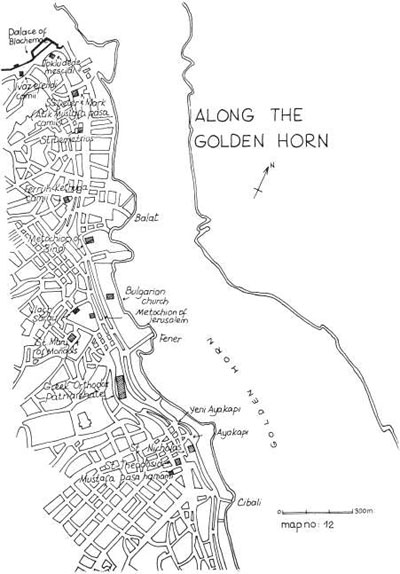
The region along the Stamboul shore of the Golden Horn above the two bridges is one which few tourists ever see, except for one or two of the more famous monuments. This is a pity, for it has a distinctive atmosphere which is quite unlike that of any other part of the city. Some of its quarters, particularly Fener and Balat, are very picturesque and preserves aspects of the life of old Stamboul which have all but vanished elsewhere.
Our tour begins at the Stamboul end of the Atatürk Bridge. This is the place known as Odun Kapısı, the Wood Gate, after a long vanished gateway known in antiquity as the Porta Plarea. The first part of our tour takes us along the shore highway, which is now bordered by a park along the Golden Horn, making our stroll easier and more pleasant than it was in times past.
GOLDEN HORN SEA-WALLS
As we walk along we see on the left side of the avenue stretches of the medieval Byzantine sea-walls that once extended along the shores of the Golden Horn and the Marmara, joining up with the land-walls at both ends. The stretch that we will pass on our present tour, which goes beyond what was once the end-point of Constantine’s wall, was originally built by Theodosius II in the fifth century to meet the great land-walls which he constructed at that time. These sea-walls were repaired and reconstructed many times across the centuries, particularly by the Emperor Theophilus in the ninth century. These fortifications consisted for the most part of a single line of walls ten metres in height and five kilometres long, studded by a total of 110 defence towers placed at regular intervals. Considerable stretches of this wall still remain standing, particularly along the route of our present tour, although almost all of it is in ruins. Much of this ruination was brought about in the last great sieges of the city, by the Crusaders in 1203–4 and the Turks in 1453. In both instances the besiegers lined up their warships against the sea-walls along the Golden Horn and repeatedly assaulted them. And the destruction wrought by these sieges and subsequent centuries of decay is now being rapidly completed by the encroachment of modern highways and factories.
The sea-walls along the Golden Horn were pierced by about a score of gates and posterns, many of them famous in the history of the city. Of these only one or two remain, although the location of the others can easily be determined, since the streets of the modern town still converge to where these ancient gates once opened, following the same routes they have for many centuries past. The first of these gates which we pass on our tour is about 450 metres along from the Atatürk Bridge. This is Cibali Kapı, known in Byzantium as the Porta Puteae. A Turkish inscription beside the gate commemorates the fact that it was breached on 29 May 1453, the day on which Constantinople fell to the Turks. This gate also marks the point which stood opposite the extreme left wing of the Venetian fleet in their final assault on 12 April 1204.
The huge building along the side of the avenue before Cibali Kapı is Kadır Has University. This private Turkish university, founded in 2002, is housed in the former Cibali Tobacco and Cigarette Factory, which opened in 1884. The factory was designed by Alexandre Vallaury and built by the architect Hovsep Aznavur. The factory was long disused before it was superbly restored and converted into a university. During the restoration an early Byzantine cistern was discovered beyond the end of the building near Cibali Kapı.
About 250 metres past Cibali Kapı we come on the left to a little pink-walled Greek church dedicated to St. Nicholas. This church dates to about 1720 and was originally the metochion, or private property, of the Vathopedi Monastery on Mount Athos. The corbelled stone structure in which the church is housed is typical of the so-called meta-Byzantine buildings we will see along the shore of the Golden Horn, most of them dating from the seventeenth or eighteenth century. The principal treasure of the church is a very rare portative mosaic dating from the eleventh century; it can be seen only during the services on Sunday. Notice also in the lobby the model of an ancient galleon hanging from the ceiling. These are to be found in many of the waterfront churches of the city, placed there by sailors in gratitude for salvation from the perils of the sea.
Just beyond St. Nicholas we come to Aya Kapı, the Holy Gate, a little portal which opens from a tiny square beside the avenue. This was known in Byzantium as the Gate of St. Theodosia, after the nearby church of the same name.
CHURCH OF ST. THEODOSİA
To reach the church we pass through the gate and continue for about 50 metres until we come to the second turning on the left, where we continue for another 50 metres until we come to Gül Camii, somewhat doubtfully identified as the Church of St. Theodosia. Its history is obscure but the foundations recently brought to light date from the late tenth or the eleventh century, as is shown by the “recessed brickwork” typical of this period. Thus the earlier dating of the church to the ninth century appears to be erroneous.
The building is one of the most imposing Byzantine churches in the city and, in spite of a certain amount of Turkish reconstruction, still preserves its original form. It is a cross-domed church with side aisles supporting galleries; the piers supporting the dome are disengaged from the walls, and the corners behind them form alcoves of two storeys. The central dome and the pointed arches which support it are Turkish reconstructions, as are most of the windows. From the exterior the building is rather gaunt and tall: the upper parts have been considerably altered in Turkish times, with the result of making it still more fortress-like. The two side apses, however, are worthy of note, with their three tiers of blind niches and their elaborate brick corbels. Among the more pleasing aspects of the exterior is the minaret, handsomely proportioned and clearly belonging to the classical period when the church was converted into a mosque.
There are two interesting legends associated with the church: one of them perhaps true, the other almost certainly false. The first of these legends (the one which may be true) concerns the Turkish name of the building, Gül Camii, or the Mosque of the Rose. It seems that the saint’s feast-day falls on 29 May, and on that day in the year 1453 a great congregation assembled in the church appealing for Theodosia’s intercession. The church had been decked with roses in celebration of the feast-day, and when the Turkish soldiers entered the church after the city fell they found the roses still in place: so the romantic story goes, and hence the romantic name.
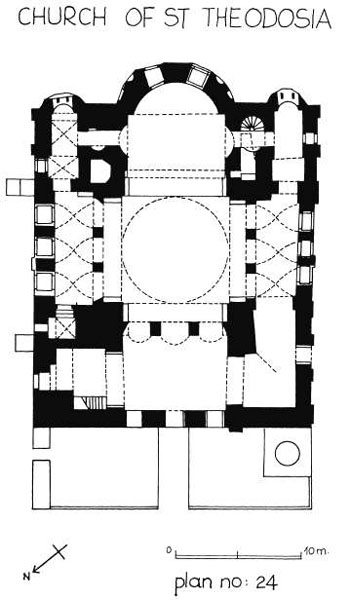
The second legend, which seems to have originated long after the Conquest, has it that the church of St. Theodosia was the final resting-place of Constantine XI Dragases, the last Emperor of Byzantium. There are several different traditions as to the circumstances of the Emperors death and the place of his burial, but the one in favour among Greeks of an older generation was that he was interred in a chamber in the south-east pier of St. Theodosia. And indeed there is a burial-chamber there, reached by a staircase leading up inside the pier itself, and within it is a coffin, or sarcophagus, covered by a green shawl. However, an equally persistent Turkish legend has it that this is not the tomb of Constantine but that of a Muslim saint called Gül Baba, the eponymous founder of the mosque! To further complicate the problem, above the lintel of the door leading to the burial-chamber there is a cryptic Turkish inscription which reads: “Tomb of the Apostle, disciple of Christ, peace be to him.”

Leaving the church, we turn left and then at the second corner we turn left again. A short distance along on the left side of the street we come to one of the oldest and grandest Turkish baths in the city, now closed for restoration. It is now called Küçük (Little) Mustafa Paşa Hamamı, but it seems actually to have been founded by Koca Mustafa Paşa, Grand Vezir to Beyazit II, who built it sometime before 1512. Its plan and the incredibly varied and intricate structure of its domes would entirely bear out that early date. Its camekân, about 14.5 metres square, is among the largest in the city, so that not even the wooden galleries around it detract much from its impressiveness; in its centre there is a pretty marble basin. The soğukluk, as so often, is merely carved out of the hararet, consisting of its right-hand cubicle and the bottom arm of the cross. The hararet itself is very splendid. The central dome has a deep cornice of elaborately-carved stalactites. Each of the three remaining cross-arms is covered with a vault of utterly different structure, the prettiest being perhaps that on the right which has a semidome in the form of a deeply ribbed shell. The two corner cubicles at the back have domes supported on a cornice of juxtaposed triangles, while the third cubicle has a very beautiful opus sectile pavement in a variety of brilliant coloured marbles.

After leaving the hamam we turn right and walk west along Küçük Mustafa Paşa Sokağı for about 100 metres until we come to an intersection with streets winding off in several directions. If we take the street that veers off at about 45° to the right, we soon come to the fragmentary ruins of a small Byzantine church partly concealed by trees and houses. Only a portion of the apse survives, but this is interesting as showing an elaborate decoration in brickwork of meander and zigzag designs. Attempts to identify the building with several churches known to have been in the area lack any serious evidence; it is known locally as Sinan Paşa Mescidi. The church would appear to date from the thirteenth or fourteenth century.
HAVUZLU HAMAM
Once past the church we come quickly to Yeni Aya Kapı, which leads out to the main road along the Golden Horn. This portal is not one of the original gateways in the Byzantine sea-walls, but was constructed in 1582 by Sinan. The local residents had petitioned the government to open a gate there so that they could more easily make their way to the new bath which Sinan had constructed outside the walls at that point. This bath, the Havuzlu Hamam, or Bath with a Pool, was built by Sinan in 1582 for the Valide Sultan Nurbanu, mother of Murat III. Unfortunately the hamam is now disaffected and in a state of advanced decay.
THE PETRİON
About 100 metres beyond Yeni Aya Kapı, we come to a point where a second road, Sadrazam Ali Paşa Caddesi, branches off to the left at a slight angle to the main road along the Golden Horn. This was the site of the Gate of the Petrion, one of the portals in the Byzantine sea-walls. The Petrion itself was a walled enclave on the lower slope of the Fifth Hill; the portal here being its eastern sea-gate. The Petrion figured prominently in the assaults upon the sea-walls by the Crusaders and the Turks. On 13 July 1203, the Venetian galleys under Doge Dandolo pushed their prows up against the sea-walls of the Petrion and captured 25 defence towers. The French knight Villehardouin describes Dandolo in action at that time: “The Doge of Venice, though an old man [he was nearly ninety] and totally blind, stood at the bow of his galley with the banner of St. Mark unfurled before him. He cried out to his men to put him on shore or he would deal with them as they deserved. They obeyed him promptly, for the galley touched ground and the men in it leapt ashore, carrying the banner of St. Mark to land before the Doge.” In the final Crusader assault upon the city on 12 April 1204, the Petrion was once again the centre of the action. It was here that two brave knights jumped from the flying-bridge of the galleon Pelerine onto a defence tower, and from there led the charge that breached the walls and brought about the capture of the city. On 29 May 1453, the Petrion withstood a sustained attack by the Turkish fleet and the defenders surrendered only when they heard that the land-walls were breached and that the city had fallen. Since it had been surrendered rather than being taken by assault, Fatih decreed that the houses and churches in the Petrion be spared in the general sack of the city. Evliya Çelebi tells us that as a result of their prudent surrender the fishermen of the Petrion “are even now free from all kinds of duties and give no tithe to the Inspector of the Fisheries.”
THE GREEK ORTHODOX PATRİARCHATE
Leaving the main road and veering left along Sadrazam Ali Paşa Caddesi, we soon come to the entrance to the Greek Orthodox Patriarchate. On entering, we notice that the main gate is permanently welded shut and painted black. This is the famous Orta Kapı, the Central Gate, which has become almost a symbol of Greek-Turkish intransigence. For it was here that Gregory V, Patriarch of Constantinople, was hanged for treason on 22 April 1821.
The Greek Orthodox Patriarchate has been on this site since about 1601, having moved around for a number of years after leaving the Pammakaristos in 1586. The present patriarchal church of St. George, however, dates only from 1720. Like almost all the post-Conquest churches in the city, it is a small basilica. This form was adopted partly because of its simplicity, but largely because the Christians were forbidden to build churches with domes or masonry roofs, so that the basilica with its timbered roof, a traditional Christian edifice, was the obvious solution. The earlier church seems to have had the same form, for an Italian traveller who saw it in 1615 describes it as “of moderate size, long in form and with several aisles.” Among the many relics in the church are the remains of St. Omonia, St. Theophano and St. Euphemia of Chalcedon, whose martyrium we have seen near the Hippodrome; their coffins are in the south aisle. On the right side of the central aisle is the Partriarchal Throne, which is thought to date from the late Byzantine period, although the pious claim that it is the original throne of St. John Chrysostomos, who was Patriarch at the beginning of the fifth century. The church also contains a very lovely portative mosaic of the Blessed Virgin, of the same type and date as the one at St. Nicholas.
Across the courtyard from the church are the other buildings of the Patriarchate. With the exception of the library, a pleasing old building, these are all modern structures erected after the disastrous fire of 1941 which gutted most of the buildings on this side of the courtyard. It is hard to believe that this modest establishment was the centre of the entire Orthodox Church, or that in its great days the Ecumenical Patriarch of Constantinople dominated the religious affairs of the entire Eastern Christian world. Today, although the present Patriarch, Bartholomeos, is still the spiritual leader of Orthodox Christianity, his actual flock in Turkey consists of only the few thousand Greeks still resident in Istanbul and the Aegean islands of Imbros and Tenedos.
THE FENER
After leaving the Patriarchate we continue on along Sadrazam Ali Paşa Caddesi for a few paces to the next intersection. Just to the right at this point is the site of the former Fener Kapısı, the ancient Porta Phanari, or the Gate of the Lighthouse. This gate, now vanished, long ago gave its name to the adjacent quarter, the Fener, so famous in the history of Istanbul in past centuries. Beginning in the sixteenth century, Greeks of this neighbourhood, the Feneriotes, amassed considerable wealth in trade and commerce under the protective mantle of the Ottoman Empire. Many Feneriotes achieved positions of great eminence in the Empire and several families between them even gained control of the trans-Danubian principalities of Moldavia and Wallachia, client states of the Ottomans. The Feneriotes ruled as Hospodars, or Princes, and much of the wealth which they thus acquired was funnelled back into the Fener, where they built magnificent mansions and palaces. The palaces of the Feneriotes have now vanished, but a few of their mansions still survive, reminding us of that colourful period in the city’s past.
Continuing along in the same direction for a few steps past Fener Kapısı, we take the first left and then almost immediately turn right into the next street, Vodina Caddesi. About 100 metres along this street on the left side we see a high wall which encloses a large open area extending up the side of the hill. This area is the property of the Greek Orthodox Patriarchate and within it are two churches of some interest. (Those wishing to see these churches should make enquiries at the Greek Orthodox Patriarchate.) The first of these is the church of St. George Metochi, just inside the walls along Vodina Caddesi. It is entered through the gate we see half way down the block. Since the middle of the seventeenth century this has been the Metochion of the Patriarchate of Jerusalem. The church, which has been rebuilt several times since then, was originally given to the Patriarch of Jerusalem by Michael Cantacuzenus, one of the first Feneriote plutocrats, whose palace stood within the walled enclosure where we find the church today. Michael Cantacuzenus, whom the Turks called Şeytanoğlu, the Son of Satan, used his wealth to good advantage, acquiring a vast library which included a collection of most of the extant ancient manuscripts in the city. Among the manuscripts in St. George there was discovered in 1906 a lost work of Archimedes. This manuscript, a tenth-century copy in palimpsest, was a perfect and complete text of Archimedes’ Method of Treating Mechanical Problems, Dedicated to Eratosthenes. This is perhaps the single most important work of the greatest mathematical physicist of antiquity, and constitutes a very great addition to our knowledge of ancient science.
Passing St. George’s and continuing along Vodina Caddesi to the next corner, we turn left and follow the walled enclosure along a steep cobbled street leading uphill. A little way up the hill we see another iron gate which leads to the second of the two churches in this enclave. This is the church of the Panaghia Paramithias (St. Mary the Consoler), which served as the Patriarchal church from 1586 till 1596, in the years just after the Patriarchate was moved from the Pammakaristos. Notice the double eagle carved on the marble flagstone at the entrance to the church; this is the symbol of the imperial Palaeologan dynasty and of the Greek Orthodox Patriarchate. This church is more commonly called Vlach Saray, or the Palace of the Wallachians, because it was attached to the adjacent palace of the Cantacuzenus family, who were Hospodars of Wallachia as well as of Moldavia. Unfortunately, Vlach Saray was destroyed by a fire in 1976, and only charred ruins remain to be seen today.
ST. MARY OF THE MONGOLS
Continuing up the hill we turn left at the corner and then take the second right. We then see ahead a rose-red Byzantine church, deformed in shape and with an unusually high drum. This is the church dedicated to the Theotokos Panaghiotissa, the All-Holy Mother of God, but it is more generally called the Mouchliotissa, or St. Mary of the Mongols. This church was founded, or rebuilt, in about 1282 by the Princess Maria Palaeologina, an illegitimate daughter of the Emperor Michael VIII Palaeologus. In the year 1265 Maria was sent by her father as a bride to Hulagu, the Great Khan of the Mongols. Hulagu died before Maria arrived at the Mongol court, however, so she was married instead to his son and successor Abagu. Maria lived at the Mongol court in Persia for about 15 years, and through her influence the Khan and many of his court became Christians. But then, in 1281, Abagu was assassinated by his brother Ahmet and Maria was forced to return to Constantinople. After Maria’s return her father offered her as a bride to still another Khan of the Mongols, Charabanda, but this time she refused; perhaps she had had enough of Khans. At about this time Maria founded the church which we see today, together with a convent, and dedicated it to the Mouchliotissa, Our Lady of the Mongols. Maria, the Despoina of the Mongols, as she was known, then became a nun and spent her last years in retirement in her convent: This romantic tale appears to be only partially true, for the church seems actually to have been founded by Isaac Dukas, uncle of Michael VIII, about 1261.The Despoina of the Mongols perhaps merely added to it and gave it further adornments. After the Conquest, Sultan Mehmet II, at the request of his Greek architect Christodoulos (who may be Atik Sinan, the architect of the original Fatih Camii), issued a decree confirming the right of the local Greeks to keep this church. The Greeks remain in possession of the church to this day, and what is claimed to be Fatih’s ferman, or decree, is still displayed there. This is the only Byzantine church which has been continuously in the hands of the Greeks since before the Turkish Conquest.
The church was originally quatrefoil in plan internally and trefoil externally. That is, the small central dome on a high drum was surrounded by four semidomes along the axes, all but the western one resting on the outer walls of the building, which thus formed exedrae; the whole was preceded by a narthex of three bays. But the entire southern side of the church was swept away in modern times and replaced by a squarish narthex which is in every direction out of line with the original building. The effect is most disconcerting. The church is still adorned with one art treasure from its Byzantine period, a very beautiful portative mosaic of the Theotokos Pammakaristos, the All-Joyous Mother of God. The obvious similarity of this icon to those we have seen at St. Nicholas and at the patriarchal church of St. George strongly suggests that they were all done by the same artist, working in the eleventh century. These are the only three such portative mosaics remaining in the city, and there are only about ten others still known to exist elsewhere.
MEGALİ SCHOLİO
As we leave the church we see off to our right the huge structure which dominates the skyline of this part of the city; it houses a very old and illustrious institution, the Greek Lycee of the Fener, known in Greek as the Megali Scholio, or the Great School. The present red brick building was built in 1881. But the original Megali Scholio, by tradition, was founded before the Turkish Conquest and remained the principal Greek institution of secular education throughout the course of Ottoman history. Here were educated many of the Greek voivodes (governors) and hospodars of Moldavia and Wallachia, and many of the chief interpreters who often wielded such great influence at the Sublime Porte – men with the resounding names of the Byzantine aristocracy, Palaeologus, Cantacuzenus, Cantemir, Mavrocordato and Ypsilanti.
FROM FENER TO BALAT
We now retrace our steps back to the last turning before the church and there take the street to the right. This almost immediately brings us to a steep step-street which bounds the walled enclosure containing the churches of St. George Metochi and Vlach Saray. Halfway down the steps we come to another of the gateways to the enclosure. Beside the gate is a plaque honouring Demetrius Cantemir, a Feneriote Greek who became Prince of Moldavia. Cantemir wrote a history of the Ottoman Empire covering the years 1688–1710 and he also wrote an important treatise on Turkish musicology.
At the bottom of the steps we turn left and then right at the next corner, bringing us back to Vodina Caddesi. We retrace our steps to Fener Kapısı, after which we continue walking up the shore of the Golden Horn.
About 100 metres beyond Fener Kapısı we come to a restored meta-Byzantine building that now houses the Women’s Library and Cultural Centre. The library, which opened in 1990, is the first institution of its kind in Turkey. Its collection includes works by and about women in Turkish and other languages, including a complete collection of all the women’s magazines and periodicals published in Turkey in the late Ottoman era and in the early years of the Turkish Republic. It is also a research centre for women’s studies.
About 150 metres farther along, we see on our right a very astonishing church indeed, that of St. Stephen of the Bulgars. This and the building opposite, the former Exarchate, were erected in 1871, at a time when the Bulgarian Church was asserting its independence from the Greek Orthodox Patriarchate of Constantinople. The church of St. Stephen is a Gothic building entirely constructed of cast iron! The church was prefabricated in Vienna and shipped down the Danube in sections, and then erected here on the shore of the Golden Horn. Not only the outside but the interior as well is of cast iron; even what appear to be panels of marble revetment prove on one’s knocking them to be iron, likewise the seemingly sculptured ornamentation! Nevertheless, the church is rather handsome, both its interior and exterior, and it is kept in excellent repair for the small community of Bulgarians who still worship there. The church is surrounded by a pretty and well-tended garden in which are buried several metropolitans of the Bulgarian Church.
Continuing along in the same direction, we come after about 250 metres to the Metochion of Mount Sinai, the oldest and grandest of the meta-Byzantine mansions of the Fener. This house is typical of the few remaining Feneriote mansions, chiefly of the seventeenth century, erected apparently in a continuation or modification of the old Byzantine style. They are constructed of alternate courses of stone and brick; each storey projects over the street, corbelled out on elaborate consoles; the cornice under the roof consists of courses of brick in saw-tooth design. They are very stoutly built, with massive walls and iron doors and window-shutters, more like fortresses than ordinary houses. The house which we are now looking at is of particular interest because it was for nearly three centuries the Metochion of the Monastery of St. Catherine on Mount Sinai. The Monastery of St. Catherine, first founded by Justinian, was for long a semi-autonomous church under the control of the Patriarchate of Alexandria. The Monastery, like many others, has always been represented in Constantinople by one of its archimandrites, who first took up residence in this mansion in 1686. The Metochion is now abandoned and is rapidly falling into ruins.
Just beyond the Archimandrite’s mansion, a gateway leads us into the courtyard of the church of St. John the Baptist, the chapel of the monastery which was once part of the Metochion. The church is probably of Byzantine foundation, but it has been burned down and reconstructed several times and the present structure dates only from 1830. It is of no interest except for its connection with the Metochion of Mount Sinai.
BALAT
About 150 metres beyond the church we come to Balat Kapısı, the site of another of the Byzantine sea-gates along the Golden Horn, of which nothing now remains. This has been identified variously as the Gate of the Kynegos (Hunter) or that of the Prodromos (St. John the Baptist). The Turkish name Balat is a corruption of the Greek Palation, or Palace, so called because of the Byzantine Palace of Blachernae which stood nearby. Although the gate has now disappeared, its name survives in that of the surrounding quarter, the picturesque and venerable Balat. Balat has been for many centuries one of the principal Jewish quarters of the city. Many of these were Greek-speaking Jews who lived here in Byzantine times, but these were later absorbed by the Sephardic Jews who emigrated from Spain in 1492 and took up residence in the Ottoman Empire on the invitation of Beyazit II. There are still half a dozen ancient synagogues in the quarter, one of them dating in foundation from Byzantine times, although most of the present structures date from no earlier than the first half of the nineteenth century. Although much of the Jewish community has now moved to more modern neighbourhoods of Istanbul or emigrated to Israel, some still remain in their old quarter in Balat, continuing to speak the medieval Ladino which they brought with them from Spain more than five centuries ago.
There are a few monuments of some minor interest in the immediate neighbourhood of Balat Kapısı. The first of these monuments is found in the second street in from the highway along the Golden Horn and somewhat to the left of the gate. (Although the gate no longer exists, there is no mistaking its former location, for all the local streets converge on it.) After a few twists and turns through the tortuous streets, we come to the rather handsome church of Surp Reşdagabet (Holy Archangels), which has been in the possession of the Armenian community since 1629. It appears to have taken the place of a church of the thirteenth or fourteenth century dedicated to the Taxiarch Saints, that is, the Archangels Michael and Gabriel as chiefs (taxiarchoi) of the celestial militia. The present church dates from a complete rebuilding in 1835.
FERRUH KETHÜDA CAMİİ
To the right of Balat Kapısı and on the same street as the church we come to a small mosque which is a minor work of the great Sinan. A long and handsomely written inscription in Arabic over the fine entrance portal of red conglomerate marble informs those who can read it that the mosque was built in A.H. 970 (A.D. 1562–3) by Ferruh Ağa, Kethüda (Steward) of the Grand Vezir Semiz Ali Paşa. The building is of the simple rectangular type; it most probably once had a wooden ceiling with a little dome, but this has been replaced in a recent restoration by a flat concrete ceiling. The building is very long and shallow, with a long and shallow apse for the mihrab, which is adorned with tiles of the Tekfur Saray period. A wooden balcony runs along the west wall, but this is clearly not like the original, for it obstructs the windows in an awkward way. A deep porch precedes the mosque; it must have been rather impressive, supported, as it would appear, on eight columns, the plinths for which remain; but it has been very summarily restored and glazed in. All the same, it is attractive with its grand marble portal, two handsome niches with pretty conch tops, and at each end a curious sort of “anta” or projection of the mosque wall with windows above and below. This is the handsomest and most interesting of Sinan’s many mosques of this simple type and it deserves a more sympathetic restoration.
There is an ancient hamam just to the east of the mosque. This has been attributed to Sinan, but wrongly; it is not in the Tezkere and it appears much earlier in a vakfiye (deed of a pious foundation) of Fatih himself. It is not very impressive and is hardly worth a visit.
The oldest and most historic synagogue in Balat is a short way to the south on Kürkçü Çeşme Sokağı. This is the recently restored Ahrida Synagogue, which dates back to the first half of the fifteenth century, the only synagogue in Istanbul remaining from the Byzantine era. (Permission to visit the synagogue can be obtained from the office of the Chief Rabbinate in Beyoğlu.)
BALAT TO AYVANSARAY
We now retrace our steps to Ferruh Kethüda Camii and continue walking northwards. About 150 metres beyond the mosque we see on the left side of the street the gateway of a little Greek church, interesting only because of its great age. This is the church of the Panaghia Balinu, which is known to have stood on this site as early as 1597, although the present structure dates only from 1730, with later alterations. There are a great many so-called “modern” Greek churches in Istanbul of comparable antiquity, although few of their present structures predate the nineteenth century. The earliest list of post-Conquest Greek churches is that by Tryphon Karabeinikoff, who was sent to Istanbul in 1583 and again in 1593 by the Czar to distribute money to the Christian churches there. Tryphon listed seven monasteries and convents and 47 churches which were functioning in Istanbul at that time, including the Panaghia Balinu.
About 100 metres farther along we see on the right another of the churches mentioned by Tryphon, that of St. Demetrius Kanabu. Although the present church dates only to 1730 at the earliest, its origins go back to Byzantine times, for a church of that name is known to have existed on this site as early as 1334. It is suggested that the church may have been founded by the family of Nicholas Kanabu, who became emperor for a few days in April 1204, in the brief interval between the deposition of the co-emperors Alexius IV and Isaac II and the later usurpation by Alexius V. St. Demetrius served as the Patriarchal church from 1597 until 1601, when the Patriarchate moved to its present site.

About 150 metres farther along on Mustafa Paşa Bostanı Sokağı we turn right on a short street that leads out to the Golden Horn. Near the end of the street we see on the right a pretty little Byzantine church converted into a mosque known as Atik Mustafa Paşa Camii. This has been identified tentatively as the Church of SS. Peter and Mark.
The building appears to be the only cross-domed Byzantine church of the ninth century remaining in the city. The wooden porch, the dome and its drum, and probably some of the roofs and many of the windows are Turkish restorations. For the rest, the church preserves its original plan which is simple and, for a Byzantine structure, regular. A dome, doubtless originally on a fairly high drum with windows, covers the centre of the cross; the arms are barrel-vaulted, as are the four small rooms beyond the dome piers which fill up the corners of the cross; they are entered through high, narrow arches. The three apses, semicircular within, have three faces on the exterior. It must have been an attractive little church and it still has a decayed charm.
BLACHERNAE AYAZMA
We now return to Mustafa Paşa Bostanı Sokağı and continue on in the same direction as before. At the next corner on the left we come to the entrance of the famous ayazma, or holy spring, of Blachernae. This ayazma, like countless others in the city and elsewhere in the Greek world, has been venerated since pre-Christian times, and its waters are believed to possess miraculous powers. The ayazma at Blachernae was one of the most popular in the city and even the Emperor and Empress came here to partake of the life-giving waters. In 451 a great church was built over the spring by Pulcheria, wife of the Emperor Marcian. A few years later the church served to house the celebrated robe and mantle of the Virgin. These garments, which had been stolen from a Jewess in Jerusalem by two Byzantine pilgrims, were considered to be the most sacred relics in Constantinople, “the palladium of the city and the disperser of all warlike foes.” Thus Blachernae became the most important shrine in the city and remained so throughout the history of Byzantium. The ancient church of the Blachernae was destroyed by fire in 1434, but its site is still occupied by a modern Greek chapel above the sacred spring.
IVAZ EFENDİ CAMİİ
After leaving the ayazma we turn left and then right at the next corner onto Dervişzade Sokağı, the Street of the Dervish’s Son. At the northern end of the terrace, built almost up against the towers of the Byzantine city-walls, we see Ivaz Efendi Camii. This is a very attractive mosque and while of no great size it is the only monumental building in the whole district. Some scholars have attributed it to Sinan, but it does not appear in his Tezkere and there seems to be no definite evidence to identify the architect. There is no historical inscription and the date of construction is given variously as 1581 or 1585, the latter being the year when Ivaz Efendi died. The mosque is almost square, its dome resting on four semidomes with stalactite cornices; the mihrab is in a projecting apse and is decorated with Iznik tiles of the best period. The centre of the west wall is occupied by a gallery in two stories supported on slender marble columns. There are also wooden galleries to north and south, but these are probably not original – certainly not in their present form. The interior is very elegant and gives a great sense of light, illuminated as it is by many windows in all its walls. The west façade is most unusual: instead of a central entrance-portal there are double doors at each end of the façade, the rest of it being filled with windows; the effect is very pretty. Another odd, indeed unique, feature is that the minaret is at the south-east corner. Originally there was a porch, evidently with a sloping roof supported by columns, which ran round three sides of the building.
THE PALACE OF BLACHERNAE
The terrace on which Ivaz Efendi Camii stands is the site of the famous Palace of Blachernae, of which now only a few ruined towers and some substructures remain. The first palace on this site was built by the Emperor Anastasius in about the year 500. The palace was thenceforth used by the imperial family whenever they came to visit the nearby shrine of Blachernae. Over the centuries the Palace of Blachernae was rebuilt and enlarged several times, particularly during the reign of the Comneni dynasty during the eleventh and twelfth centuries. From that time on Blachernae became the favourite residence of the imperial family, gradually supplanting the Great Palace on the First Hill. The splendours and magnificence of the Palace of Blachernae particularly impressed the Crusaders, some of whom have left glowing accounts of it. This may have heightened their desire to take the city for themselves. After the restoration of the Empire in 1261 the Great Palace on the Marmara was abandoned altogether, and for the remainder of the Byzantine period the imperial family lived exclusively at Blachernae; they were still in residence there when the city fell to the Turks on 29 May 1453.
The two towers which we see just behind Ivaz Efendi Camii are a part of the palace. The one to the left is traditionally called the Tower of Isaac Angelus and that to the right the Prison of Anemas, although there are scholars who would identify the latter with one of the towers closer to the Golden Horn. The Prison of Anemas appears frequently in the history of the last centuries of Byzantium. A half-dozen emperors were at one time or another imprisoned, tortured and mutilated in this tower, and two of them were murdered there. The Tower of Isaac Angelus is so-called because it was most probably built by that emperor, in about 1188, perhaps as a private apartment with its upper level serving as a belvedere. Certainly the upper storey of the tower, on a level with the terrace, commands a superb view of the Golden Horn and of the surrounding countryside; notice outside the windows the shafts of columns which once supported a balcony. Seven years after he completed his tower, Isaac Angelus was incarcerated in the Prison of Anemas and blinded – the traditional Byzantine disfiguration of deposed emperors. He was restored briefly in 1213, ruling as co-emperor with his son, Alexius IV, but the two were deposed early in the following year. Isaac and Alexius were then confined to the Prison of Anemas and were strangled there shortly afterwards.
A modern concrete stairway in the terrace leads down to the substructures of the palace. These are quite impressive, but to visit them one must be equipped with a flashlight. The penetralia consist of two nearly parallel walls some 60 metres long, the space between which varies from 8 to 12 metres in width, being divided by arched cross-walls into three storeys of compartments – 42 in all. Since the wooden floors have long since decayed, these vast dungeons give an impression of immense height. From this passage one can enter the towers of Isaac Angelus and Anemas, where a ramp leads down to a small entrance at the foot of the wall; here one gets a good view of the enormous towers from the outside and notices the curious “counterfort” by which they were surrounded at the bottom.
TOKLU DEDE MESCİDİ
Leaving the Palace of Blachernae, we retrace our steps for a short way down the Street of the Dervish’s Son; then we take the first left along a winding lane that leads us downhill towards the Golden Horn. A little way along, at a bend in the road to the right, there were once visible the fragmentary remains of a tiny Byzantine church. Not many years ago the apse and two walls of the church were still standing and traces of frescoes could still be discerned within. But since then one wall and the apse have disappeared and all that remains is the south wall, which now forms part of a house. The church was converted into a mosque after the Conquest and called Toklu Dede Mescidi, in honour of Toklu Ibrahim Dede, a companion of the Prophet who died in the first Arab siege of the city in 673. We mention this now almost unidentifiable wall because a lot has been written about it by the Byzantinists – but to no great purpose. It used to be identified as the church of St. Thecla, founded by a daughter of Theophilus the Unfortunate in the ninth century, but this ascription has now become unfashionable; the arguments both for and against it, or any other identification, are exceedingly tenuous. Undoubtedly the remaining wall of the church will soon disappear as well; then the tedious arguments can at last be laid to rest.
A few feet farther on, the lane comes to an end and we find ourselves once more on the main coast road. We are now on the site of the last sea-gate in the walls along the Horn, the Porta Kiliomene, of which not a trace remains. To our left on the avenue, we see the last stretch of the maritime fortifications, a massive wall and the impressive ruins of three defence-towers. Here the land-walls ended their long march and joined the sea-walls along the Golden Horn.