
16

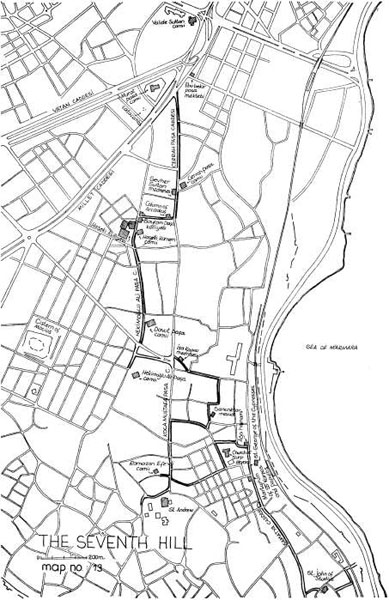
The first six hills of the city march in an almost straight line along the Stamboul shore of the Golden Horn. The Seventh Hill stands by itself towards the Marmara shore, covering most of the south-western part of Stamboul. Its highest point is at the Gate of Romanus (Topkapı), whence it slopes down to the north towards the valley of the Lycus, which divides it from the Sixth, Fifth and Fourth Hills, while to the south it approaches the sea, leaving sometimes a wide, sometimes a narrow plain along the shore. Our present tour will take us along the Marmara slopes of the Seventh Hill, through one of the most pleasant and picturesque parts of the city. This region, like the slopes of the Fifth and Sixth Hills above the Golden Horn, preserves much of the flavour of Ottoman Stamboul, with its winding cobbled streets lined with old wooden houses, its vine-covered teahouses sitting under venerable plane-trees, and its ancient mosque courtyards still serving as communal centres as they did in centuries past. This lovely old district is one of the most enchanting quarters of Stamboul, and nowhere else in the city can one enjoy more pleasurable strolls than there.
AKSARAY AND VALİDE SULTAN CAMİİ
We will start our tour at the crossroads in Aksaray, the second of the two great squares in modern Stamboul. Like Beyazit Square, Aksaray occupies approximately the site of an ancient Roman forum, in this case the Forum Bovis. At the Forum Bovis the Mese once again divided into two branches, one leading off to the north-west along the route of the modern Millet Caddesi, the other south-west following approximately the course of Cerrah Paşa Caddesi. Up until a few years ago Aksaray was a lively, bustling crossroads and market square, but now it has been utterly destroyed by a massive clover-leaf intersection. We will begin our stroll at this point, where stand almost cheek-by-jowl examples of the first interesting beginnings of Ottoman architecture and of its bitter end. The latter, Valide Sultan Camii, can be seen just to the north of the overpass. It combines elements from Moorish and Turkish, Gothic, Renaissance and Empire styles in a garish rococo hodgepodge. The mosque was built in 1871 for Pertevniyal Valide Sultan, the mother of Sultan Abdül Aziz. It used to be ascribed to the Italian architect Montani, but it seems actually to be by the Armenians Hagop and Sarkis Balyan, who built some of the late Ottoman palaces we will see along the Bosphorus.
At the west of the overpass and to the left down the first cross street, we come to a handsome sibyan mektebi. This was founded by Ebu Bekir Paşa in A.H. 1136 (A.D. 1723–4); it has recently been restored and is now in use as a children’s library, like so many others of its type.
Beyond the western end of the overpass the two new highways meet in an acute angle; the southern one, Millet Caddesi, runs up along the back of the Seventh Hill to Top Kapı and is a very busy and important thoroughfare; the northern one, Vatan Caddesi, follows the course of the Lycus River which is canalized beneath it.

In the angle between these two avenues stands the attractive and ancient mosque of Murat Paşa, the second of the two mosques of the “Bursa type” that still exist in Istanbul. It is smaller and less elaborate than Mahmut Paşa Camii but resembles it in general plan: a long rectangular room divided by an arch into two squares each covered by a dome, with two small side-chambers to north and south forming a tabhane for travellers. Of the two large domes, the eastern one rests on pendentives with bold and deeply cut stalactites, but the western one has that curious arrangement of triangles which we have seen on the smaller domes at Mahmut Paşa. The porch has five domed bays with six very handsome ancient columns: two of Syenitic granite, four of verd antique. The capitals are of three different kinds, arranged symmetrically, two types of stalactites and the lozenge capital. The construction of the building is in courses of brick and stone. The pious foundation originally included a medrese and a large double hamam; but these have unfortunately perished in the widening of the adjacent streets.
The founder, Murat Paşa, was a convert from the imperial family of the Palaeologues; he became a vezir of Fatih and died in battle as a relatively young man. The date of construction of his mosque is given in an intricate inscription in Arabic over the main door – A.H. 874 (A.D. 1469) – later than Mahmut Paşa Camii by only seven years. The calligraphy in this inscription is exceptionally beautiful and is probably by Ali Sofi, who did the fine inscription over the Imperial Gate to the Saray.
Behind Murat Paşa Camii a large catacomb was discovered in 1972 during excavations for a sewer. Eight vaulted chambers were found extending over an area roughly 30 metres square. It is thought that there is a second storey of comparable size beneath the first, but this has not yet been explored. The catacomb is believed to date from the sixth century A.D. The catacomb was closed off soon after its discovery and now there is no trace of it visible.
A little farther up Millet Caddesi, on the same side of the avenue, we find a newly removed and reconstructed mosque of some interest. It was founded by Selçuk Hatun, daughter of Sultan Mehmet I and an aunt of Mehmet the Conqueror. Selçuk Hatun died in 1485 and so her mosque must be from about that date. In the seventeenth century the mosque was partly burned and then was reconstructed by the Chief Black Eunuch, Abbas Ağa. In 1956, when Millet Caddesi was widened, the mosque was demolished and re-erected not far from its old site. How far the reconstructed building follows the old plan is not clear; at all events the mosque is rather attractive and the reconstruction at least adequate.
We now cross Millet Caddesi and continue south for a short distance until we come to Cerrah Paşa Caddesi, where we turn right and begin walking along the Marmara slope of the Seventh Hill. Here we leave the modern city behind, for the most part, and stroll through a more serene and old-fashioned quarter of Stamboul.

A short way along the left side of the avenue we come to an imposing mosque in its walled garden. This is Cerrah Paşa Camii, after which the avenue and the surrounding neighbourhood are named. Cerrah Mehmet Paşa, who founded it, had been a barber and therefore a surgeon (cerrah), having gotten this official title by performing the circumcision of the future Sultan Mehmet III. The latter in 1598 appointed him Grand Vezir and wrote him a letter warning him that he would be drawn and quartered if he did not do his duty. But he was only required to do his duty for six months or so, for he was dismissed – without being drawn and quartered – in consequence of the ill success of the war against Hungary.
An Arabic inscription over the door gives the date as A.H. 1002 (A.D. 1593); the architect was Davut Ağa, Sinan’s successor as Chief Architect. One might rank Cerrah Paşa Camii among the half-dozen most successful of the vezirial mosques. Its plan presents an interesting modification of the hexagon-in-rectangle type. The four domes which flank the central dome at the corners, instead of being oriented along the diagonals of the rectangle, are parallel with the cross axis. This plan has the advantage that, for any hexagon, the width of the building can be increased without limit. Such a plan was never used by Sinan and is seen again only in Hekimoğlu Ali Paşa Camii, which is a little farther west on this same hill. The mihrab is in a rectangular apse which projects from the east wall. The galleries, which run around three sides of the building, are supported by pretty ogive arches with polychrome voussoirs of white stone and red conglomerate marble; in some of the spandrels there are very charming rosettes. In short, the interior is elegant in detail and gives a sense of spaciousness and light. The exterior, too, is impressive by its proportions, in spite of the ruined state of the porch and the unfortunate restoration job that was done on the domes and semidomes. The porch originally had seven bays and its eight handsome antique columns are still standing, four of Proconnesian marble, two of Theban granite, and two of Syenitic granite. The türbe of the founder, a simple octagonal building, is in front of the mosque beside the entrance gate. Nearby is a ruined şadırvan and outside in the corner of the precinct wall is a pretty çeşme. The complex originally included an interesting hamam which unfortunately has been destroyed.
MEDRESE OF GEVHER HATUN
Immediately across the street is an interesting medrese which is not part of Cerrah Mehmet Paşa’s foundation. This was built in the second half of the sixteenth century by Gevher Sultan, daughter of Selim II and wife of the great admiral Piyale Paşa. This medrese, which has been restored, has the standard form of a rectangular porticoed courtyard with cells beyond.
COLUMN OF ARCADİUS
We now continue along Cerrah Paşa Caddesi for another 100 metres and take the second turning on the right, Haseki Kadın Sokağı. A short distance up the street on the right we find the shapeless remains of the Column of Arcadius, wedged tightly between two houses and as tall as they are; its marble surface is rent and pitted and it is overgrown with a mantle of ivy. Erected in 402 by the Emperor Arcadius, the column was decorated with spiral bands of sculpture in bas relief representing the triumphs of the emperor, like Trajan’s column in Rome. It stood in the centre of an imperial forum called after Arcadius. At the top of the column, which was more than 50 metres high, there was an enormous Corinthian capital surmounted by an equestrian statue of Arcadius, placed there in 421 by his son, Theodosius II. This statue was eventually toppled from the column and destroyed during an earthquake in 704. The column itself remained standing for another 1,000 years until it was deliberately demolished in 1715, when it appeared to be in immanent danger of collapsing on the neighbouring houses. Now all that remains are the mutilated base and some fragments of sculpture from the column which are on display in the Archaeological Museum. It is possible to enter the interior of the base through a side door in the house to the left. Once inside the base, we can climb up an interior stairway to the top of the ruin, where there is still visible a short length of the column with barely discernible remnants of the sculptured decoration.

Leaving the column, we continue on along Haseki Kadın Sokağı to the end of the street. There we come to the külliye of Bayram Paşa, which is divided by the street itself; on the right are the medrese and mektep, and on the left the mescit, tekke, türbe, and sebil. An inscription on the sebil gives the date of construction as A.H. 1044 (A.D. 1634). At that time Bayram Paşa was Kaymakam, or Mayor, of the city; two years later he became Grand Vezir and soon after died on Murat IV’s expedition against Baghdad. At the corner to the left is the handsome sebil with five grilled openings; behind it is the really palatial türbe of the founder, looking rather like a small mosque. (It is said to have fine and original tiles; unfortunately it is shut up and inaccessible.) At the far end of the enclosed garden and graveyard stands the mescit surrounded on two sides by the porticoed cells of the dervish tekke. The mescit, is a large octagonal building which served also as the room where the dervishes performed their music and dance ceremonies. The whole complex is finely built of ashlar stone in the high classical manner and the very irregularity of its design makes it singularly attractive.
COMPLEX OF HASEKİ HÜRREM
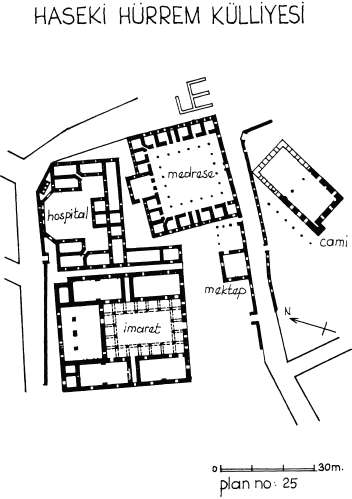
Turning left at the corner and passing the külliye of Bayram Paşa, we come immediately to that of Haseki Hürrem, which is contiguous with it to the west. This külliye was built by Haseki Hürrem, the famous Roxelana, and is the third largest and most magnificent complex in the old city, ranking only after those of Fatih and Süleyman. The mosque and its dependencies were built by Sinan and completed in 1539, making these the earliest known works by him in the city. The mosque is disappointing: originally it consisted of a small square room covered by a dome on stalactited pendentives, preceded by a rather pretentious porch of five bays which overlapped the building at both ends. It may perhaps have had a certain elegance of proportion and detail. But in 1612 a second and identical room was added on the north, the north wall being removed and its place taken by a great arch supported on two columns. The mihrab was then moved to the middle of the new extended east wall so that it stands squeezed behind one of the columns. The result is distinctly unpleasing.
Not so the other buildings of the külliye which are magnificent: a medrese, a primary school, a public kitchen and a hospital. Moreover, most of the complex has been well restored. The medrese is immediately across the street from the mosque. It is of the usual type – a porticoed courtyard surrounded by the student’s cubicles and the dershane; but apart from its truly imperial size, it is singularly well-proportioned and excellent in detail. Its 20 columns are of granite, Proconnesian marble, and vend antique; their lozenge capitals are decorated with small rosettes and medallions of various elegant designs and here and there with a sort of serpentine garland motif, a quite unique design. Also unique are the two pairs of lotus flower capitals, their leaves spreading out at the top to support a sort of abacus; though soft and featureless, they make a not unattractive variation from the almost characterless lozenge. Two carved hemispherical bosses in the spandrels of the arcade call attention to the dershane, a monumental square room with a dome. The great charm of the courtyard must have been still greater when the faience panels with inscriptions were still in place in the lunettes of the windows; many years ago when the building was dilapidated they were removed to the museum and are now on display in the Çinili Köşk. Next to the medrese is the large and very oddly-shaped sibyan mektebi in two storeys with widely-projecting eaves.
The imaret, which was still in use up until the early 1970s, is beyond the mektep, entered through a monumental portal which leads to an alleyway. At the end of this, one enters the long rectangular courtyard of the imaret, shaded with trees. Vast kitchens with large domes and enormous chimneys (better seen from inside at the back) line three sides of the courtyard.
The hospital is behind the medrese, entered from the street behind the külliye to the north. It is a building of most unusual form: the court is octagonal but without a columned portico. The two large corner rooms at the back, whose great domes have stalactited pendentives coming far down the walls, originally opened to the courtyard through huge arches, now glassed-in; with these open rooms or eyvans all the other wards and chambers of the hospital communicated. Opposite the eyvans on one side is the entrance portal, approached through an irregular vestibule, like that so often found in Persian mosques. On the other side are the lavatories, also irregular in shape; while the eighth side of the courtyard forms the façade on the street with grilled windows. This building too has been well restored and is once again in use as a hospital.

Returning to the street outside Haseki Hürrem Camii, we continue on in the same direction for about 400 metres. Then to our left, set back from the road and partly concealed by trees and houses, we see a fine but dilapidated old mosque. This is Davut Paşa Camii, dated by an inscription over the door to A.H. 890 (A.D. 1485). Davut Paşa, the founder, was Grand Vezir under Sultan Beyazit II. In plan the mosque belongs to the simple type of the square chamber covered by a large blind dome; but the mihrab is in a five-sided apse projecting from the east wall and to north and south are small rooms, two on each side, once used as tabhanes for travelling dervishes. What gives the building its distinction and harmony, however, is the beautiful shallow dome, quite obviously less than half a hemisphere. The pendentives of the dome are an unusually magnificent example of the stalactite form, here boldly incised and brought far down the corners of the walls. Unfortunately they are in very bad condition, as is the interior in general. A small amount of very careful restoration is called for, for this mosque is one of the half-dozen of the earliest period which are most worthy of preservation. In fact, the five-domed porch, which was partially in ruins, has now been well restored; let us hope the interior will soon be too.
Behind the mosque a delightfully topsy-turvy graveyard surrounds the founder’s türbe, octagonal in form and with an odd dome in eight triangular segments. Across the narrow street to the north stands the medrese of the külliye, almost completely surrounded and concealed by houses. The courtyard must have been extremely handsome – indeed it still is – with its re-used Byzantine columns and capitals, but it is in an advanced state of ruin. Here immediate restoration is urgently needed to save it before it is too late, for this is the only one of the fifteenth-century vezirial medreses which survives in something like its original form. The külliye once also had an imaret and a mektep, but these have completely disappeared.

Some 200 metres beyond Davut Paşa Camii and on the same side of the street, we come to a grand and interesting complex, that of Hekimoğlu Ali Paşa. This nobleman was the son (oglu) of the court physician (hekim) and was himself Grand Vezir for 15 years under Sultan Mahmut I. A long inscription in Turkish verse over the door gives the date of construction as A.H. 1147 (A.D. 1734–5); the architect was Ömer Ağa. One can consider this complex either the last of the great classical buildings or the first of the new baroque style, for it has characteristics of both. At the corner of the precinct wall beside the north entrance is a very beautiful sebil of marble with five bronze grilles; above runs an elaborate frieze with a long inscription and fine carvings of vines, flowers and rosettes in the new rococo style that had recently been introduced from France. The façade of the türbe along the street is faced in marble, corbelled out towards the top and with a çeşme at the far end. It is a large rectangular building with two domes dividing it into two equal square areas. This form was not unknown in the classical period – compare Sinan’s Pertev Paşa türbe at Eyüp (see Chapter 18); but it was rare and the use of it here seems to indicate a willingness to experiment with new forms. Farther along the precinct wall stands the monumental gateway with a domed chamber above; this was the library of the foundation. Though the manuscripts have been transferred elsewhere, it still contains the painted wooden cages with grilles in which they were stored; an elegant floral frieze runs round the top of the walls and floral medallions adorn the dome. From the columned porch at the top of the steps leading to the library, one commands a good view of the whole complex, with its singularly attractive garden full of tall cypresses and aged plane trees, and opposite the stately porch and very slender minaret of the mosque.
The mosque itself, raised on a substructure containing a cistern, is purely classical in form. Indeed its plan is almost an exact replica of that at Cerrah Paşa, which we saw earlier on this tour. In contrast to that, the present building is perhaps a little weak and effeminate; there is a certain blurring of forms and enervating of structural distinctions, an effect not mitigated by the pale colour of the tile revetment. The tiles are still Turkish, not manufactured at Iznik as formerly, but at the recently established kilns at Tekfur Saray. All the same, the general impression of the interior is charming if not exactly powerful. There is a further hint of the new baroque style in one of its less pleasing traits in some of the capitals of the columns both in the porch and beneath the sultans loge. The traditional stalactite and lozenge capitals have been abandoned there in favour of a very weak and characterless form, such as an impost capital which seems quite out of scale and out of place. The whole complex within the precinct wall has been very completely and very well restored. Outside the precinct, across the street to the north-east, stands the tekke of the foundation, but little is left of it save a very ruinous zaviye, or rooms for the dervish ceremonies.

We now walk back to the intersection we passed just before we reached the mosque. There we turn left into Yaprağı Sokağı, which after the first intersection becomes Sırrı Paşa Sokağı. Just before the first turning on the left we come to a Greek church surrounded by a walled garden. This is the church of the Panaghia Gorgoepikoos, the Virgin Who Answers Requests Quickly. The church is referred to as early as 1343, and it is mentioned in Tryphon’s list of 1583. The present building dates from the early nineteenth century.
We turn left at the corner beyond the church, and then after the next intersection we see on our right the ruins of a once handsome medrese. It was built by Sinan for Nişancı Mehmet Bey, who served as Keeper of the Royal Seal (Nişancı) for Süleyman the Magnificent. The medrese was built before 1566 when Mehmet Bey died on hearing the news of Süleymans death.
At the corner beyond the medrese we turn right on Köprülüzade Sokağı, which after three blocks brings us to the south-west corner of an enormous open cistern on the summit of the Seventh Hill. This is the third and largest of the extant Roman reservoirs in the city, that of St. Mocius, so called from a famous church dedicated to that saint, a local martyr under Diocletian. It is a rectangle 170 by 147 metres, or just under 25,000 square metres in area. Constructed under the Emperor Anastasius (r. 491–518), it fell into disuse in Byzantine times; like the other two Roman reservoirs it served as a vegetable garden and orchard, with a few wooden houses at the eastern end. In 1993 it was converted into the Fatih Educational Park.
Returning to Hekimoğlu Ali Paşa Camii, we take the street that runs past the northern side of the mosque precinct. We follow this to its intersection with Koca Mustafa Paşa Caddesi; then we take the street opposite and slightly to our left; this immediately brings us to a pathetic ruin which is of interest only because of its association with the great Sinan.
ISA KAPI MESCİDİ
This complex consists of two walls of a Byzantine church and the wreck of a medrese by Sinan. Of the church only the south and east walls remain. It was of the simplest kind; an oblong room without aisles ending at the east in a large projecting apse and two tiny side apses. In the southern side apse there could be seen till recently the traces of frescoes; these have now almost entirely disappeared. The building is probably to be dated to the beginning of the fourteenth century, but nothing is known of its history nor even the name of the saint to whom it is dedicated. About 1560 the church was turned into a mosque by the eunuch Ibrahim Paşa, who added to it a handsome medrese designed by Sinan. Both church and medrese were destroyed by the great earthquake of 1894 and have remained abandoned ever since. The ruins of the medrese, which is unusual in plan, are rather fine; its large dershane still bears traces of plaster decoration around the dome, and the narrow courtyard beyond must have been very attractive. The medrese, known as Isa Kapı Mescidi, is now under restoration. The name Isa Kapısı means the Gate of Christ and the theory is that it preserves the memory of one of the gates in the city walls of Constantine the Great which are thought to have passed close by. This is possible, but the arguments of the authorities are contradictory and inconclusive.
Following the alley that leads round behind the medrese, we pass a little square and find ourselves at the top of a steep hill leading down to the Marmara, of which one has an extensive view. Below on the left the great new building of the Istanbul Hospital – the usual block of concrete and glass – makes a curious contrast with the ancient cobbled streets and the decrepit but picturesque wooden houses among which we have been wandering.
SANCAKTAR MESCİDİ
At the top of the hill we turn right into Sancaktar Tekke Sokağı, which leads after several zigzags to an octagonal Byzantine building called Sancaktar Mescidi. This has been identified, on very slender evidence, as one of the buildings of the Monastery of Gastria. The legend is that this monastery was founded in the fourth century by St. Helena, mother of Constantine the Great, and that it derives its name of Gastria, which means vases, from the vases of flowers she brought back from Calvary where she had luckily discovered the True Cross! This story has been refuted by the French scholar Janin, who shows that there is no trace of the existence of the monastery before the ninth century. The present little building has the form of an octagon on the exterior with a projecting apse at the east end; within, it has the form of a domed cross. It is thought that it was once a funerary chapel; it has been dated variously from the eleventh to the fourteenth century. The building was for long an abandoned ruin, but it has now been restored and is once again serving as a mosque.
Leaving Sancaktar Mescidi, we walk straight ahead for a few paces to the next intersection and then turn right on Marmara Caddesi. This brings us back to Koca Mustafa Paşa Caddesi, where we turn left and stroll through the pleasant district of Samatya.
RAMAZAN EFENDİ CAMİİ
Continuing along the avenue, we take the second right onto Ramazan Efendi Caddesi, where a short way along on the right we come to a small but charming mosque with a pretty garden courtyard in front. The official name of the mosque is Hoca Hüsrev Camii, for the court official who originally founded it, but it is more usually called Ramazan Efendi Camii, after the first şeyh of the dervish tekke which was part of the original foundation. The building is by Sinan, and a long inscription over the inner door by his friend the poet Mustafa Sa’i, gives the date as A.H. 994 (A.D. 1586); thus, this is undoubtedly the last mosque built by the great architect, completed in his 97th year. It is a building of the simplest type: a small rectangular room with a wooden roof and porch. It is thought that it was originally covered with a wooden dome and that it had a porch with three domed bays supported by four marble columns; the present wooden porch and flat wooden ceiling are botched restorations after an earthquake. The minaret is an elegant structure both in proportion and in detail, while the small şadırvan in the courtyard is exquisitely carved. But the great fame of the mosque comes from the magnificent panels of faience with which it is adorned. These are from the Iznik kilns at the height of their artistic production and are thus some of the finest tiles in existence: the borders of “tomato-red” or Armenian bole are especially celebrated.
After leaving the mosque we return to Koca Mustafa Paşa Caddesi and continue on in the same direction as before. A short distance along, the avenue forks to the right, and we soon come to a picturesque square shaded with trees and lined with teahouses and cafés. On the left side of the square is the entrance to the mosque complex of Koca Mustafa Paşa, after whom the avenue and the surrounding neighbourhood are named.

The central building of this picturesque complex is Koca Mustafa Paşa Camii, anciently a church known as St. Andrew in Krisei. The identification and history of the church are very obscure and much disputed. One may summarize the discussions of the learned in a series of subjunctive statements: that Koca Mustafa Paşa Camii may have been one of the churches in the region dedicated to a St. Andrew; that if it is, it is probably that dedicated by the Princess Theodora Raoulina about 1264 to St. Andrew of Crete; that the present building was fairly certainly of the ambulatory type; that it may have been built on the foundations of an earlier church dedicated to St. Andrew the Apostle; and that it certainly re-used sixth-century materials, especially capitals. The mosque has been reoriented by 90° so that the mihrab and mimber are under the semidome against the south wall; the entrance is in the north wall, in front of which a modern porch has been added. One enters through a door at the west end of the north aisle and should proceed at once to the central bay of the narthex. This bay has a small dome supported by columns with beautiful sixth-century capitals of the pseudo-Ionic type. From here one enters through the central portal into a sort of inner narthex, or aisle, separated from the church by two verd antique columns; this aisle is regrettably obstructed by a large wooden gallery. But from this point the whole church is visible; it now has a trefoil shape but was probably originally ambulatory; that is, there would have been a triple arcade supported by two columns to north and south, like the one which still exists on the west. To the east the conch of the apse is preceded by a deep barrel vault; to north and south open out the two later Ottoman semidomes. Even in its greatly altered form it is an extremely attractive building.
The dependencies of the mosque include a medrese, a tekke, a mektep and two türbes; what survives of these are of a much later date than the conversion of the church into a mosque. The mosque is one of the most popular religious shrines in the city, for in one of the türbes is buried the famous folk-saint Sümbül (Hyacinth) Efendi. Sümbül Efendi was the first şeyh of the dervish tekke which was established here in the sixteenth century, and since then he has been prayed to by the common people of Istanbul for help in solving their problems. In the other türbe beside that of Sümbül Efendi is buried his daughter Rahine, who is generally prayed to by young women looking for a suitable husband. The ancient plane tree tottering above her türbe is said to possess talismanic powers.
We now retrace our steps for a short way back along Koca Mustafa Paşa Caddesi and then take the first right after the fork in the road. This street, Mudafaai Milliye Caddesi, takes us down the slope of the Seventh Hill towards the Marmara shore. About 250 metres along we turn left on Marmara Caddesi, a wide and pleasant avenue that runs along the heights parallel to the sea. As we begin walking along this avenue we see on our right the large Armenian church of Surp Kevork (St. George), called in Turkish Sulu Manastir, built in the precincts of the ancient Byzantine monastery of St. Mary Peribleptos. Of the latter nothing but substructures remain. It was founded in the eleventh century by Romanus III Argyros and has remained a Christian church ever since. The tradition heretofore generally accepted is that the church remained in the hands of the Greeks until 1643, when it was given to the Armenians by Sultan Ibrahim under the influence of a favourite Armenian concubine. (This lady’s name was Şeker Parça, or Piece of Sugar; she is said to have weighed more than 300 pounds.) This story, however, appears to be fictitious, for we read in the recently published work of the Armenian traveller Simeon of Zamosc in Poland, who visited the city in 1608, that it was already at that date in the hands of the Armenians and was the cathedral church of the Armenian Patriarch.
Apparently Surp Kevork had been the Armenian cathedral church since 1461, when Sultan Mehmet the Conqueror recognized the Armenian Patriarchate of Istanbul. The first Armenian Patriarch was Bishop Hovakim of Bursa. The Patriarchate remained in Samatya until 1641, when it was moved to its present location in Kumkapı. The Patriarchal church in Kumkapı, Surp Astvadzadzin, was originally built in 1645, but the building which we see there today dates only from 1913.
AĞA HAMAMI
Once past the church we turn right and take the road which leads down towards the sea. As we do so we are confronted almost immediately with an interesting view of a vast double hamam. It is astonishing how many domes of all sizes and arranged apparently at random these hamams have, and it is not often that one can get a good view of them from above. This one is called Ağa Hamamı and is a work of Sinan. It is unfortunately disaffected and ruinous, used for commercial purposes. The workshop is installed in what was once the hararet of the bath, a typical cruciform room with cubicles in the corners.
After passing the hamam we turn right on Samatya Caddesi, which skirts the foot of the Seventh Hill not far from the sea. As we walk along we soon pass on our left the courtyard wall of a very venerable Greek church, St. George of the Cypresses. This church was originally founded in the ninth century and has remained in the hands of the Greeks ever since. The present building, however, dates only from 1830.
MARTYRIUM OF SS. KARPOS AND PAPYLOS
A little farther along the avenue on the right side we see on the height above the tall tower of the modern Greek church of St. Menas. The church itself is of no interest, but beneath it, though in no way structurally connected with it, are some very important and ancient substructures. They are entered from Samatya Caddesi and are presently used as a workshop. These substructures, discovered only in 1935, have been identified as the crypt of the Martryium of SS. Karpos and Papylos, who perished in the Decian persecutions in 250–1. The crypt is a large circular domed chamber which reminds one of the beehive tombs at Mycenae, only constructed not of stone but of brick, in the excellent technique of the fourth or fifth century A.D. At the east is a deep apse, while completely round the chamber runs a vaulted passage, also of brick. (This passage can be entered through a door in the teahouse just beyond the workshop.) Since this appears to be one of the oldest surviving places of Christian worship in the city and since it is unique in form, it is much to be hoped that it will be rescued from its base uses, and thoroughly investigated and restored.
Some 500 metres farther along the avenue we see on the left a modern Greek church, that of SS. Constantine and Helena. This church has only very recently been rebuilt, but its foundation goes back at least as far as 1563, the date of the earliest recorded reference to it.
CHURCH OF ST. JOHN THE BAPTIST OF STUDIUS
We turn left at the second street beyond SS. Constantine and Helen and come to the walled courtyard of a very ancient and interesting Byzantine church. This is the church of St. John the Baptist of Studius, known in Turkish as Imrahor Camii. It was founded by a Roman named Studius in 450, and is thus the oldest surviving church in the city. In form it is a pure basilica with a single apse at the east end; it is preceded by a narthex and an atrium. The narthex is divided into three bays, of which the wider central one has a very beautiful portal consisting of four columns in antis, with magnificent Corinthian capitals sup porting an elaborate entablature with richly sculptured architrave, frieze and cornice. Two of the marble door-frames still stand between the columns. From the narthex five doors lead into the church, which is divided, in the traditional basilican style, into a nave and side aisles by two rows of seven columns. Six of those on the north side still stand; they are of verd antique, with capitals and entablature as in the narthex. The nave ends in a single semicircular apse where once rose the tiers of seats for the clergy and in front of them the altar. Above the aisles and narthex ran galleries, the columns of which supported a trussed timber roof. The interior was revetted with marble and the upper parts decorated with mosaics. The floor was also of mosaic or opus sectile, and of this some portions may still be seen, although they are fast disappearing.
Nothing now remains of the monastery of the church, the Studion, once the most famous and powerful institution of its kind in the Byzantine Empire. This monastery first came into prominence in the year 799, when the great abbot Theodore assumed direction of its affairs. Inspired by Theodore’s spiritual and intellectual leadership, the Studion became a centre for the first renaissance of Byzantine culture in the ninth century. Many monks of the Studion won renown as composers of sacred hymns, painters of icons, and illuminators of manuscripts. The Studion was particularly noted for its scholarship and was active in the preservation and copying of ancient manuscripts. The Emperor Isaac I Comnenus, who had studied there as a youth, referred to it as “that glorious and illustrious school of virtue.” The Studion continued as one of the spiritual and intellectual centres of the Empire right up to the time of the Conquest. During the first half of the fifteenth century the University of Constantinople was located at the Studion, and during that period some of the greatest scholars in the history of Byzantium taught and studied there. The Studion survived the fall of Byzantium and continued to function for nearly half a century after the Conquest, having celebrated its millennium in 1450. But then at the close of the fifteenth century the church of St. John was converted into a mosque and the few monks who were still resident were forced to seek shelter elsewhere. What was left of the monastery in modern times was utterly destroyed in the earthquake of 1894 and now not a trace remains.
Before we leave St. John’s, we might read what one of the monks of the Studion wrote in praise of it some centuries ago, apparently in a moment of great happiness: “No barbarian looks upon my face, no woman hears my voice. For a thousand years no useless man has entered the monastery of the Studion, none of the female sex has trodden its court. I dwell in a cell that is like a palace; a garden, an olive grove and a vineyard surround me. Before me there are graceful and luxuriant cypress trees. On one hand is the great city with its market places and on the other the mother of churches and the empire of the world.”
Leaving the church we turn left and follow the winding path which leads us around to the south-eastern corner of its outer precincts. Here, at the edge of a vacant field, we find a small shed which gives access to a covered cistern which was once part of the Studion. It is quite impressive, containing 23 granite columns with handsome Corinthian capitals. Beside it is an ayazma, or holy well, with two columns.
After leaving the cistern we continue on in the same direction until we arrive at the railway line. There we turn left and follow the railway as far as the first underpass, from which a path leads us out to the sea-walls. There we turn right and in a few steps come to a portal called Narlı Kapı, the ancient Pomegranate Gate, whence a path takes us out to the Marmara road. Here we can stroll back towards town along the shore, enjoying a splendid view of the Stamboul skyline.