
18

Eyüp, a village far up the Golden Horn, had in the nineteenth century the reputation of being wildly romantic and picturesque. Surrounded on two sides by high hills covered with groves of cypress trees and turbaned tombstones, commanding magnificent views of both shores of the Golden Horn, it was a peaceful back water devoted to death and religion. The modern world in its most dreary form of shabby factories and warehouses and cheap housing developments has unfortunately caught up with it and is investing it on all sides, though the view down the Golden Horn is still romantic at sunset.
Nevertheless, Eyüp itself has so far resisted the worst encroachments of the modern world and it contains some of the most interesting as well as some of the most sacred relics of Ottoman piety; of all the suburbs of Istanbul it is the one which most repays a visit. The best way of reaching Eyüp is by ferry from the Galata Bridge, particularly now that new and more comfortable ferries have been put into service. The journey is pleasant and affords an opportunity of viewing from a distance the villages and districts on the way. Alternatively one can take a taxi, stopping en route at a number of the interesting monuments on the north shore of the Golden Horn above the Atatürk Bridge, which we will visit on this itinerary.
The Golden Horn (Halıç or Estuary in Turkish) has become badly polluted in the past century, although a vigorous effort is now being made to clean up the Horn and its shores. The Golden Horn is an inlet of the Bosphorus, stretching north-west for some 11 kilometres from Saray Point, with an average width of about 400 metres. At its northern end two little streams flow into the Horn, Alibey Suyu on the west and Kâğıthane Suyu on the east; they were once known to Europeans as the Sweet Waters of Europe. For centuries the charming meadows between them were the site of royal gardens, palaces and pavilions, and were a favourite holiday resort for city-dwellers, as they are once again becoming today.

The first stop of the ferry is on the north shore of the Golden Horn at Kasım Paşa, a short way above the Atatürk Bridge. Here one might make an excursion by taxi in order to visit one of the most interesting and enigmatic of the classical mosques, that of Piyale Paşa, about a mile straight up the valley from the landing stage. Constructed in 1573, the mosque is unique in the classical period in more than one respect. In the first place it is the only classical mosque to revert in plan to the Ulu Cami or multidomed type, common in the Selçuk and early Ottoman periods. Its six ample and equal domes in two rows of three are supported by two great red granite columns. Thus far it follows the earlier type, but all else is different. In the centre of the west wall opposite the mihrab is a small balcony supported on six columns, and behind this rises very unusually the single minaret, which is thus in the middle of the west façade. The entrance portals are to the right and left of the balcony, and there are narrow galleries along the sides of the building. The room is lighted by numerous windows, many of the upper ones being round, oeils-de-boeuf; between the second and third tier a wide frieze of faience has inscriptions from the Kuran in white on a blue ground, from the hand of the famous hattat (calligrapher) Karahisarı, who wrote the inscriptions in the Süleymaniye. The mihrab also is a very beautiful work of Iznik tiles of the best period. The whole interior is not merely unusual but exceptionally charming. The exterior is even more unusual. Around three sides of the building runs a deep porch whose vaults are supported by stout rectangular pillars; above the side porches were galleries with sloping roofs supported on innumerable small columns, while in front of the main western porch was another lower one with 22 columns. The roofs of this and the upper galleries on the sides have unfortunately disappeared, but from old pictures one can see how fascinating this unique arrangement was. The founder’s türbe behind the mosque also had a columned porch, and it is said that the total number of columns was 118; evidently Piyale had a passion for them. Piyale Paşa, son of a Croatian shoemaker, was brought up in the Palace School and married a daughter of Selim II; he was Lord High Admiral and conquered the island of Chios as well as repeatedly harrying the coasts of Italy.
At Kasım Paşa is the famous naval Arsenal (Tershane), originally built by Mehmet the Conqueror. During the sixteenth and seventeenth centuries it made a great impression on foreign travellers, for it could accommodate 120 ships in drydock and there was nothing like it in Europe. Now its activities are more modest. At the water’s edge not far beyond the landing stage is a pretty little nineteenth-century palace for the commandant in charge of the Taşkızak Naval Arsenal.
Farther up the north shore of the Golden Horn, opposite Balat, we see the former imperial residence known as Aynalı Kavak Kasr, the Pavilion of the Mirroring Poplars. This handsome building was probably constructed during the reign of Ahmet III (r. 1703–30), restored by Selim III (r. 1789–1807), and given its present form with alterations by Mahmut II (r. 1808–39). Aynalı Kavak figures in Turkish history as the site of the peace conference which in 1779 ended a war between Russia and the Ottoman Empire. The palace was restored and reopened in 1993 as a museum, housing a fascinating collection of Turkish musical instruments.
After Kasım Paşa the next ferry stop is at Fener on the south shore of the Golden Horn. The ferry then crosses over to stop at Hasköy on the north shore before going on to its last stop at Eyüp. At Hasköy one might want to break the journey by visiting the very interesting Rahmi M. Koç Industrial Museum. Part of the museum is housed in a beautifully restored Ottoman lengerhane, a forge for making ship’s chains and anchors, a structure dating from the reign of Ahmet III. One of the buildings of the lengerhane has been converted into a very attractive restaurant called the Café du Levant.
THE MOSQUE AND TÜRBE OF EYÜP
The mosque of Eyüp is the holiest in Istanbul; indeed after Mecca and Jerusalem it is perhaps the third most sacred place of pilgrimage in the Islamic world. This is because it is the reputed burial place of Eyüp (Job) Ensari, the friend and standard-bearer of the Prophet Muhammed. Long after the Prophet’s death, Eyüp is said to have been one of the leaders of the first Arab siege of Constantinople from 674 to 678 and to have been killed and buried somewhere outside the walls. When some eight centuries later Fatih Mehmet besieged the city, he and his advisors, as Evliya Çelebi writes,
spent seven whole days searching for the tomb. At last Akşemsettin (the Şeyh-ül Islam) exclaimed, “Good news, my Prince, of Eyüp’s tomb!” Thus saying he began to pray and then fell asleep. Some interpreted this sleep as a veil cast by shame over his ignorance of the tomb; but after some time he raised his head, his eyes became bloodshot, the sweat ran from his forehead, and he said to the Sultan, “Eyüp’s tomb is on the very spot where I spread the carpet for prayer.” Upon this, three of his attendants together with the Şeyh and the Sultan began to dig up the ground, when at a depth of three yards they found a square stone of verd antique on which was written in Cufic letters: “This is the tomb of Eba Eyüp.” They lifted the stone and found below it the body of Eyüp wrapped up in a saffron-coloured shroud, with a brazen play-ball in his hand, fresh and well-preserved. They replaced the stone, formed a little mound of the earth they had dug up, and laid the foundations of the mausoleum amidst the prayers of the whole army.
This pleasant story, though still current and recounted in one form or another by the guides and guidebooks, seems rather unlikely – apart from its supernatural elements – because it appears that the tomb had always been known and respected even by the Byzantines. Various Arab historians note that it was made a condition of peace, after the first Arab siege, that the tomb should be preserved. An Arab traveller during the reign of Manuel I Comnenus (r. 1143–80) mentions it as still existing in his day, while another traveller, Zakariya al-Kazwini (ca. 1203–83), relates that “this tomb is now venerated among them (the Byzantines) and they open it when they pray for rain in times of drought; and rain is granted them.” If the tomb was still extant in early Palaeologan times, it seems improbable that it should so completely have disappeared before the Turkish Conquest. Probably, Fatih restored or rebuilt it on a grander scale.
The külliye as a whole, originally including the türbe, mosque, medrese, han, hamam, imaret and market, was built by Fatih Mehmet in 1458, five years after the Conquest. Here on their accession to the throne the Ottoman sultans were girded with the sword of Osman, a ceremony equivalent to coronation. By the end of the eighteenth century the mosque had fallen into ruin, perhaps a victim of the great earthquake of 1766 which had destroyed Fatih’s own mosque. At all events, in 1798 under Sultan Selim III, what remained of the building was torn down and the present mosque erected in its place and finished in 1800; only the minarets, the gift of Ahmet III, remain from the older building.
One approaches through an outer courtyard of irregular shape but great picturesqueness. The two great gateways with their undulating baroque forms, the staircase and gallery to the imperial loge, the huge and aged plane trees in whose hollows live lame storks and in whose branches beautiful grey herons build their nests in spring, the flocks of pampered pigeons – all this makes the courtyard the most delightful in Istanbul. From here one enters the inner court, surrounded on three sides by an unusually tall and stately colonnade and also shaded by venerable plane trees. The mosque itself in plan is an octagon inscribed in a rectangle and closely resembles Sinan’s Azap Kapı Camii, though on a rather larger scale and with many baroque details of decoration. But in spite of its late date the mosque is singularly attractive with its pale honey-coloured stone, the decorations picked out in gold, and the elegant chandelier hanging from the centre of the dome.
The side of the building opposite the mosque is a blank wall, most of it covered with panels of tiles without an overall pattern and of many different periods, some of them of great individual beauty. A door in the wall leads to the vestibule of the türbe of Eyüp, an octagonal building three sides of which project into the vestibule. The latter is itself sheathed in tiles, many of them of the best Iznik period. The türbe is sumptuously decorated, though with work largely of the baroque period.
Of the other buildings of the külliye the medrese, which according to Evliya formed the courtyard of the mosque, was evidently swept away when the latter was rebuilt; the imaret is a ruin. But of the hamam the soğukluk and hararet still remain and are in use; they have the elaborate and attractive dome structure typical of the early period, and handsome marble floors. The original camekân has completely disappeared and been replaced by a rather make-shift one largely of wood. In the Victoria and Albert Museum there is a very fine panel of 24 Iznik tiles of about 1570 from this hamam, very probably from the demolished camekân.
THE KÜLLİYE OF MİHRİŞAH SULTAN
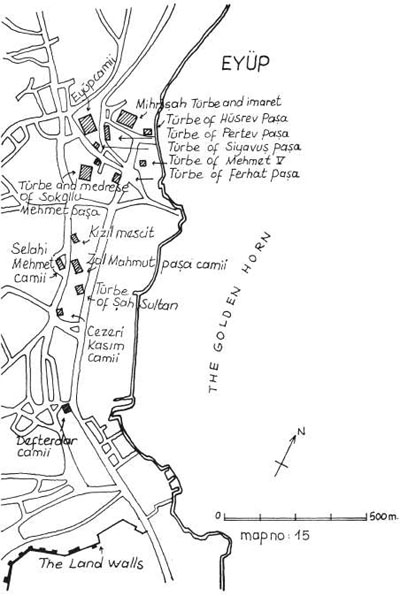
Leaving Eyüp Camii by the north gate, one finds oneself in a narrow street that leads down to the Golden Horn. Most of the left side of this street is occupied by the enormous külliye built in 1794 by Mihrişah Valide Sultan, mother of Selim III. This is one of the largest and most elaborate of all the baroque complexes and includes the türbe of the foundress together with a mektep, an imaret, and a splendid sebil and çeşmes. The türbe is round, but the façade undulates turning it into a polygon, the various faces being separated by slender columns of red or dark grey marble; in general it recalls the türbe of Nakşidil at Fatih, though it is not quite so flamboyant. The entrance is in a little courtyard filled with tombstones and trees, along one side of which runs the columned portico of the mektep or primary school. Farther along the street another monumental gateway leads into the vast courtyard with more and tombstones and surrounded on three sides by the porticoes of the huge imaret or public kitchen. This is one of the very few imarets in Istanbul which still fulfil their function as food kitchens for the poor of the district; some 500 people are served daily at 11 o’clock with food to take away. In leaving you should notice the magnificent sebil at the end of the garden wall on the street side.
Continuing towards the water, one passes on the right the türbe and on the left the library of Hüsref Paşa, dated 1839 and both in heavy Empire style; but the domes of the library reading-rooms contain a good example of that horrendous Italianate comic opera painted decoration of garlands, draperies and columns, which is so distressing when it occurs in classical buildings but is quite appropriate here. At the end of the street at the waters edge one gets a good view of the neo-classical türbe of the Sultan Mehmet V Reşat who died in 1918, oddly enough the only one of all the sultans to be buried in the holy precincts of Eyüp and the last to be buried in his own country. It is a rather heavy building, the interior revetted in modern Kütahya tiles predominantly of a vivid (too vivid) green.
Taking the street parallel to the Golden Horn, one soon comes to a crossroads where stand several classical türbes. The finest and most elaborate of these is that of Ferhat Paşa, octagonal in structure with a richly decorated cornice and polychrome voussoirs and window-frames.


Further up the street that leads back towards Eyüp Camii two classical türbes of great simplicity face one another. The one on the left is that of Sokollu Mehmet Paşa, built by Sinan in about 1572; it forms part of a small külliye. Elegant and well-proportioned, it is severely plain, but the interior contains some interesting stained glass, partly ancient and partly a modern imitation but very well done; alternate windows are predominantly blue and green. A little colonnade attaches the türbe to the dershane of the very fine medrese of the complex. Notice the handsome identical doorways of the two buildings, differing only in that the rich polychrome work of the türbe is in verd antique, that of the dershane in red conglomerate marble. The dershane also has stained glass windows, but they are modern and not so good as those in the türbe. Its dome is supported on squinches of very bold stalactites. The opposite door leads into the medrese courtyard, long and narrow, its colonnade having ten domes on the long sides, only three on the ends. The building has been well restored and is used as a children’s clinic: it is so pretty and charming, with a delightfully well-kept garden, that it must almost be a pleasure to be a patient! In the little garden of the türbe are buried the family and descendants of Sokollu Mehmet, and just beyond the graveyard is a building in the same style as the dershane: this is the dar-ül kura or school for the various methods of reading the Kuran. This little complex as a whole is certainly one of Sinan’s most attractive.
Sokollu Mehmet Paşa was perhaps the greatest and most capable of the long line of able grand vezirs of the sixteenth century. He was the son of a Bosnian priest and was born in the castle of Sokol, “the falcon’s nest”, in Bosnia. But he was taken in the devşirme and brought up in the Palace School at the Saray. He married the princess Ismihan Sultan, daughter of Sultan Selim the Sot. His outstanding genius brought him early preferment and he successively held the posts of Lord High Treasurer, Grand Admiral, Beylerbey of Rumelia, Vezir, and finally Grand Vezir, a position which he held continuously for 15 years under three sultans, Süleyman, Selim II and Murat III, from 1564 to 1579, in which year he was murdered in the Divan itself by a mad soldier. Posterity owes him three of the most beautiful architectural monuments in Istanbul: the present complex, the mosque at Azap Kapı, and – most beautiful of all – the mosque at Kadirga Liman under the Hippodrome; all were the work of Sinan.
The türbe across the street from Sokollu’s is that of Siyavuş Paşa, austere like the other but adorned within by inscriptions and pendentives in excellent Iznik tiles. It is also by Sinan; Siyavuş outlived Sinan by a dozen years and died in 1601, but he seems to have had Sinan build this türbe originally for some of his children who died young, and then was finally buried there himself. Still another türbe by Sinan is to be found half-way up a narrow and picturesque little alleyway beside the türbe of Siyavuş that leads back towards the mosque of Eyüp through a forest of tombstones. This is the tomb of Pertev Paşa, of a very unusual design, rectangular and more like a house than a tomb. It was originally divided into two equal areas each covered by a dome of wood exquisitely painted; this survived until 1927 when it fell victim to neglect. Inside are still to be seen some charming marble sarcophagi of Pertev and his family.
One has now come full circle back to the north gate of the courtyard of Eyüp Camii. If one crosses the court and takes the inner of the two roads parallel with the Golden Horn, one soon comes to the second group of buildings that make Eyüp illustrious. The first, Kızıl Mescit, is perhaps hardly worth a visit though it has been reasonably well restored. Built in 1581 by Kiremitçi Süleyman Çelebi, it is of the simplest type, a rectangular room of stone and brick with a tiled roof and a brick minaret. A little farther on, on the opposite side of the street stands the mosque of Silahi Mehmet Bey, also of the simplest type but nearly a century older than the other and with a fascinating minaret. This is hexagonal in shape, built of stone and brick and without a balcony, but instead a sort of lantern with six windows and a tall conical cap. There are in the city three or four other minarets with this lantern arrangement, but this is much the most striking and pretty.

Opposite Silahi is the grandest and most interesting mosque in Eyüp, that of Zal Mahmut Paşa, a mature but unique work of Sinan. Its date of construction is unknown; that usually given, 1551, is at least 20 years too early, and a date in the mid 1570s seems most probable. Zal was a rather unsavoury character: when in 1553 Süleyman had his son Mustafa put to death, it was Mahmut (who got his forename Zal from that of a Persian hero famous for his Herculean strength) who finally overcame the young princes resistance and strangled him. Later he married the Princess Şah Sultan, sister of Selim the Sot, as a reward, it is said, for having smoothed that princes path to the throne by the elimination of his brother. In 1580, Zal and his wife died in a single night.
A fine view of the south façade of the building may be had from the garden of Silahi Camii which is a little higher. With its four tiers of windows and its great height and squareness it looks more like a palace than a mosque. The north façade is even more towering, for the mosque is built on a slope and supported on vaulted substructures in which rooms for the lower medrese have been made. The mosque is constructed of alternate courses of stone and brick. A handsome porch of five bays gives access to the interior. This is a vast rectangular room; the massive dome arches spring on the east from supports in the wall itself, on the west from thick and rather stubby pillars some distance in from the west wall; galleries supported on a rather heavy arcade, some of whose arches are of the ogive type, run round three sides. The walls, which rise in a rectangle to the full height of the dome drum, are pierced with many windows and in spite of the width of the galleries provide plenty of light. The general effect of the interior is perhaps a little heavy but nonetheless grand and impressive: and it is quite different from that of any other mosque.
The leaves of the main entrance door are fine inlaid work in wood, as are the mimber and mahfil in carved marble. The only other remaining decoration is some excellent faience in the mihrab; perhaps there was once more tile work which has perished, for Evliya tells us that “architectural ornaments and decorations are nowhere lavished in so prodigal a way as here”; and he calls it “the finest of all the mosques in the Ottoman empire built by vezirs,” and adds: “the architect Sinan in this building displayed his utmost art.” The mosque was for many years in a state of near ruin but has now been very well restored.
The complex includes two medreses, like the mosque itself built of stone and brick, one round three sides of the main courtyard, the other on a lower level to the north, enclosing two sides of the türbe garden. They are both extremely picturesque and irregular in design. In the upper medrese most of the south side consists of a building without a portico, which looks rather like an imaret and may perhaps have served as one. The dershane is not in the centre of the west wall but has been shifted to near the north end, and the last arches of the portico on this side are smaller than the others. There is no obvious reason for any of these abnormalities but they have a certain charm, enhanced by the ogive arches of the arcade. At the north-east corner a long flight of steps leads down to the garden of the türbe. The lower medrese partly encloses two sides of it. It is an octagonal building of the usual type in which are buried Zal and his wife.
A door in the east wall of the türbe garden leads to another külliye of a very different type, one of the most delightful of the smaller baroque complexes. It consists of an elaborate türbe and mektep with a sebil on the street and a çeşme in the garden. It was built at the end of the eighteenth century by Şah Sultan, a sister of Selim III. The undulating façades of the türbe and the amusing turned back staircase of the mektep are very charming.
One now returns to the inner street along which there are two or three buildings that are worth at least a glance. One comes first to the small mosque of Cezari Kasım Paşa, erected in 1515. It has a pretty porch with four handsome antique columns of red granite, and the balcony of the minaret is supported on an unusual zigzag corbel. A little further down the street is the mosque of the Defterdar (Lord High Treasurer) Mahmut Efendi; it is also ancient in foundation, but wholly rebuilt in the eighteenth century and of little interest in itself. In the garden is the founder’s curious open türbe with a dome supported on arches with scalloped soffits.
This completes our stroll to Eyüp, after which we walk back to the iskele to take a ferry back along the Golden Horn to the Galata Bridge.