
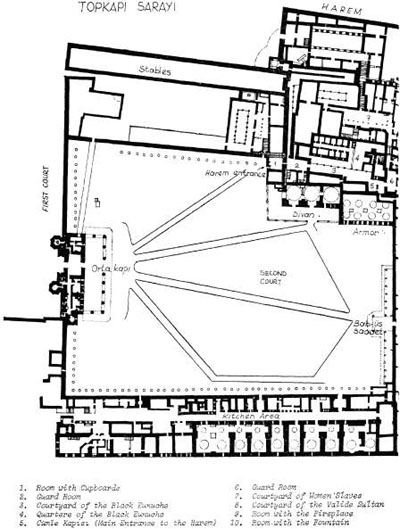

4

Topkapı Sarayı, the Great Palace of the Osmanlı Sultans, is the most extensive and fascinating monument of Ottoman civil architecture in existence. In addition to its architectural and historical interest, it contains, as a museum, superb and unrivalled collections of porcelains, armour, fabrics, jewels, illuminated manuscripts, calligraphy, and many objects of art formerly belonging to the sultans. A cursory visit requires several hours; to know it thoroughly many weeks would hardly suffice.
When Mehmet the Conqueror, known to the Turks as Fatih Sultan Mehmet, captured Constantinople in 1453, he found the former palaces of the Byzantine Emperors in such ruins as to be uninhabitable. He therefore selected a large overgrown area on the Third Hill as the site of his palace, the district where now stand the central buildings of the University of Istanbul and the great complex of the Süleymaniye. Here he erected an extensive palace which later came to be known as Eski Saray, or the Old Palace. For only a few years later, in 1459, he decided to build a new palace at the northern end of the First Hill; the area once occupied by the ancient acropolis of Byzantium. To do so he cut off the point of the Constantinopolitan triangle by building a massive defence-wall, guarded by towers, which extended from the Byzantine sea-walls along the Golden Horn to those along the Marmara. (The palace eventually took its name from the main sea-gate in these defence-walls; this was Topkapı, the Cannon Gate, so-called because it bristled with armaments. This twin-towered gateway formerly stood at Saray Point, but it was destroyed in the nineteenth century.) The area thus enclosed must be approximately identical with the ancient city of Byzantium before its successive enlargements. Fatih Mehmet constructed his palace on the high ground, or acropolis; on the slopes of the hill and along the seashore he laid out extensive parks and gardens. He could not have chosen a more magnificent site in the city. As Evliya Çelebi remarked of it more than three centuries ago: “Never hath a more delightful residence been erected by the art of man.”
Of the Palace as we know it today, almost the entire plan, with the exception of the Harem and the so-called Fourth Court, was laid out and built by Fatih between 1459 and 1465. The Harem in its present state belongs largely to the time of Murat III (r. 1574–95), with extensive reconstructions and additions chiefly under Mehmet IV (r. 1648–87) and Osman III (r. 1754–7); while the isolated pavilions of the Fourth Court date from various periods. On three occasions, in 1574, 1665 and 1856, very serious fires devastated large sections of the Palace, so that while the three main courts have preserved essentially the arrangement given them by Fatih, many of the buildings have either disappeared (as most of those in the First Court) or been reconstructed and redecorated in later periods.
The Palace of Topkapı must not be thought of merely as the private residence of the Sultan and his court, for it was much more than that. It was the seat of the supreme executive and judicial council of the Empire, the Divan, and it housed the largest and most select of the training schools for the imperial civil service, the Palace School. The various divisions of the Saray correspond pretty clearly with these various functions. The First Court, which was open to the public, was the service area for the Palace. It contained a hospital, a bakery, an arsenal, the mint and outer treasury, and a large number of storage places and dormitories for guards and domestics of the Outer Service, those whose duties did not ordinarily bring them into the private, residential areas of the Palace. The Second Court was the seat of the Divan, devoted to the public administration of the Empire; it could be entered by anyone who had business to transact with the Council. Beyond this court to right and left were certain other service areas: the kitchens and privy stables. The Third Court, strictly reserved for officials of the Court and Government, was largely given over to various divisions of the Palace School, but also contained some of the chambers of the selamlık, or reception rooms of the Sultan. The Harem, specifically the women’s quarter of the Palace, had additional rooms of the selamlık, the men’s quarter of the palace, and the Sultan’s private apartments, as well as quarters for the Black Eunuchs. The Fourth Court was a large enclosed garden on various levels with occasional pleasure domes. The total number of people permanently resident in the Saray was between 4,000 and 5,000.
THE FIRST COURT
The main entrance to the Palace, now as always, is through the Imperial Gate, Bab-ı Hümayun, opposite the north-east corner of Haghia Sophia and the fountain of Ahmet III (see Chapter 5). The great gatehouse is basically the work of Fatih Mehmet, though it has radically changed its appearance in the course of the centuries. Originally there was a second storey, demolished in 1867 when Abdül Aziz surrounded the gate with the present marble frame and lined the niches on either side with marble. The side niches were once used for the display of the severed heads of offenders of importance. The rooms in the gateway were for the Kapıcıs, or corps of guards, of whom 50 were perpetually on duty. The older part of the arch contains four beautiful inscriptions, one recording the erection of the gate by Mehmet the Conqueror in 1478, the other three quotations from the Kuran. The tuğra, or imperial monogram, is that of Mahmut II, and other inscriptions record the remodelling by Abdül Aziz in 1867.
On entering through the Bab-ı Hümayun, we find ourselves in the First Court, often called the Courtyard of the Janissaries. On the right as one enters, there once stood the famous infirmary for the pages of the Palace School. Beyond this, a road leads down to the gardens of the outer palace, filled with Byzantine substructures and modern military installations. The rest of the right-hand side of that Court consists of a blank wall behind which were the palace bakeries, famous for the superfine white bread baked for the Sultan and the chosen few on whom he bestowed it; these buildings, several times burned down and reconstructed, now serve as workrooms for the museum.
On the left or west side of the Court, between the outer wall and the church of Haghia Eirene, once stood a quadrangle which housed the Straw Weavers and the Carriers of Silver Pitchers, and whose courtyard served as a storage place for the firewood of the Palace. Part of this has been excavated, revealing Byzantine substructures; these and the church of Haghia Eirene, converted by Fatih into an arsenal, are described in Chapter 5. North of the church, behind a high wall, are buildings once used as the Imperial Mint and the Outer Treasury. Beside these a road runs down to the museums and the public gardens of the Saray. The rest of this side of the Court was occupied by barracks for domestics of the Outer Service, a mosque, and storerooms; these, doubtless largely constructed of wood, have completely disappeared.
We now approach the Bab-üs Selam or Gate of Salutations, generally known as Orta Kapı, or the Middle Gate. This is a much more impressive gateway than the first, very typical of the military architecture of Fatih’s time with its octagonal towers and conical tops. This was the entrance to the Inner Palace where everyone had to dismount, for no one but the Sultan was allowed to ride beyond this point. In the wall to the right of the gate is the Executioner’s Fountain (Cellat Çeşmesi); here the executioner washed his hands and sword after a decapitation, which usually took place just outside the gate. Nearby are two Example Stones (Ibret Taşları) for displaying the heads of important culprits. Here one comes to the public entrance to the Topkapı Sarayı Museum where, after purchasing a ticket, one enters the Second Court.
THE SECOND COURT
This Court, still very much as it was when Fatih laid it out, is a tranquil cloister of imposing proportions, planted with venerable cypress trees; several fountains once adorned it and mild-eyed gazelles pastured on the glebe. Except for the rooms of the Divan and the Inner Treasury in the north-west corner there are no buildings in this court, which consists simply of blank walls faced by colonnaded porticoes with antique marble columns and Turkish capitals. Beyond the colonnade the whole of the eastern side is occupied by the kitchens of the palace, while beyond the western colonnade are the Privy Stables and the quarters of the Halberdiers-with-Tresses.
The Court of the Divan seems to have been designed essentially for the pageantry connected with the transaction of the public business of the Empire. Here four times a week the Divan, or Imperial Council, met to deliberate on administrative affairs or to discharge its judicial functions. On such occasions the whole courtyard was filled with a vast throng of magnificently dressed officials and the corps of Palace guards and Janissaries, at least 5,000 on ordinary days, but more than 10,000 when ambassadors were received or other extraordinary business was transacted. Even at such times an almost absolute silence reigned throughout the courtyard, a silence commented on with astonishment by the travellers who witnessed it.
The inside of the Bab-üs Selam has an elaborate but oddly irregular portico of ten columns with a widely overhanging roof, unfortunately badly repainted in the nineteenth century. To the right is a crude but useful bird’s-eye view of the Saray which helps one to get one’s bearings. The rooms on either side of the gate had various uses: guardrooms, the executioner’s room with a prison attached, waiting-rooms for ambassadors and others attending an audience with the Grand Vezir or Sultan.
From the gate, five paths radiate to various parts of the Court. Let us first visit – as is only right – the Divan. This, together with the Inner Treasury, projects from the north-west corner and is dominated by the square tower with a conical roof which is such a conspicuous feature of the Saray from many points in the city. This complex dates in essentials from Fatih’s time, though much altered at subsequent periods. The tower was lower in Fatih’s day and had a pyramidal roof, the present structure with its Corinthian columns having been added by Mahmut II in 1820.
The complex consists of the Council Chamber or Divan proper, the Public Records Office and the Office of the Grand Vezir. The first two open widely into one another by a great arch; each is square and domed. Both were redecorated in the time of Ahmet III in a rather charming rococo style, but the Council Chamber was restored in 1945 to its appearance in the reign of Murat III, who had restored it after the great fire of 1574. The lower walls are revetted in Iznik tiles of the best period, while the upper parts, the vaults and the dome, retain faded traces of their original arabesque painting. Around three sides of the room run low couch es covered with carpets. Here sat the members of the Council; the Grand Vezir in the centre opposite the door, the other Lords of Council on either side of him in strict order of rank. Over the Grand Vezir’s seat is a grilled window giving into a small room in the tower; here the sultans, after they had ceased to attend meetings of the Divan, could overhear the proceedings unseen. The Records Office has retained its eighteenth-century decor; here were kept records that might be needed at Council meetings. From here a door led to the Grand Vezir’s office, though the present entrance is from under the elaborate portico with richly painted rococo ceiling.
Adjacent to these three rooms is the Inner Treasury, a long room with eight domes in four pairs supported by three massive piers. Here and in the vaults below was stored the treasure of the Empire as it arrived from the provinces, and here it was kept until the quarterly pay-days for the use of the Council, the payment of officials, Janissaries and others; at the end of each quarter what remained unspent was transferred to the Imperial Treasury in the Third Court. In this room is now displayed the Saray’s collection of arms and armour. As one would expect, this is especially rich in Turkish armour of all periods, including much that belonged to the sultans themselves, and outstanding pieces of booty from foreign conquests in Europe, Asia and Africa.
Retracing our steps under the loggia of the Divan, we come to a door almost underneath the tower. This is the Carriage Gate, one of the two main entrances to the Harem; we shall return to it later after visiting the rest of the palace first. The remainder of the west side of the Court is occupied by a long portico where are displayed various Turkish inscriptions assembled from different places. A small door in this wall near the Carriage Gate leads to the quarters of the Halberdiers-with-Tresses (Zülüflü Baltacılar), so called because two false curls or tresses hung down from their tall hats in front of their eyes. This strange headgear was devised so that the Halberdiers, who on occasion delivered firewood to the Harem, could not get a good view of the odalisques! The quarters of the Halberdiers-with-Tresses are as picturesque as their name, but they are not open to the public.
At the south end of this portico, a door called the Gate of the Dead (Meyyit Kapısı), because through it were borne the bodies of those who died in the Saray, leads down to the area of the Privy Stables on the lower slope of the hill. We come first to the mid-eighteenth-century mosque of Beşir Ağa. This is chiefly interesting for its curious minaret corbelled out from a corner of the building; the minaret has no balcony but, instead, an enclosed space at the top with openings for the müezzin to make the call to prayer. The Privy Stables (Has Ahır), which housed only 20 or 30 horses for the use of the Sultan and his favourite pages, occupied the long building which runs from end to end of this area. Built by Fatih, it consists of two parts, the long stables themselves and at the far end two smaller rooms, that of the Imrahor, or Master of the Horse, and the Raht Hazinesi, or Harness Treasury, for the bejewelled harnesses and trappings. These are very pretty rooms, one with a charming eighteenth-century painted ceiling, the other domed and with a quaint gallery. In both are now displayed the valuable imperial harnesses, while the long stable now houses carriages, mostly of the nineteenth century and not very interesting.
Returning to the Orta Kapi, we now take the right-hand path towards the kitchens. On the way we notice an enormous fifth- or sixth-century Byzantine capital, dug up here in the 1960s. If we enter the kitchen area by the southernmost gate, we find another capital of the same type, slightly smaller but more interestingly carved. Both capitals obviously bore statues, but whose statues and why they came to be buried in the Saray are still unanswered questions.
Beyond the three gates a long, narrow courtyard or open passageway runs the entire length of the area. The palace kitchens open off from this on the right; on the left are the storerooms for food and utensils and rooms for the various categories of cooks, as well as two mosques. The southern part of the area and rooms on the left have been much reconstructed in modern times and are used as museum storehouses and offices. The kitchens consist of a long series of ten spacious rooms with lofty domes on the Marmara side – a conspicuous feature of the Istanbul skyline – and equally lofty domelike chimneys on the side of the court yard. The two southernmost domes go back to Fatih’s time, the other eight to that of Beyazit II, while the cone-like chimneys in front of them are additions by Sinan, who reconstructed much of this area for Murat III after the devastating fire of 1574. Each kitchen had a separate use: for the Sultan, for the Valide, the eunuchs, the harem ladies, the Divan, and so on; but the assignments varied from time to time.
Today the kitchens are used for the display of the Saray’s incomparable collection of Chinese porcelain and other china and glass. The Chinese collection is said to be the third richest and most varied in the world, surpassed only by those at Beijing and Dresden. Begun by Beyazit II, augmented by Selim I and above all by Süleyman the Magnificent, the pieces date from the wonderful celadons of the Sung and Yuan dynasties (A.D. 960–1368) to the later Ming of the eighteenth century. The European specimens, Limoges, Sèvres, Meissen and others, are less impressive. In the last two kitchens there is a fascinating collection of antique kitchen utensils, including platters, bowls, ladles and kazans, or bronze cauldrons of prodigious size, all of which were once used in the Saray kitchens. The small building with three domes at the north end of the courtyard is variously described as the confectioner’s mosque or as an olive-oil refinery and soap manufactory; doubtless it served different purposes at different times. It now houses an interesting collection of Turkish glass from the Beykoz and other Istanbul factories of the eighteenth and nineteenth centuries, some of it very lovely.
Leaving the kitchen precincts, we approach the third gate, the Bab-üs Saadet, or Gate of Felicity, the entrance to the strictly private parts of the Palace. The gate itself must go back to the time of Fatih, though it was reconstructed in the later sixteenth century and thoroughly redecorated in a rococo style in the eighteenth. At the time of his accession and on bayrams, the Sultan sat here on his gold and emerald throne to receive the homage of his subjects and officials.
THE THIRD COURT
Just beyond the inner threshold of the Bab-üs Saadet stands the Arz Odası, or Throne Room. Although in the Third Court, it belongs by function and use rather to the Second, for here was played out the last act of the ceremonies connected with the meetings of the Divan. Here, at the end of each session of the council, the Grand Vezir and the other high functionaries waited on the Sultan and reported to him upon the business transacted and the decisions taken, which could not be considered final until they had received the royal assent. Here also the ambassadors of foreign powers were presented at their arrival and leave-taking. The Throne Room occupies a small building with a heavy and widely overhanging roof supported on a colonnade of antique marble columns. The foundations date from Fatih’s time, but most of the superstructure belongs to that of Selim I; inscriptions record restorations by Ahmet III and Mahmut II. The room was restored yet again in more recent times, after being badly damaged in the fire of 1856. On either side of the entrance portal are panels of yellow and green tiles in the charming cuerda seca technique of the early Iznik period in the sixteenth century, and nearby is a fountain placed there by Süleyman. The building is divided into a small antechamber on the right and the throne room proper on the left. The magnificent canopy of the throne, dated by an inscription to A.H. 1005 (A.D. 1596) in the reign of Mehmet III, and a gilt-bronze chimney-piece nearby, are the only parts of the decoration that survived the nineteenth-century fire. The throne was hung with magnificent bejewelled embroideries for different occasions; some of these are on display in the Treasury.
Apart from the Throne Room, the Treasury and the Pavilion of the Holy Mantle, all the buildings in and around this Third Court were devoted to the Halls of the Palace School. The School was organized in six divisions or Halls: the two introductory schools, Küçük Oda (Small Hall) and Büyük Oda (Large Hall), occupied the entire southern side of the court to left and right, respectively, of the Bab-üs Saadet. Here were the quarters of the White Eunuchs and their Ağa, who were in charge of the administration and discipline of the School. If a youth was talented in any direction, he would pass from this introductory school to one of the four vocational Halls. The Seferli Koğuşu, or Campaign Hall, stands on the raised part of the east side of the Court, formerly surrounded on the sides and back by the baths of Selim III, the principal hamam of the school. The northen side of the Court, opposite the Bab-üs Saadet, was occupied by the Hazine Koğuşu, the Hall of the Treasury, next to the Treasury itself, and the Kiler Koğuşu, the Hall of the Commissariat. Finally, the last and highest of the vocational schools, the Has Oda Koğuşu, the Hall of the Privy Chamber, occupies a large building on the west side of the Court between the Pavilion of the Holy Mantle and Ağalar Camii.
This elaborately organized school for the training of the Imperial Civil Service appears to be unique in the Islamic world. It was founded and its principles laid down by Fatih, though later sultans added to and modified it. The pages who attended the school came from the Christian minorities of the Empire and likely youths captured in war. They entered at various ages from 12 to 18 and received a vigorous training, intellectual and physical, which in contrast to the usual Islamic education was largely secular and designed to prepare the students for the administration of the Empire. There can be no doubt that the brilliant success of the Ottoman state in the earlier centuries of its existence was to a large extent due to the training its administrators received in this school.
Tuning to the right from Bab-üs Saadet, we pass the building which was once the Büyük Oda. This building burned down in 1856 but has since been reconstructed and is now used for museum offices. We then come to Seferli Koğuşu, preceded by a domed colonnade supported by a row of very handsome Byzantine columns in verd antique. The Hall is a long room divided into three aisles by two rows of pillars and barrel-vaulted. It houses the Imperial Wardrobe, a fascinating collection of costumes of the sultans from Fatih’s time onward. There are over 1,300 of them, of which many of the most interesting are on display. All of the older ones are of the kaftan type, a long robe reaching to the feet made of silk, satin or velvet brocade in brilliant colours and bold design, often lined or trimmed with fur; many are of outstanding beauty and nearly all are in perfect condition.
The rest of the eastern side of the Court is taken up with the rooms, on a slightly lower level, of the köşk or pavilion of Mehmet the Conqueror, which served him and several later sultans as a selamlık, or suite of reception rooms. The vaults below were used as the Privy Treasury and gradually the rooms themselves were turned over to the Treasury as storerooms. It is curious that these rooms, some of the finest in the Palace and with an unrivalled view, should from the seventeenth century onwards have been used as mere storerooms, even the superb open loggia at the corner having at one time been walled in. The loggia has been opened again and the rooms are used for the display of the Palace treasures: four great thrones encrusted with precious stones, of which the huge golden one studded with emeralds (actually chrysolites) was used on bayrams and other state occasions right down to the end of the Empire; bejewelled swords and daggers, objects of jade and other semi-precious stones often mounted in gold, caskets overflowing with uncut emeralds and rubies, and hundreds of other precious objects of gold and jewels. It is altogether an astonishing collection, admirably mounted and displayed.
In the centre of the Court, standing by itself, is the Library of Ahmet III, erected in 1719 near the site of an older pavilion with a pool. It is an elegant little building of Proconnesian marble consisting of a domed area flanked by three loggias with sofas and cupboards for books, and though of the eighteenth century the decoration is still almost wholly classical.
The two main buildings on the north side of the Court were both damaged in the fire of 1856; the nearer one was entirely reconstructed and now serves as offices for the Director of the Museum. The farther one, beyond a passage leading to the Fourth Court, houses the exhibition of Turkish and Persian miniatures. From an artistic point of view this is perhaps the supreme treasure of the Saray; the collection of miniatures is said to number more than 13,000. Here one finds exhibited, in addition to the celebrated paintings of the Fatih Album and examples of the various Persian schools, a large collection of the Turkish school, including a beautiful and touching portrait of Süleyman in old age by Nigâri and portraits by the same artist of Barbarossa and of Selim II. The Hünername and the Surname manuscripts are justly celebrated: the former deals with the hunting prowess of the sultans, the latter with the fabulous circumcision ceremonies of Prince Mehmet, son of Mehmet III, which lasted for 52 days in the Hippodrome; both are lavishly illustrated. Among the later works the single figures of men and women by Levni are bewitching for their elegance and wit.
The west side of the Court is occupied by the following buildings: the Pavilion of the Holy Mantle, the Hall of the Privy Chamber, the Mosque of the Ağas, and one of the two main entrances to the Harem. The first and last of these we shall visit presently; meantime a few words will suffice for the two middle ones. The Has Oda Koğuşu, or Hall of the Privy Chamber, was the highest of the vocational divisions of the Palace School, limited to 40 pages in immediate attendance upon the Sultan, including the highest of the officials in the Inner Palace. Here is displayed a part of the collection of manuscripts, not miniatures this time but admirable calligraphy, of all periods and all schools. Beyond the Has Oda, the building that juts out at an angle is Ağalar Camii, the principal mosque of the Palace School. Though dating in origin from the time of Fatih, it has been much remodelled and now houses the Library of the Saray.
We now return to the Pavilion of the Holy Mantle, or Hırka-i Saadet Dairesi, where are preserved the relics of the Prophet Muhammed. These relics, of which the Prophet’s Mantle is the most sacred, were brought from Egypt by Selim I after his conquest of that country in 1517, when he assumed the title of Caliph. For centuries they were guarded here religiously and displayed on state occasions only to the Sultan, his family and his immediate entourage; in 1962 the present exhibit was arranged and opened to the public. The Pavilion itself consists of four domed rooms forming a square, with a fifth domed room opening off to the left. In foundation and plan at least, it goes back to Fatih’s time; at that time and until the nineteenth century it formed part of the Has Oda, or selamlık. Murat III partly reconstructed the rooms and embellished them with tiles, and Mahmut II added some not very happy touches.
One enters into a room with a pretty fountain under the dome, which opens by a huge arch into the second room. Here are displayed the bow of the Prophet Muhammed and the swords of the first four Caliphs, Abu Bekr, Umar, Othman and ‘Ali; farther on is one of the doors of the great mosque at Mecca. In the room to the left are some beautiful ancient Kurans; the solid gold covering for the Hacer-i Esved, the stone which fell from heaven and is built into the Kaaba at Mecca; also water-gutters from Mecca of chased and moulded silver-gilt, and other precious objects. Returning to the room with the fountain, we pass into another chamber where are preserved the more personal relics of the Prophet: hairs from his beard, one of his teeth, his footprint, his seal, and so on. Through a grilled door in this room one looks into (one cannot enter) the room where the Holy Mantle itself is preserved in a golden coffer under a magnificent golden baldachino, and in another coffer is the Holy Standard, unfurled at times when a holy war was declared against the infidel. This room has the most superb tiles of the greatest Iznik period, but has been somewhat marred by the heavy rococo fireplace added by Mahmut II.
Leaving the room by the door opposite that by which we entered, we find ourselves in the open L-shaped Portico of Columns. This portico surrounds two sides of the Pavilion of the Mantle and opens onto a marble terrace bordering a pool with a fountain; at one end is the Rivan Köşkü, at the other the Circumcision Room. This is one of the most charming parts of the Palace and commands excellent views of Pera and the Golden Horn. It was here that Thomas Dallam set up the famous mechanical organ which Queen Elizabeth I had sent as a gift to Sultan Mehmet III. The Rivan Köşkü at the east end of the portico was built in 1636 by Murat IV to commemorate his capture of Rivan, or Arivan, in Persia. It is a cruciform room entirely revetted with Iznik tiles dating from just after the greatest period but still beautiful; the outside has a polychrome revetment of marble. At the other end of the portico is the Circumcision Room (Sünnet Odası) built by the mad Sultan Ibrahim in 1641; it is entirely sheathed inside and out in tiles. They are rather a puzzle, for they date from several different periods from the greatest Iznik style in cuerda seca technique through the great period in the second half of the sixteenth and early seventeenth centuries; few if any belong to the time of Ibrahim himself; as it is they form a sort of museum of Turkish tiles of the best periods. The marble terrace with the pool is the meeting place of the Third and Fourth Courts.
THE FOURTH COURT
The Fourth Court is not really a courtyard but a garden on various levels, adorned with köşks or pavilions. In the centre of the balustrade of the marble terrace stands the Iftariye, a baldachino with a magnificent gilt-bronze canopy erected by Sultan Ibrahim in 1640. The balcony receives its name from the iftar, or evening meal, which is taken after sunset in the holy month of Ramazan. Beyond it stands the famous Baghdad Köşkü, a sort of grander replica of the Rivan Köşkü, built by Murat IV in 1639 to commemorate his capture of Baghdad. Cruciform like the other, it, too, is sheathed in tiles both within and without and is surrounded by a columned portico. The tiles are chiefly blue and white and some may antedate the köşk itself. Its enormous bronze chimney-piece is very fine and its dome splendid with elaborate arabesques on a crimson ground, painted on leather.
A staircase beside the pool leads down into what was once the tulip garden of Ahmet III. This garden was the site of the famous tulip festivals of the Lâle Devri, the Age of Tulips, that delightful epoch in the first half of the eighteenth century. It is still a pretty garden and on the north side is a charming rococo köşk called Sofa Köşkü, or sometimes, for no good reason, the Köşk of Kara Mustafa Paşa. It seems to have been built or thoroughly reconstructed by Ahmet III, doubtless to enjoy his tulips from, and again redecorated in 1752 by Mahmut I; it is a very pretty example of Turkish rococo. Farther on is a low tower called variously Başlala Kulesi and Hekimbaşı Odası, the Tower of the Head Tutor or the Chamber of the Head Physician; it doubtless served different purposes at different periods. Across a road that leads down to the outer gardens, there stands on a marble terrace the Mecidiye Köşkü, the latest addition to the buildings of the Saray. This was constructed in about 1840 by Abdül Mecit I, not long before he built the Palace of Dolmabahçe on the Bosphorus; it is entirely western in style. On its lower floor and terrace, overlooking the Marmara, there is an excellent restaurant; if one has spent the morning in the Saray one would do well to fortify oneself here before visiting the Harem.
THE HAREM
We now return to the Court of the Divan to visit the Harem, the public entrance to which is through the Carriage Gate under the Divan tower. The Harem is a veritable labyrinth of passages, courtyards, gardens, staircases and rooms – some 300 of them almost all surprisingly small – on half a dozen levels. It includes not only the women’s quarters or Harem proper, but also the quarters of the Black Eunuchs who were in charge of the Harem, rooms and schoolhouses for the young princes, the Sultan’s private apartments, and the apartments called the Cage (Kafes) where the Sultan’s brothers lived in relatively honourable confinement. To inspect it all even cursorily would take many days of arduous exploration. Perhaps fortunately, only about two dozen rooms, passages and courtyards are at present open to the public, including most of the more important and impressive ones; the rest of the area is still undergoing restoration. We shall therefore confine this account principally to those rooms which are now open.
The Harem was not an original part of the Palace as laid out by Fatih Mehmet. Fatih seems to have designed Topkapı Sarayı as a kind of glorified office-building for the transaction of the public business of the Empire and for the training of the Civil Service, reserving the Eski Saray on the Third Hill for his domestic life, his wives and concubines. His immediate successors, Beyazit II, Selim I and Süleyman the Magnificent for most of his reign, maintained this arrangement. Süleyman is said to have allowed his wife Roxelana (Haseki Hürrem) to install herself in Topkapı Sarayı, but probably in wooden pavilions, like many of those at the Eski Saray; and their son, Selim II, seems to have followed suit. At all events, the earliest buildings in the Harem which can be definitely dated belong to the reign of Selim’s son and successor, Murat III (r. 1574–95).
The Carriage Gate receives its name from the fact that the Harem ladies here entered their carriages whenever they were allowed to go for an outing. Above the gate there is an inscription giving the date A.H. 996 (A.D. 1588). The gateway opens into a small, dark room called Dolaplı Kubbe, the Dome with Cupboards, and this is followed by a room revetted with quite fine tiles, which served as a guard room. On the left a door opens to a long passage leading down to the gardens of the Saray, and another gives access to the mosque of the Black Eunuchs; while on the right a door opens into the Divan tower. We now enter the long, narrow, open Courtyard of the Black Eunuchs, also revetted with tiles and with a colonnade on the left, behind which are the rooms of the eunuchs. Both the guard room and the courtyard have inscriptions dated A.H. 1079 (A.D. 1668–9), showing that these areas were reconstructed or redecorated by Mehmet IV after the great fire of 1665. The living quarters of the Black Eunuchs are arranged around an inner covered courtyard in three storey with a tall fireplace at one end. There are ten or twelve little rooms on each floor, but even so they must have been very crowded since there were several hundred of them; doubtless they served in watches and slept in relays. Returning to the open courtyard, we pass on the left a staircase that leads up to the Princes’ Schoolrooms where the young sons of the Sultan received their instruction; these are pretty rooms with good tiles, but they are not now open to the public. Just beyond, a door leads to the apartments of the Chief Black Eunuch or Kızlar Ağası (literally Lord of the Girls); he was a most important and powerful official in the Harem, but his apartments (also closed) are very small and gloomy.
At the far end of the open courtyard is the Cümle Kapısı, or Main Gate, into the Harem proper. It leads into a second guard room, from the left side of which a long, narrow corridor stretches to the open Courtyard of the Cariyeler, or women slaves. This courtyard is a pleasant one with a colonnade on one side; round the far end of it stretch the dormitories of the slaves on two floors. On the right are three suites of rooms for the chief women officials of the Harem; the Kahya Kadın, or Head Stewardess, an important functionary who under the Sultan’s mother ruled over the Harem; the Harem treasurer; and the Harem laundress. Their rooms are very attractive, domed and tiled, and with a good view over the gardens, not at all like the stuffy rooms of the eunuchs. (One of these suites is open to the public.) The long staircase just beyond the three suites leads down to a large courtyard on a much lower level occupied by the Harem hospital. It is very picturesque, but unfortunately it is not yet open to the public.
Retracing our steps a little way we come to a short passage that leads to the large open Courtyard of the Valide Sultan. At the north-west corner of the courtyard a doorway leads into Ocaklı Oda, the Room with a Hearth, a tiled chamber dominated by a splendid bronze ocak, or chimney-piece. On the right a door leads into the apartments of the First and Second Kadıns, the two highest ranking wives of the Sultan. On the left a door opens into a smaller chamber called Çeşmeli Oda, the Room with a Fountain, named for the pretty çeşme that adorns one of its walls. This and Ocaklı Oda served as ante-rooms between the Harem and the Sultan’s own apartments.
The apartments of the Valide Sultan occupy most of the west side of the courtyard that bears her name, with four rooms on the ground floor and four more above, all of them dating to 1666–7. The rooms on the ground floor, the only ones open to the public, are her salon, reception room, bedroom and sitting room. Her bedroom has Iznik tiles dated 1667, with floral panels of quite magnificent design for this reatively late date. A long and narrow hall known as the Corridor of the Baths leads north from the Valide’s sitting room to the Sultan’s apartments. This passes through an elaborate suite of rooms and baths, partly on two floors, separating the baths to the east from the living rooms to the west. There are two baths, the one on the south belonging to the Valide and the other to the Sultan. Only the Sultan’s bath is open to the public. The two baths are almost identical, their decoration baroque but simple; the actual bathing place screened off by a gilt-bronze grille.
At its north end the Corridor of the Baths leads to the imperial reception room known as Hünkâr Sofası, the Hall of the Emperor, the largest and grandest room in the Palace. Divided by a great arch into two unequal sections, the larger section is domed, the smaller, slightly raised, with a balcony above. The upper part of the room – dome, pendentives and arches – has been restored to its original appearance in the late sixteenth century, while the lower part retains the baroque decorations with which Osman III (r. 1754–7) unfortunately adorned the entire room; the contrast is not altogether happy. This Hall was a reception room where the Sultan gave entertainments for the women of the Harem, the balcony being used by the musicians. It was evidently built somewhat later than the adjacent Salon of Murat III, which is dated by an inscription to 1578. The tradition that this room, like Murat’s, is by Sinan is not impossible; Murat may well have decided to add an even grander room to his already very beautiful suite. This great room is certainly worthy of Sinan and if not built by him cannot at all events be very much later.
We pass through a small but lavishly tiled antechamber into the Salon of Murat III, often but erroneously called his bedroom. This is undoubtedly the most beautiful room in the Saray, retaining the whole of its original decoration. The walls are sheathed in Iznik tiles at the apogee of their greatest period; the panel of plum blossoms surrounding the elegant bronze ocak is especially noteworthy, as is the calligraphic frieze that runs around the room. Opposite the ocak is an elaborate three-tiered fountain of carved polychrome marble set in a marble embrasure. But it is the perfect and harmonious proportions of the room as much as its superb decoration that lend it distinction and charm. As we have said, it was created by Sinan in 1578. Early in the next century (1608–9) Ahmet I added a pendant to it on the west, a much smaller room but domed and tiled almost as beautifully as Murat’s. It looks out over the pool and garden and the much later marble terrace of Osman III, and the light reflected from the predominately blue-green tiles gives it a cool and aqueous atmosphere. A century later still (1705–6) Ahmet III added or redecorated another tiny room to the south, called Yemış Odası, or the Fruit Room, because of the painted panels of fruit with which the walls are decorated. This belongs to the high Tulip period and shows the first beginnings of European rococo influence; but of all the rococo rooms in the Palace this is surely the most bewitching.
We now retrace our steps through Murat’s Salon and antechamber and come on the left to a pair of very beautiful rooms until recently identified as the Cage, the place of confinement of the Sultan’s brothers. This was never a very convincing identification and has at last been definitely abandoned, the Cage being now identified with the many small and dark rooms on the upper floor over the Council Place of the Jinns, from the west end of which opens the first of the rooms we have come to. It is not known exactly when or why they were built, but they must date from the end of the sixteenth century or the first years of the seventeenth, for their tiles are of the very greatest period, indeed perhaps the most beautiful anywhere in the Palace. The first room has a dome magnificently painted on canvas; the ceiling of the inner room is flat but also superbly painted. And it has a wonderful brass-gilt fireplace, on each side of which, above, are two of the most gorgeous tile panels in existence. Beyond the fireplace the paving stones have been removed to reveal at a depth of 30 cm. or so another pavement and a surface of tiles, also of the great period but of a totally different design and colour from those which now line the room. This was the level of the antechamber to Murat’s Salon, which was cut in half to provide space for this room. This chopping up of rooms in order to fit in new ones occurs frequently in the Harem, and although one would not willingly lack this room with its wonderful tiles, it does seem wanton to have so badly botched Sinan’s antechamber.
We come out again into the colonnade known as the Council Place of the Jinns, a name which seems to have no traditional origin – perhaps the Sultan felt that since the incarcerated princes lived above it they might be taking council with the Jinns for his overthrow. The colonnaded way leads to a large open courtyard known as the Gözdeler Taslığı, the Terrace of the Favourites, which overlooks the lower gardens of the palace. The apartments of the Sultan’s favourites were in the long suite of rooms on the upper floor of the building to the rear of the courtyard. These rooms are still undergoing restoration and are not open to the public. When we first saw them in the early 1960s these apartments looked as if they had been untouched since their last occupants left when the Harem was officially closed in 1909, deserted and hung with cobwebs, inhabited with the ghosts of those who lived there in the past. The windows were shuttered and the rooms were in almost total darkness; we could see the dull gleam of an old brass bedstead under a tottering canopy, and discern the forms of sagging divans draped in rotting cloth. The dust-covered mirror of an old dressing-table reflected the dark image of a deserted room.
At the far end of the Hall of the Favourites there is a sitting-room once used by the Sultan when he came to call on his ladies. It has a pleasant balcony from which the Sultan could look out over the gardens of the Saray and across the Golden Horn to the green hills of Pera on the other side. In all the Saray there could have been no more agreeable place for the Sultan to enjoy his keyif than there, cooled by gentle breezes from the Bosphorus, watching the lights twinkling like captive constellations on the hills of his beautiful city, listening to the soft voices of his women whispering along the Hall of the Favourites. It is no wonder that they once called this place Darüssaadet, or the House of Felicity.
Tours of the Harem end at the Gözdeler Taşlığı, and from there we head back to the exit. We follow the Golden Road, passing the staircase where in the year 1809 the slave girl Cevri Khalfa fought off the assassins who were trying to kill Prince Mahmut, the future Sultan Mahmut II. We then pass through the Cümle Kapısı, the main gate of the Harem, and turn left twice to pass through Kuşhane Kapısı, the Birdcage Gate, where in 1651 the Sultan Valide Kösem was killed by the Chief Black Eunuch, Tall Süleyman. Here we leave the Harem and return to the Third Court, having completed our stroll through the House of Felicity.