
5

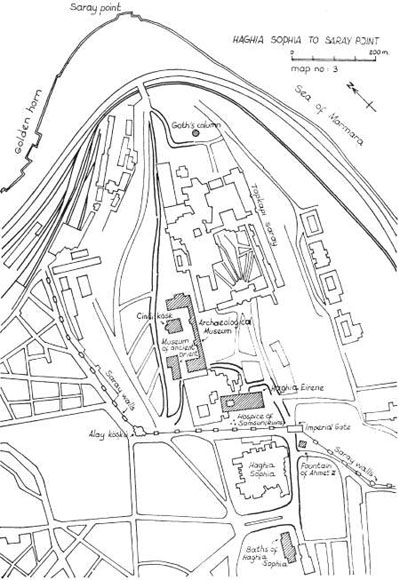
Our present stroll will take us from Haghia Sophia through the outer courtyard of the Saray and its lower gardens. This area, at the very apex of the old city, is almost totally cut off from the turbulent life of modern Stamboul, shielded as it is by outer walls of the Saray. Walking through these quiet gardens, it is difficult to imagine that this was the site of the ancient town of Byzantium.
We shall begin our stroll in the great square before Haghia Sophia, the heart of the ancient town. Before we leave the square we should at least glance at a building which most tourists miss, prominent as it is, probably because it is dwarfed by the imposing monuments around it. This is the Hamam of Haseki Hürrem, which stands at the eastern side of the park between Haghia Sophia and the Blue Mosque. This splendid bath was commissioned by Süleyman the Magnificent in the name of his wife Haseki Hürrem, better known in the West as Roxelana. The hamam was designed by Süleyman’s Chief Architect, the great Sinan, and completed by him in the year 1556; it is perhaps the finest bath which Sinan built in his long and illustrious career. It is a double hamam, one end being for men, the other for women. Each end consists of a great entrance hall with a vast dome; from here one passes through a corridor with three small domes to the hararet, also domed and surrounded by a series of little chambers for washing. Notice the charming symmetry of the building and its gracious lines; it is the most attractive and one of the most elaborate of the Turkish baths in the city. The hamam has been splendidly restored, and it is now open to the public as a gallery for the display of modern Turkish carpets.
It is interesting to learn that the Hamam of Haseki Hürrem stands near the site of the ancient Baths of Zeuxippus, first built by Septimius Severus in about A.D. 196 and later enlarged by Constantine the Great. Excavations carried out in this area in the years 1927–8 brought to light early Byzantine foundations which some scholars have identified as belonging to this bath, the most celebrated in ancient Constantinople. These remains, which have since been covered up, are about midway between Haghia Sophia and the Blue Mosque.
We now leave the square and pass behind the apse of Haghia Sophia. The street on which we are now walking was known in Byzantium as the Embolos of the Holy Well. This was a porticoed way by which the Emperor could walk from the Palace of Chalke to the Holy Well, which was located at the south-east corner of Haghia Sophia. From there the Emperor could enter Haghia Sophia, passing through the large gate which we can still see in the east bay of the south aisle. The area to the right of this street is now under excavation by the Archaeological Museum, where extensive remains of the Great Palace of Byzantium (see Chapter 6) have been unearthed. The site will soon be open to the public.
Farther along this street, at the north-east corner of the church, we come to a large Turkish gate in rococo style. This is the back door to the precincts of Haghia Sophia and leads to a building which was once the skeuophylakion, or treasury of the church. The building is not open to the public. To the left is Soğuk Çeşme Sokağı, the Street of the Cold Fountain, where a row of elegant nineteenth-century Turkish houses is built up against the outer defence wall of Topkapı Sarayı. These houses were restored from near ruin in 1984–6 by the Turkish Touring and Automobile Association (TTAA), headed by Çelik Gülersoy, and now form the Aysofya Pansoyonlar. One of the houses is now the library of the Çelik Gülersoy Foundation, an extraordinary collection of books, maps, engravings and paintings of Istanbul in Ottoman times.
FOUNTAIN OF AHMET III
We are now in the square before the Imperial Gate of Topkapı Sarayı. In the centre of this square we see the grandest and most handsome of all the street-fountains in Istanbul. This fountain was built by Sultan Ahmet III in 1728 and is a particularly fine example of Turkish rococo architecture. It is a square structure with an overhanging roof surmounted by five small domes. On each of the four sides there is a çeşme, or wall-fountain, and at each of four corners a sebil. Each of the wall-fountains is set into a niche framed in an ogival archway. The voussoirs of the arches are in alternating red and pink marble and the façade is richly decorated with floral designs in low relief. The corner sebils are semicircular in form, each having three windows framed by engaged marble columns and enclosed with ornate bronze grilles. The curved wall above and below each sebil is delicately carved and elaborately decorated with relieved designs and ornate inscriptions. Above each of the four fountains there is a long and beautiful inscription in gold letters on a blue-green ground; the text is by the celebrated poet Seyit Vehbi, who is here praising the fountain and comparing its waters with those of the holy spring Zemzem and of the sacred selsebils of Paradise. The inscription ends with these modest lines: “Seyit Vehbi Efendi, the most distinguished among the word-wizards of the age, strung these pearls on the thread of his verse and joined together the two lines of the chronographic distich, like two sweet almonds breast to breast: With what a wall has Sultan Ahmet dammed the waters / For astonishment stopped the flood in the midst of its course!”
HAGHİA EİRENE
Passing through the Imperial Gate into the first courtyard of the Saray, we see a little way forward on the left the rose-red apse of a Byzantine church. This is Haghia Eirene, the former church of the Divine Peace. According to tradition, the original church of Haghia Eirene was one of the first Christian churches in the old town of Byzantium. The church was rebuilt on a larger scale by Constantine the Great or his son Constantius, and it served as the patriarchal cathedral until the completion of the first church of Haghia Sophia. During the reign of Constantius, Haghia Eirene was at the centre of the violent disputes then taking place between the Arians and the Orthodox party, the upholders of the Nicene Creed, and in the year 346 more than 3,000 people were killed in a religious riot in the courtyard of the church. The final triumph of the Orthodox party came in Haghia Eirene in the year 381, when the Second Ecumenical Council there reaffirmed the Nicene Creed and condemned the Arians as heretics. Haghia Eirene again came into prominence after the destruction of Haghia Sophia in the year 404, when for a decade it again served as the patriarchal cathedral. But then, after the reconstruction of Haghia Sophia by Theodosius II, Haghia Eirene took its accustomed second place and seldom thereafter played a leading role in the religious life of the city. At the time of the Nika Revolt in 532, Haghia Eirene shared the fate of Haghia Sophia, when the two churches were totally destroyed by fire. Justinian immediately afterwards began to rebuild Haghia Eirene along with Haghia Sophia, and both churches were rededicated at about the same time, in the year 537. The new churches of the Divine Wisdom and the Divine Peace were thenceforth closely linked together and formed two parts of what was essentially one religious establishment. Although Haghia Eirene was dwarfed in size and eclipsed in importance by its great neighbour, its ancient origins were always honoured by the people of Byzantium, who called it Palaia Ekklesia, or the Old Church.
Haghia Eirene was almost destroyed in the year 564, when a fire ruined the atrium and part of the narthex, but it was soon afterwards repaired by Justinian, then in the last year of his life. In October 740 the church was severely shaken by a violent earthquake and was once again restored, either by Leo III or his son Constantine V. It appears that since that date no further major catastrophe has befallen the church, so that the building we see today is essentially that of Justinian, except for the eighth-century repairs and minor Turkish additions. After the Conquest, Haghia Eirene was enclosed within the outer walls of Topkapı Sarayı. The outermost court of the Saray, where Haghia Eirene was located, was principally given over to the Janissaries and the church was used by them as an arsenal. Later, some years after the destruction of the Janissaries in 1826, Haghia Eirene became a storehouse for antiquities, principally old Ottoman armaments. Beginning in the 1950s, the interior of Haghia Eirene was cleared of its military exhibits and thoroughly restored, and since then it has been used for concerts and exhibitions.
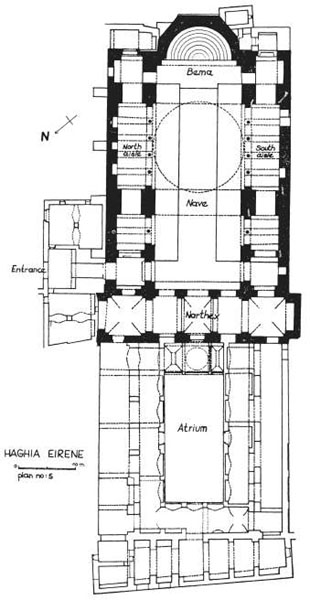
The ground around the church has risen some five metres above its ancient level and the present entry is through a Turkish porch and outbuildings towards the western end of the north aisle. Entering the church, we descend in semi-darkness along a stone ramp to the level of the interior. At the end of the ramp we pass through the north aisle and find ourselves at the rear of the church, looking down the length of the nave. From here we can see that the church is a basilica, but a basilica of a very unusual type. The wide nave is divided from the side aisles by the usual columned arcade, but this arcade is interrupted towards the west by the great piers that support the dome to the east and the smaller elliptical domical vault to the west. The eastern dome is supported by four great arches which are expanded into deep barrel-vaults on all sides except the west. Here we see the transition from a pure domed basilica to a centralized Greek-cross plan, which was later to supersede the basilica. The apse, semicircular within, five-sided without, is covered by a semidome. Below there is a synthronon, the only one in the city surviving from Byzantine times; this consists of six tiers of seats around the periphery of the apse facing the site of the altar, with an ambulatory passage beneath the top row, entered through framed doorways on either side.
In the semidome of the apse there is an ancient mosaic of a simple cross in black outline standing on a pedestal of three steps, against a gold ground with a geometric border. The inscription here is from Psalm lxv, 4 and 5; that on the bema arch perhaps from Amos ix, 6, with alterations, but in both cases, parts of the mosaic have fallen away and the letters were painted in by someone who was indifferent both to grammar and sense. There is some difference of opinion concerning the dating of these mosaics, one opinion being that they are to be ascribed to the reconstruction by Constantine V after the earthquake of 740, the other holding that they are from Justinian’s time. The decorative mosaics in the narthex, which are not unlike those in Haghia Sophia, are almost certainly from Justinian’s period.
At the western end of the nave, five doors lead from the church into the narthex and formerly five more led thence into the atrium, but three have been blocked up. This atrium and the scanty remains of that at St. John of Studius (see Chapter 16) are the only ones that are now extant in the city. Unfortunately, the one here has been rather drastically altered, for the whole of the inner peristyle is Turkish as well as a good many bays of the outer. But most of the outward walls are Byzantine; and curiously irregular they are, the northern portico being considerably longer than the southern so that the west wall runs at an angle. In the south-east corner, a short flight of steps leads to a door that communicated with buildings to the south, the ruins of which will be described presently. Haghia Eirene now serves as a concert hall for many of the musical events produced in the Istanbul International Festival; it makes a superb setting for these performances, and the acoustics of the old church are excellent.
If we leave Haghia Eirene and walk back through the garden behind the apse we can examine the ruins to the south of the church. (These are obscured by a fence and are not officially open to the public, but one can still view the ruins discretely.) These ruins, which were first excavated in 1946, are almost certainly the remains of the once-famous Hospice of Samson. Procopius informs us that between Haghia Sophia and Haghia Eirene “there was a certain hospice, devoted to those who were at once destitute and suffering from serious illness, namely those who were suffering the loss of both property and health. This was erected in early times by a certain pious man, Samson by name.” Procopius then goes on to say that the Hospice of Samson was destroyed by fire during the Nika Revolt, along with the two great churches on either side of it, and that it was rebuilt and greatly enlarged by Justinian. Unfortunately, the excavations were never carried far enough to make clear the plan of the Hospice. One can make out a courtyard opposite the atrium of Haghia Eirene, where some columns and capitals (which don’t seem to fit) have been set up again. To the east is a complex series of rooms, including a nympheaeum and a small cistern, some of them with opus sectile floors. There is a broad corridor between the Hospice and Haghia Eirene and to the east a vaulted ramp which may have given access to the galleries of the church. From the masonry and the capitals it would appear that the major part of the work is of the time of Justinian and doubtless belongs to the reconstruction mentioned by Procopius. It is clear that this building connected directly with the atrium of Haghia Eirene, which is only a few feet higher than the level of the courtyard. One may hope that more serious and competent excavations will soon be carried out.
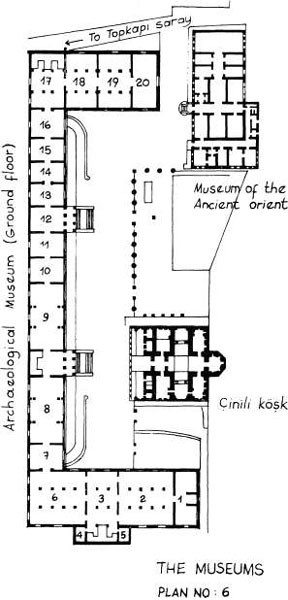
We now leave the precincts of Haghia Eirene and take the path which leads to the gate on the left side of the First Court. The building complex to the left of the gate is the Darphane, the former Imperial Mint and Treasury. This has been restored and is now open to the public; there is little of great interest to be seen except when there are special exhibitions or cultural events. At the lower entrance to the Darphane we see on the right the general entrance to the Archaeological Museum, the Museum of the Ancient Orient and the Çinili Köşk.
As we enter the courtyard the first building on our left is the Museum of the Ancient Orient. The entrance to the museum is flanked by two basalt lions of the neo-Hittite period (ca. 800 B.C.). The museum houses a unique collection of pre-Islamic Arab artifacts mostly from the Yemen, along with Babylonian, Neo-Hittite and Assyrian antiquities, including a series of the superb faience panels of lions and monsters, yellow on a blue ground, that once adorned the processional way to the Isthar gate at Babylon. Notable exhibits include the statue of a deified Babylonian king from the beginning of the second millennium B.C.; inscribed tablets with the Code of Hammurabi (1750 B.C.) and the Treaty of Kadesh (1286 B.C.); reliefs and colossal statues of the neo-Hittite period; a small Egyptian collection; and a selection of cuneiform cylinders for which the museum is famous. The collection as a whole is not large but is of the greatest historical importance. The building has recently been restored and the collection reorganized, thus making this one of the most interesting and attractive museums of antiquities in Europe.
THE ARCHAEOLOGICAL MUSEUM
The Archaeological Museum occupies the whole right side and far end of the courtyard. The modern history of the museum can be said to date from 1881, when Osman Hamdi Bey was made director. Over the next three decades, until his death in 1910, Osman Hamdi Bey succeeded in establishing the modern institution which we see today, one of the great museums of Europe. One of the most dramatic events in this development came in 1887 during Osman Hamdi Bey’s excavation of the royal necropolis at Sidon, when he unearthed the magnificent group of sarcophagi which are the pride of the museum. Since the Çinili Köşk, where antiquities were first stored, proved too small to house these new acquisitions, a new museum was built directly opposite and opened to the public in 1896. Later discoveries by Osman Hamdi Bey and other archaeologists soon filled this museum to overflowing and it became necessary to build two additional wings, which were opened in 1902 and 1908. A new four-storey annexe was begun behind the museum in 1988 and completed in 1992.
On entering the museum notice the colossal porphyry sarcophagi arrayed along the side of the building between the two stairways. These contained the remains of early Byzantine emperors of the fourth and fifth centuries and were originally in the crypt of the church of the Holy Apostles on the Fourth Hill, now the site of Fatih Camii (see Chapter 12).
On entering from the first stairway we will first turn left to see the exhibits in the northern half of the museum; after which we will then retrace our steps to see the southern half; we will then go on to look at the antiquities in the annexe, whose entrance is opposite the museum shop between the two stairways. In the lobby we see a colossal statue of Bes, the Cypriot Hercules, holding up a headless lioness by her hind paws. A great hole gapes from the god’s loins; it has been politely suggested that this once served as a fountain, but it was perhaps more likely the seat of an appropriately gigantic phallus. The statue is from Cyprus and dates from the imperial Roman era, first to third century A.D.
The first two rooms beyond the museum shop contain a number of the extraordinary sarcophagi discovered by Osman Hamdi Bey in the royal necropolis at Sidon in Syria. These sarcophagi belonged to a succession of kings who ruled in Phoenicia between the mid-fifth century B.C. and the latter half of the following century. Just inside the doorway of the first room we see the Tabit Sarcophagus, made in the sixth century B.C. for an Egyptian general and reused in the following century by Tabnit, King of Sidon, whose remains are displayed in the glass case just beyond. Also on exhibit here are the Lycian Sarcophagus and the Satrap Sarcophagus, both from the latter part of the sixth century B.C. and found in the region known as Lycia on the Mediterranean coast of Turkey. Beyond these rooms is the lobby inside the second staircase, which is devoted to Osman Hamdi Bey, with photographs illustrating his career.
The next room exhibits some of the sarcophagi discovered at Sidon by Osman Hamdi Bey in 1887. The most famous of these is the magnificent Alexander Sarcophagus, so-called not because it is that of Alexander himself (as is so often said), but because it is adorned with sculptures in deep, almost round relief showing Alexander in scenes of hunting and war. The sarcophagus was made for King Abdalonymos of Sidon, who began his reign in 333 B.C. after Alexander defeated the Persians at the battle of Issus, which may be represented in the reliefs of battle scenes on the sarcophagus. Also exhibited here are two other outstanding funerary monuments, the Satrap Sarcophagus and the Sarcophagus of Mourning Women. The Satrap Sarcophagus, which is dated to the second half of the fifth century B.C., takes its name from the fact that it was the tomb of a satrap, or Persian viceroy, who is shown reclining on a couch in a relief on one side of the monument, while on the other side he appears in a hunting scene. The Sarcophagus of Mourning Women dates from mid-fourth century B.C. It takes its name from the statues of the mourning women framed between Ionic columns on its sides and ends, 18 in all. A funeral procession is shown in a frieze on the lid of the sarcophagus, which is thought to have belonged to King Straton of Sidon, who died in 360 B.C.
The rooms beyond are principally devoted to sarcophagi and other funerary monuments, the finest of which are perhaps the Meleager Sarcophagus, the Sarcophagus of Phaedra and Hippolytus, and the Sidamara Sarcophagus, which date from the third and second centuries B.C. Other outstanding exhibits include reliefs from two Hellenistic temples in western Asia Minor, the temple of Hecate at Lagina and the temple of Artemis at Magnesia on the Maeander. The two stone lions which flank the foot of the staircase once stood on the façade of the Byzantine palace of Bucoleon (see Chapter 6), and were removed to the museum during the construction of the railway line along the Marmara in 1871.
Returning to the entrance lobby, we now stroll through the southern half of the museum. The first room has sculptures of the archaic period (700–480 B.C.). The free-standing statues here are idealized representations of a young man, known in Greek as a kouros, or a young woman, or kore, which were placed as dedicatory offerings in temples of Apollo and Artemis. The most notable are a legless kouros and a kouros from Samos, the face in both cases showing the haunting archaic style characteristic of Greek sculpture of this period. The finest relief is from Cyzicus, showing a long-haired youth driving a chariot drawn by two horses.
The next room contains sculptures dating from the period of Persian rule in Asia Minor (546–333 B.C.). The two best examples are from Daskylion, both with reliefs showing funeral processions in which mourners are following a cart carrying a sarcophagus.
The room beyond this is devoted to Attic grave stelae with reliefs, along with other sculptures of the classical period (480–323 B.C.). The finest stelae are those of a young athlete from Nisyros, a young warrior from Pella, and one from Amisus (Samsun) showing the deceased bidding farewell to his two young sons. The two most notable sculptures in the round are the head of a horse, provenance unknown, and a statue of Athena from Leptus Magna in Libya, a Roman copy of the Greek original.
The following room has sculptures of the Hellenistic period (323–129 B.C.), the two most famous being representations of Alexander the Great. One, from Pergamum, is a head of Alexander, a third century B.C. copy of the original by Lyssipus. Alexander is here represented in the classic pose which became the archetype for all later representations of him: what Plutarch called his swimming eye and lion’s mane of hair, his mouth slightly open and his head inclined to the left, a strange lost look on his handsome face. The other, from Magnesia-ad-Sipylum, is a statue of Alexander in which he is shown as a young Hercules, another archetypal representation of the young god-king.
The next room has sculptures from Tralles and Magnesia on the Maeander. Here we see the famous Ephebos of Tralles, from the late first century B.C. or early first century A.D. This statue represents a youth resting after exercise; he is standing in a relaxed attitude with a cape draped round him to protect him from the cold, a wistful half-smile on his downcast face.
We now enter the first room of the south wing, devoted to Hellenistic and Roman sculpture. The most noteworthy is a statue of Hermes, a copy of the original by Alcamenes, which stood just outside the Propylaion on the Acropolis of Athens. In the centre of the room there is a large head of the poetess Sappho from Smyrna (Izmir), a Roman copy of the Hellenistic original. The left side of the room is devoted to Roman portrait busts of the first to fourth century A.D., including those of ten emperors ranging from Augustus to Constantine the Great.
The next room has sculptures from Ephesus, Miletus and Aphrodisias. The principal work from Ephesus is a large reclining statue of a river god from the second century A.D. The most outstanding exhibit from Miletus is a statue of Apollo Kitharados, also from the second century A.D. The most notable work from Aphrodisias is a statue of the emperor Valentinian II from the late fourth century A.D.
The last room in this wing is devoted to sculptures of the Roman imperial period. The most striking work here is just to the left inside the doorway. This is a colossal statue of Tyche, the Goddess of Fortune, who is shown holding the child Plutos, God of Wealth, while above them there is a cornucopia filled with fruit and flowers; this was found at Prusias-ad-Hypium and is from the second century A.D.
We now make our way to the new annexe. The ground floor is devoted to Byzantium and its Neighbours, as well as to an exhibition of antiquities found during excavations for the Marmararay Project, a new commuter railway line that will go under the southern end of the Bosphorus from Istanbul to Üsküdar. The exhibit on the first floor is called Istanbul Through the Age; on the second floor is Anatolia and Troy Through the Ages; and on the third floor the theme is the Cultures of Anatolia’s Neighbours.
Byzantium and its Neighbours has exhibits from archaeological sites in Thrace and Bithynia, the regions that bordered the ancient city of Byzantium on its European and Asian sides, respectively. The most fascinating exhibits from Thrace were found in tumuli covering royal graves, particularly a superb bronze head of a warrior with a tightly-fitting helmet, from the fourth century B.C. A notable exhibit from Bithynia is a colossal head of Oceanus from Nicomedeia (Izmit), dating from the second century A.D. Other exhibits are from the ancient Thracian cities of Selymbia (Silivri), Perinthos and Eleonte, and from the Bithynian cities of Chalcedon (Kadıköy), Nicomedeia and Claudiopolis (Bolu), including funerary reliefs, portait busts and marble statues. The exhibits from Byzantine Constantinople include two large marble pedestals, monuments to the famous charioteer Porphyrios commemorating his victories in the Hippodrome. These pedestals, each of which once bore a bronze statue of Porphyrios, were commissioned by the Emperor Anastasius (r. 491–518), and give some measure of the enormous popularity which this charioteer once enjoyed in the Roman era. The pedestals are chiefly of interest because of the sculptures in low relief on their sides, in which are represented lively scenes from the ancient Hippodrome of Constantinople.
The exhibits from the Marmaray Project include objects found in both the old city and in Üsküdar. The main area of excavation has been in the Yeni Kapı district on the Marmara shore of the old city, where a large harbour was established when Constantine the Great founded Constantinople in A.D. 330, and which eventually silted up through alluvial earth deposited by the Lycus River. A team of archaeologists led by Professor Ismail Karamut, head of the Istanbul Archaeological Museum, has discovered the well-preserved remains of more than 30 ships, along with the remnants of piers, warehouses and other structures, including part of the city walls built by Constantine. The most spectacular find was made in 2008, when the skeletons of two adults and two children were unearthed along with the remains of a small Neolithic settlement on the harbour dating from between 6400 B.C. and 5800 B.C., predating the formation of the Bosphorus strait by several centuries. The exhibit includes numerous objects of all types found in the excavations, along with photographs of the sites and exciting videos of the archaeological work in progress, including the preservation of the ancient ships discovered in the harbour.
The first gallery of the Istanbul Through the Ages exhibit is arranged chronologically, beginning with the founding of the ancient Greek city-state of Byzantium in the seventh century B.C. and ending with the Turkish Conquest in 1453. The first part of the exhibit that one sees includes objects ranging from the archaic period through the Roman era, including tools, pottery, household artifacts and funerary monuments. Looking over the balcony here one sees a reconstruction of the façade of the temple of Athena at Assos, dating from the late sixth century B.C. The remaining galleries of the exhibit are arranged topographically, with objects found in various parts of the city and its most important Byzantine monuments. One of these shows the works of art discovered during the restoration of Kalenderhane Camii, the former church of the Kyriotissa (incorrectly identified as St. Saviour Akataleptos); these include frescoes of the life of St. Francis dating from the Latin Occupation of 1204–61, and a beautiful mosaic portait of the Virgin from the pre-iconoclastic period, the only work of this era extant in the city. One particularly fascinating exhibit is a fragment of the porphyry group of the Tetrarchs, a statue of the Emperors of East and West and their Caesars that originally stood in the square known as the Philadelphion on the Marmara slope of the Third Hill. The statue was carried off by the Venetians when the Latins sacked Constantinople in 1204, leaving beyond this fragment, which was rediscovered in 1965 by the Turkish archaeologist Nezih Firatlı. Another interesting exhibit is a fragment of the so-called Serpent Column in the ancient Hippodrome (see Chapter 6). One of the three intertwined bronze serpents that form the column lost its head during the Ottoman period, but a fragment of it was found in 1847 and eventually preserved in the museum. The penultimate gallery has exhibits from Genoese Galata dating from the last two centuries of the Byzantine period, including coats-of-arms of Latin knights who were buried in the church of SS. Paul and Domenic, now known as Arap Camii (see Chapter 20). In the last gallery we see a length of the huge chain that was used by the Byzantines to close the Golden Horn in times of siege. There is also an exhibition of coins from ancient Byzantium and Byzantine Constantinople.
The exhibit on Anatolia and Troy Through the Ages is arranged chronologically, with the various levels in the archaeological site at Troy on one side of the room, ranging from Troy I (3000–2500 B.C.) to Troy IX (250 B.C.-A.D. 400), while on the other side are exhibits from other archaeological sites in Anatolia ranging from the earliest prehistoric periods up to the archaic age.
The exhibit on the Cultures of Anatolia’s Neighbours is dedicated to ancient Syria, Palestine and Cyprus. The most striking exhibit is a recreated hypogeum, or subterranean tomb, from ancient Palmyra in Syria, dated A.D. 108. The sculptural portraits in the hypogeum are originals, taken from a number of funerary monuments in Palymyra’s Valley of the Tombs.
In leaving the new annexe we pass through a room on the second floor of the old museum. The glass cases here contain votive figurines of the classical and Hellenistic periods. In the centre of the room is a colossal bronze statue of the emperor Hadrian from Nicomedeia, dated mid-second century A.D. From the window there is a good view of Çinili Köşk, the next stop on our itinerary.

We now leave the Archaeological Museum and cross over to Çinili Köşk, the Tiled Pavilion. This is the oldest Ottoman secular building in Istanbul, built by Sultan Mehmet II in 1472 as an outer pavilion of Topkapı Sarayı. It is Persian in design and decoration, a derivation which is emphasized by its long and beautifully written Persian inscription giving the date of construction. In front of the building before the museum was built, there was a large jirit field (jirit was a kind of polo game much favoured by the pages of the Saray), and Çinili Köşk seems to have been built as a kind of viewing pavilion. It is in two storeys, almost identical in plan, that is to say, cruciform, with chambers in the corners of the cross. It has a deeply recessed entrance alcove on the main floor, entirely revetted in tiles of various kinds, most of them tile mosaic in turquoise and dark blue. On the back wall these form simple geometric designs, but in the deep soffit of the arch, they display an inscription in an incredibly stylized, one might say geometricized, type of Cufic calligraphy. On the three faces of the vault at the height of the lintel of the door, there is a long double Persian inscription in the beautiful cuerda seca technique. The main inscription is in white letters on a dark blue ground. Above and entwined with this is a subordinate inscription in yellow, with the tendrils of a vine meandering in and out between the letters, the whole encased in a frame of deep mauve with flowers of dark blue, turquoise and white. Appropriately, Çinili Köşk now serves as a museum to exhibit Turkish tiles and ceramics.
The interior consists of a central salon in the shape of an inverted Latin cross with a dome over the crossing. The cross is extended by a vestibule at the entrance end, an apse-like room at the far end, and two eyvans, or open alcoves (now glazed in), at the ends of the shorter arms; additional chambers occupy the corners of the cross. All these rooms were once tiled and many of them still are, with triangular and hexagonal tiles of turquoise and deepest blue, sometimes with superimposed gold designs; these tiles are very similar to those in the Yeşil Cami at Bursa.
Until the present age of nationalism, foreign wares tended to be more highly prized than domestic products. Such appears to have been the case in the Ottoman court as regards the local pottery of Iznik – with the exception of wall tiles. At all events, the exhibition of china in the Çinili Köşk, though interesting, is far less extensive and varied than several of those in foreign museums and private collections, especially the Victoria and Albert and the unrivalled Godman collection; and most of the present display did not belong to the sultans, but was subsequently acquired by the museum. In the first room, to the left of the entrance vestibule, is a small collection of Selçuk tiles – mostly wall tiles of enamel and majolica ware – of the twelfth to fourteenth centuries. Entering the central salon, one is at once struck by the superb mihrab from the mosque of Ibrahim Bey at Karaman, one of the most splendid works from the height of the great Iznik period. Also in this room are two fine lunette panels in the cuerda seca technique from the medrese of Haseki Hiirrem, dated 1539. The second room, to the left, has tiles of the transition period from Selçuk to Ottoman of the fourteenth and fifteenth centuries, while the third and fourth contain some of the best Iznik ware of the sixteenth and early seventeenth centuries. Notice in the third room a charming eighteenth-century baroque fountain, partly tiled and partly painted, set into a niche in the wall. These last two rooms also contain a pair of magnificent kandils, or mosque lamps; they are both from Sokollu Mehmet Paşa Camii (see Chapter 6) and are therefore to be dated about 1577. The next two rooms contain pottery of the eighteenth and nineteenth centuries, some of it pretty but Europeanized and lacking in the brilliance and mastery of the earlier work. But in the last one should notice some very charming nineteenth-century plates from Çanakkale, painted with a very restricted palette in a sort of expressionist style with fish, birds, and especially boats.
Leaving the Çinili Köşk we walk back again through the courtyard. As we do so we might be tempted to wander through the gardens in the museum precincts. In the gardens opposite to the museum and beside the Çinili Köşk, there is a fascinating collection of antique fragments which one can examine leisurely while having a drink in the café there. The most extraordinary object there is a block of marble carved into the form of two colossal Gorgon heads, identical to another pair we will subsequently see in the Basilica Cistern (see Chapter 7). All four of these heads were apparently part of a frieze in the Forum of Constantine (see Chapter 7) on the Second Hill, and probably originated in a temple in Asia Minor.
Passing through the courtyard exit we turn right on the road outside and follow it downhill, flanked by ancient columns and capitals. This road takes us almost to Soğuk Çeşme Kapısı, the entrance to Gülhane Park, through which we will now stroll.
GÜLHANE PARK
Gülhane Park was once part of the outer gardens of the Saray. Originally this area would have been the lower town of the ancient Greek city of Byzantium, whose defence walls followed the same line as the outer walls of Topkapı Sarayı that we see to our left. The acropolis of ancient Byzantium was on the present site of the Saray, whose high retaining wall we see on our right. The kiosk just above the retaining wall is that of Osman III, built in the mid-eighteenth century in a baroque style. In the park below the kiosk we see an ancient structure that has been restored and is now open to the public. This is a Roman cistern dated to the early fourth century, its brick roof supported by 12 columns in three rows of four each.
On the left side of the park we now come to the new Museum of Islamic Science and Technology, which opened in 2008. The museum, which was conceived by the Turkish historian of science Fuat Sezgin, is devoted to the history of Islamic science and technology from the ninth through the sixteenth century. The instruments and other objects on display here were reconstructed by the Institute for the History of Arabic-Islamic Science at Goethe University in Frankfurt, based predominately on illustrations and descriptions found in original sources and, to a lesser extent, on surviving originals.
Once past the walls of the inner palace, we follow the path leading uphill to the right and come to one of the very oldest monuments in the city. This is the so-called Goth’s Column, a granite monolith 15 metres high surmounted by a Corinthian capital. The name of the column comes from the laconic inscription on its base: FORTUNAE REDUCI OB DEVICTOS GOTHOS, which means: “To Fortune, who returns by reason of the defeat of the Goths.” The column has been variously ascribed to Claudius II Gothicus (A.D. 268–70) or to Constantine the Great, but there is no firm evidence either way. According to the Byzantine historian Nicephorus Gregoras, this column was once surmounted by a statue of Byzas the Megarian, the eponymous founder of Byzantium.
Taking a path leading off from the column towards the park exit, we pass the ruins of what appears to be an early Byzantine structure, consisting of a series of small rooms fronted by a rather irregular colonnade. These ruins have never been thoroughly investigated and their date and identity have not been established.
Passing through the park exit we cross the highway and walk out to Saray Point. As we do so we pass a large bronze statue of Kemal Atatürk, the father of modern Turkey and the first President of the Turkish Republic. This monument, which was made in 1926 by the Austrian sculptor Kripple, was the first statue of a Turk ever to be erected in this country.
Walking out onto Saray Point itself, we find ourselves at the confluence of the Bosphorus and the Golden Horn, as they flow together into the Sea of Marmara. Seated here at one of the seaside cafés, we command one of the most sweeping views in the city. From Saray Point we can stroll back to the Galata Bridge along the shore road. Along the way, we pass on our right the recently-reconstructed Sepetçiler Köşkü, a rather handsome Ottoman structure standing on the seashore. The kiosk was built in 1647 by the guild of the Sepetçiler, or Basket-Weavers, fot Sultan Ibrahim the Mad, and served as a sea-pavilion and boat-house of Topkapı Sarayı. In Ottoman times there was a line of such pavilions stretching from Saray Point to where the outer walls of the palace came down to the Golden Horn, but now only the Sepetçiler Köşkü remains.