
6

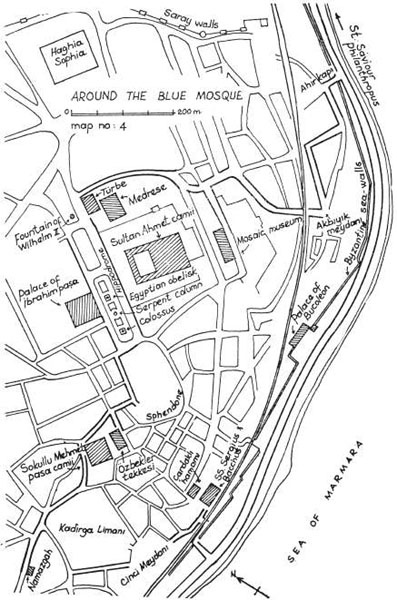
The east side of the At Meydanı, the ancient Hippodrome, is occupied by Sultan Ahmet Camii, usually known to tourists as the BlueMosque. The Blue Mosque is thought by many to be the most splendid of the imperial mosques in the city, with its graceful cascade of domes and semidomes, its six slender minarets accentuating the corners of the courtyard and the building, the lovely grey colour of the stone set off by gilded ornaments on domes and minarets, and its generally imposing but gracious proportions. It is one of the principal adornments on the skyline of the old city, particulary when one sees it from a ship approaching Istanbul across the Sea of Marmara.
The Blue Mosque was founded by Sultan Ahmet I and constructed by the architect Mehmet Ağa between 1609 and 1616. Tradition has it that the young Sultan was so enthusiastic about his mosque that he often pitched in himself, to hurry along the construction. The same tradition tells us that the Sultan appeared at the dedication ceremony wearing a hat shaped like the Prophet’s foot, in token of his humility. But Ahmet was given little time to enjoy his mosque, for he died the year after its completion, when he was only 27 years of age.
Sultan Ahmet Camii is preceded by a courtyard as large as the interior of the mosque itself, with monumental entryways at each of three sides. The central or western gate is the grandest of these; its outer façade is decorated with a calligraphic inscription by Dervish Mehmet, the father of Evliya Çelebi. The courtyard is in the classic style, bordered by a peristyle of 26 columns forming a portico covered by 30 small domes. At the centre of the courtyard there is a handsome octagonal şadırvan which, like the one at Yeni Cami, now serves only a decorative purpose. The ritual ablutions are actually performed at water taps in the outer courtyard, beneath the graceful arcade which forms part of the north and south walls of the avlu.

The main entrance to the mosque itself is at the eastern side of the courtyard, with smaller entrances from the outer courtyard beside the central minarets on the north and south sides. (Tourists are asked to enter through the south door and are restricted to the west end of the prayer hall.)
The interior plan of Sultan Ahmet Camii, like that of Yeni Cami and other imperial mosques, recalls in a general way that of Haghia Sophia; but in this case the differences are greater than the resemblance. It is very nearly a square (51 metres long by 53 metres wide) covered by a dome (23.5 metres in diameter and 43 metres high), resting on four pointed arches and four smooth pendentives. To east and west are semidomes, themselves flanked by smaller ones. So far, it is not unlike Haghia Sophia. But in Sultan Ahmet, instead of tympanic arches to north and south, there are two more semidomes, making a quatrefoil design. This so-called “centralized” plan would seem to have two disadvantages: the reiterated symmetry becomes lifeless and tedious, and it gives too much prominence to the necessarily bulky piers that support the dome. In this case, the architect has gone out of his way to call attention to these supports by making them colossal, clear-standing columns, five metres in diameter, and has emphasized their squatness by dividing them in the middle by a band and then ribbing them above and below with convex flutes. The effect is somewhat disconcerting; nevertheless one has the impression that the mosque interior is in general the most admired in the city.
The mosque is flooded with light from its 260 windows. These were once filled with coloured glass which would have tempered the too-crude brightness; now they are slowly being replaced with modern imitations. The painted arabesques in the domes and upper parts of the building are feeble in design and crude in colouring, as almost always in these modern imitations of a type of decoration that was in the sixteenth and seventeenth centuries richly elaborate in design and somberly magnificent in colour. Here the predominant colour is a rather blatant blue, from which the building derives its popular name of the Blue Mosque. What is original and very beautiful in the decoration of the interior is the revetment of tiles on the lower part of the walls, especially in the galleries. They are Iznik tiles of the best period and they deserve study. The magnificent floral designs display the traditional lily, carnation, tulip and rose motifs, also cypresses and other trees, all in exquisite colours; subtle blues and greens predominating. The mihrab and mimber, of white Proconnesian marble, are also original; they are fine examples of the carved stonework of that period. Of equal excellence is the bronzework of the great courtyard doors and the woodwork, encrusted with ivory and mother-of-pearl, of the doors and window-shutters of the mosque itself. Under the sultan’s loge, which is in the upper gallery to the left of the mihrab, the wooden ceiling is painted with floral and geometrical arabesques in that exquisite early style in rich and gorgeous colours, of which so few examples remain.
A ramp at the north-east corner of the mosque leads up to the hünkâr kasrı, a suite of rooms used by the Sultan whenever he came here for services, with an internal passageway leading to the hünkar mahfili, or imperial loge, within the mosque. The hünkâr kasrı is now used to house the Vakıflar Carpet Museum, a remarkable collection of Turkish carpets from all over Turkey and covering all periods of Ottoman history, including a number that were made for use in the Sultan’s tent when he was on campaign.
Beneath the kıble end of the prayer room of the mosque there were storerooms and stables, and these have been restored to house the Vakiflar Kilim Museum, whose collection includes works ranging in date from the fifteenth to the nineteenth century, including rare and beautiful examples. This museum has a separate entryway from the courtyard below the mosque on that side, just above the restored Ottoman market-street (see p. 129) on Kaba Sakal Sokağı, the Street of the Bushy Beard.
The külliye of Sultan Ahmet was appropriately extensive, including a medrese, türbe, hospital, kervansaray, primary school, public kitchen and market. The hospital and the kervansaray were destroyed in the nineteenth century, and the public kitchen was incorporated into one of the buildings of the School of Industrial Arts, which stood at the southern end of the At Meydanı before it burned down in the late 1970s. It has since been restored and serves as the office of the rector of Marmara University. The primary school, which has recently been restored, is elevated above the northern wall of the outer precinct of the mosque.
The large medrese, dwarfed somewhat by the great scale of the mosque itself, is just outside the precinct wall towards the north-west. It is rectangular in plan, with 24 cells arrayed around the four sides of a portico, with its entrance at the west end of the north portico. The lavatories are located at the south-eastern corner of the building.
The large square türbe is just beside the medrese to the south. Here are buried, besides Ahmet I, his wife Kösem and three of his sons, Murat IV, Osman II and Prince Beyazit. Prince Beyazit, the Bajazet of Racine’s great tragedy, was killed by his brother, the terrible Murat I V, who now shares the türbe with him. Osman II, as Evliya Çelebi tells us, was “put to death in the Castle of the Seven Towers by the compression of his testicles, a mode of execution reserved by custom to the Ottoman Emperors.” And Kösem, as we know, was strangled to death in the Harem. This extraordinary woman had dominated the Harem for half a century during the reigns of her husband, Ahmet I, two of her sons, Murat IV and Ibrahim, and the early years of that of her grandson, Mehmet IV. She was originally named Anastasia, the daughter of a Greek priest on the Aegean isle of Tinos, and was sold into the Harem when she was only 13. Sultan Ahmet renamed her Kösem, or Leader of the Flock, since she was first in a group of slave girls presented to him one morning. She was also known as Mahpeyker, or Visage of the Moon, because of her great beauty.
THE HIPPODROME
As we have noted previously, the square in front of Sultan Ahmet Camii is located on the site of the ancient Hippodrome. It has often been remarked that just as Haghia Sophia was the centre of the religious life of Constantinople, so the Hippodrome was the centre of its civil activities. The interests and the passions of the populace were about equally divided between theological controversy and the chariot races of the Hippodrome. Frequently, indeed, the two became involved together, since the Blues and the Greens, the rival circus factions, would generally adopt different sides in religious disputes, which constantly served as a convenient mask for political and economic struggles. Thus on many occasions, riots and insurrections began in the Hippodrome, the most famous being the Nika rebellion in January 532. This revolt ended when Justinian’s general, Belisarius, trapped the rebels in the Hippodrome and there slaughtered 30,000 of them. There is an ancient tradition that the partisans were buried where they fell and that their bones still inhabit the site.
The Hippodrome was an immense structure begun in 203 by the Emperor Septimius Severus; later Constantine the Great extended and remodelled it. It was 480 metres in length and 117.5 metres wide; it could seat, according to one estimate, about 30,000 spectators. The central line, or spina, of the course was marked by obelisks and columns, three of which are still the outstanding monuments of the At Meydanı. The royal enclosure, the kathisma, was probably situated midway along the eastern side of the arena. The straight northern end of the arena, where the spectators and chariots entered through vaulted passageways, was located about where is now the fountain of Kaiser Wilhelm II. The semi-circular southern end, or sphendone, is today concealed far beyond the buildings at the south end of the square. The great vaulted substructures at this end of the Hippodrome are visible from the streets below the At Meydanı on the Marmara slope of the First Hill. At the top of the outer wall there ran all around the structure an arcade of columns with an epistyle in the classical manner. Many of these were still standing nearly a century after the Turkish Conquest, but in 1550 they were pulled down and used for building material.
Some idea of the substructures and the internal anatomy of the Hippodrome may be obtained from the excavations made in the 1960s on the western side. Here we see various sustaining arches, remains of staircases leading to the seats, and a few of the seats themselves. Unfortunately the excavations were very badly done, being merely diggings for the foundations of the Law Courts which it was originally proposed to build there.
The first of the monuments on the spina, beginning at the northern end, is the Egyptian Obelisk. This was originally commissioned by the Pharaoh Thutmose III (1549–1503 B.C.), who erected it at Deir el Bahri opposite Thebes in Upper Egypt to commemorate one of his campaigns in Syria and his crossing of the Euphrates River. As can be seen, the shaft of the Obelisk, which is now nearly 20 metres high, has been broken off; according to Sir Flinders Petrie, it was originally 30 metres in height and weighed about 800 tonnes. The Obelisk was brought to Constantinople some time during the fourth century A.D., perhaps by Constantine the Great, but, though a mere fragment, it could not be raised and lay for some years on the seashore. It was finally erected on its present site by Theodosius the Great in 390. The Obelisk is mounted on four brazen blocks which rest on a marble basis with sculptured reliefs. These represent the Emperor and his family in the imperial box in the Hippodrome: on the south side he is watching the races depicted in the lower block; on the east he is crowning the victors; on the north he is assisting in the erection of the Obelisk itself, the method of which is represented in the lower block; and on the west he is receiving homage from vanquished enemies. Inscriptions in Greek and Latin on the base praise Theodosius and his Prefect Proclus for erecting the Obelisk; the Latin inscription tells us that 30 days were required to do the job, while the one in Greek says that it took 32. (Were the Greek and Latin scribes not on speaking terms?) The total height of the monument including the base is about 26 metres and the bottom of it represents approximately the original level of the race-course, some 4.5 metres below the present surface of the ground.
The second of the three monuments on the spina is the Serpent Column. The three intertwined bronze serpents which form the column were the base of a trophy that once stood in the Temple of Apollo at Delphi. This trophy was dedicated to Apollo as a token of gratitude by the 31 Greek cities which defeated the Persians in the battle of Plataea (479 B.C.); according to tradition the bronze serpents were cast from the shields of the fallen Persian warriors. The names of the 31 cities are inscribed on the coils of the serpents near the bottom. The column was brought from Delphi by Constantine the Great; it seems to have stood at first in the courtyard of Haghia Sophia and to have been moved to the Hippodrome only at a later date. There are several stories about what became of the missing serpent heads, but the most likely one is that they were chopped off by a member of the Polish Embassy one night in April of the year 1700. The upper part of one of the serpent heads was found in 1847 and is now, as we have seen, on exhibit at the Archaeological Museum. Like the serpents themselves, it is a very beautiful and finished piece of bronze sculpture, as is to be expected of a Greek work of that period.
The third of the ancient monuments on the spina is a roughly built pillar of stone 32 metres high which stands near the southern end of the At Meydanı. The sixteenth-century French traveller, Gyllius, called it the Colossus, but most modern writers refer to it, incorrectly, as the Column of Constantine Porphryogenitus. Both names stem from the Greek inscription on its base, where the pillar is compared to the Colossus of Rhodes, and where it is recorded that the pillar was restored and sheathed in bronze by the Emperor Constantine VII Porphyrogenitus (r. 912–59). But the inscription also says that the pillar was decayed by time, so that it must date to an earlier period, perhaps to that of Theodosius the Great or Constantine the Great. It seems to have been a favourite pastime in the early Turkish period to climb this column as an acrobatic feat – at least if one can judge by a Turkish miniature which shows a man at the top of it, another in the act of climbing the obelisk, and a monkey on a pole higher than both! And Gyllius tells a rather grim story of having, himself, seen two young men climb the pillar one after the other; the first came down safely but the second lost his nerve, jumped, and was, of course, instantly killed.

Occupying a large part of the west side of the Hippodrome, but partly concealed by an ugly nineteenth-century building, are the remains of the vast palace of Ibrahim Paşa, built around 1520. Ibrahim Paşa was a Greek convert to Islam who became an intimate companion of Süleyman the Magnificent during the early years of his reign. In 1523, Ibrahim was appointed Grand Vezir and the following year he married Süleyman’s sister Hadice, at which time he was given this palace on the Hippodrome. Some idea of the enormous wealth and influence which Ibrahim had at this time can be gained from even a casual view of the palace, the grandest private residence ever built in the Ottoman Empire, far greater in size than any of the buildings in Topkapı Sarayı itself. But the very magnitude of this wealth and power was the ultimate cause of Ibrahim’s ownfall. Later in Süleyman’s reign, when he fell under the influence of his wife Roxelana, the Sultan was persuaded that Ibrahim must be eliminated, for he was taking on the airs of royalty. And so one night in the year 1536, after having dined alone with the Sultan, as he had so often in the years of their intimacy, Ibrahim retired to an adjacent room in the Saray and was there murdered while he slept. Immediately afterwards all of Ibrahim’s wealth and possessions were confiscated by the state, including the palace on the Hippodrome. For a time, Ibrahim’s palace seems to have been used as a dormitory and school for the apprentice pages in the Saray. The great hall, that part of the palace which fronts on the Hippodrome, was in Ibrahim’s time the Audience Room of the Grand Vezir, and afterwards it was probably the High Court of Justice. In later times it seems to have been used as a barracks for unmarried Janissaries and also as a prison. By the beginning of the nineteenth century much of the palace was in ruins, but then it was restored and opened to the public in 1983 as the Museum of Turkish and Islamic Art.
After passing through the entrance lobby, one enters the northeast corner of the great central courtyard; this has been restored very attractively, with marble paving around a garden and with a balcony overlooking the Hippodrome. Part of the north wing has been fitted out as an old-fashioned Istanbul coffee-house, an ideal place to relax before or after seeing the exhibits in the museum.
Before going through the galleries, one might pause to survey the structure of the palace. What one sees here is the main part of the original palace of Ibrahim Paşa. In addition to this there was another section of almost equal size adjoining the present structure to the north-west, apparently an enormous han-like edifice, which has vanished except for the wing nearest the Hippodrome. The most important part of the present structure is the great hall, which takes up most of the upper level of the south wing on the side overlooking the Hippodrome; this would have been Ibrahim Paşa’s Hall of the Divan, and the two large rooms to its west would have been antechambers to this. The long western or inner side of the palace on the upper floor has at its rear a row of 13 cell-like cubicles opening onto a long corridor with a stone sofa overlooking the garden. This corridor turns the corner to pass along the north wing, which is only half as long as the south wing, with five cells along the inner side and a sixth overlooking the courtyard. The southern end of the corridor here is connected with the coutyard by a stairway, the entrance below being through a foyer with a great round-arched entryway. The lower level of the palace around the courtyard consists of a series of splendid vaults, supported by a single row of piers in the north and south wings, creating two aisles, while in the south wing there is a triple row of piers, one row engaged in the walls on the courtyard side, thus creating three aisles there. Some of these vaults are used to house the ethnographical collection of the museum, while the other exhibits are on the upper level of the palace.
The main collections on the upper level include rare and beautiful works from all periods of the Turkish and Islamic world, including objects from the Ummayid, Abbasid, Mamluk, Selçuk, Beylik and Ottoman periods, ranging in date from the seventh century to the nineteenth. The collections include carpets, manuscripts and calligraphy, miniatures, wood work, ceramics and glassware, metalwork and folk-arts, altogether an extraordinary exhibit, superbly displayed. The ethnographical collection consists principally of objects belonging to the Yürük, the nomadic Turkish people of Anatolia, whose way of life has not changed in its essentials since the first Turcoman tribes made their way into Asia Minor after the battle of Manzikert in 1071. The most fascinating exhibits here are the black goat-hair tents of the Yürük, furnished with objects that these nomads still use in their daily life, a living heritage of Anatolian Turkish culture.
We now leave the At Meydanı by the street at the south-western end, walking alongside the building there, now the Rectorate of Marmara University. At the first turning we pass through a gate and enter the garden behind the school (the gateman never objects to visitors). This garden occupies part of the sphendone, the southern, semicircular end of the Hippodrome. The chief reason for coming here is the view, which is very fine. The Marmara coast of the city can be seen in all its extent, from Saray Point to the Marble Tower, where the land walls meet the Marmara. Looking out across the Marmara we see the Princes’ Isles floating between sea and sky, and beyond them the mountains of Asia; on a clear day we can see the Bithynian Olympus (Uludağ) with its snow- capped summit. In the foreground just below us to the right is the mosque of Sokollu Mehmet Paşa, and straight ahead by the seashore the former church of SS. Sergius and Bacchus with its curiously corrugated dome; these are the next important items on our itinerary. If we look down over the railing, we see the great supporting wall of the Hippodrome. Within this wall, under our feet, are various stone chambers and the long spacious corridor which ran round the whole length of the Hippodrome and from which doors and staircases led to the various blocks of seats. Part of this corridor was converted into a cistern in later Byzantine times and still supplies water to the district below. If we look back in this direction from the seashore beyond SS. Sergius and Bacchus, we will see the whole sweep of the great semicircular wall.
We now return to the street outside and follow it downhill to the second turning on the left, where at the corner we see the remains of an ancient mosque. This is Helvacı Camii, founded in 1546 by one Iskender Ağa: it is too ruinous to be of any interest. Farther down the street to the left is a very odd and interesting tekke, or dervish monastery. This is part of the külliye of Sokollu Mehmet Paşa Camii built by the great Sinan, which is just below it. It is rather oddly designed, but its form is unique because of the steep descent of the hill on which it is built. We enter by a little domed gatehouse and find immediately opposite the large and handsome mescit-zaviye, or room for the dervish ceremonies. On the right is a small porticoed courtyard with the cells of the dervishes; on the left is another courtyard of cells, but in this case it is in two storeys because of the difference in level: one descends to the lower level by a staircase behind the zaviye. Both courtyards are rather low and dark with square pillars instead of columns, which give them a somewhat forbidding appearance; but the arrangement as a whole is ingenious and attractive. The building has recently been rather summarily restored.
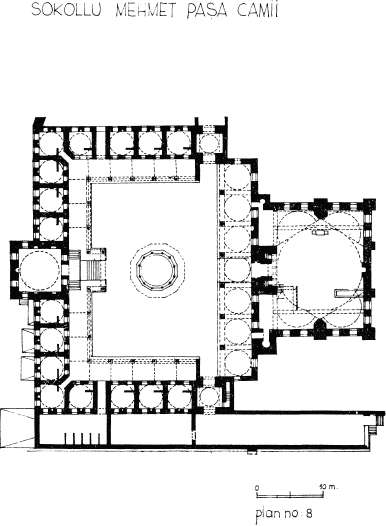

We now return to the street from which we branched off and continue down to the left; presently a gate leads to the garden and courtyard of a great mosque. This is one of the most beautiful of the smaller mosques of Sinan. It was built in A.H. 979 (A.D. 1571–2) for Ismihan Sultan, daughter of Selim II and wife of the Grand Vezir Sokollu Mehmet Paşa after whom the mosque is generally called. This mosque is built on the site of an ancient church, once wrongly identified as that of St. Anastasia, from which doubtless the columns of the courtyard were taken.
The courtyard itself is enchanting in design. It served, as in the case of many mosques, as a medrese; the scholars lived in the little domed cubicles or cells under the portico. Each cell had its own window, its fireplace and its recess for books. Instruction was given in the dershane, the large domed room over the staircase in the west wall, and also in the mosque itself. Notice the charming ogive arches of the portico and the fine şadırvan in the centre. The porch of the mosque forms the fourth side of the court; in the lunettes of the window are some striking and elegant inscriptions in blue and white faience. Entering the building, one is delighted by the harmony of its lines, the lovely soft colour of the stone, the marble decoration and, above all, the tiles. In form, the mosque is a hexagon inscribed in a rectangle (almost square), and the whole is covered by a dome, counter-balanced at the corners by four small semidomes. There are no side aisles, but around three sides runs a low gallery supported on slender marble columns with the typical Ottoman lozenge capitals. The polychrome of the arches, the voussoirs of alternate green and white marble, is characteristic of the classic period.
The tile decoration in the mosque has been used with singularly charming effect. Not the entire wall but only selected areas have been sheathed in tiles: the pendentives of the dome, the exquisite mihrab section of the east wall, and a frieze of floral designs under the galleries. The predominant colour is a cool turquoise, and this has been picked up again here and there in the carpets. The whole effect is extraordinarily harmonious. Above the entrance portal can be seen a small specimen of the wonderful painted decoration of the classical period. It consists of very elaborate arabesque designs in rich and vivid colours. Also above the door, surrounded by a design in gold, is a fragment of black stone from the holy Kaaba in Mecca; other fragments can be seen in the mihrab and mimber, themselves fine work in carved marble and faience.
We leave the mosque by the broad staircase below the west wall of the courtyard (notice the fine inlaid arabesque woodwork of the great doors), and turn left and then right onto Kadirga Liman Caddesi. This picturesque old street soon brings us to a large open square, much of which is now used as a playground. This is the pleasant area known as Kadirga Limanı, which means literally the Galley Port. As its name suggests, this was anciently a seaport, now long since silted up and built over. The port was originally dug and put in shape by the Emperor Julian the Apostate in 362 and called after him. In about 570, Justin II redredged and enlarged it and named it for his wife, Sophia. It had continually to be redredged but remained in use until after the Turkish Conquest. By about 1550, when Gyllius saw it, only a small part of the harbour remained and now even this is gone. Today only bits and pieces of the inner fortifications of the harbour are left, cropping up here and there as parts of houses and garden walls in several of the streets between here and the sea.
In the centre of the square, Kadirga Liman Meydanı, there is a very striking and unique monument. This is the namazgah of Esma Sultan, daughter of Ahmet III, which was built in 1779. It is a great rectangular block of masonry, on the two faces of which are fountains with ornamental inscriptions, the corners having ornamental niches, while the third side is occupied by a staircase which leads to the flat roof. This is the only surviving example in Stamboul of a namazgah, or open-air place of prayer, in which the kıble or direction of prayer is indicated but which is otherwise without furniture or decoration. Namazgahs are common enough in Anatolia and the remains of at least two others can be seen in the environs of Istanbul, one in the Okmeydanı overlooking the Golden Horn and the other at Anadolu Hisarı on the Bosphorus; but this is the only one left in the old city.
After leaving the namazgah, we cross to the street at the southern side of the park and turn left. This street soon brings us to a large open field, Cinci Meydanı, which is bordered on the side by the railroad line. Cinci Meydanı, the Square of the Genii, is named after Cinci Hoca, a favourite of Sultan Ibrahim, who once owned land on this site. When Ibrahim first came to the throne there was some doubt as to his sexual potency, and so his mother Kösem sought out Cinci Hoca, who had acquired a considerable reputation as a büyücü, that is, a wizard quacksalver. Cinci Hoca would seem to have done his job well, for Ibrahim soon had the Harem swinging with cradles and was performing sexual spectaculars which are still recalled with awe. But when Crazy Ibrahim was deposed in 1648, Cinci Hoca fell too, and he and his friend Pezevenk (the Pimp) were torn to pieces by an angry mob in the At Meydanı. The Square of the Genii is today a football field, which we pass and continue eastward, following a narrow lane parallel to the railroad track.
SS. SERGİUS AND BACCHUS
At the end of this lane, we come to one of the entrances to the courtyard of the beautiful Küçük Aya Sofya Camii, the former Byzantine church of SS. Sergius and Bacchus. The church was begun by Justinian and his Empress Theodora in 527, five years before the commencement of the present church of Haghia Sophia. It thus belongs to that extraordinary period of prolific and fruitful experiment in architectural forms which produced, in this city, buildings so ambitious and so different as the present church, Haghia Sophia itself, and Haghia Eirene – to name only the existing monuments – and in Ravenna, St. Vitale, the Baptistry and St. Apollinare in Classe. It is as if the architects were searching for new modes of expression suitable to a new age. The domes of this period are specially worthy of note: the great dome of Haghia Sophia is of course unique, but the method of transition from the octagon to the dome here is astonishing: the dome is divided into 16 compartments, eight flat sections alternating with eight concave ones above the angles of the octagon. This gives the dome the oddly undulatory or corrugated effect we noticed when looking down on it from the sphendone. The octagon has eight polygonal piers between which are pairs of columns, alternately of verd antique and red Synnada marble both above and below, arranged straight on the axes but curved out into the exedrae at each corner. The whole forms an arcade that gives an effect almost of choric dancers in some elaborate but formal evolution, as Procopius happily says in another connection. The space between this brightly coloured, moving curtain of columns and the exterior walls of the rectangle becomes an ambulatory below and a spacious gallery above. (One ascends to the gallery by a staircase at the south end of the narthex; don’t fail to do so, for the view of the church from above is very impressive.) The capitals and the classic entablature are exquisite specimens of the elaborately carved and deeply undercut style of the sixth century. On the ground floor the capitals are of the “melon” type, in the gallery “pseudo-Ionic”, and a few of them still bear the monogram of Justinian and Theodora, though most of these have been effaced. In the gallery the epistyle is arcaded in a way that became habitual in later Byzantine architecture – already in Haghia Sophia, for example; but on the ground floor the entablature is still basically classical, trabeated instead of arched, with the traditional architrave, frieze, and cornice, but how different in effect from anything classical: like lace. The frieze consists of a long and beautifully carved inscription in 12 Greek hexameters in honour of the founders and of St. Sergius; oddly enough St. Bacchus is not mentioned. SS. Sergius and Bacchus were two Roman soldiers martyred for their espousal of Christianity; later they became the patron saints of Christians in the Roman army. These saints were especially dear to Justinian because they saved his life some years before he came to the throne, in the reign of Anastasius. It seems that Justinian had been accused of plotting against the Emperor and was in danger of being executed, but Sergius and Bacchus appeared in a dream to Anastasius and interceded for him. As soon as Justinian himself became Emperor in 527, he expressed his gratitude to the saints by dedicating to them this church, the first of those with which he adorned the city.
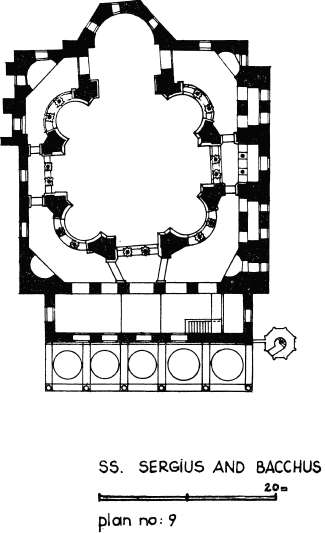
In SS. Sergius and Bacchus, as in almost all of the surviving Byzantine churches of the city, we must simply use our imagination in order to recapture the extraordinary beauty of its original condition. The walls, like those of Haghia Sophia, were revetted with veined and variegated marbles; the vaults and domes glittered with mosaics. “By the sheen of its marbles it was more resplendent than the sun,” says Procopius, “and everywhere it was filled profusely with gold.”
SS. Sergius and Bacchus continued to serve as a church for nearly 1,000 years after its founding, but then in the first decade of the sixteenth century it was converted into a mosque. Its patron at that time was Hüseyin Ağa, who was Kapıağası, or Chief of the White Eunuchs, in the reign of Beyazit II. Hüseyin Ağa’s tomb can still be seen in the garden to the north of the church. The building is now called Küçük Aya Sofya Camii, the mosque of Little Haghia Sophia, because of its supposed resemblance to the Great Church.
Just to the north of the church, on Küçük Aya Sofya Caddesi, we find an ancient bath, Çardaklı Hamam. An inscription shows that it was built in 1503 by a Kapıağası under Beyazit II; its date and its proximity to Küçük Aya Sofya Camii suggest that the founder may have been Hüseyin Ağa. The hamam is ruinous and unusable but must have been quite grand.
Returning to the church we pass through the courtyard once again and leave by the gate through which we first entered. Retracing our steps for a short distance, we then turn left to follow a winding lane which passes under the railroad line and eventually leads us out to the Marmara shore. Here we turn left and follow the ancient Byzantine sea walls along the Marmara.
ALONG THE SEA WALLS
The sea walls in the section along which we are walking were originally constructed by Constantine the Great, ending where his land walls met the sea at Samatya. When the Theodosian walls were built in the following century, the Marmara sea walls were extended to meet them. During the ninth century, the Marmara walls were almost completely rebuilt by the Emperor Theophilus, who sought to strengthen the city’s maritime defences against the Saracens. The Marmara defences consisted of a single line of walls 12–15 metres high studded with 188 towers at regular intervals. These walls stretched from the Marble Tower to Saray Point, a total distance of eight kilometres, and were pierced by 13 sea-gates. At Saray Point, the Marmara walls joined up with those along the Golden Horn, thus completing the maritime defence system. Although much of the fortifications along the Marmara have been destroyed in recent years, that which remains is still impressive, particularly the walls and towers along our present itinerary.
Almost immediately in front of SS. Sergius and Bacchus is a small postern gate doubtless for the use of the monastery that was attached to the church. Upon closer inspection, we find that the posts of the gateway are carved with a long inscription in Greek, containing a conflation or cento from Habakkuk and Psalms. It seems to be generally agreed that these inscribed doorposts once formed the base of the celebrated equestrian statue of Justinian which anciently stood in the Augustaeum.
A short distance beyond this gate we come to the ruins of another and grander postern, whose Turkish name is Çatladı Kapı, or the Cracked Gate. The marble sides and archway of the gate are finely carved with acanthus-leaf decorations as well as with a large monogram of Justinian. This postern is probably the one which was called the Imperial Marine Gate, since it appears to have been one of the entrances from the port of Bucoleon, the private harbour of the Great Palace. It was also called the Porta Leonis, from the statues of the two lions which stood on the façade of the Palace of Bucoleon, one of the seaside buildings of the Great Palace. (These are the lions which we saw in the Archaeological Museum.) The main entryway from the port to the palace was by a monumental staircase in the huge tower just beyond the Çatladı Kapı. As we pass this tower we see all that now remains of Bucoleon: the eastern loggia of the palace with its three marble-framed windows and a vaulted room behind them. Below the windows some projecting corbels indicate that a balcony ran along the façade, suspended over a marble quay below. Notice the curious-looking row of large square marble slabs built into the lower part of the wall; if you insert your hand under them you will find that they are Doric capitals of the fifth century B.C., doubtless from some ancient temple that stood nearby.
These ruins are all that now remain above ground of the Great Palace of Byzantium, whose pavilions and gardens covered the Marmara slopes of the First Hill. The palace was first built by Constantine the Great at the time when he founded his new capital. Much of the Palace was destroyed during the Nika rebellion in 532, but it was soon afterwards rebuilt and considerably enlarged by Justinian. Later emperors, particularly Basil the Macedonian in the ninth century, restored and extended the palace and adorned it with works of art. The Great Palace was divided into several different establishments: the Sacred Palace and the Palaces of Daphne and Chalke, which were located near the present site of the Blue Mosque; the Palaces of Magnaura and Mangana, which stood to the south-east of Haghia Sophia, on the slope of the hill leading down the Marmara; and the sea-palace of Bucoleon. In its time, the Great Palace had no equal in the world and medieval travellers have left us awed descriptions of its splendours. The Emperors of Byzantium lived and ruled there for nearly nine centuries, up until the sack of Constantinople by the Crusaders in 1204. After the restoration of the Byzantine Empire in 1261 the Great Palace was found to be in a state of advanced decay and was never afterwards restored. Instead, the later emperors abandoned the palaces by the Marmara and took up their residence in the Palace of Blachernae, in the north-western corner of the city. At the time of the Turkish Conquest, the Great Palace was completely in ruins. Shortly after he entered the city, Sultan Mehmet the Conqueror walked through the ruined halls of the palace and was so saddened as to recite a melancholy distich by the Persian poet Saadi: “The spider is the curtain-holder in the Palace of the Caesars. The owl hoots its night call on the Towers of Aphrasiab.”
Passing the Palace of Bucoleon, we continue walking along the sea-walls. The next defence-tower we pass, in the angle just to the east of Bucoleon, was once the Pharos or Lighthouse of Byzantium. In modern times it has been replaced by another light house farther along the sea-walls.
About 400 metres beyond the Bucoleon we come to one of the ancient public gateways in the sea-wall. (The gate is just beyond the Kalyon Hotel and a little restaurant called Karışma Sen, which means literally Mind Your Own Business.) The Byzantine name of this gateway is unknown, but in Ottoman times it was called Ahır Kapı, or the Stable Gate, because it led to the Sultan’s mews nearby. Perhaps it had the same name in Byzantium, for the Emperor Michael III is known to have built some marble stables in this same area in the middle of the ninth century.
The footsore stroller can, at this point, rest in the teahouse beside the Stable Gate, while the more ambitious take a short detour a little farther along the sea-walls.
A short way along in a turn-around, steps lead to a football field behind the sea-walls from where there is a good view of the outer walls of Topkapı Sarayı marching up the hill towards Haghia Sophia, with seven towers in the fortifications visible.
About 500 metres beyond the Stable Gate, past the modern lighthouse, we come to a marble structure called the Incili Köşk, or the Pavilion of the Pearl. An inscription on the fountain which is built into the kiosk attributes its founding to Sinan Paşa and gives the date A.H. 986 (A.D. 1578). This is all that remains of the Sinan Paşa Köşkü, one of the outer pavilions of Topkapı Sarayı. This kiosk was a particular favourite of Murat III. During his last illness in January 1595, the Sultan spent his days in this kiosk, listening sadly to the dirges of his musicians, waiting for death to come. One evening the Ottoman fleet sailed by on its return from the south and, learning that the Sultan was in the kiosk, fired a volley in his honour. But the volley shook loose the plaster ceiling of the kiosk and caused it to come showering down on the Sultan and his musicians. “And so is destroyed the kiosk of my life,” said Murat sadly, whereupon he was carried back to his death-bed in the Saray.
A short distance beyond the Incili Köşkü we see the façade of an ancient church built into the sea-walls, with blocked-up doors, windows, niches, and a huge arch rising to the top of the wall. These are the substructures of the church of St. Saviour Philanthropes, built in the first half of the twelfth century by Alexius I Comnenus, one of the greatest of the Byzantine emperors. There is a tradition that the Emperor, himself, was buried in this church, but no trace of his tomb has ever been found. In times past, one could penetrate through one of the openings into a vast crypt with towering vaults and massy walls, obviously of several different periods; but the church has now been sealed off and one can no longer enter its interior.
We now retrace our steps so as to return to the Stable Gate. As we do so we might notice, just beyond the Incili Köşk, the huge vaults which were probably once part of the substructure of the Palace of Mangana. Beyond these substructures we pass a series of small posterns which once gave entrance to the area which in Ottoman times was the lower garden of the Saray. This whole area is filled with subterranean vaults, crypts and complex passages which belonged to the substructure of the various churches, monasteries and palaces which covered this part of the First Hill. Most of these substructures are now almost impossible to access, either for natural causes or because the area is controlled by the military.
We now return to the Stable Gate and pass through the double portal in the sea-walls to re-enter the city. After passing through the gate we immediately turn left on Ahır Kapı Sokağı and then take the first right, Keresteci Hakkı Sokağı, which we follow around a left bend until it comes to Ak Bıyık Meydanı, the Square of the White Moustache. This is the centre of one of the most picturesque neighbourhoods in old Stamboul, and its winding lanes have some of the most marvellous names in town: the Street of the Bushy Beard, the Street of the Sweating Whiskers, the Street of the ShameFaced, the Street of Ibrahim of Black Hell, and the Avenue of the White Moustache, from which the square and the surrounding neighbourhood are named.
Before leaving the Square of the White Moustache, do not fail to notice the two fountains there, especially the one on the left side of the square, the Ak Bıyık Meydan Çeşmesi. There are more than 400 of these çeşmes in Stamboul alone, ranging in size from the monumental street fountains such as that of Sultan Ahmet III, to simple wall-fountains. For centuries these çeşmes were the only sources of water for the ordinary people of Istanbul, and up until recent years there are many sections of the city which still depend mainly upon them. The Ak Bıyık Meydan Çeşmesi is an attractive example of a Turkish baroque fountain, with its rich decoration of flowers and cypress trees. The chronogram on the fountain reads as follows: “When the mother of Ali Paşa, Vezir in the reign of Sultan Mahmut I, quenched the thirst of the people with the pure and clear water of her charity, Riza of Beşiktaş, a Nakşibendi dervish, uttered the following epigram: ‘Come and drink the water of eternal life from this fountain’.” The numerical value of the words in the last phrase gives the year of foundation as A.H. 1147 or A.D. 1734.
We leave Ak Bıyık Meydanı by the street opposite the fountain, Ak Bıyık Caddesi. This takes us under the railway line and turns right uphill until it intersects the broad Mimar Mehmet Ağa Caddesi, where we turn left. We then take the first turning on our left, Torun Sokağı, a little street which brings us directly behind the Blue Mosque. A short distance along this street we come to the Mosaic Museum, the next stop on our itinerary. Entering the museum grounds, we first pass through a garden filled with remnants of ancient columns and capitals, uncovered during excavations which began in 1935. These fragments, together with the mosaic pavements inside the museum, were once part of the Great Palace, the colonnaded way known as the Mosaic Peri style.
What one sees inside the museum is the north-east portico of the Peristyle. There has been considerable disagreement about the date of these mosaics. The arguments are far too technical and complex to be entered into here, but the upshot is that late Roman mosaics of this sort – they belong to the same general type as those at Antioch, at Apamea, at Piazza Armerina in Sicily, in North Africa and elsewhere – cannot be exactly dated on stylistic grounds alone. But current opinion is that the mosaics date from the reign of Justinian (r. 527–65), probably when he restored the Great Palace after the Nika Revolt in 532.
We leave by the upper gate of the museum, where we turn right on Kabasakal Sokaği, the Street of the Bushy Beard. This is a picturesque seventeenth-century Ottoman arasta, or market street, which was part of the külliye of Sultan Ahmet Camii. The arasta was restored from utter ruin in the 1980s and is now once again serving as a market street, principally for the tourist trade.
At the end of the arasta we turn left on Mimar Mehmet Ağa Caddesi, where we turn left and walk back towards the garden between the Blue Mosque and Haghia Sophia. Here we turn right onto Kabasakal Sokağı, the continuation of the old bazaar street. This passes on its left the Hamam of Roxelana and on its right the seventeenth-century medrese of Cedid Mehmet Efendi and a nineteenth-century mansion known as Yeşil Ev, the Green House. Both of the latter buildings were restored in the 1980s by the Turkish Touring and Automobile Club. The cells of the medrese now house shops where artisans specializing in old Ottoman crafts make and sell their works. Yeşil Ev is now an elegant hotel with an excellent restaurant, which in the summer months spreads out into the very pleasant rear courtyard, a perfect place to restore oneself after a long stroll around the First Hill.