
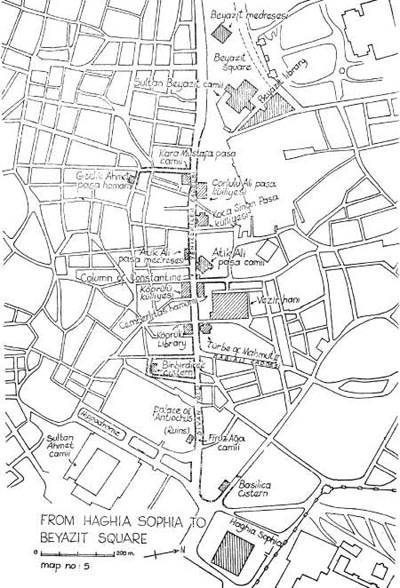
7

Aya Sofya Meydanı, the square beside Haghia Sophia, occupies a site which was once the heart of Byzantine Constantinople. The square coincides almost exactly with the Augustaeum, the publc forecourt to the Great Palace of Byzantium. On its northern side the Augustaeum gave access to the church of Haghia Sophia and to the Patriarchal Palace, while outside its south-eastern corner stood the Chalke, or Brazen House, the monumental vestibule of the Great Palace. The Hippodrome was located just to the south-west of the Augustaeum and the Baths of Zeuxippus were to its south. A short way to the west of the Augustaeum there was another great communal square, the Stoa Basilica, a porticoed piazza surrounded by the buildings of the University of Constantinople, the central law courts of the empire, the principal public library, and a large outdoor book market. Thus the Augustaeum and its immediate neighbourhood were at the very hub of life in the ancient city. Today the square is no longer a civic centre, but it is still a very central starting point for visting the antiquities on the First and Second Hills of the old city.
At the south-western corner of the Augustaeum, at the beginning of the modern Divan Yolu, there stood a monument called the Miliarum Aureum, the Golden Milestone, known more simply as the Milion. Excavations in 1965 unearthed a fragment of the Milion beside the Ottoman suterazi, or water-control tower, just to the right at the beginning of Divan Yolu. The fragment, a tall marble stele, was part of a four-sided ceremonial archway surmounted by statues of Constantine the Great and his mother Helena, holding between them the True Cross.
The Milion, like its namesake in the Roman Forum, was the point of departure for the great roads which ran out of the city and was the reference point for their milestones. Here began the Mese, or Middle Way, the main thoroughfare of ancient Constantinople, which followed the course of the modern Divan Yolu. The Mese, which was flanked for a good part of its length with marble porticoes, led westward from the Milion along the ridge between the First and Second Hills, atop which it passed through the Forum of Constantine. Continuing westward, along the route of the Modern Yeniçeriler Caddesi, the Avenue of the Janissaries, the Mese then ran along the ridge between the Second and Third Hills and entered the Forum of Theodosius, on the site of the present-day Beyazit Square. Beyond there, the Mese divided into two branches, one of which extended west and the other south-west. The western branch passed through the Gate of Charisius, where it joined the Roman road to Adrianople, now known as Edirne. The other branch passed through the famous Golden Gate and linked up with the Via Egnatia, which marched through Thrace, Macedonia and Epirus to the Adriatic. The main thoroughfares of modern Stamboul follow quite closely the course of these Roman roads built more than 15 centuries ago.
The thoroughfare between Haghia Sophia and Beyazit Square continued to be one of the principal arteries of the town in Ottoman times, for it was the main road from Topkapı Sarayı to the centre of Stamboul. For that reason it is lined with monuments of the imperial Ottoman centuries, as well as some ruined remnants of imperial Byzantium. It is called Divan Yolu, the Road of the Divan, because of the procession of dignitaries that passed along it whenever there were meetings of the Divan, or imperial council, in the Second Court of Topkapı Sarayı.
THE BASİLİCA CISTERN
The first monument on our itinerary is a short way down Yerebatan Caddesi, the street that leads off half-right from Aya Sofya Meydanı at the beginning of Divan Yolu. Almost immediately on the left we come to a small building which is the entrance to an enormous underground cistern, Yerebatan Saray, or the Underground Palace. Restoration of the cistern began in 1985 and it opened to the public in 1988.
The structure was known in Byzantium as the Basilica Cistern because it lay underneath the Stoa Basilica, the second of the two great squares on the First Hill. The Basilica Cistern was built by Justinian after the Nika Revolt in 532, possibly as an enlargement of an earlier cistern of Constantine. Throughout the Byzantine period the Basilica Cistern was used to store water for the Great Palace and the other buildings on the First Hill, and after the Conquest its waters were used for the gardens of Topkapı Sarayı. Nevertheless, general knowledge of the cistern’s existence seems to have been lost in the century after the Conquest, and it was not rediscovered until 1546. In that year Petrus Gyllius, while engaged in his study of the surviving Byzantine antiquities in the city, learned that the people in this neighbourhood obtained water by lowering buckets through holes in their basement floors; some even caught fish from there. Gyllius made a thorough search through the neighbourhood and finally found a house through whose basement he could go down into the cistern, probably at the spot where the modern entrance is located. As Gyllius writes, referring to the Stoa Balica as the Imperial Portico:
The Imperial Portico is not to be seen, though the Cistern remains. Through the inhabitants’ carelessness and contempt for everything that is curious it was never discovered except by me, who was a stranger among them, after a long and diligent search for it. The whole area was built over, which made it less suspected that there was a cistern there. The people had not the least suspicion of it, though they daily drew their water out of the wells that were sunk into it. By chance I went into a house where there was a way down to it and went aboard a little skiff. I discovered it after the master of the house lit some torches and rowed me here and there through the pillars, which lay very deep in water. He was very intent on catching his fish, with which the Cistern abounds, and speared some of them by the light of the torches. There is also a small light that descends from the mouth of the well and reflects on the water, where the fish usually come for air.
The Cistern is three hundred and thirty-six feet long, a hundred and eighty two feet broad, and two hundred and twenty-four Roman paces in circumference. The roof, arches and sides are all brickwork covered with terra-cotta, which is not the least impaired by time. The roof is supported by three hundred and thirty six pillars. The space of the intercolumniation is twelve feet. Each pillar is over forty feet, nine inches high. They stand lengthwise in twelve ranges, broadways in twenty-eight… There is an abundance of wells that empty into the Cistern. When it was filling in the winter time I saw a large stream of water filling from a great pipe with mighty noise until the pillars were covered up with water to the middle of the capitals. This Cistern stands west of the Church of St. Sophia a distance of eighty Roman paces.
Ninety of the columns in the south-west corner were walled off in the nineteenth century. The columns are topped by Byzantine Corinthian capitals; these have imposts above them which support little domes of brick in a herringbone pattern. One of the columns on the left side is carved with a curious peacock-eye or lopped branch design. This identifies it as part of the triumphal arch in the Forum of Theodosius I on the Third Hill (see Chapter 9), where fragments of identical columns were excavated in 1965. In the far left corner of the cistern, at a slightly lower level, one of the columns is mounted on ancient classical bases supported by the heads of Gorgons, one of them upside down and the other on its side. (The Gorgons in Greek mythology were three sisters, one of whom, Medusa, was slain by Perseus.) These Gorgon heads and the two we have seen outside the Archaeological Museum were, as we have noted, originally in the Forum of Constantine, whose site we will see later on this itinerary.
FIRUZ AĞA CAMİİ
On leaving Yerebatan Saray, we retrace our steps and return once again to the beginning of Divan Yolu; 100 metres or so up Divan Yolu and on its left side, we see a tiny mosque, one of the oldest in the city. It was constructed in 1491 for Firuz Ağa, Chief Treasurer in the reign of Sultan Beyazit II. Firuz Ağa Camii is of interest principally because it is one of the few examples in Istanbul of a mosque of the “pre-classical” period, that is, of those built before 1500. This is the architectural style which flourished principally in the city of Bursa when it was the capital of the Ottoman Empire, before the Conquest. In form, Firuz Ağa Camii is quite simple, consisting merely of a square room covered by a windowless dome resting on the walls, the so-called single unit type of mosque. The building is preceded by a little porch of three bays, typical of the single-unit Bursa mosques, while the minaret, unusually, is on the left-hand side. The tomb of the founder, in the form of a marble sarcophagus, is on the terrace beside the mosque. Firuz Ağa Camii is an elegant little building, perhaps the most handsome of the early mosques of its type in the city.
THE PALACES OF ANTİOCHUS AND LAUSUS
Just beyond Firuz Ağa Camii, there is a little park which borders an open area excavated some years ago. The ruins which were exposed in these excavations are so fragmentary that it is difficult to determine their identity. It is thought that what we see here are the ruins of two adjacent palaces, those of Antiochus and Lausus, two noblemen of the early fifth century. The grandest of these is the palace of Antiochus, an hexagonal building with five deep semicircular apses with circular rooms between the apses. In the early seventh century, this palace was converted into a martyrium for the body of St. Euphemia when it was taken from Chalcedon to Constantinople. This lady was a virgin, martyred in Chalcedon in about the year 303. We learn from the Anonymous Englishman, writing in 1190, that St. Euphemia performed an astonishing miracle during the Oecumenical Council at Chalcedon in 451. According to his account, the two opposing parties in the Council, the Orthodox and the Monophysites, decided to resolve their dispute about the nature of Christ by placing their formulas in the saint’s casket and letting her decide. A week later they opened the casket and found the Orthodox formula upon her heart and that of the Monophysites lying under her feet, thus bringing victory to the Orthodox party. The martyrium is elaborately decorated with paintings in fresco, representing scenes from the life and especially the gaudy martyrdom of St. Euphemia, and a striking picture of the Forty Martyrs of Sebaste; these are preserved in rather bad condition under a shed beside the Law Courts. They were at first ascribed to the ninth century but the latest study places them in the late thirteenth. Unfortunately, the shed covering the frescoes is closed permanently and the paintings can no longer be seen by the public.
THE BİNBİRDİREK CISTERN
Once past these ruins we take the first left off Divan Yolu, and a short way along on the right we come to the entrance to the ancient cistern known as Binbirdirek, “the Thousand and One Columns”. The cistern was restored in the years 1995–2002 and is now open as a tourist attraction. Unfortunately the restoration was badly done and what was once an awesome and romantic site has now lost its historical identity; nevertheless it is still very interesting.
The dimensions of the cistern are 64 by 56.4 metres or 3,610 square metres; thus it is the second largest covered cistern in the city, though with only a third the area of Yerebatan Saray. It is thought that the cistern was originally built in the second quarter of the fourth century by Philoxenus, a Roman senator who came to the city with Constantine the Great, although there is evidence that some of the structure at least dates to the fifth or sixth centuries. During the nineteenth century the cistern was used as a spinning-mill and more recently as a storehouse.
The cistern was originally about 19 metres high from the floor to the top of the little brick domes in herringbone design. The columns are in two tiers bound together by curious stone ties. There were originally 224 double columns in 16 rows of 14 each, but 12 of these were walled in not long after the cistern was completed. The impost capitals are plain except that some of them are inscribed with monograms of the stone masons.
Continuing along the left side of Divan Yolu, on the next block we pass the Galeri Kayseri, the best book shop in the city for works in English on Istanbul and other places in Turkey.
At the next corner we turn left on Piyer Loti Caddesi, named for the French writer Pierre Loti. At the end of the block and on the right we come to the Eminönü Belediye Başbakanlığı building, the Town Hall of the Eminönü district, which has now been merged with the Fatih district, the two together comprising the whole of the old city. A door to the right of the main entrance has a sign indicating the entrance to the Theodosius Cistern, another of the city’s late Roman subterranean reservoirs. The cistern measures 42.5 by 25 metres; its roof of brick domes in the usual herringbone design is supported by 32 columns of white marble in four rows of eight each, with some capitals of the the Corinthian order and others Doric, undoubtedly reused from older structures. The cistern is believed to have been built during the reign of Theodosius II (r. 408–50) by his sister Pulcheria, who would later marry her brother’s successor Marcian (r. 450–7). The cistern was summarily restored and opened to the public in 1994.
We once again turn to Divan Yolu. Then on the next block we see on the right side of the avenue the rather heavy türbe of Sultan Mahmut II (r. 1808–39) and its long garden wall. Mahmut died in 1839 and his türbe is in the then popular Empire style, a little pompous and formal. Here also are buried sultans Abül Aziz (r. 1861–76) and Abdül Hamit II (r. 1876–1909), together with a large number of imperial consorts and princes.
THE KÖPRÜLÜ COMPLEX
Directly opposite the türbe of Mahmut II, on the left side of Divan Yolu, we see an elegant Ottoman library of the seventeenth century. This is one of the buildings of the Köprülü külliyesi, whose other institutions we will presently see in the immediate neighbourhood. These buildings were erected in the years 1659–60 by two members of the illustrious Köprülü family, Mehmet Paşa and his son Fazıl Ahmet Paşa. The Köprülü are generally considered to be the most distinguished family in the whole history of the Ottoman Empire. During the second half of the seventeenth century and the early years of the eighteenth, no fewer than five members of this family served as Grand Vezir, some of them among the most able who ever held that post. The library of the Köprülü külliyesi is a handsome little building with a columned porch and a domed reading-room, constructed in a mixture of brick and stone. The library contains an important collection of books and manuscripts many of which were the property of its founders, who were known in their time as Mehmet the Cruel and Ahmet the Statist.
One block beyond the library and on the same side of the street, we come to two other institutions of the Köprülü külliyesi, the mosque and the türbe of Mehmet the Cruel. The türbe is of a rather unusual type, in the sense that it is roofed only by a metal grille. This gave rise to the legend that the grave was deliberately left open to the elements, so that the falling rain could cool the shade of the Grand Vezir, who was burning in hell-fire because of the thousands of rebels he had executed while in office. In the graveyard just beside the türbe we see the tombstone of a modern member of this famous family, Mehmet Fuat Köprülü, the distinguished historian and sometimes Minister for Foreign Affairs, who died in 1966. The mosque is a few steps beyond the türbe, projecting out into the sidewalk of Divan Yolu. The mosque, which is octagonal in shape, was once the dershane, or lecture-room, of the Köprülü medresesi, most of which has now disappeared.

Directly across the avenue from the Köprülü mosque is the Çemberlitaş Hamamı, one of the finest extant examples of a classical hamam. This hamam was founded by Nurbanu Valide Sultan some time before her death in 1583; she was the wife of Selim II and the mother of Murat III. She was a great builder: her magnificent mosque complex in Üsküdar is described in Chapter 19. Her architect there was Sinan, but he does not appear to have been responsible for the present beautiful structure, for it is not mentioned in the Tezkere, the official list of his works. This bath is still fortunately in use, at least the men’s section. It was originally double but part of the men’s section was destroyed when the avenue was widened. In general it follows the usual plan: a great domed camekân leads to a small three-domed soğukluk, which opens into the hararet. This latter has a rather charming arrangement, seen also at Cağaloğlu and elsewhere; inscribed in a square chamber is a circle of columns supporting an arcade on which rests the dome. In the corners are the little washing-cells, each with its dome and an attractive door; the pavements have geometric designs.
THE COLUMN OF CONSTANTINE
Just across the side street from the hamam we come to one of the most venerable monuments in the city, the Column of Constantine. Ths is known locally as Çemberlitaş, or the Hooped Column, hence the name of the surrounding neighbourhood; in English it was in times past called the Burnt Column because of the marks of a fire that raged around it in the eighteenth century. This column marks the centre of what was once the Forum of Constantine the Great and was erected by him to celebrate the dedication of the city as capital of the Roman Empire on 11 May in the year 330. Constantine’s forum with columned porticoes had the unusual shape of an oval. It has been compared to Bernini’s superb portico at St. Peter’s, though models nearer in time and place are not wanting: for example, the charming elliptical agora at Gerasa (Jerash) in Jordan built 200 years earlier, probably by Hadrian. Around it stood the usual public buildings: a Senate (there was still another Senate House off the Augustaeum), a Praetorium, and several temples and churches. And of course it was adorned with statues both Christian and pagan. The relics of all this grandeur are now buried some three metres beneath the present level of the road, and all that remains visible is the column, itself, much mutilated.
The column now consists of a very ungainly masonry base about ten metres high surmounted by a shaft of six porphyry drums, the joints between them hooped with iron bands; at the summit are ten courses of masonry topped by a marble block; the total height is 34.8 metres. Originally the column had a square pedestal standing on five steps; on the pedestal was a porphyry plinth and column base and seven porphyry drums. (The present masonry casing conceals the lowest of these.) At the summit, instead of the present masonry, there was a large capital, presumably Corinthian, upon which stood a statue of Constantine as Apollo. The iron hoops were an early addition, put on in 416 because the lowest part of the column had a piece knocked out of it and was thought unsafe. The statue of Constantine fell down as the result of a violent wind in 1106, and some 50 years later Manuel I Commenus replaced the capital by the masonry courses we see today, on top of which he placed a large cross. The lower masonry is Turkish work added in 1779 in order to bolster up the column. The column has recently been restored and the iron hoops have been replaced by new ones.
The ceremony of the original dedication of the column was a curious mixture of assorted pagan and Christian rites. Buried under the column or in the statue, itself, was the most incredible collection of relics: the Palladium of Troy, the hatchet of Noah, the stone from which Moses made water flow, the baskets and remains of the loaves with which Christ fed the multitude, the nails of the Passion (intertwined with the rays of Apollo!) and bits of the True Cross discovered by St. Helena at Jerusalem for the occasion. And the Apollo above did not prevent the people from later worshipping the deified Emperor, converted into a Christian saint, in a chapel at the base of the column.
VEZİR HANI
Leaving the main avenue for a moment, we turn to the right on Vezir Han Caddesi, the street which runs downhill beside the Column of Constantine. A short distance down the right side of this street we come to the entrance to Vezir Hanı, another institution of the Köprülü külliyesi. Such hans, or kervansarays, were commercial establishments where a travelling merchant could not only obtain food and lodging for the night but could also sell or store his goods. They are huge and stoutly-built structures of stone, or stone and brick, with two or three storeys around a great courtyard. One enters through a monumental gateway with very strong doors of thick wood, bound with iron, that are locked and barred at night. The vast courtyard is surrounded with porticoes, the one on the ground floor giving access to the windowless storerooms and stables, with staircases on each side leading up to the first floor gallery, more open and brighter, from which the living rooms were reached. In the centre of the courtyard there was generally a small mosque. Today, with the replacement of the horse and camel by the motor-truck, the character of these old hans has changed considerably, and they are now given over to every conceivable form of commerce and industry. Most of them, like Vezir Hanı, are in a shocking state of dilapidation and near ruin. Nevertheless they are still grand and picturesque, evoking something of the now almost vanished Oriental atmosphere of old Stamboul.
Returning once again to Divan Yolu, we continue on past Constantine’s column on the same side of the street to an interesting mosque, Atik Ali Paşa Camii. This is one of the oldest mosques in the city, having been built in 1496 by the Hadım (Eunuch) Atik Ali Paşa, Grand Vezir of Sultan Beyazit II. Surrounded by a quiet garden off the busy street, it is an attractive little mosque, especially from the outside. Its plan is somewhat unusual, in that it consists of a rectangular room divided into unequal parts by an arch. The western and larger section is covered by a dome, the eastern by a semidome under which is the mihrab, as if in a sort of great apse. The western section is also flanked to north and south by two rooms with smaller domes. The semidome and the four small domes have stalactite pendentives, a common feature in mosques of early date.
Atik Ali Paşa Camii originally had several dependencies: a tekke, an imaret and a medrese. Of these only a part of the medrese remains; it is across the Divan Yolu from the mosque, the remainder having been destroyed some time ago when the road was widened. This building, though mutilated, is interesting as being one of the very few medreses of the pre-classical period that survive in the city.

A short distance beyond Atik Ali Paşa Camii, on the same side of the avenue, we come to the külliye of Koca Sinan Paşa, enclosed by a picturesque marble wall with iron grilles. The külliye consists of a medrese, a sebil and the türbe of Koca Sinan Paşa, who died in 1595. Koca Sinan Paşa was Grand Vezir under Murat III and Mehmet III and was the conqueror of the Yemen. Perhaps the most outstanding element in this very attractive complex of buildings is the türbe, a fine structure with 16 sides, built of polychrome stonework, white and rose-coloured, and with a rich cornice of stalactites and handsome window mouldings. The medrese, which we enter by a gate in the alley alongside, has a charming courtyard with a portico in ogive arches. The sebil, too, is an elegant structure with bronze grilles separated by little columns and surmounted by an overhanging roof. The whole complex was built in 1593 by Davut Ağa, the successor to Sinan as Chief Architect.

On the other side of the alley across from the sebil, a marble wall with grilles encloses another complex of buildings, the külliye of Ali Paşa of Çorlu. This Ali Paşa was a son-in-law of Mustafa II and was Grand Vezir under Ahmet III, on whose orders he was beheaded in 1711 on the island of Mytilene. Ali Paşa’s head was afterwards brought back to Istanbul and buried in the cemetery of his külliye, which had been completed three years earlier. This külliye, consisting of a small mosque and a medrese, belongs to the transition period between the classical and the baroque styles. Though attractive, there is nothing especially outstanding about these buildings, although one might notice how essentially classical they still are. The only very obvious baroque features are the capitals of the columns of the porch.

Directly across the avenue we see the octagonal mosque of Kara Mustafa Paşa of Merzifon, together with a medrese and a sebil. This unfortunate Grand Vezir also lost his head, which, according to an Ottoman historian, “rolled at the feet of the Sultan (Mehmet IV) at Belgrade” after the unsuccessful second siege of Vienna in 1683, of which Kara Mustafa had been in charge. The buildings were begun in 1669 and finished by the Paşa’s son in 1690. This mosque is of the transitional type between classic and baroque and is of interest chiefly as one of the few octagonal buildings to be used as a mosque. This külliye and the other two we have just looked at have recently been well restored; Kara Mustafa’s medrese has been converted into an institute commemorating the celebrated poet, Yahya Kemal, who died in 1958.

The street just beyond this little külliye is called Gedik Paşa Caddesi; this leads to a hamam of the same name at the second turning on the left. This is one of the very oldest baths in the city, built in about 1475, and it is still in operation. Its founder was Gedik Ahmet Paşa, one of Mehmet the Conquerors Grand Vezirs (1470–7), commander of the fleet at the capture of Azof and conqueror of Otranto. This hamam has an unusually spacious and monumental soğukluk consisting of a large domed area flanked by alcoves and cubicles; the one on the right has a very elaborate stalactited vault. The hararet is cruciform except that the lower arm of the cross has been cut off and made part of the soğukluk; the corners of the cross form domed cubicles. The bath has recently been restored and now glistens with bright new marble; it is much patronized by the inhabitants of this picturesque district.
THE BEYAZİDİYE
Returning once again to the main avenue, we continue along to Beyazit Square, a confused and chaotic intersection of no recognizable geometric shape. Crossing to the right-hand side of the avenue, we come to the Beyazidiye, the mosque and associated pious foundations of Sultan Beyazit II. The Beyazidiye was the second great mosque complex to be erected in the city. Founded by Beyazit II, son and successor of Mehmet the Conqueror, it was built between 1501 and 1506, and consists of the great mosque itself, a medrese, a primary school, a public kitchen, a hamam and several türbes. Heretofore, the architects name has variously been given as Hayrettin or Kemalettin, but a recent study has shown that the külliye is due to a certain Yakub-şah bin Sultan şah, who also built a kervansaray at Bursa. His background is unknown and his origin uncertain, but he may have been a Turk. Whatever his origin, he created a work of the very first importance, both in its excellence as a building and in its historic importance in the development of Turkish architecture. The mosque marks the beginning of the great classical period which continued for more than 200 years. Before this time, Ottoman architects had been experimenting with various styles of mosques and had often produced buildings of great beauty, as in Yeşil Cami at Bursa or Üç Şerefeli Cami at Edirne; but no definite style had evolved which could produce the vast mosques demanded by the glory of the new capital and the increasing magnificence of the sultans. The original mosque of the Conqueror was indeed a monumental building, but as that was destroyed by an earthquake in the eighteenth century, Beyazit Camii remains the first extant example of what the great imperial mosques of the sixteenth and seventeenth century were to be like.
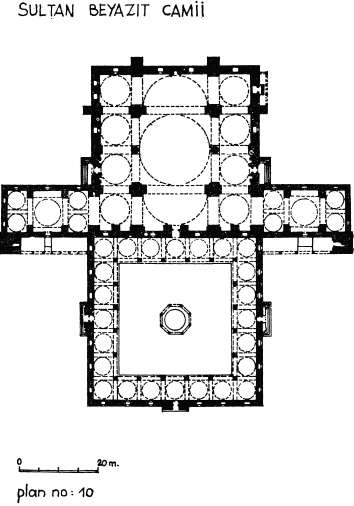
One enters Beyazit Camii through one of the most charming of all the mosque courtyards. A peristyle of 20 ancient columns – porphyry, verd antique and Syennitic granite – upholds an arcade with red-and-white or black-and-white marble voussoirs. The colonnade is roofed with 24 small domes and three magnificent entrance portals give access to it. The pavement is of polychrome marble and in the centre stands a beautifully decorated şadırvan. (The core of the şadırvan at least is beautiful – the encircling colonnade of stumpy verd antique columns supporting a dome seems to be a clumsy restoration.) Capitals, cornices and niches are elaborately decorated with stalactite mouldings. The harmony of proportions, the rich but restained decoration, the brilliance of the variegated marbles, not to speak of the interesting vendors and crowds which always throng it, give this courtyard a charm of its own.
An exceptionally fine portal leads into the mosque, which in plan is a greatly simplified and much smaller version of Haghia Sophia. As there, the great central dome and the semidomes to east and west form a kind of nave, beyond which to north and south are side aisles. The arches supporting the dome spring from four huge rectangular piers; the dome has smooth pendentives but rests on a cornice of stalactite mouldings. There are no galleries over the aisles, which open wide into the nave, being separated from it only by the piers and by a single antique granite column between them. This is an essential break with the plan of Haghia Sophia: in one way or another the mosques all try to centralize their plan as much as possible, so that the entire area is visible from any point. At the west side a broad corridor divided into domed or vaulted bays and, extending considerably beyond the main body of the mosque, creates the effect of a narthex. This is a transitional feature, retained from an older style of mosque; it appears only rarely later on. At each end of this “narthex” rise the two fine minarets, their shafts picked out with geometric designs in terra-cotta; they stand far beyond the main part of the building in a position which is unique and gives a very grand effect. At the end of the south arm of the narthex, a small library was added in the eighteenth century by the Şeyh-ül Islam Veliyüttin Efendi. An unusual feature of the interior of the mosque is that the sultans loge is to the right of the mimber instead of the left as is habitual; it is supported on columns of very rich and rare marbles. The central area of the building is approximately 40 metres on a side, and the diameter of the dome about 17 metres.
THE PIOUS FOUNDATIONS OF THE BEYAZİDİYE
Behind the mosque – or, as the Turks say, in front of the mihrab – is the türbe garden; here Beyazit II lies buried in a simple, well-proportioned türbe of limestone picked out in verd antique. Nearby is the even simpler türbe of his daughter, Selçuk Hatun. Beyond these, a third türbe in a highly decorated Empire style is that of the Grand Vezir Koca Reşit Paşa, the distinguished leader of the Tanzimat (Reform) movement, who died in 1857. Below the eastern side of the türbe garden facing the street is an arcade of shops originally erected by Sinan in 1580; it had long since almost completely disappeared, but one of the happier ideas in the redesigning of Beyazit Square was to reconstruct it.
Just beside these shops is the large double sibyan mektebi with two domes and a porch; this is undoubtedly the oldest surviving primary school in the city, since that belonging to the külliye of Fatih Mehmet has disappeared. It has recently been handsomely restored and now houses the hakkı tarık us Research Library. (hakkı tarık us was a journalist who, like the poet e.e. cummings, had an aversion to capital letters.) Between this building and the northern minaret is a very pretty courtyard called the Sahaflar Çarşısı, or the Market of the Secondhand Book Sellers, in which we will linger on our next stroll through the city.
Almost opposite the north minaret stands the extremely impressive imaret of the külliye. The imaret, in addition to serving as a public kitchen, seems also to have been used as a kervansaray. The various rooms of the imaret line three sides of the courtyard (now roofed in), with the fourth side containing the monumental entrance-portal. The first room on the right housed an olive-press, the second was a grain storeroom, and the third, in the right-hand corner, was the bakery, equipped with two huge ovens. The large domed chamber at the far end of the courtyard was the kitchen and dining room. The even larger domed structure beside it, forming the left third of the complex, served as a stable for the horses and camels of the travellers who were guests at the imaret, while the chamber between the stable and the courtyard was used as a dormitory. The imaret was converted into a library by Sultan Abdül Hamit II in 1882; it now houses the State Library (Devlet Kütüphanesi). The library is an important one of 120,000 volumes and more than 7,000 manuscripts and the imaret makes a fine home for it.
The medrese of Beyazit’s külliye is at the far west end of the square. It is of the standard form; the hücres, or cells, where the students lived and studied, are ranged around four sides of a porticoed courtyard, while the dershane, or lecture-hall, is opposite the entrance portal. This building has also been converted into a library, that of the Municipality (Belediye Kütüphanesi); unfortunately the restoration and conversion were rather badly done, a lot of cement having been used instead of stone and the portico having been very crudely glassed in. Nevertheless, the proportions of the building are so good and the garden in the courtyard so attractive that the general effect is still quite charming.
The medrese is now used to house the Museum of Calligraphic Art. The collections of the museum are organized into various sections; these are: Cufic Kurans, treatises and manuscripts and panels in Indian and Moroccan scripts; Nakshi Kurans and wooden cut-outs; Ta’liq Kurans and Tuluth panels; Ta’liq manuscripts and panels; Tuluth Nakshi collages and calligraphic compositions; the Holy Relics and dar-ül kürsa; Tuluth and mirror writings; Ta’liq panels, compositions, Tuluth and Nakshi Kurans; tuğras and Nakshi Kurans; Hilyes (descriptions of the features and qualities of the Prophet); embroidered inscriptions and works by women calligraphers; calligraphic models and Muhakkak Kurans. There are also examples of calligraphic inscriptions on wood, stone and glass, and other examples of the use of calligraphy, including title deeds, family trees, and even a talismanic shirt. There are also interesting exhibits of calligraphic equipment, and one cell has been set up with wax models showing a calligrapher instructing his students in this quintessentially Islamic art form, wonderfully evoked in this interesting museum.
Beyond the medrese, facing on the wide Ordu Caddesi that leads down into the valley at Aksaray, are the splendid ruins of Beyazit’s hamam. This must have been among the most magnificent in the city, and it is now being restored from near ruin; the fabric still seems to be essentially in good condition. It is a double hamam, the two sections being almost identical, the women’s a little smaller than the men’s. Apart from the monumental façade housing the two camekâns with their great domes, the best view of the hamam may be had from the second floor of the University building just beyond; from here one sees the elaborate series of domes and vaults that cover the soğukluk and the hararet.
ISTANBUL UNIVERSITY AND THE BEYAZIT TOWER
On the north side of Beyazit Square stand the main buildings of the University of Istanbul. Immediately after the Conquest Sultan Mehmet II founded a medrese at the Aya Sofya mosque and a few years later he built the eight great medreses which were attached to his mosque; other such institutions were added by Beyazıt II, Selim I, and above all by Süleyman, who surrounded his own mosque with another seven medreses. In addition to Theology and Philosophy, there were Faculties of Law, Medicine and Science. But the decline of the Empire was accompanied by a corresponding decline of learning. The first attempt to establish a secular institution of higher learning, known in Turkish as Darülfunun, was begun during the reign of Sultan Abdül Mecit I (r. 1839–61), as part of the reform movement known as the Tanzimat. The Darülfunun, which registered its first students in 1869, was reorganized in 1900 on the model of European universities, including faculties of science, medicine and civil law. After the founding of the Republic of Turkey in 1923 the Darülfunun was reformed and reorganized to become the University of Istanbul. It was then installed in its present building, previously the Seraskerat, or Ministry of War. The main part of the building was constructed by the French architect Bourgeois in 1866 in the sumptuous stylelessness then thought appropriate to ministerial edifices; and during the last two decades or so various wings have been added, equally styleless but not nearly so sumptuous.
The area on which these central buildings of the University stand formed part of the site where Mehmet the Conqueror built the Eski Saray, or Old Seraglio, immediately after the Conquest. Somewhat later he began to build Topkapı Sarayı on the First Hill and the Eski Saray was gradually abandoned as the official residence of the sultans. Some of its various and extensive buildings were used as a place of claustration for the women of defunct sultans, others as private palaces of distinguished vezirs; and a large part of its grounds was appropriated by Süleyman for his great mosque complex. In the end the whole thing disappeared and has left not a trace behind.
In the courtyard of the university stands the Beyazit Tower, a characteristic feature of the Stamboul skyline. There had long been a wooden tower at this point for fire-watchers, but it was not until 1828 that Mahmut II caused the tower to be built. It is some 50 metres high, and its upper platform commands a view of the entire city if one can obtain permission to enter.