

THE STATE OF THE UNION 
After winning the American Revolution and (mostly) not losing the War of 1812, the United States was suddenly the center of attention. The crowned heads of Europe were watching the newborn federation closely, praying that this weird experiment in nation-building and self-government would fail spectacularly. But they were disappointed. Far from degenerating into class warfare or regional rivalries, from 1815 to 1850 the United States pulled itself together and embarked on one of the greatest periods of territorial conquest in human history–settling the Wild West!
Still, the new country wasn’t exactly a perfect union. It remained divided over slavery, having sidestepped the issue in the Constitution. Further, the westward push only exacerbated the conflict, as each new Western state threatened to change the balance of power in Congress. With fierce Northern abolitionists on one side and equally fierce pro-slavery Southerners on the other, something had to give. But for the time being, the young, carefree United States was happy to sweep the whole incendiary issue under the highly flammable rug.
Slavery wasn’t the only question at hand. For example, what to do with all those Native Americans still living on Western land, which God had clearly set aside for white people? The settlers hit on a comprehensive solution–as their branding experts called it, “Manifest Destiny!” (“Mass murder?” “No: Manifest Destiny!”) And in fairness to the settlers, many Native American tribes were also quite warlike. There were just fewer of them.
Before long, advances in steam power and mass production were transforming the big cities of the Northeast. Imported from Britain, industrialization raised the standard of living for a broad segment of society and set the stage for the rise of the United States as the world’s biggest economy when it overtook Britain in the second half of the nineteenth century, thanks to its larger population and abundant natural resources. But the conditions were still far from ideal; many urban factory workers lived and worked in squalor. Additionally, these new industrial sweatshops employed ever-larger numbers of poor European immigrants, whose arrival triggered a massive wave of xenophobia and isolationism.
Meanwhile, American religious ferment gave rise to the Second Great Awakening, an evangelical Protestant revival that brought millions back to the old churches and also generated a new one: the Church of Jesus Christ of Latter-Day Saints, also known as the Mormon Church. The Mormons were a clean-living, hardworking crew, but some of their doctrine–particularly the practice of polygamy–raised eyebrows … followed quickly by torches, burning effigies, and pitchforks.
But probably the biggest development in early nineteenth-century America was the revolution in transportation and communications brought about by new technologies and investment in infrastructure, as railroads, canals, and telegraphs tied the states together like never before. With growing cohesion came a greater sense of national unity–but the feeling of pride inspired by this new American identity couldn’t cover up the deepening divide over slavery.
 WHAT HAPPENED WHEN
|
January 26, 1815 |
Andrew Jackson captures New Orleans. |
|
January 17, 1821 |
Mexico invites Americans to settle in Texas and California. |
|
1823 |
Joseph Smith Jr. is visited by the angel Moroni for the first time. |
|
1825 |
Mexico bans slavery. |
|
1828 |
Mexico tries to stop Anglo-American immigration to Texas. |
|
1831 |
Nat Turner leads a slave rebellion in rural Virginia; Smith leads the Mormons to Kirtland, Ohio. |
|
1832 |
Southern states pass harsh anti-literacy laws regulating slavery. |
|
1833 |
Mexico repeals ban on Anglo-American immigration to Texas. |
|
March 2, 1836 |
Texas rebellion begins. |
|
March 3, 1837 |
Texas rebellion ends with Texan independence. |
|
June 27, 1844 |
Smith is killed in a jail cell in Carthage, Illinois. |
|
1845 |
Florida (March 3) and Texas (December 29) join the Union. |
|
April 25, 1846 |
The Mexican-American War begins. |
|
June 18, 1846 |
Americans stage the Bear Flag Revolt in California. |
|
February 2, 1848 |
The Mexican-American War ends. |
|
September 9, 1850 |
California joins the Union. |
SPECIAL REPORT 
We’ve Got Issues
Slavery
In the first half of the nineteenth century, America was increasingly divided by one huge, ugly issue: slavery. Among other things, it complicated the young country’s expansion in the west, where each new state threatened to change the national balance of power between pro-slavery and anti-slavery forces.
 East of the Rockies, slave state land covered an area of more than 850,000 square miles, while free states contained just 450,000 square miles.
Even before the American Revolution, opposition to slavery was already entrenched in some areas of the North, particularly with the Quakers of Pennsylvania. This idealistic Christian sect, famous for egalitarian social views, began voicing opposition to slavery as early as 1688. And the Quakers weren’t the only ones. During the Revolutionary War, Benjamin Franklin and Thomas Jefferson rallied the Continental Congress and orchestrated a ban on the overseas slave trade as part of the anti-British boycott. During the Revolutionary War, both sides promised emancipation to slaves who fought for their cause. Following independence, it seemed to some people that slavery was actually headed for extinction.
To bring men hither, or to rob and sell them against their will, we stand against.
–Quaker anti-slavery compact, 1688
But the invention of the cotton gin in 1793, followed by the invention of steam-powered looms for mass-producing cotton fabric, changed all of that. Suddenly slavery was far more profitable. People who wanted lots of cotton clothing were thrilled–the people hoping to escape from slavery, less so. From 1794 to 1807, new cotton plantations sprang up across the temperate Southern states, and the value of slaves increased, spurring the international and interstate slave trade.
This was bad news, not only for the slaves, but for the fledgling United States, which would pay for slavery with blood in the Civil War. Tensions began rising in the 1830s, as a new generation of Northern abolitionists–mostly Methodists, Baptists, Congregationalists, and New School Presbyterians–demanded immediate emancipation, believing they had a divine mission to abolish the “heinous sin” of slavery. Raising awareness with rallies where integrated choirs sang anti-slavery hymns, the abolitionists eventually succeeded in banning slavery in all of the Northern states. But the real goal was always abolition of slavery in the South–and not just for religious reasons. Threatened by competition from cheaper slave labor, Northern farmers and artisans resented the wealth of Southern plantation owners. The Northern elite also feared Southern political domination–"The Slave Power.”
The Anti-Slavery movement … was at its commencement, and has ever since been, thoroughly and emphatically a religious enterprise.
–Charles K. Whipple, a Massachusetts abolitionist, 1856
Their fears were not unfounded. Although the North had a larger population, the big increase in slavery benefited the Southern states politically, thanks to the “Three-Fifths Compromise.” This measure, demanded by Southern states as a condition for signing the Constitution in 1787, counted each slave as three-fifths of a white citizen when calculating proportional representation in the House of Representatives. While the slaves themselves couldn’t vote, their growing numbers gave an extra jolt of power to the white Southerners who could. In 1830 each Southern member of Congress represented about 40,600 actual citizens, while each Northern member represented 55,370 actual citizens. If you’re scratching your head over this, you can guess how the Northerners felt.
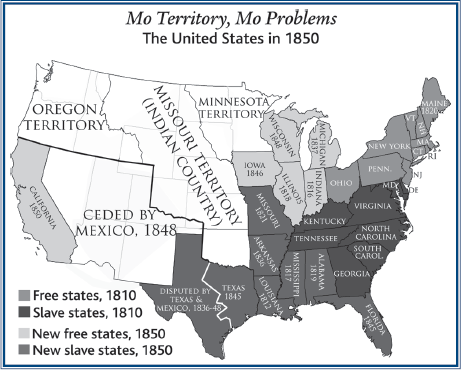
The situation in the Senate was possibly even more dangerous. Since each new state received the same number of senators (two) regardless of population, there was an obvious incentive for both factions to create new states filled with their own sympathizers. The race got going after Thomas Jefferson’s purchase of Louisiana from France in 1803, accelerated with the prospect of new states in the Missouri Territory, and kicked into high gear in 1848 after the American victory in the Mexican War opened vast new areas to settlement. As different parts of the country pursued their glaringly contradictory visions of Manifest Destiny, politicians tried to hammer out agreements to make the whole system a little less harebrained. The results were still ridiculous. For example, the Missouri Compromise of 1820 banned slavery above a certain line of latitude (36° 30’ N), except for Missouri, where slavery was allowed, but only as long as Maine was also admitted as a new free state to keep the balance of power. These congressional contortions foreshadowed worse conflict to come, especially as two parts of the Missouri Territory–Kansas and Nebraska–got in line for statehood.
REBEL WITH A CAUSE
Slave owners often tried to justify the institution of slavery by asserting slaves were actually happy to be slaves. This ludicrous claim was contradicted by a series of slave revolts, including about a dozen major uprisings or conspiracies in the eighteenth and nineteenth centuries. Regardless of whether they owned slaves or not, Southern whites lived in constant fear of a general uprising, especially as slaves made up more than half the population in some places. One of the most famous–and violent–slave revolts was led by Nat Turner, who rallied over 70 slaves and freed blacks and went on a rampage in Virginia, resulting in the murders of 60 white people on August 21–22, 1831. Turner’s uprising was quickly crushed by the Virginia militia, which found and hung 56 blacks. (Meanwhile, angry white mobs lynched another 100–200.) But it stood out as proof of slaves’ desperate misery, fueling abolitionist sentiment in the North.
 LIES YOUR TEACHER TOLD YOU
LIE: The United States was strictly divided between the North and South.
THE TRUTH: Okay. So we just traced the division that pitted North against South in the nineteenth century. But the familiar North-versus-South scenario overlooks the fact that there were actually three major territorial units in the nineteenth century: the North, the South, and the “Midlands,” which, true to the name, occupied a huge area in between.
On maps, the North and South are neatly separated in the East by the Mason-Dixon Line, named after two surveyors–Charles Mason and Jeremiah Dixon–who laid down the famous border in 1763 to help resolve a territorial dispute between Maryland and Pennsylvania. But west of the Appalachians, things got blurry. Here pioneers had more in common with each other than with the North or South. This was partly due to the predominance of the Scots-Irish: although lots of other ethnicities were represented–including Germans, Swedes, and African-Americans (mostly freed slaves)–the Scots-Irish were the most numerous and adventurous group, leading expansion and shaping frontier culture with their traditions. Ignoring royal proclamations (did we mention they hated the English?), they began moving westward in the decades before the American Revolution, crossing the Appalachians through the Cumberland Gap and settling the fertile Tennessee and Ohio River valleys.
The Scots-Irish influence on the Midlands and America in general is pretty clear. Common Scots-Irish names include Alexander, Anderson, Carter, Clinton, Craig, Cunningham, Davison, Foster, Hamilton, Hall, Harrison, Jackson, Johnson, McDonald, Wilson, and Young. These settlers were fiercely independent to the point of belligerence, despising government and prizing self-reliance. They tended to be small-time farmers and avid hunters, drawn to the open land and wild game of the frontier. Literate and better-educated than most other frontiersmen, they clung to their local churches–except when there wasn’t a local church (in which case they were known for carousing and rabble-rousing). Their cultural legacy includes square dancing to the music of fiddles and “jaw harps.” After exposure to African-American music, they added guitars and banjos to their repertoire–in fact, Scots-Irish reels and jigs formed the basis of American bluegrass, folk, and country music.
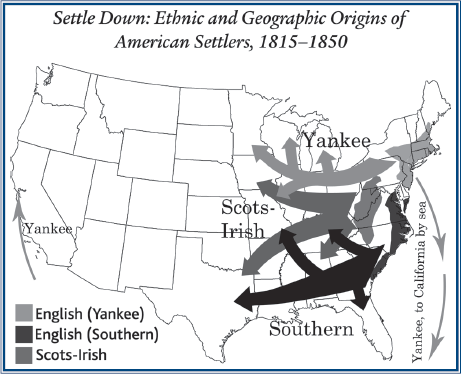
But the differences between the Midlands and other parts of the country were based on economic as well as ethnic and cultural factors. In a time when “roads” were unpaved tracks in the wilderness, the Midlands were truly remote. Rivers like the Ohio, Tennessee, and Mississippi provided relatively fast transportation, but even with steamboats the journey from New Orleans to Louisville, Kentucky, could still take 25 days. This made it difficult to get agricultural produce to market before it spoiled. As a result, the Midlands never developed the huge plantations that arose in the South. Most farms remained small, with farmers focused on raising food for their families and some trade with neighbors. Without plantations, there wasn’t really a demand for slaves.
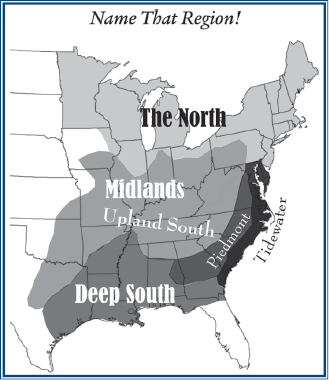
While the Scots-Irish spread out across the Midlands from 1815 to 1850, to the north and south, the descendants of English colonists were also heading westward, bringing their very different ways of life with them. Up north, the settlers were mostly “Yankees"–New Englanders descended from the original Puritan colonists in Massachusetts, who fanned out across upstate New York to the northern parts of Ohio, Indiana, Illinois, and Iowa, entering Michigan and Wisconsin from the south. Here they founded orderly communities modeled on the small, conservative, egalitarian towns of New England, where life centered on the church and all important decisions were made by popular vote at town meetings.
To the south, the settlers were mostly descendants of the more relaxed, less morally uptight English colonists who’d settled the Tidewater region of Virginia and North Carolina. Part of the reason they were so relaxed, of course, was because slaves were doing all the work. After Andrew Jackson secured the U.S. claim to New Orleans in 1815, ambitious young men from the lower echelons of the Tidewater aristocracy headed west to make their fortunes by establishing new (and bigger!) cotton plantations in Alabama, Mississippi, Louisiana, and Texas. The new plantations were concentrated in the southern parts of the states and along major rivers like the Mississippi, which provided cheap transportation for millions of bales of cotton.
LIE: The Alamo was about defending liberty and freedom.
THE TRUTH: The popular image of the Alamo–a glorious, desperate last stand for freedom–is one of the great American myths. Before an angry mob of Texans hunts us down, here’s the real story: the roughly 250 Americans who died at the Alamo from February 23 through March 6, 1836, weren’t defending liberty–they were protecting slavery
The word “álamo” is Spanish for a cottonwood tree.
Although Texas was still part of Mexico in the decades following Mexico’s War of Independence from Spain (1810–1821), it attracted more and more American settlers. Soon the Americans outnumbered the Mexicans, which was okay with the Mexican government–it had actually invited Americans to settle there in the hopes that they would control raids by native tribes, which they did. In fact, many Texans–led by Stephen Austin–actually wanted Texas to become a Mexican state.
The trouble started in 1829, when Vicente Guerrero, a hero of the Mexican War of Independence, was given dictatorial powers by the Mexican Senate, and horror of horrors, banned slavery throughout Mexico. This angered and alarmed American settlers who had moved to Texas specifically to establish Southern-style, slave-powered cotton plantations. Austin convinced Guerrero to grant Texas an exemption, and the move allowed everyone to sidestep this awkward issue …
At least, until Guerrero was toppled by Anastasio Bustamente–a far more ambitious dictator, who feared that Mexico was losing control of Texas. Bustamente was also determined to replace Mexico’s relaxed federal system with a powerful central government. To strengthen his hold on Texas, Bustamente cut off all American immigration and raised taxes and tariffs on trade with the United States. This angered the Texans, but it wasn’t too bad: the immigration restriction was repealed in 1833, and–since the government for the most part only pretended to collect taxes–the Texans only pretended to pay them.
Dear Sir: We have received by the last mail a Decree Given by the executive of our Government Liberating all the Slaves in its territory … in the Name of God, what Shall we do? For God’s sake advise me on the subject by the return of mail. We are ruined for ever Should this measure be adopted.
–Letter to Stephen Austin from John Durst, a prominent Texan, 1829
The Texans’ biggest fear was realized in 1835: two years after ousting Bustamente, General Antonio Lopez de Santa Anna extended the ban on slavery to specifically include Texas. With Stephen Austin leading the charge, the Texans rebelled.
Enter the Alamo. Overconfident after a few easy victories against smaller Mexican forces, the Texans foolishly divided their army. Leaving just a few hundred rebel troops to hold San Antonio, the remainder of the army made a futile attack on Matamoros, a city on the Gulf Coast hundreds of miles to the south. Santa Anna, after defeating a totally separate group of rebels in Zacatecas (he was not a popular dictator), headed north into Texas, taking San Antonio by surprise in February 1836. Frantically gathering supplies, 250 rebels took refuge in the Alamo, an old Spanish mission north of San Antonio, under the informal leadership of Davy Crockett and James Bowie.
You may all go to hell, and I will go to Texas.
–Davy Crockett, after failing to win reelection as U.S. representative for Tennessee, 1835
There was no way the rebels could break the siege–it was 1,500 Mexican troops to their 250–but there was no point in surrender either, as Santa Anna had announced that he would take no prisoners. In the end the defenders were (obviously) wiped out, but only after inflicting about 600 casualties on Santa Anna’s troops. A Pyrrhic victory for the Mexicans, the Alamo crucially weakened Santa Anna, who then did himself no favors by dividing his reduced force to chase the fleeing provisional government of Texas.
Against all odds, on April 21, 1836, Santa Anna’s Mexican cavalry was defeated in a record 18 minutes at the Battle of San Jacinto River by a smaller force of Texans in a desperate surprise attack. The Texans captured Santa Anna as he tried to flee through a nearby swamp. To buy his freedom, the humiliated dictator agreed to recognize Texas as an independent state. The Texans succeeded in upholding slavery, avoiding taxes, and all that other stuff. For the next nine years, the Republic of Texas existed as a nation unto itself, before joining the United States in 1845–needless to say, as a slave state.
LIE: America has always welcomed immigrants.
THE TRUTH: America has done better than most countries with its immigration policies. But welcomed? Not so much. If you’re tempted to shout out something about the beautiful melting pot of our nation, we’d like to remind you of the “Nativist” political movements that preached virulent hatred of “un-American” immigrants–mostly Catholic Europeans–who began showing up in larger and larger numbers in the 1830s.
The biggest immigrant group of the era was Irish Catholic peasants. From 1820 to 1840, 220,000 Irish immigrants fled oppressive English landlords for America. They accounted for roughly a third of the total 742,000 immigrants arriving in that period. But Irish immigration really kicked into high gear when a potato blight destroyed the entire Irish potato crop in the late 1840s. As English landlords looked on indifferently, 1.5 million Irish starved to death, and another 1.6 million relocated. Immigrants went from less than 1 percent of the U.S. population in 1820 to around 10 percent in 1850. And with 961,719 Irish immigrants living in the United States in 1850, the Irish rose from less than 1 percent to about 4 percent of the total population (of 23 million).
In the seventeenth century, Europeans were pressed to grow potatoes, which were hardier and offered more food per acre than most other crops. Farmers were asked (or forced) to plant potatoes in hopes of avoiding the famines that had plagued nations during wartime. The areas that depended most heavily on the potato crop–like Ireland–were those hardest hit by the famine of the 1840s.
That may not seem like a large percentage, but the Irish were highly visible in urban areas like New York, Boston, and Philadelphia, where they eventually made up a quarter of the population. Drawn to these cities by the initial stage of the Industrial Revolution, the first Irish immigrants, despite their incredible poverty, saved enough money to bring over family members, who did the same in turn. Later immigrants often headed west, but still tended to gravitate to urban areas, contributing to the rapid growth of a new generation of cities, including Pittsburgh, Buffalo, Chicago, and St. Louis. They also settled almost exclusively in the North, in large part because the Southern slave economy offered few opportunities for unskilled, poor white laborers.
WHEN IRISH EYES ARE CRYING
So, where did all of this resentment for Irish folk come from? As with other immigrant groups, highly visible negative behaviors were exaggerated and combined with more fanciful fears to create a repulsive Irish stereotype. Some immigrants–especially young Irishmen–stood out for their unkempt appearance and rampant alcohol abuse, which resulted in public brawls, particularly after the emergence of Irish street gangs such as the 40 Thieves and the Roach Guards in the 1820s. Spurred by the miserable conditions, children of large immigrant families were often forced into panhandling or thievery, and young women turned to prostitution. The desperation shows in the numbers: in the 1840s, the notorious Five Points neighborhood of Manhattan contained 17 brothels and too many saloons to count. Just how bad was it? A Five Points tenement and flophouse for homeless Irish and African-Americans, known as the Old Brewery, was said to have witnessed a murder every night for 15 years from 1837 to 1852, when the Ladies’ Home Mission Society finally bought the building and razed it.
I do think I saw more drunken folks, men and women, that day than I ever saw before … I would rather risk myself in an Indian fight than venture among these creatures after night.
–Davy Crockett, on Irish immigrants in Five Points, 1834
The destitute Irish immigrants inspired an unprecedented wave of revulsion. According to official records, Irish immigrants were routinely classified as “colored,” and caricatures in newspapers highlighted the supposed resemblance between Irish, Africans, and monkeys. In the popular imagination, the Irish were subhuman–filthy, congenitally stupid drunks who incited riots and wanted to turn America into a Catholic country ruled by the Pope. For a country where many equated religious freedom with Protestantism, this was a terrifying thought, especially because by 1850 there were 3.1 million Catholics living in the United States. Fear of “Papist” subversion fueled the anti-immigrant “Nativist” movement, which aimed to defend the “purity” of “Native Americans” (meaning Anglo-Saxon Protestants, not to be confused with native Native Americans) from “foreign pollution.”
There are several kinds of power working at the fabric of the republic–water-power, steam-power and Irish-power. The last works hardest of all.
–U.S. newspaper, 1826
Anti-Irish violence flared up repeatedly in nineteenth-century America. Philadelphia was rocked by anti-Irish riots in 1844, after rabble-rousers spread rumors that Irish Catholics planned to remove copies of the Bible from public schools. A series of street battles in May between armed mobs left four Nativists and ten Irish dead; two Catholic churches and a number of associated buildings were also burned. In July, another Nativist mob gathered after learning Catholics had stockpiled weapons in a local church–ironically, in case it was attacked. When government troops arrived with cannons to disperse them, the Nativists brought their own cannons and began pelting the soldiers with stones. A pitched battle followed, leaving 19 dead. Amazingly, or perhaps not, grand juries blamed the Catholics for “inciting” these outbursts.
The Nativist movement also produced some popular but short-lived political parties that employed gangs to intimidate their rivals. Founded in 1843, the American Republican Party grew more radical under the influence of an anti-Catholic secret society, the Order of the Star-Spangled Banner. Soon, the party became better known by its nickname, the “Know-Nothings,” stemming from the answer members gave when asked about their secret meetings. But after sweeping into power in local elections in 1855 in Chicago and Boston–both cities with large Irish populations–the Know-Nothings rapidly faded from the scene.
In 1856 the American Know-Nothing Party nominated former Whig President Millard Fillmore–who had been president during 1850–1853, after the death of Zachary Taylor–as its presidential candidate. He only earned eight electoral votes, behind Republican candidate John C. Fremont and Democratic winner James Buchanan.
Meanwhile, the Irish slowly worked their way up the social and political ladder. In New York the Irish gradually assumed control of the deeply corrupt Tammany Hall political machine, beginning in the 1830s. Reaching out to German, Jewish, and Italian immigrants, the Tammany politicians handed out crooked city contracts and public jobs (especially with the police) and arranged for the mass naturalization of immigrants, who then became voters. They also stood up for tenants against greedy landlords and helped workers organize unions. Just how corrupt were they? The most famous leader of the Tammany machine, Boss William M. Tweed is believed to have stolen about $200 million from New York City–the equivalent of $8 billion today.
 WHERE MY GODS AT
Don’t Hate Us Because We’re Bountiful
Nowadays most people associate Mormons with Utah, but Utah was actually the last resort for the leaders of the Church of Jesus Christ of Latter-Day Saints. So what compelled them to make their home in the middle of a desert? Relentless persecution and attempted genocide, naturally.
From the beginning, the Church was viewed as a little, well, peculiar. Its founder, Joseph Smith Jr., was the son of a poor, semiliterate eccentric who moved his family 10 times in 19 years, drifting from Vermont to western upstate New York. Like his father, Smith was an amateur treasure hunter, who believed certain stones possessed magical powers for locating buried valuables. Meanwhile, his epileptic mother took him to intense religious revivals and shared her frequent visions. In 1819, at the age of 14, God the Father and Jesus Christ began speaking to Joseph Jr. as well.
The two sides of Smith’s life came together in September 1823, when he told friends and family that an angel named Moroni had visited him and described a spot on a nearby hill where a buried box held mystical golden tablets. Smith said these tablets contained lost Christian scriptures, written by Moroni and his father Mormon around 400 CE, telling of a hitherto-unknown journey by Jesus Christ to the Americas. According to Smith, who dictated his translation of these tablets to followers, Jesus preached the gospel to native civilizations, which converted to Christianity.
The first round of persecution came when Smith refused to show the golden tablets to acquaintances who, having helped him on earlier treasure-hunting expeditions, now wanted part of his find as their own. Smith escaped by moving to his wife Emma’s hometown in Pennsylvania in 1827, where he dictated the Book of Mormon to a schoolteacher named Oliver Cowdery. Their strange, secretive behavior attracted hostile attention from neighbors, prompting Smith to move back to upstate New York, where he and Cowdery finished their transcriptions. Smith was fated to follow this pattern for the rest of his short life, chased from place to place by neighbors suspicious of his unusual beliefs.
MR. AND MRS. SMITH (AND MRS. SMITH, AND MRS. SMITH)
By contemporary standards, Smith’s beliefs were indeed pretty strange. For starters, Smith said the Book of Mormon “added to” and “confirmed” the New Testament, offending Protestants and Catholics alike with the implication that the Bible was somehow incomplete. Smith’s stories of long-lost native civilizations seemed like outlandish fabrications, and the secrecy surrounding his revelations led many to label him a swindler and huckster. His view of the afterlife–in which every “saved” Mormon man will receive his own planet to populate with his progeny–and his later belief that dead people could be baptized posthumously were also considered sacrilegious.
But without question the deal breaker was polygamy. Smith secretly taught the elite inner circle that more children gave them more power in the afterlife. According to one count, he married 33 women himself, and before long, the practice spread to followers. In addition to going against Christian beliefs, polygamy also ran counter to the emerging Victorian romantic ideal, in which the wife submitted to her husband’s authority, while he submitted to her moral guidance. Multiple wives would have less influence, since the man could withdraw his affections if one annoyed him. Despite that selling point, most men feared the rich and powerful would dominate the supply of marriageable women, while women feared that men would marry multiple wives as cheap labor, much as Southern plantation owners bought teams of slaves.
I think no more of taking another wife than I do of buying a cow.
–Heber C. Kimball, one of Smith’s Twelve Apostles, 1857
Although the United States promised freedom of religion, it was hard to imagine a new, contradictory religion suddenly emerging and gaining followers. But the opening of the frontier and the incipient Industrial Revolution led to unprecedented mobility and economic upheaval, leaving people feeling disconnected and disoriented. These conditions triggered the Second Great Awakening, a huge religious revival, in the 1820s–1830s. In this context Smith’s unusual ideas proved attractive to some people–especially spiritual individuals who found traditional Protestant sects unsatisfying. After Smith formally founded the Church in April 1830, his charismatic leadership attracted about 100 followers who gathered in upstate New York to be near him.
However, this growing community of spiritual seekers didn’t get along with their more traditional Christian neighbors. Local newspapers condemned Mormonism as “extravagant delusion” and “abominable … blasphemy,” with doctrines based on “ignorance and superstition.” Smith himself was called “a real, unprincipled, villainous impostor.”
In the face of this hostility, Smith led his followers on what turned out to be a circuitous path across the country, running from one angry mob after another and gaining thousands of converts along the way. They fled from New York to Kirtland, Ohio, to Independence, Missouri, where angry townspeople demanded Smith turn over his collection of four Egyptian mummies as repayment for debts, and where the state’s governor issued the infamous “Extermination Order,” which called for the citizens of Missouri to kill any Mormons they found. Most escaped to Illinois, thanks to the leadership of Brigham Young, Smith’s energetic lieutenant, and settled on a swampy stretch of the Mississippi River in Illinois, which Smith optimistically named Nauvoo, an arcane Hebrew word meaning “beautiful.” And aside from a couple of malaria epidemics, things went well enough at first … but in 1842 the trouble started again.
In Illinois more male church members began taking multiple wives, scandalizing non-Mormons. On top of all this, Smith’s behavior was becoming increasingly erratic and grandiose: he declared his candidacy for president while also proclaiming himself king of the Kingdom of God. The last straw came when Smith proposed marriage to the wives of senior Mormons, turning their husbands against him.
In June of 1844, Smith tried to stifle growing dissent within the Church by destroying the printing press of a newspaper started by the ex-Mormon leaders. The move enraged non-Mormon neighbors, who saw the self-proclaimed “king” trampling on the First Amendment. Once again, angry mobs besieged the Mormons, and the governor of Illinois demanded that Smith give himself up and stand trial. On June 25, 1844, Smith agreed. Two days later an angry mob broke into the jail in Carthage, Illinois, and shot Smith to death.
Brigham Young, the new leader of the Church, now began planning what was in effect a Mormon exodus. From 1846 to 1852, Young organized the emigration of about 15,000 believers from Illinois to the Valley of the Great Salt Lake in what is now Utah. Along the way the Mormons cleared trails, built bridges, and established ferry services that were later used by non-Mormon pioneers. With new farms irrigated by mountain streams, the population of the valley swelled from 147 in 1847 to 40,000 in 1860. Salt Lake City became one of the main stopovers for pioneers headed to the Pacific coast, and in 1848 the Mexican-American War brought most of the West, including the Mormon territory, into the possession of the United States. The Mormons–who had always wanted to live peacefully alongside other Americans–were delighted. After all of that trouble, America came to them!
STATES OF DENIAL
The state of Utah, admitted to the Union in 1891, is just a fraction of the original proposed Mormon state covering three times Utah’s territory: Deseret, which actually existed for two years from 1849–1851. Deseret (the word for “Honeybee” in the Book of Moroni, symbolizing hard work) covered the entire “Great Basin” between the Rocky Mountains and the Sierra Nevada range, including Utah and Nevada, most of Arizona, the eastern half of California, southern Oregon, and large chunks of Wyoming, Colorado, and New Mexico. This ambitious plan actually got some traction in Washington, D.C., and in 1849, President Zachary Taylor sent an emissary west with a proposal to combine Deseret and California into a single state. The plan came to nothing, and the promise of territorial status and eventual statehood spelled the end for Deseret: to gain federal recognition, the Mormon government voted to dissolve Deseret in 1851. However Deseret’s General Assembly continued meeting as a kind of “ghost” government until 1872.
But Deseret isn’t the only “almost state” in America’s past:
The State of Franklin: In 1784, to pay off its Revolutionary War debt North Carolina’s legislature voted, without consulting the inhabitants, to hand over the state’s eight westernmost counties to the federal government. When finicky legislators decided to “re-annex” the territory just a few months later, the disgruntled settlers of the 45,000-square-mile area–many of them Revolutionary War veterans–voted to secede. Plan A was to gain admission to the Union as the new state of Franklin, but they missed statehood by two votes in Congress. Unfortunately there wasn’t really a Plan B, so the territory entered administrative limbo. Nonetheless, the Franklinites proclaimed Greeneville the capital, wrote a constitution, elected a house of representatives and a governor, and established courts. But the area was poor (government officials were paid in deer hides) and Franklin’s tiny militia couldn’t protect it from native tribes. In 1790 Franklin agreed to become part of Tennessee, whose first governor was John Sevier–former governor of Franklin.
Republic of Madawaska: Literally a husband-and-wife operation, the Republic of Madawaska resulted from the fuzzy U.S.-Canada border after the American Revolution. In 1825 an American settler, John Baker, petitioned for his area of New Brunswick to become part of Maine and the United States; his wife Sophie Rice (later the “vice-president of the Republic”) sewed an “American” flag which they flew on July 4, 1827. But Maine’s legislature dragged its feet replying to Baker, who was considered a nuisance, so in August Baker and 14 other settlers declared themselves the Republic of Madawaska, a.k.a. American Aroostook. Great Britain, which still claimed the territory, arrested and jailed Baker for sedition; they also took Sophie’s flag, which she promptly replaced. Ludicrous though it was, the incident touched a raw, patriotic nerve in the United States. Maine encouraged the Madawaskans to claim about 4,300 square miles of Canadian land for their “Republic,” causing considerable alarm in Ottawa and Washington, D.C. After the Aroostook War (casualty: one pig), the U.S. and Britain divided the Republic of Madawaska in two. A version of Sophie’s flag still flies over the city hall of Edmundston, New Brunswick, and the mayor of Edmundston also holds the title of “President of the Republic of Madawaska.”
 OTHER PEOPLE’S STUFF
So Long, and Thanks for All the States
In 1840 the United States measured just under 1.7 million square miles, making it five times the size of the Austrian Empire, then the largest state in Europe. By the end of the decade, it had grown to 2.9 million square miles, bigger than all of Europe. How did the young nation manage to add 1.2 million square miles, containing untold treasures in minerals, timber, and arable land, in just ten years? Well, it’s a safe bet no one gave it to them.
Of all the countries in history that have been robbed, Mexico was neither the most nor least deserving. On one hand, it had been the legitimate, acknowledged owner of the western part of North America all the way up to Oregon and Colorado since 1540, when the conquistador Francisco Vazquez de Coronado first claimed the area for Spain. On the other hand, Mexico never really “did” anything with the place. In 1821 the entire Mexican population of Alta California–a vast region incorporating modern-day California, Nevada, and most of Arizona and Utah–was just 3,270, while Texas held just 2,500, with few if any “Anglos” in either territory. By 1836 there were about 30,000 Anglos in Texas versus 3,500 Mexicans. In California, by 1850 there were 60,000 Anglos versus about 7,000 Mexicans (along with about 1,000 African-Americans and 22,000 foreign immigrants).
YOU COULD SEE RUSSIA FROM YOUR HOUSE
Fort Ross, located about 90 miles north of San Francisco, marked the southernmost limit of Russian territory in North America. It was founded in 1812 by the Russian-American Company as an agricultural colony to feed Russian fur trappers in Alaska. With a population of 250 at its peak, Fort Ross was actually the central hub for a number of even smaller outposts as far south as Bodega Bay and the Farallon Islands, located 40 miles north and 18 miles west of San Francisco, respectively. The Russians dismantled the colony in 1841. But Mexico was still worried about the threat of Russian expansion into their land, so they invited Anglo-American settlers to California as a buffer against Russian expansion from Alaska. The Mexican government also considered inviting Chinese colonists and Irish famine refugees to California..
But all of this is beside the point: America was going to take the land either way, because it was Manifest Destiny. Texas had been easy: the Texans did all the fighting in the Texan War of Independence, 1835–1836, and then voted to join the United States in 1845. But President James Polk wanted more. The Mexican-American War of 1846–1848 was supposedly about Texas, but in reality it was a gambit to pluck California and additional territory. In 1845, before the war even started, Polk dispatched a paramilitary unit led by John Fremont to infiltrate California from the east and a U.S. naval squadron to take the Pacific ports from the west. Californians formed their own state, the “Bear Flag Republic,” and entered the Union as a free state in 1850.
Taxonomists still disagree on the identification of the now-extinct California grizzly–the bear depicted on the flag of California–as a unique species.
THE LITTLE DOCTRINE THAT COULD
In 1823 President James Monroe probably never expected his little doctrine would become such a long-lasting or important part of American foreign policy–and world history. Following successful wars of independence in South America and Mexico, the Monroe Doctrine stated that the United States wouldn’t permit European powers (Spain and France, this means you!) to reacquire territory in the New World–posing as the protective older sibling of the new Latin American republics. It was all bluff: the adolescent United States had just demonstrated in the War of 1812 that it was mostly no match for much larger European militaries outside its own borders (or inside them, for that matter). But the Monroe Doctrine proved surprisingly effective, even when America was still shrimpy, because it had the tacit support of Britain, which had a Royal Navy to actually enforce its will. Of course, the Monroe Doctrine wasn’t quite as idealistic as it seemed: as soon as the United States was powerful enough, it stole a big chunk of Mexico for itself, and has made a habit of intervening in Latin America up to the present day.
In truth, Mexico was lucky it didn’t lose more. Congressional East Coast Democrats wanted to annex the entire country, and Polk himself proposed annexing the less-populated northern territories down to the port of Tampico on the Gulf of Mexico. But the move was blocked by John C. Calhoun and Southern Democrats, who opposed extending America’s borders to include Mexicans on racial grounds.
The long-term effects of the Mexican War are incalculable, but we’ll give it a shot: Mexico lost 525,000 square miles of land to the United States, representing over half its total territory. As a result, it became even more committed to preserving the rest. The sense of victimization by the United States united Mexico’s native peasants with its white and Creole elite, who closed ranks against the Anglo invaders from the north. On the American side, in addition to giant new territories for settlement, the war gave the United States a foothold on the Pacific, opening vast Asian markets to American trade–but it also aggravated the disagreement about slavery as new states lined up to join the Union.
Repatriate Games
As tension over slavery simmered, the growing number of freedmen–former slaves who earned enough to buy their freedom or were “manumitted” by kindly owners–became a highly visible reminder of the issue that America was resolutely ignoring. In the South, slave owners were alarmed by the presence of freedmen, fearing they would encourage resistance or rebellion among the population that remained enslaved. In the North, even progressive whites still held racist views, and many doubted that whites and freedmen could live together in peace. In a rare moment of harmony, some Northerners and Southerners agreed on a plan: persuading the freedmen to “repatriate” to Africa.
While this plan was (sort of) well-intentioned, in retrospect it was pretty disgraceful. Basically, the sentiment was: “We appreciate all your hard work, but we changed our minds, so pack your bags! You’re going back to your own country, or at least, somewhere on the same continent.”
With this goal in mind, in 1816 a university teacher named Robert Finley founded the American Colonization Society (ACS), which raised money to send freedmen, along with a small amount of start-up capital, back to Africa. In 1820 the first ship sailed from New York City to Sierra Leone and then headed south to lay claim to a stretch of forbidding jungle inhabited by unfriendly native tribes. In less than a month, yellow fever claimed the lives of one quarter of the 88 freedmen, along with the three white ACS officials who accompanied the expedition.
However, over the next few years the settlement, christened “Liberia,” was reinforced by hundreds more settlers, and in 1822 they founded the capital city of Monrovia, named in honor of President James Monroe. The early colonists accomplished a great deal, surviving disease, establishing farms, fighting off native attacks, and ending the slave trade from that region. By 1828, roughly 1,200 immigrants had settled in Liberia, including many sent from British and French colonies in the Caribbean. By 1838, there were 2,638 African-American settlers living in several small towns along the coast.
Ironically, the African-American settlers in Liberia treated the native Africans just as badly as the European colonialists did. Ultimately, the “Americo-Liberians” pushed the borders of their colony north and south to include 600 miles of African coastline and then ventured into the densely forested interior, where they clashed with hostile native tribes. Taking the natives’ land with deceptive treaties, forbidding the use of alcohol, turning tribes against each other–it’s hard to imagine why the Americo-Liberians weren’t welcome. To this day, Liberian society is divided into two classes: people belonging to the native African tribes, who tend to be economically exploited and excluded from political power, and the wealthy elite, made up of descendants of the Americo-Liberian settlers.
 TRENDSPOTTING
Fashion to the Max
If you’re into giant dresses, hats the size of hula hoops, and balloons on your biceps, the Romantic Era was the time for you. Taking a cue from London and Paris, between 1825 and 1845, American women of the middle and upper classes turned their backs on the slim, diaphanous styles of the previous decades in favor of a big new look.
The invention of photography in the mid-nineteenth century led to more exacting standards in art and fashion, since near-perfect images could be widely produced.
At the center of the Romantic style was a new silhouette, which widened the hem so that dresses became bell-shaped, with the bottom spanning three or four feet. And to support this considerable circumference, dresses were reinforced with horsehair and extra padding, especially (ahem) toward the rear. In fact, women had to wear up to a dozen starched cotton petticoats just to fill out the skirts. Capacious “beret” sleeves were accentuated with masses of lace and ruffles around the shoulders; as styles approached cartoon-like proportions, eventually the sleeves too had to be supported with whalebone stays or leather padding. Meanwhile, the waist of the dress was much lower than its neo-Classical predecessor, allowing the voluminous lower half of the dress to blossom out from a narrow waistline. And we do mean narrow: after a couple decades of relative freedom in the neo-Classical period, the “natural” waist of the Romantic period meant women once again had to wear constricting corsets to achieve the desired shape.
Heaven save the ladies, how they dress! We have seen more colours in these ten minutes, than we should have seen elsewhere, in as many days. What various parasols! what rainbow silks and satins! what pinking of thin stockings, and pinching of thin shoes, and fluttering of ribbons and silk tassels, and display of rich cloaks with gaudy hoods and linings!
–Charles Dickens, on the women of New York City, 1842
The sleeves and skirts weren’t the only items expanding: the fairly compact turbans and bonnets from the turn of the century were replaced by hats of prodigious width, ornamented with ribbons, bows, baubles, feathers, flowers, and palm fronds until they looked like small topiaries.
Although colors became more muted as the Romantic period went on, in the first half of the nineteenth century, dresses could be quite distracting–with floral and geometric patterns embroidered in silk or velvet. These fashions might sound over-the-top nowadays, but if you think of them in all white, you’ll recognize an outfit that’s still with us today: the archetypal wedding dress, which became standard after Queen Victoria wore it to her wedding in 1840.
THE END OF ROMANCE
At the end of this period, bold, practical women, fed up with the sheer enormity of Romantic fashions, began wearing “bloomers"–large, billowy pantaloons–doing away with the need for petticoats. Although they were considered scandalous by some, bloomers were actually based on styles borrowed from the Ottoman Turks, giving them an exotic (and therefore more respectable) lineage.
Book Learnin’
As American literature blossomed in the first half of the nineteenth century, plenty of citizens were unable to appreciate the country’s literary accomplishments. In 1800 about 33 percent of white American men and women couldn’t read. In the Northern states, about 25 percent of the white population was totally illiterate, compared with 40 percent in the Southern states. This regional difference was attributable in part to the mostly rural character of Southern society, which tended to be poorer and geographically dispersed, making it difficult to establish primary schools; poor farmers also relied on their children as an important source of labor. In the North, literacy rates were aided by the high population density in New England and its tradition of primary schooling since Puritan times (only to read the Bible, of course).
As more primary schools were established, especially in the North, literacy increased significantly, but a large part of the population remained functionally illiterate (meaning they might be able to read simple text but couldn’t write). By 1840, the functional illiteracy rate for white Americans was about 13 percent–still not great, but a major improvement from 1800.
Almost one-quarter of the men applying for marriage licenses were unable to write their names.
–Virginia Governor David Campbell, on Virginia literacy, 1839
Reflecting the social hierarchy of the time, literacy rates were especially low among women and African-Americans (both slaves and freedmen). In 1840 white women were almost twice as likely to be illiterate as men in both the North and South. Among African-Americans, anti-literacy laws actually forbade white masters to teach their slaves to read. In 1860, W.E.B. DuBois estimated that only about 5 percent of the African-American slave population had any degree of literacy. Counting everybody–white, black, male, female, free, enslaved–one-quarter of the American population was completely illiterate in 1840.
QUICK LIT
After two centuries following the English example in all things writerly, American literature exploded (in a good way) in the first half of the nineteenth century. There are so many deservedly famous authors in this period there’s no way to do justice to them all, but here’s a cheat sheet to three of the best:
Ralph Waldo Emerson (1803–1882): The seed of literacy was planted in New England, and one of its most impressive flowers was Ralph Waldo Emerson, who founded “transcendentalism.” A profound genius with an intensely private character, Emerson was outspoken in his support of the individual’s right to be him-or herself. In an 1837 address at Harvard called “The American Scholar,” he called for a completely new, open, and objective approach to the world; some called the speech “The American Intellectual Declaration of Independence.”
Nathaniel Hawthorne (1804–1864): A descendant of Puritan New Englanders, Hawthorne had a melancholy sensibility that resonated with the deep forests and often grim history of the region. Considered a leader of the literary movement called Dark Romanticism, his most famous work by far is the Scarlet Letter, published in 1850, which tells a story of illicit love, martyrdom, and redemption in Puritan times. The protagonist, Hester Prynne, is seduced by the town’s minister, Arthur Dimmesdale, when her husband is lost at sea, and her transgression is revealed to all when she bears his child. As punishment, Prynne is forced to wear a red “A,” for adulterer, for the rest of her life. Nonetheless, she refuses to betray Dimmesdale, who bears his guilt in anguished silence–but there’s a twist (no, we’re not going to tell you what it is).
Herman Melville (1819–1891): Considered by some to be the greatest author in American history, Melville’s life was fully as adventurous as his novels. As a young man, he went to sea several times when sailing ships still ruled the waves. In 1841 he joined the crew of an American whaling ship, sailed around the world, deserted in Polynesia, and lived for a time among people reputed to be cannibals. His famous novel, Moby Dick, published in 1851, drew on his experiences in telling the story of Captain Ahab, who circles the globe obsessively searching for a mysterious white sperm whale that had ripped off one of his legs. High school English classes have been giggling at the word “sperm” ever since.
Libation Nation
Americans didn’t invent the practice of habitually drinking far too much, but they did come up with the idea of alcoholism as a disease process: in 1784 Benjamin Rush, a Philadelphia physician (and signer of the Declaration of Independence) wrote a short treatise with a typically lengthy name, “An Inquiry into the Effects of Ardent Spirits upon the Human Body and Mind, with an Account of the Means of Preventing, and of the Remedies for Curing Them.” A perceived rise in the level of drunkenness after the Revolution spurred renewed interest in Rush’s work and led eventually to the founding of “Temperance Societies” beginning in 1789.
The most popular drink in the nineteenth century was whiskey–an “all-American” liquor borrowed from Scotland and Ireland which replaced rum during the British blockades in the American Revolution and War of 1812. So how much alcohol did Americans actually consume? Reliable figures are scarce, but in 1790 the people of the United States consumed three gallons of hard liquor for every man, woman, and child (they didn’t even bother counting how much beer and wine was consumed). That equals about 750 shots per person per year. By 1830 per capita consumption had grown to five gallons, about 1,250 shots per year. When you factor out (most) women and children, who tended to drink less, it would appear that in 1830 5.5 million American males over the age of 10, of all races, drank an average eight shots per day!
At the first blush, the Americans strike a foreigner as being an exceedingly drunken people …
–British journalist George August Sala, 1865
The Rail World, Season I
After the War of 1812, the United States was transformed by a revolutionary new form of transportation imported from Britain. In addition to allowing individuals more mobility than ever before, railroads were tools of industry, linking resources, factories, products, and people at incredibly low cost.
Railroads were actually part of a larger transportation revolution that swept America from 1815 to 1850. They were preceded by a network of canals linking rivers, lakes, and bays, including the famous Erie Canal, the Chesapeake & Ohio, and the Ohio & Erie. Like railroads, canals enabled individual mobility, the shipment of agricultural goods, and increased industrial production–just at lower speeds. Although railroads eventually replaced canals in the second half of the nineteenth century, throughout the first half they often worked together.
Keeping Tracks
U.S. Railroads 1835–1850
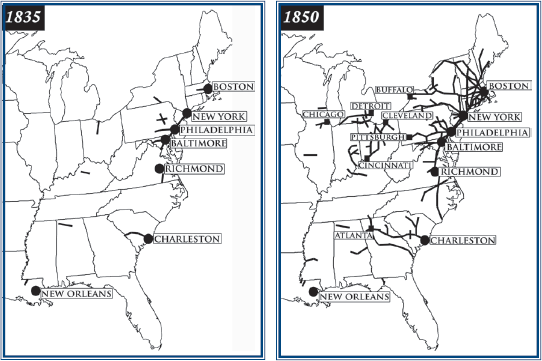
The first successful American railroad was the Delaware & Hudson, launched in 1829, which carried coal from mines in northeast Pennsylvania to a nearby canal for shipment to urban markets. The second successful railroad, the Baltimore & Ohio, opened for business in 1830 and connected Baltimore, Maryland, to the Ohio River at Wheeling, Virginia (later West Virginia). The B&O–yes, of Monopoly fame–carried coal from western Virginia to industrializing Northeastern cities via Baltimore and carried finished goods in the opposite direction to the growing populations in Ohio and the other Midwestern states. In 1832 another railroad, the Camden & Amboy, provided a transit corridor running up the center of New Jersey, helping connect New York to Philadelphia and Baltimore.
Railroads followed America’s volatile industrializing economy, including relatively slow growth following big busts like the Panic of 1837, followed by the Depression of 1838–1843 (resulting from rampant Western land speculation and bank failures). But even during the worst years, the U.S. railroad network expanded, jumping from under 30 miles in 1830 to over 9,000 miles in 1850.
The expanding canal and railroad networks not only allowed the settlement of vast new agricultural areas in the American Midwest–they also spurred the growth of a new generation of cities that served as collection and distribution hubs and soon rivaled the old colonial port cities in wealth and population. By 1850 Chicago (incorporated in 1833) had a population of 30,000, while Buffalo (incorporated in 1832) grew to 42,000. The transportation boom, industrialization, and the rise of new cities were concentrated in the Northeast and Midwest. The South experienced the same trends but on a smaller scale: for example, Atlanta (founded in 1837 to collect and ship cotton to Charleston and Savannah by rail) had only grown to 2,500 by 1850.
MADE IN AMERICA 
Speedy Boats
Americans have always had a connection to boats–everyone arrived on them, after all–and the first half of the nineteenth century was a golden age of American seafaring, when U.S. shipyards revolutionized international commerce with a new kind of sailing ship: the super-fast clipper.
The term “clipper” probably comes from the colloquial term for a fast horse, which could “go at a good clip.”
The first ships to go by this name were Baltimore clippers–small, fast schooners that weren’t ideal for traveling the open ocean but sailed the Chesapeake Bay before the American Revolution and later served as privateers raiding British commerce during the War of 1812. But the classic ship was the bigger Yankee clipper, distinguished by multiple masts with large square sails, giving it an enormous surface area of canvas to catch the wind, paired with a slender, narrow hull with a “forward-raking” bow–a ship designed for maximum speed. The most famous builder of Yankee clippers was Donald McKay, who owned a shipyard in East Boston that turned out some of the best-known ships, including the Flying Cloud, Bald Eagle, Great Republic, Lightning, Champion of the Seas, and Sovereign of the Seas–the fastest sailing ship ever built up to that point, with a record speed of 25.5 miles per hour in 1854.
With a limited amount of room in their slender holds, clipper ships came to dominate passenger traffic and shipping for high-value cargoes like mail, tea, and spices; freight rates were simply too expensive for more mundane goods like timber, coal, or cotton. After the California Gold Rush began in 1849, these ships played a crucial role in the settling of the West Coast, carrying gold-hungry American and immigrant prospectors from East Coast ports all the way around South America to the land of golden opportunity. Thanks to clippers like the Flying Cloud, it now took less than 90 days to make a 16,000-mile journey that previously took sailing ships 200 days.
During the 1830s–1840s, American-made clipper ships were sought after by merchants of every nation, as embarrassed British shipbuilders found themselves outclassed by their upstart Yankee cousins. Eventually the Brits caught up, building world-class clippers of their own in the 1850s–but by this time, the sun was already setting on the age of sail, thanks to the arrival of cheaper (and far less romantic) oceangoing steamships.
Red, White, and Baseball
While its popularity has waned somewhat in recent decades, baseball still carries the cachet of the all-American pastime–a thoroughly patriotic sport. But much like most other sports, it’s based on older games that were revised and juiced up by Americans in the early nineteenth century.
Baseball was probably derived from a ball game played in Irish towns and villages since the fifteenth century, called “rounders.” By the eighteenth century, rounders incorporated many of the basic elements of modern baseball: two opposing teams face off, with one in the field and one “at bat,” and successive batters try to hit a small ball and then make the “round” of four bases to score. Three strikes and you’re out!
During the 1820s–1850s, Irish immigrants brought rounders with them to the New World, where local variations developed in cities with big Irish populations. In one variant, the Massachusetts game, the batter started out standing halfway between home plate and first base, and the opposing team could “out” someone by throwing the ball at them (ouch!)–but runners weren’t required to stay on the baselines, meaning there was an element of “tag” in the game. Another variant, the Philadelphia game, incorporated the familiar diamond-shaped field and decreed nine players to a team.
However, it was the New York game that prevailed, as codified in the “Knickerbocker Rules” drawn up by Alexander Cartwright, a volunteer firefighter who founded the Knickerbocker Baseball Club, an amateur sports league for New York fire brigades. In 1845 the club decided to standardize the rules of New York’s local “town game,” giving the task to Cartwright and a committee of club members. The Knickerbocker Rules decreed nine innings and said any “knock” outside the lines of first and third base was a “foul ball.” In 1858 they added a “strike zone,” where a pitch would be counted as a strike even if the batter didn’t swing, to prevent batters from simply waiting for an easy pitch. To prevent pitchers from throwing wide, in 1863 they added the “ball” rule, in which the batter gets an automatic “walk” to first base after four bad pitches, or balls.
Some elements of the New York game would still be unfamiliar to modern baseball fans. For several decades after 1845, the Knickerbocker Rules required underhand pitching. Until 1865, Knickerbocker Rules also allowed fielders to “out” the batter by catching the ball after one bounce–mostly out of concern for safety, since the game was still played without gloves or other protective gear.
Dancing Shoes
Tap-dancing and its cousins jazz dancing and “stepping” para-diddled into existence thanks to William Henry Lane, also known as “Master Juba,” an African-American dancer who dominated the scene in the 1840s. Born to a free African-American couple in Providence, Rhode Island in 1825, at some time in his childhood he moved to the Five Points neighborhood of New York City. Here the 5'3", light-skinned teenager learned to dance the jigs and reels of poor Irish immigrants–melding their precise footwork with African traditions.
In 1841 he hooked up with P.T. Barnum, the promoter and unapologetic swindler, who employed the 16-year-old Juba as an impostor for John Diamond, a white dancer in blackface who left Barnum’s employment under a cloud. In time the deceit was revealed, but by then Juba was a star in his own right. His original dancing style, a forerunner of modern tap dance, quickly became the most popular part of the show. In 1842 he put on a show in a Five Points saloon for the visiting British author Charles Dickens.
Single shuffle, double shuffle, and cross cut: snapping his fingers, rolling his eyes, turning in his knees, presenting the back of his legs in front, spinning about on his toes and heels … dancing with two left legs, two right legs, two wooden legs, two wire legs, two spring legs – all sorts of legs and no legs.
–Charles Dickens, 1842
In 1848 Juba toured Britain and was invited to perform for Queen Victoria at Buckingham Palace, the highpoint of his career. Tragically, despite his great success he never made that much money, and the combination of poverty and a physically exhausting schedule seems to have worn out his body by 1852. He was 27 years old.
 BY THE NUMBERS
|
6,184,477 |
free white population of Southern states, 1850 |
|
3,200,364 |
slave population of Southern states, 1850 |
|
1,920,218 |
number of white citizens these slaves “equaled” under the Three-Fifths Compromise |
|
13,244,708 |
free white population of Northern and Western states, 1850 |
|
70,300 |
voters electing each Southern member of the House of Representatives, 1850 |
|
98,110 |
voters electing each Northern member of the House of Representatives, 1850 |
|
60,000 |
foreign-born (immigrant) population of the United States, 1820 |
|
2.25 million |
foreign-born (immigrant) population of the United States, 1850 |
|
200 |
number of major gang wars in New York City, 1834–1844 |
|
22 |
number of people killed in riots caused by fans of two rival actors at Astor Place in New York City, 1849 |
|
11,000 |
number of prostitutes in New York City, 1839 |
|
50,000 |
number of prostitutes in New York City, 1850 |
|
20,000 |
number of Irish who died aboard ships traveling from Britain to Canada, 1847 |
|
78 |
bushels of wheat shipped east by Chicago in 1838 |
|
2,000,000 |
bushels of wheat shipped east by Chicago in 1848 |
|
30–40 |
length, in days, of trip from St. Louis to New York City via the Ohio River, 1830 |
|
12–18 |
length, in days, of trip from St. Louis to New York City via Chicago and the Erie Canal, 1850 |
|
24 |
number of delegates at Wisconsin’s constitutional convention in 1847 who were born in New England, out of a total 69 |
|
66 percent |
proportion of Chicago’s adult male population that was foreign-born, 1850 |
|
$6.50 |
weekly earnings of a man working in a textile factory in 1850 |
|
$2.50–$3.50 |
weekly earnings of a woman working in a textile factory in 1850 |
|
$10.37 |
weekly cost of living for a family of five in New York City in 1850 |
|
13–15 |
age most children began working in factories in 1850 |
|
10 |
percentage of the white population in the North who were functionally illiterate in 1840 |
|
19 |
percentage of the white population in the South who were functionally illiterate in 1840 |