

THE STATE OF THE UNION 
If you had to sum up the Civil War in one word, “bloodbath” wouldn’t be a bad choice. Easily the most destructive war in U.S. history, the Civil War claimed the lives of 620,000 Americans and laid waste to large parts of the country. But as the central catastrophe of American history, it still inspires debate: could the North and South have worked out some kind of compromise? And could the South have won with a different strategy? (Basically, no.)
After the war ended in 1865, the North tried to “fix” the South by making Southern whites as angry as possible. Unsurprisingly it didn’t turn out too well. The decade-long phase known as “Reconstruction” stalled in the face of Southern opposition. Embittered whites rolled back the reforms that had extended political and civil rights to freed slaves. Meanwhile, hard-core Confederate veterans formed new paramilitary organizations, including the Ku Klux Klan, to scare blacks into submission.
Once the war was over, expansion in North America resumed without missing a beat, as the period after the Civil War saw a rapid development of the Western frontier, including the inauguration of the first transcontinental railroad and the purchase of Alaska. Further afield, all eyes turned to Asia after a U.S. fleet under Commodore Mathew Perry “opened” Japan to the world in 1854.
On the home front, with slavery abolished, social reformers turned their crusading energy elsewhere, leading to the so-called Progressive Movement, which tried to improve American society through charitable efforts and government intervention. The Progressives had their work cut out for them, as America’s breakneck development brought industrial slums to cities across the Northeast and Midwest. The postwar “Gilded Age” saw growing wealth but also increasing social inequality as America began shifting from a mostly rural and agrarian land to a dynamic, urban nation centered on teeming industrial metropolises.
 WHAT HAPPENED WHEN
|
September 4, 1850 |
The Compromise of 1850 allows settlers in Utah territory to decide by “popular sovereignty” whether slavery will be legal there, while admitting California as a free state. |
|
August 24, 1853 |
George Crum invents the potato chip in Saratoga Springs, New York. |
|
May 30, 1854 |
The Kansas-Nebraska Act allows settlers in the Kansas-Nebraska territory to decide by popular sovereignty whether slavery will be legal there. |
|
1854 |
Republican Party is founded. |
|
1854–1858 |
Pro- and anti-slavery settlers battle each other in “Bleeding Kansas.” |
|
July 12, 1856 |
William Walker seizes control of Nicaragua. |
|
May 1, 1857 |
William Walker is deposed as president of Nicaragua. |
|
1858 |
Abraham Lincoln runs for one of two U.S. Senate seats in Illinois on the Republican, anti-slavery ticket, but loses. |
|
October 16–18, 1859 |
John Brown leads a doomed raid on the federal armory at Harper’s Ferry, Virginia, in an attempt to start a slave uprising. |
|
1860 |
Democratic party splits into Northern and Southern factions, running two candidates for president; Lincoln wins on the Republican ticket. |
|
December 24, 1860 |
South Carolina secedes. |
|
April 12, 1861 |
The Civil War begins. |
|
1862 |
The North suffers multiple defeats but scores its first big victory at Antietam on September 17. |
|
January 1, 1863 |
Lincoln issues the Emancipation Proclamation. |
|
July 1–3,1863 |
Meade defeats Lee at the Battle of Gettysburg; the tide turns against the Confederacy. |
|
1864 |
Lincoln appoints Grant the supreme commander of Union forces; Sherman devastates Georgia, South Carolina, and North Carolina. |
|
April 1865 |
The Confederacy surrenders on April 9; Lincoln is assassinated on April 14. |
|
1866 |
Radical Republicans in Congress take control of Reconstruction; Confederate veterans found the Ku Klux Klan. |
|
1868 |
Arkansas, Florida, North Carolina, South Carolina, Louisiana, and Alabama are readmitted to the Union. |
|
1870 |
Virginia, Mississippi, Texas, and Georgia are readmitted to the Union. |
LIES YOUR TEACHER TOLD YOU 
LIE: A compromise could have averted the Civil War.
THE TRUTH: The politicians tried really, really hard, but there was just no way around the basic dispute over slavery, and disagreement over tariffs just added fuel to the fire.
Tackling the smaller issue first, the tariff argument came down to money. The Southern plantation system made certain families spectacularly wealthy, but it also committed the region to a relatively simple agrarian economy. The main issue with this, of course, was that the Southern exports–cotton, rice, tobacco, cotton, indigo, and cotton–were all agricultural commodities requiring mass cultivation to be profitable.
 When the Civil War erupted in 1861, two U.S. states–Mississippi and South Carolina–were home to slave populations that outnumbered their free citizens.
As the demand for cotton increased, competition between Northern textile mills and their British counterparts drove up cotton prices. Meanwhile, Northerners in Congress continued to pursue protectionist policies to encourage industry, including tariffs on imports, hoping to give a boost to the factories in their region. Southern congressmen, on the other hand, opposed tariffs because they feared their British and French customers would respond by slapping counter-tariffs on Southern cotton exports.
Shall we sink down as serfs to the heartless, speculative Yankees, swindled by his tariffs, robbed by his taxes, skinned by his railroad monopolies?
–Democratic newspaper editor
And that’s exactly what happened. In 1828 Northern congressmen passed a protectionist tariff (nicknamed the “Tariff of Abominations” by the South) so outrageous that the British responded with a counter-tariff of their own. The tariffs doubly affected the South, hurting cotton sales while making imports of manufactured goods more expensive. If the Northerners got their way, Southerners would have to sell cotton to Northern factories at low prices and buy expensive Northern manufactured goods; in other words, the South would be a Northern vassal, playing the same role India did for Britain. (Southerners, reaching for their rifles, naturally took exception.)
For all the bitter controversy, the tariff dispute could probably have been settled without violence. But at the same time, Southerners were worried about growing abolitionist sentiment in the North. True, in 1838 William Lloyd Garrison’s American Anti-Slavery Society had only 250,000 members (about 2.7 percent of the Northern population), but they were committed and well-connected, with a disproportionate influence in Protestant churches. More importantly, their opposition to slavery was uncompromising. Southerners especially detested Northern whites and free blacks who gave refuge to runaway slaves, accusing them of abetting the theft of property. Adding insult to injury, some Northern states passed “personal liberty laws,” which protected fugitive slaves by prohibiting local law enforcement from apprehending them. In response, slave owners began hiring bounty hunters, and the whole situation escalated. Before long, abolitionists were helping runaway slaves to escape to Canada, where slavery had been abolished since 1834.
HOW IT ALL BREAKS DOWN (LITERALLY) …
|
Northern extremists (including Republicans and abolitionists) |
Moderates (including Northern “Peace” Democrats and pro-Union Southerners) |
Southern extremists and sympathizers (including Northern “Copperheads”) |
|
|
Slavery is … |
A wicked sin that must be abolished at once, before Christ’s return. |
Maybe good, maybe bad, but definitely not worth getting killed for either way. |
An inalienable right, sanctioned in the Bible and integral to Southern society. |
|
Possible remedies include … |
Remedy? We said abolish it. And no, we won’t pay for a buyout. |
The government could spend billions to buy out slave owners, if anyone will pay. |
Meddling Yankees could mind their own damn business. |
|
Future expansion … |
Cannot include any new slave states, period. |
Should adhere to the original 36°30’ border between slave and free states agreed to in 1820. |
Should include slave states above the 36°30’ border, if voters choose to allow it. |
|
Tariffs on imports … |
Are critical to encourage industry by protecting against British dumping. |
Should probably be repealed or lowered to avoid provoking foreign counter-tariffs. |
Are a Yankee industrialist plot to provoke foreign tariffs on cotton exports. |
|
States’ rights … |
Don’t include the right to secede (and we won’t allow slavery to spread). |
Allow slavery in new states if the people vote for it, but not secession. |
Allow slavery in new states AND secession. |
|
Secession is … |
Treason. |
A tragedy to be averted at all costs (and probably illegal). |
A second American Revolution. |
UNCLE TOM’S CALL TO ARMS
It’s no exaggeration to say that Uncle Tom’s Cabin, Or, Life Among the Lowly, published in 1852 by Harriet Beecher Stowe, was one of the main causes for the Civil War, because it built sympathy among Northern whites for blacks suffering in servitude. Stowe’s story portrayed the sufferings of a kindly old slave, Uncle Tom, and his loved ones under the oppression of plantation owner Simon Legree. With an emphasis on Christian virtues like humility, charity, and forgiveness (Harriet was the daughter of noted preacher Lyman Beecher), the book was the most powerful literary expression of the abolitionist movement. Banned in the South, Uncle Tom’s Cabin sold 300,000 copies in the North in 1852–1853 alone. That number is even more impressive when you consider that each copy was probably read by eight to ten people, meaning that over 10 percent of the total U.S. population read the book.
So you’re the little woman who wrote the book that made this great war!
–Abraham Lincoln’s supposed greeting to Harriet Beecher Stowe, 1862
Under the weight of the combined economic and social pressures, Southern members of Congress became determined to spread support for slavery to new states. In fact, the admissions of Florida and Texas (1845) to the United States were explicitly intended to “strengthen slavery” and with it, the South, by adding Southern senators. But Southern expansion stalled after Texas, as there was little prospect of the underpopulated Southwest or Indian Territory (Oklahoma) becoming states anytime soon. Meanwhile, the North ushered in the free states of Michigan (1837), Iowa (1846), Wisconsin (1848), and California (1850). Northern states were also generally more populous.
To catch up, the South needed access to territories north of the Missouri Compromise line. A new measure, the Compromise of 1850, gave the South new hope. In return for admitting California as a free state, even though half of it lay “below the line,” Northern politicians agreed to let settlers in Utah vote for themselves whether slavery should be legal there. The compromise also strengthened federal fugitive-slave laws and left open the status of slavery in the New Mexico Territory.
COMPROMISE, COP-OUTS, AND CONFUSION: YOUR CONGRESS AT WORK
|
Compromise |
Compromisers |
Issue and “resolution” |
||
|
Three-Fifths Compromise (1787) |
James Wilson, Roger Sherman |
Northern and Southern delegates to the Constitutional Convention agreed to count each slave as three-fifths of a person in calculating proportional representation. Neither side was happy: Southerners still felt threatened by Northern population growth, and Northerners were angry that slaves were used to boost white Southern representation. |
||
|
Missouri Compromise (1820) |
Sen. Henry Clay, Rep. John Taylor, Sen. Jesse B. Thomas |
Northern and Southern members of Congress agreed to 36°30’ as the border between slave states and free states as the West was settled–except for Missouri, which was admitted as a slave state in 1820 along with Maine as a free state, for balance. Confused? So were they! |
||
|
Democratic Convention (1844) |
James Polk |
As Texas sought admission as a slave state, Democrats were divided over slavery’s long-term prospects. Polk promised to admit Texas but then step down after one term so the two sides could duke it out over new states. |
||
|
Compromise of 1850 |
Sen. Stephen A. Douglas |
With the dispute still simmering, the compromise proposed by Illinois Sen. Stephen A. Douglas allowed California to enter as a free state in exchange for opening territories above the 36°30’ line (namely, Utah) to slavery, if voters supported it (they didn’t). |
||
|
Kansas-Nebraska Act (1854) |
Sen. Stephen A. Douglas |
This deal allowed settlers to decide whether Kansas and Nebraska would be slave or free states, even though they were above 36°30', because Northern businessmen wanted to build a transcontinental railroad there. |
This measure soon made way for the Kansas-Nebraska Act of 1854, when Congress decreed that the new territories of Kansas and Nebraska could also determine the legality of slavery on their own, through a popular vote. Moderate Northern congressmen like Stephen A. Douglas, the Democratic senator from Illinois, forged these concessions in the Kansas-Nebraska Act because they wanted to build a transcontinental railroad through Kansas and Nebraska. Besides, what could possibly be wrong with referring the issue to a popular vote?
As it turns out, plenty. The “slavery debates” in Kansas often featured guns, knives, ropes, pitchforks, and fire. From 1854 to 1858, about 10,000 pro-and anti-slavery partisans battled fiercely to control the fate of “Bleeding Kansas.” It wasn’t long before high-profile officials got involved. David Rice Atchison, a Democratic senator from Missouri, led the pro-slavery invasion in 1855. Meanwhile John Brown–a devout Christian and anti-slavery fanatic–rode from Ohio to Kansas with his seven sons, recruiting radical anti-slavery fighters along the way. In May of 1856, Brown’s militia murdered five unarmed pro-slavery settlers near Pottawatomie Creek in Franklin County, Kansas. Over four years Bleeding Kansas claimed about 200 lives.
We are determined to repel this Northern invasion, and make Kansas a Slave State; though our rivers should be covered with the blood of their victims, and the carcasses of the Abolitionists should be so numerous in the territory as to breed disease and sickness, we will not be deterred from our purpose.
–Benjamin F. Stringfellow, in the newspaper Squatter Sovereign, 1855
Bleeding Kansas eventually entered the Union as a free state–but this was only the beginning. On October 16, 1859, John Brown charged back into the national limelight in spectacularly crazy fashion with an implausible plan to start a slave rebellion in Virginia. With 22 followers, Brown staged a daring (and suicidal) raid on the federal armory at Harper’s Ferry, now located in West Virginia, to obtain weapons for a rebel slave army that he really, really hoped would materialize to fight with him. It didn’t. Unfortunately for Brown, the only crowds that surfaced were local militias, along with some spectators. The militias surrounded the arsenal and cut off all escape routes, and after a two-day siege, Marines led by U.S. Army Colonel Robert E. Lee assaulted the arsenal and killed 10 of Brown’s followers. Five rebels escaped, but Brown was captured alive along with six of his followers. Over the next few months, all seven were convicted of treason and hanged.
ABRAHAM LINCOLN IN 90 SECONDS
Born in a log cabin in central Kentucky on February 12, 1809, Abraham Lincoln was a son of the early American frontier. In 1816 the family moved to neighboring Indiana, in part because Lincoln’s father, Thomas, disapproved of slavery. In typical frontier fashion, his family relocated again to Illinois in 1830, where Lincoln got a job carrying goods on raft-like “flatboats” on local tributaries of the Mississippi River. Lincoln had less than two years of formal schooling but managed to teach himself about a wide range of subjects, and by 1837 he was practicing law in Springfield, Illinois.
Although he didn’t hunt or fish, Lincoln was an accomplished outdoorsman, whose height and strength made him a formidable wrestler. This came in handy in his early political career: during his first, unsuccessful candidacy for the Illinois General Assembly in 1832, one of Lincoln’s supporters was being harassed by a heckler at a rally–so Lincoln picked up the man by his collar and the back of his pants and literally threw him out of the meeting.
Lincoln didn’t win that election, but he did get elected to the Assembly in 1834. In 1837 he stated his opposition to slavery for the first time, publicly voicing a long-held private belief. His first stint in national politics, as a congressman from Illinois, wasn’t all that promising: an old-school Whig, he alienated his constituents by arguing that the Mexican War of 1848 was unconstitutional, and he didn’t run for reelection.
Meanwhile his first love, Ann Rutledge, died of typhoid fever in 1835; following a rocky courtship and at least one canceled wedding, in 1841 Lincoln married Mary Todd, the daughter of a wealthy Kentucky slave owner. After giving up his seat in Congress, Lincoln focused on his legal practice (even arguing a case before the U.S. Supreme Court) and raising a family. But in 1854 he finally came out of political retirement to oppose the Kansas-Nebraska Act, which would extend slavery to new states.
That year he helped orchestrate an alliance with remnants of the Whig Party, dissenting Democrats, and various “Free Soil” groups to form the Republican Party. In 1858 Lincoln lost his bid for the Senate seat held by Illinois Democrat Stephen A. Douglas, the author of the Kansas-Nebraska Act, but became famous for his brilliant oratory in their debates.
A house divided against itself cannot stand. I believe this government cannot endure, permanently, half slave and half free. I do not expect the Union to be dissolved–I do not expect the house to fall–but I do expect it will cease to be divided.
–Abraham Lincoln, 1858
Brown’s ill-fated raid cast a pall over the presidential election of 1860, heightening Southern suspicions about Abraham Lincoln, the Republican candidate. Lincoln claimed that he only wanted to prevent slavery from spreading to new states, but Southerners were convinced that he wanted to eliminate slavery everywhere. During the campaign, Southern politicians and newspaper editors warned that the South would secede if Lincoln were elected–but Northern voters viewed these threats as bullying. In fact, the secession talk played right into Lincoln’s hands: plenty of Northerners who were indifferent to slavery were horrified at these Southern tactics and the idea of dividing the Union. Indeed, the threat of secession split the Democratic Party into Northern and Southern factions, which ran separate candidates–Douglas in the North and John C. Breckinridge, a zealous pro-slavery candidate, in the South. Ironically, by splitting the Democratic vote, they helped their worst fear come true: Lincoln won.
But this is where we get back to our original point: with the idea of Southern secession on the table, Congress moved into crisis mode. Moderates on both sides tried frantically to work out a compromise, led by legislators from Kentucky, Missouri, and Maryland, who feared–correctly–their border states would be torn apart if the conflict turned violent. In December 1860, John J. Crittenden, a senator from Kentucky, proposed constitutional amendments reinstating the 36° 30’ boundary, prohibiting Congress from making any law regulating slavery, and providing compensation for owners of runaway slaves. Both houses of Congress created committees to finesse these proposals, but Republicans refused to allow slavery in any more states–which, after all, was their entire political platform.
On December 20, 1860, a state convention in South Carolina formally voted to secede from the Union. South Carolina was followed in January 1861 by Mississippi, Florida, Alabama, Georgia, and Louisiana. Texas seceded on February 1. Still, last-minute efforts to work out a compromise continued. In February of 1861, state legislators in Virginia invited all of the states to a “Peace Conference,” but this too failed: Northern attendees, anticipating military action against the secessionists, refused to tie President Lincoln’s hands before he took office on March 4, 1861. On April 12, troops of the new Confederate States of America bombarded the federal garrison at Fort Sumter on an island in Charleston harbor. The Civil War had begun.
LIE: Lincoln protected civil liberties.
THE TRUTH: There’s no question that Abraham Lincoln was one of the greatest presidents in U.S. history. He’s venerated for winning the Civil War, saving the United States, and freeing the slaves. But protecting constitutional liberties wasn’t one of his strong points. In fact, he placed more temporary restrictions on civil liberties than any other president. Modern legal scholars and historians are sympathetic to Lincoln because of the problems he had to tackle: the country was tearing itself apart, and Lincoln believed extreme measures were justified to put it back together. But this took him into some iffy areas, constitutionally speaking.
Lincoln’s most controversial orders suspended the basic right of habeas corpus. At the time, habeas corpus guaranteed the right of any U.S. citizen held prisoner by the federal government to appear before a judge and petition for release. Typically a court issued a “writ of habeas corpus” requiring the jailer or warden to bring the prisoner before the court within a certain amount of time, along with official documentation showing legal authority to hold the prisoner. The Constitution allowed that habeas corpus could be suspended in times of rebellion or foreign invasion. This meant that the federal authorities could arrest and detain dangerous individuals indefinitely, without charges, for as long as the state of emergency lasted. But the Constitution was vague about who should wield this tremendous power. Could it be suspended by a simple majority vote in Congress? Or a two-thirds vote? Lincoln had his own answer: presidential decree. It’s no surprise that the president used his power to press the issue, but that didn’t make it constitutional. On the other hand, the constitution gave so little guidance on the topic that it wasn’t exactly unconstitutional either.
The privilege of the Writ of Habeas Corpus shall not be suspended, unless when in Cases of Rebellion or Invasion the public Safety may require it.
–Section 9 of Article I of the U.S. Constitution
With serious reservations, Lincoln first suspended habeas corpus in Maryland on April 27, 1861. (It remained suspended until the Supreme Court restored habeas corpus in all states in 1866.) Lincoln was afraid that Maryland’s pro-slavery state legislature might vote to secede and join the Southern Confederacy, thus cutting the Washington, D.C. train line off from the Northern states. So in 1861, federal troops arrested Baltimore’s mayor and chief of police, as well as nine members of the state legislature who were suspected of favoring secession. They also arrested newspaper editors and businessmen, some of whom were held for a year without charge.
There were immediate challenges to Lincoln’s authority. In fact, the Supreme Court ruled that Lincoln had acted illegally, asserting that only Congress could suspend habeas corpus. But Lincoln ignored the ruling, pointing out that Congress wasn’t in session at the time. Henceforth, cases involving the suspension of habeas corpus would usually be heard by military commissions, meaning Union officers got to decide whether to restore liberty to prisoners they considered despicable traitors … and you can guess how that usually turned out.
Multiple defeats suffered by Union forces in 1861–1862 sparked more dissent in the North, which in turn brought more restrictions on personal liberty. Habeas corpus was suspended again. But this time it was to keep Northerners in line while the government was trying to enforce the draft.
Many Northerners–especially, anti-war Democrats–were increasingly unhappy with Lincoln, and opposition to his tactics reached fever pitch after he issued the Emancipation Proclamation on September 22, 1862. Before long, these Northern Democrats were playing on white resentment, saying there was no reason whites should fight and die for African slaves. Poor Northerners were also outraged by a “commutation fee” that allowed rich men to duck out of military service for $300. Draft riots erupted in New York, Massachusetts, Vermont, New Hampshire, Ohio, Indiana, and Iowa, with entire cities rebelling against the federal government. On March 3, 1863, the Republican-dominated Congress passed the Habeas Corpus Indemnity Act, stating that “during the present rebellion, the president of the United States, whenever in his judgment the public safety may require it, is authorized to suspend the privilege of the writ of habeas corpus in any case throughout the United States or any part thereof.” Armed with this unambiguous authority, Union officers were instructed to suppress the riots and imprison dissidents, whoever they were–even members of Congress.
On May 5, 1863, Clement Vallandigham–a Democratic congressman from Ohio who discouraged constituents from joining the war effort and called for the removal of “King Lincoln"–was arrested, denied habeas corpus, tried by a military commission, and sentenced to two years in prison for “uttering disloyal sentiments.” This time the Supreme Court refused to review the sentence of the military commission. Lincoln averted a PR disaster by shipping Vallandigham across the lines to the Confederacy, where he obviously belonged.
Vallandigham was afforded an unusual bit of clemency due to his high profile. But Lincoln kept dozens of newspaper editors jailed and didn’t commute their sentences. In effect, this meant that the suspension of habeas corpus was essentially a suspension of the First Amendment. As press censorship escalated, it especially targeted Northern Democrat (“Copperhead”) newspapers that opposed the war. Official censorship measures included denying journalists telegraph service, denying publishers postal service for circulation, and closing newspaper offices. Unofficially, paramilitary groups of Union soldiers on leave destroyed printing presses and roughed up Copperhead journalists.
The Copperheads were nicknamed after the venomous North American snake Agkistrodon contortrix, but Democrats embraced the moniker and even wore Liberty Head pennies as badges.
Altogether, around 300 out of a total 3,000 newspapers were censored during the course of the Civil War, including some well-known titles still in operation today, such as the Cincinnati Enquirer, Iowa Constitution, and New York’s Daily News.
Good! We’ll have dispatches from hell before breakfast.
–Union General William Tecumseh Sherman, on being told (incorrectly) that three newspaper journalists had just been killed
LIE: The South could have won the Civil War.
THE TRUTH: The South started the Civil War with better troops, better generals, and better morale than the North, but in the end it didn’t matter, because the North had more. More what, you ask? More everything.
Before we give you the gloom report, it’s only fair to give Dixie its due and explain why Confederate leaders thought they had a fighting chance. Many of the best officers in the U.S. Army were Southern. Out of a total 1,108 U.S. Army officers in 1860, 270 resigned to join the Confederate Army, and of these, 184 were West Point graduates. More importantly, they included a large proportion of the mid-career lieutenants and colonels with actual command experience. This was especially true of the elite cavalry, where four out of five regimental commanders left to fight for the South (most notably Robert E. Lee). Meanwhile, most Southern rank-and-file soldiers, coming from rural backgrounds, owned their own guns and had hunting experience, unlike urban Northerners. Fighting for their homes, the rebels were also more gung ho in general: 100,000 rebels enlisted in March 1861, versus 92,000 volunteers in the North, even though the Southern population was considerably smaller.
But for these startling defections, the rebellion never could have assumed formidable proportions.
–War Department report to Congress, 1861, after so many West Point graduates fought for the Confederacy that the U.S. Senate debated closing the academy
Yet the Confederacy had problems before the first shot was fired. There was widespread opposition to secession in certain areas–especially the Upland South areas like Tennessee, Arkansas, western North Carolina, and what became West Virginia. Unlike plantation owners in the Deep South, the whites in Appalachia–largely the descendants of Scots-Irish settlers–had no financial stake in slavery and tended to be more ambivalent. Most of the poor “dirt farmers” saw no reason to fight for the right of the wealthy to own slaves. These feelings essentially mirrored the sentiments of poor whites in the North, who saw no reason to fight to free the slaves. Likewise, Kentucky and Missouri declared their neutrality before being invaded by both Confederate and Union forces in 1861. Meanwhile, counties in northern Alabama and eastern Tennessee tried to secede from the Confederacy and rejoin the Union. Some succeeded: West Virginia seceded from Virginia to form a new Union state in 1863, and the citizens of Winston County, Alabama, declared themselves the Republic of Winston and defied Confederate authority to the end of the Civil War, helping Union forces with local scouts.
I hope to have God on my side, but I must have Kentucky.
–Abraham Lincoln, 1861
Nonetheless, the Confederacy’s early military superiority allowed it to inflict a series of humiliating defeats on poorly led, untrained Northern troops. At this stage the Union resembled a heavily tranquilized badger: comically helpless, but when the tranqs wear off, watch out!
Confederate leaders knew their only hope of success lay in scoring so many victories early on that the North became demoralized. And they had enough military experience to guess that if the war dragged on, the North would have time to marshal its huge economy and crush the South.
And that’s what happened. In 1860 Northern cities were home to 86 percent of the nation’s industry. That year Northern states produced 25 times as much iron, and Pennsylvania alone produced nine times as much coal as the entire Confederacy. So once the North got its act together, it put that might to use, churning out a huge navy to blockade the South, cutting off cotton exports and ruining the Southern economy. The North also had more than twice the length of railroads and nine times the length of telegraphs in 1860–huge advantages in mobility and communications.
One of the railroad workers who physically strung the telegraph lines from Pennsylvania to Virginia was future millionaire philanthropist Andrew Carnegie.
Putting the Union’s strength to use took some time: as rebel troops schooled Union forces again and again, Lincoln desperately shuffled through commanders, fully aware of the discontent building up in the North. From 1861 through 1864, the Army of the Potomac–the main Union force in the key mid-Atlantic region–had five different commanders: Irvin McDowell (1861), George B. McClellan (1861–1862), Ambrose Burnside (1862–1863), Joseph Hooker (1863), and George Meade (1863–1864). Meanwhile, Robert E. Lee assumed supreme command of the Confederate armies and pressed the Southern advantage with a daring invasion of central Pennsylvania–the only major military action on Northern soil. But Lee lost his gamble, meeting defeat at Gettysburg in July 1863, and from there on things looked grim: the badger was fully awake and very, very angry.
THE BRITISH AREN’T COMING!
Occasionally, historians entertain the idea that the South might have won if the British had stepped in to help the Confederates. The theory generally goes that if Robert E. Lee had won at Gettysburg, the Brits would have stepped in, giving the South a boost with their powerful navy. It’s true some British officials considered the idea in the early part of the war, but the scenario is implausible at best. The Royal Navy was formidable, but British fleets were spread around the globe. Meanwhile, the Union Navy grew rapidly, surpassing the Royal Navy in size by 1865. Although Union ships and crews couldn’t match the Brits, they were concentrated in one place.
The British were also afraid that the North might retaliate by invading Canada, requiring costly defensive measures. Furthermore, the Confederacy’s “trump card"–British industry’s need for Southern cotton–wasn’t much of a trump card at all. The Brits had alternative cotton sources in Egypt and India. Last but not least, Queen Victoria–then at the height of her power–had worked for decades to enforce an 1833 decree banning slavery in most of the British Empire, and many of her subjects would have objected to helping slave owners.
In 1864 Lincoln promoted Ulysses S. Grant to supreme command. Grant was fresh from victories in the West, where he had split the Confederacy by conquering Tennessee and Mississippi. Although he wasn’t a brilliant battlefield strategist like his opponent, Robert E. Lee, he made full use of the Union’s advantages in population, transportation, and communication to pin Southern armies and overwhelm them with sheer numbers. And he was tenacious, hounding Confederate armies constantly with little regard for Union casualties. During his bloody pursuit of Lee across northern Virginia, Northern newspapers gave him the nickname “Butcher Grant.”
The end result of the Civil War was the total impoverishment of the South, thanks partly to the Union’s policy of “hard war,” implemented most thoroughly by William Tecumseh Sherman on his March to the Sea. After helping Grant capture Chattanooga, Tennessee, in November 1863, Sherman captured Atlanta in September 1864, ordered all of the residents out, and burned the city to the ground. He then led 98,000 Union troops across Georgia to the port of Savannah, relying on “forage” for supplies–i.e., stealing anything that wasn’t bolted down and burning the rest.
General Grant is a great general. I know him well. He stood by me when I was crazy, and I stood by him when he was drunk; and now, sir, we stand by each other always.
–Sherman, 1864
 QUICK’N'EASY CIVIL WAR
The Big Picture: There were two major “theatres” or areas of operations during the Civil War: the Eastern theater (focused on the area around Washington, D.C., and the Confederate capital, Richmond) and the Western theater, where Union and rebel forces vied for control of divided states like Missouri, Kentucky, Mississippi, and Tennessee.
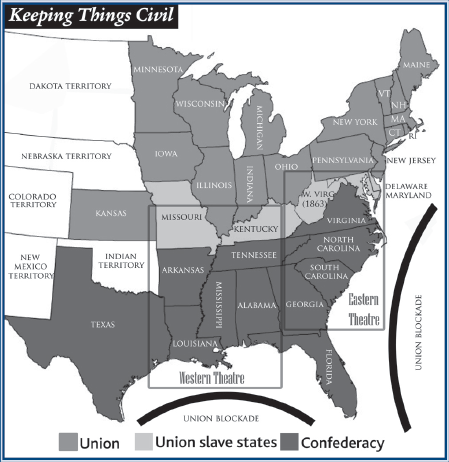
It all started in the east: after the Union garrison at Fort Sumter in Charleston Harbor surrendered in April, the first Union march on Richmond ended in total defeat at Bull Run, Maryland, July 21, 1861.
To the west, both sides invaded Kentucky in September-November, 1861. Union forces from Illinois invaded Missouri, and by the end of 1861, they basically controlled both states. In 1862, Union forces under Ulysses S. Grant began splitting the Confederacy by conquering the Mississippi River Valley and Tennessee, culminating in a bloody victory at Shiloh, Tennessee, April 6–7. With Commander David Farragut’s capture of New Orleans on April 29, 1862, Union forces were poised to cut the Confederacy in two. Confederate Gen. Braxton Bragg tried to turn the tide by invading Kentucky, and scored a victory at Perryville, October 8, 1862, but failed to follow up. His later push to retake Tennessee ended in defeat at Stones River, December 31.
Meanwhile, back east, the Union was schooled by rebels under Thomas J. “Stonewall” Jackson, who won five battles in the Shenandoah Valley from April-June, 1862. Union forces chasing Jackson were mauled again at the Second Battle of Bull Run, August 28–30, 1862. George McClellan (Lincoln’s general of the hour) chased Robert E. Lee’s Army of Northern Virginia into Maryland, where Lee fought him to a draw at Antietam, September 17, 1862. Desperate for a victory before year’s end, Lincoln ordered Ambrose Burnside to attack Richmond. Bad idea: the Army of the Potomac was badly beaten by Lee’s Army of Northern Virginia at Fredericksburg, Virginia, December 11–15.
If General McClellan does not want to use the army, I would like to borrow it for a time.
–Lincoln, 1862
On January 1, 1863, Lincoln issued the Emancipation Proclamation freeing the slaves, but he still needed a victory for political support. Gen. Joseph Hooker marched on Richmond but was badly beaten by Lee at Chancellorsville, VA, April 30–May 6; however Lee lost Jackson, his best commander, to friendly fire. The Union got a much-needed boost when West Virginia voted to secede from Virginia and (re-)join the Union on June 20. Hoping a victory on Northern soil would break Union morale, Lee crossed the Mason-Dixon Line into Pennsylvania, but was defeated by Gen. George Meade at Gettysburg on July 1–3. And on July 4, over in the Western theatre, Grant captured Vicksburg, Mississippi–completing the division of the Confederacy. But a Union invasion of Georgia was repelled at Chickamauga, September 19–20.
Desperate to find a commander who would attack Lee and regain control in the east, Lincoln promoted Grant to overall commander of Union forces. Grant’s first major attacks in the Overland Campaign were repulsed at the Battles of Wilderness, Spotsylvania, and Cold Harbor, May 31–June 12, 1864. But Lee was slowly forced back, and Grant laid siege to Petersburg, VA–key to Richmond’s defenses.
Meanwhile Grant’s right-hand man William Tecumseh Sherman invaded northern Georgia and captured Atlanta on September 2, 1864. Forced out of Atlanta, Confederate Gen. John Bell Hood counter-invaded Tennessee to distract Sherman but met defeat at Franklin, November 30, 1864. After burning Atlanta in November 1864, Sherman marched southeast through Georgia to the Atlantic Ocean, with his troops laying waste to everything in their path.
Sherman then turned his march north from January-March 1865, devastating South Carolina and North Carolina, where he joined forces with Union troops arriving by sea. He encountered fierce resistance from Confederate troops under Joseph E. Johnston, but sheer Union numbers forced Johnston to retreat west. He finally surrendered to Sherman at Durham Station, North Carolina, on April 26.
Things came to a head in Virginia around the same time: after ten months Grant crushed rebel defenses at Petersburg in March, and Lee was forced to abandon Richmond on April 2 (during the retreat it burned to the ground, probably mostly by accident). Grant chased Lee across Virginia until he finally surrendered at Appomattox, April 9.
SPECIAL REPORT 
Reconstruction Derby
As the Civil War drew to a close, Congress was completely dominated by Northern Republicans, including a number of “Radical Republicans"–fierce abolitionists who made no secret of their loathing for the South. However, the Radical Republicans were mostly kept in line by Abraham Lincoln, who enjoyed enormous moral authority and prestige after leading the Union to victory. Lincoln, a moderate Republican, favored relatively lenient treatment for the South, including a quick end to military occupation and speedy readmission of ex-Confederate states to the Union.
But Lincoln’s assassination by John Wilkes Booth on April 14, 1865, let the Radical Republicans out of their cage. Lincoln’s successor, Vice President Andrew Johnson, was a former senator from Tennessee and the only Southern senator to stay in Congress after secession. This gave him enough credibility to serve as Lincoln’s V.P.–but not to deal with the rabidly anti-Southern Radical Republicans once Lincoln was gone.
While Johnson proposed continuing Lincoln’s lenient policies for Reconstruction, the Radical Republicans demanded the South be punished for slavery and secession. The rift widened quickly, beginning with Johnson’s amnesty for the vast majority of Confederate soldiers (excluding only those above the rank of colonel) on May 29, 1865. The first open congressional rebellion came after Johnson allowed Southern states to hold elections to Congress in September–October 1865.
In December 1865 the Radical Republicans simply refused to admit Southern representatives into the 39th Congress. This meant there was no real opposition in 1866 when the Republicans passed the Thirteenth Amendment abolishing slavery and created a Joint Committee on Reconstruction–signaling their intention to take control of Reconstruction in the not-too-distant future. Next, they moved to renew and expand the Bureau of Refugees, Freedmen, and Abandoned Lands, better known as the Freedmen’s Bureau, originally created in March 1865 to protect and advance the interests of freed slaves. They also passed the Civil Rights Act, granting full citizenship to the freed slaves.
These idealistic acts were sure to raise tensions in the South, where whites bitterly resented the growing power of former slaves. Still hoping for national reconciliation, Johnson vetoed both acts, which needless to say enraged the Radical Republicans, who overrode Johnson’s veto of the Civil Rights Act–the first time Congress had passed a major law over a presidential veto. Their aggressive moves triggered a wave of race riots across the South, with scores of freedmen killed by angry white mobs.
Southern resistance in turn angered Northern voters, who returned an overwhelming Republican majority to Congress in November 1866. In March 1867 Congress passed the First Reconstruction Act–again over Johnson’s veto–taking control of the Union occupation and administration of Southern states. This marked the end of “Presidential Reconstruction” and the beginning of “Congressional Reconstruction"–though a better name for it might be “Military Reconstruction,” as the Republicans basically treated the South like a foreign country under military occupation.
The Reconstruction Act divided the former Confederacy into five military districts, took the vote away (again) from many ex-Confederates, and made state governments subject to Union military commanders. This second-class status continued until the states gave black adult males the vote and ratified the Fourteenth Amendment, which guaranteed the rights of citizens to equal protection under the law. Johnson protested these harsh tactics but was basically rendered powerless when Congress impeached him in February 1868 (coming within one vote of actually removing him from office). And in November the Union military hero Ulysses S. Grant won the presidential election with the explicit support of Radical Republicans, promising a hard line on Reconstruction.
Under the Reconstruction regime in the late 1860s and early 1870s, freedmen voted for the first time, while many Southern white men were disenfranchised for taking part in secessionist activities. As a result, large numbers of African-American representatives were elected to Congress for the first time in U.S. history. To help secure this promising step toward political equality, in February of 1869 Congress passed the Fifteenth Amendment, declaring that “race, color, or previous condition of servitude” cannot be used to bar citizens from exercising their right to vote; it was ratified by the states a year later. Then the Republican Congress declared war on the Klu Klux Klan, which had sprung up in resistance to Reconstruction. In the fall of 1867, the KKK began “night-riding” to intimidate blacks in rural Tennessee–the first known instance of organized, large-scale racial persecution by the secretive group. In April of 1871, Congress passed the Ku Klux Klan Act, allowing Grant to suspend habeas corpus to fight the KKK in South Carolina.
But these early signs of progress proved fleeting. After a decade of Reconstruction, it became clear the federal government would never be able to crush entrenched white resistance across the South. The Northern states lacked the political will to maintain a large army of occupation in the South indefinitely, and when the occupation finally ended, embittered Southern whites reasserted their traditional control of the region by excluding freedmen from political and civil life.
Eventually the Republicans just gave up, effectively cutting loose Southern blacks, as part of one of the dirtiest political deals in U.S. history–and that’s saying something. In 1876 the Republican candidate Rutherford B. Hayes lost the popular vote, but the election was still up in the air because of disputed counts in Florida, Louisiana, and South Carolina. Realizing the Republicans were probably going to steal the election anyway, Southern Democrats cut a secret deal giving Hayes these states, and the presidency, in exchange for withdrawing Union troops from the South. In the process, they were screwing over their own candidate, Samuel J. Tilden, but as a New York Yankee and former War Democrat, he was almost as bad as any Republican.
 PROFILES IN SCOURGES
Nathan Bedford Forrest (1821–1877)
One of the Confederacy’s most brilliant cavalry commanders, today Nathan Bedford Forrest is mostly remembered for one thing: being a racist cracker. Forrest sealed his legacy when he served as the first “Grand Wizard” of the Ku Klux Klan. In truth, he was a lot more complicated than that.
Compared to most of his fellow officers, Forrest came from a remarkably humble background. The firstborn son of a poor blacksmith in Chapel Hill, Tennessee, at the age of 13, he saved his mother from an attack by a panther. On his father’s death in 1838, the 17-year-old Forrest became head of the family and legal guardian of 11 younger siblings. Three years later, he went into business in Mississippi with his uncle, who was soon killed by two local rivals. Forrest killed both of his uncle’s murderers and went on to great success as a plantation owner and slave trader based out of Memphis. With stints as a steamboat captain and a professional gambler, by the time the Civil War began in 1861, Forrest was worth $1.5 million, making him one of the richest men in the South.
Planters were legally exempt from military service, but in 1861 Forrest enlisted in the Confederate Army as a private and was quickly elevated to colonel on account of his wealth. In fact, he was asked to recruit his own special cavalry regiment, “Forrest’s Tennessee Cavalry Battalion,” which became one of the elite units of the Confederate Army. The battalion included 45 of Forrest’s slaves, whom he promised to free if they would fight with him in the war. (He freed them all in late 1863, before the war was over.)
Personally, Forrest was fearless and ferocious, killing 31 men over the course of the Civil War, many in hand-to-hand fighting. In April 1862 at the battle of Shiloh–not realizing he had become separated from his men–he charged into a brigade of Union soldiers by himself and then incredibly managed to escape by using an enemy soldier as a human shield.
But there was more to Forrest than just the physical bravery. Although he had no formal education and almost no military training, he surprised everyone with his inborn genius for cavalry combat. He was especially skilled at using the mobility and speed of horse-mounted troops to outmaneuver and surprise opposing commanders. And he had plenty of tricks up his sleeve: he once duped a much larger force of Union cavalry into surrendering by making his own army appear bigger than it was. (He had his troops circle a hill several times within sight of Union lines.) He won battle after battle and was eventually promoted to major general in December 1863.
In 1865, as the war became an increasingly desperate attempt to evade Union armies, Forrest fought on, leading his dwindling army in a last-ditch defense of Tennessee and Alabama. But on learning that Robert E. Lee had finally surrendered at Appomattox, Virginia, Forrest decided to lay down arms as well, asking his troops to “cultivate friendly feelings towards those with whom we have so long contended …”
This all contrasted sharply with another part of Forrest’s legacy. On capturing Fort Pillow in central Mississippi in April 1864, Forrest’s men massacred Union soldiers, including many African-Americans, which historians have interpreted as an early expression of racial animosity. After the war, Forrest joined the Ku Klux Klan, a paramilitary organization formed by Confederate veterans to resist Reconstruction. The first goal of the Klan was to regain control of state governments across the South by 1867. After trying to persuade African-Americans to vote for old-school Confederates (good luck!), the Klan soon turned to violence, intimidating African-American voters to prevent them from going to the polls. Meanwhile, as one of the South’s great Civil War heroes, Forrest was elevated to Grand Wizard of the shadowy group.
Mississippi’s Fort Pillow was not named after a head cushion, but after General Gideon Johnson Pillow.
All of this certainly reads like an indictment of Forrest–but there is some evidence to the contrary. Take the massacre at Fort Pillow: according to some sources, Forrest ordered his troops to kill the Union soldiers as they tried to surrender–but others say he begged the Union soldiers to surrender and was ignored. After the battle, Forrest arranged for wounded African-American prisoners to be transported to a Confederate military hospital to receive medical care. And although his political opponents implicated him in the Klan’s turn to violence, Forrest publicly denounced the violence and ordered the Klan to disband as a result. In 1875 he was invited to address an African-American civic group, the “Jubilee of Pole-Bearers,” where the mistress of ceremonies presented him with a bouquet of flowers “as a token of reconciliation, an offering of peace and good will.” After explaining his motives in fighting for the Confederacy, Forrest spoke in favor of civil equality for African-Americans, calling for their admission to professions from which they had been excluded.
This is a proud day for me. Having occupied the position I have for thirteen years, and being misunderstood by the colored race, I take this occasion to say that I am your friend … We were born on the same soil, breathe the same air, live in the same land, and why should we not be brothers and sisters…. I want to elevate every man, and to see you take your places in your shops, stores and offices.
–Nathan Bedford Forrest, in an address to African-American civic leaders, 1875
John Wilkes Booth (1838–1865)
A vain, shallow man, John Wilkes Booth struck out against the North when it was too late to have any effect on the outcome of the war. In fact, he succeeded in making things (much) worse for his beloved South, which is why he’s still remembered today as a Great American Dingbat.
Booth was born on May 10, 1838, the ninth child in a well-known family of actors. His early upbringing more or less guaranteed an unstable personality: his father, Junius, loved the spotlight but kept his family isolated in a primitive log cabin in Bel Air, Maryland. In addition to Junius’s alcoholism, there’s also evidence that he, as well as John and various siblings, may have suffered from bipolar disorder. In fact, in 1835 Junius threatened to kill President Andrew Jackson in a letter. So it seems his son was just a crazy chip off an already unstable block.
In 1854 Booth briefly involved himself in political causes, traveling to Baltimore as an anti-immigrant “Know-Nothing Party” delegate. But he soon threw himself into acting, where he won fame as a master of the overwrought, melodramatic style then in vogue. Called “the handsomest man in America” and “a muscular, perfect man,” Booth was more than just a rugged face: he also had an amazing memory, which allowed him to act in 83 different plays in one year. In 1860 he embarked on a national tour, appearing at popular theaters across the country. He even earned praise from Walt Whitman, who swooned over his New York performance!
After the Civil War began, Booth continued touring the North–evidently he wasn’t so angry he couldn’t stand Northern adulation. Along the way, he was actually in the same room as President Lincoln twice before the assassination, as a performer in plays at Ford’s Theatre in November 1863. Booth earned a fortune as an actor, but he invested it foolishly and lost large amounts of money. He became more and more agitated as the tide of the Civil War turned against the Confederacy, and he raged against Lincoln to the point that his brothers stopped talking to him. Falling in with a shady crowd of Confederate sympathizers, Booth smuggled quinine for the Southern cause and cooked up a far-fetched plan to kidnap Lincoln and hold him hostage until the Union agreed to make peace. On April 11, he was in a small audience addressed by Lincoln from the White House balcony. Lincoln said he supported giving freed slaves the vote, which drove Booth into paroxysms of rage. With seven co-conspirators, Booth decided to assassinate Lincoln as the president watched a performance of the romantic comedy Our American Cousin at Ford’s Theatre on the evening of April 14. The plan was more or less spontaneous, as Booth and his accomplices only learned Lincoln would be attending that morning.
African slavery is one of the greatest blessings that God has ever bestowed upon a favored nation
–John Wilkes Booth, in a posthumous letter
That evening, Booth–a regular at Ford’s Theatre–had no problem getting access to the hallway behind the president’s box. And because no one had ever assassinated the president before, there was no security detail. Booth simply stepped into the unlocked box and shot Lincoln in the back of the head with a .44-caliber Derringer as he sat next to his wife, Mary. Henry Rath-bone, a major in the Union army who was sitting in the president’s box, threw himself at Booth, but the assassin stabbed him and clambered over the railing to make his getaway. Booth injured his leg leaping from the balcony to the stage, but had the presence of mind to shout “sic semper tyrannis,” a Latin phrase meaning “thus always to tyrants” before making his exit. In the end Booth and a co-conspirator made it as far as a barn in southern Maryland, where Union troops found them hiding on April 26, 1865. When Booth refused to give himself up, the soldiers set fire to the barn, forcing Booth into an open spot, where one of the soldiers shot him in the neck. Booth died a few hours later on the porch of the farmhouse.
So what did Booth accomplish with his famous misdeed? Lincoln had always advocated a lenient policy for the Reconstruction of the South: he wanted to have all the Confederate states reincorporated into the Union by the end of 1865 and proposed relatively moderate requirements for readmission. Vice President Andrew Johnson was ready to carry out Lincoln’s moderate plan–but after the assassination, he didn’t have the authority or charisma to control Radical Republicans in Congress who took a much harsher approach, motivated in part by anger over Lincoln’s assassination–so Booth’s last act only made a bad situation worse for his beloved region.
Booth was far from alone in his Lincoln hatred; a Wisconsin editor named Marcus Pomeroy editorialized about the Great Emancipator in 1864: “. . . If he is elected to misgovern for another four years, we trust some bold hand will pierce his heart with dagger point for the public good.”
 WHERE MY GODS AT
A Haunted White House
In the second half of the nineteenth century, people from all walks of life in Europe and America became deeply interested in supernatural phenomena. In particular, many educated people believed they could contact the dead through “séances” facilitated by Spiritualist mediums. And this wasn’t just considered spooky entertainment. In an age when modern medicine still involved generous application of leeches, death was both commonplace and mysterious. One out of every hundred pregnant women died in childbirth–more in germ-filled hospitals–while 25 percent of newborn children died before the age of one. Meanwhile, diseases like cancer and tuberculosis carried off otherwise healthy adults seemingly at random.
Spiritualism was basically an entirely separate religion, complete with its own churches, weekly services, hymns, retreats, and charitable organizations. Although Spiritualists were monotheists, they often doubted the Old and New Testaments and embraced a vision of God embodied in the Universe. Spiritualists also didn’t believe that souls were rewarded or punished for their behavior in life: instead they imagined the afterlife divided into different spheres or astral planes through which the souls of the deceased could progress while striving to draw closer to the loving spirit of God. Because this afterlife coexisted with the visible physical world, the spirits of the dead were all around, meaning that mediums with “the gift” could make contact.
Spiritualism first made headlines in upstate New York. In March 1848, two sisters, Kate and Margaret Fox, claimed to be able to communicate with a local murder victim in séances where witnesses heard the deceased “answer” questions with knocks. The Fox sisters quickly became local celebrities, gaining a following among free-thinking Quakers, who had a long tradition of religious nonconformity. Other famous Spiritualists in the second half of the nineteenth century were Cora Scott, a beautiful young woman who used mesmerism to induce trances, and Achsa Sprague, who gave trance lectures until her death in 1861.
Some of the most famous séances took place in the White House in 1863, when Mary Todd Lincoln invited the female medium Nettie Colburn Maynard to help her contact the spirit of her dead son Willie. Colburn’s stories from the Lincoln séances include some fantastic occurrences: supposedly a grand piano began levitating when she played it, and another time a bench levitated with the president still sitting on it. Historians disagree on whether Lincoln actually took part in these séances, but it seems likely that he did on at least some occasions. Lincoln was extremely distraught over Willie’s death: in the week following his funeral, on two occasions Lincoln visited the crypt where the embalmed body was interred and asked for the coffin to be opened so he could look on his face again. Afterward, he often said that he could sense the presence of Willie’s spirit in the White House.
Lincoln’s Spiritual bent also expressed itself in premonitions and visions of his own death: throughout his life, Lincoln claimed that when he looked in the mirror, he could sometimes see his own dead face floating, disembodied, next to his living reflection. According to other sources, Lincoln also consulted Spiritualists seeking information about the future course of the war.
Gentlemen, you may be surprised and think it strange, but when the doctor here was describing a war, I distinctly saw myself, in second sight, bearing an important part in that strife.
–Abraham Lincoln, shortly before the election of 1860
 OTHER PEOPLE’S STUFF
Presidente for a Day
In the years before the Civil War, Southern expansionists had big plans to create a tropical slave empire encompassing the Caribbean and more. But when Northerners foiled those ambitions in Congress, some Southern adventurers decided to ignore the government and handle the task themselves. A good number tried to conquer Latin American territory with their own personal armies, launching literally hundreds of “filibustering” expeditions in the mid-nineteenth century.
The time will come when the free navigation of the Amazon … will be regarded by the people of this country as second only in importance to the acquisition of Louisiana.
–William L. Herndon, Exploration of the Valley of the Amazon 1851–1852
The most successful of the nineteenth-century filibusters was William Walker, a Tennessee native who made himself president of Nicaragua from 1856 to 1857. But as with most of his colleagues, Walker’s megalomaniacal plans led him to ruin.
Born into a Nashville banking family, William Walker graduated summa cum laude from the University of Tennessee at the age of 14. After studying in Scotland, France, and Germany; earning a medical degree from the University of Pennsylvania (by 19); and beginning law school in New Orleans, Walker decided to drop his studies and became a journalist–which in Walker’s case meant living the high life, fighting duels, and dabbling in international intrigue.
The term “filibuster” is based on the Dutch word for “pirate,” vrijbuiter–also the origin of the English word “freebooter.” In today’s world, the word is more commonly used in the legislature for tactics taken by an opponent in order to delay or prevent action on a bill.
Walker arrived in San Francisco in June 1850, just a few months after the seedy boom town was officially incorporated on April 15, 1850. Taking a job as the editor of the San Francisco Herald, Walker became a local hero when Judge Levi Parsons, stung by critical editorials, charged Walker with contempt of court and threw him in jail. This flagrant violation of First Amendment rights sparked mass protests by the people of San Francisco, and it made Walker a celebrity. He tried to stay in the public eye after being freed, but he lacked the warmth and charm needed to win in politics. And anyway, his interests lay elsewhere.
In 1853 Walker led 45 desperate characters in a brazen attempt to seize Mexico’s Baja Peninsula. Landing at La Paz, Walker declared the place the “Republic of Sonora” and proceeded to institute Louisiana laws, since he wanted to ensure that slavery remained legal. Back home, his dashing bravery captured the popular imagination, and most Americans appear to have supported Walker: plenty of Northerners still favored expansion, and even some anti-slavery, anti-expansion newspapers in New York and Boston caught the Walker bug.
But Walker’s plans began to unravel with the arrival of reinforcements from San Francisco. Food supplies dwindled, and half the reinforcements deserted almost immediately. Alarmed, Walker doubled down by invading the main part of the Mexican state of Sonora, just across the narrow Gulf of Baja, with his 130 remaining troops. Following the Colorado River, they penetrated 200 miles before their supplies finally ran out. Another 50 men deserted, and Walker was forced to lead the sorry crew of would-be empire builders back to the Baja Peninsula, where they now found themselves harassed by local outlaws. After a humiliating evacuation and repatriation to California, Walker and his chief officers faced federal charges of violating neutrality laws. Luckily for Walker, he was acquitted by a sympathetic San Francisco court.
This meant his schedule was totally open in 1855, when Nicaraguan rebels asked him to help overthrow the government of Nicaragua. Walker jumped at the opportunity. After all, Nicaragua meant 50,000 square miles, with a population approaching 300,000, combined with good soil, plentiful fresh water, cotton, tobacco, rice, and indigo. And in the mid-nineteenth century, its strategic location made Nicaragua a crucial transit point for Americans traveling by sea from the eastern United States to California. Every month up to 2,000 U.S. citizens crossed Nicaragua via steamboats and stage coach, courtesy of Cornelius Vanderbilt’s Accessory Transit Company (ATC). Since 1849, Vanderbilt had worked to build a canal across Nicaragua–and whoever wished to control Nicaragua had to have Vanderbilt’s support.
Walker’s invasion of Nicaragua went remarkably well at first. His private army of 58 men set sail for Nicaragua on May 4, 1855, and miraculously their leaky, old ship made it all the way to Nicaragua’s Pacific port of Realejo without serious damage or loss of life. Walker then headed inland to the provincial capital of Leon, where his men received a warm welcome from their rebel hosts. After bolstering his army with about 100 native recruits, Walker sailed south to attack San Juan del Sur, the Pacific terminus of ATC’s trans-Nicaragua transportation system, and roundly defeated a Nicaraguan force three times the size of his. This success attracted even more recruits, swelling the ranks of Walker’s army to over 250. Fearing local toughs would desert if they didn’t see some action (and loot), Walker and his men embarked on a passenger steamboat and steamed north through Lake Nicaragua to capture Granada, the enemy capital, in a bloodless predawn raid. And so Walker became master of Nicaragua. Seriously!
As military governor and then presidente, Walker freed Nicaragua’s political prisoners and tried to reconcile with supporters of the former government. While he (shockingly) alienated regular Nicaraguans, he was recognized as the legitimate ruler of Nicaragua by U.S. President Franklin Pierce–a Northern expansionist and Southern sympathizer who favored the annexation of Cuba and Central America. Hoping to build economic and political ties with the United States, Walker also solicited investments from American capitalists–specifically former partners of Vanderbilt who were now his competitors, trying to replace the ATC’s steam ferries and stagecoaches with a new trans-Nicaraguan railroad. However, Vanderbilt–who was worth about $180 billion in today’s U.S. dollars–was not a man to be trifled with.
Gentlemen, you have undertaken to cheat me. I won’t sue you, for the law is too slow. I’ll ruin you. Yours truly, Cornelius Vanderbilt.
–Cornelius Vanderbilt
There was only one way this could end: Vanderbilt organized a coalition of half a dozen Central American states opposed to Walker, raised a rebel army in Costa Rica, and toppled the filibuster’s year-old regime. And just like that, Walker was forced to return to Mobile, Alabama, which he used as a base for an attempt to take over Honduras in August 1860. But by this time, his luck had run out. Walker was captured by British troops and was handed over to Honduran authorities for execution.
Your Kingdom for a Whale
In the eighteenth and nineteenth centuries, ships sailing from New England literally circled the globe in pursuit of mankind’s eternal nemesis–the whale. By the early nineteenth century, they had the enemy on the run. The peak harvest came in 1840, when Yankee whalers brought in 11,593,483 gallons of whale oil to feed the American demand for lamp fuel. But as the supply diminished, the price went up, and even more whalers went into the business. From 1823 to 1846, the American whaling fleet increased from 203 to 736 ships, and they chased whales all the way from New England to the waters off Alaska; from there it was just a short trip down the Aleutian and Kuril island chains to the coast of Japan.
Thousands of miles away from their home base, it wasn’t profitable or practical for Yankee whalers to return home whenever they ran out of food, water, or firewood. Luckily, Japan was a convenient source of all three. There was just one small issue: the Japanese were legally required to kill or arrest all foreigners who set foot on their soil. These extreme sakoku (“seclusion laws”) were no joke: in 1837 an American merchant named Charles King tried to return three shipwrecked Japanese sailors and had his ship shelled for his trouble.
Everything changed, however, with the discovery of gold in California in 1849, followed by the admission of California to the Union in 1850. Now that America owned real estate on the Pacific Ocean, the tantalizing prospect of trade with Asian countries seemed within reach. It was time for Japan to be a little friendlier, whether the Japanese liked it or not. An expedition by U.S. Navy Captain James Glynn to Nagasaki in 1849 achieved little–but yielded an important development, as Glynn advised Congress to use force the next time. Thus Japan received a surprise visit from Commodore Matthew Perry and four heavily armed steam-powered frigates on July 8, 1853.
Perry’s demand was fairly simple: he wanted to drop off a letter from President Millard Fillmore requesting that Americans be allowed to trade in Japan, and that the Japanese help rescue and return American sailors in case of shipwreck. However, this was asking too much of the samurai officials at the Uraga harbor, who instructed Perry to continue on to Nagasaki. But Perry’s instructions were clear. When the officials continued to refuse to let him deliver his letter, he demonstrated the superiority of modern American weaponry by destroying a few buildings with new, super-accurate Paixhans guns that fired exploding shells. The samurai sensibly relented and agreed to allow Perry to come ashore to deliver the letter, for one of history’s more dramatic mail drops.
When Commodore Perry’s four ships pulled into Edo (Tokyo) Bay in 1854, the locals had never seen steamships before. They feared that the vessels were “giant dragons puffing smoke.”
The Japanese took abundant (absurd) precautions. Accompanied by dozens of sailors, on July 14 Perry was allowed to walk a short distance through the town of Kurihama to an official silk tent set up just for the occasion. To make sure the foreigners saw nothing of Japan, wood and silk screens were erected along the entire route, concealing practically everything but the cobblestone streets. To be on the safe side, the town was also guarded by thousands of samurai, brought in especially to make sure the Americans wouldn’t somehow slip unnoticed into Japan. Once Perry arrived at the tent, neither of the Japanese officials present would speak to him–they were determined to adhere to the official rule against interacting with foreigners. The trio sat in uncomfortable silence for several minutes before an underling indicated–through mime–that Perry should place Fillmore’s letter in an ornate box used for official documents.
After this incredibly awkward audience, Perry left for China with a promise to return for their reply in a year–giving the shogun’s top officials plenty of time to totally freak out. As they raced to fortify the country’s ports, the samurai realized that their armaments were woefully inadequate. Maybe cutting themselves off from the outside world for hundreds of years hadn’t been such a good idea, after all. Reform-minded members of the elite decided that Japan needed new management. So in 1867 they installed a figurehead for their new government with the title Emperor Meiji. The new era brought a top-down social revolution that saw the importation of modern technology, breakneck industrialization, and the adoption of some outward trappings of Western culture. Known as the Meiji Restoration, in one incredible decade, Japan jumped from feudalism to an advanced industrial economy. But this didn’t mean everything was peachy: although they ended up agreeing to Perry’s demands, Japan’s leaders weren’t about to forget the fear and humiliation inflicted by the Westerners.
The Bargain Basement Sale on Alaska
Sometimes politicians don’t know a good thing, even if it’s been encrusted with diamonds and handed to them on a golden platter. Just consider the ambivalence over whether the United States should purchase Alaska from the Russian Empire in 1867. The deal, brokered by Secretary of State William Seward, almost fell through because Congress couldn’t imagine a possible use for the territory, which many derisively dismissed as “Seward’s Icebox.”
As the global chess game between London and St. Petersburg unfolded, the Russians first offered to sell Alaska in 1859, motivated by concern that the Brits might swoop in and take the underpopulated territory for free. But the Americans hemmed and hawed, and then got distracted by the Civil War. The second time around, the Russian ambassador, Eduard de Stoeckl, had to distribute massive bribes to Congress just to make sure the deal went through. In the end, the United States paid $7.2 million for territory measuring 656,425 square miles, working out to just under $0.02 per acre, which increased total U.S. territory by about 20 percent. Americans only realized what an incredible deal they’d gotten after gold was discovered in 1896–followed by diamonds, platinum, nickel, copper, oil, and natural gas. (Not to mention timber, one of Alaska’s biggest natural resources, which should have been enough reason to buy the place on its own.)
YOUR LANDMASS IS SO BIG
One of the most incredible things about Alaska is its sheer size, which is perhaps best communicated through “yo momma” jokes:
Alaska’s so big … you could fit 75 New Jerseys in it!
Alaska’s so fresh … it holds 32 percent of the total U.S. supply of freshwater! (980 cubic kilometers/year, out of a total 3,069/year)
Alaska’s so rich … it’s produced about 42 million ounces of gold to date! (1,305 tons, which would be worth $46.2 billion at today’s values)
Alaska’s so rugged … it has the tallest mountain in North America! (Mount McKinley, 20,320 feet)
Alaska’s so forested … it has more trees than France (42 million acres), Germany (26 million acres), Italy (26 million acres), and Britain (7 million acres) combined (129 million acres total)!
Except for the Aleutian Islands and a narrow strip of land extending along the southern coast the country would be not worth taking as a gift… .
–Horace Greely, 1867
 TRENDSPOTTING
Hoop Dreams
In the 1850s and 1860s, women’s skirts reached such absurd proportions that they actually required hidden structural supports, in the form of cage-like wire frames. In the United States the first cage-frame support for skirts was patented in 1856 by W. S. Thompson. His “hoop” supports became wildly popular on both sides of the Atlantic, as women freed their legs from suffocating layers of wool or cotton petticoats. There were some drawbacks, however. On an unpracticed wearer, the wide, wiry undergarments could knock over furniture. Worse still, cheap, knockoff models were sometimes visible through the dress and audibly creaky. But the hoops were so much more comfortable that women from all walks of life wanted them: in fact, they were one of the first fashions widely adopted by both upper- and lower-class women.
Henry Wadsworth Longfellow’s second wife, Frances, died as a result of her enormous hoop skirt catching fire from a dropped match. Henry tried to smother the flames, but the steel frame beneath her crinolines made it impossible.
After a certain point, however, skirts just couldn’t get any bigger. (When you occupy more space than a dining room table, it’s a good sign you should curb the trend.) Thus the new fashion, emerging from 1862 to 1864, called for skirts that were smaller in front while retaining the characteristic bell shape in back. This allowed women to wear much smaller hoop structures and eventually do away with them altogether in favor of bustles, which were less cumbersome while providing the same structure. Upper-class women might still wear the classic full bell-shaped skirts, but usually only for special formal occasions.
Meanwhile, the invention of synthetic dyes allowed women to go crazy with new, eye-catching colors and patterns–and they did. Most of the synthetic dyes from this period were developed by German chemists and their students in Britain and France, including mauve in 1856, magenta in 1858, several bright blue dyes in 1861, yellow in 1862, “Hoffman violet” and “Bismarck brown” in 1863, “Metternich green” in 1866, aldehyde green in 1869, and orange in 1876. Although the early dyes had some distinct limitations–the colors tended to run–they were so novel that dressmakers couldn’t resist. In typical fashion-world style, the craze for color went through a push pull. The color rush in the 1860s led to a backlash in favor of muted colors in 1872, only to reemerge again in the late 1870s, and then be cast aside again in the early 1880s. Oh, fashion world, if only you could make up your mind.
MADE IN THE USA 
A Chip Off the Old Potato
Potatoes are native to the Western Hemisphere, so it’s only fitting that after conquering Europe, they migrated back to North America, where they achieved their most sublime incarnation–the glorious, greasy, salty chip.
In 1853, Saratoga Springs was a fashionable resort destination in upstate New York. Just five hours away from New York City by train, its mineral springs promised recuperation and relaxation for rich folks fleeing the filthy, squalid city. Today, however, the Springs are equally famous for being the birthplace of the potato chip, invented by George Crum, a part African-American, part Native American chef, employed by the luxurious Moon Lake Lodge.
Like many brilliant inventions, the first batch of potato chips resulted from a failed attempt to do something else. Crum’s specialties were French fries, and he usually prepared them in the traditional thick-cut style, producing meaty wedges with the skin unpeeled. But on August 24, 1853, a particularly troublesome guest sent his fries back to Crum’s kitchen, complaining they were too chunky. Crum obligingly produced another dish of more slender fries, but these too were sent back. Now completely riled up, Crum decided to create French fries that were so impossibly thin and brittle that the finicky guest wouldn’t be able to spear them with a fork. To make sure they were inedible, he fried them for even longer and then coated them liberally with salt.
Of course the plan backfired, and the guest pronounced the dish delicious. Soon other diners wanted to sample the addictive chips. Before long “Saratoga chips” were packaged in portable paper bags and were being sold across New York and New England. In 1860 Crum opened his very own restaurant, where every meal started with a basket of potato chips.
Oil! The Early Years
In the mid-nineteenth century, the United States was powered by wood, waterwheels, coal, and whale oil. Of these, coal was clearly “the next big thing.” But the period from 1850 to 1875 also saw growing interest in another form of fossilized organic matter: petroleum. “Rock oil,” as it was called, could be converted to kerosene, and it worked terrifically as a replacement for whale oil, which was increasingly scarce and expensive. Additionally, in its unrefined form, petroleum worked as an excellent lubricant for steam engines, keeping pistons from overheating.
In the early days of the Industrial Revolution, only small amounts of petroleum were needed. This meant that the demand could be met easily enough from natural seepage–pools of oil that formed on the surface above subterranean deposits. But as the number of steam engines grew and kerosene became more popular, so did the demand for rock oil. Engineers had experimented with various well designs around the world in the 1840s and 1850s, but the first modern oil well–which became the model for all subsequent commercial oil wells–was drilled in Titusville, Pennsylvania, in 1859 by a freelance engineer named Edwin Drake. And though Drake’s backers gave up on him, he eventually succeeded in hitting oil by using a steam engine to drill through 60 feet of topsoil, gravel, and bedrock.
Before they were pushed out of the Northeast, members of the Seneca tribe used “rock oil” seeping from the ground for various medicinal purposes.
The whole process was a whole lot more complicated than simply drilling a hole in the ground. The main problem was that as the drill passed through the gravel layer, the sides of the well kept collapsing. As the crumbling sides filled in the bottom, they impeded the drill’s progress. To solve this problem, Drake hit on a genius idea: the “drive pipe.” Composed of 10-foot segments connected by flexible joints, the pipe worked to hold back the mud and gravel. And though drilling through bedrock was laborintensive and time-consuming, Drake finally struck oil at a depth of 69.5 feet.
In no time, Drake’s well began producing 25 barrels of oil a day, and in just over a decade, the area around Titusville was producing 5.8 million barrels of oil per year, thanks to the copycat operations that sprang up almost immediately. Like many great minds in early American history, Drake neglected to file a patent for his invention. Oops!
Stop That Cow
Nasty and effective, barbed wire is a quintessential American invention: without it, the West might not have been won. Or at least, there would have been a lot more cows, horses, and miscellaneous livestock roaming free, with distraught ranchers in pursuit!
Called “the Devil’s Rope,” barbed wire substituted for more substantial fencing materials like wood or stone. While regular wire was an option, the average cow, weighing 1,000 pounds or more, was not deterred by “smooth” wire fences. Bulls, weighing up to a ton and armed with horns, were even less daunted. The difficulty of ranching without fencing quickly became a serious hindrance to Western expansion.
Barbed wire museums are located in both McLean, Texas, and LaCrosse, Kansas.
From 1857 to 1867, a handful of inventors “back East” experimented with wire augmented with small knots of sharp cut wire, but there wasn’t much demand in the tree-filled eastern part of the country. Farther west, however, it was an idea whose time had come. Approximately 176 ranchers submitted some variation of the basic idea to Illinois patent offices, which set in motion an exciting legal free-for-all, with various patent holders trying to prove that barbed wire manufacturers were stealing their ideas.
In the end, the patent office chose Joseph F. Glidden’s economical design, which produced the maximum number of sharp edges with the least amount of wire. And in 1874, Glidden sold half his patent to an enterprising Illinois hardware entrepreneur named Isaac L. Ellwood, who began manufacturing barbed wire by hand. Imitators produced close variants of the design, and small factories sprang up across western Illinois, all of them turning out barbed wire using manual labor. By 1884 the legitimate factories (there were still plenty of bootleg joints too) were manufacturing up to 100,000 tons of barbed wire a year. That’s roughly 600,000 miles of barbed wire, or 40 times the circumference of the earth!
Touchdowns and Tight Ends
Early versions of a rugby-like game were probably being played in Wales in the medieval period, and there are records of “fute ball” being played in English villages in the twelfth century. These games were favorites of English boarding schools, where they provided schoolboys with an opportunity to beat each other senseless (like they needed an excuse). Some of these followed English colonists across the Atlantic Ocean.
At first both American and English football games were more mob happenings than sporting events, with rival “teams” of over a hundred players churning playing fields into muddy, bloody chaos. Unsurprisingly, the American strain was particularly popular on college campuses, with a Harvard tradition called “Bloody Monday” pitting sophomores against freshmen beginning in 1827, and another mob-friendly version called “ball-own” played at Princeton around the same time. (Injuries were common, and occasionally property was destroyed in drunken riot-celebrations, prompting Yale to ban football in 1860, followed by Harvard in 1861.)
However, in the eighteenth and nineteenth centuries, the American and English versions began slowly drifting apart, moving toward the football and rugby we know and love today, but continued to cross-pollinate. One of the basic elements of American football–the touchdown–was borrowed from rugby. The touchdown, or “try” in rugby, was introduced to American players in May 1874 during a series of matches between Montreal’s McGill University and Harvard, played in Cambridge, Massachusetts; in the first game, they played American football, and in the second, rugby. Harvard players introduced the rugby touchdown to other college teams, and this quickly became the most popular version of the game.
In following years some finishing touches were added by Walter Camp, whose innovations as a Yale undergrad and alumnus earned him the title the “Father of American Football.” Most notably, Camp formed the rival teams into two lines–"the line of scrimmage"–and added the center-quarterback “snap,” which initiates play. From 1876 to 1887, he also reduced the number of players per team from 15 to 11, established the standard playing field size of 120 yards by 53 and one-third yards, and set the length of play at two 45-minute halves.
BY THE NUMBERS 
|
781 |
number of pro-slavery votes cast in Lawrence, Kansas, 1855 |
|
253 |
number of anti-slavery votes cast in Lawrence, Kansas, 1855 |
|
232 |
number of legal votes cast in Lawrence, Kansas, 1855 |
|
128,300 |
number of “industrial establishments” in the United States, June 1860 |
|
110,274 |
number of those that were located in the North |
|
$700 million |
amount of Union wartime expenditures “tainted with fraud” |
|
20 percent |
proportion of total wartime expenditures this represented |
|
300 |
miles of railroad destroyed in Sherman’s “March to the Sea” through Georgia |
|
12,000 |
square miles of Georgia devastated in the march |
|
620,000 |
number of Americans killed in the Civil War |
|
110,000 |
number of Union soldiers killed in action |
|
93,000 |
number of Confederate soldiers killed in action |
|
250,000 |
number of Union soldiers who died from injuries or disease |
|
167,000 |
number of Confederate soldiers who died from injuries or disease |
|
64 percent |
percent of delegates to Louisiana’s 1867 state constitutional convention who were African-American |
|
61 percent |
percent of delegates to South Carolina’s 1867 state constitutional convention who were African-American |
|
8 million |
tons of coal consumed in the United States, 1850 |
|
46.6 million |
tons of coal consumed in the United States, 1875 |
|
440,000 |
U.S. oil production in barrels, 1859 |
|
10.9 million |
U.S. oil production in barrels, 1875 |
|
20 percent |
proportion of state budget spent by Mississippi on prosthetic limbs in 1866 |