

THE STATE OF THE UNION 
After the epic, futile spanking that was Reconstruction, a new equilibrium was established between the triumphant Northern states and their defeated (but not-at-all-repentant) Southern counterparts. With the passage of time, the majority of Americans on both sides seemed determined to put the Civil War behind them and move on. Veterans returned to their wives and fathered a new generation of children who had no personal experience of the war. And in many places, the only visible reminders of the Civil War were the unusual number of amputees in public life and military cemeteries sprinkled liberally across North and South.
Imbued with a grand “Progressive” vision from this optimistic period, ambitious men of every stripe turned their energies to science, medicine, law, business, politics, and religion, confident in their ability to truly improve the world. American scientists and inventors made technical advances that revolutionized everyday life. Riding the wave of technological progress, businessmen (The Rockefellers! The Carnegies!) built colossal companies whose unprecedented size allowed them to dominate the American economy–and not in a fun role-playing way.
Meanwhile, statesmen and their friends in the press reunited North and South in pursuit of an array of glittering imperial causes. The demise of slavery meant that the main political obstacle to settling the remaining Western territories and accepting them as states had been removed. Hundreds of thousands of Civil War veterans, African-American freedmen, and immigrants headed West to make their fortunes. America wasn’t just interested in local real estate, and it wasn’t long before the United States had seized Cuba, Puerto Rico, Hawaii, and the Philippines with the intention of creating its own European-style colonial empire. But being an imperial power turned out to be way more trouble than it was worth, and before long Americans soured on the project.
Nonetheless, great men of American finance and industry still had many “interests” in Latin American affairs, which the U.S. government obligingly protected with diplomacy, espionage, and outright invasion when necessary. One of the biggest projects in Central America was digging a canal across the narrow Isthmus of Panama, connecting the Pacific Ocean to the Caribbean Sea and thereby saving freight and passenger liners the month-long detour around South America. Meanwhile, another new American mega-corporation, United Fruit, effectively ruled large parts of Central America with the approval and assistance of statesmen and spies in Washington, D.C.
During this period, cities took the leading role in the U.S. economy. Foreigners continued to pour into the United States, but more of them settled in urban areas–a big change from the 1840s to 1870s, when huge numbers of Europeans (especially Germans) had flocked to the Midwest. The closing of the frontier in the 1890s meant there was less and less unclaimed land, and urban industry began to displace rural agriculture in the economy’s top spot.
 WHAT HAPPENED WHEN
|
January 10, 1870 |
John D. Rockefeller founds Standard Oil. |
|
April 4, 1877 |
First telephone switchboard goes into operation in Boston. |
|
April 24, 1877 |
U.S. troops withdraw from the South. |
|
February 19, 1878 |
Thomas Edison patents the phonograph. |
|
January 27, 1880 |
Thomas Edison patents the light bulb. |
|
July 2,1890 |
Congress passes Sherman Anti-Trust Act. |
|
1892 |
New York City and Chicago are connected by a telephone line; Andrew Carnegie forms Carnegie Steel. |
|
1893 |
Henry Ford begins experimenting with automobile design; American sugar planters overthrow the Polynesian monarchy in Hawaii. |
|
1894 |
New York City and Boston are connected by a telephone line. |
|
1898 |
United States conquers Cuba, Puerto Rico, Guam, and the Philippines in the Spanish-American War. |
|
1900 |
Wright brothers begin experimenting with gliders. |
|
September 14, 1901 |
President William McKinley is assassinated. |
|
1903 |
The Ford Motor Company is incorporated; Wright brothers make first powered flights in Kitty Hawk, North Carolina; Teddy Roosevelt supports revolution in Panama. |
|
March 9, 1907 |
Indiana passes first state eugenics law in the United States |
|
1908 |
Henry Ford introduces the Model T. |
|
May 15, 1911 |
The Supreme Court orders Standard Oil broken up into 34 companies. |
SPECIAL REPORT 
We’ve Still Got Issues Jim Crow Laws and National Reconciliation
As with any messy breakup, the reconciliation between North and South required distasteful sacrifices from both sides: defeated white Southerners had to accept the failure of their cause and the loss of their slaves, while victorious Northerners had to accept real limits on their ability to transform Southern society.
No one was particularly surprised by the failure of Reconstruction, considering the basic facts on the ground: the Southern economy remained focused on agriculture, and whites still owned virtually all of the land. As Southern Democrats returned to power, they brushed aside proposals to redistribute plantation land to freed slaves and instead created a new, re-branded system of slavery called “sharecropping.” Landowners loaned African-Americans farmland in return for a cut of the harvest. Tenant farmers also had to pay their former masters to use their cotton gins to process their own crops. Thus African-American sharecroppers remained indebted and impoverished and could never save enough cash to buy their land.
 Sharecropping continued well into the twentieth century. In fact, two of America’s most heartfelt female vocalists–
Tina Turner and Dolly Parton–
While lack of property and education kept African-American tenant farmers poor, they were deprived of their political rights by the Ku Klux Klan, the White Leagues, and the Red Shirts–paramilitary groups formed by Confederate veterans to instill terror in former slaves. Eventually the White Leagues, described without irony as “the military arm of the Democratic Party,” were incorporated into state militias and the National Guard, revealing the close connections between local governments and illegal thuggery. In the 1880s and 1890s, these mobs of white vigilantes were essentially immune from the legal system and used their power to lynch hundreds of African-Americans for supposed offenses like rape, “speaking rudely,” and “making obscene gestures.” Many victims were simply too successful or too outspoken–e.g., actually trying to vote–for poor whites who resented any competition.
Unwilling to revisit the issue of states’ rights, the Supreme Court refused to overturn state laws enabling massive electoral fraud in 1875. Meanwhile in Congress, sympathetic Northern Democrats also opposed any attempt to enforce policies protecting freedmen, calling the attempts federal “tyranny” against the states.
To formalize the disenfranchisement of freed African-Americans, the resurgent Southern Democrats–or “Dixiecrats”–instituted requirements for voters, including literacy tests and poll taxes. Of course, both measures excluded poor whites too. In Alabama, the number of eligible white voters decreased from 232,821 in 1900 to 191,432 in 1903. When poor whites protested, legislators in some Southern states responded with “grandfather clauses,” which said a man could vote if his grandfather had voted in 1867 (the year before freedmen got the vote). These tactics, upheld by the Supreme Court well into the twentieth century, effectively sidelined black voters. In Louisiana, for instance, the number of black voters fell from 130,000 in 1896 to 1,300 in 1904.
After the turn of the century, the term “grandfather clause” became a standard term for any new law that offers exemptions to certain people based on prior standing or action.
In 1883 the Supreme Court overturned the Civil Rights Act of 1875, which guaranteed equal treatment in “public accommodations,” as an unconstitutional extension of federal power over the states. This emboldened Southern legislators to draft laws enforcing racial segregation in public places. These were known as “Jim Crow” laws (named for the main character in a satirical song about slaves from the 1830s). The new ordinances mandated the creation of “separate but equal” facilities for whites and African-Americans in schools, hospitals, public transportation, restaurants, bars, and virtually everywhere else. Both groups already lived and worked apart, so to some extent Jim Crow laws merely reinforced customary segregation. Still, the creation of legal barriers based on race made it even easier for the white majority to control and exploit African-Americans. And the creation of “always separate, but never equal” African-American schools further limited the prospects of children born to illiterate ex-slaves. In 1896 the legality of “separate but equal” segregation was upheld by the Supreme Court in Plessy v. Ferguson.
LIES YOUR TEACHER TOLD YOU 
LIE: The North was less racist than the South.
THE TRUTH: The sad fact is that racism continued to be more or less the norm in late nineteenth-century and early twentieth-century America, and Northern states were no exception–they were just less honest about what they were doing.
Northern racism was evident before the Civil War, when whites instigated bloody race riots to protest not only the planned integration of public schools, but also proposals to build separate black-only schools. The fracas left most African-American children with no schools, period. Then, during the Civil War, anti-war Northern Democrats, known as Copperheads, urged whites to resist the draft with the virulent slogan “We won’t fight for the nigger.” The group played on the fears of poor immigrants worried about losing their jobs to free African-Americans.
After the war, Northern racists were galvanized by the increasing numbers of African-Americans migrating to Northern cities in search of factory jobs–a gradual increase at first, which began to accelerate after the turn of the century. This prompted a new wave of white opposition; while most Northern states had passed laws by 1890 to ban segregation in public schools, in reality most local school boards bitterly resisted integration.
Braves slugger Henry “Hank” Aaron revealed that racism was more difficult to deal with during his time in Milwaukee than it was in Atlanta. In the South, it was more obvious and blatant, and thus easier to combat. In the North, it occurred “behind your back. ”
The unofficial segregation was buttressed by economic discrimination. White employers generally hired white applicants over black candidates when given the choice. Worse still, the status quo was reinforced by threats from violent immigrant gangs–especially Irish and Italians–who demanded jobs for their “constituents.” Corrupt political machines like the Tammany Hall Democrats in New York City also steered city jobs and public contracts to white supporters. And although lynching was less common than in the South, bouts of anti-black violence erupted in New York City; Baltimore; Cincinnati; Omaha; Philadelphia; and Washington, D.C., between 1900 and 1910.
Despite all of this, African-Americans continued migrating from the South. Northern cities simply provided more economic opportunities than the rural South, where there was little prospect of employment outside of sharecropping.
LIE: Immigrants came to America to participate in its capitalist economy.
THE TRUTH: Most immigrants came to America for work on whatever terms they could get it, but there were a good number who weren’t willing to settle for the capitalist grind. From 1880 to 1903, there was an influx of radical leftists who espoused ideologies like communism and anarchism–and most Americans didn’t want a dash of communism in their melting pot. Both groups drew support from the ranks of immigrant factory workers who lived and worked in miserable conditions. Eventually, public fears of “bomb-throwing anarchists” prompted Congress to pass the Immigration Act of March 3, 1903, prohibiting immigration by “anarchists, or persons who believe in, or advocate, the overthrow by force or violence, or of all government, or of all forms of law, or the assassination of public officials.”
These fears weren’t groundless. Indeed, radical anarchists–most visibly those from Germany, Italy, and Russia–were the nineteenth-century equivalent of modern-day terrorist groups like Al Qaeda. Forming autonomous cells, they pursued their fantastic vision of a world without government through assassinations and indiscriminate bombings–dignifying terrorism as “propaganda of the deed,” a term invented by the Russian group “People’s Will.” And they were surprisingly successful. Two particular groups dominated these threats in America–Germans before 1890, and Italians afterward. (Otto von Bismarck lifted the ban on the Social Democratic Party in 1890, giving left-wing Germans a political outlet–but when anarchists from the Italian Socialist party were excluded in 1892, they picked up the violence baton and ran with it.)
Despite the two groups’ European origins, the most famous incident of anarchist agitation occurred in the United States: the “Haymarket Massacre.” On May 4, 1886, Chicago police tried to break up a peaceful demonstration by factory workers in Haymarket Square. As the officers directed the crowd, someone threw a bomb. A cop died from the explosion, chaos ensued, and in the resulting violence, seven more police officers were killed. An unknown number of civilians (up to 50, by one count) also became casualties. And though it remains unclear just who did what–some of the police deaths were due to friendly fire–the incident became a rallying cry for anarchists and anti-anarchists alike. Anarchists were infuriated by the prosecution of eight of their own who helped organize the rally. (The fact that they were arrested on the trumped-up charges of “conspiracy to commit murder” only fanned the flames.) Seven were condemned to death, four were actually executed in November 1887, and a fifth committed suicide in jail.
The names of the defendants were enough to convince many Americans that anarchism was an immigrant conspiracy. Seven of the eight men prosecuted in the Haymarket incident were German immigrants, and the eighth, Oscar Neebe, was born in America to German immigrant parents. Eight years later, in July 1892, two German-speaking Lithuanian Jewish anarchists conspired to assassinate Henry Clay Frick, the operating manager for Carnegie Steel. To be fair, Clay was called the most hated man in America because of his brutal strike-breaking tactics. But the plan backfired, and instead of bringing support to the striking workers, the pair undermined the cause and only reinforced the public perception of the immigrant stereotype.
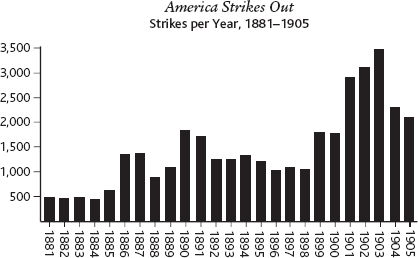
America Strikes Out
Strikes per Year, 1881-1905
But those weren’t the only terrorist acts on American soil. Perhaps the most disturbing anarchist terror plot was the assassination of President William McKinley by Leon Czolgosz on September 6, 1901. While not an immigrant himself, Czolgosz, born to Polish immigrant parents, was lumped together with other foreign malefactors as part of the “black anarchist” threat from abroad. Czolgosz encouraged the association, and his personal history would have been familiar to many immigrants: after going to work at the American Wire and Steel Company at the age of 10, he and his brothers were fired when other workers went on strike. From the ages of 16 to 18, Czolgosz worked at a glass factory in Pennsylvania. Not long after, he had a mental breakdown.
Thrilled and inspired by the recent assassination of Italy’s King Umberto I, in late August of 1901, Czolgosz rented a room in Buffalo, New York. Then, on September 6, he snuck his .32-caliber revolver into the Pan-American Exposition, where President McKinley was scheduled to make an appearance. Somehow evading the security (three Secret Service agents were guarding the president, against his wishes), Czolgosz made his way to the front of the line and shot the president twice at point-blank range. After being severely beaten by the crowd, Czolgosz was convicted and sentenced to death on September 23; on October 29 he was electrocuted at Auburn Prison in upstate New York. Meanwhile, McKinley lingered for eight days before dying on September 14.
Shortly after his execution, sulfuric acid was thrown on Leon Czolgosz’s body in order to hasten decomposition. His remains were then diffused into the prison’s soil.
FROM PINKERTON TO BLACKWATER
Despite the name, most employees of the Pinkerton National Detective Agency weren’t really “detectives.” A more appropriate list of roles would include security guards, bounty hunters, and plain ol’ thugs. Pinkerton founded the agency in 1855 to assist railroads threatened with labor outages, and Pinkertons were soon providing
security for “scabs” brought in to replace striking workers at factories and mines across the Northeast. In this role, Pinkertons became hated symbols of industrial exploitation. These chaotic scenes often turned violent, with Pinkertons accused of beating and killing striking workers (who sometimes started the violence).
In the 1870s a Pinkerton detective, James McParland, infiltrated the Molly Maguires, a secret labor union/criminal group composed of Irish immigrants in the Pennsylvania coal mines. McParland helped bring down the secret Mafia-style organization–but it seems his employers shared information with vigilantes, probably in the pay of Pennsylvania industrialists, who murdered suspected members of the Molly Maguires as well as their families. The most notorious Pinkerton case, however, is the Homestead Steel Strike of 1892, near Pittsburgh, Pennsylvania, when violence left seven Pinkertons and nine strikers dead.
The Pinkertons were also forerunners of modern-day private security contractors hired by the government. They were sometimes given a huge amount of authority. In February 1861 Allan Pinkerton personally supervised Abraham Lincoln’s security as he passed through hostile Baltimore en route to his inauguration in Washington. Pinkerton based his strategy in part on intelligence from a female spy, Kate Warne, who had infiltrated a group of alleged plotters. (She was an employee of his Female Detective Bureau, created to use “feminine wiles” in detective work.)
During the Civil War, Pinkertons provided security for the Union Army and carried out espionage for the United States in the Confederacy, including organizing “Loyal Leagues” of slaves, runaways, and freedmen as intelligence networks. In 1871 the U.S. Department of Justice hired the Pinkertons to investigate violations of federal law–basically employing them as a proto-FBI. At one point in 1909, Pinkerton employed 40,000 agents–larger than the 28,000 personnel in the U.S. Army.
But the growing power of the agency alarmed authorities. In 1889 Ohio outlawed the Pinkertons over concern they might serve as a private army, and over the next 10 years, 24 states banned armed guards–mostly targeting Pinkerton. After the Homestead Steel Strike, in 1893 Congress passed the Anti-Pinkerton Act, forbidding any government agency from employing them.
LIE: America is (not) an imperialist nation.
THE TRUTH: The United States is definitely not an imperialist nation, except when it is. Confused? One prime example of America behaving as an imperialist power, while simultaneously opposing imperialism, is the Spanish-American War of 1898.
As the vast territories of the American West were claimed and divided up in the late 1800s, the American public turned its attention to nearby territories like Cuba, Puerto Rico, and the Philippines (in this case, “nearby” means nearby China). The only problem was that all these islands belonged to Spain, which refused to sell them to the United States, even when America said “please.” So the United States decided to take them.
PARDON MY REACH
1890: Alfred T. Mahan advocates the conquest of Cuba, the Philippines, and Hawaii to project American naval power.
1892: Cuban exiles in the United States organize the Cuban Revolutionary Party with the goal of achieving independence; Filipinos form several armed revolutionary leagues to do the same.
1895: Cuban uprising against Spanish rule begins.
1896: The U.S. Congress votes to recognize Cuban independence; President Grover Cleveland warns the United States may intervene in Cuba; Filipinos revolt against Spanish rule.
1897: Newspapers owned by William Randolph Hearst and Joseph Pulitzer whip up anti-Spanish sentiment in the United States.
1898
January: Spain grants some autonomy to Cuba.
February: USS Maine explodes in Havana harbor, triggering pro-war sentiment in the United States.
March: Commodore George Dewey is ordered to sail for the Philippines.
April: The U.S. Congress declares war on Spain; President McKinley enlists 125,000 volunteers.
May: Commodore Dewey arrives in Manila and defeats the Spanish navy.
June: Marines land in Cuba; Guam surrenders; American Anti-Imperialist League formed.
July: Teddy Roosevelt and the Rough Riders capture San Juan Hill, near Santiago de Cuba; Hawaii is annexed; Spanish forces in Cuba surrender.
August: The United States and Spain agree to a cease-fire; Manila falls to U.S. forces the next day.
September: First Congress of Philippine Republic meets to draw up a constitution.
October: McKinley insists on the annexation of the Philippines.
December: The United States and Spain sign formal peace treaty, giving the United States control of Puerto Rico, the Philippines, and Guam for $20 million.
1899
January: The United States refuses to recognize the new Filipino government.
February: The Filipino insurrection against the American occupation begins.
SHE AIN’T HEAVY, SHE’S MY SISTER
If you’re not clear on the United States’ take on imperialism yet, consider Secretary of State James G. Blaine’s “Big Sister Policy.” This name was meant to convey American benevolence. Of course, as anyone with a big sister can attest, they’re also bossy, hypocritical know-it-alls who humiliate you and take your stuff without asking, all while telling you it’s for your own good. That pretty much sums up U.S. relations with Latin America in this period.
But this bully tactic wasn’t a uniquely American concept. At the time, there was plenty of “taking” going on across the globe–Britain, France, and Germany were actively carving up Asia and Africa, conquering native peoples and booting out the earlier generation of colonial powers like Spain and Portugal. The growing power of European empires made America nervous, especially because Britain and France both had their sights on Cuba and the Philippines. To preempt the brutish and uncouth European imperialism, American politicians proposed that the United States pursue a policy of “enlightened” imperialism. (Sounds delightful, no?)
But there were other reasons America wanted to take Spain’s stuff. In the second half of the nineteenth century, seafaring was revolutionized by the introduction of the steam engine, which replaced wind as the main source of power. However, this presented a new challenge. Coal took up a lot of space and limited the amount of cargo that ships could carry. So to make steam-powered shipping cost-effective, merchants and militaries needed networks of refueling stations. One near Asia would be particularly useful, but Cuba seemed like a nice option as well.
Still, the popular rationale for engaging in the Spanish-American War was that the United States was selflessly advancing the cause of liberty and freedom. And this sentiment was surprisingly genuine: Americans were empathetic to Cuban rebels in their fight for independence from Spain. Even before the uprising began in 1895, Cuban exiles in the United States were rallying financial and political support–a job made easier when Spain herded 300,000 civilians into concentration camps in Cuba, where 100,000 died of disease and starvation.
With public opinion firmly behind the rebels, all the United States needed was a reason to get involved. This didn’t take long. In January 1898 President McKinley sent the warship USS Maine to Havana–supposedly to protect Americans living in Cuba but actually to intimidate Spain. On the evening of February 15, 1898, the Maine hit a Spanish mine, exploded, and sank in Havana harbor with the loss of 266 American sailors. The fate of the Spanish Empire was sealed as sensational newspaper accounts whipped public opinion into war frenzy around the rallying cry, “Remember the Maine, To Hell with Spain!” (Where would jingoism be without rhyming?) Of course, newspaper publishers like William Randolph Hearst had an interest in promoting conflict, since wars sold lots of papers.
We are the ruling race of the world … ours is the blood of government; ours the heart of dominion; ours the brain and genius of administration.
–Senator Albert Beveridge, 1898
SO GOOD IT HEARST
In an effort to amp up sales, William Randolph Hearst exaggerated the situation in Cuba just a tad by printing front-page stories of Spanish soldiers cannibalizing Cuban prisoners and strip-searching female American tourists in public. That kind of thing is why he’s remembered as one of this era’s over-the-top industrial titans. Hearst reveled in being able to control public opinion–but was above all a businessman. Born in San Francisco on April 29, 1863, he was the son of a wealthy miner who also owned several local newspapers. As a youth, Hearst was a mischievous troublemaker, getting himself expelled from Harvard for giving some of his instructors chamber pots with their names inscribed on the bottom. But as a publisher, he was a force of nature. In 1887 his father gave him control over The San Francisco Examiner, and Hearst soon went bicoastal with his acquisition of The New York Journal, followed by 28 other newspapers in major American cities, as well as a number of magazines. Indeed, he created one of the first truly national newspaper chains, with a daily circulation of 13 million reaching approximately 40 million readers–almost half the population in 1910–giving him unprecedented power to mold public opinion and influence events. This wasn’t always a good thing, however, as he also pioneered sensationalistic tabloid journalism that tended to be long on emotion and somewhat shorter on facts. Of course, that’s what sold newspapers. And he sold quite a few: in 1935 Hearst was worth about $200 million, equal to about $3 billion–$5 billion today.
You furnish the pictures, and I’ll furnish the war.
–Newspaper publisher William Randolph Hearst,
to illustrator Frederic Remington
Congress itself was still ambivalent about the whole imperial thing: on one hand a resolution introduced by Senator Henry M. Teller of Colorado renounced all U.S. claims to Cuban territory. But the imperialists also got their way: after the war, the U.S. military governor in Cuba, John R. Brooke, appointed provincial governors and mayors, and U.S. capitalists soon dominated Cuban industry and agriculture. By 1902, U.S. mining companies controlled 80 percent of Cuba’s exports of copper ore, and by 1905, 10 percent of the land belonged to giant American-owned agriculture estates. Meanwhile, the right to vote was restricted to literate Cuban landowners, excluding the majority of Cubans and empowering the elite, who traditionally favored closer relations with the United States.
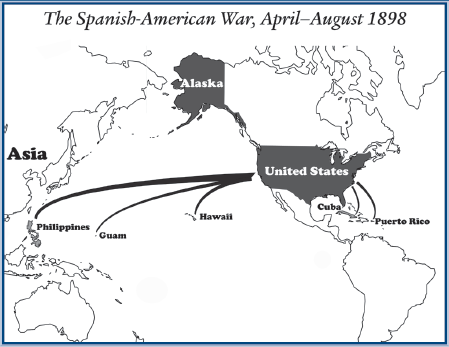
But Cuba was only one part of the imperial plan sort of endorsed by the American public. In four brief months, from April to August 1898, the United States also conquered the Spanish possessions of Puerto Rico, Guam, and the Philippines (paying a nominal fee to make it all look aboveboard). Like Cuba, the last was mostly a cakewalk, as American troops intervened on the side of native rebels who were already fighting for independence. Unlike Cuba, however, the Filipino rebels were not prepared to accept another foreign occupation.
Damn the Americans! Why don’t they tyrannize us more?
–Manuel Quezon, a rebel commander, later the
president of the Philippines
Over three bloody years, from 1899 to 1902, U.S. troops ultimately secured victory over the Filipino rebels. All told, the fighting claimed the lives of about 200,000 civilians–3 percent of the total population–through disease, starvation, and atrocities committed by both sides. (Much like regular imperialists, “enlightened” imperialists were also willing to herd hundreds of thousands of civilians into concentration camps.) On the other hand, outside the war zone, the American occupation was relatively relaxed, and U.S. forces aided development. In the Philippines, this meant building roads and telegraphs, ensuring clean water supplies, and controlling diseases like malaria, cholera, smallpox, and typhoid fever. The U.S. government also won hearts and minds in noncombat zones by buying 400,000 acres of land from the Vatican (which had received it as a pious gift from the Spanish crown) and redistributing it to local peasants.
ACT NOW AND GET A FREE CHAIN OF ISLANDS!
On June 20, 1898, U.S. Navy ships on the way to the Philippines seized the small but strategically located island of Guam. After capturing a few dozen Spanish soldiers, the squadron commander decided not to garrison Guam–so Frank Portusach, an American civilian who happened to be living there, temporarily served as the entire U.S. occupation force!
Following the “while we’re at it” school of foreign policy, the United States also picked up Hawaii, even though it didn’t belong to Spain. Actually the islands’ Christian Polynesian monarchy had already been overthrown in 1893 by American settlers–mostly sugar plantation owners–who asked for U.S. Marines to help keep things under control. After four years as an independent republic, the settlers persuaded Congress to annex Hawaii as a territory in July 1898. The acquisition fit in nicely with America’s other holdings, especially since the Philippines provided a cheap labor source for Hawaii’s sugarcane plantations.
We must have Hawaii to help us get our share of China.
–President William McKinley, to Congress, 1898
All in all, American empire-building was a fairly halfhearted, wishy-washy affair. In Cuba, the Platt Amendment of 1899 withdrew U.S. troops and handed the authority over to a civilian government elected by Cubans. But it also prohibited Cuba from conducting most of its own foreign policy, gave America military bases on Cuban soil, and gave Congress the right to intervene on behalf of American economic interests–aka, the entire Cuban economy.
The Filipinos received fewer powers of self-government, but plenty of lip service. In 1901 President McKinley appointed a Philippine Commission that William Howard Taft oversaw as governor. In 1907 the Filipinos were finally allowed to elect their own representative assembly, which became the lower body of a two-part legislature, with the commission playing the senior role. In the racist fashion of the day, Americans were reluctant to turn authority over to the Filipinos out of prejudice, arguing “childlike” Asians were incapable of self-government.
The Pacific is the ocean of the commerce of the future … The power that rules the Pacific, therefore, is the power that rules the world. And, with the Philippines, that power is and will forever be the American Republic.
–Senator Albert Beveridge, 1898
OTHER PEOPLE’S STUFF 
Good America/Bad America
The Spanish-American War signaled the emergence of a new, more aggressive approach to relations with Latin America, especially when debt was involved. And it was involved quite often. At the time, a number of Latin American regimes had borrowed money that they couldn’t pay back from European financiers. This fueled American fears because European powers were in the habit of repossessing countries that defaulted on loans, and the United States wasn’t exactly eager for Britain, France, or Germany to have a foothold in the Western Hemisphere. American anxiety only increased after a dozen Latin American nations defaulted on British loans in the 1870s. (The fact that the Brits bombarded a port in Honduras and seized a strip of Nicaraguan land soon after wasn’t calming anyone’s nerves.)
Determined to keep those wily Europeans out, President Teddy Roosevelt and his successor, William Howard Taft, laid out a “good cop, bad cop” foreign policy. On one hand, European lending would be replaced by American finance, referred to as “dollar diplomacy.” On the other hand, the United States was happy to take control of countries that defaulted on European loans–by force if necessary–and manage their finances until those debts were repaid. The idea was to deprive Europeans of any excuse to intervene, and it was referred to as “gunboat diplomacy.” This bad cop part of the plan was also a blatant violation of each country’s sovereignty, but whatever: the United States figured that in time they’d get used to it. In the first two decades of the twentieth century, the United States assumed control of the Dominican Republic, Nicaragua, and Haiti (the young Assistant Secretary of the U.S. Navy, Franklin Delano Roosevelt, drew up a new Haitian constitution) and threatened similar measures against Honduras and Guatemala.
Until coffee gained popularity, beer was the breakfast beverage of choice in most urban areas of the United States.
Unsurprisingly, American financiers ended up controlling huge sections of the regional economy: for example, as part of debt restructuring, U.S. banks took possession of Nicaragua’s national bank and railroads. The United States also intervened throughout Central America and the Caribbean to protect American property, prop up friendly rulers, and get rid of the unfriendly ones with a combination of cloak-and-dagger methods and open force. Once again, Nicaragua was a frequent beneficiary: in 1909, after President Jose Santos Zelaya became too friendly with European investors, an American mining company engineered a rebellion as a pretext for occupation by U.S. Marines. Zelaya was replaced by Adolfo Diaz, an executive from the mining company, who formally invited U.S. forces to occupy Nicaragua for over a decade. Not surprisingly, the United States happily accepted.
The headquarters of the Banco Nacional de Nicaragua were technically located in Connecticut, where it was incorporated by American bankers. Meanwhile, the headquarters of Ferrocarril del Pacifico, the Nicaraguan national railway, were located in Maine!
This was a typical approach, as America’s distinctive form of “imperiahisn’t“ favored indirect control through puppet regimes. It was cheaper than ruling a country outright, which required spending money on administration, infrastructure, sanitation, education, and other assorted amenities. Native leaders also inspired less popular resentment than gringo governors and could get away with harsher measures when resistance cropped up. (Plus, they could take the blame if anything went sour, as it often did.)
FOREIGN POLICY GOES BANANAS
Controlling so-called Banana Republics was often too taxing for U.S. policymakers, so they simply “subcontracted” the work out. Take United Fruit (now Chiquita). The company was formed by the 1899 merger of the Boston Fruit Company with the national railroad of Costa Rica, and was controlled by an American mogul, Minor C. Keith, who built the rail system in exchange for 800,000 acres of tax-free land. Keith’s big idea–taking Asian bananas and growing them in Central America–proved to be a big success. In the 1890s he expanded his banana-railroad empire to include large parts of Guatemala, El Salvador, Nicaragua, Panama, Colombia, Venezuela, Brazil, Jamaica, and the Dominican Republic. The merger with the Boston Fruit Company, which controlled production in Cuba, formed the largest agricultural conglomerate in the world.
But there was competition. In 1899 Standard Fruit (now Dole) was founded by two Sicilian immigrants, Joseph Vaccaro, a New Orleans fruit wholesaler, and Salvador D’Antoni, a smuggler and gunrunner operating in northern Honduras. Taking a page from United Fruit’s book, Vaccaro and D’Antoni soon dominated Honduras, building and controlling ports, railroads, and telegraph lines. And they didn’t shrink from deceit and violence. Early on, for example, they raised money from Honduran investors in the port of La Ceiba–but in 1903, when the Honduran investors demanded their share of the profits, Vaccaro had the city hall of La Ceiba burned down, destroying the records of their investments. How you like them bananas?
A Man, a Plan, an American-Constructed Uprising
Probably the single biggest U.S. intervention in Central America involved the creation of a new country, Panama, in territory that used to belong to Colombia. This was the culmination of a long, drawn-out effort to build a canal connecting the Atlantic and Pacific oceans somewhere in Central America, where the distance between them was narrowest.
HAPPY BELATED B-DAY, AMERICA!
In 1886 Ferdinand de Lesseps presented the speech that officially dedicated France’s greatest gift to the United States, the Statue of Liberty. The Statue (whose full title is Liberty Enlightening the World) was originally supposed to be unveiled on the centennial of the Declaration of Independence, but the project ran into a number of delays. Besides engineering challenges, fundraising for the pedestal went slowly until newspaper publisher Joseph Pulitzer shamed readers into donating with scolding editorials. The internal structure of the 151-foot-tall statue was designed by Maurice Koechlin, the engineer who designed the Eiffel Tower for Gustave Eiffel. With the pedestal, the entire Statue of Liberty monument is 305 feet tall, and was the tallest structure in the United States when it was erected; Chicago’s Home Insurance Building, completed in 1885, was 138 feet tall.
People had been talking about a “trans-Isthmian” canal as early as the sixteenth century, when a Spanish priest suggested building one with native slave labor. Similar plans received enthusiastic support from Thomas Jefferson and John Quincy Adams during their presidencies. The value was obvious: a very fast clipper ship took about 90 days to make the voyage from New York City around South America to San Francisco in 1850. But after the Panama Canal opened in 1914, steamships could make the trip in just 22 days. In addition to encouraging trade, this resulted in fewer shipwrecks–especially in the perilous Straits of Magellan–not to mention fewer shipboard deaths from disease and starvation. But huge obstacles (e.g., landslides, malaria, and pesky governments) kept the vision from being realized until the late nineteenth century, when they were finally vanquished by America’s “can-do” attitude, along with some good old-fashioned manipulation.
Initially, the French seemed like the best bet to make the canal happen. In 1879 Ferdinand de Lesseps, the French engineer famous for building the Suez Canal, secured funding to build an enormously expensive canal that would cut through Panama’s mountainous terrain at sea level. In 1888, however, Lessep’s Panama Canal Company went bankrupt. Landslides and tropical diseases had bested French ambition.
Meanwhile, for at least half a century, America’s attention had been focused on building a canal in Nicaragua. The country’s low-lying terrain and network of navigable rivers and lakes made it feel like the better candidate. But the bargain-basement price of Lessep’s Panama Canal Company proved irresistible, and in 1904 the U.S. government bought it for a song. And along with the fine price, America was happy to keep Lessep’s half-built canal out of the other European nations’ hands.
The stretch of land upon which the Panama Canal was constructed lies at such an odd angle that ships heading from the Caribbean to the Pacific have to travel in a southeasterly direction.
After the purchase, American engineers quickly set about working on a new, more realistic design for the canal. The final design incorporated three sets of locks to raise and lower ships across the isthmus. But even before construction began, there was a problem. The Colombian Senate refused to ratify the treaty giving the United States a 99-year lease on the Colombian territory where the canal was supposed to be built–not because of any misgivings about U.S. imperialism, but rather simple greed. They wanted another $15 million on top of the $10 million down payment that the United States had already agreed to. Unfortunately, they made a rookie mistake in underestimating Teddy Roosevelt. Possessing little patience for foreigners, and even less for Congress, “TR” refused to go back to Capitol Hill to wheedle more money for the canal. He had a better plan: why make a new treaty, when you can make a new country?
This proved surprisingly easy, thanks to the geographic isolation and rebellious character of the territory in question. Like other parts of the Central America hinterland, Panama was in a chronic state of just-about-to-rebel, needing only a little encouragement (along with some money and guns) to erupt. Simply start with one off-the-shelf uprising, throw in a naval blockade to prevent Colombia from sending troops, and voila–Panama! The United States recognized Panamanian independence immediately, and in the next breath, the two countries signed a treaty giving the United States a lease on the same terms previously offered to Colombia.
But creating a new country was the easy part. It would take another 10 long years before the United States cut a canal across the 50 miles of mountainous jungle.
RUMBLE IN THE JUNGLE
The Americans faced the same challenges in digging the canal as their French predecessors, including malaria and yellow fever outbreaks. In fact, America’s greatest accomplishment might have been in controlling these mosquito-borne diseases. The effort was led by Colonel William Crawford Gorgas, who declared an all-out war on the pests. Gorgas’s methods induce cringes nowadays, but they worked: after ordering miles of the jungle leveled, he went after the mosquitoes’ ability to reproduce by draining all the standing water in the country. Gorgas took no prisoners and every puddle, pond, and wetland was sucked dry. Any standing water that couldn’t be drained was treated with pesticide and coated with a layer of petroleum, preventing new mosquito larvae from taking hold. Gorgas also ordered the fumigation of buildings and instituted a quarantine policy for sick individuals. Finally, he ordered workers’ barracks enclosed with screens to keep out mosquitoes (well, white workers’ barracks, anyway–black workers mostly slept in tents). The result: fever reduction and more construction!
 MADE IN AMERICA
The Gibson Girls
Here’s something you don’t see every decade: in the last quarter of the nineteenth century, American women embraced a homegrown fashion trend! That’s right. Instead of copping styles from Paris or London, the new feminine ideal was personified by “the Gibson Girl,” depicted by the pen-and-ink illustrator Charles Gibson. Like other fashion movements, the Gibson Girl style had a definite look, but also reflected an attitude and a unique approach to the world. Gibson Girls were beautiful and glamorous, but they were also fun-loving and even a bit cheeky.
How could the drawings of one illustrator become the iconic images of an age? One word: print. With literacy levels steadily increasing and production and distribution costs simultaneously decreasing, newspapers became a daily habit for most educated people. Readers could choose from morning and evening editions, and news junkies often picked up both. The total circulation of daily newspapers increased from 3,566,395 in 1880 to 24,211,977 in 1909 (from 7 percent to 26 percent of the U.S. population). Meanwhile, the total number of monthly magazines increased from 1,167 in 1880 to 2,767 in 1910. Some big titles even boasted circulations over 1 million. These print publications, along with the advertisements within, helped create a mass culture–both shaping and reflecting the standards and expectations of all parts of life.
Part of the increase in magazine readership from 1880 to 1910 was the result of the Postal Act of 1879, which reduced the mailing cost by establishing a lower second-class rate for magazines.
It was in this context that Charles Gibson drew his satirical cartoons, with his “Girls” sometimes enchantingly ethereal, sometimes comical, but always beautiful. The stereotypical Gibson Girl was tall and trim, with a narrow waist. She had curves, a distinctive S-shaped profile with the help of a corset, and delicate facial features. Popular hairstyles, like the pompadour and bouffant, resembled more relaxed, free-flowing versions of Romantic hairdos; a few locks of a Gibson Girl’s hair might trail carelessly for artistic effect.
Running errands during the day, the Gibson Girl was likely to wear a “traveling suit,” including an embroidered blouse with a dark bowtie, a seersucker “outing” skirt, elbow-length satin gloves, and a straw “boater” hat decorated with flowers or ribbons. When she wanted to stand out in the evening, the Gibson Girl got a bit friskier, wearing elegant, low-cut gowns that revealed her shoulders, arms, and more than a hint of cleavage. Of course, she always had spectacular gem-encrusted earrings and necklaces to call attention to the aforementioned cleavage. Other elegant, must-have accessories included fancy silk fans, jeweled hatpins, and tiny silk handbags.
If you’re still trying to picture the archetypal Gibson Girl, two words capture the look: Mary Poppins. Yowza!
The women Gibson idolized were a new breed, and much of their behavior–smoking, drinking, maintaining an active, sporty lifestyle–was viewed as unladylike. Some worked as shopgirls, priding themselves on financial independence. Others even traveled on their own, unaccompanied by men. Overall, guys were clearly nervous about the blurring of gender boundaries, fearing a female invasion of traditionally male domains. As a satirist, Gibson was an equally keen observer of men, and he loved playing off of their anxieties and befuddlement.
A Deeply Undesirable Movement
The dark side of the post-Civil War Progressive Era was the eugenics movement. To be fair, eugenics began in Britain and had a global following, but its first application on a big scale came in the United States. In fact, Americans were so good at eugenics that U.S. laws were used as models for the program established in Germany in the 1920s and 1930s by the Nazi regime.
Inspired by Charles Darwin’s theory of natural selection, the doctrine held that “desirable” and “undesirable” human traits corresponded to “superior” and “inferior” genes inherited from ancestors. Eugenicists also believed that society was actively undermining the process of natural selection through benevolent institutions like public education, charity, and social welfare. These programs had the unintended consequence of enabling “inferior” individuals to have more children, reversing the natural order of things. With natural selection suspended, desirable traits were doomed to be overwhelmed by multiplying hordes of genetically unfit human beings.
Pointing to the success of American farmers who embraced “scientific” principles, eugenicists persuaded educated Americans that humanity could be improved if the country employed the same methods used in animal husbandry. In fact, the first organization to advocate eugenics was the American Breeders’ Association, a group of professional livestock breeders. Bolstered by their success with cattle and poultry, they were quick to apply their learnings to the human population with their “Report on the Best Practical Means to Cut off the Defective Germ-Plasm of the American Population.” But what exactly was this “defective germ-plasm” they hoped to eradicate from the human population? The catchall term included people with mental disabilities, epileptics, alcoholics, criminals, blind people, deaf people, people with congenital deformities, “paupers,” the homeless, and anyone suffering from “immorality.”
The term “eugenics” (from a Greek term meaning “well-born”) was coined in 1883 by English scientist Sir Francis Galton, half-cousin of Charles Darwin.
As the movement gained popularity in the 1880s, eugenics drew on a body of (supposedly) scientific literature produced by researchers at nonprofit organizations. Simultaneously, various groups were using these results to lobby for state and federal eugenics laws.
To gain political support, eugenics advocates exploited the American public’s vague but deep-seated fears of contagion, sexual defilement, and racial impurity. To get a sense of how rapidly this movement progressed, take a look at Indiana–the first state to pass a eugenics law:
1879–Harriet Foster, a social scientist, presents a paper on “The Education of Idiots and Imbeciles,” blaming inbreeding and inherited alcoholism for mental disabilities.
1881–Preacher Oscar C. McCulloch presents a “Study in Social Degradation,” asserting a hereditary basis for vice and ignorance, based on questionable observations he made of farm families in rural Indiana.
1889–Their research is confirmed by the Board of State Charities.
1898–The Board advocates that all “defective” individuals be forbidden to marry, and that all “defectives” in the custody of state prisons and mental hospitals be sterilized.
1899–This agenda is quickly put into action at the Indiana State Reformatory by Dr. Harry C. Sharp, who sterilized about 500 inmates from 1899 to 1910.
1901–The governor signs a law putting “feeble-minded” women with no legal guardians into state custody to prevent them from reproducing.
1905–It becomes illegal for “imbeciles, epileptics, and those of unsound mind” to marry.
1907–The Indiana Eugenics Law is passed, mandating the sterilization of “criminals, idiots, rapists, and imbeciles.”
Ultimately, about 2,500 people were sterilized involuntarily in Indiana. By 1914 similar eugenics laws had been adopted in 14 states, including New York, New Jersey, California, Michigan, and Iowa, and legislators were considering eugenics laws in 11 more. By the 1940s, 30 states had laws ordering sterilization of “feeble-minded” people who were “wards of the state.” Altogether, approximately 65,000 Americans were sterilized.
In this family history are murders, a large number of illegitimacies and of prostitutes. They are generally diseased. The children die young. They live by petty stealing, begging, ash-gathering … this condition is met by the benevolent public with almost unlimited public and private aid, thus encouraging them in the idle, wandering life, and in the propagation of similarly disposed children.
–Oscar C. McCulloch, “The Tribe of Ishmael:
A Study in Social Degradation,” 1881
But the American eugenics movement had another insidious legislative goal as well: to prevent the interbreeding of different groups. In the decades following the Civil War, Americans were particularly anxious about the influx of immigrants from southern and eastern Europe and the prospect of African-Americans mixing with whites biologically. In the fevered public imagination, the threat of race mixing overlapped with an increase in venereal diseases–especially syphilis–which were felt to damage the genetic stock of the human race. Eugenics advocates also appealed to American patriotism, drawing parallels between international competition and Darwin’s theory of survival of the fittest. Eugenicists warned of dire results if the “blood” of the white race became “corrupted” or “polluted” by African blood, conveniently aligning social Darwinist pseudoscience with white fears of black men raping white women (or, even worse, consensual relations). In many states eugenics advocates simply had to reinstate bans from the colonial period on marriage and sexual relations between blacks and whites. By 1914, 30 states had laws prohibiting race mixing, with six states going so far as to amend their constitutions. Many of these statutes required couples who wanted to wed to produce proof of their racial purity, along with a form certifying that a doctor’s examination and blood test showed no sign of genetic defect.
At the national level, Congress debated three constitutional amendments prohibiting interracial marriages, but none succeeded. When Congress did get around to passing eugenics laws, it focused on limiting immigration by “undesirables,” including whole races and nationalities. Urged by lobbyists from groups like the Immigration Restriction League, the main targets were Slavs and Jews from Eastern Europe and Italians, who were supposedly less intelligent on average. In 1924 Congress invited Harry Laughlin–a former high school principal and the director of Eugenics Record Office–to testify on the subject of mentally defective immigrants. This led to the Immigration Restriction Act, effectively ending immigration until after the Second World War.
Nothing but the Blues
The traditions of African-American music stretch back to the arrival of the first slaves in the early seventeenth century, but since they never wrote down anything down, it’s hard to know what it sounded like. Most of our information comes from descriptions left by white contemporaries, who noted that there were different kinds of music for different occasions. In the cotton fields, groups of slaves used work songs to set a pace that everyone could maintain, making sure no one fell behind and subtly managing the expectations of white overseers. Visitors to plantations also left accounts of groups of slaves dancing in circles to drumming or fiddle music accompanied by rhythmic clapping and stomping. On Sundays, in simple log cabin churches, slaves sang “anthems” (better known as gospel songs) whose Christian imagery expressed their suffering and hopes for freedom.
After the Civil War, newly liberated African-Americans could travel where they pleased for the first time, just as the South was being crisscrossed by new railroads. Riding the rails, itinerant black musicians were able to share local songs and styles and were also exposed to various kinds of white music, including Scots-Irish ballads that evolved into modern country music; in fact, there was a great deal of overlap between country music and the blues (evident in shared subject matter, tending toward complaints about S.O.B. bosses, lost dogs, and unfaithful women).
We’ll probably never be able to pinpoint the exact time and place where the blues was born, but the new style seems to have emerged in the 1880s and 1890s in small rural towns that sprang up across the Deep South. A common feature of these towns was a “juke joint” offering liquor and music, sometimes sharing a roof with a small general store. The joints generally showcased a regular “in-house” musician, who lived nearby, as well as touring musicians (“wandering” might be more accurate), who visited from neighboring counties.
During this period, the most successful bluesmen would cover larger territories, visiting more towns and building their reputations until word eventually reached the region’s small but growing cities, concentrated on the banks of the Mississippi River. After making a name in these small cities, it would be easy enough to hitch a ride on a paddle-wheel steamer heading upriver to St. Louis and points north. Thus the blues became popular in black communities throughout the Mississippi River basin, and anywhere else that could be reached easily by riverboats or tramp freighters. Musicians continued to innovate, and in the 1910s and 1920s, the original form–Mississippi Delta blues–spawned regional styles like Memphis blues (folksy, using banjos, washboards, and kazoos), St. Louis blues (incorporating elements of ragtime) and Texas blues (emphasizing guitar virtuosity, with more “swing”).
“The blues” is a shortened form of the term “the blue dev ils,” the demons once believed to cause sadness and melancholy.
No Bottles of Coke on the Wall
Yes, it’s true: when the fizzy soft drink was first formulated, Coca-Cola contained small amounts of cocaine, which probably made it mildly habit-forming. But it turns out the early business dealings surrounding the “Pause That Refreshes” were far more nefarious than any of its ingredients.
In the decades after the Civil War, the United States was swept by a new wave of anti-alcohol activism. This was partially triggered by the return home of Civil War soldiers who had gotten a taste for drink to escape the terror and tedium of war. Temperance also absorbed the energies of Christian women who had previously focused their energies on the abolition of slavery. (Basically, it was “next on the list” of moral causes.) With concerned members of the clergy leading the way, the mostly female rank and file pushed for local and state laws controlling or prohibiting the sale of alcohol.
There is some of the onerest men here that I ever saw, and the most swearing and card playing and fitin and drunkenness that I ever saw at any place.
–A new recruit in the Union army,
in a letter to his mother, 1861
That’s how the city of Atlanta and Fulton County came to be no-booze zones in 1886. While most shopkeepers threw their hands up in despair, one proprietor in Columbus, Georgia, saw the ban as an opportunity. John Pemberton, who’d developed a “French Wine Coca” containing alcohol as a “patent medicine,” now set about producing an alcohol-free version, to appeal to the health-conscious ladies of Atlanta. Pemberton also claimed his Coca-Cola could cure morphine addiction, depression, headaches, and erectile dysfunction. Interestingly, the alleged health benefits of Coca-Cola were attributed less to its caffeine or cocaine content than its carbonation, which was believed to be “restorative” in this period.
Selling for five cents a glass at soda fountains in pharmacies around Atlanta, Pemberton’s beverage was a hit, and like every successful invention, it soon gave rise to a field of knockoffs and imitators. Eventually Pemberton, who was suffering from a morphine addiction, sold his Coca-Cola Company to Asa Griggs Candler, the maker of a rival beverage, who (this is important!) also bought the formula. On learning that Pemberton had also sold majority stakes in Coca-Cola Company to at least four other businessmen–he was a morphine addict, after all–in 1892 Candler decided to ditch the whole legal mess and create a new corporation, The Coca-Cola Company (note the important difference). If this all sounds a bit shady and illegal, well, it probably was: Candler supposedly forged Pemberton’s signature on the 1888 bill of sale–and his decision in 1910 to burn the company’s early corporate records doesn’t exactly allay suspicion.
But as the old American saying goes: “Whatever!” The Coca-Cola Company now belonged to Candler, who proved to be a capable marketer. Fittingly, however, his best idea was actually somebody else’s: in 1891 the Biedenharn Candy Company began bottling Coca-Cola in Vicksburg, Mississippi, and in 1899 two entrepreneurs obtained Candler’s skeptical permission to open a proprietary Coca-Cola bottling operation in Chattanooga, Tennessee. Bottling Coca-Cola allowed the beverage to expand into retail distribution, via general stores, as well as restaurants and hotels, which didn’t always have soda fountains. Of course pharmacies continued to sell the fountain drink. Operated by “soda jerks,” these were informally known as “dope shops” because of the cocaine content.
So how much cocaine did Coca-Cola actually contain in the good old days? Pemberton’s original formula had five ounces of coca leaves for every gallon of syrup; this would produce 65 twelve-ounce cups of Coca-Cola, each containing 34 milligrams of cocaine (providing the cocaine was fully extracted from the coca leaves). For an adult man weighing 150 pounds, or 68 kilograms, that works out to 0.5 milligrams of cocaine per kilogram. While that’s not a huge amount of cocaine (100 milligrams is a fairly small recreational dose) it’s nothing to sniff at either: 0.5 milligrams per kilogram can produce feelings of euphoria, and long-term changes in dopamine levels in the brains of lab monkeys.
Thanks for Everything, Edison
In 1862, at the age of 15, Thomas Edison’s first job was selling newspapers at a train station near his home in Mount Clemens, Michigan. While hawking papers one day, Edison saved a three-year-old boy, Jimmy Mackenzie, from a runaway freight car. The boy’s father, the train station’s telegraph operator, was so grateful that he trained Edison in telegraphy, beginning his lifelong love affair with technology (and especially electricity). Later, at his laboratory in Menlo Park, New Jersey, Edison went on to invent everything but the kitchen sink, including …
The Phonograph
Strange though it seems now, before Edison invented the phonograph in 1877, there was no way for human beings to capture and re-create sound mechanically. Edison changed all that by using precise mechanical motion to transcribe dynamic sound waves into a solid, three-dimensional object, which stored the information until he wanted to reverse the process. When Edison put it all together, a carbon fiber diaphragm vibrated in response to sound waves, causing a needle to move up and down, leaving a series of indentations on a rotating cylinder. By adjusting the needle and diaphragm, Edison could make the process flow backward, so that indentations on the cylinder caused the needle to move up and down, making the carbon fibers vibrate and thus producing sound–or rather, re-producing it. The phonograph stunned and delighted people the world over, and it earned Edison the nickname “The Wizard of Menlo Park.”
The first recorded sound on Edison’s new invention was the inventor’s own voice, reciting the nursery rhyme “Mary Had a Little Lamb.” He later claimed that it was the first thing that sprang to mind. Edison didn’t wish to make a grand announcement in case the device failed to work properly.
The Light Bulb
In the nineteenth century, Americans and Europeans were still using lamps that burned whale oil or kerosene, but these were expensive and maybe not as safe as desired (sorry Chicago!). Inspired by Britain’s “arc lamps,” which worked by passing an electric charge through gaseous, ionized neon, argon, or mercury, in 1878 Edison hit on the idea of replacing the reactive gas with a thin filament. The challenge was finding a material whose chemical structure caused it to emit light when electrified, but also stood up to prolonged electric current without burning up. Part of the answer came from enclosing the filament in a glass vacuum bulb to limit exposure to oxygen. But Edison and his assistants still had to experiment with thousands of materials to find one cheap and durable enough to be practical. After more than a year of experimentation, he discovered that carbonized cotton fiber could produce light for 13.5 hours before burning out. Several months later he discovered that carbonized bamboo filament could last up to 1,200 hours. Nowadays, however, most filaments are made of tungsten.
The Movie Camera
Without movie cameras there would be no movies, no Hollywood, no glamour, no gratuitous sex and violence, no ludicrously overpriced popcorn–everything that makes America America. Thankfully two important elements were already in place when Edison came along: in the 1820s two Frenchmen, Joseph Nicephore Niepce and Louis Daguerre, had invented still photography, and in 1884 George Eastman had invented lightweight film, which replaced cumbersome metal plates. Eastman’s invention allowed for a large number of photographic images to be produced using a smaller, more manageable medium. And this set the stage for Edison to give the job to someone else: his assistant William Dickson. With a general directive from Edison to apply the basic idea of the phonograph to photography, Dickson–a photographer himself–eventually came up with a system using strips of celluloid wrapped around a rotating cylinder. Together with Edison’s phonograph, the kineto-scope could produce “sight, sound, and motion.” Gratuitous sex and violence weren’t far behind.
What Didn’t Edison Invent?!
While we could go on and on about the things Thomas Alva worked on (A complete 3-story house with moldings and furniture that could be created from one single pour of concrete! Electric railroads! Underwater searchlights! A trick for camouflaging the Navy’s ships!), we should probably give a few other great inventors their due. Here are a few other inventions from the period that we couldn’t do without:
Telephones
Alexander Graham Bell was born in Edinburgh, Scotland, but his famous invention was conceived in Boston, Massachusetts, where he settled in 1871. (Well, sort of settled. He was actually commuting from Canada and is now hailed as a proud native son of Scotland, Canada, and the United States.) Bell was another one of those infuriatingly capable polymath eggheads, who showed off his Towering Genius at the age of 12 by inventing a labor-saving device for a local mill. By the age of 16, he had taught himself piano, ventriloquism, and sign language to talk to his mother, who was becoming deaf. He also translated instructions from a German inventor on how to build an “automaton” capable of rudimentary artificial speech. Later, he trained his family dog to growl on command so he could figure out how to manipulate the dog’s lips and tongue to produce what sounded like human speech–standard stuff, really.
After a distinctly mediocre high school career, Bell took a job as a teacher, but then tragedy struck twice. Tuberculosis claimed the lives of one of his brothers in 1867, and then it took the other in 1870. When Bell also took ill, his parents dropped everything and moved from Scotland to Canada so their sole surviving son could recuperate. In Canada, Bell started hanging out with members of the Onondoga tribe, learned their language, and created a written language for them, for which they honored him with an honorary chieftainship. In 1871, at the age of 24, he was asked to train instructors for a school for deaf people in Boston.
Sometime in 1873–1874, Bell began working on a device he called a “harmonic telegraph” or the “electric speech machine,” which would transmit sounds long distances using electric current. The basic idea was similar to telegraphy: a series of inputs on one end would be transmitted electrically and decoded at a distant location–but instead of a telegraph operator tapping a lever, a human voice would open and close the circuit using sound waves. There were some major challenges. At first, Bell thought he would need cables containing many more strands of copper than conventional telegraph lines. That’s because his initial concept called for a group of electrical impulses traveling down separate wires, each triggered by a specific frequency, which then activated specific metal “reeds” on the other end.
But as Bell was assembling the first multi-reed model with the help of his assistant, Thomas Watson, Watson accidentally “twanged” one of the metal reeds. Bell heard the full range of tones created by the reed, rather than just one frequency, and he quickly realized that he could use a single reed instead of multiple reeds, and just one wire instead of many wires. Other obstacles remained, but ultimately, Bell hit on a novel solution that worked.
Soon Bell was giving personal demonstrations to various notables, including Queen Victoria, who declared it “most extraordinary.” After founding the Bell Telephone Company in 1877, he continued improving the telephone to make it more practical. Meanwhile, work began on long-distance phone lines connecting Boston, New York, Baltimore, and Chicago. By 1886, 150,000 Americans owned telephones, and everyone else wanted one. We haven’t shut up since.
Ironically, Bell came to hate the constant ringing of his own home telephone and banished it from his study so he could think in peace.
Plane Genius
Flying has been one of the most coveted superhero powers since the beginning of time. But attempts to get airborne tended to end pretty badly (see: Icarus, small children leaping off of tall objects, etc.). All of this changed, however, with the invention of the internal combustion engine by an Italian engineer, Pietro Benini, in 1856. The internal combustion engine operated on the same basic principle as the steam engine–raising and lowering pistons to turn wheels or propellers–but it made the process more efficient by replacing super-heated water vapor with flammable diesel or gasoline, providing far more horsepower from a much smaller unit. Further refinements made internal combustion engines even lighter, setting the stage for two enterprising bicycle geeks from Dayton, Ohio, to change the world forever.
In 1899 Orville and Wilbur Wright, two brothers who owned a bike shop and had mechanical experience with electric motors, began work on a “flying machine.” They were inspired by Otto Lilienthal, a German inventor who built and flew gliders in the early 1890s, proving that a heavier-than-air object could stay aloft for quite some time, even without a source of power, if it had the right wing design. Basically, their idea was to put an internal combustion engine on a glider, allowing it to stay aloft as long as the fuel lasted. Sounds easy, right? Not really: as Lilienthal’s tragic death in 1896 illustrated, this was a dangerous business, and it’s kind of amazing that both Wright brothers lived to enjoy their success.
Small sacrifices must be made!
–final words of Otto Lilienthal, German aviation
pioneer, after breaking his spine, 1896
With the more outgoing and ambitious Wilbur taking the lead, the brothers took a different tack from other would-be aeronauts. They focused on what they considered the real challenge: the difficulty of maneuvering a large, unstable object in midair. Plenty of other inventors had seen the potential of putting an engine on a glider to get airborne, but no one seems to have given much thought to the method of steering–or even more critically, getting back on the ground safely.
To develop an effective mechanism for controlling their flying machine, from 1900 to 1903, the Wright brothers performed a thorough battery of tests using gliders modeled on recent French and German craft. They incorporated the “double-decker” wing design favored by European inventors and Lilienthal’s design for a curved-top cross-section to provide more lift. They also added their own innovation: a “front elevator,” which was basically a forward-facing tail for steering and stabilization.
The brothers then journeyed to Kitty Hawk, North Carolina. There, for the next three years, they conducted over 1,000 gliding experiments aided by ocean breezes and the beach as a soft landing area. In the off seasons, they returned to Ohio, where they investigated air resistance, lift, and optimal wing design, using scale models and a homemade wind tunnel. Their experimentation was also sped along by their clever system for fastening various wings together using struts made of bicycle wheel spokes. This allowed them to test different configurations without having to rebuild their models every time.
In 1903, after perfecting a system for controlling midair maneuvers, the brothers decided it was time to add a propeller powered by an internal combustion engine. The 12-horsepower engine was built in just six weeks by Charlie Taylor, an employee at their bicycle shop. By casting the engine block out of lightweight aluminum, Taylor helped keep the Wright Flyer I remarkably light. In the end, the biplane had a 40-foot wingspan and tipped the scales at just 625 pounds. On December 17, 1903, unfazed by the freezing cold, the brothers made four short flights over the beach at Kitty Hawk, North Carolina, ranging in length from 120 to 852 feet, at an altitude of 10 feet, with an airspeed of seven miles per hour. The era of flight had begun.
PROFILES IN SCROOGES 
In the second half of the nineteenth century, the phenomenal expansion of American industry allowed a handful of brilliant, ruthless businessmen to acquire more money, in relative terms, than any private individual before or since.
John D. Rockefeller (1839–1937)
The super-richest member of the super-rich club, John D. Rockefeller was the second child of a traveling elixir salesman. Resolving not to follow his father’s ne’er-do-well example, Rockefeller nonetheless inherited his knack for creative deal-making and showed an entrepreneurial bent early in life: he earned extra money by raising turkeys and selling candy to local children. Soon he had enough cash to start making small loans to neighboring farmers. In 1855, at the age of 16, Rockefeller took a job as a bookkeeper for a dry goods store in Cleveland. There, he impressed everyone with his diligence, mathematical ability, and an intuitive grasp of the logistics involved in commerce–especially freight costs.
Four years later, he went into business for himself with a partner in produce distribution, and in 1863 they opened a small oil refinery to produce kerosene, which was rapidly replacing whale oil as the preferred fuel for lamps. In 1865 Rockefeller, now 26, bought out his partners, and a year later he joined forces with his brother, William, who built another oil refinery in Cleveland. The brothers luckily (or wisely) took up the oil business just before a prolonged boom, selling their kerosene in New York City and reinvesting their profits in the refining operation. Before long they owned the largest oil refinery in the world, and in 1870, the brothers created a new corporation, Standard Oil of Ohio. The duo borrowed heavily to acquire new competing refiners, but John was able to achieve substantial savings elsewhere by striking secret deals with railroads that gave Standard Oil rebates for its high-volume oil shipping business. These methods allowed him to drive competing companies into bankruptcy and buy them cheaply. Once under Standard Oil’s control, the acquired companies participated in Rockefeller’s shipping rebate scheme, giving him leverage to negotiate even bigger discounts with the railroads. By 1872 Standard Oil had acquired 22 of its 26 competitors in Cleveland, setting the stage for national expansion.
Rockefeller’s achievements didn’t just benefit his own bank account. By creating economies of scale, he could offer consumers better quality kerosene at a lower price. But after achieving dominance in kerosene refining, there was nothing left to do but take over other parts of the supply chain. In the 1880s, Rockefeller used the same ruthless tactics to methodically expand his control to new areas like oil prospecting and production, crude oil shipment, and kerosene retail sales. Eventually Standard Oil came to control 90 percent of the U.S. kerosene market, raising alarm in the general public about its dominance.
Opponents focused on the “trust” structure created by Standard Oil’s attorneys in 1879, which allowed it to sidestep state laws preventing one corporation from owning stock in another. In 1892 Ohio state regulators went after Standard Oil, forcing separation of the core Ohio business from corporate branches in various states. Wily Rockefeller found ways to work around this “anti-trust” regulation, and Standard Oil was eventually reorganized as a national holding company based in New Jersey in 1909. However, it was about to run afoul of the federal government, thanks to the growth of a whole new industry: automobiles.
The prospect of giving Rockefeller control over the indispensable fuel for the automobile craze was too much for federal regulators. In 1911, Standard Oil of New Jersey–which controlled an astonishing 64 percent of the vastly expanded oil and gas business–became the target of federal prosecution under the Sherman Anti-Trust Act of 1890. The Supreme Court found that the company had engaged in anti-competitive … well, competition. The company was ordered dismembered, and today, the list of companies created from Standard Oil includes familiar names like Exxon, Mobil, Chevron, Amoco, and Conoco. However, things weren’t all bad for Rockefeller. He got to keep his huge fortune as well as his stock in the new companies. Shortly after Standard Oil was broken up, his total worth was estimated at $900 million, or about 2.3 percent of U.S. GDP at that time. (Nowadays that would be equivalent to about $318 billion.)
He [Rockefeller] couldn’t walk down the aisle of his church without people asking for some money.
–Peter Johnson, The Rockefeller Century
Andrew Carnegie (1835–1919)
Another ruthless entrepreneurial spirit, Andrew Carnegie played a key role in the rise of the United States as the world’s leading industrial power. Thanks to the superior strength of steel, railroads required less maintenance, allowing them to expand to new areas; shipyards were able to turn out the biggest vessels in history, including giant passenger liners and cargo ships; and architects could transform the urban landscape with skyscrapers and suspension bridges.
Andrew Carnegie’s family migrated from Scotland to Pittsburgh in 1848, when he was 13 years old. Like most other children from poor families, Carnegie went to work in a factory, working 12-hour days, six days a week in a cotton mill for a weekly wage of $1.25. In 1850 his uncle got him a job as a messenger boy for the Pittsburgh office of the Ohio Telegraph Company. Carnegie impressed his employer with his intelligence and work ethic, and by 1851 he was working as a telegraph operator. In 1853 he left this post to work as the personal secretary and telegraph operator for Thomas A. Scott, the president of the Pennsylvania Railroad Company (yes, the same one from the board game Monopoly) and soon became the boss of its Pittsburgh division. Meanwhile, beginning in 1855, Carnegie started investing in railroads, iron foundries, and steel mills, which used the new Bessemer process to cheaply produce large amounts of high-quality steel.
Andrew Carnegie so loved bagpipe music that once he amassed his fortune, he hired a personal piper, the first such instrumentalist in Pittsburgh.
During the Civil War, Scott was appointed Assistant Secretary of War, with responsibility for the critical area of transportation. Scott brought his trusted lieutenant along, at the tender age of 26, to oversee military railroads and telegraph operations in the Eastern United States. Still tending his private investments, Carnegie founded a steel mill in Pittsburgh and made a fortune supplying the Union army’s endless need for steel.
Most of this steel went to weapons, but in his official position, Carnegie noted that wooden railroad bridges were weak and unreliable and could use the steel as well. After the Civil War, Carnegie focused all of his attention on the steel business, taking over the Keystone Bridge Works and the Union Ironworks and marketing his steel to railroads as a replacement for rickety wood structures. Like Rockefeller, Carnegie used his growing dominance in steel production to negotiate lower shipping costs, and before long, he began expanding his empire to include the sources of iron ore, iron ore transportation, and sales and distribution. Beginning in 1886 Carnegie made a series of acquisitions of iron ore fields and rival companies, and in 1892 rolled them all up in Carnegie Steel–the world’s largest producer of iron and steel at the time. But there was still more hugeness to come. In 1901, when Carnegie was 66 years old and planning his retirement, he was approached by the New York City financiers, John Pierpont Morgan and Charles Schwab, with a proposal to combine Carnegie Steel with its two main competitors, Federal Steel and National Steel, along with eight other companies. The result would be a colossal trust called U.S. Steel. In the end, Morgan and Schwab bought Carnegie Steel for $480 million. Carnegie’s take was $225 million–slightly over 1 percent of U.S. GDP at the time.
Like Rockefeller, Carnegie devoted himself to philanthropic causes in later years, opening 3,000 libraries around the world, buying organs for 7,000 churches, building Carnegie Hall in New York City, donating to the Tuskegee Institute, and helping fund the establishment of both the University of Birmingham in the United Kingdom and Carnegie Mellon University in Pittsburgh. But like Rockefeller, Carnegie’s philanthropy may have been intended to assuage guilt over the methods behind his success–or at least, regret about the reputation they earned him. Among other things, his name was always associated with the Homestead Steel Strike, a 143-day labor conflict between steelworkers and Carnegie Steel’s management in 1892 that left 16 dead.
Bessemer, Bessemer Mucho
American Steel Production (Millions of Tons)
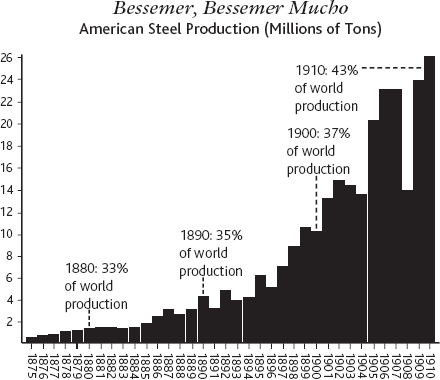
Henry Ford (1863–1947)
Henry Ford’s accomplishments go way beyond simply founding the Ford Motor Company. His innovations in manufacturing and marketing revolutionized dozens of industries, raised the standard of living for billions of people around the world, and literally reshaped the landscape, all while securing America’s position as the leading industrial power.
Born on a farm in Dearborn, Michigan, in 1863, the young Ford gained a reputation for being a technical whiz. As a child he fixed watches, and by the age of 16, he’d taken a job as an apprentice machinist in Detroit. By 19, Ford had returned to Dearborn to work on the family farm; but he found the work intolerably tedious. To pass the time, he tinkered with his father’s small portable steam engine, and before long he was hired as a steam engine repairman. After marrying his wife, Clara, in 1888, Ford also opened a sawmill to supplement their income–but his brilliant mind was drawn to the new, more complex technologies transforming the United States and the wider world. In 1891 he took a job as an engineer with the Edison Illuminating Company, where he quickly worked his way up to chief engineer.
In 1893, Ford began experimenting with gas-powered internal combustion engines, and by 1896, he’d built his own rudimentary automobile, dubbed the “Quadricycle.” After receiving encouragement from Edison himself, in 1899 Ford rounded up enough investors to create the Detroit Automobile Company, but his first attempt at automobile manufacturing failed, and the company went belly-up within two years. Ford blamed the high price of the vehicles. But he also noticed that consumers were deterred by the noisy engines, which many assumed were unsafe. After building two faster, quieter models, in 1902 Ford and his friend Alexander Malcomson launched a new company, Ford & Malcomson, Ltd., which was renamed Ford Motor Company in 1903.
This time around, Ford cleverly promoted his new vehicles by giving souped-up versions to race car drivers and sponsoring the Indianapolis 500. (Predictably, as soon as Americans had cars, they started racing them.) Then, in 1908, he introduced the Model T, which combined affordability with quality and a less noisy engine. The model became immensely popular, and immensely profitable for Ford–who maximized profits by implementing assembly-line manufacturing at his plant in Dearborn, Michigan. His innovative system used moving belts to carry parts and partially assembled machinery from station to station, where workers performed different tasks again and again. By having workers focus on performing just one task many times, instead of the complex process of assembling an entire vehicle, Ford was able to raise productivity, which in turn allowed him to offer his workers better wages than any other factory owner.
Like his fellow industrial barons, Ford left a mixed legacy, earning praise as a pioneer of industry, a generous employer (he was an early advocate of profit sharing and the 40-hour workweek), and a philanthropist. However, he also had some noteworthy flaws: like Carnegie, he employed thuggish security details to break up protests by striking employees, sometimes resulting in bloodshed. Ford is also remembered for his eccentric political views, which were colored by his surprisingly passionate anti-Semitism. During World War I, he claimed that Jewish war financiers sank the Lusitania to bring the United States into the war. Ford also became an admirer of Adolf Hitler–who returned the sentiment, telling an American reporter, “I regard Henry Ford as my inspiration.” The German dictator even awarded Ford a medal and kept a portrait of Ford next to his desk.
BY THE NUMBERS 
|
84 percent |
voter turnout in South Carolina, 1880 |
|
18 percent |
voter turnout in South Carolina, 1896 |
|
181,315 |
number of African-Americans eligible to vote in Alabama, 1900 |
|
2,980 |
number of African-Americans eligible to vote in Alabama, 1903 |
|
600,000 |
total number of white voters disenfranchised by Alabama, 1900–1941 |
|
500,000 |
total number of black voters disenfranchised by Alabama, 1900–1941 |
|
49,371,340 |
U.S. population, 1880 |
|
91,641,195 |
U.S. population, 1910 |
|
6,499,431 |
number of U.S. citizens/permanent residents who were born abroad, 1880 |
|
15,243,626 |
number of U.S. citizens/permanent residents who were born abroad, 1910 |
|
1,388,550 |
tons of steel manufactured in the United States, 1880 |
|
26,094,919 |
tons of steel manufactured in the United States, 1910 |
|
43 percent |
proportion of world steel output this represented, 1910 |
|
1,912,000 |
population of New York City, 1880 |
|
4,767,000 |
population of New York City, 1910 |
|
$350 million |
total cost of the U.S. Panama Canal project |
|
21,900 |
death toll among workers on the French attempt to build a canal |
|
5,600 |
death toll among workers in the American canal project |
|
232,000,000 |
cubic yards of earth excavated in the American canal project |
|
200,000 |
total number of Filipino civilian deaths during the rebellion against American occupation from 1899 to 1903 |
|
60,000 |
number of Americans sterilized under various eugenics laws in the twentieth century |
|
47,900 |
number of telephones in the United States, 1880 |
|
150,000 |
number of telephones in the United States, 1886 |
|
1,800 |
number of gas-powered automobiles in the United States, 1900 |
|
458,000 |
number of gas-powered automobiles in the United States, 1910 |