


THE STATE OF THE UNION 
For most of the world, the first half of the twentieth century was a horrible nightmare of violence and destruction, beginning with World War I (1914–1918). But for the USA, things were booming, and America did its best to stay aloof from all those Debbie Downers abroad. Alas, in the “modern” era, that turned out to be impossible.
Once roused into joining World War I, the United States poured its resources into the effort, providing a decisive surge of manpower that forced Germany and the other Central Powers to admit defeat. Afterward, the peoples of Europe (though not their leaders) looked to the United States to lead peace negotiations. Unfortunately for everybody, President Woodrow Wilson kind of screwed up the peace negotiations, and his successors did the same to international finance.
But let’s stay positive. Back home, the postwar period was super, as continuing revolutions in science, technology, and manufacturing transformed American society and culture. More and more households owned things: cars, telephones, refrigerators, and best of all, radios! At the push of a button you could get the latest news, listen to a sporting event in another time zone, or even turn an isolated farmhouse into a dance hall. And there was plenty of new music to dance to. Jazz was part of a hip urban aesthetic with its own slang, fashion, art, and literature, created by poor African-Americans fleeing the Jim Crow South for Northern cities. Unfortunately, the refugees encountered a whole new set of problems, including drug abuse, crime, and–you guessed it–more racial discrimination
The whole period shared this ambiguity. On one hand, the “Roaring ‘20s” was fueled by spectacular economic growth. Between the easy access to loans and all the fun new consumer must-haves, America was quick to indulge. But (*spoiler alert*) this was all leading to dangerous “bubbles” in the credit and stock markets, and as the ‘20s roared on, storm clouds began appearing on the horizon.
Meanwhile, World War I established an ominous precedent by expanding the government’s role in the economy and the lives of citizens, making Americans more beholden to their government. But at least we had jazz to keep us humming.
 WHAT HAPPENED WHEN
|
November 5, 1912 |
Woodrow Wilson wins first term as president, beating Teddy Roosevelt, who ran on the “Bull Moose” ticket. |
|
August 1, 1914 |
World War I begins in Europe. |
|
November 7, 1916 |
Woodrow Wilson wins reelection with slogan “He Kept Us Out of the War.” |
|
January 19, 1917 |
Zimmerman telegram, in which Germany urges Mexico to declare war on the United States, is made public. |
|
February 1, 1917 |
Germany resumes unrestricted submarine warfare. |
|
April 6, 1917 |
United States joins World War I. |
|
July 3, 1917 |
First U.S. troops arrive in France. |
|
January 8, 1918 |
Wilson outlines “Fourteen Points” for peace. |
|
March 3, 1918 |
Bolsheviks make separate peace with Germany, Treaty of Brest-Litovsk. |
|
March 11, 1918 |
First outbreak of influenza at Fort Riley, Kansas. |
|
April–May 1918 |
Influenza spreads in French camps near Bordeaux. |
|
November 11, 1918 |
Germany agrees to an armistice. |
|
June 28, 1919 |
Treaty of Versailles is signed. |
|
January 16, 1919 |
Eighteenth Amendment ratified, enacting Prohibition of alcohol. |
|
August 18, 1920 |
Nineteenth Amendment ratified, giving women the right to vote. |
|
March 3, 1923 |
Henry Luce launches Time magazine. |
|
August 2, 1923 |
Warren Harding dies in office, is succeeded by Calvin Coolidge. |
|
September 1, 1924 |
United States formulates Dawes Plan to regulate European debt repayments. |
|
April 10, 1925 |
F. Scott Fitzgerald publishes The Great Gatsby. |
|
July 10, 1925 |
Scopes Monkey Trial begins in Dayton, Tennessee. |
|
October 22, 1926 |
Ernest Hemingway publishes The Sun Also Rises. |
|
May 20–21, 1927 |
Charles Lindbergh flies across the Atlantic Ocean from New York to Paris. |
|
October 6, 1927 |
“The Jazz Singer,” starring Al Jolson, popularizes “talkies.” |
|
November 18, 1928 |
Mickey Mouse makes first appearance in Disney’s cartoon “Steamboat Willie.” |
|
November 6, 1928 |
Herbert Hoover wins presidency with a promise of “A Chicken in Every Pot.” |
LIES YOUR TEACHER TOLD YOU 
LIE: America has always stood by other democracies.
THE TRUTH: Let’s call a spade a spade. For most of its history, America hasn’t given a darn about other democracies. There have been some heroic interventions–like World War I–but these were really just heroic justifications for protecting American trade (which America has always cared about). Over the decades, the “preserving democracy” excuse was only trotted out when the nation’s leaders needed to rally public opinion. Thus it wasn’t until trade was threatened that the United States discovered that World War I was putting Democracy in Danger.
To be fair, American isolationists had some good arguments against entering World War I. From the U.S. perspective, the arrogant Europeans had foolishly gotten themselves into the war through a ridiculous tangle of treaties. And the players weren’t exactly defenseless: Britain stood at the head of the largest empire in history, French soldiers were considered the bravest in Europe, and Russia was really, really big. So the Allied powers didn’t seem to need American help. Further, Germany was a multiparty democracy at the time, and millions of Americans were descended from German immigrants.
By 1915 public opposition to the war was mushrooming, and it spawned dozens and dozens of civic and religious organizations, many organized by Quakers and women. In a politically savvy, though not entirely truthful reaction to the broad-based feelings of opposition, President Woodrow Wilson won the 1916 election with the catchy slogan “He Kept Us Out of the War.” Of course, skeptics noted that Wilson actually seemed to be preparing for war by expanding the U.S. Army, National Guard, and Navy, establishing the Army Reserve Officer Training Corps (ROTC), and giving himself authority over the National Guard in case of emergency.
 Woodrow Wilson’s “He Kept Us Out of the War” slogan held true for barely a month into his second term; he was re-inaugurated on March 4, 1917. The United States declared war on Germany on April 6.
But not everyone in the United States shunned the fight: America’s political and economic elite favored intervention as early as 1915, knowing that key trade relationships with Britain and France would be ruined if they were defeated. After American trade with Germany was severed by the British blockade, trade with Britain and France grew even more important. During the war, American exporters supplied both countries with vehicles, fuel, food, and consumer goods, allowing the Allied Powers to devote their own industry exclusively to armaments–and American exporters were making out like bandits. Then bankers got in on the act: starting in 1915 American banks loaned Britain and France hundreds of millions of dollars to continue buying American goods. These war financiers feared that the debts might never be repaid if the Allied Powers lost. With so much trade and money at risk, these business interests were all the motivation that the United States needed to get in on the Allied action. But how would the politicians and elite get ordinary Americans on board?
Luckily, they had some help from the Germans. In the throes of warfare, German “U-boats” (from unterseeboot or “undersea boat”) began by sinking British and French merchant ships and then started going after neutral ships and passenger vessels as well–especially those carrying armaments and supplies to their enemies. Before long, U-boat attacks had claimed the lives of hundreds of American civilians; the most infamous incident was the sinking of the Cunard liner RMS Lusitania on May 17, 1915. Indeed, the ship had been carrying arms–including 4.5 million rifle cartridges–but the huge number of civilian casualties (1,198 lives, including almost 100 children and 128 Americans) triggered a wave of anti-German sentiment.
Upon its launch in 1907, the Lusitania was the largest ocean liner in the world.
In response, Germany–which was wisely trying to avoid baiting the United States into the war–forbade attacks against neutral shipping and passenger liners. But the position didn’t last: German civilians were suffering from the British blockade, and as the war dragged on, German hard-liners demanded a return to unrestricted submarine warfare against neutral shipping, American vessels or not. The German strategy almost worked: in the last two years of the war, U-boats sank 8.9 million tons of shipping, and the effort nearly starved Britain into surrender. But it also gave Wilson the support he needed to get Congress to declare war in April of 1917.
A few days after obtaining the declaration of war, Wilson established the Committee for Public Information (CPI), tasked with unleashing a barrage of propaganda to get Americans marching to the same tune. Guided by marketing all-stars from journalist Walter Lippmann (the Pulitzer prize winner who also introduced the concept of “Cold War”) to Edward Bernays (considered the “father of public relations”), the CPI launched a propaganda blitz through every medium possible: newspapers, magazines, books, pamphlets, radio, movies, public events, and public school curricula. The campaign had two main thrusts: first, highlight the German brutality, and second, link the war effort to democracy instead of, you know, business interests. Here, the German military again pitched in by effectively overthrowing the democratic government in January 1917. Once a military coup took over Germany, American sympathy for the nation waned, and the anti-war movement was promptly pushed aside to make way for the Great War.
It all culminates in the fabrication of a system of all evil, and of another which is the system of all good … It is not enough to say our side is more right than the enemy’s, that our victory will help democracy more than his. One must insist that our victory will end war forever, and make the world safe for democracy.
–Walter Lippmann, Public Opinion, 1922
 QUICK’N’EASY WORLD WAR I
In a major dose of irony, WWI essentially resulted from a system of treaties created to keep the peace in Europe. After initially staying aloof, the United States was forced to join the fight because of economic ties with Britain and France (along with Russia, the main Allied Powers). U.S. industry and manpower helped bring the Central Powers–Germany, Austria-Hungary and the Ottoman Empire–to their knees.
1914: On June 28, Archduke Franz-Ferdinand of the Austrian Hapsburg dynasty was assassinated in Sarajevo–the capital of Bosnia, a province of Austria-Hungary–by a Bosnian Serb nationalist. Backed by Germany, Austria-Hungary declared war on the neighboring Kingdom of Serbia in August, triggering a counter-declaration of war by Serbia’s ally Russia, followed by Germany, France, and Britain. Germany seemed unstoppable at first, scoring major victories over Russia on the eastern front and smashing through neutral Belgium to invade northern France on the western front. However, both fronts settled into trench warfare thanks to a badass new weapon–the machine gun–which could mow down hundreds of attackers.
1915: Both sides tried to break the stalemate of trench warfare with new tactics, especially poison gas, pioneered by the Germans. Germany conducted the first aerial bombardments of London with zeppelins and unleashed submarine warfare against Allied shipping. Meanwhile the Turks launched the Armenian genocide which eventually killed 1.5 million. Britain set up a naval blockade of Germany in March, and Italy joined the Allied Powers in April.
1916: Having failed to break the stalemate, both sides resorted to more human wave assaults which failed to achieve anything. The Somme saw the first experimental use of tanks by the British, who also introduced the draft in May. Meanwhile in August Kaiser Wilhelm II appointed a new top commander, Paul von Hindenburg, who took control of the entire German economy.
1917: The Allied Powers suffered a major setback as Russian armies mutinied and revolutionaries toppled Czar Nicholas II in February, leading to the collapse of the eastern front. However, the odds were evened by the United States joining the war on April 6, 1917, following renewed German submarine warfare and anger over the Zimmerman telegram (in which Germany encouraged Mexico to attack the U.S.).
1918: Following a second revolution by Lenin’s Bolsheviks, the Bolsheviks made peace with Germany, allowing the Germans to shift over a million troops from the eastern front to the west. U.S. troops under John “Blackjack” Pershing help blunt the impact of the final German offensive. As the world was decimated by influenza, the Ottoman Empire signed an armistice on October 30, followed by Austria-Hungary on November 3 and Germany on November 11. All three soon collapsed as revolutions swept away outdated monarchies.
LIE: Woodrow Wilson failed to achieve his goals because he was too idealistic.
THE TRUTH: Things might have turned out better for Europe and the rest of the world if President Wilson had been a little more idealistic–or at least, more consistent.
When the smoke cleared after World War I, the United States had clearly bumped aside Britain as top dog. Wilson, dubbed by the press as “the most powerful man in the world” and “the Prince of Peace,” was widely expected to forge a fair settlement balancing the interests of the victorious Allied Powers (Britain, France, and Italy) with those of the defeated Central Powers (Germany, Austria, and Turkey). This wasn’t unreasonable. Although the United States fought on the side of the Allied Powers, America’s short involvement left its citizens relatively untainted by the bitterness permeating Europe. Thus, Wilson had room to present himself as an impartial mediator who could exercise a restraining influence on the victors. Plus, France and Britain both owed the United States billions of dollars and were hoping to renegotiate their enormous debts on more favorable terms, giving him leverage, if he chose to use it (in the end he didn’t). The situation seemed ideal, especially since the Germans were already on board with Wilson’s plan for peace–or so they thought.
In three addresses to Congress during 1918, Wilson outlined a framework for peace negotiations, consisting of “Fourteen Points” elaborated by “Four Principles” and capped by “Five Particulars.” These included “absolute freedom of navigation upon the seas,” implying the British blockade would be lifted; “no discrimination or favoritism between peoples,” implying the United States wouldn’t favor the Allied powers over Germany; and last but not least, “peoples and provinces are not to be bartered about from sovereignty to sovereignty,” implying that Germany would retain its territorial integrity. This Powerpoint for Peace was consistent with Wilson’s call for “peace without victory,” meaning a fair settlement that didn’t blame or punish the losers.
Mr. Wilson bores me with his Fourteen Points. Why, God Almighty has only ten!
–French Prime Minister Georges Clemenceau, 1918
Two days after Wilson made the promise about territorial integrity, the top German general, Erich von Ludendorff, instructed his staff to open negotiations for a cease-fire. Wilson had offered Germany peace with honor, and his generous terms were critical to von Ludendorff’s decision: Germans wanted peace, but not at the price of German territory, which would dishonor the sacrifice of over 2 million German soldiers and the half a million German civilians who died. And while Germany was in bad shape, it wasn’t finished–with Russia out of the war due to a Bolshevik uprising, the German army appeared capable of fighting on if necessary. By September 1918, roughly 1.4 million German soldiers were conducting a fighting withdrawal, inflicting huge casualties on a combined French, British, and American force of about 1.7 million.
Ludendorff stood beside Adolf Hitler during the latter’s unsuccessful coup attempt at Munich in 1923. He soon fell out with the future Fuehrer, however, when he joined a fanatical pagan group whose ideals did not mesh with the Nazi philosophy.
Unfortunately, Wilson didn’t stick to his promises. On October 29, 1918, Wilson’s personal representative, Edward House, met secretly in London with French Prime Minister Georges Clemenceau and British Prime Minister David Lloyd George to secretly hear their “commentary” on the president’s proposal. Their secret revisions basically gutted Wilson’s most important promises, calling for the breakup of the Austro-Hungarian Empire, the creation of a new Polish state using a chunk of Germany, and the transfer of the province of Alsace-Lorraine from Germany to France. The Brits and French also demanded that the treaty include a statement of Germany’s official “war guilt,” a meaningless insult practically designed to make the Germans angry–but not as angry as the subsequent bill for the damages. The Allies figured something along the lines of $33 billion ($2.2 trillion in today’s dollars) should do it, with payments scheduled until 1988.
After secretly saying goodbye to the two prime ministers, House sent a telegraph to Wilson summarizing the French and British revisions, so the president knew about them when the Allies agreed to begin armistice negotiations just a week later. But he neglected to inform the Germans about these incredibly important changes. It was a classic bait and switch. When the Germans finally did find out about the revisions in March of 1919, another promise to them was broken: instead of a negotiation between the Central Powers and the Allies, as Wilson had guaranteed, Germany and Austria were simply told to sign.
When President Wilson left Washington he enjoyed a prestige and a moral influence throughout the world unequalled in history … The disillusion was so complete, that some of those who had trusted most hardly dared speak of it … Was the treaty really as bad as it seemed? What had happened to the President?
–John Maynard Keynes,
The Economic Consequences of the Peace, 1919
So the question remains: if the Germans objected to the final treaty, why didn’t they just refuse to sign it and keep fighting? By this point, it wasn’t an option. Six months had passed since the armistice took effect, and both sides were already demobilizing, sending exhausted, traumatized soldiers home as fast as they could. And by the time the German delegation arrived in Versailles to sign the treaty, the government of the new Weimar Republic was barely able to maintain order at home. The delegation had no choice but to sign under protest and then tell the German people they’d been duped.
A common response at the time was: so what? After all, the Germans had just imposed an incredibly unfair peace treaty on the Russians at Brest-Litovsk in 1917–so why should they expect to be treated any better? Besides, the whole war was pretty much their fault anyway, according to the Allies. But the deception was a big deal. It triggered a wave of outrage across the German political spectrum–left, right, and center–which almost never agreed on anything. If Allied diplomats didn’t understand why this was a problem, then they’d just have to wait and see. It wouldn’t be long.
To this day, nobody really knows what Wilson was thinking. It’s possible he deliberately deceived the Germans–but the implication that he drew up an idealistic peace program as part of the biggest con job in history just seems too perversely cynical. Alternatively, it may have just slipped his mind; there are, in fact, questions about Wilson’s mental health during this period. In April 1919, while in Paris, he suffered a minor stroke, which can change one’s personality and cause disordered thinking. And there may have been earlier strokes that were covered up. But the most likely explanation is that he just deferred these unpleasant, complicated issues to the new League of Nations proposed by Britain: sure, the Germans would be wildly upset for a few years, but his successors in the White House could make sure the new international body addressed Germany’s grievances.
Woodrow Wilson never owned a dog while in the White House, but he and his wife kept a flock of sheep as pets (and natural lawn mowers). Their wool was auctioned to raise funds for the American Red Cross.
That plan would maybe have worked had the United States actually joined the newly formed League of Nations, but partisan politics and senile dementia ensured the United States would never join the League. Without U.S. participation, the terms of the Treaty of Versailles were never revised–meaning Germany stayed angry, and indeed, got even angrier.
WHOLE LOTTA GOV
From 1910 to 1930, everything about America got bigger: population, industrial power, energy consumption, cars, buildings. All this growth was viewed as good for Americans and therefore, the world. But this period also saw remarkable expansion of government at the local, state, and national levels. This was partly due to the huge expansion of the American economy, whose growing complexity demanded more regulatory mechanisms. In December 1913, Woodrow Wilson signed the Federal Reserve Act, creating the Federal Reserve System (in essence, a new U.S. central bank) to provide liquidity in case of emergency. “The Fed” also assumed responsibility for controlling the money supply by raising or lowering interest rates on loans to private banks and determining the interest rates they charged for their loans. 1913 also saw the creation of a permanent federal income tax.
World War I accelerated the expansion: the government was suddenly tasked with coordinating industrial production, creating an army of over four million men, transporting them to Europe, and guaranteeing massive loans to European allies. Inevitably, the war spending ran up huge deficits, which most Americans accepted, because the war was an emergency. But once the war ended, America quickly discovered that shrinking government is like trying to get toothpaste back in the tube: although total government spending decreased sharply after World War I, the government’s share of GDP ended up being almost twice as large (14.3 percent) as before the war (8.2 percent).
LIE: Social progress began in cities and then filtered out to rural areas.
THE TRUTH: Sorry, city slickers! One of the most important social movements in American history–women’s suffrage–got going on the frontier before taking root in cities.
As early as the eighteenth century, women (and men) had been advocating women’s suffrage in Europe and America, but their numbers had remained small. That all changed, however, in the middle of the nineteenth century when their cause became intertwined with abolitionism. As female activists became major players in the movement to end slavery, they became increasingly frustrated by its slow progress–a hurdle they blamed on their inability to voice opinions directly through the ballot box.
While women’s suffrage was discussed everywhere in the United States in the nineteenth century–most notably at the Seneca Falls Convention organized by Elizabeth Cady Stanton in upstate New York in 1848–the first real progress came on the Western frontier. In 1869 the Wyoming territory became the first political entity in the Northern Hemisphere to grant women the right to vote regardless of their professional or marital status. Following Wyoming’s lead, women’s suffrage movements won the right to vote from all-male state governments in Colorado in 1893, Utah in 1895, and Idaho in 1896. After the turn of the century, they were joined by Washington in 1910; California in 1911; Arizona, Oregon, and Kansas in 1912; Alaska in 1913; and Montana in 1914. Progress was considerably slower back East. In 1913 Illinois gave women the right to vote in presidential elections but not state elections. And it wasn’t until 1917 that New York became the first Eastern state to grant women full suffrage. Finally, in 1919 both houses of Congress caught on to the 50-year old trend and passed the Nineteenth Amendment to the Constitution, giving women the right to vote.
The first American woman to cast a vote in a public election was Wyoming’s Eliza Swain, on September 6, 1870.
So why were Western states so far ahead of the curve? The reason may have been economic–women were in short supply in many parts of the frontier, resulting in a scarcity of labor. In 1870 women made up just 19 percent of Idaho’s population, 19 percent in Montana, 24 percent in Nevada, 21 percent in Wyoming, and 37 percent in Colorado. Or perhaps it was biological, as these were great odds for the ladies, but not so ideal for the menfolk. As the years progressed, lonely legislators hoped that giving women the right to vote would attract more women from back East as well as lure more immigrants.
As I am from a city farther east, where the best hands get only $5 per week, I think the wages, $7.50, here are very good, but the girls here do much more work.
–female worker in Denver, 1888
Back at the national level, one of the main reasons Congress finally passed the Nineteenth Amendment–nearly half a century after women had been given suffrage in Wyoming–was the war. Wilson’s claim that the United States fought to protect democracy sparked suffrage protests and a vigil for freedom in Washington, D.C. Meanwhile, America was also feeling the effects of events in Europe, where new postwar governments in Germany, Austria, Russia, and Poland had given women the right to vote in 1918. Even Britain had granted women limited suffrage by that point, and Congress was feeling the pressure.
TRENDSPOTTING 
The Great American Road Trip
The 1920s kicked off the golden age of automobiles. The appeal was obvious: compared to horses, cars were faster, more reliable, required less care, and didn’t leave large clumps of the brown stuff in the street. Henry Ford’s assembly-line production made cars so cheap that practically every household could aspire to own one: the Model T fell from $850 in 1909 to just $290 in the 1920s. Meanwhile, larger vehicles revolutionized public transportation and distribution in American cities: buses carried the car-less for a penny, while refrigerator trucks allowed more reliable delivery of fresh foods and ice.
Imagine a motor car able to support on its roof the live weight of a 10,000 pound elephant!
–Chrysler magazine advertisement, 1931
Automation
The Rise of American Car Culture, 1905–1935

This new age of pistons and four-wheelers also brought with it a new custom: the road trip. Suddenly, families and groups of friends could tour states, regions, or even the whole country by automobile, stopping to see the sights and experience the local color. These early road trips weren’t for the faint of heart. Most cars lacked insulation against the elements, and the stretches of road outside cities and towns were poorly constructed. At the time, American roads were still a patchwork of local streets, “post roads,” privately maintained “auto trails,” and private roads on farms and ranches; that remained the case until the late 1920s, when the first primitive interstate highways went into service. In fact, these new roads were paid for by taxes on gasoline–one of the few times Americans actually welcomed taxes. As one of Tennessee’s top gas tax officers put it, “Who ever heard, before, of a popular tax?”
But it was clear, as a new America blossomed, that folks were keen to put their new cars to the road, exploring every inch of the country. The sudden increase in the number of people taking long-distance car trips, for business and pleasure, led to the emergence of a whole new world of commercial enterprises to serve them. One obvious necessity–fuel–was filled by roadside gas stations. America’s first “filling station,” built in St. Louis in 1905, was an independent business (read: not owned by Standard Oil). However, the second was built by Standard Oil in Seattle in 1907, beginning a trend of national chains owned by American energy companies. The number of U.S. gas stations in operation jumped from 25 in 1910 to 15,000 in 1920 and over 100,000 in 1930.
The first cross-country road trip was made in 1903 by H. Nelson Jackson, Sewall Crocker, and a dog, Bud, who traveled from San Francisco to New York in 63 days.
Meanwhile new businesses also offered lodging to long-distance drivers–“auto camps,” basically early motels consisting of separate cabins or bungalows (or concrete “teepees,” if you were feeling kitschy), which rented for a few dollars a night. Many auto camps, or “tourist courts,” were located near national parks and recreation areas, reflecting the surge in interest in outdoor activities and sightseeing enabled by car ownership. During the late 1920s and 1930s, auto camps gave way to bona fide motels (that’s “motor” + “hotel”)–single structures, usually no more than one or two stories in height, offering hotel-like accommodations, including gross, vaguely mildewed towels. Like so many other twentieth-century lifestyle innovations, motels came from California: the first, the Motel Inn of San Luis Obispo, was built by Arthur Heineman in 1925.
Don’t forget about food! Road-tripping builds an appetite, but in an era before effective health regulations, drivers were understandably leery of catching salmonella at some roadside greasy spoon. New national restaurant chains sprang up to meet this demand, offering travelers alimentary assurance with a standard menu and prominently displayed promises of cleanliness. The most famous of the new chains was Howard Johnson’s. Beginning with a single soda shop and newsstand founded in Quincy, Massachusetts, in 1925, over the next three decades Howard Deering Johnson built an empire of roadside diners (with matching motels, beginning in 1954), which achieved iconic status with their bizarre orange roofs and glowing blue beacons.
HERE WE ARE NOW, ENTERTAIN U.S.
The 1920s wasn’t just a golden age for automobiles. It was also the dawn of a new era of fun! New forms of entertainment quickly became cultural necessities. The widespread availability of radio receivers, based on the work of the Italian Guglielmo Marconi in the late nineteenth century, gave rise to radio broadcasts that carried news, music, talk shows, and serialized melodramas to millions of households across the United States. Meanwhile, beginning in the 1910s, record numbers of Americans went to silent movies, with almost 75 percent of the population attending a movie at least once a week by the end of the 1920s. Moviegoers were drawn by the first generation of Hollywood movie stars, including beauties like Mary Pickford, Louise Brooks, Clara Bow, and Lillian Gish, as well as comedians like Charlie Chaplin, Buster Keaton, and Harold Lloyd and dashing leading men like Douglas Fairbanks and the legendary Rudolph Valentino. The introduction of “talkies,” beginning with “The Jazz Singer,” starring Al Jolson (1927), took the movie craze to the next level.
 OTHER PEOPLE’S STUFF
Good Morning, Vladivostok!
Of all the odd, unexpected places occupied by American troops over the years, two of the weirdest have to be the Russian ports of Vladivostok and Archangelsk, located on the Pacific Ocean and the White Sea, respectively. So how the heck did U.S. troops end up there?
Following a successful coup in November 1917, Vladimir Lenin’s communist Bolsheviks seized control of the Russian heartland in Eastern Europe. But the “Reds” still faced a loose alliance of “Whites” (Russian officers still loyal to the throne), “Greens” (nationalist and peasant armies fighting for independence), “Blacks” (anarchists), and various foreign POWs and volunteer fighters, who didn’t get colored jerseys.
Fearing a Bolshevik victory might trigger revolutions in Western Europe, the British and French decided to nip the threat in the bud by helping Bolshevik foes crush the movement. Of course the two countries were a little overextended, what with World War I and all, so they looked to their new ally–the United States–to do the heavy lifting. President Wilson was skeptical, but in July 1918 he agreed to send 5,000 troops to Archangelsk and 8,000 troops to Vladivostok on the condition that their missions be limited to guarding Allied aid shipments.
By the time the American North Russia Expeditionary Force (nicknamed the “Polar Bears”) arrived in Archangelsk, the Bolsheviks had already lifted the stockpiles, leaving the Americans twiddling their thumbs. So the British general in charge sent them into battle. The American force fought bravely, pushing the Reds back hundreds of miles, but ultimately, just like every other would-be Russia invader in history, they were frustrated by the nation’s sheer size. Then the Russians–who were better prepared for winter fighting–launched a series of attacks forcing them back to Archangelsk. The U.S. troops were finally withdrawn after the ice melted in May 1919, by which time they’d suffered about 110 combat deaths and 70 deaths from disease (mostly influenza).
Meanwhile, the American Expeditionary Force Siberia arrived in Vladivostok in August of 1918. Their American commander, General William S. Graves, refused to take part in Allied attacks on the Bolsheviks, pointing out that this wasn’t part of his mission. This saved his troops from combat. But during the two long years Graves and his troops spent guarding the eastern end of the Trans-Siberian Railroad, they suffered all the miseries for which Siberia is famous: freezing temperatures, disease, and shortages of food and fuel. Their endurance earned them their own animal nickname, the “Wolfhounds,” after their hardy canine mascot. The lucky ones got to take R&R in Vladivostok, a cosmopolitan city with electricity, streetcars, and, well, ladies of the night. The last Wolfhounds left Siberia in April 1920, having suffered 189 deaths from noncombat causes.
In the end, neither occupation achieved much of anything. The Bolsheviks’ success and the aftermath–including the murders of millions of innocent people ordered by Lenin and Stalin–horrified the world and especially offended the staunchly capitalist United States, where anti-communism became the defining political ethos of the twentieth century.
The Loan Ranger
Most wartime loans to the European allies actually came from the U.S. government rather than private sources. In 1923 the Brits still owed the United States $4.66 billion, equal to one-quarter of the U.K.’s gross domestic product, while France owed about $3 billion. France and Italy also owed money to Britain, and thanks to the reparations agreement, Germany owed money to, like, everyone.
After the war, the Brits and French suggested canceling their debt, or at least lowering the interest, to help revive Europe’s totaled economy. The American response, delivered by Wilson’s successors, the Republican Presidents Warren Harding and Calvin Coolidge, was basically what you’d say to your broke cousin Eddie who owes you two grand: “That’s a nice idea. Where’s my money?” Counterintuitively, some forgiving and forgetting would actually have been more beneficial to the United States: putting cash in European pockets would have allowed them to buy more American imports, and the United States could have used its leverage to demand an end to protective tariffs. Renewed trade could also have tied Europe together, possibly averting another war. But the U.S. government wasn’t interested in thinking the situation through. In fact, American diplomats were forbidden to even talk about canceling the debt.
At today’s value, the combined postwar debts that Britain and France owed the United States would exceed $500 billion.
The problem with this strategy was that Britain’s debt was merely the last link in a debt chain involving practically every country in Europe. The first domino fell in January 1923, when the Americans refused to allow any major revisions to the terms of Britain’s debt, meaning Britain couldn’t offer France easier terms. Of course the French refused to lower German reparations payments until they knew theirs would be lowered too. To drive the point home, in January of 1923 France declared Germany in default and sent troops to occupy the Ruhr Valley, a key German industrial region, with the intention of squeezing the cash out of local banks and industries.
Borrowed money, even when owing to a nation by another nation, should be repaid. They hired the money didn’t they? Let them repay it.
–President Calvin Coolidge, explaining why he
wouldn’t forgive European debts, 1925
Unfortunately, the French squeezed too hard. German workers in the Ruhr went on strike, German businessmen refused to pay the French taxes, and on March 31, eleven German factory workers were killed in clashes with French troops. In August, the whole situation just got worse. The British demanded that the French pay at least enough to enable Britain to pay its debts to America, at the same time begging the French to stop extorting funds from Germany. The French replied that they’d be happy to reduce Germany’s payments as soon as Britain reduced French debt, which … well, you get the idea.
Meanwhile, the German government, infuriated by the French occupation, had a brilliant idea for paying off its debts: print more money! This scheme triggered hyperinflation, and by November 1923, the average price of consumer goods in Reichsmarks was an incredible 260 million times what it had been in January of that year. (Around this time, cash had become so devalued that German housewives started using money to light their kitchen stoves.) In September, Bavaria revolted, and this was followed by a communist uprising in Hamburg. Martial law was declared, and in October of 1924, a new chancellor announced that Germany wouldn’t pay further reparations without some kind of deal to get French troops out of Germany.
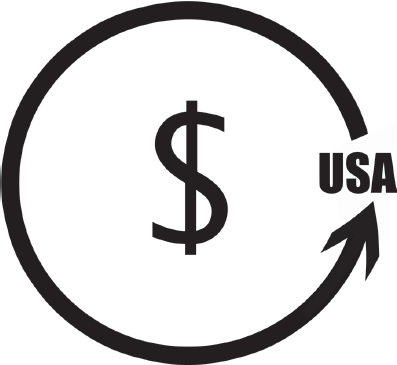
Finally, in 1924 the United States took action and proposed an awesomely ridiculous scheme that “solved” the problem. The “Dawes Plan” (named for Assistant Secretary of the Treasury Charles Dawes) called for billions of dollars in new American loans to Germany, which Germany would use to pay reparations to France, so France could pay Britain, and Britain in turn could pay America. The circular scheme ended up being just as futile as it sounds, since all the loans were basically wiped out by the Great Depression. No country benefited, and everyone suffered. Just canceling the debts really would have been the smarter move.
This would all be sort of comical, in a Three Stooges kind of way, except for the terrible long-term results. The French occupation of the Ruhr inspired a fresh surge of anger in Germany, multiplied by the economic meltdown that followed. As various groups vied to grab the reins in an unsteady German state, one crazy contestant rose to prominence. In 1923 a war veteran named Adolf Hitler led his tiny Nazi Party in a (failed) attempt to seize power in Munich. Thanks in part to the Dawes Plan, he’d be back.

(The Dawes Plan, Simplified)
 WHERE MY GODS AT
Fundamentally Speaking
In the last decades of the nineteenth century, against the glorious backdrop of Gilded Age materialism, immorality, alcohol, prostitution, and violent crime, a new breed of evangelical Protestants emerged. Until then, most Protestant theologians had accommodated the growing field of science by interpreting Scripture metaphorically, but this hard-line group believed in “inerrancy”–interpreting Scripture as the literal word of God.
This new approach was first outlined by Dwight Lyman Moody, the son of a poor Massachusetts stonemason. In 1886 Moody established the Chicago Evangelization Society (later the Moody Bible Institute) and led huge conversion crusades all over America. Before long, “fundamentals” became the group’s rallying cry for a return to “true” Christian faith, and around 1920 these activists were dubbed “fundamentalists.” By this point, they were led by the charismatic William B. Riley, a Baptist from Minneapolis who founded the World Christian Fundamentals Association. After helping enact Prohibition, Riley went after “the new infidelity … modernism” and its “awful harvest of skepticism,” as exemplified by Charles Darwin’s theories. Riley homed in on Darwin, because he believed that his brand of skepticism especially threatened and contradicted the word of the Bible.
When the Church is regarded as the body of God-fearing, righteous-living men, then, it ought to be in politics, and as a powerful influence.
–William B. Riley
While Riley scorned evolutionary scientists, he reserved his harshest criticism for the “liberal” theologians who tried to accommodate evolution by interpreting the Bible figuratively. In an effort to counter the emerging beliefs, fundamentalists opened more than a dozen new schools across the country based around inerrancy. They also took to radio, believing it was the perfect medium to reach the masses. In 1923–1924 debates between fundamentalist John R. Straton and a liberal Unitarian minister named Charles Francis Potter were broadcast live from Carnegie Hall, with listeners voting for the winner by telephone. Not satisfied with airtime on “unchurched” radio, fundamentalists established their own stations, including the Bible Institute of Los Angeles’s KJS (1922) and the Moody Bible Institute’s WMBI (1925). In 1932 fundamentalists contributed 246 hours to Chicago’s weekly total of 290 hours of religious programming; by 1935, 80 stations were broadcasting 400 fundamentalist programs nationwide.
The fundamentalists were encouraged by large, enthusiastic audiences whose presence seemed to confirm that they spoke for ordinary Americans. There’s no question that they struck a chord with millions of people, especially in the South, West, and rural Midwest, where “the great commoner,” William Jennings Bryan, persuaded five state legislatures to pass laws banning the teaching of evolution. But it turns out the fundamentalists fundamentally overestimated their support base …
Monkey See, Monkey Sue
The infamous Scopes Monkey Trial (John Thomas Scopes v. State of Tennessee) was a high-profile, unintentionally comical legal showdown over Tennessee’s 1925 Butler Act, forbidding public schools “to teach any theory that denies the story of the Divine Creation of man as taught in the Bible, and to teach instead that man has descended from a lower order of animals.” The act was named for John Washington Butler, a farmer and clerk for the Round Lick Association of Primitive Baptists (really), who ran for the state legislature after an itinerant preacher convinced him of the evils of evolution.
Encouraged by the American Civil Liberties Union, challengers to Butler’s law chose John Scopes, a 24-year-old football coach and substitute science teacher at Rhea County High School in Dayton, Tennessee, to contest the law. The ACLU brought in Clarence Darrow, the country’s leading criminal attorney, to match wits with William Jennings Bryan, who had suddenly agreed to act as the special guest prosecutor for the state of Tennessee. Both sides were eager to have the trial broadcast live on national radio, and the court case became a contest between opposing worldviews.
Over eight days Bryan argued that evolution wasn’t fact but merely an unproven theory, since science couldn’t explain the mechanism behind it. (DNA wouldn’t be discovered until 1953.) Darrow argued that the meaning of “teach” was ambiguous: if students asked about evolution, could teachers explain the theory without necessarily endorsing it, or was it illegal to even mention the word? In a bizarre, fairly malicious move, Darrow also called Bryan to testify about his Christian beliefs and then pounced when he hauled out the King James Bible for reference, noting there are several versions of the Bible–which one did the law refer to?
After just over a week of media circus, the jury found Scopes guilty (he was), and the judge fined him $100, the minimum amount required by the law. Bryan and Riley preened while their followers celebrated the defeat of evolution–but the real victory went to their opponents, who carried public opinion, thanks to the radio audience. To their surprise, the fundamentalists were ridiculed in the press. The headlines also played on ever-present sectional tensions, depicting the South as a laughingstock. Newspapers noted that the presiding judge–a fundamentalist–opened proceedings with a toddler seated on his desk, began each day with a blessing delivered by a fundamentalist minister, and refused to allow the defense to explain the tenets of evolution to jurors. Meanwhile, the citizens of Rhea County were uncharitably portrayed as a bunch of toothless, whittling, banjo-plucking rubes. The verdict, according to political satirists of the day, was that Darrow had “made a monkey” out of Bryan.
Over the next few years “modernist” clergy defeated fundamentalists trying to take over evangelical churches. The group was further marginalized following the bad press surrounding Sister Aimee McPherson, a popular Pentecostal preacher who faked her own kidnapping in 1926. Beating a retreat, the fundamentalists transformed their churches, schools, and radio stations into the hubs of a separate, parallel society, limiting their exposure to sinners.
MADE IN AMERICA 
The Art of the Cool
Born in New Orleans around 1900, jazz was the first genre of music to inspire a worldwide mania for all things American (which often meant all things African-American), especially in Western Europe. Drawing from blues and ragtime, the genre also folded the jaunty-yet-soulful marching music of traditional New Orleans’ funeral processions into its ingredient list. Before long, jazz spread North, following the wave of African-Americans migrating from the rural South to big Northern cities, and soon it took hold in places like Chicago and New York City, with pioneers like Louis Armstrong, Ferdinand Joseph LaMothe (better known as Jelly Roll Morton), and Duke Ellington.
Jazz was more than just a new kind of music: it was part of a broader style, “American Cool,” which quickly became America’s top export. And while there’s nothing less cool than trying to explain “cool,” we’ll give it a shot in the interest of the historical record.
Dumping Dixie
African-American Migration, 1900–1930

Linguists have noted that unlike some slang terms such as “groovy” or “da bomb,” which eventually began to sound dated, “cool” still remains cool some 50 years after entering the vernacular.
An emotional style focused–paradoxically–on minimizing emotion, “being cool” likely began in African-American culture as a way for individuals to passively deflect the psychological hurt inflicted by white racism. In American Cool, effortless mastery of both oneself and one’s context became expressed through verbal and body language, or lack thereof: the cool American is calm, unfazed, even slightly jaded or blasé. This new emotional minimalism was part of a long-term shift in what society modeled as “proper” emotional behavior. In the nineteenth-century Victorian period, individuals were expected to control the extreme feelings raging just beneath the surface; by the twentieth century, they were supposed to be truly, inwardly detached from those feelings, skeptical of any passion except for “natural” urges like hunger and sexual desire.
One of the great cultural movements of the early twentieth century, the Harlem Renaissance featured a liberal amount of cool aesthetics. In literature, this included the jazz poetry of Langston Hughes, combining a literary voice with gritty subject matter drawn from real life (he described his own musical tastes as “bop or Bach”). The Harlem Renaissance also brought new styles of visual art, drawing on traditional African art, American folk art, and the sights of Harlem, from classically trained painters and sculptors like Charles Alston,
Along with this general attitude and demeanor, mainstream America also picked up the aesthetic trappings associated with African-American cool: a combination of high and low. This juxtaposition was visible in every area of life, from fashion to art to language, and was particularly true for younger Americans who fought in World War I or came of age shortly afterward–the so-called Lost Generation. These disillusioned and dissolute teens and young adults fixated on all the things their elders tried to ignore, and the “low” part of American Cool manifested in a fascination with illegal or illicit behavior and the renunciation of traditional morality, including tramps and hobos, criminals and private eyes, dive bars and flophouses, drugs and alcohol. (At least, in cities. Rural America remained a bit square, holding fast to traditional values.) One example of this renunciation was the risqué “flapper” fashion embraced by young women of the day. Here’s how the New Republic described the trend in 1925:
She is frankly, heavily made up, not to imitate nature, but for an altogether artificial effect–pallor mortis, poisonously scarlet lips, richly ringed eyes … Her dress is brief. It is cut low … the skirt comes just below her knees, overlapping by a faint fraction her rolled and twisted stockings … The corset is as dead as the dodo’s grandfather … The petticoat is even more defunct … The brassiere has been abandoned since 1925.

SLANGUAGE ARTS
Originating in the 1910s–1920s and first popularized by jazz idol Lester Young in the 1930s, the idea of “cool” quickly spread through mainstream culture, giving rise to scores of expressions: you can “be cool,” “stay cool,” “play it cool,” “keep your cool,” “lose your cool,” “cool it,” “cool your heels,” or “cool your jets.” We all want to make a “cool million,” and someone can be a “cool customer,” “cool cat,” “cool as a cucumber,” “coolheaded,” or just “real cool.” Before long (surprise!) the concept was co-opted by corporate America and soon anything could be cool. By the 1950s you could eat Cool Whip, wear Cool-Ray sunglasses, paint your nails with cool Cutex polish, drink cool 7-Up, grill with cool A-1 sauce, or “jazz up” your salad with cool French dressing. For some reason it was extra-cool to spell the word with a “K” in brand names–e.g., Kool cigarettes, Kool-Aid, Dura-Kool fabrics, Kool Krome sunglasses … and the list goes on.
Of course, cool wasn’t the only new slang being slung in America. “Hip” and “hipster,” coined by jazz musicians, referred to the typical position of a supine opium smoker, lying sideways on his or her hip, leading to the coded inquiry: “Are you hip?”
The Original Swine Flu
Proving that things can indeed always get worse, in 1918 the world was devastated by an influenza pandemic that made World War I look like a rowdy soccer match. And it all started in America. Sorry, world!
On March 4, 1918, a deadly influenza virus surfaced among American soldiers in Fort Riley, Kansas–followed by Queens, New York; Charleston, South Carolina; and Detroit, Michigan, later that month. Small and isolated, Fort Riley is definitely the odd man out in this list, prompting an obvious question: why there? Since it’s unlikely the flu actually came from Kansas–most flu strains originate in poor countries where peasants live in close proximity to infected livestock–an innocuous precursor was most likely brought to Fort Riley sometime before the first outbreak.
The flu outbreak forced the cancellation of the 1919 Stanley Cup, when so many players fell ill after the fifth game that it was impossible to continue.
Wherever the disease came from, the events of 1917–1918 were practically designed to spread it, thanks to the global movement of millions of people. After the United States joined World War I in April 1917, the first priority was organizing the greatly expanded U.S. Army. Four million enlisted men were trained and deployed to Europe in waves, beginning with the first draft of 687,000 called up in September 1917. To do this, the Army established 16 regional training centers around the country, each able to accommodate 50,000 men. Like the other centers, Fort Riley brought together large numbers of young men who, for the most part, had never traveled far from home (leaving them vulnerable to strange diseases) and piled them together in drafty barracks. Factor in communal showers, latrines, and dining areas, and you have a pandemic playground. After boot camp, the troops were thrown together in even bigger groups at East Coast ports where they awaited embarkation for Europe. And once in Europe, they were exposed to still more exotic contagions by their foreign allies.
This intercontinental game of musical chairs didn’t just move the virus around: it actually may have caused a killer strain, as a result of multiple strains simultaneously infecting the same individual. When that happens, the virus can veer from the script with a “genetic exchange event”–an RNA remix in which different strains combine their characteristics. Somewhere on its European vacation, the virus became even more virulent and deadly: in April 1918, just one month after the Fort Riley outbreak, an epidemic incapacitated French troops at a camp near Bordeaux, followed almost immediately by flare-ups in northern France and across the frontlines in Germany. In May and June of 1918, it killed five out of every 1,000 people in various parts of Europe–but it wasn’t until August of that year that it became a super-killer, with three simultaneous outbreaks in Boston, Massachusetts; Brest, France; and Freetown, Sierra Leone.
With the earth encircled by disease, the toll was truly epic: altogether the pandemic infected about 500 million people and carried off 50 million–100 million victims. The death toll was two or three times the total number of military and civilian casualties in World War I, and probably more than those killed by the Black Death in medieval Europe. In the United States alone, the flu killed 675,000 people, about six times the number of American soldiers killed in World War I. And actually, more than half of the 110,000 American war dead–57,000–also died from the flu. This global decimation was especially shocking because most of the casualties were young people, reversing the usual pattern for influenza mortality.
Despite its Midwestern origins, the scourge became known as the “Spanish Flu” because Spain–a neutral country–hadn’t instituted wartime censorship, meaning that it was the only place the press could report the actual death toll (260,000).
Frozen Foods
A Birdseye View
It’s hard to believe that there was life before frozen food. But in 1924, Birdseye provided a boon to lazy people across the world when it became the anti-Prometheus and brought frozen foods down to earth. Why did such a simple invention take so long to deliver? One obvious challenge was the lack of a method to keep things frozen. This problem was solved in 1911, when a French monk created the first electric-powered refrigerator. By 1919 a modified American design had been acquired by the president of General Motors, William C. Durant, and renamed “Frigidaire.” The first freezer-equipped refrigerators hit the market in 1922, but sales were hindered by their great expense–at $714, they cost more than a Ford Model T ($500)!
As prices came down, sales picked up (the new models cost just $275 in 1930), and by 1932 Frigidaire and its two main competitors, Kelvinator and Servel, had total annual sales of 2.5 million units. In fact, the demand continued to grow every year, despite the Great Depression. With refrigerators keeping food fresher for longer, housewives didn’t have to make as many shopping trips or worry as much about exposing their families to spoiled milk or meat, which could carry tasty E. coli, salmonella, typhoid fever, and staphylococcus.
Clarence Birdseye founded his frozen food empire with a $7 capital investment, which he used to purchase an electric fan, buckets of brine, and cakes of ice.
Once the refrigerator had been perfected, the next logical step was refining the art of freezing food. But it turns out you can’t just throw fresh meat or vegetables into the freezer: if the freezing process takes too long, water has a chance to form large ice crystals, which rupture the food cell membranes, destroying the food’s nutritional value and making it soft and mushy (the technical term is “gross”). Fortunately, in 1916 a Brooklyn taxidermist named Clarence Birdseye realized that this could be avoided with rapid freezing, preserving more of the food’s texture, flavor, and nutrients. In following years Birdseye developed a process for “flash-freezing” vegetables in wax-coated cardboard boxes under high pressure; he also figured out that briefly boiling vegetables (blanching) before freezing halted the ripening process, which otherwise resulted in tough, flavorless, discolored vegetables. By 1924 Birdseye had mastered the basic flash-freezing process and opened his own business, the General Seafoods Company, selling flash-frozen fish, vegetables, and rabbit.
In 1929 General Foods–later Kraft General Foods–bought Birdseye’s patents and trademarks for the huge sum of $22 million and began selling the first “Birds Eye Frosted Food” in 1930. However, Kraft still faced two big obstacles. On the consumer side, most American housewives remained skeptical that frozen vegetables could taste anything like the fresh version. On the retail side, there was a lack of freezers. Birds Eye tackled the first problem with an advertising blitz in popular magazines, touting the freshness of vacuum-sealed meat and vegetables. To address the second problem, in 1934 Birds Eye began leasing special new glass-topped display freezers to stores for a nominal fee, spurring interest among shopkeepers.
Despite these efforts, sales remained low until rationing during World War II finally forced Americans to give frozen peas a chance. As frozen food sales surged, millions of housewives impressed their picky families with (relatively) fresh vegetables out of season–yet another amazing feature of modern life.
The Rx for Med School
At the end of the nineteenth century, the American medical field was seriously unwell. “Quack” doctors abounded, and many “legitimate” physicians simply apprenticed with an older physician for two years, inheriting all his antiquated beliefs and procedures. While there was some understanding of contagious disease, most doctors failed to take adequate preventive measures and unwittingly became transmission vectors. For instance, obstetricians who failed to wash their hands between deliveries spread puerperal infection (“childbed fever”), killing 20,000 American women a year.
That’s not to say there weren’t plenty of brilliant minds: from 1881 to 1900, William Stewart Halsted, the first chief surgeon at Johns Hopkins University, pioneered the use of blood transfusions, silk sutures, and rubber surgical gloves. He also developed surgeries like the radical mastectomy for the treatment of breast cancer and a highly effective procedure for repairing inguinal hernias. And he wasn’t alone. The talent was there, mixed indiscriminately with the hacks. The real problem was inconsistency: laymen had no way of knowing whether someone claiming to be a doctor was legit.
THE GREAT WHITE SLOPE
In 1884 William Stewart Halsted established the use of cocaine as a local anesthetic, but during the course of his investigations, he inadvertently became addicted, along with his students and several colleagues. Out of this group, only Halsted and one other colleague eventually recovered … sort of. Physicians at a sanatorium in Providence, Rhode Island, “cured” Halsted’s addiction by substituting morphine for cocaine. Unbeknownst to his colleagues and students at Johns Hopkins, Halsted remained a morphine addict for the rest of his life.
That’s where Abraham Flexner came in. A teacher from Louisville, Kentucky, Flexner attracted national attention with his new approach to education. He believed in small classes, lots of personal attention, practical demonstrations, and student participation. Flexner’s ideas were completely at odds with accepted educational theory, with its narrow focus on rote memorization and recitation of facts, supplemented by corporal punishment as needed. As an agnostic Jew, Flexner also faced anti-Semitic discrimination–which, like racism, was more or less universal in nineteenth-century America. But none of that stopped the Louisville schoolteacher. His experimental prep school became so successful–with most graduates admitted to elite colleges–that criticism soon turned to curiosity.
In 1908 Flexner wrote a critique of American higher education, The American College, which attracted the attention of the board of directors of the Carnegie Foundation. The foundation’s president, Henry Pritchett, invited Flexner to assess the current state of American and Canadian medical education and draw up a comprehensive program of reform. Despite a complete lack of medical training, Flexner accepted the challenge.
After reviewing German medical schools (then regarded as the most advanced in the world) as well as his alma mater, Johns Hopkins, the top U.S. school, Flexner turned to the other 154 American and Canadian medical schools then in business. At each he reviewed the entrance requirements, faculty qualifications, and the size and quality of lab and hospital facilities. Overall, Flexner found only 16 schools that required at least two years of college education, and only one, Johns Hopkins, requiring four years of college with biology and chemistry. Another fifty required prior education equivalent to high school. The rest–the majority of American medical schools–had no requirements at all besides enough money to pay their fees.
This was about to change: the Carnegie Foundation asked for a candid report, and Flexner–hardly one to mince words in the first place–carried out this directive with vigor. Published with great fanfare in 1910, Medical Education in the United States and Canadabasically rained fiery death on a large part of the existing system of medical education. Over the next decade, 70 of the establishments Flexner condemned were closed. Meanwhile, philanthropists and state governments raised tens of millions of dollars to revamp the schools that could be saved–most affiliated with universities–in accordance with Flexner’s recommendations.
THE QUOTABLE FLEXNER
Its anatomy room, containing a single cadaver, is indescribably foul … Nothing more disgraceful calling itself a medical school can be found anywhere.
–on the soon-to-be-defunct Georgia College of
Eclectic Medicine and Surgery located in Atlanta
The city of Chicago is in respect to medical education the plague spot of the country.
–on Chicago
Close the medical school, get rid of the student body, build a new medical school on the Johns Hopkins model, get new chairmen and start over.
–advice to philanthropist Robert Brookings on how to improve
the Washington University School of Medicine in St. Louis
So what were Flexner’s recommendations? Because medicine is a science, medical schools should be integrated into existing academic institutions, giving students and faculty access to libraries and laboratories to support research. They should receive generous financial support from private donors or state governments. Senior instructors should be tenured professors with a full-time commitment to medical teaching, and instruction should follow a set four-year curriculum, as at Johns Hopkins. Because medicine is also a practice, medical schools should have access to large hospitals where students can participate in all aspects of the profession. To gain a systematic knowledge of medicine, students should be exposed to all its major branches in rotation.
 PROFILES IN SCOURGES
“Scarface” Al Capone (1899–1947)
Today Prohibition is regarded as the single biggest failure in the history of American social reform. But on one front, it was a huge success: without Prohibition, we never could have had Al Capone’s Chicago Outfit.
When Prohibition was enacted in 1920, it had plenty of popular support. The Christian temperance movement had been calling for legal limits on the sale of alcohol as far back as the seventeenth century, and while proposed bans on tobacco and theaters(!) fell flat, banning alcohol seemed to make more sense. By 1919, 33 states had enacted their own Prohibition laws, bolstered in part by a new surge of women voters showing their muscle at the ballot box.
The South is dry and will vote dry. That is, everybody sober enough to stagger to the polls.
–Will Rogers, 1926
This was all well and good, but the fact is people like booze. Although there are no statistics on alcohol consumption during Prohibition, the rate of cirrhosis of the liver didn’t waver one bit during Prohibition or afterward. So what did banning alcohol accomplish, if people were still drinking just as much? Well, it drove the whole business underground, into the hands of enterprising criminals.
Enter the Sicilian Mafia, also known as cosa nostra, “our thing.” With massive profits to be made, these shady characters would stop at nothing to protect their business, leading to wholesale corruption and a steady increase in the murder rate from 1920 to 1933. Although the early American Mafia was predominantly Sicilian, non-Sicilian Italians were sometimes given (or just took) important positions. In Chicago, a nascent Mafia was established by Giacomo “Diamond Jim” Colosimo, an Italian immigrant from Calabria (the “toe” in the Italian boot) around the turn of the century. In 1909 Colosimo brought in his nephew Giovanni “Johnny the Fox” Torrio from Brooklyn to serve as his enforcer, and a decade later, Torrio’s old second-in-command–an ambitious 20-year-old thug named Al Capone–followed. Like Colosimo and Torrio, Capone was not of Sicilian extraction: his parents were from the area around Naples, and he was born in Brooklyn. But he made up for it with his willingness to employ utmost brutality.
By 1920 it was obvious to Torrio and Capone that Prohibition was a potential bonanza, but Colosimo, an old-fashioned whoresn-numbers guy, was nervous about taking on the federal government. Torrio and Capone had Colosimo “rubbed out,” then jumped into the illegal alcohol trade feet first, making the most of Colosimo’s network of 200 brothels–a ready-made distribution network for illegal booze with preexisting connections with corrupt cops and politicians.
This American system of ours … call it Americanism, call it capitalism, call it what you like, gives to each and every one of us a great opportunity if we only seize it with both hands and make the most of it.
–Al Capone
From 1920 to 1923, Torrio and Capone saw their business grow by leaps and bounds as the good people of Chicago flocked to speakeasies (the word comes from the barkeep’s advice to “speak easy” to avoid police attention). Their network of illegal bars and clubs grew from about 160 in 1920 to about 10,000 by the middle of the decade, when Torrio retired, giving Capone a virtual monopoly. Unlike his Sicilian colleagues, Capone was happy to employ “talented” individuals whatever their background, so the Chicago Outfit was a bit of a rainbow coalition. Capone’s gang included plenty of Jews, Irish-Americans, and African-Americans, and at its height in the late 1920s, Capone’s Chicago Outfit was said to employ 1,000 people, with a payroll of $300,000 a week, while total annual revenues reached over $100 million a year. According to Capone, about $30 million of his annual revenues went to paying off elected officials, newspapermen, and most of all, the judges and police; by the late 1920s, over half of the judges and cops in Chicago were said to be receiving bribes from Capone.
Alcohol flowed to Capone’s establishments from various sources–farmers distilling whiskey in homemade stills, beer and liquor imported from Canada, and rumrunners coming through the Bahamas and Bermuda. Capone’s liquor was sold all over the country, from New York City to Omaha, Nebraska, and the mob boss took a personal interest in the management of his regional businesses. In fact, he had at least a dozen luxurious safe houses set up across the country for business travel. Within this vast realm, Capone’s influence varied from place to place; while he held absolute power in Chicago and its environs, in other places, like Kansas City and St. Louis, he supplied liquor to local crime families, which then became loosely subordinated to the Chicago Outfit. If ever displeased, Capone could quickly and easily dispatch one of the hundreds of paid killers in his employ almost anywhere in the country to protect his interests.
During the winter months, Model Ts loaded with Canadian booze simply drove across the frozen Detroit River from Windsor.
Of course you don’t keep hundreds of killers on staff if you’re not going to use them, which brings us to the “violent” part of “violent crime”: beyond “supplying a demand,” as Capone innocently described his business activities, what kinds of mayhem was the Chicago Outfit responsible for? Overall, Capone’s criminal operation is blamed for about 500 murders–mostly underworld players but also a good number of innocent bystanders. The first wave of murders warranting national attention came during the “Chicago Beer Wars” of 1923–1926, an intermittent series of turf fights that left the Torrio-Capone mob in control of most of the city after 375 gangsters and affiliates on both sides had been murdered. Along the way, in 1924 Capone and Torrio decided to move their headquarters to a quieter spot in the neighboring town of Cicero, Illinois. To ensure a sympathetic government in Cicero, 200 armed hoodlums forced the entire town to vote for their favored candidate; election day ended with the gangsters fighting pitched battles with an equal number of policemen sent from all over Cook County to stop them. Probably the most infamous incident, however, was the Valentine’s Day Massacre of seven rival gang members on February 14, 1929. Capone’s men, disguised as police officers, pretended to arrest the men but then simply lined them up in a basement garage and shot them. While this succeeded in securing Capone’s control of all of Chicago, the brutal execution-style murders–publicized in lurid newspaper photos–sparked a national outcry.
But Capone was never convicted of a single murder or for the illegal sale of alcohol. Rather, his fate hinged on his failure to pay income taxes on all the money generated by the Chicago Outfit. Capone was only able to launder so much of his fortune through reputable businesses, and he was finally caught by Eliot Ness, a former director of public safety for Cleveland, who’d been given a special mission in 1927 to stop Capone. Sifting the Chicago police department for officers not on Capone’s payroll, Ness assembled a small team of incorruptible individuals, nicknamed “The Untouchables,” who doggedly pursued Capone for three years. (Ness himself survived several assassination attempts.) Capone was finally found guilty on 22 counts of tax evasion in 1931 and sentenced to eleven years, beginning in 1932. In prison Capone’s mind began to deteriorate from untreated syphilis, and he was completely demented by the time he was released in 1943. He finally died of late-stage syphilis on January 25, 1947; he was 48 years old.
If you can’t get a drink you aren’t trying.
–popular saying in Detroit, 1925
BY THE NUMBERS 
|
25 million |
number of dead in World War I |
|
110,000 |
number of U.S. dead in World War I |
|
0.4 percent |
U.S. dead as a proportion of the total |
|
2,439 |
number of ships sunk by German U-boats in 1917 (the year with most ships sunk) |
|
6,235,878 |
total tonnage of ships sunk by German U-boats in 1917 |
|
881,027 |
total tonnage sunk in April 1917 (the worst month of the war, in terms of tonnage losses) |
|
200 |
number of ships engaged in rum-running during Prohibition |
|
50,000 |
number of people employed by smuggling in Detroit |
|
$105 million |
total revenue of Al Capone’s Chicago Outfit, 1930 |
|
$32 million |
total expenditures on Prohibition by all levels of government, 1930 |
|
8 |
number of murders per 100,000 inhabitants in Chicago, 1918 |
|
18 |
number of murders per 100,000 inhabitants in Chicago, 1925 |
|
30 million |
weekly movie attendance in 1920 |
|
28 percent |
proportion of the U.S. population this represented |
|
90 million |
weekly movie attendance in 1929 |
|
73 percent |
proportion of the U.S. population this represented |
|
5,000 |
nationwide refrigerator sales, 1921 |
|
800,000 |
nationwide refrigerator sales, 1929 |
|
8 percent |
proportion of the African-American population living in Northern states, 1900 |
|
19 percent |
proportion of the African-American population living in Northern states, 1930 |
|
458,000 |
number of cars on American roads, 1910 |
|
26,750,000 |
number of cars on American roads, 1930 |