

THE STATE OF THE UNION 
To paraphrase Shakespeare: some countries are born great, some achieve greatness, and some spill something that smells like greatness on themselves after falling asleep on the couch. That last would be America. Having turned its back on international affairs after World War I, the United States had to be roused awake and then dragged kicking and screaming into World War II–after which it ended up a “superpower.” Some countries have all the luck.
To be fair, Americans had plenty to worry about on the home front, like the Great Depression. As the plummeting U.S. economy dragged the rest of the world down, ominous developments began abroad. For instance, the fact that authoritarian governments were rising in Germany and Japan would have been worrisome for anyone paying attention, but Americans were too busy wallowing in their misery to take much notice.
America’s invitation to the party was delivered on December 7, 1941, with the Japanese surprise attack on Pearl Harbor. The strike plunged the United States into war, not just with Imperial Japan, but also with its allies, Nazi Germany and Fascist Italy. Together the three “Axis Powers” steered the planet into the most destructive war in history–which they almost won. But like all compulsive risk takers, they eventually gambled away their advantage, leaving the war to be decided by brute force and mass production. (Did someone say “American industry”?) Not to give away the ending, but between U.S. industrial output, Soviet manpower, and sheer British stubbornness, by 1945 the Allied Powers–who took to calling themselves the United Nations–completely crushed the Axis, destroying their militaristic regimes and occupying their homelands.
After the war, the United States faced (yet again) the daunting tasks of reviving injured allies and rebuilding defeated foes. But it also had to deal with a new threat: communist subversion. Sponsored by America’s recent ally, the Soviet Union, this brand of communism required a full-court press. And America attacked accordingly with a diverse arsenal of weapons: economic aid, diplomacy, covert operations, and military power, including a whole lotta nukes.
Back at home, American society had emerged from the war as a whole new beast. Perhaps the most important change saw millions of women leave the home to enter the workplace, making up for the critical labor shortage that had resulted from millions of men joining the armed forces. Although many of these women were later fired so employers could give their jobs to returning GIs, a precedent had been established, foreshadowing the feminist movement. Meanwhile, instead of going back to work, many returning soldiers went back to school, thanks to the GI Bill, which paid for millions of young adults to attend college–now an increasingly common part of American education. Finally, another era-defining development saw the 1.2 million African-Americans who fought in the war come home determined to secure the basic civil rights they felt they deserved after their loyal service to their country.
 WHAT HAPPENED WHEN
|
October 24, 1929 |
“Great Crash” of New York stock market. |
|
June 17, 1930 |
President Herbert Hoover signs the disastrous Smoot-Hawley tariff. |
|
November 8, 1932 |
Franklin Delano Roosevelt wins first election to presidency. |
|
January 30, 1933 |
Adolf Hitler becomes chancellor of Germany. |
|
July 5, 1935 |
National Labor Relations Act lays the groundwork for American union movement. |
|
November 3, 1936 |
FDR wins second term. |
|
September 1, 1939 |
Germany invades Poland, beginning World War II. |
|
September 21, 1939 |
United States establishes “Cash and Carry” policy, trading as neutral power. |
|
November 5, 1940 |
FDR wins third term. |
|
March 11, 1941 |
United States drops “Cash and Carry” for “Lend-Lease,” openly favoring Allies. |
|
December 7, 1941 |
Japan attacks Pearl Harbor. |
|
June 4–7, 1942 |
United States wins Battle of Midway. |
|
November 8, 1942 |
United States and Britain invade North Africa. |
|
June 6, 1944 |
“D-Day,” the Allied invasion of France. |
|
November 7, 1944 |
FDR wins fourth term. |
|
December 16, 1944– |
Desperate last-ditch German |
|
January 25, 1945 |
counteroffensive fails during “The Battle of the Bulge.” |
|
April 12, 1945 |
FDR dies; Vice President Harry Truman becomes president. |
|
May 7, 1945 |
Germany surrenders. |
|
August 6 and 9, 1945 |
United States drops atomic bombs on Hiroshima and Nagasaki; Japan surrenders. |
|
March 2–24, 1946 |
“Iran Crisis” pits America against Soviet Union, until Stalin backs down. |
|
June 24, 1948–May 12, 1949 |
Soviet forces blockade Western troops in Berlin, but United States circumvents blockade with an airlift. |
|
August 29, 1949 |
Soviet Union tests its first atomic bomb in Kazakhstan. |
|
December 7, 1949 |
Mao Zedong’s communists triumph in China. |
|
June 25, 1950–July 27, 1953 |
Korean War rages until an armistice is signed, ending fighting in a draw. |
 LIES YOUR TEACHER TOLD YOU
LIE: The stock market crash on October 24, 1929 caused the Great Depression.
THE TRUTH: Oh, man. There are so many lies about this epic downturn that you need a dedicated staff just to keep track of ‘em. First things first: the Great Depression did not start with the stock market crash on October 24, 1929–“Black Thursday.” At that point, the downturn was already under way, thanks to a combination of credit-happy consumers and reckless lending.
The Federal Reserve Banks, created by Woodrow Wilson in 1913, controlled the money supply by adjusting the interest rate on loans to private banks. When the Fed raised interest rates, private banks had to raise their interest rates too, resulting in less borrowing by businesses and consumers; when the Fed lowered interest rates, it freed up funds and boosted lending. There’s nothing inherently wrong with this system, but when politicians got their paws on the Federal Reserve Banks, bad things started to happen. Not really understanding the impact of what they were doing, officials kept interest rates low through the 1920s because it was politically popular. Everyone likes money! The loans sustained short-term economic growth by allowing businesses to invest in new factories and consumers to buy more stuff. Easy credit also “solved” problems caused by tariffs in the United States and Europe. When American exports were too expensive for foreign consumers, the U.S. government simply boosted foreign demand by encouraging American banks to lend the foreigners billions of dollars. The whole system was pumping more and more air into a credit bubble now engulfing the world.
Despite increased production, domestic prices remained high throughout the 1920s, but Americans didn’t really notice because there was so much money floating around. With easy access to credit, more consumers bought more goods at higher prices, allowing businesses to hire more employees at higher wages. This gave them collateral to borrow more money and buy more stuff, which … you get the idea. Easy credit also led to rampant stock market speculation, with stockbrokers lending investors up to 90 percent of the value of the stocks they’d bought. This too wasn’t good for that looming, growing bubble.
At some point, the merry-go-round had to stop. There were already signs of trouble in February 1926, when tire prices started sliding. The trend reflected diminishing auto sales and was followed by rubber in January 1928, cotton and wool in August 1928, and copper in April 1929. Back in July of 1927, with demand starting to sputter, the governor of the New York Federal Reserve Bank, Benjamin Strong, had tried to counter the slide by injecting even more credit into the system. Wall Street kept on partying, but savvy investors were eyeing the exits: something was clearly going on in late 1928, when the Dow Jones Industrial Average climbed to a new record of 295.62 on November 28–then tumbled 13 percent over the following week in a market “correction.”
 Although the stock market crash popularized the stereotypical suicide image of depressed investors leaping from skyscraper windows, the most common method of suicide during that time was asphyxiation by gas.
Ironically, it was the Federal Reserve itself that finally pulled the plug in 1929, raising rates after a belated change of heart. Immediately, the wild ride ground to a halt. After growing 15 percent during the previous year, U.S. industrial production stalled in June 1929. By September, the continued standstill triggered the first big slides in stock prices, and October brought panic. Stockbrokers called in loans, speculators started going bankrupt, and many investors were ruined. Then … the market recovered: after tumbling from 380 in mid-October to below 200 in November, by April of 1930 the Dow Jones was back above 290.
Okay. So if the United States survived the famous Black Friday crash, what actually kicked off the Great Depression? The truth is, there was another crash–the “real” crash–with the Dow Jones plunging from over 270 in June of 1930 to rock bottom at 41.22 on July 8, 1932. Spread out over two years, this vertiginous 85 percent decline was less of a crash and more of a “slow, groaning collapse.”
LIE: Herbert Hoover didn’t do anything to counteract the Great Depression.
BONUS LIE: FDR saved the day with The New Deal.
THE TRUTH: America might have been better off if Hoover had left some things alone. In June of 1929, Hoover signed the Agricultural Marketing Act, which bought up surplus produce to shore up prices; in October he reversed the Fed’s change of heart and pumped another $300 million into credit markets; in October 1930, he formed the President’s Emergency Committee on Employment to coordinate local welfare and work programs; and in January of 1932, he supersized the credit infusion by creating the Reconstruction Finance Corporation (RFC), which distributed $2 billion in emergency loans to banks, railroads, farm mortgage associations, and life insurance companies. Hoover also launched a public works program, including the famous Hoover Dam–at the time, the largest concrete structure in the world. Last but not least, Hoover ordered wage controls, hoping to put more money in workers’ pockets and stimulate consumption.
Unfortunately, many of these initiatives simply made things worse. Hoover’s biggest domestic policy mistake was insisting that industry continue paying high wages; instead of paying everyone less, bosses simply fired employees. And people struggled to feed their families because prices were kept artificially high by the Agricultural Marketing Act. So everyone spent less, pushing more companies into bankruptcy, and sending unemployment even higher.
Herbert Hoover and his wife spent many years in China and often spoke to each other in Cantonese at the White House to maintain confidentiality.
In June of 1930 Hoover delivered his economic coup de grâce by signing the Smoot-Hawley Tariff Act (authored by Senator Reed Smoot and Representative Willis Hawley). The move raised duties on 20,000 kinds of imported goods to near-record levels. Predictably, indignant foreign trade partners jacked up their own tariffs, wiping out the American farmers who supplied these markets. As international trade dwindled, Europeans lost faith in the dollar and started cashing in their American currency at U.S. banks for gold. This began depleting the reserves that guaranteed deposits, at which point terrified small-time account holders starting besieging banks to demand their money in gold too. The banks were simultaneously being hit by a wave of bankruptcies overseas–remember all those foreign loans?–and more stock market speculators going belly-up. All told, between January 1930 and December 1933, 10,763 out of 24,970 American banks failed, taking with them deposits worth over $6.8 billion, including the life savings of millions of ordinary people. Basically, over the course of three years, a sum equal to 7 percent of the U.S. gross domestic product in 1930 just evaporated.
Hoover single-handedly took a one-year recession and turned it into an open-ended cataclysm. It’s no surprise that voters handed him a pink slip in the presidential election of 1932. But was the new guy–Franklin Delano Roosevelt, the charismatic, eloquent Democratic candidate–really all that different? This is yet another misconception. The truth is, most of FDR’s initiatives were simply continuations (or expansions) of Hoover-era policies. The Home Owners’ Loan Act of 1933, which distributed more government credit to prevent foreclosures, re-upped the Federal Home Loan Bank created by Hoover in 1932; the Agricultural Adjustment Act of 1933 did Hoover one better by paying farmers not to grow food in the first place; the Emergency Banking Act of 1933 and the Loans to Industry Act of 1934 expanded Hoover’s less-than-helpful RFC; and Hoover’s Norris-LaGuardia Act of 1932, clearing away legal obstacles to labor organizing, was strengthened by FDR’s National Labor Relations Act of 1935. Like Hoover, FDR also reluctantly accepted deficit spending and ordered public works projects, including the Tennessee Valley Authority, created in 1933 to provide hydroelectric power to the rural South. The only real difference was FDR’s willingness to distribute relief aid directly to ordinary Americans, which alleviated suffering but did little to end the downturn. Aside from this, their supposed differences are mostly the product of PR spun by both sides during the 1932 election.
WAR!
Q: What is it good for?
A: It stimulates production!
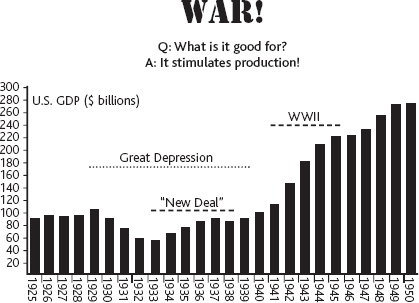
So why did a strategy that failed for Hoover work for FDR? Easy: it didn’t. In fact, the series of social and economic reforms enacted by FDR (collectively known as the New Deal) may even have delayed recovery by allowing big business to form anti-competitive cartels, raising the price of consumer goods, discouraging hiring by decreeing high wages, propping up failing businesses, and crowding out private investment. What really revived the American economy? War.
LIE: FDR knew about the impending attack on Pearl Harbor but let it happen to force America to go to war.
THE TRUTH: FDR did know that the United States was on a collision course with Japan. In fact, he wanted Japan (or Germany) to make the first move so that the United States had a reason for joining the war. But he definitely didn’t know that Pearl Harbor was going to be attacked.
The fact is, U.S.-Japan tension had been building for a while. The whole thing started in the 1930s, when a group of fanatical, hypernationalist military officers hijacked Japan’s foreign policy. While the rest of the world was distracted by the Great Depression, Japan launched an aggressive campaign of expansion, starting with the occupation of northern China from 1931 to 1936. Then in July of 1937, they picked up the pace. Japanese forces had occupied Beijing by August, Shanghai by October, and Nanjing by December.
Reports of Japanese atrocities during the “Rape of Nanjing” gave FDR the political support he needed to withdraw from the 1911 U.S.-Japan Treaty of Commerce, clearing the way for restrictions on Japanese imports like American coal, metal, and oil. But instead of caving and retreating, the Japanese expanded the scope of their aggression by occupying northern Indochina, a French colonial territory. FDR upped the ante by halting exports of aviation gasoline and scrap iron to Japan. Japan decided to counter by announcing a formal pact with Nazi Germany and Fascist Italy in September 1940. Further incensed by this American “bullying” (can’t a guy rape and pillage his neighbors any more?), Japan also invaded southern Indochina in July 1941. Finally, a fed-up FDR countered by halting oil sales, threatening to paralyze the Japanese military, which had only a two-year supply of fuel.
With oil reserves dwindling, the Japanese high command ordered Japan’s ambassador, Kichisaburo Nomura (an old friend of FDR’s from World War I) to conduct negotiations. But in fact, Japan had no intention of giving in to American demands: having decided in September 1941 that war was inevitable, the Japanese instead planned to use U.S.-Japan talks as a smoke screen while preparing a surprise attack on the U.S. Pacific fleet at Pearl Harbor. Japan hoped the bombings would put the U.S. fleet out of action long enough to allow them to conquer the oil-rich Dutch East Indies.
By this stage, FDR clearly wanted the United States to join the war, but he believed the only way to get isolation-prone Americans involved was by forcing one of the Axis powers to “shoot first.” Like most of his advisors, FDR believed that the first shot would come on the Atlantic side, where German U-boats threatened American ships. On the off chance that it did end up coming on the Pacific side, most people expected the Japanese to attack the Dutch East Indies or the Philippines. Expert opinion held that a sizable carrier fleet simply wouldn’t be able to make it from Japan to Hawaii, almost 4,000 miles away, undetected. Furthermore, an airborne attack on Pearl Harbor would require new torpedoes that could be dropped by planes in shallow water–the technology just didn’t exist. Except that unbeknownst to the U.S. military, Japan’s Imperial Navy had perfected this weapon in the summer of 1941.
Some conspiracy theorists assert that FDR must have known about the impending attack from American intelligence-gathering–but between deliberate Japanese deception and homegrown American incompetence, confusion reigned. For example, U.S. spooks believed shortwave radio broadcasts from Tokyo would be used to deliver coded messages in weather reports, with one phrase, “east wind rain,” warning Japanese diplomats of imminent war. After the war, some analysts claimed to remember hearing the code–but it turns out the Japanese never used it. U.S. code breakers did intercept messages to Japanese diplomats instructing them to destroy sensitive documents on December 1, but this was ambiguous: for all they knew, the Japanese were just being paranoid. (The more important Japanese naval code wasn’t cracked until the next year.)
Wabun Code is the form of Morse Code used to transmit Japanese text. On December 2, 1941, the Japanese flagship IJN Nagato sent the message “Niitakayama nobore 1208” (Climb Mount Niitaka on December 8 Japan Time).”
In trying to implicate FDR, conspiracy theorists also cite several cloak-and-dagger anecdotes. For example, in June of 1941 British intelligence learned German spies were trying to collect detailed information about U.S. forces in Hawaii, and the Brits supposedly informed J. Edgar Hoover, the head of the Federal Bureau of Investigation. From this, it might have been possible for Hoover to deduce that Japan might attack Pearl Harbor in a war–but let’s be realistic: this possibility wasn’t a secret, and the intercepts made no mention of specific Japanese plans, let alone dates or times. (The Japanese were unlikely to share such details with even their allies: Pearl Harbor took Hitler by surprise.)
The best argument against these conspiracy theories is common sense: if FDR’s goal was defeating Japan, it wasn’t very slick to start by sacrificing the majority of the U.S. Pacific fleet. Indeed, if FDR really knew about the impending attack, he could have accomplished the same objective by moving most of the fleet somewhere safe and leaving a few old, obsolete battleships in Pearl Harbor as bait, with their crews enjoying shore leave. But sadly, the truth is that nobody had a clue.
LIE: America defeated Nazi Germany with help from its plucky British sidekick.
THE TRUTH: The Soviet Union defeated Hitler–pretty much by itself. While American and British participation did help shorten the war considerably, by the time the United States joined the effort, the Soviet Union had already done most of the work.
Of course, you can also argue that the Soviet Union was just cleaning up its own mess. The Soviet dictator Josef Stalin shared the blame for starting the war, since he helped Hitler with a mutual assistance pact in 1939. The pact freed Hitler to conquer the rest of Europe, while Stalin supplied him with wheat, oil, and other natural resources; in return, Stalin got half of Poland and (he thought) an assurance Hitler wouldn’t attack the Soviet Union. Wrong!
Now, your average crazed megalomaniac might decide conquering Western Europe was enough–but Hitler thought big. Long diatribe short, the German leader wanted to conquer new territory in the east, kill all the Jews and Slavs, and colonize Eastern Europe with “Aryan” Germans. And he was 100 percent serious about this very, very crazy plan. From the Nazi invasion of the Soviet Union in June 1941 to the end of the war, the number of German troops deployed on the Eastern front never sank below three-quarters of Germany’s total strength. As a result, the Eastern front saw mind-boggling casualties: just under 90 percent (3.2 million) of German combat deaths and three-quarters of German tank losses occurred there. On the Soviet side, 11 million soldiers died, including 2 million in German POW camps. Combined with civilian deaths, the total Soviet toll came to an astonishing and horrifying 25 million, compared to 1.3 million combined military and civilian deaths for the United States, U.K., and France.
Responsibility for the horrors of the Eastern front rests with Hitler and his accomplices–but the United States and U.K. didn’t seem to be in much of a hurry to help their ally. Stalin brought up the idea of opening up a second front in Western Europe in July 1941, and in June of 1942 the Western Allies assured him that the invasion of France would begin no later than September 1943. When it didn’t, Stalin angrily withdrew his ambassadors to the United States and U.K., accusing the Western Allies of delaying so the Germans and Soviets could wear each other out. And he may have been right about that.
The United States did help the Soviet Union with Lend-Lease supplies, including 7,500 tanks, 14,750 planes, and 1,980 rail locomotives–but this aid only accounted for about 9 percent of Soviet wartime needs, as the Red Army lost 61,000 tanks and 26,000 planes from 1943 to 1945 and 15,800 locomotives from 1941 to 1945. The British and Americans also “helped out” by dropping about two million tons of TNT and napalm on Germany, killing over 300,000 civilians, but “strategic bombing” achieved little: the important German factories were moved underground, and war production actually increased from 1942 to 1944.
 QUICK’N’EASY WORLD WAR II
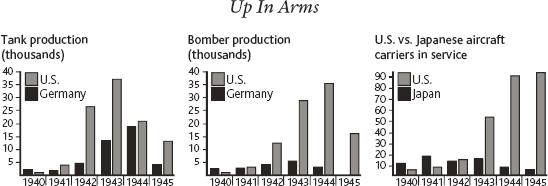
War broke out in September 1939 when France and the U.K. finally (belatedly) decided to resist Adolf Hitler’s continuing aggression in Europe. It became a global conflict when Hitler forged an alliance with Imperial Japan, which was busily conquering Asia. An American embargo cutting off oil to Japan put the United States on a collision course with the Axis Powers–but the U.S. was already deeply involved in the war. Above all, Allied victory was due to the combination of enormous Soviet manpower and U.S. industrial production.
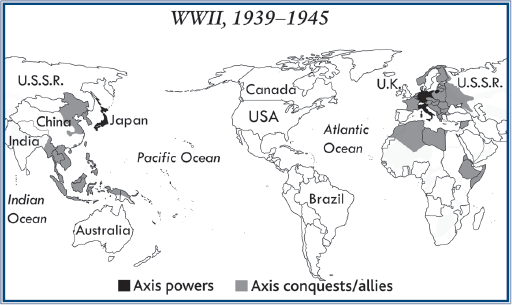
Before ever joining the war, the United States was supplying the U.K. under the “Cash and Carry” system, which required the Brits to pay for goods up front and ship them aboard their own vessels to avoid violating neutrality. In March 1941 the U.S. replaced this with “Lend-Lease,” which delivered goods to the Brits and Soviets aboard U.S. vessels in return for IOUs. As in WWI, these ships were targeted by German U-boats in the Atlantic, but U.S. entry into WWII on December 7, 1941 tipped the balance in the “Battle of the Atlantic.” In May 1942 the United States began organizing Lend-Lease convoys with naval escorts, and by 1944 the U-boat menace was vanquished–but only after the loss of 3,500 merchant ships and 30,000 crew members.
On land, the U.S.-U.K. strategy in Europe basically called for chipping away at the edges of Axis territory in the south and west while Hitler was distracted by his epic, ill-fated invasion of the Soviet Union in the east. In November 1942 the United States and U.K. invaded North Africa to liberate Morocco, Algeria, and Tunisia from the Vichy regime (the pro-Nazi “collaborationist” government in southern France). From here they invaded Sicily in July 1943, followed by mainland Italy in September 1943. Mussolini’s Fascist government collapsed, but the Germans swiftly occupied Italy in an attempt to halt the Allied advance.
As Allied armies battled their way north to Rome, to the west they launched Operation Overlord, the invasion to liberate France, on June 6, 1944 (D-Day). After landing on the Normandy peninsula in the face of fierce German resistance, U.S. and U.K. armored columns pushed south and east under the leadership of two daring tank commanders–the American George S. Patton and the British Bernard Law Montgomery. Eager to occupy Germany before the Soviets, the Allies raced forward through France into Belgium–directly into a German trap.
Up In Arms
On December 16, 1944 the Germans launched a desperate surprise attack that “bulged out” into Allied territory, cutting off U.S. troops at Bastogne, Belgium. However Patton made a daring counter-attack which broke through enemy lines to rescue the besieged Americans, and a break in winter weather let the Allies use their superior air power again. By January 25, 1945, the Battle of the Bulge was over; three months later, American GIs shook hands with their Soviet counterparts in central Germany.
Meanwhile, somewhere in the Pacific… . After the surprise attack on Pearl Harbor, Japanese forces swept out across the western and central Pacific Ocean, conquering the Philippines, Indonesia, and a number of smaller island chains which they turned into air strips and naval bases. U.S. forces had to first stop the Japanese advance, and then roll back the tide–a formidable task, as Japanese conquests ranged across thousands of miles and were defended by soldiers with suicidal devotion to their cause. The United States had a huge advantage in industrial production, however, which allowed it to churn out more ships and weapons than Japan–especially aircraft carriers, which revolutionized naval warfare.
The United States scored a strategic victory at Coral Sea, May 4–8, 1942: although one U.S. aircraft carrier was sunk and another damaged, the U.S.–Australian force halted the Japanese drive to conquer Australia. This was followed by a decisive win at Midway, June 4–7, 1942, where the U.S. Navy turned the tables on a Japanese trap, thanks to cracking the Japanese naval code. Four Japanese carriers were destroyed for the loss of just one American carrier–a huge blow from which the Japanese never recovered.
Gen. Douglas MacArthur followed up these victories with an attack on Japanese forces occupying the Solomon Islands, from August 1942–February 1943. This provided a base for MacArthur’s strategy of “island-hopping”–bypassing less-important enemy strongholds to concentrate on key spots, like atolls within bomber range of Japan. While MacArthur pushed on to liberate the Philippines, U.S. bombers based in the Marianas Islands pulverized Japan with high explosives and napalm. Then in August 1945 two atomic bombs obliterated Hiroshima and Nagasaki. Japan surrendered September 2, 1945.
 OTHER PEOPLE’S STUFF
Investing in Other People’s Stuff
Thanks to wartime production, the United States’ economy had been effectively resuscitated. But in a world full of war-ravaged countries, the United States faced a daunting twofold task. Not only was the nation burdened with trying to revive its traumatized allies, but it also needed to rebuild its defeated foes along (hopefully) democratic lines. Luckily, the United States had a foolproof plan: throw money at the problem.
By the end of the war in 1945, Europe had been totaled. Over 40 million soldiers and civilians were dead and 25 million wounded, while vast areas from the Atlantic to Stalingrad lay in ruins. In Germany alone, 30,000 acres or 36 square miles of built-up urban space had been flattened by British and American strategic bombing. In January 1946 the average German ration was down to 1,500 calories per day and would soon fall to 900 calories per day without swift action.
In addition to simple humanitarian concerns, the catastrophe increased the possibility of a communist takeover of Western Europe. The ideology always played well in times of desperate poverty, and communist cells were now getting covert support from Stalin. A communist revolution in Greece triggered civil war from 1946 to 1949. American officials were even more alarmed by the prospect of communists taking power through legitimate elections. In 1946, French communists won 182 out of a total 627 seats in the new National Assembly, making them the biggest party in France. In Italy in 1948, the communist-led coalition took 31 percent of the vote. Sacrebleu! Mamma mia!
The short-term priority–ending hunger in Western Europe–had a relatively straightforward solution: farmers in the United States and Canada went full throttle, while their governments scraped together emergency wheat shipments by diverting grain from livestock feed and alcohol production. Altogether over one billion bushels of wheat were sent to Europe from 1945 to 1952. But while the first crisis had been averted, the long-term goal–steering Western Europe away from communism to a market-based economy–took a little more doing.
The Cooperative for American Remittances to Europe (or CARE, as in CARE package) was formed in 1945 to send Army Surplus rations to starving people in war-ravaged Europe.
Luckily, the United States had allies in Europe’s conservative elite, including businessmen, bankers, aristocrats, and Christian clergy, who were all full of advice about how to combat communism. To convince ordinary Europeans that the market system was the way to go, these advocates said that the Americans had to demonstrate that capitalism delivered a higher standard of living than communism. This meant the free market (literally) had to deliver the goods–bicycles, radios, refrigerators, cars, telephones, children’s toys, jewelry, candy, liquor, movies … you name it.
Of course some small problems remained, like the lack of raw materials for European factories, money to pay employees, and fuel to transport products. The European Recovery Plan–better known as the Marshall Plan, after U.S. Secretary of State George Marshall–overcame these obstacles by “priming the pump” and doling out grants to businesses, charities, and local governments. From 1948 to 1952, the Marshall Plan disbursed a total of $12.7 billion to rebuild infrastructure, reopen factories, revive banks, and fund small business. Panels of European officials, businessmen, and labor leaders decided how to distribute the money. (Including organized labor in these negotiations was a crucial part of undermining support for communist parties.) Over the same period, the United States also dispensed about $1 billion of aid to Japan. (This was separate from the Marshall Plan.) Not coincidentally, in both places most of the aid was spent on American exports, such as food, machinery, and fuel.
While United States aid to Europe and Japan got the ball rolling, private investment and international trade were leaned on to do the rest. Confidence in the reviving global economy was also bolstered by a new international monetary system created by the U.S. government at Breton Woods, Virginia, in 1944. The Breton Woods system tightened currency controls to avoid a repeat of the roller coaster-like inflation, deflation, and foreign exchange rate fluctuations of the 1930s. Breton Woods also created two new global financial institutions, the International Monetary Fund and the International Bank for Reconstruction and Development (later the World Bank), which supervised exchange rates and provided loans for economic development; both were controlled by the United States and relied on the dollar as their reserve currency.
Thanks in large part to these measures, by the early 1950s the European and Japanese economies were moving again, and the situation looked stable enough for American business to join the action. From 1945 to 1955, total direct investment by American businesses in Europe tripled from $1 billion to $3 billion; meanwhile, in Japan it rose from nothing to $129 million. Overall, the postwar period saw the United States replace Britain as the world’s main source of foreign investment.
This also signaled a big change in American attitudes toward the rest of the world. Along with the mantle of “leader of the free world,” the United States was now obligated to help protect its allies from the communist threat (or risk seeing them turned into enemies). Meanwhile, Europe was increasingly becoming “Americanized.” For example, Germany had turned into a major center of automobile manufacturing, and rates of car ownership, already increasing before the war, surged in the 1950s. On the other hand, some European countries tried to resist the American cultural-economic wave. In February 1950, the French Assembly tried to limit sales of Coca-Cola, arousing the righteous fury of American patriots, but after a great deal of talk and no action, everyone shrugged and forgot about it.
Defending Other People’s Stuff
As many a youth sports coach has told their lackluster team: the best offense is a good defense. And a nervous United States was about to storm the world playing field and defend like crazy. As the lines were drawn in early rounds of the Cold War, it became clear that America was going to have to do more than just sell stuff to countries threatened by communism. So in 1947 President Harry Truman laid out a new defense policy promising both financial and military aid to any country threatened by communist forces, internally or externally. To deter aggression, the “Truman Doctrine” emphasized defensive treaties committing the United States to help its allies around the world–a huge change in American foreign policy, which until that point had mostly steered clear of “entangling alliances.”
There will emerge two centers of world significance: a socialist center, drawing to itself the countries which tend toward socialism, and a capitalist center, drawing to itself the countries that incline toward capitalism. The battle between these two centers for command of the world economy will decide the fate of capitalism and of communism in the entire world.
–Josef Stalin, 1927
After the Cold War, it became popular to suggest that American leaders had exaggerated the communist threat. But the threat was real. Communism was a crusading ideology aiming for world domination, and the Soviet version was especially aggressive when compounded with Russian nationalism. The Soviets had demonstrated their pro-expansionist attitude before World War II with the invasion of Finland and the Baltic states, and Stalin began pushing his boundaries again almost immediately after the war was over. And the threat became even more serious when the Soviet Union tested its first atomic bomb in August 1949, canceling out America’s main advantage.
I got very acquainted with Joe Stalin, and I like old Joe!
–Harry Truman, 1948
By June of 1948, Russian-Western relations had turned openly hostile. Stalin set up a year-long blockade of West Berlin in an attempt to force British, French, and American troops out. And while the Western Allies defeated this blockade with the Berlin airlift–delivering 4,000 tons of food per day to the city’s grateful inhabitants–the Allies needed a way to guard against further aggression. In 1949, Truman worked to establish the North Atlantic Treaty Organization (NATO), which committed the countries of Western Europe, the United States, and Canada to one another’s defense. In truth, this alliance was mostly theoretical for the first few years, because the militaries lacked the ground troops to match up with Stalin’s. Instead, the United States relied heavily on the threat of nuclear weapons to make up for a lack of conventional forces: defensive plans like “Reaper” (1949) and “Dropshot” (1950) envisioned dropping over 100 atomic bombs on the Soviet Union. Eventually, NATO decided the best way to respond to Stalin’s aggressive tactics was to build up a true military, and that’s exactly what it did in the 1950s.
While NATO members were strengthening their alliance, Stalin was busy probing local defenses across the 3,000-mile stretch of Europe and Asia bordering the Soviet sphere. In the late 1940s he put pressure on Iran, Greece, and Turkey, but his bullying backfired, driving these countries into America’s arms. In fact, Greece and Turkey joined NATO in 1952. Farther east, however, communism seemed to be taking. Mao Zedong’s Chinese communists vanquished the Nationalists in 1949. This was a huge shock to American confidence, spurring recriminations between Democrats and Republicans over who “lost China.” After the nation “went Red,” Truman couldn’t afford to lose another Asian country–but that’s exactly what started happening.
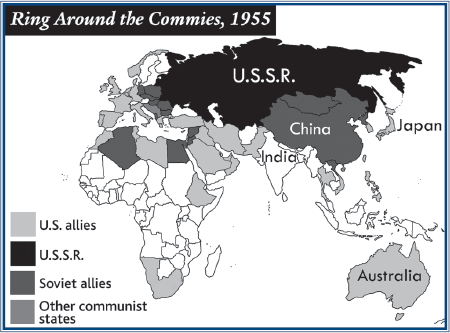
In the final days of World War II, Soviet forces occupied the northern half of Korea, a former Japanese colony, while U.S. troops occupied the south. Various attempts to reunify the peninsula failed, so in 1949 the Americans set up a pro-U.S. dictator, Syngman Rhee, in South Korea; then they checked out. Bad move: up in North Korea the Soviets were helping communist leader Kim Il-Sung build a formidable army to wage a war of reunification. In June 1950, 231,000 North Korean soldiers poured across the 38th parallel, shredding South Korean forces. To slow the northern advance, General Douglas MacArthur–still supervising the U.S. occupation of Japan–sent over the U.S. Eighth Army. Finally, the North Korean offensive began to stall amid fierce fighting outside the southern port city of Pusan (the “Pusan Perimeter”). At this point things looked pretty bad, with U.S. forces controlling less than 10 percent of the peninsula–but MacArthur was about to flip the script.
Seeing the North Korean armies concentrated in the southeast, in September 1950 MacArthur proposed an amphibious landing on the west coast of the peninsula at the port of Inchon, cutting North Korean supply lines and forcing the North Koreans to fight on two fronts. Many of MacArthur’s colleagues expressed alarm, noting that the harbor at Inchon was protected by narrow channels, treacherous currents, and rough, hilly terrain–not to mention the North Koreans themselves. But that was the whole idea, MacArthur argued: the North Koreans would never expect such a crazy move. They’d be totally unprepared.
I cannot believe that a great nation like the United States cannot give me these few paltry reinforcements for which I ask. Tell the President that if he gives them to me, I will land at Inchon on the rising tide at daybreak on the 15th of September. And between the hammer of this landing and the anvil of the Eighth army, I will shatter and destroy the armies of North Korea.
–MacArthur to Averell Harriman,
an advisor to Truman, 1950
MacArthur was right. The landing at Inchon was a brilliant success, leading to the total collapse of the North Korean armies. But in the end, he was too aggressive for his own good. He followed up on his initial success by pushing north to the Chinese border, despite repeated warnings that this would provoke Chinese intervention. And–surprise!–that’s exactly what happened in late October 1950, when over 300,000 Chinese troops surged over the border, sending U.S. forces reeling. By early January 1951, the Chinese had recaptured Seoul, and U.S. morale sank to an all-time low.
Embarrassed by his poor judgment, MacArthur wanted Truman to use nuclear weapons against Chinese forces in Korea and northern China. He questioned the president’s repeated refusals, and the public breach got him canned. His replacement, Matthew Ridgway, managed to rally U.S. forces and regain some lost territory amid heavy fighting, and the troops stabilized the front around the 38th parallel. In July of 1953, the opposing sides finally agreed to a cease-fire. In other words, everything ended up right where it started, except for the over two million dead, who were distinctly worse off.
Oil Wells (That Ended Well)
Critics often complain (correctly) that America uses its economic and military power to dominate the world’s oil supply. But the real question is: who would they rather have in charge?
After World War II, there was no mistaking American designs on foreign oil. Even before the war was over, FDR worked overtime to secure control of the Saudi Arabian supply. In February of 1945, just two months before his fatal stroke, Roosevelt traveled to Egypt aboard a U.S. Navy destroyer to meet with Saudi King Abdulaziz and forge a long-term pact. The promise? American aid and protection in return for oil–lots and lots of oil.
King Abdulaziz wanted to bring his own sheep aboard the USS Quincy for his meeting with FDR because, as a Muslim, he only ate freshly killed meat.
As part of the deal, the U.S. Air Force would expand its base in northern Saudi Arabia, and U.S. Navy aircraft carriers would protect the shipping routes to Europe and Asia. To clear up any confusion about who had priority in the Middle East, FDR shooed the French out of their colonial territories in Syria and Lebanon and bluntly informed the Brits that Saudi Arabia was now off-limits. From day one, U.S. diplomacy was coordinated with private enterprise, and by 1953, the U.S.-dominated oil cartel known as the “Seven Sisters” controlled 87 percent of the world’s production, colluding to fix prices and crush competitors.
Persian oil is yours. We share the oil of Iraq and Kuwait. As for Saudi Arabian oil, it is ours.
–FDR, to the British ambassador Lord Halifax, 1944
There was good reason to want control of foreign oil: modern industrial societies were completely dependent on oil, both economically and militarily. It’s why Japan invaded the Dutch East Indies and Hitler invaded southern Russia. Stalin, realizing that he too could do with more oil, was also looking to expand Soviet influence over oil-rich territories in the Middle East. In fact, American and Western European military planners expected World War III to start with the Red Army lunging for the oil fields of Iran, Iraq, and Saudi Arabia. By protecting Middle Eastern oil fields, the benevolent, kindly United States was also ensuring stable energy supplies for its allies, enabling reconstruction and recovery in Europe and Japan.
Okay, that’s the sympathetic interpretation of American actions. There was also a shady side to the whole enterprise. The push to control global oil supplies had started well before World War II, and it involved some pretty questionable (illegal) tactics. As U.S. domestic production increasingly went to support the American love affair with automobiles, U.S. oil companies turned to foreign oil to supply their export businesses. More importantly, they weren’t afraid to meddle to protect their interests. This wasn’t anything new: when Mexican revolutionaries passed laws in 1925 threatening American oil interests in Mexico, U.S. oil companies plotted the overthrow of the new government. (Eventually the dispute was resolved peacefully.) Likewise, Standard Oil forced its way into Venezuela by threatening to support an independence movement in the oil-rich province of Zulia.
These tactics continued after World War II. When Iran’s left-leaning Prime Minister Mohammad Mosaddeq took control of the Anglo-Iranian Oil Company in 1951, the United States saw it as a golden opportunity to replace the Brits. In 1953 President Eisenhower gave the green light for a CIA coup (re)installing the Shah of Iran. And just as the United States had hoped, the shah granted concessions to five U.S. companies–Mobil, Gulf, Standard Oil of California, Standard Oil of New Jersey, and Texaco.
As for America’s friendly motives? It’s true America helped its allies by protecting the flow of oil against disruption by the Soviets and other commie bad guys. But this was a double-edged sword: the aircraft carriers that guarded the sea-lanes to Europe and Asia could just as easily close them if the United States became displeased with its allies. In other words, control of oil gave America a stranglehold on the economies of Western Europe and Japan. In this context, it’s hardly surprising that the United States encouraged their growing dependence on foreign oil.
THE WIZARD OF OSS
At FDR’s request, Major General William Joseph Donovan formed the Office of Strategic Services (OSS) at the height of World War II. Prior to WWII, American intelligence work was conducted by a number of different organizations that didn’t coordinate their activities, including divisions of the State Department, Treasury, and the Navy and War departments. Beginning in July 1941, Donovan recruited spies, analysts, and code breakers for a new dedicated intelligence-gathering and covert operations outfit. Formally established by FDR on June 13, 1942, the OSS carried out a number of important missions during WWII, including recruiting a key German spy, the anti-Nazi diplomat Fritz Kolbe, who gave the OSS crucial information about German expectations for D-Day, the V–2 rocket program, new high-tech German jet fighters, and Nazi spies abroad. The OSS worked with French resistance fighters ahead of the Allied liberation of France and also carried out a massive campaign of propaganda, psychological warfare, and disinformation to mislead the Germans about American intentions. Outside Europe the OSS hunted Nazi spies in Africa and Latin America. Meanwhile, in the Pacific theater, OSS agents trained Chinese Kuomintang and communist troops resisting the Japanese, and in Vietnam the OSS made contact with Ho Chi Minh, whose Viet Minh nationalists were also fighting the Japanese. Overall, the OSS employed 24,000 people around the world by the end of the war, including improbable characters like Red Sox catcher Moe Berg and celebrity chef Julia Child. The OSS was disbanded in 1945 but reconstituted as a new group, the Central Intelligence Agency, by President Truman in 1947.
How the CIA and the Mob Became Friends (and Influenced People)
The end of Prohibition hadn’t been the end of the American Mafia. When alcohol became legal again in 1933, Sicilian-American mob bosses took their earnings from rum-running and wisely reinvested in “protection” rackets, loan-sharking, prostitution, gambling, and organized labor. Unions in particular were an ideal new growth opportunity, and by the beginning of World War II, gangsters controlled an array of them. One that turned out to be especially handy was the International Longshoremen’s Association, which represented dockworkers in New York and New Jersey. This meant that, in addition to smuggling, mob bosses could disrupt legitimate shipping by organizing strikes. With the war looming, the U.S. military pragmatically decided it would be easier to play ball with the mob than fight it. Luckily, the mobsters were eager allies motivated by greed, a hatred of Mussolini (who attacked the Mafia in Sicily), and–yes–American patriotism.
The first boss to sign on was Joseph Lanza, who controlled the docks on Manhattan’s Lower East Side. He agreed to help the Office of Naval Intelligence (ONI) keep things running smoothly in return for clemency in his 1938 extortion conviction. Through Lanza, the ONI established contact with Charles “Lucky” Luciano and his faithful henchman Albert Anastasia, who controlled the West Side docks. Lanza, Luciano, and Anastasia pledged their assistance in preventing strikes from disrupting wartime shipping and in uncovering spies and saboteurs who threatened dockyard operations. In return for early parole from prison, Luciano also used his connections in Sicily to facilitate the invasion of the island in 1943 by American and British forces. As a thank you, the Americans troops released hundreds of imprisoned mafiosi, put local bosses in charge of dozens of towns, and let them use Army trucks for smuggling. Things got so friendly that some bosses seriously advocated Sicily joining the United States! American diplomats politely deflected this suggestion.
After the war was over, Luciano, who had been freed and deported to Italy by the U.S. government in recognition of his wartime service, started getting involved in organized crime’s new high-growth business, drug smuggling, almost certainly with the knowledge–and maybe even help–of the CIA. The postwar Mafia drug-smuggling operation evolved over time, and it was thanks to the mob’s BFF, the CIA, that the most profitable network–“the French Connection”–came about.
In 1947, CIA spymasters employed two Corsican brothers, Antoine and Barthelemy Guerini, to break up strikes by communist dockworkers in the port city of Marseilles, France. Once in control of the docks, the Guerinis went into business with Luciano. Beginning in 1951, raw opium harvested in Turkey was smuggled overland to Beirut, Lebanon, refined into morphine base, and then shipped onward to Marseilles, where Corsican drug chemists turned it into heroin. From Marseilles the heroin was distributed all over Europe as well as to the United States via merchant ships sailing from northern European ports. After New York City customs officials caught on, smuggling shifted south under the direction of Santo Trafficante Jr., one of the most powerful mobsters in American history. The boss of the “Tampa family,” controlling Florida, Cuba, and the Caribbean, Trafficante established new routes running from Marseilles through Cuba, Martinique, and Guadeloupe, onward to Puerto Rico, and finally to Miami for distribution across the United States.
Whether deliberate or accidental, the CIA’s role in reviving the international heroin trade had some rather unfortunate consequences back home. After disappearing almost entirely during World War II, heroin addiction returned with a vengeance in the late 1940s. The Mafia’s only concession? They agreed to limit heroin sales to African-American neighborhoods, figuring the government wouldn’t care as much about addiction among minority populations. (They were right.)
 MADE IN THE USA
The Cult of the Cathode Ray
If there’s one American invention that everyone can agree is unambiguously good, except for the huge drawbacks, it’s TV. The idea of transmitting images to a display made of a photoconductive element like selenium had occurred to European inventors as early as 1886. French inventors transmitted still images to selenium cells in 1909, and in 1925 a Scottish inventor, John Logie Baird, succeeded in transmitting moving silhouette images to a cathode ray tube. That same year, American Charles Francis Jenkins transmitted moving images of a toy windmill using radio waves, and in 1927 Bell Labs did something similar with synchronized sound. All this science stuff to say: the world was getting closer to its future “Project Runway” addiction, but it wasn’t quite there yet.
Enter a red-blooded, technology-obsessed American inventor named Philo T. Farnsworth. Farnsworth developed the first practical electronic (as opposed to electromechanical) television system. While previous inventors had tried using cathode ray tubes as displays, Farnsworth was the first to use a cathode ray tube for the camera. In 1927 he filed a patent for his “Image Dissector” camera, in which light struck a layer of photosensitive material, causing it to emit electron streams that were steered to a positively charged anode, or “detector.” In 1931 Farnsworth developed an “electron multiplier” to boost the signal strength, allowing a much clearer image, and in 1934 he demonstrated the complete system at the Franklin Institute in Philadelphia.
It turned out Farnsworth wasn’t the only one experimenting with a cathode ray type of camera. In 1923 Vladimir Zworykin, an engineer for Westinghouse Electric Corporation, was doing so too, just not as successfully. Zworykin’s camera never produced a clear enough image to warrant further investment. After RCA bought the Westinghouse patent in 1929, it claimed that it superseded Farnsworth’s, but the U.S. Patent Office dismissed RCA’s claim in 1935, and four years later, RCA agreed to pay Farnsworth the considerable sum of $1 million for the right to use his technology.
Although the Great Depression and World War II hobbled sales at first, the return to peace and prosperity brought a tidal wave of TV to America. It would be hard to exaggerate the TV craze of the late 1940s and early 1950s: the number of television sets in operation in the United States rose from fewer than 7,000 in 1940 to 350,000 in 1948, 9.7 million in 1950, and 42.9 million in 1955. The mania spread socially, as proud owners of new sets invited friends over to watch together; in 1946 the prize fight pitting Joe Louis against Billy Conn was watched by 150,000 viewers gathered around a relatively small number of TV sets, sometimes in groups of 30 or more.
Sensing the huge demand, TV broadcasters rushed to invest in new programming: 1948 saw the debut of “The Ed Sullivan Show,” featuring musical performances and variety acts. The year 1951 followed with the pioneering sitcom “I Love Lucy.” And 1952 brought NBC’s “Today Show,” which struggled until host Fred Garroway was joined by a belligerent chimpanzee cohost named J. Fred Muggs.
The first television commercial, for Bulova watches, aired on
TV stations began to organize themselves in networks to offer advertisers greater reach, usually under the umbrella of radio networks. And before long, the leading radio broadcasters dominated TV too. By the early 1950s, there were four main broadcast networks–NBC, ABC, CBS, and DuMont–with dozens of station affiliates around the country. The advertising dollars started pouring in too. Total TV ad revenue jumped from $207 million in 1951 to $750 million in 1955, surpassing radio.
But it wasn’t all chimps and beer ads. In 1951 Edward R. Murrow launched America’s first TV news program, “See It Now,” which gave viewers an up-close look at the sacrifices of U.S. soldiers in the Korean War. In 1954 Murrow helped undermine support for Senator Joseph McCarthy, whose communist witch hunts ruined the reputations of hundreds of innocent people. And it was TV that enabled McCarthy to deliver his own coup de grâce during a live broadcast of his House Un-American Activities Committee hearings on communists in the military. Infuriated by McCarthy’s attack on one of his junior staffers, Joseph Welch, a lawyer for the Army, delivered a verbal pistol-whipping witnessed by millions of Americans, which shattered McCarthy’s aura of authority and invincibility. Three years later he died of alcoholism.
Until this moment, Senator, I think I never really gauged your cruelty or your recklessness. Let us not assassinate this lad further, Senator. You have done enough. Have you no sense of decency, sir? At long last, have you left no sense of decency?
–Joseph Welch, to Senator Joseph McCarthy, June 1954
Fissile Missiles
They’re nothing to brag about, but nuclear weapons were the single biggest factor shaping the postwar world. Just think about what would have happened if someone else (say, the Nazis) invented them first. In fact, that’s the whole reason the American bomb program got rolling in the first place. In 1938 the German chemists Otto Hahn and Fritz Strassmann reported their discovery of a new element, barium, which they created by bombarding uranium with neutrons. It was the first fission reaction observed in an experimental setting. Then in 1939, Enrico Fermi, an Italian physicist, and Leo Szilard, a Hungarian Jew, conducted further experiments at Columbia University confirming that uranium could sustain a nuclear chain reaction.
Fermi and Szilard had only a tiny amount of uranium isotope U-235 for their experiment, but their research showed that with a large enough concentration of “fissile” material, the splitting of trillions of atoms releases a huge amount of energy in what is technically termed a really big explosion. Putting 235 and 235 together, Fermi and Szilard realized that the Nazis could possibly be developing a super-bomb. To get the attention of the U.S. government, Szilard recruited the most famous scientist in the world as a spokesman: Albert Einstein. As a German Jew, Einstein was equally unnerved by the prospect of a “Nazi bomb,” and he wrote to FDR, warning him of the potential consequences and urging him to develop an American bomb first.
In 1941 FDR gave the job to the newly created Office of Scientific Research, where a team headed by Nobel-Prize-winning physicist Arthur Compton and fellow physicist J. Robert Oppenheimer produced the first self-sustaining nuclear chain reaction in a reactor beneath the University of Chicago’s Stagg Field in December of 1942. The group also determined that in addition to U-235, plutonium (formed by adding a neutron to U-238) would work as a bomb fuel. Now Compton and Oppenheimer just had to refine sufficient quantities of the nuclear fuel and design an actual bomb. Easy enough!
Or not. The scale of the work required a leader who knew how to move mountains. So in September of 1942, control of the “Manhattan Engineer Project” was transferred yet again, this time to the U.S. Army, under the command of Leslie Groves, a brigadier general with a reputation for pushing huge projects to completion under strenuous deadlines by being very unpleasant, if necessary. Concerned for the project’s secrecy, Groves relocated the key work to a derelict boys’ boarding school in Los Alamos, New Mexico, where the scientists lived and labored in complete seclusion. They even slept in the refurbished dormitories and held conferences in dusty classrooms.
Despite some technical glitches, by August of 1945 the weapons design team at Los Alamos had constructed three plutonium bombs and one uranium bomb. The slender uranium bomb was nicknamed “Little Boy,” while the rotund plutonium bombs were called the “Fat Man” (or “Fat Men,” technically).
Outside of Los Alamos, the world was changing pretty fast. FDR died in March, Germany surrendered in May. Only the war in the Pacific continued, with Japan appearing determined to hold out to the bitter end. At a conference on May 10–11, a “Target Committee” led by Oppenheimer recommended a list of targets to Groves. With two atom bombs ready to use, on July 26 Truman joined the other Allies in issuing the Potsdam Declaration, calling for Japan’s unconditional surrender. When Japan rejected the Declaration on July 29, final preparations for an attack on Hiroshima began.
At 8:15 in the morning on Monday, August 6, 1945, the B-29 Enola Gay dropped Little Boy on Hiroshima. Detonating 2,000 feet above the city, the bomb exploded with a force equivalent to 13,000 tons of TNT, destroying five square miles of the city. Seventy thousand inhabitants died instantly, followed by another 70,000 in subsequent weeks and months–all told, the bomb killed 40 percent of the city’s population. Three days later, at 11:01 in the morning on Thursday, August 9, the B-29 Bockscar (accompanied by one other plane) dropped one of the Fat Man bombs on Nagasaki–a secondary target selected because the first target, Kokura, was obscured by cloud cover. The bomb detonated 1,540 feet above the city, producing an explosion equivalent to 21,000 tons of TNT. The bomb completely ravaged three square miles of the city and killed 40,000 people instantly, followed by another 40,000 in subsequent months–35 percent of the city’s total population.
The Enola Gay was named after the mother of the aircraft’s pilot, Paul Tibbets.
Questions about the decision to use the bombs have lingered: Was it really necessary? Was it morally right? Didn’t the Japanese try to surrender between Hiroshima and Nagasaki, making the second bomb unnecessary? On the last question, at least, facts indicate that the Japanese were not interested in surrendering: the Japanese high command made no attempt to do so before the bombing of Nagasaki. Indeed, after Hiroshima was destroyed, Japan’s top brass asked the nation’s nuclear scientists if they could make a similar bomb in six months, indicating they were determined to fight on. Further, the war minister and chiefs of staff of the Imperial Japanese armed forces still refused to surrender after the second bomb was dropped. It was only through intervention by Emperor Hirohito on August 14 that the issue was finally settled.
As for the necessity of the bombing, Truman believed he was saving thousands of American lives that would be lost invading Japan: in the months before the bombings, kamikazes and bloody battles for control of small islands like Iwo Jima and Okinawa indicated that U.S. forces would face plenty of suicidal, last-ditch attacks. American commanders anticipated up to a quarter million American casualties, to say nothing of Japanese deaths. In any event, the atomic bombs could be considered the logical conclusion of America’s long campaign of “strategic” bombing with napalm and high explosives. Before Hiroshima and Nagasaki, U.S. bomber fleets had destroyed half of the built-up urban areas in scores of Japan’s largest cities; in one attack on Tokyo on the night of March 9–10, U.S. pilots dropped 1,700 tons of bombs on the city, causing a firestorm that killed 100,000 civilians and destroyed 16 square miles–and this was just one of a dozen attacks on the Japanese capital in 1945. Overall, conventional bombing killed 300,000 Japanese and a similar number of German civilians, while leaving more injured or deformed for life.
From Magnetron to Microwave
The same year that saw the invention of the atomic bomb also gave the world another hot device: the microwave oven. The principle behind microwave cooking was discovered by Percy Spencer, an engineer who worked on radar installations for defense contractor Raytheon. After noticing that a chocolate bar melted after being accidentally placed in front of a new “magnetron” vacuum tube, Spencer experimented with other foods, including popcorn (which worked perfectly) and an egg (not so much). After these experiments, Spencer deduced that the food was being heated by low-density microwave energy that could penetrate solid objects. Using those principles, he designed his first primitive oven in 1945, and by October of 1946, Raytheon had filed a patent for a microwave based on Spencer’s idea. Excited about the new invention, the company even installed an experimental version in a restaurant in Boston to demonstrate its convenience … but there was still a long way to go.
The code name Percy Spencer used for the microwave oven while it was still in the developmental stage was “Speedy Weenie.”
The first oven intended for commercial sale–the Radarange, manufactured in 1947–wasn’t particularly practical: almost six feet tall, it tipped the scale at 750 pounds and cost $5,000 (that’s in 1947 dollars). The second version, produced in 1954, was better but still needed work: it gobbled electricity and cost $2,000–$3,000, at a time when the average cost of a new car was about $1,700. Figuring a home appliance manufacturer might have better luck than a defense contractor, Raytheon licensed the design to the Tappan Stove Company in 1952, but at $1,295, Tappan’s 1955 model still fell flatter than a microwave soufflé … at least, where housewives were concerned.
The food service industry was quicker on the uptake. Postwar America had become all about speedy service and convenience, and microwaves allowed the new generation of fast-food restaurants to thaw, cook, and sell large amounts of perishable food quickly, without violating health codes. Before long, manufacturers were employing microwaves to roast coffee beans, nuts, and potato chips. Factories even started using the ovens to treat nonfood items like leather, tobacco, and cotton cloth. Housewives didn’t come around until 1967, with the unveiling of a relatively low-energy model costing just $500 by Amana Refrigeration, a Raytheon subsidiary.
 TRENDSPOTTING
Women Be Workin’
American women have always worked–even harder than men, if you believe ‘em. But traditionally, female labor took place in the home, out of public view. In the nineteenth century, girls and young women worked in textile mills and other industrial establishments, but this employment was supposed to be temporary, ending when they got married. Aside from housework (which was of course unpaid), the only work readily available to most women was still domestic–i.e., child care, laundry, sewing, or serving as a maid in an upper-class household. This began to change in the 1880s, when some young women worked outside the home as shopgirls, public school teachers, and nurses. The upper ranks of the business world remained closed to women, but growing numbers began to work in administrative capacities: by 1900, three-quarters of the stenographers and typists in the United States were women, as were many corporate secretaries, telephone switchboard operators, and librarians.
And that’s more or less how it was until World War II turned the American workplace and the role of women upside down. From 1941 to 1945, a total of 16 million men served in the U.S. armed forces. This translated to about a quarter of the total American workforce in 1940. The result was a huge shortfall in labor, even after factories sponged up the jobless from the Great Depression. The solution was obvious: housewives. Responding to a concerted propaganda campaign by government and business (think: “Rosie the Riveter”), about seven million women entered the workforce between 1941 and 1945, boosting the share of women from about 25 percent of the total to 36 percent in 1945.
Of course the captains of industry–all men–took advantage of the situation, paying women just $0.65 where male workers earned $1.00. But Pandora’s lunch box had been opened: not only had women proved they were just as capable as men, many found they actually enjoyed working outside the home, savoring the sense of accomplishment and camaraderie they got contributing to the war effort. And though these same patriotic women would soon face open discrimination by employers (businesses were under pressure to hire returning GIs), millions of women continued to work after the war.
Picket Fences
Automobiles transformed American society by allowing the growing middle class to live outside cities–particularly after Eisenhower expanded the interstate highway system in the 1950s. From 1920 to 1960, the proportion of Americans living in the ‘burbs doubled from 16.7 percent to 33.3 percent–meaning 17.7 million to 60 million people! One of the first car-centric suburbs was located in Westchester County, north of New York City: here the town of New Rochelle saw its population almost quadruple from about 15,000 people in 1900 to 54,000 in 1930. Another New York suburb, Levittown, was the archetypal planned community of the postwar era: a prefabricated suburb of about 17,500 homes, it was built from 1947 to 1951 by William Levitt, a building magnate who embraced streamlined mass-construction methods picked up from the U.S. government during World War II. Levittown provided affordable middle-class homes to factory workers, making it a symbol of American postwar prosperity.
Pop singer Billy Joel, political commentator Bill O’Reilly, and cartoonist Bill Griffith all grew up in Levittown.
Farther west, on the shores of Lake Michigan, Chicago’s suburbs grew to include Evanston, Wilmette, Kenilworth, Arlington Heights, Cicero, Palatine, and Skokie. Within a wider 200-mile radius–an area nicknamed “Chicagoland” by the Chicago Tribune in 1926–whole cities came to be considered suburbs of Chicago, including Aurora, Joliet, and Naperville. Around the junction of the Mississippi and Missouri rivers, the St. Louis metropolitan area expanded to include Alton, Brentwood, Concord, Kirkwood, Lakeshire, Webster, and St. Charles.
LIFE IS A SUPERHIGHWAY
The first American interstate highway system, created in the 1920s, was a pretty bare-bones transportation network: many of the “highways” were just local roads given the grand title without much in the way of new pavement or extra lanes to justify it. The real deal came in the 1950s, courtesy of President Dwight D. Eisenhower, who on June 29, 1956, signed a bill ordering the construction of four-, six-, and eight-lane “superhighways” crisscrossing the country. Fittingly titled the Dwight D. Eisenhower National System of Interstate and Defense Highways, the network was a huge gain in personal mobility for Americans who owned cars–but as the name indicates, it also served a strategic military purpose by making it easier to move troops and supplies.
Eisenhower was motivated by a couple of personal experiences in the U.S. Army. As a colonel in 1919, he had accompanied a convoy of military trucks across the country, remarking that the trucks hit dirt roads in Illinois “and practically no more pavement was encountered until reaching California,” with many sections in Western states “almost impassable.” (In Nevada the road was “one succession of dust, ruts, pits and holes.”) Over two decades later, as the supreme commander of the Allied Expeditionary Force in Europe, Eisenhower admired the German autobahn highways constructed at Hitler’s command in the 1930s and noted their advantages for military mobility.
The most extreme example of car-centric suburban development is southern California, where Los Angeles became a “city” composed entirely of suburbs, with no real city center. In 1920 the original City of Los Angeles, measuring about 500 square miles, was already fairly huge by the standards of the day–but the sprawl was just beginning! As cars became the dominant mode of transportation, more and more people settled in surrounding Los Angeles County, an area measuring about 3,500 square miles (excluding the city) stretching from Long Beach in the south to Palmdale in the north and Malibu in the west. Los Angeles County came to include a total of 88 separate cities and towns. And L.A. still wasn’t done stretching out. In the second half of the twentieth century, this “urban agglomeration” absorbed four neighboring counties–Orange, Riverside, San Bernardino, and Ventura–forming a metropolitan area measuring 34,000 square miles, with a total population approaching 20 million!
WATER WARS
The huge increase in L.A.’s population–from 1.25 million in 1930 to 2.5 million in 1960–was only possible because of epic efforts to provide the desert metropolis with water, begun by William Mulholland, the all-powerful boss of the city’s water department. Mulholland didn’t shrink from unethical tactics. From 1898 to 1905, he bought strategically located plots of farmland in the Owens River Valley 250 miles north of L.A., without telling the locals he intended to divert the water south for irrigation as well as domestic use. In 1913 a 233-mile aqueduct began bringing water from the valley to L.A.–but demand grew so quickly that the L.A. water department eventually diverted the Owens River, causing 100-square-mile Owens Lake to dry up. This led to the California Water Wars, in which local farmers dynamited the aqueducts, forcing L.A. to negotiate. (The city settled by buying the rest of their worthless land.) Meanwhile, Mulholland was forced to resign in disgrace after another project, the St. Francis Dam, collapsed on March 12, 1928, leaving 450 dead.
Degrees for Free
Until the middle of the twentieth century, most Americans never contemplated attending a college or university after graduating from public high school. But this all started to change with the emergence of a large, upwardly mobile middle class who viewed education as the key to further social advancement–especially after living through the Great Depression. Of course, World War II played a big part in this attitude shift. Among the rewards offered to young adults for serving in the armed forces was a free college education, courtesy of the Servicemen’s Readjustment Act of 1944, better known as the “GI Bill.” By the time the legislation had run its course in 1956, it had sent 7.8 million veterans to school.
But the GI Bill wasn’t just about recognizing service. For politicians, it became a savvy way to ease the reintegration of millions of young men back into the economy. Political leaders feared that the return of all these soldiers, coinciding with a big reduction in jobs created by defense spending (think of all the factories that had been supplying goods to the troops), could trigger serious economic headaches. By sending some of these veterans to school, the GI Bill kept them off the labor market for a couple years, giving the economy more time to absorb the surplus workers.
While all returning servicemen (including 350,000 women) were eligible for financial assistance under the GI Bill, they didn’t all have the same opportunity to attend the school of their choice. American higher education remained segregated by race and gender, and most colleges and universities were closed to African-Americans and women. Although they could attend separate schools, the institutions for blacks and women typically lacked the financial and educational resources available to white men.
Before four years became the norm to earn a college degree, first-year students were called “freshmen,” second-
 PROFIILES IN SCOURGES
Murderous-Minded Perverts
There are documented cases of serial killers in America going back to the eighteenth century, but there was definitely an uptick in the first part of the twentieth century: from January 1911 to April 1912, there were 49 axe murders in Louisiana and Texas, all unsolved, including whole families massacred as they slept. Henry Lee Moore was implicated in 20 axe murders across the Midwest in 1912; Loving Mitchell in 30 more in 1915. Things got even crazier from the 1920s to the 1940s, with more high-profile cases and increasingly detailed reporting of the disturbed psychology of serial killers. Thus the celebrity serial killer was born.
EARLE NELSON (AKA “The Gorilla Killer” and “The Dark Strangler”) Nelson murdered at least 22 women in eight states and one Canadian province from 1926 to 1927. After losing both parents to syphilis at the age of two, Nelson underwent a change in personality at age 10 after being hit by a streetcar. At 21 he tried to rape a 12-year-old girl but was thwarted when she screamed for help. Nelson committed his first murder in February 1926, two weeks after being released from a California mental hospital. He targeted middle-aged women who rented rooms in boarding houses, inquiring about lodging and setting them at ease by appearing to study his well-worn Bible … before strangling them with his bare hands and stashing the bodies under their beds. Nelson committed acts of necrophilia with the corpses of most of his victims, and on one occasion slept in the same bed with a mutilated body for three days. His physical strength earned him the nickname “The Gorilla Killer.” Nelson was caught after killing a landlady in Winnipeg, Canada. After a short-lived jail-break, he was recaptured, tried, and finally hung on January 13, 1928.
A note in Nelson’s Napa State Mental Hospital file indicated that the 18-year-
ALBERT FISH (AKA “The Gray Man,” “The Brooklyn Vampire,” and “The Werewolf of Wysteria”) A real horror show, Albert Fish was convicted of three verifiable child murders, though he claimed the total was closer to 100–all involving molestation and cannibalism. Born Hamilton Fish in 1870, Fish took to calling himself “Albert,” the name of his dead brother, after his mother sent him to live in an orphanage. There, young Albert came to derive sexual pleasure from regular beatings. At the age of 12, he had a homosexual relationship with an older boy who introduced him to coprophagia (eating feces), and he started hanging around public baths, where he could watch naked boys. In 1890, Fish moved to New York City, where he became a male prostitute and child rapist, and in 1898 he married a woman (chosen by his mother), who eventually bore him six children. After his wife left him in 1917, Fish began piercing his groin with needles. X-rays later revealed that Fish had 29 needles in his pelvis. He also began hearing voices commanding him to kill and mutilate children.
I have no particular desire to live. I have no particular desire to be killed. It is a matter of indifference to me. I do not think I am altogether right.
–Albert Fish, 1935
Fish was undone by his own need to brag and torment the families of his victims. In 1928 he abducted and murdered a 10-year-old girl named Grace Budd; six years later he sent a letter to her mother recounting how he had choked her to death and then cooked and eaten her over the course of nine days. Police traced the stationery back to a boarding house where Fish had been staying and arrested him on December 13, 1934. At his trial the jury somehow declared Fish “sane” and sentenced him to death. Fish was executed on January 16, 1936, after proclaiming that electrocution would be “the supreme thrill of my life.”
JOE BALL After serving in World War I, Ball became a bootlegger and later the proprietor of a small tavern, the Sociable Inn, outside the town of Elmendorf in south Texas. Ball was also the proud owner of five alligators, which he kept in a pool behind the bar as an added attraction–entertaining customers by feeding the creatures live cats, dogs, possums, and raccoons. From 1930 to 1938, Ball hired a procession of young, pretty, maybe not-so-bright women as waitresses, who tended to disappear after a few months. Oddly enough, so did several of his wives and girlfriends. At long last, suspecting Ball was up to no good, local law enforcement made several inquiries that turned up nothing: Ball, an intimidating sort, was able to keep his activities cloaked in mystery by scaring the bejeezus out of nosy neighbors. (One was so terrified he moved out of town.) But in 1938 Ball started pushing his luck: a 23-year-old woman went missing after working for him for just a few months, followed by two more employees. Then the frightened neighbor finally came forward, returning from California to tell the sheriff that Ball had threatened his life. Apparently, the neighbor had seen Ball dismembering a body next to the alligator pit. When deputies went to the Sociable Inn to question Ball again, he offed himself with a shot to the heart. In the end, lawmen guessed Ball killed at least 22 women and a teenage boy but never found any evidence for most of these crimes. Or for the hypothesis that he fed the bodies to his pet alligators.
Joe Ball’s alligators were donated to the San Antonio Zoo, where they became a pop
BY THE NUMBERS 
|
380.33 |
Dow Jones Industrial Average in mid-October, 1929 |
|
41.22 |
Dow Jones Industrial Average in mid-July, 1932 |
|
$104.4 billion |
U.S. GDP, 1929 |
|
$56.4 billion |
U.S. GDP, 1933 |
|
10,763 |
banks closed from 1929 to 1933 |
|
1.5 million |
U.S. unemployed, 1929 |
|
3.2 percent |
U.S. unemployment rate, 1929 |
|
14 million |
U.S. unemployed, 1933 |
|
25 percent |
U.S. unemployment rate, 1933 |
|
2,402 |
U.S. servicemen killed in the surprise attack on Pearl Harbor, 1941 |
|
12,513 |
U.S. servicemen killed in the battle of Okinawa, 1945 |
|
110,000 |
Japanese soldiers killed in the battle of Okinawa, 1945 |
|
140,000 |
number of people killed in the Hiroshima bombing |
|
80,000 |
number of people killed in the Nagasaki bombing |
|
100,000 |
number of people killed in the firebombing of Tokyo, March 9–10, 1945 |
|
1,700 |
tons of bombs dropped on Tokyo in this raid |
|
623,418 |
tons of bombs dropped by the U.S. Eighth Air Force on Germany in World War II |
|
$50.1 billion |
value of material supplied to Allies under Lend-Lease program, 1941–1945 |
|
$7.2 billion |
U.S. direct investment in foreign countries in 1945 |
|
$19.2 billion |
U.S. direct investment in foreign countries in 1955 |
|
$1,300 |
average cost of a new car in 1947 |
|
$1,900 |
average cost of a new car in 1955 |