

THE STATE OF THE UNION 
After the disastrous 1960s and 1970s, Americans were disillusioned by defeat in Vietnam, dishonesty in Watergate, and disco on the dance floor. But things were about to turn around. Exhausted by the honest, earnest pessimism of Jimmy Carter, in 1980 Americans elected the sunny, congenial Ronald Reagan, who told them, “It’s Morning in America.” Like his Republican predecessor Richard Nixon, Reagan was short on details but long on optimism … and it worked: Reagan promised that whatever problems the country faced, Americans had the strength and spirit to overcome them.
They say that the United States has had its days in the sun, that our nation has passed its zenith. They expect you to tell your children that the American people no longer have the will to cope with their problems, that the future will be one of sacrifice and few opportunities. My fellow citizens, I utterly reject that view.
–Ronald Reagan, 1980
As president, Reagan managed to restore America’s dwindling mojo, lift the economy out of the doldrums, and revitalize its damaged, demoralized military, all while soothing partisan rancor with his folksy personal style. He won the votes of “Reagan Democrats” by reminding Americans of the continuing Soviet threat to the “free world” (something of a misnomer, since it included many pro-American dictators) and by advocating for a strong, unapologetic role for the United States in world affairs. Reagan massively increased the American defense budget and mounted overt and covert interventions to reverse communist gains. Some of these were of questionable legality–okay, they were illegal–but with his avuncular charm and bad memory, Reagan never seemed to get caught. Just his subordinates.
This isn’t to say everything was peachy at home: the 1980s will be remembered for some of the worst social problems in American history, including a wave of crime associated with the drug of the moment–cocaine, first in powdered form, then as smokable “crack” rocks. Crack contributed to the continuing disintegration of inner cities, which reached “rock” bottom in this period. The end of this period also brought a sharp economic downturn and the most costly episode of urban mayhem in American history–the L.A. riots–which revealed deep rifts in American society. Meanwhile, a terrifying new disease, HIV-AIDS, emerged in America’s gay subculture before migrating to the heterosexual mainstream, spreading through sexual contact, shared needles among IV drug users, and (in the early stages of the epidemic) blood transfusions.
On the other hand, there were amazing technological advances that transformed the American economy and then the world. The most important by far was the personal computer, pioneered by Apple in 1976 and extended to the masses by PCs equipped with Microsoft Windows. The personal computing revolution paved the way for the later expansion of the Internet–a new technology that remained a relative rarity in this period. In foreign affairs the United States was more powerful than ever, winning the First Gulf War and then–quite unexpectedly–the Cold War, with the shocking collapse of the Soviet Union in 1991.
 WHAT HAPPENED WHEN
|
April 4, 1975 |
Microsoft founded by Bill Gates in Albuquerque, New Mexico. |
|
|
April 1, 1976 |
Apple I, the first personal computer, unveiled. |
|
|
May 1976 |
Hard rock band Blue Öyster Cult releases “Don’t Fear the Reaper.” |
|
|
July 4, 1976 |
United States celebrates bicentennial. |
|
|
January 21, 1977 |
President Carter pardons Vietnam draft dodgers on his first day in office. |
|
|
September 5–12, |
Carter presides over historic Camp David peace |
|
|
1978 |
accords between Egypt and Israel. |
|
|
January 17 and |
Shah Pahlavi flees Iran; Ayatollah Khomeini |
|
|
February 1, 1979 |
returns from exile to lead country. |
|
|
November 4, 1979 |
Iranian students storm U.S. Embassy in Teheran, hold workers hostage. |
|
|
December 24, 1979 |
Soviets invade Afghanistan to crush U.S.-backed mujahedin. |
|
|
July 19–August 3, |
United States boycotts Summer Olympics in |
|
|
1980 |
Moscow. |
|
|
September 22, 1980 |
Iraqi dictator Saddam Hussein invades Iran. |
|
|
November 4, 1980 |
Republican Ronald Reagan unseats incumbent President Jimmy Carter. |
|
|
January 20, 1981 |
U.S. embassy hostages are released hours after Reagan is inaugurated. |
|
|
August 12, 1981 |
IBM launches first PC. |
|
|
September 25, 1981 |
Sandra Day O’Connor becomes first female U.S. Supreme Court justice. |
|
|
June–July 1981 |
First reports of gay men dying from AIDS in New York, L.A., and San Francisco. |
|
|
August 1, 1981 |
MTV launches. |
|
|
January 24, 1984 |
Apple Macintosh debuts. |
|
|
January 28, 1986 |
Space shuttle Challenger explodes on liftoff, killing seven. |
|
|
October 19, 1987 |
U.S. stock market crashes; stock values dive 508.32 points, or 22.6 percent. |
|
|
November 8, 1988 |
Vice President George H.W. Bush beats Massachusetts Governor Michael Dukakis in race for president. |
|
|
November 9, 1989 |
Berlin Wall falls. |
|
|
August 2, 1990 |
Iraq invades Kuwait. |
|
|
January 16–February |
United States leads international coalition to |
27, 1991 |
|
liberate Kuwait in Operation Desert Storm. |
November 7, 1991 |
|
|
Earvin “Magic” Johnson announces he has HIV. |
December 8, 1991 |
|
|
Soviet Union collapses. |
April 29–May 4, |
|
|
Not-guilty verdict in Rodney King beating case |
||
|
1992 |
triggers L.A. riots. |
 LIES YOUR TEACHER TOLD YOU
LIE: The Republicans got evangelical Christians involved in politics.
THE TRUTH: It was the Democrats–specifically, Jimmy Carter–who politicized evangelical Christians during the 1976 presidential race. The Dems just couldn’t hold on to them.
Before 1976 neither party had a real claim on evangelical Protestants. In 1964 moderate Southern Baptists voted for Lyndon Johnson out of regional loyalty, but evangelical support was fleeting. Horrified by the wave of drug use, casual sex, and “heathen cults” that swept the country in the late 1960s, in 1968 they switched to Republican Richard Nixon, a pious Quaker, who ran as the champion of decency and order. But then in 1974, they were shocked by Nixon’s dishonesty in Watergate (not to mention the unrelenting stream of profanity on White House tapes that surfaced during the scandal). Evangelicals were further angered by Gerald Ford’s pardon of the ex-president, contrary to their ideals of personal responsibility.
History suggested the disillusioned evangelicals would join fundamentalists in withdrawing from politics altogether, but there was a new activist impulse at work, inspired by moral issues: in 1969 evangelicals in Anaheim, California, drew national attention with protests against a sex education curriculum planned for the city’s public schools, followed in 1974 by a similar protest against sex ed in Kanawha County, West Virginia. Then the Democrats surprised everyone by nominating a “born-again” Southern evangelical to run for president in 1976.
Georgia Governor Jimmy Carter hit all the right issues, lamenting “the loss of stability and loss of values in our lives,” which he blamed on “the steady erosion and weakening of our families.” He promised to tackle divorce, illegitimacy, and drug abuse, but his most important promise was also the simplest: “I will never lie to you.” This stance won him the support of televangelists like Pat Robertson, who told millions of viewers “we have an unprecedented opportunity for America to fulfill the dream of the early settlers … that this land would be used to glorify God.” Bailey Smith, a prominent figure among Southern Baptists, opined, “This country needs a born-again man in the White House. And his initials are the same as our Lord’s.”
Overall, Carter took about half the evangelical vote in 1976, a huge increase from the 20 percent who voted Democrat four years before. He also took 59.1 percent of the Southern Baptist vote versus 37.6 percent for Ford, helping secure his victory in Southern states. Up north, born-again evangelicals favored Carter 58 percent–33 percent, giving him the margin of victory in important swing states like Ohio and Pennsylvania. Of course, Carter’s narrow win was also due to strong support from other constituencies, including over 90 percent of the African-American vote. But 1976 marked the first time a presidential candidate had targeted evangelicals as a distinct political bloc, and they responded with dramatic results. Little wonder, then, that Time and Newsweek both declared 1976 “The Year of the Evangelical.”
When Carter failed to deliver on his promises, however, the powerful forces he summoned turned against him. He admitted (in Playboy, no less) to having “lusted in his heart” for women besides his wife, put no evangelicals in high-ranking positions, sidestepped issues like abortion and school prayer, and supported the hated Equal Rights Amendment backed by feminists. Indeed it looked like he’d broken his most important promise–not to lie. Meanwhile, the fundamentalists reemerged onto the scene, shocked by the “decay” of American society and disillusioned with Carter, exploiting evangelical anger to take leadership positions in once-moderate organizations. Before long evangelicals and fundamentalists had recombined forces in a broader political movement, which eventually included even Catholics–a complete revolution for American Protestants, who had long viewed the Vatican as Public Enemy No. 1.
In reality, there is little difference theologically between Fundamentalists and Evangelicals … We Fundamentalists have much to offer our Evangelical brethren that they need. We preach the Bible with authority and conviction. Where they hesitate and equivocate, we loudly thunder, “Thus saith the Lord!”
–Jerry Falwell, 1981
In 1978 fundamentalists rallied the troops to protest an IRS decision revoking the tax-exempt status of Bible colleges like Bob Jones University that practiced de facto racial segregation. Media continued to be a crucial organizational tool: James Dob-son drummed up support via his radio program “Focus on the Family,” launched in 1977, while Falwell used his TV pulpit and national speaking tours to raise awareness. At the same time fundamentalist leaders also moved quietly to seize power in key organizations: during the annual meeting of the Southern Baptist Convention in Houston in 1979, fundamentalist Baptists implemented a secret plan to purge the organization of liberals over the next decade. (By 1988 fundamentalists had complete control.)
When Carter failed to affirm his opposition to abortion in 1979, an ultraconservative Catholic, Paul Weyrich, helped Falwell found the Moral Majority, a lobbying group whose first project was campaigning for Ronald Reagan (not an evangelical, but he seemed to hold their views on abortion, school prayer, and taxes). The Moral Majority claimed it registered 2 million–4 million fundamentalist voters for the 1980 presidential election, giving Reagan 63 percent of the evangelical vote, including 61 percent of the white born-again vote and half the Southern Baptists. In the end, Reagan didn’t actually do much for evangelical causes, but he did restore battered American self-confidence, and everyone likes a winner. Evangelicals have voted Republican ever since.
LIE: The United States supported Osama bin Laden in the 1980s.
THE TRUTH: While the United States historically has supported an awful lot of awful people, this one is a blatant conspiracy theory. The story goes like this: in the 1980s the United States supported Afghan guerrilla fighters resisting the Soviet invasion of their country. Osama bin Laden also supported the resistance fighters; therefore, the United States supported Osama bin Laden. And that’s it. But there is no evidence, none, that the United States had anything to do with bin Laden before, during, or after the war of resistance in Afghanistan.
U.S. involvement in Afghanistan began on July 3, 1979, when President Jimmy Carter ordered the CIA to provide covert support to guerrilla fighters (mujahedin) opposing the communist regime in Kabul. This followed a series of American diplomatic victories in the region: in 1978–1979, the United States had coaxed Iraqi leader Saddam Hussein into friendlier relations, reconciled with Turkey after the controversy over Cyprus, and brokered a peace agreement between Israel and Egypt. Fearing another American victory in the global checkers game that was the Cold War, in December of 1979, Leonid Brezhnev–the senile premier of the Soviet Union–ordered the Red Army to occupy Afghanistan and prop up the hated communist regime in Kabul. Of course, this just ended up making things a thousand times worse, which was the American plan all along.
It was on July 3, 1979 that President Carter signed the first directive for secret aid to the opponents of the pro-Soviet regime in Kabul … That secret operation was an excellent idea. It had the effect of drawing the Soviets into the Afghan trap.
–Former U.S. Secretary of State Zbigniew Brzezinski, 1998
It worked like a charm. Before you could say “Zbigniew Brzezinski,” the Soviet invasion triggered an international outcry, turning world opinion against the Kremlin. Meanwhile, the Red Army waded into a deep pile of guerrilla feces in Afghanistan, noted for its rugged terrain and national pastime of killing strangers. Better still, in all the indignation the rest of the world (temporarily) forgot about the U.S. debacle in Vietnam.
Toward the end of the Carter administration, the CIA initiated “Operation Cyclone,” delivering money and weapons to the Afghan guerillas via Pakistan, an American ally since the 1950s–but at this point the level of funding ($20 million-$30 million in 1980) was too low to have any real impact on the course of the war. That changed when a U.S. congressman from Texas named Charlie Wilson took an interest in the Afghan resistance and–at the urging of CIA Director William Casey and CIA Afghan task force chief Gust Avrakotos–persuaded Congress to funnel more and more money and weapons to the mujahedin, reaching about $600 million per year by the mid–1980s. Congress also agreed to send billions of dollars in aid to Pakistan to keep things running smoothly, including emergency relief for millions of Afghan refugees. Meanwhile, American allies, led by Saudi Arabia, also poured billions of dollars into the resistance.
So where was Osama bin Laden during all this? To hear him tell it, bin Laden–who was studying economics at Saudi Arabia’s King Abdul Aziz University–dropped everything to fly to Afghanistan just a few weeks after the Soviet invasion in December 1979. Other accounts say he didn’t head north until more than a year later. Either way, bin Laden was definitely in the area by 1981. In the area–but not in Afghanistan. Bin Laden spent most of the war in Pakistan, where he used the personal fortune he inherited from his father, a Saudi construction tycoon, to build roads for bringing in supplies and to set up camps and religious schools (madrassas) where new mujahedin could train, safe from Soviet attack.
Since the entire system of foreign support technically didn’t exist, there was no official oversight or coordination between the CIA and the other foreign intelligence agencies. And that’s how they wanted it: the chaotic situation allowed the agencies to cooperate when necessary, but also try to outmaneuver each other by forging secret alliances with their favorite mujahedin leaders. The CIA secretly backed a warlord named Abdul Haq, while bin Laden channeled Saudi funding to a handful of Afghan mujahedin leaders who subscribed to Wahhabism, Saudi Arabia’s particularly strict and militant brand of Islam. Bin Laden followed orders from Saudi intelligence chief Prince Turki, who insisted that all contact with foreign agencies be handled by headquarters in Riyadh–not field operatives. This is important because it means bin Laden never had contact with the CIA.
The closest the CIA ever came to bin Laden was through its relationship with Abdullah Yusuf Azzam, a former teacher of bin Laden’s who worked with him in Peshawar, Pakistan. The organization Azzam founded in 1984, Maktab al-Khadamat, or “Services Office,” played a key role in recruiting young Muslim men from all over the world to fight in Afghanistan, and it was definitely supported by the ISI (Pakistan’s intelligence service) with funds from the CIA and Saudi intelligence (the GID). But there’s no evidence for CIA contact with bin Laden through Azzam, who tried to keep the agency in the dark about the extent of his Saudi support.
So no, it looks like the United States didn’t support bin Laden in Afghanistan. But does that really matter? While the CIA may not have had contact with bin Laden specifically, it unquestionably helped turn Islamist extremism into the global threat it is today. When the Afghans fell to fighting each other in the mid–1980s, the CIA and its allies decided to focus on recruiting foreign Muslim fighters, who were felt to be more committed. To rally Muslim support, they portrayed the Afghan resistance as a jihad (holy war) pitting Islam against the Soviet infidels, and created a global network of Islamist charities to raise funds and recruit new jihadists.
Not everyone thought this was such a hot idea: in 1989 Benazir Bhutto, the prime minister of Pakistan, warned President George Bush, “You are creating a Frankenstein.” But by then it was too late.
LIE: Al Gore said he invented the Internet.
THE TRUTH: Gore’s political rivals said he said this, to make him look silly during the 2000 presidential election. Shocking, we know.
Gore made the now-infamous statement on March 9, 1999, during an interview with CNN’s Wolf Blitzer, who asked the vice president and aspiring presidential candidate what qualities and accomplishments distinguished him from his main competitor in the Democratic primary, Senator Bill Bradley. As part of a longer answer (no one ever said he invented brevity) Gore said: “During my service in the United States Congress, I took the initiative in creating the Internet. I took the initiative in moving forward a whole range of initiatives that have proven to be important to our country’s economic growth.”
While this is a bold claim, “took the initiative in creating” is not the same as “invented.” The latter summons up a cinematic montage of Gore writing equations in a white lab coat, laying fiber-optic cable in a hardhat, and sharing a cup of tea with a housewife while explaining how to use e-mail; the former suggests that he played a key role in a broader congressional effort to formulate policies that enabled other people (engineers and computer scientists) to make the Internet what it is today. And that is pretty close to the truth.
Indeed, Al Gore was well aware that the “Internet” was already in existence when he was first elected to Congress in 1977. The groundwork for the Internet was laid in the late 1960s by researchers at leading California universities who invented a way to transmit information by breaking large amounts of data into smaller “packets,” which could be sent to multiple computers simultaneously. This pioneering digital network was organized and funded by the Advanced Research Projects Agency (ARPA), the Pentagon’s cutting-edge research and development division, as a way of sharing information between research sites: ARPANET’s first four routers were located at UCLA, UC Santa Barbara, Stanford, and the University of Utah. As more schools and labs were added, the network grew from four routers in 1969 to 40 in 1972. In 1975, when there were 57 routers (including some in Europe), ARPA handed the Net over to the Pentagon, which planned to use it as a back up in case other communications were knocked out by a Soviet first strike.
 The first spam e-mail was sent out via ARPANET in May 1978 by a marketing rep at Digital Equipment Corporation. Quite accidentally, he’d sent out an invitation to an open house to every person in the ARPANET directory instead of just his intended recipients.
Al Gore played an early, central role in making the growing network available for nonmilitary use. One year after the Pentagon separated the military and civilian parts of the network in 1983, Gore supported initiatives by NASA, the Department of Energy, and the National Science Foundation to build new “wide area networks” (WAN). To speed this process, in 1986 Gore authored the Supercomputer Network Act, which funded research to expand connections between universities and federal research facilities using high-capacity fiber-optic cables.
In 1988 the Pentagon announced it would phase out ARPANET by 1990, prompting universities, industry, and other civilian users to expand the nonmilitary network. At the urging of these groups, in 1988 Gore authored legislation allocating federal funds to connect 1,000 academic and other civilian networks to form an “information superhighway.” This evolved into the National High-Performance Computing and Communications Act, a $1.7 billion project linking universities, libraries, government facilities, and industrial labs in a common network. The NHPCCA–otherwise known as the “Gore Bill"–also funded computer scientists at the University of Illinois at Champaign-Urbana who developed Mosaic, the first graphic Web browser, which inspired successors like Netscape Navigator and Internet Explorer.
The 1992 expiration date set for funding from the National Science Foundation raised the question of how to finance further expansion. Again, Gore was instrumental in getting Congress to pass the Information Infrastructure and Technology Act of 1992, which allowed businesses and individuals to use the Internet for commercial purposes. There was no question Gore understood the broader implications of his policies: rallying support for the NHPCCA in the House of Representatives in 1989, he told committee members, “I genuinely believe that the creation of this nationwide network will create an environment where work stations are common in homes and even small businesses.”
Some years later, Gore’s colleagues and leading computer scientists stepped up to defend his claim that he “took the initiative in creating the Internet.” In September 2000, Newt Gingrich, a former GOP Speaker of the House, said, “Gore is the person who, in the Congress, most systematically worked to make sure that we got to an Internet.” Meanwhile Vinton Cerf–who played a key role in designing the basic architecture and core protocols of the Internet and is sometimes credited as the “father of the Internet"–recalled that “Al Gore was the first political leader to recognize the importance of the Internet and to promote and support its development … long before most people were listening.”
SPECIAL REPORT 
Riot Here, Riot Now
After the civil rights movement, whites were eager to turn the page. After all, the country had finally dealt with the legacy of 300 years of racist oppression of African-Americans. Phew!
Actually, the optimists were half right. From 1950 to 1975, the number of blacks living in poverty dropped from 75 percent to 31 percent as per capita income rose from $810 to $2,980 ($7,150 to $10,800 in 2008 dollars). Adult illiteracy fell from 10 percent to 2 percent, and the number of African-Americans enrolled in four-year colleges increased fivefold to 665,000. And the numbers don’t lie, right? Well, it turns out these gains weren’t shared evenly by the community: as things got better for the rising African-American middle class, they got worse for an increasingly destitute and desperate “underclass.” While there had always been an African-American class hierarchy, beginning around 1970, the internal divisions became increasingly pronounced, forming two distinct communities that continued to drift further apart.
Middle Class on the Move
Socioeconomic polarization in the African-American community
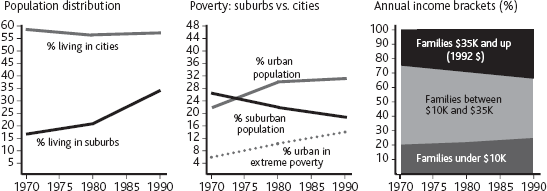
Following the earlier pattern of “white flight” from cities to suburbs, the African-American middle class left ghettoes for suburban neighborhoods with lower crime rates, better schools, and higher property values. From 1970 to 1990, the number of African-Americans living in suburbs jumped from 3.6 million to 10.2 million. However “black flight” contributed to an even greater concentration of poverty in central cities. The total number of African-Americans living in poverty in the ghettoes increased from 2.9 million in 1970 to 5.3 million in 1990, from 13 percent to 18 percent of the African-American population.
In many cities the tax base tumbled to new lows, inevitably sending public education, transportation, law enforcement, and sanitation into a nosedive. Although the phenomenon was widespread, some cases stand out for sheer awfulness. From 1970 to 1990, the unfortunate city of East St. Louis, Illinois, saw its population dwindle from 70,000 to 40,000, while tax revenues plunged from $175 million to under $50 million. Thirty percent of the city’s buildings were abandoned, and garbage collection simply ceased from 1987 to 1992. As mountains of stinking garbage piled up, the city pumps broke, backing up raw sewage into schools and forming a sewage “lake” in the courtyard of one housing project. Police and firefighters went on strike for unpaid wages, city hall was sold to pay down the debt, and traffic lights were turned off because of overdue bills.
As if things weren’t bad enough, the arrival of crack in 1984 took U.S. urban blight to the next level, transforming ghettoes into burned-out, postapocalyptic war zones in just a few short years. By 1990 half a million people reported using crack in the previous month, almost all in urban areas. Crime rates surged, with the number of young African-American men murdered each year tripling between 1985 and 1992. From 1975 to 1992, the number of African-American men in prison almost quadrupled, to 425,000, or 50 percent of the total prison population. In 1991 the Justice Department estimated that an African-American male born that year had a 28 percent chance of going to prison someday.
Most Americans did their best to ignore deteriorating conditions in inner cities. But there were occasional updates in the form of eruptions of civil disorder: clear expressions of discontent within this crushing urban poverty. The most spectacular outbreak occurred in Los Angeles in 1992. Racial tensions were already running high following news broadcasts of a videotape showing six white LAPD officers beating an African-American motorist, Rodney King, who they pulled over after a high-speed chase on the night of March 3, 1991. The police later testified that King–whose blood alcohol limit was twice the legal level–hit one of the officers, lunged for another’s gun, and didn’t stop after two shocks from a Tazer, leading them to conclude he was on PCP.
All this allegedly occurred before George Holliday, a resident in a nearby apartment block, began videotaping the incident; the video showed King being kicked six times while receiving 56 blows from nightsticks, attempting to crawl out of the circle of police officers, and on one occasion rising to his knees before being knocked over again. King was treated for a broken ankle, a facial fracture, and many cuts and bruises; a nurse later testified she heard the officers joking about the beating.
After the LAPD declined to investigate Holliday’s complaint, he took the video to a local TV station, KTLA, which aired it on the local news. The video was soon picked up by CNN and other national news outlets. The resulting outcry prompted L.A.'s district attorney to charge four of the officers with using excessive force. At first, a guilty verdict seemed like a foregone conclusion–until the trial venue was moved to Simi Valley, a white, conservative suburb northwest of L.A. There, a jury composed of 10 whites, one Asian, and one Latino acquitted the officers of almost all charges.
The verdicts were handed down at 3:10 p.m. on Wednesday, April 29, 1992, and by 3:45 p.m. an angry crowd of several hundred had gathered in front of the L.A. County Courthouse; the first reports of looting came around 6:15 p.m. LAPD helicopters took fire from rooftop snipers (who also forced LAX air traffic control to reroute planes until flights were canceled), but TV news helicopters went unmolested, and for the first time ever, Americans could watch a riot unfold, live, with a bird’s-eye view of the action. The first report of arson came at 7:45 p.m., and soon south central L.A. was ablaze. By nightfall, there were over 500 fires ravaging the city. L.A.'s African-American mayor, Tom Bradley, declared a dusk-to-dawn curfew in south central L.A., and California governor Pete Wilson ordered the mobilization of 2,000 National Guardsmen.
Gangs in earlier years were rather benign. They settled their differences with chains, baseball bats, and knives; guns were comparatively rare. In 1992 they had literally thousands of guns, many of them better than ours.
–Major General James Delk,
California National Guard
On Thursday, April 30, the sun rose over a paralyzed city, as all public transportation in L.A. was suspended and all public schools were closed. The second day of rioting brought more arson and looting, and on Friday, May 1, President George H.W. Bush mobilized federal troops to restore order. Still, the violence continued unabated until Saturday, when 8,000 local law enforcement officers were reinforced by 10,000 National Guardsmen, 3,500 Army soldiers, 1,500 Marines, and 1,000 U.S. Marshals.
By Monday evening the riots were over, leaving 53 dead, 2,400 injured, and 12,100 in jail. Seven thousand fires had destroyed 613 buildings and damaged another 960, while looters robbed and vandalized 2,700 businesses, many of which never reopened. The total cost of the damage was $1.5 billion, almost all in African-American neighborhoods. As in previous riots, most of the victims were also minorities: the death toll included 25 African-Americans, 16 Latinos, 8 whites, 2 Asians, and 2 immigrants from the Middle East.
TRENDSPOTTING 
Shirt Happens
The Shirt Off Men’s Backs
Men have always enjoyed looking at women, but ogling had mostly been a one-way street in the modern era. Hollywood had acknowledged women’s appreciation of male physical beauty in the first decades of the twentieth century, when audiences swooned for movie stars like Rudolph Valentino and Douglas Fairbanks. But displays were still fairly modest, focusing on handsome features accentuated by well-tailored suits (or in Valentino’s case, flowing robes), which only hinted at the body underneath. Likewise in the 1940s, leading men like Clark Gable and Cary Grant built careers on a handsome smile, while Humphrey Bogart was admired more for his cool demeanor than good looks. By contrast, female stars like Marilyn Monroe, Betty Grable, Doris Day, Deborah Kerr, and Debbie Reynolds showed a lot of skin in an endless parade of movies set near beaches or swimming pools.
Clark Gable’s dazzling smile was the result of a full set of porcelain dentures; he’d had most of his teeth extracted in 1933.
In the 1960s actresses like Liz Taylor, Julie Christie, and Bridget Bardot graduated to bikinis, but men still didn’t show much skin–which was strange, considering the very positive audience reactions when movies did stray into beefcake country: the famous surf kiss between Burt Lancaster and Deborah Kerr in “From Here to Eternity” (which also featured a shirtless Montgomery Clift), Marlon Brando doffing his shirt in “A Streetcar Named Desire” in 1951, and a young Paul Newman doing the same–repeatedly–in “Cat on a Hot Tin Roof,” in 1958. Also, anything starring James Dean.
Nevertheless, it wasn’t until the 1970s that male beauty emerged as a subject of public discussion, thanks to feminists (who were on one hand reluctant to declare their appreciation for anything man-related, but at the same time determined to even the score in the objectification game). In 1972 Burt Reynolds posed for his famous centerfold in Cosmopolitan magazine, 1973 brought the debut of Playgirl, and in 1975 Ms. magazine published a “Men’s Issue” with Robert Redford’s lats on the cover. New York magazine noted, “Women are admitting to being turned on by male cheesecake, a situation inconceivable until now.”
From 1975 to 1992, the number of Americans who were obese doubled from 30 million to 60 million, with rates rising in children as well as adults. Average calorie intake during this period stayed the same, at about 2,100 per person. How is that possible? That’s the $46 billion question (the total cost of treating obesity in 1990). Scientists still aren’t sure.
The 1980s brought more open ogling of the male form, focusing on a new generation of male “sex symbols.” In 1980 Richard Gere started things off with a bang in “American Gigolo,” causing a minor uproar with a few moments of blurry full-frontal nudity, and 1982's “Rambo: First Blood” featured a muscle-bound Sylvester Stallone. In 1983 Tom Cruise hit it big with his role as a young basketball player in “All the Right Moves,” heralding a career built on beefcake, including “Risky Business” (1983) and “Top Gun” (1986). In 1987 “Dirty Dancing” centered on Patrick Swayze’s sweaty torso, and Mel Gibson won critical acclaim for walking around bare-bottomed in “Lethal Weapon.”
But men had one more step to take before catching up with women in the objectification game: nudity for the sole purpose of selling consumer goods. This proud moment finally came in 1982, when fashion designer Calvin Klein began plastering billboards and magazines with artfully titillating underwear ads. In 1992 Klein catapulted to national prominence with ads showing 21-year-old Mark Wahlberg, still known by his stage name, Marky Mark, wearing Klein’s iconic boxer briefs. Finally, gender equality–at least, on the nearly naked front.
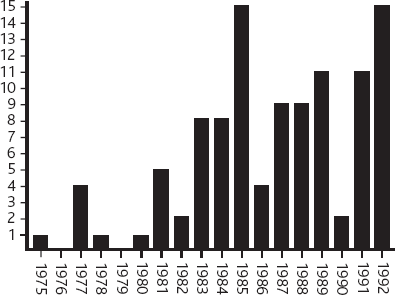
Number of Times “Hunk” Is Used in Reference to a Man in Time and New York Magazines
Losing Our Shirts to Pay for Health Care
In 1975 Americans spent $133 billion, or $590 per person, on health care, including prescriptions, surgery, and hospital bills. In 1992 health-care spending totaled $839 billion, or $3,288 per person (which is $1,256 per person in 1975 dollars). What the health happened?
In fact, the increased cost of health care was (partly) a positive trend, reflecting the improved quality of health care available to ordinary people. After taking the lead in medical research in the 1950s, America generated a flood of new medications, surgical techniques, and devices to prolong and improve the quality of life. From 1975 to 1992, average American life expectancy rose from 72.6 to 75.8, thanks to advances on multiple fronts, with the death rate for heart disease falling 16 percent and the five-year survival rate for cancer increasing from 48 percent to 60 percent. This included big gains in five-year survival for breast cancer (from 75 percent to 85 percent), melanoma (67 percent–88 percent), childhood leukemia (50 percent–85 percent), and prostate cancer (67 percent–97 percent). Go America!
Many of these improvements were made possible by expensive new technologies or medicines that cost a lot of money to develop–in 1992 alone, pharmaceutical companies spent an average $500 million on research and development for each new drug. Higher survival rates were also due to Americans getting more regular checkups and screenings, which also cost more money. At $100 per mammogram, for example, breast cancer screenings cost about $2 billion per year in the early 1990s. Last but not least, the fact that Americans were living longer raised costs in areas like nursing home care and prescription drugs. In short, as with most goods and services, as people wanted more and better health care, they had to pay more for it.
But unfortunately, not all the money was going to corresponding increases in the quality or quantity of health care. The publicly funded health-care plans established by Lyndon Johnson–Medicaid and Medicare–had billions of dollars of waste resulting from fraud and inefficiency. The congressional General Accounting Office estimated that from 1975 to 1992 10 percent of Medicare spending was lost to fraud and abuse, for a total $110 billion over that period. In 1996 the Inspector General for the Department of Health and Human Services revised the estimate up to 14 percent of all Medicare costs–over $23 billion per year! And in 1991 alone, Medicaid supposedly paid $5.5 billion in fraudulent prescription drug fees–about 7.7 percent of its total spending.
Fraud investigators have turned up all kinds of absurd schemes to bilk Medicare and Medicaid. One elderly woman’s medical care required 12.5 miles of tape; a dentist claimed to see 500 patients a day; a 19-year-old football player was treated for diaper rash; and comatose patients were prescribed birth control pills.
This is a mind-boggling amount of fraud, but it’s plausible considering that only 17 percent of all Medicare claims received any kind of review in 1989. Meanwhile, because Medicaid was set up in a way that positively encouraged more spending (the federal government provides matching funds to states for health-care expenditures, essentially paying states to spend more), states also learned how to “game” the system; one creative scheme involved raising taxes on health care providers, refunding their tax payments, and counting the refunds as “spending.” Between rising legitimate costs, pork barrel, and massive fraud, federal spending on Medicare jumped nine-fold from $15.5 billion in 1975 to $136.3 billion in 1992, while Medicaid spending increased 10fold from $6.6 billion to $66 billion. That compares to a mere six-fold increase in total health care spending over the same period. Somehow, the math just doesn’t seem to add up.
Of course, it’s not all Uncle Sam’s fault. The private sector had its own issues, like the always fun practice of suing doctors. During this same period, the number of medical malpractice lawsuits soared from 2.5 per 100 physicians in 1975 to 14.1 per 100 in 1992. Some of these were doubtless justified, but profit, as always, was a major factor. And why shouldn’t it have been? Payouts were bigger than ever: the average verdict of malpractice lawsuits increased from $220,000 in 1975 to $1.2 million in 1990. And while most plaintiffs who brought frivolous medical malpractice lawsuits didn’t actually end up winning any money, the mere fact that physicians were sued for malpractice triggered automatic rate hikes in their medical malpractice insurance premiums. Of course, doctors simply passed these costs along to the public.
So what did Americans do about spiraling health-care costs? For the most part, nothing. During this period, attempts to reform Medicare and Medicaid failed miserably, for the simple reason that people like free stuff from the government. In 1981 Ronald Reagan dropped the idea of reforming Medicare payments like a hot potato after realizing he was on the wrong side of public opinion. As for malpractice lawsuits, some states passed legislation modeled on California’s 1975 Medical Injury Compensation Reform Act, which lowered malpractice insurance premiums by limiting malpractice verdicts for “pain and suffering” to $250,000–but congressional efforts to reform malpractice law were derailed by lobbyists representing trial lawyers.
AIDS AND ADVOCACY
In June-July 1981, the Centers for Disease Control in Atlanta reported that gay men in New York, Los Angeles, and San Francisco were being hospitalized with the same mysterious set of symptoms, including pneumonia, Kaposi’s sarcoma–a rare skin cancer usually seen in elderly patients–and oral thrush, an indication of immune failure. Ominously, 26 of the 29 patients were already dead. By the end of 1981, 241 people had died–almost all gay men–with the annual toll rising sharply to 853 in 1982, 2,304 in 1983, and 4,251 in 1984.
At a loss, doctors dubbed the new disease “gay-related immune deficiency” (GRID) and speculated it might be caused by drug abuse or some other element of young gay men’s “party lifestyle.” By 1982 CDC researchers had linked the disease to bodily fluids and speculated it was transmitted by homosexual anal intercourse, which causes small tears and bleeding in the rectal lining. That same year the CDC dropped GRID in favor of a new name, acquired immune deficiency syndrome, indicating it wasn’t intrinsically gay-related. But health officials still failed to anticipate it might cross over to heterosexuals–an egregious oversight, which helped the epidemic get a foothold in the general population. The disease probably spread to heterosexuals via bisexual men, shared needles among intravenous drug users, and tainted blood transfusions. (After linking AIDS to blood in 1982, it took another year for the CDC to warn that blood banks might be contaminated.) With evidence of epidemics surfacing in Europe and Africa, in 1983 the Pasteur Institute in Paris, France, said it had isolated the human immunodeficiency virus, which causes AIDS. In 1984 Dr. Robert Gallo, a researcher at the U.S. National Cancer Institute, claimed (incorrectly) to be the first to discover the virus; however, techniques developed by his lab in the 1970s had been crucial to the Pasteur Institute’s isolation of the virus a year earlier. In 1985 the U.S. Food and Drug Administration introduced the first antibody test and finally began screening blood supplies. The year 1985 also saw the first celebrity AIDS death–Rock Hudson, a Hollywood heartthrob from the 1950s and 1960s who never publicly revealed his homosexuality. He was one of 5,636 U.S. AIDS deaths that year. The first effective treatment for AIDS, AZT, was introduced in 1987, and in 1988 U.S. Surgeon General C. Everett Koop mounted a publicity blitz promoting the use of condoms for safe sex, including the mailing of 107 million pamphlets titled “Understanding AIDS.” Nonetheless, the number of AIDS deaths continued climbing sharply to 14,544 in 1989 and 18,447 in 1990–including Ryan White, a teenage hemophiliac infected by a tainted blood transfusion. In 1991, 20,454 people succumbed in the United States, and basketball player Irvin “Magic” Johnson revealed he had HIV. In 1992, 23,411 died and one million Americans were estimated to have HIV.
The U.S. death toll would continue to climb until the mid–1990s, when the first protease-inhibitor drugs were introduced in 1995–1996. Overall, from 1981 to 2009, at least 600,000 Americans died from AIDS, and 1.2 million Americans are currently living with HIV. Worldwide, total deaths topped 25 million, and at least 35 million people are currently living with the virus. AIDS has orphaned 14 million children in sub-Saharan Africa.
Ironically, the AIDS epidemic resulted in greater visibility–and ultimately, acceptance–for “alternative sexualities” in American society (lesbians, gays, bisexuals, and transgendered people, or LGBT for sort-of-short). This was partly the work of new advocacy organizations formed to publicize the effects of the AIDS epidemic and put pressure on public officials and pharmaceutical companies for swift action. These included the Gay Men’s Health Crisis, formed in 1982, the American Foundation for Aids Research (AmFAR) formed in 1985, ACT UP, formed in 1987, and the AIDS Memorial Quilt project, also started in 1987.
Cable TV On, Women’s Shirts Off
Before the Internet became a limitless font of pornography just a mouse-click away, late-night premium cable TV was pretty much the best thing ever invented, as far as teenage boys were concerned. And, okay, all those hundreds of other cable channels weren’t bad either.
Cable TV actually started way back in the late 1940s as a way of getting television to remote rural areas: receiving towers picked up distant broadcast signals and distributed them to local subscribers via cable–a less costly alternative to “repeater” towers, which used a lot more power to boost faraway broadcast signals. Because the receiving towers could pick up local broadcasts from hundreds of miles away, by the 1950s many cable subscribers actually had more viewing choices than households limited to plain old “bunny ears” broadcast TV. Local broadcasters supported by the Big Three Networks–NBC, CBS, and ABC–complained about the new competition, prompting the FCC to clamp down on cable in the 1960s, with limits on what kind of content cable networks could carry, and from where.
But it’s hard to stop a good idea, especially when it has the potential to deliver pornography to private households. 1972 brought the beginning of cable deregulation (thanks, Nixon!), and that same year, Charles Dolan and Gerald Levin of Sterling Manhattan Cable launched the first premium pay cable company, Home Box Office, which they envisioned as a local cable network allowing wealthy Manhattanites to watch movies in the comfort of their own luxury apartments–a revolutionary concept. After being bought by magazine publisher Time Inc. in 1973, HBO went national in September 1975 by leasing bandwidth on satellites, which allowed it to deliver the signal to local cable receiving towers all over the country. Once again, cable subscribers were getting more viewing options than regular broadcast-only households–and this time there was nothing the broadcasters could do about it.
In December of 1976, HBO was followed into orbit by WTCG, a local Atlanta-based cable network whose owner–an aspiring media mogul named R.E. “Ted” Turner–wanted to use satellite to achieve national reach for his programming. Ted’s channels were dominated by sitcoms, cartoons, old movies, and sports (including the Atlanta Braves and Atlanta Hawks, which he also owned). But unlike HBO, Turner distributed his content for free, making money by selling advertising at cheaper rates than the broadcast networks. By 1981 Turner Broadcasting System reached 2.5 million households around the country, with annual advertising revenues of $95 million, growing to an incredible $1.77 billion by 1992.
But back to the seventies. The late part of the decade brought a flurry of new national cable networks, both free and premium, and couch potatoes couldn’t have been happier: Viacom’s new Showtime channel debuted in March 1978, The Movie Channel in January 1979, and the Entertainment and Sports Network in September 1979. In June 1980 Ted Turner revolutionized TV (again) with the launch of the Cable News Network, CNN, providing 24-hour news coverage. Two months later HBO launched Cinemax to compete with The Movie Channel and Showtime. Before long, the intensifying competition pushed all four movie channels to switch to round-the-clock programming.
Around this time, big media companies like Time Inc., Warner Cable Communications, and Viacom expanded from cable programming to cable infrastructure, tying together local networks to form regional and then national distribution systems. And in 1984 they got a boost from Congress, which cleared away legal obstacles to further expansion, triggering a byzantine series of mergers, acquisitions, joint ventures, and spinoffs.
The most important thing to remember, though, is that these vast media empires were built to a considerable degree on smut. As media historians Thomas Baldwin and D. Stevens McVoywrote in 1983, “It has always been accepted that uncut, R-rated movies are a major appeal of the big pay networks.” HBO Chairman Michael Fuchs himself told a new employee that “randy guys are a major part of our demographic.” In the early 1980s, The Movie Channel enjoyed rapid growth as the only premium movie channel to show R-rated movies in daytime, prompting Showtime and Cinemax (aka “Skinemax”) to begin doing the same. In 1982 the Playboy Channel launched with 340,000 subscribers, which jumped to 750,000 by 1985–but when execs foolishly tried to take the channel more “mainstream” (it’s Playboy, people!), subscribers tumbled to 400,000 by 1988. Meanwhile, competitors clearly understood the formula for Playboy’s success: in 1984 Bridget Potter, the head of original programming for HBO, issued a directive that Cinemax would focus (even more) on classy softcore porn. Her exact instructions? “Spicy but not obscene.”
 MADE IN AMERICA
Computers Get Personal
difficult to imagine, but once, long ago, personal computers didn’t exist. Let us journey back to this strange, semi-mythical time, when the world was full of legend, wonder, and superstition.
Before personal computers, all computing was handled by “mainframe” computers, which were shared by teams of people.
Mostly used by scientists, mathematicians, and government officials, these behemoth computing machines performed complex calculations that would take humans weeks, months, or years. The first mainframes were built during World War II to calculate ballistic trajectories, and in the 1950s, Remington Rand built mainframe computers for the U.S. Census Bureau and the Internal Revenue Service.
By the early 1970s, most big businesses and academic institutions had computers. But the costs were exorbitant. In fact, researchers had to share computers, with people waiting their turn to perform all their calculations in scheduled windows of availability–a system that inevitably led to accusations of computer hogging and arguments about whose research was more important.
Everything was about to change. In 1976 two computer science geeks in Palo Alto, California, Steve Jobs and Steve Wozniak, designed and sold the Apple I–the first low-cost, preassembled computer circuit board, incorporating 30 microchips, which users (pretty much computer geeks exclusively) could easily hook up to a television monitor and electronic keyboard. The next step was the Apple II, the first complete, “out of the box” personal computer in 1977. Where the Apple I sold about 200 units total, the Apple II sold at least five million over the next 10 years. Apple was soon joined by IBM, which rushed its own pioneering personal computer, the IBM 5150, to market in 1981.
BEFORE THERE WAS IPAD …
1944: The Electronic Numerical Integrator and Calculator (ENIAC) weighs 30 tons and sucks up about 200 kilowatts of electrical power to determine the feasibility of the first hydrogen bomb.
1951: The Census Bureau’s UNIVAC I weighs “just” 15 tons and uses 125 kilowatts of electricity.
1955: International Business Machines (IBM) introduces its first commercially successful mainframe, the 705, weighing 17 tons, occupying over 1,000 square feet, and using about 100 kilowatts.
1957: IBM ships the 608, which dramatically reduces the size and energy consumption of computers by replacing vacuum tubes with transistors.
1960–1963: MIT engineers develop the first integrated circuits, which concentrate huge numbers of transistors on very small pieces of silicon substrate, called microprocessors or microchips. The first practical integrated circuits are incorporated into the Apollo guidance computer by MIT engineers, with design and production improvements lowering the cost from $1,000 in 1960 to just $25 in 1963.
With the scale and marketing resources of a huge company behind it, IBM’s desktop seemed poised to crush Apple and dominate the PC market. But in 1984 Apple hit back with the Macintosh, a $2,000 console with a graphic interface that was more accessible than IBM’s PC. Apple paid film director Ridley Scott $1.5 million to create an iconic TV ad invoking the imagery of George Orwell’s novel 1984, with a female athlete (Apple) throwing a sledgehammer and shattering a huge television screen filled by a propaganda-spewing dictator (IBM). The ad aired during Superbowl XVIII on January 22, 1984, and is generally considered one of the most effective television ads in history, drawing a line between Mac and PC fans that remains to this day.
Both Apple and IBM continued improving their personal computers, offering more memory and capabilities at lower prices in a fierce battle for market share. Ultimately, IBM and Apple took different approaches to personal computing products, which ironically ended up marginalizing both companies, although for different reasons. IBM followed a policy of “open architecture,” incorporating processors built by third-party technology companies that were compatible with a variety of operating systems. Meanwhile, Apple prohibited users from installing any operating system besides the proprietary Mac system and also refused to license the Mac graphical interface for use in PCs.
As a result of these decisions, both companies created an opening for a new generation of personal computer manufacturers to join the fray. On one hand, IBM’s open architecture meant rival manufacturers could produce cheaper PC “clones” that functioned just like IBMs. For its part, Apple’s refusal to license the Mac operating system failed to prevent Seattle-based Microsoft, founded by Bill Gates in 1975, from introducing Windows–an operating system featuring a graphic interface that bore an uncanny resemblance to the Mac–in 1985. (Anyway, Mac’s system actually borrowed heavily from an earlier prototype interface developed by Xerox.) At this point the focus shifted from hardware to software, and Microsoft quickly became the dominant force in personal computing.
Gold on the Silver Screen
After inventing the movie camera and the movie star, America’s next big contribution to the movie business was the blockbuster– an epic movie, released simultaneously at movie theaters nationwide (usually during the summer), which becomes a huge hit, rakes in hundreds of millions of dollars, and dazzles the news media into giving it additional free publicity.
In previous eras, hit films built their success gradually, moving from limited distribution to nationwide distribution as “buzz” built in the press. This was partly due to the fact that the U.S. movie business was divided among literally hundreds of independent theaters and small chains, mostly the result of court-ordered breakups of the “big five” movie chains in the late 1940s and 1950s. But in the 1960s, a new round of consolidation was aided by the rise of the “multiplex"–a group of theaters under one roof connected to a mall. As the total number of movie screens rose from 10,335 in 1970 to 22,774 in 1990, the number of screens owned by the four largest chains also rose, from about 800 (8 percent) to about 8,000 (35 percent) over the same period.
Increasing concentration of movie theater ownership made it easier to coordinate the simultaneous release of movies across America. At the same time, by the early 1970s movie theater owners were desperate for something to reverse a long-term slump in audience numbers resulting from competition from television. True, there had been some big hits, which showed cinema still had a hold on the American imagination: in 1972 Francis Ford Coppola’s “The Godfather” eventually achieved nationwide distribution, raking in $135 million in U.S. box office sales, and two years later “The Exorcist” also succeeded the old-fashioned way, attaining national distribution and box office sales of $193 million.
It was Sidney Sheinberg, the president and chief operating officer of MCA, who first hit upon the idea that “wide release” could generate enough buzz–and sales–to offset bigger initial expenses for marketing and promotions. As a bonus, the studio could actually save money in the long run, since the marketing spending would all be front-loaded in the first couple of weeks (rather than spread out, piecemeal, as the film gradually penetrated new markets). Of course, Sheinberg also realized he needed a larger-than-life movie to justify this gamble.
Luckily, Sheinberg had wisely supported an enterprising young director, Steven Spielberg, who had taken on an unconventional project: a big-screen adaptation of a best-selling novel about a 25-foot great white shark terrorizing a summer tourist spot. On June 20, 1975, “Jaws” opened amid a publicity feeding frenzy at almost 500 theaters nationwide. The result was the largest movie debut in history (to date), earning $7 million in its first weekend (or $28 million in 2008 dollars). “Jaws” went on to make $260 million in U.S. ticket sales. In some cities, crowds of moviegoers formed ticket lines that stretched all the way around the block; the era of the “blockbuster” had begun.
THE REPUBLIC OF HOLLYWOOD
The years following “Jaws” saw more epic movies opening with equally epic national distribution and ticket sales: “Star Wars” (1977, $461 million), “Superman” (1978, $134 million), “The Empire Strikes Back” (1980, $290 million), “Raiders of the Lost Ark” (1981, $245 million), “E.T.” (1982, $435 million), “Return of the Jedi” (1983, $309 million), “Ghostbusters” (1984, $238 million), “Indiana Jones and the Temple of Doom” (1984, $179 million), “Beverly Hills Cop” (1984, $234 million), and “Back to the Future” (1985, $210 million). The combined box office receipts of these blockbusters–totaling $3 billion–exceeded the 1985 GDPs of 65 sovereign nations, including Iceland and Nicaragua.
Hip-Hop Hooray
For like the hundredth time in U.S. history, musical innovation by African-Americans in the 1970s and 1980s led to the creation of a whole new genre of music–hip-hop–which swept white mainstream American youth culture before taking over the rest of the world. Sound strangely familiar? Well, it’s pretty much the exact same sequence of events that catapulted first jazz and then rock-n-roll to global dominance.
Like its predecessors, hip-hop’s origins are a bit mysterious because it emerged in a poor, marginal community. It was pioneered sometime in the mid–1970s by street-corner artists in the Bronx, who delivered impromptu vocal performances, sometimes in the form of contests, where participants improvised rhythmic, lyrical “spoken word” monologues. Known as rapping, this practice incorporated other folk traditions, like the ritualized exchange of insults, boasting and intimidation, and comical narrative, all mixed together with a healthy dose of word play.
By the late 1970s, some rappers joined forces with DJs who were experimenting with turntable techniques at dance parties, looping short stretches of funk and disco records where the other instruments “break” to showcase the bass and percussion. By repeating these breaks again and again, they created a totally new, infectious, and highly danceable sound. The DJs paired up turntables, allowing them to extend the break beats or pair them in novel ways with bits of blues, jazz, rock, and Motown, and also experimented with “scratching"–the feedback-like sound produced by pulling a record backward to loop the break beat.
Before long, rappers were part of the performance, accompanying DJs at dance parties as “masters of ceremonies” or “MCs” who improvised “disco raps” over the break beats. Rival rappers developed followings who packed clubs to hear them compete in (relatively) friendly contests displaying verbal prowess and rhyming skills. Between their feuds, flamboyant costumes, and sexy backup dancers, it wasn’t hard for MCs to steal the spotlight from the DJs, but the MC-DJ relationship remained central to the new musical genre known as “hip-hop.”
As party music, early hip-hop was mostly about dancing and having a good time: the archetypal example is the Sugar Hill Gang’s “Rapper’s Delight,” which sampled the hit disco song “Good Times” by Chic and became the first hip-hop song to break through to mainstream audiences in 1979–1980. However, the tone and subject matter took a decidedly negative turn as conditions in inner cities deteriorated over the course of the 1980s, especially with the arrival of crack cocaine in 1983–1984. The mid-1980s saw the emergence of a new subgenre of hip-hop, “gangsta rap,” created by rappers who took the criminal underworld as their subject matter. In fact, some of the most famous hip-hop stars of this period started out as crack dealers, including Eric Lynn Wright, aka Eazy-E; Shawn Corey Carter, aka Jay-Z; and Christopher Wallace, aka Frank White, aka The Notorious B.I.G., aka Biggie Smalls, aka Big Poppa.
PARTISAN PROFILES 
Ladies of the Right
While left-leaning feminists tended to dominate women’s political involvement in the 1970s, feminism and related social movements for abortion and gay rights triggered a backlash by conservative women who stood up for “traditional” values. Predictably, they met with an extremely hostile reaction from feminists–but they did succeed in letting the world know American women held a wide range of political views.
PHYLLIS SCHLAFLY (b. August 15, 1924). The uber-grandma of female conservative activism, Schlafly was involved in politics before feminism even hit the scene. Her principle concern was the global threat of communism, and she even joined the hard-core John Birch Society for a brief time. (She left because she disagreed with its paranoid focus on domestic communist threats.)
However, Schlafly was soon drawn into the domestic upheavals that divided America in the 1960s. She opposed liberal Republicans like Nixon as too moderate on social issues, and in 1964 she tore into the Northeastern liberal GOP for selling out its principles. That same year she also supported ultraconservative Republican presidential candidate Barry Goldwater–distinguished by his opposition to the New Deal and his hawkish foreign policy views.
When feminism emerged in the early 1970s, Schlafly was having none of it: her activism was now devoted to sticking up for women who opted for traditional roles as wives and mothers (although she herself was a working professional). Schlafly achieved national prominence with her campaign against the Equal Rights Amendment proposed in 1972, and she played a key role in defeating the amendment. She founded an activist group, Stop Taking Our Privileges (STOP), which argued the ERA would actually undermine women’s social position by freeing husbands from the obligation to support their wives, making it harder for widowed housewives to collect Social Security, and making women eligible for the draft. Whether or not these warnings were accurate, they helped turn public opinion against the ERA, which failed in June 1982 after being ratified by 35 out of the required 38 states.
ANITA BRYANT (b. March 25, 1940). Bryant is best remembered for her failed attempts to roll back gay rights–oh, and for a string of saccharine hit songs in the 1950s and early 1960s, including “Til There Was You,” “Paper Roses,” and “Step By Step, Little By Little.”
After achieving moderate success as a singer, in 1969 Bryant became the spokeswoman for the Florida Citrus Commission, appearing in TV commercials where she exhorted the audience to “Come to the Florida Sunshine Tree!” In 1977, however, Bryant suddenly threw herself into politics with her campaign to reverse a local gay rights ordinance in Dade County, Florida, which would have prohibited discrimination on the basis of sexual orientation. A Southern Baptist, like other conservative evangelicals Bryant viewed the gay rights movement as an assault on morality itself. With encouragement from Jerry Falwell, Bryant founded an activist group called Save Our Children, which managed to repeal the gay rights ordinance in Dade County (until 1998, when it was finally reinstituted).
If homosexuals are allowed to change the law in their favor, why not prostitutes, thieves, or murderers?
–Anita Bryant, 1977
Bryant’s initiative inspired similar (but less successful) campaigns to repeal gay rights ordinances across the country. Meanwhile, a national boycott of orange juice prompted the Florida Citrus Commission to drop Bryant in 1980; she was also shunned by the liberal entertainment business, leading to bankruptcy, and conservative Christians turned on her following her divorce in 1979. She currently leads Anita Bryant Ministries in Oklahoma City.
Jeanne KIRKPATRJCK (November 19, 1926–December 7, 2006). Although she started out as a Democrat, America’s first female ambassador to the United Nations ended up as a prominent female figure in the GOP.
The daughter of an Oklahoma oil prospector, Kirkpatrick displayed a formidable intellect at an early age and then pursued a career in academia with all the usual liberal credentials. In 1968 Kirkpatrick supported Democratic candidate Hubert Humphrey–but over the course of the 1970s, she became increasingly disillusioned with the foreign policy of Democrats like Jimmy Carter, who mostly steered clear of confrontation with the Soviets after the defeat in Vietnam. Kirkpatrick warned that as a totalitarian regime, the Soviet government was fundamentally untrustworthy and would secretly find a way around the arms control agreements (she was right). For Kirkpatrick and other hawks, Carter’s moves to increase military spending and aid rebels in Afghanistan were too little, too late.
In 1980–while still a registered Democrat–Kirkpatrick became a foreign policy advisor to Republican presidential candidate Ronald Reagan, encouraging his hard-line position against the Soviets. After he became president, Reagan appointed Kirkpatrick U.S. ambassador to the United Nations. Kirkpatrick became notorious for her ultra-hawkish foreign policy views, including support for Argentina’s far-right military dictatorship and the secret scheme that became known as the Iran-Contra Affair. In 1984–still a registered Democrat–she delivered the keynote address to the Republican National Convention, lashing out at Democrats who “blamed America” for the world’s problems instead of recognizing Soviet aggression for what it was.
As Reagan adopted a more conciliatory approach toward the Soviet Union in his second term, in 1985 Kirkpatrick resigned her ambassadorship and returned to academia as a professor at Georgetown (in 1985 she also finally joined the Republican party).
Russia is playing chess, while we are playing Monopoly. The only question is whether they will checkmate us before we bankrupt them.
–Jeanne Kirkpatrick, 1988
SANDRA DAY O’CONNOR: NOT DOWN WIT’ GOP
Born in El Paso, Texas, in 1930, Sandra Day O’Connor was one of the first female students to graduate from Stanford University Law School and was a trailblazing female attorney before serving as an Arizona state senator and then an elected judge in Maricopa County, Arizona. A Republican, she nonetheless failed to conform to the views of “pro-life” Republicans, who publicly opposed her nomination by President Reagan in 1981. Reagan brushed off their criticism, and O’Connor was approved by the Senate with a world-beating 99–0 vote, making her the first female Supreme Court justice in U.S. history.
 OTHER PEOPLE’s STUFF
Persian Gulf, Part I
Ayatollah There’d Be Trouble!
Shah Mohammad Reza Pahlavi had been America’s BFF in the Persian Gulf since 1953, when President Eisenhower ordered the CIA to overthrow the democratically elected prime minister of Persia, Mohammad Mossadeq, and replace him with Pahlavi. The shah was a loyal American ally, crushing Middle Eastern communist movements, supporting Israel, and keeping the oil flowing from Iran and its Arab neighbors. He also bought billions of dollars of American arms. But he failed to make friends with one crucial interest group–his people. Over the course of his 26-year reign, Shah Pahlavi managed to systematically alienate all the important constituencies.
To keep the lid on dissent, the shah resorted to increasingly brutal repression by secret police, whose agents were trained in “domestic espionage and interrogation techniques” (torture) by CIA advisors. Washington bent over backward to avoid mentioning the shah’s human rights abuses until 1977, when it finally started publicly pressuring the shah to ease up on political repression–at the exact wrong moment. The shah’s belated political reforms backfired, allowing the opposition to overthrow the government. And instead of ushering in a more democratic regime, U.S. intervention helped to create a new regime that was even worse (whoops). In January 1979 the shah fled Iran, and Ayatollah Khomeini–a preeminent Shiite cleric famed for his unflinching opposition to the shah–returned from exile.
Khomeini preached a new political philosophy based on Shiite tradition called velayat e-faqih, “the guardianship of the clerics,” which called for Shiite mullahs to “guard” the power of the state from misuse. This included imposing Sharia (Islamic law), censoring the media, and creating an ultraconservative Council of Guardians, which could invalidate political candidates. Some of Khomeini’s fiercest supporters were radical anti-American university students, who stormed the U.S. embassy and took 53 Americans hostage on November 4, 1979.
Under growing public pressure, President Carter approved a multistage (aka absurdly ambitious) plan code-named “Eagle Claw” to free the hostages. Eight U.S. Navy helicopters were to fly from aircraft carriers in the Arabian Sea to a desert landing strip in eastern Iran, where they would meet up with four transport planes carrying fuel and U.S. special forces, and would refuel before carrying the special forces to a spot outside Teheran, where they would hide out overnight before boarding trucks driven by Iranian CIA operatives, sneaking into downtown Teheran, freeing the hostages, and then heading to a nearby soccer stadium for pickup by the helicopters, which would fly them back to the carriers. It was perfect–nothing could go wrong.
The plan didn’t even make it past the first stage: three of the Navy helicopters malfunctioned when sand got stuck in their rotors, forcing the mission to abort after the various aircraft met up in eastern Iran. Worse, as the aircraft prepared to withdraw, one of the helicopters collided with a transport, killing eight servicemen and destroying both aircraft. During the panicked evacuation, the other helicopters were abandoned, so the Iranians actually came out ahead by five helicopters. Although it was an embarrassing failure, Eagle Claw raised public awareness about the decline in American military power, leading to reform and revitalization in the 1980s. Meanwhile, the hostages were finally released a few hours after Ronald Reagan’s inauguration (prompting unproven allegations that his campaign had a secret deal with the Iranians). The hostage crisis lasted 444 days from November 4, 1979, to January 21, 1981.
Upon their return to the United States, each of the hostages received a lifetime pass to any Major League Baseball game.
Persian Gulf, Part II
Revenge Is a Dish Best Served a Thousandfold
The hostage crisis was a huge escalation of the conflict between the Islamic Republic and the United States, which left Americans feeling humiliated and angry–and eager for payback. The chance for revenge came when Saddam Hussein, the dictator of Iraq, invaded Iran in September 1980. When the tide of war turned against Hussein in June of 1982, President Reagan decided he couldn’t allow Iraq to be defeated. We needed the oil! (Okay, and good ol’ revenge too.)
I SAY HEROISM, YOU SAY HIGH TREASON
After Marxist Sandinistas overthrew the Nicaraguan dictator Anastasio Somoza Debayle, the United States forged an alliance of anti-Sandinista elements, the “contras.” Beginning in July 1985, members of Reagan’s National Security Council raised money for the contras “off the books” by selling weapons to Iran, still a bitter U.S. enemy–which constituted high treason, since Congress had specifically forbidden this. Rear Admiral John Poindexter was found guilty of multiple felonies, and Secretary of Defense Caspar Weinberger was indicted on charges of perjury and obstruction of justice, but President Bush pardoned them before Weinberger faced trial. Somehow Colonel Oliver North, who arranged the payments to the contras–the treason part–came out of this an “American hero.” As for Reagan, he couldn’t recall his role. Oh well!
The United States started off helping behind the scenes, passing along weapons, ammunition, vehicles, bank loans, military advice and intelligence, chemical weapon ingredients–basically, anything dangerous that could be covertly passed along. But when Iranian attacks on oil tankers in the Persian Gulf threatened global price stability, the gloves came off. In April 1988 Reagan ordered Operation Praying Mantis, which destroyed the better part of the Iranian navy and Iranian oil platforms in the Persian Gulf. Then on July 3, 1988, the guided missile cruiser USS Vincennesshot down Iran Air Flight 655, killing 290 civilian passengers and crew. The United States claimed this was a mistake, but Khomeini believed it was deliberate and feared it might presage escalating American involvement. This persuaded him to finally agree to a U.N.-brokered armistice. The eight-year war was especially destructive for Iran, which lost about 800,000 soldiers and civilians versus 300,000 Iraqi dead–due in large part to American support for Iraq.
Persian Gulf, Part III
With Friends Like These …
America had wreaked vengeance on Iran, but nothing is ever simple: now it had to deal with Iraq, which it had just armed to the teeth. Irony!
The U.S. government was never exactly a fan of Saddam Hussein, who snuggled up to the Soviet Union in the 1970s and portrayed himself as the leader of Arab opposition to Israel. The State Department had publicly condemned Iraq’s use of chemical weapons during the Iran-Iraq War (despite the fact that American companies were providing some ingredients), and everyone was nervous about his clear interest in nuclear weapons. The last straw was Hussein’s invasion of neighboring Kuwait, a tiny, defenseless country that just happens to be sitting on about 7.2 percent of the world’s proven oil reserves.
Hussein had borrowed billions of dollars from Kuwait during his war with Iran, and when Kuwait refused to cancel his debts, Hussein decided to cancel Kuwait, confident the United States wouldn’t stop him. He had good reason to think this, because that’s what he was told by April Glaspie, the U.S. ambassador to Iraq. It’s not clear how much of Glaspie’s disclosure was directed by President Bush and how much was just a gap in communications (or, for the conspiracy theorists, how much was a deliberate plan to trick Iraq into invading Kuwait so the United States could be on the side of good).
We have no opinion on the Arab-Arab conflicts, like your border disagreement with Kuwait … the issue is not associated with America … All that we hope is that these issues are solved quickly.
–April Glaspie
After Iraq invaded Kuwait on August 2, 1990, the U.N. immediately imposed economic sanctions on Iraq, and in November of 1990, the U.N. Security Council gave Iraq a deadline of January 15, 1991, to withdraw its troops. President Bush hurried U.S. troops to Saudi Arabia to protect America’s key ally and oil supplier from Iraqi aggression (Operation Desert Shield, August 7, 1990–January 15, 1991), and he began assembling a global coalition to liberate Kuwait. Altogether, almost a million troops converged on the Persian Gulf region, of which 543,000 were U.S. personnel.
The liberation of Kuwait (Operation Desert Storm, January 16–April 11, 1992) was a massive, high-tech turkey shoot, opening with one of the most devastating aerial bombardments in history. Although fewer bombs were dropped than in previous wars, a larger proportion were “precision munitions,” equipped with laser guidance systems that allowed attacking aircraft to destroy their target the first time–doing with one “smart bomb” what previously took 10 or 100 “dumb bombs.” In the first two weeks alone, coalition planes flew 37,000 missions, targeting the Iraqi air force and air defenses, followed by Iraqi Republican Guard and Iraqi Army formations in Kuwait and Iraq. After wiping out most of these targets, the air campaign moved on to SCUD missile launchers, production labs for weapons of mass destruction, oil refineries and port facilities, the Iraqi navy, roads and bridges in Iraq, and the Iraqi power network.
After this deluge, the ground campaign was almost an afterthought, if not a foregone conclusion. On February 24, 1991, U.S. Marines crossed from Saudi Arabia into Kuwait, taking thousands of prisoners. Tens of thousands of Iraqi troops tried to flee along the main highway to Iraq but were slaughtered by U.S. air power in such numbers it was dubbed the “Highway of Death.” By February 27, Kuwait was liberated, and the following day the Iraqi commander agreed to meet for cease-fire negotiations.
After the war, America was on top of the world again, with President Bush enthusing, “We finally beat the Vietnam syndrome.” The United States had flexed its muscles, protected its allies, and showed that it was a team player in the U.N. Even better, the United States just happened to end up with a vastly expanded military presence in the Persian Gulf, with troops in Bahrain, Kuwait, Oman, Qatar, Saudi Arabia, and the United Arab Emirates. And no one could have a problem with that, right?
DIRTY LITTLE WARS
Between all the dirty, hit’n'run wars and the well-intentioned but ill-fated peacekeeping missions, America had its fair share of scrapes. Here are a few of the notches we added to the old ammunition belt:
Invasion of Grenada, October 1983: One of the more “comic opera” wars in U.S. history. Reagan ordered the invasion of the wee Caribbean island nation of Grenada when an internal quarrel in the ruling communist regime presented a chance to flush the whole miniature Marxist misadventure into the sea. In 1984 Grenada held its first elections in almost a decade.
Lebanon, 1982–1984: In 1975 the small eastern Mediterranean nation of Lebanon descended into civil war, and in 1982 the U.N. organized a multinational peacekeeping force. However, not all the Lebanese factions wanted peace. On October 23, 1983, a Hezbollah suicide bomber detonated a truck full of explosives in front of barracks housing foreign troops, killing 241 U.S. Marines and 58 French soldiers. The U.N. force withdrew soon after.
Libya, Operation El Dorado Canyon, April 15, 1986: After Libyan intelligence was implicated in the bombing of a West Berlin nightclub popular with U.S. servicemen, Reagan ordered punitive air raids that killed 45 soldiers and officials and 15 civilians, including the adopted daughter of the Libyan leader, Muammar Qaddafi. The strike is believed to have provoked the Libyan bombing of Pan Am Flight 103 over Lockerbie, Scotland, killing 270.
Panama, Operation Just Cause, December 1989: In the 1970s and early 1980s, Panamanian dictator Manuel Noriega was an important U.S. ally, but he also got in bed with cocaine smugglers. On December 20, 1989, 28,000 U.S. troops descended on Panama, and Noriega was extradited to the United States, where he was eventually tried and convicted of racketeering, drug smuggling, and money laundering.
Pulling the Rod Out of the Iron Curtain
The single most important U.S. diplomatic victory in recent history is also the least understood. In the early 1980s, the Soviet Union was the “Evil Empire"–a huge, powerful adversary, oppressing tens of millions of Eastern European vassals and spinning nefarious anti-American plots. Then, in the early 1990s, it simply ceased to exist. What happened?
In the early 1970s, Richard Nixon warmed to the idea of détente, or a “thaw” in the Cold War–but in the second half of the decade, a group of “neoconservative” analysts unearthed evidence that the Soviets tricked the United States: while reducing their long-range ICBMs as agreed, they more than made up for it with new medium-range missiles. Soviet aggression in Afghanistan (un)sealed the deal, wrecking détente and sending relations to their lowest point since the beginning of the Cold War.
In response, Reagan basically reopened the arms race, eliminating the Soviet advantage and forcing the Kremlin to increase spending as well. But the Politburo realized it had a problem: with a smaller economy, the Soviet Union was already devoting a large proportion of its gross national product to defense, and the only way to spend more was by lowering the population’s standard of living. U.S. and European trade sanctions in response to the invasion of Afghanistan made the situation even worse. Soviet trade with Western Europe fell sharply as a result, decreasing from 22 percent to 15 percent of Soviet exports from 1980 to 1988. Likewise, from 1981 to 1983 Reagan convinced Congress to enforce trade sanctions against Poland (a key Soviet ally) which eventually forced the communist regime in Warsaw to recognize Solidarity, a new democratic reform movement led by Lech Walesa, the boss of the dockworkers’ union.
As the standard of living declined behind the Iron Curtain, popular discontent increased, but there was also a glimmer of hope in Mikhail Gorbachev, a reformer who took power in 1985. Gorbachev decided the only way to sustain military and social spending simultaneously was by seeking renewed foreign trade with Western Europe–especially sales of abundant Soviet oil and natural gas. But NATO allies in Europe–Margaret Thatcher in Britain, Helmut Kohl in West Germany, and François Mitterrand in France–mostly supported Reagan (well, sort of), giving him leverage over Gorbachev. Not coincidentally, beginning in January 1984, Reagan also indicated he would be receptive to new negotiations for nuclear and conventional arms control agreements–a classic “carrot and stick” approach.
Spending Habits, U.S. vs. Soviet Union
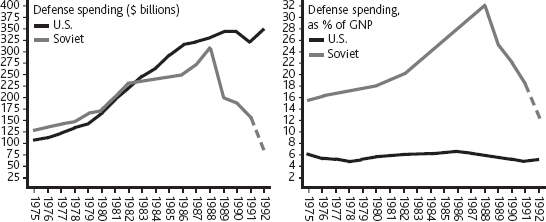
While Raisa Gorbachev dazzled the Western world (she was often referred to as “the Princess Di of the Soviet Union”), she wasn’t very pop
Reagan and Gorbachev met in person for the first time in Geneva, Switzerland, on November 19, 1985, to discuss nuclear arms control and Soviet objections to Reagan’s provocative plan for space-based missile defense (the Strategic Defense Initiative). Thus commenced a very unusual friendship between the American and Soviet leaders. Reagan was surprised to discover that Gorbachev was a genuine reformer who wanted to open up the Soviet Union and give its citizens more freedom, while Gorbachev was pleased to find that Reagan was hardly the bellicose, trigger-happy cowboy that some of his official remarks seemed to suggest.
My fellow Americans, I am pleased to tell you today that I’ve signed legislation that will outlaw Russia forever. We begin bombing in five minutes.
–Ronald Reagan, whose “joke” was accidentally broadcast on the radio during a live on-air mic check, August 11, 1984
A subsequent meeting in Reykjavik, Iceland, on October 11, 1986, didn’t produce the hoped-for arms control agreement–but at least the rival superpowers were still talking. Moreover, Gorbachev’s dealings with Reagan gave him the credibility he needed at home to implement perestroika–political and economic reforms–over the objections of hard-liners on the Politburo. At this point Reagan ratcheted up the rhetoric again, strengthening Gorbachev’s hand at the expense of the hard-liners. On June 12, 1987, Reagan visited Berlin’s famous Brandenburg Gate–then divided by the Berlin Wall–and challenged Gorbachev to carry out his promises of liberalization behind the Iron Curtain.
General Secretary Gorbachev, if you seek peace, if you seek prosperity for the Soviet Union and Eastern Europe, if you seek liberalization: Come here to this gate! Mr. Gorbachev, open this gate! Mr. Gorbachev, tear down this wall!
–Ronald Reagan, at the Brandenburg Gate in Berlin, June 12, 1987
In December 1987 Gorbachev came to Washington, D.C., where the two leaders negotiated the first (mostly symbolic) nuclear arms reduction agreement–signed by Reagan over the protests of foreign policy hawks in his administration. In return, April 1988 brought Gorbachev’s biggest concession yet, with his announcement that Soviet troops would begin withdrawing from Afghanistan. This in turn cleared the way for Reagan’s visit to Moscow in May 1988, where he was allowed to meet with political dissidents–a sign Gorbachev was sincere about reform.
While Gorbachev never intended to bring about the dissolution of the Soviet Union, the reforms he implemented quickly spun out of control–beginning with his new policy of non-interference in the internal affairs of Warsaw Pact allies. In April 1989 Poland agreed to democratic reforms. In early 1989, the Hungarian government allowed non-communist political parties, followed by the dissolution of the communist Party in October. In May of 1989, the Hungarians opened the border with Austria, leading to an exodus of citizens from other Warsaw Pact countries through Hungary to the West. In November–December 1989, the communist regime in Czechoslovakia resigned under public pressure, leading to free elections. In the first weeks of 1990, the communist regime in Bulgaria collapsed, and the Berlin Wall fell. In December 1989, the brutal Romanian dictator Nicolae Ceausescu was overthrown and executed, and finally, the Soviet Union itself collapsed after a failed coup attempt against Gorbachev by hard-liners in August 1991. After two years of upheaval that no one could have predicted, the Cold War was suddenly over.
 BY THE NUMBERS
|
31.3 percent |
African-American poverty rate, 1975 |
||
|
33.4 percent |
African-American poverty rate, 1991 |
||
|
360,000 |
African-American men in prison, 1992 |
||
|
310,000 |
African-American men in college, 1992 |
||
|
4KB |
standard amount of memory preinstalled on Apple II computers, 1977 |
||
|
4MB |
standard amount of memory preinstalled on Apple Macintosh Quadra 900s, 1991 |
||
|
99,900 |
percent increase in standard preinstalled memory over this 14-year period |
||
|
16 million |
number of households subscribing to cable TV, 1980 |
||
|
57 million |
number of households subscribing to cable TV, 1992 |
||
|
$5 billion-$6 billion |
estimated revenues of the Medellin Cartel, mid-1980s |
||
|
$24 billion |
Pablo Escobar’s personal fortune, as estimated by Forbes magazine, 1989 |
||
|
13,309 |
total U.S. AIDS deaths, 1985 |
||
|
206,000 |
total U.S. AIDS deaths, 1992 |
||
|
4 million |
total world AIDS deaths, 1992 |
||
|
31 percent |
proportion of Americans identifying as evangelical or born-again Christians, Gallup, 1976 |
39 percent |
proportion identifying as evangelical or born-again Christians, Gallup, 1998 |
|
38 percent |
proportion who said they interpret the Bible literally, Gallup, 1980 |
||
|
32 percent |
proportion who said they interpret the Bible literally, Gallup, 1992 |
||
|
18 percent |
proportion who said flooding was divine punishment for the sins of inhabitants of the Mississippi River Valley, Gallup, 1993 |
||
|
120,000 |
number of Iraqi troops occupying Kuwait, 1990–1991 |
||
|
960,000 |
total number of coalition troops participating in the First Gulf War 1990–1991 |
||
|
543,000 |
number of U.S. troops in this total |
||
|
35,000 |
number of Iraqi dead |
||
|
379 |
number of coalition dead |
||
|
3 million+ |
sorties flown by U.S. Air Force, Navy, and Marine Corps pilots in Vietnam |
||
|
94,000 |
sorties flown by U.S. Air Force, Navy, and Marine Corps pilots in First Gulf War |
||
|
4 percent |
Iraqi electricity production at the end of the war, as a proportion of prewar production |
||
|
88,000 |
tons of bombs dropped in First Gulf War |
||
|
7 million |
tons of bombs dropped in Vietnam conflict |
||
|
$61 billion |
cost of the First Gulf War |
||
|
$48.2 billion |
total contribution from coalition allies |
||
|
4 percent |
proportion of American children who were obese in 1975 |
||
|
11 percent |
proportion of American children who were obese in 1992 |