
9

‘Render up your body or die’
While the dashing courtesans of the Haymarket ruled the West End, life in the East End was one long battle for survival. Poverty and hunger, rather than an excessive desire for extravagant clothing and a proclivity to sin, drove young women onto the streets. During the course of his research, Henry Mayhew was shocked to hear from one seamstress who sewed shirts from five o’clock in the morning until midnight, but still did not earn enough money to feed herself and her child.1 Struggling to survive on derisory wages, young women often faced a stark choice: ‘render up your body or die’. Prostitution, for all its drawbacks, was a welcome alternative to starvation. It was also a welcome alternative to a wretched, poverty-stricken marriage.
For all the glamour of the West End, a million Londoners lived in slums where the streets were frequently so narrow that you could step from the window of one house into that of its opposite neighbour, while the houses were piled so high, storey upon storey, that the light could scarcely penetrate into the court or alley that lay between. Far from the theatres and cafés of the Haymarket, this was a world where there were no sewers or privies or drains and the houses were filthy and overcrowded. Most families lived in a single room, sleeping together on a heap of straw and rags, men and women, brothers and sisters, old and young. The only water source was a parish pump, and this water was so difficult to obtain that the majority of families lived in unsanitary conditions.2 In 1883, in The Bitter Cry of Outcast London, W. C. Preston recalled visiting a tenement house in which one cellar was occupied by a father, mother, three children and four pigs; in another room, a man lay ill with smallpox, while his wife was recovering from the birth of her eighth child and the other children ran around naked and dirty; an underground kitchen turned out to be occupied by seven people and the corpse of a child that nobody could afford to bury.3 Intimacy, comfort and recreational sex were impossible in such inhumane conditions; instead, any sex that did take place was nasty, brutish and short. The possibility of further pregnancies and childbirth rendered women frigid with anxiety, while contraception (in the form of condoms and pessaries) was prohibitively expensive for women who could not even afford to buy food. Beer and gin, at least, offered parents a brief spate of oblivion from the struggle to feed and clothe their families. Men took their pleasure, if they could afford it, with the cheapest whores available in the nearby taverns, while domestic violence was an inevitable consequence of mental and physical exhaustion and despair.
In Liza of Lambeth the author Somerset Maugham drew on his experience as a medical student at St Thomas’s Hospital, where he had witnessed the aftermath of countless ‘domestics’. A friend of Liza’s confides that she was beaten up by her new husband: ‘I ’ad ter go ter the ’orspital – it bled all dahn my fice, and went streamin’ like a bust water-pipe.’ But, after threatening to have her husband arrested, the woman relents. ‘I wouldn’t charge ’im. I know ’e don’t mean it; ’e’s as gentle as a lamb when ’e’s sober.’4 A classic victim, this young woman espoused the sentimental view that a fist was as good as a kiss in such straitened times.
Insanitary conditions meant that the infant mortality rate was high in the East End, but many women were so desperate that they found themselves unable to face the prospect of another birth. These were the women who, for a fee of ten shillings, put themselves in the hands of an abortionist. There was an abortionist in every working-class district of London. Some were wise women, noted for their infallible folk remedies, treating their patients with herbs and tinctures; others were struck-off doctors, or half-trained nurses skilled in the application of hot baths, pints of gin and long knitting needles. In most cases, these latter procedures resulted in severe, sometimes fatal injury to the mother, left to haemorrhage to death or succumb to peritonitis. If she survived, the mother was still liable to be prosecuted for infanticide, as, to all intents and purposes, abortion remained illegal until the passing of the Abortion Act in 1967.
If a child still succeeded in being born, its parents had one final option: infanticide. Some mothers, faced with another mouth to feed, suffocated their babies or left them to die of malnutrition and neglect; some babies were sent to ‘baby-farms’, where newborns were taken in and raised for a small fee, frequently growing up to become prostitutes in their turn. In a more macabre development, many ‘baby farmers’ disposed of their tiny charges in the river. Every year, the Thames would yield up its grisly catch of infant corpses;5 the sight of drowned babies floating in the Thames became such a regular occurrence that it scarcely occasioned comment.
Little wonder then that when glamorous young women returned to the slums to visit their families, loaded with gifts and cash, younger girls flocked to follow their example. Our Times correspondent, ‘Another Unfortunate’, recalls just such an incident when she was thirteen years old and a cousin arrived, lavishly dressed and bearing trinkets and ribbons. ‘Another Unfortunate’ was captivated and her ambition was stirred. This, she realized, was the way out, this was the way to escape from sharing one room with her bricklayer father and several siblings and watching her parents’ wages going on beer and gin. This was infinitely preferable to her mother’s life, her figure wrecked by childbirth and working in the brickfield. ‘Another Unfortunate’, like many a pragmatic backstreet girl, had no illusions regarding surrendering her ‘honour’ to obtain this lifestyle.
I was a fine, robust, healthy girl, 13 years of age. I had larked with the boys of my own age. I had huddled with them, boys and girls together, all night long in our common haunts. I had seen much and heard abundantly of the mysteries of the sexes. To me such things had been matters of common sight and common talk. For some time I had coquetted on the verge of a strong curiosity, and a natural desire, and without a particle of affection, scarce a partiality, I lost – what? not my virtue, for I never had any. According to my own ideas at the time I only extended my rightful enjoyments.
‘Another Unfortunate’ did not have to wait long before she received the opportunity to put her knowledge to profitable use. ‘In the commencement of my fifteenth year one of our be-ribboned visitors took me off, and introduced me to the great world, and thus commenced my career as what you better classes call a prostitute.’ ‘Another Unfortunate’ was fortunate enough to find her own Professor Higgins in the form of a kindly older gentleman who educated her and taught her the social graces, enabling her to gain the skills to write letters to The Times arguing the case for prostitutes.6
During a ‘pilgrimage’ to the East End, accompanied for his own safety by the Assistant Commissioner of the Metropolitan Police, Dr William Acton was dismayed to see ‘respectable’ women rubbing shoulders with prostitutes like ‘Another Unfortunate’ in a music hall. The bar was crowded with well-dressed women, some of whom were prostitutes, but many of whom were married women, out with their husbands to enjoy a drink and a smoke and watch the turns on stage as a brief respite from their daily troubles. Acton was surprised by this ‘elbowing of vice and virtue’ although he had witnessed similar scenes in the West End. What also surprised him was the reverence shown by locals to girls who had evidently done well from prostitution, and the attitude of tolerance towards the ‘gay’ women. ‘Any persons connected with them whom they see well-dressed, and with money in their pockets, command a kind of respect, although the source from whence the means are obtained may be a disreputable one.’ Acton found these reunions disturbing and his attitude was one of disgust at witnessing ‘the vicious and profligate sisterhood flaunting it gaily, or “first-rate”, in their language – accepting all the attentions of men, freely plied with liquor, sitting in the best places, dressed far above their station, with plenty of money to spend, and denying themselves no amusement or enjoyment, encumbered with no domestic ties, and burdened with no children’.7 Acton fretted about the effect this would have upon respectable women. ‘This actual superiority of a loose life could not have escaped the attention of the quick-witted sex,’ he worried, as though the sight of Victorian women enjoying themselves was completely unacceptable!
But life on the streets, or in a brothel, was preferable to life at home with drunken parents, no food and no clothes. As Mother Willit of Gerrard Street, Soho, put it: ‘So help her kidnies, she alu’us turned her gals out with a clean arse and a good tog [dress]; and as she turned ’em out, she didn’t care who turned ’em up, ’cause ’em vos as clean as a smelt [fish] and as fresh as a daisy – she vouldn’t have a speck’d [diseased] un if she know’d it.’8
Other women, of course, were not so fortunate. These are the lower categories of Henry Mayhew’s classes of prostitutes, the streetwalkers, the dress lodgers, the sailors’ women who worked the docks, and the lowly park women. The streetwalkers fared particularly harshly. In ‘A Night on Waterloo Bridge’, American journalist James Greenwood describes a typical night on the ‘Bridge of Sighs’.
It is a freezing cold night, with a small rain falling, and he finds himself speculating as to how many ‘unfortunates’ came to this scene, to stand on the centre parapet and brood on the prospect of that final terrible leap into the dark, and how many changed their minds, brought to their senses by the contemplation of the black and awful depth and the bleak wind that blew off the icy water. Greenwood interviews a policeman, who has become experienced in dealing with maudlin prostitutes who always seemed to find the bridge awkward to get over on their way home to Blackfriars. ‘I ain’t equal to explainin’ it’ the policeman admits, ‘but it’s a dark and solitary bit after the gas of the public-houses and that, and it strikes ’em as such, I suppose, and sets ’em thinking of the lots that have made a jump of it when they got as far as the middle arch, and then they get the ‘blues,’ and there’s no doing anything with ’em. It would do good to some of them fast young fellows who go in for ‘seeing life,’ as they call it, if they could see some of them miserable gals shivering home over the bridge here, in the dark and rain, sometimes at one or two in the morning.9
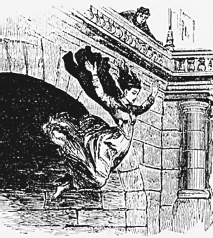
Death by drowning was a common fate for London’s prostitutes and a popular theme for writers and artists. Cover illustration for Charles Selby’s London by Night (1886).
Greenwood waits around, and sees for himself an amazing number of wretched girls and women come hurrying from the Strand side of the bridge, and, ‘with an aspect exactly as opposite to “gay” as black is to white, making haste, through the rain which had saturated their flimsy skirts and covered the pavement with a thick paste of mud, cruelly cold to ill-shod feet, towards the miserable lodgings in the poorer neighbourhoods of Lambeth and Blackfriars which were dignified with the name of home’.10
The only whores who seemed cheerful were the ones still the worse for drink, who were distinguished by their cheerful singing, keeping their courage up, Greenwood reflects, like small boys whistling in the dark. As for the rest, ‘they looked so wretchedly wet, cold, and utterly comfortless, that it would have been a mercy rather than a sin to have conferred a glass of brandy on them’. One of the youngest whores begs him to buy her a cup of coffee, and he relents, regarding her as a sorry child ‘for really she was little better’, and she jokes that the man on the coffee stall is as good as a father to her, before falling into such a severe coughing fit that it is obvious she is not long for this world. The stall is a snug little cabin, built of boards and canvas, with the cheerful glow of a charcoal fire within, and the stallholder himself dispensing the smoking beverage and bread and butter to seven or eight female outcasts who huddle together in the friendly shelter, two or three being seated on a form and dozing by the fire, their drenched clothes steaming in the heat. By the light of the fire, Greenwood observes the ghastly contrast between their pinched and haggard faces, pale except for the paint patches that glare like plague spots and their dishevelled finery, the drooping feathers and festoons of rainbow ribbon with which their hats are trimmed.
On his way back, Greenwood spots another low-life scene in one of the recesses of Waterloo Bridge. There are two women, one young and well but flashily dressed, the other miserable, shabby and middle aged, wearing an old black cloak with which she is trying to protect the younger woman from the rain. With them is an unprepossessing individual of the male sex, whose cadaverous features are a combination of the lowest of the low: he looks like a dog-stealer, a police informer and a street-fighter. The older woman is trying to persuade the younger one to go ‘back’, wherever that might be, or face getting into a row. ‘Lor! you needn’t fret about that,’ declares the cadaverous gentleman, with a growl that sounds like a preliminary to a bite. ‘She’ll come to her senses. She’s a pretty one to cut the high caper – without a rag to call her own.’ This sneer appears to cut the young woman to the quick. Casting off the protective wing of the older woman’s cloak, she bursts out: ‘Curse you both! Curse you both! Who was it that robbed me of my good clothes? Who cheated and plundered me but you, you thief, till I hadn’t a skirt to call my own!’
‘Never mind who cheated you,’ responds the bully. ‘That’s nothing to do with them clothes what’s only lent you. If yer don’t know how to behave in ’em, come on home and get out of ’em.’ Then, seeing Greenwood for the first time, he nudges the older woman, and addresses the girl in a softer voice, remarking that it’s no good her sitting there ‘ketching cold’, and the trio move away towards the Surrey side [the South Bank] of the bridge, the young woman still insisting that she won’t go back, she would rather be dead and buried. As Greenwood watches them walk away, a female voice comments: ‘That’s the way with them marms; they gets a silk gown on, and then a Duchess ain’t good enough to be their sister. Serve her right, whatever she gets.’ The voice comes from a ragged, starved-looking wretch, the bones showing sharp under her white skin, who is so drunk that she can scarcely stand and has to hold on to the stone-work for support. This apparition tells Greenwood that the young woman is a ‘dress woman, one of them that they tog out so that they may show off at their best and make the most of their faces’. But they can’t trust the girls, adds the awful creature, venturing to take the steadying grasp from the stone coping that she might clap both her skinny hands in malicious glee. ‘They never trust ’em further than they can see ’em. You might tell that by the shadder.’ The ‘shadder’ or shadow was tasked with sticking close to the ‘dress woman’, or ‘dress whore’ (a prostitute who hired her clothes from a procuress), and never leaving her, not even for a minute. The dress women are ‘no more their own mistresses than galley-slaves are,’ she concludes. ‘And serve ’em right!’ As for the man who accompanied them, well, he was worse than a dog. ‘For dogs don’t eat each other!’ she screams. ‘He’d steal his mother’s crutches if she was a cripple, and get drunk with the money he sold them for, and go home and beat her.’ And with that, the poor shameful creature staggers away.11
This ‘dress woman’, or ‘dress lodger’, had probably tried to run away from Catherine Street, off the Strand, which was a popular locale with this type of prostitute. During the day and the early part of the evening, the dress women would stop almost every man they met, but with reasonable decorum. Under the influence of drink, they plied their trade with increasing rudeness and freedom as the night wore on, while their ‘shadders’ followed at a respectful distance. Unlike other categories of prostitute, dress women led a particularly miserable life, sent out ‘rouged and whitewashed, with painted lips and eyebrows, and false hair’, to parade in Catherine Street, Langham Place, the Haymarket Theatre, the City Road and the Lyceum, and restricted to specific beats on the same side of one particular street within a few hundred yards or less of one particular spot. If they failed to pick up a punter, their shadows would sally forth and canvass on their behalf, or swear at the girls, and even beat them.
In The Night Side of London, J. Ewing Ritchie echoed the sentiments of the mad woman on Waterloo Bridge, commenting that these gay ladies were worse off than the American slaves. Dress women started in the business at eighteen and were easily burned out, particularly by the effects of alcohol. Catherine Street might have appeared festive, while the gas burned brightly by night, and there was dancing, and wine, and songs, but these girls paid the price. In the small hours, you might hear the hollow laughter, sadder than tears, of a drunken dress lodger, freshly ejected from a pub, and too far gone to have any decency left. ‘Drink and sadness combined have tortured her brain to madness. Her curses fill the air; a crowd collects; the police come up; she is borne on a stretcher to Bow-street, and in the morning is dismissed with a reprimand, or sentenced to a month’s imprisonment, as the sitting magistrate is in a good temper or the reverse.’ This was a common sight on Catherine Street, says our correspondent. ‘I have known life lost here in these midnight brawls; yet by day it has a dull and decent appearance, and little would the passing stranger guess all its revelations of sorrow and of crime.’12
Alcoholism was an occupational hazard for prostitutes. ‘When I’m sad, I drink,’ one told Henry Mayhew. ‘And I’m very often sad.’13 While the courtesans of the West End tippled champagne or White Satin gin, their less fortunate sisters drank themselves to death. One such was ‘Lucy’, or ‘Lushing Loo’, whose fondness for the bottle has given her that suggestive name. Mayhew interviewed Loo in an East End pub. At first, her appearance seemed to be at odds with her name. She looks lady-like, if somewhat haggard. Tastefully, if cheaply, dressed, she seems quiet and dejected. Mayhew suspects she needs a drink, and offers her half a crown. Her eyes light up, and, instead of the usual fare served in gin palaces, her tastes are sufficiently aristocratic for her to order ‘a drain of pale’, a glass of fine brandy. Loo proceeds to order glass after glass, and becomes maudlin. When Mayhew enquires as to what the matter could be, she lays her hand to her head and cries that she wishes she were dead, and laid in her coffin, ‘and it won’t be long now until she is’. And then with a typical alcoholic mood swing, she brightens up and starts singing. Once she’s settled down a bit, Mayhew enquires as to her former occupation. ‘Oh, I’m a seduced milliner,’ she says, impatiently, ready to please a potential client. ‘Anything you like!’14 Mayhew urges Loo to enter a refuge, wean herself off the drink and learn an honest trade, but Loo is indifferent to her fate. ‘I don’t wish to live,’ she replies. ‘I shall soon get D. T. [delirium tremens, a symptom of advanced alcoholism] and then I’ll kill myself in a fit of madness.’15 Soon after, a young Frenchman enters the bar, singing ‘Vive l’amour, le vin, et le tabac’ (long live love, wine and tobacco) and Mayhew leaves him in conversation with Loo.
But Loo is a paragon of abstinence compared with ‘China Emma’, so called because her lover was a Chinese sailor called Appoo. Appoo regularly sent money home to Emma, and obviously had some feeling for her as he made regular and drastic attempts to cure her alcoholism. When Emma got drunk, Appoo tied up her arms and legs, dragged her outside into the gutter and threw buckets of water over her, but even this didn’t succeed. ‘I’d die for the drink,’ Emma told Mayhew, ‘I don’t care what I does to get it.’ Emma had even tried to kill herself on several occasions by jumping in the Thames, but her efforts were always frustrated. Once she even jumped out of a first-floor window in Jamaica Place straight into the river, but a passing boatman hooked her out and she ended up in court, sentenced to a month in jail for attempted suicide.16
Emma was a sailor’s woman, a category of prostitutes towards whom Mayhew was reasonably sympathetic. He deplored (as ever) their extravagance but was impressed by the way the sailors treated their women. Sailors were a vital source of revenue in the East End; tens of thousands of men descended on the London docks from all over the world, arriving in the world’s busiest port, ready for shore leave and with their pay burning a hole in their pockets. And the sailors’ women or ‘leggers’ motts’17 were there to help them spend it. With high-rolling sailors looking for a good time, brothel keeping inevitably flourished in the East End. One aspect of the sailors’ behaviour intrigued Mayhew; rather than having several women, many sailors would take up with one girl, who effectively became their wife for the duration. Another curiosity was that very few English girls became sailors’ women; they were generally German or Irish. Mayhew noted many ‘tall, brazen-faced’ German women, dressed in gaudy colours, dancing and pirouetting in a dance hall off the Ratcliffe Highway.
Just as in the West End, the red-light district was concentrated on a certain number of streets consisting of the Ratcliffe Highway, Frederick Street, Brunswick Street and Shadwell High Street.18 This quarter burst into life every night when the whores paraded up and down in short nightgowns and night-jackets, outside notorious pubs such as the Half Moon and Seven Stars, the Ship and Shears and the Duke of York in Shadwell High Street, and the Shakespeare’s Head in Shadwell Walk,19 ‘flaunting about bare-headed, in dirty-white muslin and greasy, cheap blue silk, with originally ugly faces horribly seamed with small-pox, and disfigured by vice’.20
Many of the girls had distinctive names: ‘Cocoa Bet’; ‘Salmony-faced Mary Anne’; and the legendary ‘Black Sall’, described by one writer like a ship: ‘a Dutch-built piratical schooner carrying on a free trade under the black flag…many a stout and lusty lugger has borne down upon, and hoisted the British standard over, our sable privateer, Black Sall’.21
Towards the latter half of the nineteenth century, sailors’ spending patterns altered dramatically, due to the setting up of savings banks. Sailors were encouraged to bank the greater part of their pay, much to the relief of their families, but to the detriment of those whores and publicans who relied on their custom.
For investigators such as Mayhew and Acton, the East End was another country, and a dangerous one at that: Mayhew perceived Whitechapel as a suspicious, unhealthy locality, its population a strange amalgamation of Jews, English, French, Germans and other ‘antagonistic elements that must clash and jar’. But the social reformer had the grace to concede that the theatres and music halls were first rate, with their awesome firework displays, blue demons, red demons, Satans who vanished through a trapdoor and gauzy nymphs sitting astride sunbeams halfway between the stage and the flies. Outside the theatres, fights frequently added to the sense of high drama, as in this incident:
Three times in ten minutes I saw crowds collect round doorways, attracted by fights, especially by fights between women. One of them, her face covered with blood, tears in her eyes, drunk, was trying to fly at a man while the mob watched and laughed. And as if the uproar were a signal, the population of the neighbouring ‘lanes’ came pouring into the street, children in rags, paupers, street women, as if a human sewer were suddenly clearing itself.22
During his inspection of the many brothels which ‘infested’ the East End, Mayhew noted miserable establishments with faded chintz curtains and four-poster beds, and clapped-out old women sitting around sharing a can of beer. He also witnessed a development which he found almost too horrible to describe, comparing it with the work of a sensational novelist. On this occasion, he visited a shabby house, a ‘wretched tumble down hovel’ with no front door, in Victoria Place, Bluegate. Upon entering, he found a pitiful old woman and a young girl huddling for warmth around a miserable coke fire. The old woman told Mayhew that she paid five shillings a week rent, and charged the prostitutes who used her rooms four shillings a week, but that trade was slack as the shipping on the river was slow. Mayhew went upstairs and began his tour of inspection.
The first room we entered contained a Lascar [a sailor with the East India company], who had come over in some vessel, and his woman. There was a sickly smell in the chamber, that I discovered proceeded from the opium he had been smoking. There was not a chair to be seen; nothing but a table, upon which were placed a few odds-and-ends. The Lascar was lying on a paliasse [mattress] placed upon the floor (there was no bedstead), apparently stupefied from the effects of the opium he had been taking. A couple of old tattered blankets sufficed to cover him. By his bedside sat his woman, who was half idiotically endeavouring to derive some stupefaction from the ashes he had left in his pipe. Her face was grimy and unwashed, and her hands so black and filthy that mustard-and-cress might have been sown successfully upon them. As she was huddled up with her back against the wall she appeared an animated bundle of rags. She was apparently a powerfully made woman, and although her face was wrinkled and careworn, she did not look exactly decrepit, but more like one thoroughly broken down in spirit than in body. In all probability she was diseased.23
This is a grimly prescient picture of prostitution and addiction, the Victorian equivalent of a crack house. While alcohol had always played its part in the history of prostitution, drug use was a new and disturbing development.
As if this level of degradation was not enough, Mayhew paints an even more desperate picture of low life in his portrayal of a ‘park woman’. These poor creatures were even lower in the food chain than the worn-out unfortunates who skulked about the West End, scrounging a living from fashionable passers-by and the more affluent prostitutes who paid them to go away. According to Mayhew, the park women were utterly lost to all sense of shame; they wandered about London’s parks after nightfall, and consented to any species of humiliation in return for a few shillings. Park women could be met in Hyde Park, between the hours of five and ten (until the gates were closed) in winter. In Green Park, and the Mall, which was a nocturnal thoroughfare, you could spot these low wretches walking about sometimes with men, more generally alone, often early in the morning. They were to be seen reclining on the benches placed under the trees, originally intended, no doubt, for a different purpose, occasionally with the head of a drunken man reposing in their lap. Far from being the slender beauties and willing whores encountered by James Boswell, these women were so brutalized and scarred by alcohol and disease that the parks were the only venues left to them; they operated in the shadows, away from the gaslight which would have exposed the ravages of time, the defects of their personal appearance and the shabbiness of their ancient and dilapidated attire.
Mayhew describes these women as engaging in disgusting practices that were gratifying only to men of morbid and diseased imaginations (a prudish reference to fellatio) but whatever services they offered, one thing was obvious: in the West End, Hyde Park had become the Victorian equivalent of Gropecunt Lane, the knackers’ yard for ageing whores. Mayhew interviewed one woman who always wore a long thick veil concealing her features, which made her interesting to the unsuspicious and unwise. This park woman had started her career as one of Mayhew’s ‘better educated’ prostitutes. A former governess, she had lived on the continent with her lover until he blew his brains out with a pistol in a fit of desperation, having lost a fortune at the casino. Eventually returning to England, she had drifted gradually downmarket due to alcoholism and poor health.
‘I was infected with a disease, of which I did not know the evil effects if neglected,’ she told Mayhew. ‘The disastrous consequence of that neglect is only too apparent now. You will be disgusted, when I tell you that it attacked my face, and ruined my features to such an extent that I am hideous to look upon, and should be noticed by no one if I frequented those places where women of my class most congregate; indeed, I should be driven away with curses and execrations.’24
Mayhew was genuinely moved by the plight of this woman, endowed with a fair amount of education, speaking in a superior manner, making use of words that very few in her position would know how to employ, reduced by a variety of circumstances to the very bottom of a prostitute’s career. She refused to enter a workhouse, but she could not get a job. Although she could sew and paint in watercolours, nobody would hire her, because they didn’t like to look at her face, which presented so dreadful an appearance that it frightened people. She had her moments, generally hours, of oblivion, when she was intoxicated, and spent all her money on drink. And she knew that she would not live long. She had injured her constitution greatly, and suffered from a disease which a hospital surgeon had told her would kill her in time. Mayhew paid her for the interview, and told her to spend the money on getting into a refuge, whilst knowing that she would use it to buy alcohol. She would not live long, she repeated, and she wanted to die as she was, where she was.
And it is here that Mayhew makes one of his mission statements: ‘One only gets at the depravity of mankind by searching below the surface of society; and for certain purposes such knowledge and information are useful and beneficial to the community. Therefore the philanthropist must overcome his repugnance to the task, and draw back the veil that is thinly spread over the skeleton.’
Spurred on by these accounts of the depravity of mankind, militant Christians, feminists and other social reformers campaigned against prostitution as the century progressed. While the vast armies of peripatetic whores had roamed Haymarket in the 1850s and 1860s, and the sailors’ women of the East End had catered to thousands, the following decade saw a concerted campaign to wipe out prostitution and impose middle-class morality on all Londoners, regardless of their economic circumstances. The onslaught on prostitution took a number of forms, sanitary and moral. In public health terms, the first Contagious Diseases Act of 1864, designed to protect the health of the military in ports and garrison towns, specified that all prostitutes servicing troops and sailors must undergo a compulsory medical examination. The Act, which derived from earlier legislation dealing with the health of cattle, summed up official Victorian attitudes towards whores. ‘Prostitutes should be treated as foul sewers are treated, as physical facts and not as moral agents.’25
Under the terms of the Act, women convicted of being ‘a common prostitute’ were summonsed to undergo a medical inspection. If they refused, they were sent to a ‘Lock hospital’. Lock hospitals, so named after the original establishment in London, ostensibly specialized in venereal medicine but were little more than prisons for whores, from which many women emerged to find their children in the workhouse and their few possessions auctioned off to pay their debts.26
Prostitutes were demonized by Victorian moralists for spreading venereal disease, despite the fact that mortality rates from syphilis were considerably lower than those from tuberculosis and childbirth. Being at the front line of the war against venereal disease, many whores were more expert in treatment than doctors, and their preventive measures included examining clients and refusing to have sex with infected men. They also resorted to herbal remedies or cleansing medications which were considerably more effective than the mercury recommended by doctors.27
Prostitutes also faced tougher policing measures. The Metropolitan Police Act in 1850 made loitering an offence, while from 1858, any house which ‘harboured’ more than one whore was deemed to be a ‘disorderly house’ and the landlady could be prosecuted. Publicans, who had once relied on a co-dependent relationship with whores to bring in the trade, were banned from allowing prostitutes to ‘assemble and continue’ on their premises.28
In addition to these medical and legal constraints, a sanctimonious layer of morality was descending on Victorian London like a fog, with famous campaigners such as William Gladstone reaching out to prostitutes as if they were brands to be snatched from the burning.
William Gladstone, four times British prime minister, had already taken the lead in the 1850s, when he began to visit the Argyll Rooms and develop friendships with prostitutes whom he wished to reform. Gladstone’s motivations, however, appear somewhat obscure. While his ostensible motive was to pluck fallen women from their depraved state and train them to be useful members of society, he also enjoyed putting himself in the way of temptation and wrote up the charms of the most attractive whores in his diary, in Italian. While it is doubtful that, unlike other politicians, he ever compromised himself or betrayed his marital vows, the premier was not immune to the attractions of the women he interviewed. Returning home from these visits, he would inevitably retire to his chambers and flagellate himself with a whip as punishment for what he considered to be his shameful desires.
‘Refuges’, such as the ones Gladstone visited, were opened where former prostitutes could retrain as factory workers or servants, although few women found the prospect appealing compared with the money they could earn ‘on the game’. Another solution, advocated by Victorian doctors, police and the military, was to legalize prostitution, in line with Britain’s continental neighbours. But such a pragmatic response met with outrage from middle-class feminists such as Josephine Butler, who had declared in 1871 that it was ‘the old, the inveterate, the deeply rooted evil of prostitution itself against which we are destined to make war’.29
Butler’s mission was to wipe prostitution off the face of the earth, or at least off the face of Great Britain, and so she founded the Social Purity Alliance in 1873, which required young men to abstain from all sexual activity. This organization inspired other such fellowships as the National Vigilance Association, intended to guard the nation’s morals, and the White Cross Army, whose members were exhorted to ‘endeavour to put down all indecent language and coarse jests’ and ‘to use every possible means to fulfil the commandment “keep THYSELF pure”’.30 Butler and her supporters relied on moral outrage to focus public opinion on their campaigns. To this end, she exploited two sensational developments: the so-called ‘white slave trade’ or supposed international trafficking in women, and the phenomenon of child prostitution.
In a spirited piece of revisionism, prostitution historian Nickie Roberts maintains that ‘white slavery’ was an urban myth, but it was certainly one which exercised a powerful grip over the Victorian imagination. In such circumstances, the typical victim would have been an innocent white adolescent girl who was drugged and abducted by a sinister immigrant, and who would wake to find herself held captive in some infernal foreign brothel, where she would be subject to the pornographic lusts and whims of sadistic non-white pimps and handlers.31 Moralists were convinced that such traffic in women existed, operated by established underground networks, and succeeded in whipping up hysteria about this imaginary outrage. A pamphlet by Alfred Dyer, ‘The European Slave Trade in English Girls’ (1880), claimed that English girls were being abducted by the score and forced to work in the brothels of Brussels. A parliamentary commission of inquiry subsequently revealed that there was already an existing traffic in established British prostitutes being recruited to continental brothels, of whom about 200 eventually returned home again, having discovered that they did not enjoy working under the strict regulations operating in French and Belgian establishments.
According to Roberts, evidence for the ‘white slave trade’ rests upon the international migration of whores which had developed towards the end of the nineteenth century. With the expansion of trade routes to the outposts of the British Empire, millions were on the move, not least enterprising prostitutes who felt they might fare better in America and the Colonies. These women willingly travelled thousands of miles to escape oppression in their own country and work in the USA, Latin America, Egypt, South Africa and Asia. Men often travelled with them, acting as their chaperones and agents, and providing valuable introductions in the overseas sex trade.
One such young woman was Fanny Epstein, a Jewish immigrant in Whitechapel, who left home with a man called Alexander Kahn in 1891 and set off for India. When she went missing, Fanny’s father appealed to the Foreign Office and she was traced to the red-light district of Bombay. Officers from the Bombay police were duly dispatched to ask Fanny if she required help in getting home to England, only to be told that she had come to India of her own free will and intended to stay. She had no regret or embarrassment about her work and impressed the commissioner of the Bombay police as ‘singularly calm and self-possessed, a somewhat determined young woman and well able to look after herself’.32 Kahn had been arrested, but when Fanny testified that she had left home of her own free will and that Kahn had provided her with money to set herself up in Bombay, the case against him collapsed.
A further outburst of moral outrage developed with the campaign to raise the age of consent from twelve to sixteen years, and concern about the ‘trade in virgins’. As we know from previous chapters, there had always been a trade in virgins from London’s earliest days, with bawds reserving their latest recruits to be auctioned off to the highest bidder. It is also evident that despite the sentimental Victorian ideal of the innocent little girl as portrayed by Charles Dickens or Lewis Carroll, creator of Alice in Wonderland, in reality millions of children endured a short life of miserable exploitation in factories, coal mines and sweatshops. Given these conditions, it is scarcely surprising that they also faced sexual exploitation. Back in 1835, the London Society for the Protection of Young Females found 400 individuals making a living by procuring girls between the ages of eleven and fifteen ‘for the purposes of prostitution’,33 while the same society recorded 2,700 cases of syphilis in girls between the ages of eleven and sixteen over an eight-year period.
‘Walter’ described one encounter with ‘a small girl’ who invited him into her ‘miserable house’. Enticed by her ‘smallness and freshness’ (‘Walter’ imagined the girl to be about fifteen years but she appears to have been younger), he began to undress her, but was incapacitated by fear of disease, and asked for a condom. At this point of the narrative, the girl’s mother entered the scene, breast-feeding a baby. She provided money for the girl to go off and buy a French letter, and sat and talked to ‘Walter’ as they awaited her daughter’s return. ‘She must live,’ says the mother, philosophically, ‘and she’s better at home doing that, than doing it away from me.’ The girl then returned, but ‘Walter’ had lost interest. ‘The affair was not enticing,’ he concluded, laconically.34‘Walter’s’ experience is shocking but not remarkable in a culture where children and young people were regularly exploited.
Waterloo was notorious for child prostitutes and beggars who plucked at the sleeves of passers-by, whining for pennies and making obscene suggestions in the hope of fleecing a potential client.35 Judges reported that children had appeared before them aged less than fourteen who could not remember the circumstances of their first intercourse. As in previous centuries, the backstreets and rookeries of London teemed with vagabonds and tiny desperadoes who survived on their wits and scratched a living by begging, stealing and selling their bodies.
According to one investigator, old roués with a desire for ‘green fruit’36 frequented the child brothels or employed procuresses to track down virgins, as in this description of a ‘fashionable villa’ where virgins were regularly sacrificed. The proprietress welcomes our narrator in, and shows him
a room where you can be perfectly secure. The walls are thick, there is a double carpet on the floor. The window, which fronts on the back garden, is doubly secured, first with shutters, then with heavy curtains. You lock the door and then you do as you please. The girl may scream blue murder, but not a sound will be heard. The servants will be far away at the other end of the house. I will only be about seeing that all is snug.37
Attempts to raise the age of consent were making little impression on Parliament until the campaigner Josephine Butler turned for help to the editor of the Pall Mall Gazette, W. T. Stead. Butler’s mission was to stamp out prostitution in general and the trade in virgins in particular. As a committed Christian, Stead was sympathetic to Butler’s views. He was also eager to make a name for himself as a journalist. In 1885, he undertook his own investigation into the sex trade. The result was ‘The Maiden Tribute of Modern Babylon’, one of the first examples of muck-racking sensationalism.38
While journalists such as Mayhew and his assistant Bracebridge Hemyng had interviewed and recorded the voices of working prostitutes, Stead set up his own sting operation by manipulating a young and impressionable girl as adroitly as any old bawd. One of Stead’s contacts, a Member of Parliament, had told him over a glass of champagne that it was possible to buy a virgin for £5.39 With the help of Bramwell Booth (son of the founder of the Salvation Army), Stead set out to prove this theory. Stead recruited a retired prostitute, Rebecca Jarrett, as his agent and she procured a girl for him.40 The girl in question turned out to be thirteen-year-old Eliza Armstrong, who arrived with her mother, the latter sporting a split lip, evidence of the fact that Mr Armstrong, Eliza’s father, had not approved of the enterprise. Eliza was wearing a long dark travelling dress with a yellow collar, a black hat and a hairstyle known as a ‘Piccadilly bang’ which Stead regarded as rather common. (‘Bangs’ or fringes, lying over the forehead and often curled with irons, were considered to be vulgar.)
Eliza was taken to a Madame Mourez, an underground midwife who certified her virgo intacta, and then Stead took her to a low boarding house in Poland Street where Rebecca Jarrett had obtained rooms. Stead ordered drinks, while Rebecca chloroformed Eliza and put her to bed. Stead, decked out in grotesque make-up that made him look like an old rake, insisted on entering Eliza’s bedroom to carry out the charade as far as possible. But Eliza woke up screaming: Rebecca had forgotten how to chloroform her victim efficiently, and Stead retired in confusion.41
After being subjected to another examination, this time so that a proper physician could certify her unharmed for Stead and Booth’s ultimate protection, Bramwell Booth packed the miserable girl off to the Salvation Army in France.42
Stead took great pride in this episode. ‘Even at this day,’ he wrote, ‘I stand amazed at the audacity with which I carried the thing through.’43 It did not occur to him that Eliza might have found the experience disturbing. ‘Beyond the momentary surprise of the midwife’s examination, which was necessary to prove that a little harlot had not been palmed off upon us, she experienced not the slightest inconvenience.’44
Despite the fact that Stead and Booth had exploited the girl much as any old rake would have done – for their own purposes and without her consent – Stead became an overnight sensation and, most importantly for any journalist, saw a massive boost in his paper’s circulation figures. ‘The Maiden Tribute’ hit the headlines like a bombshell, promising readers ‘shuddering horror…the violation of virgins’, ‘confessions of a brothel keeper’ and even ‘strapping girls down’.45 The language of pornography had been pressed into the service of journalism in order to expose a social evil and boost the circulation of the Pall Mall Gazette. There were riots outside the offices of the Gazette as eager readers tried to get their hands on a copy, which was banned by W H Smith on moral grounds. Copies changed hands at twelve times the cover price and the articles were syndicated in the USA and published across Europe from France to Russia.46
As a result of the scandal, a massive demonstration, 250,000 strong, took place in Hyde Park, demanding the raising of the age of consent to sixteen. Feminists, socialists and Christians converged to express their horror at ‘Modern Babylon’: wearing white roses for purity, ten columns of marchers descended upon the park, accompanied by the sound of tambourines, drums and flutes, and carrying banners appealing to men to ‘Protect the Girls of England’ while inviting women to ‘Join the War on Vice’ and steer the nation away from ‘Shame, Shame, Horror!’ There were wagonloads of young virgins dressed in white, flying a flag which read ‘The Innocents, Will They Be Slaughtered?’ and then, borne aloft like a god, came the conquering hero, accompanied by shouts of ‘Long live Stead!’47
While Stead succumbed to grandiose self-satisfaction, other more urbane commentators questioned his motives. The MP for Whitehaven suggested that Stead might be liable to criminal prosecution himself for buying a young girl, while the playwright George Bernard Shaw described the Eliza Armstrong case as ‘a put-up job’ and doubted his journalistic credentials. ‘After that, it was clear that he was a man who could not work with anybody, and nobody could work with him.’48 However, it was a Mrs Lynn Linton who seems to have got Stead pegged and hinted at his true motivation. This reactionary campaigner (she made it her life’s work to deride the feminist ‘new woman’ beloved of the progressives) made a shrewd assessment of Stead as a dirty old man when she wrote that ‘he exudes semen through the skin’.49
Meanwhile, Eliza Armstrong’s mother read the Pall Mall Gazette and recognized her own daughter in the account of the young virgin, ‘Lily’, acquired by Stead. Mrs Armstrong had been told that Eliza had gone into service. Horrified to find out that the girl had been sent to France, Mrs Armstrong went to the papers, and received a sympathetic hearing from Lloyd’s Newspaper, a rival scandal sheet. A reporter from Lloyd’s, accompanied by another journalist from St James’s Gazette, tracked down Madame Mourez, while Eliza’s father, Mr Armstrong, headed to Paris to find his daughter, and got lost in the brothels (or at least that was his explanation).50 Eliza, meanwhile, had been sent back to England, and was discovered with Stead, in his garden in Wimbledon. Stead, to his evident delight, found himself under arrest for fraudulently procuring Eliza; he felt he had proved his point by drawing attention to the so-called white slave trade. ‘To the legal minds the substantial question was whether or not Eliza had been taken “fraudulently” out of possession of the parents, the axiom being that all fraud annuls all consent.’51
There was only one answer. Madame Mourez and Rebecca Jarrett got six months each, and Stead received three months, which he embraced enthusiastically because he felt vindicated and enjoyed the publicity. Incarcerated in Holloway (now a women’s prison), Stead received sympathetic treatment: his ‘cell’ consisted of a room with an armchair, a blazing fire, a comfortable bed, a writing desk and a tea-table. The months in ‘Happy Holloway’ flew by; years later Stead was to reflect that he had never been happier.52Once he had completed his jail term, the Pall Mall Gazette took him back, ‘provided there were no more virgins’,53 but his career faltered thereafter, and his behaviour became increasingly erratic. Every 10 November, Stead dressed up in his prison uniform, boarded his commuter train in Wimbledon, and walked across Waterloo Bridge in the style of a convict, reliving the glory days of his trial.
After a number of failed ventures, including a spiritualist newspaper, Borderland, aimed at the twilight world of mediums and table-tappers, Stead met his appropriately sensational end in 1912, during a transatlantic voyage, when ‘the man of most importance now alive’ went down with the ship that could not sink: the Titanic.54
For girls at risk of sexual exploitation, Stead’s publicity stunt had one positive outcome. The Criminal Law Amendment Act of 1885 raised the age of consent from twelve to sixteen, made procurement a criminal offence and stated that the penalty for assaulting a girl under thirteen was whipping or penal servitude. The Act gave the police extensive powers against procurers and brothel keepers, but also had the effect of outlawing consensual male homosexuality, with disastrous consequences. The consequences were also severe for prostitutes. A new wave of repression followed, as lodging houses and brothels were closed down. In 1887 the brewery heir turned purity campaigner Frederick Charrington rampaged through the streets of the East End with his supporters, closing down brothels, assaulting prostitutes and in one case kicking a brothel attendant so hard in the stomach that Charrington was subsequently sued.55 So many street prostitutes were arrested that open soliciting was replaced by a ‘stealthy glance or mumbled word’.
The social purity movement proved catastrophic for whores. With the closure of lodging houses and houses of assignation, women were forced to book into seedy hotels or to rent furnished rooms. In both instances, this entailed the risk of being alone with clients who might rob and/or assault them, a constant source of anxiety for any woman involved in the sex trade. But in this case the dangers were more acute: there was no vengeful madam to scold a penniless client or kick him out if he got rough; no fellow whore next door to storm in and knock him over the head with a frying pan if he became abusive. The only other option was to ply their trade on the streets, but down dark alleys where the police could not find them.
Conditions were more dangerous for London’s whores than they had ever been. And it was at this point, at the height of the purity campaign, that they faced their most deadly enemy: the serial killer known as ‘Jack the Ripper’, who terrorized the East End in 1888 with the murders of five prostitutes, and who may also have been responsible for killing another six. From the first terrible discovery of a woman’s body, to the killer’s game of cat and mouse with the Metropolitan Police, Jack the Ripper’s bloody campaign constituted a reign of terror in the foggy backstreets of the East End.
The first body was discovered on the morning of 31 August 1888, when a driver from Pickford’s removals spotted a woman lying in an alleyway called Buck’s Row, just off Whitechapel Road and yards from the London Hospital. Thinking the woman to be drunk, or dead, he and a colleague went to investigate, and found that the woman’s head had been severed from her body, leaving a gash over an inch wide. When the body was taken to the mortuary one officer, an Inspector Spratley, casually turned up the victim’s clothes and saw that the lower part of her abdomen had been ripped open. According to one investigator, the injuries were such that ‘they could only have been inflicted by a madman’. The police surgeon, Dr Ralph Llewellyn, observed that he had never seen a more horrible case. ‘She was ripped open just as you see a dead calf at a butcher’s shop. The murder was done by someone very handy with the knife.’56 Bystander apathy was a notable feature of this crime: one local resident heard five cries of ‘Murder! Police!’, but knowing Buck’s Row to be a haunt of street prostitutes, she did not bother to find out what the fuss was about and was quite satisfied when the shouts for help died away.57 The victim’s name was Mary Ann Nichols, and the police had no idea of a motive, apart from a theory that Mary Ann might have been the victim of a blackmail gang. With the local division out of their depth, Chief Inspector Frederick Abberline, a detective with previous experience in Whitechapel, was brought in to head up the case.
A week later, on 8 September, the corpse of Annie Chapman was found in a passage leading to a lodging house at 29 Hanbury Street, Spitalfields. Annie lived with ‘Sievey’ who, as his name suggests, was a sieve-maker, in Dorset Street, and had left him in bed while she went out at 1.45 a.m. to earn the rent. Annie’s body was discovered at 6 a.m. by a fellow lodger, John Davies, who lived on the top floor. He called across to some workmen, saying that a woman had clearly been murdered. ‘Her clothes were thrown back, but her face was visible,’ said James Kent, another eyewitness. ‘Her apron seemed to be thrown back over her clothes. I could see from the feet up to the knees. She had a handkerchief of some kind round her throat, which seemed sucked into her throat…it seemed as if her inside had been pulled from her, and thrown at her. It was lying over her left shoulder.’58
At this point, rumours began to circulate to the effect that a man with a leather apron and a knife had been seen in the area. And there was indeed a ‘Leather Apron’ in the form of John Pizer, a Jewish tradesman, who was arrested and released when he convinced the police that he had nothing to do with the killings. Given the mood developing in the neighbourhood, ‘Leather Apron’ was lucky he did not get lynched, but the theory that the murders had been committed by a man in a leather apron gained credibility as the plot thickened.59
On 27 September 1888, the Central News Agency received a letter which was subsequently forwarded to the Metropolitan Police on 29 September. Written in lurid prose, it purported to be from the murderer: ‘Dear Boss…’ the letter began. ‘That joke about Leather Apron gave me real fits…I am down on whores and I shant quit ripping them till I do get buckled…’ The letter continued in this vein and was signed ‘Jack the Ripper’, a name which naturally caught the popular imagination as soon as the police went public with it.
A day later, the body of Elizabeth Stride, nicknamed ‘Long Liz’, was discovered about 1 a.m., lying on the ground in Dutfield’s Yard, off Berner Street (now Henriques Street) in Whitechapel. There was one clear-cut incision on the neck; the cause of death was massive blood loss from the nearly severed main artery on the left side. That there also were no mutilations to the abdomen has left some uncertainty about the identity of Elizabeth’s murderer, along with the suggestion that her killer was disturbed during the attack. Three-quarters of an hour later, the body of Catherine Eddowes was found in Mitre Square in the City of London: her throat had been cut and a major part of her uterus, and her left kidney, had been removed. On 1 October, a postcard written in red ink was sent to the police. In this, the writer called himself ‘saucy Jack’ and referred to ‘the double event’ before signing off as Jack the Ripper.60
The press seized on the gruesome potential of ‘The Double Event’ and the murders became a source of public fascination, lurid, spine-chilling but sufficiently remote from most readers’ cosy suburban world to pose a threat. Reynold’s Newspaper ran with a piece of doggerel to the effect that ‘Murder is stalking red handed ’mid the homes of the weary poor’ while newsboys ran up and down the streets crying ‘Latest Hawful Horror. A woman cut in pieces! Speshul!’61 Chief Inspector Abberline noted the similarity between the victims and speculated as to the killer’s motivation. All the victims were prostitutes, all middle-aged, all of medium height, and all with missing teeth, though the latter characteristic was not uncommon among working-class women of the period. Prostitutes interviewed by the press remained characteristically stoical. One, who had been on the game for twenty years, concluded: ‘Well, suppose I do get killed, it will be a good thing for me, for the winter is coming on and the life is awful. I can’t leave it; nobody would employ me.’62
In their search for a culprit, vigilante gangs targeted Jewish immigrants. As obvious aliens with distinctive cultural features and religious beliefs, they were inevitably a focus for violent anti-Semitism. Jewish boys were chased through the streets with cries of ‘It was a Jew what did it!’ and ‘No Englishman did it!’63 Immediately after the Eddowes murder, a piece of her bloodstained apron was found in a doorway in Goulston Street, Whitechapel. Above the piece of cloth, on the brick fascia in the doorway, was the legend, in chalk, ‘The Juwes are The men that Will not be Blamed for nothing.’ To this day, expert opinion is divided as to whether this was a message from the murderer, a piece of anti-Semitic graffiti, or an enigmatic reference to a piece of regalia, the ‘juwes’, which features in the ritual of the Freemasons.
The discovery of a female torso in the cellars of the new police building under construction at Whitehall added to the air of horror on 2 October 1888, while a deluge of copycat ‘Jack the Ripper’ letters added to the problems of the overstretched police. Then the Chairman of the Whitechapel Vigilance Committee, builder George Lusk, suffered an extremely unpleasant shock. On 16 October 1888, he received half a human kidney in a cardboard box through the post. With this gruesome object was a letter scrawled in a spidery hand, addressed ‘From Hell’ and concluding: ‘Catch me when you can Mishter Lusk.’ The writer claimed to have fried and eaten the other half of the ‘kidne’ [sic], which was ‘very nise’. The shaken Lusk took both kidney and letter to the police. While the police and the police surgeon felt it was probably a hoax by a medical student, others believed it was part of Eddowes’ missing organ.64
The Whitechapel murders were becoming notorious, with newspapers from Europe to the Americas speculating on the identity of the killer. Alleged culprits included doctors, slaughterers, sailors and lunatics of every description. The image of the killer as a ‘shabby genteel’ man dressed in black, wearing a slouch hat and carrying a shiny black doctor’s bag began to take hold. The tabloids had seen nothing like this since the ‘Maiden Tribute’ and they had a field day. Though there were no Whitechapel murders in October there was still plenty to write about, including dozens of arrests on suspicion, usually followed by a quick release.
Among those questioned were Aaron Kosminski, a poor Polish Jew resident in Whitechapel; Montague John Druitt, a thirty-one-year-old barrister and school teacher who committed suicide in December 1888; Michael Ostrog, a Russian-born multi-pseudonymous thief and confidence trickster, believed to be fifty-five years old in 1888, and detained in asylums on several occasions; and Dr Francis J. Tumblety, fifty-six years old, an American ‘quack’, who was arrested in November 1888 for offences of gross indecency, and fled the country later the same month, having obtained bail at a very high price.
Friday, 9 November should have been a day of great celebration for Londoners, with the investiture of a new Lord Mayor. However, at 10.45 a.m., the body of Mary Jane Kelly was discovered in her room at 13 Miller’s Court, off Dorset Street, Spitalfields. Mary Jane, who had taken to calling herself ‘Marie’ following a trip to Paris but who was commonly known as ‘Ginger’, was lying on the bed in her single room. She had been murdered with such ferocity that it beggared description. Her throat had been severed down to the spine, and her abdomen virtually emptied of its organs. Her heart was missing. The Ripper’s latest atrocity completely overshadowed the Lord Mayor’s celebrations, and led to the resignation of the Metropolitan Commissioner of Police, Sir Charles Warren.65
After the Kelly murder, and many more abortive arrests, the panic started to die down a little and a more quiescent atmosphere began to reign. In early 1889 Inspector Abberline left to take on other cases, and the inquiry was handed over to Inspector Henry Moore. His last extant report on the murders is dated 1896, when another ‘Jack the Ripper’ letter was received. There were brief flurries of press activity and wild suggestions that the ‘Ripper’ had returned on the occasions of subsequent murders. The last serious suspect was Tom Sadler, a sailor who was arrested in 1891 for the murder of the prostitute Frances Coles. When they tracked Sadler down to the Phoenix public house in Smithfield, the police were convinced that they had got their man. Sadler, a violent drunk with a history of assaulting women, fitted their profile. But when he went on trial for murder, the jury remained unconvinced of his guilt and Sadler walked free.
An entire genre of ‘Ripperology’ has developed over the years, with historians, psychologists and retired police officers bringing their considerable acumen to try to identify the perpetrator or perpetrators of these horrors. The British Medical Journalsuggested that the atrocities might have been committed by a ruthless but enterprising gang eager to sell wombs to medical students,66 while other theories as to the Ripper’s identity laid the blame at the feet of Freemasons and even the Duke of Clarence, a younger son of Queen Victoria and thought to be mentally disturbed. In recent years, the American crime novelist Patricia Cornwell has put forward an ingenious case attributing the murders to the north London artist Walter Sickert, a theory as intriguing as any other in the dark realm of ‘Ripperology’. Sickert had a ghastly fascination with prostitution and cruelty, as one of his most famous paintings indicates. Based on ‘The Camden Town Murder’, it shows the body of a prostitute lying on a bed, while her husband sits beside her, wringing his hands. A grim piece of social realism, it echoes the sentiment which must have run through the minds of those men whose women were murdered by the Ripper: as the man sits in his despair, one question is uppermost in his mind: ‘What Shall We Do For The Rent?’
Whoever the Ripper may have been, the consequences of his bloody swathe through the East End were lethal for prostitutes. While the flitting shade of Jack the Ripper took his place alongside Sweeney Todd as one of the grisly legends of Victorian London, his potential victims were forced to turn for protection to male pimps. Over the subsequent century, prostitution was to undergo a transition from a female-dominated industry into a lucrative division of organized crime.