
8

‘The streets of London are an open book…’
In 1853, the Pre-Raphaelite artist Holman Hunt exhibited a painting entitled The Awakening Conscience. The art historian Peter Quennell described the scene, which depicts a young woman with dishevelled hair leaping from the grip of her foxy lover, touched to the heart by the associations of the music he has been ‘strumming’ on the piano in an ‘incautious’ moment. Holman Hunt intended to illustrate the ‘manner in which the appeal of the spirit of heavenly love calls a soul to abandon a lower life’. His piano playing and her ‘career of shame’ are simultaneously interrupted as her conscience breaks like dawn across her clouded features.1 The young woman’s expression was regarded as so disturbing in the original version that the first owner of the painting asked Holman Hunt to tone it down.
And who is this young woman with the dishevelled hair and a rather startled expression, turning away from her life of luxury? She is, of course, a ‘fallen woman’, who depends for her livelihood on the charity of rich gentlemen such as the foxy lover upon whose lap she rests. Holman Hunt was so determined that his depiction should be accurate that he visited several houses in St John’s Wood, the neighbourhood associated with ‘kept women’, to gain an accurate impression of such a creature and her way of life. As a result, the canvas presents an invaluable record of the home of a mid-Victorian demi-mondaine. Her sitting room is cheerful, opulent and overcrowded, with an upright rosewood piano, a busy carpet clashing with the florid wallpaper, a gilded clock beneath a glass bell and a gold-framed mirror which reflects a sunny back garden through the open window. All the furniture is new, expensive and, according to Pre-Raphaelite aesthetics, embarrassingly vulgar. This is a gilded cage, similar to many other gilded cages all over north London, where many a ‘soiled dove’ was kept in her love nest by a generous gallant.2 Motivated by moral fervour, Holman Hunt drives home the message with clunkingly explicit imagery: the young woman’s pet cat is toying with a bird; the fingers of a discarded glove, lying on the floor, point to her future: she too will be carelessly thrown aside, when the time comes. Hogarth would have blushed at the younger painter’s earnestly doctrinaire approach.
But for all her awakening conscience, Holman Hunt is keen to remind us that this dove’s flight will not be an easy one. Victorian morality dictated that once a young woman had turned her back on respectable society, rehabilitation would be a lengthy process, if it came at all. ‘The doors of the wholly respectable world are closed against her,’ wrote Quennell in his commentary on the painting. ‘She must be content perhaps with a quiet country refuge, there under an assumed name to pass her remaining days in piety and good works.’3
The popular notion was that a fallen woman was always fallen. If she fluttered back to the domestic dovecote, it was as a crippled supplicant. While The Awakening Conscience represented the most upmarket form of prostitution, Dante Gabriel Rossetti’s Found(begun in 1853 and never fully completed) was more brutal. Writing to Holman Hunt and anxious to explain that the concept of Found preceded Holman Hunt’s depiction of a fallen woman, Rossetti told his colleague that the picture represents a London street at dawn, with the lamps still lit along a bridge that forms the distant background.
A drover has left his cart standing in the middle of the road, in which stands a bleating calf on its way to market, and has run a little way after a girl who has passed him, wandering in the streets. He had just come up with her and she, recognizing him, has sunk under her shame upon her knees, against the wall of a raised churchyard in the foreground, while he stands holding her hands as he seized them, half in bewilderment and half guarding her from doing herself a hurt. The calf, a white one, will be a beautiful and suggestive part of the thing.4
The girl is clearly that popular cliché, the lost innocent who has been decoyed up to London and fallen among thieves. The honest yeoman, filled with pity and repulsion by her plight, is either her father or her childhood sweetheart.
One of the most famous fictional depictions of the wages of sin occurs in David Copperfield by Charles Dickens, when old Mr Peggotty, who has wandered across Europe searching for his lost daughter, eventually tracks her down near Golden Square, in Soho, with the assistance of another prostitute, Martha. When David and Peggotty meet her, Martha is on the brink of suicide:
As if she were a part of the refuse it had cast out, and left to corruption and decay, the girl we had followed strayed down to the river’s brink, and stood in the midst of this night-picture, lonely and still, looking at the water…I think she was talking to herself. I am sure, although absorbed in gazing at the water, that her shawl was off her shoulders, and that she was muffling her hands in it, in an unsettled and bewildered way, more like the action of a sleepwalker than a waking person. I know, and never can forget, that there was that in her wild manner which gave me no assurance but that she would sink before my eyes, until I had her arm within my grasp…We carried her away from the water to where there were some dry stones, and there laid her down, crying and moaning. In a little while she sat among the stones holding her wretched head with both her hands. ‘Oh, the river!’ she cried passionately. ‘Oh, the river!’5
Martha is past saving; but David and Peggotty do at least trace ‘Little Emily’, who, having been ‘ruined’ (that is, seduced) by the rakish Steerforth, is considered unfit to return to her family but is instead bundled off in an emigrant ship bound for Australia to start a new life. Death by drowning was a common fate for London’s prostitutes, and a popular theme for writers and artists. While Found Drowned by George Frederick Watts was exhibited in 1850, Thomas Hood explored the theme in ‘The Bridge of Sighs’, where the poet gazes voyeuristically upon the drowned body of a young woman, speculating as to the tragic cause of her death and lingering salaciously over the soaking garments which cling to her wet body, the looped auburn tresses dripping with water and ‘those poor lips of her, oozing clammily’.6
On a lighter note, a cartoon appeared in Punch on 10 January 1857, depicting ‘The Great Social Evil’. The time: midnight. The scene: ‘not a hundred miles from the Haymarket’. It depicts two women: Fanny, who is resplendent in her finery but haggard, and Bella, whose shabby clothes denote her rustic origins. Fanny is propping up a theatre doorway where La Traviata (an opera about a doomed courtesan) is playing. She looks as miserable as sin and the punch line is glaringly obvious: ‘Ah, Fanny!’ exclaims Bella, looking at her friend. ‘How long have you been gay!’ (‘Gay’ at that period was street slang for ‘prostitute’.) Thomas Hardy, creator of one of literature’s most famous fallen women, Tess of the D’Urbervilles, was also attracted by the irony of the ‘gay’ woman in ‘The Ruined Maid’:
‘O ’Melia, my dear, this does everything crown!
Who could have supposed I should meet you in Town?
And whence such fair garments, such prosperi-ty?’
‘O didn’t you know I’d been ruined?’ said she.
‘You left us in tatters, without shoes or socks,
Tired of digging potatoes, and spudding up docks;
And now you’ve gay bracelets and bright feathers three!’
‘Yes: that’s how we dress when we’re ruined,’ said she.
‘Your hands were like paws then, your face blue and bleak
But now I’m bewitched by your delicate cheek,
And your little gloves fit as on any la-dy!’
‘We never do work when we’re ruined,’ said she.
‘You used to call home-life a hag-ridden dream,
And you’d sigh, and you’d sock [sulk]; but at present you seem
To know not of megrims or melancho-ly!’
‘True. One’s pretty lively when ruined,’ said she.7
These representations of fallen women all appeared at the height of a moral panic about prostitution, fanned into hysteria by social reformers and the popular press. Dr Michael Ryan, an authority on prostitution, claimed that, by 1857, there were 80,000 prostitutes working in London, making over £8m a year.8 The significance of this turnover was not lost on the industrious Victorian establishment, with newspaper columnists reduced to spluttering moral outrage by the prostitutes’ earning power and the fact that none of them paid taxes. In time-honoured fashion, whores were demonized as a menace to public health. ‘Who are those fair creatures, neither chaperone nor chaperoned, those somebodies nobody knows, who elbow our wives and daughters in the parks and promenades?’ demanded Dr William Acton (1813–75), a noted campaigner against prostitution. ‘Who are those painted, dressy women, flaunting along the streets and boldly accosting the passers-by?’9
Who were these women? They were the visible evidence of a flourishing night-time economy (and, it has to be said, a daytime economy too) which offered rich rewards and considerable incentives compared with twelve-hour days losing their eyesight sewing shirts in a sweatshop or scrubbing floors. The logic of their choice was lost upon misogynistic commentators who characterized prostitutes in vivid rhetoric as rolling along the road to ruin in hired carriages, looking out with shameless faces and despairing eyes, to the envy of their wretched sisters, who slouched along in faded finery and the mere rags of fashionable attire.10
Acton described an upmarket prostitute as the ‘flaunting, extravagant quean’, young and fair, dragging a besotted young lover like a lackey to parties, flower shows and the races, and night after night to select balls, plays or public saloons, and then dropping him once she has spent his allowance, taking up with another man, possibly his best friend, until she has run the gauntlet of men about town and is reduced to going downmarket, becoming a toast of the tavern by the age of thirty, ‘the loudest of the loud, in the utmost blaze of finery, looked on as first-rate company by aspiring gents, surrounded by a knot of gentlemen who applaud her rampant nonsense, and wandering, hotel-sick, businessmen whose footsteps stray at night to where she keeps her foolish court’.11
At this point, Acton becomes positively venomous: ‘She is a sort of whitewashed sepulchre, fair to the eye, but full of inner rottenness – a mercenary human tigress,’ demanding respect but insufferably rude, proud and high-minded one moment, but not ashamed to beg for a shilling the next, spending her considerable earnings with romantic extravagance upon her own appearance and upon the sharks and parasites who feed off her and her world. These were the young women condemned by Acton because they ‘flaunted it first rate’ on the streets of London,12 and they were vilified not only for exploiting sexuality (their own and that of their clients) and selling themselves for money, but as a result of that age-old stereotype, the Madonna and the Magdalene, the mother and the whore. According to prevailing Victorian morality, the role of the woman was to be ‘the angel of the house’, who set the moral tone of the family through sacrifice and self-denial and whose body was the exclusive property of her husband. Sex, as far as ‘respectable’ women were concerned, was a duty.
Dr William Acton, who was a consultant gynaecologist, maintained that the majority of ‘respectable’ women did not enjoy performing their conjugal rites and
(happily for them) are not very much troubled with sexual feeling of any kind. What men are habitually, women are only exceptionally. The best mothers, wives, and managers of households, know little or nothing of sexual indulgences. Love of home, children, and domestic duties, are the only passion they feel…she submits to her husband but only to please him; and, but for the desire of maternity, would far rather be relieved from his attentions.13
While the aristocracy had always had their affairs, the lord taking a mistress while his lady pursued her intrigues after producing an heir and a spare, the effect of such social conditioning upon the middle classes was to create a vast market of punters. For where was a man to turn if his wife despised sex? ‘Walter’, the anonymous author of a notorious sexual memoir, struggled for years with fidelity; his is a rather extreme example of an unhappy marriage but provides some insight into the frustrated husband’s mentality:
I tried to like, to love her. It was impossible. Hateful in day, she was loathsome to me in bed. Long I strove to do my duty, and be faithful, yet to such a pitch did my disgust at length go, that laying by her side, I had wet dreams nightly, sooner than relieve myself in her. I have frigged myself in the streets before entering my house, sooner than fuck her. I loving women…ready to be kind and loving to her, was driven to avoid her as I would a corpse. I have followed a woman for miles with my prick stiff, yet went to my wretched home pure, because I had vowed to be chaste. My heart was burning to have an affectionate kiss, a voluptuous sigh from some woman, yet I avoided obtaining it. My health began to give way; sleepless nights, weary days made me contemplate suicide.14
‘Walter’ was, of course, the punter par excellence, and we shall return to his anecdotes in due course, but his needs were familiar to thousands of London men, and an army of prostitutes inevitably sprang up to service them.
Those ‘respectable’ women who enjoyed sex to the extent of having an affair were subject to a vicious double standard, illustrated perfectly by a triptych of paintings by Augustus Egg entitled Past and Present (c. 1858), depicting the collapse of a middle-class marriage.
In the first, The Infidelity Discovered, a well-dressed wife lies headlong on the drawing-room floor. She is sobbing desperately at her husband’s feet, as he crumples in his fist a letter he has intercepted from her lover. Their two young daughters look on with horror, and the scene drips with symbolism: the house of cards the little girls have been building has collapsed; a novel by Balzac (who frequently wrote about adultery) lies nearby; and on the table is an apple with a knife through its heart, representing Original Sin. The position of the woman’s body is ambiguous: is she lying down because she is begging for forgiveness, or because her husband has knocked her to the floor?
In the second painting, The Abandoned Daughters, the action has moved on by five years. The daughters are in mourning for their father, who has just died, leaving them orphaned, and, because of their mother’s adultery, unlikely to find appropriate suitors. There is a little cloud under the moon, which the daughters can see from their bedroom window, as they pray for their father and their mother. In the third painting, Past and Present, their mother can see the same little cloud, from her refuge behind a boat under a bridge on the banks of the river. Cast out by her lover, she cradles her illegitimate child beneath her cloak. Their fate is clear: if mother and child do not succumb to malnutrition and hypothermia, they may well consign themselves to the waters of the Thames.
The paintings caused predictable outrage, with publications such as the Athenaeum condemning the subject matter as ‘an impure thing that seems out of place in a gallery of laughing brightness, where young happy faces come to chat and trifle’ and observing that there ‘must be a line drawn as to where the horrors that should be painted for public and innocent sight begin, and we think Mr Egg has put one foot at least beyond this line’. In sorrow rather than in anger the anonymous critic for The Art-Journalfound the subject matter ‘too poignant for a series of paintings’, while Holman Hunt concluded that the paintings would not be popular with the public and assumed that Egg was drawn to the theme on moral grounds. Egg himself remained silent. But given the poignancy and impending tragedy of the last scene, one cannot help wondering whether his triptych was actually designed as a comment on the cruelty of Victorian marriage and the double standards which dictated that a cheating husband was entitled to his pleasure, but that a fallen ‘angel of the house’ was destined to be a social outcast, condemned to die destitute on the streets of London.
Pragmatic commentators such as Parent-Duchâtelet argued that ‘prostitution exists, and will ever exist, in all great towns, because, like mendicancy and gambling, it is an industry and an expedient against hunger’,15 and that it should be legalized. His views were echoed by the campaigning journalist Henry Mayhew (1812–87) in his masterpiece London Labour and the London Poor (1851–62), one of the classic works of social investigation. Mayhew recognized prostitution as a social phenomenon going all the way back to ancient Rome. It was not merely an object for repulsion or false sentiment but a fact of life which had to be addressed and dealt with.
A product of his age, Mayhew was not without his own prejudices, but as the subsequent anecdotes reveal, he was fascinated by prostitution and relatively tolerant towards the women who had chosen ‘the life’. While Acton’s approach was bombastic and opinionated, Mayhew presented his evidence to readers in the form of dozens of interviews with the prostitutes themselves, and it is these eyewitness accounts which provide an intriguing insight into the underworld of Victorian sexuality.
Mayhew cast his net wide with his working definition of a prostitute as ‘literally every woman who yields to her passions and loses her virtue’. He then proceeded to classify London’s working girls into six categories:
1. Kept mistresses
Prima donnas
2. Convives
a. Independent
b. Subject to mistress
i. board lodgers (given board)
ii. dress lodgers (given board & dress)
3. Low lodging houses’ women
4. Sailors’ and soldiers’ women
5. Park women
6. Thieves’ women.16
Although he recognized that ‘the shades of London prostitution…are as numberless as those of society at large’, Mayhew’s taxonomy reflected Victorian society: upper-class ‘kept women’, middle-class ‘prima donnas’ and working-class streetwalkers.
The premier division of whores consisted of kept women or mistresses. These ‘seclusives’, as Mayhew referred to them, lived in elegant suburban villas identical to the type represented in The Awakening Conscience; they drove their carriages through Hyde Park, took a box at the opera and even attended the most exclusive balls, moving through the upper echelons of society unchallenged, thanks to the machinations of their lovers. These girls serviced ‘the upper ten thousand’ or ruling class, and were supported by their men of opulence and rank in the privacy of their own homes.17 Mayhew does not name these women outright but instead, in journalistic tradition, bestows noms de guerre derived from the whores of classical antiquity, so we hear about ‘Laïs’, who was ‘under the protection of a prince of the blood royal’; ‘Aspasia’, whose ‘friend’ was ‘one of the most influential noblemen’, and ‘Phryne’, the ‘chère amie’ of a well-known Guards officer, or a banker, or a broker. Far from being ostracized or lonely, these ladies enjoyed a lavish lifestyle, calling on one another and leaving their cards at the fashionable hour, in a parody of conventional society women. In many cases, their relationships with their lovers proved as enduring and satisfactory as conventional marriages.
However, there was a perennial disadvantage in being the sole mistress of an older man; younger women hankered for the diverting company of a fit, young lover, the consequences of which could be disastrous. Mayhew tells of ‘Lady Blank’, who took the fancy of the great ‘Lord X’, when they met at a brothel in Bolton Row. Lord X set her up in a splendid house overlooking Regent’s Park, with an allowance of £4000 a year. Soon Lady Blank was living the life, with a carriage and stud, a box at the opera, fashionable clothes and jewels. Lord X became possessive, however, and when she introduced an attractive young man as her cousin, he began to watch her more closely. Soon, Lady Blank was surrounded by spies; she was too naive to realize that everyone around her had been bribed. Eventually, she was ‘surprised with her paramour in a position that placed doubt out of the question’, and the next day, with a few sarcastic remarks, Lord X gave her £500 and her marching orders.18
Across the Channel, during the Second Empire, the top-drawer whores were regarded as national treasures. These women were the supermodels of their day, a manifestation of imperial wealth, and every detail of their lives – from their investments in property, the carriages they kept, the clothes they wore and the succession of opulent lovers they entertained – was the subject of eager discussion and national pride.19 The Goncourt brothers, a pair of French novelists, bribed the maid of a famous courtesan to show them the magnificent Valenciennes lace lingerie, designed at considerable expense, which her mistress planned to wear while receiving specially favoured visitors. There were no discreet pseudonyms in their writing. The names of Hortense Schneider (1833–1920), esteemed opera star and mistress of Edward VIII, and ‘La Païva’, the Russian Jewess Esther Lachman, who became one of the most famous courtesans of the 1870s, in one generation, and of Liane de Pougy and Cléo de Mérode in the next, were repeated not only in Paris but in every European capital. Beyond praise or blame, these women drew crowds of admiring onlookers when they appeared in their carriages in the Bois de Boulogne.
English cocottes, as a rule, did not achieve quite the same high status, but there was a brief interval when the London demi-monde produced a number of celebrated characters. Harriette Wilson (1786–1832) was an early example. Born Harriette Doubechet in Shepherd Market, she was one of fifteen children of a Swiss watch-maker. The family were poor and had to shift for themselves, but they were also enterprising, with the girls quick to see the advantages of entering ‘the life’. Harriette and two of her sisters, Amy and Fanny, became renowned courtesans, known as ‘The Three Graces’, while the most successful member of the family was their sister Sophia, who married into the aristocracy. Harriette was not beautiful but made up for it in terms of vivacity and sex appeal. Her first lover was the Earl of Craven, and as the courtesan of the Marquess of Argyll, she had a considerable amount of power and could move in the highest social circles, able to take a box at the opera and appear in her trademark white muslin. Harriette showed a touching readiness to compensate for her lack of education by reading up on the great thinkers of the day, such as Rousseau, Racine and Boswell, the better to entertain her intellectual lovers, but she was also something of an entrepreneur. Once she had officially ‘retired’ at the age of thirty-two and was safely married to ‘Colonel’ William Rochfort (his title appears to have been bogus), Harriette wrote her memoirs and sent copies of the manuscript to all her exes with a demand for £200 in return for silence. Given that Harriette’s exes had included two past prime ministers, two future ones, numerous aristocrats and Members of Parliament, she had no shortage of scandalous material. Cabinet ministers and diplomats went rushing across Europe to silence her, while the King, George IV, moaned that the ‘Wilson business’ had nearly destroyed him. Harriette had not, however, foreseen the robust response of one of her most famous lovers, the Duke of Wellington, to her attempts at blackmail: four words scrawled across the title page of her manuscript, ‘Publish and be Damned!’ So Harriette did. And she was. Harriette’s portrait of the Iron Duke was not flattering: she described him as ‘most unentertaining’, commented that when he came round to see her in the evenings he dressed ‘like a ratcatcher’ and was bad in bed.20
On publication day, Harriette’s publisher, Stockdale, had to erect barriers outside his shop in the Haymarket to hold back the crowds. This original ‘kiss ’n’ tell’ memoir earned publisher and author £10,000 each, but they both paid a high price. Stockdale was overwhelmed with lawsuits and Harriette was ostracized. When Harriette later appeared in the papers charged with beating her French maid, the press went to town on her ruined looks and her scoundrel of a husband. She is thought to have died around 1832. Wellington, and the rest of the establishment, had their revenge.21
Then there was Cora Pearl, the ‘undisputed Queen of Beauty’, who nevertheless had to move to Paris to become the toast of the town, and, most famous of all, the redoubtable ‘Skittles’, Catherine Walters, a courtesan in the grand tradition, companion as well as concubine, friend to poets, artists and musicians and one of the last great courtesans.
These were the girls Mayhew referred to as the ‘prima donnas’, or leading ladies. These were the stars of the demi-monde; they reigned supreme in the West End.22 With their distinctive ‘yellow chignons’ (bleached blonde hair) they were to be seen in the parks in ravishing hats, drawing up their elegant carriages or horses close to the rails and chatting with the gentlemen. It was not difficult, according to one writer in the Pall Mall Gazette, to guess the occupation of the dashing equestrienne who saluted half a dozen men at a time with her whip or with a wink, or who varied the monotony of a safe seat by holding her hands behind her back, while gracefully swerving over to listen to the compliments of a walking admirer.23

The Victorian courtesan Catherine Walters or ‘Skittles’, a celebrated ‘horsebreaker’, in her riding habit c. 1870.
Skittles in particular was an excellent horsewoman and her exploits in Hyde Park drew crowds of admirers, eagerly wondering whether her skills in the bedroom were commensurate with her technique in the saddle. In 1862, Skittles’ antics proved such a draw that she effectively stopped the traffic in Hyde Park, jeopardizing access to the Great Exhibition in nearby South Kensington.24 Prima donnas such as Skittles went on display everywhere: in boxes at the theatre, at concerts, wherever fashionable people congregated. Theoretically barred from events where royalty was present, these women were visible anywhere which was open to paying customers and where one did not have to rely on breeding or family connections to get in.
Skittles proved to be the most celebrated courtesan of the period. So called because her first job was working at a bowling alley in Park Lane, and because she rolled over easily, Skittles started life in Liverpool as plain Catherine Walters, born the daughter of an Irish customs officer in Toxteth in 1839. In 1856, at the age of seventeen, Catherine arrived in London to seek her fortune. After five years working the Haymarket, she met the Marquess of Hartington (later the 8th Duke of Devonshire), an aspiring Liberal MP, who fell madly in love with her and set her up in a house in Mayfair complete with servants, carriages and an annuity of £2000 a year.
Skittles swiftly became the darling of the London scene: Sir Edwin Landseer painted her portrait, and hung it in the Royal Academy; the future poet laureate Alfred Austen and Wilfred Scrawen Blunt dedicated poems to her; even the formidable Prime Minister, William Gladstone, who had a soft spot for prostitutes, invited her to tea. Skittles was smart enough to understand that her quirky character was a major factor of her charm. She romanticized her origins, hammed up her Scouse accent and entranced her admirers with a winning combination of classical beauty and a mouth like a docker. She also took the opportunity to improve herself. Intelligent, witty and well read, she was interested in art, music and religion. One of Skittles’ greatest assets was her discretion: she was reputed to have had affairs with half the crowned heads of Europe, but never confirmed or denied these rumours. She really was one of the greatest grandes horizontales, in a direct line of descent from Nell Gwyn, and as such it was only fitting that eventually she became the mistress of her greatest conquest, the Prince of Wales, the future King Edward VII.
If Skittles was the last true courtesan, Edward was the last of our promiscuous monarchs, having had affairs throughout his married life, with the acquiescence of his long-suffering wife, Princess Alexandra of Denmark. Edward’s name was linked with all the great beauties of the day, including the actress Lily Langtry, Alice Keppel (great-grandmother of Camilla Parker Bowles) and Lady Randolph Churchill, mother of Sir Winston. Skittles retired in 1890, a wealthy woman, and clearly a healthy one too, as she lived on until 1920 in her splendid Mayfair home, a survivor of another age.
Mayhew regarded high-class courtesans such as Skittles as a bad influence, railing that these girls set a poor example to the lower orders with their dazzling extravagance and were nothing more than ‘tubercules on the social system’.25 But these were the top whores. Whatever Mayhew’s moral outrage, these women operated without fear of criminal prosecution. The Metropolitan police left them alone: it would have been impossible to do otherwise, considering that their clients included aristocrats, MPs, barristers and military commanders. So, as in previous generations, the kept women were almost immune to prosecution and were most likely to quit the life through a prestigious marriage or comfortable retirement.
Houses of assignation, which have been considered in earlier chapters, remained a popular feature of London’s sexual life. It was in these establishments, wrote Mayhew, that ‘ladies of intrigue’ found their pleasure. Ladies of intrigue, he wrote, were ‘married women who have connection with other men than their husbands, and unmarried women who gratify their passion secretly’,26 and who ‘merely to satisfy their animal instincts, intrigue with men whom they do not truly love’.27 Mayhew had heard of a house of assignation in Regent Street, but dealt with it in a cursory fashion, since ‘this sort of clandestine prostitution is not nearly so common in England as in France and other parts of the continent, where chastity and faithfulness among married women are remarkable for their absence’.28 He did pause to relate one anecdote which revealed how these houses operated.
The story concerns a high-society woman, let us call her Lady Susan, who, married to a man of considerable wealth, nevertheless found that she was unhappy with him, and eventually came to the conclusion that she was trapped in a marriage with a man who made her miserable. Lady Susan was naturally passionate, and, desperate for an affair, decided to visit a house in Mayfair that one of her female friends had mentioned some time before. Ordering a cab, she was driven to the house and knocked at the door. When it opened, there was no need for her to explain herself; the nature of her visit was understood. Lady Susan was shown upstairs into a handsomely appointed sitting room, there to await the arrival of her unknown paramour.
After a little time, the door opened and a gentleman appeared. The curtains were drawn and the blinds turned down, so that the entire room was pervaded with a dim, soft light which prevented her from seeing him clearly. The man approached Lady Susan and began to speak softly on some indifferent subject. Lady Susan listened for a moment and then gave a cry of astonishment as she realized that the voice was that of her husband. He, equally confused, realized that he had accidentally met his own wife in a house of ill fame – his wife, whom he had treated unkindly and cruelly, leaving her to languish at home while he roamed about London. This tryst with a twist had a successful outcome, however, as it concluded with a reconciliation when both husband and wife admitted that they were equally to blame.
Every evening, any stranger to London could not fail to be struck by the extraordinary scenes as the dense throng of people crowded along London Bridge, Fleet Street, Cheapside, Holborn, Oxford Street and the Strand. But nothing made more of a vivid impression than the gaiety of Regent Street and the Haymarket, with the architectural splendour of its aristocratic streets, the brilliant illumination of the shops, cafés and concert rooms, and the troops of elegantly dressed courtesans rustling in silks and satins, and waving to everyone, from the ragged crossing-sweeper and the tattered shoe-black to the high-bred gentlemen of fashion and sons of the nobility.
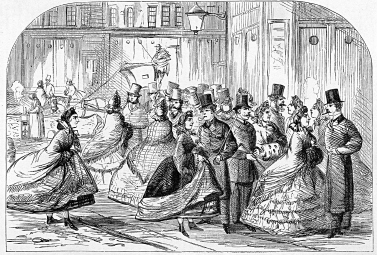
Prostitutes offer their services in the Haymarket in London’s West End c. 1860.
It was to this part of the West End that London’s prostitutes were drawn like moths to a flame. Every form of prostitute was to be found in the Haymarket: beautiful girls with blooming cheeks, newly up from the country; pale, elegant milliners; French girls, notable for their dark silk coats and white or dark silk bonnets, trimmed with brightly coloured ribbons or flowers, who patrolled a beat on Pall Mall so that they could hover outside the gentlemen’s clubs; and, of course, the bloated old women who had grown grey in the service of prostitution, or been invalided out through venereal disease.
The Haymarket was the heart of the theatre district, so there were always rich pickings to be had as the crowds spilled out onto the pavements, aroused by the dramatic spectacle witnessed on stage and eager for more excitement. By the 1850s, the Haymarket was also the heart of London’s nightlife, offering food, drink and entertainment to every level of society, from expensive supper clubs such as Kate Hamilton’s, the Turkish divans (similar to today’s cigar bars), where men gathered to smoke tobacco and pick up women, and the night houses, where patrons paid over the odds for dinner while the girls worked the room. Even the kept women emerged briefly to visit the supper rooms, where their fashionable carriages might be seen drawn up outside, or to attend the Alhambra Music Hall.
‘The Halls’ as they were known were the Victorian equivalent of the notorious Restoration playhouses, bawdy, smoky, genial dens of iniquity popular with all social classes, who flocked to watch a succession of daring variety acts, consisting of coarse popular songs and saucy comedians. The Alhambra was inevitably popular with prostitutes, both for work and recreation. It was a great lofty building, ablaze with light, gorgeous with colour and gilding. Wine, spirits and ale flowed, and everybody appeared well dressed, the gaslight making even tawdry finery look like elegant costumes. The quality lounged on the balcony and in the boxes, watching the performances, which according to one commentator were designed to outrage moral decency for the amusement of those patrons who were so depraved that they required constant stimulation.
In the haze of tobacco smoke, the heat and glare of gas, the excitement of strong drink and the unrestrained licence of many of the most prominent visitors, a ‘ballet’ would be performed by a throng of bold women, two-score half-naked girls and middle-aged women, all painted and raddled, brassy smiles plastered across their weary faces as they skipped and pranced in response to the applause that greeted an indecent gesture or an obscene leer; these were the dancers who were willing to divest themselves of the last remaining shreds of modesty – and most of their clothes as well.
These acts drummed up trade for the working girls who trawled the halls, just as their orange girl predecessors had done in previous generations. Here, flaunting, talking, laughing, not merely tolerated but actively encouraged, they were treated to rich food and fine wines at their admirers’ expense. These were the ‘gay’ ladies, and the West End was their world.
For all his reforming zeal, even Mayhew was quite taken with the vivid scenes in the Haymarket and recorded the beautiful young women in their feathers and lace with the enthusiasm of a tourist. Other commentators were less forgiving, such as the columnist in Household Words who regarded the same part of London as ‘black-guard, ruffianly and deeply dangerous’:
If Piccadilly may be termed an artery of the metropolis, most assuredly that strip of pavement between the top of the Haymarket and the Regent Circus is one of its ulcers. It is always an offensive place to pass, even in the daytime; but at night it is absolutely hideous, with its sparring snobs, and flashing satins, and sporting gents [‘sporting’ was a euphemism for ‘on the pull’], and painted cheeks, and brandy-sparkling eyes, and bad tobacco, and hoarse horse-laughs, and loud indecency. From an extensive continental experience of cities, I can take personally an example from three quarters of the globe; but I have never anywhere witnessed such open ruffianism and wretched profligacy as rings along those Piccadilly flagstones any time after the gas is lighted.29
Meanwhile, the sexual compulsive ‘Walter’, who seems to have been a difficult man to shock, professed himself astonished by the sight of women relieving themselves openly on a street near the Strand which was
dark of a night and a favourite place for doxies to go to relieve their bladders. The police took no notice of such trifles, provided it was not done in the greater thoroughfare (although I have seen at night women do it openly in the gutters in the Strand); in the particular street I have seen them pissing almost in rows; yet they mostly went in twos to do that job, for a woman likes a screen, one usually standing up till the other has finished, and then taking her turn. Indeed the pissing in all bye-streets of the Strand was continuous, for although the population of London was only half of what it is now, the number of gay ladies seemed double there.30
Mayhew disapproved of the kept women, the pampered soiled doves of St John’s Wood, but he was rather more sympathetic towards the West End girls or ‘Cyprians’. Prone to sentimentality, he cast them as ephemeral butterflies with an uncertain future. He classified the girls into two distinct categories, the ‘Better Educated’ and the ‘More Genteel’. Mayhew found himself drawn to the ‘Better Educated’ girls, who were plainly dressed, came from middle-class homes and had ‘a lady’s education’. The ‘More Genteel’ prostitutes dressed in high fashion. One thing both categories of girls had in common was their abandoned state. They were former milliners or dressmakers from the West End who had fallen into prostitution after being seduced and abandoned by clerks or shop assistants or gentlemen of the town. Others were former servants who had lost their jobs after being seduced, or worse, by the gentlemen of the house or fellow servants.
A considerable number had come up to London from the provinces with young men who subsequently abandoned them, or were decoyed to London by pimps in the age-old fashion. Again, as in previous generations, some girls had arrived in London looking for work and resorted to prostitution when the going got rough, while others were on the run from unhappy families and sexual abuse. There were also ‘seclusives’ down on their luck, having been abandoned by their former lovers, and a number of French, Belgian and German girls. Mayhew admitted that:
They present a stunning spectacle, walking the streets in black silk cloaks or light grey mantles, many with silk paletots [coats] and wide skirts, extended by an ample crinoline, looking almost like a pyramid, with the apex terminating at the black or white satin bonnet, trimmed with waving ribbons and gay flowers. Some have cheeks red with rouge, and here and there are women radiant with health. Many look cold and heartless; others have ‘an interesting appearance’.31
London’s most splendid shopping mall, the Burlington Arcade, was a favourite beat. This elegant arcade, running between Piccadilly and Bond Street, is still celebrated for its array of exotic luxury goods, from glittering jewellery to soft cashmere and exquisite chocolates; but in Victorian London, sex was for sale here too. Between the hours of three and five in the afternoon the ‘Cyprian corps’, consisting of the massed ranks of the Prima Donnas, the Better Educated and the More Genteel, could tout for business and bag an entire range of clients, from a dashing young blade to a ruddy-faced gentleman farmer up from the country or a silver-haired old charmer.
Far from protesting about having their mall overrun by prostitutes, many of the proprietors recognized that they were good for business and resorted to ‘Paphian intricacies’ (another reference to Aphrodite), renting out rooms above their shops in return for a share of the takings. Once a woman had approached her prey, it was an easy matter to steer him inside a friendly bonnet shop or accommodating tobacconist’s and upstairs to the bedroom.32 ‘Walter’ and two of his friends amused themselves in one such establishment: ‘it was not an unusual thing then for two [women] to have a cigar shop, with a big sofa in a back parlour, one keeping shop whilst the other fucked. Whilst the strumming was going on in the parlour, people bought cigars and tobacco – for it was really sold there, – little did they guess the fun going on behind that red curtain.’33
And of course, as always, there were the enthusiastic amateurs. Occasionally, one might see beautiful young shopgirls or milliners flitting along Regent Street or Pall Mall like bright birds of passage, to meet with some gentleman on the sly, and to earn a few shillings to top up their meagre salaries. Sometimes, one might see a fashionable young widow, or a beautiful young wife, wending her way in the evenings to meet with some rickety, white-haired old gentleman loitering about Pall Mall. And such scenes did not even merit a second glance: such things were not wondered at by those acquainted with high life in London.34 Acton referred to these amateurs as ‘dollymops’, young women who prostituted themselves for their own pleasure, in return for a few trinkets. These girls tended to be servants, shopgirls or maids who met men during the course of business; instead of heading for the casinos and taverns, they flirted with their customers from behind the shop counter, or were accosted while returning to their lodgings, or walking their employers’ children in the park. Nursemaids were particularly popular with soldiers, and the girls were flattered by the attention, succumbing easily to ‘scarlet fever’, attracted by their dashing red uniforms. ‘A red coat is all powerful with this class, who prefer a soldier to a servant, or any other description of man they come in contact with.’35
Even when business was nominally over for the day, the Cyprian corps remained in the West End. Mayhew and his friends watched them walking up and down Regent Street and the Haymarket, some by themselves, some in pairs, some with a gallant they had picked up, calling at the wine-vaults or restaurants, or sitting down in the brilliant coffee rooms, adorned with large mirrors, to a cup of coffee or China tea. They patrolled the theatre district of Leicester Square and Haymarket as crowds of theatre-goers poured out into the streets after the performances, but they were also to be seen plying for trade at the crowded bars, ‘these dreadful hotbeds of vice and immorality’ as one commentator described them.
When a young man meets there with handsome fine-looking girls, well-dressed with genteel manners, he forgets the indecency of their appearance and the looseness and impropriety of their language and behaviour, if these do not attract him the more, and he gets interested and entangled with them, and is led astray; and this the more readily as he sees around him much older men of respectable appearance, without scruple talking and romping with them.36
This prostitute described a typical day in her life to the journalist Bracebridge Hemyng, Mayhew’s researcher, in the 1850s:
I get up about four o’clock, dress and dine: after that I may walk about the streets for an hour or two and pick up anyone I am fortunate enough to meet, that is if I want money; afterwards I go to Holborn, dance a little, and if anyone likes me I take him home with me. If not, I go to the Haymarket, and wander from one cafe to another, from Sally’s at the Carlton, from Barns’ to Sam’s, and if I find no one there I go, if I feel inclined, to the divans. I like the Grand Turkish best, but you don’t as a rule find good men at any of the divans.37
Many of the more faded prostitutes frequented the Pavilion to meet gentlemen and enjoy the singing and instrumental music over some liquor, while the younger and more affluent girls flocked to the music halls, or the Argyll Rooms, rustling in splendid dresses, to spend the time till midnight, when they accompanied the gentlemen they had picked up there to the expensive supper rooms and night houses. Acton described a visit to the Argyll Rooms where he sat in
a spacious room, the fittings of which are of a most costly description, while brilliant gas illuminations, reflected by numerous mirrors, impart a fairy-like aspect to the scene. The company is mixed. The women are of course all prostitutes. They are for the most part pretty, and quietly, though expensively dressed, while delicate complexions, unaccompanied by the pallor of ill-health, are neither few nor far between. This appearance is doubtless due in many cases to the artistic manner of the make-up by powder and cosmetics, on the employment of which extreme care is bestowed.38
The Argyll Rooms offered the perfect opportunity for ‘sporting ladies’, another euphemism for prostitutes, to consort with ‘sporting’ aristocrats, such as Lord Hastings, a famous playboy and prankster who once emptied a sack of rats onto the dance floor.39Meanwhile, at the Portland Rooms, where the most expensive courtesans worked the room between midnight and four in the morning, punters could see the Parisian ‘can-can’ danced, ‘in every unrestricted form, the women behaving in a more Bacchanalian fashion than in other places’.40 The chief attraction of the can-can was, of course, that the dancers were performing in voluminous skirts, and no knickers.
After a hard afternoon working the Burlington Arcade, the girls’ favourite rendezvous was Kate Hamilton’s supper club, where they could dissipate their ennui and restore themselves for another night of carousing at a private party or Mott’s casino. Kate Hamilton’s was actually the Cafe Royal, but such was Kate’s influence in 1850s London that the club bore her name. Situated in Princess Street, near Leicester Square, Kate’s club was approached by a long and securely guarded passage leading to a saloon where the mistress of the establishment sat enthroned among her favourites, a formidable figure weighing twenty stone, with the weather-beaten features of an ex-sailor. Seated on a raised platform, in a low-cut dress, Kate Hamilton sipped champagne steadily from midnight to daylight, keeping order with her powerful voice and shaking like a blancmange every time she laughed.41
Kate made a killing by selling food and drink at highly inflated prices. She had a bouncer on the door to keep out the riff-raff and only gentlemen prepared to spend over £5 were admitted. Mayhew noted that these supper rooms were ‘frequented by a better set of men and women than perhaps any other in London’.42 Kate could afford to bribe the authorities, but every now and again there was a raid. There was a well-rehearsed drill on such occasions: when the alarm went up that the police were on the way, carpets were rolled up in the twinkling of an eye, floorboards were raised and bottles and glasses thrust underneath, everyone assumed a virtuous, demure air and spoke in subdued tones, as if butter wouldn’t melt, while a bevy of police officers headed by an inspector marched solemnly in and, having completed the farce, marched solemnly out again.43
Over the course of the evening, many of the girls were seen walking with young, middle-aged and sometimes frail old men to Oxenden Street, Panton Street and James Street, near the Haymarket. They were taking their clients to ‘houses of accommodation’, which was safer than going home with them. ‘Walter’ described one to which he had resorted in his youth: ‘It was a gentleman’s house, although the room cost but five shillings; red curtains, looking-glasses, wax lights, clean linen, a huge chair, a large bed, and a cheval-glass, large enough for the biggest couple to be reflected in, were all there.’44
For all their glamour, the off-duty lives of the Cyprian corps were grim. They might be treated to splendid suppers amidst lascivious smiles in the Haymarket, but they lived in seedy flats in Soho, Pimlico or Chelsea, and were so careless and extravagant that they were often reduced to pawning their dresses to buy food. Mayhew painted a disheartening picture of the girls at home, ‘sprawled lazily in bed, in sad dishabille, with dishevelled hair and muddy eyes, their voices hoarse with bad temper and misery’.45
The girls who could not afford to rent their own flats shared lodging houses or ‘convives’ (shared in connivance with the landlord) just off Piccadilly. It was in these frowzy and horribly overpriced rooms that the girls demonstrated a degree of loyalty which genuinely impressed Mayhew. ‘They may have dispensed with all womanly modesty,’ he admitted, ‘but they bond with each other fast, and within hours are referring to one another as “my dear”; they lend each other clothes and money, and even support one another with unparalleled generosity. They are forced to room together, as no respectable landlord would take them in.’46
This sense of solidarity sprang from the fact that, as Nickie Roberts reminds us, prostitution at this period was essentially female controlled. Brothels, lodging houses and accommodation houses were mostly run by women, all of whom had been through the experience of prostitution themselves. Madams or bawds took a cut from the girls who worked on their premises, but pimps were virtually unknown. One reformer, Mary Higgs, gained a glimpse of this solidarity when she visited a lodging house; although she disapproves, of course, of the girls’ lifestyle, there is a trace of admiration in her description: ‘round the fire was a group of girls far gone in dissipation, good-looking girls most of them, but shameless; smoking cigarettes, boasting of drinks or drinkers, using foul language, singing music-hall songs, or talking vileness. The room grew full and breakfasts were about. A girl called “Dot” danced the “cake-walk” in the middle of the room.’47
It was a precarious life. ‘Strange things happen to us sometimes,’ one told Mayhew. ‘We may now and then die of consumption; but the other day a lady friend of mine met a gentleman at Sam’s, and yesterday they were married at St George’s, Hanover Square. The gentleman had lots of money, I believe, and he started off with her at once for the continent. It is a very strange and unusual case, but we often do marry, and well too; why shouldn’t we, we are pretty, we dress well, we can talk and insinuate ourselves into the hearts of men by appealing to their passions and their senses.’48
The second class of prostitutes in the Haymarket, the third in Mayhew’s whores’ division, were the young working-class girls, daughters of domestic servants and labourers. Some of these girls were of a tender age, thirteen and upwards, and were to be seen wandering around Leicester Square and along the Haymarket and Regent Street. They dressed in girlish light cotton gowns, and crinolines that seemed too fancy for the daytime, with light grey or brown cloaks and funny little pork pie hats in white or red, some with a waving feather. Some walked timidly, others were brazen; some looked artless and ingenuous, others artful and pert. Some had fine features and good figures, while others were short and dumpy. These were girls who sold themselves for a lower price, and haunted the coffee shops around Leicester Square, where the blinds were drawn down, and there were notices over the door announcing that ‘beds are to be had within’.49 Many of these girls qualified as Mayhew’s ‘thieves’ women’; they were often in league with pickpockets, who robbed their clients of their watches, purses, pins and fine silk or linen handkerchiefs (which they would sell after the embroidered initials had been unpicked) after the girls had duped them down a dark alley.
Many went into their occupation willingly, with a pragmatic rationale. ‘Walter’ picked up such a girl in the Strand, and, after the usual business had been transacted, had a long chat with the girl, named Kitty, who possessed ‘a frankness, openness and freshness which delighted me’,50 as does her level of denial. When he asks: ‘How long have you been gay?’ Kitty retorts, ‘I ain’t gay!’, astonished. When ‘Walter’ points out that ‘you let men fuck you, don’t you?’, she insists, ‘Yes, but I ain’t gay!’ The gay ladies, as far as she is concerned, are the ones who ‘come out regular of a night, dressed up, and gets their livings by it’.51 Further questioning elicits the information that both Kitty’s parents are employed, her mother as a charwoman, and that she is supposed to be at home, looking after little brothers and sisters. Instead of which, she locks them in the kitchen and heads up West. ‘Walter’ is quite disturbed by this. ‘“They may set fire to themselves!” said I. “There ain’t no fire; after we have had breakfast, I puts it out, and lights it at night if mother wants hot water.”’52 ‘Walter’ struck up something of a relationship with Kitty, and saw her several times. The most poignant element of his description is the reason Kitty sells herself: to buy food. They can’t live on what her mother earns, and Kitty’s takings go on sausages, pies and sausage rolls. ‘That’s what you went gay for?’ ‘Walter’ says, incredulously. ‘Sausage rolls?’ ‘Yes, meat-pies and pastry too.’53
Mayhew records a similar conversation with another girl, ‘Dolly’, who hated working the Haymarket, but loved dancing, and spent the money she earned on new clothes and a new bonnet every week. A former servant who had been sacked after being seduced by the master of the house, Dolly was making the best of things in a tough world.
Others, as in our next example, were victims of entrapment, decoyed into the life with a technique unchanged since the days of evil Mother Needham. Mayhew interviewed this young lady, ‘Bella’, who lived in a brothel in Langham Place. From the outside, with its handsome green curtains, this appears to be a substantial and highly respectable town house. And, once inside, the veil of respectability continued, as Mayhew and his colleague were shown into a comfortably furnished room with yielding sofas and glass chandeliers. Bella entered the room and, after some confusion when she asked the men what they would like and was surprised when they only wanted to talk, a bottle of wine was sent for which loosened her tongue.
Bella’s tale was sadly familiar. A young girl from Stepney who had lost her mother in childhood, she had never been warned by her father, a joiner, about the dangers facing an attractive young girl at large in the East End. One afternoon, Bella was befriended by a kindly middle-aged lady who invited her round for tea. The next thing she knew was that she had been made drunk, signed some papers, and had ‘her spirit broken’. In return for working as a prostitute, Bella was fed and clothed, and had become inured to her way of life. She couldn’t imagine anything else, now. She never thought about it; she would go mad if she did; she lived in the present, and never went blubbering about as some did. She tried to be as jolly as she could; where was the fun in being miserable?54This, Mayhew recalled, was the prevailing philosophy among prostitutes. The girls got through it as best they could with a stoical attitude and plenty of White Satin, a popular brand of gin.
Alcoholism was rife. Mayhew interviewed another woman, in the Haymarket, a woman grown old and fallen upon hard times. ‘Times is altered, sir, since I come on the town,’ she confided. ‘Nothing lasts forever and I’ve stood my share of wear and tear.’55 This woman demonstrates the same weary stoicism: ‘I don’t think much of my way of life. You folks as has honour, and character, and feelings, and such, can’t understand how all that’s been beaten out of people like me. I don’t feel. I’m used to it.’ Although she admitted that when she heard of her mother’s death, she did cry and she was genuinely heartbroken, ‘but Lor’, where’s the good of fretting? It’s the drink mostly that keeps me going. You’ve no idea how I look forward to my drop of gin. It’s everything to me.’56
Drink helped to dull the pain of violent beatings from punters and lovers alike. Mayhew met another young girl, just twenty-one, and down on her luck after parting from her gentleman. The said gentleman had seen her flirting with a friend at the Assembly Rooms in Holborn and beaten her so violently that she had been confined to bed for three months. Eventually, she summoned up the courage to run away, taking £300 and most of her clothes and jewellery. But she had to sell the jewellery, and when the proceeds ran out, she had been reduced to ‘walking in the Haymarket’ and turning tricks at the cafés. Now she had been forced to sell the remainder of her dresses. ‘Since then I have been more shabby in appearance, and not so much noticed.’57
This unfortunate seemed, even at such a tender age, destined to end up like those poor degraded creatures who constituted Mayhew’s third category of Haymarket women, the worn-out wretches who skulked about, scrounging a living from the fashionable passers-by and the more affluent prostitutes who paid them to go away.
However, this picture of prostitutes as doomed and damned for all eternity represents only one side of the story. One of Mayhew’s interviewees, a young lady at the top of her game, was deeply offended when he asked what she thought would become of her. ‘What do I think will become of me? What an absurd question. I could marry to-morrow if I liked!’ she responded pertly. Mayhew was repelled by this unrepentant attitude, describing the girl as a typical example of her class. ‘They live entirely for the moment, and care little about the morrow until they are actually pressed in any way, and then they are fertile in expedients,’ he noted, wearily.58 But this young lady was not alone in her defiant attitude. On 24 February 1858, when moral panic about prostitution was at its height, a letter appeared in The Times actually written by ‘Another Unfortunate’, who described herself as ‘one of those who, as Rousseau says, are born to be prostitutes’, and made a spirited defence of her profession, demanding to be treated with the same courtesy as a ‘respectable’ woman. ‘I earn my money and pay my way…I do not get drunk, nor fight, nor create uproar in the streets or out of them. I do not use bad language. I do not offend the public eye by open indecencies.’ The prostitute then reminded her readers that she had not only paid her debt to society, but had contributed to the economy, paying the most fashionable West End milliners, silk makers and boot makers, who all knew who she was and how she earned her money, and solicited her business as earnestly and cringingly as if she were married to the chairman of the Society for the Suppression of Vice.
This letter inspired an editorial the very next day, in which the anonymous leader writer commented that
the great bulk of the London prostitutes are not Magdalens, nor specimens of humanity in agony, nor Clarissa Harlowes. They are not – the bulk of them – cowering under gateways, nor preparing to throw themselves from Waterloo Bridge, but are comfortably practising their trade, either as the entire or partial means of their subsistence. They have no remorse or misgivings about the nature of their pursuit; on the contrary, they consider the calling an advantageous one, and they look upon their success in it with satisfaction.59
Dr William Acton also believed that the phrase ‘Once a harlot, always a harlot’ was a myth. During the course of his extensive research, Acton had found plenty of evidence to show that prostitution was a transitory state. Otherwise, he argued, where on earth did all those women go? London’s 80,000 prostitutes did not simply vanish into thin air. They were not all struck down in mid-career by suicide, alcoholism or venereal disease, nor did they fall by the wayside like autumn leaves, to be heaped up to rot, or crawl home to die of remorse. Instead, argued Acton, after a maximum of four years on the streets they were fully conversant with the hardships of the trade and ready to escape should the opportunity present itself. Anyone who had survived the life would by this stage have a healthy physique, an excellent constitution, good business sense and an unparalleled insight into human nature which could only be an asset in any career she chose. Any sensible woman by then would have made ‘a dash at respectability by marriage’ or sunk her savings into a milliner’s shop or a lodging house. Emigration to the colonies, with the promise of a fresh start, was another popular choice.
The last word on a successful transition from prostitution comes from the writer Arthur Munby, who recorded the fascinating story of Sarah Tanner. Munby had first met Sarah in 1855, when she was ‘a maid of all work to a tradesman in Oxford Street: a lively honest rosy-faced girl, virtuous & self-possessed’, a brunette with fine hazel eyes. Munby ran into her a year or so later, on Regent Street, ‘arrayed in gorgeous apparel’. It appeared that Sarah had got tired of being in service, wanted to see life and be independent, and so had chosen to become a prostitute, of her own accord. Sarah had taken it up as a profession, even reading and taking writing lessons so that she would be a fit companion to gentlemen. She saw no harm in it, enjoyed it very much, thought it might raise her and perhaps be profitable. After taking her for a glass of beer, which Sarah did not ask for, Munby took his leave of her. He saw her a few times subsequently, on duty (although there is no indication that he availed himself of her professional services), until one day he ran into her dressed differently again, like a respectable upper servant, in quiet, tasteful clothes. ‘“I’ve left the streets and settled down,” she said quietly. “I’d been on the streets three years, and saved up – I told you I should get on, you know – and so I thought I’d leave, and I’ve taken a coffeehouse with my earnings – the Hampshire Coffeehouse, over Waterloo Bridge.” I laughed, incredulous. “Quite true,” said she simply. “I manage it all myself, & I can give you chops & tea – & anything you like: you must come & see me.”’
Munby was surprised and impressed by Sarah’s entrepreneurial spirit.
Now here is a handsome young woman of twenty-six, who, having begun life as a servant of all work, and then spent three years in voluntary prostitution amongst men of a class much above her own, retires with a little competence, and invests the earnings of her infamous trade in a respectable coffeehouse, where she settles down in homely usefulness and virtuous comfort! Surely then this story is a singular contribution to the statistics of the ‘Social Evil’ and of female character and society in the lower classes.60
Sarah’s story is a satisfying corrective to the repellent depiction of ‘flaunting queans’ and mercenary human tigresses served up in the popular press. However, in an overcrowded city riddled with poverty and social injustice, there was inevitably a more sinister side. To experience this, let us accompany Mayhew and Acton on their expedition into darkest London.