
7

‘When Sodomites were so impudent to ply on th’Exchange
And by Daylight the Piazza of Covent Garden to range…’
When the actor David Garrick asked Samuel Johnson what he considered to be the two most important things in life, Johnson replied: ‘Drinking and fucking!’ Many Londoners would have agreed with him. Sexuality takes many different forms, however, and London in the eighteenth century had much to offer those with more recherché tastes. In this chapter, we’ll investigate such phenomena as the ‘Sodomitical clubs’, the flagellation brothels, lesbianism, auto-erotic asphyxiation and last but not least the notorious Hellfire Club. Let us turn first to the ‘molly houses’, sex clubs for homosexuals from all social backgrounds, but particularly popular with effeminate men or ‘mollies’.
In May 1726 the London Journal carried an account of twenty ‘Sodomitical clubs’ in which patrons made their assignations ‘and then withdrew into some dark Corners to perpetrate their odious Wickedness’,1 including molly houses such as the Talbot Inn in the Strand, the Fountain in the Strand and the Three Potters in Cripplegate Without. Meanwhile, the male proprietor of the male brothel in Camomile Street, Bishopsgate, went under the splendidly camp pseudonym of ‘Countess of Camomile’.
The most famous molly house was undoubtedly ‘Mother Clap’s’ in Holborn, which had beds in every room and catered for ‘thirty to forty Chaps every night’ and even more on Sundays, the most popular night of the week for homosexual assignations. Mother Clap (her name appears to be a reference to the pox) was a tolerant old bawd, quite prepared to overhear her patrons ‘talk all manner of gross and vile obscenity and be wonderfully pleased with it’.2
When Mother Clap’s was raided, in 1726, and its patrons put on trial, one eyewitness described seeing between forty and fifty men making love to one another, ‘calling one another “my dear” and hugging, kissing and tickling each other as if they were a mixture of wanton males and females, and assuming effeminate voices and airs’; they indulged in dancing and making curtsies and
telling each other that they ought to be whipped for not coming to school more frequently. Some were completely rigged in gowns, petticoats, headcloths, fine laced shoes, furbelowed scarves, and masks; some had riding hoods; some were dressed like milkmaids, others like shepherdesses with green hats, waistcoats, and petticoats; and others had their faces patched and painted and wore very extensive hoop petticoats, which had been very lately introduced.
The patrons sat on one another’s laps, kissing in a lewd manner and using their hands indecently; after an interval of toying and playing,3 they would repair to a back room or ‘chapel’ for sex or ‘marriage’. When they emerged, they would regale their friends with full details of their ‘wedding night’, and ‘brag, in plain terms, of what they had been doing’.4
At the Fountain in Russell Square, cross-dressers even enacted childbirth scenes, where one molly would deliver a doll. According to Ned Ward, a chronicler of London low life, said doll would be ‘Christened and the Holy Sacrament of Baptism impudently Prophan’d’. Ward, a tabloid moralist, disapproved of the mollies, condemning them as so totally destitute of all masculine attributes that they preferred to behave as women. They adopted all the small vanities natural to the feminine sex to such an extent that ‘they will try to speak, walk, chatter, shriek and scold as women do, aping them as well in other respects’.5 On occasion, the mollies, or rent boys, lost out: one young man, Edward Courtney, told a magistrates’ court that he had been prevailed upon to have sex with a country gentleman at the Royal Oak in Pall Mall, and was told that he would be paid ‘handsomely’, only to discover that ‘he stayed all night but in the morning he gave me no more than a sixpence!’6
Female prostitutes faced a sliding scale of punishments when apprehended, determined by their class and the social standing of their punters, ranging from a fine to a prison sentence. The stakes were considerably higher for homosexuals, punters and renters alike, and the punishments more severe. Young male prostitutes, or ‘catamites’, might have cruised the Royal Exchange, picking up rich merchants, but the consequences of arrest and prosecution were far worse than they were for women. Buggery was still illegal, a capital offence which theoretically carried a death sentence if penetration could be proved. While most judges were reluctant to hang ‘sodomites’, convicted homosexuals faced heavy prison sentences, with the act itself being classified as a form of common assault, and being ‘outed’ could ruin a man’s reputation.
In 1707, there was a great scandal when a ‘Sodomites’ Club’ in the City was raided. Forty men who frequented the alleys around the Royal Exchange were arrested, including Jacob Ecclestone, a merchant, who later committed suicide in Newgate; a draper, William Grant, who hanged himself in the same prison; a Mr Jermain, curate of St Dunstan’s-in-the-East, who slashed his throat with a razor, and a Mr Bearden who killed himself in the same fashion.7 In 1726, the Societies for the Reformation of Manners closed down over twenty molly houses, including Mother Clap’s. The enlightened patroness found herself in the pillory, and later died of her injuries, just like her fellow bawd Mother Needham. Several of her clients were executed.
Public tolerance of ‘sodomites’ did not improve over the years. In October 1764, the Public Advertiser reported that ‘A bugger aged sixty was put in the Cheapside Pillory. The Mob tore off his clothes, pelted him with Filth, whipt him almost to Death. He was naked and covered with Dung. When the Hour was up he was carried almost unconscious back to Newgate.’8
Class and wealth proved no defence against homophobia as is illustrated by the sad fate of Sir Richard Payne Knight (1751–1824), MP for Leominster, connoisseur and antiquarian. From being a backbench MP in a sleepy rural constituency, Knight was reviled as a dangerous subversive when his book on classical antiquities appeared in 1786; hatred and disdain were heaped upon him and some of his best friends, including Horace Walpole, disowned him.
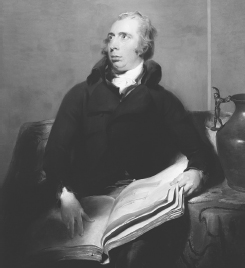
Richard Payne Knight c. 1793. His ‘Discourse on the Worship of Priapus ’caused a scandal.
Knight’s early life gave no indication of this sensational destiny. He was born in Herefordshire, a sickly child who attended neither public school nor university. Knight’s family were philistine Tory landowners who distrusted his bookish tendencies, and, years later, Knight admitted that his unhappy childhood and feelings of abandonment might have been the cause of the ‘ungovern’d passions’ which led him astray. Although Knight never confided the exact nature of these passions, his choice of subject matter and that he never married provide a clue. This, and the fact that he devoted his twenties to an extended Grand Tour, spending months in Italy in the company of other young men, excavating the Roman remains at Herculaneum which had yielded up a treasure of erotic imagery. Accompanying Knight was his closest friend, John Robert Cozens, a gifted young artist. Cozens, like Knight, was a delicate young man, with a history of mental and physical illness, but the two appeared firm friends until, in the course of one trip, they reached Naples. There, for reasons that have never been disclosed, Knight and Cozens parted for ever, and Cozens suffered a mental breakdown. Supported by the writer William Beckford, Cozens returned to England and was diagnosed with incurable madness by Dr Thomas Monro, medical director of Bedlam. Knight never saw his friend again, but, until Cozens’s death in 1799, he paid for his medical care.
Knight, meanwhile, returned to London and fell under the spell of Pierre François Hugues, the soi-disant Baron d’Hancarville (1719–1805). A decadent drifter, always in debt, often in prison, d’Hancarville charmed everyone who came in contact with him, winning reluctant admiration from all with his deft combination of the forbidden and the exotic.9 The shrewd and manipulative d’Hancarville swiftly made himself the object of Knight’s ‘ungovern’d passions’, paving the way for a scandal which would destroy Knight’s career. D’Hancarville was a pornographer who somehow managed to obtain over 700 vases for the envoy Sir William Hamilton, but he could be a deadly ally. One colleague, Winckelmann, was murdered in Vienna. D’Hancarville himself was expelled from Naples for publishing pornographic pictures; in 1769 he managed to make a killing by producing cheaper versions.
D’Hancarville published his own book in 1785. This purported to be a study of the arts of Ancient Greece but was in effect a volume of pornography devoted to the worship of Priapus, depicting couples in a variety of sexual positions under the benevolent gaze of the said deity. In one illustration the happy couple are even depicted ‘harvesting’ Priapus’s seed.10 This inspired Knight to go into print on his own account, and in 1786 he published his Account of the Remains of the Worship of Priapus, a scholarly account of his findings in Italy, which also included a dissertation, ‘Discourse on the Worship of Priapus’. At first glance, this seems little more than the usual exercise in dilettantism by a learned gentleman who has been on his Grand Tour and seeks recognition in print. The publication’s ostensible purpose was to serve as a back-up to a colleague’s Account of the Remains of the Worship of Priapus lately existing at Isernia, in the Kingdom of Naples, which also sounds deadly dull. However, it was the illustrations which really gave the game away: two dozen sexually explicit black and white images among the 217 quarto pages, culminating in a scene where a satyr is depicted having sex with a goat. As if this was not enough, Knight’s innocent tone of ‘enlightened paganism’, in the course of which he argued that sex was a legitimate form of worship and that the crucifix itself, as worshipped by Christians, was a phallic symbol, was taken as evidence of profound anti-clericalism. Although Knight attempted to limit any damage to his reputation by making his book a subscription-only publication, limited to learned gentlemen, news of this sensational tome soon leaked out. Unlike d’Hancarville, a professional pornographer who had absolutely nothing to lose, Knight suffered utter vilification. At one stroke this gentle, learned backbencher was transformed into a monster of depravity. Knight retreated to his country pile a dejected figure, and never lived down the shame. He was not to know that his book, republished in the nineteenth century, would become one of the most popular works of Victorian homosexual pornography. Whether this information would have been of any consolation to him is a matter for conjecture.11
While Knight was condemned for his learned treatise on male sexuality, a greater degree of tolerance was extended towards one of the most celebrated and curious cases of male to female cross-dressing, that of Chevalier d’Eon de Beaumont (1728–1810). The Chevalier came to England in 1752 in connection with preliminary talks leading to the Treaty of Versailles. He first attracted attention owing to a number of plots attempting to return him forcibly to France. The Chevalier received sympathetic press coverage, which reflected favourably on the relative freedom of England compared with France. At some point during the 1760s, the Chevalier began to appear in public in women’s clothes. The rumour was circulated that ‘he’ had been brought up as a boy, and for political reasons could only now return to his true gender. Reasons for his decision to adopt female dress were legion: some even suggested that he was ordered to do so by Louis XVI, and that he had completed several spying missions for France while disguised as a woman. He did keep press cuttings about cross-dressing, hermaphrodites and related issues, so the topic was obviously very important to him.
The Chevalier’s decision to dress as a woman prompted a frenzy of press speculation as to his true gender. The Morning Post pledged £200,000 to whoever could settle the argument and the debate raged as to whether he was ‘a man, an hermaphrodite or any other animal’. Legal disputes over gambling on the issue led to a court case, Hayes v. Jaques (1777), in which two doctors testified that the Chevalier was a woman. One claimed that he had treated her for ‘women’s disorders’, while the other stated that she had made amorous suggestions to him. The court ruled that he was a woman, and the Chevalier signed an affidavit swearing that he had no interest in the bets taken out on him. Press speculation did not however subside: an article appeared in the Morning Herald and Daily Advertiser stating that he had always been a woman and concluding that ‘the visitation of M. D’Eon to this country in the attire of the feminine, it is hoped will operate so forcibly as to induce such ladies who have usurped a right to wearing breeches, to leave them off’.
Between 1794 and 1796, the Chevalier drew large crowds to his public fencing displays – whilst dressed as a woman. Despite being referred to in the Public Ledger as ‘an impertinent French female’ most press coverage was favourable. The Chevalier was regarded as a woman who had been forced to disguise herself as a man but who had now reassigned herself to her true gender. His reticence towards women when he himself was in breeches was taken as further evidence of his female identity, while his status as an aristocrat also offered protection.
The Chevalier died in 1810, and when his body was examined, he was discovered to have been a man. But, while he was indisputably male, it was noted that ‘the throat was by no means a man’s; the shoulders were square, the breast remarkably full, the arms, hands and fingers those of a stout female; and the legs and feet corresponding with the arms’.12
Lesbians (the term was used in its modern meaning from 1732) had a lower profile, partly because sexual acts between women have never been illegal, and partly because lesbianism has rarely been perceived as a threat to the status quo. Lesbian displays would have been on the menu of any self-respecting seraglio: a standard service for male punters keen to watch some girl-on-girl action, as in the seduction of Fanny Hill by an older woman at the outset of her sexual career. Genuine lesbian relationships were common among prostitutes; many women developed close emotional and physical bonds as a means of survival and as a response to male abuse.
Punters or ‘cullies’ were not surprised to encounter lesbians in the course of their sexual adventures. Harris’s List of Covent Garden Ladies tells us about a Miss Wilson of Green Street, Cavendish Square, who is of above average height and lacking in conventional female graces: ‘her hands and arms, her limbs, indeed, in general, are more calculated for the milk-carrier, than the soft delights of love’. Miss Wilson frequently declared that ‘a female bed-fellow can give more real joys than ever she experienced with the male part of the sex’ and that ‘many of the pranks she has played with her own sex in bed (where she is as lascivious as a goat) have come to our knowledge’.13
‘Mother Courage’ of Suffolk Street and Frances Bradshaw of Bow Street catered for the lesbian trade, while Sisters Anne and Elanor [sic] Redshawe ran ‘an extremely secretive discreet House of Intrigue in Tavistock Street, catering for Ladies in the Highest Keeping’ and wealthy married women who came in disguise to amuse themselves.14
Lesbians were tolerated if they appeared reassuringly feminine, or if they were, like Queen Anne, of such exalted station that they were immune to the law. The Fleet Registers give three examples of women marrying each other, without any action being taken against them.15 While heterosexual women who dressed as men to enlist in the military, such as Hannah Snell, the Female Marine (1723–92), were tolerated, visibly butch women received very different treatment, since passing for a man endowed them with greater social and economic status. Catherine Vizzani, an Italian courtesan caught trying to elope with another woman whilst dressed as a man, was shot dead in 1755.16
There were more visible lesbians down in the East End, where a balladeer immortalized this couple in 1728:
‘Two Kissing Girls of Spitalfields’
That one’s a Man is false, they’ve both been felt,
Tho’ Jolly swears, Bess is, or sh’ has been gelt [castrated]
She bullies, whistles, sings, and rants and swears
Beyond the Plyers at St. Katern’s Stairs [St Katharine’s Docks];
She kisses all, but Jenny is her dear,
She feels her Bubbies, and she bites her ear:
They to the Garret or the Cellar sneak.
Play tricks, and put each other to the Squeak.
What Pity ’tis, in such a case as this,
One does not pass a Metamorphosis,
Then they’d not stop the flowing Breach of Dagnum
With Digitus vel instrumentum magnum.17
Dagenham Breach was a thousand-acre lake next to the Thames resulting from a repair to its walls from 1714 to eliminate a 400-foot mud bank that was a danger to shipping. It was near St Katharine’s Docks, where men plied for work as porters unloading ships. The last line says that these women will have to plug up the hole with a finger (‘digit’) in the absence of any larger instrument, alluding to their lack of a penis. So this Latin tag appears to have been a variant on the old gag about the boy sticking his finger in the dyke.
Penis or no, lesbians were a common feature of medical textbooks, many of which served as a source of titillation, notably in descriptions of the clitoris. This magnificent organ, first officially discovered by anatomists in the sixteenth century, was regarded as a form of mini-penis. The larger the clitoris, writers argued, the greater the propensity to ‘tribadism’ or ‘frottage’ (rubbing) and women having sex with each other like men. According to one author, ‘Women well furnished in these Parts may divert themselves with their Companions to whom for the most part they can give as much Pleasure as Men do but cannot receive in any proportion the Pleasure themselves, for want of Ejaculation, the Crisis of Enjoyment to the Male in the Intrigues of Venus. I am informed that Diversions of this nature are frequently practis’d by robust and lustful Females who cannot with any prospect of safety to their Reputations venture upon the Embraces of a Man, though they are never so strongly inclin’d’.18
Despite the fact that the average clitoris is about the length of half a finger, a bawdy literature developed in which women from certain racial backgrounds were more generously endowed, and therefore more libidinous, particularly the Italians (stereotyped as sex-mad, yet again), Turkish, Arab and black women, who were reputed to have clitorises as large and as effective as a penis. The collective attitude of (male) authors to lesbianism was, as is so often the case with men, erotic fascination, tinged with the occasional reminder that such conduct was, of course, immoral. The anonymous scribe of Satan’s Harvest Home issued a rebuke to ‘Sapphists’ who ‘not content with our Sex, begins Amours with her own, and teaches the Female World a new Sort of Sin, call’d the Flats, practis’d at Twickenham at this day’.19
The mention of an innocuous south-west London suburb is a reference to Lady Mary Wortley Montagu, an aristocratic English traveller who eventually retired to Twickenham. Lady Mary was so inspired by the beauty and solidarity of the Turkish women she met during her travels that she was suspected of having indulged in the pleasures of the harem, which, according to the author of Satan’s Harvest Home, was a veritable cornucopia of girl-on-girl action, steam baths and cucumbers, which he refers to as ‘the Game of Flats’. This is a reference to games with playing cards, which were called ‘flats’, and an allusion to the rubbing together of two ‘flat’ female pudenda. For example, sex between women was described in 1698–9 as ‘a New Game / Call’d Flats with a Swinging Clitoris’. The lesbian usage, though it can be traced back to at least 1663, is not recorded in the Oxford English Dictionary.20
‘Flats’ was said to be particularly popular among the Turks:
ordinarily the Women bathe by themselves, bond and free together; so that you shall many Times see young Maids, exceeding beautiful, gathered from all Parts of the World, exposed naked to the View of other Women, who thereupon fall in Love with them…By this you may guess, what the strict Watch over Females comes to, and that it is not enough to avoid the Company of an adulterous Man, for the Females burn in Love one towards another; and the Pandaresses [female pimps] to such refined Lovers are the Bards [bawds]; and, therefore, some Turks will deny their Wives the Use of their public Baths, but they cannot do it altogether, because their Law allows them.21
In keeping with the theory that foreign girls were better endowed, and more libidinous, women had to travel abroad to experience the wilder shores of love. This attitude is apparent in A Sapphic Epistle to Mrs D (1782), in which the anonymous Mrs D pursues lesbian amours in Italy, ‘where many lascivious females divert themselves one with another’. Men should beware, warns another poet, lest their sweethearts be seduced by other women when their backs are turned:
Know, whilst you idle thus away your time,
Women in secret joys consume their prime,
Some fav’urite maid, or handy young coquette
Steals the rich prize you vainly strive to get;
Of them be cautious, but the artful prude
Watch most, for she will thoughtless girls delude…
Your lovely nymph, in private quench’d her flame
With some experienc’d, well-known crafty dame.22
Those lesbians, and straight women, for whom clitoral orgasm was not sufficient could console themselves with a dildo, which had become a must-have accessory for any self-respecting woman or man about town by the early eighteenth century. One Georges-Louis Lesage (1676–1759), visiting England in 1713, noted that there were always some women in St James’s Park carrying baskets full of dolls which seemed to be in great demand with the young ladies. Instead of legs, the dolls supported a cylinder, covered with cloth, which was about six inches long and one inch wide. According to Lesage, one young woman complained that hers was too big and she wanted to exchange it for a smaller one, but the vendor refused to do so, arguing that it would be impossible to resell it.23
‘Signor Dildo’ as Rochester referred to this ‘cylinder’ in his poem of 1678 was much in demand, and an entire tradition of bawdy verse developed lauding the properties of this essential item. One poem describes the exploits of a dildo when it arrives in London. Nicknamed ‘Monsieur Thing’, the poem follows it from Covent Garden to Fleet Street and to the homes of several ladies in dire need of its services:
The Engine does come up so near to Nature,
Can spout so pleasing, betwixt Wind and Water,
Warm mild, or any other Liquid softer,
Slow as they please, or, if they please, much faster.
Monsieur Thing then meets another merchant’s wife, who immediately takes a shine to him:
She boldly work’d him up into an Oil,
So did she make the Creature slave and toil;
She wrought him till he was just out of breath,
And harrast Seignior almost unto Death.
His troubles are not over, however, as he is called upon to satisfy an old maid and a couple of lesbians, one of whom ties him to her middle:
She acted Man, being in a merry Mood,
Striving to please her Partner as she cou’d;
And thus they took it in their turns to please
Their Lustful Inclinations to appease.24
Sold at sixpence a copy, ‘Monsieur Thing’s Origin’ did not please everybody: one female bookseller who caught a pair of hawkers selling the poem outside her shop set the constables on them.25
Another source of amusement was the sex doll, which could be ordered by eighteenth-century males with sufficient means for their private amusement.26 Published in 1748, Adollizing: or, a lively picture of a doll-worship assures the reader that this extraordinary episode is based on a true story. Clodius, a person of high distinction, failing to seduce the beautiful young Clarabella, takes himself off to a ‘Latin artist’ (Italians once again being synonymous with sex in eighteenth-century London) who makes a doll, ‘as big as life’ and with perfect craftsmanship, right down to ‘the arch’d mount, just o’er the cloven part’, upon which ‘a tuft of hair he fixes with nice art’.27 This doll is not for display only:
A seven-inch bore, proportion’d to his mind,
With oval entrance, all with spunge [sic] he lin’d,
Which warmly mollify’d, is fit for use,
And will the sought-for consequence produce.28
Eventually, Clodius becomes bored with his doll, and, despite experimenting with different heads, abandons it in favour of Clarabella, who eventually thaws sufficiently to reciprocate his advances.
Eighteenth-century Londoners were intrigued by, and not always tolerant of, sexual diversity, whilst being fascinated by freak show aspects of human sexuality such as hermaphrodites and ‘castrati’ or eunuchs, who, it was believed, were capable of sexual intercourse but sexually sterile. An entire body of pornographic literature developed devoted to the premise that a sexually frustrated woman could find relief with a eunuch as there was no danger of getting pregnant. ‘Castrati’ are ‘very tractable; it gratifies their pride to be taken notice of by a woman and they toil like horses’.29 In one tale, Lady Lucian decides to try out Signor Squalini, a singer, who proves most satisfactory and is hired as her music tutor. One day, however, the happy musicians are disturbed by Lady Lucian’s husband, who passed by her door and:
heard his lady cry out in an extatic [sic] tone of voice, ‘Give what thou can’st, and let me dream the rest.’ His lordship was too well read in Pope, not to know where that line was, and the occasion of speaking it; he laid his hand immediately upon the lock of the door, and giving it a push, open, for the lady had omitted to bolt it, he beheld my lady and her master – not playing the harpsichord, but playing upon it: her ladyship couchant upon the instrument, which served her for a sopha [sic], and the master recumbent on the lady, while every now and then he touched the keys of the harpsichord with his feet.
Three days later, husband and wife parted by mutual consent, allowing Lady Lucian the opportunity to enjoy the society of her dear castrato without molestation.30
Flagellation had always been popular, particularly among the nobility – and with women as well as men. Queen Catherine de’ Medici was said to enjoy placing her maids of honour over her knee and whipping them like little children, and pages often found themselves upon the whipping block as well. Flagellation, as we know, constituted one of the standard services of brothels. In The Virtuoso (1678) Thomas Shadwell portrayed an elderly gentleman who ‘loves castigation mightily’31 whilst the Treatise on the Use of Flogging (1718) established this fetish firmly in the public consciousness, and led to a flogging boom, with specialist brothels opening all over London. Mother Burgess, one of many bawds who specialized in flagellation, was immortalized in ‘The Paphian Grove’ (1738):
With Breeches down, there let some lusty Ladd,
(to desp’rate Sickness desperate Cures are had!)
With honest Birch excoriate your Hide
And flog the Cupid from your scourged Bankside!
‘Paphian’, derived from Aphrodite, the goddess of love, referred to any act of illicit love.32
One of the best-known flogging brothels was Mary Wilson’s, originally opened around 1777 in New Road, St Pancras, then moving to larger premises at nearby Tonbridge Place. Wilson published The Exhibition of Female Flagellants, praising the benefits of being whipped by women, before moving to fashionable Bond Street, then St John’s Wood. An erudite woman, who translated and published European erotic novels, she noted that there were three types of client who enjoyed flagellation:
1. Those who like to receive a fustigation, more or less severe from the hands of a fine woman, who is sufficiently robust to wield the rod with vigour and effect.
2. Those who desire to administer birch discipline on the white and plump buttocks of a female.
3. Those who neither wish to be passive recipients nor active administrators of birch discipline, but derive sufficient excitement as mere spectators of the sport.33
She also recognized that flagellation had considerable appeal:
It is very true that there are innumerable old generals, admirals, colonels and captains, as well as bishops, judges, barristers, lords, commoners and physicians, who periodically go to be whipped, merely because it warms their blood, and keeps up a little agreeable excitement in their systems long after the power of enjoying the opposite sex has failed them; but it is equally true, that hundreds of young men through having been educated at institutions where the masters are fond of administering birch discipline, and recollecting certain sensations produced by it, have imbibed a passion for it, and have longed to receive the same chastisement from the hands of a fine woman…34
When Wilson moved on for good to Paris, her brothel went to Theresa Berkeley, one of the most famous experts in flagellation. In 1787, Berkeley took control of a house of assignation known as the ‘White House’ at 21 Soho Square. This was a grand mansion with opulent decor, and featured the Gold Room, the Silver Room and the Bronze Room – all equipped with mirrors, so that the girls and their clients could view their performances. There was also a Painted Chamber, a Grotto and a Coal Hole, but the pièce de résistancewas the ‘Skeleton Room’, fitted with a cupboard from which a human skeleton emerged, a subtle memento mori for older punters.
Mrs Berkeley, or ‘The Governess’ as she came to be known, moved to new premises at 28 Charlotte Street in 1828. She made it a habit to find out ‘every idea, every caprice, every wish of her clients’, no matters how recherché, as long as she got paid.
Her instruments of torture were more numerous than those of any other governess. Her supply of birch was extensive, and kept in water, so that it was always green and pliant: she had shafts with a dozen whip thongs on each of them; a dozen different sizes of cat-o’-nine-tails, some with needle points worked into them; various kinds of thin bending canes; leather straps like coach traces; battle-doors [sic], made of thick sole-leather, with inch nails run through to docket, and currycomb tough hides rendered callous by many years flagellation. Holly brushes, furze brushes; a prickly evergreen, called butcher’s brush and during the summer, a glass and China vases, filled with a constant supply of green nettles, with which she often restored the dead to life. Thus, at her shop, whoever went with plenty of money, could be birched, whipped, fustigated, scourged, needle-pricked, half-hung, holly-brushed, furze-brushed, butcher-brushed, stinging-nettled, curry-combed, phlebotomized, and tortured till he had a belly full.35
On the second floor, clients who so wished could be strung up via a hook and pulley attached to the ceiling, by which she could draw a man up by his hands. ‘For those whose lech it was to flog a woman, she would herself submit to a certain extent; but if they were gluttons at it, she had women in attendance who would take any number of lashes the flogger pleased, provided he forked out an ad valorem duty. Among these were Miss Ring, Hannah Jones, Sally Taylor, One-eyed Peg, Bauld-cunted Poll, and a black girl, called Ebony Bet.’
‘The Governess’ also invented the ‘Berkeley Horse’ in the spring of 1828. According to the pornography expert Henry Spencer Ashbee, this contraption was
a notorious machine for Mrs Berkley [sic] to flog gentlemen upon…It is capable of being opened to a considerable extent, so as to bring the body to any angle that might be desirable. There is a print in Mrs Berkley’s memoirs, representing a man upon it quite naked. A woman is sitting in a chair exactly under it, with her bosom, belly, and bush exposed: she is manualizing his embolon [plug], whilst Mrs Berkley is birching his posteriors. When the new flogging machine was invented, the designer told her it would bring her into notice, and go by her name after her death; and it did cause her to be talked of, and brought her a great deal of business.36
It certainly did. ‘The Governess’ made £10,000 at her Charlotte Street establishment between 1828 and her death in 1836. Her fortune went to her brother-in-law, a missionary, who rejected it because he disapproved of the manner in which it had been made.37
A Mrs Collet ran a similar establishment in Covent Garden, known to have been patronized by the Prince of Wales (later George IV), although ‘it is not known whether the Royal Wrist wielded the whip, or the Royal Buttocks submitted to it’.38 The craze for flagellation was so great at this period that one old roué, Chace Pine, devised a machine which could whip forty persons at a time although many enthusiasts would argue that this approach lacks the human touch.39
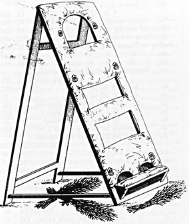
The notorious Berkeley Horse invented by Theresa Berkeley. Enthusiasts were bound to this apparatus and whipped.
The public appetite for books about flagellation fuelled the emerging pornography industry, which was to take off during the nineteenth century with the development of mass-production printing. Eighteenth-century readers were catered for with titles such as Jacques Boileau’s Histoire des flagellants (Amsterdam, 1701), which inspired many sequels and parodies. The pornographer Edmund Curll translated the 1718 edition of John Henry Melbonius’s De usu flagorum (first published 1639) or A Treatise of the Use of Flogging and defended his publication with spurious medical claims, arguing that ‘the rods’ represented a cure for impotence and venereal disease, and reading about such topics offered comfort for men and women unable to obtain sexual satisfaction by more conventional means. ‘There are Persons who are stimulated to Venery by Strokes of Rods, and worked up into a Flame of Lust by Blows,’ he reminds us, ‘and that the Part, which distinguishes us to be Men, should be raised by the Charm of invigorating Lashes.’ He supports his argument with classical quotations and the observation that old lechers use flogging to ‘re-inflame the cold parts’.40
Flogging appealed particularly to the nobility, perhaps because, as Mary Wilson suggested, they had been aroused by early experiences of flagellation at their public schools. One popular anecdote concerned an elderly aristocrat who rented a house in St James’s Place and hired an attractive elderly woman as his housekeeper. One day each week, she had been instructed to lay out scrubbing brushes, mops, and every other item necessary to clean a room, and to engage two women to meet him there on that day. One of these women was to ‘role play’ a housekeeper and the other a chambermaid. The nobleman would then dress himself up as a parish girl and begin scrubbing the room. Afterwards, either one or both of the women would scold him for doing a poor job and then whip him, just as many parish girls were whipped by their mistresses.
‘Amorous strangulation’, or auto-erotic asphyxiation, was not unknown in eighteenth-century London, as illustrated by the peculiar case of Franz Kotzwara (1730–91), a Bohemian musician.41 This celebrated double bass player and composer of ‘The Battle of Prague’ (which commemorates the Prussian victory in 1757 over the Austrians at Prague) had a taste for wine, women and kinky sex. On 2 September 1791 he visited the brothel at 5 Vine Street in St Martin’s, where he met with the prostitute Susannah Hill. Following dinner, Kotzwara demanded that she cut off his testicles, a service which she refused to perform. Kotzwara then strangled himself on a rope hooked to the door, ostensibly while having sex with the girl. This led to a spectacular trial at the Old Bailey, where Hill was charged with murder. But once testimony was produced which documented Kotzwara’s eclectic sexual tastes, Hill was acquitted. Kotzwara’s is the first documented case of auto-erotic asphyxiation.
The final player in this account of sexual perversity is Sir Francis Dashwood (1708–81), proprietor of the Hellfire Club, although it must be admitted that the most infamous behaviour associated with this establishment occurred outside London. The original Hellfire Club had been founded by Philip, Duke of Wharton in 1719, when Dashwood would have been too young to be a member. Lord Wharton was a prominent politician with two separate lives; the first as a man of letters, and the second as a drunkard, a rioter, an infidel and a rake. Members of the club were assumed to include Wharton’s immediate friends, the Earl of Hillsborough, the Earl of Lichfield and Sir Edmund O’Brien. This Hellfire Club was a typical early eighteenth-century club in that it was formed for one specific purpose: in this case, to ridicule religion and conventional morality – hence its name. While its supposed president was the Devil, and members referred to themselves as ‘devils’, there was no actual devil worship in evidence. Instead, activities included mock religious ceremonies, and dinners to which members turned up dressed as characters from the Bible, and ate dishes such as Holy Ghost Pie and Devil’s Loin, washed down with Hell-fire punch. The club met on Sundays at different locations around London, with one popular venue being the Greyhound Tavern. However, it was unusual in that it admitted women as members, and, since respectable ladies could not frequent taverns, meetings were also held at members’ houses.
From these relatively innocuous origins, the Hellfire Club took a different turn under the presidency of Sir Francis Dashwood, a rake who had fornicated his way across Europe on his Grand Tour.42 Dashwood was alternately fascinated and repelled by Roman Catholicism – it was said that at one moment Dashwood would be jeering at the rituals and vestments and at the next sobbing and praying on his knees – as well as Freemasonry and Satanism. On one occasion, he produced a whip in the Sistine Chapel and beat those kneeling in prayer. Dashwood returned to England and was elected MP for New Romney. His private life, meanwhile, was increasingly devoted to decadence and dissolution.
In 1746, Dashwood founded his Order of the Knights of St Francis, which initially met at the George and Vulture tavern in the Cornhill. The Knights convened in a room dominated by ‘an everlasting Rosicrucian lamp’, a large crystal globe encircled by a gold serpent with its tail in its mouth. The globe was crowned with a pair of silver wings and was suspended in chains in the form of twisted serpents. The Hellfire Club proved so popular that the George and Vulture became too small for its devotions, so proceedings moved to Dashwood’s extravagant country house at West Wycombe. This neo-Gothic fantasy included a west wing which was a replica of a temple to Bacchus. The first meeting of Dashwood’s ‘brotherhood’ was held on Walpurgis Night 1752. Walpurgis Night is a pre-Christian festival, celebrated on 1 May, and reflected Sir Francis’s obsession with paganism. But the event was not a success, perhaps because of objections raised by his long-suffering wife, the ‘pious prude’ Mary Ellis, and he did not hold parties at home again. Instead, in 1751, Dashwood leased Medmenham Abbey from a friend, Francis Duffield. On the Thames near Marlow, about six miles from West Wycombe, the house had originally been a Cistercian abbey before being rebuilt as a Tudor mansion. Dashwood had the abbey rebuilt in Gothic Revival style, and the motto Fais ce que tu voudras (‘Do what thou wilt’, an injunction later taken up by Aleister Crowley) was placed above a doorway in stained glass.
There had been a cave beneath the original abbey, with a low narrow entrance surrounded by yew trees. Believing this to be an old pagan site, Dashwood had a further network of caves excavated, where he and his followers could celebrate their rites. For some idea of what actually went on, one must turn to coffee-house gossips such as Horace Walpole, who described these events as ‘rigorously pagan: Bacchus and Venus were the deities to whom they almost publicly sacrificed; and the nymphs and the hogsheads that were laid in against the festivals of this new church, sufficiently informed the neighbourhood of the complexion of those hermits.’ The thirteen members addressed each other as ‘brothers’ and the leader, who changed regularly, as ‘Abbot’. During meetings members supposedly wore ritual clothing: white trousers, jacket and cap, while the ‘Abbot’ wore a red ensemble of the same style.
The Hellfire Club was an open secret among the establishment, and its members and visitors included some of the most influential political figures of the day: Lord Bute, who was to become Prime Minister; Lord Sandwich, a sadistic rapist and First Lord of the Admiralty, described as ‘completely depraved, as mischievous as a monkey and as lecherous as a goat’; and his rival, John Wilkes, the radical MP and journalist. Other devotees included Thomas Potter, son of the Archbishop of Canterbury, Paymaster General and a rumoured necrophiliac; and William Douglas, later 4th Duke of Queensberry, one of the richest and most rapacious men of his age. Benjamin Franklin, the Prince of Wales and even Horace Walpole himself were alleged members.
Dashwood’s mistress, ‘Hell-fire Stanhope’, one of London’s top bawds, ferried molls down from the city to participate in orgies, and also initiated upper-class ladies into the club. These women included Dashwood’s half-sister, Mary Walcott; Frances, Viscountess Fane; and Lady Mary Wortley Montagu, who no doubt enjoyed the lesbian displays which were actively encouraged.43 Inevitably, it was claimed that Dashwood’s monks celebrated black mass, with satanic prayers offered in the flickering candlelight over the naked body of an aristocratic young woman, as masked participants gathered round to watch and then sipped wine from her navel, but to the modern eye, events as described seem no more sinister than an erotic party or a sex club.
Dashwood is remembered as a libertine par excellence, but even Dashwood did not believe that pleasure should be for everybody. Whatever went on at the Hellfire Club, he was still a member of the establishment. Enjoyment was not for the common man: Dashwood’s first act on becoming Chancellor of the Exchequer in 1762 was to levy a tax on cider, an act which must have earned the condemnation of pagans and Christians alike.

Over the centuries, London’s whores had proved capable of indulging every peccadillo imaginable. What these women and men could not have foreseen, however, was the next development in the city’s sexual history. As London became the world’s great capital of industry and commerce, a global workshop and a glittering metropolis, it also became the centre of the world’s sex trade, as young girls arrived in their tens of thousands, desperate for a new life but soon drawn into the net of the world’s oldest profession.