
10
Two views of the circumstances of our lives coexist in our minds, which we take out and use as the whim takes us. One is that our lives are ordered and that there is a reason for everything; the other is that everything is due to chance – in the words of Macbeth, ‘a tale told by an idiot, full of sound and fury, signifying nothing’. The planets appear to move in an orderly and predictable way, but in fact, major circumstances of our existence on Earth, indeed the very architecture of the solar system, were set by chaos and chance, in unknowable motions of the planets and in accidental collisions between planets. The biography of the Earth might have been completely different.
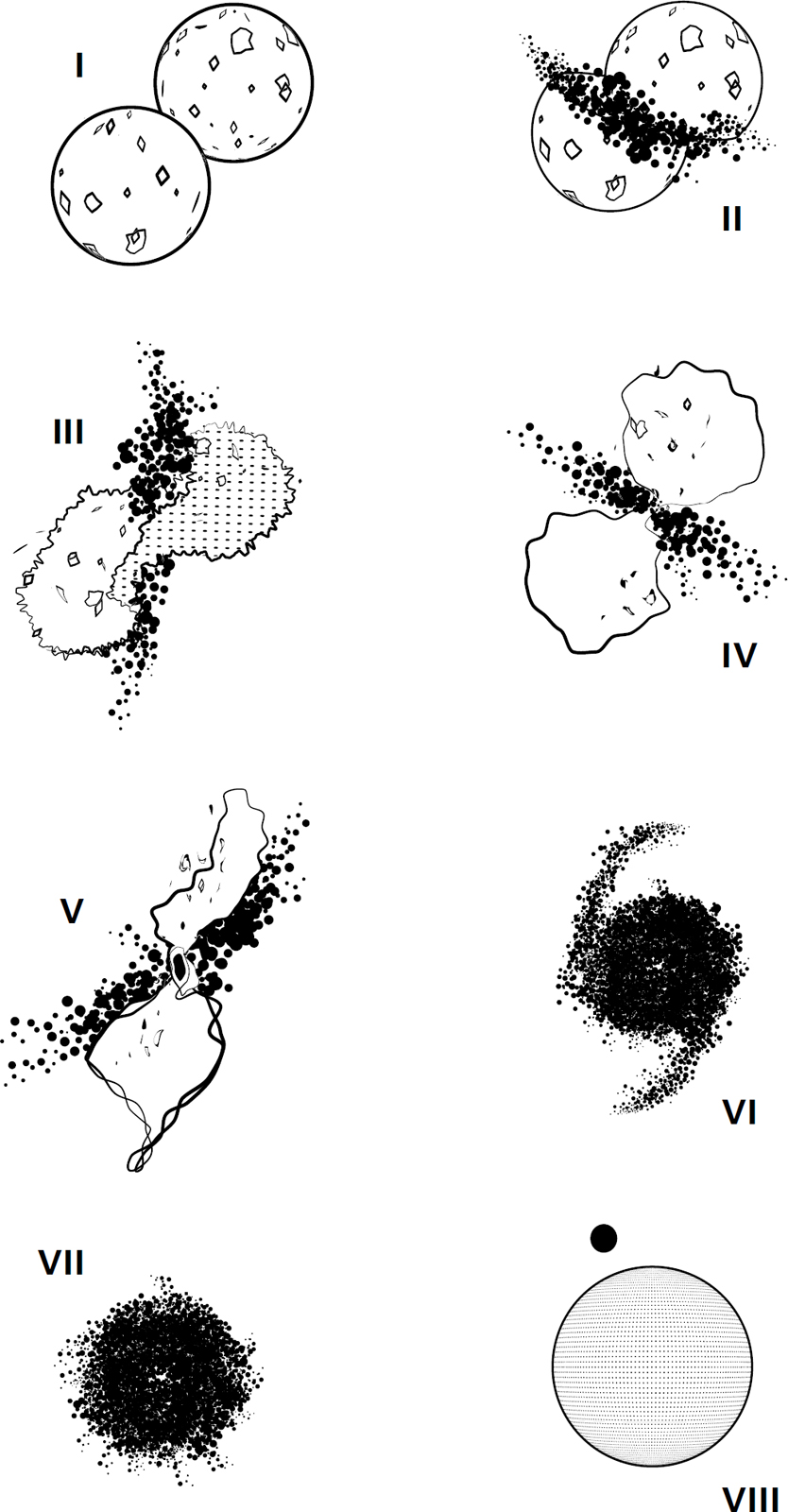
The Moon originated from a collision between the proto-Earth and a smaller, errant planet.
From protoplanets to the planets: the planets grow up
Early on in their history, planets become layered into zones of different composition. This is called planetary differentiation and was the result of the melting (or at least softening) and separation of different kinds of planetary materials. It started to happen in planetesimals as they grew to a size of about 1,000 kilometres (600 miles) in diameter. Denser material tended to sink down into the centre of the planetesimal and less dense material rose up towards the surface. Thus, the larger planetesimals, as well as large protoplanets and satellites, became ‘differentiated’ into zones of different composition with density increasing inwards. The composition of the zones depended on where the protoplanet was formed, how massive it was and the history that it had (that is, how much energy had been input into the planet and under what circumstances, to cause its material to float up or sink down).
This differentiation is one reason why there are so many kinds of meteorites. Meteorites are pieces of solid material that had been orbiting the solar system, like the small asteroids that they are, and then fell to Earth. Some of the pieces are original solar system material and have never been part of a planet of any kind. Other pieces are fragments of a broken asteroid, which had, at least partly, differentiated. The asteroid was shattered into pieces by collision with another. The mineral of which a given piece is made depends not only on the asteroid from which the meteorite came, but also on the zone within the asteroid.
In differentiated terrestrial planets, such as the Earth or Mars, or rocky satellites such as the Moon or Jupiter’s satellite Io, the central region became a core (made wholly or partly of iron and nickel), surrounded by a rocky mantle and overlaid by an outer crust, and, in some cases, a gaseous atmosphere. The core of the Earth became large and layered into a solid inner core and a liquid outer core. Jupiter’s icy satellites Europa and Ganymede differentiated into a similar core-mantle interior, but they developed no crust; instead, they became surrounded by layers of ice and water. Molten iron in the cores generated planet-wide magnetic fields by a dynamo effect as currents circulated in the liquid. As a result of these structures, some meteorites are made of iron and nickel and some of stony rocks, with the minerals of the stone varying considerably.
The giant planets, like Jupiter and Saturn, stratified into a deep, dense gaseous atmosphere underlain by a molecular layer of hydrogen and helium. Inside the planet where the pressure was high, the hydrogen took up metallic properties, such as are never seen in laboratory conditions because the precondition for them is a high pressure, so high that it is unattainable on Earth. These planets developed a central core, composed of heavier elements like iron, silicon and magnesium, but also of water, ammonia and methane.
The initial source of the energy that drove the evolution of rocky planetesimals into protoplanets and then into terrestrial planets was the accretion of other planetesimals, which yield up their kinetic energy in the impact to make heat. This liquified the surface into an ocean of molten magma. Residual solid material floated to the top of the magma ocean and heavier iron-rich liquid material sank. This released further energy in a runaway process that continued to separate out the material of the planet into a dense solid and liquid core, and a rocky mantle.
The liquid magma solidified on the surface as it cooled, starting within a million years after the formation of Earth. This process became complete in tens of millions of years, with the surface shielded from further meteoric bombardment by the atmosphere that it developed (except by large meteors that had the energy to break through the atmospheric barrier). Unlike the Earth, the Moon, being so much smaller, could not retain any significant atmosphere and the bombardment of the surface continued.
Further heat sources that acted later to develop the structure of the planets were the decay of radioactive elements and tidal heating, if the planet or satellite was a member of a planet/satellite pair, as with Jupiter’s satellites Io and Europa. Another factor was the size of the protoplanet and the amount of insulation provided by the rocky mantle that acted to keep the heat in if it was a thick enough blanket. If the protoplanet was small, it cooled relatively faster and any melted material solidified, which halted differentiation as well as turning off any magnetic field because the inner dynamo was no longer turning.
The creation of the Moon
As the solar nebula dissipated, it left behind many planetesimals and a number of large protoplanets. They moved around the Sun in densely packed orbits, disturbed in an irregular way by interaction with passing neighbours. Collisions were inevitable, and there were two extreme kinds of collisions that had entirely different outcomes.
The first was a collision of a small planetesimal with a large protoplanet at a low relative speed – for example, as one of them overtakes the other. This resulted in the disintegration of the smaller planetesimal, some churning of the surface of the protoplanet and a hot crater – in short, in the accretion of the smaller planetesimal into the larger body. This was a way that planets grew, further such collisions overlapping onto the earlier ones. Only the very last collisions left craters as scars that are still visible.
At the other extreme, the head-on collision of two equal planetesimals resulted in the disintegration of each into many pieces. This was how many asteroids were created – some went on to be captured by planets and became moons. The broken pieces could have been of various compositions depending on which differentiated zone of the broken planet they came from. Meteorites are simply small asteroids that have fallen to Earth – the two main types of meteorites are iron or stony, depending on whether they were a piece of a frozen iron core or a rocky mantle. Indications are that one asteroid, called Psyche, the sixteenth asteroid discovered and one of the ten most massive asteroids in the asteroid belt, is made almost entirely of iron; it may be the iron core of a previous larger asteroid that lost its mantle in catastrophic collisions. An eponymous NASA space mission is due to visit Psyche in 2026.
A collision type that had an outcome important for us was neither the first nor the second above, but a kind of midway case: the glancing blow of one planetesimal on another. This alters the rotation of each and breaks off a few large pieces and many smaller fragments. This was how Earth’s Moon was created. The basic scenario was put forward by American astronomers William Hartmann and Donald Davis of the Planetary Science Institute, Tucson, in Arizona at a conference in 1974, at which their idea connected with work by Harvard University researchers A. G. W. Cameron and William Ward on the dynamical properties of the Earth–Moon system – their orbits and rotation. The theory languished until 1984 when an international meeting was organized in Kona, Hawaii, about the origin of the Moon. At the start of that meeting, there was no consensus about the origin of the Moon, but by its end what became known as the giant impact hypothesis had emerged as the lead idea and has remained so ever since. The Kona conference was remarkably decisive in creating a consensus that outlined the origin of the Moon, but many variants of the main idea have been put forward and the subject cannot be said to be closed.
The main challenge in sketching out how the Moon formed is to account simultaneously for the orbit of the Moon and the rotational speed of the Earth, while also explaining their composition. The idea is that the Earth–Moon system originated from the collision of the proto-Earth, Gaia, with another protoplanet, Theia, soon after the formation of the solar system – perhaps 100 million years afterwards. Gaia was 90 per cent the size of the Earth and Theia was the size of Mars. The collision was a glancing blow and sped up the rotation of the embryonic Earth, much as stroking a hand along the equator of a geographical globe will make it spin faster. The collision left the Earth rotating much faster than now. Instead of twenty-four hours, the day was five hours long.
The collision broke up Theia and smashed the outer mantle of the Earth into small, hot pieces. The materials jumbled up. Some fell back down to Earth, some flew off into space and some entered into orbit around the Earth. A large concentration of pieces gathered together and built up the Moon, continuing the orbit.
The rocks brought back from the Moon by the Apollo astronauts in the 1970s showed that the composition of the Moon is very similar to that of the outer portions of our planet – the two are more alike than different. The mantles of the Moon and Earth are identical, distinct from the composition of meteorites from Mars and from asteroids. However, the Moon is poorer in elements that vaporize readily, such as potassium, suggesting that they may have boiled off the hot pieces from which it formed. A further large difference is that the Earth has a large iron core and the Moon does not.
The explanation put forward is that the collision of Theia with Gaia created a disc of hot material derived largely from Theia, the impactor. Both Gaia and Theia were protoplanets with a central iron core surrounded by a rocky mantle. A large fraction of the rocky mantles of the two shattered in the collision and accumulated into the Moon. As a result, the composition of the lunar rocks is essentially the same as the composition of the Earth’s mantle. The two iron cores merged into one, which was acquired by the Earth, the Moon acquiring almost none.
The development of the orbits of the planets
As the solar nebula dissipated, it left behind numerous planetesimals at all stages of maturity. Some were primitive bodies that were dust and grains fused into small bodies like Arrokoth (see Chapter 9). Some were larger bodies (planets), and there may well have been more planets than the eight true planets and accompanying asteroids that there are now.
The orbits of the planets back then are not something that can be calculated precisely because of the limitations of ‘chaos’ in solving the equations of gravitation as applied to a number of planets. This makes the calculations about more than one planet in orbit around one sun inherently uncertain. According to Isaac Newton’s analysis of two bodies in orbit one around the other (the Sun and one planet), the orbits are determined for all time: they are ellipses that repeat indefinitely. But, of course, the solar system consists of more than two bodies – in the early years of the solar system many more than two. At some level, it is impossible to ignore the pull of each planet on the others, and the orbits of planets are actually much more complex than repetitive ellipses.
In fact, the extension of Newton’s theory from two bodies even to just three is intractable, let alone to hundreds or thousands. In 1887, the King of Sweden offered a prize for the solution of what came to be known as the Three-Body Problem: what are the orbits of three bodies moving under the influence of their mutual attraction by gravity? The French mathematician Henri Poincaré (1854–1912) won the prize because his analysis was the most impressive, but even he did not find the precise, mathematical solution that was being sought, and since then nor has anyone else.
What Poincaré found was that he could calculate the orbits of three bodies numerically, through laborious hand calculations on paper – but the orbits were ‘so tangled that I cannot even begin to draw them’, he said. Worse than this, Poincaré described in an essay on chance in Science and Method (1908) how when the three bodies were started from slightly different initial positions, the orbits were entirely different. ‘It may happen that small differences in the initial positions may lead to enormous differences in the final phenomena. Prediction becomes impossible.’
Poincaré’s work has been confirmed by modern mathematical techniques, including computer calculations of thousands of cases. In modern mathematical language, planetary orbits are ‘chaotic’. If you start calculations with the planets in particular places and with particular speeds, you can calculate where they will be in, let us say, 100 million years. If you displace one of the planets by just centimetres from its assumed initial position, the planets could be, after the same time, in entirely different places. Chaotic behaviour is predictable in the short term but, in the long term, it depends so much on where you start the calculation that you cannot accurately describe the behaviour over a much longer period. Weather forecasting is chaotic in this sense. Meteorologists predict the weather, more or less accurately, a few days ahead. However, the tiny air disturbances from the flapping wings of a butterfly in Brazil, which are small changes in the starting point of the calculations, completely change the prediction. This fact of weather forecasting was discovered in 1963 by Edward Lorenz, a meteorologist at the Massachusetts Institute of Technology, who coined the term ‘Butterfly Effect’; University of Maryland physicist James Yorke conceived the less frivolous-sounding term ‘chaos’.
Although it is impossible to say exactly what happened to the hundreds or thousands of bodies in the solar system 3 billion or 4 billion years ago, mathematicians can describe some of what might have happened, in the same way that meteorologists can make predictions about the weather. They calculate a case with certain starting conditions, alter the start slightly and repeat the forecast, alter it again and repeat the forecast yet again, many times. They compare all the outcomes and pick up those that give plausible and frequent matches to expectations. They take the features that are common to the forecasts as indicative of reality.
The best simulation of the early solar system is known as the Nice Simulation (‘Nice’ is pronounced ‘niece’, because the work took place in 2005 at the Côte d’Azur Observatory in the French city of that name). The international group of mathematicians was led by Italian astronomer Alessandro Morbidelli. According to the simulation, what happened in the first billion years or so of the history of the solar system was like a gigantic game of interplanetary billiards or pool played by hyperactive children let loose around a billiard or pool table.
The Nice Simulation starts at a time when there were many planetesimals moving among the planets. The planets at that time included at least the four outer giant planets that we know today (Jupiter, Saturn, Uranus and Neptune) and the four inner terrestrial planets (Mercury, Venus, Earth and Mars) but, it is supposed, some more besides. Perhaps there were half a dozen of each kind. The giant planets were considerably closer to the Sun than they are now, perhaps between 5 and 30 astronomical units.
As the planetesimals moved through the solar system, they occasionally encountered one of the larger planets. Sometimes, in the encounter the planetesimal was ejected from the solar system. Perhaps this happened over time to the vast majority. These became interstellar asteroids, little worlds travelling in the darkness of space, forever far from the light of the Sun, and cold beyond its warmth. They became orphans ranging the empty spaces of the Galaxy.
The same thing may well have happened in exoplanetary systems. Occasionally one of their escaped planets looms up out of interstellar space and speeds through our solar system. A specific example of such an exoplanet was ’Oumuamua, which appeared in 2017. It was discovered by one of the US Panoramic Survey Telescope and Rapid Response System (Pan-STARRS) telescopes in Hawaii. This system consists of two telescopes, with two more planned, and each is 1.8 metres (6 feet) in size – not very large as telescopes go, but each with an unusually wide field so they can survey a large amount of sky, which they repeatedly image, saving the results. The telescopes are attached to a highly efficient data analysis system, which looks for changes from image to image, such as a new star appearing, or, in this case, an asteroid moving from one place to another.
It was impossible to see directly the shape of the asteroid that Pan-STARRS discovered, but it changed brightness as it rotated, dimmer when presenting a small area, brighter when seen face-on. It was either long and thin (dim when end-on) or disc-shaped (dim when edge-on). An imaginative idea, not quite unthinkable, was that it was cylindrical or flying-saucer-shaped because it was an interstellar rocket or spaceship. The thought that it was not a natural object was supplemented by the fact that it was moving along a path that indicated its orbit was influenced by some force additional to the Sun’s gravity, such as a sail blown by light pressure from the Sun or as an engine of some sort. It is more likely, however, that ’Oumuamua was an asteroid covered in nitrogen ices that vaporized as it warmed on approaching the Sun, which caused a reaction force – a rocket engine, but a natural one. This hypothesis was supported by its colour, which was distinctly red like the dwarf planet Pluto, a characteristic of the nitrogen ices with which Pluto is coated.
’Oumuamua was caught in the act of falling at unusually high speed into the solar system from outside. Some similar visitors have already come into the solar system and masquerade as familiar asteroids. However, some of them orbit backwards, having been captured from a randomly oriented direction in space – the 2017 visitor is the first asteroid to be seen on the way in, before capture. Because the Pan-STARRS telescopes are in Hawaii, the astronomers there consulted the local community for suggestions of a suitable name. The body was named ’Oumuamua, which in Hawaiian means ‘the first messenger to arrive from afar’. Unfortunately, its orbit quickly took it out of sight, probably forever. It swept into and out of the solar system like a sailing boat in windy conditions that failed in an attempt to stop at a harbour mooring.
When planetesimals were being ejected from our solar system by interaction with the planets, they kicked the planets backwards a little and so the planets gradually migrated in towards the Sun. After tens or hundreds of millions of years this altered the periods of the two innermost giant planets, Jupiter and Saturn. They resonated, with two of Jupiter’s orbits taking exactly the same time as one of Saturn’s: this is called a 2:1 (two to one) resonance. Working together, the two planets had a profound effect on all the rest of the planets and asteroids. Some more of them were ejected into space and the outcome for the terrestrial planets was that just four were left behind – those we know today as Mercury, Venus, Earth and Mars.
At that time, the Earth might have become interstellar – a cold, lifeless planet roving around the Galaxy like a lone coyote on the icy, vacant prairie. Fortunately for us, however, this did not happen. Our planet shifted its orbit back and forth towards and away from the Sun, ending up in the Goldilocks Zone of the solar system, where it is not too hot and not too cold, but the temperature is just the right value to make possible the oceans and the evolution of life.
There was also a profound effect on the rest of the solar system. Asteroids were swung out of their orbits. Most, perhaps more than 99 per cent, were flung into the far reaches of the solar system or interstellar space. Others jaywalked across the circular paths of the planets. Some swooped so close to a planet that they were captured, like the two asteroids that became Phobos and Deimos, the moons of Mars, and a number that likewise became some of the smaller moons of Jupiter and Saturn. Those that came too close to the planets fell on them, especially those planets inwards towards the Sun, like Mercury, and their satellites, like our Moon. They pounded their surfaces, making numerous craters – this was the event that we know as the Late Heavy Bombardment.
The Late Heavy Bombardment
In the 1960s and 1970s, the USA and the then USSR were competing in the space race, with the USA responding to President Kennedy’s challenge to NASA in 1961 to land a man on the Moon by the end of the decade. The Apollo lunar landing programme was the result, with a series of manned trial missions in 1967–69, culminating in the first manned landing mission, Apollo 11, which was launched on 11 July 1969 and landed in the Oceanus Procellarum nine days later. Between then and 1972 the Apollo astronauts collected 382 kilograms (842 lbs) of lunar rocks from six landing sites and brought them back to Earth. The rocks were individually selected for their potential significance by the astronauts, picked up with tongs and scoops and put into numbered bags. They were packed under vacuum into suitcase-like aluminium containers and personally escorted back to the USA.
In parallel, the Soviet Space Agency executed a series of competing unmanned missions: the Luna programme. Luna 15 was launched to the Moon from Baikonur Cosmodrome in Kazakhstan on 13 July 1969 during the flight of Apollo 11, in an effort to upstage the American landing. It arrived in Moon-orbit on 17 July and attempted to land on 21 July but impacted into the Mare Crisium (some sources say that it crashed into a lunar mountain at an altitude of 3,000 metres/10,000 feet, but no such mountain exists, so that is not accurate). Luna 15 was intended to automatically return a sample of lunar material back to Earth, a goal that was achieved in September 1970 by Luna 16 after a year of three further mission failures.
Luna 16 settled base-down on the lunar surface on 20 September 1970. It drilled 35 millimetres (1.5 inches) into the ground and brought out 101 grams (3.5 ounces) of soil, which it put into a strong container attached to a small rocket. The rocket was fired back towards Earth, where it arrived without course corrections to parachute the container onto the grassy steppes of Kazakhstan. It was a brilliant piece of automated spaceflight. I saw the container in the museum of the Lavochkin Association, the institute in Moscow that makes space vehicles for the Russian programme for scientific space exploration. The container looked as I would have expected of something that had ended a round trip to the Moon with a fiery descent through the atmosphere and a hard thump on the ground – it was black and battered. There were two further successful Luna probes that automatically returned 225 grams (8 ounces) of lunar samples: Luna 20 in 1972 and Luna 24 in 1976. The lunar soil was from sites that had been chosen for their general geological characteristics but were otherwise selected only because they were within reach of the lander.
In 2020, China became the third country to return lunar material to Earth. In its Chang’e 5 mission, a multiple spacecraft was sent into lunar orbit and dropped a lander onto the plain of the northern Oceanus Procellarum near Mons Rümker, a raised region 70 kilometres (40 miles) in dimension, formed by volcanic activity late in the Moon’s history. The site had been chosen because the geological feature is thought to have formed just 1.3 billion to 1.2 billion years ago, making its rocks much younger than the typical 3-billion- to 4-billion-year-old samples collected by Apollo astronauts. The Mons Rümker material will help scientists investigate why this area of the Moon was geologically active long after activity ended in most other lunar areas. The lander scooped up lunar soil, some of it brought up from 2 metres (6.5 feet) below ground by a drill. It packed the soil into an ascender rocket on top of the lander, which then took the 1.7 kilograms (3.7 lbs) of soil back to the orbiter and transferred it into the returner. The orbiter carried the returner to Earth, where it separated and landed by parachute on the snowy grasslands of Mongolia on 16 December 2020 with its precious, rare cargo.
Other lunar rocks, less expensively collected but completely unselected by human agency, have been found among meteorites, having fallen to Earth after being knocked off the Moon’s surface by the impact of asteroids. About four hundred pieces of the Moon like this have been found, amounting to 190 kilograms (420 lbs) in total. Their origin from the Moon has been established by comparing details of their composition with the Apollo samples.
If lunar rocks are splattered into space and onto the Earth by asteroid impacts, then we would expect that there would be a two-way traffic, sometimes transporting terrestrial rocks to the Moon. In 1971, the Apollo 14 commander, astronaut Alan Shepard, spotted a football-sized rock on the lunar surface. The rock came to be known as Big Bertha, or, more prosaically, Lunar Sample 14321. Its constituents were pieces that had been mixed together and frozen by a meteor impact somewhere on the Moon to make a single rock that had been ejected to the Apollo 14 landing site. The smaller pieces were mostly lunar in origin, but one piece proved better to match Earth rocks than lunar rocks. The terrestrial piece is 4 billion years old, as old as or older than any terrestrial rock found on Earth. At some time, it fell from Earth onto the Moon, to be fused by a later meteor impact into Big Bertha.
Lunar rocks have been scrutinized in great detail, with their ages determined by looking at the rate at which long-lived radioactive elements decay. There are different types of ages associated with different elements, so they measure the time since different events in the history of the rock. These can include the time since the rock last crystallized, the time since it was last struck by an impact, the time since it was dug up and, if it has been a meteorite, the length of time that it has been exposed in space to cosmic rays.
The oldest lunar rocks are those collected from the lunar highlands, the lighter areas of the Moon. The oldest moonrock of all the ones collected is 4.52 billion years old, almost as old as the very oldest meteorites that are regarded as original material from the solar nebula. Individual rocks from the dark, flat, lunar low-lands have ages that seem to cluster between 4.0 billion and 3.85 billion years. This was when they last solidified. It appears, therefore, that the crust of the Moon was strongly heated 3.9 billion years ago, some half a billion years after the Moon first formed.
The explanation for this was put forward between 1974 and 1976 by a group of astronomers at Sheffield University in the UK, led by Grenville Turner. They suggested that the Moon had first solidified about 4.5 billion years ago. It would have been impacted then by asteroids left over from the first formation of the planets. After a period of half a billion years of relative peace, the surface of the Moon was then bombarded heavily for 200 million years starting 3.9 billion years ago, remelted and resolidified. Turner called this event the ‘Lunar Cataclysm’, which later became known as the Late Heavy Bombardment. The event produced about 1,700 craters on the Moon larger than 20 kilometres (12 miles) in diameter and many more that are smaller.
If the Moon suffered in this way, so did the Earth, which was as much in the firing line as the Moon, even if protected by an atmosphere. Mathematically, there would have been tens of thousands of craters larger than 20 kilometres (12 miles) produced on Earth – some would have been 1,000 kilometres (600 miles) across. They have all disappeared, eroded away by 3.9 billion years of weather. However, the composition of deep ocean sediments provides some indication that the Late Heavy Bombardment did indeed affect our planet. The composition of Greenland and Canadian sediments from 3.9 billion years ago suggests that they contain more meteoritic material than usual. This layer of sediment includes material brought to Earth in the Late Heavy Bombardment.
It might also be significant that the fossil record of life on Earth seems to have started about 3.9 billion years ago – if life had evolved before this, it may have been set back badly by the Late Heavy Bombardment and most traces of the earlier life erased. If there are surviving fossils older than 3.9 billion years, they are controversial and few in number. There has been no catastrophe as large on Earth since, so life has had a free run to evolve, although not without smaller incidents, like the Chicxulub asteroid impact (see Chapter 11).
The surface of the Moon
The main surface features of the Moon are more than 3 billion years old, the oldest the lunar highlands. They are light-coloured, rough, mountainous areas made of the mineral anorthosite, a form of feldspar derived from magma. They are covered with large craters, 50–100 kilometres (30–60 miles) in diameter, caused by the impact of meteors. These large craters often have a central peak. The impact of a meteor vaporizes and liquidizes the ground of the impact site and causes an explosion that causes the ground to surge outwards and pile rocks up at a crater wall. If the surge is reflected back strongly, it converges on the central point and raises a central peak. The walls of lunar craters are often as high as terrestrial mountain ranges.
One striking difference between terrestrial mountain ranges and lunar ones is that terrestrial mountain ranges are caused by the slow collision of tectonic plates. The collision rumples up the line of collision into folds. This raises terrestrial mountains millimetre by millimetre. It takes millions of years to form a terrestrial mountain range. Lunar mountain ranges, on the other hand, are created in a matter of minutes.
Rocks from the highlands retrieved by the Apollo astronauts are typically 4.3 billion years old, some as old as 4.5 billion years. The highlands surround a number of giant ringed craters (or so-called ‘basins’), thirty of them with diameters of 300 kilometres (200 miles) or more, such as the Imbrium and Orientale basins. At the end of the Late Heavy Bombardment, there was a period starting 3.8 billion years ago and lasting for 800 million years in which basalt lava oozed up from under the surface and flooded low-lying areas. This filled the basins with black lava that has since solidified. The lava cooled into dark, flat plains covering the crater floors. Although the first observers to use telescopes to view these dark features on the Moon set aside the old myths about them (which identified them as a man in the Moon, an old woman carrying firewood on her back or rabbits, or other similar folk tales), they still mistook them for bodies of water and so replaced the old myths with a newer one, which survives in the Latin names for some lunar features, such as mare (‘sea’ – the plural is maria), oceanus (‘ocean’), sinus (‘bay’), lacus (‘lake’), palus (‘swamp’) and rille (‘river’).
Most episodes of lava flooding ended about 3.0 billion years ago, but meteors continued to impact on the lunar surface, cratering the lava plains and highlands. Some of the younger large craters have bright rays, such as the crater Tycho, which lies towards the south pole of the Moon. The longest of Tycho’s rays is 2,202 kilometres (1,368 miles) long. Material that lies on the Moon’s surface weathers due to exposure to the solar wind, micrometeorite bombardment and solar cosmic rays. It becomes darker in colour and the newly formed rays gradually disappear. The rays are unweathered, white debris thrown out from under the ground at the site of the meteor impact, and similar debris exposed by boulders that have been thrown out and have fallen, disturbing surface material below their trajectory. An additional indication that the craters are young is that the rays overlie the rest of the lunar surface, running in straight lines over mountains and craters with no interruptions.
Tycho is estimated as being 108 million years old: it is the youngest major lunar crater, although there are many younger smaller ones. The Tycho meteor impact was broadly contemporary with the dinosaurs, predating the impact at Chicxulub (see page 244) by 30 million years. Lunar cratering continues at a small scale even now. Telescopes that monitor the night-time areas of the Moon see brief flashes of light that are signals that a meteor impact has happened. They occur a few times per hour and create craters perhaps a few metres in diameter. Larger craters are still occasionally being made. NASA’s Lunar Reconnaissance Orbiter spacecraft has monitored the lunar surface since 2009 and has identified hundreds of new craters with diameters over 10 metres (30 feet), appearing at the rate of one every couple of days. If Earth had no atmosphere, the rate at which new craters appeared on land would be similar.
Meteoritic changes to the surface of the Moon are on the same scale as the man-made changes left from the Apollo landings and other scars left by robotic spacecraft that crashed or landed on the Moon during the space age, starting when the Soviet-era Russian spacecraft Luna 2 impacted the Moon in 1959, the first time that humankind had left its mark on another world.
The lava flows that filled the maria (‘seas’) were the most dramatic of the volcanic events that occurred on the Moon in the past, but there are others, smaller and more recent, which have left their traces on the lunar surface. The Hadley Rille is a deep, sinuous channel at the landing site of Apollo 15, caused by flowing lava, perhaps a lava tube whose roof has collapsed. There are small, circular, vertical pits discovered by the Lunar Reconnaissance Orbiter that appear to be above a lava tube where the roof has recently collapsed in individual places. Sosigenes A is a dish-shaped lunar depression filled with a pancake-like lava flow, thought to be 18 million years old.
All these features are small and the visible face of the Moon has changed little throughout the past 3 billion years. In Planetary Science: A Lunar Perspective, New Zealand-born planetary scientist Stuart Ross Taylor wrote in 1982:
A space traveler visiting the Earth 3–4 [billion years] ago would have seen the Moon rather like it is today. The red glow of a mare basalt flood could have been visible during a particularly well-timed visit. The spectacular but nearly instantaneous production of the Imbrium or Orientale basins or of a large impact crater would require finer timing to witness.
Taylor might have added that from the Earth now we see the Moon to be almost dead, but still twitching a little.
The orbits of the planets now
At the time of the Late Heavy Bombardment, the outer planets moved outwards. Moreover, the two outer planets, Neptune and Uranus, swapped positions. Neptune became the frontier of the solar system, with Uranus moving inside its orbit. This happened because, as described above, Jupiter and Saturn came into resonance, with two orbits of the one fitting exactly into the time for one orbit of the other, and their combined influence switched the places of Uranus and Neptune in the solar system.
When orbiting in the solar nebula, Jupiter moved inwards. During the upheaval at the time of the Late Heavy Bombardment, it moved outwards again. Saturn, Uranus and Neptune also moved outwards too. However, before it settled down into its current near-circular orbit, Neptune moved in an eccentric orbit, cutting across the orbits of the other planets, jaywalking. This chaos threw the asteroids around. Some were hurled to skim near other planets, where they were captured and became moons. Some asteroids became confined into the space between the orbits of Mars and Jupiter. Others were thrown outwards towards the edge of the solar system, some of them scattered into the vast emptiness of interstellar space.
The time of the Late Heavy Bombardment was the most turbulent period in the lives of the planets. There were major catastrophes still to come to individual planets, but not a general chaos that pervaded the whole solar system for an extended time. Following this period was a time during which the solar system was tidied up. The elliptical orbits of the planets interacted so that over hundreds of millions of years they changed shape and orientation, sweeping out the space around their orbits in bands. Anything in the bands was accreted – the eight major planets cleared a zone around their orbit, feeding on everything within. After the first half a billion years of its existence the solar system changed from a nebula of gas, dust and rocks filling the entire plane of the solar system to the relatively empty area that it is now.
On the one hand we can regard the solar system as almost empty. On the other hand, the solar system is full. The total width of the swept bands within the spacing of the planets just about fills the plane of the solar system without overlap. This means that there is little or no risk that two large planets will collide, although it remains a possibility that an errant asteroid might collide with a planet, or two smaller asteroids might collide in the more crowded asteroid belt. There is no room for any further planets without a risk that the extra ones would eventually collide with a neighbour.
The situation has become rather favourable for us. Most of the small asteroids that had survived the chaos and still wandered around the solar system were swept up and captured. This removed much of the risk that Earth and the other planets would be bombarded by asteroids in the future.
Of course, the planets, even the Earth, are still at risk from stray asteroids, or asteroids that are disturbed in some infrequent close encounter. Asteroid impacts – for example, the impact near Chicxulub in Mexico that changed the global climate and at least contributed to the extinction of the dinosaurs – remain a feature of the evolution of planets. Some collisions were set in train at that turbulent time, but are yet to happen: the asteroid-moon Phobos orbits close to Mars (only about 5,800 kilometres/3,600 miles above its surface) and is approaching Mars by nearly 2 metres (6.5 feet) per century; it is likely doomed to crash onto Mars in 50 million years. However, impacts of asteroids on the planets nowadays are occasional, not a sustained, lethal bombardment.
The continued interaction of the orbits of the planets causes regular cyclic changes in the orbit of the Earth and its rotation. These changes alter the location of the warmest areas on Earth, which in turn alters the directions and the strength of the winds, and therefore, ultimately, the climate. Of course, climate is the complicated result of many processes, such as the greenhouse effect, volcanism, asteroid impact and continental drift, as well as changes in the composition of the Earth’s atmosphere, such as industrially and agriculturally generated carbon dioxide. Here I set aside many of these important factors and concentrate on the astronomical causes of climate change.
The warm zone on the Earth is the range of latitudes around the Equator, but over the year the warmest zone oscillates to the north and the south, because the Earth is tilted at 23.5 degrees to its orbital plane around the Sun. The warmest zone moves from the Tropic of Cancer at 23.5 degrees North in June to the Tropic of Capricorn at 23.5 degrees South in December. This produces the annual cycle of the seasons. Additionally, the eccentricity of the Earth’s orbit around the Sun causes a small but noticeable variation. The Earth does not orbit the Sun in a perfect circle, but in an ellipse, which causes the distance between the Earth and the Sun to change around the year, changing the solar flux as received at Earth and therefore influencing the temperature. People who live in the northern hemisphere may be surprised to learn that the Earth is closest to the Sun in the first week of January, the middle of winter. It is, correspondingly, furthest from the Sun in the first week of July. This alters the effect of the Earth’s tilt on the seasons. In January, the summer solar radiation is stronger in the southern hemisphere than the summer solar radiation is in July in the northern hemisphere, which is why summers tend to be hotter in the southern hemisphere.
If the Earth’s tilt and its eccentric orbit stayed the same forever, these annual cycles of the seasons would repeat in the same way from year to year. However, because of the interaction of the orbits of the planets, the Earth’s orbit and orientation changes over time. The Earth’s axis does not always point in the same direction but, in a cycle called precession, points around a cone over a period of 26,000 years. Moreover, the tilt is not constant at 23.5 degrees, its current value. The angle of the cone opens and narrows between 23 and 49 degrees over a period of 41,000 years. The eccentricity of the Earth’s orbit is currently 3.4 per cent but changes between almost 0 and 7 per cent, on a timescale of 100,000 years.
The changes in intensity of sunlight arising from all these orbital cycles is complicated. They were systematically calculated by the Serbian civil engineer and geophysicist Milutin Milankovič (1879–1958) in the 1920s and 1930s. For this reason, they are called Milankovič (or Milankovitch) cycles. He related the ice ages to these cycles, with recent cold periods occurring approximately every 100,000 years, when all the effects combined to produce maximum cooling.
Ocean sediments and Antarctic ice cores have supported Milankovič’s theory. Their isotopic composition varies from layer to layer, and shows how the temperature was changing over the period when the layers were deposited. In the USA, ice cores are stored in a purpose-built facility called the US National Ice Core Laboratory in Denver, Colorado. Ice cores from drill sites in Greenland, Antarctica and high mountain glaciers in the western United States show that the Ice Age presently coming to an end began 40 million years ago. An ice age is defined by glaciologists as a period on Earth in which there are extensive ice sheets, as there are in Antarctica and Greenland now, although they are retreating. The climate grew colder during the Pliocene and Pleistocene periods, starting around 3 million years ago, with the spread of ice sheets across the northern hemisphere. Since then, glaciers have advanced and retreated every 40,000 to 100,000 years. They are on the retreat now, with Milankovič’s astronomical cycles being the main long-term reason, but with anthropogenic global warming also adding a sudden extra push.