
9
The solar system is extremely important to us as our home environment, the one that gives us our existence. The present age of space exploration and powerful telescopes has widened the compass of our astronomical knowledge and understanding of that environment. We are learning about the planets in individual detail, and can compare them, to an increasing extent, with planets orbiting other stars. This has added more and more numerous certainties to what used to be just plausible guesses about how planets and life evolved. Planetary science and astrobiology (the science of extraterrestrial life) are multidisciplinary subjects of increasing sophistication and significance.
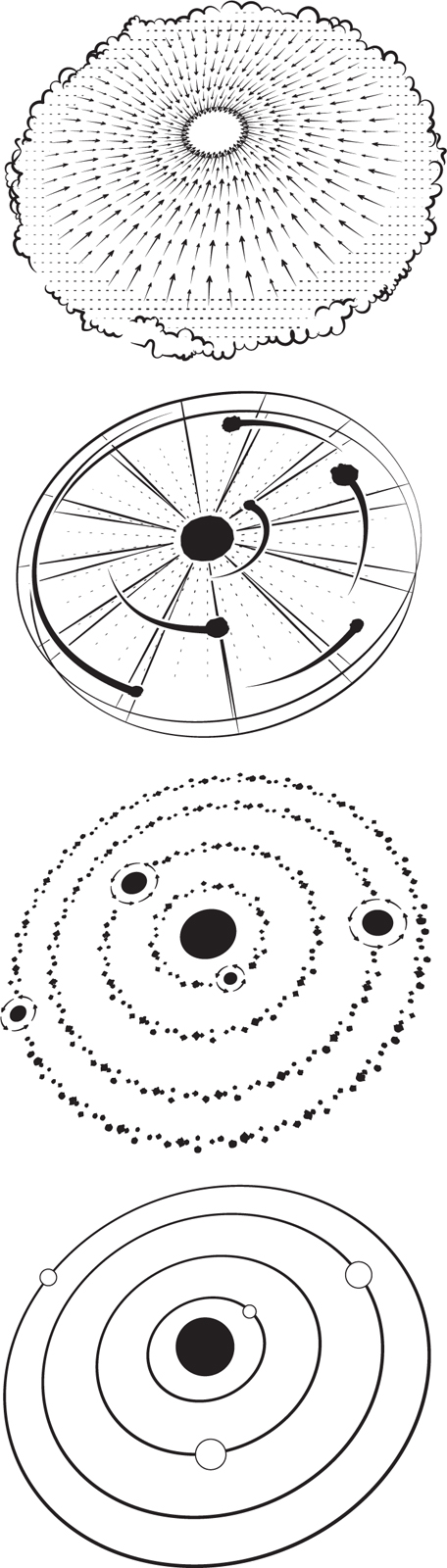
A disc of gas and dust surrounded the Sun as it formed. Dust particles stuck together and built up the planets.
Icy dust in the solar nebula
On a cosmic scale the solar system is insignificant compared to galaxies and stars, and in cosmic history it is a late arrival, which is why it appears towards the end of this biography of the Universe. This book commenced with a Big Bang, but the story is only now reaching towards what appears to us to be its culmination: the emergence of humankind as a cosmic phenomenon. This perspective is self-centred and what appears to us to be the climax is, in a broader perspective, of limited impact and short duration (see Chapter 12).
The potential for planets to exist and to host life on their surface is present in the interstellar medium of our Galaxy, and was realized in our solar system as the Sun came into existence in the solar nebula. The solar nebula formed a disc of gas and solid grains that rotated around the nascent Sun, travelling in more or less circular orbits (see Chapter 6). The gas originated in interstellar space and was mostly hydrogen and helium, made in the Big Bang, but it also contained simple molecular compounds, made of elements like carbon, oxygen and nitrogen, themselves made in stars. Molecules of few atoms were the more common because they were simpler to make in the vacuous spaces of the Galaxy than complicated molecules. They included hydrogen molecules (two hydrogen atoms, H2), water (two atoms of hydrogen and one of oxygen, H2O), ammonia (three atoms of hydrogen and one of nitrogen, NH3) and carbon mon- and di-oxide (one atom of carbon and one or two of oxygen respectively, CO and CO2); more complex molecules like methanol (one atom each of carbon and oxygen and four of hydrogen, CH3OH) and acetaldehyde (two atoms of carbon, one of oxygen and four of hydrogen, CH3CHO) also occurred. The most complex molecules discovered so far in interstellar space have a dozen or more atoms, like benzene, C6H6, with six carbon and six hydrogen atoms arranged in a ring. Buckminsterfullerene molecules (informally known as ‘bucky balls’) have only one kind of atom but many of them: each has sixty carbon atoms arranged in a structure typical of a geodesic dome designed by the architect Buckminster Fuller.
We could infer that these might have been about as complex as the molecules of the solar nebula, before it became warm and dense and cooked up anything more complicated. The chemical composition of the disc was similar to that of comets in the modern solar system; indeed, the solar nebula was the material from which comets originated. Interstellar space is cold, like comets, and these molecules, and others like them, were at the outset frozen onto the grains of the solar nebula as various forms of ice, then amalgamated together as comets 4.5 billion years ago. Until a comet for some reason ventures into the warmth of the Sun, which activates further chemical reactions, it will have remained little changed since then.
At the same time as these molecules were accumulating into the solar nebula, the Sun was forming at its centre, brightening and radiating more heat. This warmed those grains that were unshadowed in the zones nearest to the Sun. There, the ice melted and vaporized – or more correctly, in space the ice ‘sublimated’, turning directly from solid to gas without passing through the liquid form. (Frozen carbon dioxide commonly does this even on Earth, as when dry ice is used in a gothic theatrical production to simulate fog on the stage.) Solid grains were left behind as the sublimated vapour joined the other gases in the solar nebula.
The boundary between the inner zone where most of the frozen ices are vaporized and the outer zone where they remain solid is called the snow line, by analogy with the contour line on a high mountain above which snow remains frozen all the year. Typically, the snow line in young stars like the Sun lies at a radius of two or three times the radius of the Earth’s orbit (the radius of the Earth’s orbit is defined as 1 astronomical unit, so 2–3 astronomical units, corresponding to about the orbit of Mars in our solar system). Inside the snow line, the solar nebula became dry, made of solid grains, and the ices vaporized. Molecules of the gases (mostly hydrogen and helium) warmed and dissipated away from the Sun. Outside the snow line, grains kept their icy cover and the gases stayed put.
The snow line differs somewhat in its location from compound to compound, depending on the temperature at which the solid form of the compound changes to vapour. ‘The’ snow line is taken as the boundary between water vapour and water ice. In general, however, there develops a progressive change of composition of the solar nebula as different compounds vaporize. This means that there are compositional differences in solar system bodies, depending on where they formed.
As a protostar forms within a protoplanetary nebula, the snow line is close to the star and it has not been possible with current telescopes to image the nebulae and see the boundary except in one unusual case, V883 Orionis. The image was obtained with the Atacama Large Millimeter/submillimeter Array (ALMA), which is a unique international telescope operated by the European Southern Observatory that studies the Universe from a high plateau at Chajnantor in the foothills of the Andes Mountains in Chile, near to San Pedro de Atacama.
ALMA is composed of sixty-six high-precision antennas, operating at wavelengths of 0.32–3.6 millimetres. They are connected together in an interferometer and act together as a single telescope. Antennas can be moved on huge transporters so the interferometer can be arranged in different configurations, where the maximum distance between antennas can vary from 150 metres (500 feet) to 16 kilometres (10 miles). There are two transporters called Otto and Lore that do this job, picking up and repositioning the antennas on their mounting pads to a precision of about a millimetre. This enables the interferometer to make detailed pictures of the sky by combining data from all the antennas in all of the configurations through a specialized computer called a correlator. ALMA’s pictures can be sharper than the pictures from the Hubble Space Telescope.
ALMA operates by sensing millimetre and submillimetre radiation. Such signals from space are heavily absorbed by water vapour in the Earth’s atmosphere, so telescopes for this kind of astronomy must be built on sites where the air is thin and dry. The ALMA site, in the Atacama Desert at an altitude of 5,000 metres (16,000 feet), is one of the driest places on Earth and because of the height, the air is thin. Workers at the site must breathe oxygen from cylinders to operate this frontier observatory, almost as if on a spacewalk, but it is worth the difficulty: ALMA has opened a new window into the Universe, through which, among other things, it can see the warm dust and the molecules in exoplanetary systems. Unfortunately, astronomers can detect only gas and dust and cannot directly see anything that has a size between a tennis ball and a large planet and so they cannot detect the stages by which planetesimals grow from pebbles and rocks (meteoroids) into asteroids and planets. Because they are the essence of planet-building, the small bits are crucial, but their precise role is a bit of a mystery.
Even with its amazingly sharp imaging properties, ALMA has not usually been able to witness the boundary marked by the snow line in ordinary protoplanetary discs because, at 2–3 astronomical units, it is so far into the protoplanetary nebula that structure cannot be distinguished from the central star. However, there has been one favourable case, as mentioned above. In 2016, the snow line in the protoplanetary disc around the star V883 Orionis lay at a distance of more than 40 astronomical units (the size of the orbit of Neptune in our solar system). The star is like the Sun, only one-third more massive, but it was temporarily four hundred times brighter than normal. It was experiencing an outburst, a sudden increase in temperature and luminosity due to large amounts of material being transferred from the disc to the star, activating the disc and then the star’s surface. The disc was flash-heated by the outburst and released molecules from its icy compounds in the inner zone of the protoplanetary disc. The water that was vaporized lay within 40 astronomical units of the star. Other molecules detected as vapour included methanol (CH3OH), acetone (CH3COCH3), acetaldehyde (CH3CHO), methyl formate (CH3OCHO) and acetonitrile (CH3CN). These more complex organic molecules lay within their snow line of 60 astronomical units.
The formation of protoplanets
The solar nebula formed a disc of gas, ice and solid grains that rotated around the Sun. The build-up of the grains to terrestrial planets is a subject still under study but it may have happened somewhat like this. About 100,000 years after the birth of the solar system, the grains were small and the odd electrostatic charge on one could influence its trajectory among the others. When grains of opposite electrostatic charge touched, they stuck together. In another similar effect, a molecule on the surface of a grain might have an atom broken off so that an unsatisfied chemical bond waved free. If two grains with free chemical bonds touched, the bonds might link and connect the two grains, again sticking them together. In ways like these, small grains coagulated and grew, becoming centimetre-sized pebbles.
Once the grains had become pebbles several million years later, they grew faster; they sailed through the dust and gas of the solar nebula, whose material flowed around both sides of the disturbance, colliding behind the fragment and falling onto its rear. In addition, dust particles or smaller pieces hitting a fragment would break up and bounce in pieces, settling on the surface of the fragment. These processes built up the fragment, in a process called accretion. The pebbles grew to boulder-size and larger, metres to kilometres in size.
At this stage, the fragments are termed ‘planetesimals’. These larger fragments moved together, attracting each other with the force of gravity to form protoplanets. Some protoplanets merged to become the planets and some remained as asteroids in the present-day solar system. One survivor is the Kuiper Belt object Arrokoth (the name means ‘sky’ in the Powhatan/Algonquian language and its numerical designation is 2014 MU69). Arrokoth was formerly nicknamed Ultima Thule (which signifies ‘beyond the most distant lands’) because of its position in the solar system beyond Pluto. The New Horizons space probe flew by Arrokoth on 1 January 2019, having passed Neptune, the most distant planet, and even Pluto. Images from the fly-by (pl. XIII) showed that Arrokoth has two connected lobes 30 kilometres (19 miles) long overall, so that from some angles it looks like a snowman. It has a smooth surface and a uniform composition, indicating it is pristine, unaltered since its origin.
The lobes of this two-part object were once separate bodies that formed close together, moving slowly relative to each other, at a walking pace of perhaps 1–2 metres (3–6.5 feet) per second. They were mutually attracted by gravity into an orbit, the one around the other. They touched, rubbed together and then gently merged. Each of the lobes is itself made up of smaller lumps that had earlier fused together. Arrokoth looks the way it does, not because it smashed violently together with collisions, but because it accumulated gently with small kisses and enveloping hugs.
The protoplanets that formed near to the Sun got bigger by accumulating material that they encountered on their orbits and by merging together. Outside the snow line, larger gas giant planets like Jupiter formed in the abundant, gaseous and dense nebular material, in the same way, more or less, that galaxies had earlier formed from hydrogen made in the Big Bang, or that stars like the Sun had formed from interstellar material in our Galaxy, by collapsing around the place where a somewhat denser clump of gas had condensed.
The gravitational force from each protoplanet became large enough to influence the surrounding nebula. Each accreted further material, feeding as it rolled along its orbit. Like a lawnmower driving forwards through long grass and filling the grass-collector, each protoplanet emptied its track through the solar nebula over a period measured in hundreds of thousands of years. The cleared tracks are a characteristic of many of the pictures of protoplanetary discs made by ALMA. They offer evidence for the existence of the exoplanets that emptied the tracks. ALMA’s pictures look out into space and view other planetary systems but, perhaps more importantly, they enable us to visualize our own solar system as if we were looking back in time to its formation and the time its planets were accreting.
Eventually, some protoplanets became massive enough to count as planets, reflecting the light of their parent star. From nebula through protoplanetary nebula to protoplanets took a relatively short time as astronomical time periods go, about 10 million years. The new protoplanets were warm from their birth process: the rain of dust, pebbles, rocks and asteroids had heated the planetary surfaces by impacting on them, and processes such as the decay of radioactive materials had released heat internal to the planets. They warmed further from the outside by collecting heat from their star. There is one system known that mimics the solar system at this stage: the exoplanetary system orbiting the star PDS 70 (pl. XII). It is a star with a mass not much different from the Sun; its two planets are jupiters, orbiting at Jupiter-like distances from their star, so if smaller rocky planets are uncovered inside the orbit of the inner planet this may have been how the solar system looked at its birth.
Within the snow line of the solar nebula, the grains were dry, solid, rocky material. Beyond the snow line the grains retained their icy coatings. Grains are made of elements that are not very abundant in the Universe compared with hydrogen and helium, so there was not much mass in the solar nebula within the snow line. So, when, within the snow line, the dry grains coagulated to form small planetesimals, they became the rocky planets. These included Mercury, Venus, Earth and Mars, but perhaps also other terrestrial planets that have since disappeared. They are all low-mass planets – the lighter and very much more abundant gases (hydrogen and its compounds, and helium) have dispersed and floated off.
Outside the snow line the icy grains amalgamated and went on to form the gas giant planets – Jupiter, Saturn, Uranus and Neptune – and again, perhaps there were others at first. These outer planetesimals formed in the densest part of the solar nebula, replete not only with solid grains but with unvaporized ices and even greater amounts of hydrogen and helium gas. The outer planetesimals dragged in the gases that lay within a feeding zone and so built up massive, gassy planets.
In a litter of animals like pigs, one, usually the biggest one at birth, is often more successful in feeding itself than the others and is called dominant. It starts bigger than all the others and gets proportionately even bigger by gobbling more food than the rest. If the solar system could be viewed in the same way, Jupiter would be the dominant planet. It successfully pulled in more than three times the mass of the second-largest planet Saturn, itself nearly six times the mass of the next largest planet. Jupiter fed on a wide zone and its gravitational pull extended even further than its reach. As a result, it stirred up the planetesimals forming in the solar nebula nearby. Many of the planetesimals collided, broke up and could not mend themselves. Thus, Jupiter inhibited the formation of a planet in the place where we now see asteroids.
The asteroid zone contains asteroids from various origins. Some are planetesimals, like Bennu. Some of them are immature, small planets – more than planetesimals and less than a full-sized planet. Ceres is one of the larger asteroids, a spherical so-called ‘dwarf planet’ in fact, and perhaps originated in this way. Some asteroids, like Ida and Gaspra, appear to be fractured planets because they are so angular. Collisions in the crowded asteroid belt were frequent and small pieces broke off larger asteroids and this accounts for their irregular shapes.
As Jupiter grew large by gathering infalling streamers of gas, the streamers interacted and created a disc-shaped nebula of dust and gas, centred on the planet, much like the nebula from which the solar system originated. This nebula developed into a mini-solar system, which became Jupiter’s system of satellites, the four largest of which are called the Galilean satellites, after their discoverer. Some inner satellites did not survive; they fell onto the proto-Jupiter.
As the solar nebula disappeared, Jupiter’s nebula became unconstrained and had room to expand. Moreover, the satellites grew by accretion, so the nebula diminished. Jupiter gathered the remaining material, and the growth of the satellites ceased after about 100,000 years. However many satellites were created at the outset, few of the original satellites are left in orbit today, the others (if there were others) having disappeared, perhaps having fallen on Jupiter or been ejected from Jupiter’s gravitational control. The Galilean satellites are the largest four. Since this time of the origin of the Galilean satellites, however, Jupiter has captured numerous passing asteroids and this has brought its present number of satellites up to eighty.
The quartet are Io, Europa (pl. XIV), Ganymede and Callisto. All are 3,000–5,000 kilometres (2,000–3,000 miles) in diameter, comparable with our Moon. Distant from the Sun’s warmth, and outside the snow line of the solar system, they did not grow massive enough to retain an atmosphere, but they did accumulate and retain a considerable amount of water ice. Thus, they started their lives as similar ice-rich rocky worlds. Because of the varying history of warming that they have had subsequently, they developed individual characters of their own (see Chapters 10 and 11). Jupiter has nearly eighty known satellites. Other than the Galilean satellites, most were passing asteroids that ventured too close and were captured.
Saturn may have developed its system of satellites in the same way and at the same time as Jupiter’s Galilean satellites, including its largest satellite Titan and some of its mid-sized ones. Only Titan grew massive enough to retain a substantial atmosphere. Like Jupiter, Saturn went on to accumulate many further satellites: captured asteroids. It has more than eighty satellites in total, as well as innumerable tiny satellites that make up its rings.
Migration of the planets
The planetesimals and the residual gaseous parts of the solar nebula continued to interact. Each planetesimal exerted attraction on the gas both inside and outside its orbit. The interaction started by causing the planetesimals to drift inwards. If uninterrupted, this migration would have created a solar system far different from the one we actually inhabit. The Earth would have been a casualty, swept into the Sun. The gas giants may have survived but would be in orbits much closer to the Sun.
If this had happened, our solar system would have been much more like many recently discovered exoplanetary systems than it is. Our solar system consists of eight planets spread in distance from 0.6 to 40 astronomical units from the Sun (four of them massive gas giants between 5 and 40 astronomical units), orbiting with periods between 3 months and 165 years (the gas giants between 12 years and 165 years). Typical exoplanetary systems discovered so far have one or two massive planets lying at distances from their sun of 0.01–10 astronomical units, and with periods between 0.1 and 50 years. Exoplanetary systems typically have fewer gas giants much closer to their sun. In part, this is a matter of observational selection – it is easier to find systems that have massive planets in a short period orbit – but this selection effect can be accounted for and it seems nevertheless true that exoplanetary systems with a so-called ‘hot jupiter’ are an archetype; the first exoplanet securely identified was of this type. It was discovered in 1995 in orbit around the star 51 Pegasi by Swiss astronomers Michel Mayor and his PhD student Didier Queloz, who were awarded the Nobel Prize in Physics for the discovery in 2019.
The gas giant planets in hot jupiter systems must have formed further out in their planetary system, beyond its snow line, but have migrated inwards. They are now much hotter than they were, with their gaseous material evaporating and dissipating. Our Jupiter avoided this fate because, in some way, it reversed its course and tacked like a boat to sail against the tide, returning back towards its birthplace further out.
By contrast with Jupiter, which formed further out in the solar system than it is now and ended up closer to the Sun, the outermost planet, Neptune, seems to have formed closer in and then ended up further away. Astronomers deduce this by trying to solve a puzzling feature of our solar system: it looks as if it has not been around long enough to form the outermost planets. The frontier of the solar system, where Neptune is now, is far from the Sun and the Sun’s gravity is weak; exciting things do not often happen in this zone because things move slowly, so collisions seldom occur and are slow. Planetesimals that formed there did not grow large. Our solar system has such small planetesimals in its distant reaches: out beyond Neptune is the so-called Kuiper Belt, the home of the trans-Neptunian objects (the clue is in the name). These objects have origins that are heterogeneous, but many are like Peter Pan – they never grew up. The two-lobed asteroid Arrokoth described above is an example.
So, it appears that Neptune could not have been formed where it currently is. Unless something else happened that we haven’t accounted for yet, Neptune should not exist. The solution to this conundrum seems to be that it must have been formed further in towards the Sun and moved out to its current orbit.
The same is indicated by an anomaly in the overall properties of the solar system. There is, by and large, a smooth progression in the size of planets outwards from the Sun. The ones near the Sun are the smallest, the ones in the central zone are the most massive, and then, towards the boundary of the solar system, planetary masses tail off. This progression must have had its origins in the density of the solar nebula: at a given ring in the nebula around the Sun, the more material that was there in orbit, the greater the mass of the planet that would initially form there. Of course, there would be processes during or afterwards that would reduce or increase the mass of the planet from this time but what was the starting point? What was the profile of the mass distribution in the solar nebula?
We know that any hydrogen and helium that transferred from the solar nebula into the planetesimals that turned into the rocky planets was not retained (unless chemically combined into heavier molecules, like water), but we can be fairly confident that the heavier elements in a planet, like iron and silicon, are representative of what it was born with. The idea to generate the mass profile of the original solar nebula, therefore, is to take the rocky component of each planet and add hydrogen and helium until the chemical elements as a whole match the Sun in composition, on the assumption that the composition of the Sun has not changed much from the time of its birth. If the augmented mass for each planet is spread over the area of the orbit within the solar nebula, that might give a satisfactory profile of the surface density of the solar nebula.
Although this method seems promising, it does not result in a good starting point to provide enough mass to make the planets of our solar system. It gives low surface densities for the solar nebula, with its mass too thinly spread to form the giant planets quickly. Jupiter, according to this method, would take millions of years to form, Uranus and Neptune billions of years. The indications are that the process of the formation of the planets took perhaps hundreds of thousands of years, or even less time.
In general, there has not been enough time for our solar system to develop, if the planets formed where they are now. It would have taken too long for enough material to fall together to make giant planets. Moreover, the longer the time that hydrogen and helium hang about, the more of it dissipates into space, warmed and pushed away by radiation from the Sun. The formation of the giant planets would not only slow down, but also never be a completed process.
Rather than completely giving up this approach to the theory of planetary formation, astronomers have looked at what extra feature could be introduced to make the theory work. What seems to succeed, and to fit in with other ideas about the early history of the solar system, is to suppose that the planets were formed at about halfway in from where they are now. This would compress the solar nebula into a quarter of the area, increase its density accordingly and begin the creation of planetesimals from a denser start, which would speed up the making of big planets.
There is an anomaly in this theory that is startling about Neptune. In the outer reaches of the solar nebula (it is supposed), there was a smooth drop-off of surface density with distance from the Sun, which should have resulted in a smooth decrease of planet mass. The actual progression starts off along this path: Jupiter is 320 times the mass of the Earth and Saturn 95 times, but then it all goes awry. Uranus is next in line outwards at fourteen times the mass of the Earth, but Neptune is bigger at seventeen times. If the outer planets lined up in order of decreasing mass, Neptune should be closer to the Sun than Uranus. Neptune not only moved outwards from where it was born, it is in the wrong place in the planetary line-up. This is a clue that there was some major reorganization of the planets after they had formed – Neptune was somehow shoved towards the outer fringe of the solar system as we shall see in the following chapter.