
4
Between the emergence of the Cosmic Microwave Background Radiation out of the maelstrom of the Big Bang and the formation of the first galaxies came a period known to astronomers as the Dark Ages, when no light is visible from galaxies or quasars because there were fewer or no galaxies or quasars. Even when there were, they were shrouded and hidden in obscuring dust. This chapter is the story of why the Dark Ages were dark, and how the darkness cleared.
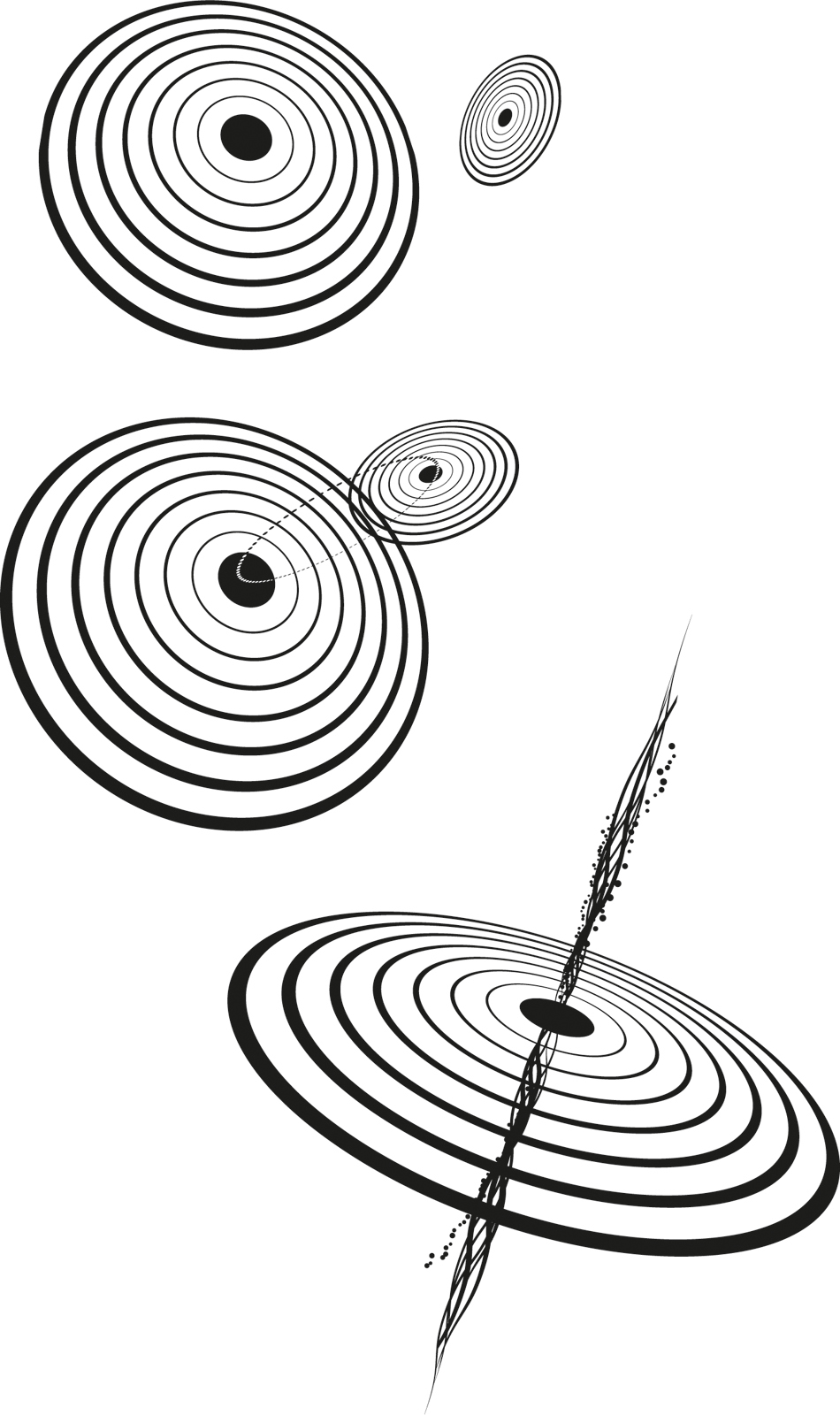
Black holes, surrounded by orbiting discs, merged to become powerful, radiating quasars.
The formation of the first stars
It took perhaps a few hundred million years to make the first stars and galaxies that shone their light out into space – an epoch termed ‘Cosmic Dawn’. Even when stars appeared, however, their light did not penetrate very far into space because it was absorbed by surrounding gas and dust.
The first galaxies were made solely of hydrogen and helium, the only elements made in the Big Bang, so, naturally, their stars were made just of these elements too. One consequence of this chemical purity is that the stars in these galaxies had no planets, certainly not planets like the Earth. Terrestrial planets are made of heavier elements than hydrogen – for example, as we will see later in Chapter 10, the Earth has an iron core: no iron, no Earth. Moreover, all planets have been built up at the start of the planet-building process by sticking solid particles of heavy elements together (see Chapter 9). So, it is likely that a star that is made from pure hydrogen and helium will have no planets whatsoever, not even a jupiter, even though jupiters are predominantly hydrogen and helium.
Another feature of the first stars is that they were more massive and brighter than the stars that are typical now. The temperature and pressure inside a massive star are much higher than inside a less massive one. The nuclear fusion reactor in each star’s core is thus more active, generating more energy. As the energy flows up through the body of the star it pushes upwards due to the phenomenon of radiation pressure. This supports the body of the star against the downward force of gravity and holds the star up, stopping it from collapsing. But if the star is too massive, it generates too much energy. Radiation pressure overcomes the star’s gravitational force and blows the star apart. There is thus an upper limit to the mass of a star.
The exact value of the upper limit to the mass of a star depends on its chemical composition, because atoms of different structures intercept more or less radiation and this changes its upward pressure. The Sun is made of hydrogen and helium with just 2 per cent by mass of the other elements. The maximum mass of a star with the composition of the Sun is calculated to be about 120 solar masses, if the star is to remain stable. If a star has absolutely no elements other than hydrogen and helium, its maximum mass can be considerably higher than even these estimates – several hundred times the mass of the Sun.
These theoretical calculations are given credibility by observations of the most massive stars known. The most massive is R136a1, which is the brightest star in the dense star cluster R136, the central concentration of stars in the larger star cluster NGC 2070 (entry number 2070 in the New General Catalogue). The cluster is part of the Tarantula Nebula complex in the Large Magellanic Cloud (see page 107), which is made of material with half the proportion of heavy metals that the Sun has. R136a1 has a mass variously estimated at 265–315 times the mass of the Sun. There are some other young stars that are temporarily even more massive than this, some way above 300 solar masses, but they are unstable and losing mass, because it is being blown off by the pressure of radiation.
The first stars were likely therefore to have been very massive and as such they had short lives measured in only millions of years: more massive stars burn hydrogen at a fast rate, and even if they have more of it to burn, they use it more quickly, just as a profligate millionaire might go bankrupt more quickly than a poorer, frugal miser. They became red supergiants and then exploded as supernovae: there are few or no stars of this first generation that survive to the present day. As supergiants, they burnt helium to make carbon, which they ejected as dense clouds of dust that cloaked them and their companion stars in dusty, opaque veils.
Supermassive black holes
Stars are not the only source of the light generated in a galaxy. Virtually all galaxies develop at their heart a supermassive black hole. Black holes themselves are black but as material falls towards a black hole, the energy the material loses is radiated in the form of light and other radiation. The birth and early life of supermassive black holes is a factor in the story of the Dark Ages and the Cosmic Dawn.
Within a month or so of learning about Albert Einstein’s general theory of relativity, and even before Einstein formally published it in 1916, the German mathematical physicist Karl Schwarzschild (1873–1916) used it to develop the idea of a black hole. Schwarzschild imagined the following situation: according to general relativity, space curves around a massive body due to the gravitational distortion of spacetime, which causes light to follow curved paths. If a body existed that is sufficiently massive and sufficiently small, then light from the surface of the body might curve so tightly that it might never reach any more than a small distance from the body. The body would then be black, because light would never leave it. The properties of bodies like this were summed up in the name given to them by the American physicist Robert Dicke about 1961 and popularized in 1967 by the theoretical physicist John Wheeler: ‘black hole’.
The surface that divides a black hole from the outside world is called the event horizon (pl. VII). No news about anything that happens inside the event horizon can escape through the event horizon: any material (like a newspaper) or any radiation (like radio waves or light) that might carry news about events is dragged back by the strength of the black hole’s gravity. The event cannot get across the horizon. Just outside the horizon, gravity strongly bends the tracks of light rays from anything that is visible there and its image can escape but is very distorted.
Although their mathematical properties were quite well developed for more than at least half a century after Schwarzschild’s work, black holes remained only a theoretical possibility and had never been observed in nature, so for a long time they were a solution looking for a problem. We now know that nature makes black holes in at least two ways: stellar-mass black holes are produced by supernova explosions (see Chapter 8) and grow by mergers of small black holes into bigger ones; supermassive black holes are produced in the nuclei of nearly all galaxies. There may also be so-called ‘intermediate’ black holes in clusters of stars, produced by a third, unknown way.
Isolated black holes are dark and difficult to see. However, some stellar-sized black holes exist in binary star systems, which can merge to produce gravitational radiation (see Chapter 8). Additionally, if matter (gas) falls into a black hole, it releases gravitational energy, which heats the gas. This can happen if the black hole has a companion star that leaks gas onto it, or if other stars get drawn near the black hole, break up and then fall into it. These two scenarios make some black holes visible as, on the one hand, X-ray binary stars (see Chapter 8) and, on the other, quasars.
When the early stars exploded, they created black holes of a mass comparable to the stars from which they formed, say ten to one hundred times the mass of the Sun. At about the same time, perhaps even earlier, before the first stars formed, a parallel process began to make another form of black hole, so-called supermassive black holes. These can now be as massive as 1 billion solar masses (the most massive known is J0313-1806 at 1.6 billion solar masses). They started off smaller and grew by accumulating more and more mass from the parent galaxy.
How small were supermassive black holes when they first started to grow? That is a mystery. Astronomers used to think that they grew from stellar black holes made by supernovae; where there were many stellar-sized black holes, they merged together to make a bigger black hole, which drew in further black holes. However, astronomers now think that this happens too slowly to have worked in time to make the earliest supermassive black holes. There is evidence that supermassive black holes had come into being only a few hundred million years after the start of the Universe: the oldest-known supermassive black hole, J0313-1806, was in existence just 670 million years after the Big Bang. That is too short a time for 10–100 solar-mass black holes to merge together to grow into a 1-billion-solar-mass black hole – J0313-1806 would have had to start off at 10,000 solar masses.
If mergers of stellar-mass black holes built up supermassive black holes, they must have got off to a good start via some other process. One likely possibility is that gas and thousands or hundreds of thousands of stars in the central regions of a galaxy formed a cloud that was so dense that it collapsed all together into a medium-sized black hole. This black hole was able to grow to be supermassive by drawing in further stars and clouds, and other black holes.
Some astronomers think that such events in the centres of the youngest galaxies were the triggers that provoked the formation of stars generally in galaxies. Of course, we owe our existence to the Sun. If the Sun was a side effect of the formation of a black hole in our Galaxy, we, too, owe our origin to the action of a supermassive black hole.
Whatever process it was by which supermassive black holes form, it caused an immense pile-up in the centre of the parent galaxies. Packed into a small volume, a black hole of 1 billion solar masses has a gravitational effect that makes it impossible for light to leave, hence, of course, the term ‘black hole’.
Quasars
Although supermassive black holes themselves are black, anything that falls down towards the black hole need not be black. If enough material falls, the energy released can be prodigious. Material in the neighbourhood of the black hole is energized and blazes bright in what is called a quasar. Quasars were quickly formed in most – perhaps nearly all – new-born galaxies during the Dark Ages, possibly only millions of years or at most only a few hundred million years after the Big Bang.
The first supermassive black holes drew in the surrounding gas and dust and other smaller stars, converting their gravitational potential energy into radiated energy of various kinds – light, X-rays, radio and so on. Trapped inside the dusty cloak of gas and dust that permeated the parent galaxy, the energy could not escape directly, so at first the Dark Ages remained dark, but the energy warmed the dust in the quasar’s parent galaxy, which then re-radiated it as infrared and other radiation. Emerging from the obscurity of the Dark Ages, infrared-radiating galaxies have been detected by infrared- and microwave-sensitive telescopes. (Infrared radiation has a wavelength between about 1 micron to about 1 millimetre, microwave radiation between 1 millimetre to 1 metre, but there are no distinct dividing lines. Because infrared and microwave radiations are absorbed by water vapour, the performance of telescopes sensitive to these radiations is very limited if they are located in a damp environment. They work best if they are located in the dry air on the tops of high mountains and in Antarctica, or are orbiting in space.)
The first stars and black holes having appeared, they poured energy into their parent galaxy. This not only heated the dust, but also pushed it by radiation pressure. The galaxy’s interstellar clouds of dust and gas dissipated, dispersing into the outer regions of the parent galaxy and surrounding space. This parted the curtains of dust and revealed the galaxy’s stars to the outside Universe and this is the way in which the first galaxies began to end the Dark Ages.
The outflow of energy from stars and black holes in the same galaxies went on to push away material that might be about to fall into the black hole – because the black hole ate so much, it stopped itself feeding. This process is called feedback. The quasar having switched off, however, the gas and dust may then have started to fall back into the galaxy, perhaps accelerated towards the centre of the galaxy and into the black hole by the near passage of another galaxy. This alternation of feast or famine developed into a cycle in a typical galaxy in which its quasar and the formation of new stars switched on and off, alternating every few billion years – but the Dark Ages had ended.
Galaxies that host supermassive black holes reveal themselves in a number of guises. The first type was identified in 1943 by American astronomer Carl Seyfert (1911–1960), at the time a research fellow at the Mount Wilson Observatory in California, although it took decades for their extraordinary nature to emerge. Seyfert noticed their unusually bright nuclei and that they have strong emission lines in their spectra coming from gas that was, in some cases, moving very quickly. The gas was in orbit around something very massive. At the time, the galaxies were enough of an unexplained curiosity to be given a distinctive name: Seyfert galaxies.
In the next development, radio astronomers discovered that some galaxies emit radio waves – the first recorded radio galaxy is on Grote Reber’s 1939 radio map of the sky (see page 109). On the map it was confused with the structure of the Milky Way in the constellation of Cygnus and was not at first recognized as a separate feature. In 1946, British physicist J. S. Hey and his colleagues used war-surplus radar equipment to study this source. They named it Cygnus A, the strongest celestial radio source in that constellation. The source was very small and some astronomers thought that it was a new kind of ‘radio star’. Others, including cosmologists Austrian-born Thomas Gold and British Fred Hoyle (see page 269), argued that it was not a star, it was outside the Milky Way and some sort of galaxy in its own right. Some years later, they were proved right.
In 1951, University of Cambridge radio-astronomer Sir Francis Graham-Smith (b. 1923) measured the radio position of Cygnus A accurately enough to make it worthwhile to try to find out what was at the same place in the visible sky. The quickest way he could communicate to his colleagues in California, where there were the largest telescopes, was by airmail. German-American astronomer Walter Baade (see page 122) at Caltech took pictures at that position in April 1952 with the 200-inch Hale telescope on Mount Palomar: ‘There were galaxies all over the plate, more than two hundred of them, and the brightest was at the centre. It showed signs of tidal distortion, gravitational pull between the two nuclei – I had never seen anything like it before. It was so much on my mind that while I was driving home for supper, I had to stop the car and think.’ Baade concluded that Cygnus A was two galaxies in collision.
Discussing his discovery with a sceptical colleague, Ralph Minkowski, Baade bet him that the spectrum of Cygnus A would have spectral emission lines from gas made highly energetic through the collision. The stake for the bet was a bottle of whisky. Minkowski soon took the spectrum with the Palomar telescope, found that Cygnus A did indeed have emission lines and conceded the bet. He need not have proffered the whisky, since the emission lines come not from a collision between galaxies but from gas interacting with a massive black hole, but the whisky was long gone by the time that was clear and he did not get the bottle back.
In the decade following the Second World War, radio astronomy technology improved rapidly and University of Cambridge radio astronomer Martin Ryle invented the powerful kind of radio interferometer for which he received the Nobel Prize in 1974 (see page 22). From 1953 onwards his telescopes were used to make radio surveys of the sky and discovered vast numbers (several thousands) of sources. The sources were distributed evenly all over the sky, so were not likely to be something in our Galaxy; they proved to be galaxies that emit radio waves. One comprehensive and accurate catalogue was published in 1959: sources listed in it received the designation 3C (the third such catalogue made in Cambridge).
The seventh-strongest source in the 3C catalogue had the number 3C273. ‘Strong’ could indicate that the source was relatively nearby, and if it was a galaxy, as understood up to then, it would be readily visible in sky pictures, but there was no obvious galaxy in the same direction. To be more definite it was necessary to determine the position of the radio source even better than Ryle’s telescopes could determine. This became possible because of a piece of luck: from time to time the Moon passes in front of 3C273. British radio astronomer Cyril Hazard used the newly built Parkes radio telescope in Australia to watch a series of such occultations in 1962. He was able to pin down its position by plotting the leading and trailing edges of the Moon at the moment that 3C273 disappeared and reappeared – the source was where the two edges intersected. A number of people noticed that the radio source was near to what looked like an unremarkable star; American astronomer Tom Matthews at Caltech was the first to nail down the position and prove the coincidence. The similarity between the radio source and an ordinary star gave rise to the technical names Quasi-Stellar Object or Quasi-Stellar Radio Source for this kind of astronomical object. The name was a mouthful and came to be abbreviated as ‘quasar’.
At first no one could credit that the star was really responsible for the radio emission. But Caltech Dutch-American astronomer Maarten Schmidt (b. 1929) was minded to take a spectrum of the ‘star’, in order to eliminate it. What he found showed how important it is in science to be methodical and comprehensive and not jump to a conclusion. The star was very bright for the 200-inch telescope and his first attempt was overexposed. He persevered and discovered from a second attempt that 3C273 was not an ordinary star. It had spectral lines in emission, indicating hot gas was present. There was some energetic process going on and that could be why the ‘star’ was a radio source. Trying to be more specific, Schmidt attempted to identify the emission lines in order to figure out what might be happening. The emission lines did not match with anything he had seen before, though he tried several different sorts of explanations. Nor could they be identified by other world experts to whom Schmidt showed the spectrum.
Collaborating with Hazard in writing up all the work on 3C273, Schmidt tried to systematize the wavelengths of the lines in a diagram and suddenly noticed that four of them formed a progression that reminded him of the spectrum of hydrogen – but with the wavelengths redshifted by a huge factor. When he applied the same factor to the other spectral lines, their identification made immediate sense. It all worked out if the spectral lines were redshifted by an unprecedented large amount.
The largest redshifts in astronomy are the result of the expansion of the Universe. If that was the origin of the redshift, 3C273 was receding at record-breaking speed. Schmidt had discovered that 3C273 was not a star, but a galaxy at a huge distance. To look like a nearby star but in fact be at such a distance, 3C273 was radiating energy at a power never before seen. Schmidt had solved one problem by identifying 3C273 but generated another: what was the source of such a power? And that was not all, there was a further problem to come.
On photographs, 3C273 was very small – star-like – but it proved also to be very small in reality. This became apparent in 1963 when American astronomers Harlan Smith (1924–1991) and Dorrit Hoffleit (1907–2007) looked back through the archive of sky photographs at the Harvard College Observatory and discovered that the ‘star’ that was coincident with 3C273 varied by large amounts on a timescale of years. This meant that it could only be at most light years in dimension, contrasted with the size of a normal galaxy, which is many tens of thousands of light years in size.
Incredibly bright, incredibly distant, incredibly small – it took something incredible to provide an explanation, and it is that quasars are supermassive black holes. Supermassive is not an exaggeration: the most massive black holes in the centres of galaxies have masses of billions of times the mass of the Sun.
Quasars are bright because their black hole is a kind of an engine that turns stars and gas that fall in into light radiation. The light radiation heats up gas and dust that surrounds the black hole. The nearest material to the black hole, in orbit around it in a disc whose size is comparable to the size of the solar system, is gradually spiralling down into the black hole. It gets heated so much that it emits X-rays: many of the ‘stars’ seen by X-ray telescopes in space are in fact quasars. The power output of quasars is so huge that they can be seen at vast distances. Modern surveys of quasars look out into a huge volume of space: they have identified hundreds of thousands. In 2020, a catalogue compiled with the Gaia space satellite data (see pages 100–102) listed more than 1.6 million. A map of quasars is effectively a map of the Universe out to its most distant parts. Powerful and ubiquitous, quasars initiated Cosmic Dawn and continue to control the Universe.
Colliding galaxies
Brief outbursts from black holes may be individual chance events that are caused by a particular star or gas cloud that ventured too close, the origins of that event usually lost in the mists of the past. There are also larger, more frequent and longer-lasting outbursts when the black hole is repeatedly feasting. They can be triggered by a close encounter between a galaxy and another one that passes by. It may even be that two galaxies collide, which not only wakes up the supermassive black hole in each but causes a starburst in which each galaxy lights up with newly formed, bright stars. Supermassive black holes awakened and bright stars were born: Cosmic Dawn got well under way (see page 82).
As described in Chapter 3, the cosmic web is made of empty voids, but these are surrounded by filaments and clusters, where the galaxies are crowded together. If everything was spread out evenly, galaxies would seldom collide, but because there are extra-dense regions in the cosmic web, galaxies sometimes do collide. The stars in the galaxies are rather small compared to the distances that separate them, so the stars themselves collide only occasionally, the galaxies passing through each other without touching, like marching bandsmen on parade. But, unlike bandsmen, the stars do attract each other by a mutual force of gravity. As the collision proceeds, the galaxies become disturbed in shape. Some stars even get flung out of their parent galaxy, coursing into lonely intergalactic space.
It is interesting to imagine what you would see if you lived on a planet orbiting a star in one of the colliding galaxies. The collision would take place over hundreds of millions of years so it doesn’t seem possible that any single individual would comprehend the whole event. It would start with the approaching galaxy looming in a segment of the night sky separated from the normal milky way visible to the planet’s inhabitants. Our Milky Way stretches on a great circle around the galactic equator, but the milky way in a colliding galaxy would twist and loop, drawn into a distorted shape across the night sky by the pull of the oncoming intruder. Mid-collision, the entire sky would be bright with stars, obscuring the more distant galaxies. If one’s own star suffered the indignity of being ejected from its home galaxy, you would look back to see both galaxies gather together in that part of the sky and gradually recede. The night sky would darken and become free of stars. You would be alone in the dark of intergalactic space for the rest of eternity.
Depending on the circumstances of a collision of two galaxies, they might ‘stick’ together, and they might merge. The way by which this happens is somewhat similar to the way that brakes work on a car. Just as brakes turn the kinetic energy of the car into heat and stop its motion, so the collision between two galaxies might ‘heat’ their stars – not by making them individually hotter, but by making them collectively move faster. With the extra speed, the stars can penetrate further in their orbits from their parent galaxy – each galaxy expands. It is not a tidy expansion because the collision would cause the stars to slosh about. Surges of stars make tidal waves in the outer parts of their galaxy. The tidal surges look like shells.
Galaxy collisions are the way that galaxies grow over time. The Hubble Space Telescope set out to investigate how that growth took place. It made deep exposures of two or three areas in the sky, where there were neither stars nor any galaxies known up to that time, to investigate the faintest galaxies that it could see. In astronomy, in general, fainter means further, which in turn means older, so the galaxies that it discovered were very far away, and back a long time ago, close to the time of the Big Bang. These exposures are collectively known as the Hubble Deep Fields (pl. II). They found that, indeed, early in the life of the Universe, galaxies were smaller and more numerous than now. The galaxies had been pictured emerging from the Dark Ages up to half a billion years after the Big Bang. Because they were more numerous than now, they collided more readily and often showed as more disturbed in shape, with tails and arcs of stars at the point of being flung into space. Over the lifetime of the Universe, irregular galaxies like these have merged and settled down to form the larger, more regular galaxies that we see around us now.
Collisions between galaxies not only cause galaxies to merge and get larger, they may be transformational, changing the galaxies’ appearance and subsequent history. If a small galaxy collides with a large one, it is called a minor collision. Such a collision 5 billion years ago had, for us, the momentous consequence to conceive our Sun: see pages 105 and 124). However, the small galaxy did not cause much of a disturbance and it was absorbed by the large one without too much drama. On the other hand, if two big galaxies undergo a major collision, it can be transformational, changing the entire nature of the galaxies – for example, spiral galaxies can be transformed into elliptical ones. This is something that will happen to our Galaxy in the future – it will become part of an elliptical galaxy.
There are broadly two kinds of galaxies. Some are flat, rotating systems with spiral arms, like ours. They are the result of the collapse of a slowly rotating intergalactic cloud of hydrogen gas. The cloud rotates faster as it gets smaller and centrifugal force spins the cloud into a flat disc, in which spiral arms appear. This process creates a spiral galaxy.
The beauty of spiral galaxies does not survive in the close company of another. Consider two spirals that rotate about axes that are inclined at a large angle to each other and that are set on a collision course. The first thing that happens as the galaxies approach each other is that their spiral arms are pulled out and the galaxies make grotesque shapes. Then the gas in the two galaxies crashes together and makes especially dense regions. These regions make stars. Because the crash is quick, the combined galaxy shows brightly, with a burst of star formation, using up all the gas. Over time, the two galaxies merge and the stars of which they are made get muddled up. They have no particular way in which they can go, so the merged galaxy does not know which way it should rotate. It loses any spiral galaxy characteristics and develops into an elliptical galaxy. ‘Elliptical’ refers to its appearance in a two-dimensional picture. It is really a three-dimensional shape, something like a ball. Perhaps it is spherical, but more likely it is ellipsoidal: the shape of a rugby football (a prolate spheroid), or flattened at the poles like the planet Earth (an oblate spheroid). Or perhaps it is even more strangely shaped and has no rotational symmetry at all: it is a tri-axial ellipsoid.
There is more of a chance that galaxies collide if they are in a crowded region. Spiral galaxies that formed in such regions have likely collided already and so, nowadays, elliptical galaxies are more common in clusters of galaxies. The outer regions of clusters and the filaments of the cosmic web are not as crowded, so spirals are more common in these regions of space.
Collisions might be the main way that galaxies grow and evolve but that process, as we understand it, does not explain all galaxies. There are some abnormally massive elliptical galaxies in the central parts of clusters that are difficult to explain as the result of mergers. They seem to be related to galaxies hidden in the Dark Ages that have been discovered by NASA’s Spitzer Space Telescope and by the Atacama Large Millimeter/submillimeter Array (ALMA) telescope in Chile (see page 184). Spitzer identified a number of faint galaxies that are not seen with the Hubble Space Telescope’s most in-depth view of the Universe, 10 billion light years away, and ALMA was able to study half of them in further detail. ALMA confirmed that they are massive, star-forming galaxies that are producing stars one hundred times more efficiently than the Milky Way. These galaxies are representative of the majority of massive galaxies in the Universe 10 billion years ago, most of which have so far been missed. They are unexpectedly abundant, their numbers well exceeding predictions from theoretical simulations. They assembled during the first billion years of the Universe. It has so far proved impossible to explain how such big galaxies were formed so fast.
Starbursts and quasar outbursts
Collisions between galaxies cause the galaxies to get brighter. This moved the life of the Universe on from the Dark Ages towards the Cosmic Dawn.
During the mergers of galaxies, stars do not collide because they are small and well separated, but clouds of interstellar gas are bigger and do. Gas at the collision interface is squashed. In especially dense regions, gas in the cloud collapses to form stars. If in an image we catch two galaxies colliding, the new stars show as clusters of stars that are bright, hot and blue, with the surrounding gas excited by ultraviolet starlight glowing brightly as a jumble of nebulae. Such an event is known as a starburst (pl. VI). Looking across the whole population of stars in a galaxy, astronomers can identify epochs when starbursts happened, each one triggered by a succession of collisions. The life of a galaxy and its stars is marked by these active episodes.
Shortly after each starburst – perhaps tens of thousands to millions of years after – the newly born stars begin to explode as supernovae, so there is a sudden wave of supernova explosions. There might be as many as one hundred times more supernovae than usual – one per year in a galaxy rather than one per century.
The stars that explode as supernovae are well developed in their evolution and have progressed beyond the burning of hydrogen to helium. They have been burning helium to carbon, carbon to oxygen, oxygen to neon, and so on to magnesium, silicon, sulphur, argon, calcium and iron. The explosion spreads these elements into space where some condense to make dust particles – graphite particles of carbon, sand-like material made of silicate compounds with silicon and oxygen, iron particles and so on. The dust made in the early colliding galaxies was formed in abundance because the first stars were large, evolved rapidly and made lots of the relevant elements before exploding as supernovae. The dust cloaked the light and heat from the remaining stars. It absorbed the light energy and so it became hotter. It emitted infrared radiation, which can be detected by infrared-sensitive telescopes. Microwave radiation with wavelengths in the millimetre range also carries heat from warm things like dust grains: millimetre-wavelength radiation like this can be detected by the ALMA telescope in Chile. ALMA has been able to detect galaxies densely covered by dust so opaque that they cannot be seen at all by the Hubble Space Telescope.
Another effect of the collisions is that the motion of stars and gas in each galaxy is disturbed. Stars and gas no longer orbit the centre of their galaxies in near-circles and the galaxy loses its circular symmetry. If it is a spiral galaxy, it may develop a central ‘bar’ of stars, with its spiral arms starting at each end of the bar (see page 103). Individual stars and streams of gas become redirected into orbits not only around the galaxy in circles but also passing in and out of the galaxy. This raises the possibility that they will pass near to the galaxy’s central supermassive black hole. The pull of the black hole on the nearer side of a star is greater than on the far side and is a tidal force (see page 113). The star may disrupt and its material will join back into the interstellar gas stream flowing onto the black hole.
Black holes do not mind what they eat to make a quasar. Like lions and crocodiles in the Serengeti Park in Tanzania waiting for the tide of wildebeest, impala and zebra on their annual migration, they gorge on anything, usually gas and dust, but ‘spaghettified’ stars (see page 113) are tasty, too. If such a star drops onto a black hole at the centre of a galaxy, more mass than usual flows towards the quasar in a process called accretion. The flow may often be so great that the black hole cannot swallow it all at once and the material from the disrupted star circles round the black hole in an accretion disc, gradually leaking through onto the black hole itself. The increased mass flow onto the black hole causes the quasar to brighten. The brightening is episodic as extra-big lumps drop into the accretion disc and then into the black hole, so there are short outbursts as well as an overall longer increase of power output. The effects become visible as a bright flaring quasar.
If not all, then nearly all galaxies have a central supermassive black hole. If two galaxies merge, the merged galaxy has two black holes. There are some galaxies, such as NGC 6240, that have a double nucleus, a bright spot of radiated energy coming from two black holes, each drawing in surrounding material. The supermassive black holes are separately eating gas and stars.
In further interactions with the stars and the other black hole, each black hole approaches the other, dining together in close company, then they eat each other. The two black holes gravitate together and orbit each other making a binary black hole pair, stirring up and consuming gas and stars that wander nearby. As they orbit, they radiate gravitational waves. The black hole binary system loses energy and its orbit speeds up, causing gravitational radiation at an increasing power. This lasts for tens or hundreds of millions of years, with the two black holes drawing ever closer.
There is a quasar, OJ 287, which seems to have reached this state. For the last 130 years at least, it has been giving a double burst of light every 11–12 years. One interpretation of what is going on in OJ 287 is that it is a binary black hole pair, so close together that they appear to us as one bright nucleus in a much fainter, merged galaxy. The orbital period of the smaller one around the larger one is twelve years. Twice per orbit the smaller smashes through the accretion disc around the larger, the collision and the brief meal making a double flash.
Eventually the two black holes get so close that they merge in a frenzied, but silent, crescendo of gravitational wave energy. After a very long build-up, the final merger is quick, with prodigious amounts of energy, radiated in a brief burst. The burst could be detectable from right across the Universe, given the right gravitational wave detector. Like radio antennas, gravitational wave detectors are of different sizes according to the frequency range at which they operate: small antennas are sensitive to short waves, namely those of high frequency. Terrestrial gravitational wave detectors like LIGO (see page 172) operate at the wrong frequency range to pick up merging supermassive black holes because the detectors are too small (less than the size of the Earth). Detectors in space can be much bigger (as described on pages 265–66, the space-borne gravitational wave detector eLISA is planned to be six times as big as the Earth–Moon distance) and will be able to see these events.
It seems likely that events from merging supermassive black holes will also produce other forms of radiation, like X-rays and radio waves. The gravitational waves themselves scarcely interact with matter, and little of their energy is directly converted via matter into light and radio waves. However, matter accreting onto the black holes is violently disturbed and radiates in a way that is correlated with the gravitational waves. With attention drawn to a merger event by detection of the gravitational waves, together with some information about the direction from which it comes, derived from the orientation of the detector, astronomers may be able to track the event down to the galaxy in which it appears. Of course, if the galaxy is already recognized to contain two black holes it will be easier to do this. For OJ 287, one theory predicts that the ultimate merger will happen in about ten thousand years, so there is no urgency to get ready. eLISA could well detect between ten and one hundred mergers of supermassive black holes per year, out to a distance of 12 billion light years, with in addition 10 per cent of them detected as X-ray and radio sources. These events provide opportunities for wonderful multi-messenger astronomical investigations that the eLISA scientific teams are planning (see Chapter 13).
Extra energy is liberated by the collision, by the newly born bright blue stars in the starburst, by the supernovae that they make, by the quasar outbursts and by black hole mergers. It is considerably more than normal starlight. It has a profound long-term effect on the development of the merged galaxy that is the outcome from the collision.
Cosmic Dawn
In 1965, soon after Maarten Schmidt had identified the first-known quasar, he gave a talk at Caltech about them. Whatever they were, Schmidt described why the quasars had an enormous redshift and were therefore at prodigious distances in the Universe. This made it possible for astronomers to use them as probes to investigate the intergalactic space across which their light had travelled. There were two PhD students in the audience who noticed something about Schmidt’s data that had been overlooked because it was something that was not present in the spectra, rather than something that was. The two students were Jim Gunn (see also page 53) and Bruce Peterson.
Gunn and Peterson saw that short-wavelength ultraviolet light was abundant in the spectra, without any sign that it was being absorbed. Ultraviolet light with a wavelength less than 1,216 angstroms is very readily absorbed by hydrogen atoms and the Universe is full of hydrogen. (An angstrom is a unit of length, conventionally used to measure the wavelength of light, ultraviolet light and X-rays. Named after a Swedish physicist, it is exactly the same as one-ten-billionth of a metre.) Why was the hydrogen that lies between us and the quasar not absorbing the ultraviolet light? It would not be a subtle effect in the spectra of quasars: all the short-wavelength ultraviolet light ought to be absorbed. This analysis came to be known as the Gunn-Peterson effect. It does not often happen that two students yet to be awarded a PhD discover an important scientific effect and have it named after them.
The importance of the effect is that it shows us the state at the present time of the most abundant material in intergalactic space – in fact, in the Universe. As Gunn and Peterson concluded, the likely resolution of the problem is that the hydrogen in intergalactic space is not mainly in the form of hydrogen atoms. The hydrogen atoms have been ionized into their components: electrons and protons. Estimates are that, typically, currently there are fewer than one neutral hydrogen atom in intergalactic gas clouds for every ten thousand free-floating protons, each matched with one buzzing electron.
Even at this low density, the neutral hydrogen atoms do show some effects on quasar spectra, which became apparent as the quality of the available spectra improved. Individual spectral lines, designated as Lyman-alpha, show up in the light of the quasar, imprinted as the light from the quasar travels, through cloud after cloud, to us. The spectral lines appear at the range of wavelengths that correspond to the redshift of the clouds, in the line of sight one after another. The rays of light from the quasar pass through the clouds, threading through them, just as a skewer pushes through meat cubes in a kebab. In distant quasars the spectral lines are so numerous that they look like rows of trees and are referred to as the Lyman-alpha forest. They constitute a demonstration that intergalactic space is full of hydrogen gas clouds. These clouds are the primary constituent of the Universe. Stars, galaxies and quasars get more attention only because they shine brightly and call attention to themselves with louder voices. The Lyman-alpha forest is related conceptually to the Gunn-Peterson effect: the effect is what happens when the Lyman-alpha forest is very dense.
The hydrogen in the Universe at the time of the Big Bang was ionized and as the Universe cooled, it combined into atoms, a process that was completed after several hundred thousand years. The atoms persisted into the Dark Ages. Nowadays, according to the Gunn-Peterson effect, the atoms are broken up again into ions. When did this occur? The question is framed in astronomy as ‘When was the epoch of reionization?’ and does not have a precise answer. Like the dawn of a winter’s morning, Cosmic Dawn developed slowly, at first revealing formless shapes (dust-shrouded galaxies) and then recognizable features of the astronomical landscape (bright galaxies and quasars).
The question can be addressed by looking for the Gunn-Peterson effect in quasars at progressively greater and greater distances, looking back in time into the Dark Ages. Only a few cases have been discovered. They suggest that reionization started when the Universe was about 300 million years old and was complete by about 800 million years.
A similar story emerges from the statistics of the furthest galaxies known. The most distant galaxy as I write is GN-z11 (although there are other contestants for this title, where the evidence is generally regarded as less definite). GN-z11 was found by the Hubble Space Telescope using its infrared capabilities. The galaxy is much smaller than the Milky Way but is very bright for its size because it is forming stars at a great rate and the stars are bright (because they are made of pure hydrogen and helium).
Because it is the most distant galaxy, GN-z11 is the galaxy recorded soonest after the Big Bang, seen as it was when the Universe was 400 million years old. Over the next few hundred million years the clouds of dust that hid younger galaxies gradually dissipated further, the stars emerging into view from within, and Cosmic Dawn was fully achieved some hundreds of millions of years later, ending the Dark Ages. The clearing of the dust also revealed the earliest supermassive black holes shining as quasars. The most distant quasar known at the time of writing was discovered in January 2021 and is called J0313-1806. We see it as it was 670 million years after the Big Bang, just emerging from the Dark Ages into the Cosmic Dawn.
It may well be possible to observe directly the appearance and then disappearance of neutral hydrogen in intergalactic space over the epoch of reionization. Neutral hydrogen has a characteristic spectral line at a wavelength of 21 centimetres, equivalent to a frequency of 1,420 megacycles per second (MHz). Radio telescopes looking back into the distant cosmological past have to tune to a much longer wavelength (lower frequencies) to detect this spectral line. The Experiment to Detect the Global Epoch of Reionization Signature (EDGES), led by American cosmologist Judd Bowman of Arizona State University, is a small ground-based radio telescope located in a radio quiet zone in the Murchison Radio-astronomy Observatory in Western Australia. It looks at the sky as it passes overhead, and it has to tune to radio frequencies of 50–100 MHz (wavelengths of 6.0–3.0 metres) to see 21-centimetre radio waves from neutral hydrogen at the right time in the past. At the longest wavelengths (biggest redshifts) it sees no signal from cosmological neutral hydrogen. As it tunes in towards the reionization, it sees the signal from neutral hydrogen turn on as the Universe cooled, and then turn off as the proportion of neutral hydrogen diminishes again in the reionization.
According to first results from EDGES, published late in 2019, the first light of Cosmic Dawn happened 250 million years after the Big Bang. This estimate for the time of Cosmic Dawn is a bit discordant with other methods and more work will be needed to come to a consensus that reconciles all the different methodologies and whatever it is, precisely, that each one measures.
Cosmic Noon: when the Universe was brightest
Cosmic Dawn, the epoch of reionization, started when the Universe was about 300 million years old and was completed mostly by 600 million years, certainly by 800 million years old or so. Since then, the Universe has been, in overall appearance, the Universe that we see until today: a universe of galaxies, shining into clouds of ionized hydrogen. What happened to the Universe after Cosmic Dawn was the equivalent of a human being growing up – a childhood and adolescence, followed by a longer period in which the Universe was the equivalent of a mature and ageing adult, which is the time in which we now live.
The entirety of the history of star formation in the Universe was first elucidated successfully by the Italian astrophysicist Piero Madau in 1996. After Cosmic Dawn, the rate at which stars are born became more and more frequent. The birth of new stars in the Universe reached its maximum rate at 3.5 billion years after the Big Bang: sometimes this epoch, when the Universe of galaxies was at its most mature, is referred to as ‘Cosmic Noon’. From Cosmic Dawn to Cosmic Noon, galaxies on average got larger and brighter, with numerous brilliant stars and glowing nebulae. The Universe was at its brightest, aglow with light.
Since Cosmic Noon, starbirths have become less and less frequent, halving every 2.6 billion years as the cosmic afternoon has progressed. As the older stars fade away, there are fewer stars to replace them. As a result, on average, galaxies are becoming fainter. The majority of brilliant, young blue stars that shone into intergalactic space and caused the nebulae of their host galaxy to glow have died in increasing numbers. They are being transformed into fainter red stars, with no new generation of stars to replace them. The reason for this change is that star formation has been diminished by feedback mechanisms, the energy radiated by supermassive black holes and supernovae dispersing interstellar hydrogen gas (see pages 118–19), which, in any case, is less abundant, having been depleted by being used up by earlier stars. At the present time, galaxies are more likely than before to be quenched or starved.
As a result, galaxies are becoming redder and deader. At present, the stellar birth rate on average in the Universe has fallen to one-tenth of the value it had at maximum, and will fall further. After 100 million million years have passed, no more stars will form. Cosmic Dawn was followed by Cosmic Noon and the cosmic afternoon will be followed by cosmic night. The present and likely future states of the Universe are clear, because it is relatively easy to study the Universe nearby: it is gradually fading away, ageing gracefully. It is on its inevitable trajectory towards darkness and cold.
It is more difficult to look back to see the detail of the time when stars first formed, and beyond that to see into the Dark Ages. It will take new telescopes, like the James Webb Space Telescope, which is optimized to record infrared radiation, to clarify the situation and address the issue further. Its work will be supported by specialist radio telescopes currently under construction like the Square Kilometre Array (SKA) and gigantic optical telescopes, such as the European Southern Observatory’s Extremely Large Telescope (ELT), and a couple of slightly smaller telescopes operated by American agencies. They will look into the Dark Ages, enabling astronomers to view the Universe during its childhood.