
5
Why does our Galaxy look the way it does? Determining this is akin to discerning the history of an archaeological site. The basic data are the locations, motions and ages of the stars from which the Galaxy is made, some of which show subtleties that indicate their alien origin. Like archaeological finds, they indicate how the site developed, through a succession of collisions and mergers, much as an army might have invaded a historical location, leading to the assimilation and naturalization of the civilian population that migrated after them.
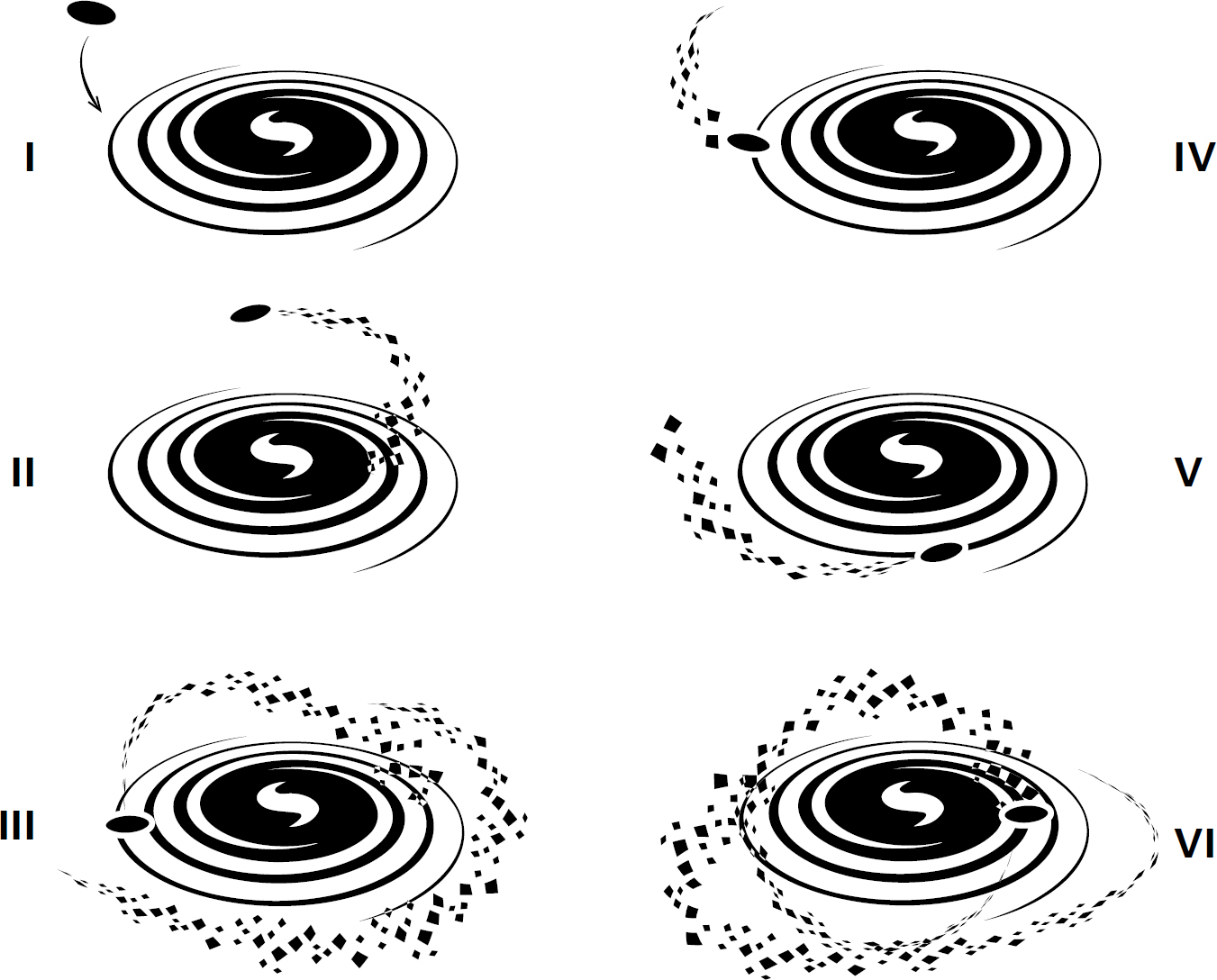
Galaxies merged, building each other up in a hierarchy to progressively bigger sizes. The galaxies that orbited and then merged with our own Galaxy left trails of their alien stars.
The birth of our Galaxy
The Milky Way Galaxy is our galaxy of stars, including our Sun. It is common to call it simply ‘the Galaxy’, with a capital letter. Although it is clear that the Galaxy is very old, it has been surprisingly difficult to say accurately how old it is. The way that this has been attempted historically is to track down the oldest stars in it: the Galaxy must be at least as old as them. One problem with this method is that, even if you find an old star, you do not know whether there are stars somewhere else in the Galaxy that are older, or whether the star is an interloper having dropped into the Galaxy from outside. However, most of the mergers of other galaxies with our own Galaxy took place early on in its history, so that finding such stars is a promising way to address the problem. A separate but even more difficult issue that immediately follows the discovery of an old star is that the various ways that the ages of stars are estimated are not very precise.
The stars that are easiest to study in detail in an attempt to determine their age are the brightest ones – the ones we see in the night sky. Being bright, they are by and large the nearer ones. They live in the same neighbourhood as our Sun, meaning that they live in the galactic disc. Disc stars are predominantly young. It takes astronomers quite an effort to pick out the few old stars that are coursing through them. In general, the stars of the more distant galactic halo are the remnants of galaxies that merged with our own Galaxy billions of years ago and which have disintegrated. That is the least confusing place to seek out the oldest stars.
The galactic halo is where globular clusters of stars live. By contrast with individual stars, globular clusters are among the most readily recognizable objects in the Milky Way. They are dense clusters of perhaps hundreds of thousands of stars, which are fossils that hark back to the Galaxy’s early history. Globular clusters are so called because they are almost spherical. They look like small galaxies, which in a way they are. They contain many stars and they are often at great distances, on the far reaches of the Galaxy, almost in intergalactic space. One is so well populated with stars that even though it is not at all the nearest, it is the brightest. At 15,800 light years, it is so distant, and therefore appears so small, that it is usual for anyone with normal eyesight but no telescope to see it as a star. Accordingly, it was originally given a name appropriate to a star: Omega Centauri.
Omega Centauri is a stunning sight in any telescope, the finest globular cluster in the sky. It is not usually permitted to use an expensive, large telescope for something as frivolous as stargazing but once, waiting for some problem to be fixed so that I could get on with my scientific programme, I looked at Omega Centauri for purposes of astro-tourism with the 4-metre (150-inch) Anglo-Australian Telescope. I took the detector off the telescope’s camera and, seated in the observing chair, I looked at the cluster’s stars hovering in the focal plane of the camera, over my knees. They were suspended in space, as they would be if one could cruise past them in an interstellar spacecraft. Small tremulations of the atmosphere caused the impression that they were alive, that I was really close to the cluster. I could readily pick out stars of different colours, particularly the bright, red giants. It was a mesmerizing, breathtaking sight.
Since they are so old, globular clusters evidently persist for a long time, but they do not last forever. The dense inner regions are tightly packed and do indeed last for eons. However, stars in the outer regions are less strongly bound to the globular cluster by its gravitational force and they may wander off as the cluster orbits around and through the Galaxy, subjected to random disturbances. Omega Centauri is a glorious sight now but it was even more glorious before it lost its outer fringe of stars, like Samson’s hair before Delilah cut his locks off.
Some of Omega Centauri’s lost stars have been identified mingling with our own Galaxy’s stars – 309 of them flow in a stream called Fimbulthul (named for one of the eleven rivers that, in Norse mythology, flowed through the primordial void). The trail of stars arcs over 18 degrees in the sky in orbits that take them as close as 5,000 light years to the centre of the Galaxy and as far as 21,300 light years from it. Their orbits follow that of Omega Centauri. It seems likely that Omega Centauri is the central, densest part of a dwarf galaxy that has fallen into our own Galaxy and is shedding its stars in the Fimbulthul stream. Omega Centauri is thus not native to our Galaxy, it is an immigrant that settled here.
The age of globular clusters can be estimated by analysing the old stars that they contain. Some of these stars are so-called white dwarfs. Most stars that have completed their lives die by becoming small, faint white dwarfs (see Chapter 8), which are at first hot (white hot – this is the origin of their name). They then cool by emitting radiation – not only light and heat but also neutrinos. The temperature of the white dwarfs gradually drops. I have seen it portrayed in western movies, and I suppose it is true, that a Native American scout can estimate when a campfire was abandoned by feeling the temperature of the dying embers. In the same way, the age of a white dwarf can be estimated from the temperature of its surface. White dwarfs are being made throughout the history of a given globular cluster, and the age of the coolest white dwarf in a cluster is a lower limit to the cluster’s age. Exploiting the logic of this story, in 2004 Canadian astronomer Harvey Richer estimated the age of the globular cluster M 4 as 12.7 billion years, give or take 700 million years.
Another way to estimate the age of a globular cluster is to fit theoretical calculations of the evolution of stars to the pattern of the brightness and temperature of the cluster’s stars. This gives a range of ages for a number of globular clusters. They have quite a spread, with a likely value for the oldest cluster of 12.6 billion years.
Although it is difficult to find in the Milky Way a very old star that is drifting among all the others without signalling its age by being a member of a globular cluster, the way to do this is to survey the spectrum of lots of stars using a quick technique to pick out the metal-poor ones. ‘Metal-poor’ means that they have rather small amounts of those elements that have been made progressively throughout the life of the Universe by generation after generation of earlier stars. It has in recent times become possible to do this by making rapid surveys of millions or even hundreds of millions of stars using automated telescopes. This produces lots of data but, with techniques that have fed into more general computer analyses of Big Data used for forecasting in industry and politics, the field can be narrowed to a short list of the oldest-looking stars. More detailed studies confirm which ones really are very old – this is a time-consuming process: you have to kiss a lot of frogs before one turns out to be the prince that you are hoping to find. The oldest found in this way is the star 2MASS J18082002-5104378 B. The complicated designation hints that this star is one of many that are superficially similar but that proved to be an exceptional, although tiny, ultra-metal-poor star born about 13.5 billion years ago.
Another way to determine the age of stars that can in principle be very precise is to look at elements like thorium (Th) and uranium (U) to see how much of each a star contains. These two are long-lived radioactive elements, which gradually decrease with time at a very precisely calibrated rate. The amount that stars contain, compared to the amount expected by looking at every other element that they have, shows how much time has passed. Although this does not carry the uncertainties of theoretical calculations, the method does suffer from the problem that measuring the quantity of suitable elements in the spectrum of a star is difficult because there is usually not much of them there. However, Th-232 and U-238 are the two useful radioactive elements for this purpose because they take a time to decay that is comparable to the age of the Galaxy and leave relatively large traces of their presence in the stellar spectrum. Th-232 has a half-life of 14.05 billion years and U-238, 4.468 billion years. The process of working out when astronomical things happened using nuclear techniques is called nucleocosmochronology. Applying this polysyllabic method to the star CS 31082-001 yielded a value for its age of about 12.5 plus or minus 3 billion years, and the age of BD +17° 3248 came in at 13.8 plus or minus 4 billion years.
All these figures for the age of the Galaxy are uncertain and somewhat difficult to reconcile and astronomers still have more to do to be able to be clear about this topic. But the bottom line is: our Galaxy is indeed very old, having been born, probably, about 13 billion years ago. This was within the first half a billion to a billion years of the Universe, towards the end of the Dark Ages.
The shape of our Galaxy
The Galaxy formed from a gas cloud within which the oldest of its stars were condensing, and took up a distinctive spiral shape. It was not easy to determine the shape of our Galaxy because we are inside it and cannot view its overall structure, but here is how it was done.
As I look out from the upstairs study of my house through a window, I can see some of the city in which I live. Other houses are spread out horizontally all around. I infer that the city is built on flat land – the houses are distributed in a plane that extends out towards the horizon. I cannot tell the size of the city – the houses stretch out into the distance, but beyond a certain distance the nearer houses obscure the houses that lie beyond. I can estimate the distance of the furthest houses that I can see but I do not know how far houses continue. I know that they peter out at the city’s edge but I cannot see it. I can see that the nearest houses, including mine, form a row, and I can see that there is another row of houses running parallel to mine. I would find it difficult to map the distribution of the more distant houses, although I could use a laser ranger to find the distance of some of the chimney pots that I can see across the roofs and plot their distribution on a map to find how they line up along other streets in the neighbourhood. If I raise my eyes above the horizontal, I can see some far houses clustered in the distance – there is a village built on a hill in that direction. I can see that in some areas of the village the houses form lines. I can infer that my city has features in common with that distant village – houses are arranged in streets. I could make observations like these to build up a map of my city.
These observations are similar to those that astronomers have made through history to map our Galaxy and show the distribution of its stars, in part from investigating the properties of our Galaxy itself and in part from looking at galaxies that are like ours. The Milky Way is one of the most obvious features of the night sky when viewed from a site without interference from artificial lights. It consists of large numbers of stars, massed into a filmy band. So, the first clues as to the shape of the Galaxy were from simple observations of the shape of the Milky Way as it arcs across the night sky.
The earliest clear scientific description of the Milky Way was by Ptolemy, a Greek astronomer who lived in Alexandria in Egypt in the second century CE. He was probably a librarian at the famous library of that city and used his access to its collection to compile textbooks, including a book on astronomy now known as Almagest, which through Arabic translations became the definitive work on that subject for almost a thousand years. ‘The Milky Way is not simply a circle,’ he wrote, ‘but a zone having almost the colour of milk, whence its name. It is not regular and ordered but different in width, colour, density and position.’
The explanation for the Milky Way’s milk-like appearance proved to be that it is made up of many stars that are too faint and close to each other to be viewed individually. This was first conjectured in the fifth century BCE by the Greek philosopher Democritus and proved by Italian astronomer Galileo Galilei (1564–1642) with his telescope in the winter of 1609–10. Galileo wrote in his 1610 treatise Sidereus nuncius (The Starry Messenger) that the Milky Way ‘is, in fact, nothing but a collection of innumerable stars grouped together in clusters. Upon whatever part of it the telescope was directed, a vast cloud of stars is immediately presented to view.’ However, Galileo offered no explanation of the shape of the Milky Way as a band along a great circle of the celestial sphere.
One of the first explanations to get close to a scientific, geometrical model relating to the distribution of the stars was by William Stukeley (1687–1765), an English antiquarian who studied Stonehenge, as well as astronomical phenomena. In his Memoir (1757), he suggested that nearer stars – the ones that we can see individually – formed a bounded spherical cluster, surrounded, Saturn-like, by a flat ring of stars. It is this ring that, viewed from a central point where we are located, we see as the Milky Way, thought Stukeley.
The start of modern ideas about the structure of the Milky Way was a model proposed by Thomas Wright (1711–1786), an eccentric, astronomer, mathematician and garden designer from northeast England. In a short book published in 1750, Wright explained the structure of the Universe, starting with the solar system and extending to the stars. A mixture of the profound and the peculiar, the book has more significance than its content might otherwise deserve because the German philosopher Immanuel Kant acknowledged it as the source of his ideas about the origin of the Milky Way, which he relates to other celestial bodies.
Wright’s model of the Milky Way proposed that it is a slab of stars seen from the inside. Look from within the slab, in the plane, and many stars and much starlight can be seen. Look across the slab and fewer stars are seen, and thus less starlight. He went on to tweak his model by supposing that the slab of stars was formed by two concentric spherical surfaces of large diameter, so that locally the distribution could appear planar, as far as it could be perceived within a short distance. Wright concluded by imagining how the Milky Way Galaxy is one of a collection of spherical star systems that stretch without end into space, the local region being something ‘which you may if you please, call a partial View of Immensity, or without much Impropriety perhaps, a finite View of Infinity’.
It is not too much of an exaggeration to say that Wright’s model presages the modern view of the Milky Way Galaxy as a flat collection of stars surrounded by other similar galaxies that extend far into space.
Through a report in a newspaper, Wright’s ideas inspired Immanuel Kant (1724–1804), which he acknowledged in his 1755 Allgemeine Naturgeschichte und Theorie des Himmels (Universal Natural History and Theory of Heaven), adding:
[Herr Wright] first gave me cause to regard the fixed stars not as a scattered milling mass without any visible order, but rather as a system…extending through the entire heavens, and where they are most densely massed, they form the bright band that is called the Milky Way. I have become convinced that, because this zone, illuminated by countless Suns, has very exactly the direction of a very large circle, our Sun must also be very close to this large plane of reference.
In the second part of his book, by far the longest, Kant presents his nebular hypothesis, explaining how these features of his model originate in the rotation of a large cloud of gas, a nebula. He went on to suggest that the Milky Way formed from a (much larger) rotating cloud. Kant related this idea to the cloudy structures, or ‘nebulae’, being discovered by eighteenth-century astronomers and eventually catalogued by French astronomer Charles Messier in 1771 and 1781 (see page 58). They might also be similarly large and distant discs of stars.
The question of the relationship between the Milky Way and the nebulae was studied in the late years of the eighteenth century by British astronomer William Herschel (1738–1822). He developed the field of stellar statistics, counting the number of stars that he could see in various directions through his Twenty-Foot Telescope (the size was the focal length of the light-collecting mirror, not the diameter). He called this process ‘star gaging’, using eighteenth-century spelling. He sampled the population of stars in hundreds of directions, then plotted the results of his stellar census along a great circle in the sky orthogonal to the line of the Milky Way, showing the numbers in a polar diagram. The resulting figure was three to four times longer than it was broad.
In analysing the result of his observations, Herschel assumed that all the stars were more or less the same brightness and formed a uniform distribution in space, and that his telescope was capable of viewing out to the edge of the stellar system and beyond. The numbers of stars thus represented the distance to which the system of stars extended. On these assumptions, the polar diagram was a section through the system. It was flattened, a shape not unlike many nebulae that Herschel had also viewed with his telescope: we now would call these nebulae edge-on spiral or elliptical galaxies. Herschel interpreted the distribution of the stars as a slab, with the Sun on its centre line, and the Milky Way as the effect of our view from within the slab. Herschel noted the bifurcation of the distribution, where the Milky Way is split along its length in the constellation of Cygnus. It is now known that this is the result of obscuration of more distant stars by the dust clouds along the central plane of the Milky Way (pl. I), but Herschel interpreted it as a lack of stars where the slab was split in two. He related this to the variety of shapes of the nebulae that he had seen.
When in 1789 Herschel completed his even larger telescope, the Forty-Foot Telescope, he discovered immediately that it saw more stars than the Twenty-Foot Telescope, so that it was clear that he had not previously penetrated beyond the edge of the Milky Way stellar system. The distribution of stars extended indefinitely into space, beyond the reach of his telescopes, and his polar diagram was not a representative cross-section through the Galaxy. If anything, the diagram disproved one of his key assumptions, that the distribution of stars was uniform. Nevertheless, Herschel’s picture continued to be reproduced, even up to the present day, as if it was a model of the Galaxy, confirming in many ways the view of Wright and Kant. In the closing years of the eighteenth century, Herschel himself continued to hold to a qualitative view that the Milky Way Galaxy was a flattened distribution of stars, analogous to other nebulae. This model has prevailed.
In parallel to his work on the distribution of stars in order to determine the shape of our own star system, Herschel set out to inspect the known nebulae and to find and classify new ones. His method was to sweep his telescope over the sky in parallel, overlapping strips. He noted the features that passed into the field of view that he saw from his perch at the eyepiece, high on the telescope in his garden. He shouted the details to his sister Caroline, who took notes at a table on the grass below or at the first-floor window of their house. She also undertook the task during cloudy nights and the daytime to make systematic, formal catalogues of the discoveries.
Herschel found more than two thousand nebulae, which often looked like flattened discs, and speculated that such nebulae could be Milky Way systems. However, the question of the relationship of the Milky Way to the nebulae remained in doubt for a further hundred years until the astronomers of the early twentieth century concluded that many nebulae were star systems outside the Galaxy, at first called ‘island universes’ and then, by analogy with our own star system, ‘galaxies’. With the invention of photography and its application to astronomy, galaxies were definitely identified as, typically, flattened rotating discs of stars. The stars are orbiting around a central bulge of old, red stars with bright, blue stars arranged along spiral arms, the whole thing embedded in a larger approximately spherical halo. The history of the origin of the Galaxy thus starts with an explanation for this distinctive shape.
The Galaxy originated as a small, chance accumulation in the Big Bang material of hydrogen, helium and dark matter. Over the first few millions of years of its life, the Galaxy grew rapidly more massive, accumulating further dark matter and gas through the accretion of that jumble of material onto the lump. At first the dark matter and the ordinary matter stayed intermingled during the formation of the Galaxy, but the ordinary matter began to cool down relative to the dark matter. This was because ordinary matter radiates energy, whereas dark matter does not. This meant that ordinary matter (the gas) slowed its motion, whereas the dark matter did not. The ordinary matter contracted into the centre of the lump, but the dark matter retained its shape as a larger halo. The dark matter halo of our Galaxy is extensive – it extends out to a distance of 200,000 light years or more – and is typical of all galaxies: the dark matter is more widely distributed than the stars and gas.
Meanwhile, the Galaxy continued to accrete material. At the same time that it grew in mass, it shrank in size and, as a result, it rotated more quickly. The origin of the rotation was in the original lump, which was slowly rotating. As the Galaxy shrank, it rotated faster. The reason is the same one that enables an ice skater to pirouette faster: she makes herself effectively smaller by drawing her arms into her sides and then moving them vertically up above her head. When this happens, her skirt flares outwards due to effects of centrifugal force. Likewise, the gas in the Galaxy formed a kind of skirt, changing from a slowly rotating, more or less spherical shape to a rapidly rotating disc. The dark matter and the gas that first condensed into stars remained in the spherical halo of the Galaxy, but later generations of stars, such as the Sun, formed in the gas of the flat disc. The flat disc of stars is what we see edge-on in the night sky when we view the Milky Way. It is embedded in the halo.
The first mergers with our Galaxy
In the first years of the Big Bang, when the Universe was more tightly packed than now and there were more galaxies because galaxies were smaller, collisions between galaxies were more common. Smaller galaxies merged with larger ones. Our Galaxy grew by galactic cannibalism, eating other galaxies. Some of the earliest acquisitions were galaxies that contained globular clusters, which survived the merger. These alien globular clusters look more or less like the native globular clusters born in our own Galaxy, but they have characteristics, such as their composition, that mark them as interlopers. As many as a quarter of the 150 globular clusters in our Galaxy are intergalactic aliens, now settled in our Galaxy as immigrants.
While compact globular clusters of alien stars survived the merger of their parent galaxy with ours, other infalling galaxies were completely disrupted, their stars now mingling individually with native-born galactic stars. Some mergers have proceeded in fits and starts. The so-called Virgo Overdensity is the heart of a dwarf spheroidal galaxy that fell into the Galaxy in a head-on collision, plunging radially in towards the galactic centre about 2.7 billion years ago. It barrelled right through and out the other side, gradually shedding stars even as it disturbed the Galaxy’s stars and began to fall back. The multiple collision has created shells of stars in the halo of our Galaxy. Even now, some smaller galaxies are falling into our Galaxy, leaving behind streams of individual stars and star clusters that orbit in its outskirts. Some streams encircle the Galaxy more than once as the incoming galaxy orbits repeatedly.
Stars get pulled from the infalling galaxy by our Galaxy. These alien stars leave behind a track akin to the condensation trail of a high-flying jet aircraft, marking where the incoming galaxy fell. Like a condensation trail, the star stream may drift slightly from where it was deposited and widen over time as the track diffuses. Over the succeeding millions of years, the stream will have disintegrated, the alien stars intermingling with the rest.
One statistical study suggests that over the course of its lifetime, the Galaxy has cannibalized about five galaxies with more than 100 million stars, and about fifteen with at least 10 million stars (these figures refer to mergers that left identifiable traces). As well as these major meals, the Galaxy would have snacked on numerous smaller galaxies.
The first mergers between our Galaxy and others are unclear from the present available evidence. This is for several reasons. The Galaxy was smaller than it is now, having accreted a number of galaxies since it was born, and grown bigger, so the effect of the mergers was major and repeatedly transformed the nature of our Galaxy. Moreover, much has happened to our Galaxy since the first mergers happened, so the early history is very indistinct.
The earliest merger of a galaxy with ours from which some features have been identified from statistical studies took place 11 billion to 9 billion years ago, when the Galaxy was four times less massive. It must have truly transformed what our Galaxy looked like at the time. Traces of the infalling galaxy were found independently by two groups of astronomers in data from the Gaia space satellite.
Gaia is the name of an ESA satellite launched in 2013 from the European Spaceport in French Guiana in South America. GAIA was originally an appropriate acronym for the spacecraft, but the whole design concept changed during development so the acronym is no longer appropriate; however, the name was kept for continuity. The spacecraft, which is, as I write, in what will probably be its last years of operation, repeatedly observed a billion stars and other objects (like asteroids) over its lifetime, estimated at nine years, gathering information about their position, their motions and their intrinsic properties. It started observations three weeks after launch at its observing station, a point known as L2, located 1.5 million kilometres (930,000 miles) from Earth in the direction away from the Sun, where the combined pull of the Sun and Earth keep the satellite in orbit, tracking alongside the Earth in its annual circuit. The heart of the satellite consists of very precise and delicate optical instruments, always shielded from the Sun by a heatshield that nullifies temperature variations. The whole arrangement makes Gaia a phenomenal data-gathering machine.
The satellite slowly rotates, four times a day, and has two telescopes that point in directions that are 106 degrees apart. The telescopes feed CCDs, which record what is seen. The 106 CCDs in the ensemble of instruments have a total of 1 billion pixels – an ultra-high definition (UHD) TV camera has just under 9 million pixels, a hundred times fewer. The telescopes scan a circle on the sky, one telescope following the other, and the instruments in the focal plane of the telescopes time the passage of stars in the fields of view. As time progresses and the satellite continues on its orbit, it scans strips of sky that are side by side, repeatedly viewing the entire sky. The amount of data that flows from the telescopes is prodigious. From L2, Gaia transmits with a wireless power of only 300 watts to ESA ground stations in Australia, Spain and Argentina at a rate of up to 10 million bits per second, comparable to domestic high-speed fibre-optics broadband connections to the Internet. A total of some 100 terabytes of science data is being collected during Gaia’s lifetime, with the estimated total data archive surpassing 1 petabyte, roughly the same size as the data in all the research libraries in the USA put together.
Over its lifetime, Gaia will observe each of its billion stars about eighty times. The orbit and orientation of the satellite are continuously monitored to a very high precision, and the timings effectively provide the positions of the stars. Over time, changes in the position of the stars provide their distance and their motion across the sky. Further optical instruments and CCDs record the brightness and spectrum of the stars and their velocity towards or away from us. Because Gaia gathers fundamental data for so many stars, it is a wonderful set for astronomers to analyse. In the early years after data was first released, Gaia produced more than fifteen hundred astronomical papers a year. This numerical performance indicator does not tell by any means the whole story about scientific value, but the Gaia team takes pride that it puts its satellite on a par with the hitherto most productive astronomical facility, namely the Hubble Space Telescope.
This gigantic set of data for so many stars makes it possible to identify and examine the statistical properties of different groups of stars in our Galaxy. Stars in the plane of the Galaxy move differently from stars in the halo – they have circular orbits around the Galaxy and orbits that plunge in and out of the Galaxy, respectively.
A group of stars discovered in Gaia data by Russian-born astronomer Vasily Belokurov and his collaborators at the University of Cambridge in 2019 has been given the inelegant name of ‘the Sausage’ because of the shape of the distribution of the stars in diagrams showing their compositions and their orbital speeds and positions, as measured by Gaia. According to Belokurov and a second group of astronomers, mostly Dutch-based and led by Argentine Amina Helmi, these stars occupy the inner halo of our Galaxy and are the remains of a galaxy about the size of the Small Magellanic Cloud that collided headlong with our Galaxy approximately 11 billion to 9 billion years ago, when it had an age of a few billion years.
Helmi and her colleagues christened the infalling galaxy Gaia-Enceladus, a name intended to be more poetic than ‘the Sausage’. In Greek mythology, Enceladus was one of the Titans, and the offspring of Gaia and Uranus (Earth and Sky), said to be buried under Mount Etna in Sicily and responsible for earthquakes. Likewise, the galaxy is an intellectual offspring from the spacecraft Gaia and the astronomical sky; it was a giant galaxy compared to other satellite galaxies of the Milky Way; it has been buried (disrupted by our Milky Way Galaxy and hidden in the Gaia data); and it was responsible for what might be termed seismic activity, or shaking the Milky Way. The name of Enceladus having already been taken by one of Saturn’s moons, the galaxy was given a double-barrelled name of Gaia-Enceladus, the authors said, to avoid confusion, even if this adds six syllables and thirteen letters of erudite classical mythology to astronomy. My guess is that, like the first asteroid, Ceres, discovered in 1801 and originally named Ceres Ferdinandea, its name will be shortened in usage.
The development of spiral arms
After the hurly-burly of the early mergers, the Galaxy was able to settle and develop and maintain an orderly structure. The hydrogen gas in the disc of the Galaxy and the stars that formed in it developed a very definite structure: they took up a spiral shape (see page 77). It is very hard to see the spiral from our vantage point in the Galaxy – it is always difficult to see the shape of something from the inside. Nevertheless, it has proved possible to put together a map that reveals that two main spiral arms emanate from the central region of our Galaxy, each twisting through a complete revolution. There are two less dense spiral arms that lie between them.
The spiral arms of our Galaxy do not originate right in its centre. The central region of our Galaxy has the shape of a ‘bar’ and the Galaxy’s spiral arms emanate from the end of the bar (pl. VIII). Barred spiral galaxies like this are common – just one-third of spiral galaxies have arms that originate at their central point, while perhaps two-thirds of the spiral galaxies nearby to us are similar to ours in having a bar. The stars in the bar are older stars and they orbit in and out of the Galaxy.
The reason why the bar forms, and why not all spiral galaxies have one, is something to do with the interaction of the stars in the disc with the galaxy’s dark matter halo, but it is a complicated problem and astronomers are not agreed on exactly how it all works. However, once a bar formed, waves in the gas in the disc of the Galaxy caused the gas to line up in spirals that emanate from the ends of the bar. Stars were pulled into the massive concentrations of gas along the spirals and new stars formed because the gas was so concentrated. New stars are blue and emit energetic ultraviolet light, which splits apart the hydrogen atoms in their neighbourhood into protons and electrons. If the protons and electrons recombined to reassemble the hydrogen atoms, they emitted red light known as H-alpha. The clouds of gas became visible as red nebulae, centred on the ultraviolet-emitting stars and delineating the spiral arms. The pattern of spiral arms, blue stars and red nebulae is very distinctive, and very beautiful, and the reason why colour pictures of spiral galaxies are widely reproduced.
The Hubble Space Telescope makes it possible to look at the development of spiral arms in general, in typical spiral galaxies over most of the lifetime of the Universe. A similar sequence of events must have taken place for our Galaxy. The most distant galaxies, which we see in their infancy a few billion years after the Big Bang, were somewhat shapeless. They had bright, clumpy star-forming regions, similar in their content to spiral galaxies, but without spiral structure. Over the next billion years or so, these galaxies began to develop a more structured appearance, with a central bulge. The effects of rotation began to appear, like the start of the rotation of water as it flows into the drain hole of a bath. Two clear spiral arms started to appear when the galaxies were 3 billion to 4 billion years old, with more complex, multi-armed structures, as we see in our Galaxy, appearing many billions of years later, at the time of the formation of the thinnest parts of the disc, at 9 billion years old.
The stars in the disc of the Galaxy orbit around its centre, but the spiral arms remain stationary – they are self-perpetuating. The reason for this is similar to the reason that congestion persists on a motorway after some sort of slowdown (perhaps for a minor accident). The slowdown starts with the accident itself, building congestion, then, even after the accident is cleared, cars enter the congested area, slow down to pass through it and whizz off once it is behind them. The congested spot remains fixed at a particular point on the motorway all day, even though the cars on the motorway drive through. Likewise, stars move through the spiral arms of the Galaxy but the arms stay fixed. However, gas compressed in the spiral arms changes into stars, so the arms gradually became depleted. The Galaxy is gradually becoming more anaemic, its arms becoming thinner with age.
Accretion of smaller galaxies: mergers and streams
Individual stars, star clusters and small galaxies continue to fall into our Galaxy even now. About a dozen star streams have been identified, left behind from recent infalls. The Field of Streams is a patch of sky where several stellar streams cross. The main one, identified on the celestial sky in 1997 by Belokurov and his colleagues, is the Sagittarius Stream – a thin ribbon of stars that wrap in a spiral around the Galaxy more than once, which shows as a doubling of the stream.
This stream has been strewn from the Sagittarius Dwarf Elliptical Galaxy, which is not a big player – as the word ‘dwarf’ in its name indicates, it is a small galaxy (our Galaxy contains perhaps 100 billion stars; the Sagittarius Dwarf Elliptical Galaxy contains hundreds of millions – many hundred times fewer). It is 70,000 light years away on the far side of our Galaxy in the direction of Sagittarius, a constellation that is large and full of bright stars and extensive clouds of stars that belong to the bulge in the centre of our Galaxy. The stars of the dwarf galaxy are thus confused by foreground galactic stars and it takes a lot of work to separate them out. This is the reason why it was only discovered in 1994 by University of Cambridge astronomers Rodrigo Ibata, Mike Irwin and Gerry Gilmore.
The Sagittarius Dwarf Elliptical Galaxy is one of the two nearest galaxies to ours. As proposed in 1995 by British astrophysicist Donald Lynden-Bell and chemist Ruth Lynden-Bell, it is orbiting around and through our Galaxy. It fell into our Galaxy 5 billion years ago and has orbited the Galaxy several times. The last two and a half orbits have left their traces of the stars that it discarded on the sky as the Sagittarius Stream.
The Sagittarius Dwarf Elliptical Galaxy has passed up and down through the plane of our Galaxy three times, the first time during its infall 5 billion years ago, again 2 billion years ago and a third time 1 billion years ago, according to astronomer Tomás Ruiz-Lara of the Instituto de Astrofísica de Canarias. When his team looked into the Gaia data for the Milky Way, they found three periods, each lasting hundreds of millions of years, when the birth rate of stars surged in our Galaxy, with peaks at 5.7 billion years ago, 1.9 billion years ago and 1 billion years ago. These epochs correspond with our Galaxy’s interactions with the dwarf galaxy. The first epoch included the time during which our Sun was formed. It seems that the birth of our Sun was triggered by the dwarf galaxy’s infall.
The Sagittarius Dwarf Elliptical Galaxy is on its final pass around our Galaxy. It is being disrupted by the Large Magellanic Cloud, a galaxy of significant mass that is approaching our Galaxy and making its first fly-by. It happens that it will pass quite close to the dwarf galaxy, and the three galaxies will dance around each other. The whirl will fully dissipate the stars of the Sagittarius Dwarf Elliptical Galaxy into a continuous stream without any noticeable concentration.
Other star streams in the Field of Streams were discovered by Belokurov and Australian astronomer Daniel Zucker’s team in 2006, including the Orphan Stream, whose parent has not been identified, and a trail of stars being stripped from the globular cluster Palomar 5, similar to the stream of stars left behind by Omega Centauri.
The stars that make up the streams in the Field of Streams were identified by grouping stars with similar properties in their spectra as measured by the Sloan Digital Sky Survey (see page 53), and that lined up in curved arcs in three-dimensional space in a way that suggested they were linked and enabled them to be distinguished from other stars in the Milky Way. In the course of time, over a very few orbits of the Galaxy, all the streams will become more diffuse. In time, it will become too difficult to separate the stars in this way.
Our Galaxy’s companions
The Magellanic Clouds are two luminous areas in the night sky that look to the naked eye like bits broken off the Milky Way but are, in fact, two galaxies: the Large and Small Magellanic Clouds. They have been long known to the original inhabitants of the southern hemisphere, like the Aboriginal Australians, but were seen and first entered into written history by Europeans during the early voyages of discovery to the southern seas. The first drawing that survives is a star chart of 1516 made by Italian explorer Andrea Corsali, a double agent for the Medici family. On a mission to India to find commercial opportunities for the family to exploit, he reported that (in the words of a contemporary translation) ‘We saw manifestly twoo clowdes of reasonable bygnesse movynge above the place of the pole, nowe rysynge nowe faulynge, so keepynge their continuall course in circular movynge.’
The clouds were named after Ferdinand Magellan (Fernão de Magalhães e Sousa), the Portuguese captain who led the first European circumnavigation of the world (1519–22). Magellan had no opportunity to tell the story of their discovery since he was killed in the Philippines during the final months of the voyage home. It was Antonio Pigafetta, an Italian navigator on the voyage, who reported that: ‘The Antarctic [celestial] pole is not so covered with stars as the Arctic, for there are to be seen many small stars congregated together, which are like two clouds a little separated from one another and quite dim, in the midst of which there are one or two stars.’
The Large and Small Magellanic Clouds are the largest of the satellite galaxies of our Galaxy. The Large Magellanic Cloud is 14,000 light years in diameter and is 1 per cent of the mass of our Galaxy; the Small Magellanic Cloud is less than half that. They are 200,000 and 150,000 light years from Earth, respectively, and were once thought to be our nearest neighbours. They are definitely on our Galaxy’s doorstep to intergalactic space and significantly subject to its tidal forces. The two galaxies, particularly the Small Magellanic Cloud, are the source of a stream of material orbiting and falling onto our Galaxy. The stream shows as a faint arc of neutral hydrogen gas across half the sky.
There are about sixty satellite galaxies known and nearby to our Galaxy, most of which seem to have been satellites right from the start. A few may have been captured as they passed close to our Galaxy, and some may have disappeared from view by merging with others. They range in distance from the edge of our Galaxy out to about 1 million light years. They are typically small galaxies, so-called dwarf galaxies, some only a few hundred light years in diameter or less, and containing fewer than one thousand stars. If the smaller of the satellite galaxies of our own Galaxy were within its boundaries, they could be called star clusters; what makes them galaxies in their own right is principally their isolation in space. There is thus a continuum between the satellite galaxies and globular clusters.
The satellite galaxies are a puzzle, not because there are so many but because there are many fewer than calculated. The Andromeda Galaxy has a similar number to our Galaxy; about thirty are known. The Millennium Simulation (see page 54) suggests that there should be 500–1,000 satellite galaxies in orbit around big galaxies like ours and Andromeda, and that number is about ten times the reality. The solution seems to lie somewhere in the properties of dark matter. Another puzzle concerning the dwarf galaxy satellites of our own Galaxy is that several of them contain a surprisingly large amount of dark matter.
The galaxies with which our Galaxy merged over the last few billion years were individually minor and there do not seem to be any further mergers in the offing in the immediate future. As a result, the Galaxy has kept its spiral structure intact for the past 9 billion years, settling down after each disturbance to its regular life. It will remain calm for 4.5 billion years into the future, then the Galaxy will merge with a galaxy that is bigger than ours, which will completely destroy its spiral shape, transforming the two into an elliptical galaxy, with the distinct possibility that our Sun will be thrown off into intergalactic space (see Chapter 12). A collision between our Galaxy and another triggered the birth of the Sun and a second collision will determine the circumstances of its death.
Our Galaxy’s supermassive black hole ate a star and is resting after the big meal
Disturbances by passing and merging galaxies have a big influence on the black hole in our Galaxy, throwing food, in the form of gas and stars, into its gravitational maw. Our black hole was probably born as the Galaxy collapsed but its appetite has caused it to grow since then. It is classified as supermassive, although it is of a modest size compared with those in other galaxies, and is ‘only’ 4 million times the mass of our Sun. It was tracked down in the centre of our Galaxy early in the history of radio astronomy.
The person who discovered that the sky emits celestial radio emission was American radio engineer Karl Jansky (1905–1950), who between 1928 and 1932 worked for Bell Telephone Laboratories at Holmdel, New Jersey, investigating the sources of interference that might affect transatlantic telephony. He built an antenna in the form of an open, rectangular, wooden frame, with aerial wires strung over it. On wheels, it rotated on a track and was nicknamed ‘the Merry-Go-Round’. By 1932, Jansky had found a natural source of ‘static’, or radio noise, that he described as ‘a very steady hiss’, with a maximum fixed in space along the Milky Way.
For reasons decided by his commercial employer, Jansky had to abandon his astronomical investigations in 1933, but his discovery was followed up by another American radio engineer, Grote Reber (1911–2002), who had astronomy as a hobby and built a dish-like radio telescope in Wheaton, Illinois, that was an object of curiosity for the local population. After a light plane circling the radio telescope suffered an engine failure and had to make an emergency landing, some of the locals speculated that the telescope was a weapon emitting destructive rays.
In 1939–42, Reber was the first to map the Milky Way in radio waves, and showed that its greatest intensity peaked in the constellation of Sagittarius. This radio source gathered the name Sagittarius A as the strongest source in that constellation, or Sgr A for short. It soon became clear that Sgr A was complex, with two main halves: Sagittarius A West and Sagittarius A East. Sgr A West coincides with the highest density of stars in the Galaxy and in 1959 the International Astronomical Union agreed to make it the central node of a coordinate system to map the Galaxy as seen from our position. It was an inspired choice because in February 1974, American astronomers Bruce Balick and Robert Brown discovered a bright point-like radio source within Sgr A West. In the Astrophysical Journal in 1974, they concluded: ‘The unusual nature of the sub-arcsecond structure and its positional coincidence with the inner 1-parsec core of the galactic nucleus strongly suggests that this structure is physically associated with the galactic center (in fact, defines the galactic center).’
The radio source became known as Sagittarius A* (pronounced ‘Sagittarius A-star’ and abbreviated as Sgr A*). It proved to be the black hole at the centre of our Galaxy. As it is a black hole, it is in itself invisible because no light or radio waves can escape from the strength of its gravitational field, but closely surrounding the black hole is a rotating disc of material that is falling in, like water circling the drainage hole in a bath, and radio and other emission is coming from that disc, powered by the energy released during the fall. Surrounding that is a cluster of a couple of dozen stars, extending out to a distance of some 50 light hours, about one hundred times the size of our solar system. Around that again is a dense cluster of thousands of stars extending out to a distance of several light years, comparable with, but considerably more tightly packed than, a globular cluster of stars. Intermingled with these stars are several gas clouds.
The motion of the stars surrounding the black hole has been studied by several teams, one led from the Max Planck Institute for Extraterrestrial Physics by the German astronomer Reinhard Genzel (b. 1952) and one from the University of California, Los Angeles, led by the American astronomer Andrea Ghez (b. 1965). For more than two decades, they have repeatedly imaged the inner stars with the European Southern Observatory’s telescopes in Chile and the Keck Observatory twin telescopes in Hawaii and been able to see them orbit Sgr A*. The stars are speeding round Sgr A* with velocities up to 1,400 kilometres per second (3 million miles per hour). The motions arise because of the pull of Sgr A* and make it possible to estimate that it is 4.6 million times the mass of the Sun. Ghez and Genzel were awarded the Nobel Prize in Physics in 2020.
One of the stars orbiting the supermassive black hole at the centre of our Galaxy is on a particularly long, thin orbit that takes it very close to Sgr A*, within 45 astronomical units (AU), without colliding (45 AU is forty-five times the distance of the Earth from the Sun, just a bit more than the distance of Pluto from the Sun). The 4.6 million solar-mass object must be smaller than this. What can be this massive and this small? There is only one suggestion that makes sense. Calculation of the size of a black hole of that mass shows that its radius is seventeen times the radius of the Sun, so it easily fits within the star cluster and the orbit of its most closely approaching star.
The stars orbiting Sgr A* are fewer than they were. One that has left the cluster used to be in a binary system (two stars orbiting one another). Under the influence of the rest of the cluster, it ventured too close to the Galaxy’s black hole. The two stars and the black hole engaged in a gravitational tussle in which the black hole, a million times more massive than either of the stars, was an inevitable victor. About 4.8 million years ago, it broke the binary star apart and threw out one of them, which became a high-velocity star, speeding through the Galaxy much faster than other stars. The way in which black holes do this was worked out in 1988 by American astronomer Jack Hills (b. 1943), then of the USA’s Los Alamos National Laboratory: what happens is thus called the Hills Mechanism.
In 2019, the ejected star was identified as the one catalogued as S5-HVS1, located in the southern hemisphere below the galactic centre on the far side of the Galaxy, at a distance of 29,000 light years from Earth. It is an A-type star, which means that it has a mass of about 2.4 solar masses, and is a common sort of star, like many others – Altair, Sirius and Vega are just three of the stars in the night sky that are similar. It was picked out from others by virtue of its high speed, measured by a survey being conducted with the Anglo-Australian Telescope in New South Wales in Australia: it is moving at 1,755 kilometres per second (about 3.9 million miles per hour), speeding in a radial direction away from Sgr A*, the centre of the Milky Way Galaxy. By contrast, our Sun moves at just 225 kilometres (140 miles) per second circumferentially around the Galaxy. The trajectory of S5-HVS1 has been tracked back and it shows that the star originated from near to the central black hole of our Galaxy. Its companion is presumably still in the cluster of stars orbiting around the galactic black hole, or maybe it was swallowed by the black hole.
The velocity of S5-HVS1 is so high that it will inevitably leave the Galaxy in 100 million years and never return. It spent the first part of its life in close companionship with another star in a binary system and was separated from it about 4.8 million years ago. It is spending the middle of its life as a single star among the many stars in the crowded Galaxy and is doomed to live out the future and final part of its life in the cold darkness of extragalactic space. There will be a short period as it reaches a distance of a few million light years when it becomes first a red giant and then a beautiful but unseen planetary nebula. Beyond that time, it will die a quiet and isolated death.
S5-HVS1 is the first clear example of the Hills Mechanism in action. The star was probably thrown away from the black hole with a speed in excess of 8,000 kilometres per second (about 17.9 million miles per hour). This is nigh on 3 per cent of the speed of light, so S5-HVS1 was given quite a kick – the cosmic equivalent of being hit out of the baseball park or cricket ground to score a home run or a six. It has been slowed to its current speed by the retarding effect of the force of gravity of the black hole and the Galaxy in combination.
When a star gets very close to a black hole the force of gravity experienced by the near and far sides of the star (or cloud) can be very different – the near side is more strongly attracted to the black hole than the far side. This is a tidal force, akin to the force of the Sun that causes the tides in the sea. When the star is far away, its own force of gravity holds the two sides together, but when it is too close, the near side is lifted off the star. The tidal force distorts the shape of the star, elongating it into a thin, rope-like string of gaseous debris. This process is facetiously called ‘spaghettification’.
Extreme spaghettification leads to complete disruption, and the material from the disrupted star (or cloud) can fall into the back hole, moving through the disc that surrounds it. The sudden surge of material wakes the black hole. It causes the black hole suddenly and temporarily to emit copious amounts of light, radio waves and X-rays. The technical name for such a phenomenon is a Tidal Disruption Event (TDE); the nearest and best studied TDE is AT2019qiz, which started in September 2019, came to maximum brightness in October and faded from view after five more months. The TDE took place in a black hole of mass about a million times the mass of the Sun, in a face-on spiral galaxy at a distance of 215 million light years.
The unlucky star, which ventured too close to the black hole, was similar to the Sun. It was stretched into shreds, half of which were sucked into the black hole and half churned into the space all around. This material formed an opaque wall of material around the black hole that hid the final stages of the event from view. In general, similar walls make it hard to spot TDEs. Because black holes eat stars in private, TDEs are much more frequent than our few discoveries suggest.
Estimates are that a star falls into the black hole in our Galaxy, spaghettifies and causes one of these large flares on average once every 50,000 years or so. Some encounters will have produced very bright outbursts, seen perhaps only by the uncomprehending eyes of prehistoric animals or the awed eyes of our pre-human ancestors.
A flare from our black hole
One modest outburst from our Galaxy’s black hole took place three hundred years ago. From 1994 to 2005, Japanese astronomers led by Tatsuya Inui of Kyoto University collected observations made by a series of X-ray telescopes that showed how a cloud of gas near the central black hole responded to the outburst. Regions in the gas cloud called Sagittarius B2 brightened and faded over the course of nearly twelve years. The varying X-ray output from the black hole Sgr A* had taken three hundred years to travel to B2, so the cloud was responding to an event that had occurred three hundred years earlier. The brightness of the ‘light echo’ suggested that the black hole was a million times brighter three centuries ago than now. That would still not have made it visible to the naked eye, however – evidently the meal on which the black hole dined then was just a snack: perhaps a small comet coasting through space. The black hole would need to eat something like an entire star to make an outburst that could be seen from Earth. That meal, a full dinner, was what probably happened in the encounter of the binary star with Sgr A* 4.8 million years ago.
The most recent infalls into our Galaxy’s black hole have been very small and caused only modest bursts of radio waves and X-rays. The largest seen was observed in 2013 by Chandra, NASA’s X-ray sensitive telescope in space – the X-ray emission from the Galaxy’s black hole increased by a factor of four hundred. There was a near miss in 2014, during an encounter between a gas cloud known as G2 and the Galaxy’s black hole, which caused astronomers much excitement. It was forecast that the gas cloud would be disrupted as it approached the black hole and that, although the cloud would not hit the black hole directly, some of the material would spill into it. However, the black hole did not light up. Perhaps a massive star was embedded inside the gas cloud, with a strong enough force of gravity of its own to counteract the pull of the black hole and keep the cloud together as it passed. G2 came close to the black hole but not close enough to trigger a spectacular flare. The event was a disappointing anticlimax.
If we compare the black hole in our Galaxy with others, it is not very bright. One reason for this is that it is not nearly as massive as other supermassive black holes, which can easily be ten thousand times more massive. Another is that not much matter currently falls onto our black hole. It seems to have purged the surrounding volume of space of gas. Some matter does dribble in a thin trickle of material into the disc orbiting the black hole and then into the black hole itself. The material responsible for the radio emission from Sgr A* is thin gas emitted from stars in the vicinity, the stars in the cluster of stars surrounding the black hole. For the black hole this is not a meal, it is a between-meal snack. Apart from this minor continuous nibbling, our Galaxy’s black hole is currently resting after its most recent spaghetti feast.