
6
The Sun was not born from a gas cloud as a single child but as a member of a family of stars, so it had many siblings. It had ancestors, who contributed to the composition of the gas cloud from which the Sun formed. The Sun had children, the planets of the solar system. The Sun is thus connected into a family tree that has its roots back to the stars that lived during the Dark Ages and descendants that include our Earth and, one could say, ourselves.
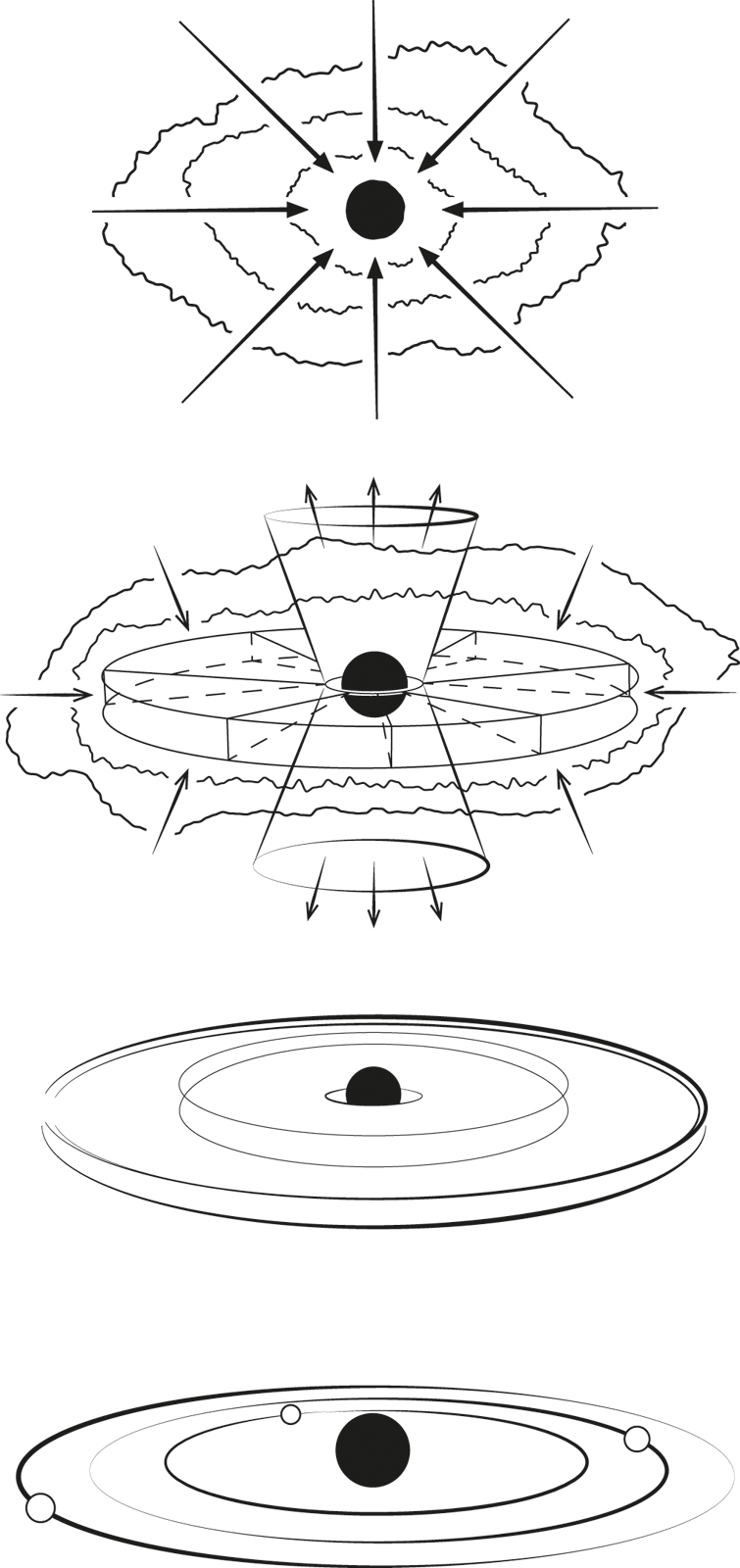
Within the clouds of gas and dust in each galaxy, new stars condensed. They recycled some of the condensing material back into space, but some remained behind in flat discs, rotating in orbit around the stars. Material in the discs quickly aggregated into systems of planets.
The formation of our Galaxy’s first stars and star clusters
Like the Galaxy itself, the stars in our Galaxy formed in collapsing clouds of gas. Each collapsing gas cloud fragmented and formed more than one star – perhaps only a few or possibly as many as hundreds or thousands of stars – all were generated at the same time, so essentially, the stars in the cluster had the same birthday. The result was an association or a cluster of stars.
The oldest star clusters in our Galaxy (other than globular clusters) are NGC 6791 and Be 17 at 10 billion years old. Star clusters contain stars of very different masses, ranging upwards from a few per cent of the mass of the Sun. It is usually the case in a collection of objects that there are more of the least massive objects and fewer of the most massive ones. On the seashore, for example, there are few rocks and boulders, a multitude of pebbles in the shingle and grains of sand that seem countless. A star cluster thus consists of a small number of large stars and a large number of small ones.
When first born in a star cluster, the larger stars are both brighter and hotter than the smaller ones, so a typical very young star cluster has a few bright, hot blue stars, a large number of white or yellow ones the same brightness and temperature as the Sun, and many faint, cooler orange or red ones. An older star cluster may have some bright red stars, which have evolved from the blue or white ones so the most massive stars have reduced in number.
Photographs of young star clusters look like a collection of gemstones, with a few bright blue sapphires, a number of white diamonds and a scattering of red garnets – one such cluster, NGC 4755, is also known as the Jewel Box, gaining its name from a remark made by nineteenth-century English astronomer John Herschel when he described its telescopic appearance as ‘a superb piece of fancy jewelry’. This star cluster lies in the constellation of the Southern Cross and was discovered by French astronomer Nicolas Louis de Lacaille in 1751. It is mostly composed of blue stars but has one that is a particularly prominent bright red.
Sometimes the collapse of the gas cloud that made stars happened simply because the gas cloud grew dense and collapsed under its own weight. Sometimes the collapse may have been triggered by an external event. During an interaction between two galaxies, for example, the passing galaxy may have caused gas clouds to collide in the Galaxy, squashing them together at the interface. This can create so many stars at once that the galaxy is called a starburst (see page 75). These triggers for star formation could be the ones that occurred right from the start of the Universe, even in gas clouds made (as they were at the outset of the Universe) solely of hydrogen, helium and dark matter, and were enough to start star formation in our Galaxy some 13 billion to 12 billion years ago. Once some stars had been made, they were able to influence the formation of more stars.
As described in Chapter 4, the first stars were made of the two light elements (hydrogen and helium), which do not much impede the flow of radiation outwards to their surface from their central cores, where nuclear reactions take place. As outlined in Chapter 8, stars are a balance between the downward force of gravity and the upward push of the outflowing radiation, so the balance of these forces in the first stars is different from the balance in stars nowadays. The outcome was that, in general, the first stars were more massive than stars now and generated more energy than is usual now. The gas clouds in which the stars were embedded were strongly heated and expanded. The expanding gas was driven like a piston into surrounding gas, squashing the gas at the interface. This triggered the formation of a second generation of stars: the same repeating mechanism operates in the Galaxy today (pl. IX).
The galactic ecosystem
Because the first stars in our Galaxy were so massive and radiating so much, they evolved quickly, completing their lives in hundreds of thousands or millions of years, rather than the billions of years more typical of stars now. They turned into supernovae, exploding into their surroundings. This added further energy into the gas cloud, both in the form of radiation and the motion of the outflowing body of the star, amplifying the formation of stars in new generations. However, the very events that triggered the formation of further generations of stars created so many that further star formation was inhibited through the process of feedback.
The energy poured into the Galaxy pushed interstellar gas out into the halo, causing it to flow up along the rotation axis of the Galaxy in the phenomenon known as the ‘galactic wind’. Satellites flying astronomical telescopes sensitive to gamma rays have detected this hot gas streaming up from the galactic centre, flowing out perpendicularly to the Galaxy’s disc. This outward flow initially reduced the raw material available in the disc for new stars to form. However, hydrogen gas in the outer reaches of the Galaxy, in nearby intergalactic space, was able to fall into entrances in the Galaxy, where there were open corridors around the sides. This replenished the interstellar material in our Galaxy and started a new cycle of feedback.
These cyclic processes form an ecosystem centred on our Galaxy, enveloping subordinate ecosystems within, like the cycle that connects interstellar hydrogen clouds, stars and supernovae in loops. In ecology, an ecosystem is a biological community of interacting organisms and their physical environment. Used more generally, as here, the word denotes a complex network or interconnected system. In astronomy, the Earth itself forms an ecosystem that includes its magnetic field. The solar system is an ecosystem that includes the Sun and a solar wind that extends out beyond Pluto, and planets that exchange rocky material in the form of meteoroids (debris in orbit in the solar system, broken off planets and asteroids). The stars and nebulae in the Galaxy form ecosystems that cycle gas back and forth. Galaxies are an ecosystem, with subordinate ecosystems comprising stars, gas and other components of galaxies; the physical environment is intergalactic space. Clusters of galaxies are even larger, with stars, gas and dark matter interacting and exchanging energy.
As well as the hydrogen gas that pervades the space between the stars (the interstellar medium), there is gas between the galaxies (the intergalactic medium). The cyclic process that moves hydrogen gas from the intergalactic medium to the interstellar medium in a galaxy and then to stars, and then to gas that escapes from the galaxy back into intergalactic space, is not a perfectly regenerating cycle. The basic raw material is hydrogen, made in the Big Bang, which resides in intergalactic space around the galaxy, and it is gradually being used up. Some of it escapes entirely into space, beyond the ecosystem of the galaxy. Some of the hydrogen is transformed into other elements that are carried away in the general flows, to wherever the flow goes. Some hydrogen ends up as dead stars – neutron stars, white dwarfs and black holes – which remain in the parent galaxy. Some of the mass of the hydrogen is changed into energy and is radiated away into space. However, some and perhaps most of the hydrogen that flows out of the galaxy is recycled back through the galaxy, probably many times.
We do not have direct evidence of the size of the ecosystem of our Galaxy – it is too difficult to judge the size of the ecosystem from our position inside it. However, astronomers have been able to map the ecosystem of our similar neighbour, the Andromeda Galaxy, which is about 1 million light years in radius, so it is presumed that our Galaxy’s ecosystem is approximately the same size. Considering that the Andromeda Galaxy is 2.5 million light years away, it is likely that the ecosystems of our Galaxy and Andromeda’s just about touch near the halfway mark. If the two galaxies were closer, they might well exchange gaseous material through a contact point. This happens in clusters where galaxies are crowded together.
Our terrestrial biological ecosystems – for example, the relationship between animals, trees, carbon dioxide and atmospheric oxygen – operate in cycles and subcycles that all lie within the galactic ecosystem. The relative size of our terrestrial ecosystems to the galactic ecosystem is the same as the relative size of a virus to the Earth. Our part in the operation of the Galaxy is, as one might have anticipated, utterly insignificant!
The ageing demography of the Galaxy
Like the history of the human population, the history of the number of stars in the Galaxy has been one of a progressive increase, while the history of their environment shows evidence of progressive change as stars have interacted with their surroundings. In human history, changes in the number of humans took place in fits and starts. The human population modified its environment for its own benefit, progressively optimizing its properties to favour human beings: the numbers of people increased. Humans also overexploited their environment and caused intermittent famine: their numbers decreased. Thus, the size of the human population has surged back and forth in cycles on top of the progressive trend. Likewise, in cosmic history the stars of the Galaxy have become more abundant over time as stars aged and died, triggering waves of new star formation. Additionally, they were born in surges, as the result of starbursts caused by successive encounters with other galaxies, such as the Sagittarius Dwarf Elliptical Galaxy (see page 105).
Stars have progressively moved interstellar gas, gathering it into their own bodies and eventually locking it away into their carcasses when they die, which has depleted the interstellar gas. The chemical composition of the gas that remains in galactic space has changed, gradually enriched or polluted (depending on your point of view) by new chemical elements created by nuclear processes in stars and in explosive events like supernovae, and spread into space by various kinds of stellar outflows and explosions. In detail, stars are nuclear furnaces, burning hydrogen in nuclear fusion processes that change hydrogen into heavier chemical elements. They include helium, carbon, oxygen, iron and all the other chemical elements. Eventually, the nuclear fuel in each star is used up and the stars die. They change into black holes, neutron stars and white dwarfs and fade away. At various stages in their lives, they blow outwards with a wind, or they explode as some form of supernova or kilonova, so that in any case they recycle some of their material back into interstellar space. The material that they eject has been enriched with heavy elements and mixes with the interstellar gas in the Galaxy. Interstellar gas was at first pristine from the Big Bang, made of hydrogen and helium only, but progressively it became enriched with new elements. New generations of stars formed in this enriched material and the cycle repeats.
As a result of this cyclic process, younger stars have larger amounts of heavy chemical elements than older ones. Astronomers use a simple, convenient shorthand for this, dividing stars into two groups (with a proposed third group: see page 124). Stellar populations are numbered in the reverse order in which they were born. Population I stars are composed of hydrogen and helium and noticeably enriched with heavier elements. Older Population II stars are composed likewise of hydrogen and helium plus far smaller amounts of heavy elements. The quantity of heavy elements is significant enough to affect the appearance and structure of the stars, and, with not very much work, the two populations are distinguishable through relatively simple procedures. The division between stellar populations correlates with the way our Galaxy and others are constructed. In a given galaxy, the stars of one population or the other congregate together. One immediately visible result of this is that the colour of a galaxy varies from place to place. In a spiral galaxy, the stars of the spiral arms are blue and the stars of its halo are red. The classification of stars in this way was developed in the 1940s and 1950s, first by German-American astronomer Walter Baade (1893–1960).
Baade was born and became an astronomer in Germany and moved to the USA and the Mount Wilson Observatory in California in 1931. He started the process to become an American citizen but in a move from one house to another he lost the papers. He disliked any bureaucratic business and failed to reactivate the procedure that would have overcome this setback. As a result, when the Second World War began, he was still a German citizen and therefore classified as an enemy alien and confined to a limited area. However, the authorities took a tolerant view and that area was Pasadena, California, which included the Mount Wilson Observatory. Like Brer Rabbit confined by Brer Fox in the briar patch, he was where he wanted to be. The other astronomers at the observatory had been drafted into the armed forces and deployed away from astronomy, so Baade had as much use of the 100-inch Hooker Telescope as he wanted. He took his work as an astronomer seriously and while observing with the telescope, he was always formally dressed in jacket and tie. Most astronomers nowadays dress to use a telescope in jeans and a T-shirt, with a warm, outdoor overjacket or hoodie, as if going for a country hike.
At 2.5 metres (100 inches), the Hooker Telescope was the largest in the world from 1917 to 1948, and Baade used it to investigate the stellar content of different types of galaxies. Wartime conditions along the seashore of California made his use of the telescope even more effective. In February 1942, a Japanese submarine lobbed artillery shells onto Santa Barbara and showed that the coastal cities were within striking distance of naval attack. Fear of air raids intensified wariness and as a result, restrictions were placed on the use of artificial lighting in the Los Angeles basin. The skies were dark, an atmospheric condition that favours the study of faint stars in distant galaxies.
With access to a large telescope under dark skies, Baade was for the first time able to discern the individual stars of M 31 (the Andromeda Galaxy) and its two companions, M 32 and NGC 205. By 1944, he had recognized the distinctive properties of the blue stars in the spiral arms of M 31, in contrast to the red giant stars in the two companions and the nucleus of M 31, and called them Population I and II respectively. By analogy, what had happened to M 31 to produce this distinction was similar to what happened to our own Galaxy, which is also a spiral galaxy.
By 1957, Baade had realized that this was not a straightforward division – there was a continuum from one population to the other – but astronomers still retain the simple idea as the basis for easy discussion. It is close enough to the history, since the underlying reason is related to the progressive origins of stars. Early stars were injected into the halo of the Galaxy by early mergers, but, later, stars formed in its disc. The stars that formed lately still include bright blue stars, and the stars from the halo have all been around for so long that they have turned into red giants and white dwarfs (see page 162). Population II stars are old and the only ones found in the halo; Population I stars are young and found in the disc, near the spiral arms of the Galaxy.
Although Population II stars in the halo have smaller amounts of heavy elements, they do have some, so they cannot have been among the very first stars. The stars made immediately after the Big Bang must have been made purely of hydrogen and helium because that was all the material available – they were the ones that made the heavy elements that we now see in Population II stars. They belong to a stage of development of our Galaxy that preceded Populations I and II. These, the earliest stars, have been given the label of Population III but none have ever been discovered. They were born a long time ago and were more massive and brighter than stars of the other two populations, meaning that they radiated prodigious amounts of energy and used up their nuclear fuel faster than is now normal, so they have all died. When astronomers get telescopes that can look back into the Dark Ages, they expect to find some Population III stars.
We humans have a stake in the classification of stars into populations. We live on a solid planet made up of heavier elements made in stars that lived previous to the birth of our Sun and we use such elements in our biochemistry. It would not have been possible for our Sun to make a planetary system with a planet like ours, nor for us to evolve, if the Sun had been born too early in the life of the Galaxy. Our Sun was born 4.55 billion years ago, two-thirds of the way through the life of our Galaxy and is a Population I star. If this had not been the case, we would not be around to discuss the issue.
What caused the birth of the Sun?
The Sun formed out of an interstellar cloud of gas when the cloud became unstable – that is, when the internal gravitational force pulling the cloud together became larger than the outward internal pressure force of the cloud. This did not happen without reason: there was a trigger and a series of events that induced the Sun’s birth. The trigger could well have been due to the infall of the Sagittarius Dwarf Elliptical Galaxy, as described on pages 105–106. Its passage through the plane of the Galaxy disturbed the interstellar gas cloud and its gas swirled about. Parts of the cloud compressed and became extra dense and then collapsed, unstoppably, forming into a star cluster.
The massive stars of the cluster evolved quickly. One of them became a supernova and caused a further collapse within a surviving gas cloud and this formed the Sun. The supernova exploded near to the gas cloud – within about 10–20 light years – and compressed its boundaries. We know this because the supernova explosion left its traces behind in meteoritic material: the Allende meteorite, for one. It is made of material preserved from the time of formation of the solar system and reveals some of its history.
The Allende meteorite was recovered for science largely through the efforts of two Smithsonian Institution scientists, Brian Mason (1917–2009) and Roy Clarke (1925–2016), and of NASA geologist Elbert King (1935–1998). King worked to prepare the programme to analyse lunar rocks brought back from the Moon by Apollo astronauts, whom he trained in geology at the Manned Spacecraft Center in Houston, Texas – he had taken up the study of meteorites as a means to develop suitable techniques.
The Allende meteorite fell 560 kilometres (350 miles) south of El Paso in Texas, in an area including the village of Pueblito de Allende, in Chihuahua, Mexico. On 8 February 1969, a bright meteor was seen in the very early morning hours. Local people described loud noises like claps of thunder as the meteorite fell, with stones falling from the sky. The meteorite was originally the size of a car but broke into hundreds of pieces as it traversed the Earth’s atmosphere, scattering in a strewn field the shape of an ellipse, 50 kilometres (30 miles) long, 12 kilometres (7½ miles) wide and 250 square kilometres (100 square miles) or more in area. More than 2 tonnes were collected, the largest fragment having a mass of about 110 kilograms (240 lbs). One large fragment fell near the post office in Pueblito de Allende, missing it by only 10 metres (30 feet). Meteorites are usually named after the post office nearest to their landing site: this one emphatically selected its appropriate name.
In Moon Trip (1989), King described how he learnt about the Allende fall in Mexico while unsuccessfully searching for a meteorite reported to have fallen in Texas. He contacted Rubén Rocha Chávez, a newspaper editor in Hidalgo del Parral, who recounted what local people had told him about the brilliant fireball in the middle of the night and described the several pieces of meteorite he had on his desk. King immediately travelled to the city, arriving thirty-six hours after the fall. He was astonished when he saw two big meteorite pieces on the editor’s desk: one weighed more than 15 kilograms (30 lbs).
King and the NASA team and the scientists from the Smithsonian obtained pieces of the Allende meteorite for scientific analysis, many of which had been collected by local inhabitants, some of whom preserved them in plastic bags previously used for food; these contaminated specimens have lost a lot of their scientific interest. The Smithsonian scientists organized schoolchildren to find pieces and instructed them on how to handle the fragments, preserving them in unused freezer bags. The youngsters were paid with bottles of soft drinks. Local people continued to find specimens, some of them large, for the next year. Small pieces are still being found and many of them are made into jewelry.
The Allende meteorite is an important and rare type of meteorite. By coincidence, it fell just as the preparations for the Apollo 11 lunar landing were nearing completion, with the prospect that the astronauts would return with lunar rocks to analyse. This focused attention on it and, with its widespread distribution among scientists, it has become the most studied meteorite ever – its properties are outlined or cited in more than 16,000 scientific papers.
The Allende meteorites contain millimetre-sized spherical chondrules (see pages 133–34) and centimetre-sized irregular mineral pieces composed primarily of calcium and aluminium oxides. These pieces proved to be 4.568 billion years old and contained magnesium-26 (Mg-26). In 1977, this remarkable discovery prompted nuclear physicists Alastair Cameron (1925–2005) and James Truran (b. 1940) to advance the idea that the nuclear processes that produced it took place in a supernova that contaminated the Sun, both stars having been born in the same gas cloud condensed by the collision with the Sagittarius Dwarf Elliptical Galaxy. The supernova was about 10 light years from the Sun. The supernova created aluminium-26 (Al-26) during the explosion and ejected it into space. Rushing outwards, the outer layers of the resulting expanding shell made from the body of the exploding star reached a dense part of the gas cloud in about a century, injecting the Al-26. This part of the gas cloud collapsed into our Sun and material left over became our solar system, including planet Earth and the meteorite. Meanwhile, because it is radioactive, the Al-26 decayed to Mg-26, with a half-life of 720,000 years. From supernova to meteorite had taken not much more than a million years. The meteorite orbited in the solar system, preserving its page of history unaltered for more than 4.5 billion years until it fell to Earth in 1969.
The rotation of the Sun
The Galaxy is rotating, but it is not a rigid object. The central parts move faster than the outer parts. At any given place in the Galaxy, one side of a gas cloud would move faster than the other. This means that gas clouds also rotate. In addition, when the gas cloud that produced the Sun was blasted by the nearby supernova, the blast would not have aligned in any way to the cloud; it would have had some glancing component. Just like a hand stroking a terrestrial globe, this would cause the gas cloud to spin. The bottom line is that the gas cloud would rotate, even if slowly.
The gas cloud was perhaps 10 light years in size. A dense fraction of the cloud, called the solar nebula, perhaps a light year or so in size, formed the Sun. The collapse of the solar nebula into the Sun caused it to rotate faster. This is an inevitable consequence of the physical principle called conservation of angular momentum. Angular momentum is essentially the size of an object times the speed of its rotation, and that product is conserved – it remains constant during a change of configuration. So, if the size of the solar nebula decreases, its rotation speed increases. A similar thing happened during the formation of our Galaxy (see pages 98–99). The Sun formed as a rapidly rotating star, potentially with a period of rotation of an hour or so. This is in contrast with the actual period of rotation as it is today, which is about one month. Just as the skirt of a spinning ice skater flares outwards due to centrifugal force, a disc of solar material spun off the equator of the Sun. Unlike the case of the ice skater, whose skirt weighs almost nothing, the disc of the solar nebula was massive, so it effectively made the solar nebula larger again. The principle of the conservation of angular momentum applies further, and this braked the Sun to its present slow rotation speed.
The nascent Sun
The supernova near to the Sun’s interstellar cloud squashed the gas of the cloud in an irregular way – some parts were made denser than others, some dense regions were more massive than others. Those parts that were the right mass and the right size became unstable in a process called Jeans collapse, named after the British astrophysicist Sir James Jeans (1877–1946) who described the phenomenon in 1902. Denser-than-usual bits of the cloud collapsed where the size of the dense part was bigger than a threshold value that is nowadays referred to as the Jeans length. Different mass bits produced stars of different mass. In each case, the collapse was a runaway process, accelerating exponentially, as gravity overcame the pressure in the interstellar gas. The problem that Jeans did not solve is the same problem that urgently confronts a skier who accelerates downhill: how to stop. This part of the birth history of the Sun was figured out in 1961 by the Japanese astrophysicist Chushiro Hayashi (1920–2010).
The collapse of a small region of the parent gas cloud from which the Sun formed happened quickly; it took a total of about half a million years to form the Sun. During this time, the Sun was a protostar. The collapse built up from the centre of the protostar, gradually encompassing the entire body of the collapsing gas cloud. The core of the protostar was made first. Material from the collapsing gas cloud’s outer regions followed in afterwards, falling on the core, building its mass. Gravitational energy released in the collapse heated the protostar, which emitted submillimetre and long-wavelength infrared radiation. Clouds of dust and gas condensed onto and around the proto-Sun, turbulent and moving rapidly as they rained down. Some of the material that did not build onto the proto-Sun gradually settled into a rotational motion in a disc in a flat plane. This was the proto-solar system. The disc would eventually become the orbital plane for the Sun’s planets.
Disc material flowed inwards from the outside edges towards the central proto-Sun. Colliding at the centre of the disc, material that was not accreted by the proto-Sun was spewed outwards in a jet, spraying up into the poles of the disc. There may have been residual gaseous material above the disc that was impacted by the jet. If there was, the jet material blew into the gas and excited it to emit infrared and visible radiation. If we could look back into the past and see the proto-Sun and proto-solar system at this stage, about 100,000 years after collapse began, we would see an infrared-emitting star, surrounded by a dark disc, with a jet coming out and, a short distance away at the end of the jet, a Herbig-Haro (or HH) object.
HH objects are nebulae that were initially discovered by American astronomer Sherburne Wesley Burnham. Their importance was uncovered by two astronomers working at first independently and then in tandem, the American George Herbig (1920–2013) and the Mexican Guillermo Haro (1913–1988). Herbig had become dedicated to astronomy at the early age of eight years old, and was appointed straight from his astronomy studies at the University of California to the Lick Observatory on Mount Hamilton in California, working there until he moved to Hawaii just before his retirement. By contrast, Haro studied law and started his working life as a reporter, becoming interested in astronomy only when he interviewed the director of the Tonantzintla Observatory in Mexico. He rapidly advanced and was appointed to succeed as director in 1950. Herbig became interested in infrared-emitting stars and the nebulae with which they were often associated in the sky. He met Haro at a conference in 1949 and learnt that he was also interested in the same things. Working together, they elucidated properties of HH objects, discovering that as nebulae they were unusual in being excited not by hot stars but by collisions with other fast-moving gas. This gas, it was later discovered, had been emitted in a jet by a nearby protostar.
After about half a million years had elapsed, the proto-Sun was approaching a temperature of about 4,000 degrees Celsius (7,000 degrees Fahrenheit). It became visible to the outside Universe by blowing away the surrounding cocoon of material raining down on its surface. It was rotating quickly, and it was embedded in a dusty, gaseous environment, with everything moving quickly.
Our Sun at this stage was a T Tauri star, which is a type of variable star. Many stars of a similar sort are known today in interstellar clouds. The archetype star, T Tauri itself, was discovered by English astronomer John Russell Hind (1823–1895). While still a teenager, Hind started his astronomical career as a ‘computer’, performing grinding mathematical calculations at the Royal Observatory in Greenwich under the Astronomer Royal, the fearsome George Airy. He escaped this drudgery aged twenty-one, when he was employed in 1844 by George Bishop, a rich wine merchant, who had a private observatory in Regent’s Park, London. Hind began a search for the planet that was perturbing the motion of Uranus. His technique was to compare the sky with star charts of the ecliptic regions, which he had prepared at the start of his employment. He was beaten to the discovery of the planet Neptune in 1846 by the German astronomer Johann Gottfried Galle. He repurposed his search towards ‘minor planets’, as he called them, or asteroids as they are now known. At the time, they were regarded as scarcely less interesting than Neptune. He went on to discover eleven asteroids, as well as a number of comets.
Hind had already discovered six asteroids when, on the night of 11 October 1852, he was scanning his telescope across the constellation of Taurus, near to the Pleiades and Hyades star clusters. He noticed a star in the sky that was missing from his chart – the implication to Hind was that he had succeeded in finding a seventh minor planet, one that had moved onto the area of the chart and was only masquerading as a star. The right explanation was that the object was in fact a star, one that was variable in brightness. It had been too faint to be seen when the chart was compiled but had become bright enough to be visible by the time that Hind looked. It was identified in the constellation with the letter T.
T Tauri and its surroundings became additionally attractive for astronomers when Hind noticed a small nebula not far away, which disappeared a decade later. It returned to view briefly in the 1890s and came back fully in the 1930s. It was catalogued as NGC 1555 but is more familiarly known as Hind’s Variable Nebula and it reflects the light of T Tauri. Not only is the star T Tauri variable so that the nebula varies in brightness too, but there are also opaque clouds streaming in space between the two that create a play of shadows on the nebula.
In T Tauri and its nebula we have a model for the nascent Sun at its first shining about a million years after it began to collapse from its parent gas cloud. It emerged from its opaque envelope of stellar formation. Having recently coalesced from its dusty and gaseous surroundings, it became visible at optical wavelengths. Like T Tauri itself, the Sun would have been changing rapidly in brightness, due to violent activity in the atmosphere of the star and to moving clouds of dust and gas.
In the proto-Sun, the downward force of gravity became progressively opposed by an upwards push caused by the increasing outward flow of energy from within. As the proto-Sun got hotter, it became transparent to the flow of radiation. It began to generate nuclear energy, increasing the amount that it radiated even more, so that the downward pull of gravity was exactly balanced by an upward push by the out-flowing radiation. At this point, the proto-Sun settled down into the Sun, having achieved the status of a mature star.
From the beginning of the collapse of the proto-Sun, triggered by the impact of material flung out by the nearby supernova, until the protostar became the Sun took about a million years. During this time, the solar nebula developed its disc-like shape, with the Sun at its centre, generating energy and warming the inner parts of the nebula.
Composition of the solar nebula
On 28 September 1969, just before eleven o’clock, a meteor broke up with a bang over Murchison, in Victoria, Australia. It startled the cows in a dairy farm and attracted the attention of people going to church that Sunday morning. Because it arrived at such a crucial time, there were many eye witnesses to the meteor, which broke into meteorites that fell across the town. (Rocks that orbit in space are meteoroids, rocks that then traverse the Earth’s atmosphere are meteors, and rocks that reach the ground are meteorites. The same rock may change its designation three times in a matter of seconds!)
Brothers Peter and Kim Gillick, aged ten and eleven, were building a ferret cage in their backyard when the meteor exploded over their heads; the explosion set off an intense interest in them that lasted over a year: they became meteorite hunters. One meteorite punctured the roof of a hay barn: it had obviously fallen from the sky and became the model for what they were looking for. It was very distinctive – black, crumbly and smelling of methylated spirits.
The boys plotted maps of the pieces that were accidentally recovered. They realized quickly that the small pieces travel a shorter distance and fell quicker to the Earth, while the larger pieces, less influenced by air resistance, carried on and went further. They extrapolated from their map to identify further areas worth searching. The meteor was travelling towards a lake called the Waranga Basin and the biggest piece could well still be under water, but over the next twelve months, the boys recovered from dry land about one-third of the more than 80 kilograms (180 lbs) of the meteorite that has been gathered. The family donated some of what they had found to Australian institutes and museums and sold most of the rest, making enough to pay for the boys’ college education.
Fragments had been promptly collected and carefully preserved in clean, plastic bags, so they were not contaminated, and ideal for scientific analysis. They showed that, like the Allende meteorite, the Murchison meteorite is a carbonaceous chondrite.
Meteorites are pieces that originated as asteroids, solar system bodies that used to be called minor planets, a name that expresses accurately what they are. Like the other planets, minor planets formed from the solar nebula. Some asteroids are large, rounded worlds that settled under their own gravity. Such a large asteroid like this trapped heat generated internally from radioactive elements and generated externally by the fall of smaller asteroids onto its surface. It melted inside. Minerals that became liquid at low temperatures, such as iron, percolated into a central core, leaving more rocky material wrapped around the asteroid in a mantle near the surface. The asteroid ‘differentiated’, or separated into zones (see Chapter 10). If such an asteroid breaks up (because it collides with another one), the pieces are made of iron or rocks depending on what part of the asteroid they come from.
Lots of meteorites are like this, but not the Murchison meteorite. It originated from another kind of asteroid, a small world that never became massive enough to become spherical. The insides of asteroids like this never melted, so the material of which they are made never differentiated. The material of the solar nebula packed together enough so that it fused into a solid but never suffered from a strong pressure or a high temperature, although it may have reached a temperature and pressure high enough to alter its mineral composition. (Exposure to water is another factor that might have changed its mineral composition.) Small asteroids may never have collided at a high speed with other asteroids. Such a small asteroid may, however, now encounter the Earth and fall as a meteorite. It will have a distinctive appearance – individual small pieces of rock, or chondrules, millimetres in size, fused together. A chondrite is such a meteorite: stony with chondrules, the small spheres of silicate rock.
Within the class of chondrites there are a number of different sorts, and carbonaceous chondrites, like the Murchison meteorite, are of a type that contains abundant carbon and organic compounds. The carbon compounds make the meteorite black. The remarkable smell of the Murchison meteorite was so strong that it was noticeable at the time of the fall, diffusing down from the meteor’s trajectory, as well as diffusing from the pieces themselves. The smell comes from organic molecules, like amino acids, sugars and alcohol-related chemicals, in the material of which the meteorite is made. These organic molecules may be the seeds from which life formed on Earth, brought to our planet by a similar meteorite in the distant past. The molecules had not been generated by living organisms, but it could be that on Earth they associated together and produced biology-like structures that became live creatures.
The thought is that the molecules had originally been made in the solar nebula (see Chapter 9) – the same material as the gas cloud that was the birthplace of the Sun. The cloud was primarily hydrogen gas as made from the Big Bang, with a few per cent of helium, but it was enriched with elements like carbon, oxygen, silica and iron made in stars and exploded into the interstellar medium, including elements made from the nearby supernova, like magnesium-26, made from the radioactive decay of aluminium-26. It also contained elements formed by dying stars billions of years ago. As stars age, the nuclear processes inside them make elements such as carbon, oxygen, silicon and calcium. The stars also change structure, and the changes dredge up these heavier elements from internal regions to their surface. They blow these elements out into the surrounding environment, where they cool and coalesce into molecules. These molecules condensed into solid grains in the solar nebula as the Sun was forming, and then into the planets and other objects in the solar system that were forming at that time, including the Allende and the Murchison meteorites. As mentioned on page 126, the oldest grains are 4.568 billion years old, as determined from the properties of the radioactive elements that they contain, and this is what is taken as the age of the Sun and the solar system.
Presolar grains are small solid pieces in the solar nebula that predate the formation of the Sun and the Murchison meteorite is the most abundant source of such grains that we know. A similar dust grain, technically a calcium-aluminium-rich inclusion (CAI), has also been found in a fragment of the Allende meteorite. The inclusion was named ‘Curious Marie’ by University of Chicago scientists who, in 2016, found the element curium (named after Marie Curie) in it; the name is both a pun and a further tribute to the notable woman scientist and Nobel Prize winner. In 2020, scientists led by Olga Pravdivtseva, working at Washington University in St. Louis, determined that the CAI predates the formation of the solar system.
Presolar grains in both the Murchison and Allende meteorites came from other stars. They formed in the outer parts of a dying star and got pushed away by the radiation pressure from the star into the surrounding environment. They became part of the interstellar medium and travelled in the Galaxy. In this way, the gas cloud from which the Sun formed became contaminated with dust that had its origin in other stars that pre-existed the Sun. This dust became incorporated into the solar nebula and then found its way into the planets and the fragments of planets that we call meteorites.
The dust of the solar nebula that accumulated into the Earth has lost its identity over time, crushed and remoulded by geological and biological activity. It has been remixed into new chemicals and new structures, such as mountains, trees and people: the composition of the material of your own body can be traced back to the solar nebula. The connection between the material of your body and the solar nebula is, of course, a complicated one, made up of many links, and it would be difficult to draw conclusions about the solar nebula from human biology. But there are bodies from the solar nebula that have not undergone such radical processes and are much more primitive: they are chondrites like the Allende and Murchison meteorites. In the construction of a chondrite the dust of the solar nebula has been squashed into a solid, only gently and without much modification. Chondrites are the closest we have to the original material of the solar system.
What happened to the Sun’s family?
The Sun was born 4.55 billion years ago – it has since left home, lost contact with its kin and grown to maturity.
It is not known for sure that the Sun was formed as part of a compact cluster of perhaps as many as a thousand stars, about 10 light years in dimension, but that is a scenario that is often discussed. In any case, few if any stars are formed in isolation. The Sun is thus very likely to have been formed as part of a family, a village or even a city of stars.
Virtually all the stars in the Sun’s family would have formed with a planetary system. The stars were originally very close, each separated from its neighbour by perhaps only 1 light year on average, and sometimes passing much closer. In those encounters there was the opportunity for the planets of one star to cross into the planetary systems of the other. The planetary systems of each star may now consist of its own planets and planets captured from elsewhere.
In fact, this may be the case for our own solar system. Most of the planets of the solar system appear to have been formed in the same process that formed the Sun, although perhaps some of the asteroids are adopted. Among them are a few that move in tilted orbits among the outer planets: these asteroids are collectively known as Centaurs. They are a mixed bag, but the orbits of some of them have been tracked back to their birth orbits well beyond the furthest members of our solar system and lying across the plane of orbit of the rest of the planets. They may have been pulled into our solar system from another planetary system around one or more of the Sun’s close siblings in its birth-cluster.
Although born into a close-knit family, the Sun and its solar system are now living on their own. The closest star is called Proxima (meaning ‘the nearest’), which is 4.22 light years away from the Sun, equivalent to 40 million million kilometres (25 million million miles) – the Sun’s nearest neighbour is actually quite far away – and lies close to a bright star, Alpha Centauri, which is a multiple star. The brightest star, Alpha Centauri A, has a companion, known as Alpha Centauri B. They have a ‘high, common proper motion’: namely, they move across the sky, they move very quickly and they move together. These are signs that A and B are joined together in a binary star system and that they are not far away – in general, the closer something is, the faster it seems to change position. If you lie on your back in a meadow, the bees flying over your nose zip across your field of view, whereas a high-flying jet aircraft seems to crawl across the sky. The distance of the two stars is very small as star distances go: at ‘only’ 4.37 light years, or 41 million million kilometres (26 million million miles) from the Earth.
In the course of a study of the Alpha Centauri binary star, the Scottish-born astronomer Robert Innes (1861–1933), working in South Africa, discovered a rather faint star that had the same motion as the other two, a fellow traveller and apparently part of the Alpha Centauri system, which it indeed proved to be. For Innes, this was a discovery towards which he had been working for most of his life and might explain why, at the time, he rather over-sold the significance of what he had found.
Innes went to school in Dublin, where he showed an aptitude for mathematics, but as one of twelve children he was obliged to leave school at an early age. He worked in commerce but remained an autodidact. In 1890, he moved with his new bride to Sydney where he became a successful wine merchant, which meant that he was able to indulge an interest in astronomy, in particular the discovery and measurement of binary stars and other mathematical problems. In 1896, because of his business success he was offered a position as an administrator at the Royal Observatory in South Africa, with the promise of some involvement in its scientific work. Some of it was paid but he carried out much of it unpaid, in his spare time, making a success of both aspects of this post.
In 1903 he was appointed the founding director of the newly established Union Observatory in Johannesburg and began a survey of the Southern sky looking in the area around high proper-motion stars to find similar ones. His aim was to find nearby binary and triple stars and, in 1915, he discovered the third star in the Alpha Centauri system, the companion to A and B; initially, it was given the neutral name of C. Innes and Dutch astronomer Joan Voûte (1879–1963) independently measured the distance of C, showing that A, B and C are indeed all members of the same triple star system. A and B are close to one another, orbiting with a period of eighty years. C moves around the pair of them in a very elliptical orbit with a period of half a million years and at a considerable distance from the two, currently, 13,000 times the Earth–Sun distance.
Voûte published his data on the distance of C before Innes. Innes’s data suggested that C was not only close to Alpha Centauri A and B, but also closer to Earth than either, so he rushed into print soon after Voûte with that claim. His results did not really justify this assertion, because, like all data, it was uncertain and, although his claim was possibly correct, the uncertainty was large enough that it was also more or less equally possible that it was not. Without a close analysis of the accuracy of his data, Innes took the chance, named the star Proxima and was acclaimed for its discovery. More accurate measurements over the years have shown that his guess was, in fact, right and Proxima became recognized as the nearest star to Earth, not counting the Sun.
‘Near’ is, of course, a word to be appreciated in its astronomical context. Travelling at 299,800 kilometres (186,000 miles) per second, the light of Proxima takes 4.24 years to travel to us. The triple system is on an approaching trajectory and in 27,000 years, Proxima will make its closest approach to the Earth at only 3.0 light years. At about the same time, it will lose the title of ‘nearest star’ because its orbit will have taken it to the far side of Alpha Centauri A and B, which will then alternate as the nearest star to the Sun, as the one orbits around the other with their period of eighty years.
The Alpha Centauri system also contains three planets (a, b and c) that orbit Proxima in its planetary system. Proxima b is much like the Earth in size and mass, although considerably closer to its parent star than Earth. Proxima is rather a dim star but because Proxima b is relatively close to it, it also has about the same temperature as the Earth. The surface environment of the planet is thus quite Earth-like, making it an interesting target for investigations of astrobiology, the science of life in the Universe. Can life exist there – even alien intelligence? Given the planet’s closeness to us, could we communicate with extraterrestrials? One’s imagination can readily spiral off into optimistic predictions!
To come back closer to reality, does Alpha Centauri C deserve the name Proxima – is it in fact the nearest star to the Sun or could there be an even closer star, as yet undiscovered? From time to time, astronomers have sought to explain some feature of the solar system by the effect of a star nearer than Proxima. For example, in 1982, University of Chicago palaeontologists Jack Sepkoski and David Raup studied mass extinctions – global catastrophes that wiped out many species at the same time – as they appeared in the geological record of fossil strata and noted an apparent periodicity in the times of the extinctions that indicated some recurrent event. Working at about the same time, American physicist Adrian Melott and palaeontologist Richard Bambach homed in on the periodicity as 26 million years during the last 500 million years, later modifying their analysis of the periodicity to 60 million years.
In 1984, astronomers Daniel Whitmire and Al Jackson, and independently Marc Davis, Piet Hut and Richard Muller, sought to explain the extinctions as the result of meteoric and cometary bombardments of the Earth, like the Chicxulub asteroid that struck Mexico 64 million years ago and caused the extinction of the dinosaurs (see Chapter 11). They formed the hypothesis that the bombardments are triggered by periodic disturbances of asteroids in the solar system, by an undiscovered star, which, they further hypothesized, is in a periodic highly elliptical orbit. It disturbs the solar system at its closest approaches to the Sun, a position known as perihelion. If the periodicity was 26 million years, the star would lie at a distance of only 1.5 light years at the present time. The star was named Nemesis, after the goddess who controls fate; it is also popularly known as the Death Star, following the nomenclature of the movie series, Star Wars.
To be close but remain undiscovered, Nemesis must be a faint, cool, brown dwarf star. Brown dwarf stars emit infrared radiation. There have been several general surveys for infrared-emitting stars, and some surveys targeted specifically towards finding Nemesis. No star as near as 1.5 light years has been detected. Its existence, and indeed the existence of a periodicity in the occurrence of mass extinctions in the prehistoric history of life on Earth, remain speculative, and even unlikely.
So, as far as we know, the Sun is alone. What has happened to the Sun’s birth companions?
It is sometimes possible to identify ‘moving groups’ of stars orbiting the Galaxy on parallel tracks. A moving group began as a cluster of stars and the stars have ‘remembered’ the original trajectory of the cluster. Astronomer Marina Kounkel and her colleagues at Western Washington University in the USA have used Gaia space satellite measurements of the movements of over 1 billion stars to uncover nearly 2,000 moving groups of stars in the Galaxy, up to about 3,000 light years from us. Around half of these stars are found in long, string-like configurations that move as a group.
The moving groups that survive in our Galaxy are composed of young stars because after just a few million years the stars lose their ties with their original family. The reason is that, over time, the stars in the cluster drive out all the residual gas that remained after their formation and weaken the force of gravity that tethers the stars to their cluster of origin. This happened long ago to the Sun and its siblings. They have journeyed around the Galaxy about twenty times in their lifetime, not only having lost the gas whose mass kept them tied together, but also being jostled by random encounters with other stars and with gas clouds. As a result, the stars of the solar cluster have gradually separated. The Sun’s siblings have mingled into the crowd of other stars of the Milky Way, lost their family connection and become anonymous.