
7
The Sun is the source of all the energy that we consume as humans (except for nuclear power, which comes from the Big Bang or from long-dead stars that exploded as supernovae). Its importance to us would alone justify the Sun having a chapter to itself, but in addition it is an utterly typical star and, with the rest, is crucial to the biographical development of the Universe.
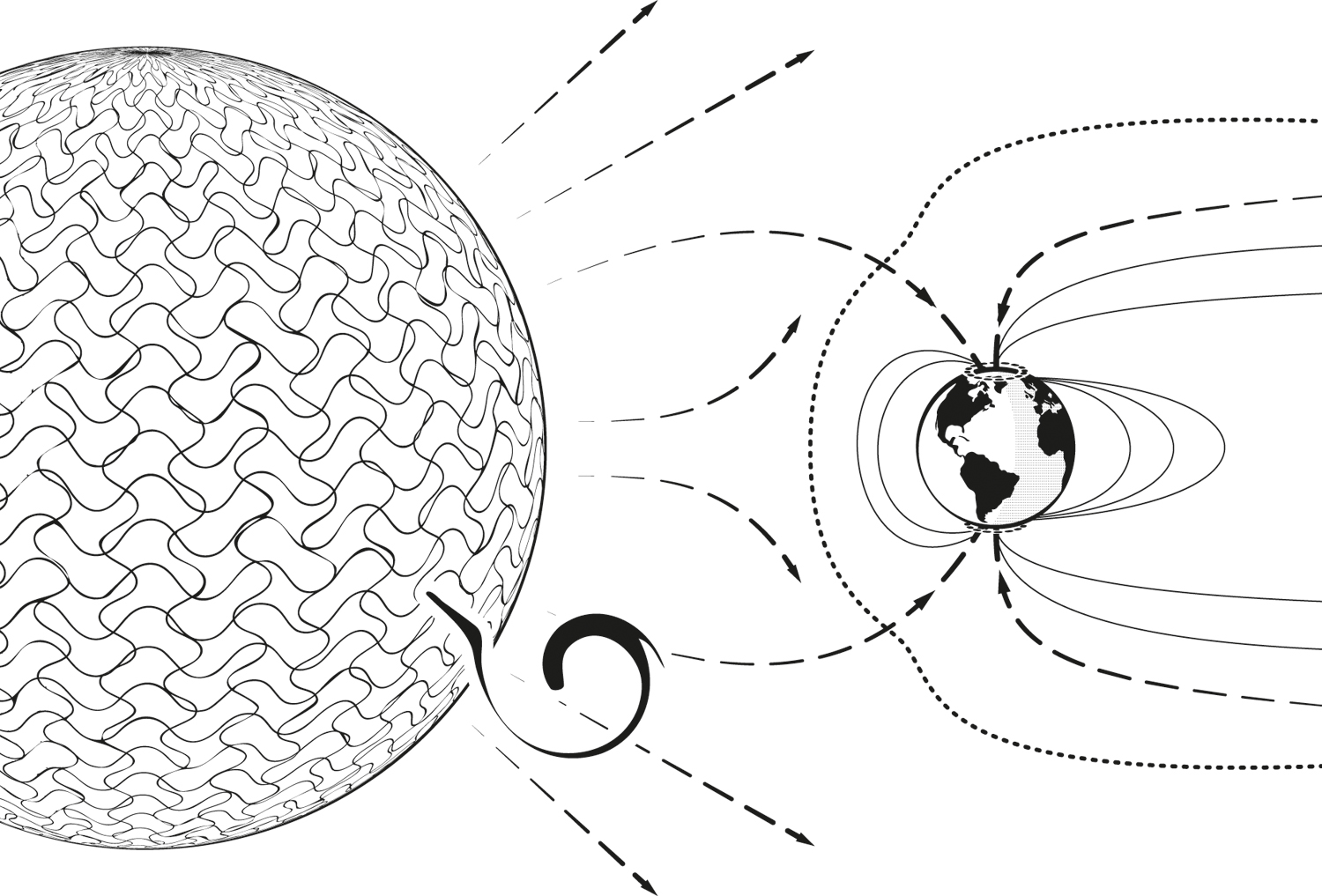
The Sun and its wind of energetic particles dominates the space surrounding the planets, including the Earth. The Earth’s surface is, however, shielded from the Sun’s particles by a magnetic field.
The origin of the Sun’s energy
While the Sun was a youngster, a protostar, it radiated energy from a range of sources such as the gravitational energy that was dissipated by its fall from a cloud in the interstellar medium into a star, and for some time in the nineteenth century astronomers thought that this might still be the source of the power of the Sun: the German physicist Hermann von Helmholtz and the Canadian astronomer Simon Newcomb calculated that the Sun could have existed for perhaps several millions of years if it were so, a period of time thought to be indescribably long. However, in the twentieth century, scientists began to realize that the Earth was much older even than this, and since the Earth was dependent on the Sun, the Sun must be as old or older than the Earth.
The twentieth-century conclusion about the age of the Earth was based on the new science of radioactivity, discovered by French scientists Henri Becquerel, Marie Curie and Pierre Curie. It enabled the British physicist Lord Ernest Rutherford to develop a way to use radioactive decay to measure the age of rocks. A young American chemist, Bertram B. Boltwood, discovered that some rocks were as much as 1 billion to 2 billion years old, and we now know of rocks two to four times older. This was far too long for the gravitational energy of the Sun’s formation to have lasted. How could the Sun keep shining for such a long time?
The answer was discovered by two physicists at the University of Göttingen in Germany – Fritz Houtermans (1903–1966) and Robert d’Escourt Atkinson (1898–1982). Holidaying together on a walking tour in the summer of 1927, they talked about the source of the Sun’s power. Atkinson, a British astrophysicist, knew that Sir Arthur Stanley Eddington (see page 17) had just determined the physical conditions inside the Sun and how it maintained its size: its density and its temperature created a high pressure inside the Sun, which countered the force of gravity that was drawing the material of its body tightly together. The Sun is in balance between these upwards and downwards forces respectively. The balance is very precise because the pressure and temperature are self-adjusting. If the Sun expands for some reason unconnected with its own structure, the pressure and temperature will fall and it will contract. The opposite is also the case. It always acts to restore its equilibrium.
The pressure comes from two sources. The gas of which the Sun is composed generates its own pressure, but in addition, the radiation generated in the core flows up through the Sun. Both pressures push against gravity and support the Sun against collapse.
Atkinson knew that the high density and temperature inside the Sun would mean that what was then called atomic transmutation of the solar material was possible. The atoms (or, as we now know, their broken-down nuclei) in the centre of the Sun would frequently collide. If the collisions transformed some atoms from one kind to another, losing mass in the process, what was then called atomic energy (we would now more precisely call it nuclear energy) would be produced. ‘This might be the source of the Sun’s energy,’ suggested Atkinson. ‘Let’s just work the thing out, shall we?’ said Houtermans, a nuclear physicist. ‘How could it happen in the Sun?’ It did not take the two men long to work it out on a piece of paper. Houtermans was able to boast to his future wife about the sparkling stars that the two of them saw during an evening walk, telling her: ‘“I’ve known since yesterday why it is they sparkle.” She didn’t seem the least moved by this statement. Perhaps she didn’t believe it. At that moment, probably, she felt no interest in the matter whatever.’
The two young scientists had discovered how the fusion of light elements into heavier ones could fuel the Sun. In these reactions, four hydrogen nuclei become fused into one helium nucleus. The mass of the helium nucleus is less than four hydrogen nuclei, and the loss of mass is converted into energy, through Albert Einstein’s famous equation of the equivalence of mass and energy, E = mc2. The amount of material that the Sun fuses in its core is enormous: 620 million tonnes (683 million short tons) of hydrogen into 616 million tonnes (679 million short tons) of helium each second. Thus, each second, the Sun converts more than 4 million tonnes (4.4 million short tons) of matter into energy. The Sun is so large that this attrition rate can be kept up for billions of years. The Sun was a protostar for only half a million years. It will spend a total of about 10 billion years fusing hydrogen to helium and has been 4.5 billion years doing this so far.
What happens inside the Sun?
The details of what happens inside the Sun have been confirmed with astonishing accuracy by the detection of neutrinos (tiny particles given out in the nuclear processes), which travel from the Sun’s interior and have been detected on Earth using specially built neutrino detectors.
When we see the Sun through mist or as it sets in a dusty atmosphere, we can see that it has a surface. In scientific terms this means that sunlight originates from a narrow layer in the Sun – the Sun has a transparent atmosphere above that layer through which light can travel, but below that layer the Sun is opaque. As a result, we cannot look at the interior of the Sun directly. At first only the Sun’s surface characteristics and its global properties – such as its diameter and the amount of energy that it radiates – could be determined by direct observation. Its interior was literally out of sight.
However, we now know what happens inside the Sun. Ingenious mathematical calculations have built up a theoretical picture of the Sun’s interior in such a way that the results of the calculations fitted the Sun’s global properties. The understanding of the inner workings of the Sun that developed was the result of one of the great feats of reasoning in modern physics. From the 1920s, astronomers knew the physical conditions inside the Sun by calculation and from the 1930s they knew that nuclear reactions were the source of the Sun’s energy. In the 1950s, they had begun to understand the way that stars evolve in relation to one another from observations of star clusters. These calculations built up confidence in astronomers’ theoretical knowledge of the Sun’s interior.
This knowledge was further developed by tuning the calculations to fit what could be learnt from two radiations that pass from its interior regions through solar material and that provided clues as to the conditions in the Sun’s interior regions. The radiations that opened the inner workings of the Sun to direct scrutiny are neutrinos and sound.
Neutrinos are made in the proton-proton nuclear chain reaction inside the Sun that makes the Sun’s energy. Because it is so hot in the Sun, the hydrogen atoms there split apart and become free electrons and protons. Because it is so dense in the Sun, the protons readily hit one another. Two of them may combine, one of them changing to a neutron by emitting a neutrino and a particle called a positron. The reaction continues towards its conclusion when another proton sticks to the pair, forming a helium nucleus containing a pair of protons and a neutron. Two similar helium nuclei then collide and two protons are ejected, leaving behind a helium nucleus with a pair of protons and a pair of neutrons. The net result of this chain is that four protons (p) have made a helium nucleus (4He), releasing energy, two positively charged positrons (e+) and two neutrinos (νe – there are three kinds of neutrinos and this is the kind associated with electrons). In the notation of nuclear physics:

The neutrinos escape at the speed of light, travelling so fast that it takes only eight minutes for them to reach the Earth. They carry small parcels of energy. The numbers of neutrinos given off by the Sun is immense – 65 billion of them pass through every square centimetre (0.2 square inch) of the Earth every second. Reckoning your cross-section at about 1 square metre (10 square feet), that is 100,000 billion passing through you every second.
There are floods of solar neutrinos, but they are whisper-quiet, few interact with anything and we have no sensation from them. A typical neutrino can travel through a light year (10 million million kilometres/6 million million miles) of material without interacting with it in any detectable way. Not many interact with the thousands of kilometres across the diameter of the Earth, let alone the few centimetres of flesh on a person.
Despite the astonishing speed and elusiveness of neutrinos, it is possible to build detectors that do catch some solar neutrinos because they are not entirely inert and there are so many that a tiny number do interact. The first solar-neutrino detector was built by American physicist Raymond Davis, Jr (1914–2006), of the Brookhaven National Laboratory in the USA, following technical suggestions from the Italian-born physicist Bruno Pontecorvo (1913–1993) and American physicist Luis Walter Alvarez (1911–1988).
Davis worked with American astrophysicist John Bahcall (1934–2005), who insisted that it was practical to try to catch neutrinos, as the vast numbers constantly released by the Sun overwhelmed the small chance for each one that it would be caught by a neutrino detector. In the bowels of the Homestake Gold Mine, in Lead, South Dakota, deep enough underground to avoid interference from cosmic rays, Davis installed a tank containing 615 tonnes (677 short tons) of carbon tetrachloride, a solvent normally used for dry cleaning. (The amount was equivalent to 380,000 litres/100,000 US gallons – the volume of water contained in a large swimming pool. The physicists joked that, if they were unsuccessful in their experiment and lost their jobs, they could set up in the cleaning business.)
Solar neutrinos were captured on the chlorine atoms in the solution and converted to radioactive argon atoms. These argon atoms were flushed out of the tank every few months and counted as they decayed by emitting a radioactive particle. (This method of counting the argon atoms was why the detector was put underground: the number of radioactive particles from cosmic rays that could get muddled up with the argon atoms had to be kept to a minimum, absorbed by 1,478 metres/4,850 feet of rock above the experiment.)
Bahcall originally estimated that Davis would capture just seventeen argon atoms from the tank in each extraction run, but in fact, in the first experiment in 1968, lasting six months, many fewer neutrinos were seen, about one-third as many as calculated. The calculations were scrutinized and the equipment was improved, but the same result appeared when the experiment was re-run. The question was ‘where are the missing neutrinos?’, which became known as the ‘solar neutrino problem’. Davis’s experiment could detect neutrinos but not say where they came from.
Another neutrino detector called Kamiokande was built and operated by Japanese astrophysicist Masatoshi Koshiba (1926–2020). Kamiokande was able to determine the trajectory of the incoming neutrinos, and, looking back along their paths, was able to prove that the neutrinos the detector captured came from the Sun. It thus confirmed in 1989 that Davis had indeed detected neutrinos from the Sun and that there were fewer than expected.
The Sudbury Neutrino Observatory (SNO) was located 2,100 metres (6,800 feet) underground in Vale’s Creighton Mine in Ontario, Canada. It detected solar neutrinos through their interactions not with carbon tetrachloride but with a large tank of ‘heavy water’. Heavy water is water made, as ordinary water, of an oxygen atom and two hydrogen atoms, but the hydrogen atoms each consist of one electron in orbit around a nucleus that is made, not of a single proton, but of a proton and a neutron. Such a hydrogen atom is called deuterium, for which the symbol is D. The chemical formula for water is H2O; heavy water is D2O.
Heavy water is used as a moderator to control nuclear reactors. It exists in nature but is rare – in naturally occurring water, about 1 molecule in 20 million is heavy water. It is correspondingly expensive to separate the heavy water from the others. To detect neutrinos, SNO used about 300 million Canadian dollars’ worth of heavy water, from a stockpile kept by Atomic Energy of Canada with which to make its CANDU (Canada Deuterium Uranium) reactors. The heavy water is not used up in the process, so SNO was only borrowing the water and gave it back when the experiment was ended in 2006. SNO likewise found that solar neutrinos were missing.
At first, some physicists thought that the discrepancy between observation and theory had arisen because astronomers’ standard calculations relating to the solar interior must be flawed. There were no missing neutrinos, they thought, because somehow astronomers had overestimated the numbers of neutrinos that the Sun was making. The astronomers rejected this, in part because they had found a second way to look inside the Sun, to check their theories about its make-up.
This approach was called helioseismology – the study of oscillations in the body of the Sun, which resemble earthquakes studied by seismologists on Earth. In the general turmoil of motion of hot material in the Sun’s interior, the Sun generates sound waves whose resonances travel across the body of the Sun. Its surface oscillates up and down. The Sun rings, like a cymbal quietly singing as it is brushed by a succession of impacts from a stream of sand grains. Of course, sound cannot travel through space. It travels through the material of the Sun to its surface, where astronomers measure the surface moving, just as the trembler of an electric bell oscillates.
The first solar oscillations were discovered in 1960 by Caltech physicist Robert Leighton (1919–1997) with the Mount Wilson Observatory’s 60-Foot Solar Tower Telescope. He measured the main oscillation period at about five minutes, but there are other periods in the data that depend on the route that the sound waves take through the body of the Sun and the time that this takes. In the 1970s, physicist Roger Ulrich at the University of California, Los Angeles, suggested that the duration, frequency and tone of these oscillations could provide clues to the composition of the Sun’s interior. The different zones in the Sun vary in composition, temperature and density and these conditions affect the time it takes sound to cross the Sun. The sound waves thus carry information about the interior of the Sun to the surface, just as the oscillations of earthquakes at the surface of the Earth carry information about its interior structure – this is the way that geologists know about the existence and properties of the Earth’s liquid iron core, for example.
Although solar oscillations were discovered by an Earth-based telescope, these telescopes are limited in what they can find out about them. An individual telescope cannot observe the Sun after it disappears daily below the horizon at night and that limits the accuracy and the completeness with which astronomers can enumerate the sound frequencies in the data. Astronomers therefore set up networks of ground-based solar telescopes around the world to follow the Sun continuously. The networks have names like GONG (the US National Solar Observatory’s Global Oscillation Network Group), BiSON (Birmingham Solar Oscillations Network) and HiDHN (High Degree Helioseismology Network) – but technical issues and bad weather still interfered with the observations.
The Solar and Heliospheric Observatory (SOHO) satellite, a joint project involving ESA and NASA, avoided this limitation. It has been staring at the Sun continuously from space since its launch in 1995. The mission was intended to last two years but has already lasted twenty-five, and will likely operate for more. The comprehensive observations of the SOHO satellite provided new data on the temperature inside the Sun, and the way that its interior rotates slower than its surface layers, generating a hot layer inside the Sun that is the ultimate cause of features on its surface. SOHO also proved that the standard calculations that had been used to measure sound-speed at various depths in the interior of the Sun were 99.9 per cent accurate. The conclusion was that astronomers knew rather well how many neutrinos the Sun was making, and Davis’s ‘missing neutrinos’ were not the result of a miscalculation of solar conditions.
Assuming that astrophysicists knew about the state of material inside the Sun and nuclear physicists knew how many neutrinos that would create, physicists had to concentrate on the issue of why many went missing from Davis’s neutrino detector. Something evidently happens to neutrinos after they leave the Sun. The explanation was first proposed by the famous physicist Bruno Pontecorvo (who had also become notorious outside his field by defecting to join the Soviet nuclear programme) only a year after Davis first found the solar neutrino discrepancy in 1968.
Neutrinos come in three different kinds – or ‘flavours’ – each associated with another kind of particle: electron neutrinos, muon neutrinos and tau neutrinos. They can oscillate from one ‘flavour’ to another as they travel the eight-minute journey across the distance between the Sun and the Earth. Davis’s neutrino detector had the capacity to capture and detect solar neutrinos of only one flavour – the flavour generated deep within the Sun. By the time the neutrinos arrived on Earth, many of them had changed by ‘oscillating’ from that flavour to another, so they bypassed the detectors and went missing. The evidence that this happens was discovered by the Japanese Kamiokande detector and the Canadian SNO and became ever more convincing between 1998 and 2001, and beyond.
Astronomers were proud that their meticulous work on the Sun had led to a new discovery about particle physics: neutrino oscillations. The work was justly recognized by the award of the Nobel Prize in Physics in 2002 to Masatoshi Koshiba and Raymond Davis ‘for pioneering contributions to astrophysics, in particular for the detection of cosmic neutrinos’. Canadian astrophysicist Arthur B. McDonald, the director of the SNO experiment, was likewise awarded a share of the Nobel Prize in Physics in 2015 for the experiment’s contribution to the discovery of neutrino oscillation.
The faint young Sun problem
Calculations about the Sun have stood up well against the intense scrutiny of helioseismology provoked by the solar neutrino problem, so that its structure is well established at this point in its lifetime. But, of course, the Sun cannot have the same structure all its life – it is using up its fuel and radiating energy, and its interior changes accordingly. Among other things, the luminosity of the Sun changes.
The Sun is gradually becoming hotter, because the helium atoms that are made in the core occupy less volume than the hydrogen atoms that were fused. The core is therefore shrinking. Because the layers of the Sun become closer to the centre, they experience a stronger gravitational force. To maintain the balance between the internal pressure of the Sun and its downwards gravitational force, the internal pressure increases, which raises the internal temperature and pressure, which increases the rate at which the nuclear fusions occur, with greater power output. As a result, the Sun is 20–30 per cent brighter now than it was 4 billion years ago.
The internal structure of the Sun at the present time is so well established by results from solar neutrinos that it could almost be called a fact rather than a theory. In a way, this is not surprising because the theory is a combination of precise physics. It is a consequence of the way the Sun generates energy by nuclear fusion of hydrogen to helium in its core, and the balance of its gravitational force against the pressure of the gases inside. The calculations of all these processes are very robust. As a result, few people doubt the calculations of how the luminosity of the Sun has changed: it was fainter in the past. Putting this conclusion about the solar physics against what is known about the Earth’s climate in that early era creates what is known as the ‘faint young Sun problem’. For 2 billion years the young Sun was so faint it did not radiate the warmth to keep the Earth from freezing over. And yet, from about 4 billion years ago, the Earth was covered in oceans (see pages 222–23): there was no one alive at that time, but if there had been, people who looked at its surface would have seen storms of rain lashing onto the wavy surface of blue oceans, not blizzards of snow falling onto glistening white ice. The Earth should have been in an intense ice age, but it was not.
How can astronomers and geologists be so sure about this? The solar part of the faint young Sun problem seems to be in good shape. There is considerable doubt, however, about how the Earth’s climate changes, even over decades, as the current arguments show about the response of the weather to changes in carbon dioxide levels generated by anthropogenic emissions. What evidence is there about the climate from so long ago?
Some of the Earth’s oldest rocks are sedimentary rocks that are part of a banded iron formation and are embedded in greensand rocks from southwest Greenland at a place called Isua. Zircons in the greensand rocks are dated by radioactive techniques at 3.8 billion years old. Some of the minerals of the Isua banded iron formation can only form under surface water. The rocks were deposited in a similar process to the way that limestone is deposited from seawater in marine environments of the present time.
The Isua greenstone belt also contains pillow lavas, which are lavas shaped in metre-sized lumps that look like pillows; the structure forms as hot lava flows into cold water and occurs in modern times at places such as underwater volcanoes. The fact that they occur in the Isua greenstone belt shows that there were large lakes or oceans on the Earth’s surface at least 3.8 billion years ago. Thus, there are signs in ancient rocks that the Earth was wet 4 billion years ago, in spite of the faintness of the Sun. Something was compensating for the lack of warmth from our star. This must have had an effect on the start of life on Earth, although it is hard to say what.
Most studies suggest that the ‘something’ was the extra blanket of an enhanced greenhouse effect. At this early time in the Earth’s history, before plant life evolved to inject oxygen into the Earth’s atmosphere, gases like ammonia and methane, as well as carbon dioxide, were more common and could well have contributed to a stronger greenhouse effect than is the case now (see Chapter 11). Or perhaps, although the total radiation from the Sun was fainter than now, some key wavelength regions were stronger and this affected the transparency of the Earth’s atmosphere in some crucial way.
Other suggestions are based on the possibility that the Earth has changed its orientation in space and its rotation rate. In modern times, Earth rotates once every twenty-four hours around its axis, which is tilted at 23.5 degrees away from the pole of the ecliptic (Earth’s orbital plane). Neither a change of the axial tilt (obliquity) nor of the rotation period directly affects the average energy received from the Sun, but they can, in principle, change the distribution of energy over the Earth. This affects the extent and distribution of ice cover. High obliquity has been shown to lead to a warmer climate and could offset the faint early Sun for axial tilt values of 65–70 degrees. What we know from records of the magnetic field of the Earth suggests that its tilt has been remarkably low and stable over the last 2.5 billion years. This evidence does not take us back as far as 4 billion years, but theory suggests that the Moon stabilizes the obliquity, so it may have always been about the value that it is now.
Earth’s rotation period is known to have changed considerably as the result of tidal friction, which causes the Moon to move further away from Earth and the Earth’s rotation to slow down over time. At the time that the Moon was formed by the impact of a protoplanet onto the embryonic Earth (see Chapter 10), its rotation period was about five hours. Its rotation period 4 billion years ago has been estimated to be just fourteen hours. A rapid rotation rate increases the temperature difference between equator and poles because it changes the mid-latitude eddies in the atmosphere: at faster rotation rates, these eddies are smaller and thus less efficient in transporting heat polewards. This effect could, in principle, prevent low-latitude glaciation.
The faint young Sun problem has been known for half a century and after decades of research it ‘refuses to go away’ (climatologist Georg Feulner, quoting geoscientist James Kasting in 2010). Since it does not seem to be a problem with the astronomical calculations, it looks as if the solution must contain something significant about the Earth. At the moment the book about the Earth’s history is closed at these pages so we cannot easily read what is written there. It is unsettling that the evolution of the Earth, and the life on it, depended on something so mysterious.
The Sun’s domain
The centre of the Sun is at a density of 150 grams per cubic centimetre (87 ounces per cubic inch) and a temperature of about 16 million degrees Celsius (29 million degrees Fahrenheit). The nuclear reactions that occur in the core are not very powerful – about the same per cubic metre as a cold-blooded animal or a compost heap – but the Sun is huge. It contains a lot of cubic metres and its immense power derives from its size. The density and the temperature of the Sun’s core drop sharply out to about 25 per cent of the Sun’s radius. The majority of the Sun’s bulk and its material consists of hot plasma (gas made of ionized atoms) and radiation that flows up and out from the hot core to the cooler surface.
Although individual photons of light move at, of course, the speed of light, the photons ping-pong back and forth in the material, making little net progress outwards. The tide of outflowing solar energy thus moves slowly, taking about 30 million years to traverse the Sun from centre to surface, even though the Sun’s radius is only 2.3 light seconds long (the technical name for this way of measuring the journey time is the Kelvin-Helmholtz timescale). So not only do we see the Sun’s surface in the past as it was eight minutes ago (the time it takes light to traverse the 150 million kilometres/93 million miles from the Sun to Earth), but also we sense through its warmth the Sun’s interior as it was in the even more distant past, 30 million years ago, because of the Kelvin-Helmholtz timescale.
Above about 70 per cent of the Sun’s radius, its material circulates up and down, to and from the surface in columns, like cumulus clouds that mark convection columns in the Earth’s atmosphere. Seen from an aircraft flying high above the Earth, the tops of the clouds form a mottled pattern hiding the ground below. Likewise, the tops of the solar convection columns are visible at the Sun’s surface in mottled patterns known as granulation.
Effects from the circulation of the solar material generate a magnetic field, which pervades the Sun, extending out into the surrounding solar system. It pushes up through the granulation, in places bending the columns and shouldering them aside. These areas manifest themselves as sunspots, dark areas between the bright tops of the granulation. Sunspots usually come in pairs, one of them where the magnetic field exits through the surface and one where it goes back in. The dynamo that generates the Sun’s magnetic field strengthens and weakens, with an eleven-year period. The abundance of sunspots follows the same cycle, with many large sunspots at sunspot maximum (the time of maximum magnetic strength) and few or none at all at sunspot minimum.
The sunspot cycle is not completely regular. From 1645 to 1715, the Sun completely missed three solar cycles, a period known as the Maunder Minimum, when very few sunspots were seen. This coincided with the phenomenon known as the Little Ice Age, when Europe was plunged into unusually cold winters, a time of frozen rivers and deep snow. The Sun is known to affect the climate – for example, the price of wheat mimics the eleven-year sunspot cycle, a correlation interpreted as a link from the price of wheat to the harvest size to the weather to solar activity. However, the coincidental occurrence of the Little Ice Age and the Maunder Minimum might be just that: a coincidence.
The term ‘Maunder Minimum’ comes from the British astronomer Edward Maunder (1851–1928), who first published papers on the subject in 1890 and 1894. Although he did not in fact do the work that he described, the name Maunder Minimum is still apposite because his wife, astronomer Annie Maunder (1868–1947), was responsible for the work and made the discovery. It was another of those cases in which a female scientific collaborator had her thunder stolen. Annie had been educated in mathematics at Girton College, Cambridge, and persisted in seeking a job at the Royal Observatory, Greenwich, as a ‘lady computer’ in the solar department, a post below her capabilities. She married Maunder, who worked on solar topics at the observatory. As required by the conventions of the day, she was obliged to resign her job on marriage, but continued to research in solar astronomy, using family resources, and to publish through or with her husband.
The temperature of the surface of the Sun is 6,000 degrees Celsius (11,000 degrees Fahrenheit). The atmosphere of the Sun is somewhat cooler a little way above the surface but then gets progressively hotter, reaching astonishing temperatures measured in millions of degrees in the region known as the corona. The name is a reference to the crown-like halo that surrounds the Sun when the bright light of the surface is covered by the Moon at a total solar eclipse. The Sun’s halo is scattered sunlight much like the Earth’s blue sky, but additionally there are emissions from strongly fractured atoms that betray the corona’s high temperatures. One such previously unidentified emission, known since 1869, proved in 1940 to arise from iron atoms from which thirteen of their twenty-six electrons had been ripped. Such an energetic state for iron was so unusual that it was more credible at the time to identify the emission as coming from a previously unknown element, which was named ‘coronium’, but that turned out not to exist. The way the Sun heats its corona and generates such mysteries remains itself a mystery.
Solar flares: ‘space weather’ and the Carrington Event
The corona is threaded by the Sun’s magnetic field. There are arcs and bridges that arch from one sunspot to another, and holes and pillars that extend into space (pl. X). Luminous clouds of plasma zoom along the magnetic field lines. Like tangled elastic, the magnetic field lines can work their way into a tight knot and then suddenly release, creating a solar flare. Associated with flares are catapulting clouds of plasma that burst off the Sun into space, as if the Sun had sneezed. These are so-called coronal mass ejections. They may travel towards the Earth and envelop it in a cloud of electrons, accompanied by electrical discharges and luminous displays. Events like these affect the Earth’s magnetic environment and create disturbances known as geomagnetic storms, or more colloquially, ‘space weather’. Small events take place frequently, but they become more and less frequent in a cycle that follows the sunspot cycle. Flares are generally more powerful at sunspot maximum.
Solar flares are labelled in classes with letters: A, B, C, M, X, and then on in the series X1, X2, X3 and so on, doubling up in power each time. X-class flares occur at a rate of about ten per year, with X10-class flares occurring a few times per solar cycle. The largest solar flare recorded since satellites started to measure them scientifically in 1976 was an X28 solar flare that occurred on 4 November 2003.
The largest geomagnetic storm ever recorded took place in September 1859, after a bright flare on the Sun. It was the first solar flare ever observed, as well as the most powerful. The 1859 flare is estimated to have been X50, a ‘super X-class flare’, 4 million times more powerful than the flare of 2003. It is remarkable that it is known to human history because it affected only a small area of the Sun, lasted only minutes and there was no equipment with which to see it better than with the human eye. Fortunately, it was seen by an amateur but very knowledgeable English astronomer, Richard Carrington (1826–1875), who spent many hours looking at the Sun through his telescope and was rewarded by his unique discovery.
The son of the owner of a profitable brewery, Carrington was at first destined for the Church and entered the University of Cambridge to study theology, but his aptitude for science and mathematics took him into astronomy, and, on graduating, he worked in the observatory at Durham University. He fell out with his supervisor there (his quarrelsome manner made similar events a recurrent feature of his life) and, with financial support from his father and the brewery (which he had to manage), he moved to Redhill in Surrey where he built an observatory. He used his very well-made and expensive telescope to measure star positions, but also became interested in the Sun, noting that previous observers had not brought the same accuracy of measurement to observing sunspots as was routine for observing stars.
With a colleague, Carrington organized a day/night schedule to carry out his solar and stellar observing programmes and set himself the target to monitor sunspots for the whole of the eleven-year sunspot cycle starting in 1853. That programme came to a premature end because his method of observing the Sun with the unaided eye became obsolete, he became ill and a series of consuming and dramatic events in his personal life led to a tragic death. But before this decline set in, on 1 September 1859, Carrington finished his morning observations of the Sun, and then noticed two intensely bright patches in a large group of sunspots. In 1860, in an article in the journal of the Royal Astronomical Society, he wrote:
I…noted down the time by the chronometer, and seeing the outburst to be very rapidly on the increase, and being somewhat flurried by the surprise, I hastily ran to call someone to witness the exhibition with me, and on returning within 60 seconds, was mortified to find that it was already much changed and enfeebled.
The bright flare had lasted for only five minutes. Carrington had been unable to find quickly anyone from his household to confirm what he was seeing, but another amateur astronomer, Richard Hodgson, was also looking at the Sun from his own observatory at the same time and, in the article following Carrington’s, said that he had recorded on the Sun’s surface ‘a very brilliant star of light…dazzling’.
Visiting the Kew Observatory in Richmond to see if they had recorded the flare, Carrington was disappointed that they had no record of the Sun for that day. Kew Observatory, however, was not only an astronomical observatory, it also observed the Earth’s atmosphere. From 1845, it had recorded the atmosphere’s meteorological and electrical properties with automatic equipment; the apparatus incorporated some of the earliest successful scientific photographic cameras. The observatory also observed the Earth’s magnetic field. Its magnetometers were needles hung on silk threads, pointing along magnetic field lines, showing the direction to magnetic north and the angle by which the field lines dipped down into the ground. Lights shone onto the needles caused tracks on rotating drums wrapped in light-sensitive paper. Carrington was shown the magnetometer records – a few hours after the solar flare, there was an unusual crotchet-like kink in the track, showing that there had been a disturbance of the Earth’s magnetic field. This coincidence gave him the thought that the Sun affected the geomagnetic field.
Additional effects of the 1859 Carrington Event – which we now know was indeed geomagnetic as well as solar – were that telegraph systems in Europe and North America failed, some giving their operators an electric shock. Over the following nights, bright displays of the aurora were seen from all over the world including Australia, Belgium, Bermuda, Britain, China, Colombia, Cuba, France, Hawaii, Japan, Mexico, Norway and the USA. The aurora over the Rocky Mountains was bright enough to imitate dawn and wake gold miners, who began preparing breakfast. People could read newspapers by the auroral light.
Solar flares (pl. X) and the associated coronal mass ejections can produce electrical and magnetic disturbances of the terrestrial magnetic field. Additionally, high energy radiation from the flares disturbs the balance of electrons, protons and atoms in the layer of charged particles in the atmosphere that lies between 80 and 1,000 kilometres (50 and 620 miles) high and which constitutes the ionosphere. The effects interrupt shortwave communications, cause electrical surges in power lines, produce auroral displays, interfere with GPS navigational signals and permanently damage electronic equipment in space satellites.
The flare of 2003 was one of a series recorded as a stuttering out of the Sun over a three-week period. The SOHO satellite, the Advanced Composition Explorer, many satellite TV and radio satellite services and a number of US Department of Defense satellites were among the spacecraft whose operation was interrupted. A Japanese satellite, ADEOS-2, was damaged beyond repair, as was one of the instruments aboard NASA’s Mars Odyssey mission. The crew of the International Space Station, Commander Mike Foale and Flight Engineer Alexander Kaleri, had to shelter from the high radiation levels in the more robust parts of the spacecraft, the aft end of the Russian-built Zvezda Service Module. Airlines and ground controllers experienced communications problems with aircraft flying polar routes and diverted aircraft to safer routes and lower altitudes, using the atmosphere to reduce radiation exposure for passengers and crew but running up fuel costs and losing payload capacity. An electricity blackout occurred in southern Sweden as a result of the solar activity.
According to a report by insurers Lloyd’s of London and Atmospheric and Environmental Research, a consultancy in the United States, if the Carrington Event recurred and the subsequent coronal mass ejection did envelope the Earth, it would cost billions of dollars and full recovery from the damage would take four years. This is the economic fear behind the drive by several spacefaring nations, including the USA and the UK to name just two, to forecast space weather, just like meteorological weather. If this can be done, we may be able to take some mitigating actions to avert service interruption and equipment damage. It will not be possible to stop the Sun from sneezing, but we may be able to learn enough to forecast when it is likely to do so and to turn our head so we do not catch cold.