
8
Size matters very much for a star, governing its internal make-up and life expectancy. As a star’s fuel runs out, its energy production weakens and its pressure and temperature adjust. This leads eventually to the collapse of the star into a white dwarf, a neutron star or a black hole – or even to its complete destruction.
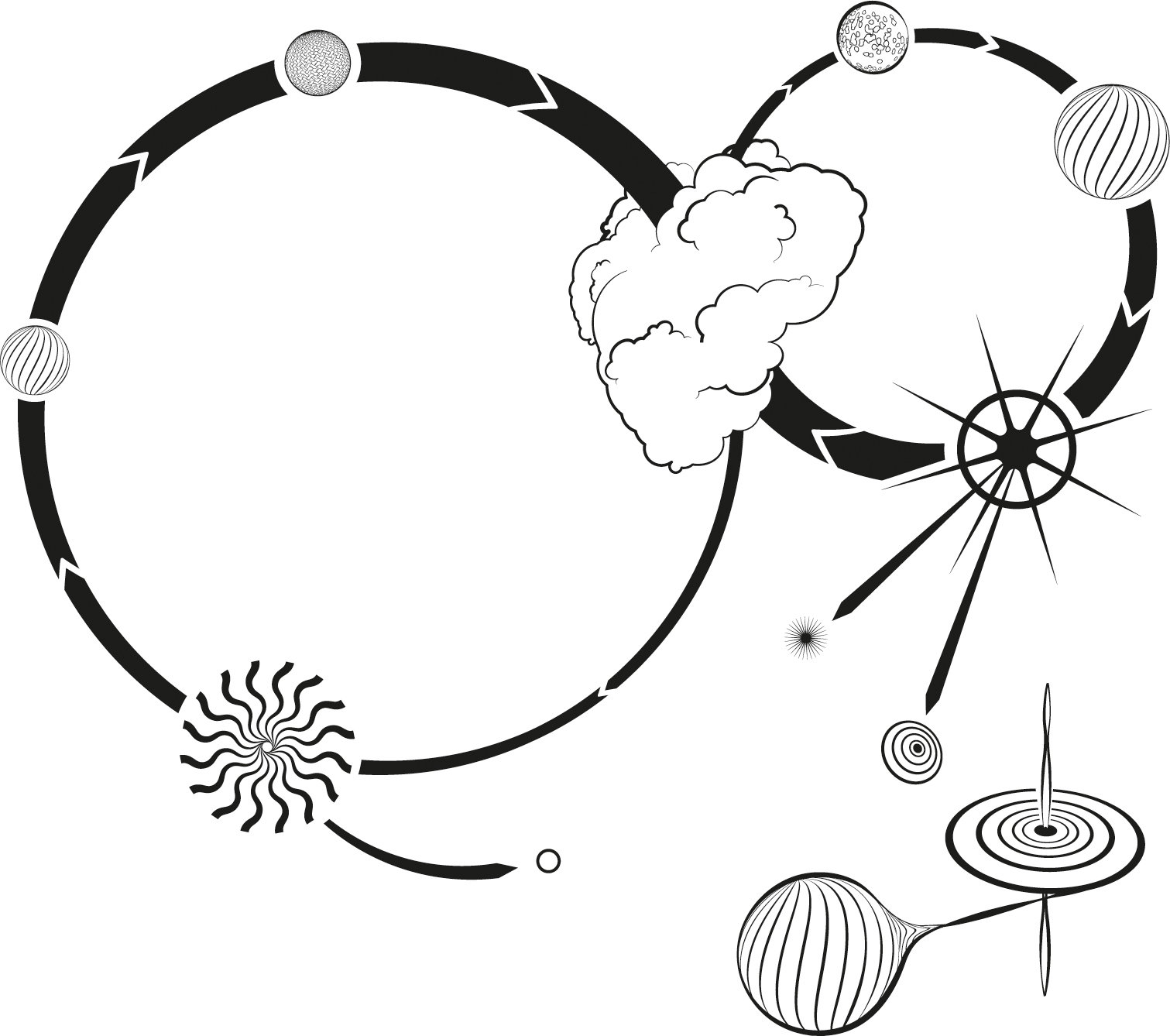
All stars originate in interstellar clouds, and much of their body cycles back to interstellar space when they die. Massive stars evolve and explode as supernovae, making black holes and neutron stars (right loop); less massive ones, like the Sun, make planetary nebulae and white dwarfs (left loop).
Dying stars
The way that a star dies differs from star to star principally because of the star’s size, or, more accurately, its mass. For humans, there is room to debate whether, as Neil Young sang in some versions of ‘Hey Hey, My My (Into the Black)’, ‘it’s better to burn out than to fade away’. Stars go one way or the other, according to their parameters (but have no opinion about which is better). Likewise, the age at which a star dies also differs from star to star. The more massive a star, the more nuclear fuel it has, so the natural expectation would be that massive stars live longer, but that is not, in fact, the case. The more massive a star, the more internal pressure it requires to support itself, and, while it is living, the star adjusts its temperature and density to provide a high pressure. The rate at which nuclear reaction occurs inside the star depends very strongly on temperature and density, so massive stars are very luminous.
In general, the less massive a star is, the longer it lives. Stars that are less than about 0.9 times the mass of the Sun can live for longer than the Universe has existed, so all of them that have ever been born are still alive (unless something unusual and catastrophic has happened). Stars between 0.9 and 8 solar masses last for many millions or even billions of years. Stars at 8 solar masses last for 30 million years. More massive stars live for even less time than that.
White dwarfs and Type Ia supernovae
A star like the Sun with a mass up to 8 solar masses turns into a red giant star towards the end of its life, burning the helium that it has produced in its core. The helium is transformed to carbon and oxygen. This phase of its life lasts perhaps a billion years. The red giant star sheds its outer layers as a so-called planetary nebula. The residual core of the star then quickly turns into a white dwarf star, with a mass typically of 0.6 solar masses but up to about 1.4 solar masses (the mass of the most massive white dwarf star so far discovered is 1.3 solar masses). Nuclear burning has ceased in such a star, which shines only by radiating the heat that it still contains from this earlier nuclear burning. It progressively cools, turning eventually into an all but invisible black dwarf.
White dwarfs take their time to transform into black dwarfs – probably none in our Galaxy have ever made it to this stage yet. The dimmest white dwarfs known have a cooling age of 9 billion years. They typically have come from stars originally of about 3 solar masses, which took about 300 million years to become white dwarfs. Looking on the oldest white dwarfs as having come from the oldest stars in the Galaxy, this puts the age of the Galaxy as 9.3 billion years, at a minimum.
There are billions of white dwarfs in our Galaxy: 95 per cent of stars end their lives in this way. However, although they are common, they are faint, so they are easily overlooked and none had been discovered until 1910. The first to be identified is called 40 Eridani B – the letter ‘B’ refers to the fact that it is the faint companion to the star 40 Eridani A, a binary star discovered by William Herschel (and further shown to be a triple).
Because it is in a binary system, it is possible to infer the mass of 40 Eridani B, which is not unusual and not very different to the Sun, at 0.6 times the Sun’s mass. On a routine visit to Harvard College Observatory, American astronomer Henry Norris Russell (1877–1957) from Princeton University pointed out to Observatory director Edward Pickering (see page 41) that 40 Eridani B was abnormally faint. They discussed the consequence that it must be rather small – small stars have less surface area from which to radiate light, do not radiate much and therefore are faint – 40 Eridani B would thus seem to be abnormally dense, which implied that the structure of the star was different from others. Russell mentioned that it would be useful to know the star’s temperature so that its size could be properly determined – the amount of light per unit area radiated by a star depends on its temperature, so dividing its total luminosity by the light radiated per unit area leads to an estimate of the star’s surface area and hence a more precise determination of its radius. The Harvard Observatory was in the middle of a project to find the temperatures of large numbers of stars. Pickering made a telephone call to his assistant, Scottish astronomer Williamina Fleming (1857–1911). Russell recalled that ‘in half an hour she came up and said “I’ve got it here…”. I knew enough, even then, to know what it meant.’
The temperature of the star was very high: it was ‘white’ hot. But it was also very dim, which meant that it was very small – a ‘dwarf’. Russell correctly surmised that the star was a similar size to the Earth, much smaller than the Sun or other similar stars although its mass was like theirs. The term ‘white dwarf’ for such a star was coined by Dutch-American astronomer Willem Luyten in 1922.
White dwarfs are extremely small and dense – a matchbox filled with white dwarf material would weigh 1 tonne – and the force of gravity at their surface is very strong. White dwarf material is extraordinarily incompressible since it has to withstand the tendency of the star to collapse under its own weight. In 1925, a young British physicist, Ralph Fowler (1889–1944), using the new science of quantum mechanics, discovered that this material is ‘degenerate’: all the electrons in the material are packed together as closely as is physically possible, stopped from getting closer by the laws of quantum mechanics. The pressure generated in the degenerate material resists the tendency of the star to collapse, even given the strong gravitational force that drags it down.
Fowler’s discovery was incorporated into calculations of the structure of white dwarfs by a nineteen-year-old Indian mathematician Subrahmanyan Chandrasekhar (1910–1995). In 1930, he was on an ocean liner sailing from India to Britain to study at Trinity College, Cambridge, passing the time on the cruise around the Cape of Good Hope by making relaxing astrophysical calculations (unlike most other passengers, one may safely guess). Chandrasekhar discovered the relationship between the mass and the size of white dwarfs – he found to his surprise that the more massive the star, the smaller its size. In fact, he found that there is a mass at which a white dwarf would be point-like. Above this mass, white dwarfs cannot exist, no matter how massive a star that they formed from. This limit is known as the Chandrasekhar mass and is about one and a half times the mass of the Sun.
A white dwarf star at the Chandrasekhar limit occupies just a point – an infinitely small volume, or in the language of mathematics, a ‘singularity’. If nature nears a mathematical singularity, it is heading towards a physical impossibility. Before the impossible is reached, nature diverts into some other realm. The new realm here is an explosion and, possibly, the creation of a black hole. Not everyone realized this at first. When Chandrasekhar presented his results to his colleagues in 1935, he was publicly ridiculed by the most distinguished astronomer in Britain at the time, Sir Arthur Stanley Eddington (see page 17), who called the result ‘stellar buffoonery’. Humiliated, Chandrasekhar abandoned his career in Britain and emigrated to the USA, where he worked at the University of Chicago for the rest of his life. His lifetime of achievement was recognized by the award of the Nobel Prize in Physics in 1983 ‘for his theoretical studies of the physical processes of importance to the structure and evolution of the stars’.
Rarely, a white dwarf is one member of a binary star system so compact that the white dwarf catches any material that floats off its companion. It gets more massive, and, in conformity with Chandrasekhar’s calculations, it gets smaller. It may accrete so much that eventually it collapses towards a small point. This scenario was proposed in 1973 by the American theoretician Icko Iben and the young British astronomer John Whelan to explain some extremely bright stellar explosions, those called Type Ia supernovae. The white dwarf’s collapse releases huge amounts of energy and triggers a thermonuclear explosion that destroys the white dwarf star.
An alternative idea that leads to the same result is that two white dwarfs might exist in a binary star. They might touch and merge, and head towards being a white dwarf star that is over the Chandrasekhar limit and too massive. This, too, might produce a Type Ia supernova.
The most famous Type Ia supernova was the first supernova observed scientifically. It was monitored by the extraordinary Danish astronomer Tyge Ottesen Brahe de Knudstrup, better known as Tycho Brahe (1546–1601). Tycho was a rich nobleman, who indulged his appetites and his interest in astronomy by applying both his own wealth and that of his king, Frederick II. He was notably eccentric and had a gold artificial nose, having lost part of his actual nose in a duel. He had a pet elk that died after falling, drunk, down a flight of stairs. After a change of royal rule in Denmark, Tycho lost financial support and spent his final years in Prague under the patronage of Emperor Rudolf. After a formal dinner there, he died after medical complications brought on from retention of urine, having been too embarrassed to excuse himself from the table. His monument in the Prague church in which he is buried shows him in armour, with a large moustache, his self-indulgence evident from his obesity and his jowls.
Tycho had taken up astronomy as a teenaged student and became obsessed by discrepancies in tables in his textbooks that gave the positions of planets and stars. With meticulous care he made sighting instruments that were the best possible at the time – pivoted arrangements of wooden rulers with sights and brass protractors to measure angles – and he set out to improve the data by making the most accurate measurements that he could. One evening in 1572, presumably after dinner, Tycho was driving home in his carriage and saw a group of peasants marvelling at something in the constellation of Cassiopeia. What he saw where they were pointing was a new bright star in the night sky. Tycho recorded his discovery in his book De Nova Stella (About the New Star), boasting about his familiarity with the stars and giving the original observers little credit in his story.
Where credit is certainly his due, it is that for over a year from his home at Herrevad Abbey, then in Denmark, Tycho repeatedly measured the position of the new star (now known as Tycho’s supernova) and proved that it did not shift its position in the slightest relative to other stars in the constellation. The significance of this was that, if a star was close by, it would shift its position as the Earth rotated and took Tycho from one side of the planet to the other. The star had to be at a distance well beyond the orbit of the Moon: it had, in fact, to be a star, not a meteorological phenomenon, as was thought at the time about any celestial object that changed (for example, had been invisible and then appeared).
Tycho and others also made assiduous measurements of the brightness of the star from its sudden appearance on about 1 November 1572 until it faded below naked-eye visibility in the spring of 1574. The observations that were made compared the brightness of the new star with other fixed stars, and it has been possible to use these comparisons to show accurately how the star’s brightness changed. The plot of the changes has a characteristic shape, the same as modern light curves of Type Ia supernovae.
Although it has long faded from view, the spectrum of Tycho’s supernova was obtained in 2008 by the National Astronomical Observatory of Japan’s 8.2-metre (320-inch) Subaru Telescope on Mauna Kea, Hawaii. The flash of light from the supernova is being reflected from a screen of dust in the Milky Way off to the side of the direct journey from the supernova to us, taking an extra 436 years to travel the greater distance of the diverted journey. The reflection had been discovered after a targeted search by the 4-metre (150-inch) Mayall Telescope at the Kitt Peak National Observatory in Arizona. So, as well as the light curve, the spectrum also proved that the type of Tycho’s supernova was due to a thermonuclear explosion of a white dwarf star.
In 2004, the probable truth of Iben and Whelan’s scenario was proved by a team led by Spanish astronomer Pilar Ruiz-Lapuente, who discovered the companion star released by Tycho’s supernova. Ruiz-Lapuente used the 4.2-metre (165-inch) William Herschel Telescope on La Palma in the Canary Islands to identify the star, Tycho G, confirming her discovery with the Hubble Space Telescope. The companion star to the white dwarf, the one that donated the extra material, had been released at high speed like a stone from a slingshot, as if the white dwarf holding it in orbit had disappeared – which effectively it had. The companion star was a rather ordinary star, similar to our Sun, identified as of interest because it was moving at the expected high speed away from the position of the supernova.
Neutron stars, pulsars and Type II supernovae
The Swiss-American astronomer Fritz Zwicky (see page 26) and his German-American colleague Walter Baade (see page 122) coined the term ‘supernova’ in 1934. The Latin word nova, meaning ‘new’, had been used historically in astronomy for a new star, and Zwicky and Baade did indeed see bright stars appear in other galaxies suddenly and without warning, as if new. For a few days, they outshone the light from all the rest of the billions of the stars in the galaxy put together. They were thus highly energetic outbursts, which merited adding the prefix ‘super’ to make the word ‘supernova’ to describe what the two astronomers had seen. The new stars faded away as the explosions dissipated.
As described above, Type Ia supernovae are collapses of white dwarfs, the corpses of stars like the Sun that lived and died in previous generations. There are other kinds of supernovae – Type II – that are collapses of the core inside a living, massive star. By far, most stars end their lives as white dwarfs, but not the rarer, more massive ones that are more than about eight times the mass of the Sun.
If a larger star with too massive a core tries to create a white dwarf, it cannot – the putative white dwarf star implodes. The energy that the collapse releases blows off the outer layers of the star in a fierce explosion. These layers contain chemical elements that have been generated by the nuclear processes that have been powering the star, so the ejected material contains large amounts of helium, carbon, oxygen and other elements that were in the star, as well as the elements manufactured in the explosion itself, like iron and nickel. This material forms a large shell around the site of the explosion, which collides with interstellar material all around. The collision heats the ejecta and the free electrons in space to make it a source of not only light but also X-rays and radio waves – a ‘supernova remnant’. It remains visible in space for thousands of years until it dissipates.
Supernovae occur once every few decades in a galaxy like ours, but we miss seeing most of them – they occur in stars that are behind opaque curtains of interstellar dust. There are historical records of six supernovae in our Galaxy in the last thousand years. The supernova of 1054 was noted by Chinese astronomers and depicted on the Bayeux Tapestry, which records the invasion of Britain in 1066 by Duke William of Normandy. This supernova produced not only an outrushing nebula, called the Crab Nebula (pl. XI), but also an energetic star, the stellar remnant of the supernova and a pulsar, which was discovered in 1968 by American astronomers David Staelin and Edward Reifenstein at the National Radio Astronomy Observatory in Green Bank, West Virginia.
The term ‘pulsar’ is a blended neologism from the phrase ‘PULSating radio stAR’, which describes a star that emits pulses of radio waves. The first of these stars were identified with a radio telescope in 1967 by British astrophysicist Jocelyn Bell (b. 1943) during her PhD project at the University of Cambridge. She was being supervised by Antony Hewish. Hewish, but not Bell, was awarded the Nobel Prize in Physics in 1974 in a story of scientific recognition that is seen as reminiscent of the case of Annie Maunder (see page 155). The astonishingly regular radio pulses of pulsars seemed artificial, so, although they were manifestly in interstellar space, Bell’s colleagues half-seriously contemplated whether they were communication devices that extraterrestrial space travellers had placed as an Interstellar Positioning System, an IPS like our GPS. In fact, they proved to be tiny, rotating stars, spinning rapidly, sometimes in much less than a second, beaming out radio waves that sweep across the Earth on each rotation. The Crab Nebula pulsar rotates thirty times each second.
The stars that form the basis for pulsars are somewhat similar to white dwarfs but are one hundred times smaller, perhaps 12 kilometres (7½ miles) in radius – the size of a ring road around a city, not, as are white dwarfs, the size of the entire Earth. Pulsars are made of neutrons and are a type of neutron star, which are produced by the collapse of the core of stars that are between about eight and perhaps thirty times the mass of the Sun. Like white dwarfs, neutron stars have a mass comparable to the Sun. As previously noted, a matchbox full of white dwarf material weighs 1 tonne; a similar quantity of neutron star material weighs 1 million tonnes.
Tiny neutron stars are somewhat difficult to find in the vastness of space, but they help to call attention to themselves by shouting ‘Look at me!’ in different ways: pulsars radiate radio waves; other neutron stars radiate X-rays. If a star is in orbit around a neutron star, the star may, as it ages, swell up to a giant and leak. Some gas will fall onto the neutron star and will be compressed by a strong force of gravity. Just as air compressed in a bicycle pump gets hot, so too does this gas get hot – to temperatures in excess of a million degrees, emitting X-rays. Scorpius X-1, the first stellar X-ray source discovered in the constellation of Scorpio in 1967 by Italian-American astrophysicist Riccardo Giacconi, who was awarded the Nobel Prize in Physics in 2002, is a neutron star in such a binary star system.
Stellar black holes
White dwarfs are stars that are the basis of Type Ia supernovae. Neutron stars are created from Type II supernovae, but they are not the only possible product. A star more massive than those that formed neutron stars and whose core collapses as a supernova produces a black hole. Black holes originating in this way have masses measured in solar masses, not millions or billions of solar masses, so, in order to distinguish them from supermassive black holes (see page 66), they are termed ‘stellar black holes’.
Isolated stellar black holes are dark stars that drift invisibly in interstellar space. They show themselves if matter (gas) falls into them from something nearby. In such a case, the gas releases gravitational energy, which heats the gas, perhaps to millions or tens of millions of degrees. This can happen if the black hole has a companion star that leaks gas onto it: the black hole becomes visible as an X-ray binary star.
X-ray binary stars are pairs of stars, each orbiting around the other, so close that their orbital period is short (minutes to days). One component is a more-or-less normal star. The other is a star much smaller in size (but not in mass) like a black hole. The normal star transfers matter (gas) onto its compact companion via an accretion disc: matter spirals inwards and falls onto the black hole. The matter is squashed as it falls into the throat of the black hole and gets hot. The first such black hole was discovered in 1971 in the X-ray source Cygnus X-1; about twenty are now known.
Gravitational wave events: binary neutron star and black hole mergers
When a binary star revolves, the gravity around it changes, sending ripples through space at the speed of light. These ripples are called gravitational waves and are a feature of Einstein’s general theory of relativity (see page 16). They are emitted from anything in which the distribution of mass changes. They are very weak, even from something the mass of a star, and were first detected in 2015 by two exquisitely sensitive instruments, operated together as the Laser Interferometer Gravitational-Wave Observatory (LIGO). There were, however, earlier signs that gravitational waves exist, convincing enough to determine the specification of the instruments, develop their technology and gather the finance to make them.
The effects of gravitational waves were discovered even as long ago as the late 1970s, from studies of the orbits of binary neutron stars. The first of them, B1913+16, was discovered by American physicist Russell Hulse (b. 1950) and his PhD supervisor American astrophysicist Joseph Taylor (b. 1941) in 1973 with the Arecibo Observatory’s 305-metre (1,000-foot) diameter radio telescope in Puerto Rico, which, alas, collapsed in 2020 following damaging hurricanes. Its significance for general relativity was immediately realized. It was a Nobel Prize-winning discovery, awarded to both scientists in 1993 ‘for the discovery of a new type of pulsar, a discovery that has opened up new possibilities for the study of gravitation’.
The Hulse-Taylor binary pulsar is in a small, high-eccentricity, short-period (eight-hour) orbit around a second neutron star. Its pulses arrive early or late according to whether the pulsar is on the near side or far side of its orbit. The timing discrepancies make it possible to map the orbit very precisely and to see how general relativity causes changes. In fact, after only two years, while Hulse was writing up his thesis in 1975, the effects of general relativity had been first seen in the pulsar timings. By 1980 it was possible for Taylor to see the full effect of the gravitational waves that the pulsar emits. The loss of energy from the system, as the gravitational waves radiate away, causes its orbit to shrink by 1.5 centimetres (0.6 inch) every orbit, so it has shrunk by 1 kilometre (0.6 mile) since it was discovered.
Further binary pulsars have been discovered and monitored since the Hulse-Taylor pulsar. In none of these cases has it been possible to measure gravitational waves themselves, only the effect of the leakage of energy from the stars’ orbits due to gravitational waves. The calculations of general relativity fit amazingly well, to an accuracy much more precise than 0.1 per cent. This degree of certainty about gravitational waves inspired LIGO.
LIGO, which made the first direct detections of gravitational waves, is two instruments in Hanford, Washington, and Livingston, Louisiana, working in conjunction with a similar detector near Pisa in Italy, called Virgo. A fourth detector, the Kamioka Gravitational Wave Detector (KAGRA) in Japan, came into operation in 2020. Having multiple detectors distributed globally makes it possible to distinguish celestial events from local disturbances, like Earth tremors. Moreover, as the gravitational waves sweep through the Earth they arrive at the detectors at successive moments, which enables the scientists to estimate the direction from which the gravitational waves have come. The line of travel of the gravitational waves tracks back towards their origin.
The principle used by the instruments is to measure with a laser the distance between two freely hanging pendulum mirrors, operating as an optical interferometer. The passage of gravitational waves causes the mirrors to bob like corks on the sea, changing their separation. That alters the optical pattern in the interferometer. On 14 September 2015, LIGO saw its and the world’s first detected gravitational wave event. It proved to be gravitational waves from two merging black holes. In 2017, the Nobel Prize in Physics was awarded to Americans Kip Thorne, Rainer Weiss and Barry Barish for their role in making the first detections: Thorne is an expert in the theory of gravitational waves; Weiss invented the laser technique used by the LIGO interferometers; and Barish led the project to make and use them.
The first event, GW150914 (‘GW’ to denote a gravitational wave event; the number is the date the event was seen, in YYMMDD format) was only two-tenths of a second in duration. The two black holes circled each other in their final orbits, quickly spiralling inwards with their orbital speed increasing. The gravitational waves made a ‘chirp’, with their frequency increasing from 35 revolutions per second to 250 per second, following the decrease of the orbital period as the two black holes got closer. The two black holes touched and merged into one. The resulting black hole oscillated afterwards for a few hundredths of a second.
The two black holes in this event were thirty-five and thirty times the mass of the Sun; when they merged, they produced a black hole of a mass sixty-two times the Sun’s. Three solar masses had gone missing. This mass had been converted to the energy of the gravitational waves, through the E = mc2 equation, and radiated away. The merger took place in a galaxy at a distance of 1.5 billion light years. Diluted by being spread out on the surface of a sphere of that radius, a minute fraction of this energy had been responsible for moving the pendulum weights in LIGO. Later gravitational wave events have been up to ten times farther away, so a large fraction of black hole mergers in practically the entire Universe lies within range of the gravitational wave detectors – with the proviso, of course, that the merger event takes place at the right moment and at the right distance so that the gravitational waves travel to arrive when the detectors are operating.
The signature of gravitational waves from the mergers was precisely what had been expected, which made analysis of the observation straightforward – the way to do it had all been well worked out, discussed openly for years and agreed in the community beforehand. This must have contributed to the speedy response of the Nobel Prize committee and the short interval between discovery and award. In that time (fifteen months) a dozen further events had been logged and all but one were mergers of black holes.
What was unexpected was that the black holes were so massive – not supermassive but more than stellar. Black holes in a binary star system (it had been understood) come from supernova explosions of the progenitor stars. Cutting a long story short, astronomers believed until then that only smaller black holes could be the result of a supernova and were expecting that they would see merging black holes with masses in the range of 5–20 solar masses, not the 30–50 solar mass range that has transpired. There must be something that astronomers do not understand – but what? The answer is a discovery yet to be made.
Nearly all the events seen (numbering well over fifty up to 2020) have been black hole mergers. A handful have been mergers of one neutron star with another, and one the merger of a neutron star with a black hole. The first neutron star merger event, GW170817, took place in 2017. The two neutron stars spiralled into each other over a period of nearly two minutes, the frequency of each revolution increasing from 24 revolutions per second to about 300. The merger seemingly produced a neutron star of up to about 3 solar masses. Considering that neutron stars can survive only if their mass is less than 2 solar masses, that meant that this new one was hypermassive and doomed. There are signs that it quickly collapsed to a black hole – the merged neutron star was just a step on the way to oblivion.
It is conceivable that just as neutron stars merge, white dwarfs might also merge to create a white dwarf star that is temporarily more than the maximum mass it can usually be. It, too, would then quickly collapse to a black hole. Such an event would look like an extra-energetic Type Ia supernova. This is a model for Type Ia supernovae that is an alternative to Iben and Whelan’s model described on page 165. There is a star known as WDJ0551+4135 that appears to be the result of the merger of two white dwarfs into one. Its mass is 1.14 solar masses and it just missed out on exploding as a Type Ia supernova. By contrast, there have been Type Ia supernovae that were abnormally bright and the reason why might be that they were outbursts caused by merging white dwarfs too big to survive.
Black hole mergers themselves produce no significant light, radio wave or X-ray energy, but neutron star mergers splatter about material that picks up energy from the event and radiates in ways that optical, radio and X-ray telescopes can see. Two seconds after the gravitational wave burst from the GW170817 event, a short gamma-ray burst (two seconds in duration) was detected by the Fermi Gamma-ray Space Telescope and INTEGRAL (the INTErnational Gamma-Ray Astrophysics Laboratory) spacecraft. Gamma-ray bursts are labelled with letters and date numbers using the same convention as gravitational wave events, so GW170817 was quickly followed at the same place by a burst of gamma rays, GRB170817. The date designations are identical because the two events were almost simultaneous, within seconds of each other. Eleven hours later, a new, transient point source of light was found in a galaxy during a search of the region indicated by the gravitational wave detectors and the gamma rays.
An event like this is called ‘multi-messenger’ because the astronomical information is conveyed by several sorts of radiation detected by different kinds of telescope. Each radiation brings a different opportunity for an investigation, which, taken altogether, can provide the most complete picture of what happened. It is a challenge to take advantage of the opportunities offered by multi-messenger events because they take place without warning, anywhere in the sky, at any time. They are often transient, fading away in seconds or, usually at most, days, so there might be very little time for each telescope crew to get their act together. To reap the evident advantages, astronomers have tried to organize themselves into groups for multi-messenger studies, coordinating their equipment in order to observe transients. They have constructed observing networks ranging in complexity from two telescopes mounted on the same satellite and pointing in the same direction, to global networks of dozens of telescopes.
In a global network, an event detected by one telescope triggers its fellow telescopes to start their investigations. NASA’s space telescope, the Neil Gehrels Swift Observatory launched in 2004, is studying gamma-ray bursts and has an autonomous system on board to detect bursts. It issues an alert within seconds that triggers other telescopes to interrupt whatever they are doing, to slew to point to the position of the burst and to bring their capabilities to bear. Of course, there are uncontrollable natural environmental circumstances that may upset plans – having a space telescope located on the wrong side of the Earth at the critical moment or having a ground-based telescope languishing under thick cloud are two common setbacks.
The phenomenon that was GW/GRB170817 lasted in its entirety for a sufficient length of time that it was successfully monitored by seventy telescopes, joining in one after another to observe with radiations from gamma rays to radio wavelengths. The gamma-ray, ultraviolet, optical, infrared and radio sources faded mostly away over the hours, days and weeks that followed the gravitational wave detection, with some unexplained weak radiations seen even two and a half years later. The event proved to have taken place in the elliptical galaxy NGC 4993, 130 million light years away. The X-ray, light and radio radiations were from an exploding, rapidly cooling cloud of material, debris ejected from the neutron star merger from which the gravitational waves and the gamma rays were emitted. The phenomenon is known as a kilonova.
The afterglow of the gamma-ray burst GRB170817 was powered by the radioactive decay of heavy nuclei generated in the event. Kilonovae produce half the chemical elements heavier than iron in the Universe, approximately 16,000 times the mass of the Earth in each event. Heavy elements include gold and platinum; it is intriguing to look at a piece of gold and platinum jewelry, like a ring, and imagine the time chain of the creation of its elements in the violence of a kilonova, their travel through interstellar space into the solar nebula and the Earth, and then the geological and human processes that brought them to your third finger. Without kilonovae to make them, these elements would be even more uncommon and valuable than they actually are.
Gamma-ray bursts
The gamma-ray burst seen from GRB170817 was a type of explosion first detected in the 1960s by US military satellites called Vela spacecraft. The 1960s was a tense time during the Cold War between the Western allies led by the USA and the Eastern bloc led by the then Soviet Union (the USSR, now the Russian bloc). Each side was developing nuclear weapons, and tests carried out on the surface of the Earth were generating dangerous nuclear fallout, which drifted around the world, troubling the innocent. The Partial Test Ban Treaty was signed in 1963, which banned tests of nuclear weapons in the atmosphere, in space and under water (but permitting underground tests). To monitor compliance, in 1967 the USA launched a constellation of Vela satellites. They were designed to detect gamma rays in short bursts, as emitted by nuclear weapons. To everybody’s amazement the satellites immediately saw gamma-ray bursts at a frequency of about once per day, far too many to be due to nuclear tests. For reasons of military security, this information was not generally released until 1973. The bursts came from random directions in space, and it became obvious that they were natural celestial phenomena.
As explained above, celestial gamma-ray bursts are given a date number starting with the year, followed by the month and day. If, rarely, there is more than one burst in a given day, a subsequent letter is added – A, B and so on. Each burst lasts between a few thousandths of a second to, typically, several minutes. The bursts fall into two groups: short bursts with an average duration of one-third of a second, and long bursts with an average duration of about half a minute, although they may last for more than a couple of hours. The bursts, particularly the longer ones, are often followed by an ‘afterglow’ – a source of light and radio waves suddenly appears and then slowly fades away.
A short burst of 0.3 seconds’ length must come from something that is less than 0.3 light seconds long. Otherwise, it would be blurred out into a longer pulse by the light travel time between the front and back of whatever it is that is flashing (0.3 light seconds is 100,000 kilometres/60,000 miles, only a few times the size of the Earth). The origin of the short bursts as two merging neutron stars was uncovered by the study of GRB170817, as described above.
The longer bursters are probably from ‘naked’ supernovae. These events are due to the collapse of a star that has, in the course of its earlier evolution, shed its outer layers to such a depth as to expose its core. The collapse of the core of a Type II supernova to a black hole always generates gamma rays, but usually they are absorbed by the outer body of the star. If that outer body is missing, the supernova is naked and the gamma rays are able to flow into space, because there is nothing to stop them. The gamma-ray bursts sometimes flare repeatedly in complicated and apparently random patterns. This phenomenon is thought to relate to lumps of material ejected by the supernova falling back and being eaten by the new black hole.
The connection between long bursters and core-collapse supernovae was proved when examples were found with a gamma-ray burst and a radio-wave and light afterglow all in coincidence. The afterglows were often seen to be located in galaxies, at great distances. This proved just how energetic the events were, each releasing an amount of energy comparable to a supernova. In fact, at face value, it seemed that they release hundreds of thousands of times more energy than a supernova, hence the alternative name for this phenomenon: ‘hypernova’. The energy calculation was ramped down, however, when it was realized that the gamma radiation was beamed. We see gamma rays from a burst only if we on Earth are in the brighter part of the beam. If we think this bright part is typical, we consequently greatly overestimate the total energy being produced. Nevertheless, even if hypernovae are not as powerful as was once thought, they are hundreds or thousands of times more powerful than supernovae. Gamma-ray bursts are the most powerful stellar explosions known in the Universe. Only events associated with supermassive black holes, on a galactic scale, are bigger. Since we do not see gamma-ray bursts unless we are in the beam, most of them are missed and only about one burst per day is seen. For every one observed, there are five hundred more.
The light and radio-wave afterglows are caused by the stimulation of interstellar material that surrounds the progenitor star by jets that are the channels through which the energy of the hypernova is released. That interstellar material differs in its amount and distribution from location to location and thus the afterglow shows different behaviour from event to event.
The most powerful gamma-ray burst recorded is GRB080916C, which was detected on 16 September 2008 by the Fermi Gamma-ray Space Telescope. It released the energy of approximately six thousand Type Ia supernovae. It was 12 billion light years away, in a galaxy identified a few hours after the burst with a dedicated multi-messenger telescope – the Gamma-ray Burst Optical/Near-infrared Detector (GROND) attached to the 2.2-metre (90-inch) telescope at the European Southern Observatory’s site at La Silla, Chile.
All these events from different types of dying stars are very powerful. Their energy derives from the release of potential energy from the mass of a star as it collapses to become a neutron star or black hole. This energy is in the region of 1044–1046 joules, which radiates outwards into the Universe, in different forms and for a variable length of time depending on the exact circumstances of the explosions. This is a lot of energy, equivalent to that radiated by the Sun in its entire lifetime of 10 billion years or so. At just a few seconds, however, the explosion of a gamma-ray burster is brief so that all the energy is concentrated into a short, powerful burst.
If the energy of collapsing stars or merging black holes is not absorbed by something surrounding them, the burst travels for billions of light years and penetrates as a detectable amount into a significant fraction of the Universe. Mergers of stellar black holes are the most powerful such events. The flow of their gravitational wave energy is almost unimpeded by anything, and produces an event that we can see from a distance of 10 billion light years, which we could loosely describe as being on the other side of the Universe. These are the biggest bangs since the Big Bang.