
Unlike our civil calendar which is purely solar and the Islamic calendar which is purely lunar, the Christian ecclesiastical calendar depends on both the Sun and the Moon. Initially, the problem was complicated by differences between the various Christian Churches concerning the extent to which Jewish practices should be followed. Jewish law ordained that the Paschal Lamb must be slaughtered on the fourteenth day (beginning at nightfall) of Nisan, the first month of the ecclesiastical year, which began in the spring. According to the Gospels of Matthew, Mark, and Luke, since Christ was the true Paschal Lamb the Last Supper occurred on the day of the Jewish Paschal Feast, but according to John's Gospel that was the day of the crucifixion. A further complication was that the Jewish Feast could occur on any day of the week, whereas most Christians eventually wished the day of the Resurrection (two days after the crucifixion) to be on a Sunday. Only those in Asia Minor adhered to a definite date of the Jewish calendar, and as a result were called Quarto- decimans. This Paschal controversy first became a matter of general concern in the second century and led Polycarp, Bishop of Smyrna, to visit the Roman Pope Anicetus in the year 158. They agreed that each should adhere to his own practice. Forty years later a much more bitter controversy occurred between the Roman Pope Victor and Polycrates, Bishop of Ephesus, but eventually peace was restored by the Bishop of Lyons, Irenaeus.
Overshadowing these doctrinal differences, however, the determination of the relevant dates was complicated by the use of different methods of calculation, so that by the beginning of the fourth century important centres of Christianity such as Rome and Alexandria were celebrating Easter at very different times. At the request of the Emperor Constantine, the question was considered by the Council of Nicaea in the year 325. Unfortunately, the records we have of that Council are largely silent on this important issue, but later the same century Ambrose, Archbishop of Milan, in a letter that has survived, wrote that the Council had decreed that the western practice should prevail, so that Easter must be celebrated on the Sunday following the first full moon after the spring equinox. This Sunday was chosen so as to ensure that Easter never coincided with the Jewish Passover. The Quartodecimans refused to accept this decision and their practice continued in Asia Minor until the sixth century. The expression 'full moon' in connection with Easter means the ecclesiastical full moon, that is, the fourteenth day of the moon reckoned from the day of the first appearance of the moon after conjunction. The actual determination of this was referred to the astronomers of Alexandria, who alone were technically competent to deal with it.
According to Eusebius ( Church History, vii. 32), Anatolius, Bishop of Laodicea, had already begun using the Metonic cycle for determining Easter c. 277. This method was adopted in Alexandria, with the equinox taken to occur on 21 March, instead of 19 March as Anatolius had assumed. Eusebius mentions ( Church History, vii. 20) that Bishop Dionysius of Alexandria had previously proposed a rule for Easter based on an 8-year cycle. This corresponds to the third convergent of the continued fraction for the number of months in the year, that is,
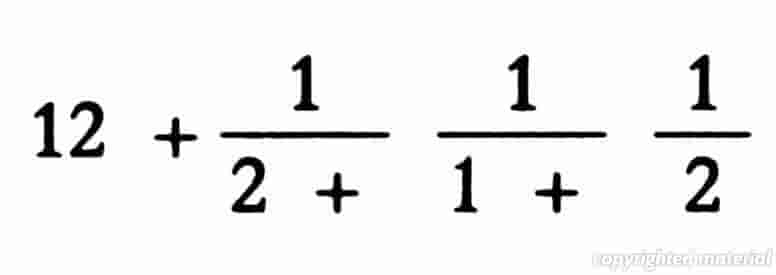
from the formula in Appendix 2, which is equal to 99/8. It implies that there are approximately 99 lunations in 8 years. This is the octaeteris cycle referred to by Geminus (p. 45). Later, Victorius, Bishop of Aquitaine, introduced (c. 457) a new cycle combining the Metonic cycle of 19 years with a solar cycle of 28 years (28 being the product of 7, the number of days in the week, and 4, the number of years in the leap year cycle) so as to produce a new cycle of 532 years for Easter. This came to be called the 'Dionysian period', because it was used by the Roman abbot Dionysius Exiguus in constructing the Easter tables that he calculated at the command of the emperor Justinian in the sixth century. Dionysius himself produced Easter tables only for the period 532 to 627, but later Isidore of Seville (c. 560-636) continued them until 721. In the eighth century Bede completed this 532-year cycle by calculating tables down to the year 1063. The calculation of Easter was called the computus.
In the West regional differences in the dating of Easter ceased by the end of the eighth century, but by the thirteenth century the divergence of the spring equinox from 21 March began to be a cause for concern, since it then amounted to seven or eight days. This divergence was pointed out by, among others, Sacrobosco ( John of Holywood, fl. 1230) in his De anni ratione, and by Roger Bacon (c. 1219-92) in his De reformatione calendaris, transmitted to the Pope. Nevertheless, it was not until 1474 that Pope Sixtus IV invited the leading astronomer of the day,
Regiomontanus, to Rome for the reconstruction of the calendar. His premature death delayed further action, and so it was not until 1582 that the more accurate Gregorian calendar replaced the Julian calendar.The Julian calendar was based on the inaccurate assumption that the tropical year is exactly 365.25 days. The other inaccurate assumption that affected the determination of Easter and the Church calendar was that, according to the Metonic cycle, 235 lunations are exactly equal to 19 Julian years. By 1582 the error in the lunar cycle from this cause amounted to about four days so that the fourteenth day of the Church calendar moon was the eighteenth day of the actual mean moon. A method of calculation was suggested by Aloisius Lilius which involved abandoning the Metonic cycle and replacing the Golden Number by the Epact. The term 'Golden Number' was coined to indicate the place which any year occupies in the Metonic cycle, that is, the age of the moon on a given date, because the Greeks are said to have inscribed these numbers in gold on public pillars. For years AD the rule for obtaining this Number is to add one to the number of the particular year concerned, for example 1582, and find the remainder on dividing by 19, with the additional proviso that when this remainder is zero the Golden Number is taken to be 19. Because the Golden Numbers were only adapted to the Julian calendar, Lilius in his proposed reform of that calendar used Epacts instead, an 'Epact' being the whole number denoting the lunar phase, that is the age of the calendrical moon, on a definite date, for example, 1 January. Following this method, the Papal astronomer Christopher Clavius computed new tables for the determination of Easter according to the Gregorian calendar.Nowadays it is not necessary to appeal to the Clavius tables in order to determine the date of Easter, because in 1800 an elegant mathematical formula for this purpose was devised by the great German mathematician Carl Friedrich Gauss ( 1777- 1855). Previously, a set of mathematical rules of the same general character was devised by Thomas Harriot ( 1560- 1621) but was never published. (Like much of Harriot's scientific work, it has only come to light in recent years.) Gauss's rule, when applied to any year in the present century written as 1900 + N, can be stated as follows:
|
1. |
calculate the remainders a, b, and c, when N is divided by 19, 4, and 7, respectively; |
|
2. |
calculate the remainder d, when 19a + 24 is divided by 30; |
|
(3) |
calculate the remainder e, when 2b + 4(c - 1) + 6d is divided by 7; |
|
(4) |
if the sum d + e does not exceed 9, Easter occurs on the day in March given by d + e + 22, but if d + e exceeds 9, Easter occurs on the day in April given by d + e - 9. |
For example, for the year 1988, we have N = 88, a = 12, b = 0, c = 4, d = 12, e = 0, and hence Easter falls on 3 April.
Unfortunately, Gauss's neat solution fails to give correct results for some years after 4200, and so in 1817 the problem was further inves- tigated by the French astronomer Jean-Baptiste Delambre ( 1749- 1822). Sixty years later a thorough re-examination of the problem was made by Samuel Butcher, Bishop of Meath.1 In 1876 a New York correspondent had sent, without proof, to the weekly scientific periodical Nature a rule for the determination of Easter which, unlike Gauss's rule, is subject to no exceptions.2 Butcher showed that this rule followed from Delambre's analytical solution. For any given year n the rule is as follows:
|
Divide |
By |
Quotient |
Remainder |
|
n |
19 |
a |
|
|
n |
100 |
b |
c |
|
b |
4 |
d |
e |
|
b + 8 |
25 |
f |
|
|
b - f + 1 |
3 |
g |
|
|
19a + b - d - g + 15 |
30 |
h |
|
|
c |
4 |
i |
k |
|
32 + 2e + 2i - h - k |
7 |
l |
|
|
a + 11h + 22l |
451 |
m |
|
|
h + l - 7m + 114 |
31 |
p |
q |
The number of the month in which Easter falls is given by p and the day of the month by q + 1. For example, for the year 1988 this calculation yields p = 4, q = 2, and hence we conclude that Easter Day that year is 3 April. The earliest day on which Easter can occur is 22 March and the latest 25 April. Uspensky and Heaslet provide an elementary mathematical discussion of calendrical problems, including the calculation of Easter.3