
Part III
The invention of the verge escapement
In antiquity the only mechanical (or, more strictly speaking, quasi- mechanical) instruments for recording the passage of time were water-clocks. The fundamental difference between water-clocks and mechanical clocks, in the strict sense of the term, is that the former involve a continuous process, for example, the flow of water through an orifice, whereas the latter depend on a mechanical motion that continually repeats itself and so divides time uniformly into discrete segments. Many of the ancient water-clocks were instruments of considerable complexity, particularly as they were designed to indicate hours which varied throughout the year. Although there were no mechanical clocks in antiquity, mechanical models appear to have been constructed to reproduce the relative motions of the heavenly bodies. Writing in the first century BC, Cicero ( De republica, I. xiv. 22) referred to one invented in Syracuse by Archimedes ( 2 87)-212 BC). We know nothing about the gearing devices involved, but the associated mathematical calculations may have been contained in a lost treatise of Archimedes On sphere- making, that is on modelling the heavens. One remarkable Hellenistic geared mechanism, however, has survived from the first century BC. It was discovered in 1900 in the wreck of a Greek ship near the barren islet of Antikythera, off the south coast of Greece. In 1974, D. J. de Solla Price reported on the results of X-ray and gamma-ray radiography of the corroded remains of this bronze mechanism and concluded that it was a calendrical computing device.1 It appears to have included means of determining the positions of the sun and moon in the zodiac, and it involved an assembly of wheels with fixed gear-ratios for the mechanization of the Metonic cycle, in which 19 solar years correspond to 235 lunar months (see Appendix 2). According to our present knowledge, this machine was the nearest the artificers of antiquity came to inventing a truly mechanical clock.

Fig. 2 Reconstruction of the Antikythera geared mechanism.This is a diagram of the differential gear assembly of the Antikythera mechanism as reconstructed by D. J. de Solla Price from the four surviving heavily corroded bronze fragments, which appear to contain the remains of 31 gear wheels. From the respective numbers of teeth in these remains, he claimed that the function of the instrument was calendrical, since it seemed to him that in the complete mechanism the numbers 19 and 235 of the Metonic cycle (Appendix 2) were involved. It is possible that this mechanism formed part of a collection of 'spoils of war' that was being conveyed by sea to Rome following the sack of Athens by Sulla's troops in 86 BC.
Until recently the Antikythera mechanism was thought to be the sole surviving example of mathematical gearing in the Hellenistic tradition. However, in 1983 four fragments of a geared instrument of early Byzantine origin, probably made during, or just before, the reign of Justinian I ( 527-65), were acquired by the Science Museum, London.2 It has been possible to reconstruct the complete instrument, which was a brass portable sundial with a geared calendar that showed the approximate shape of the moon and its age in days and may also have shown its position and that of the sun in the zodiac. Two of the fragments involve gears of fifty-nine and nineteen teeth and of ten and seven teeth, respectively. These correspond to parts of a mechanical calendar described by the Persian scientist al-Biruni ( 9 73)- 1048) about the year 1000. A practical link has thus been revealed between the Hellenistic tradition of mathematical gearing and the medieval Islamic. The only surviving example of the latter is a calendrical mechanism yielding the shape and age of the moon in days and the positions of the sun and moon in the zodiac. It is attached to a Persian astrolabe of the early thirteenth century now in the Museum of the History of Science at Oxford. The earliest surviving gearing from the Latin West is attached to a French astrolabe of about 1300, now in the Science Museum, London.
Although no definite links have yet been discovered between the first mechanical clocks and earlier geared astronomical models and automata, the way in which a surviving late fourteenth-century clock such as that of Wells Cathedral displays the phases of the moon and figures which emerge at successive hours suggests that such clocks were the product of a continuing tradition from the distant past. There is also textual evidence to support this view. Nevertheless, the actual origin of the mechanical clock remains a mystery, although it probably occurred towards the end of the thirteenth century.
Early that century the market for water-clocks was such that a guild of clockmakers is known to have existed in Cologne who by 1220 occupied a special street, the Urlogengasse, or Clockmakers Street.3 Since, in northern climes, water-clocks must have been a nuisance in winter when they froze, in the fourteenth century sand-clocks were invented. This invention was made following the introduction of a new and finer 'sand' made of powdered eggshell. Coarse sand cannot be used for this purpose, because it soon enlarges the hole through which it flows. Sand-clocks proved suitable only for measuring short periods. They were principally used on board ship to measure its speed by counting the number of knots paid out on a line tied to a log floating astern, while the sand-glass measured a given time that was usually half a minute. They were also used for timing the length of sailors' watches. Incidentally, it was not until the end of the fifteenth century that the sand-glass was depicted as the attribute of Father Time.4
The incentive to develop the mechanical clock may well have been fostered by the need for it in medieval monasteries, where punctuality was a virtue that was rigorously insisted on and late arrival at divine service or meals was punished. The need for punctuality was not due to any desire for 'saving time' but because the strict regulation of time was needed to help maintain the discipline of monastic life. In any case, it seems inevitable that the development of the mechanical clock should have been primarily due to the Church for, although the transmission of power by rope and pulley had long been known to craftsmen, the mathematics of gear-trains (particularly astronomical trains) was known only to the highly educated, and their education was provided only by the Church.
The English word 'clock' is etymologically related to the medieval Latin word clocca and the French word cloche, meaning a bell. Bells played a prominent part in medieval life, and mechanisms for ringing them, made of toothed wheels and oscillating levers, may have helped to prepare for the invention of mechanical clocks. Possible evidence for this view can be seen in the only surviving thirteenth-century picture of a Western water-clock, which seems to have been used about 1250 in Paris at the court of Louis IX. It was essentially a device for ringing the hours. The only visible wheel appears to have twenty-four teeth, which may signify that it rotated daily. The driving power was provided by a slowly descending weight hanging from a cord wound round the axle, this being the earliest instance known of a weight drive in a clock. It was followed about twenty years later, in 1271, by the forecast of a purely mechanical chronometer by Robertus Anglicus ('Robert the Englishman') in a commentary that he wrote on the Treatise on the Sphere of Sacrobosco. He envisaged this as a well-balanced wheel driven by a lead weight suspended from its axle so that it would make one revolution between sunrise and sunset. Nevertheless, he said of those clockmakers who were attempting to make such a timepiece that 'they cannot quite perfect their work'.5
Under the patronage of Alfonso X (el Sabio, 'the wise') of Castile a set. of improved astronomical tables, known as the 'Alfonsine Tables', was compiled by Rabbi Isaac ben Sid of Toledo and published in the Libros del saber de astronomica in 1277. In Volume IV of this work, republished in Madrid in 1866, various inventions are described including a 'mercury clock'. This is a weight-driven clock equipped with a brake consisting of a drum divided into twelve compartments with small holes in the dividing walls. The lower six compartments are filled with mercury. As the driving weight causes the drum to rotate, the mercury is raised until it counter-balances the weight, which can then fall slowly as the mercury flows through the dividing walls. The uniform motion of the drum depends on the viscosity of the mercury. The motion can be regulated by varying the weight and/or the size of the drum. The essential feature of the mechanical clock missing from this interesting device was the 'escapement'. The invention of the mechanical clock probably occurred after 1277, since if it had occurred earlier it is almost certain that it would have been included in Volume IV of the Libros del saber de astronomica. It would seem that the date of the invention of the mechanical clock is probably some time between 1280 and 1300.
The crucial invention that made the mechanical clock possible was the 'verge-and-foliot' escapement. A horizontal bar, or 'foliot', was pivoted at its centre to a vertical rod, or 'verge', on which were two pallets. These engaged with a toothed wheel (driven by a weight suspended from a drum) which pushed the verge first one way and then the other, causing the foliot to oscillate. The wheel advanced, or 'escaped', by the space of one tooth for each to-and-fro oscillation of the foliot. The foliot carried two weights (regulators) on each side, and the speed of the oscillation could be adjusted by altering either the weights or their distance from the verge. (In Italy the foliot was sometimes replaced by a balance wheel with a similar reciprocating action.) The system also involved a mechanism for counting the oscillations. No one knows who first made this ingenious invention, although as already indicated it was probably towards the end of the thirteenth century. According to C. F. C. Beeson, the earliest European record of a clock with a mechanical escapement is that of 1283 in the Annals of Dunstable Priory in Bedfordshire.6 He also cites records from Exeter Cathedral ( 1284), old St Paul's, London ( 1286), Merton College, Oxford ( 1288?), Norwich Cathedral Priory ( 1290), Ely Abbey ( 1291), and Canterbury Cathedral ( 1292). As J. D. North, who has drawn attention to these, remarks, 'Taken singly, the records are easy to view with scepticism, but taking them together, and noting especially that relatively large sums of money are involved in payment for the materials used, they persuade us that the mechanical clock had indeed arrived on the scene.'7
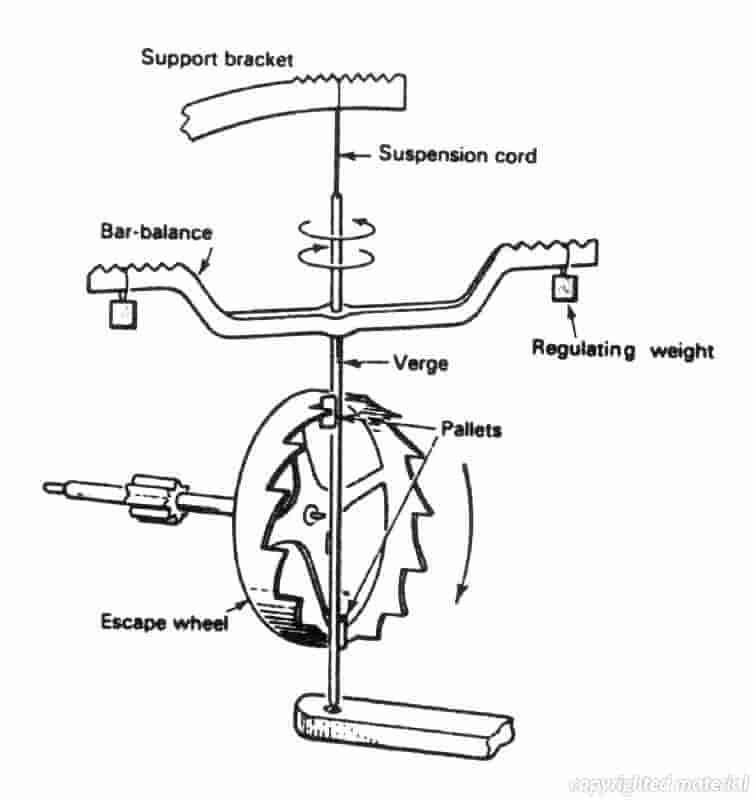
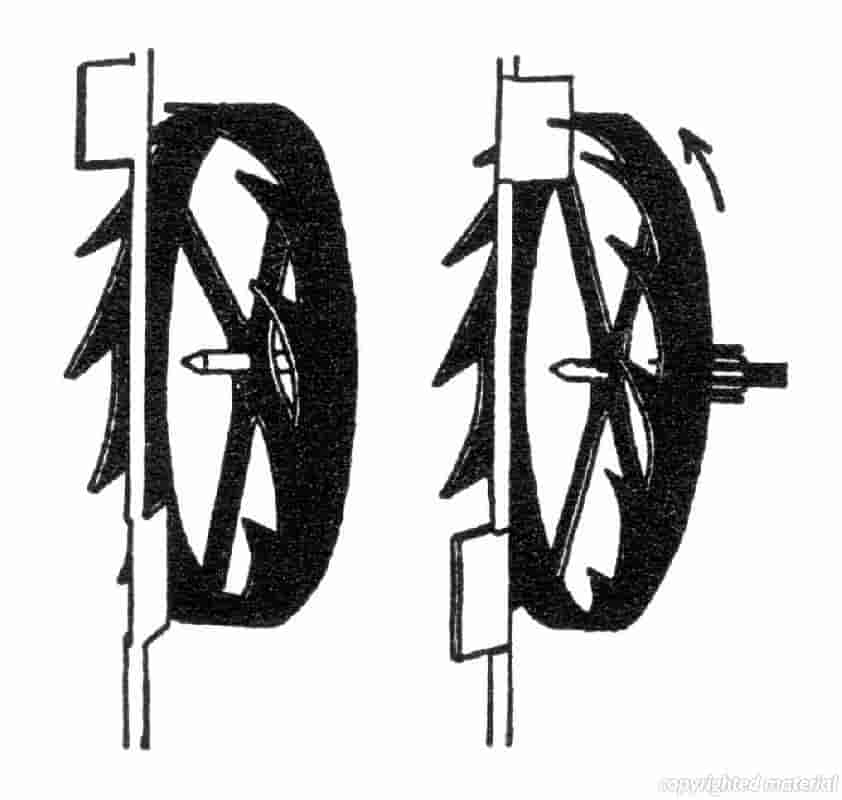
Fig. 3 The verge-and-foliot mechanical clock.The foliot (from the Latin word for 'leaf') was a horizontal bar (or balance) with a weight (or regulator) at each end (Fig. 3a). At its mid-point the bar was fixed to the verge (from the Latin word for 'twig'), a vertical rod on which were two pallets (or flanges). These engaged with a toothed wheel, which pushed the verge first one way and then the other (Fig. 3b), thereby causing the foliot to oscillate. The wheel itself advanced by one tooth for each double oscillation. The rate of oscillation could be adjusted by altering either the weights or their distance from the verge. This ingenious mechanism was robust, almost impervious to wear, and capable of. ticking away ceaselessly so long as its moving parts were kept well-oiled. Its main disadvantage was that, unlike a pendulum, the balance controlling the oscillations had no natural period of its own.
Although it is generally supposed that the first truly mechanical escapement was of the verge-and-foliot type found in various church clocks throughout Europe, the earliest escapement of which we have definite detailed knowledge is that of the clock designed for the Abbey of St Albans c. 1328 by Richard of Wallingford (c. 1292- 1336), the son of a blacksmith, who became Abbot in 1327. (His father's occupation is particularly significant, because the invention of the mechanical clock must presumably have depended on the co-operation of the learned man, probably a monk, who first thought of it and the blacksmith who actually constructed it.) It was an oscillating mechanism involving an extra wheel, as compared with the verge-and-foliot system. J. D. North has succeeded in reconstructing the St Albans escapement from the purely verbal description given in the surviving manuscript.8 It was in some ways superior to the verge type. North has also found that a similar escapement was known more than a century and a half later to Leonardo da Vinci. Drawings of it are given in his Codex Atlanticus of about 1495, but Leonardo can no longer be regarded as its inventor. The St Albans clock had two similar escapements, one to control the going-train and one to ring the bell each hour on a twenty-four-hour system with the number of strokes equal to the hour. According to North, it is not inconceivable that such an oscillating striking device, triggered at suitably chosen intervals by a hydraulic clock, pointed the way to the first mechanical escapement proper.
The oldest surviving clock in England is the Salisbury Cathedral clock that was made not later than 1386. It has no dial or hands but strikes the hours. The verge-period for a half-swing is four seconds. The clock was restored to its original condition in full working order in 1956, after a lapse of seventy-two years.9 Another more complete clock, believed to be by the same craftsman, that was in Wells Cathedral from at least 1392 is now in the Science Museum, London. (Both clocks were in due course converted to pendulum clocks.)
The accuracy of all early mechanical clocks was low, because the foliot and wheel had no natural periods of their own and also because of the effects of friction. It was, however, an age when civilization was becoming more vigorous and the number and skill of metal workers were increasing. A tremendous craze developed for the construction of elaborate astronomical clocks. As a leading historian of medieval technology has remarked, 'No European community felt able to hold up its head unless in its midst the planets wheeled in cycles and epicycles, whilst angels trumpeted and countermarched at the booming of the hours.'10 Outstanding among these 'clocks' was the astrarium of Giovanni de' Dondi of Padua, designed between 1348 and 1364. This complex instrument with its finely cut teeth and intricate gearing was made of brass and was smaller than the clumsy early English clocks that were made of forged iron. It was only incidentally a timepiece. Primarily it was a mechanical representation of the universe, a kind of planetarium. It was much more elaborate than the first of the famous series of astronomical clocks in Strasbourg Cathedral that was installed about the same time, 1350. The original Strasbourg clock probably contained, besides moving figures, an annual-calendar dial, and possibly a lunar dial and an astrolabe, but the instrument designed by Giovanni de' Dondi incorporated a perpetual calendar for all religious feasts, both fixed and movable, and also indicated the celestial motions of the sun, moon, and planets, including even the motions of the nodes of the moon's orbit, which take over eighteen years to make a complete revolution around the ecliptic.
It is not surprising that this remarkably complete astronomical clock attracted the attention of princes. It was acquired in 1381 by Duke Gian Galeazzo Visconti, an intellectual who has been described as 'a sedate but crafty ruler with a great love of order and precision'.11 He moved it to his palace in Pavia, where in 1420 it was recorded as being in the ducal library. It was very difficult to keep in working order, and when the emperor Charles V saw it in Pavia in 1529 it needed repair. Charles, who had a taste for mechanical devices, commissioned Gionallo Torriano of Cremona to repair it, but owing to corrosion he found that this was impossible and he agreed to make a similar instrument. When Charles retired to the monastery of San Yuste in 1555, with a large collection of clocks and watches, he took Torriano with him. After Charles V died in 1558, Torriano entered the service of his son Philip II and moved to Toledo, where he died in 1585. A few years ago manuscript evidence was discovered that Torriano's copy of de' Dondi's clock was still at his house in Toledo in the seventeenth century, and it is therefore unlikely that, as formerly thought, it perished when the convent of San Yuste with its art treasures was set on fire by the French in 1809. In recent years a number of working reconstructions of de' Dondi's clock have been made.
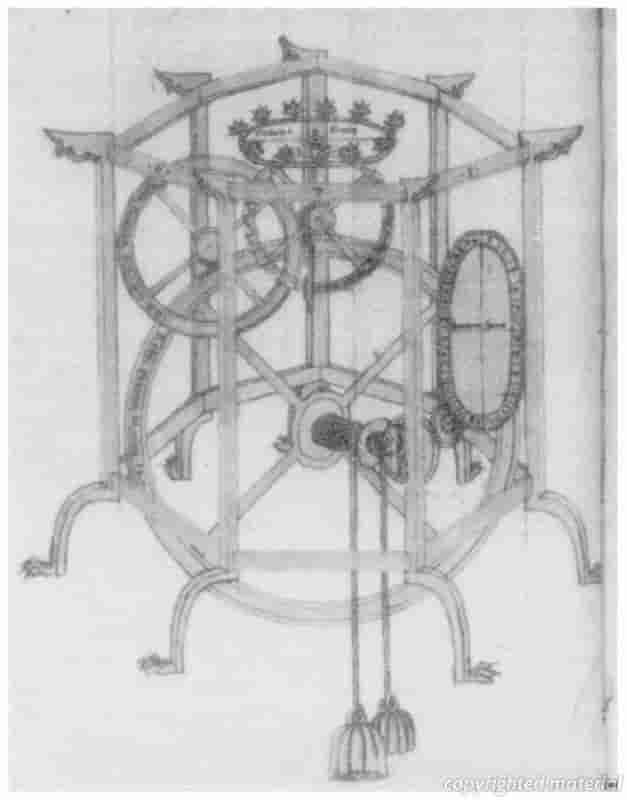
Fig. 4 A drawing of de' Dondi's astronomical clock.This drawing, dated 1461, of a part of de' Dondi's astronomical clock is from a manuscript in the Bodleian Library, Oxford. ( MS. Laud Misc.620, fol. 10v.) This complex weight-driven instrument, which was completed at Padua in 1364, was regulated by a horizontal balance-wheel shaped like a regal crown. Two pallets were fitted to the verge of this wheel. The upper one was made to move by one of the 24 teeth of the escape-wheel, which turned the verge and balance-wheel so that this pallet then escaped and at the same time the lower pallet became engaged. The latter then turned the verge and balance-wheel the opposite way, and so the process continued. The balance-wheel had a beat of 2 seconds. In recent years a number of models of this clock have been made; one is in the Museum of the Smithsonian Institution, Washington, DC.
In the course of the fourteenth century mechanical clocks became progressively more numerous in Europe, most of those that were not installed in churches being public clocks. One such was a striking clock designed by Giovanni de' Dondi's father Jacopo, on whom the surname ' del Orologio' was conferred. It was erected in the entrance tower of the Carrara Palace at Padua in 1344, but was destroyed in the assault on that town by the Milanese in 1390. Although they were expensive, public clocks were generally regarded as being very useful. Whereas church bells announced the times of the various religious offices, the communal clock was a secular instrument that struck the hours, and by the end of the fourteenth century some were made that struck the quarters, although this did not mean that they were any more accurate. They were often unable to keep time to within fifteen minutes a day and were frequently out of order. This is not surprising since all geared wheels had to be cut by hand.
The social influence of the mechanical clock
An important consequence of the introduction of mechanical clocks was that in much of western Europe it led to the adoption of the uniform hour of sixty minutes. The earliest recorded clocks, such as the St Alban's clock and that erected in the Palace Chapel of the Visconti in Milan in 1335, struck up to twenty-four. Dante would appear to have seen a striking clock at least fifteen years before the Visconti clock of 1335 was installed; he may have seen the iron clock placed in the campanile of the church of Sant' Eustorgio in Milan in 1309--the first Italian public clock of which we have knowledge. In Paradiso, composed between 1317 and 1320, he made a famous reference (24. 13-15) to the striking-train of a clock:
E come cerchi in tempra d'oriuoli si giran si che il primo, a chi pon mente, quieto pare, e l'ultimo che voli . . .
('And even as wheels in harmony of clockwork so turn that the first, to whoso noteth it, seemeth still, and the last to fly . . .')
Despite the inconvenience of counting large numbers the twenty- four-hour system persisted for centuries in Italy, but most other countries of western Europe soon adopted the system in which the hours were counted in two sets of twelve from midnight and from noon, respectively. The uniform hour of sixty minutes soon tended to replace the day as the fundamental unit of labour time in the textile industry. For example, in 1335 the governor of Artois authorized the inhabitants of Aire-sur-la-Lys to build a belfry whose bell would chime the working hours of textile employees.12 The problem of the length of the working day was particularly important in the textile industry, where wages were a considerable part of production costs.
Despite the invention of the mechanical clock, for most people time remained uneven in quality. Nothing had done more to encourage this belief than the Church with its ecclesiastical calendar and regulations concerning what could or could not be done on specific days. Rules, or canons, were also established for the recital of prayers at definite times of the day. Known as the Canonical Hours, these followed the system of seasonal hours: Matins before dawn, Prime at sunrise, Tierce at 3. Sext at 6, Nones at 9, Vespers at 11 (the last four being reckoned from sunrise), and Compline after sunset. In due course Nones was set back three hours to midday, and this is the origin of the word 'noon'. Devout lay folk who wished to participate in this daily programme, however, needed their own prayerbooks. A 'Book of Hours' was the name given to such a prayerbook intended for private or family devotion, the term 'hours' indicating not an interval of sixty minutes, but less precise parts of the day that were set aside for religious and other duties. Originally, books of this type were commissioned only by kings and the highest nobility, but by the fifteenth century secular workshops had been set up, particularly in Paris and other cities in France and the Low Countries, so as to provide such books for a wider public. They form the largest single category of medieval manuscripts that have come down to us, and all later prayerbooks derive from them.13 They usually begin with pictures of the occupations of the different months, followed by passages from the Gospels and the liturgical hours from Matins (and Lauds) to Vespers and Compline, and completed by miniatures of the life of the Virgin. The most celebrated of all these books is the Très riches heures, painted early in the fifteenth century by the Limbourg brothers for the Duc de Berry, third son of King John II of France.14
Popular superstitions concerning lucky and unlucky days, the existence of which has already been referred to in connection with the Romans, were reinforced in the Middle Ages by the recognition of black-letter days in the ecclesiastical calendar. For example, the day commemorating the massacre of the Holy Innocents, 28 December, was regarded as a day of particular ill-omen, especially in the fifteenth century. Moreover, throughout the year the particular day of the week on which Innocents' Day had fallen the previous year was also regarded as a black-letter day, and was also called Innocents' Day. Those who were influenced by this belief refrained from setting out on a journey or from starting a major task on that day of the week. An interesting example of this superstition concerns the coronation of Edward IV on 4 March 1461. In the preceding year 28 December fell on a Sunday and as the coronation took place on that day of the week it had to be repeated on another day!15 Even as late as the last quarter of the sixteenth century Queen Elizabeth's chief minister Lord Burghley warned his son to avoid undertaking new enterprises on three particularly ominous anniversaries in the ecclesiastical calendar: the first Monday in April (the murder of Abel), the first Monday in August (the destruction of Sodom and Gomorrah), and the last Monday in December (the birthday of Judas Iscariot).
A class of special days (and weeks) that has survived in both the Roman and Anglican Churches is that of 'Ember Days' and 'Ember Weeks'. Associated with the four seasons, the weeks concerned begin, respectively, on St Lucy's Day (13 December), the First Sunday in Lent, Whitsunday, and Holy Cross Day (14 September). Wednesdays, Fridays, and Saturdays in these weeks are the Ember Days. Traditionally, these days were set apart for special prayer and fasting. The following Sundays, for example Trinity Sunday, are the days specially fixed for the ordination of the clergy. This ancient custom was finally established as a law of the Church. c. 1085, by Pope Gregory VII.
In England, belief in the uniformity of time was greatly influenced by the Puritans in their strong opposition to the practices of the Roman Church, in particular to the idea of special days in the ecclesiastical calendar. Instead, the Puritans advocated a regular routine of six days of work followed by a day of rest on the Sabbath, the famous Non- conformist ethic. During the course of the seventeenth century, despite the reaction against Puritanism which followed the restoration of the monarchy in 1660, this point of view became increasingly influential, so that by the end of the century it had come to be generally accepted. As Keith Thomas has pointed out, 'This change in working habits constituted an important step towards the social acceptance of the modern notion of time as even in quality, as opposed to the primitive sense of time's unevenness and irregularity.'16
In France, a step towards ending the dominance of the liturgical practices of the Church was taken as early as 1370 by King Charles V when he ordered all the bells in Paris to be regulated by the recently installed clock of the royal palace, designed by Heinrich von Wiek (Henri de Vic), and to be rung at hourly intervals. Although the practical difficulties of time measurement were such that until the middle of the seventeenth century most clocks had but one hand and the dial was divided only into hours and quarters, the abstract framework of uniformly divided time gradually became the new medium of daily existence.
This important development, which began in the towns, was fostered by the mercantile class and the rise of a money economy. As long as power was concentrated in the ownership of land, time was felt to be plentiful and was primarily associated with the unchanging cycle of the soft. With the increased circulation of money and the organization of commercial networks, however, the emphasis was on mobility. Time was no longer associated just with cataclysms and festivals but rather with everyday life. It was soon realized by many of the middle class that 'time is money' and consequently must be carefully regulated and used economically. As Lewis Mumford has pointed out, 'Time-keeping passed into time-saving and time-accounting and time-rationing. As this took place, Eternity gradually ceased to serve as the measure and focus of human actions.'17
A typical instance of late medieval anxiety about time occurs in a letter of 1399 written by the wife of the 'Merchant of Prato', Francesco di Marco Datini, to her ageing husband: 'In view of all you have to do, when you waste an hour, it seems to me a thousand. . . . For I deem naught so precious to you, both for body and soul, as time, and methinks you value it too little.'18 Two years later we find Datini himself writing in the same vein to one of his partners in Spain, Cristofano di Bartolo, whom he wished to persuade to come home. A similar note was struck by Chaucer in the Host introduction to the "'Man of Law's Tale'" in The Canterbury Tales, written about 1400:
And therefor by the shadwe he took his wit
That Phebus, which that shoon so clere and brighte,
Degrees was fyve and fourty clombe on highte;
And for that day, as in that latitude,
It was ten of the clokke, he gan conclude,
And sodeynly he plighte his hors aboute.
'Lordinges,' quod he, 'I warne yow, al this route,
The fourthe party of this day is goon;
Now, for the love of god and of Seint John,
Leseth no tyme, as ferforth as ye may;
Lordinges, the tyme wasteth night and day,
And steleth from us, what prively slepinge,
And what thurgh necligence in our wakynge,
As dooth the streem, that turneth never agayn,
Descending fro the montaigne into playn.'
Before long there were many activities for which time came to be increasingly regarded as valuable. In the early and high Middle Ages it had been possible to spend many tens and even hundreds of years on erecting a single building, be it a cathedral, a castle, or a town hall. This 'was possible because human life was regarded as primarily the life of the community in which one generation quietly succeeded another, so that there was no pressing need for rapid construction. All this was destined to change in the late Middle Ages and Renaissance period. Even in painting the time factor made itself felt. For although we frequently find in paintings of this period that a number of consecutive scenes are represented simultaneously in one picture, in other ways temporal considerations came to exert a decisive influence--in particular, causing painting a secco to replace al fresco, or true fresco, since the very long apprenticeship that pupils had to serve before they became proficient in fresco painting could not be maintained, and a successful painter had to work fast in order to handle all the commissions that he received. Even as great an artist as Michelangelo ( 1475- 1564) was unable to turn the tide. Originally it had been planned that the Last Judgement in the Sistine Chapel should be painted a secco in oil, but he insisted on carrying out the work al fresco since he considered oil painting to be only 'fit for women and slovenly people'! His point of view conflicted with the spirit of the age and, despite his example, the glorious art of true fresco died out, its practice being incompatible with the new social attitude to time.
This attitude was also responsible for a new horological invention that was ultimately to be of far-reaching social significance. The first mechanical clocks were large and unwieldy, and there was soon a desire for smaller and more portable mechanisms. To meet this demand springs began to be used in the fifteenth century in place of weights as the source of motive power in clocks. This development was important because it made possible the invention of the domestic clock and also the watch. One of the earliest references to a watch is the gold pomander 'wherein is a clocke' that was presented in 1540 by Henry VIII to Catherine Howard, his fifth wife.19 The public clock, whether installed in a church or in a town square, was only an intermittent reminder of the passage of time, but a domestic clock or a watch was a continually visible indicator. As D. S. Landes has pointed out, whereas the public clock could be used to open and close markets, to signal the start and end of work and to move people around, it signalled only moments rather than the continual passage of time. A chamber clock or watch, on the other hand, was an ever-visible reminder of 'time used, time spent, time wasted, time lost'. As such it was prod and key to personal achievement and productivity.20
Nevertheless, centuries were to elapse before this invention became widespread. Indeed, for a long while the possession of a domestic clock or a watch tended to be restricted to the wealthy and was looked upon more as a sign of affluence than as a social necessity. As late as the middle of the seventeenth century we find, for example, that even at the age of 30 Samuel Pepys ( 1633-1703), already an important government official, did not possess a watch. Instead, he lived by the church bells of London and occasionally a sundial, as did almost everyone else there. Consequently, very few specific appointments were made. Pepys moved around from public places to coffee houses and taverns hoping to do business. He often went to discuss matters with the Lord High Admiral, James, Duke of York, only to find that the Duke had gone hunting. Pepys never expresses surprise or resentment. Time had a different significance for him and most of his contemporaries than it has for us.
Since watches were for long the toys of the rich, it is not surprising that often when ordinary folk encountered one they were extremely puzzled and were even inclined to look upon it as something evil and dangerous. An amusing instance of this is related by John Aubrey concerning an Oxford don, Thomas Allen ( 1542-1632), who owned many mathematical and other scientific instruments. When staying one Long Vacation at a friend's place, 'at Hom Lacey in Herefordshire" he happened to leave his watch on the window-sir of his chamber. According to Aubrey,
The maydes came in to make the bed, and hearing a thing in a case cry Tick, Tick, Tick, presently concluded that it was his Devill, and took it by the string with the tongues, and threw it out of the windowe into the mote (to drown the Deviff). It so happened that the string hung on a sprig of an elder that grew out of the mote, and this confirmed them that 'twas the Devill. [Consequently], the good old gentleman got his watch back.21
When most people possessed no clocks or watches but lived more in the countryside than they do today, they took far more note than we do of the various timings associated with plants and animals. Indeed, some plants were even named thereby, for example, the 'day's eye' (daisy), so-called in allusion to its revealing its yellow disc in the morning and concealing it again in the evening. Most notable of natural timings was cock-crow, and a famous tribute to the cock Chauntecleer's horological skill was paid by Chaucer in the 'Nun's Priest's Tale':
Wel sikerer was his crowying in his logge,
Than is a clokke, or an abbey orlogge.
By nature knew he ech ascenscioun
Of equinoxial in thilke toun;
For whan degrees fiftene were ascended,
Thanne crew he, that it mighte nat ben amended.
Although watches were extremely rare before the late seventeenth century, the influence of mechanical timekeeping had already made itself felt in a variety of ways, besides those already mentioned. By the sixteenth century mining operations had become closely regulated by the clock according to Agricola (Georg Bauer), who in his De re metallica, of 1555, noted the precise times of shifts. Many professional people, such as judges and teachers, commenced their duties at stated hours, and by the late Middle Ages even the often unruly undergraduates at universities such as Oxford were subjected to the discipline of fixed timetables. Lectures often began as early as 5 or 6 a.m. in the summer (7 a.m. in the winter), and sometimes the first lecture went on for three hours, no provision being made for any food before 10 a.m.22 It is interesting to trace the way in which the times of meals have changed over the centuries, particularly because in everyday life it is not just the clock which tells us which part of the day we are in but the meals that we eat. Thus, in common parlance, 'afternoon' now begins an hour or more after 'noon' according to the clock. Also dinner has tended to get later and later in the day. The fascinating details of this historical trend have been described by Arnold Palmer.23 Although, the rule of the clock affected most people in the sixteenth century far less than it does us today, it was already sufficient to provoke Brother Jean in the Gargantua ( 1535) of Rabelais to complain that 'the hours are made for man and not man for the hours!'24