
Reform of the calendar
Throughout history the ultimate standard of time has been derived from astronomical observations. In due course this led to the hour, minute, and second being defined as fractions of one rotation of the earth on its axis. Since it was found convenient in everyday life to determine this rotation by the orientation of the earth relative to the sun, the 'mean solar day' was defined as the period of rotation of the Earth on its axis relative to the Sun corrected for all known irregularities. Because the earth's orbit is only approximately circular, the relative speed of the sun is not quite uniform. Also the sun's apparent motion in the sky is not along the celestial equator (the projection of the earth's Equator on to the sky), and consequently the component of the sun's motion parallel to the Equator varies. As a result, for the purposes of ordinary timekeeping a 'mean sun' is defined as moving at a constant rate which is the average of that of the actual sun. The difference between mean solar time and apparent solar time (as given by a sundial) is called the 'equation of time'. The 'equation of time' vanishes four times a year, on or about 15 April, 15 June, 31 August, and 24 December. The maximum amount by which apparent (or sundial) noon precedes mean noon is about 16.5 minutes on or about 3 November, and the maximum amount by which mean noon precedes apparent noon is about 14.5 minutes on or about 12 February. The 'mean solar second' is defined as the appropriate fraction (1/86,400) of the mean solar day.
Although in everyday life we find it convenient to determine time by the position of the earth relative to the sun, in practice it is more accurate to determine the times when stars cross 'the meridian, which is the projection on to the sky of the circle of longitude through the place on the earth's surface where the observations are being made. The interval between successive transits of the same star, or group of stars, across the meridian is called the 'sidereal day'. Since there is one more sidereal day in the year than there are solar days, the solar day is about four minutes longer than the sidereal day, which can be converted into the solar day by a numerical formula given to ten decimal places by observations extending over two hundred years.
The unit of time on which the seasons and the calendar depend is called the 'tropical year'. It is the time between two successive passages of the sun through the point at which its annual path against the general background of the stars (the 'ecliptic') crosses the celestial equator at the spring equinox. It is not the same as the time between successive passages of the sun through the same fixed point on the sky, because the equinox has a retrograde motion of just over 50 arc-seconds a year. This 'precession of the equinoxes', as it is called, is due to the gravitational pull of the sun and moon on the earth's equatorial bulge, thereby causing the earth's axis to precess, like the axis of a spinning top, with a period of about 25,800 years. The discovery of the precession of the equinoxes was made in antiquity by the Greek astronomer Hipparchus, and correct knowledge of it is required for the precise determination of the calendar. In antiquity the length of the tropical year was determined with the aid of a gnomon at noon at successive summer solstices (at the same place) when its shadow is shortest; whereas the length of the sidereal year was obtained from successive heliacal risings of the same bright star. According to modern measurements the tropical year is equal to about 365.2422 mean solar days, and the sidereal year to about 365.2564 of these days.
The estimate of the tropical year that was the basis of the Julian calendar, 365.25 days, was just over eleven minutes too long, equivalent to an extra day every 128 years. Consequently, by 1582 the spring equinox, which in Julius Caesar's day fell on 25 March, had retrograded to 11 March. Moreover, Easter, which by the decision of the Council of Nicaea in the year 325 should be celebrated on the first Sunday after the spring full moon (i.e. the full moon occurring on, or immediately after, 21 March) had got steadily further away from the full moon. To bring the equinox to 21 March, Pope Gregory XIII, acting on the advice of a special commission that included the distinguished Jesuit Papal astronomer Christopher Clavius, directed that the day after 4 October 1582 be designated 15 October (October was chosen because it was the month with the fewest saints days and other special ecclesiastical days), and that the leap year intercalary day be omitted in all centenary years except those that are multiples of 400. Thus 1600 was a leap year and 2000 will be too, but the intervening centenary years were not. Moreover, it was decreed that the year should begin on 1 January. The new calendar, had been suggested by a medical lecturer in the University of Perugia, Luigi Giglio (latinized as Aloisius Lilius). Lilius died in 1576, but his brother Antonio presented his scheme to the Pope. Unfortunately, Lilius's manuscript was never printed and is now lost. Clavius regarded Lilius as a man entitled to immortality because 'he was the principal author of such an excellent correction.' For a more detailed account of these questions and of the dating of Easter, see the Appendix.
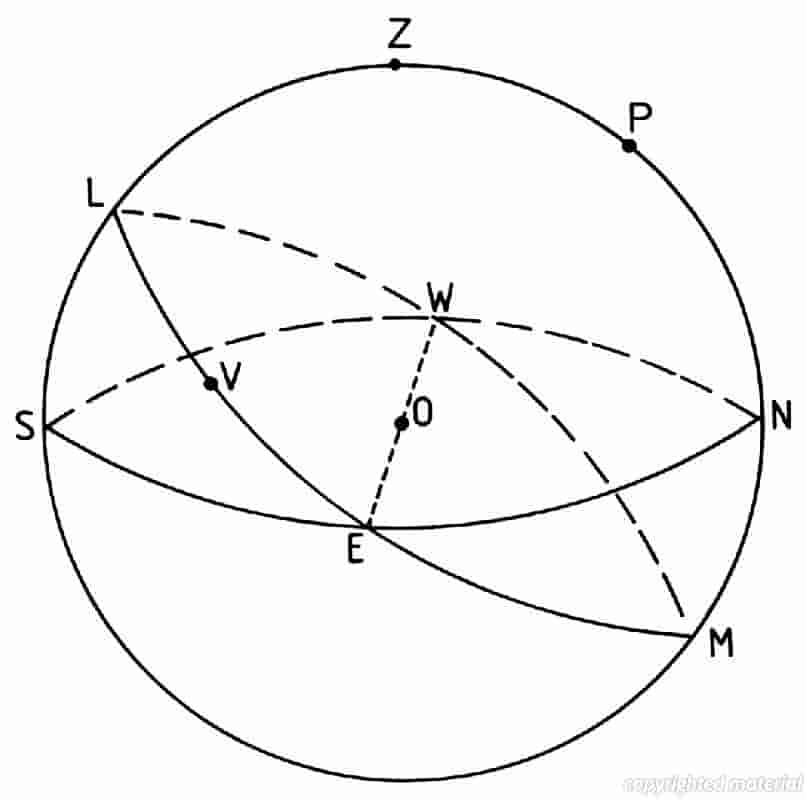
Fig. 5 The celestial sphere. Since they are so remote, the so-called 'fixed stars' (as distinct from planets, satellites, comets, and so on) can be depicted as fixed points on a sphere with a radius that is very large compared with the radius of the earth's annual orbit around the sun. The lines from all observers on earth to any given star will therefore cut this sphere, known as the 'celestial sphere', at the same point. Consequently, any observer O can be regarded as being at the centre of the celestial sphere. Because of the earth's diurnal rotation, the celestial sphere appears to rotate daily about the line joining the earth's north and south poles. In accordance with standard mathematical terminology, any circle on the celestial sphere which has its centre at O is called a 'great circle'. (Lines of longitude on the earth's surface are also great circles, whereas lines of latitude, except the equator, are not, being only so-called 'small circles'.) In the above figure the great circle ENWS represents the horizon of O, with its pole at the zenith- point Z. Similarly, the great circle ELWM represents the celestial equator (projection of the terrestrial equator on to the celestial globe). Its north pole is at P, the so-called 'Pole Star' being close to it. V represents the vernal equinox (first point of Aries). The ecliptic (projection on to the celestial sphere of the sun's apparent annual path against the general background of the stars, due to the earth orbiting the sun) is the great circle through V that lies in the plane cutting the plane of the celestial equator at an angle of approximately 23½ degrees. The earth's axis of diurnal rotation is in the direction OP. The celestial sphere rotates about the line joining O to the poles of the ecliptic in a top-like motion. This 'precession of the equinoxes' has a period of nearly 26,000 years.
At first only Catholic countries adopted the Gregorian calendar, since in Protestant lands, despite some influential support for it, the feeling became widespread that the Pope 'with the mind of a serpent and the cunning of a wolf' was stealthily seeking by means of the calendar to dominate Christendom once again.1 Although this point of view now seems ludicrous, it was not thought so at the time. For Gregory XIII was not only a powerful promoter of the Counter-Reformation but had fully supported Philip II in his ruthless campaign against the Protestants in the Spanish Netherlands and had celebrated the St Bartholomew's Day massacre of the French Huguenots in 1572 by having a medal struck to commemorate it. Nevertheless, there were Protestant astronomers, notably Tycho Brahe and Kepler, who approved of the Gregorian reform, although others felt that Clavius had not applied sufficient scientific rigour in his investigations concerning it. In 1613, at the Diet of Regensburg, Kepler (who, in supporting Clavius, made the point that 'Easter is a feast and not a planet. You do not determine it to hours, minutes and seconds') argued that the Gregorian calendar did not involve the acceptance of a papal bull but only the results of calculations by astronomers and mathematicians.2 Nevertheless, the Protestant states maintained their opposition until 1700, when most of them decided to adopt the Gregorian calendar. In England and Ireland, however, anti- Catholic feeling, which was as much political as religious, successfully prevented its introduction for another fifty years, until the inconvenience of using a different date from that employed in the greater part of Europe could no longer be tolerated. Already in 1583, however, Queen Elizabeth's favourite mathematician, astrologer, and secret agent, John Dee, using data from Copernicus, had produced an eleven-day correction which he claimed was more accurate than the Gregorian ten-day correction due to Clavius. An English mathematical committee, composed of the astronomer Thomas Digges, Sir Henry Savile, and a Mr Chambers, agreed with Dee but recommended, to his disgust, that it would be more convenient in practice to adopt the same calendar as the Continent. Queen Elizabeth's ministers Burghley and Walsingham approved of Dee's plan, but nothing came of it because of the violent opposition of the bishops, who argued that the new calendar showed the influence of Papism. When at last, in September 1752, the change was made Dee's correction was adopted, 3 September becoming 14 September.
In England 25 December was taken as the beginning of the year during the Middle Ages until the latter part of the twelfth century, when 25 March was chosen instead. The Church decided to begin its year on that day (Lady Day) because it was the day of the Annunciation, being exactly nine months ahead of Christmas Day. In England the year beginning on 25 March was called the 'Year of Grace'. Although January appeared as the first month of the year in calendars and almanacs, all official documents followed the dating of the 'Year of Grace' until 1751. In that year the official year began on 25 March and ended on 31 December. From then onwards the official year began on 1 January. These changes were authorized by an Act of Parliament of 1750. Only a minimal change, however, was made in the tax year, which still ends on 5 April. That date in the new style calendar corresponded to 25 March in the old style calendar. In Scotland the year has begun on 1 January since 1600.
Confusion can easily arise when we try to compare dates between 1582 and 1752 according to the Julian calendar that prevailed in England with the corresponding dates in the Gregorian calendar used in some of the principal European countries. For example, it has sometimes been asserted that Cervantes died on the same day as Shakespeare. Unfortunately, this remarkable coincidence did not occur; Cervantes died in Madrid on Saturday, 23 April 1616, according to the Gregorian calendar already in use there, whereas Shakespeare died at Stratford-upon-Avon on Tuesday, 23 April 1616, according to the Julian calendar still current in this country, the corresponding Gregorian date being Tuesday, 3 May 1616, and so Shakespeare in fact outlived Cervantes by ten days.
The greatest opposition to the new calendar arose in the eastern Churches, and was forcibly expressed by the Patriarchs of Constantinople, Alexandria, and Armenia. Not until 1923 did the Orthodox Church in Greece, Romania, and Russia adopt it. The monks on Mount Athos (in north-eastern Greece) have still not accepted it. Nearly all the monasteries there adhere to the Julian calendar, which is now thirteen days behind the Gregorian. Moreover, at one monastery they still reckon the time of day according to the original Georgian style, with sunrise always occurring at twelve o'clock. Everywhere else on the 'Holy Mountain' they follow the old Turkish system, with sunset at that time. This system is said to go back to the Byzantines and at least has the advantage that the traveller knows from his watch how many hours of daylight there are left.3 The island of Foula, twenty miles west of Shetland, still retains the Julian calendar for its festivals, such as Christmas and Hogmanay.
Although civil time is based on natural phenomena, we have seen that not only religious but purely political considerations can influence the construction of a calendar, as in the case of ancient Rome. A much more recent instance of this occurred when, after deposing Louis XVI, the National Convention, or French Parliament, decided to introduce a completely new calendar. It was decreed that Year I should begin on what would otherwise have been 22 September 1792, the day the Republic was proclaimed. New names, such as Germinal, Prairial, and Thermidor, were devised by the dramatist Fabre d'Eglantine for the twelve new months of thirty days each, divided into three 'weeks'. each of ten days. At the end of the year there were five days of festival called Sansculottides, or 'Trouser-days'. (The culotte, or breeches, was regarded as an aristocratic garment, and the common people wore trousers. Sansculotte was originally a derogatory term applied by the upper classes to their lower-class opponents.) The sixth extra day in leap year was to be 'The Trouser-day' when, according to Fabre, Frenchmen 'will come from all parts of the Republic to celebrate liberty and equality, to cement by their embraces the national fraternity, and to swear, in the name of all, on the altar of the country, to live and die as free and brave Trousermen.'4 Fabre also devised names for each day of the year, many referring to fauna, flora, minerals, and agricultural implements. The new calendar, which was described by the American statesman John Quincy Adams as an 'incongruous composition of profound learning and superficial frivolity, of irreligion and morality, of delicate imagination and coarse vulgarity',5 had a short life. It was officially discontinued by Napoleon, and on 1 January 1806 the French reverted to the Gregorian calendar, which despite its imperfections is still the most widely used calendar in the world.
The pendulum clock and the clocklike universe
Although medieval scholars were not, as a rule, concerned with machines, they became more and more interested in mechanical clocks, particularly because of their connection with astronomy. It was generally believed that a correct knowledge of the heavenly bodies and their motions was necessary for the success of most earthly activities. The theory of astral influences was accepted by most Christian thinkers until the seventeenth century. That is why medical students were required to study astronomy and astrology, so that a horoscope could be cast of the hour when the patient fell ill and the propitious hour for the appropriate treatment, such as surgery, be determined. A present-clay relic of the influence of astrology on medicine is our use of the Italian word 'influenza' for the viral infection which was thought in former times to be due to a malevolent flow coming down to the sufferer from an evil star. Another etymological relic is the word 'disaster': originally this referred to the unfavourable aspect of a star (Latin astrum). Carlo Cipolla has drawn attention to the assertion by a writer in 1473 that the public clock in Mantua served the purpose of showing 'the proper time for phlebotomy, for surgery, for making dresses, for tilling the soil, for undertaking journeys and for other things very useful in this world.'6 In particular, people believed that a star 'born' when it first appeared on the horizon influenced the life of a child coming into this world at that moment, and that a star just setting at the moment of a child's birth had implications for the circumstances of his or her death.
The invention of clockwork and its application to mechanical models of the universe, such as de' Dondi's, made a powerful impact on many minds. It is, therefore, not surprising that the clock metaphor came to be used in a variety of contexts. For example, Jean Froissart, in his poem 'Li orloge amoureus' (c. 1380) presented an elaborate allegory in which various aspects of chivalrous love were compared with the different parts of a mechanical clock, the verge-and-foliot escapement being associated with the virtue of moderation, since self-control was the highest in the canon of virtues of the medieval knight.7 No doubt Froissart had an actual clock in mind when he wrote this poem, and if so it may well have been Henri de Vic's clock at the royal palace in Paris. Sadly, that famous clock later became an object of derision, as is evident from the scurrilous rhyme:
C'est I'horloge du Palais;
Elle va comme ça lui plaît!
A particularly interesting indication of the way in which the invention of clockwork began to influence philosophical thought occurs in a treatise by Froissart's contemporary Nicole Oresme ( 1323-82) on the question of whether the motions of the heavenly bodies are commensurable or incommensurable. Part of the treatise is in the form of an allegorical debate between Arithmetic who favours commensurability and Geometry the opposite. Arithmetic argues that incommensurability and irrational proportion would detract from the harmony of the universe. 'For if anyone should make a mechanical clock would he not move all the wheels as harmoniously as possible?'8 This is an early example of the mechanical simulation of the universe by clockwork suggesting, at least implicitly, the reciprocal idea that the universe itself is a clocklike machine.
This idea came to the fore in the scientific revolution of the seventeenth century. Early that century Kepler specifically rejected the old quasi-animistic magical conception of the universe and asserted that it was similar to a clock. Among others who drew the same analogy was Robert Boyle ( 1627-91). In a passage in which he maintained that the existence of God is not revealed so much by miracles as by the exquisite structure and symmetry of the world--that is by regularity rather than irregularity--he argued that the universe is not a puppet whose strings have to be pulled now and again but it is like a rare clock, such as may be that at Strasbourg, where all things are so skilfully contrived, that the engine being once set a-moving, all things proceed according to the artificer's first design, and the motions . . . do not require the particular interposing of the artificer, or any intelligent agent employed by him, but perform their functions upon particular occasions, by virtue of the general and primitive contrivance of the whole engine.9
Boyle's words clearly imply a conception of nature from which all traces of the animistic world-view, such as was still evident at the beginning of the seventeenth century in Gilbert's book on the magnet, have been banished. In the development of the mechanistic conception of nature in the course of that century the mechanical clock played a central role. It was surely no coincidence that the greatest practitioner of the mechanical philosophy in its formative period, the Dutch scientist Christiaan Huygens ( 1629-95), who in the first chapter of his Traité de la lumièredeclared that in true philosophy all natural phenomena are explained 'par des raisons de mechaniques', was also responsible for converting the mechanical clock into a precision instrument.
This development was based on the discovery of a natural periodic process that could be conveniently adapted for the purposes of accurate time- keeping. As the result of much mathematical thinking on experiments with oscillating pendulums, Galileo ( 1564- 1642) came to the conclusion that each simple pendulum has its own period of vibration depending on its length. (Historians of science now ascribe priority in this important discovery to the French scientist Marin Mersenne ( 1588- 1648).) In his old age Galileo contemplated applying the pendulum to clockwork which could record mechanically the number of swings.
The first pendulum clock was based on the theoretical researches of Christiaan Huygens who, because of his astronomical observations, felt the need for a more exact timekeeper than had been previously available. In June 1657 the government of the United Netherlands granted to Salomon Coster of The Hague the exclusive rights for twenty-one years to make and sell clocks in that country based on Huygens's invention. Huygens discovered two years later that theoretically perfect isochronism (uniformity of oscillation) could be achieved by compelling the bob to describe a cycloidal arc. (A cycloid is the curve described by a point- like spot on a circular wheel that rolls without slipping along a straight line.) Great as was Huygens's achievement from the point of view of theory, particularly as set forth in his famous treatise Horologium oscillatorium, published in Paris in 1673, the practical solution of the problem of more accurate timekeeping came only with the invention of a new type of escapement.
Huygens's clock incorporated the verge type, but about 1670 a much improved type, the anchor type, was invented that interfered less with the pendulum's free motion. Although it is not clear who was responsible for this invention, John Smith in his Horological Disquisitions of 1694 attributed it to the London clockmaker William Clements. In this form of escapement, as a tooth of the scape-wheel escapes from the pallet at one end of the anchor, so a tooth on the other side engages with the pallet at the other end of the anchor. For satisfactory functioning, however, clocks incorporating the pendulum and the anchor type of escapement had to be placed on a level surface, and consequently in portable domestic clocks verge escapements were retained.
For those who were not astronomers the sundial remained the arbiter of local time against which clocks and watches were checked, although few common sundials in the seventeenth century were capable of showing time more accurately than to within half a minute at best. In the first comprehensive scientific treatise on the art of horology, William Derham's Artificial Clockmaker (first edition 1696), attention was drawn to the need to correct sundial readings for the effect of atmospheric refraction when the sun is low in the sky.
Although the earliest watches were driven by a spring, there was no controlling spring on the balance-wheel. Neither the foliot for clocks nor the balance-wheel for watches had a truly regular motion of their own and consequently no precise timekeeping property. Both the rate of swing of a pendulum under gravity and the motion of a balance-wheel under the control of a spring are, however, periodic. Just as the invention of the pendulum improved timekeeping by clocks, so the invention of the balance-spring about 1675 produced a similar improvement in the accuracy of watches. Robert Hooke ( 1635- 1702) and Huygens each laid claim to the invention of the balance-spring. To Hooke can definitely be attributed the law of springs ut tensio sic vis ('the extension is proportional to the tension'), which he published in 1678 and which is named after him. Meanwhile, Huygens had actually made a spiral balance-spring, the idea of which Hooke claimed had first occurred to him but had been communicated to Huygens by Henry Oldenburg, the Secretary of the Royal Society, whom Hooke denounced as a 'trafficker in intelligence'! We can only conclude that, whereas Huygens definitely produced a watch with a balance-spring, there is abundant evidence that Hooke was the kind of ingenious inventor who often fails to follow up his insights sufficiently far to justify his claims. The question of Hooke's contributions to horology has been carefully examined by the historian of science Rupert Hall.10
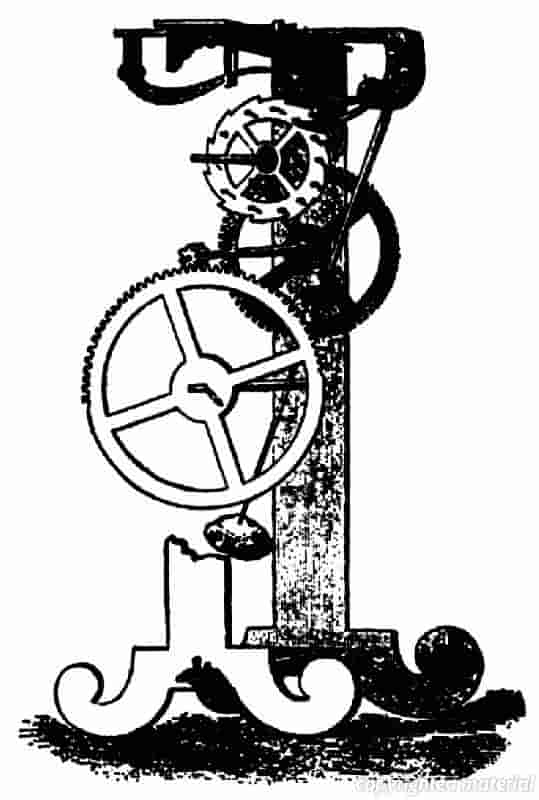
Fig. 6 A drawing of Galileo's pendulum clock. In 1637 Galileo devised a train of wheels actuated by a pendulum for counting oscillations, but the pendulum had to be controlled by hand. In 1641, the year before he died, Galileo considered how the pendulum itself could be used as a clock. In 1649 his son, Vincenzio, tried to construct a clock based on his father's design, but he died before completing it. (An inventory of his effects included an unfinished pendulum clock.) In 1659 a drawing by Galileo's friend and biographer Viviani of a clock based on Galileo's ideas was sent by one of his former disciples, Prince Leopold dei Medici, brother of the Grand Duke of Tuscany, to the French astronomer Ismael Boulliau. He passed it on to his friend Christiaan Huygens, who received it in January 1660. This drawing is reproduced above. Galileo's pendulum clock involved a new type of escapement which--was superior to the traditional verge type retained by Huygens. Each swing of the pendulum pushes the top wheel from one projecting pin to the next.
FIG.I.
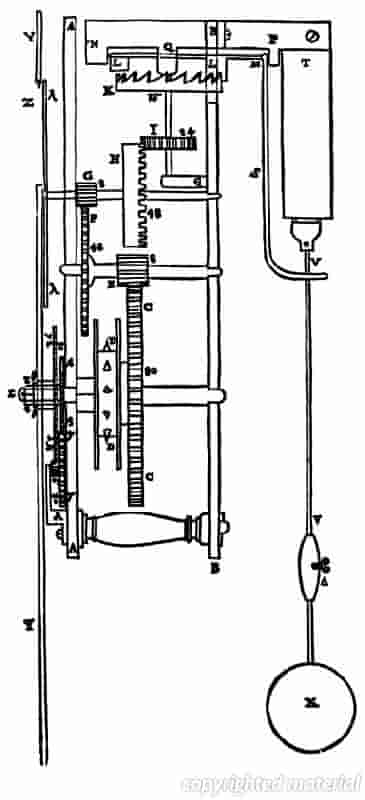
FIG.II.
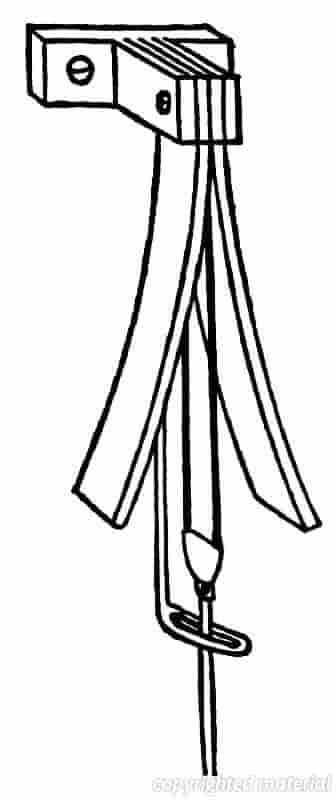
FIG.III.
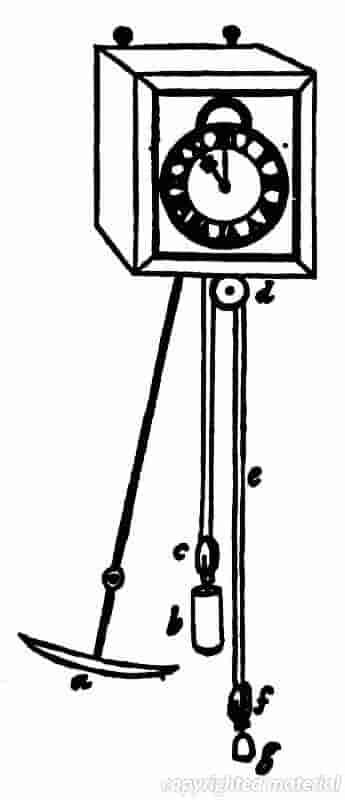
Fig. 7 Huygens's pendulum clock of 1673.These diagrams relating to Huygens's pendulum clock are on page 4 of his Horologium Oscillatorium de Motu Pendulorum at Horologia Aptato, published in Paris in 1673 'Cum Privilegio Regis' and dedicated to Louis XIV. Fig. I illustrates the works of the clock complete with verge escapement; Fig. II the cycloidal cheeks controlling the oscillations of the pendulum; and Fig. III the external appearance of the clock. In this clock, unlike Huygens's earlier clock, the pendulum was hung between cycloidal cheeks, so that its time of oscillation was independent of the size of the arc of swing--an important property for accurate timekeeping.
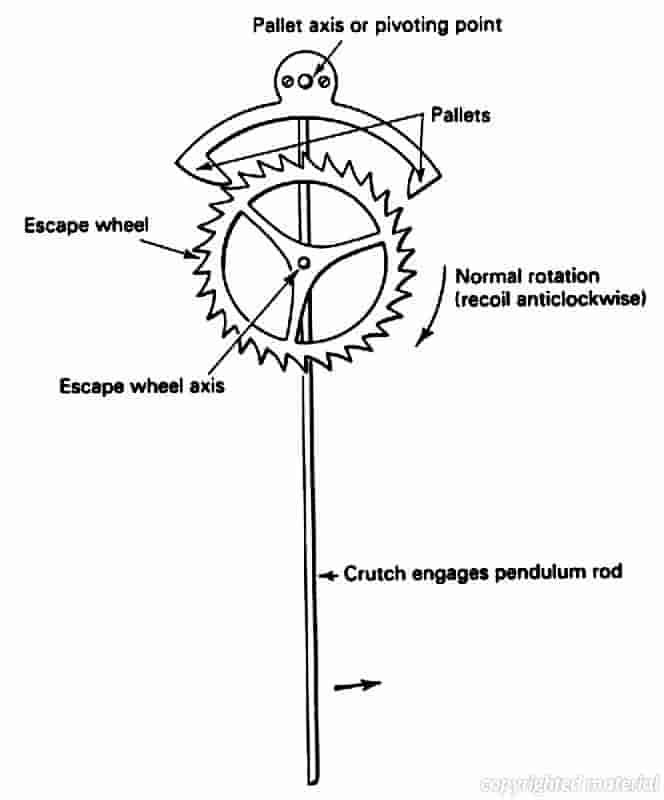
Fig. 8 The anchor escapement.The anchor escapement consists of a wheel with pointed teeth and an anchor carrying, at places equidistant from its axis, two pallets which catch the teeth of the wheel in succession as each escapes from the action of the other.
There is no doubt that the achievement of greater precision in mechanical timekeeping in the second half of the seventeenth century was a momentous advance, for it ultimately led to recognition of the importance of precise measurement generally in science and technology. Moreover, the invention of an accurate mechanical clock had a tremendous influence on the concept of time itself. For, unlike the clocks that preceded it, which tended to be irregular in their operation, the improved mechanical clock when properly regulated could tick away uniformly and continually for years on end, and so must have greatly strengthened belief in the homogeneity and continuity of time. The mechanical clock was therefore not only the prototype instrument for the mechanical conception of the universe but for the modern idea of time. An even more far-reaching influence has been claimed for it by Lewis Mumford, who has pointed out that 'It dissociated time from human events and helped create belief in an independent world of mathematically measurable sequences: the special world of science.'11
We have seen that in referring to the famous Strasbourg clock Boyle said that 'the engine being once set a-moving, all things proceed according to the artificer's first design'. In the case of a clock, 'design' refers to the action of its mechanism and has no teleological significance. The mechanical conception of the universe was in this respect clocklike and in marked contrast to Aristotle's conception of the universe, which had greatly influenced medieval natural philosophers. That was based on the importance Aristotle attached to the fully developed forms to which, in his view, all things inanimate as well as animate aspire. Consequently, for him the essences or special qualities of things, rather than temporal sequences, were the primary objects of scientific investigation. This way of thinking came under fire in the seventeenth century, because it was increasingly felt that it failed to explain anything. Instead of postulating ad hoc qualities, scientists who rejected the views of Aristotle and his medieval followers invoked hypothetical mechanical systems to elucidate natural phenomena. In so far as such a system operates from given initial conditions it has some similarity to a clock. If a clock is to indicate the correct time, its mechanism must not only function properly but the hands must be correctly set beforehand. The analogy can be considered either purely mechanistically or else mathematically. In the latter case the object is to calculate the course which a physical system will follow in time from given initial conditions.
This was the method adopted by Newton in the theory of gravitation which he developed in the Principia, published in 1687, the full title of which refers specifically to the mathematical principles of natural philosophy. As he said in one of his letters to Bentley, 'Gravity must be caused by an agent acting constantly according to certain laws; but whether this agent be material or immaterial I have left to the consideration of my readers.' Unlike his principal continental critics, Huygens and Leibniz, Newton was willing, at least in the Principia, to bypass the problem of explaining gravitation mechanistically. Instead, taking time as the independent variable, he formulated mathematical laws of motion and gravitation in terms of which gravitational phenomena can be described and predicted.
The particular concept of mathematical time used by Newton was based on the analogy between time and a geometrical straight line. Although this analogy had been used by Galileo and by others before him, notably Nicole Oresme in the fourteenth century, the first explicit account of it was given by Isaac Newton's predecessor in the chair of mathematics at Cambridge, Isaac Barrow, in his Geometrical Lectures, published in 1670. Barrow was greatly impressed by the kinematic method in geometry that had been developed by Galileo's pupil Torricelli. Barrow realized that to understand this method it was necessary to study time, and he was particularly concerned with the relation of time and motion. 'Time does not imply motion, so far as its absolute and intrinsic nature is concerned; not any more than it implies rest; whether things move or are still, whether we sleep or wake, Time pursues the even tenour of its way.' He regarded time as essentially a mathematical concept that has many analogies with a line, for 'Time has length alone, is similar in all its parts and can be looked upon as constituted from a simple addition of successive instants or a continuous flow of one instant.'12 Barrow's statement goes further than any of Galileo's, for Galileo used only straight line segments to denote particular intervals of time.
Barrow's views greatly influenced Newton. In particular, Barrow's idea that, irrespective of whether things move or are still, whether we sleep or wake, 'Time pursues the even tenour of its way' is echoed in the famous definition at the beginning of Newton Principia: 'Absolute, true and mathematical time, of itself, and from its own nature, flows equably without relation to anything external.' Newton regarded the moments of absolute time as forming a continuous sequence like the points on a geometrical line and he believed that the rate at which these moments succeed each other is independent of all particular events and processes.
Newton's adoption of the idea of absolute time, existing in its own right, was partly due to his belief that there must be a fundamental theoretical measure of time to compensate for the difficulty of determining a truly accurate practical time-scale. As has been discovered since (see pp. 167-8) and as Newton himself seems to have realized, in the long run we cannot obtain a truly fundamental time-scale from the observed motions of either the earth or the heavenly bodies. One of the difficulties of Newton's definition, however, is that there is no way of using it to obtain a practical means of measuring time. It has also been criticized by philosophers, since it ascribes to time the function of flowing; but, if time were something that flowed, then it would itself consist of a series of events in time, and this is meaningless. Time cannot itself be a process in time. Moreover, what is meant by saying that 'time flows equably' or uniformly? This would seem to imply that there is something which controls the rate of flow of time so that it always goes at the same speed. If, however, time exists 'without relation to anything external', what meaning can be attached to saying that its rate of flow is not uniform? If no meaning can be attached even to the possibility of non-uniform flow, what is the point of stipulating that its flow is 'equable'?
That moments of absolute time can exist in their own right is now generally regarded by scientists and philosophers as an unnecessary hypothesis. Events are simultaneous not because they occupy the same moment of time but because they occur together. Any two events that are not simultaneous are in a definite temporal order since one occurs before the other and not because they occupy different moments of time, one of which is earlier than the other. In other words, we derive time from events and not the other way round. This was the point of view taken by Newton's great contemporary Leibniz, who did not believe that moments of time can exist independently of events. He based his argument for this on what he called 'the principle of sufficient reason', according to which nothing happens without there being a reason why it should be so rather than otherwise. He applied this principle to time by considering the case of someone who asks why God did not create everything a year sooner and from this wishes to infer that God did something for which he could not possibly have had a reason to do it thus rather than otherwise. Leibniz's reply is that the inference would be true if time were something apart from temporal things, for it would be impossible that there should be reasons why things should have been applied to certain instants rather than to others when their succession remained the same. But this itself proves that instants apart from things are nothing and that they only consist in the successive order of things. If this remains the same, one of the states (for example, that in which the Creation was imagined to have occurred a year earlier) would be in no way different and could not be distinguished from the other. In Leibniz's view, time is the order of succession of phenomena, so that if there were no phenomena there would be no time.13
The nature of time and its relationship to different forms of existence, including the physical, had been considered long before the seventeenth century, notably by St Thomas Aquinas ( 1224-74) in his massive Summa theologica, in which he discussed three kinds of 'time'. Time, in the strict sense, he regarded as a state of succession that has a definite beginning and end. It applies only to terrestrial bodies and phenomena. Eternity, which exists all at once (tota simul), is essentially 'timeless' and the prerogative of God alone. The third concept, called aevum, originally due to the sixth-century philosopher Boethius, like time has a beginning but unlike time no end. Aquinas considered it to be the 'temporal' state of angels, heavenly bodies, and ideas (archetypum mundum).
Despite the difference between Newton's and Leibniz's views concerning the nature of physical time, in other respects their ideas about the concept were similar. Both believed that time was universal and unique, the universe comprising a succession of states, each of which exists for an instant, successive instants being like the order of points on an indefinitely extended straight line. This was the concept of time which was to dominate physical science until the advent of Einstein's special theory of relativity early this century.
Newton's views concerning time were not confined to the physical world but extended to human history and to prophecy. Like many of his contemporaries he believed that the world was coming to an end. He was convinced that the comet of 1680 had just missed hitting the earth, and in his biblical commentaries, on Revelations and the Book of Daniel he maintained that the end of the world could not long be delayed, but he was careful to avoid the prediction made by the millenarians who had settled upon a date. His contemporary and fellow scientist Robert Boyle also believed that 'the present course of nature shall not last always, but that one day this world . . . shall either be abolished by annihilation, or, which seems more probable, be innovated, and, as it were transfigured, and that, by the intervention of that fire, which shall dissolve and destroy the present frame of nature'.14
Newton Chronology of Ancient Kingdoms amended, posthumously published in 1728, and his Observations upon the Prophecies of Daniel and the Apocalypse of St John, published in 1733, can together be regarded as providing a universal history of mankind that was intended to be the counterpart of the physical history of the world set out in his Principia. By about 1700 chronology had become a subject of major concern to many thinkers because of its relevance for the authenticity of the Bible. The Old Testament as it has come down to us contains no dates. Bede had calculated the interval between Creation and Incarnation to be 3,952 years. Earlier, Eusebius obtained a figure of 5,198 years. By 1660 at least fifty different dates had been assigned to Creation, depending on which version of the Old Testament and which counting method were used.15 James Ussher, Archbishop of Armagh ( 1581-1656), proposed 23 October 4004 BC, and the Danzig astronomer Johannes Hevelius ( 1611-87) in his Prodromus astronomiae, posthumously published in 1690, computed the exact time to be 6 o'clock in the evening, 24 October 3963 BC.16 Newton, however, was careful not to assign a specific date for the Creation.
Newton devoted a good part of the last thirty years of his life to the careful study of chronology and sought to determine what he regarded as key dates, such as that of the Argonauts' expedition. Although he made use of literary references whenever necessary, he preferred to use astronomical techniques if possible. In particular, he thought that chronology could be put on a scientific basis by means of the accurate determination of the precession of the equinoxes. By its aid he believed that, if a relevant record could be found of the position of the sun relative to the fixed stars at the time of equinox, any event in the past could, in principle, be dated.
In a letter to Oldenburg of 7 December 1675, Newton explicitly stated his belief that 'nature is a perpetual circulatory worker'. Although later he argued that the 'amount of motion' in the world would of its own accord tend to decrease, unless God intervened to correct this, this proviso reveals his continuing belief in the essentially clocklike nature of the universe. In his view, God actually needed to intervene in the natural world from time to time to adjust its working in the same kind of way as a clockmaker needs occasionally to reset a clock so that it reads correctly.
Attitudes to time and history in the sixteenth and seventeenth centuries
In the sixteenth century people tended to be obsessed with the destructive aspect of time. The typical Renaissance image of time was as the destroyer equipped with hour-glass, scythe, or sickle. This attitude to time can be seen in Shakespeare, notably in his sonnets and in The Rape of Lucrece, especially stanza 133:
Mis-shapen Time, copesmate of ugly Night,
Swift subtle post, carrier of grisly care,
Eater of youth, false slave to false delight,
Base watch of woes, sin's pack-horse, virtue's snare,
Thou nursest all and murder'st all that are:
O, hear me then, injurious, shifting Time!
Be guilty of my death, since of my crime.
In Shakespeare's sonnets time is treated with what has been described as a 'polyphonic grandeur unmatched in English literature'. In some ways his attitude to time appears to have been very different from ours. For example, whereas we like to think of his plays as having been written for all time, it is most unlikely that that is how he thought of them himself. In his day the average run of a play was not more than five performances, few plays were ever revived and hardly any were printed. It is probable that Shakespeare wrote his plays not for the sake of posterity, but to earn enough money for him to be able to retire in comfort to his native Stratford-upon-Avon. A distinguished Tudor historian has pointed out that when Shakespeare lived, 'No playwright in his senses could have supposed himself to be writing for all time. The Elizabethans lived in the present.'17To them ars longa, vita brevis would have been meaningless.
While Shakespeare's concern with time was only at the personal level, his contemporary Edmund Spenser was obsessed with time at all levels, including the astronomical.18 Although the Church Fathers had converted history from an endless sequence of cycles to a vision of the whole universe moving from Creation to Redemption, the figure of the circle still dominated human thought in astronomy in the sixteenth century. This had a great influence on Spenser who, despite his profound concern with time, was essentially a backward-looking figure. As a recent authority on the role of time in his poetry has remarked, Spenser believed that 'our mortality and the insufficiency of all created things is, by grace, only one aspect of a total situation of which cyclical return is the other face, until such time as time shall cease'.19
Another contemporary of Shakespeare, Sir Walter Raleigh, was also greatly concerned with the depredations of time. He believed that the objective order of the universe was revealed in history and that it provided a vision of the meaning and purpose of human life. His massive History of the World, composed between 1608 and 1614 during his imprisonment in the Tower of London, was dedicated to James I, but instead of being pleased that learned but tetchy monarch complained that the book was 'too sawcie in censuring princes'! It was dominated by Raleigh's preoccupation with time, especially the poignant contrast between the temporal scale of his own life and the vast enterprise he had undertaken. Although he left his book incomplete after covering the period from the Fall of Adam to the Fall of Carthage, it runs to over 2,700 pages in the reprint of 1829. Well aware of the cosmic significance of time, he was convinced that all along the world was tending to get worse and worse. In holding this belief he was in general accord with the prevailing opinion of thinkers and writers of the Renaissance and Reformation eras, who were almost entirely backward-looking. Overwhelmed by a sense of the significance of the 'Cosmic Fall', they tended to believe in the existence of a primeval 'Golden Age', followed by irreversible decline. One of the starkest expressions of this view was Martin Luther's in his commentary of 1545 on the Book of Genesis: 'The world degenerates and grows worse every day. . . . The calamities inflicted on Adam . . . were light in comparison with those inflicted on us.' Luther also complained that after the Flood the trees and fruits of the earth 'are but miserable remnants . . . of those former riches which the earth produced when first created'.20
The backward-looking tendency in the sixteenth century is indicated by the word Rinascita ('Renaissance'), invented by Vasari and others in Italy, for it signified the rebirth of something old and not the introduction of something new. Later that century rulers such as Philip II of Spain, Elizabeth I of England, and Henry IV of France thought of themselves as upholders and maintainers and never as founders and innovators. Indeed, as a biographer of the French monarch has pointed out, 'Such an attitude caused Henry to describe himself to the Assembly of Notables as "Liberator and Restorer of the French State".'21 These rulers regarded their reforms as a return to some pristine model of the past.
Similarly, Vieta ( François Viète), the greatest mathematician of the sixteenth century, regarded innovation as renovation. Moreover, even the numerous technological advances in western Europe in the Middle Ages led to no general concept of technological progress.
During the Renaissance men became more and more aware that almost everything changes with time and so has a history. However, whereas in the Middle Ages the linear interpretation of history had been stressed because of its significance for Christian doctrine, in the Renaissance there was a marked revival of the cyclical view, because there was more concentration on secular history. Greater attention was paid to the literature that had survived from classical antiquity and to the cyclical point of view that characterized much of it. For example, Giorgio Vasari (1511-64) in his Lives of the Painters, Sculptors, and Architects favoured this idea in the history of art, believing--not surprisingly--that after Michelangelo (1475-1564) art was more likely to decline than to progress still further. More surprisingly, Francis Bacon (1561-1626), the prophet of scientific advance, in one of the last essays that he wrote, 'Of Vicissitude of Things', adhered to a cyclical view of history in general:
In the Youth of a State, Armes doe flourish: in the Middle Age of a State, Learning: And in them both together for a time: In the Declining Age of a State, Mechanical Arts and Merchandise. Learning hath his Infancy, when it is but beginning, and almost Childish: Then his Youth, when it is Luxuriant and Iuventile: Then his Strength of yeares, when it is Solide and Reduced: and lastly his Old Age, when it waxeth Dry and Exhaust. But it is not good, to looke too long, upon these turning Wheeles of Vicissitude, lest we become Giddy.
In the course of the seventeenth century the pessimistic and backward- looking attitudes to time that had characterized the previous century were gradually replaced by optimistic and forward-looking views. An optimistic view of the future was expressed by Francis Bacon in an early unpublished essay of 1603. It bore the significant title Temporis partus masculus (The masculine birth of time).
Mary Tiles in a recent paper with the title 'Mathesis and the Masculine Birth of Time' has discussed Bacon's ideas on scientific method and his peculiar terminology.22 Something is a 'birth of time' if it arises from cumulative corporate experience. Truth was regarded by Bacon as the 'feminine birth of time', whereas by the 'masculine birth of time' he meant active intervention in the world amounting to an exercise of power over nature. Bacon distinguished knowledge derived from ancient texts from that actively sought by modern natural philosophers. The term 'mathesis' refers to the ordering of knowledge (classification, etc.), particularly by means of mathematics. Bacon wrote: 'Science is to be sought from the light of nature, not from the darkness of antiquity. It matters not what has been done; our business is to see what can be done.'
The scornful rejection by Bacon of the doctrine that the ancients had encompassed all knowledge was echoed by, among others, John Wilkins who in The Discovery of a New World, published in 1638, attempted to show that the moon is inhabited. In it he wrote: 'There are yet many secret Truths which the ancients have passed over, that are yet left to make some of our Age famous for their Discovery.' Two years later, in A Discourse concerning a New Planet, in which he advocated the Copernican theory, he wrote even more significantly:
Antiquity does consist in the Old Age of the World, not in the youth of it. In such learning as may be increased by fresh Experiments and new Discoveries: 'tis we are the Fathers, and of more Antiquity than former Ages; because we have the advantage of more Time than they had, and Truth (we say) is the Daughter of Time.
This slogan (Veritas filia temporis) was much used in the sixteenth century and has a fascinating history, as has been shown by Fritz Saxl in his erudite chapter bearing this title in the Ernst Cassirer Festschrift.23 In an important footnote (p. 200) he mentions that his 'learned friend' Dr Klibansky had informed him that it can be traced back to ancient Greece where two different traditions prevailed: 'Time reveals either guilt and its punishment, as in Aeschylus' tragedies, or it reveals true valour and the honour due to it, as in Pindar's aristocratic poetry. Sophocles uses it to express his humble faith in the justice of divinity.'
The change from a backward to a forward temporal orientation was also advocated, in 1627, by a young Anglican divine, George Hake- will, in a refutation of Bishop Goodman Fall of Man ( 1616), an unremittingly gloomy demonstration that the world was approaching extinction. The question of the 'last days' aroused the intellectual interests not only of chronologists but also of mathematicians. Baron Napier of Merchiston, who published his famous Mirifici logarithmorum canonis descriptis in 1614, valued his invention of logarithms because it helped to speed up his calculations of the number of the Beast in the Book of Revelations, whom he wished to identify with the Roman Pope! Hakewill's book of over 600 pages bore a lengthy title that began: AnApologie of the Power and Providence of God in the Government of the World or an Examination and Censure of the Common Errour Touching Nature's Perpetuall and Universall Decay
Apologie of the Power and Providence of God in the Government of the World or an Examination and Censure of the Common Errour Touching Nature's Perpetuall and Universall Decay . . . In this prolix publication Hakewill, who was influenced by Bacon, dismissed the traditional lamentations about decay as merely a manifestation of 'the morosity and crooked disposition of old men, always complaining of the hardness of the present times, together with an excessive admiration of Antiquity'.24 At first his views met with considerable opposition, but as the century progressed they came to be widely accepted. For example, we find Milton declaring in one of his Latin essays that 'Natura non pater senium' ('nature does not suffer from old age').
The world was not necessarily getting worse; still less did it show signs of ending, despite the prophets of the 'Fifth Monarchy', who had announced that the Millenium would arrive in 1666. Why believe Nostradamus, who a century earlier, had assigned the end of the world to 31 July 1999? An important contributory factor to the development of a sense of time associated with a forward-looking perspective of political action was provided by the 'Antichrist' myth which became wide- spread in England in the mid-seventeenth century during the religious and political upheavals of the civil war and its aftermath. This myth looked forward to the defeat of Antichrist, variously identified with the Pope, the bishops, the whole hierarchy of the Church of England, the King, and the royalists. Gradually, however, as Doomsday was repeatedly postponed, the Golden Age was transferred from the past to the future and millenarian prophecies were replaced by Utopian programmes. As Carl Becker has neatly summarized it, in the eighteenth century 'The philosophers called in Posterity to exorcise the double illusion of the Christian paradise and the golden age of antiquity.'25
A forward-looking perspective also greatly influenced those who rejected scholastic philosophy and replaced it by the experimental philosophy advocated by Francis Bacon. The scientific revolution of the seventeenth century gave rise to what has been called 'the quarrel of ancients and moderns'. The essential point at issue was that unquestionable authority should no longer be attributed to the thinkers and writers of antiquity. In France a general attack on appeals to authority in scientific matters was made by Bernard de Fontenelle in his Digression sur les anciens et les modernes, published in 1683.
The need to establish an objective criterion of historical truth was clearly realized by Jean Bodin in his Methodus ad facilem historiarum cognitionem (Method for the easy understanding of histories) of 1566, but although he castigated those who sighed for a lost Golden Age, he still adhered to the cyclical concept of history, as did the Italian philosophers of history Machiavelli and Guiccardini earlier that century. Machiavelli thought that history is dominated by an oscillation between the bad and the good but with the bad tending to be in control longer than the good. Belief in the cyclical nature of history was, in fact, widespread from the Middle Ages to the seventeenth century despite the Church's view that time extends from the Creation to the end of the world, both being unique events. Despite his cyclical views, Bodin was one of the first to attempt to discover whether there are any causal factors controlling the rise and fall of empires and so producing a common direction of historical events. According to a modern authority, he also gave 'one of the best early surveys of the history of historiography'.26
Although the Bible provides no dates, its chronology, particularly that of the Old Testament, became important following the Reformation and the resulting theological disputes. Previously, the Bible had not been regarded by the Church as a historical document but allegorically as an oracle. The view of Protestants such as Luther, however, was that the Bible (which for them replaced the Church as the ultimate source of religious authority) should be taken literally--a point of view that has not been entirely eliminated even in our own day. In England, Richard Hooker (c. 1554-1600), in the course of his intellectual defence of the theological and ecclesiastical media via of the Anglican Church, The Laws of Ecclesiastical Polity, criticized the Puritans for attempting to apply Old Testament precepts to contemporary society, for which they were irrelevant because of the very different circumstances that prevailed. In the following century, the philosopher Baruch Spinoza ( 1632-77) went still further in regarding the Bible purely as an historical document and so was a forerunner of the nineteenth- and twentieth-century historical experts in the higher criticism of that work.
Scholarly historical chronology, in particular of classical antiquity, began with the publication in 1583 of the De emendatione temporum of the great scholar J. J. Scaliger ( 1540- 1609). He introduced in 1582 the system of Julian days beginning at noon on 1 January 4713 BC (for chronological purposes this was the date chosen by him for the Creation) so as to avoid the irregularities in length of the months and years when calculating the time between two events. The number of the Julian day beginning at noon on 1 January 1988 is 2,447,162. Julian days are still used by astronomers, for example, for the times of maximum and minimum brightness of variable stars.
Despite Scaliger, when the philosopher René Descartes ( 1596-1650) was engaged in his quest for absolute certainty he dismissed history as being based on mere opinion and arbitrary subjectivity, the historical sciences in his day being in a more primitive state than the mathematical. Indeed, the first formulation of criteria for testing the authenticity of documents, particularly charters and other manuscripts in medieval Latin, was not achieved until after Descartes' day by Mabillon in his De re diplomatica, published in 1681. The process of corruption of texts was ultimately arrested by printers, but not until the eighteenth century. At first, following the invention of movable type about 1450, texts actually appear to have been altered more rapidly by early printing methods than they had been by medieval copyists.27
Another work published in 1681 was the first French detailed world- history, Jacques Bossuet Discours sur l' histoire universelle; but although he dealt with the rise and fall of empires, Bossuet omitted all those that were not Christian, except for Greece and Rome in so far as he considered that they were relevant for the establishment of Christianity. Nevertheless, Bossuet's book is important in the history of historiography because it was one of the first universal histories after Raleigh's. Bossuet believed that man's actions are supervised by a Divine Providence, so that, however inexplicable and surprising particular events may seem to be, they nevertheless advance in 'une suite reglée'.