

Enriching a horse’s life
In recent years problems relating to dominance seem to have mushroomed. The explanation that the social hierarchy between human and horse has not been established is used to justify why horses show resistance and why they misbehave when ridden, as well as a variety of other signs of disobedience. As we have already seen, it is not possible to establish a true hierarchy using the methods of dominance training. Horses have to be educated and trained and every trainer has a choice as to whether they work with negative or positive methods during this process.
Many of the so-called problems with dominance are, however, homemade. They are due less to the relationship with the person, and much more to the often unsuitable management and care of the horse, to a lack of attention paid to the horse’s natural needs, and to too many or too few demands being placed on the horse. In dominance training the real causes of the problems are frequently not addressed, but just the symptoms. A horse whose need for exercise is restricted owing to the way it is kept will always tend to fidget, rush and be generally stroppy. No exercises from the school of dominance training are going to help; improving the horse’s living conditions is the only solution.
Let a horse be a horse
Modern and appropriate horse management should focus on the individual needs of each horse, as well as on the basic needs of the horse as a species. The more we deviate from this, the more frequently we are likely to encounter problems when handling or training our horses. Horses will look for outlets for their dissatisfaction and stress.

Essential for the soul: just letting a horse relax and be itself.
The most important prerequisites for a contented horse are the opportunity for exercise and movement, friendships with other horses, sufficient feed and water, light and fresh air. The horses themselves should be able to decide where they spend their time. The field or paddock must be appropriate for the number of horses and they should always have shelter available so that they can get out of the weather. It is true that horses love company but not every horse is suited to every group. The construction of a herd of horses living out together should be done with care, with the animals being watched carefully to ensure that the combination suits every horse’s personality and its needs.
Horses are almost always hungry. It is not only a matter of consuming feed, but there is something integral to a horse’s nature that requires it to chew. If the horse doesn’t get enough roughage then it will look for a way to satisfy this need to chew.
Studies conducted over recent years have proven that horses don’t necessarily move about more when they have a large area of turnout compared with a smaller area. If they have a bare, square-shaped paddock, the horses are likely to stand around a lot because there is nothing to stimulate or occupy them. The result is a bored group of horses, and as a result of boredom and stress the more aggressive of them will pester the others. Excessive aggression within a group is always a sign of stress, and is often not performed by especially dominant animals. Horses need some structure to their environment – they require plants, sources of feed, a trough to drink from, a sand hill or two, circular rather than square turnout and even branches to nibble on, all of which will give them something to occupy themselves with. Bare turnout that doesn’t have grass should resemble a more natural grass turnout as much as possible. A field with plenty of grass is the best turnout of all, of course, if the condition of the horse allows.
One of the common causes of problem behaviour lies in a horse’s inability to mix with others in a herd. Many horses, unfortunately, have never really lived within a herd. As foals they were kept with their mothers by themselves, later they may have been kept in a group of adolescents without the company of horses of different ages, and then later sentenced to isolation in a stable with only very short bursts of turnout. From day one horses need to be surrounded by other horses. Only a few days of isolation can lead to permanent psychological damage, which will often lead to difficulties when handling. Horses kept by themselves or horses that spend too much time in their stables will out of necessity see people as a vent for their unsatisfied need for play and social contact.

Keeping a horse under poor or inappropriate conditions will often lead to problems when handling, as well as to stable ‘vices’ and other behavioural issues.
Stallions and geldings kept like this will tend to be naughty and very cheeky. They will rush ahead when being led and often like to nip or bite. This is not a problem relating to dominance – or the lack thereof – but usually just a result of the horse’s unfulfilled need for contact with humans or other horses. It is not just hours spent training that will help to eliminate such difficult behaviour, but a combination of training and changes in the way the horse is kept that will lead to an improvement for both horse and owner.
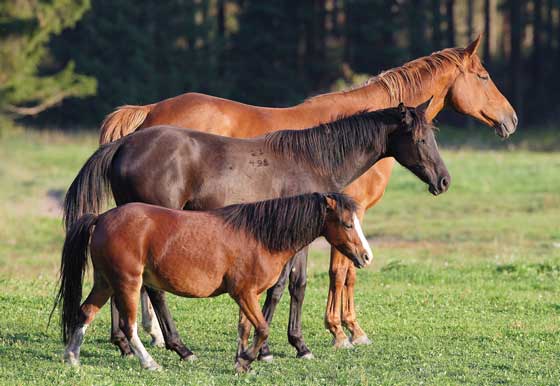
Putting a real mix of horses together in a group demands special care when introducing them to each other.
You are unlikely to be successful if you expect to be able to turn a constantly agitated or disobedient horse into a well behaved one just by using dominance-based exercises.
So long as nothing is changed in the way a horse lives or is kept, new difficulties are inevitable. Improving the horse’s life is sometimes called a programme of enrichment. Every horse owner can introduce long lasting improvements in the way they keep their horses by taking advantage of turnout and referring to the many good books on more natural forms of horse management.
Horse-friendly training
Further reasons for a number of the behavioural and apparently dominance related problems are the demands – either too few or too many – placed on horses during their daily training routines.
The work that a horse is asked to perform should always be appropriate to the animal’s potential ability. Not every horse has to learn to perform
a piaffe or to do a sliding stop. Some horses may constantly feel as though they are out of their depth in terms of the work they are being asked to do, and so may try evade the demands being placed on them by shying or spooking, being cheeky or trying diversionary tactics such as snapping at the lead rope.
Asking too little can also cause problems. In this case a horse will get bored and will tend to start being silly in order to get a reaction from us, in effect creating its own entertainment.
A system of horse-friendly training will be directed at the horse’s physical and mental capabilities. As a rider and horse owner you should be in the best position to gauge from your own horse’s behaviour and the way it expresses itself what is best for your horse. If my horse seems happy and relaxed, if it has a gleam in its eye, its ears are flicking back and forth and it has a playful expression on its face then it is likely to be enjoying our work together. If it shows resistance, shows little initiative in certain exercises and has a tense look on its face, then it is possible that the horse is being asked for too much. The way a horse appears can be used as an indicator of whether training is truly horse-friendly or not.
Horse and rider as a team
Only those who manage to build a relationship with their horses that is based on friendship and understanding can really benefit from this unique relationship. There are a variety of relationship exercises and tests that have nothing to do with the commonly used methods found in a dominance-based training system.

A horse-friendly system of training should always be built around the physical and mental potential of the horse.
A simple question that gives a good indication of the relationship between you and your horse is to look at what happens when you meet. Does your horse allow itself to be caught from the field? A horse that has a good relationship with the people around it will acknowledge your arrival and, depending on its temperament and the situation, will look up, whicker or possibly walk towards you, all the while showing an interested expression on its face. It’s not such a good sign if the horse runs away or doesn’t react at all. Many owners of horses that are kept mainly in stables are often deceived about the actual state of their relationship because of the way that their horse greets them, apparently enthusiastically, when they enter the yard. In many cases the horses are pleased more about the fact that you are a sign that they are likely to be freed from their prison or fed, rather than being particularly thrilled to see you. Real conclusions can only be drawn about a relationship in situations where the horse makes its own decisions.

Often you can see at first glance what the relationship between human and horse is like.
How does the horse react when it is spoken to by its owner? Many horses don’t react at all to their name or to a friendly approach since they have simply never learnt to understand this form of communication. A sociable horse should react positively to human body language. Sociable and friendly horses prick their ears when they are spoken to, follow their people with their eyes and ears, and like being touched.
Do you know where your horse likes being scratched, what its favourite food is and which games it likes playing most? It is surprising how many people don’t know how to give their horse a small pleasure and thus cement their relationship. It is so easy to go over your horse with your fingers and try to find out on which parts of its body it likes being touched and in what way. Some horses like being touched very gently, others like a really strong contact. Many horses love being scratched on the withers or the thigh, but few actually like being given the traditional pat on the neck.
When it comes to feed there are very clear preferences that are easy to discover if you take time to experiment with feed or treats. Of course most horses like carrots, but whether they prefer them to apples can really only be found out if you offer both of them at the same time.
When it comes to playing there are also significant differences between horses. Some like games involving lots of running about and will love racing you across the arena, while others are very mouthy and will enjoy picking things up with their mouth and carrying them around. Playing together will considerably strengthen your relationship with your horse.

A relaxed hack is a comfort for you and your horse and will strengthen the bond between you.
Creative time off
We all constantly run the danger of being taken over by the daily grind. It is true that many horses are creatures of habit who en-joy doing the things that they are used to. However, there should always be variation in the work you do together in order to prevent boredom setting in. It can sometimes be helpful to try more creative activities in some of your free time, activities that there is not necessarily an obvious point to. Amid the demands of competition, we all too often forget that for most of us riding is a leisure pursuit and that we are supposed to be having fun with our horses. It does you and your horse good sometimes to let yourselves go and just enjoy being together. Given that grazing is one of the fundamental occupations for a horse, simply sitting in your horse’s field and watching them graze can help to strengthen your relationship. Your horse will see your presence as a positive sign and this will help to deepen their bond with you.

It doesn’t always have to be work: rider and horse enjoy time out together.
There are also a variety of toys that you and your horse can play with together. Ranging from large pieces of cloth and plastic tarpaulins to balloons and balls, anything is allowed as long as it can be enjoyed by both and there is no risk of injury.
Circus tricks offer both human and horse the chance to develop and blossom, and will refine the communication between the two of you. Horses love to learn and increase their intelligence through play. It is important however that you don’t turn these exercises into another training programme that has to be worked through and demands a certain level of achievement – it should all be about enjoying doing something together.
Many horses just like being out with their human and equine friends. Riding out leisurely with others or alone can be a good way of deepening and cementing friendships.
Learning by reward
In contrast to the learning techniques promoted through the system of dominance-based training, which are based on a principle of building up and then releasing pressure, positive training methods are based on rewarding the horse. Common to all of these reward-based methods is giving something positive and avoiding any negative influences or pressure.
Of course there will be times when a situation demands fast action and may require the use of pressure or force. We have to differentiate, though, between real dangers and conflicts and everyday training and learning situations. In the latter there is no danger to life and limb and the horse can learn in peace and quiet. Learning by reward has nothing to do with anti-authoritarian teaching or wrapping the horse up in cotton wool. It is a clear concept that any trainer can follow. Of course, it is the human who decides when and for what a reward should be given, and who therefore takes a leading role, in the positive sense of the word.
A horse that has understood this principle will learn very quickly.
For us too it can be difficult to get rid of our own educational ballast. On the one hand we may have been brought up and educated in a system that has used negative reinforcement or punishment. We will all have experienced a variety of systems in our past that have used some form of pressure to educate us, from having to achieve certain grades at school to being grounded following supposedly unacceptable behaviour. Even if we haven’t been influenced by the very modern concepts of hierarchy, dominance and leadership, then it is almost a 100 per cent probability that we have learned that riding and training involves forms of negative reinforcement.
But how does positive training work when we want to avoid putting any pressure on our horse? Positive training works by offering a sought-after reward when the horse does something correct and withholding this reward when it doesn’t show the desired reaction. The horse can make its own decision and is not forced into action by its handler. Meaningful rewards satisfy one of a horse’s basic needs. Feed rewards are particularly effective and easy to use. Other types of reward such as scratching, praise or games can also be found in positive training systems. When using positive reinforcement the stage at which a reward is given is of crucial significance. A horse can only connect a reward with a displayed behaviour or action when the reward is given immediately the behaviour is shown, or at most a few seconds afterwards. Otherwise it won’t know why it has been given a reward, which can lead to misunderstanding.
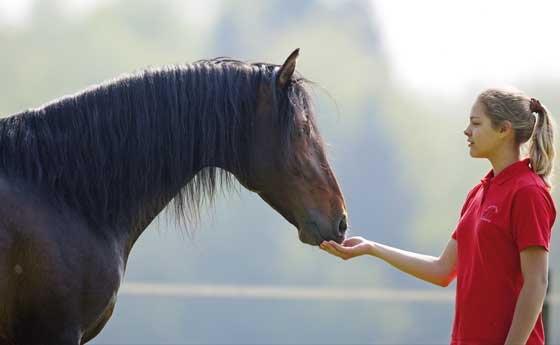
Learning by reward isn’t anti-authoritarian, but instead both partners have agreed on a mutual set of rules that can be used consistently. Horses learn particularly effectively when rewarded with feed.
For any system of positive training it is important to watch for signs of the horse feeling content or settled. This includes breathing quietly, a relaxed expression on its face, the unmistakable sign of playfulness when the horse extends its top lip a bit like an elephant’s trunk, a gleam in the eyes and actively taking part in what is happening around it.