
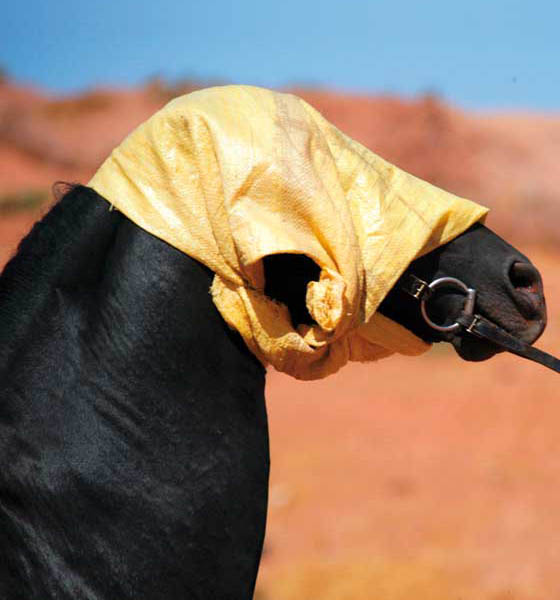
When the horse is misunderstood
Diagnosing dominance problems has be-come almost fashionable, but it ignores both the fact that scientists have cast grave doubts over the existence of this type of problem and that it is a diagnosis that can be made on only very rare occasions. Every sign of a horse lacking enthusiasm, showing reluctance, being uncontrollable or difficult will be stamped as a dominance problem, regardless of the more likely cause being based on pain, poor quality equipment, the way the horse is being kept or the way the horse has been raised. This is all because in putting the problem down to issues of dominance the person is placed in a controlling role. The question has to be asked whether the diagnosis stems more from the trainer’s own philosophy and behaviour.
The dominant human as an environmental factor
Provided they have enjoyed a healthy upbringing, horses are prepared by nature to develop relationships with other horses and adapt to their social structure. They are not prepared for a modern, dominant master who has decided that certain behaviour on the part of his horse should be seen as an attack on his own position of power, and therefore sees it as his purpose in life to treat any inappropriate or abnormal behaviour on the part of the horse, such as a wandering of the eye away from the exercise at hand, as a personal affront.
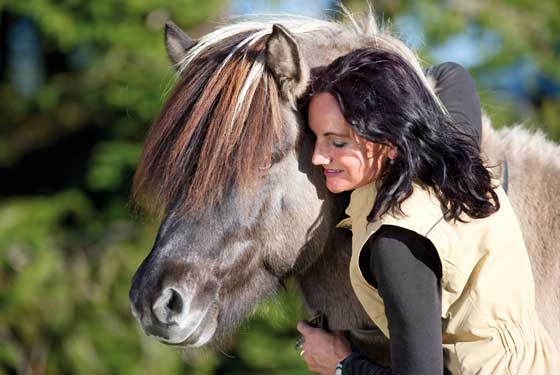
If you turn your back on dominance-based training you will discover a new level of friendship with your horse that strengthens the emotional bonds between you.
True leaders don’t even ask the question of who is dominant and who isn’t, because they are self-confident and don’t take their horse’s behaviour personally. They are more likely to consider how they can train their horse’s behaviour more positively instead of constantly questioning their relationship. Those with a natural command over others are considerate and don’t need to worry constantly that their horses are going to suddenly try to seize power. A ‘dominant’ person, however, will often turn their relationship with their horse into a constant battle – as if the horse has nothing better to do than to test them incessantly. Research has shown that horses aren’t in a position to be able to test anyone. They are motivated by the moment, either because they have no other choice physically, or because they have not yet learned to act differently.
Many problem situations are caused by a hu-man’s forceful and dominant behaviour towards horses. Horses often feel subtly threatened by their people and appear, depending on their personality, to be unwilling, fearful, overexcited or apathetic. The ambiguous signals that are given out by people often unsettle horses and create their own problems.
If a person isn’t, for example, totally convinced by the concept of dominance training, they won’t be able to implement it properly, even with the help of instruction from professional trainers.
We have to be happy in our own minds about what we are doing and be able to apply a method with a clear conscience. Many people feel a subconscious aversion to the concept of dominance because it doesn’t reflect the emotional ties they have with their horse. A person like this will run into problems using a training method that is inherently wrong for them, while more positive methods of training may give them an easier and less problematic way of working with their horse.
Many difficult situations are worsened by confrontation. Loading a horse into a trailer often becomes a problem because it isn’t done in an atmosphere of calm, but is instead left to the last minute before leaving for a competition. The stress felt by all involved in the situation escalates dramatically until it becomes a direct confrontation between two wills – that of the person and of the horse. Most riders appear to expect that every horse, even with no practice, is simply going to walk into the trailer. They see any misbehaviour as an attack on their own position and a deliberate disobedience by the animal. If loading into a trailer had been introduced from the start with patience, praise and a positive attitude it would probably never have developed into such a confrontation in the first place.
A person’s adaptability and willingness to compromise are important when faced with difficult situations. A situation mired in problems needs to be analysed, not simply tackled without any thought. Only then can you relate the training steps to the actual cause of the undesirable behaviour, such as fear or pain, rather than just expecting a horse with problems to submit to your will. Compromise will often be necessary in order to get to where you want to go. This means that the real fear that many horses experience when walking into a trailer will only be overcome by a longer period of practice during which the horse learns to walk on to the trailer voluntarily rather than being forced by its handler to do so.
More important than solving problems is preventing them from occurring in the first place. Potential difficulties can be avoided well in advance through good horse management, a relaxed learning environment and positive training methods. Horses that like their work learn easily and have no reason to resist you.
Common problems and possible solutions
In this section I would like to give you an overview of the problem areas that are most often diagnosed as being due to issues of dominance, and then discuss what could be the actual causes. These causes are given only as a suggestion of the direction that should be explored further, because a complete solution would have to be worked out on the spot on a case by case basis.
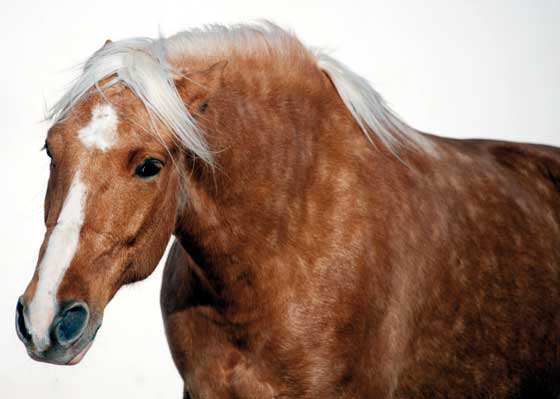
Aggressive behaviour can have many causes and shouldn’t be labelled automatically as stemming from dominance issues.
Aggressive behaviour
Horses are often diagnosed with dominance problems when they show aggression towards people or other horses, whether this is demonstrated by biting, kicking or rearing. Studies have shown that animals with a higher social standing tend not to be particularly aggressive, but on the contrary tend to be less often involved in fighting or other aggressive conflicts. A much more likely reason for the vicious cycle of aggression is pain, certain symptoms that tend to increase aggression such as those associated with hormonal changes or infectious diseases, as well as stress.
If these causes can’t be found, then you may be faced with aggressive behaviour that has been learned as a defence mechanism. Whatever you do to tackle this aggression, your own safety should be paramount. Typical dominance-based training equates to training using confrontation but with added pressure. This can lead to a horse becoming more aggressive in response, which is why a positive approach is always preferable.
Disobedience
If a horse doesn’t follow your commands but just seems to ignore them, this can also be put down to problems of dominance. The more probable reason, however, is that the horse either hasn’t understood what it is being asked to do, that it physically can’t do it, or that you are dealing with a animal that is an example of the passively stressed horse. Passive stress is shown by animals when they react to outside pressure with a complete refusal to work and very often with total passivity. In effect they withdraw into their shell. These types of horses can easily be driven into a state of learned helplessness by a rigid pressure-based system of training.
Fear
Many dominance-based trainers claim that their methods can lead to an improvement in horses that tend to be anxious or scared of various things. However, this involves in effect ‘forbidding’ anxious or fearful behaviour using pressure, rather than working on the cause of the fear. Many trainers will get a horse to load into a trailer using a build-up of intense psychological pressure that forces them to comply despite their fear.
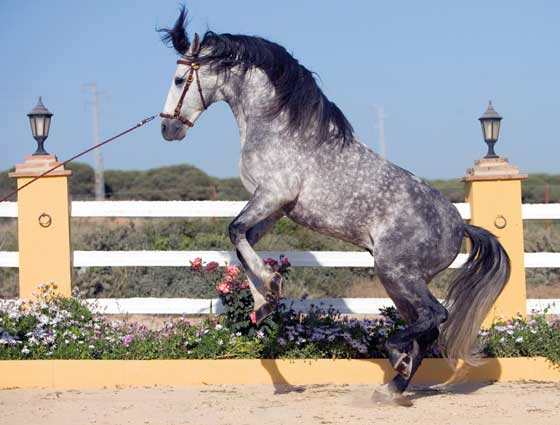
Dominance-based trainers frequently confront horses with stimuli to cause fear, virtually asking for disobedience.
In the long term, though, the horse will still be difficult to load because the owner or rider usually can’t repeat the exercise by themselves and will still be confronted by the horse’s fear. In a dominance-based training system fear is suppressed by learned helplessness.
To work through fear you should never resort to methods that use pressure or the technique of flooding the horse with stimuli. Instead the horse should be desensitised gradually to situations that it is afraid of.
A typical example of this is a horse that is scared of having fly spray applied. First of all the horse (not tied up) is shown the bottle and praised for looking at the object. The next step is to spray away from the horse to get it used to the noise and again praise it for standing still. Gradually the bottle can be sprayed closer and closer to the horse until the horse is actually sprayed itself, again all the while being rewarded. Only then can the horse get used to the situation in a more relaxed way and learn that the spray can is not dangerous but rather has something positive about it.
Some horses are by nature, owing to a traumatic experience or a lack of worldliness, more fearful in their behaviour. Getting a horse gradually used to something that can cause fear is described as systematic desensitisation, meaning that the horse is confronted with what causes it fear but only so far that it doesn’t cause stress.
If this process of habituation isn’t done step by step, but as fast as possible, it is described as ‘flooding’ the senses with stimuli. The horse is exposed constantly to an unknown stimulus until the fearful reaction decreases as a result of the exhaustion of its attention span, and the horse learns eventually that the stimulus holds no real danger. An example of this is ‘sacking out’. A rider puts a saddle straight on a horse for the first time. The horse bucks and rears because of a strong fear reaction and, depending on its temperament, may show this form of defence mechanism for a long period. It notices eventually that it can’t get rid of the saddle and resigns itself to its fate. It will never like the saddle, though, because from the start it wasn’t a positive experience.
This type of confrontational training is very wearing and has many side-effects. In the case of very fearful or sensitive horses it can lead to real phobias and pathological panic attacks or even to aggression. The horse can become a complete bundle of nerves that has no trust even in itself. Given that horses are always aware of their surroundings and will connect them with the stimulus that they are being confronted with, a horse will begin to connect you with the flood of stimuli and start to fear you, or in certain situations avoid you – a poor basis on which to build a partnership.
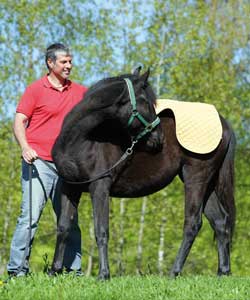
An ethical and practical way to get a horse used to the saddle cloth and then later the saddle is to work in small steps and in a relaxed atmosphere.
The worst risks are often not even mentioned, out of pure ignorance. When using this flooding method you must ensure that the horse cannot run away from the stimulus – in other words it has to be confined. In practice this means that most trainers, when trying a saddle on a horse for the first time, will use a high-fenced enclosure like a round pen that the horse can’t usually get out of. This doesn’t mean, however, that it won’t try. Depending on their temperament, some horses will try to jump over or break through the fence, becoming an uncontrollable danger for anyone present as well as itself. A panicked horse becomes almost oblivious to pain and will incur severe injuries in order to get away from the stimulus, or the source of its fear.
Apart from the incalculable risks that characterise these methods, I find them morally reprehensible. No one should ever knowingly cause an animal to panic, especially when there are more intelligent and humane ways of training horses. Don’t let anyone frighten or scare your horse just to get it used to a saddle or to get it on to a trailer. Horses can’t stand up to confrontation or see the sense behind it, so we owe it to our horses to look after their psychological needs.
A more positive way of getting a horse used to the saddle would, for example, be to place the as yet unfamiliar saddle on a stand next to a young horse while they are eating. The horse learns that a saddle is an everyday object. Gradually you can introduce carrying the saddle around, letting the girth or stirrups make their usual noise and then start laying the saddle cloth over the horse. Only when the horse accepts the saddle cloth should the saddle be placed on its back, initially without doing the girth up. Gradually tighten the girth up and reward the horse for standing still. In the following weeks and months the saddle can become a constant companion to the horse on walks or when being worked in hand, before moving on to actually riding.
In order to end up with a reliable leisure companion with whom you can enjoy long hacks, you will need to work on the horse’s overall calmness and self-composure. A horse may well shy away from unknown objects or sounds, or even other animals. In short, the unfamiliar is scary. Given that when riding out you will encounter a multitude of unfamiliar objects, you should try to get your horse used to such things in familiar surroundings.
To improve the horse’s relationship with objects that may cause it fear, such as umbrellas, plastic sheeting or rubbish bins, we need to carry out a programme of systematic desensitisation with conditioning against the objects. First of all the horse should gradually get accustomed to looking at the object in a relaxed environment (desensitisation), with the distance to the object gradually reduced. Unwanted behaviour such as fidgeting or nipping can be stopped by using rewards when the horse is standing quietly. This transformation of a situation that until that point had negative connotations with the use of positive associations is known in learning psychology as conditioning. The good thing about systematic desensitisation is that what was for the horse a negative situation (‘I’m afraid of that big flapping monster’) becomes, thanks to the reward given, a positive one (‘Great, I recognise these flappy things, I get a treat when I see them so I am happy to get close to them’). With systematic desensitisation you build up the exercise gradually so that the horse will always stay quiet and accepting of the situation. It is very important to ensure that the horse never gets the chance to respond in a way that you don’t want, because this can worsen the situation and develop into a habit. For this reason the distance to the objects used for practice should always be great enough that you stay just beneath the threshold that would trigger a fear reaction. Outside of training, situations that could cause a negative reaction should be avoided at all costs, in order to avoid giving the horse any opportunity to develop un-desirable behaviour.
You need to find out at what distance from a scary object your horse will remain calm. If your horse only just notices the umbrella when it is five metres away and starts to tense up when it is at three metres, then you shouldn’t go below three metres when starting to practise. Gradually the horse will learn to accept the unknown, even without treats.
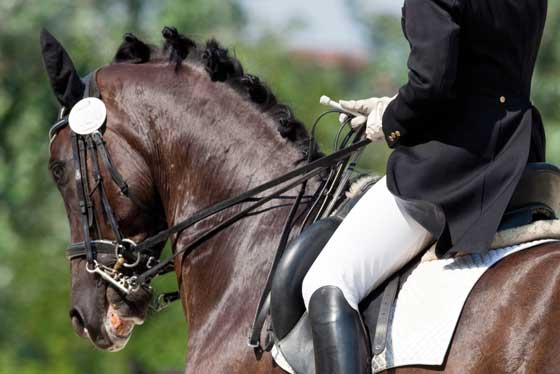
Aspects of horse welfare are often trampled underfoot in horse sport. Under the disguise of dominance the horse is portrayed as a potentially dangerous animal that can only be controlled by the use of psychological or physical force. A look into the eyes of horses trained like this often reveals the sad truth.