

NINE

There have been many women in my life, fair and plain, hearing and deaf, but I have chosen four among them to record here, for their role in deaf history or for their closeness to me. The first, Alice Cogswell, qualifies on both counts. Then I will speak of Julia Brace, the deaf-blind girl whose flowering into womanhood has inspired people the world over by demonstrating that human potentiality lies in the plasticity of the mind and not in the mechanics of the senses. Third comes my own dear Eliza and our family, and finally the queen of the deaf, Sophia Fowler Gallaudet.
Never have I felt my limitations as a historian more keenly than at this moment. Having shown the falsity of the hearing history that styles itself a history of the deaf, shall I now, an old man who has spent all his youth and most of his adult years among men, write a history of women and the deaf? To this problem must be added another: I have been able to distill this history so far from a fund of documents written by friends of the deaf and by the deaf themselves—Bébian’s journal, Berthier’s biographies, the silent press.… But the record of the lives of women, their qualities and their acts, is very scant indeed. Many women have been kept in servitude by some relative; coarsely clad, faithful and diligent in labor, often skillful in household duties or farm work, they live and die knowing little of the outer world, and it records nothing of them. And yet, I cannot omit to speak of deaf women, and so I have determined to write about those of my own acquaintance and the men and issues that particularly concerned them.
Most of the letters Alice Cogswell wrote after she entered our school have been lost. Those that survive—her compositions printed in the annual reports, for example—are on sober and religious topics, gracefully discussed. After three years’ instruction, she wrote: “What is hope? It is to aim the good thing with moderate wish and smile, but it is not a violent emotion. What is admiration? It is to elevate with sweet feeling to see the beautiful and elegant objects and it differs from wonder.”1 Some years later, Alice had occasion to write her reflections on death when a neighbor committed suicide; the closing lines move me for their imagery and portent of her own premature death:
“In my memory she moved like a blithe bird. She was full of life and buoyancy. All that saw her admired her, and all that knew, loved her. She was like a ‘bright bud of promise,’ but fading in the grave, and will ‘bloom out in righteousness’ in Heaven, forever and forever.
“My memory is now afresh, that her sunny ringlets always plaited before my eyes, and they won’t perhaps be the less shining in the cold bed of Death. They may be the emblem of Eternity, which ever curl, and curl without end.”2
In the happy and fruitful years after her schooling, a young woman in her twenties, Alice flourished. Her brothers and sisters married—the oldest of her sisters, as you will recall, married Lewis Weld3—and Alice, much loved by her nephews and nieces, visited them all—those who lived in New York and New Jersey as well as those who lived in Hartford. If not all her new relatives could sign, all her old ones did, so there was always an interpreter around, as well as the slate she kept handy.
With Alice thriving, Mason’s mind was relieved of a great burden, but he did not abandon his concern for the unfortunate. He continued to care for the sick, to operate, to teach, and he launched a great new project, the Hartford Retreat for the Insane. In the year Alice was graduated from the asylum, 1824, the doors of the retreat were opened to patients. It was the first in Connecticut and one of the first in the nation. (Since it received no aid from the state, which like all others was content to imprison the insane with common criminals, the retreat had to charge high fees, and few of the thousand or so insane living in Connecticut could be accepted.)4 As general overseer, Mason endeavored to make the institution worthy of its standing as a model, following the precepts of the new “mental medicine,” whose leading proponent was Abbé Sicard’s colleague in the Society of Observers of Man and Itard’s mentor, Philippe Pinel, director of the Paris insane asylum. It called for good personal hygiene, exercise, and constructive labor from the patients and kindness and respect from the attendants.
On the threshold of his seventies, and of the third decade of this century, Mason could look with satisfaction at the works of his lifetime. His children were well launched in their marital or professional careers. The Hartford school was highly successful and was emulated throughout the nation. The Retreat for the Insane was firmly established. It is almost as if he said, “Now I have done what I could do,” and then he lay down. His mortal illness was short—five days—but long enough for all the city to be gripped by anxiety.5 Late in the afternoon on the last two days, people gathered in knots on the sidewalk outside his house on Prospect Street, whispering among themselves. Some recounted how he had snatched them from death, others how he had eased their pain, saved their child, taught their son, pleaded their cause. Why were they there? There was nothing they wanted other than the privilege of bearing witness to the last earthly act of a great man. Catherine Beecher* came to the house and said: “We feel as orphans.”6
The final night, quite late—neighbors and friends had gone home to rest—we gathered around Mason’s bed. Two of his former pupils stayed by his side, though there was little they could do beyond summon us. Alice, her eyes wide with alarm, watched the agony of her sisters’ faces, took in her mother’s tears, observed the words of encouragement and peace consigning Mason to God’s care, and now kept a silent, immobile vigil.
The next day we assembled in Mason’s room again while neighbors arranged the funeral and prepared mourning clothes. We wept, but Alice, dry-eyed, moved among us with words of consolation. The following day, the Sabbath, Lewis Weld, who was staying with the Cogswells, sent for me early with the appalling information that Alice had gone berserk. As I rushed to the house I encountered the knots of neighbors and Reverend Strong’s successor, Joel Hawes, who said and mimed, “God give you strength.” Lewis spilled out the awful events of the previous night. He had been awakened by heartrending shrieks just at the hour his father-in-law had died the night before. Rushing down to Mason’s room, he had found Elizabeth on the floor, apparently dead, his wife, Mary, struggling with a frantic and screaming Alice, and Mason’s widow on the verge of fainting (as Elizabeth had done). Now, after a night of terror and distress, Alice was dozing; I took up my station at her bedside. Outside, the day was bleak and cold; a steel-gray sky glowered at barren trees and a sweep of bare fields covered in old, encrusted snow. They’ll have a time digging the grave behind the church, I thought. The dim light insinuated itself into the room between the half-closed shutters. Alice’s face was drawn, her sleep troubled; at one moment she awoke with a start. “ME-SICK. FATHER DEAD TAKE-CARE-OF-ME CAN’T.” “But you have many fathers,” I said. “Jesus is your father. The abbé de l’Epée is the father of the deaf. I love you like a father. So do Thomas and Lewis.” We spoke of Jesus—his tenderness to little children, his pity for the sick and suffering, his compassion for his disciples when he left them.
In time, there were movements about the house as her father’s body was taken away. “I am too sick to go to the grave,” she said. “I must try to sleep.” I dozed next to her and awoke to see her staring at the chink in the shutters: large flakes of snow drifted past it. “Cold, icy grave,” she signed. I answered: “The snow reminds us of the white robes he will don in heaven.” She smiled and slept.
Perhaps unwisely, I returned to my own family that night; Alice spent it moaning and shrieking. In the morning she did not recognize her family; the doctor was with her. Over the next few days, Catherine Beecher, Lydia Sigourney, and Thomas tried unsuccessfully to break through the wall she had erected. Sometimes she fancied she was already in heaven. “I hear David’s harp!” she signed. There were short intervals of reason: once she reflected on her grief in a signed phrase of striking poetry; the English translation cannot do it justice: “Our two hearts had grown so close together they became one and can no longer be separated.”
A few hours before her death, Thomas stood calmly, tenderly by her bed waiting; at last, he seemed to catch her eye. He made the sign of the wounded hand, emblem of our Savior. Alice signed, “PRAY”; and Thomas commended her soul to the Good Shepherd.
There is nowhere in France as desolate as the Connecticut River Valley in winter. The wind comes funneling in from the Sound and strips bare everything in its path in its rush north to Canada. The gray-shingled houses hunker down close to the ground, the trees resemble skeletons of giant travelers caught long ago in the snow. If you trudge through the fields as I did that day, punching holes in the earth’s crust, the swirling crystals ice on your scalp and eyelids, you lose your vision and your sense of here, now. I withdrew to an inner hearth where Alice, insubstantial, also dwelled. Alice, we did it for you, I explained. Thomas, Mason, and I. (This was true: Eliza, Sophia, the others, came later.) We failed you. We spoke so little of the joys of this earth, so much of those in the kingdom of God, that only Mason’s sturdy anchor firmly held you here. We administered the strong medicine of the Gospel, compounded for cynics, hypocrites, and sinners, to a child’s soul that knew none of these, that hearing people had sheltered out of ignorance and love, that was too vulnerable. Now Alice was in a realm in which ideas were communicated without language, where there were no hearing and no deaf, where there were no barriers and no one was shunned or silenced. But that, I thought, would not excuse us. I followed my footsteps back to the house. Lydia wrote some obituary verse: “Joy! I am mute no more.” And life, as it always does, went on.7
A few years before these events, Julia Brace was admitted to our school at age seventeen. She was to become the first educated deaf-blind person; I know of only a half dozen more since then, of whom Samuel Gridley Howe’s pupil Laura Bridgman is the most famous. (We shall learn more of Howe and Laura later in this history.) Thomas had visited Julia’s home in Glastonbury just before going overseas; while abroad he discussed her case with the philosopher Dugald Stewart and sent back instructions that a tangible alphabet should be constructed out of wood, clay, or pins in a cushion, and Julia taught to read and spell. (Valentin Haäy had not yet invented raised print, nor Louis Braille his system of tangible dots.) Mason visited Julia’s home for this purpose just before the asylum opened, and Alice accompanied him. “Miss Julia Brace blind and Deaf and Dumb very poor,” Alice wrote. “She live in very little house very cold. She no frock. Me very sorry. Have yes me give one new frock her very much glad she for winter.”8
Diderot’s famous letter on the blind makes several allusions to the hypothetical case of a blind deaf-mute; in one place he remarks somewhat whimsically that if someone born in these circumstances should begin to philosophize concerning man according to the method of Descartes, he would place the seat of his soul at the tips of his fingers and after an effort of profound meditation, he would feel his fingers ache as much as we should do our heads. He also said that no communication could exist between such a person and ourselves and that he must remain in a state of imbecility. Julia Brace showed that he was wrong, that hearing and vision are not the only avenues to the mind. But how to teach true language through touch? Epée’s plan was to have a polished steel alphabet constructed, if any such child should ever be found and brought to him, for which he advertised in the papers.
You might think it particularly obtuse to try and teach a deaf-blind girl to manipulate shapes that represent in a complicated way the component sounds in words she cannot hear, but it should be said in Thomas’s defense that Julia had heard and spoken until her illness at four and a half. Still, letters could not penetrate the veil of darkness that surrounded her. In fact, the abbé Sicard did not think much of this way of proceeding. He wrote that he started out with the alphabet when he went to teach Massieu, but “what information, in reality, can the understanding possibly derive from a series of abstract characters arranged in a particular order by chance alone and to which nothing equivalent can be exhibited in Nature?” Sicard urged, instead, that our instruction be modeled not on the teaching of reading but on the child’s natural acquisition of his mother tongue. He was right: it was sign, which Julia learned promptly and well once she joined the deaf in our school, that penetrated the veil and did so beautifully. How extraordinary that this language, destined for the eye and obeying, as it were, the eye’s imperatives, could be equally grasped by Julia’s opened palms passed ever so lightly over the hands of the signer. How little it seems to matter if the ear, the eye, or the palm receives the message!
Once Thomas had returned from Europe to Hartford, he sent Dugald Stewart a summary of Julia’s case, as he promised he would. Here are the essentials:
Julia had no sight or hearing but like Stewart’s pupil, James Mitchell, she seemed to have the most acute senses of smell and touch. For example, when Mason Cogswell and Thomas met her, she freely felt them, rubbing their hands with her own. (She had formerly been afraid of strangers, which her family traced to her dread of her physician, who had applied painful blisters to various parts of her body.) Then she put her hands to her nose as if still retaining on them the peculiarity of her visitors’ smell. They conducted an experiment. They put their watches in her hands. As they did so, she rubbed their hands with one of her own, which she immediately applied to her nose in order to determine to whom the object belonged. Then each of them attempted to take back the other’s watch. She invariably perceived the deception, would not suffer the wrong commutation, but returned to each his own watch.
If smell was particularly the sense of recognition for Julia, touch was the sense of exploration. When any new object was given to her, she first felt every part of it, moving the ends of her fingers over it with peculiar minuteness and delicacy. She then applied it to her upper lip, on which she rubbed it for some time as if there was the seat of a more nice sensibility of feeling.
The cases of Brace and Mitchell both led to the same conclusion: loss of some senses sharpens the acuteness of those remaining. These senses were entirely sufficient to allow Julia to go to any part of her home in Glastonbury without assistance. She even went into the yard with a basket for the purpose of gathering wood chips.
Her parents had reported to Thomas that Julia was solicitous of her brothers and sisters. She had several—all younger than herself. When they lived together at home, she sometimes washed their faces and hands; she would rock the infant in the cradle and feel its eyes to ascertain if it were sleeping, and if she found it crying she would sometimes give it sugar. The asylum, so rich in possibilities of communication and useful labor, rapidly supplanted the sterility (hardly the word, for it was a filthy hovel) of her parents’ farmhouse, though before their death, they sometimes came to see her at our school, and she would visit them during vacations. Julia is deeply tied to her family in her affections, but separation from friends seems to weaken her attachment rapidly. Those who have made her presents of particular value—in her view—she is apt to remember and she shows pleasure on meeting them again, whereupon she generally refers to the gift with which they are associated. Her support comes from charitable donations dropped in an alms box at the front door of the asylum that is reserved specifically for her. This box she frequently hefts and she expresses pleasure when it shows an increase in weight, for she learned early that money is the means to satisfy many of her wants.
When Julia came to the asylum, I readily taught her my name sign. I let her feel the scar on my face. Thereafter, to greet her, I would touch her arm to get her attention, then brush her cheek lightly. She would do likewise when speaking to me. Thomas was the only one who wore spectacles; after he let her feel them and feel the sign made for them, which was also his name sign, she learned to use this sign as appropriate to him alone. Similarly, she learned the names of objects around her that concerned her. Soon, she could be sent to fetch an article of dress, her scissors, thimble, or anything of her own with as much assurance that she would understand and procure it as with anyone else. When she needed new clothing she could go to the matron, tell her what she wanted, ask her to go to the principal to get him to open her money box, take some money, and give it for the thing desired. If some girl’s behavior should offend her, she would go with the offender to the matron, state the offense in strong terms of condemnation and say the steward or the principal must be called to inflict the appropriate punishment, specifying sometimes locking up, boxing ears, or thrashing.
Although she has spent nearly her entire life in our asylum, Julia’s knowledge of the external world, acquired through signed communication and some firsthand experience, is considerable. On one occasion she asked to visit a family she knew who lived rather far from the asylum. When told that the road was too muddy, she asked how deep the mud was, whether the water ran along the gutters, and if the cows drank the water. Like all of us, she talks a great deal about the weather: will Miss P. be able to return to the asylum through the snow? Mr. W. must put on his high-top boots.
You may wonder how she tells time. At school, she is guided during the day by the regular succession of the pupils’ activities. She anticipates the return of the seasons, holidays, and vacations, no doubt by her own observation and by talking with those around her. Julia rises in summer about four, in winter five o’clock; the earliest riser in the women’s dormitory, she washes, dresses without assistance, brushes her hair before the looking glass, and makes her bed impeccably. She then goes down to the sitting room and waits until summoned for breakfast. Then comes one of her duties: she has for years washed and wiped the teaspoons used by the pupils at meals and tea, some 130 of them. Others on the kitchen staff collect them for her, except during vacation. Then it is her job, and on the very first morning of vacation she sets off around the hall without a word being said to her on the subject. Once she has cleaned and dried the spoons, she puts them in their proper place and changes the towels as often as cleanliness requires. If teaspoons from the steward’s table become mixed with the others, she instantly detects the error and puts them to one side, though I wager you would not see the difference between the two sets of spoons.
In the morning, she sews, knits, or mends. Clothing has become the central concern of Julia’s life. She had been sent to a little school for children where she learned to knit and now, at sixty-two, she sews or knits five or six hours a day, but if making anything for herself, she doubles her diligence, working with great perseverance until it is finished. Julia performs the entire work of knitting a stocking without assistance: shapes it properly, narrowing, widening, and so on. Matron reports that she has been known, on examining the knitting work of a little girl, to discover its defects with surprising readiness and, after condemning them roundly, to pull out the needles, unravel the work till she had removed all its imperfect parts, and then taking up the stitches, return the item to its owner finished. Though she needs some assistance in cutting elaborate patterns and in sewing the waist and sleeves, she makes her own clothes, threading her needle with her fingers and tongue. She wants her dresses fashionable, or rather like those of others, especially of the younger girls around her. Sometimes, matron assigns her some other task, for example, ironing. Then she goes to the ironing room, puts her flatirons to the fire, selects her own clothes from the mass belonging to more than one hundred people, and irons them to perfection.
Julia knows most if not all of the women in the institution and is well disposed to all of them, strongly attached to a few. Though she has seen forty-four entering classes come and go, she still takes particular interest when a new young girl is admitted, asks to meet her, wants to know who her instructor will be, inquires about her progress. She is, however, ill-disposed to male pupils and markedly averse to men; Thomas and I and one or two of the oldest teachers are the only exceptions. On Thanksgiving, when the boys are invited to the girls’ sitting room and gallantly accompany them on a tour around the building, with parents in attendance, Julia will accept no man’s arm.9
So far as I know, Julia has never been guilty of theft, falsehood, or wickedness. She is scrupulous about property—even a straight pin found in her work must be restored to its owner; she expects the same from others. Although she is very fond of money, she is perfectly trustworthy with that of others and is occasionally asked to deliver money from one person to another without the least apprehension. Even articles given to her she will not retain unless it is quite certain they were meant as a gift, not for inspection alone.
Whence this morality arises I do not know, but it does not arise from her belief in God, and this is an interesting finding for moral philosophy. Julia abstains from labor of any kind on Sabbath, but she also abstains from chapel, and I think she simply enjoys a day of rest wearing her finery. We tried an experiment: we called her attention to various objects and said Miss C. made that one, Mr. H. another and so on. The idea of making is familiar to her; she makes many things herself. Then we presented fruits, flowers, vegetables, stones and told her that neither this friend nor that acquaintance made any of them; neither men nor women made them. We hoped thus to arouse her curiosity and convey to her mind the idea of the Almighty Creator, but the attempt was not successful.
We do not know what her ideas of death are. Many deaths have occurred in the asylum during her residence and all deeply interested her. At the first, she examined the body carefully and finding it was incapable of movement and had ceased breathing, she was horrified. With each successive death she was less agitated. She makes the signs for weeping, for being sorry, perhaps for burying, and asks to see the corpse. She examines the graveclothes, feels the face and hands of the dead body with delicacy, makes the sign for being dead, says the friends are sorry, and so on. Sometimes she says the individual was good “and has gone up.” I believe she has a conscious spiritual existence and assumes, therefore, that others do, too.
All of these observations about Julia further demonstrate how grievously wrong are the beliefs of hearing-sighted people with respect to the deaf-blind. In his great compendium of English common law, Blackstone wrote, “Such a man is looked upon as in the same state with an idiot … incapable of any understanding, as wanting all those senses which furnish the human mind with ideas.”10 How wonderfully Julia proves it is not so.
And yet—Julia’s fate was in some ways little better than that of my long-ago love, the pupil of Abbé Salvan. For she was never taught a trade, and, disliking men, has never married. Unable to be self-sufficient, she has remained in her asylum all her life. She is now sixty-two. Perhaps she suffered a more cruel affliction than deafness and blindness in the parental ignorance that condemned her to live for years like a primitive animal at the bottom of the ocean; had her parents known sign language, had she been put in contact sooner with the world around her, she could have had a rich and fulfilling childhood and her life a happier unfolding.
But there are other, less melancholy fates for those such as Alice and Julia. Consider a happy, healthy deaf woman who bloomed with education into intelligent maturity, married a devoted and industrious deaf man, raised wonderful children, and lived happily ever after: my beloved wife, Eliza Boardman Clerc.11 We have been married for half a century, and such is the sweet complementarity of our dispositions that we could remain together in tranquillity and joy for another fifty years. We have grown old together in uncanny synchrony. As my hair turned to gray, so did Liza’s. As my wrinkles appeared, hers did, too. In recent years, my sleep grew light and short; Liza joins me for hot chocolate as the sun rises. We don’t go out any more—we are both too old and too frail, and while I spend the day writing, Liza gracefully arranges its regime around me. It would gratify us both to go hand in hand to our Savior.
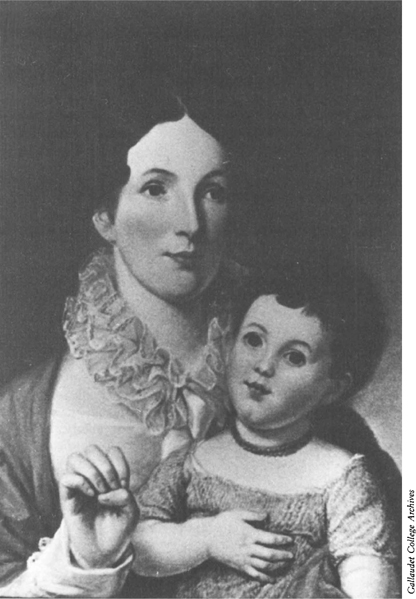
ELIZA BOARDMAN CLERC (MRS. LAURENT CLERC) AND DAUGHTER ELIZABETH
(PAINTING BY CHARLES WILLSON PEALE)
Liza came to Hartford, one of the first score of students, from the home of relatives in Whitesborough, New York. She was an orphan who had lost her hearing in early childhood. I confess at first I scarcely noticed her; those early months at the asylum were busy and breathless times. The months passed, summer vacation came and went, I knew who she was, of course, yet I had never really seen her. And then, one day, for no apparent reason, I was keenly aware of Eliza’s presence, of her comely twenty-five years. Her gently oval face was a work of art of perfect symmetry: her hair parted in the middle, beautiful large eyes and arching eyebrows, a long slender nose, a small mouth with perfect lips turned slightly up at the corners, an intimation of dimples. Now when she came into the room each day I was a little short of breath, as when walking into the wind. Her signing had at first an endearing awkwardness or, rather, hesitancy. I found that I would call on her in class more and more frequently, which made her blush more crimson, and I braved the matron’s glare to converse with Liza and her friends in the girls’ sitting room. As the days passed, rumors spread; our lighthearted glances became soulful looks, full of vulnerability and affection. I was encouraged, no, I was divinely inspired. Finally, one day when I saw her from my study window picking berries with her classmates, the sun glinting in her chestnut hair, bending, rising, skipping along the path, I went out into the garden, brazenly summoned her to my side, and announced: “My intentions are honorable, Miss Boardman.”
“Oh, yes, Mr. Clerc,” she replied. “Oh, yes!”
Returning to my study I realized with awe the immensity of what was happening: I was in love, and my love was returned, but all the rest was obstacles. I was Catholic and Eliza was not. It would be, as far as I knew, the first deaf marriage in America and its symbolic meaning could weigh heavily on us. There had been successful deaf marriages in France, but here in America they were unfamiliar and some might disapprove. I was still a French citizen and wondered if I even had the right to marry in Connecticut. Would Eliza be happy to live with me in France, if I were to return there permanently?
When I came to Hartford, Congregationalism was the state religion. There were only a few other Catholics, mainly poor Irish, and no Catholic church. The Episcopal church, attended by many members of the board of the asylum, generously set aside seats for me and such pupils as wished to attend. There were no interpreters, but we could follow the different parts of the service in the prayerbook.12 Abbé Sicard was truly hurt when, during my first visit to France, I told him of this, and worse, introduced my Protestant wife. “You are an apostate!” he cried. “My stipulations, your mother’s entreaties were for naught!” He went on and on. My contract specifically prohibited my teaching contrary to my religion. Thomas was the worst sort of Protestant, evangelical: he sought to keep the Roman Church out of America. (In that Sicard was right.) My kindness had allowed the Protestants to monopolize the education of the deaf in America! (Right, again.)13 Yet I had no choice: it was not for some years that the first Catholic church was gathered in Connecticut. Hardly a reason to marry a non-Catholic, Sicard countered, but in truth, I was not an abbé and I did not feel doctrinal differences quite so strongly. Besides, I was in love.
When, two years earlier, I had joyfully brought the good news of my marriage proposal to Thomas, he, too, received it with gloom:14 it will be most difficult for you, Clerc; people will disapprove; you will have deaf-mute children, increasing the number. I left the interview in a fury. Then we will not be married here at all, I decided. I wrote to Liza’s guardian, asking if I might offer his ward my hand and if the wedding could take place among Eliza’s family. She must have written home about me, for the response was prompt, warm, and positive. Come before the spring is too far advanced, he wrote, or the roads to Cohoes Falls will be impassable. Take a coach from Albany or Troy.
We were married by the rector of the Episcopal church at Troy and chaplain of the U.S. Senate, the Reverend Dr. Butler, whom I had met when Thomas and I were fund-raising in Albany. Friends also dating from that time who attended included Harmanus Bleecher and Theodore Sedgwick, distinguished law partners held various government posts, and a few others. Lewis Weld was my best man and Reverend Butler’s daughter and Eliza’s cousin were bridesmaids.15
I thought a lot about what Thomas had said and about the furtive character of this wedding in rural New York far from my friends and colleagues. I believed in the rightness of what I was doing but—less than three years before, on shipboard, had I not told Mr. Wilder that I should marry a hearing woman? Now I know I was right to wed Eliza, and Thomas very very wrong, as he willingly acknowledged in later years. Healthy deaf people should always be encouraged to marry if they so desire, as most do, and they should marry other deaf people if they so desire, as most do. Hearing people—not deaf—have written a lot of arrant nonsense on this topic. At best it is born of ignorant superstition; at worst it is part of the same campaign that would deprive us of our language. I want to set the record straight.
Of the seventeen hundred pupils received since our asylum opened, only one hundred have deaf relatives, a smaller number, deaf parents.16 It is hearing parents whose children populate our asylums, and if deaf people never again married and had children, the deaf population of the United States would not change perceptibly. The first reason for this is that half our pupils have acquired deafness: spotted fever alone, the disease that took Alice’s hearing, is responsible for a fifth of these cases, scarlet fever for nearly one half; then come falls and inflammations.17 Another ten percent of our pupils come from the marriage of blood relatives. Again, it is hearing people who are responsible; a minuscule number of these parents are deaf. Many of these kindred hearing parents have children who are retarded as well as deaf but not all do; remember the de Velascos, for example.18
As for the remaining deaf pupils who were born so, some nine out of ten have hearing parents.19
Thus, discouraging deaf marriage would not have any significant impact on the incidence of deafness. Now look at the reasons for encouraging it. It is what deaf people themselves desire: the uneducated deaf, the orally trained deaf, the deaf from our asylums, they all wish to marry and most wish to marry other deaf people. The reasons are not hard to find: facile communication; shared experience; the friends of the one more readily become the friends of the other. Deaf people know, too, that for these reasons such marriages are less subject to divorce. The chances of having a deaf child are small, one in ten, but if deaf parents should be blessed with one, is there anything to regret? Deafness does not entail wrongdoing, disgrace, physical suffering. Educated deaf people generally manage their affairs judiciously, bring up their children well, become useful and respectable members of the community—these are the words of our former director, William Turner, and he is right.20
As an old man who has followed the course of many marriages, hearing and deaf and mixed, my advice to the deaf is that given in Scripture: “Be ye not unequally yoked together.” The chances of having a deaf child are not reduced if you take a hearing spouse, and deaf should marry deaf. Raise your children, hearing or deaf, well. Give them all the priceless heritage of your language and see that they add to it a command of written English. If God gives you a deaf child, make him wise, devout, strong, proud. He has a special mission: to serve as the vehicle of our language and culture, to sustain deaf society as an evolving variety of the human condition.
I presume to offer some advice to hearing parents as well. If a deaf child should come into your family, it is up to you whether the event becomes a tragedy or a source of great joy and instruction. At first you wonder at him, sympathize with him, do all you can to make him happy, rejoice to see that the infant seems more and more to appreciate what you do. He is constantly struggling to make his wishes known by various expressions of his face, by the signs and gestures that his own spontaneous feelings lead him to employ. If you have not experienced it, you cannot imagine the joy in witnessing the child’s growing originality and skill in doing this, his graphic pantomime, his evident pleasure when he is understood, his rapid progress in this singular language, the development of his intellect, your pleasure (and that of the other children) in learning signs from him, in your newfound power to express to him increasingly subtle ideas and desires.21 Parents! Seek out the deaf parents in your community. Ask their help in learning sign. Encourage your child to play with theirs so he may make more rapid progress in language. Not only will you and your child continue to grow as you continue to communicate but you yourself will gain much of great value, a second tongue, a second set of friends, a deeper insight into the variety and richness of the human condition.
Or will the advent of your deaf child be a tragedy? Will you quail before the onus of learning a second language? Will you deny his difference, pretend that there is nothing for you to learn, that you can raise him as you raised your other children? Will you heed the oralists, who say, “Your child is not deaf, he just cannot hear”; who use your increasing guilt to whip you into a frenzy of denial: force the child to speak, never sign, struggle, labor, persevere—or plead guilty!22 But having a deaf child is not a crime. Refusing to communicate with him is. That is an abuse of your child as surely as if you walled him up in an attic room. Hearing parents who prevent their deaf child from learning sign language from fluent users should have the child taken from them by the state, for their intolerance and ignorance are doing the child serious damage. I have taught nearly two thousand deaf children of deaf and hearing parents; the deaf parents are poorer, less well read, less traveled, engage in more menial trades—and yet, as a rule, their children do better in school and better in life.23 Why? What is the difference? Deaf children of deaf parents grow up in a loving, communicative home. They arrive at our school with a store of knowledge, moral values, good habits. The deaf child of hearing parents generally grows up in cruel isolation, not so different from that of the Wild Boy of Aveyron. His parents have long ago reduced their messages to a few simple gestures; the child’s mind atrophies. Lessons in lipreading hardly change the bleak picture, for the child can glean little from his parents’ lips without prior knowledge of language and the world.24 Parents! If your child cannot communicate—truly share his fears, love, needs, wonder, and ideas—in aural language and you will not communicate in visual language, then you have decided he will be truly deaf and blind, virtually without communication. And that is a tragedy.
Eliza and I had our first child: her dark eyes were as bright as diamonds. Soon after her arrival, while she was awake and lying quietly, I got down on my knees, sneaked up on her, and rang a little bell next to her ear. She turned around abruptly, laughing.25 Then, forty-nine years ago, I was filled with joy: she would not face the struggle of so many deaf children. Now I feel differently. In any case, it is God’s will, as it was that four of our six children (all hearing) would grow to adulthood: Elizabeth, now married, with a son of her own; Francis, rector of Saint John’s Episcopal Church, who has two children; Charles, who died as a young man in New York; and Sarah, now Mrs. Henry Deming.26
Since Eliza and I were wed, several hundred deaf and dumb persons of both sexes here, in the United States of America, have married after leaving school, and are blessed with children, which is a great comfort for them in their old age! I wish the same could be said of my native land, but today there are hardly two dozen deaf women to be found thus happily situated. I learned why on the occasion of my last visit to France, in 1846. After spending the winter months with my sisters in Lyon, I stopped over in Paris on the way home and, of course, promptly repaired to Saint-Jacques, where I was able to visit the classes of the girls. As was true when I was a pupil there, they are shut up as in a cloister, and few gentlemen ever have access to them; nor are the teachers of the boys admitted to visit them. An exception was made in my favor. I owed it to the politeness of the director, who alone has the right of entering and giving permission to enter; and he gave me this permission, probably, on account of my being a stranger, visiting from a foreign land. It was the recreation hour when I called. The girls were in their garden, and on learning of my arrival, immediately left their amusements and crowded around me. Some believed they recognized me; others stood gazing; some inquired of others who I was and what I had come for. Their curiosity was soon satisfied, and they politely ushered me into their sitting-room upstairs. They numbered about sixty. Most of them were between the ages of ten and sixteen; all dressed alike in plain clothes, uniformity being rigorously enforced, as is the case elsewhere in boarding schools for young ladies. At two P.M. they were called out to their respective classes, which I attended by turns. Their teachers, with two of whom I had the honor of being acquainted, received me kindly. They were all ladies of fine talents, first-rate education, and extensive reading; but of rather too much self-confidence, for we have not yet seen or heard of their ever having produced any very remarkable female scholars. Their apology is that this is wholly owing to a want, on the part of their pupils, of an opportunity to practice their scholarship. This may be true in a certain sense; but why do they keep their pupils shut up like nuns in a convent, and thereby deprive them of the opportunity of practicing? Why do they not permit them to visit or to receive visits? Why do they never introduce them into the very society they themselves frequent? What inconsistency, therefore, between their excuse and their objections! They say that they fear there may be danger for these unfortunate girls should they go out, even when accompanied, in so large a city as Paris. This may be true. But if their pupils are taught self-respect and know to whom they may resort for protection, and have principles of morality imbued into their minds and the fear of God in their hearts, there will be no ground for the apprehensions of these good ladies, who, although unmarried, know very well how to conduct themselves in this world of wickedness, deception, and misery.
I remarked among these poor girls several who were very intelligent and who would become useful members of society, make excellent wives, and be good mothers, if they had ever a chance of being known; which, alas, will never happen as long as they continue to be cut off from society. I wish the lady professors of Saint-Jacques could see what a contrast there is between the present condition of their pupils and our own.
I shortly made this remark to Ferdinand Berthier, whom I visited in another wing of the school. Berthier had always taken an interest in the laws concerning deaf marriage and had several stories to tell me that bear on the subject of deaf women and their mistreatment in hearing society. One in particular stays with me.
The mayor of Gensac, a village in the southwest, had recently been called before the civil tribunal at the instance of a young deaf woman, Marguerite L., for refusing to marry her and a hearing man from her village. She was a churchgoer, a housekeeper, she cared for her father’s cows, prepared her own clothing, but she had never been to school. M. le Maire, cold interpreter of the law, acknowledged all her good qualities but did not find in her the intelligence required by Chapter VI of the civil code, the section on marriage. At the tribunal, she was overawed by the pomp and circumstance; questioned by the president in a loud voice, she did not respond, for she was deaf. When Marguerite was asked in elaborate pantomime if she wanted to marry the groom, she cried out; when offered the court reporter instead, she pushed him aside. When asked to find her beloved in the audience she spotted him in half a minute and led him to the bench hand in hand. Nevertheless, the state’s attorney could not find that she knew the “responsibilities and obligations of marriage.” Her curé offered to serve as her interpreter, if given three months to familiarize himself with her pantomime. Permission refused. The tribunal then ruled against authorizing the marriage and ordered Marguerite to pay the costs of the hearing. The young woman rapidly apprehended this and was reduced to tears. Her fiancé intends to appeal. “The first village lout who presents himself is allowed to marry,” Berthier stormed in my presence, “provided he says ‘yes’; but a doctor’s diploma is almost necessary for the deaf-mute who would marry.”27
My last portrait of a woman is that of Sophia Gallaudet, Thomas’s wife, the queen of the deaf. When he first saw her, as he told the story, we were in New Haven, fund-raising. Her parents, hardy farmers, had taken Sophia, then nineteen, and her sister Parnel, nine years older, both born deaf, to meet Thomas and secure admission to our school. “When I met the two sisters I was much impressed,” Thomas recalled. “Both were of rare comeliness with jet-black hair and dark and enquiring eyes. I bowed with exaggerated courtliness and the high-spirited Sophia returned the greeting with a deep curtsy. The father explained that he hoped we would teach them to read, write, and cipher. They used a rapid and abbreviated form of signing among themselves but I responded in pantomime that we would do all that and more.” They were the thirteenth and fourteenth pupils to enter the asylum.
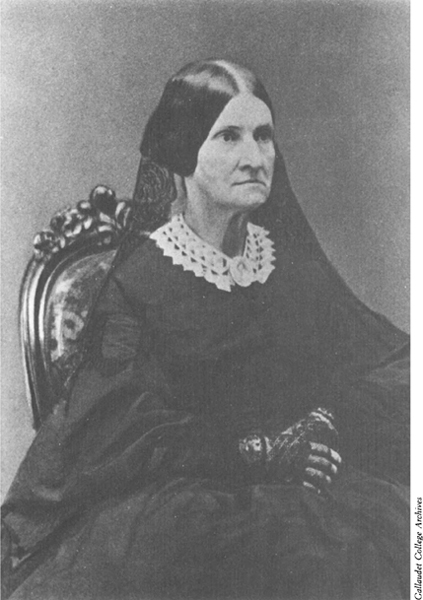
SOPHIA FOWLER GALLAUDET (MRS. T. H. GALLAUDET)
Sophia’s parents were from old New England stock, her mother descended from a member of the Hooker colony that founded Hartford, her father one of four sons of a pioneer settler who marched at the head of the Seventh Connecticut Regiment in response to the call of Lexington. He built his son and daughter-in-law a handsome mansion, where Sophia and her five brothers and sisters were born, and willed them one hundred acres on Moose Hill, a little in from the Sound, on the carriage road to New Haven.28 Like Massieu, Sophia worked around the farm but longed to go to school; like him, she had a circle of people with whom to communicate, including her older sister, her deaf cousin, Ward, who lived across the road, and her hearing parents; and, like Massieu, when finally allowed a formal education, she progressed with lightning speed. I have come across one of Thomas’s letters in which he boasts, “Eighteen months ago, Sophia knew not that there was a creator of the world and she felt no moral accountability to him. Now she understands the simple doctrines of the Gospel and of late gives such satisfactory evidence of hopeful piety to our pastor that he has admitted her to the communion of the church.”29
As Sophia—vivacious, intelligent, attractive—progressed, so did Thomas’s affections, but he kept them to himself for a year. When he proposed she was amazed:
—I have no knowledge of the world.
—You can travel and meet people.
—My education has just begun.
—I will help you continue it.
He was thirty-three, an “earnest Christian of wide and varied culture,” she later told me, “travelled, accomplished, high-minded, accustomed to move in refined society. Is he doing it from pity,” she asked, “or as a symbolic gesture?”
“Neither,” I told her, “it is love.” She had ample color, open generous eyes, rippling hair, graceful proportions, dignity, and poise. They were married soon after we moved into the new asylum, and went to Saratoga, where one takes the waters, on their wedding trip.
Hartford society fussed a little at first but soon accepted Sophia as they came to know her, and she created a society of her own in her home, for she developed a fluent command of written English and was a fund of general information; Thomas, too, had an active mind at home as at work, and table talk concerned affairs of the world and especially practical religion. Their marriage was marked by sweet accord of temper, taste, and views on instruction and child-rearing.30 Sophia was loving, gentle, judicious. Thomas’s somewhat more excitable disposition was mastered by self-discipline. Together they raised a large family, four sons and four daughters. The oldest, Thomas, is rector of an Episcopal church, Saint Ann’s, which he founded for the deaf in New York; moreover, he has promoted services in sign language in churches throughout the United States. The second, Sophia, married a Southern military man and died recently. The third, Peter Wallace, is a businessman on Wall Street. Jane Hall is a teacher in a ladies’ seminary, William Lewis, an inventor living in New Jersey, Catherine Fowler is married, living in New York. The daughter born the year Alice Cogswell died was named after her; she married a minister, editor of the Sunday School Times and close friend of the Gallaudets’ last child, Edward Miner. Edward is president of the National Deaf-Mute College in Washington. Thus the oldest and the youngest sons carry the banner passed from their father.31
The same year that Alice and Mason Cogswell died, Thomas felt particularly exhausted, unwell, and overburdened. He petitioned the board for relief from daily instruction. Word had it that some of the faculty objected to a commensurate increase in their duties, the board did not accede to Thomas’s request, and he resigned in April, effective October 1830.32 Thus ended thirteen years at the head of our institution and at the helm of American education for the deaf. We had been so intimate, so harmonious, Thomas and I, so attached to each other, we had labored together so many years, that when he resigned in the same year I lost Alice and Mason, I was full of pain. I felt betrayed, though of course I never said so.
Thomas’s activities in the next score of years were many and diverse. In particular, he published children’s books, beginning with A Child’s Book of the Soul, which went through many editions in many languages. Then came The Child’s Book of Repentance, The Child’s Book on Natural Theology, nine volumes of scriptural biography and much more.33
During his long retirement Thomas refused invitations to head the first normal school in Massachusetts, to teach philosophy of education at New York University, to serve as superintendent of common schools in Connecticut (the post then went to Henry Barnard), to direct the New England Asylum for the Blind (Samuel Gridley Howe became head instead), to found a teacher training school at Princeton. He experimented with educating the feebleminded, helped Catherine Beecher found her female seminary, planned an institution for chronic alcoholics, aided in founding normal schools (he served on a committee for this purpose with Noah Webster when the first teachers’ convention was held the year he retired). For seven years Thomas directed religious services at the Hartford jail. He promoted religious education in the West and belonged to several evangelical societies. He also took on the post of chaplain at the Retreat for the Insane that Mason had founded. It would have warmed your heart, as it did mine, to see that truly good man moving with composure and kindness among the ranting, the spellbound, the hysterical, beaming reassurance and love. His chapel was a hallway, his pulpit an old desk, but his subject, ah, his subject was Christ’s love, which he so masterfully unfolded to their bleary eyes that the patients listened attentively and with decorum.
In the fall of 1850 Thomas and I were honored by a large gathering of deaf people at the asylum at which each of us was presented with a silver pitcher and tray, the gift of those throughout the United States who had been educated at our school.34 With two hundred visitors and the two hundred pupils enrolled, it was the largest deaf convocation up to that time, ever, anywhere. The participants’ general appearance was of intelligence and respectability, industrious habits, comfortable circumstances. The event was the forerunner of conventions and associations of the deaf that have sprung up in the twenty years since—and the countless more sure to come. It was modeled on Berthier’s Central Society of the Deaf, which counted members from diverse regions, schools, and professions and held annual banquets in honor of Epée, beginning in 1834. These meetings develop a special type of deaf leader—the organizer and platform orator. In Paris, Berthier, in Hartford, Thomas Brown, who, after five years as a pupil at our school and two as an assistant and carpentry instructor, had returned to his aging parents on their hundred-acre farm in Henniker, New Hampshire, and made it thrive; he was a hard worker, a good horseman, a reliable wheat grower, and a respected citizen, active in town affairs (he was sent to the state Democratic convention the year following the presentation, where he prepared several speeches).
Brown is the central figure in a little deaf settlement in Henniker. His father, Nahum, was a good example of deaf people in the era before schools who got along nicely on the land without formal education. He never learned to read but his hearing wife was his interpreter. They had two deaf children, Thomas and his sister, Persis. Thomas married one of the Smith sisters, former asylum pupils, from Chilmark, and their son, also deaf, became a teacher at the Michigan school. Persis wed a hearing carpenter of the village and their two sons, also deaf, went to our school, then returned home. Thus the deaf community at Henniker included at one time Thomas’s father, sister, two nephews, son, and wife. There was also another deaf couple farming nearby. Later on, the two nephews acquired deaf wives and deaf children, so it was quite a community. The oldest nephew, William B. Swett, had a colorful career as a seafarer, general-purpose mechanic, writer, and artist before settling down in Henniker with a former pupil from the New York School.35 They have two deaf daughters, Persis and Lucy.
Thomas’s wife, Mary, was an amiable woman, industrious, kindhearted, called “an ornament to Society in Henniker.” The same History of Henniker County calls Thomas “one of our most intelligent, upright, industrious and respectable citizens.”36 Mary came from another deaf community, on the island of Martha’s Vineyard, where one in every hundred fifty people is deaf—over ten times the usual rate. In one island village with about five hundred inhabitants, one in every twenty-five is deaf. I believe all of the deaf people there are descendants of an English missionary who settled on the island in 1720.37 Naturally, hearing children on the island, like the deaf, have long learned the indigenous sign language that developed there, a century before I ever brought French Sign Language to America. Consequently, most speakers on the island will use sign language when they are in a mixed group of hearing and deaf people; the fishermen use sign to communicate at a distance, and others use it in church, where audible speech would be disturbing. The hearing and deaf children also learn written English in school, and everyone gets along nicely in this bilingual community.
Thomas Brown towered above his brethren at the presentation-day ceremonies, his full reddish beard streaked with white; he had a mane of gray hair on a large head, and a slender but powerful frame. He was quiet, slow to arrive at an opinion, but set once there, practical, methodical, deliberate. He said that his spirit had sought vainly for rest until he found a way to express his gratitude to Thomas and me.
Then he thought of a testimonial, and when he had suggested it to his deaf friends, “the flame of love ran like a prairie fire through the hearts of the whole deaf-mute band, scattered though they were through the various parts of the country.” A committee had been appointed and the necessary funds raised. Hundreds of visitors came from as far as Virginia for the ceremony. The procession made its way to Center Church, Reverend Hawes gave a prayer, Lewis Weld a welcome in sign and then in speech. Thereafter, all the proceedings were in sign language. Thomas Brown gave a welcoming address, Fischer Spofford, the oration of the day, George Loring presented Thomas with his pitcher, and Thomas gave a little speech. He said he saw the hand of Providence in Alice’s privation, in its occurring to the daughter of Mason Cogswell, in Hartford, with him next door, the hand of Providence in his referrals in England, encounter with Sicard, studies with me, and in my agreeing to join him in his labors, in our successful fund-raising. “Little did I think then, in Paris, that we should thus stand together before such a gathering of our pupils and those of kindred institutions.” The very thought was running through my mind at the same time. I was presented my pitcher next, responded with a few words of gratitude, and was followed by Job Turner, who offered the closing prayer. On one side of my pitcher you see Thomas and me leaving France; the ship is at hand and beyond the waves you can see our future school (how reassuring that sight would have been for me had I been able to discern it at the time!). On the other side of the pitcher is engraved the interior of a schoolroom with pupils. On the front, the head of Sicard; around the neck are the coats of arms of the New England states.38
The governor attended the banquet after the presentation. There were toasts, addresses, resolutions. I was reminded of Berthier’s story that at a Central Society banquet such as this one, Napoleon III, then president of the Second Republic, unexpectedly appeared with his suite in the midst of the assembly and bestowed on Berthier the rosette of the Legion of Honor.
Many of the guests stayed on at Hartford through Saturday until Sunday so they could enjoy a religious service in sign, which they badly miss when dispersed to their several communities. The scattered deaf need these gatherings vitally for many reasons in addition to religious worship: they inform, they initiate social action, they come to the aid of those in difficulty, they allow communication in our primary language—since it is not written, there is no vehicle other than reunions. Alumni reunions, religious, social, and literary associations, state and national conventions, all these should be encouraged, for they enlarge the mental life, enrich the social life, and reinforce the political life of our deaf society.
In the summer of 1851, my great friend and colleague Thomas Gallaudet took to his bed. He was never to leave it. His fatal disease was an aggravated form of dysentery. At times wracked by the most acute pain, he always endeavored to feel a perfect submission to the will of God. During the first part of the illness his mind was quite clear, and he wanted to know about everything transpiring at the school and in Hartford. Later on, he lapsed into a state of placid calm, his body became weaker, his consciousness diminished, and finally his gentle spirit passed away without a struggle. Sophia was fanning him, unaware until a few minutes afterward that his breathing had stopped.
A little while after Thomas’s death, Brown convened a convention in Vermont to raise money for a monument.39 I was elected president of the Gallaudet Monument Association. At the same time, a permanent society to honor Thomas, the New England Gallaudet Association, was proposed and William Chamberlain, a deaf journalist in the tradition of Edmund Booth, was charged with drafting a constitution (he later served as secretary). Jolly, tall, broad-shouldered, kindhearted Will Chamberlain was deafened at age five and is a skilled, self-taught lipreader.40 He came to the asylum when he was ten, gave a star performance before the Massachusetts Legislature (he arranged a dozen words into two long sentences of startling complexity and aptness), graduated at fourteen, later edited, in succession, the Marblehead Messenger, the Boston Owl (a comic paper), and the Gallaudet Guide and Deaf-Mute Companion (the first monthly magazine for the deaf), and he recently launched the National Deaf-Mute Gazette. Equally adept as a carpenter and shoemaker, as well as printer, editor, and teacher, he continues to shine as a brilliant, witty debater and an entertaining conversationalist, active in social programs for the deaf.
Chamberlain, Brown, and others met in Henniker to draw up the constitution for the new association,41 and the first deaf organization in America convened in March of 1854. Its second meeting was held two years later in Concord (it was at this meeting that Reverend Turner called Thomas Brown “the mute Cincinnatus” for his readiness to drop his plough and hasten to the aid of his fellow deaf—a title which has clung to him ever since) and the third in Worcester, Massachusetts, two years after that.42
I want to describe an important issue that came up at the third meeting and was also discussed in the American Annals of the Deaf (our professional journal) in those years—the concept of a deaf commonwealth. Many years earlier, when the Congress had donated land in Alabama to our school, after my successful visit to Washington, I thought of selling the part of the land necessary to meet our operating expenses but using the rest as a headquarters for the deaf and dumb, a place to which they might migrate after completing their education. It didn’t work out that way, but the idea came up again a little before the War, no doubt inspired by similar ideas then current for the accommodation of people of color.* One of our former pupils, John Flournoy, was a leader in the movement (as he was in the drive to establish a national deaf college). He proposed that the deaf petition Congress for a small slice of uncommitted western lands where they might migrate, the better to enjoy social intercourse, civil and religious privileges, and means of self-improvement. Our former director, William Turner, was an unconvincing opponent. He argued that deaf people would not migrate there, for it would mean breaking ties with parents and friends, and that even if they did, the community would soon become predominantly hearing, since their offspring would not generally be deaf. Flournoy had given as a further reason for the commonwealth that the deaf in America are barred from all manner of employment by social prejudice; Turner foolishly denied that, claiming instead that we were excluded only because our want of hearing and speech unfitted us for those posts. Edmund Booth wrote in from Iowa to raise some doubts (wouldn’t the community be too small to support all the trades the deaf would want to exercise?) and to discuss the choice of site. He revealed that he and William Willard and a few other Hartford graduates had formed an association two decades earlier to purchase land out west so they might continue to live in proximity and enjoy the friendship formed at the asylum. They had voted in thirteen members, but then Willard became a teacher at Ohio, two more joined the faculty at Hartford, the rest scattered, and the project died. William Chamberlain spoke out in favor of a more modest plan than Flournoy’s. A company of 200 to 300 deaf, with such hearing friends and relations as chose to join them, would go west, form a community governed by suitable laws, headed by able leaders. A township thirty-six miles square would cost $20,000. This would suffice for 140 farms at 160 acres each. A classmate of Chamberlain’s joined the debate on his side and offered $5,000 toward the purchase of land.43
The concept of a deaf township was advanced independently in France, at the same time Booth and Willard made their proposal, by the senior deaf professor at the Nancy institution, C. J. Richardin. Suppose the government established a new city, he argued in his book on the education of the deaf, and all the deaf in the realm were invited to migrate there. No doubt they would be very happy there, for no one would communicate orally and everyone would understand every other person’s language all the time. The citizens could engage in almost all the professions and arts; they could be, for example, mayors, teachers, judges, lawyers, businessmen, entertainers: in brief, they could do just about what hearing people do. “I am persuaded that in this town civilization would make great progress,” he wrote, “that each deaf person would be pleased with his existence.” Dr. Itard likewise thought that a deaf community would be successful, but he thought it impractical to arrange.44 For Richardin this was no abstract matter; he yearned to belong to such a community. He warned his hearing readers, however, that they would not be happy there. It would be as awkward for you among us, he said, as it is for us now among you. You would be singled out. A deaf person seeing you come along would say: here comes one of those foreigners who speak. On entering his home, you would say to him abashedly, “I speak and hear,” as we often must say, “I am deaf and mute.” You would be forced to communicate in pantomime with the deaf who do not know your language, as we are obliged to do with the hearing who do not know ours. You would be bored at shows where the deaf would seem only to gesticulate and act confusedly, as we are bored at shows where there is only singing and little or no action.45
Dreams like Flournoy’s, Richardin’s, Willard’s, and mine—and similar dreams of countless deaf persons—though unlikely now to become reality, are natural, and they are important, for they remind us of our dignity and they remind hearing people of how they have robbed us of it. (Not surprisingly, John Carlin joined the debate with the statement that he preferred the company of hearing people, and in any case, the scheme would never get launched, for “it is a well-known fact that the majority of deaf people show little decision of purpose in any enterprise whatever.” Such slander from the lips of a deaf man is more destructive than from the lips of the hearing, for not everyone sees through Carlin’s disguise; while he was at it, he ridiculed the Women’s Rights Convention taking place at the same time as ours in Rutland, Vermont.)
Although the principal subject of my address to the New England Gallaudet Association was the proposal for a deaf township, I also informed them that I was dissolving the monument association. Its mission had been accomplished: money had been raised, Albert Newsam selected to design the monument, and John Carlin to prepare the four panels at the base. On one point I have, until now, maintained a discreet silence. In the bas relief that is the statue’s most salient feature, Carlin represents Gallaudet in the act of teaching little deaf children. So far so good. What is he shown teaching them? Piety? Humility? No, the manual alphabet! Something any fool can learn in an hour, that no deaf man or woman or hearing friend of the deaf has contributed, least of all Thomas, something that is an emblem of oral language. It took John Carlin to think of that!46
Not long after the dedication of the Gallaudet monument, a Washington philanthropist, Amos Kendall, wrote to Edward Miner Gallaudet at Harvey Peet’s suggestion. Would he be interested in superintending the Columbian Institution for the Instruction of the Deaf and the Blind in Washington? There were several applicants, he said, and he alluded to Edward’s youth (he was then twenty), but Peet had overcome that objection by noting that Sophia Gallaudet would aid and counsel her son.
At this time, Edward was just finishing his education at Trinity College while teaching at the asylum. The dream of a college for the deaf, the first in history, had fired his imagination; he had discussed it with many of us and had made a private commitment to bring it to reality.47
College preparatory classes, “high classes,” modeled after Itard’s “supplementary course” in Paris, had already been established. The one at our school opened at mid-century with William Turner as teacher; the need could no longer be ignored in a school that had graduated such students as Wilson Whiton, George Loring, Thomas Brown, and William Chamberlain. One year later, the New York school followed our example. Deaf pupils were then able to receive five years of elementary education, three years of secondary education, and three years in the high class—eleven years in all. The curriculum included English, history, geography, astronomy, mathematics, and languages. The following year John Carlin published an article in the Annals urging a national college with a particular mission to give more training to deaf teachers.48
Then came the momentous letter from Amos Kendall.
In his day, Amos Kendall was an astute journalist, businessman, and politician; he is old and ailing now, but his mind is as sharp as ever. He was postmaster general under President Jackson and the most influential member of his “kitchen cabinet.” He served as propagandist for Jacksonian democracy, but this did not interfere with his becoming rich as business manager to Samuel Morse. When Morse had a telegraph line strung from the Library of Congress to Baltimore, it passed through Kendall’s estate. Over that line the famous sentence “What hath God wrought” was transmitted in 1844.
Now Morse’s wife was deaf—he used to speak with her by tapping out Morse code in her hands!—so Kendall had some acquaintance with deaf people, and when a certain P. H. Skinner appeared in Washington with five deaf children and solicited aid to open a school, Kendall offered to give him a house and two acres, helped him set up a board of directors, and entered a bill in Congress, rapidly passed, incorporating the Columbian Institution for the Deaf and Dumb and the Blind, and providing an allowance of $150 a year for each local child admitted. Skinner rented a house temporarily in the isolated northwest quadrant of the capital and gathered there a large number of poor deaf children.
Imagine Kendall’s dismay, indeed horror, on learning from a friend, whose washerwoman had a son in the school, that the children were badly neglected and in miserable condition. Kendall got another board member and they rushed to the house. The door was locked and the children within could not open it, so Kendall and company broke it down. Inside they found a heart-sickening sight. Two children lay ill on a pallet moaning; it was clear they had been left unattended for days.49 Kendall sued in orphan’s court and obtained guardianship of the five children Skinner had brought from New York; the others were returned to their parents. Then he consulted the heads of various deaf schools in the East, and Harvey Peet, as I have told, suggested Thomas’s son Edward to direct the new school.
Edward was a young man, twenty, full of fire and enthusiasm, when he and his mother met Amos Kendall in Washington in 1857. Kendall was seventy, frail, with white hair and side-whiskers but sparkling blue eyes. Edward told him of his dream, and Kendall agreed to help him achieve it in time.
The Columbian Institution opened in a house on Kendall’s estate. The new school had five pupils, Edward as director, Sophia as matron, one instructor for the blind, and one for the deaf—James Denison, a former Hartford pupil, born deaf, who had taught one year at the Michigan school. Within a year, there were eighteen pupils, and Edward was ready to exhibit some to the Congress and then to request an additional appropriation, the technique that Thomas and I had raised to an art form nearly half a century earlier. Congress gave him an annual appropriation and Cupid added a brunette beauty for a wife, a college friend from Hartford. Two years later, Edward learned of the Washington Manual Labor School and Male Orphan Asylum, which had never been launched for lack of operating funds but had an endowment of $4,000. He asked that the society give over those funds to establish a national college of the deaf; the organization agreed.50
The following year found Edward with a new baby and a sick wife, the country in civil war, and his school used as a hospital by troops from Pennsylvania. Nevertheless, in 1864 Congress passed the law authorizing a National Deaf-Mute College. The president who unchained the slaves unlocked higher education for the deaf; it was one more way to emphasize national interest at a time of civil war. The college’s doors opened as General Sherman began his march through Georgia to the sea.
The college has two divisions; a lower division for students who have not had access to the high classes at Hartford or New York, and an upper division for graduates of these three programs. Candidates for the upper division are examined in English, Latin, history, geography, physiology, natural philosophy, and mathematics through quadratic equations. They study geometry, Latin, rhetoric, chemistry, and mental science in the junior year and, in the senior year, history of English language and literature, Latin, astronomy, geology, political science, and moral science.51
There have been some superlative students in the few years since the college opened. Even in the first class, graduating this year, some students are paid correspondents of newspapers, one is a translator from French and German, one has invented and obtained a patent for an improvement in the microscope, one was offered a post as an editor.52 Four new professors have joined the faculty as enrollments grew, and Frederick Law Olmsted was hired from Hartford to prepare a development plan for the hundred acres of the Kendall estate. There have been sadness and struggle, too. Edward’s son and wife died in the same year. After a time, he took another wife, James Denison’s sister. Then there was a prolonged battle in the House of Representatives: on the one side, Thaddeus Stevens, a friend of the deaf and an admirer of Sophia Gallaudet; on the other, Elihu Washburn, chairman of the Committee on Appropriations, who wished to see the institution dissolved and the deaf educated only in state schools. “Higher education of the deaf is a useless extravagance,” he said.53 History and justice were on the side of the deaf.
I am pleased to relate that I was at the inauguration of the national college, five years ago. It was a splendid event on the beautiful grounds of the Kendall estate. There were representatives from other colleges, including the president of the University of Pennsylvania. I gave a brief address, as did two of Thomas’s sons and John Carlin, who received an honorary Master of Arts. Entering the third decade of his life, Edward had matured into a cultivated gentleman: in his cutaway suit, immaculate starched linen, and highly shined shoes he could be seen at art expositions, concerts, on Capitol Hill, or as he stood before me now, polite, poised, deferential yet determined. In his inaugural address, Edward pointed out that I was born while the abbé de l’Epée was still alive. He called me “a living monument of an age long past, a witness of events and men soon to be known only in the pages of history.” It made me feel very old. I must have drifted off. I seemed to be witnessing a scene: a dimly lit room, a tearful mother and two daughters, a cherubic abbot, engravings of the saints scattered about on a table. The abbé looked up inquiringly as Edward placed a cowl around his neck. “This is Edward,” I signed to Epée, “Thomas’s son.” My eyes filled with tears of frustration—there was so much to explain. My hands chattered names: Hartford, Mason, Alice, London, Edinburgh, Paris, Massieu, Sicard, Bordeaux. No one seemed to notice me, however. They acted as if I were not there.
“That,” Eliza said when I told her of my reverie, “is because you are afraid of dying.”
“No,” I replied. “I am afraid of only two temporal things: that my history may die with me; and Samuel Gridley Howe.”
“Then you must write your history,” said Eliza, “and that may also take care of Samuel Gridley Howe.”
After the ceremonies at Kendall Green, I sought out Sophia Gallaudet. I took her hands in mine and we old-timers stood there silently gazing at each other and into the past.
Forty years after entering the American Asylum and ten after Thomas’s death, Sophia had started a new career as Edward’s aide, and had become the representative woman of American deaf society. Teachers and pupils alike regard her with veneration and affection. Members of Congress have gone away impressed and charmed by her and thus disposed to aid any enterprise that would educate more like her. Thaddeus Stevens sent her a note last year from his deathbed, saying he hoped she had not forgotten him. (It was he who proposed the Fourteenth Amendment to the Constitution, guaranteeing all citizens equal protection under the laws.)54 There in Washington, Sophia reigns still, though after nine years of service, at sixty-eight, even her enduring frame has begun to bend under her duties, and she has surrendered many of them.
We were a kind of marriage, too, Thomas and I. He was often the initiator and the negotiator, I the patient executor.55 His early resignation and the passage of time made his death a little easier to bear when it came. It was always marginally expected, since Thomas was never totally well.56Lewis Weld succeeded Thomas on his resignation, as you know; he had married Mason’s oldest daughter just a few years before. Shortly after Thomas’s death, Lewis took a year’s health leave and went to Europe, but he returned only to die in a few months. He was a firm, conscientious, and practical principal and a great friend to the deaf.57 He was succeeded by William Wolcott Turner, who came to the asylum from Yale shortly after Weld did. Reverend Turner, an ordained minister, is a tall spare man with a fast sense of humor and a great love of music. He oversaw the expansion of the asylum in the forties and fifties and served as family guardian as well as teacher until he resigned about six years ago,58 when our current principal, Collins Stone, succeeded him.
After forty-two years with the American Asylum and ten at the Paris school, more than half a century in which I saw dozens of institutions for the deaf spring up, it was time for me, too, to retire.59 I had never been disabled by illness a single day. At the second meeting of the New England Gallaudet Association a petition was circulated by my former students asking the board of our asylum to grant me a comfortable retirement. It was signed by 143 of my pupils and accorded two years later. That was a little over a decade ago and only in the past few months have I begun to feel the years. Still, Eliza and I hope to welcome guests from around the nation to our golden wedding anniversary this coming June. We pray to God that He may allow us just a little more time, that I may add one conclusive chapter to this history, that we may say a few goodbyes at our anniversary, that we may prepare the continuation of our journey together.60
*American educator and feminist (1800-1878), daughter of Lyman Beecher and sister of Harriet Beecher Stowe.
*By 1860, more than 11,000 Negroes had been transported to Liberia by the American Colonization Society.