

EIGHT

Owing to adverse winds and frequent calms, my voyage to America with Thomas Gallaudet was to last fifty-two days! We were only six passengers (Thomas, Mr. Wilder, me, and three other Frenchmen)—not counting various species of living animals for our daily nourishment, among them six pigs, several ducks and cocks and hens. There were also canaries to tickle the ears of the passengers by the agreeable sound of their singing. Ah well!
I take these details from a journal that Gallaudet suggested I keep “to exercise and perfect myself in the English language.”1 Whereas Thomas would correct my journal, I would correct his signing; he taught me about American ways, I explained French methods of instruction, and we worked together on an article he was preparing for Zachary Macaulay. My journal entry for a typical day:
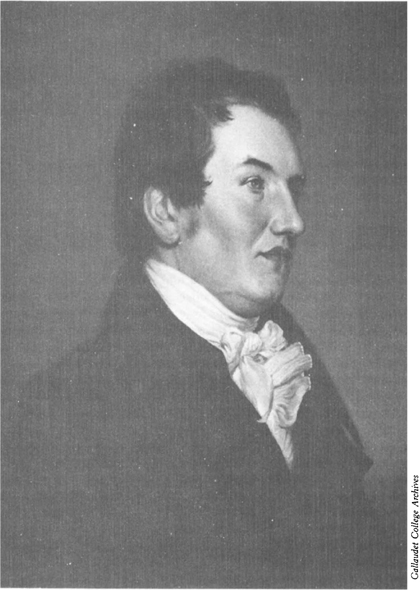
LAURENT CLERC
(PAINTING BY CHARLES WILLSON PEALE)
“Wednesday, June 19, 1816: I awoke at five o’clock, and I fell asleep again immediately. I awoke again at seven o’clock, and I rose upon the spot, lest I should fall asleep again. I dressed myself, I washed my face and my hands. I combed my head. Afterwards I went to take the air upon deck, and at the same time to rinse my teeth. I soon went again into our cabin where my friends waited for me to breakfast. I sat at table between Mr. Wilder and one of our companions, and over against Mr. Gallaudet. We took off our hats and prayed to God. Our breakfast consisted of coffee, tea, butter, buttered bread, cold meat, fish, radishes, cool eggs, cider and wine. I ate some of all. Mr. Wilder only never takes coffee, nor tea, nor meat. After our breakfast and our prayer, we all ascended upon deck. It was fair weather, the sun lighted the land, but the sea was a little agitated. I cast my eyes upon the ocean and admired God’s works. By turns I walked, read, wrote, talked with Mr. Gallaudet and amused myself by fishing or by seeing others fish.
“At two o’clock, the steward gave us notice that the dinner was ready. We all descended into our cabin, and sat in our own places. After the benediction, we hastened all to the mess which covered the table. Our dinner was good enough and as good as is possible in a ship. We said Grace, rose from the table and went upon deck. The weather had changed and become cold. I soon went and threw myself all dressed on my bed. I took my book and whilst I read it, I fell asleep in spite of myself. At seven, Mr. Gallaudet came, awoke me and told me that supper waited for me. I was up in a trice; but I had no appetite. I drank only two bowls of tea with some buttered bread. I returned to bed as soon as I had prayed to God and wished my friends a good night, and I slept till the next day.”
I find this note for June 26: “I talked a little with M. Wilder. He asked me if I should like to marry a deaf and dumb lady, handsome, young, virtuous, pious and amiable. I answered him that it would give me much pleasure but that a deaf and dumb gentleman and a lady suffering the same misfortune could not be companions for each other, and that consequently a lady endowed with the sense of hearing and with the gift of speech was and ought to be preferable and indispensable to a deaf and dumb person. Mr. Wilder replied nothing, but I am sure that he found my argument just.”
You see what a poor opinion I sometimes had of myself then! (I hide neither the good nor the bad.) Happily, by the time I was ready to marry I knew better and chose a deaf wife (as most deaf people do), who has filled my heart with gladness to this day.
Later that morning: “I conversed a little with M. Gallaudet and told him that the speaker of the House of Commons in London was a man of mean parentage, and that nevertheless he was not a mean orator, and that he had made his way by his merits and talents; a wonderful, admirable and unusual event!!! Afterwards I translated from memory into English a passage out of Paul et Virginie.* Then I labored with M. Gallaudet on the method of figures which we employ, in France, to facilitate the progress of our deaf and dumb pupils in the construction of phrases and periods. Then we dined. Then I walked a little. Then, with the aid of my dictionary, I took a lesson in geography and learned to write in English the names of all the nations or states of Europe.”
The following day: “M. Gallaudet and I took occasion to speak of London, and he asked me what I thought of the Houses of Peers and of Commons in England and of those of France, and if I had seen each one. I answered him that I had seen all; that I was at the English House of Peers when the Prince Regent came there to announce in a fine discourse the victory of Waterloo, the flight of the Emperor Napoleon and his second abdication of the Throne of France, and the future happiness and repose of all the nations of Europe; and that I was at the House of Commons when a member of that illustrious assembly proposed to raise a monument to the honor of the Hero of Waterloo (the Duke of Wellington). I questioned afterwards Mr. Gallaudet on our own houses of France. He told me that he had seen each one, with this difference, that when he was at the Chamber of Peers, there was nobody in it, and that when he was in that of Commons, there was a crowd. He found the exterior of the House fine and yet the interior finest. He praised the uniforms and regular manner in which the members were dressed. He did them the justice to acknowledge the dignity of their character and their talents. He admired the place, distinguished and raised in the middle of the House, where every orator can conveniently pronounce his discourse; but at the same time, he censured their motions of body and their gestures, and the manner in which they discoursed. He found that they made too much noise. He would wish that they would stand like statues. I rejected Mr. Gallaudet’s argument and assured him that the manners of the French orators were much better than those of the English who, though celebrated by their wisdom and knowledge, made their discourse but little interesting, since they do not accompany it with some motion of the body to give some idea of the beauty of expression, and since they discourse with their head fixed and arms crossed. M. Gallaudet and I were going to continue to speak for and against, when one gave the sign of rising from table and that caused our debate to cease.”
Thomas had come away from his experience with deaf education in Europe convinced of the superiority of the French product over the British one, although, like every hearing person, he had initially been biased toward speech and, like every federalist, against France. In thinking about his new views he took as his point of departure, as had Epée, the observation that there is no natural connection between a spoken word and the idea to which it refers.2 From this claim of John Locke’s, Epée deduced that written words could serve the deaf as spoken ones serve the hearing. The problem was to teach them written French and for this he designed methodical signs. Gallaudet’s deduction, more than half a century later, was more insightful: manual signs can represent ideas just as well as they can represent written or spoken words. In his enthusiasm he went further: sign language is more significant than other kinds because it includes the changes in our bodies and countenances produced by the movements of the soul.
Thomas was now definitely opposed to speech for the deaf and rehearsed the reasons he proposed to state in the Christian Observer.3 “The deaf never use speech among themselves or with others. I rarely heard it in all the schools I visited. I doubt whether one in a hundred, after six years’ instruction, could make himself usefully understood or understand the continued discourse of a stranger.”4 I agreed, and added, It is not the natural language of the deaf and we find it irksome. He marshaled more arguments: It is a purely mechanical feat, and teaching it conveys not one new idea. It confuses the minds of the pupils by directing their attention to many things at once, something like the effort we should have to make to learn two languages at the same time. It involves immense labor and fatigue for instructor and pupils, as the syllables in words, their accents, the differences between pronunciation and writing, must all be clearly communicated—a task of tremendous difficulty and in most cases a hopeless one. It prevents the instructor from devoting his labors to more pupils and a more important part of education—the actual communication of knowledge, the unfolding of the human mind. It discourages the pupils, for they know they have another language at hand which is easy, rapid, and delightful. Besides, how much more beautiful is the silent language of the countenance, gestures, and the fingers than the harsh and discordant sounds of those who cannot regulate the tones of their voice.5
When Thomas’s article later did appear in print it elicited a spirited (anonymous) reply. “Give the deaf what they accidentally lack and you remove the wall that separates them from the rest of society: they will be enlivened by conversation, instructed by history, enlightened and comforted by the records of eternal truth. We must give them a mother tongue, the language of the country where they reside. Now written language will not serve: it is arbitrary, external and unmeaning; speech we can see in others and feel in ourselves.”6
This is the prototype of the oralist argument. First, the difference between us and the majority is labeled our lack: we lack English, they do not lack sign. Now add the God’s breath notion: it is not enough to learn the written language of the majority, you must speak it as we do.
Thomas published a rebuttal in which he did not dispute the goal but the practicality of attaining it. The pain, labor, and expense of acquiring speech, he argued, are generally thrown away.7 “Let one of these unfortunate individuals who has even attained the honor of reciting the Lord’s Prayer in public (told it is the Lord’s Prayer, we recognize something like it)—let him read a paragraph in a newspaper, and immediately his words cease to be intelligible.” Moreover, the effort of acquiring speech, even if partially successful, usurps the place of a more useful pursuit, mental improvement.
In a sequel to this rebuttal a few months later, Thomas shifted the emphasis from attacking speech for the deaf to espousing sign.8 Whatever language we teach the deaf, we must use their native language of sign as the medium of instruction, he affirmed. So sign is necessary; it is also peculiarly vivid: “My mind has been more agitated by a description of the day of judgment that I have seen my ingenious friend Mr. Clerc exhibit in his own native language of signs than by the loftiest flights of eloquence which are to be found in the pages of Massillon or Bossuet. He was the judge and I trembled before him. He was the accepted disciple of Christ, and I almost felt the rapture which the ‘Come, ye blessed’ will inspire. He was the impenitent sinner and I shuddered with horror at the yawning gulf beneath his feet.”
These were uncomfortable times for the British oralists! First, Macaulay accused them of illiberality, then Gallaudet charged them with impracticality and downright ignorance. Next, John Arrowsmith, the hearing brother of a deaf man, published in London a second edition of Francis Green’s translation of the abbé’s final work and commented: “I am inclined to believe the first edition was suppressed. It is extraordinary that it should have entirely disappeared and there is not now a single copy to be found.”9 Arrowsmith seconded Thomas’s rebuttal of the anonymous oralist in the Christian Observer: “So long as the deaf and dumb are taught utterance, the system of delusion will continue at their asylums which has been supported and upheld by the crafty and imposed on the credulous.”10 The prestigious Quarterly Review, reporting on Arrowsmith’s book, agreed with him:
“Mr. Braidwood very successfully taught his pupils the use of a written and manual alphabet, and, through that natural medium, stored their minds with a large portion of various and useful information. In an evil hour, however, he clogged his plan with the unnecessary and cumbersome appendage of teaching them utterance. As might have been anticipated, ‘the school’ immediately fastened upon the appendage as containing the essence of the plan and, through the medium of their [articles in] encyclopedias, their annual reports and their harangues to periodical ‘meetings of subscribers,’ succeeded but too well in persuading the public that the science which they profess is a profitable and indispensable ‘craft.’ ‘Observe,’ they say, ‘the progress which children make in our asylums where they are, invariably, taught to speak! Speech, therefore, must be the cause and instrument of the progress which has been made in instructing them.’ Admirable logicians! Observe the progress which children make in establishments where they are, invariably, taught the art of carving wood—carving in wood must, therefore, be the efficient cause of their mental improvement.”11
The problem with oralists, Thomas said, is that they are unacquainted with what they oppose so doggedly. He admitted candidly that he had had many false ideas about sign language before taking lessons from Massieu and me. He had been thinking about our fund-raising tour for the school: perhaps it would be wisest to start our lectures by dispelling such fallacies about sign before we explained its positive advantages for instructing the deaf. I no longer recall Thomas’s list of fallacies, but here is mine.
Fallacy: sign language is pictorial. This error comes from confusing pantomime with sign language, a common confusion because signers do use a lot of pantomime. But the two are different: there are no ungrammatical pantomimes, only unsuccessful ones. A hearing person’s sentences in sign, on the other hand, can be quite wrong if he is not fluent, even while they are quite clear. (Just as “I call myself Laurent Clerc” is incorrect but clear.) Indeed, if sign language were very pictorial it would be immediately understood and easy to learn; it is not.
You might think of a sign language as pantomime transformed into a secret code that makes it fast and easy. The users of the code agree, as it were, to use only a score of handshapes and a like number of hand movements in a limited number of combinations. That makes signs easy to spot, use, and remember but their meanings are not obvious and have to be learned. Something similar applies to spoken language. The users of the French code agree, as it were, to restrict their words to just a score of vowels and a like number of consonants in a limited number of combinations. That makes the form of the language easier even if the content is harder to divine.
Fallacy: sign language is universal. This error comes from the fallacy that it is pictorial. To communicate with the English deaf, I had to resort to pantomime and to my lowest-level signing (lots of pointing, simple, slow signs, and the like). Similarly, I expected to find deaf people who congregated in New York City using some kind of common parlance to socialize, worship, trade, and play and I did not expect to understand it from the start. (Thus, my travels took me to just the wrong places when it came to facile communication: instead of London or New York, I would have preferred Madrid or Copenhagen, or any of numerous other European cities where disciples of Epée and Sicard had already opened schools and had spread my sign language which, with some changes, became the language of the deaf community there.)
Fallacy: sign language is concrete. This error, too, comes from the fallacy that it is pictorial. It is a particularly foolish myth, however, since even pantomime can convey abstract ideas, such as love, reverence, death, by depicting their emblems—the heart, praying hands, rigor mortis. American Sign Language, like its French parent, abounds in signs for abstract ideas, such as LOVE, FAITH, BELIEF, TRUST, and many others, some of which are not easily expressed in English words, for example AMBULATORY-PERSON and HOLLOW-CARVED-OBJECT-WITH-RIM. Anyway, all languages use words that have concrete meanings to convey abstract ideas as well. You can still “sail” into trouble in the age of steam power, and Saint John wrote, “In the beginning was the Word … and the Word was made flesh and dwelt among us.”
Fallacy: Sign language is primitive. This error is induced by word-for-word translations from a signed into a written language: the substitution yields a series of words that must violate the rules of the reader’s language and makes the source appear primitive and ungrammatical. For example, the Latin for “A bear killed my father’s geese; father shouldered his gun and went to look for it,” is, word for word, “Bear father’s geese my killed; gun shoulder leaned against and went so bear might search for.” The American Sign Language version is: “Bear geese father his catch eat; gun shoulder-on, go-look-for bear.” For a long time the French were fond of saying that not only sign language but also the spoken languages of our colonies were primitive and for the same reason. Both the deaf and the Africans share an oral tradition rather than a written one: parents teach their children by word of mouth (or hand), there are storytellers and folk tales, and much of the recording of history is done in the peoples’ second language, French. As far as I know, all societies everywhere have complicated languages that take years to learn to use properly, and deaf societies are no exception.
Thomas gave one reason why signed languages are in some ways better than spoken ones—they reflect the movements of the soul—and I want to suggest another. More of what we talk about every day has to do with the things we see, touch, and encounter than with the sounds we hear, the odors we detect, or the tastes we savor. Life is, foremost, a visual experience that takes place in space, and a visual and spatial language can tell about it efficiently and gracefully. Sign language has no need for all the little prepositions of French or English that try, and often fail, to capture spatial arrangements—nearby, underneath, circling-in-the-neighborhood, and so on. We can put the signs for the things so related in the correct relationship and move them appropriately. So much is man a seeing animal moving in space that he often conceives nonspatial matters in spatial terms—thus enlarging boundlessly the world of experience that sign conveys well. For example, everyone knows the future is ahead of us, the present here, and the past behind, and it is easy for sign language to use this spatial understanding of time, among other means, to describe when events occur. One more example: French and English sentences get all twisted around themselves trying to say who did what to whom with what, and they need lots of pronouns to help keep track. In sign we designate points in space for the actors in our story and as the verb moves from point to point the actors do directly to each other in sign what French struggles to say they did. Sign language primitive? I never met a man who called a language primitive that he knew.12
After a voyage of more than seven weeks, the sailors at long last sighted land, and the passengers went on deck to observe our entry into the harbor. I had arrived in America! The date was August 9, 1816.13 Suddenly, I was assailed by renewed doubts. What would the Americans waiting on the dock think of the deaf man with the awkward English? An educated deaf person must be something akin to a raree-show* for them.
I need not have doubted. Thomas and I stayed about ten days in New York, and his family and friends gave me a cordial welcome. One of the latter, who would become president of Columbia College, described our meeting in a letter:
“Mr. Clerc does not speak except by signs, by means of which we saw him and Mr. Gallaudet communicate with each other as expeditiously, almost, as we could do by words. With strangers he converses by writing. Mr. Gallaudet says that Mr. Clerc knew very little of English before they embarked together. You may judge yourself of his progress in it. My father saw him several days ago at the house of Mr. Gallaudet’s father, and wrote upon a slate, ‘I hope you are pleased with New York.’ He wrote in reply, ‘Yes—so well that soon I shall not regret France.’ When he called the day before yesterday with Mr. Gallaudet to return my father’s visit, my father wrote, ‘I hope you continue to be pleased with this country.’ He wrote, ‘Yes—better and better,’ and before my father could read his answer he reached out his hand for the slate and added: ‘I meet with a good reception everywhere, and the kindest attentions are shown me.’ I wrote: ‘We are surprised at your progress in English, your method of learning must have something peculiar in it, or your industry must be very great.’ He wrote: ‘By dint of studying I have got some progress, but my friend, Mr. Gallaudet, has been my best methodic.’ Before I had time to read his answer, he asked Mr. Gallaudet by signs whether he had not committed an error in the last word, and being told he had, he stepped up to me and rubbed out the two last letters.…
“I have not been able to learn how abstract ideas are communicated to the deaf and dumb, but as an example of the justness of their notions I give you the following definition of virtue which Mr. Clerc wrote verbatim and literatim, as you have it below, on my father’s asking him what idea he had of virtue: ‘It is the disposition or habit of the soul to do good, to avoid evil, and to observe what divine and human laws order and what reason dictates.’”14
Thomas wrote to Mason from New York: “We have been visited by and we have seen a great many persons, and all take a great interest in Clerc. He is so modest and easy in his manners and converses with such charm and propriety with all that it is a matter of general admiration.”
But there was a cause for consternation, and just at the outset of our great undertaking! Thomas’s letter goes on: “We have much to do to get our establishment on an eligible footing. Many here speak of the necessity of a similar establishment in New York. A great deal is said about Mr. Gard of Bordeaux. Setting aside all personal feeling, I do think it will be not a little discreditable to our country if some local and state feelings cannot be laid aside in the commencement of a project like ours.”15
Do you recall François Gard, the best student of Saint-Sernin at Bordeaux? Many considered Gard superior to Massieu; Edouard Morel, who edited the fourth circular from Saint-Jacques in which Gard wrote a report, said he had “never yet seen work from the pen of a deaf-mute that compared with his.” My friend Gard had entrusted the American consul to Bordeaux, William Lee, with a letter addressed “to the philanthropists of the United States,” offering himself—and in English at that—as a teacher of the deaf and dumb,16 “for humanity,” he said, but went on to describe his family responsibilities and present salary, which were three times what mine had been.17 I admit my reaction to Gard’s proposition was not of the most charitable. He knew I had missed out on the Russian post and now had staked all on America, yet he went into competition with me, risking a collision that might sink us all, for surely funds could not be raised for two new schools simultaneously.
Consul Lee had returned to New York from his post in France just four days before Thomas and I reached the city, and had given Gard’s letter to the New York surgeon general, Samuel Mitchill, “the Nestor of American science.” Among many professional activities, Mitchill was a founder and editor of the New York Medical Repository, and in it he had published the letter that Francis Green, in his initial burst of enthusiasm, had written from the Braidwood school to the health officer of New York, urging a similar school in America.18 Now, even as Thomas and I journeyed toward Hartford by way of New Haven, a meeting of concerned citizens was held at the home of the Reverend John Stanford, who once had assembled a class of deaf-mutes within the New York Alms House (administrative changes soon led to its dismantling).19 There Mitchill read Green’s and Gard’s letters and affirmed the possibility of educating the deaf; a larger public meeting was called at Tammany Hall.20
Thomas and I, meanwhile, called upon Yale’s distinguished president, Timothy Dwight, to seek his assistance in our effort to found what I was later to learn would be the first charitable institution in the United States. Why Dwight? Because the key to federalist philanthropy must be religion, and the crux of the religious argument must be the Christian’s responsibility for benevolence; if Thomas and I were to travel about New England preaching the obligation and feasibility of educating the deaf, then Thomas wanted his doctrine clear and convincing. Furthermore, Dwight was no learned recluse; he was one of the three great New England revivalists (the others were his grandfather, Jonathan Edwards, and his pupil, Lyman Beecher) and actively engaged in social and moral issues.
Dwight’s manner was grand and commanding (he was a large, robust man in his sixties) and he spoke, Thomas said, in an authoritative, deep, and melodious voice. (The democratic press, anxious to destroy a symbol it could not ignore, called him Pope Dwight.) He had been a Yale student at thirteen, a classmate of Reverend Strong’s, a chaplain, a Yale tutor, a Hartford Wit, and the pastor at Greenfield Hill, where he ran a famous seminary (and was visited by Mason in his youth), before becoming president of the college.
“The basis of my appeal for the asylum,” Thomas began, “is that religion consists in disinterested affection; if the first law of God given by Christ is to love the Lord, the second, ‘like unto it,’ is to ‘love thy neighbor as thyself.’ Matthew says, ‘On these two commandments hang all the law and the prophets.’”
“Christ went further,” Dwight replied. (I could not follow all of Thomas’s signing at the time but I have reconstructed the gist from later conversations, sermons, and publications.) “Those who were undeserving, unworthy, abusive, criminal—for those Christ died out of love. ‘He who dwelleth in this love dwelleth in God and God in him.’”
“Self-love, then—staking all on personal interest,” Thomas went on, “is sinful, it is the opposite of benevolence.”
“But when a man thinks of the public interest he also thinks of himself,” Dwight argued. “More than that, we cannot know all of the public interest; we naturally know best the interest and happiness of those who are nearest, ourselves, our family, our neighborhood. This is the Christian meaning of ‘Charity begins at home.’”
“That is indeed helpful,” Thomas answered, “but I fear that my audience will want, even more than a local appeal, one that is businesslike, a return on their investment, and we shall presently be said to be selling grace like the Catholics, and made a mockery of.”
“But you should know your Hopkins. What did they teach you at Andover?” Pope Dwight smiled for the first time. It was Samuel Hopkins* who, in Lyman Beecher’s words, “made disinterested benevolence the core of New England theology.” Dwight quoted him: “He who has a new heart and universal disinterested benevolence will be a friend to God and will be pleased with his infinitely benevolent character though he sees not the least evidence and has not a thought that God loves him and designs to save him.”21
Some would contribute to our asylum, then, because they loved their neighbor, others because it showed that they and God were friends, still others in the hope of gaining an eternal reward, some on the grounds of practicality (for an educated deaf man is less of a burden on society than an ignorant one), and some out of a sense of civic duty. These motives seemed to cover just about anyone who would venture into the audience on our projected tour of fund-raising.
Thomas was right in worrying from the start that the thrifty Yankees would expect a return on their investment—even in charity. In those days, the town poor were farmed out to the lowest bidders, who served their charges scraps and leftovers from the family table. The Hartford Retreat for the Insane, which Mason would help to found, would take only paying patients, and even our own asylum rejected many pupils who could not pay tuition. Benevolence is not solid ground on which to erect an institution but it was the only ground available to Thomas and me. Eventually, as the American population grew and spread south and west, its politics changed from the aristocratic beliefs of Washington and Adams to the French democratic ideals that inspired Jefferson and Jackson: if the people were to participate in government they must be equipped for that responsibility. The state’s responsibility for education extended to all its people, and schools for the deaf must be created. But this shift took many decades because it had to overcome the individualistic spirit: why should I be obliged to pay for another man’s child?
From New Haven Thomas and I took the stage to Hartford. Although the day was fair, that summer had been the coldest in memory in New England. The crop of Indian corn had been destroyed in the ground; potatoes, hay, oats were in short supply, and the barren hills in the Connecticut River Valley contrasted starkly with the verdant banks of the Rhône still vivid in my memory. I entered the city, then, in a somber and remote frame of mind. But—how fair this city was! How stately its tree-lined avenues! How palatial its homes! I felt rather as Mark Twain did when he came to live in Hartford last year: “Of all the beautiful towns it has been my fortune to see,” he wrote, “this is the chief. You do not know what beauty is if you have not been here.”22
The Cogswell residence at 38 Prospect Street was three stories high (the third under a sloping roof), with five windows giving onto the street in front, another five onto the gardens and fields behind, and on this sunny day it was filled with light that seemed to bind the ample rooms, the porch, the terrace, and the sweep of the countryside into a single scene.23 Mrs. Cogswell and her daughters, Mary and Elizabeth, young ladies of fifteen and thirteen, greeted us, and Alice was immediately sent for at Mrs. Sigourney’s (she was then still Miss Lydia Huntley). Standing awkwardly in the parlor, anticipating Alice’s arrival, I thought, She is what I have come for; for Alice and others like her, I have left everything familiar behind, and everything strange is ahead of me. Suddenly, she appeared. The room was still: all eyes were on us, and ours on each other. For one brief moment her open, ample gaze seemed to call to my soul to flow out toward her, to enter through her pupils and mingle with her own. Then reality jerked my head; I thought, Why, she’s just a little girl, not a symbol, a little girl like any other, really. “HELLO,” I signed. She laughed, her curls shaking, merriment dancing in her eyes. “DEAF YOU-ME-SAME,” she signed. I understood. “Will you teach me many signs?” she asked. “What signs will you teach me?” It was my turn to laugh, out of joy. “I will teach you the sign for love.” (“When I first met you in the parlor,” Alice told me many months later, “I thought I had never seen such beautiful signs before. MY-HEART GLOW,” she signed.)
The day after my arrival, Mason convened the directors of the asylum at the State House and before long I had made the acquaintance of the principal citizens of Hartford and their families, all of whom received and treated me so kindly I began to feel at home. But alas, before that feeling could take root, Mason, Thomas, and I were off on our fund-raising tour around the New England states. We began in Boston, armed with letters of introduction, including one from our governor to the governor of Massachusetts.24 Mason wrote to his wife with word of our initial success: “Here I am in Ben Russell’s office.” Colonel Russell published the influential semiweekly the Columbian Centinel for more than forty years. It gave full coverage to our Boston appearances. “Since our arrival we have been incessantly engaged in delivering our letters, feeling the pulses of the rich and contriving the best possible way of picking their pockets genteelly. Matters, we think, are working up towards a favorable issue. Whatever impression Mr. Gallaudet and myself have made, Clerc is doing wonders—he makes them all stare—at the different offices, at private parties, at our lodgings, and even in the streets.”25
On the day that Mason wrote, and again two days later, I appeared at the Boston Athenaeum and answered numerous questions put to me by a large company of gentlemen. On the second occasion I delivered an address through Thomas. I spoke of why I had come to America, of the abbé de l’Epée and the abbé Sicard, of my ignorance before my education and the needs of the deaf everywhere for schooling, of the fact that every European nation, however small, had a school for the deaf, but America had none. “If the deaf and dumb become happy,” I concluded, “it will be your joy to see that it is the effect of your generosity and they will preserve the remembrance of it as long as they live, and your reward will be in heaven.” (This, despite what Dwight had said.) The following day we had another exhibition for the ladies, and I appealed to the women to influence their men. “You have naturally great sensibility. If you remark among your husbands, relations or friends, some who may be insensible to this action of benevolence, I beg you to change them into better dispositions.” More than one hundred generous donations were made to the institution: the largest, $500, was from the governor, and his example was followed by all classes in the community to the amount of several thousand dollars.
Mason returned to Hartford while Thomas and I went on to Salem, where I presented yet a third address. “A great variety of questions were put to Mr. Clerc,” the Gazette reported, “to all of which he gave ready and pertinent answers, generally with the addition of some sensible remarks and sometimes with even metaphysical acuteness. Several hours were spent in the exercise of the faculties of the interesting stranger, to the great delight of the admiring assembly.” We collected over $1,000 from two score subscribers.
Early in October we returned to Hartford and in a few days Mason, Thomas, and I went on to New Haven, where the legislature was in session.* We had an exhibition before the governor and both houses, and again I delivered an address and answered numerous questions. I appealed to the legislators to urge the establishment of the school, to set an example for other legislatures, and to the citizenry. I spoke of the thousands of deaf and dumb who needed their aid and of the representative few whom I had already met: Mr. Thomas Aspinwall of Roxbury, George Ropes of Salem, Alice Cogswell of Hartford, and a Mr. Jones of New Haven. “As soon as I beheld them my face became animated, I was as agitated as a traveler of sensibility would be on meeting all of a sudden in distant regions a colony of his countrymen. On their side, those deaf and dumb persons fixed their looks on me, and recognized me as one of themselves. An expression of surprise and pleasure enlivened all their features. I approached them. I made some signs and they answered me by signs. This communication caused a most delicious sensation in each of us.…But gentlemen, if the deaf and dumb are happy together, those who do not know how to read and write are not so with persons endowed with the sense of hearing and the use of speech because they cannot make themselves understood. Be then so good as to hasten their happiness. Your countrymen have been too negligent of the unfortunate class of deaf and dumb. I hope you will soon rival the benevolence of Europe.”26
My eloquence was not, however, crowned with success, as Mason explained in a letter to Mary: “Nothing short of an immediate revelation would touch the hearts of the obdurate democrats, and ignorant and selfish federalists. The house, in the abundance of their liberality, granted $5,000. The council sent the bill back to them with $10,000. The house refused to concur and the bill falls to the ground between them. Thus all our hopes from the legislature, for the present, are blasted.”27
“I pity the cold, cautious, calculating, captious, phlegmatic legislature of our state,” Thomas wrote in a fury.28
Still, we were soon off to New York, by a novel means of transportation, the steamboat; it was a most delightful passage, “without the slightest accident,” Mason wrote to Mary. We traveled about the city speaking to members of the committee that Dr. Mitchill had convened and found them unaware of our efforts, although Mason was convinced Mitchill knew about them.29 Of course, these citizens were disinclined to contribute funds to our school until it became clearer whether New York was to have its own school or not.30 So we were left at loose ends and went immediately to the state capital in hopes of catching the rich and great while the legislature was in session.
In Albany, De Witt Clinton, the mayor of New York City for the last dozen years and shortly to become governor, received us warmly and we persuaded him of our design to have but one institution, located at Hartford.31 We had a splendid meeting at the capitol in the representatives’ chamber, where had gathered virtually all the members of the legislature, a large number of leading citizens from Albany, and many strangers from all parts of the state. At Mason’s suggestion, I emphasized the reasons for creating a single school: “As it will be large and the pupils numerous, there will be great emulation among them, and they will become better instructed.” The Albany Advertiser* gave an additional reason for a single school when it published my address: “Uniformity in the signs of thought, the language of the deaf and dumb, is of immense importance in extending their means of intercourse with each other.…This uniformity it will be difficult to preserve when the seminaries for the deaf and dumb are fairly numerous.” I had thought of this argument only after my address, but I am pleased to see I thought of it at all. At that early point in my career, Epée and Sicard’s belief that sign was everywhere the same still had great influence on me, and I might not have seen the danger of allowing several isolated signing societies to develop. I gave several reasons for choosing Hartford as the location for the single institution: its central location in the populous North, its healthful air, the low cost of living, and its distance from the largest cities, which often attract youth by various distractions and corrupt their manners (hardly a reason I would have given in France!).
The address was well received and the legislators plied me with questions, Thomas serving as translator. Q: “What is truth?” (This, I believe, was to establish if those born deaf can manage abstract ideas.) A: “It is the conformity of an action with its fact, of what we say with what we have seen, or heard, or learned.” Q: “What is the difference in the manners and habits of the people of this country and those of the French people?” A: “Your manners and habits seem to me to be more regular and simple, and consequently more salutary. Those of the French, though less regular and less constant, are nevertheless more elegant and polite, but you improve more and more every day and I hope you will be quite equal to them in a few years.”
We shortly began what Mason called our “begging tour” and by the end of the week we had collected in cash and promissory notes nearly $2,000.32 We returned to New York by steamboat and learned on arriving that Mitchill was pursuing Gard’s offer and intended to call for a census of the city’s deaf, and that John Braidwood was in town in a third attempt to start a deaf school of his own.33 (The last Mason had heard of him he had been fired from Colonel Bolling’s school at Cobb, had left debts at two Richmond taverns, and had grabbed the stage north.)34 Mitchill’s colleague Samuel Akerly went to see Braidwood and perhaps discouraged him; he reported that the Scot was obliged to leave New York because of improper conduct.35 The next word we had of Braidwood was in the spring, when he had returned to Virginia “penniless, friendless, and scarcely decently clad,” in the words of Colonel Bolling, who assisted him again—this time in opening a school in Manchester in conjunction with the Reverend John Kirkpatrick.36 We decided not to remain in New York for Mitchill’s meeting in about two weeks; for one thing, word had it that Consul Lee had left New York for Philadelphia and had circulated Gard’s letter there.37 We hoped to preempt yet a fourth attempt to open an asylum by proceeding there at once and raising a subscription.
In Philadelphia, I gave an address in Washington Hall. The meeting was crowded and I spoke of the nature of sign language, and of the abbé de l’Epée, who had communicated his system of instruction to disciples from throughout Europe, “so that all the European deaf and dumb owe their present happiness to him.” I told how Sicard perfected his method and how the deaf in Europe were trained for professions and self-sufficiency—as teachers, administrators, painters, sculptors, engravers, workers in mosaic, printers, merchants.38
I was well received, but beginning the following week the Philadelphia papers carried a series of exchanges on the merits and demerits of a local school for the deaf, and Gard’s letter was published.39 This materially hindered our fund-raising, and our subscriptions—$1, 700 in all—were not as great as we had anticipated. Our worst fears about the dispersion of effort thus confirmed, we agreed to return to New York to attempt again to head off the school there and raise a subscription of our own.40
Back in New York we made several calls attempting to interest leading citizens in the Hartford school and to persuade members of Mitchill’s committee to end their independent course.41 We decided not to attend Mitchill’s next meeting ourselves for fear of appearing to exert undue influence, but we urged our friends to attend. Stanford and Akerly reported that there were forty-seven deaf and dumb in the city (four wards not yet heard from) and that thirty-four were between six and eighteen and could receive instruction. They went on to state falsely that the Braidwoods had invented the art of teaching speech and that their method had all the advantages of Epée’s plus one more—conversation with the hearing. They proposed not to pursue François Gard’s offer because they wished their pupils to speak. Mitchill moved to form a committee of nine members to write a constitution and to petition the legislature and the city for funds to start a school for the deaf. Our friends opposed the motion, but the meeting decided in favor, and we took the steamer home to Hartford with only twenty-five donations in hand.
Ours had been a long campaign: five months, seven different cities, I don’t know how many addresses! And, except for New York and Philadelphia, it had been successful. Many towns in Connecticut and Massachusetts followed the lead of their capital cities. The other New England states and a handful of Southern states responded to our published appeals. About $700 came from overseas (S.V.S. Wilder, Hannah More, Zachary Macaulay). In all, $12,000 was collected and the legislature of Connecticut finally provided us with $5,000 more. A school for the American deaf was no longer a dream, it was about to become a reality. And Alice Cogswell would be its first pupil.
Like all gestations, that of our new school was filled with joy and apprehension. It lasted only three months. A commodious house on Main Street (now the south half of the City Hotel, adjacent to the small building that had been occupied by Noah Webster when he wrote his famous spelling book) was secured. Announcements in the newspapers specified an annual charge of $200, which included the cost of instruction that Thomas and I would provide as well as “lodging, board, washing, continued superintendence of health, conduct, manners and morals, fuel, candles, stationery, and incidentals.”42 We had so much trouble finding a head for the domestic department to supervise all these ancillary matters that Thomas chose a day in February to invoke divine assistance and the several pastors of Hartford were invited to be present to conduct religious services.43 This yielded, most improvidentially, as it turned out, the Reverend A. O. Stansbury and his lady. The notice went on to state that the term of instruction was three to six years and, I am sorry to say, that the school could not receive charity scholars except from the very few towns that had contributed to its resources.
Classes began on April 15. By the time of the opening ceremonies in Center Church the following Sunday, there were seven pupils for me to accompany.44 Reverend Strong had died while we were in New York, and it was Thomas who preached to the crowded assembly. As he entered the pulpit I thought, It is two years exactly since he consented to go to Europe and learn to be a teacher of the deaf. A parent cries: “My child will live and die in ignorance” and a servant of Christ consents to learn in order to teach. The text of what must have been the first signed sermon in America was from Isaiah: “Then the eyes of the blind shall be opened and the ears of the deaf unstopped. Then shall the lame man leap as an hart and the tongue of the dumb sing.” (Thomas said the passage referred to Christ’s miracles then and to the diffusion of the Gospel now.)
Thomas spoke of the advantages likely to arise from a school for the deaf. The deaf child is a kind of experiment of nature and from its careful study we can learn much about the human mind in general—about innate ideas of God, about the faculties that do not require language and those that do, about original notions of right and wrong and the obligations of conscience. More immediately, our school would provide consolation to relatives and friends of the deaf. It is difficult to imagine the heartbreak of a mother who cannot truly communicate with her child, to explain an absence, a danger, to reassure it in times of illness, in brief, to explain the world. (And how the world’s ways are mysterious and infuriating for the deaf youth, I recalled. And how my temper did rage when I could not fathom the wants of others nor tell them my own!)
Then Thomas came to it: the greatest advantage of educating the deaf accrues to the deaf themselves. “Must not each one of them in the language of thought sometimes say: ‘What is it that makes me different from my fellow men? Why are they so much my superiors? What is the strange mode of communicating by which they understand each other with the rapidity of lightning, and which enlightens their faces with the brightest expressions of joy?’” (Images of the neighbors’ children shunning me, of Massieu pleading with his father to go to school, of my first visit to the doctor, when my parents mysteriously allowed him to inflict great pain—these and a thousand others flickered on the screen of my mind.) “‘What are those mysterious characters over which they pore with such incessant delight and that seem to gladden the hours that pass by me so sad and cheerless? What mean the ten thousand customs which I witness in the private circles and public assemblies and which possess such mighty influence over the conduct and feelings of those around me. And the termination of life, the placing in the cold bosom of the earth those whom I have loved so long and so tenderly: how it makes me shudder! What is death? Why are my friends thus laid by and forgotten? Will they never revive from this strange slumber? Shall the grass always grow over them? Shall I see their faces no more forever? And must I also thus cease to move, and fall into an eternal sleep?’”
Thomas was a fine preacher and, whether in Paris or Albany or Hartford, always a popular one. Out of the pulpit he was an excellent conversationalist, with anecdotes from wide experience. He was tactful in winning others to his views; he would rather pray for them than reprove them; he never voted, so he could “secure the cooperation of all parties.” Neither greatness nor favor nor rank could seduce or dazzle him. In the pulpit, his manner was earnest, his subject clear, his development compelling: the audience was borne along by a swelling tide.45
Thomas went on to say how the first school for the deaf in the Western world came to be founded in Hartford (“Here God saw fit to afflict an interesting child that her misfortune might move the feelings and rouse the efforts of her parents and friends”) and why all the resources of the country should now be focused in this one school (uniformity of education and the training of teachers). He explained the rewards forthcoming for future exertions in behalf of these children, incorporating much from our discussion with President Dwight. “Do we participate in the Redeemer’s spirit? Are we promoting the welfare of his kingdom? Does our benevolence toward men spring from love toward the Savior of our souls? Let us trust alone to his righteousness for acceptance with God. That this may be the sure foundation, to each one of us, of peace in this world and of happiness in the next, may God of his mercy grant! Amen.”46
The Connecticut Asylum for the Education and Instruction of Deaf and Dumb Persons prospered, and by the time of President Monroe’s visit in June we had twenty-one pupils.47 I remember the occasion of the visit well, for it was my first meeting with a president and one I had heard much about (from St. George Randolph). In later years Henry Clay and Andrew Jackson also visited our school.48
The ostensible purpose of the newly elected President’s tour of New England was to inspect national defenses. In New Haven he visited Eli Whitney’s gun manufacture* and Yale College, then on to Middletown and the munitions works. At Hartford, his party was met by the first company of the governor’s Horse Guard and a large concourse of citizens, who escorted it over the city bridge, ornamented with three lofty evergreen and laurel arches in imitation of the triumphal arches of Rome. The assembly stopped at Morgan’s coffeehouse, where John Morgan, the senior alderman, gave a speech of welcome and the President reviewed the elegant line of troops drawn up on Main Street.49 He was then hurried down Main Street to our school, where a high platform had been prepared, and here he took his seat, as on a throne. The President’s appearance was quite unprepossessing: a small man with deep-set eyes and no forehead, he was dressed somewhat carelessly, all in plain black, bare-headed. “He hasn’t got enough brains to hold his hat on!” said one federalist.
All around the platform were the spectators, on one side was Thomas, and on the other side, myself. Thomas invited the President to ask me a question, which he would interpret in the language of signs, much as the abbé Sicard had done with the duke of Wellington. I was to answer on a slate provided me. The President wrinkled his brow and became lost in thought and a very long time went by without his framing any question at all, so Thomas repeated his offer: “If Your Excellency will be so kind as to ask some question, I will repeat it on my fingers to Mr. Clerc, and he will write an answer on the slate, to show the manner and facility of conversing by sign.” Still there was a long pause, and Thomas, seeming to fear that the President was going to sleep, roused him by repeating his offer a third time. At last the President seemed conscious, his eyes twinkled, his lips moved: “Ask him how—old he is” was the profound question. Of course, nowadays the American government does much more for the deaf, but I wonder if it does not still have this trifling image of our language and our minds: adequate perhaps to give our age or our names but inadequate for real conversation.50
The school the President visited was three stories high. From the rear there was a fine vista, cultivated country with houses here and there half-obscured by trees, bright patches of red or white in the sunlight. Closer in was the school garden, with lettuce, radishes, beets, beans, corn, cucumbers, and cabbages. No, it was not the stately seminary of the Oratorians, the vista did not include the rooftops of Paris and the Seine, and the gardens would have fit in one corner of those of Saint-Jacques. Yes, everything was scaled down in size and age, except the dreams of the new school’s young directors.
All the asylum family lived and learned within.51 (At first, our pupils had boarded out, but this put their health and comfort at the mercy of pecuniary interests and prevented the older students from socializing with the younger.) The morning assembled us to worship; the pupils then amused themselves until breakfast at seven, followed by study until nine, when half entered my classroom, the others, Thomas’s. The lessons were written with chalk on large slates placed on easels. From twelve to two, cleanup, dinner, and free time, followed by an hour’s writing instruction from Reverend Stansbury. From three to six came more classes, then a light snack, a walk or visit until nine, when all assembled for worship again and then our scholars retired.
Besides Alice, the initial class included George Loring, youngest of the group at age nine and perhaps the brightest—he had an astonishing memory for historical facts and dates. (I spoke of him earlier as the astute reader of Thomas’s facial communication.) He came from a distinguished Boston family—an illness when he was two and a half had taken his hearing and the sight of one eye—and his father had contributed liberally to the asylum during our fund-raising campaign there. He was a pupil for over eight years, then became a teacher at our school, as did the friend he arrived with, Wilson Whiton.52 The fourth pupil to join the class, as I recall, was Abigail Dillingham, from Lenox, Massachusetts. She was gifted at writing, drawing, and drafting and very industrious, and had a deaf sister who was admitted the following year.53 Abigail also became a teacher of the deaf, in Pennsylvania. Do you remember Silvester Gilbert from nearby Hebron, with five deaf children? He had corresponded with Mason and joined his appeal for a census of the deaf. When the asylum opened he sent us fifty dollars as a contribution and his eldest daughter, Mary, as a pupil.54 Gilbert’s neighbor, a Mr. Backus, sent his son to the same class: Levi Backus went on to become an instructor of the deaf in New York State and has the distinction of having launched the silent press in America: in 1836 he started editing the Canajoharie (New York) Radii.55 No less an authority than Horace Greeley* said in his magazine that Backus’s “editorials are sententious and sensible, his selections judicious, and his journal every way respectable.”56 After a decade Levi’s office burned down and he resumed publication in Fort Plain, New York, with the paper known thereafter as the Radii and Phoenix.
Parnel and Sophia Fowler came from a family of six children in Guilford; the other four were hearing, though a cousin was deaf. Alice became quite close to Sophia, who was then nineteen,57 and to another pupil in that class, Eliza Boardman of Whitesborough, New York. Thomas and I, however, were to become even closer, for he married Sophia Fowler four years later—shortly after I wed Eliza. But more of that later.
Our pupils came that first year—at its end, we had thirty-one—from ten different states.58 About half were male and their ages ranged from ten to fifty; the average pupil was in his early twenties. A little over half had been born deaf and another nine had lost their hearing before they were four, so roughly four out of five students had never spoken English to any degree. Nearly all had hearing parents and knew no other deaf people outside their family, which had increased their isolation and reliance on pantomime and home sign.59 The average stay at the asylum was initially four years, though that varied. Later the minimum stay became four years, and then five.60
My duties kept me very busy indeed. I taught a class; I assisted Thomas, especially where planning instruction and sign language were concerned. I gave some of the religious instruction. And I gave lessons in sign language after hours to Reverend Stansbury, to new teachers as they joined us, and, later, to the many hearing teachers who came to the asylum to study with me and then return to their home states to teach the deaf. In these lessons and the classroom I used French Sign Language amended for American practices; for example, I had no signs for various articles of clothing and food unknown in France and these I took from my pupils. We also used methodical sign amended for English. Most English words had a simple French translation with its methodical sign, but where that was not the case we had to invent one. The other means of communication in the classroom were written English and the French Manual Alphabet (fingerspelling), used since Epée’s time and originally taken from Bonet.
Gradually my sign language underwent expansion and modification in the hands of my American pupils. At first that caused me considerable distress; I viewed it as a kind of corruption, one so extensive in fact that when I last saw Massieu he told me to stop talking like an Indian!61 But I have come to view it as a natural evolution. Here is how it occurs.
The isolated deaf-mute who comes to our asylum, as I came to the Paris school, brings with him a more or less abridged pantomime, the only skill of communication he has been able to develop in a world that cut him off from all natural languages. To indicate individual objects, he points them out if they happen to be present. Actions can be called to mind by literal imitation. If he means to recall the idea of writing, he actually seems to write. And the signs of the passions consist simply of the facial expressions that usually accompany them. The same is true for some of the simpler intellectual operations. When our isolated deaf child wants to indicate an absent object he tries to portray its form and exhibit its qualities or any characteristic circumstances that attend it. Thus a house may be represented by carrying the hands upward parallel to each other for the sides and then joining them at the top for a roof. An object with an irregular outline—for example an animal—can be indicated by a peculiar habit or motion: what can be easier than to imitate the motion of a fish swimming? The undulation of the sea, the rolling of a ship (with the bow represented by the joined hands), the waving of a tree, the action of flying, all these will illustrate descriptive pantomime.
The uses of objects provide another fertile source of description. A stable may be distinguished from other dwellings by having a horse enter it. The horse itself may be denoted by showing its use or by the act of mounting it. Common tools and items of furniture, things that we characteristically put our hands on, provide little problem. The mode of production or preparation may likewise be resorted to if it singularly indicates the target idea. Cloth may be called to mind by reference to weaving. The shoemaker, the carpenter, the bricklayer, and so on may be personified in their various employments. The deaf child may sharpen an imaginary razor, or wind an absent watch. The materials of which objects are composed furnish yet another source for pantomime. Tastes may be conveyed by facial expressions, colors by objects at hand: the lips for red, the bosom for white, the eyebrow for black. Moral qualities may be expressed by facial expression or by metaphor. Justice, for example, may be portrayed by the action of weighing, while the countenance assumes an expression of inquiry and candor. The divisions of time can be represented by positions of the sun. The seasons suggest descriptive signs: sprouting for spring, perspiration for summer, falling leaves for autumn, cold and snow for winter.
Now as others become more conversant with the pantomime of our deaf child, he finds that he can omit many of the auxiliary signs of description and still be understood. In all his conversation, he is continually on the watch to carry this process of retrenchment further: his eye is constantly on the face of the person he is addressing and he continues his descriptions no longer than is absolutely necessary for understanding. When the deaf child then arrives at our school, he finds that his abridged home sign is often unintelligible to the other pupils and their signing is often unintelligible to him. This at first slows down communication but is not an insuperable barrier since both parties can fall back on expanded pantomime of the sort I have described. By and large, the newcomer quickly succumbs to the pressure of the group and learns that, in using their signs rather than his own, he is readily understood. No doubt he finds the signing of the community easier, too, for it is not only concise but also regular. It uses only a small stock of handshapes and movements and displays these signs in space in predictable ways he comes to expect.
The newcomer also learns a great many new signs; some have been introduced by other pupils when they came, others have arisen in the course of life at the school, the greater part I introduced in the classroom and during extracurricular activities. Additional signs develop not based on resemblance or metaphor but primarily because they distinguish one person or place from another in the limited universe of the pupils. Their growing mastery of English provides yet another source of vocabulary growth: often the first letter of an English word, represented in the manual alphabet, is employed (with some appropriate movement) to represent the same idea the word does. The expanded vocabulary attained by all of these means is of the greatest importance for it allows new activity for the intellect. I use it to impart new ideas, to define English words, to explain English word order and endings, to secure discipline and teach religion. Thus it happens that deaf-mutes familiar with the language of our school can converse on subjects, even at a very early stage of their education, that are a sealed book to their less-favored counterparts at home. And thus it happens that the vocabulary I brought from France has been superseded, modified, and added to, leaving me a little behind the times.62
I trust it is clear that I did not actually teach sign language in class; newcomers learn it from the older students spontaneously. For many years I did teach methodical sign, the invented signs for spoken language words to be used in the English word order. But after Bébian’s reform we abandoned methodical signs altogether and they are now simply an interesting monument to the ingenuity, perseverance, and classical education of Epée and Sicard.63 Neither was it necessary, of course, to teach fingerspelling. That can be learned in an hour or two—every educated person should know how—and facility comes simply with practice.
Thus of the three forms of communication eventually used in the classroom—American Sign Language, written English, and fingerspelling—only written English required instruction. It demanded, however, the greater part of our efforts, which is not surprising since it was, in the first place, a foreign language quite unfamiliar to a majority of our students and, in the second place, organized along lines totally different from the language they did know, sign language. We always used English sentences, never mere lists of words, and we tried to tie those sentences into various themes and activities as an alternate description to the one appropriate in sign.64
In our very first lessons we presented tangible things and aimed to make the pupil notice his own sensations, observations, and feelings and to talk about them in sign. Daily and Sabbath worship was conducted in sign. Increasingly, we expressed these ideas in written English sentences as well, then asked the pupil to retranslate them into sign. As he progressed, the pupil would be called on at intervals to express his own ideas in written English and to translate the signed sentence of another. The topics moved away from firsthand experience to astronomy, geography, and, later, history, biography, and arithmetic.65 Still, it must be admitted that language instruction always crowds out much of the arts and sciences, even when articulation is not taught (it crowds them out entirely when it is, as we have seen).
The one subject that was not neglected at our school, you may be sure, was religion.66 The reason, of course, was that for Gallaudet as for Epée there was not a minute to lose in saving the pupils’ souls, lest they be doomed to eternal torment by dying suddenly, unprepared. “O Almighty God,” Thomas wrote in his diary, “Thou knowest my desire is to be devoted to Thy service and to be made the instrument of training up the deaf and dumb for heaven.”67 By his every act as much as by his preaching, Thomas taught Christian values: his benevolence was practical and universal and could be followed by everyone, every day, in some way or other. As did Epée, Massieu, and Sicard, he had about him a childlike air—a certain candor and lack of guile—and thus a singular aptitude for exciting the interest and winning the confidence of children.68 Henry Barnard, the first U.S. Commissioner of Education—a post offered first to Thomas—said of him: “His religious life was his whole life…. His life was a living sermon.” Not quite, alas, for temporal demands were made on him: he taught six hours a day, he corresponded, he received visitors, arranged exhibitions, taught teachers, wrote reports, appealed for funds, conducted services, fought with the board—and found it all distasteful and desperately tiring! His very modesty, courtesy, humility made him indisposed to assume and exercise authority, impaired his efficiency, and added greatly to his cares.69
In its second year, our school quite outgrew its quarters—we had passed the hundred mark—and we took a building down the street from Mason’s home. The new site was used for all purposes except meals, which were still taken at the City Hotel, our little family marching to and fro.70Another signal event that year was the departure of Reverend Stansbury to head the rival institution in New York, which did the deaf a great disservice. It came about in this way. As we had prepared to open our school in Hartford the year before, Mitchill had convened a fifth meeting of his committee in Manhattan to consider a draft constitution for a New York school. He announced that, with another ward now reporting, there were sixty-six deaf and dumb in New York City, perhaps two-thirds of school age. Most of the people present agreed with our earlier arguments for a single institution and thought the Connecticut Asylum sufficient to receive these additional pupils: they voted to adjourn indefinitely. Mitchill and Akerly, however, saw themselves as president and secretary of a grand new institution and were not to be deterred. They prepared a list of organizers and directors, with the Honorable De Witt Clinton duplicitously heading the list, and they petitioned the New York Legislature for an act of incorporation. It was granted the very day our school opened its doors.71 The directors then wrote to England to get themselves a Braidwood. How could it be otherwise? Mitchill and Akerly were both physicians who saw the deaf as disabled, and the task of education as obliterating their disability, or at least reducing it. Moreover, he who speaks of oralism and Braidwood speaks of money, and these gentlemen were not disinterested.
Meanwhile, Reverend Stansbury had dreams of glory. Why should he not be superintendent and principal of the new school? Never mind that he signed like a dead man, in a tiny box in front of his chest without a glint of facial expression, never mind that all he knew of a classroom was how to mix chalk and paste. “I wish you [would go and] see De Witt Clinton,” he wrote to his brother in New York, “and know what are his ideas, as I understand a large subscription is to be taken up in New York for this asylum [yet] no persons are instructed as teachers, and when anything is said [here] on this head, the only reply is, that perhaps it may not be expedient to furnish New York with teachers, which might raise up a rival establishment.”72
Around the time of our school’s first anniversary, Stansbury was offered the position he so dearly sought, and asked our board to excuse him from his bond.73 Although I thought he would prejudice the people in New York against our system by misrepresenting it, since he knew so little of it, and although I knew he was quite unqualified to be the principal of a school for the deaf, I could not brook hindering him, for such an action might be construed by history as similar to the Braidwoods’; and I said so to the board.74 So, in the spring Stansbury moved to New York and the city authorities set aside a room in the almshouse for his class. Four young deaf-mutes were brought to him as day students, and all he could think to do with them was teach them the manual alphabet! Nevertheless, the enrollment grew steadily. When the long-awaited reply finally came from the Braidwoods, their proposal was deemed exorbitant and rejected. Instead, the committee hired Stansbury’s daughter. There were twenty-four day scholars and nine residential pupils who were lodged and boarded in hired rooms—hired from Akerly! The familiar story of oralism. It would have been funny if it had not been tragic, for the children.75
We not only changed quarters and superintendents in 1818, we also started hiring and training teachers. The first went on to become rather famous as a teacher of the deaf, an editor, and author of the most popular public school geography. His name was William Channing Woodbridge andhis father had organized the first association of teachers in the United States.76 A Yale graduate, Woodbridge had attended Princeton Theological Seminary with a view to becoming a foreign missionary, but Thomas urged him to consider a calling closer to hand, and he consented to visit the asylum. I still have the record of our conversation in Thomas’s chamber.77
W: My father writes me that this is “enchanted ground,” and that he is afraid I shall not judge correctly when there is so much to excite my feelings.
C: Your father, I believe, imagines that your task would be very hard; but when you see him again and inform him about our institution and tell him how much good you would do to these unfortunate beings, I am persuaded he would not urge you anymore to pursue the profession to which you intend to devote yourself.
W: My mother died eight years ago with joyful anticipation of future blessedness in the presence of God, saying, “I love my husband—I love my children, but I love my Savior more, and I long to be where he is.” On her bed of death she charged me, “My son, be an apostolic preacher. Speak for your Savior, every day you live.;”—Must I not comply with this charge?
C: If your mother lived yet at this moment she would have no objection to the proposition we make to you; for you will do much good by restoring more than two thousand unfortunates to Society and Religion: it would be more agreeable to make our Savior known to them than to preach to those who have already an idea of religion.
W: It had been long my desire to teach those who had no other means of instruction, but when I think of the millions of idolators who have no teachers it becomes more important to spend my life in teaching them.
(Woodbridge pointed to the words “millions” and “two thousand” to contrast them.)
C: If you go on purpose to teach the million idolators you will not be able to teach them all, they all will not be very docile; and the good you will have done will be reduced to a few individuals; but if you teach the deaf and dumb they will be more docile, and you will have restored to the religion of our Savior more people in this country than elsewhere.
W: You are a good lawyer for the deaf and dumb but can you encourage me by mentioning any good effects of your religious instruction of the deaf and dumb?
C: I may assure you that if you decide to stay with us, you will serve the cause of Jesus Christ more perfectly; may God determine you; what satisfaction will you not experience when you see around you the numerous persons you will have rendered happy; Jesus Christ cured the deaf and dumb, the limping, the paralytic—preferably to others; you must imitate him and cure the deaf and dumb.
I am a bit startled to see how tailored to his disposition my arguments were but they were successful in persuading him. Woodbridge suffered from a frail constitution and nervous ailments, however, and, after only three years with us, sailed off to Europe in the hope of relief. When he came back, he resigned and spent his full time on a universal geography; later, he moved to Boston and took over the American Journal of Education, changing its name to the Annals of Education.78
When the asylum’s enrollments had grown to fifty, and two more instructors were needed besides Woodbridge, Thomas, and me, Thomas applied to Yale, and Lewis Weld and Isaac Orr were recommended. Orr had an incredible amount of nervous energy, which he lavished on mechanical inventions and overwork in the schoolroom. This injured his health and, like Woodbridge, he retired early. Weld, however, began a long career at Hartford that led him to preeminence as a teacher of the deaf; he became head of the Pennsylvania school and then, with Thomas’s retirement, head of our own school, which he ably defended against the attacks of the know-nothing New England aristocracy. Weld cut a tall commanding figure. His blue eyes sparkled with intelligence in a highly expressive face whose aquiline nose and firmly compressed lips intimated the resolve with which he pursued the interests of the deaf.
In time, deaf teachers who had begun as pupils at our school joined the ranks of the faculty. You know a bit about George Loring. George had wealth, influence, intelligence, and culture. He studied French with me and after nine months wrote it with near-perfect accuracy. He loved poetry. After sixteen years with us, eight as a pupil, eight more as a teacher, he went home, in part so a poor classmate might have his job. There he read for fifteen years, while serving as acknowledged head of the Boston deaf community. At the age of forty, he married a deaf woman but that happy union ended shockingly when he died three years later.79
Loring’s friend Wilson Whiton is usually considered the first American deaf teacher, though as I recall he and Loring started teaching the same year.80 Whiton, who was born deaf and entered our school when he was twelve, was the first student sponsored by another state and the third to arrive at the asylum. He is still at our school; his wife, Sybil, a former pupil, died a few years ago.
Edmund Booth, like Alice Cogswell, had been deafened by spotted fever. When he was sixteen a neighbor informed him about our school, and he went by stage from Springfield to Hartford over the protestations of his uncle and guardian, who wanted his labor on the family farm. His autobiography describes his arrival at our school: “The coach stopped at the front door and we emerged. A few small boys came around with curious looks; the nearest with bright eager face and quick eyes scanned me from head to foot, glanced at brother Charles who was talking and attending to the baggage, motioned to the next nearest boy and then to me, and said I was a ‘new pupil.’ I did not understand then but guessed and remembered these simple signs. We entered the hall and in a few minutes Mr. Gallaudet, the principal, came. In conversation with him, my brother informed him I could speak and on this hint he—Mr. G.—proceeded to ascertain the extent of my knowledge of words. The only word he selected was ‘accumulate,’ a word with which I was wholly unacquainted. Probably he so understood from my look, he being quick enough at reading looks. He then defined the word in signs as unintelligible to me as the word itself…. Charles and I went into the boys’ and next the girls’ sitting rooms. It was all new to me and to Charles it was amusing, the innumerable motions of arms and hands. After dinner he left and I was among strangers but knew I was at home.”81
Booth was to be an excellent pupil, acquiring a very good command of English and French, and we asked him to stay on as a teacher, which he did for seven years. He resigned after a dispute over pay. Loring and Whiton had been hired at the scandalously low salary of $250 a year and Booth was told that hiring him at a higher salary, as he requested, would cause them to be dissatisfied. The sum was not enough to live on—board, fuel, washing, and traveling took up more than that amount—and all three were obliged to borrow. The salary increased yearly by $100 for four years and then $50 annually thereafter, but it was still far too low. When Lewis Weld succeeded Thomas he urged the board to increase Booth’s salary but they replied that it would entail raising those of present and future deaf teachers as well—unthinkable! Besides, since Booth had been educated on charity he should be glad to offer some of his services gratis!82
After resigning, Booth set out on a 1300-mile journey to the town of Anamosa, Iowa, where he joined a former pupil, later to become his wife, and took up farming. He was elected repeatedly to the office of county recorder but at mid-century he joined the Gold Rush past his door. The trek to California took six months and he stayed there five arduous, dangerous, lonely years,83 finally earning enough to return—by way of the Isthmus of Panama and the Mississippi River—and buy a local newspaper, the Anamosa Eureka, which he made into a strongly abolitionist paper. He is still the editor.
The second year of our school was a time not only of moving, hiring, and training but also of raising funds from the Congress. Either Thomas or I had to go to Washington, since one of us must remain in Hartford to teach; it was felt that I would be more effective, although I did not relish the prospect of exhibiting myself as a specimen before the representatives, especially in the role of soliciting aid. When I was introduced to Henry Clay in the House, however, he said he recognized me as one of two mutes he had seen signing in a Paris restaurant: he greeted me most cordially, gave me a seat by his side, interrupted the proceedings to introduce me to the members present, and suspended the session for a half hour so they could ascertain by free conversation (on paper) the ability of an educated deaf man to read and express his ideas. I repeated this performance some days later and then told the Speaker the object of my visit; he promised to assist me personally. Afterward, I visited the Senate chamber. The next day I went to the White House, where the French ambassador, to whom I had a letter of recommendation from the duc de Montmorency, introduced me to President Monroe. The President received me affably and bid me welcome to America. He said he remembered me from one of the abbé Sicard’s demonstrations (not from Hartford!) and that he hoped I would receive great honor and much gratitude by doing good to the deaf and dumb.84
A year later, on the petition of our board, which argued that we had a national mission since we received pupils from ten states, and with the support of Henry Clay as promised, a bill passed awarding the school 23,000 acres of uninhabited land in Alabama; when all of it was finally sold it provided an endowment of nearly $300,000. One immediate result of the act was that the board could obtain credit to begin building on seven acres we had recently acquired, one-half mile west of the city. Another prompt result was that the state General Assembly approved our request to change the name of the school from the Connecticut Asylum to the American Asylum at Hartford. (The deaf at our school vigorously opposed the label “asylum” but the board would not listen: appeals for funds could not be based simply on the right of the deaf to an education.)85
About the same time our school changed its name and Eliza Boardman became my wife, I reminded Thomas and the board that my three-year contract would soon expire, that I had always planned to return to my native land. Moreover, I wished to present my wife to my family, and I had received a letter from the abbé Sicard—Massieu and Machwitz miss you so, I am destitute and need you, when are you coming back?86 The board argued that the most important part of my task, the training of teachers, had just begun, that I was needed more in America than France. We reached a compromise: I would return to France for a year. If I returned to Hartford, a new three-year contract would apply at more than double my present salary and with six weeks annual vacation.87
This salary, $1,200 a year, was substantially greater than Thomas’s, a point of embarrassment to me but he insisted he did not mind. All he asked was “that we may continue to labor together in doing good to the dear immortal souls by whom we are surrounded.”88 Dear Thomas, he always felt surrounded by our pupils, never followed or accompanied by them. He entered our profession poor and after thirteen years he left it poor. Money-making was to him no passion. Benevolence, reflection, friendship—these were his passions.89
Once I was back in France, my friends, family, and the abbé urged me to stay. I still have his note to Massieu; he was then eighty and failing rapidly, but his demonstrations went on. “Beg Clerc for me to come with us [to the lecture] and tell him it will give me extreme pleasure if he will leave us no more…. I will be delighted if he prefers our country…. Paris is the foremost city in the world.”90 Massieu, however, said he could not in good conscience paint a favorable picture of prospects at Saint-Jacques: De Gérando was then increasingly taking the reins, Itard was urging more training in speech, each teacher was proceeding independently of the others. On the other hand, letters came to me from Hartford with reminders of friendship and with enticements: the new buildings were almost finished, I would find magnificent facilities on my return.
In the end, then, I came back to Hartford, postponing a final decision for another three years. Alice described my return in a letter to the parents of a friend. I excerpt it here so you can see the progress she had made in four years at our school.
“You cannot imagine how I was glad at the arrival of Mr. Clerc. Every Hartford body is extremely happy to see him. He is fleshy, happy and healthy. He had made a great deals of travels in the part of Europe. When you come here you will undoubtedly feel glad to see him again. I suppose you have not heard of this, that the new Asylum is completely finished, and the deaf and dumb persons live already there now. I used to go to school nowadays, sometimes in a chaise when it rains. But I dine with the D. and D. every noon. It is a most delightful and cool place and has as fine a prospect as I ever saw or felt. When you are in this town I will show you the apartments of the new Asylum. In the highest storey it is a very large garret called the hall and has four arched windows. You will be delighted to view the prospect. The new Asylum has been dedicated about a few weeks ago. A great number of people assembled to hear Mr. Gallaudet’s sermon, and a dedicatory hymn written by Mrs. Sigourney was sung.”91
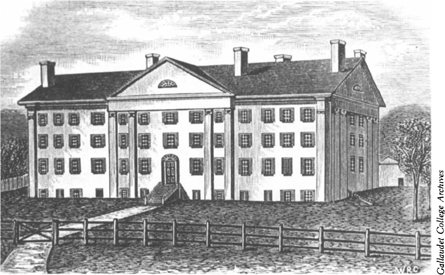
AMERICAN ASYLUM AT HARTFORD FOR THE EDUCATION AND INSTRUCTION OF THE DEAF AND DUMB (1821)
The dedication of our school’s new home shortly after my return was a splendid event. A large audience was assembled on the spacious lawn in front of the handsome four-story brick building. Nature, too, had dedicated a new cycle of fertility and growth: the lawns were lush and green, the orchards in bloom, the gardens sprouting. The sun reflected in the windows dazzled the spectators and seemed to encircle Thomas with a halo as he preached: “For we know that if our earthly house of this tabernacle were dissolved, we have a building of God.” The earthly building was designed by Daniel Wadsworth and contained accommodations for one hundred fifty pupils and others, several schoolrooms, and a chapel. How light, airy, and grand it was! “Thou didst direct the attention of the benevolent to these children of suffering,” Thomas intoned. It had begun with Alice—could it be just over four years ago? She seemed virtually a solitary instance then. Now she sat bright-eyed and alert surrounded by classmates. “Thou didst move the hand of charity to supply their wants.” And made Thomas her neighbor—how extraordinary—and gave him a glimpse of the abbé Sicard and me in London, equally fortuitous. Chance is an illusion. “Thou didst provide the means of their instruction.” Yes, even Epée’s alienation from the Church now seemed full of purpose. And Braidwood’s refusal. And Jauffret leaving me behind. “Thou didst touch the hearts of the wise and honorable with compassion towards them.” And used me as a vessel, a vassal. The endless voyage, the torrent of language, cities with strange names, Albany, New Haven, Philadelphia; the nights when I was drained, so depleted from incessant novelty. That was over now; I thought, I am home. “We do now dedicate this whole institution to Thee.” There on that lawn, on that rise, in that capital, my heart began to swell, my feet seemed scarcely planted on the ground: It is as grand as Saint-Jacques, I thought, and I have helped make it happen. “And to the Father, to the Son, and to the Holy Spirit, be rendered everlasting praises. Amen.”92
Thomas and I were provided separate houses adjacent to the grounds of the institution; mine was the former Sigourney residence, with imposing columns and stately interior, which financial reverses had caused the family to relinquish a few years earlier.93 Before long, shops were also erected at the school. Some of the earliest pupils had been grown men with trades, one a cutler, another a shoemaker, a third a cooper. They had asked to conduct their trades after school hours and had been given some facilities; when other pupils saw this and asked to be likewise engaged, the three tradesmen became teachers. Finally, it was decided to include this training in the curriculum, and the new shops were constructed.94 Nowadays there is a tailor shop, one for cabinetry, which also trains carpenters, coopers, and carriage makers, and one for shoemaking, a trade suited to many pupils since it requires little capital.95 Those students more gifted in letters or the arts can now go on to the National Deaf-Mute College, founded by Thomas’s son Edward—but that comes a little later in my story. (After the new shops were built, were the deaf shop-masters paid a stipend for their services as instructors? Not a bit of it: they were replaced with hearing masters. But more of that later, as well.)
With our expanded facilities able to receive more pupils, Thomas set out on a tour of New England legislatures to recruit more of the uneducated deaf and obtain tuition for them. “How cheerless is their perpetual solitude!” Thomas preached in Burlington and Montpelier, Vermont. “How are they shorn off from the fellowship of man!” in Portland, Maine. “How ignorant are they of many of the common transactions of life!” in Concord, New Hampshire. “We would make some of them capable of mechanical employments.” Oh, listen ye thrifty Yankees! “Others shall be capable of holding respectable stations in private and public commerce! Those who have a genius and taste for such pursuits, shall be taught to cultivate the fine arts. We would introduce them to the delights of social intercourse, to the dignity of citizens, to the solace that may be drawn at the fountains of science and literature….” It was, you see, now Thomas’s turn to plead and he did it as well as I. If I had the advantage of illustrating the goal for which I implored aid, Thomas had the training of a preacher and the fluency in English of a native speaker. Massachusetts and then New Hampshire had started sponsoring pupils some years before.96 Now Thomas induced each of the four Northern states to send commissioners to examine the asylum and negotiate terms for receiving their pupils. Soon after, Rhode Island followed suit, as did South Carolina and Georgia, following visits from Lewis Weld and a train of our pupils.97 Connecticut waited ten years before making legislative provision for the deaf children of the state too poor to attend our school: a commission was appointed with authority to select not more than fifteen of them, which would have cost the state treasury about $3,000 a year. This sum, however, the assemblymen considered excessive, and a compromise was reached by which the governor could select as many children of indigent parents as could be kept at the asylum for a total of $2,000 a year.98 (And there remains the level of state generosity in Connecticut to this day, forty years later!) Within a decade after my return from France, then, half of the states in the Union were sending their deaf pupils to the American Asylum.
This assembly of much of the deaf youth of America in one place, then to return to their several states, was one of the main forces that created a true society of the deaf throughout this vast land, with a single language serving to elevate its users and bind them together. There were three other forces at work. As state legislatures created additional schools for the deaf around the country modeled after ours—there are some thirty now—their principals were sent to Hartford for instruction.99 They studied sign language with me and each paid $50 for this private course. Then, too, teachers for the new schools were recruited from our faculty and graduates. Later on, they were also recruited from other schools, but those schools had been established by Hartford graduates. There was, then, a fanning-out throughout America from Hartford in the nineteenth century as there was throughout Western Europe from Paris in the eighteenth. However, the ties are more closely knit here because there are no national frontiers and because more deaf teachers and pupils traveled to the center and then out again.
Surprisingly, considering its beginning, the foremost of the other schools that would spread the Hartford model and language was the New York Institution. Having found a Braidwood too expensive, they had decided to get a Braidwood book instead—Joseph Watson’s. Stansbury tried to use it, but all he could get from his pupils were croaks (I assure you he was naïve enough to have tried it with the congenitally deaf). “Their utterance was harsh and indistinct,” states a report from the New York Institution, “and led to a universal sentiment in favor of discontinuing the effort.”100 The school found its funds inadequate, so Dr. Akerly took a group of pupils to appear before the legislature in Albany; this yielded $10,000 and a percentage of the tax on the state lottery. A Mr. Horace Loofborrow was then hired; although he had been a schoolteacher for ten years, he had never received any instruction in sign or in educating the deaf. With four untrained teachers and many day scholars who hindered the progress of all the pupils, the situation was a fiasco.101 Stansbury was obliged to resign and he shortly left the country: “It will be an emancipation to leave this institution,” he wrote to a friend.
The first report from the school was printed before his resignation but it made no mention of speech. Pupils learned letters and words and expressed them by signs. There was, however, a lengthy appendix in which Akerly reported on various experiments conducted on his unwilling pupils, much in the manner of Itard, but with this difference: he made the most outlandish claims of cure. “After ten weeks’ steady and laborious attention to these sixteen pupils, in which the physician has been assisted by his brother Dr. Benjamin A. Akerly, he concludes that six of them have improved in their hearing and may be learned to speak so well that hereafter they may be removed from the institution and taught like other children at an ordinary school.” Continuing in the best oralist tradition, he implied that his services could be had full-time for a fee and stated that his patients should be prohibited from signing lest they remain mutes despite the improvement in their hearing.102 The board of the institution, now headed by Akerly’s friend Mitchill, hired Akerly to replace Stansbury and also to serve as physician and it promoted the willing but uninitiated Loofborrow to principal.103 Loofborrow at least initiated a change in the mode of instruction. He and Akerly read Sicard avidly and tried to construct a method accordingly. But they were too proud to do as other schools did and send us teachers for training; when I visited the school in 1821 it was a shambles.104 There was no system or method. The signs they employed were a combination of those used by the Plains Indians to communicate between tribes, those they had learned from some of our pupils, and those they had gathered from the works of Epée and Sicard. They thought their job was finished when they had legislated a sign for every English word that came up. No one knew sign language: the only way to learn that is from a living instructor.105 I gave this frank appraisal to the New York State Senate when they wrote to me for my opinion of the school, which had requested an appropriation to construct a building. As a result, the senate made it a condition of the award that the superintendent of common schools conduct an inspection. This he did with two other gentlemen, visiting Hartford, New York, and Philadelphia. The superintendent found the New York product quite inferior to ours, and the Pennsylvania product our equal (not surprising, since I had organized the Pennsylvania school and Lewis Weld directed it).106 He urged or instructed the New York board to get qualified people: there was an internal struggle; Akerly and Mitchill resigned. The new president of the board, James Milnor, offered one of our best teachers and my friend, Harvey Peet, the positions of principal and superintendent and went to Paris to obtain a deaf teacher from Saint-Jacques. Sicard had died, however, and De Gérando’s puppet, the abbé Borel, proposed Léon Vaïsse, a hearing man, though, as I have told, a fluent signer.
Harvey Peet is today the intellectual leader of American teachers of the deaf. His textbooks are widely used and are now in their eighth or ninth editions.107 His monograph on the history of educating the deaf is clear, incisive, comprehensive: it has been a great help to me. He is the author of two dozen other articles on every facet of deaf culture, language, and education. Peet had joined us in Hartford when he was graduated from Yale, five years after our school opened; in two years he had become steward (we abolished the title superintendent) as well as teacher; his wife became our matron.
The first thing you notice about Peet is his commanding presence: he has an athletic frame, a strong will, a high opinion of himself, and indomitable energy. In recent years his hair has turned white and rheumatism has dared to oppose him, yet his movements are still graceful, his signing a pleasure to observe, his manners courtly, and his humor abundant. A few years ago, he retired in favor of his eldest son, Isaac Lewis Peet, who has married a poet and former pupil at the New York school. Harvey Peet’s two other sons are also teachers at the school, as was Thomas’s son and namesake, Reverend Thomas Gallaudet.108 Since I have witnessed the burial of so many founders of our profession, it is comforting to realize that I shall not witness Peet’s. He will go only when he is good and ready and that will not be for some time yet.
The New York school thrived under Peet and Vaïsse.109 In 1829 it was installed in excellent quarters on Fifth Avenue at Fiftieth Street, in those days about three miles from the thickly populated center of the city. The grounds took up five acres with a commanding prospect of the surrounding countryside. There were gardens and shops for tailoring, shoemaking, bookbinding, and cabinetry that supplied school needs and prepared pupils for trades.110 Several more of our teachers joined Harvey Peet as enrollments at the New York school grew to more than five hundred. The first of these was F.A.P. Barnard, who recently became president of Columbia University.111 Barnard wrote an account of how he, Peet, and Vaïsse did their share to bring about the uniformity in language and instruction struction that existed then, as now, among American schools for the deaf, and he described how Vaïsse introduced Bébian’s reforms in the New York school.
Barnard went to New York with another of our hearing teachers, David Bartlett, a fellow Yale alumnus whom Reverend Flint had fitted for college and Thomas persuaded to join us. It was I who taught Bartlett American Sign Language, for which he showed great flair. His limbs are so lithe and his control of facial expression so complete that he is a master signer. He is a sympathetic friend of the deaf, a cheering influence, a pious man, and an earnest teacher. The deaf writer J. R. Burnet, now a teacher at the New York school, wrote this poem about Bartlett’s manual language:
When Bartlett stands to pray or teach, and all
The eyes around drink in the thoughts that fall,
Not from the breathing lips and tuneful tongue,
But from the hand with graceful gesture flung,
The feelings that burn deep in his own breast
Ask not the aid of words to touch the rest,
But from his speaking limbs and changing face,
In all the thousand forms of motion’s grace,
Mind emanates in coruscations fraught
With all the thousand varied shades of thought,
That to each mind their own bright hues impart,
And glow reflected back from every heart.112
Bartlett stayed with Peet for twenty years, then opened a private school for the deaf that took only young deaf children, ages four and a half to seven, with their hearing brothers and sisters where possible. In the classroom he used sign, written English, and fingerspelling. He succeeded in making his point: in those days most schools required pupils to be ten to twelve years old—a devastatingly long time to leave a deaf child in a hearing family without language. Nowadays pupils are taken some four years younger.113 Not long ago Bartlett closed his school because of financial problems and rejoined us in Hartford, where his enthusiasm, warmth, and good humor continue unabated.114
Another of our Hartford teachers who went to New York, besides Peet, Barnard, and Bartlett, was Fisher Spofford. He hailed from an old Maine family, became deaf when he was three, and entered our school in its second year. Spofford was close friends with Whiton and Loring; he joined us as a teacher soon after they did and left with Loring for Boston, in part because of the abysmally poor pay at the asylum. He took lessons in portrait painting and, when he became proficient, practiced it for several years with considerable success. The invention of my countryman Louis Daguerre changed all that and Spofford laid aside his brush. He became a teacher at the New York school, where he remained until a hearing colleague, J. A. Cary, became superintendent of the Ohio Institution and persuaded him to join him there.
“Fisher Spofford constantly impressed on us,” one former pupil told me, “that we were to regard him as a father. Deprived as we were of all the little attentions lavished on us at home, we were grateful for his show of concern. It was his delight to entertain us with short humorous stories which we were then to repeat. Seated on his high oaken chair, with his elbow on the writing board attached to the arm of the chair, resting his chin on his thumb, the forefinger on his Roman nose, his lustrous gray eyes would observe us go through the story. If we appreciated the finer points, he would rise and pat us on the back. He would tell magical stories of the Orient with graceful motions of his supple limbs; with a suite of compelling expressions of his countenance, he would transport us to glittering palaces, lead us through jewelled apartments, usher us into the presence of majestic princes, indoctrinate us into the secrets of the genii.” Fisher Spofford’s signing was extraordinary: it had a dignity, a grace, and a force all its own. As a lecturer in chapel, he would rivet the pupils’ attention: he not only put his thought and feelings into graceful signs, he also acted them—he breathed them, as one student put it—and has thus acquired the sobriquet “the mute Garrick.”
Last year, having come into an independent legacy, Spofford withdrew from the work of teaching to return to his friends and family in New England, and to gratify his love of drawing and painting.115
A few years ago I went to New York and gave an address at the laying of the cornerstone for a new school building on a thirty-seven-acre estate overlooking the Hudson, called Fanwood. The New York school had become by then the largest in the world, and had sent principals to Ohio, as I mentioned, to Michigan twice, to Tennessee, Texas, California, and Maryland. It has sent two professors to the National Deaf-Mute College and two teachers to our school in Hartford, and educated pupils throughout the Atlantic states. And all these people took my language with them.
The second Hartford satellite was located in Philadelphia; like the one in New York it disseminated education and the American Sign Language. I went there as principal and instructor of the first class, shortly after my return from France, in 1821, to get the program going, but the real beginning of the project was in the years when we were launching the American Asylum in Hartford. A humble dealer in crockeryware, a Portuguese Jew named David Seixas, who had a little shop on Market Street in Philadelphia, had started taking in the deaf-mute children who wandered the streets begging. Presently he was clothing and feeding five boys and six girls and learning their manual communication. Was his philanthropy born of natural empathy, or did David Seixas know something of the deaf because he was related to Gersham Seixas, “the patriot rabbi,” who was a collaborator of Samuel Mitchill?116
About the time I left for France, in the spring of 1820, Seixas met with his rabbi and some prominent citizens and decided to call a public meeting to consider planning a Pennsylvania school for the deaf. The response to the call was gratifying, and in rapid succession a constitution was drawn up, a board of directors was elected, the board hired Seixas at an annual salary of $1,000, and the new principal began teaching the pupils in his home. That summer, Seixas came to study at Hartford and returned to Philadelphia urging a residential school. A house was procured in August, and a score of pupils moved in in the fall.
The opening of the new year found Seixas and six pupils in Harrisburg demonstrating their achievements to the governor and legislature, which proceeded to pass a bill sponsoring fifty indigent pupils at Seixas’s school, for three years each, at $160 a year. Eventually the legislature would extend the term to six years and remove the limit on the number of pupils. But just as all seemed auspicious for Seixas and his charges, a great tragedy befell him. The mother of one of the pupils, it seems, had a dream that told of great harm coming to her fifteen-year-old daughter. She questioned the youth, Letitia, who said that Seixas had made physical advances and had offered her money and clothes. Seixas was called before the board and vigorously denied the charges, giving a different account of each event. He asked to be confronted by his accusers. By this time, the fall, Abigail Dillingham, and her hearing brother, Charles, had been hired as teachers and Charles served as interpreter for the proceedings. According to the minutes of the meeting, Letitia was nervous but affirmed her original accusation and denied Seixas’s account. He waived the right to cross-examine her or her roommate, who confirmed her story. The matron agreed with Seixas that the children were storytellers and vindictive but the board voted by a narrow margin to dismiss him.117
It was at this juncture that the board asked the American Asylum to release me for six months to serve as principal and put the school on a sound footing.118 During my stay we hired Abraham Hutton from Princeton, to whom I gave an intensive course in sign. Charles Dillingham had previously taken lessons from me in Hartford, and with his sister seconding that instruction, he became a fluent signer and teacher. When it was time for me to leave, I recommended that Charles take my place as instructor of the senior class. Mr. Hutton’s hands “are still rather stiff,” I wrote to the board, “but he is competent to take charge of the middle class.” Abigail Dillingham was put at the head of the entering class.119 When I left, Lewis Weld was called from Hartford to succeed me as principal; he remained in Philadelphia for eight years, until he returned to our school to succeed Thomas when he resigned. Hutton then took over the Pennsylvania school from Weld and is still in charge, married to the school, a graceful and fluent signer and a kind headmaster.120 There is a staff of a dozen instructors now, about a fourth of them deaf, and about one hundred fifty pupils. All instruction is in American Sign Language, of course.
What happened to Seixas? The minority of the board that supported him brought his case before the legislature and he was acquitted. He started another school that survived for a while in competition with the Pennsylvania Institution, which he attacked from various platforms. The larger institution had more access to the ear of the legislature, however, and in the end Seixas gave it all up and moved west, a bitter man.
The deaf are frequently excellent artists, perhaps because our manual language encourages keen visual observation and subtle hand control. The only deaf man in all surviving Roman literature, Quintus Pedius, was mentioned by Pliny as among the most eminent painters of Rome.121 I spoke earlier of the Spanish artist El Mudo, and I should mention the painter of the masterpiece “Last Moments of the abbé de l’Epée,” and many other works, Frédéric Peyson, who entered the Paris school the year after I left with Thomas for America. Two of the most gifted American deaf artists were pupils at the Pennsylvania Institution when I was there: Albert Newsam and John Carlin.
Newsam was born deaf and his father, a boatman on the Ohio River, drowned soon after his birth. When he was about ten, he was taken to Philadelphia by a traveling deaf-mute who used him to solicit alms. In the spring of 1820 he was making a street sketch in chalk when the president of the board of the newly founded institution happened by, took him in charge, and enrolled him in the school. Nothing was known of his origins until a visitor from Steubenville, Ohio, elicited the keenest emotion in young Albert, who rapidly sketched the outlines of a house—the visitor’s own! Then the youth drew an adjoining street and a particular house in it, which the visitor recalled had been occupied by a poor boatman, since drowned.122
When he was my pupil, Newsam behaved himself very well and gave me no trouble. He learned his lessons thoroughly, and out of school, instead of playing with his fellow pupils in the yard, he repaired upstairs and amused himself with drawing figures of domestic animals on the blackboard; I could tell that he would become a good designer or engraver.123
When Lewis Weld directed the school he developed Newsam’s artistic talent, having him draw portraits on a large slate, and then he placed him with George Catlin, traveler and artist, especially known for his sketches of Indians. Next, when Newsam was seventeen, a handsome youth with thick black hair, an open regard, and a Roman nose, he was placed with Cephas Childs and Henry Inman, from whom he learned the art of drawing on stone for lithography, a process just introduced from France. He became justly celebrated as the most skillful and faithful portrait artist in lithography that this country has ever produced and assembled an unequaled collection of lithographic drawings and engravings, especially of Napoleon, whom he admired without bound. Newsam married a hearing woman, but the marriage was soon dissolved. I am inclined to blame the hearing woman, since I remember him as a gentle man, kindly disposed toward others, a strict teetotaler, an avid reader, and a graceful signer with a keen dislike of speech.
In his later years, Newsam was struck down by incurable paralysis. He took up drawing in bed with his left hand: “Some paint to live,” he signed, “I live to paint.” He became the prey of an imposter who, in the guise of friendship, obtained Newsam’s art treasures for safekeeping and then sold them before the artist could discover his treachery. Albert Newsam died about five years ago.124
John Carlin, Newsam’s classmate, was born deaf, as was his brother, and as a child was free to wander the streets of Philadelphia, since his father, a poor cobbler, could not make him understand the tasks that normally befall young children. When he was seven, he was one of the children taken in by Seixas and later trained at the Pennsylvania Institution. The school offered only five years’ instruction, so Carlin, when a youth of twelve, became a housepainter and studied art and languages in his spare time.
Carlin’s mother learned to fingerspell very skillfully; she enlarged her son’s vocabulary and strongly encouraged his reading. The two of them and a devoted aunt would hold long conversations by fingerspelling; signs were not used and Carlin shunned the company of other deaf children. Later he was “enticed” (his word) into the company of the deaf and “spellbound” by their signing, but he found he totally neglected his English in their company (his “mental culture” as he called it) and he soon withdrew again.125
In the 1830s Carlin went to New York to study drawing, managed some business affairs well, and paid his way to Europe, where his talent came to the attention of Paul Delaroche,* who gave him lessons. He returned to America after three years, when his money ran out, and established a studio in New York. His patrons were generally among the higher class of Knicker-bocker families but he did a portrait of me that is a good likeness. It was Carlin who encouraged Thomas’s son Edward to found a college for the deaf, and he received its first Master of Arts, giving an oration in American Sign Language at the opening, as I did, in 1864.
John Carlin wrote poetry, a children’s book, treatises on architecture, lectures on topics ranging from geology to Central Park, columns in many of the leading papers in the silent press. There he contended that oralism and fingerspelling were sufficient for the education of the deaf and for communication with them, though he does not speak at all nor lipread, and he married a deaf woman, a former pupil at the New York Institution.126
It is obvious that you can belong to the society of the deaf and still be able to hear: hearing children of deaf parents often choose to live among us, socialize and worship with deaf people, sometimes marry them. Hard-of-hearing people often do likewise, for they find the rewards of manual communication worth the effort to overcome the social barriers. It is equally true, though perhaps less obvious, that you can be deaf, even born deaf, and still resist membership in the deaf community. John Carlin is an example; he was born deaf, but he chose to be disabled among the hearing. He is a gifted painter, like deaf men before him, but he chose to write poetry in an oral language, practically unique among those who have never spoken one. Though unable to speak and read lips, he has consistently urged the teaching of speech and lipreading. Methodical signs he would tolerate, since they correspond to English, but American Sign Language he despises. He is, you see, a hearing person in everything but fact, and that fact has tortured him all his life, as witness these verses from his poem in the Philadelphia Saturday Courier:
I move—a silent exile on this earth;
As in his dreary cell one doomed for life,
My tongue is mute, and closed ear heedeth not;
No gleam of hope this darken’d mind assures
That the blest power of speech shall e’er be known.
Murmuring gaily o’er their pebbly beds
The limpid streamlets, as they onward flow
Through verdant meadows and responding woodlands,
Vocal with merry tones—I hear them not.
The linnet’s dulcet tone; the robin’s strain;
The whippowil’s; the lightsome mock-bird’s cry,
When merrily from branch to branch they skip,
Flap their blithe wings, and o’er the tranquil air
Diffuse their melodies—I hear them not.
… … … ….
O, Hope? How sweetly smileth Heavenly Hope
On the sad, drooping soul and trembling heart!
Bright as the morning star when night recedes,
His genial smile this longing soul assures
That when it leaves this sphere replete with woes,
For Paradise replete with purest joys,
My ears shall be unsealed, and I shall hear;
My tongue shall be unbound, and I shall speak,
And happy with the angels sing forever!127
Any discussion of deaf poets must mention, in addition to John Burnet128 and John Carlin, James Nack,129 who entered the New York Institution just after becoming deaf at age nine and, shortly after graduating, wrote the first of many volumes of poetry. Here, too, comes the noted literary patriot Laura Redden, who lost her hearing at age eleven, attended the Missouri school for the deaf, then published poetry and journalism under the pseudonym Howard Glyndon. Her interviews with Lincoln, several famous generals, and elected officials whom she counted among her friends were widely read, as were her war poems. Recently, she returned from assignment as French correspondent of The New York Times and her poems and stories now appear in Harper’s, the Atlantic Monthly, and other magazines.130 Even more interesting, perhaps, because the author was deaf from early childhood, is the poetry of my fellow teacher at Saint-Jacques, Pierre Pélissier, whom I mentioned earlier as the author of the first pictorial vocabulary of our language.131 Pélissier’s poem “Ma Mère! Mon Dieu!” (“My Mother! My God!”) was widely cited and even plagiarized, so that he had to bring suit against a hearing poet. Most interesting of all are the poems that deaf people compose in their native language, which exploit the patterning of shape and movement that is possible in sign. Alas, such poems, anecdotes, and stories are never written down and you must spend time among the deaf and know sign fluently if you want to sample poetry in motion.
A Kentucky senator’s love for his deaf daughter led to the founding of the first school for the deaf west of the Alleghenies, under the direction of Centre College in Danville;132 since it was to serve all of the West of the United States, it received substantial land grants under the administrations of John Quincy Adams and Martin Van Buren. The sponsors hired for principal someone representing himself as an educated deaf-mute, but he proved to be an imposter and was discharged for misconduct. Then, with as little perspicacity, they hired Mr. De Witt Clinton Mitchill, so named by a grateful father for the favors of an equally underhanded governor. He brought with him what he pleased to call the “New York method”; this was 1823 and it was merely Watson’s method gone amok. (I neglected to mention earlier that when Stansbury hired his wife and daughter, and when Mitchill hired his friend Akerly, who hired his brother, Mitchill then hired his son, who served as instructor for a year before going to Danville.) The young Mitchill’s arrival had been impatiently awaited, for a class of pupils had been idling five months with no one to instruct it but the steward. It was a bitter disappointment indeed to find after a few months’ trial that Mitchill and his method were unsatisfactory.133
Finally, the board made a wise choice, selecting John A. Jacobs from the ranks of the students at Centre College, which he had entered at fourteen.134 Jacobs mounted a white horse in Danville and rode for thirty days to Hartford, where he took private lessons from me at forty cents an hour, lived and roomed with the pupils (some his own age), and observed my classes and Thomas’s for a year and a half. He was then nineteen. He got on the same white horse and rode back where he came from, carrying my warm letter of recommendation and considerable fluency in American Sign Language—and manual English.135
Every teacher has a “disciple more devout than the master,” and Jacobs was mine. He learned methodical signs from me and when we abandoned them in Hartford, as Vaïsse did in New York and Weld in Philadelphia, Jacobs continued using them zealously in the original way. He reasoned that when a hearing person reads a sentence, each printed word evokes an idea only because it first triggers in the mind of the reader a spoken word, which is, in turn, coupled to the idea. What can the printed words trigger in the mind of a person born deaf as he reads a sentence? Why, the corresponding sequence of methodical signs, thought Jacobs. He reasoned that printed English could not trigger the reader’s sign language, since sign has quite a different order from that of English. Harvey Peet countered that there is no necessary intermediary between printed words and ideas—you can get the idea of the whole sentence directly from the words themselves. He pointed to the case of Laura Bridgman, a deaf-blind inmate of the Perkins Institution, who knows no sign and yet can use words correctly. Neither Carlin, Spofford, nor I could find methodical signs in our minds as we read texts, but none of this impressed Jacobs. Sicard would have been proud of him but I was not. I wanted to say: Don’t you see that making a deaf child sign like an English speaker and making him talk like one amount to the same thing? Embrace the language we taught you, American Sign Language; use it, use it to teach written English, but love it for itself. Now Jacobs is dying, and so am I, and I regret never having spoken my mind.136
One of our Hartford pupils launched the next school for the deaf in America—and of course brought his sign language with him. Mr. Colonel Smith had eleven pupils in his private school at Tallmadge, Ohio. Concurrently, an association of gentlemen in Cincinnati tried to establish the second school in the West and in 1821 sent the Reverend James Chute to Hartford for four months, but no support came from the legislature for another seven years. When it finally did, Horatio Hubbell was sent to me for a year and a half; I gave him private lessons in sign and he returned to found the statewide school in Columbus, which absorbed Smith’s pupils.137 All of Hubbell’s teachers were former Hartford pupils.138
When he retired after two decades or so, his successor came from the New York school: J. Addison Cary, who was an impressive signer. Unfortunately, he died within a year, and was succeeded by Collins Stone, a Hartford teacher for nineteen years.139 When Stone resigned six years ago to become our principal here at Hartford, another of our teachers replaced him.140 The Ohio Institution sired, in turn, three more state schools, opening one after the other with Ohio-trained principals and teachers: Indiana, Illinois, and Tennessee.
The Ohio school was the first in the United States established on the principle that the state must defray the entire expense of providing a complete education for the deaf, a matter of plain and acknowledged duty. Last year the school occupied new quarters, the largest structure devoted to the deaf anywhere, housing some four hundred residents. The curriculum ranges from arithmetic to Latin (required for admission to Gallaudet College) and all instruction is in American Sign Language. About a third of the teachers are deaf. This seems to be the average: four out of twelve in Hartford and in New York, two out of seven in Philadelphia, one in three in Danville, a little higher in Virginia, two out of four.
I do want to say a word about Virginia before summing up this story of the dissemination of American Sign Language and the education of the deaf. F.A.P. Barnard went down there at the urging of Dr. L. Chamberlayne, the father of two deaf boys, the older a pupil at Hartford, and put on an exhibition in the state capitol. Then Samuel Gridley Howe of Boston’s Perkins Institution for the Blind did likewise. The result was that the legislature created two schools, one for the deaf, one for the blind, and linked them, as had been tried for a while in Paris. Harvey Peet was offered the principal’s post but when he declined it, another of our teachers accepted, Reverend J. D. Tyler, a kindhearted man and an open abolitionist, the son of the chief justice of Vermont.141 When he went to Staunton, he took with him one of my pupils and dear friends, the missionary Job Turner, who was destined to become possibly the best known and most generally loved deaf man in America. Turner is descended from the rural folk of Cornwall and Hampshire, where his namesake, the great English landscape painter, was raised. He is fond of reading and skilled in English, though born deaf, and he mingles freely in general society. He will not speak or lipread but he is an excellent signer. He married a Hartford pupil and has two hearing children, who became a lawyer and a doctor but have now turned to teaching the deaf.142
Dr. Chamberlayne’s second deaf son, Hartwell, who was a pupil at the Virginia School and then the New York school, knew John Braidwood’s pupils at Manchester, where Colonel Bolling had joined the intemperate Scotsman with Reverend Kirkpatrick, after Braidwood had returned from New York and thrown himself on the colonel’s mercy. Chamberlayne says the signs used by those pupils—Colonel Bolling’s two children and three others—differed in some respects from those used now among the deaf in America, but not so materially as to prevent his talking freely with them. He thought the pupils not nearly so well educated as those he knew at Staunton and New York.143
Braidwood’s irregularities became so frequent and irritating before a year of the arrangement with Reverend Kirkpatrick had ended that the clergyman dissolved the connection and carried on the school alone—so reported Mason’s correspondent in Virginia.144 After another year, Kirkpatrick moved to another county and stopped taking deaf pupils. John Braidwood found a job as a bartender in Manchester, where he died a victim of the bottle, in 1820. With the closing of Kirkpatrick’s Manchester school and the end of the abortive oral experiment in New York, the first attempts to introduce oralism in America had failed.145
On the other hand, we can look with pride and satisfaction at the nationwide network of residential schools for the deaf that, by instructing them using their primary language, has raised them as a class to fuller participation in society. Our own school now has some two hundred pupils, with fifteen instructors, half of them deaf. I alone have taught more than one thousand five hundred pupils since I came to Hartford.146 Then there were only Thomas and me; now there are one hundred thirty teachers in some thirty residential schools around the nation.147 Yet there is so much more to be done: over half of all deaf children who should be in school are kept at home by ignorant, grasping, or fearful parents.148
In the Northeast, our pupils came to us to learn a profitable trade or profession and to become literate in English, bilingual. As the network spread south and west, increasing numbers came from the farms; they were already productive members of society. In no matter which region, they came to the residential school to find their place as deaf people among the deaf, to develop as individuals and citizens, then to return to their villages, towns, and cities to farm, to teach, to manufacture, to write, to paint, to preach, to publish, to defend the nation, and more.
Only residential institutions can provide all this; day schools cannot. The very forces that urge us now to repeat the folly of Amman, Heinicke, Wallis, and Braidwood also urge us to repeat the follies of Graser and Blanchet and Akerly. Oralism and day schools are a single enemy of the deaf, a means of dispersing us and submerging us in the larger culture and of imposing the language of the nation at the expense of our own. The New York school under Mitchill and the Philadelphia school under Seixas started as day schools; their directors were ignorant of the deaf. They soon changed to residential schools, for such mistakes cannot endure. But they can recur in another generation.
Only residential schools can provide the social contact necessary for the continued evolution of our language. Only residential schools can provide the bath of language and culture that allow the intellectual development of the child—especially the unfortunate child of hearing parents, whom nature has also cast into a second culture from which it is cut off. Only residential schools can ensure the transmission of deaf culture on a large scale, for most deaf youths learn nothing of their language and culture at home, find there no elaboration of what it means to be deaf, find there only a void. Only residential schools can provide the breadth of social contacts that allow a discriminating choice of a partner for life, only residential schools can be relied on to provide effective instruction in the pupil’s primary language. Residential schools provide the noblest of careers for talented deaf men and women, Massieu’s career and mine, the elevation of our companions in misfortune. Residential schools stand proud, imposing, before society. They say: America is made of many people. We are the deaf people: we have a language and a culture; we have a past, a present, and a future.
As each new residential school has opened it has drawn its teachers from the American Asylum or its satellites and it has spread the American Sign Language of the Deaf and the program of education that has been evolving and improving since 1760 and that I brought to these shores in 1816. Thousands of deaf citizens can justifiably say, “I was a pupil of the abbé de l’Epée”; hundreds of deaf and hearing teachers can say, “I am one of his disciples.” And this is true north and south of the border, as well. The Quebec school was started by Ronald McDonald, whom I trained. The Mexican school was started by my schoolmate Edouard Huet, who also brought French Sign Language to Brazil, when he founded the national school there.149
A mother who cries, “My children will live and die in ignorance.” A priest who answers, “I will learn their language and teach them.” Three continents where countless pairs of hands weave messages in a perpetual salute.
* A precursor of French Romanticism, this widely read tropical love story was first published in 1787 by Jacques Henri Bernardin de Saint-Pierre.
* A cheap street show.
* (1721-1803); a leading theologian and disciple of Jonathan Edwards.
* New Haven and Hartford were co-capitals at the time.
* Its editor was Theodore Dwight (1764-1846), member of Congress, Hartford Wit, and former editor of the Hartford Courant.
*Shortly after inventing the cotton gin, Whitney built this firearms factory.
*(1811-1872); founder of the New York Tribune.
*Hippolyte (also “Paul”) Delaroche (1797-1856); French historical and portrait painter.