

TEN

Indians sign. That’s one reason I have always been interested in them. Moreover, they have a certain romance for a Frenchman: we don’t have any aborigines of our own; reclusive peasants, troglodytes even, but no aborigines. I imagined I could communicate with an Indian, in pantomime if not sign, and I intended, when I came to America, to go out and find one when the moment was right.
Although sign is not a universal language, skillful signers can often communicate across language and cultural barriers, perhaps because they are also skilled at pantomime. Thus, when I was in London with Massieu and Sicard, I was able to converse with Dr. Watson’s pupils.1 Likewise, Gilbert Gamage, a pupil and then teacher at the New York school, accompanying its director, Harvey Peet, on a European tour, proved able to communicate several passages of Scripture to Forestier’s pupils at Lyon. (The son of a poet, Gamage was known far and wide for the grace and graphic power of his pantomime. His classic presentation was “Christ Stilling the Tempest,” which he performed for such distinguished observers as Henry Clay and the Prince of Wales.)
American Sign Language itself is unintelligible to strangers because, whatever basis a particular sign may have had in pantomime, it has undergone a species of abbreviation and regularization, so the movement is fluid and rapid, the handshapes are familiar, the locations are convenient. The meaning of the sign is further obscured for the stranger by the origins of many signs not in depiction but in metaphor. Thus, the beginning of one operation, piercing a wall for example, is taken for the idea of beginning in general; falling, for death; the balanced scales, for justice; straightforward speech, for truth; and, I could give countless other examples. Gamage, Peet, and I would not have been successful had we remained strictly in the bounds of our sign language, as a Frenchman speaking fluent French would not be understood in the United States. In this predicament speakers of sign do some of the same things as do speakers of oral languages. First, we engage in pantomime: we point, we imitate, we draw in the air, we enact with facial expression. Signers are generally better at this than talkers, for a properly told narrative in sign has pantomime interwoven. A second stratagem available to signers and speakers alike is to select words whose meaning the stranger might be able to guess. A French speaker looking for an inn might say hôtel, not the word he would use in France but one that an American might recognize. And I favor signs in such cases that depict contours, such as HOUSE, rather than embody metaphors, such as HOME (a compound whose roots are EAT and SLEEP). Finally, I try to unfurl many of my signs; at the cost of speed and gracefulness, I perform a throwback. For example, instead of simply closing my hand into a fist for MILK, I stoop to the appropriate height and pump my hands alternately while closing each into a fist at the bottom of its stroke.
These were the devices Thomas and I used in the celebrated case of the Amistad Africans. Portuguese slave hunters had abducted a large group of tribesmen from Sierra Leone and shipped them to Havana, the center of the illegal slave trade. There, more than fifty of the Africans were purchased by Spanish planters and placed on the Cuban schooner Amistad for shipment to a Caribbean plantation. The Africans seized the ship, killed two crew members, put the rest ashore, and ordered the owners to sail to Africa. The schooner was seized offshore by a United States brig, however, and the planters freed. The Africans were imprisoned in New Haven on charges of murder. Most of the nation’s press and the President favored extraditing them to Cuba, but abolitionists raised money for defense counsel and the case went to trial in Hartford. Thomas and I served as interpreters in the pretrial proceedings until a suitable translator was found, and so learned the details of their origin, their abduction, and their trials at sea, where several had died. In the end, the court ruled that slaves escaping from bondage are free men and the Africans were returned to their homeland.2
Another occasion to test my pantomime arose not long after the asylum was founded, when Thomas visited the home in Cornwall, Connecticut, run by the American Board of Commissioners for Foreign Missions, where scores of heathens from the South Seas and from American Indian tribes were pursuing their education. He returned with Indians from three different tribes, as well as a Hawaiian, a Tahitian, and a Malay. We asked them many questions in manual language about their lives, their families, and the state of manners and morals in their respective communities. Not only were the Indians skilled at pantomime but many of our signs were so similar to theirs that they were immediately understood. American Sign Language TRUE, for example, is pronounced with the index finger moving straight forward from the mouth; the Indian sign was the same save that the movement was curved slightly upward. In HOUSE the two hands touching at the fingertips slide downward roughly tracing the outlines of a house; the Indian sign is the same but the movement is played backward, ending at the rooftop. The signs for eating, drinking, sleeping are readily imagined and much the same. So were the signs for “good,” “death,” “pretty,” “theft,” and more that I don’t recall.3 One of the group, Thomas Hooper, conversed with us and our pupils for an hour and was well understood. He gave an account of the customs and beliefs of his people and the disruption and suffering caused by the white man. As his narrative progressed, I felt a familiar stirring in my breast. I had set out to discover how universal sign was and was discovering another kinship. Like the deaf pupils who watched him in rapt attention, Thomas Hooper was an exile in his own land.
It would be some time before I found an opportunity to pursue this discovery and it happened in a most unexpected way. A few years ago, I began a lively correspondence with my schoolmate Edouard Huet, who, having opened the first school for the deaf in Brazil,4 had been invited to Mexico to found a school there.5 Some of Huet’s pupils were from the Aztec nation and their families spoke Aztec. Huet, who wrote fluent French, Portuguese, and Spanish, took an interest in Aztecan history, customs, and language. His letters set me to thinking about the parallels between efforts to replace Aztec with Spanish, with the goal of absorbing the Indians, and efforts to replace sign with English, with the goal of absorbing the deaf.
For Queen Isabella, and countless imperialists since, language was “the perfect instrument of empire.” Her colonies were to abandon their “crude barbaric tongues” in favor of Castilian so that they would become subject to God—and the Crown. As in the history of the deaf, those in power imposed their language on the subjugated, but the clergy, wanting a real rather than an apparent transformation of belief, learned to speak to the Indian in his native tongue. In this way the clergy came to realize the richness of the Indian’s culture and the depth of his commitment to it, and so they tried to persuade the government that the only sure way to bring the Indian into the Christian way of life was to teach him with an understanding of his culture and through his primary language. The government, however, was bent on imposing Castilian directly.
The plan failed under the early viceroys, but the underlying forces for language replacement were still there, so a resurgence was inevitable. It came under Carlos II, who ordered that the Indians learn Spanish and “other good habits of reasonable men;”—this time for a practical reason (the same one urged on the signing community): the benefits it would bring in dealing with those in power. He demanded the most intense efforts of his Archbishop Loranza, whose edict on the extension of Castilian is a complete education on language and power. “The most learned and intelligent authors,” reads the decree, “defend with very solid arguments not only the idea that the Indians ought to learn Castilian but also that they can be obliged to do so. [The king has repeatedly ordered] that the Indians be instructed in the dogmas of our religion in Castilian and be taught to read and write in this idiom which ought to be understood throughout his dominions and become the one and universal idiom there by virtue of its belonging to the monarchs and conquerors. This universal knowledge is necessary in order to facilitate the governing and the spiritual guidance of the Indians, in order that they may be understood by their superiors, conceive a love for the conquering nation, banish idolatry and be civilized for purposes of business and commerce; and in order that men might not be confounded by a great diversity of languages as in the Tower of Babel…. The natives’ inclination to retain their own language impedes their will to learn another and foreign language, an inclination accentuated by the somewhat malicious desire to hide their actions from the Spaniards and not answer them directly when they believe they can be evasive.”6
Despite all these efforts, Spanish remains the language of none but the elite in Mexico. In the first years after independence, the new leaders simply closed their eyes to the masses in the countryside, declaring that there were no Indians in Mexico. Now the Indians’ existence is recognized, but the Mexican authorities say that teaching the natives in their own language contributes to the conservation of the native tongue, which may appeal to linguists and antiquarians but provides a persistent and serious obstacle to civilization and a national soul; if the state refuses to teach the Indian in his native tongue, he will find it necessary, they contend, to learn Spanish and he will forget his own language.7
Rarely are the reasons for proscribing a minority language stated as candidly as in the archbishop’s edict. Instead the Indians—and the deaf—are told: the grammar of your language is primitive, its vocabulary is impoverished, its use is socially marginal, it is not written. A government bent on eliminating its subjects’ “inferior” tongue is not satisfied if they merely learn the national language in addition to their own, and this reveals that the given objections to the native language are only a pretext for intolerance of the native culture. Likewise, those who start by attacking the language of the deaf usually end by attacking marriages among the deaf, residential schools, deaf organizations, and all the things dear to the deaf.8 If our native language is allowed to survive, we are told, our social isolation will be aggravated: like the Indians, we are advised to forget our native tongue, not merely acquire a second one.
Fortunately, for the Mexicans, for the American Indians, for the deaf and numerous others, there are countervailing forces that perpetuate their languages. The first of these is the very human desire for the society of others like oneself. The clergy as well can be a positive force: they have proven so among the deaf as among the Indians. For the clergy are intent on religious education and they know, what lay authorities deny at every moment, that the only effective education takes place in the pupil’s primary language.
A third force tending to sustain these languages, especially in the case of the deaf, is the great difficulty of mastering a second language—a difficulty compounded if the second language is utterly unrelated to one’s own, and further compounded if it is orally based and yours is silent, manual. Nevertheless, in a nation such as ours, there is only one possible course that reconciles the need for national unity with the rewards of national diversity: it is to do all in our power, using the primary language of the deaf, to give them a command of a second language of broader communication, written English. The aim is not to relieve the deaf of the task of learning English (though they may never speak it), but to arrange for them to learn it, and much besides, through the medium of their own language. Then, should one pupil prove less skillful at languages than another (as some Englishmen despair of learning French), he will at least know something of his own culture, and that of his region, his nation, and the world.
This is precisely what we have been doing in the network of residential schools for the deaf. Until recently, I thought our gains were secure. New York affirmed: “The advocates of teaching the deaf and dumb to articulate are few. All efforts to accomplish it in the institutions for their instruction are now considered useless.”9 Likewise, Hartford: “It is comparatively a useless branch of the education of the deaf and dumb. In no case is it the source of any original knowledge to the mind of the pupil. In few cases does it succeed so as to answer any valuable end.”10 But now, perhaps because of the intense desire to restore the nation so recently rent by war, there is in this land a new wave of antipathy to sign language in favor of spoken English. Now, once again, we are told that if sign cannot be made into a version of English, then it must be replaced entirely by speech. And the wealth, power, and intolerance that nourished oralism in Europe from the constable of Castile to Louis XVI now nourishes it again in America as well, with one slight difference: the role of kings in European oralism is played here by wealthy businessmen. Once again my history is rife with fortunes spent on sham speech, squandered on the surface appearance of oral language rather than invested in the bedrock of intellectual development; the leading servants of the rich New Englanders pressing for replacement of sign by English have been the inseparable social reformers Horace Mann and Samuel Gridley Howe.
When I spoke, on the first page of my history, of the “distinguished gentlemen” who are “repudiating the cause to which I have devoted my life,” when I charged them with heaping abuse on my mother tongue simply because it is different from theirs, I had in mind these two men. Mann is now dead; Howe continues to spew venom for them both, so let me begin with him and explain what kind of man he is.
A true social reformer is committed to a cause and suffers the struggle; such was Thomas Gallaudet. Howe has been committed to the struggle and well-nigh indifferent to the cause. He is combative by nature, his spirit rises in opposition, and he has found in reform a way of remaining contentious all his life.11 He is proud, cantankerous, quick to take offense. His voluminous publications on all manner of reform are paternalistic, condescending, and in the face of opposition, vituperative and contemptuous.12 After graduating from medical school, he became involved in the Greek war of independence, raising money and then fighting. On his return in 1831, he accepted an invitation to direct the newly founded New England Asylum for the Blind in Boston (later renamed the Perkins Institution after a benefactor).13 Subsequently, when his friend Horace Mann bitterly attacked all education in Massachusetts (including the practice of sending the commonwealth’s deaf children to Hartford) and the schoolmasters fought back, Howe decided to run for election to the Boston school committee, guide a model school, and reform from within. Once elected, he set out to teach the teachers a lesson. A holy war. In the end it became clear that the schools’ deficiencies had been grossly exaggerated, and Howe was not reelected.
Then Howe entered the legislature to lead the fight for reform of the care of the insane. He pushed through a bill to enlarge the asylum in Worcester, Massachusetts, that Mann had helped found a decade after Mason founded the Hartford Retreat. Howe was instrumental in founding the first American school for mental defectives; he became the superintendent of the Massachusetts School for Idiotic and Feebleminded Youth, which he initially housed at Perkins. He hired Itard’s disciple Edouard Séguin, who first thought to apply to the feebleminded the methods Itard had developed with Victor and thus founded that special branch of education. But Howe and Séguin could not get along, and my compatriot left after three months. Howe was also involved in prison reform, state reform schools, and troop sanitation, and traveled to Greece to aid the Cretans in their revolt against the Turks. And beyond all this, the great cause of Howe’s career was the abolition of slavery. Although he had come to a concern for abolition only gradually—“Those who favor the immediate emancipation of the slaves,” he wrote in 1833, “are the greatest enemies of blacks and whites;”—he eventually shipped people and arms into Kansas to keep it a slave-free state and backed John Brown’s ill-fated raid on Harpers Ferry.
In recent years he has become secretary of the Massachusetts Board of State Charities and has spoken out vigorously on the care of the blind, the deaf, the criminal, the insane, the feebleminded, the poor, and others. Certainly I do not mean to disparage all these causes, from Greeks to slaves. I do mean to show that it is reform itself in which Howe believes, and striving for so many causes, he cannot inform himself about the specific features of any one of them. You would never know, for example, from the absolute authority of his opinions about the deaf, that he has never taught a deaf person, or from his pronounced views on sign language that he knows none. Even vital affairs of the blind escape his notice: Louis Braille’s great discovery of reading by raised dots was made forty years ago but has yet to be introduced at Perkins. But then, Howe long ago lost whatever interest he had in that school’s affairs.
It began differently. While Howe studied medicine in Boston, a fellow alumnus from Brown, John Fisher, did likewise in Paris and returned to America with a plan for the first school for the blind here, modeled after the one he had visited, created by Valentin Haüy.
In Haüy’s school, boys and girls learned, ate, played, and worked together. Both blind and sighted children were admitted and all were treated as children and not invalids. Haüy did not frown on the union of two blind persons, and though he was widely criticized for this, under his administration some fourteen of his pupils eventually married and most had children of their own. Haüy had a lifelong preoccupation with mechanical details of type and printing. He developed a system of printing in raised letters that allowed him to teach his pupils to read, write, and do mathematics; manual arts and music completed the curriculum. It was six years after Haüy’s death, about the time Fisher visited in 1828, that Louis Braille, a nineteen-year-old blind pupil there, perfected an earlier dot system into a simpler one based on a six-dot cell to denote the alphabet and numerals.
Fisher agreed to sponsor Howe’s trip to Europe to examine the school for the blind himself. Howe found it secretive and inhospitable, but in any case he had not intended to stay and master the system. He frequented the salon of the Marquis de Lafayette and, contrary to the Marquis’s advice—Lafayette told him to go home—accepted a mission to carry funds to Polish revolutionaries. He was caught, imprisoned in Berlin, expelled for life from Prussia, and thrown bodily over the French border at Metz, whence he returned to Boston. Crucially, however, he brought back with him two blind instructors: Edouard Trencheri, trained at Haüy’s school, who would teach academic subjects, and an Edinburgh mechanic to teach the rest of the curriculum. Trencheri had a thorough knowledge of the sciences and rapidly learned English. The Scot I never met.14 The school opened in 1832 with seven students and in six months Howe was ready to parade the pupils before the Massachusetts legislature.
It was about a decade later that Dr. Howe came down from Boston to confront our pupil Julia Brace, then thirty-four (she had been in our asylum for seventeen years), with his own deaf-blind pupil, then twelve, Laura Bridgman. Howe’s knowledge of our success with Julia had led him to pursue Laura’s education, though with quite different means. As Howe told the story, it had all begun four years earlier when a Dartmouth student visited the farmhouse of Daniel Bridgman, a selectman of Hanover. He found a pretty little girl in the kitchen, playing with a boot as if it were a doll: she had nice features but red hollows where her eyes should have been. The farmer explained that a three-month bout of scarlet fever when his daughter was two had left her without sight or hearing and with her smell and taste blunted.15 The same epidemic had killed her two older sisters and brother. She had spent five months recovering in a darkened room, one year before she could walk unaided, two before she could sit up all day. The student made a report to the head of the medical department at Dartmouth, and some weeks later, Howe, who had traveled to the college for a meeting of a learned society, heard about the case. Early the next morning he made his way to the Bridgman farmhouse, where he found a child of seven “with a well-formed figure, a strongly marked, nervous, sanguine temperament, a large and beautifully shaped head, and the whole system in healthy action.” He engaged her parents to send her to his institution.16
When Laura Bridgman arrived at Howe’s school she had a certain amount of rudimentary signing, as deaf children from a hearing home always do. For example, she had a sign for each member of her family: drawing fingers down each side of her face designated her father (alluding to his whiskers), twirling her hand designated her mother (in imitation of a spinning wheel).17
After allowing Laura two weeks to become used to her new home, Howe began her instruction. He could not expect his pupil to learn language simply by joining the social group, as would have happened to her at Hartford; every newcomer at our school quickly learned sign, including Julia Brace, and this was not part of our instruction. At Perkins, however, Laura was—most unsuitably—in a community that used an oral language she could not hear (though she had once heard a little of it). Howe might have capitalized on her rudimentary signs to teach her sign language, but he knew none. He mistook her gesturing for sign language and thus believed the foolish but widespread claim that sign language can deal only with tangible things. Furthermore, Howe reasoned, there was no one to sign with Laura. Only one possibility remained—to teach written English in some tangible form that the people around Laura could produce. He began with raised letters but soon switched to fingerspelling.18
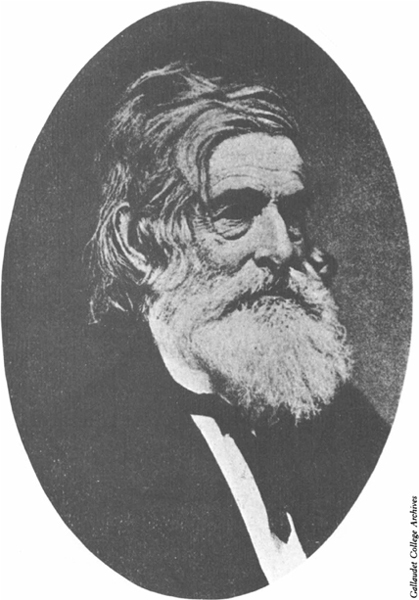
DR. SAMUEL GRIDLEY HOWE
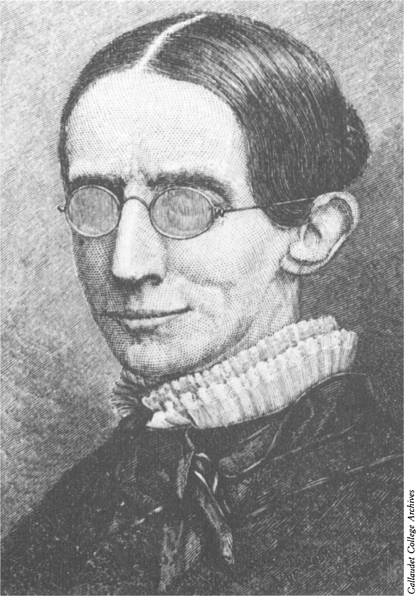
LAURA BRIDGMAN
Much as Sicard had printed letters on sketches of objects to teach Massieu their French names, Howe placed raised letters on real objects so Laura could learn the association by touch. After a few trials with a pen, a key, and such, the labels were detached and Laura learned to select the object corresponding to a given label and vice versa. Next the words were sliced up and the letters placed side by side; finally the three letters might be scrambled and Laura had to arrange them. With a pool of letters, she could select those three or four that designated an object and thus obtain it. According to Howe, the idea came to her one day in a flash that this was a means of communication. To facilitate the process, she was first given metal letters and a peg board, but she readily learned the twenty-six handshapes in the manual alphabet and thereafter fingerspelled hand in hand with her interlocuters. This took three months; the next year was spent gratifying her eager inquiries for names of things and events. She could now communicate with those around her.19
Laura was taught words for physical attributes, such as “hard” and “soft,” then those for moral attributes, “good” and “bad.” Next she studied spatial prepositions, “on,” “in,” “under,” and so on, and then verbs for concrete actions in the present tense, and then in other tenses and moods. Instruction in writing began at this point; it took a while before she realized that she could communicate with people she did not touch but once this insight came her enthusiasm and progress were great.20 Laura learned to write on grooved paper, as did the other students. She could write home; her joy was unbounded!
As admirably as fingerspelling reopened Laura’s mind, its achievements must not be exaggerated. At age nine, she had the vocabulary of a child of three. “How limited is the range of her thought,” Howe wrote. “How infantile is she in the exercise of her intellect!”21 After five years, Howe reported that Laura fingerspelled in her dreams and in daydreaming, and that she could read a little in raised print as well as in the manual alphabet.
Once Howe started writing about Laura in the Perkins reports and the newspapers, she entered the public domain and gave Howe the reputation he would need for the rest of his career as a social reformer. The reports were translated into several languages and read by thousands with interest and compassion. Charles Dickens, then the most noted author in English, visited Laura and included an account in his American Notes.22 Thomas Carlyle likewise wrote about her. Two of the world’s leading psychologists, G. Stanley Hall and Wilhelm Wündt, examined her case.23Howe became a celebrity and sought to put his new-won fame to use in other fields. It was at this time that he brought Laura to Hartford to meet our Julia Brace.
When the news was passed that Laura was in the office accompanied by Howe and Lydia Sigourney, many pupils and teachers came thronging round and filled the room and hall: I was among them. Howe was a tall, handsome man, nearly six feet, with a wealth of brown hair, a full beard, and elegant attire. Laura had removed her bonnet and cloak. She was slender and delicately formed with fine features and fair complexion; she wore a green ribbon bound over her eyes and gesticulated a good deal, but clearly was ignorant of sign language. Julia was eventually brought down and introduced. Laura was most affectionate, indeed embarrassingly so, for when Julia learned that Laura was a visitor, not a new pupil, and could not sign, she seemed to lose all interest, although she accepted a little present from Laura gracefully.
Howe proposed that Julia accompany them to the Perkins school in Boston, where she would learn reading and writing by the same means Laura had. I was opposed on the grounds that Julia, a grown woman, would be disoriented there with no one who knew her language, and besides, she already had greater skills in communication than Laura, albeit in our language. I was overruled by Julia, who, much pleased with the proposal, set about preparing her wardrobe. Thomas and matron were inclined to accede to her wishes and Howe’s urging.
Alas, I was proven right. Once separated from all her friends, duties and familiar environment, Julia sat apathetically all day long. If left alone she slept. She was pleased with her all-too-infrequent lessons, and learned the letter names of a handful of objects, but it was surely impractical to ask this beleaguered middle-aged woman to start learning a new language under such circumstances. After a year, she asked to be returned to Hartford, where she promptly resumed her old and effective means of communication.
It is a measure of the sweetness of Julia’s personality that the whole experience at Perkins left an excellent impression on her. It was a most affecting scene to see Laura grasp Julia’s larger hand with her slender fingers and guide her forefinger along the outlines of a raised letter while with the other hand she felt the changes in her face to find a sign of understanding the lesson; the two women regarded each other as surely as if they could see, the teacher full of patient attention, the older pupil frowning in puzzlement. Julia frequently alluded to Laura’s efforts and never fails to this day to ask after her if she learns that someone has come to the asylum from Boston. She returned to Hartford carrying a copy of The Blind Child’s First Lessons and for a time she continued to manifest some interest in it. Even now she occasionally spells the names of a few common objects, while also making the signs for them. But she soon tires of the exercise and raises her hand upward signifying that she wishes to carry the book back to her room. Still, she attaches a value to it, as she does to all of her possessions, and does not like to have others handle it.
Is it best to educate those born deaf and blind among deaf people who see or hearing people who do not? Clearly, the former, for a child has no more urgent and imperative need than facile communication with a group, which allows its normal intellectual, social, and emotional development. Howe attributed Julia’s failure to profit by his lessons, where Laura did, to the ravages of time: “She is past the age which nature destines for acquiring and storing up knowledge.”24 Itard invoked the same explanation for the same reason with Victor. Our current principal, Collins Stone, who doesn’t know Laura, suspects she may be unusually intelligent, Julia less so.25 That would explain why two other deaf-blind children, Oliver Caswell and Lucy Reed, who entered Perkins after Laura and were taught by the same methods, made negligible progress.26 By accepting these children in a school for the blind, Howe condemned them to a life of solitary confinement.
You might think it wondrous that Howe never tried to teach his deaf-blind pupils to speak, especially as he now advocates this course so stridently for all the deaf, whose friends cannot hear them, whereas if Laura, Oliver, or Lucy had spoken they would have been in instant communication with all around them at Perkins. In fact, all had once spoken before contracting their illness and Laura on her own initiative developed distinct vocal names for each of her Perkins acquaintances. Howe did not teach speech because he realized what he has now forgotten, how difficult such a task is and how meager the results. “It would have been a most rude and imperfect language,” he wrote then. “It would have been indeed a foolish attempt to do in a few years what it took the human race generations and ages to effect.” Amen.27
Instead, Howe taught his pupils fingerspelling, not sign. I have given some reasons. He did not know any sign and he did not realize, therefore, that language can be manual as well as vocal. He thought sign concrete, and hence unfit for restoring his deaf-blind pupils to society at large—as if they ever had belonged to society at large or ever would. And as if Massieu, Berthier, and I—and countless deaf people since—had not learned sign language first, then written language second. But Howe’s most fallacious bit of reasoning—surely a record in the history of hearing people educating the deaf—is his invoking the God’s breath notion in support of—not speech, but fingerspelling! “As people rise out of savagedom and pass through barbarism, they follow the instinct or disposition to express themselves by audible signs.… All come to speak as a matter of course and speech is the crowning acquisition in human development.” (Acquisition of language, yes, acquisition of speech, no.) “All adopt speech because it is the means contemplated by nature and for which they have organs specially fitted.” (Not so. Speech is a tenant on land owned by breathing and eating.) “I knew that Laura must have this innate desire and disposition.”28 So he taught her the manual alphabet.
At the same time that he urged fingerspelling exclusively for all the deaf, Howe hastened to acknowledge that his proposal “has an important bearing on the whole subject of deaf-mute instruction of which I by no means pretend to be a competent judge.”29 Then why not ask one, such as Thomas, me, or indeed virtually any deaf person at all? We would have told him that fingerspelling is slow and taxes the mind, that it takes ten different handshapes, for example, to convey the single brief sign UNDERSTAND, that it exists in space but does not exploit the possibilities of space, that when deaf people are obliged to use it with speakers of English they present a peculiar telegraphic form of English that is neither oral language nor manual language. Nothing shows more clearly how bizarre is a sequential spelled language to someone whose language is visual than Laura’s question why it mattered whether you spelled “cat” CAT or TAC or TCA.30
Samuel Howe’s renown as an educator, thanks to Laura, was equaled if not excelled by that of his “blood brother in reform” Horace Mann. When Howe was a freshman at Brown University, Mann was a tutor there, having graduated, valedictorian, the year before. Mann took a liking to his bright, good-looking, and sociable pupil, and they became fast friends. After Howe’s sophomore year, Mann left to enter the practice of law but remained a frequent visitor to Brown and eventually married the president’s daughter. He ran successfully for the state house of representatives and then, following the sudden death of his first wife, moved to Boston and ran successfully for the state senate. As a senator he agitated in behalf of a bill to provide an insane asylum for the state at Worcester, then took an interest in education for the first time and guided a bill through to create a state board of education to gather information and initiate reform in the schools. The governor, who had been persuaded by Mann and friends to advocate the board in his address to the legislature, now proceeded to name Mann to it. In turn, some members of the board, particularly a wealthy manufacturer and philanthropist, Edmund Dwight, urged Mann to resign from the senate and assume the board’s direction as secretary, and Mann agreed.
One of Mann’s first aims in his new post was to establish a normal or model school for teacher training. In order to persuade a reluctant legislature, Mann secured Dwight’s backing and announced that an anonymous benefactor would contribute $10,000 to a teachers’ seminary if the state would match his grant. The plan worked and in 1839 the Lexington Normal School opened.31 In the first group of pupils was Mary Swift, whom Mann sent on graduation to Howe at Perkins; Howe assigned her to teach Laura Bridgman. Shortly thereafter, Howe came to Mann’s aid, to ward off legislative forces that wished to abolish the Board of Education. “How can I thank you enough for the interest you take in me,” Mann wrote to Howe. “I have tried many times but I choke; I feel that if I have had any success, I have been mainly indebted to you for it.… If I love the cause, then how must I feel towards one to whom it is so much indebted?”32
Howe defended his embattled friend many more times and in later years raised funds for Mann, who found himself in financial straits. They helped fugitive slaves together, Howe supported Mann in his successful bid for Congress and unsuccessful bid for governor, and when Mann died, president of Antioch College, Howe took up a collection for a bronze statue to be placed opposite that of Daniel Webster in front of the Massachusetts State House. Never did this friendship have more profound repercussions, however, than when, in 1844, Horace Mann issued the famous Seventh Annual Report of his Board of Education, in which he unleashed a mighty barrage assailing American education in general and the practice of educating the deaf through sign language in particular.
Horace Mann never evinced any interest in the deaf before or after his Seventh Report. The extravagant claims made there for oral instruction of the deaf are but a sixtieth of its bulk, which concerns schoolhouses, books, apparatus, curriculum, classification, and teacher training; elementary, normal, and reform schools; homes for juvenile offenders and poor children, orphanages, prisons, hospitals for the insane, and general hospitals. How did Mann come to pronounce so vigorously on teaching the deaf, at the very head of his report, just this once in his career? Clearly, because Howe asked him to. Mann’s praise of oralism was designed to support Howe in his effort to wrest the education of the Massachusetts deaf from Hartford and place it under his aegis at the Perkins Institution for the Blind.
It was the astonishing progress of Laura Bridgman that led Howe to take an interest in the deaf. In 1842 he ran successfully for the Massachusetts House; once there, Howe was appointed by the governor as chairman of the House Committee on Public Charitable Institutions, which counted among its many duties an annual inspection of our school at Hartford, where Massachusetts sent twenty-five pupils annually and paid about half of their tuition.
As chairman, Howe was well placed to open his campaign to move the Massachusetts deaf from Hartford to Perkins. In a report issued a year after his appointment, he acknowledged that our pupils seemed to be happy and well cared-for, and then presented three objections to the tutelage of Massachusetts deaf at the American Asylum—the arrangement for all New England deaf, you may recall, for some two decades.
First, Howe recommended that the deaf be taught only written English and not sign; he had formed the mistaken impression that we taught the pupils sign. He explained that sign, although necessary for instructing the deaf, would not serve for communicating with the rest of society, whereas a solid knowledge of written English would. Note that Howe did not then advocate teaching the deaf spoken English, which he called “a foolish attempt.” His second objection to the current mode of instructing the deaf was that it admitted students too late in life, between ten and twelve. The real problem here, which Howe chose not to mention, was that the state would pay for only six years of schooling for the deaf, much less than for the hearing, and if we were to teach the deaf children a trade in that time, then they had to enter school around twelve. His third objection was that “uneducated parents whose ideas of geography are vague” would prefer to send their child to the capital of their own state—Boston! (Actually, Hartford is much more centrally located.)
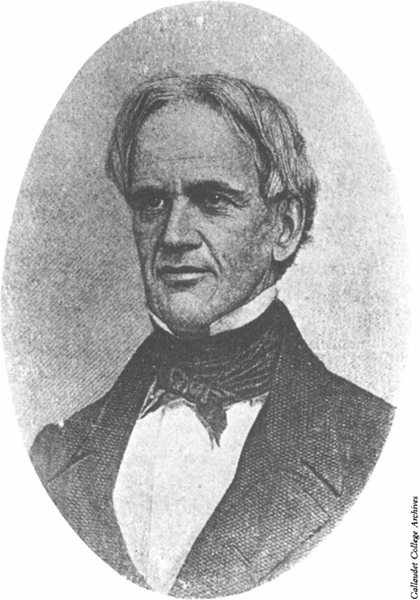
HORACE MANN
But all of this was a pretext for the bill Howe then introduced, which stipulated that henceforth all of the state’s deaf would be sent to Perkins, directed by S. G. Howe. Two further arguments were adduced as a parting shot: Perkins had excess space that a cost-conscious legislature should assign, and Laura Bridgman’s rehabilitation at Perkins proved “beyond question” that those who were merely deaf could be educated there. But the bill was defeated—it was too easy to refute Howe’s objections and to see his real goal—though he did succeed in getting authority to experiment with two sighted deaf children who had once spoken and were too young to attend our school; they were taught fingerspelling, as was Laura, but little else, and they were transferred to Hartford when old enough.33
Thus Howe was still smarting from the defeat of his bill to gain control of the deaf—he is not a man to accept defeat gracefully—when in 1843 he made plans for his joint honeymoon trip with Horace Mann and Mann’s second wife, Mary Peabody. It was Laura Bridgman who had brought Howe and his new bride, Julia Ward, together. The New York belle, eighteen years younger than Howe, then forty, was spending the season at a cottage near Boston with her sisters when Henry Wadsworth Longfellow and Charles Sumner, friends of her brother, came to call. The conversation touched on Laura and the party agreed on an outing to South Boston to see her. There Julia met Howe. Her father was a wealthy Wall Street banker, and Julia had received an elegant education that included courses in dance and music and lessons in Italian from Mozart’s librettist. Since Mary Peabody was as privileged as Julia Ward—one of her sisters was a distinguished educator and reformer; another married Nathaniel Hawthorne—nothing could be more natural than for the newlyweds to honeymoon together in Europe, visiting the sights, spas—and schools.
In London, with Charles Dickens as guide, they visited prisons, hospitals, asylums. Mann disliked the city, and Howe had nothing good to say about Watson’s school for the deaf. In Baden to take the waters with wealthy friends, Mann made a valiant effort to learn some German so he would not have to impose on his wife each time he wished to visit a German school; she found his attempts laughable but confessed that her own German was not very good either. To make matters more difficult, it was summer, Europe was resplendent, and the ladies insisted on vacationing.34 Moreover, most schools were not in session and Mann had to content himself with touring empty buildings, speaking with administrators, and visiting museums. Then developed that Howe, because of his escapade involving Polish revolutionaries a decade earlier, could not go on the most crucial leg of the joint trip, the tour of schools and asylums in Prussia.35 Thus the parties separated: Howe and his wife went on to Rome to spend the winter (she was pregnant, a daughter was born in Rome the following spring, and they did not return to America until the fall). Mann continued through Germany—his Seventh Report is full of admiration for the Germans, who “stand pre-eminent among the nations of Europe in regard to the quantity and quality of education.” By the time he and his wife reached Holland and France on the return leg of the trip, they were suffering from fatigue and homesickness; they paid scant attention to schools there.36 They returned to Boston, where Mann worked on his Seventh Report, which he presented to the legislature early in January. Here is what Mann wrote about the deaf:
“I have seen no [European] institutions for the blind equal to that under the care of Dr. Howe at South Boston, but in regard to the instruction of the Deaf and Dumb, I am constrained to express a very different opinion. The schools for this class, in Prussia, Saxony and Holland, seem to me decidedly superior to any in this country. The point of difference is fundamental. With us, the deaf and dumb are taught to converse by signs made with the fingers. There, incredible as it may seem, they are taught to speak with the lips and tongue. That a person, utterly deprived of the organs of hearing—who indeed never knew of the existence of voice or sound—should be able to talk, seems almost to transcend the limits of possibility.…But in the countries last named, it seems almost absurd to speak of the Dumb. There are hardly any dumb there; and the sense of hearing, when lost, is almost supplied by that of sight.
“It is a great blessing of a deaf-mute to be able to converse in the language of signs. But it is obvious that, as soon as he passes out of the circle of those who understand that language, he is as helpless and hopeless as ever. The power of uttering articulate sounds—of speaking as others speak,—alone restores him to society. That this can be done, and substantially in all cases, I have had abundant proof….
“I often heard pupils, in the deaf and dumb schools of Prussia and Saxony, read with more distinctness of articulation and appropriateness of expression than is done by some of the children in our own schools who possess perfect organs of speech and a complement of senses.… In some of the cities which I visited, the pupils who had gone through with a course of instruction at the deaf and dumb school were employed as artisans or mechanics, earning a competent livelihood, mingling with other men, and speaking and conversing like them. In the city of Berlin, there was a deaf and dumb man, named Habermaass, who was so famed for his correct speaking, that strangers used to call to see him. These he would meet at the door, conduct into the house, and enjoy their surprise when he told them that he was Habermaass….
“The German teachers of the deaf and dumb prohibit as far as possible, all intercourse by the artificial language of signs, in order to enforce upon the pupils the constant use of the voice. At a later period, however, all are taught to write.
“I found a class in the school for the deaf and dumb in Paris, which the instructor was endeavoring to teach to speak orally; but it is not certain that the experiment will succeed in the French language,—that language having so many similar sounds for different ideas. With the English language, however, a triumph over this great natural imperfection might undoubtedly be won; and it was an objective,—certainly with some of the trustees of the Perkins Institution for the Blind, when they petitioned the legislature last winter for power to incorporate upon that institution a department for the deaf and dumb,—to exchange the limited language of signs for the universal language of words, in the instruction of this class of children in our state. Had the members of the legislature seen and heard what I have now often seen and heard, but what I then knew of only by report, I cannot but believe that that application would have found a different fate.”37
How did Horace Mann, who had never taught a deaf child or even entered a school for the deaf prior to his European journey, come to have such pronounced and erroneous opinions about the deaf and their language?
I have suggested that Samuel Gridley Howe had seen an opportunity in his influential friend’s report on education in Europe to make the legislature regret and recant their refusal to let him educate the deaf of Massachusetts. If this is so, then Mann would have had to find some attribute of deaf education in Europe that was significantly different from the American method as practiced in Hartford, and there was one place in Europe where he could find such a thing—Germany. As we have seen, French values and practices had flooded the German-speaking lands in the wake of Napoleon’s armies; alas for the deaf, with his defeat and the withdrawal of French forces, there had been a rejection of all things French, and an upsurge of national feeling, including pride in the German language. Thus the “French method” of encouraging and using sign language had fallen into keen disfavor three decades before Mann’s visit, and the Germans had found it timely to exhume Heinicke.38 Whereas sign language had been flourishing in the school Heinicke founded at Leipzig, with the oralist resurgence, his son-in-law Carl Reich took charge and banned both sign and, for good measure, fingerspelling. But of course when the primary language of his pupils was pushed out the door it reentered by the windows; speech continued to play only a secondary role. Then Reich went on the attack; sign was like a deadly microbe: once it has contaminated the atmosphere, the only choice is to burn all the scholarly apparatus. Graduated exercises in German grammar superseded a curriculum formerly devoted to teaching elementary geography, history, and the like. By the time of Sicard’s death in 1822, sterile memorization of the byways of German sentence construction ruled the day.39
A second important focus of German oralism was to be found in the southwest, near the French border, where Victor Jäger, pastor at Gmünd, directed an institute for the deaf on oralist principles. In the new political climate, Jäger published a book attacking methodical sign and the manual alphabet that became the leading text for instructing the German deaf and remained so for over two decades.40 The school at Gmünd trained professors and directors for the majority of the new schools opening at this time in the German-speaking world—at Frankfurt, in the Grand Duchy of Baden, at Basel, and elsewhere. As part of the effort to discourage the language, gatherings, and intermarriage of the deaf, large residential schools became the exception, many small day schools the rule.
The most influential teacher who rallied to the new emphasis on instruction in German was Moritz Hill. Hill had been trained at the Berlin school founded by Heinicke’s son-in-law Eschke.41 Then he was appointed director at a Prussian school in Weissenfels, near Heinicke’s home, and from there he sent out books and disciples promoting oralism throughout Germany. In his lectures and books, however, he opposed the form that oralism took under Jäger, in Saxony, namely dry grammatical exercises. He advocated instead that deaf children learn speech as hearing children do, through constant daily use—as if, in short, they were not deaf. This was his (some what blind) application of the influential theories of Johann Pestalozzi, according to which a pupil should acquire instruction the way a child acquires knowledge from his mother, simply through normal, natural everyday contact.42
Instructing a deaf child as if he were not deaf generally suits his parents, if they are hearing, but it never suits his education. The “denial method” was carried to the point of absurdity by Johann Graser, who was asked to open a school for the deaf as a department of an ordinary school in Bavaria.43 His plan was to give the children a few years of oral training to enable them to be incorporated right into the regular classes, and he published a manual for teachers in the village schools to allow them to instruct “the deaf bench” along with their hearing pupils. All you need do, Graser told the teachers, is speak more slowly and distinctly than if you had only hearing children in your class. Although attempted with Teutonic thoroughness by nearly one hundred schools, the plan failed because its goal was unattainable.
Moritz Hill watched the experiment carefully. “The hope that each deaf mute could receive the necessary instruction at the local school in common with hearing children and without injury to the latter has been abandoned,” he wrote in 1858.44 Not only were the deaf children a burden to the teacher and thus an obstacle to the instruction of the other students, but also they made less progress than their counterparts in the residential schools and earnestly wished to return there.45 Eventually, even Graser retrenched, advocating at least one school in each province exclusively for the deaf. As Itard had discovered in Paris, most deaf children cannot learn to address and lipread a teacher, and even a slight hearing loss obliges their instruction in sign language. Thus, although German teachers spent more time speaking in class and teaching their deaf pupils to speak than did teachers in other lands, by the time Mann arrived, it was simply not true that “the German teachers prohibit as far as possible all intercourse by the artificial language of signs.”
I do not mean to say Mann lied. He was, however, certainly well disposed to find the German method superior to ours because this finding would aid a loyal friend and was consistent with his general beliefs about German education. He was, as well, unable to judge spoken German and naïve about the education of the deaf: if Howe could write two years earlier, “On the whole subject of deaf-mute instruction … I by no means pretend to be a competent judge,” how much more true was this of Mann. He was, I believe, duped, taken in.46
Here is how it happens.
A traveler visits an articulatory school. A pupil is called up who became deaf at eight or ten. The pupil speaks distinctly or recites a familiar phrase, seems to understand the everyday requests made of him vocally. The traveler never thinks of testing the pupil’s abilities or determining if he is the exception or the rule but forthwith, in a fit of enthusiasm, writes to friends at home that in Germany or England or wherever, the deaf and dumb from birth are taught to speak substantially in all cases like other men so that in these places it is almost absurd to talk of the dumb, and the faculty of hearing is supplied by the eye in reading on the lips.47 Thus, Mann. Zeal and intelligence could not compensate for a lack of practical knowledge. Had he asked a teacher of the deaf, had he deigned to ask a deaf teacher such as I, here is what I would have said. There are four great traps; they concern the pupil, his interlocutor, the material, and the visitor. Every large institution has a few outstanding pupils who can be trotted out for the visitor. How representative is the pupil? At what age did he lose his hearing? There is a world of difference between a deaf-mute and a semi-mute, between instilling a knowledge of oral language in one who is deaf, and slowing the deterioration of oral skills in someone who once spoke, perhaps even on arriving at school. Is the pupil selected semi-deaf? Can he hear speech addressed to him directly in a loud voice?
Does the pupil communicate only with familiar people, the teacher perhaps, or another pupil? It generally happens that the pupils come to understand the teacher better than they understand anyone else, and vice versa. Thomas Gallaudet told me about a man who claimed he had trained his parrot to talk. Thomas couldn’t tell what the parrot was saying unless the teacher gave him the model in advance, but he could tell that the longer the teacher worked with the parrot, the more his models sounded parrotlike.
Is the material rehearsed? Oral teachers generally have a few pupils prepared with common utterances for use with visitors: “Where do you come from?” and the like. Furthermore, if the question or the text is familiar to the visitor, it can easily appear more intelligible to him than it is. Visitors are often unwitting accomplices to this charade when they ask to hear the Lord’s Prayer, or follow by eye the pupil’s reading in some text.
Finally, it is folly for the visitor to undertake this evaluation unless he is perfectly fluent in the language or has an interpreter who is. How is he to detect faulty pronunciation, grammatical errors, or mistakes in writing in an unfamiliar orthography?
Horace Mann was misled more than once by his ignorance of these precautions. Not long after his report appeared, he joined Henry Barnard, commissioner of education in Connecticut, in organizing a meeting in Hartford of the American Institute of Instruction, where he called attention to a young man from New London who was present, who was born deaf and dumb, but whose father had succeeded in teaching him to speak, read, and write. Enoch Whipple, eighteen, was then presented to the assembly and truly he could articulate well and had an uncommon ability to read from the lips. His father, Jonathan, then gave an account of how he had taught the boy.
Fortunately, William Turner, who later became our director at Hartford, was there with me and during luncheon he questioned the father closely and experimented on the son. The result was that the young man gave prompt replies to questions made close to his ear in little more than an ordinary tone of voice, without seeing the mouth of the speaker, and was evidently neither deaf nor dumb. That afternoon the results were laid before the convention; further experiments proved that the boy was only semi-deaf. How much better he could once hear we were not told. The convention saw in a moment that this boy could hear any question put to him and answer intelligently from the sound of the voice; the father and boy, who were lions in the morning, were pretty small cubs by afternoon and they decamped without our knowing what became of them. The father deserves some credit for teaching his son some lipreading, but the case had no bearing on Mann’s assertion that those born deaf can be taught to speak and lipread. Mann had been duped again.48
I need not pursue here the common-school controversy, triggered by Mann’s Seventh Report, which raged for more that a year and led Howe to run for the Boston school committee; suffice it to say that Mann found little but evil in our common schools and nothing but good in the German ones, that Massachusetts schoolteachers took offense, that a great deal of ink was spilled on both sides, and that little changed in the end.
With regard to the deaf, Thomas Gallaudet was the first to respond, though he had retired from the field a dozen years before. He did not question Mann’s motives, as I have, nor his ability to judge—by now you know Thomas would never do such a thing. He simply affirmed—how wise!—that articulation is only one part of education. There is also mental and moral development, knowledge of our social and civil institutions, arithmetic, grammar, geography, history, reading, writing, learning a trade, and all these cannot be taught without “that very distinct, intelligible, copious, and beautiful language of signs.”49 Thomas did not publish this reply; he showed it to us and he sent it to Mann.
Harvey Peet was less generous. We cannot let Mann’s denunciation pass, he argued, for it is widely circulated from a man of high authority, it could mislead parents and legislators and impair our usefulness in the end. He struck back in the pages of the North American Review:50 “We are persuaded that if we should spend a large portion of the period, scanty at best, allowed to each pupil attempting to teach him to articulate and to read on the lips, the cases of partial failure in the far more essential, yet easier, task of teaching the vocabulary and idioms of language would be much more numerous. Articulation has been excluded from the course of instruction after careful and mature deliberation and, in the New York Institution, after actual and patient experiment; not because the object was considered of little account but because the small degree of success usually attainable was judged to be a very inadequate compensation for that expenditure of time and labor which the teaching of articulation exacts—for the many wearisome hours that must be spent in adjusting and readjusting the positions of the vocal organs, in teaching the seven sounds of the letter α, the hundreds of elementary sounds, as Mr. Mann says, represented by only twenty-six letters, and the thousand capricious irregularities in the pronunciation of the same letters or combinations of letters.
“Unless Mr. Mann has something stronger in reserve we hardly think he will succeed in persuading many of the American teachers of the deaf to tie the hands of their pupils, compel them to articulate disagreeably, and read on the lips of those who will consent to sit or stand full in the light and speak slowly and distinctly.”
Peet admonished teachers of the deaf to remember the disastrous experiment with oralism at the Paris institution under Ordinaire and concluded, “We see no present prospect that the teaching of articulation will be introduced into our institutions at all.”
If only Peet had been right! But Mann’s report was to prove the greatest threat to the education of the signing community that the deaf had yet encountered.
We now know, with access to Mann’s papers after his death, that even his friend Howe—an ardent opponent of sign language—was aghast at Mann’s remarks on the deaf, which he read on returning from Europe ten months after their publication. He thought the report’s wild claims could not survive careful scrutiny and would likely hinder more than help his efforts to gain control of deaf education. How can you say, he asked Mann, that “it is almost absurd to speak of the dumb in Germany”? “Well,” Mann replied, “if they have been taught to speak, even though it be only to name common articles of dress, furniture and animals and to give the names of friends, they can no longer with propriety be called dumb, can they?”
How do you defend your claim, Howe went on, that the American deaf are “helpless and hopeless”? “Are they not so,” Mann replied, “when they leave the circle of those who understand the sign language—like an Englishman who knows not a word of French in a company of Frenchmen who know not a word of English?” (Not at all, for the American deaf learn English and can communicate by writing with those who know no sign.) And as for your Berliner Habermaass—the one who, though deaf, spoke flawlessly—how did you judge that, Howe asked, since you scarcely know German? “The account of Habermaass,” Mann replied, “I took from a book on the subject by Moritz Hill.” Howe also disagreed with Mann’s claim that the deaf can be taught to speak “substantially in all cases.” He thought only half at most could succeed. (About half the pupils at Hartford were semi-mutes.) “As to the percentage, I said nothing about that,” Mann answered. “I said a triumph might undoubtedly be won over this natural impediment but I did not say, nor mean to be understood to say, in all cases. Nor could it be inferred that it could be won in so large a proportion of cases as in the German language, for I spoke in the report of a difference between English and German.”51
Not immune to the general conviction that there must be something in Mann’s assertions concerning the German schools, even though his characterization of the deaf was so completely in error, and eager to learn whatever there was to be learned from the Germans and others, our board sent Lewis Weld on a comprehensive tour of European schools. He was joined, for part of the tour, by a German interpreter and by two professors from Saint-Jacques, Edouard Morel and Léon Vaïsse, who had returned from New York. At the same time, the New York school independently sent George Day, fluent in German and French, to study European methods. Seven years later, Peet went himself with two deaf teachers and his son, and seven years after that Day went again.52 Each of these investigators visited about two dozen schools, some of them in common, and filed voluminous reports with precise locations, tests, and findings, all of which were lacking in the Mann report on the deaf.
In Great Britain, Weld found manual language plentiful in schools for the deaf; pupils signed among themselves, teachers used pantomime extensively intermingled with words from sign language, or the language itself if they knew it. The British two-handed manual alphabet was broadly in use. In most schools, articulation training was not attempted. However, at the London asylum, then directed by Joseph Watson’s son Thomas, oral skills were a part of the regular course for all pupils. Nevertheless, few of the 280 pupils spoke intelligibly. The Christian Examiner likewise assailed the quality of the pupils’ speech at the annual exhibitions.53 Weld was told that pupils who do not acquire some speech are considered deficient in intellect! (Actually, the opposite is closer to the truth: pupils deafened later in life, who generally benefit more from articulation training, are also more likely to have other problems, the result of the same disease that attacked their hearing.) When Day visited the London asylum shortly after Weld, the principal assured him that the object was not to teach all scholars to speak, but only to teach them to lipread. A professor there told him that not more than one-fourth could learn speech. Interviewing the seniors at this school, Weld concluded that only about half of them could read English with understanding. In Kinniburgh’s school at Edinburgh, where Thomas had sojourned nearly thirty years earlier, Weld learned that articulation training had been tried on all pupils originally, but too much time was lost and labor expended for too little result and at too great a cost in general education. Now, only ten of the seventy pupils were receiving that training in the school Braidwood had founded. Weld does recount two cases of congenitally deaf pupils who had received early, intense, and prolonged training in speech; he found one of them spoke rather intelligibly, the second less so. Weld’s conclusions: the deaf are educated in sign but, because the teachers don’t know the language well, the form of communication in the classroom is less evolved than in America, and the British deaf are less well educated than their American counterparts. Articulation training is not pursued, except in London, where it is given to a few.
Weld visited six schools in France and one each in Holland, Belgium, and Switzerland that were founded by disciples of Epée and Sicard. All education, including the teaching of French, was conducted in the pupils’ primary language. At the “mother school” in Paris, Day found “evidence of real solid attainment: I have seen nothing superior, if indeed anything equal to it, in my visits to the other schools.” There was no trace of Ordinaire’s attempt to replace sign by French. De Gérando had just died; Itard had passed away a few years earlier. Vaïsse was spending a half hour daily giving articulatory training after school to one-fourth of the boys and one-third of the girls, mainly semi-mutes. Similar efforts were made at several of the other schools in this group. By the time Peet visited Saint-Jacques, seven years later, Vaïsse was associate director, and Jean-Jacques Valade-Gabel had come from Bordeaux to teach articulation in Paris. It remained a matter of an hour or so a day for semi-mutes, an extracurricular activity. There was a third hearing professor, Puybonnieux, and four deaf professors, including Berthier, Allibert, and Pélissier. In brief, the situation outside of Germany was much as within the United States, where education was conducted in sign and some supplementary articulatory training was given to semi-mutes.54
As for Germany, the American investigators found the departures from standard practice there highly unsatisfactory. To discount their carefully documented findings on the ground that they all came from signing schools (Day, in fact, no longer did) would be to do a great injustice to the sincerity and diligence of each. Here is what they discovered; you may judge for yourself.
The investigators found the German pupils’ speech unintelligible. They were not alone in this: most German schoolteachers, clergymen, and people in other professions who were asked said, “We cannot understand the deaf and dumb.” The graduates themselves reported that they could not use speech in everyday intercourse. The teachers were frequently obliged to repeat for the visitors what a pupil had said. In the most advanced class at Leipzig, pupils read by turns, at Dr. Day’s request, a verse from the fourth chapter of Saint John. Out of eight scholars, three did not utter a single word intelligibly, two others uttered but one or two words so as to be understood, and the remaining three uttered from four to six words intelligibly. Day concluded: “The process is correctly called by German writers ‘mechanical speaking’: much time must be devoted to it, and with the greatest efforts only a defective utterance can reasonably be expected, even under the labors of the most experienced instructors.” There was no evidence whatsoever—quite the contrary—for Mann’s claim that he often heard deaf pupils read “with more distinctness of articulation and appropriateness of expression” than some of the hearing children in our own schools “who possess perfect organs of speech and a complement of the senses.”
The teachers in German schools signed so much in class while speaking—no doubt to make themselves understood—that the pupils’ abilities in lipreading alone could not be judged. Day found that a third of the advanced students appeared to understand, with the help of signs and frequent repetition, most of the instructor’s utterances. Another third lost a considerable part, and the final third were quite at a loss to say what was going on. Indeed, when the teacher was asked to refrain from signing while speaking, Day found some two-thirds of the pupils did not know what the lesson was about. How can we reconcile the pupils’ poor speech and lipreading with their teachers’ enthusiasm for instruction using oral language? Edouard Morel makes a good point: When the teachers enumerate the advantages of oral language, they contemplate it abstractly or in relation to hearing children, not the deaf. Thus they may say that oral language is rapid, that it leaves the speaker and hearer free to see and act, that it can be successfully used under a wide variety of conditions—in the dark, across a field, around a corner, and so on. But none of these things is true when oral language is used by the deaf. The speaker must speak slowly; the listener must stay still when spoken to and fix his eye upon the speaker—he dare not compare utterance with facts by looking elsewhere; the speaker must be close at hand, well lit, and so forth. Mann was quite mistaken when he wrote of lipreading: “The sense of hearing is almost supplied by that of sight.”
Not surprisingly, all investigators found that much time and therefore money was spent on the effort to provide whatever articulatory and lipreading skills could be inculcated. According to one German educator, oral exercises occupy half of the first year, a third of the second year, and a considerable part of all remaining years.55 If a third of the time is lost on the average, then a pupil loses two of his six years of schooling. Moreover, the pupils find the exercises tedious and boring, but no more so than the teachers. “The teacher needs an infinite patience,” Moritz Hill writes, and should remember “how difficult it must be for the deaf and dumb to learn and to practice something so opposed to his nature.”56
Although the failure of German teachers to instill oral skills might be considered a mere misdemeanor, a wasteful imposition on the teachers and pupils, it becomes a serious crime when coupled with an educational system that is predicated on those very oral skills. There are several grave charges. First, all investigators found that a very large proportion of deaf children were screened out of the educational system for lack of oral skills. The German schools for the deaf rejected children who were truly deaf, preferring instead the hard-of-hearing who had some speech. Morel estimated that a tenth were rejected during admissions, a fifth after trial, and only a third of those remaining could be instructed orally. This amounts to sacrificing the education of three-fourths of the students in order to provide an oral education for one-fourth.57 The Riehen school, at the Swiss-German border, for example, has admitted sixty-six pupils since its founding and dismissed nineteen for incapacity. To the north, the Pforzheim school has received two hundred and forty-nine pupils in the last two decades, fifty-two of whom have been dismissed, yet these were not indiscriminately admitted. (The principal has a list of all the deaf and dumb in the Grand Duchy of Baden and before admitting them he obtains exact information about their mental and physical capacities.) Because many of those pupils admitted, however, cannot speak and lipread sufficiently well, German schools have often taken a second measure: the pupils have been sorted into separate classes. At a typical school, “The first class contains children who have spoken, the half-deaf, and some born deaf who are exceptionally gifted. The second class contains the deaf of average intelligence. The third contains the intractable signers, the cretins and the idiots.”58 There is no doubt in my mind that I would have been put in the third class, since I proved an “intractable” signer. Likewise, Massieu, Berthier, Pélissier, and so on. In short, the oralist schools found themselves obliged to screen out the deaf, first at the door of the school, then at the door of the classroom. Such screening discriminates particularly against deaf families, for a congenitally deaf child would have to be a prodigy to learn in an oral school, whereas children from hearing families who have once spoken the language of the school have one less disadvantage. Since deaf families are usually poor, the screening helps to keep the poor entrenched in poverty and ignorance and provides education to the higher social classes.
The investigators found that oral instruction not only excluded many deaf from an education, but also poorly equipped for a career the deaf pupils who did graduate. Because most schools took the deaf child from his home around age seven or eight and instructed him for six years, the typical pupil graduated at fourteen, too young and unprepared to be self-sufficient. American schools pride themselves on teaching trades to all students, or preparing them for college. German schools do neither. Yet another grave consequence of the insistence on oral instruction is the virtual exclusion of deaf teachers, for teaching is a highly rewarding career that many of the educated deaf choose, a choice that has only the most favorable consequences for the teacher and student alike.
I have saved the most grievous effect of oralism found by the investigators for last. Since the pupils cannot understand much of what the teacher says, and since much of their time is spent on articulatory skills, they do not learn much; they are poorly educated. Edouard Morel, De Gérando’s nephew and no friend of sign language at Saint-Jacques, returned from a visit to Pforzheim reporting that pupils in their sixth year of school could not do two-digit multiplication. Yet this should not excite surprise; arithmetic, which presents no great obstacle to us who explain it in the pupils’ primary language, can be explained only with great difficulty to deaf pupils who are trying to glean it from their teacher’s lips and ciphers on the board. Indeed, some German teachers said the deaf could not be taught arithmetic beyond simple enumeration, for their minds were not equal to the task.59 Morel concluded his report: “The development of the [German] pupils’ intellect is less remarkable than in the French schools; their ideas move in a narrower circle. I attribute this inferiority to the too restricted use of the mimic [sign] language.” Here is Vaïsse (in a letter to Weld): “The general standing of the pupils when they have completed their course is far below that of your own.” And Weld: “The mass of German pupils I believe to be not so well fitted to encounter the vicissitudes of life.” And Day: “If it were necessary to specify the schools for the deaf and dumb in Germany in which the knowledge of the pupils, their compass of thought, and their power of expressing it in written language are decidedly superior to those of others, the schools in which natural signs are the most employed would instantly receive the preference. Still, the difference between the best German schools and our own in this respect is striking.” Even a German educator of the deaf, Ludwig Haug, wrote: “I doubt whether the mass of our deaf pupils when they leave school are as far advanced in moral and intellectual education, in the command of language, and in general information as those of the best foreign institutions.”
Because the draft of oralism was too bitter to swallow and rarely seemed to cure once ingested, the Germans after a few years diluted it: many schools started postponing oral instruction and returning to a curriculum surprisingly like the one they had had before, in which speech training was a complement to education, given to those who could profit by it. The final stage in the dilution of oralism arrived when German schools reintroduced sign language in class; out of class, the pupils had been using it all along.
“Of course!” Jäger now announced to a visitor to Gmünd about the time of Mann’s tour. “Only an utter ignorance of all that pertains to the subject can venture the assertion that the deaf and dumb can be educated without the aid of pantomime.”60 Likewise, in Prussia experience had quite mellowed Hill’s oralism; he now called doing without sign “unthinkable,” “contrary to nature,” “refusing to use the key that fits the lock.”61 It’s easier to find these tergiversations amusing if you can forget how many lives they destroyed.
Weld returned from Europe convinced that Mann’s claims were without basis, that we had nothing to gain and much to lose by replacing sign as the language of instruction. Nevertheless, he told me, he would recommend a more systematic and sustained effort than we had pursued so far to preserve the speech of semi-mutes. The Weld plan was to have each hearing teacher devote twenty to thirty minutes a day to teaching articulation and lipreading to semi-mutes; the deaf teachers would excuse the semi-mutes from their classes during this time—the children would go to an adjacent room where there was a hearing teacher. I was much opposed. History does not tolerate such subtle arrangements in social institutions, I told Weld. Itard never intended his intensive oral training of three semi-deaf pupils to be imposed on all the rest of the school, but the board and Ordinaire soon tried to do just that. This present accommodation would lead at least to demands for a distinct curriculum for the semi-mutes. The effort to make them talk would consume more and more of their time and eventually crowd out their true education. We must keep to sign, I told him, only sign, and students whose primary language is English and who wish to have their instruction in that language should go to a common school, seconded perhaps by lessons with a speech teacher. But we inevitably get these semi-mutes, Lewis argued, and we cannot refuse them. Moreover, the mothers want their children to speak—especially if they once heard them. Tell the mothers, I said, “Don’t try to change your child, you are the adult, you bear the burden, you change. Here is a circle of signing pupils: no straining of attention, no groping in the dark, no demand for frequent repetition, no cold and imperfect appreciation of each speaker’s meaning; instead, eloquence, poetry.… Now here are the same semi-mutes conversing orally, straining to glimpse a few fleeting movements of the speaker’s lips, speculating on their significance, requesting a repetition, frowning from the effort of attention.”62
We have to make some concessions, Lewis said; the board will demand them. We have already given training in articulation; we can do it again. I disagreed, but the board voted to give the Weld plan a fair trial. It took a year to see, and ten years to accept, that it was a failure. Only the semi-mutes received some slight benefit from it whereas all pupils suffered from a great loss of instructional time. Weld’s successor, William Turner, chose the obvious solution, which was Vaïsse’s in Paris: he hired a special teacher to provide oral instruction after class to those semi-mutes who might profit from it.63 The gains made under this arrangement were also modest,64 and when Turner retired and Collins Stone became director, the articulation teacher was released.
I spoke earlier of the deaf journalist William Chamberlain, who helped to found the New England Gallaudet Association. He was the first pupil to receive articulation training under the new regime, instituted on Weld’s return from Europe. Chamberlain had lost his hearing when he was five; his parents communicated with him by writing, and insisted that he speak. When he was eight, his father began to teach him lipreading and the youth practiced on his own with a mirror. “My first success in lipreading,” he has written, “was like a glimpse down a long vista, of freedom from trammels; but, oh! the long tiresome, discouraging time I have had in getting as far toward that freedom as I have, which is by no means half-way, although it is certainly better than nothing.” He came to Hartford at the age of twelve, while Lewis was in Europe. “I got the full benefit of the newly aroused enthusiasm in the matter. They were at me early and late and their efforts permanently benefitted me…. I am able to understand a public speaker as well as anyone else similarly situated, which is not saying a great deal. The public has had foisted upon it, at public gatherings and exhibitions, semi-mutes who, it was announced beforehand, would, after a speaker had concluded his remarks, prove how well they understood the motion of his lips by writing out a synopsis of his remarks. I can easily do the same, provided I have the privilege, as they had, of reading the manuscript in advance of its delivery. I have had more than one such job offered to me and declined them…. For public speaking, and rapidity of communication on ordinary occasions, commend me to the elastic, graceful, and comprehensive sign language.”65
Another semi-mute pupil who received oral training at Hartford is John Flournoy, the writer from Georgia who advocated a colony in which citizens would be deaf and sign language the medium of communication. In a recent issue of the National Deaf-Mute Gazette, Flournoy recounts that he arrived at Hartford speaking and lipreading, having attended hearing schools in Georgia. He had lost his hearing in an illness when he was seven. Turner boarded Flournoy in his own family, instructed him largely in English, had him read aloud and so forth. “Oral instruction to one who cannot hear readily,” Flournoy writes, “without the sign method as the principal reliance, appears to me a poor resort. It will not make literary proficients—but mediocre scholars, while the improvement of speech to converse with the hearing world will not compensate for lettered defect. Mr. Gallaudet’s and Mr. Clerc’s wisdom, therefore, was the anchor of hope of our unfortunate people.”66
As with Hartford, so with New York. Day had revealed Mann’s assertions baseless, but Hartford was trying the Weld plan, and New York would follow suit. Two years later, their board reported: “The experiment was accordingly commenced with the greater portion of the pupils, though most of them evinced a decided repugnance to this exercise. After a patient trial of several weeks, further efforts were, with the greater number, abandoned as a perfectly useless waste of time.” An oral class was then formed from the few who seemed to show some promise of gain but after a year it, too, was dropped as a failure.67
What did Horace Mann and Samuel Gridley Howe have to say with their views thus repudiated and their falsehoods revealed? Mann said not a word further concerning the deaf to the day he died ten years ago. If only Howe had followed Mann’s example! The Massachusetts legislature had defeated his proposal to arrogate the education of the deaf, the Mann report had failed to recoup his loss, and hearing and deaf people alike had assailed the document and its author, Howe’s friend. All this, smoldering in him for twenty years, burst into flame three years ago, seven years after Mann’s death. By this time there were more than 13,000 deaf people in the United States, some two dozen residential schools, a tried and effective system of education, a longer period of schooling extending up to some eight years, and an earlier age of admission, as low as six at the New York school. There was a national college for the deaf, several high classes, and distinguished deaf Americans in countless walks of life. Nevertheless, “The deaf person’s lack of an important sense,” Howe wrote in a widely publicized report of the Massachusetts Board of State Charities, “not only prevents the entire and harmonious development of mind and character but it tends to give morbid growth in certain directions; as a plant checked in its direct upward growth grows askew…. We should, in providing for the instruction and training of these persons, have association among them as little as is possible… There should be no attempts to build up permanent asylums.… A society has recently been formed here among the mutes for public religious worship in the sign language. Now such an association surely is not accord ing to sound sociological principles…. It promotes their segregation and thus their formation into a special class … The constant object should be to fashion them into the likeness of common men…. If our mutes educated at Hartford had been taught as well as children are taught in the German schools, they might attend public worship in our churches.” Having calumniated our minds, our characters, and our associations, Howe goes on to vilify our language: “The rudimentary and lower parts of language or pantomime are open to mutes; but the higher and finer part, that is, speech, is forever closed; and any substitute for it is at best imperfect.”68
All of this is a prelude to “a plan for a change in our system of educating mutes.” This time, rather than naming Perkins directly as the proper alternative, Howe proposed that the governor name three commissioners for the education of deaf-mutes, who in turn would have the authority to contract with any organization within the state to educate the Massachusetts deaf. He gave three arguments for withdrawing pupils from Hartford in favor of some organization in Massachusetts: repatriation, dispersion, and economy. The care of these “wards” would fall upon the citizens of our state, he argues, which would be instructive and the children would be closer to home. By dispersing the children as boarders in families, no more than two to a family, the evils of congregation would be lessened. New buildings would not be required to house them and thus their education would be more economical. He toys with a fourth argument, concerning methods: the attempt at oralism in American schools for the deaf admittedly failed, but it could not get a fair trial because the principals were wedded to the old ways. In a new school, oralism might succeed. This time Howe had strengthened his forces, maneuvered into position, and intended to win. It was his third attempt; I must first describe his second.69
Around the time of Horace Mann’s death, a committee of the Massachusetts legislature urged the creation of a Board of State Charities, after hearing testimony from Howe among others (he was there as a trustee of the state reform school).70 The committee specified that the governor and his council (Governor Andrew was a friend of Howe’s, as was at least one member of the council) should appoint a board with the power to move inmates from one institution to another. The governor backed the recommendation personally and it was passed in 1863. He then appointed as secretary of the board Franklin Sanborn, one of Howe’s oldest political allies, a fellow backer of John Brown’s raid on Harpers Ferry, and he appointed Howe chairman of the board.71
Howe was ready for his second major battle to gain control of the deaf and now he had one very important ally, a Boston millionaire by the name of Gardiner Greene Hubbard, whose second daughter, Mabel, then twelve, had contracted scarlet fever when she was five and had become totally deaf.72
GARDINER GREENE HUBBARD
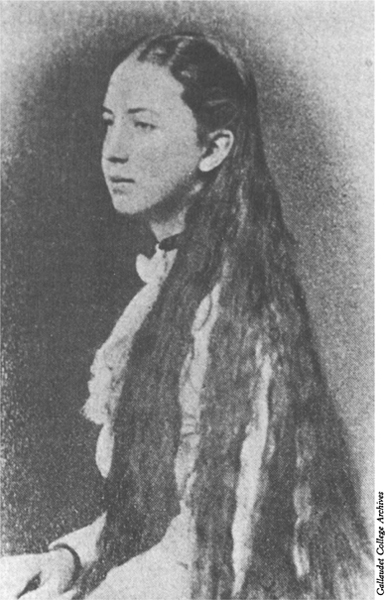
MABEL HUBBARD
As children often do in these cases, Mabel had continued to speak after her illness and her mother determined to do everything in her power to preserve her speech. She kept her with her hearing sisters, had her play their games, go to dance school with them.73 A teacher was hired to keep up her speech, teach her lipreading, and encourage her reading. Mabel’s father obtained a copy of Mann’s Seventh Report, then went to see Samuel Gridley Howe in South Boston. Howe urged him to prevent Mabel from associating with any other deaf children, to forbid her gesturing and even communicating in writing. If you want your daughter to be normal, he told Hubbard, you must speak to your daughter and she must speak to you. But Mabel’s speech continued to deteriorate, so the Hubbards hired a full-time governess, Miss Mary True, the daughter of the minister in the Maine town where their summer home was located.74 Miss True knew nothing of articulation, and at the outset Mabel could not read her lips. To make matters worse, the teacher often could not understand the child, and although Mabel had learned to read many printed words aloud, she did not know their meanings and there seemed to be no way to explain them. Mrs. Hubbard continued to spend several hours a day having Mabel name pictures and objects and recite the rhymes and hymns she knew before her illness. Miss True tried to explain the language of her books by translating it into Mabel’s own idiosyncratic English. When the child had fathomed the meaning of the original phrase or sentence in this way, the translation was set aside. Though Mabel’s speech is now unintelligible and Miss True left a year ago, Mabel is bright and diligent, and she continues to read and to receive intensive training from her mother. With all my heart I wish her a better fate than that of Pereire’s pupil Marie Marois.75
Hubbard and his wife agreed with Howe that they should not settle for sending Mabel to the asylum in Hartford with other, mainly indigent, deaf children, who used a gross, material language of the hands. What did Gardiner Greene Hubbard know about manual activities, about hands? And thus, Howe and Hubbard, two people who knew nothing of our language, culture, and heritage, not only decided the fate of one deaf child but sought to decide the fate of many.
Together, they were powerful; Howe enjoyed a reputation as a reformer and was chairman of the Board of State Charities; Hubbard had business standing and high social caste. It seems he had somewhat more political finesse than Howe, too, because Howe’s second attempt to seize control of the deaf was much more sophisticated than his first. Hubbard joined with Dr. Thomas Hill, the president of Harvard, and several others to petition the legislature for an act incorporating a school for the deaf. A friendly representative in the House introduced the bill, probably drawn by Hubbard. It provided that the state would give $5,000 a year to this school, which would board and educate thirty deaf pupils designated by the gover nor. The bill was referred to the legislature’s Committee on Public Charitable Institutions, but Howe was no longer in the legislature and the bill encountered stiff opposition, particularly from one representative and member of the governor’s council, Lewis Dudley, a lawyer who has a deaf daughter.76
Theresa Dudley was born deaf. When she was four, her parents brought her to Hartford to determine why she had never spoken; her mother refused to believe she was deaf. Turner took a music box and set it going just behind Theresa while she looked through the window at something going on outside. The child made no response to the music. He whistled loudly into her ear and she did not react. When he told the mother her daughter was indeed deaf, she became quite distressed, but he explained that, since a mute child must be either deaf or an idiot, she could be thankful her daughter was deprived of her hearing, not her intellect, and he introduced me and several of our pupils to show how much the deaf can do.77 As a result of this visit, one of our graduates, and then one from the New York school, were engaged to teach Theresa sign at home; thus the Dudleys became acquainted with some deaf people, and when Theresa was nine and entered our school, she could already read and write. During her two years with us in Hartford, she made rapid progress, not only academically but also in learning some oral skills, which were taught through the medium of her primary language, sign. When she began to articulate she had to learn not the meanings of the words but how to pronounce them—just the reverse of Mabel Hubbard. She left Hartford with a good education and a good command of English. It is not surprising, then, that her father joined our director, Collins Stone, in denouncing before the committee the Howe-Hubbard initiative, which would take Massachusetts deaf children from Hartford and impose on them an exclusively oral education.
In the event, despite an appearance by Howe, in which he disinterred the Mann report, and despite Mary Swift Lamson’s testimony on her education of Laura Bridgman without sign, the committee report was unfavorable to Howe and Hubbard. It praised the work at Hartford, saw no reason to change the practice of sending Massachusetts deaf pupils to our school, and called the instruction of the deaf orally “a theory of visionary enthusiasts which has been repeatedly tried and abandoned as impracticable.”78 As the national college opened its doors to higher education in sign language, Howe’s second attempt to obtain control of the deaf was defeated.
Dudley, however, was interested in learning more from Mary Swift Lamson about how she taught Laura Bridgman and he arranged an appointment; in one of those coincidences that cannot occur in fiction, a certain Mrs. James Cushing came to see him just as he was setting out. She had a deaf daughter, had heard he did, too, and wanted to know what means he was using to educate her. They pursued their conversation on the way to Mary Lamson’s, where Dudley learned little of interest. Mrs. Cushing, however, was delighted to hear that, with proper training, her daughter Fanny might be made normal again, and she asked Mrs. Lamson to recommend a teacher. A few days later, Mary Lamson asked her fellow teacher of Laura Bridgman, Eliza Rogers, for a suggestion and Eliza recommended her sister, Harriet.79
Harriet Rogers had graduated from the Normal School and had taught in the common schools, but she had no idea how to go about teaching a deaf child; she only remembered, thanks to Mann, that in Germany the deaf learned to speak and sign was prohibited. She began by following her sister’s example with Laura; she took Fanny Cushing to live with her and taught her fingerspelling.80
One day Mrs. Cushing took Harriet Rogers to Providence to meet a friend, the wife of a wealthy manufacturer and banker, Mrs. Henry Lippitt, who had a deaf daughter, Jeannie, then twelve, deafened at four years and three months by scarlet fever.81 The Lippitts were unwilling to send their daughter to an asylum where she would learn to speak with her hands, so Jeannie had been left in silence for some time. Finally, they heard of “a man in Boston who had been abroad and had seen a deaf boy speak and understand” and they got in touch with Samuel Gridley Howe. According to Jeannie, Howe said “he had never heard or seen such a thing,” but he urged Mrs. Lippitt to give her daughter an oral education.82 So for over three years Mrs. Lippitt had been spending five hours daily with her daughter, practicing articulation. But despite all this effort, Jeannie had made little progress in speech. When the Hubbards visited her at Howe’s suggestion, they came away discouraged at Mabel’s prospects since Jeannie’s articulation was “indistinct” and they “could hardly understand a word she said,” although she could lipread rather well. Nevertheless, Mrs. Cushing told Harriet Rogers to forget fingerspelling and to try to make her daughter Fanny speak; Harriet agreed to try.
Howe, meanwhile, twenty years after the Mann report and its repudiation, had decided to make his third and final assault on the legislature. This time he would have Mabel, Fanny, and Jeannie to show that oral education was not a “theory of visionary enthusiasts.” This time he and his partners would do as Mann did when lobbying for a state board of education: first, an anonymous philanthropist (Hubbard?) would offer a gift of money to found a deaf school if the legislature would incorporate it, and second, the governor would request the school himself in an address to the legislature. This time, no appropriation would be asked initially so there could be no objection concerning the cost.
Gardiner Hubbard had a further plan. He invited a group of six distinguished and influential friends to gather at Mary Lamson’s home, meet Harriet Rogers, and see the progress she had made with Fanny Cushing. President Hill of Harvard was a participant, as he had been in the last effort before the legislature. Also there were an eminent Boston clergyman, who had ridden with Hubbard through the South just before the Civil War,83 and Lewis B. Monroe, an elocutionist who founded the School of Oratory at Boston University.84 The group signed a testimonial, which Hubbard then published as an advertisement, stating that Harriet Rogers was about to open an oral school, had two pupils, and would welcome several more. That would show the legislature what was practical and what visionary! Despite the advertisement, seven months passed before Miss Rogers could assemble three more pupils and open her school in Chelmsford, Massachusetts, in June 1866—and even those had to be admitted with reduced tuition, since the school was private and hence relatively expensive.85
A few months before, Howe had fired the opening volley of his third assault on the legislature by attacking the existing mode of educating the deaf in his charity board’s report. Collins Stone was the first to protest publicly. Stone comes from an old New England family: he traces his ancestry back six generations to a Puritan divine in the reign of Queen Elizabeth and four generations to the first pastor of Hartford’s congregational church. After graduating from Yale, he studied for the ministry under Reverend Strong’s famous successor, Joel Hawes. He is a modest, cheerful, religious man with good practical sense, great powers of concentration, and painstaking attention to detail. Short and stout, with red hair that has become white over the years, he is not a striking signer or orator, but when he speaks, he speaks carefully, from the heart as well as the mind.86 After teaching at the American Asylum for twenty years, he went to the Ohio Institution as director, returning to Hartford to succeed William Turner six years ago.
“The fact that it is not possible to restore speech to the deaf and dumb to any considerable or useful degree,” he wrote in our annual report, “that the processes by which it is attempted are tedious and exhausting, and that the results attained are unsatisfactory and transient in their character, is not fully understood.”87 The dispute does not concern the semi-deaf and semi-mute pupils that we occasionally receive, he explained. It concerns those who have never spoken and cannot distinguish speech by ear: they constitute ninety-five percent of our students currently. Stone reviews all the arguments against oralism—the time lost, the pupils excluded from schooling, the disagreeable contortions of voice and facial expression, the inability of graduates to use their speech in general society, the many teachers required and hence great cost, the early admission precluding training in trades, the postponement of religious instruction and impossibility of group religious worship, the necessity of acquiring elusive lipreading skills, the reduced comprehension of general education. He protests Howe’s characterizing the deaf as “dependent classes” just because a part of the state taxes goes to subsidize their education. He contends that preventing a deaf child from signing isolates him more than any clique he may form with other signers. He exposes Howe’s plan for boarding deaf pupils in hearing families for the wildly impractical scheme that it is. Stone defends the Deaf-Mute Christian Association of Boston against Howe’s imprecations: it is composed of mutes who have been educated and are now respected and prosperous members of society. These men and women wish to enjoy intelligible social religious worship. Living in a community of hearing persons, laboring in the same workshops, mingling with them in social intercourse during the week, on the Sabbath they assemble by themselves for worship in the language with which they are most familiar, a language whose gracefulness, beauty and graphic power impresses every beholder. What harm is there in such an assembly to which a company of French- or Italian-born citizens gathered for a similar purpose would not also be exposed? If such weekly gatherings are “not according to sound sociological principles,” they are in any case most commendable to the deaf and dumb and must exert a happy influence on their social and moral condition.
Having disposed of Howe’s arguments based on the need for oralism—greater economy and greater dispersion in educating the deaf—Stone points out that Howe’s last argument, repatriation, is a pretext: Howe’s Perkins Institution for the Blind invites and receives blind children from all the other states in New England. Howe considers his institution sufficient to meet the wants of all these states and gives excellent reasons to show that it is in their interest to sustain but one school of this kind within the region.
Howe published a pamphlet rebutting Stone and defending the report of his board.88 He said that the American Asylum never takes his suggestions, that it is not inconsistent to make mistakes, learn from them, and revise your ideas. In the light of all that has happened and will happen, he makes an astonishing denial: he says that Stone spent most of his rebuttal on the disadvantages of oralism, which is a false issue, since the board had not recommended the teaching of articulation. But here is what Howe originally said in his report: “The friends of the system of articulation … persist in efforts to obtain for the mutes of Massachusetts the benefit of what they believe to be a vastly better system of instruction. Some of the board share in this belief.”89
Having now denied that the real issue is English versus sign, Howe appears to have forfeited his main argument, that existing schools are using an inappropriate method. To recoup his loss somewhat, he chastises Hartford for placing so little emphasis on fingerspelling. This revealed such a total unfamiliarity with education of the deaf that Dudley insisted Howe be dismissed from all his posts since he proved so ignorant of his task.90 If only it had been done! If only Dudley had remained so steadfast in our cause!
Two more significant events occurred in the struggle that year, 1866. In the fall, Gardiner Greene Hubbard went with Thomas Talbot, Harriet Ro gers’s brother-in-law and a member of the governor’s council, to see Governor Alexander Bullock. They planned to ask the legislature to grant a charter for a school for the deaf, and solicited the governor’s support. He informed them that a certain John Clarke, a banker in Northampton, had had his attention called to the dispute and offered $50,000 to endow a school for the deaf in Massachusetts.91 Governor Bullock must have asked after Howe: they were close friends from antislavery days and he, too, was one of the backers of the raid on Harpers Ferry. I fancy Hubbard told him that Howe had decided, after his failure to persuade the legislature in two earlier attempts, that it would be best for him to stay discreetly in the background. The governor said he would be pleased to oblige these gentlemen in their humanitarian request, and would support it in his annual address to the legislature the following January.92
“I confess,” said the governor in his address, “I share the sympathetic yearnings of the people of Massachusetts towards these children of the state, detained by indissoluble chains in the domain of silence. This rigid grasp we may never relax; but over unseen wires, through the seemingly impassable gulf that separates them from their fellows, we may impart no small amount of abstract knowledge and culture.” Such oratory! I suppose it may be excused in a governor’s address but, really, nothing more is involved that the prosaic issue of educating people in their primary language. The governor goes on to ring the ancient chimes of benevolence, which sound so sweet to the benefactor’s ears: “They are wards of the state. Then, as ours is the responsibility, be ours also the grateful labor.” There is money in it for everyone: “Assured as I am, on substantial grounds, that legislative action in this direction will develop rich sources of private beneficence, I have the honor to recommend that initial steps be taken to provide for this class of dependents within our own commonwealth. Should this policy be adopted, I have every reason to believe that it would eventually result in a permanent decrease of the present annual expenditure for their support.” So it was agreed that the grounds on which the campaign would be pursued were repatriation and economy. All parties knew that the latter claim was as false as the former: Hartford charged only half the true cost of educating each pupil because of the interest accrued annually from its endowment, obtained by selling the congressional gift of land in Alabama. Moreover, oral schools are inherently very expensive because a teacher can teach articulation to scarcely more than one pupil at a time, and general education to only a few because of the limits of lipreading.93 John Clarke had to be persuaded that his offer of an endowment should be restricted to an oral school: but Harriet Rogers convinced him.94
The governor appointed a special joint committee to conduct hearings on his proposal; Lewis Dudley was the chairman for the house, which augured well for the interests of the deaf. The two members drawn from the governor’s council, Talbot again and Francis Bird, augured ill, for both had contributed to Harriet Rogers’s oral school and Bird, a political boss, was a lifelong friend of Howe’s. Howe and Hubbard testified in favor of the governor’s proposal, of course; two Hartford directors, Turner and Stone, testified against. Many deaf people attended, and David Bartlett from our school served as interpreter.
While the hearings were taking place, Howe and Hubbard conducted an intensive campaign, publishing pamphlets and giving demonstrations. The trials of oralism conducted by the American and New York schools were unfair, Hubbard contended in one publication: “A fair trial can only be made where sign is not allowed. The two cannot be carried on together for the language of signs is without doubt more attractive to the deaf-mute.” It is a great wonder to me that all the oralists over the centuries who have bewailed that attraction see no message implicit in it. In the end Itard did. Hubbard’s pamphlet closes with a most damaging admission; I suppose it had to be made, for the joint committee visited Harriet Rogers’s school during the hearings and judged matters for themselves. “The articulation of most of the pupils is very imperfect,” Hubbard wrote, “and almost as unintelligible to strangers as the sign language; perhaps to some signs seem preferable to the indistinct utterances of the pupils.”95 Howe published the third report of the Board of State Charities during the hearings.96 In the section following the account concerning convicts at the state prison (they were going to try weekly lectures for their instruction), he affirmed that the board had high regard for the Hartford school but, “as the governor has said in his address, we should educate the deaf in their home state.” Then, in the section “The Blind, the Deaf-Mutes, and the Idiots,” he shook the dollar bait: “We have good authority for believing that benevolent persons stand ready to endow largely any such school that may be established by the legislature.” He repeated the arguments for repatriation and dispersion of the deaf. He reported on a visit to Harriet Rogers’s school, where he saw Roscoe Green, a cousin of Mary Lamson from Providence, deafened at age seven, and another pupil; both impressed him favorably—although Green could speak on arriving and his companion was not yet able to.97 He acknowledged that any conclusions about Harriet Rogers’s school would be premature, but he passed in review the achievements of Pereire, Braidwood, Watson, and Itard, and ended by urging the passage of the governor’s request.
As part of the campaign, Hubbard arranged receptions for the joint special committee and members of the legislature. The first was at the home of Mary Swift Lamson, within view of the State House: an exhibition of Harriet Rogers’s pupils brought an attendance of some seventy persons. The opposition was not invited, but I was told that all the tricks used on Howe and Mann in Germany were employed: pupils were exhibited without an account of when they became deaf, the extent of their hearing loss, the years of training they received, their abilities when they entered the school. The audience did not spontaneously question pupils or test them.98
The second reception, attended by hundreds of ladies and gentlemen, state officials, members of the legislature and of the city government, clergymen, and teachers, was held in the no doubt spacious home of the former mayor, Josiah Quincy, Jr., within earshot of the chamber in which the legislature was debating Hubbard’s bill. Mrs. Quincy was a friend of Mrs. Horace Mann and was most ready to extend her hospitality for such a worthy cause. Harriet Rogers and her pupils were placed on display. Roscoe Green and Jeannie Lippitt were seated about eight feet apart in the drawing room and held a conversation for all to witness about their common home city, school studies, the pleasures of vacation, and the like. The audience, including Lewis Dudley, came away mightily impressed. No one mentioned that these two young people, eighteen and fifteen, were semi-mutes, the beneficiaries of years of arduous parental training, that Roscoe had attended Miss Rogers’s school less than a year and that Jeannie Lippitt had never attended it but had had private tutors. Then, according to a newspaper report, the other children spelled words and sentences, wrote them from dictation, counted numbers, did sums, and so on. I find it noteworthy that apparently none of them spoke.99
In another stratagem, Hubbard invited Lewis Dudley, his wife, and his deaf daughter to visit Harriet Rogers’s school at Chelmsford. As Hubbard warned the visitor he might be, Dudley was unimpressed. His wife and Theresa remained several days, however, and Miss Rogers’s assistant taught their daughter, then thirteen, to articulate a few words—an event that would prove momentous. On the father’s return home a few days later, his daughter greeted him with a word of welcome. Dudley was touched but guarded in his hopes for speech in a congenitally deaf child. His wife was adamant: Theresa would be sent to Miss Rogers’s school; even if she could not learn to speak very much, she might learn to lipread.100
The first speaker on behalf of the bill to incorporate the Clarke Institution for Deaf-Mutes, Gardiner Greene Hubbard, director, and to authorize the governor to send all the Massachusetts deaf to Clarke, was Samuel Gridley Howe. His first argument was repatriation: the deaf of Kentucky are educated in Kentucky, likewise Ohio, and so on for twenty-four states, why not Massachusetts? He affirmed, second, the need for dispersing the deaf, the evils of congregation, and third, the importance of earlier admission to school than was allowed at Hartford.
In his testimony, Hubbard addressed the issue of language. Semi-deaf and semi-mutes can be taught to articulate, he argued—his experience with his own daughter proved that. “Her articulation is, of course, very imperfect, but still it is preserved.” Even some congenitally deaf can be taught. (Lewis Dudley asked him in an aside, he later recounted, “Do you think, Mr. Hubbard, that Theresa can ever be taught to say ‘father and ‘mother’?” Mr. Hubbard certainly thought she could.)101 Signs and the manual alphabet must be discarded, Hubbard said. True, many teachers are needed for a small group of pupils, but the cost can be offset by employing untrained females. It requires no art or skill to teach the deaf, just patience. But a little later in his testimony, Hubbard warned the committee, “When you visit the American Asylum, remember they have fifty years headstart on us at Chelmsford [and] teachers who have lifelong experience in the art of teaching this particular class of scholars; they know how to teach better than we do, and the instruction there cannot be compared with that at Chelmsford.” Only a lawyer could be that inconsequent!
FAY (chairman for the senate): I understand you to say that some persons can be taught to articulate who were born deaf-mutes?
HUBBARD: Yes, sir; I know that is so. We do not have sufficient experience in this country to tell exactly how.
DUDLEY: Would you recommend teaching all congenital deaf-mutes or merely making a trial of them?
HUBBARD: I would recommend a trial.
DUDLEY: What would be the criterion by which to judge?
HUBBARD: Well, I should want to take a child of a little more than average capacity, I think, or one that had more than usual opportunities of being taught.
DUDLEY: Of being taught in what way?
HUBBARD: Of being taught by articulation …
DUDLEY: How do you determine with regard to children at the age of four years who have not had any instruction at all? What shall be the criterion whether you shall commence by articulation or by some other method?
HUBBARD: That might depend upon the circumstances of the case. If the child were of poor parents, I should not attempt articulation.
BIRD: Let it grow up in ignorance?
HUBBARD: No, sir. I should send it to Hartford.
Three semi-mutes addressed the committee. The first was George Homer, from a distinguished old Boston family, who became hard of hearing gradually at the age of ten but retained his ability to talk, entering the American Asylum at thirteen. Homer is one of the leaders of the Boston deaf community and played a major role in establishing the Boston Deaf-Mute Christian Association, which Howe had criticized so roundly. Nevertheless, now addressing the committee in sign with Professor Bartlett interpreting, he stated that he agreed with Dr. Howe’s views. He does not like the idea of the deaf congregating and living together; it would be well to have deaf children board out and live in hearing families. He is in favor of articulation and recommends the experiment of an oral school. He is opposed to the over-extended use of signs. In response to the committee’s questions, Mr. Homer said that he talks about as well now as when he went to Hartford some forty years ago. He can talk with his relatives but not with strangers. Professor Bartlett spoke the word “apple” close to Mr. Homer’s ear and he repeated the word immediately.
The other two communications were letters from semi-mutes, read to the committee by Howe’s friend on the charities board, Franklin Sanborn. The first came from “our friend Amos Smith,” a Boston deaf man and American Asylum graduate, who said: “The man who succeeded so grandly with Laura is the man, I say, to engineer the education of our deaf-mutes.”102 In short, the letter is an encomium to Samuel Gridley Howe. Mr. Smith anticipated the question, if you are so opposed to the use of signs, why do you use them yourself? “I reply, that to use them is a bad practice. All chewers of the weed, all moderate and immoderate drinkers, admit their habits to be bad, but the habit has become strong in them and while they must indulge themselves, they caution others not to follow in their footsteps.” The last communication, from William Chase, a semi-mute, stated that recently thirty indigent deaf children in Massachusetts did not even apply for admission to the American Asylum because of the limited state appropriation, and that the state has shamefully reduced the permissible length of stay there from eight to six years. If those evils could be corrected by creating a Massachusetts school, and if the vacancies then left at Hartford would be filled by other deaf waiting their turn, as he understood they would be, then he favored a local school.
Franklin Sanborn summarized for the committee the history of teaching speech. He told of Marie Marois reputedly learning Pereire’s Gascon accent—but not that she never used her speech and lived and died a recluse. He told of an oral school established in Saxony as early as 1778—but not that Heinicke was a charlatan, rejected by his contemporaries and posterity. He quoted from Francis Green’s first book, on the oral progress of his son Charles—but did not reveal Green’s change of allegiance. And so on. Sanborn closed by reiterating Clarke’s offer of $50,000 if the bill was passed. The first hearing ended with an oral question-and-answer between William Turner and William Chamberlain, the first to be taught articulation at our school; Turner’s point was to illustrate that the American Asylum did everything possible to preserve the speech of semi-mutes.
At the second hearing, Howe repeated his charges that the deaf are wards of the state who suffer from the consequences of deafness, which include an adverse effect on the whole character. To support his claim that no particular training is needed to teach the deaf, and thus that the new school could economize by employing untrained teachers, Howe read a letter from a friend who had met Jonathan Whipple and his son Enoch and who was full of admiration for how the father taught his son to speak and lipread. Mr. Sanborn then read a highly articulate letter of support from John Carlin, in which Carlin strongly criticized the education that enabled him to write that letter. “The pantomimic language, generally employed in the schoolroom as well as in the sitting room and elsewhere, is not a language of words in written order,” he wrote. “It is simply a jargon of gestures, each gesture representing a word or action, and all the gestures are thrown together, utterly without regard to the grammatical order.” Carlin believes that the deaf should be taught through writing and fingerspelling; he is undecided about the feasibility of teaching by articulation but he is convinced that all our present institutions are unsatisfactory. Turner mentioned that Carlin had applied a few months earlier for a teaching position at our school, which suggested he did not entirely condemn our method of education.
The chair pointed out to Howe that the deaf audience present seemed to have been following the progress of the hearings very well, thanks to Professor Bartlett. If he were not there and the deaf did not have a manual system to guide them, how would that have been possible? Howe replied that they might be able to read his lips, but in any case he would teach them sign language after teaching them English. The important thing was not to mix the two in the course of learning.
It was finally the turn of the opposition and Collins Stone began by recalling that Howe already had the idiotic and the blind under his care and had tried for thirty-five years to add the deaf. He had brought these issues before committees of the legislature for many years and had never yet persuaded them of his views. The professional educators of the deaf were quite familiar with these ideas, there was nothing new here. The first oralists believed that you could not teach an idea by a written word or a sign but only by vocal utterance. That was Heinicke’s theory. Experience has shown that it amounts to nothing. It was also Braidwood’s strategy, and all the schools in England and Scotland tried it and gave it up for the system of Epée. “It is quite evident that Englishmen will never copy anything that a Frenchman does unless there is a very good reason for it; but this system they did adopt.” We have investigated this matter five times, Stone said, and reviewed the findings of Weld, Day, Peet, and others. We have found by experience that the time spent teaching the child articulation is better spent teaching him ideas and cultivating his mind. Did the committee realize that day after day could be spent on a single sound?
Stone assailed Howe and Hubbard’s claim that no special qualifications were required to teach the deaf. Consider how hard it is to teach a foreign language even to a hearing person, he said. We think an effective teacher needs a general education, then special training, and then four years of apprentice teaching before he is properly qualified. The argument from economy was simply false. A separate oral school in Massachusetts would incur considerable additional expense to the commonwealth.
William Turner, the next to testify, attacked the argument for dispersion of the deaf. The failure of earlier attempts to integrate the deaf into the common schools made clear that they must be gathered together for their education, so congregation is in any case a necessity. But it is also desirable. Howe’s analogy of the criminal becoming more lawless through contact with convicts has no application to the deaf. On the contrary, the deaf child becomes more socialized in a residential school: his manners, dress, neatness, appearance at table, courtesy, and respect are all improved by association. Turner also attacked the plan for an oral school. The vast majority of the deaf, who have never spoken, can never be taught to speak. Never has a parent brought such a child to our school with vocal language. No perseverance of the mother—and we know how anxious mothers are to have the little one speak—no amount of repetition of “mama,” “papa,” “good boy,” “nice boy,” has led the deaf and dumb child to communicate with his parents orally. It never has been done. It never will be done.
At the last session of the hearings, Howe poured venom once again on the deaf as a social class and raised the hoary specter of their proliferation—their numbers are growing, they are procreating. The result of allowing the deaf to associate in residential schools has been, gentlemen, deaf intermarriage! Now at Perkins the blind are better managed, the sexes strictly separated. “I favor and cultivate among my pupils the idea that the more society they have, the better, provided it be not among themselves.… I say, ‘Hands off! Don’t have any manner of acquaintance with each other.’”
Better managed? Tragic for the blind as well as the deaf, I say. Some years ago, Laura Bridgman’s teacher, a Miss Wight, had a suitor who came to call frequently at Perkins and joined in the teacher’s efforts to amuse and gratify her pupil. Laura mistook his kind words, the friendly pressure of his hand; when Miss Wight became aware of the misunderstanding, she felt obliged to tell Laura where matters really stood, that she might never have a suitor. For the blind in Howe’s care are forbidden to mix, not to mention court, marry, or have children—heavens, no! Laura could make no more sense of this than I can. Why should Howe deprive her of a companion because scarlet fever had deprived her of her sight and hearing? Her trembling fingers piteously spelled out: “Am I not pretty?”103
CHAIRMAN: You would discountenance association between deaf-mutes?
HOWE: Entirely; but, mind you, I would not discountenance association between them and other persons. I would endeavor to prevent the effects of their infirmity by bringing them into relations, as close as possible, with ordinary persons, so that their infirmity should be, so to speak, wiped out of sight.
Gardiner Hubbard had become more moderate. “We do not reject natural signs; and in addition to the manual alphabet and signs, we would teach them to read from the lips. We are not here recommending for an instant the teaching of congenital deaf-mutes articulation. It may be successful it may not be. We do not urge it. We do not pretend that it can be.”104
A few minutes later, however, he denied that his school tolerated sign.
HUBBARD: We teach at Chelmsford without the use of signs. Signs are forbidden in school and out of school.
STONE: Are not signs used in school?
HUBBARD: Very little indeed, sir. Scarcely ever.
STONE: I understand that they converse with each other entirely by signs.
BARTLETT: You will find that these children play by signs. I have seen them.
Hubbard continued: “You may not be able, probably will not be able, to understand a single word that any one of the articulating scholars speaks; they may not be able to read a single word from your lips; and yet it is the beginning, we hope, of great things.…We propose to continue this school now at Chelmsford.…Then we propose to open another school in Boston, where other deaf-mutes may be taught, perhaps by the language of signs.…I am not wedded to the idea of teaching articulation to deaf-mutes; I doubt very much whether it can be taught to congenital deaf-mutes; but I do believe in teaching these young semi-mutes the English language.”105
When Sanborn’s turn came for closing remarks, he read a resolution from a group of deaf people in Boston whom Amos Smith had apparently marshaled the night before. They stated that they would like to see deaf children educated in the common schools as are other children in the neighborhood and that the views of the Board of State Charities as set forth in its reports “meet with our approbation.” The legislation under discussion had in fact nothing to do with placing deaf children in the common schools, but that was perhaps as close as Sanborn could come to obtaining an endorsement of the Howe plan. What the legislation did concern was ending the practice of sending the state’s deaf to Hartford and sending them instead to an oral school in Massachusetts. Sanborn concluded by repeating the arguments for repatriation and dispersion. He reaffirmed that association makes the deaf more deaf, the dumb more dumb, and encourages them to intermarry. He emphasized the importance of beginning the deaf child’s education early, earlier than permitted at Hartford.
It was Mr. Dudley who found an apparent compromise, one that would serve the committee, the American Asylum, and the Howe forces; only the deaf would not be served. Why not begin the education of deaf children in several little schools scattered around Massachusetts (Dudley is from John Clarke’s home town, Northampton); then, when they are graduated at the age of ten, they can go on to Hartford. Since the state would pay our asylum for only six years’ tuition, we preferred to admit the pupils when they were ten or older, so Collins Stone said he would not object to an experimental preschool.
And so it was agreed. The report to the legislature was a great victory for the deaf in all respects but one. It did repudiate Howe’s criticism of sign, and the arguments from repatriation, dispersion, and economy. It wisely recommended that Howe and Sanborn no longer have any sway over the deaf: our schooling should be under the board of education, for the care of the commonwealth extends exactly that far, as it does for the hearing. It went on to conclude that sign and fingerspelling are the most effective means of communicating with a large majority of the deaf and that those who are congenitally deaf or who lost their hearing in infancy cannot be taught with speech. “The fact that it has been adopted by so small a portion of the schools throughout the world seems a strong argument against its exclusive use in any school intended for all classes of deaf-mutes.” Whatever evil there may be in the deaf congregating, it does not seem great enough to recommend the abandonment of large institutions or to counterbalance the advantages they offer. The committee recommended that the schooling of the deaf be started earlier and continue longer than at present, as it is with the hearing.
But the representatives did want Clarke’s money, so in a seemingly innocent compromise, they allowed what proved to be a dangerous incursion. They recommended that Clarke’s money be accepted and an institution created at Northampton—nowhere else—for the primary instruction of pupils too young to attend the American Asylum.
If only Collins Stone had done as Harvey Peet did in New York and had opened a primary department in Hartford for young deaf children, oralism could not have gained a foothold. I hold myself responsible, too, for if we had encouraged the founding of a state school in Massachusetts thirty years ago, as we finally did in New York and twenty-one other states, the Massachusetts school would have belonged to our family of residential schools, and this incursion of oralism would have been avoided. Of course, there is nothing wrong with teaching in English those few semi-mutes or semi-deaf who can speak and understand English fluently; but there is a vital distinction between these children and those who, deafened earlier or more profoundly, can communicate fluently only in sign. The distinction eludes those who are not intimately acquainted with all kinds of deaf people, and the forces seeking to obliterate the distinction, to replace sign, and to educate all deaf children in English—whatever their primary language—are powerful and relentless. You may think I am exaggerating, but you have not yet heard how this cancer has multiplied and now threatens the education, the language, and the association of my people throughout the land.
Despite the favorable committee report, the governor’s support, and Clarke’s money, the bill incorporating the Clarke school and allowing the governor to send pupils there at state expense encountered vigorous opposition in the legislature. Why should Massachusetts depart from the practice of the other New England states and its own practice for four decades in order to create a school with an unproven method destined only for semi-mutes? Just when it seemed the bill would be defeated, Lewis Dudley rose to make an impassioned appeal. (Was it at this point or later that Hubbard promised to rent Dudley’s property in Northampton to house the new school?) Theresa had been well educated at Hartford, Dudley said. But now he had heard her voice. And he had heard Jeannie Lippitt and Roscoe Green, two deaf-mutes, converse. And then Mabel Hubbard could lipread and speak some. One day Theresa might speak as these children did. (I am told there was nary a dry eye in the chamber.)106
The bill chartering the Clarke school but allowing parents to send their children to Hartford if they preferred was passed in June 1867.107 The incorporators met in Northampton and agreed to ask Miss Rogers to transport her school there from Chelmsford. With Mr. Clarke’s endowment and some rooms rented from Lewis Dudley, the Clarke Institution opened in the fall.108 The initial group of eight pupils grew to twenty in the first year, including a number of congenitally deaf young men and women. None of the board thought their words before the legislature had been binding. Thus Clarke was a residential school where the deaf congregated; they were not boarded out. The school attempted to teach orally not only English-speakers but also eleven congenitally deaf children and others whose primary language was sign. It took children of all ages in competition with Hartford, not just preschoolers. It prohibited all forms of manual language and certainly did not teach sign after teaching English. It charged the state more than double what had been paid to the American Asylum, clearly no economy. (True to Howe’s promise, however, Clarke did hire unqualified females as teachers.)
Theresa Dudley was enrolled at Clarke and her father took a position on its board; they are there to this day. After some three weeks at the school, Theresa came home one day and said to her parents: “I can say Fanny.” She had a pet bird by that name. “Saul of Tarsus was not more surprised by the voice from heaven than we were,” Dudley has written. “Here was something from Providence! Here was a possibility for congenital deaf-mutes! Here was a lesson for a skeptic and such as I had been.”109
I have it on authority that Theresa’s speech is slurred and unpleasant; that she has poor control of her voice; that she cannot pronounce some of the vowels and consonants, and therefore cannot make herself understood when she has a conversation or reads aloud.110 Yet Miss Rogers seems to have a different opinion: “Her progress has exceeded our most sanguine expectations.”111 Theresa’s father’s words at public exercises of the Clarke school explain these conflicting descriptions of her progress: “Probably there are persons here today who will go away disappointed. They will be able to understand but a part, perhaps but a small part, of what the pupils shall say; and there will be lurking in their inmost thought the query whether this institution hasn’t undertaken the impossible; and whether a large amount of time, labor and money isn’t half wasted here.” But “a wooden leg,” Dudley argues, “is a pitiful semblance of bone, nerve and muscle.… A glass eye is utterly useless for vision.… The poorest articulation pays in the increased self-respect and happiness of the pupil. Said a little girl who had been silent more than ten years and then broke out in speech: ‘I am like other people now.’”112 This is a parent’s fantasy, though no doubt well-meaning. Theresa’s sham speech no more makes her like hearing people than indeed a blind person’s glass eyes make him like sighted people. The father who communicates so fluently with the world around him loftily announces that “the poorest articulation pays in self-respect.” It is the child who pays the terrible price for this “self-respect”: if she can barely communicate orally and is not allowed to communicate manually, then she cannot communicate at all. No, for Theresa the way to self-respect, to intellectual and social development, and even to the normalcy her father so dearly desires for her is sign language and full participation in the deaf community.
Edward Miner Gallaudet followed the legislative hearings on the Clarke school as closely as he could from his position in Washington. They led him to make two major decisions. He would convene the Conference of Principals of Institutions for the Deaf to determine the proper role of articulation in the residential schools. And he would first draw his own conclusions about oralism from inspecting European schools personally. He left for Europe in the spring of 1867, by way of Hartford and Boston, while the legislature was still debating its committee’s recommendations. In Boston Hubbard gave a reception in Edward’s honor and invited his daughter Mabel and Jeannie Lippitt. Of course, Edward soon realized that the girls were semi-mutes whose wealthy parents had ensured extensive individual tutoring. They revealed nothing of what oral education might mean to the deaf as a class. In Europe, Edward visited sign schools, oral schools, and what he dubbed combined schools, in fourteen countries, omitting only Spain, Portugal, and Greece.113
In Paris he met Léon Vaïsse and found that Saint-Jacques was following a plan of supplementary articulation training similar to the one Weld had introduced in Hartford in 1845. Vaïsse had also developed a vocabulary of symbols, one for each French sound, which were drawn to have a schematic likeness with the positions of the articulators and thus recall them to the pupil. In short, he had developed a reduction of the letters of the alphabet, a special kind of phonetic script, and was enjoying some success with it in his articulation class.
Blanchet had died recently, with his project to educate mutes in the common schools a total failure, according to Professor Vaïsse. Edward thought, as Weld and Day had concluded before him, that “the true friends of the deaf and dumb [hope] that all future experiments in this direction may be abandoned.”114
In Milan Edward visited the Royal Institution founded at the turn of the century and recently converted to a normal primary and secondary school for teaching the deaf, and he visited the Provincial school under Giulio Tarra. Both schools taught in sign language, tried articulation training with all, then abandoned it with those who could not profit—an estimated two-thirds.
At the London Institution, which I had visited about half a century before in company with Massieu and Sicard, the director, the Reverend J. H. Watson, a Braidwood relative, seemed slow, easygoing, and not very interested in the deaf. He affirmed that education was impossible to conduct without sign, that few pupils could lipread well enough to understand a public speaker. Articulation was tried with all—there were 350 pupils—but continued only for the few who profit. Edward found, however, that even the most advanced pupils could not lipread his speech.115
At the school in Leipzig founded by Heinicke, Edward was invited to examine two young men, former pupils, now teachers at the school, one a semi-mute, the other semi-deaf. He found that they signed with each other and with the director, and that they were poor lipreaders, unable to follow a speaker unless they knew the text beforehand. According to Edward’s German-speaking companion, they were largely unintelligible.
In Weissenfels, the other leading German institution, Edward met with Moritz Hill, now sixty and at the head of his profession, an author of textbooks and technical articles and an experienced instructor. Hill is persuaded of the necessity of sign; naturally Edward found his a school on the combined plan. Referring to the claim that sign is banished in German schools, Hill said: “Such an idea must be attributed to malevolence or unpardonable levity.” And further: “The moral life, the intellectual development of the deaf and dumb would be inhumanly hampered.”
Edward returned to the United States convinced, first, that oral schools must fail to educate a large body of the deaf or, to avoid this unhappy result, must use sign language. In fact, the vast majority of schools use both languages, oral and manual. Which shall get the preference as the vehicle of instruction, the pupils’ primary manual language, or their secondary oral one? Edward found that the schools using sign in class obtained as good results in articulation and lipreading as schools using speech, and they obtained better results in general education. Edward concluded that the right plan for a school to follow was the Weld plan. Articulation skills are an adornment, he wrote. They can never be the basis of instruction. But they are a highly desirable adornment. Could he win the American principals over to this combined position? He would try.
About a year ago, then, he wrote to all the principals “of the regular institutions of the United States” citing the increased interest of the public in the education of the deaf and the hostility in some quarters to current methods, and inviting them to meet at the National College to discuss the controversy. Fearing a confrontation that would prove fruitless, he did not invite Harriet Rogers or Hubbard, Howe, or Sanborn, but he encouraged three of the principals to pay a visit to the Clarke school prior to the meeting. At about this time, Howe issued another report of the Board of State Charities, reaffirming that “speech is the only form of language natural to man,” boasting that the Clarke school had been opened on this principle, classing the deaf, as always, with the blind and the idiotic, urging that the Blanchet plan be tried in Boston, although admittedly it had proved a failure in Paris (because it let the deaf children in the school congregate, he said), preaching the German system for all schools educating the deaf, and claiming that Edward “has returned from Europe an advocate for teaching articulation to all deaf-mutes.”116
In his opening address to the conference, Edward denied Howe’s statement: “I am not to be claimed as a convert to the system of teaching the deaf and dumb by articulation.”117 He did see, however, two “incidental defects” in the American system of instructing the deaf and he believed his tour of schools abroad suggested some remedies. First, there was agreement that our pupils’ abilities to read and write English on graduation are insufficient. He advocated as remedies elementary schools for the deaf, as for the hearing, more trained teachers, a graded series of textbooks, and less use of sign, more of written English, in the later years.
I have a word to say about his goal of fluency in English: it is not the only goal of education and the other goals must not be subordinated to it. Oral instruction was originally a method, a means to an end, namely, the intellectual and social development of the deaf child. Other means could contribute to that end as well, and the deaf teacher had a role to play. But the oral method proved so laborious and its results so meager that it encroached more and more on the child’s education, and ultimately became the end itself, virtually displacing all other ends. Yet fluency in English—even if the end were attained—does not confer sound judgment, keen observation, an appreciation of life’s comedy and tragedy, or sensitivity to human relationships. Our hearing benefactors emphasize the power of the English language to put the American deaf child in contact with the larger English-speaking community—they insist on the extensive power of language for the child. Deaf people, however, emphasize the power of sign language to put the deaf child in contact with his immediate circle, to allow him an intimate, effortless, and full exchange of thought and feeling—they cite the intensive power of language for the child. Thus the giver and the receiver have very different concerns. The hearing English-speakers are prepared to sacrifice the intensive power of language for the deaf child in the hope of procuring him greater extensive power through English. This is destructive; the majority take the intensive power of their language for granted, scarcely realizing its importance for their mental well-being. Deaf people know better, and generally resist this sacrifice of the intensive power of sign. We agree with Edward that schools that fail to teach deaf children to read and write English have a defect, but we believe the remedy does not and should not lie in less use of sign.
When we consider the promises of articulation teachers, Edward continued, when we remember the wonderful proofs they are able to give in exceptional and half-explained cases, when we recall the vulnerability of human nature to accept shams when the advantage is great, then the wonder that so many are deceived is abated. Yet our duty is to discover if there is anything in the German system worth borrowing. Weld and Day have said yes, there is, namely, a complement to the instruction designed for semi-mute and semi-deaf pupils and, Weld adds, for the exceptional pupil who is congenitally deaf. Vaïsse agreed: try teaching articulation with all, continue with those who profit. Peet agreed, so did Day ten years later. I have found convergence, Edward said. The Germans are moving toward much greater dependence on sign, as we are moving toward more complementary training in articulation.
Edward then introduced two resolutions, the first affirming that it is the duty of all schools to provide some training in articulation and lipreading to those pupils who can profit by it; the second affirming the consequent need for more instructors and urging boards of directors to provide the necessary funds. Alarmed, Collins Stone presented two further resolutions, the first affirming that, while it is desirable to give semi-mutes and semi-deaf this complement, “it is not profitable except in very rare cases to attempt to teach congenital mutes articulation”; the second stating the American system commends itself by experience as in the highest degree adapted to the needs of the deaf.
The heads of the Illinois, Iowa, and Wisconsin schools, who had just visited Clarke, were invited to report. The first, Phillip Gillett, had gone to Northampton by way of Boston. There, Gardiner Hubbard took him into his home and then, to be absolutely certain he was properly informed before addressing the Conference of Principals, accompanied him to Clarke and remained with him at the school for two days. Gillett reported first that Clarke’s putative achievements had been published in several Illinois newspapers and had excited considerable public interest there.118 He saw some good lipreading and word articulation at Clarke, but was unable to determine the personal histories of the pupils. He did see Theresa Dudley, a congenital mute, who after six months at Clarke is “able to engage in intelligene oral conversation.” He was unsure “whether it will be wise to encourage the adoption of the method of articulation at all.”
Benjamin Talbot, from Iowa, said he had supposed those born deaf could not learn to articulate but he had been mistaken. And not only Dudley, but also the younger children spoke. One class of twelve was exercised in counting.
GALLAUDET: Did you hear any exercise where words were in combination—sentences, or short expressions?
TALBOT: Yes, sir; there was a short sentence written out upon the board.
GALLAUDET: Did you hear anyone read from a printed book or card?
TALBOT: None, except Miss Dudley.
TURNER: She learned at the American Asylum, did she not?
TALBOT: I suppose she did.… Her articulation was quite intelligible, although it was labored. She had to work hard in trying to make some of the combinations that were necessary, but I found we could understand what she said better than she could understand what we said. I sat down and conversed with her, and she would repeat what I said to her. Sometimes she would fail to catch my words. The fault, however, was probably not hers, but mine. When the teacher repeated the word to her she understood it perfectly.
GALLAUDET: Did you hear different individuals of the school converse?
TALBOT: I heard no conversation in the school except Miss Dudley’s.
There was a lengthy discussion of Theresa Dudley’s case. Clearly, Stone said, Dudley does not prove the merits of an oral education since she did not receive one. Nothing conclusive, it seemed, could be reported from Clarke. Stone had also visited the school with some others and their impression was that the teachers often could understand the pupils, although they themselves could not.
Turner denied that our schools are defective in the level of English proficiency the students attain. Hartford pupils, he claimed, can write English as well as any Yale student can write Latin. Moreover, that is sufficient. Our society does not require people whose native language is not English to write English flawlessly—only understandably.
When it came time to vote, the resolutions introduced by Edward proved uncontroversial. After all, the public discussion prompted by Howe and others required some action, the call by the son of Thomas Gallaudet for what was in essence the Weld plan made it seem eminently conservative, and a request to the board for supplementary funds for this purpose meant that no present activity need be sacrificed. With slight amendment, Stone’s resolutions reaffirming the present system for the majority of the deaf were also endorsed.119
Milligan rushed off to Wisconsin and Gillett to Illinois to open articulation classes. Michigan had already started, Maryland followed suit, then Minnesota. Now, in the spring of 1869, there are eight new oral teachers, three in New York, two in Ohio, one in Illinois, one in Wisconsin, one in Iowa, one in Hartford.120
In New York City, a group of parents of deaf children have just incorporated, on the Clarke model, the Institution for Improved Instruction of Deaf-Mutes, with a teacher brought over from Vienna.121
In Boston, the Reverend Dexter King, who was a member of the legislative committee that held hearings on the Clarke school, asked the Boston School Board, of which he is also a member, to consider opening a day school for the deaf. He conducted a census of the city’s deaf through the schools and counted fifty, of whom twenty-eight lived at home without instruction.122 Next, he held a public exhibition with pupils from Hartford and Clarke. The board has ordered that the Boston School for Deaf-Mutes shall open in the fall; it will be a primary school whose graduates are to go into the board’s regular grammar schools.123
In Cambridge, a certain Alexander Melville Bell, a distinguished British elocutionist, gave lectures last year based on his pamphlet English Visible Speech for the Millions.124 He has invented a system of symbols, on the same principle as Vaïsse, and claims that his son, Alexander Graham Bell, has used them successfully in teaching speech to the deaf in a small school in London. Hubbard has given a reception for the father and hopes to bring the son to Clarke.
Must we not consider these developments ominous? During the Conference of Principals, Edward Gallaudet remarked that the question of whether or not to teach speech had been blown out of all proportion. After all, the issue should be a minor one, he argued; it affects a minority of the deaf and even for them it is not of vital interest. But Edward was sorely mistaken. The teaching of articulation is not just an issue that has mysteriously grown out of proportion. Whether a small group shall be allowed to speak, congregate, marry, proliferate, work, and act as free men and women or whether they shall conform to the majority, be fashioned, in Howe’s words, “into the likeness of common men;”—that is the issue. To fail to understand this, to see oralism as an issue only of methods, is to be baffled by all of the history of my people, to fail to see that history’s most salient trait and organizing principle: intolerance of human diversity. I believe in variety. It is the great hope of this nation. I will not condemn it, as do the oralists and the racists. I will not restrict it, as do the free-state advocates. I will not disparage it or merely tolerate it. I will seek it out, encourage it, embrace it, treasure it just as nature treasures variety in her proliferation. I see in it great human and material wealth for our society and the necessary precursor to all favorable change.
Alas, the signs augur less tolerance of diversity in our land, not more; I see the signing community threatened. It is true that the deaf have taken enormous strides merely in my lifetime, which is but a parenthesis in the history of the deaf. Recently, the National College for Deaf-Mutes held its first graduation, and thirty-nine students are currently enrolled. I remember when grave doubts existed whether the congenitally deaf could be educated at all, beyond the most limited range. I remember when governments would not hear of educating the deaf as they do other children, and we had to rely on private charity. I remember when a deaf man was looked on as a creature highly deviant, a kind of monster whose disenthrallment was a philosophical experiment and not a practical necessity, when parents could be induced only with difficulty to allow their deaf child to remain in school three or four years. Now in America, as in Europe, there are scores of mature institutions educating the deaf in their primary language, there are elementary schools, secondary schools, and a national college that is becoming, in truth, an international college.
Still, the deaf are in grave danger. Powerful hearing people want to replace our language, to educate us in a foreign tongue, to prohibit our public worship, to disperse our gatherings, to ban our marriages—and why? Because we do not speak as they do. Will they have their way, until the deaf are scattered, isolated, and stupid everywhere? Or will the deaf continue to gather into associations, clubs, and schools that defend our rights, exalt our language, educate our children, inform our hearing friends and teach them sign? I cannot know, nor wish to, what the future holds. I only ask that this history of our struggle weigh in the balance.
♦
At the American School for the Deaf in Hartford there is a memorial to Laurent Clerc, a bronze bust atop a tall marble pedestal. The inscription reads: “Laurent Clerc, the Apostle of the Deaf-Mute of the New World. Born in La Balme, France, December 26,1785. Landed at New York, August 9, 1816. Died at Hartford, July 18, 1869.”125