

“Pure” (there is no such thing) oralism has not a leg to stand upon. It is a menace to the deaf mentally and morally, and robs them of the happiness and peace of mind God meant for them.… If I can do anything to combat this foolishness and this CRIME, please call on me.
—Isaac Goldberg, deaf chemist
The adult deaf.… will say with one voice—and that voice not the artificial and mechanical voice of pure oralism—that signs are indispensable and the Combined System the only rational one to use.… The thousand or so members of the fraternity of which I am secretary would to a man agree with all I say.
—Francis P. Gibson, deaf director National Fraternal Society of the Deaf
Probably I am personally acquainted with (or know about) more deaf adults than any other man in the United States. I have studied them, learned about their education, their daily lives and occupations, and in the entire list of the deaf whom I know, there is not a leading man, successful in the world and polished intellectually, who does not know and use the language of signs. Moreover I have never known a case where signs had a harmful effect. Instead, they have stimulated the mind, inspired the spirit, and developed the natural capabilities of the individual.
—Edwin A. Hodgson, deaf editor President, National Convention of Deaf-Mutes
What heinous crime have the deaf been guilty of that their language should be proscribed?1
—Robert P. McGregor, deaf educator First President, National Association of the Deaf

ELEVEN

My name is Harlan Lane; I am hearing. I am forty-six years old. I can detect the approach of white hair and wrinkled skin but they are still a comfortable distance away. I am a psychologist, concerned with that most human of activities, language, and a student of the sign language of the deaf. Like Clerc, I do not know why humankind is so various, and like him, I thank God for this rich diversity.
I propose to cheat death and complete Laurent Clerc’s history for him, to tell how the forces of replacement, which he saw emerging but could not follow further, developed and, first in America and then Europe, ultimately triumphed over the deaf. I hope that the obvious importance of completing the story will excuse my impertinence in the eyes of the deaf, their well-meaning teachers, and the eternal Footman.
In the decades after his death, Clerc’s worst fears were realized. The one oral day school he lamented spawned seventy by the turn of the century; a couple of oral residential schools grew to a dozen. Although Clerc knew only the occasional teacher of oral English across the land, supplementing the general education of a few semi-mutes, by 1900 most teachers of the deaf were speech teachers, and English skills had displaced general education as the central goal of schooling. In the vast network of schools that Clerc had created, two-thirds of the deaf pupils were now taught orally, by teachers speaking aloud in the classroom, and fully three-fourths were given instruction in speaking and lipreading.2 In short the forces of replacement succeeded, and most of the deaf in America and Europe are, to this day, educated in the oral language of the national majority and not in their own primary language.
Samuel Gridley Howe died just a few years after Laurent Clerc. Old and ailing, with the battle for the Clarke school won, he passed the standard in his last years to younger and more vigorous allies, to Gardiner Greene Hubbard, and especially to the man who would emerge as the greatest champion of oralism for all time, Hubbard’s son-in-law, Alexander Graham Bell.
Laurent Clerc was the leading figure in the development of the signing community and its language in the United States; the leading figure in its undoing was Alexander Graham Bell. Bell sought to banish the sign language; to disperse the deaf and discourage their socializing, organizing, publishing, and marriage; to have deaf children educated in and use exclusively the majority language. To this cause he devoted his great prestige, personal fortune and tireless efforts; thus he became, in the words of the first president of the National Association of the Deaf, “the most to be feared enemy of the American deaf, past and present.”3
Clerc and Bell were opposed not only in the central cause to which they devoted their lives, in their historical roles, but in virtually every other way. Where Clerc found strength in human variety, Bell found weakness and danger. Where Clerc saw difference, Bell saw deviance; the one had a social model of atypical people, the other a medical model. For Clerc, deafness was, above all, a social disability; the great problem of the deaf was the hearing world in which they were a minority; he hoped for a day when hearing people of goodwill would remove the handicap by accepting deaf culture and language. For Bell, deafness was a physical handicap; if it could not be cured, it could be alleviated by covering its stigmata; hearing people of goodwill would aid the deaf in a denial of their particular language and culture, in “passing” as hearing people in a hearing world. Addressing a conference of speech teachers, Bell said of deaf children, “We should try ourselves to forget that they are deaf. We should teach them to forget that they are deaf.”4 Bell was infuriated with his mother, who was hard of hearing, and would not communicate with her for some months after she adverted to his fiancée’s deafness and expressed “fears for your children.”5 Writing to his wife some years later, he said: “You cannot appreciate, as I do, what a blessing the miracle of lipreading is. It seems to me a greater wonder every day. When I am with you dear and speak to you fully by word of mouth, I often forget that you cannot hear. I never do so with mama. It seems so hard and cruel that she should be shut in all by herself, when it is possible to acquire the art of lipreading. Before I saw you, Mabel, and before I went to Boston, I acquiesced in my mother’s affliction—for to her it is an affliction.…”6
While for Clerc the overriding purpose of education was personal fulfillment, for Bell it was integration with the hearing majority: “I admit … the ease with which a deaf child acquires this sign language and its perfect adaptability for the purpose of developing his mind; but after all, it is not the language of the millions of people among whom his lot in life is cast.”7 Clerc favored deaf teachers for the model they provided to the children, for their zeal, and for their own personal fulfillment, but Bell opposed them as an obstacle to integration. Clerc saw the signing community as an indigenous linguistic minority, and linguistic scholarship of the last few decades bears him out, for it has discovered many respects in which American Sign Language partakes of apparently universal properties of human language.8 Bell viewed the deaf as one of the defective classes, among which he counted the blind and the mentally retarded. Clerc saw merit in congregation of the deaf—in couples, for compatibility; in schools, for mutual instruction by peers; in gatherings, for communal reflection and social action. Bell saw evil in marriage among the deaf, residential schools, and social organizations.
For Clerc, an immigrant and polyglot, bilingualism was a worthy goal for deaf and hearing alike. Every deaf person should learn to write at least essentials in the national language and the highly educated deaf, spokesmen for a community with no written language, should master that of the majority; he himself had done so. Bell, on the contrary, favored monolingualism for all Americans. Speaking to the National Education Association, he said, “Our population is recruited from all countries of the world and from this source another danger threatens the republic. It is important for the preservation of our national existence that the people of this country should speak one tongue.”9 Bell’s opposition to all minority languages seems to confirm Clerc’s fundamental belief that opposition to various sign languages was rooted in issues of national policy though it might appear on the surface as a parochial matter in deaf education.
The two leaders were equally opposed on the relative merits of signed and oral languages. Clerc naturally preferred sign, as did nearly all the deaf people he knew; it was, first, their language; it had in their eyes singular grace and expressiveness and was more successful than any other in communicating with the deaf. Bell saw dangers in just these merits: since it was the language of the deaf, it cut them off from the hearing; since it was so successful a mode of communication, the deaf thought in that language and laboriously translated their thought when using English. He acknowledged the grace of sign but thought it ideographic, imprecise, and concrete.10 “I would urge the abolition of the sign language.”11 The overwhelming superiority of speech was patent: “To ask the value of speech … is like asking the value of life!”12 “The adults who use sign represent our failures; let us have as few of them as we possibly can.”13 Bell’s enthusiasm for spoken English led him early in his career to wildly overstate the possibility that deaf people could learn it: “All deaf-mutes can be taught intelligible speech,” he wrote.14
Clerc’s predecessors in the education of the deaf were Epée, Sicard, Massieu, his settings Paris and Hartford; Bell’s predecessors were the Scots Dalgarno and Braidwood, his settings Edinburgh and Boston. In Boston, Howe and Hubbard won the struggle for the Clarke school, Fuller opened the Boston Day School for Deaf-Mutes, and Bell founded several oral schools of his own. Down to the present, Boston has remained largely faithful to this oral tradition.
Clerc was a man of letters, Bell a man of science. Inventor of the telephone, developer of the phonograph and airplane, founder of the journals Science and National Geographic, Bell believed that “science, adding to our knowledge, bringing us closer to God, is the highest of all things.”15Clerc’s most salient trait was humility, Bell’s egoism. Bell had a keen sense of the importance of all his thoughts, however trivial, and recorded them in voluminous notebooks left for posterity.16 As a young man, tall, slender, with jet-black hair brushed up from his forehead, with sparkling black eyes and a rich clear voice, Bell dominated social gatherings: he played the piano, recited Shakespeare, directed charades, sang Scottish songs—many found him a boor.17 In a letter to Bell’s betrothed, his father described him as “hot-headed but warm-hearted, sentimental, dreamy, self-absorbed, sincere, unselfish, ambitious to a fault, apt to let enthusiasm run away with judgment.”18 These last words are full of portent.
Clerc was a highly social man: witness the golden wedding anniversary he so looked forward to, when scores of deaf friends and former students, hearing and deaf, gathered in Hartford from all points of the compass.19 Bell, despite his buffoonery, was essentially a solitary man. The propensity appeared in his youth, when he was inclined to long, lone musings on a hilltop near Edinburgh.20 It developed in manhood, when he invariably worked alone long into the night, sleeping the following day. Bell spoke frankly of his sense of isolation and loneliness and equated it with the acute loneliness he imagined the deaf suffered.21 To withdraw from his hectic Washington life, he would plead illness.22 To his wife he wrote, “You my dear constitute the chief link between myself and the world outside.”23
Clerc was passionately interested in the people he met: his writings are largely composed of sketches of people he knew, their traits, activities, and values, his reflections on them, their impact on others. There are two kinds of people in the world, a teacher of mine once said—those who love other people and those who love mankind. Bell belonged to the latter group. “You are always so thoughtful of others,” he wrote to his wife, “whereas I somehow or other appear to be more interested in things than people, in people wholesale rather than in persons individual.”24 “How little you give me of your time and thoughts,” she wrote to him, “how little willing you are to enter into little things which yet make up the sum of our lives.”25
The women most important in Clerc’s life were his wife, Eliza, and Sophia Gallaudet, who in later years was matron at the National Deaf-Mute College and, in a sense, mother to the deaf community. Both were educated in sign language, active in deaf affairs, light-hearted, outgoing, productive women. Bell grew up with a hard-of-hearing mother who played the piano and taught others to play, including her son, while resting her ear trumpet on the sounding board. Eliza Bell could not lipread and her son would fingerspell dinner conversations to her. She determined his conception of deafness in his formative years. It was reinforced when he married Gardiner Greene Hubbard’s daughter, Mabel, who likewise had suffered a hearing loss in her youth; born hearing of a rich family, educated in English by her mother and tutors, Mabel was early made a symbol of the oralist movement. A beautiful, charming, intelligent woman, she traveled easily in hearing circles but had a phobia of the deaf. “I shrink from any reference to my disability,” she wrote near the end of her life, “and won’t be seen in public with another deaf person.”26 “I have striven in every way to have [my deafness] forgotten and to so completely be normal that I would pass as one. To have anything to do with other deaf people instantly brought this hard-concealed fact into evidence. So I have helped other things and people … anything, everything but the deaf. I would have no friends among them.… To say a child was deaf was enough to make me refuse to take any public notice of it…. Of all people, I hated [to meet] a teacher of the deaf…. Above all things I antagonized my husband’s efforts to keep up his association with them.”27
In the 1900 census, in which Bell had a hand, deaf citizens were asked how well they could speak and when they became deaf. Ninety percent of those who could not speak at all had become deaf before age five, while ninety percent of those who said they spoke well had lost their hearing after five.28 The former group included Clerc’s prime constituency, the latter Bell’s. Clerc’s archetype was the deaf child of deaf parents whose native language was American Sign Language; Bell’s was the semi-mute or semi-deaf whose native tongue was English. Between these two camps lay the constituency of those deafened before learning English but with English-speaking parents. Clerc thought their natural tendency to congregate with other deaf and acquire American Sign Language should be encouraged; Bell wanted to win them to the camp of English-speakers but lacked an effective method of doing so. Since they had never acquired English as a native language, they could not, he acknowledged, learn to lipread spoken English. For the same reason, they rarely, if ever, succeeded in speaking intelligibly.
Clerc espoused the cause of the deaf by teaching, lecturing, and persuading. Once Bell had invented the telephone, at the age of twenty-nine, he increasingly shunned personal contact, and proselytized by founding journals and associations and hiring spokesmen. If Clerc, like Epée, can be called “the apostle of the poor,” for most deaf families were, and continue to be, poor, Bell can be called the apostle of the rich, for his primary alliances were with wealthy hearing parents of children deafened by disease or accident.
As Clerc was enamored of the play of the hands, face, and body in communication, Bell admired the play of the tongue, larynx, and breath in speech. So deep and constant was Bell’s preoccupation with voice from childhood on, that his invention of the telephone seems its logical and almost necessary culmination; he once said, indeed, that it seemed he had spent his life making things talk.29 The first was the family dog, which quickly learned to growl for food. “I then attempted to manipulate his mouth,” Bell wrote. “Taking his muzzle in my hand, I caused his lips to close and open a number of times in succession…. After a little practice I was able to make him say, with perfect distinctness, the word ‘mama,’ pronounced in the English way with the accent on the second syllable.”30 With practice and suitable manipulation of the lips he was able to get a reportedly intelligible “How are you, grandmama?” The dog’s fame spread rapidly in Edinburgh.
When Aleck (as his family called him) was sixteen (about the time that Howe and Hubbard were launching their second campaign for an oral school in Massachusetts), he and his older brother, Melville, known as Melly, accepted their father’s challenge to construct their own speaking machine, and they began by studying a book on the subject by Baron von Kempelen, who, in the prior century, had built a device to imitate the human voice. The brothers divided the labor: Aleck would make the tongue and mouth, Melly the throat, larynx, and lungs. To obtain some more guidance, they sacrificed their pet cat and also dissected a lamb’s head. Melly’s “throat” was a tin tube, his “larynx” two sheets of rubber meeting at an angle, and his “lungs” his very own—he simply blew through the tube. Aleck took impressions from a human skull and made a gutta-percha replica of the human mouth. He added soft rubber lips, cheeks, and a palate lowered by a lever to allow sound to enter a nasal tube. The “tongue” was made of six wooden sections, each of which could be raised or lowered to produce various consonants, and the whole was encased in rubber. After much experimenting the day arrived for an official trial: Aleck and Melly were jubilant when their device so convincingly cried “mama!” over and over again that a neighbor came to see “what can be the matter with the baby.” From their father they won praise and a prize. What a contrast with Clerc’s introduction to sham speech at about the same age!
The Bell family’s interest in speech had begun two generations before Aleck, when grandfather Alexander Bell quit his trade of shoemaker, studied elocution, and joined the Royal Theatre in Edinburgh. With his rough-hewn Scottish features and burr, he appeared to acclaim in Rob Roy and was in the prompter’s box for a production of Bouilly’s The Abbé de I’Epée. The Bells had a daughter, Elizabeth, and two sons: David, who was born as the American Asylum opened, and Alexander Melville Bell (Aleck’s father), called Melville, two years younger.
When grandfather Bell’s earnings from the theater and the tavern he kept with his wife dwindled, he returned with his family to Saint Andrews, near Glasgow, where he had been born. There he established a school for teaching reading and correcting speech problems. With his commanding presence and expressive voice he was also in demand for public recitations. After some years he divorced his wife for cuckoldry and moved with his sons to London, where he taught speech and published several books, one on elocution, another on speech impediments, a third a version of the New Testament marked with symbols to indicate grouping and emphasis for preaching.31
Alexander Melville Bell grew into a handsome young man with dark eyes, luxuriant black hair, and a crystal-clear, finely modulated voice. When nineteen he went to Newfoundland to live with a friend of the family and recover from a bout of poor health; there he directed amateur theatricals, and treated stammerers. Then he crossed to England, at about the time that Howe and Mann did likewise, and in London taught speech three hours a day, assisting his father.
It was on a visit to Edinburgh that he met his wife-to-be. Her name was Eliza and it was love at first sight. “I found her very pretty, slim and delicate-looking—but she was deaf and could only hear with the aid of an ear tube. My sympathy was deeply excited,” he later wrote, “she was so cheerful under her affliction.”32 Eliza had become hard-of-hearing at ten; she could get along with an ear trumpet and she could speak rather well. Melville’s older brother, David, had married and settled in Dublin, teaching speech. Now Melville did likewise, securing Eliza’s hand and a lectureship in elocution at the University of Edinburgh. There he remained for more than twenty years, publishing scores of works on elocution and speech correction; said a colleague: “He had an intense desire to remedy every defect of speech.”33
One of Melville Bell’s students and close friends witnessed his most important discovery, named Visible Speech, which he and his son Aleck would later bring to America.
“I happened to be at his house on the memorable night when, busy in his den, there flashed upon him the idea of a physiological alphabet which would furnish to the eye a complete guide to the production of any oral sound by showing in the very forms of the letter the position and action of the organs of speech which its production required. It was the end toward which years of thought and study had been bringing him, but all the same, it came upon him like a sudden revelation.… At times it looked as if, like Archimedes, he might give vent to his emotions and shout ‘Eureka.’”34
The same friend describes a private demonstration of Visible Speech in his home. “When Bell’s sons had been sent away to another part of the house out of earshot, we gave Bell the most peculiar and difficult sounds we could think of, including words from the French and Gaelic, following these with inarticulate sounds, as of kissing, chuckling, etc. All these Bell wrote down in his Visible Speech alphabet, and his sons were then called in. I well remember our keen interest, and bye and bye, astonishment, as the lads—not yet thoroughly versed in the new alphabet—stood side by side looking earnestly at the paper their father had put in their hands, and slowly reproducing sound after sound just as we had uttered them….”
With Visible Speech, Alexander Melville Bell aimed, as Bonet had two centuries earlier, to “reduce the value of the letters” so that for one symbol there would be one sound. Unlike Bonet’s solution and that ultimately adopted by the International Phonetics Association, which were based on the familiar Roman alphabet but restricted the phonetic value of each letter, Bell’s involved a new set of ten basic symbols referring to the tongue, the lips, the larynx, and the nasal passage. When these symbols were elaborated and combined, they told the speaker how to arrange his articulators to yield the corresponding speech sound. Bell’s Standard Elocutionist, which appeared in 1860, united all his prior work, including a shorthand for writing Visible Speech. The book reportedly sold a quarter million copies and went through nearly two hundred editions.35 Melville had become the dean of phonetics; Shaw saluted him in the preface to Pygmalion.
It was at about this time that Melville’s son Aleck moved to London for a year, where his grandfather administered large doses of Shakespeare and phonetics to the teenager and polished Aleck’s elocution and declamation. In these and other ways he impressed on the youth the power and primacy of speech. “In no higher respect has man been created in the image of his Maker,” he wrote, much as Amman and Heinicke before him, “than in his adaptation for speech…. The Almighty fiat ‘Let there be light’ was not more wonderful in its results than the Creator endowing the clay, which he had taken from the ground, with the faculty of speech.”36
On returning to Scotland Aleck took a job at a boarding school as a teacher of elocution and music. He wanted to become a pianist, for he had a marked talent and had received lessons from an excellent teacher, but his father urged him to consider phonetics. In preparation for entering the University of Edinburgh, he also studied Latin and Greek. Perhaps most significant, Aleck conducted his first experiments on speech, discovering the strongest frequencies in various vowels by the values of the tuning forks they would set in vibration. Upon the death of grandfather Bell, Melville moved to London to take over his practice, leaving his own in Edinburgh to his oldest son, Melly. Then Aleck’s younger brother, Edward, died of tuberculosis and Aleck joined his father as an assistant. He enrolled in courses in anatomy at University College, where his father was professor of vocal physiology and lecturer in elocution, and then he matriculated at London University.37
While in Boston the joint legislative committee was holding hearings on the proposal for an oral school for the deaf, in London Alexander Melville Bell published the first edition of Visible Speech: The Science of Universal Alphabetics. From Dublin, his older brother, David, sent congratulations and a proposal to join him on an American lecture tour that would help to publicize his new work. The London practice was entrusted to Aleck.
Melville Bell arrived in Boston in time to read a scathing attack on Visible Speech in the latest issue of the North American Review: it pointed to flaws in the underlying analysis of speech articulation and claimed that the notation could be used only by trained phoneticians. Nevertheless, Harvard President Thomas Hill gave a reception for Bell, where Hubbard met him and urged him unsuccessfully to visit the newly opened Clarke school; he did accept an invitation from Hill to give six lectures at the Lowell Institute that fall. During those lectures, Melville Bell mentioned that his son was applying Visible Speech to the education of the deaf in a small London school under a Miss Susanna Hull. A schoolteacher named Sarah Fuller, who would soon direct the Boston Day School for Deaf-Mutes, was present at the lecture and wanted more details.
Susanna Hull had become interested in the deaf some five years earlier when she met a nine-year-old girl who had lost her hearing and some vision as the result of an illness when she was seven. Following a consultation with the Reverend J.H. Watson, director of the London Asylum, Hull taught the girl fingerspelling and restored some speech sounds. Soon she took on a second pupil, then a third, opening a little school in her father’s residence. Two congenitally deaf sisters came along, whom she taught by writing and the manual alphabet. Next Hull sought advice on speech teaching from a leading British phonetician, who advised her to secure a copy of Melville Bell’s Visible Speech. She found the symbol system too abstruse to use on her own, and applied to its inventor for assistance, with the result that she joined one of his classes then in progress and became conversant in the method. In the summer that Melville Bell left on his lecture tour of the United States, Hull hired his son to give speech lessons to her enlarged class of deaf pupils; this was the first of many such efforts to apply Visible Speech to the deaf.38 Aleck had graduated from talking dogs and machines to talking children.
On returning to London, Melville Bell received a flattering letter from a member of the Hill-Hubbard circle, Lewis B. Monroe, the Boston elocutionist. He stated that “elocutionary studies have been unjustly neglected until your visit,” and invited Bell to come to the United States again in the fall of the following year to give a series of twelve Lowell-endowed lectures on Shakespeare.39 But tragedy struck the family in the ensuing months: Aleck’s older brother, Melly, succumbed to the same disease as had his younger brother, Edward, tuberculosis.40 Aleck, twenty-two, was slim and delicate; fearing to lose all his children, Melville recalled the years he himself had spent recovering his health in Newfoundland and decided to move the family to Canada, choosing Brantford, Ontario, where lived an old friend.
By the time of Melville Bell’s second lecture series, in the fall of 1870, Sarah Fuller’s school in Boston had been open a year, and she arranged for most of the Boston school board to call on him and urge him to give lessons in Visible Speech at her school. Melville declined, but as Hull, in London, had applied to the father and got the son, so Fuller, in Boston, arranged to hire Alexander Graham Bell, bringing him down from Canada for three months the following spring.
When Aleck arrived in Boston, he was taken to visit Lewis Monroe, who offered to help him repeat the experiments of Hermann von Helmholtz on synthesizing vowel sounds. Bell next met Sarah Fuller, who arranged lodging for him at her sister’s home, where he soon spent hours every evening working with electrical equipment. During the day he taught Visible Speech to Fuller and her assistant, Mary True, Mabel Hubbard’s former teacher, and gave demonstration lessons to some of their thirty pupils. Bell also began teaching Visible Speech to an evening class of deaf men. At an exhibition in June, children and adults alike showed they had learned to utter all of the English speech sounds written in Visible Speech. On his way home to Brantford for the summer, Bell stopped by Northampton, where he met Harriet Rogers and Lewis Dudley. He agreed to take Theresa Dudley into his private classes, which were projected for the following fall, and Lewis Dudley accompanied him to Hartford to visit the asylum.
Since Theresa Dudley was born deaf, it is not surprising to learn from Bell’s correspondence that even after four years at Clarke her speech was “slurred and unpleasant, [she had] no voice control, some vowels and consonants [were] wrong. She could scarcely be understood.”41 Bell spent two or more hours every day with Theresa, who was now seventeen; he had three other pupils as well, but Theresa’s fee paid most of his expenses, and after her father’s moving appeal to the legislature in her behalf, a victory over her mutism would have symbolic value. After three months he exhibited his pupil: she had learned to read Visible Speech symbols, and the superintendent of schools was “mightily impressed.”42 At Christmas, Bell took Theresa home with him to Brantford, and on return to Boston, they continued their lessons until March, when he returned her to the Clarke school; Sarah Fuller then took the girl into her own home for a further program of private lessons. Bell remained at Clarke to give a series of lectures on Visible Speech, and there he met Gardiner Greene Hubbard, just returned from a stay in Germany, where he had taken his daughter Mabel in an effort to improve her speech.
From Clarke, Bell went to Hartford, where he spent two months at the invitation of the director, E. C. Stone, who had succeeded his father, Collins Stone, struck down by a locomotive. Bell taught Visible Speech to two teachers, gave a demonstration class for others, and provided all 250 pupils with some exercises in voice and Visible Speech. During his stay he continued to study sign language, which he had begun learning in Boston with some deaf adults, William Chamberlain in particular. At commencement he talked to the graduating class in sign.43
During the summer Sarah Fuller arranged for Bell to address the principals of deaf schools meeting in Flint, Michigan. Visible Speech, said Bell, could be used to correct speech defects and teach speech to the deaf; to teach literacy to adults, since it was a perfectly regular writing system; to make books for the blind less bulky, for the same reason; to allow missionaries to record unwritten tongues; and to enable phoneticians to record dying languages and dialects. He affirmed that Visible Speech had no part in the controversy between oral education, as at Clarke, and sign-language education, as at the Hartford school.44 This address, also printed in the American Annals, helped to stir interest in Visible Speech, and trials were soon conducted by Harvey Peet’s son and successor at the New York school, by Gallaudet at the Columbian Institution, and by several other principals.45
The following fall, at Sarah Fuller’s urging, Bell moved from Brantford to Boston and sought out quarters for himself and his school, which he dubbed the Establishment for the Study of Vocal Physiology, and for the teacher-training school connected with it, in a once-fashionable neighborhood of brick townhouses a few streets from where I now write. Theresa Dudley enrolled for some more months of lessons, as did Jeannie Lippitt. Mabel Hubbard was supposed to come but did not. Sarah Fuller also obtained for Bell’s new school a five-year-old boy, born deaf, who would prove his most lucrative and most lasting pupil. George Sanders had been receiving instruction for several weeks in Fuller’s home when she was relieved of that heavy burden by George’s father, a wealthy leather merchant, who contracted for his son to move into Bell’s home along with his nurse.
In planning his course of instruction for young George, Bell took as his guide the educational theory then in vogue of Friedrich Froebel (the German creator of the kindergarten), which stressed learning by doing in pleasant surroundings. To this Bell added Dalgarno’s advice that the deaf should be taught to read and write following the “mother method,” that is, as hearing children learn speech. (I have never understood why the learning of a first language should be taken as a model for the learning of a second. Only in the former does the child begin knowing no language and invariably achieve fluency in a few years, whatever the adult intervention.) Bell made Sanders’s schoolroom a playroom and labeled most of the objects there, as well as items of tableware in the dining room. George’s attempts at gestural communication were largely ignored and he was taught instead to find the card in his vocabulary pack that matched the label on the object he desired. To teach sentences, Bell and his assistant, Abbie Locke, tirelessly wrote sentences on the blackboards, which George learned to trace and act out. Later on he was taught to spell, with the teacher using a labeled glove designed by Dalgarno.46
Boston was then, as it is now, a major intellectual center and the home of several universities. Harvard’s role in Bell’s career I have already mentioned. At the recently opened Massachusetts Institute of Technology, Bell took courses in mechanics, electricity, and anatomy. Boston University was chartered in the year of his father’s first American lectures and now Lewis Monroe was opening a School of Oratory there: Bell accepted the offer of a professorship, giving lectures on elocution, Visible Speech, and articulation training; he also started a second normal class for teachers and, since he had too few young pupils for practice teaching, began a class for deaf adults as well.47 Sanders offered Bell free room and board in his home in Salem in return for instructing George there, and in the fall of 1873 Bell moved from Boston, commuting regularly. He would remain in Salem for two years.
No doubt the most important event for Bell that hectic fall occurred when Mabel Hubbard became his pupil. Some four years earlier, when Mabel was twelve, the time had come for her to enter school with her sisters. After a few months it became clear that an orally taught deaf child could not manage in an ordinary school. For one thing, although Mabel was renowned all her life for her expert lipreading skills, still she was unable to lipread sufficiently well a teacher addressing a class of hearing children. So her parents had removed her from school and, apparently convinced that Clarke could do little more for her skills, had taken her to an oral school for the deaf in Germany. According to one of Bell’s biographers who had access to the Hubbard family papers, Mabel proved so superior to the other deaf pupils that she was finally enrolled in an ordinary day school, receiving speech lessons from a German instructor privately.48 But when the Hubbards returned, after a stay of nearly three years, Mabel’s voice was not much improved, and the following fall Miss True brought her to see Alexander Graham Bell at the Boston University School of Oratory.49
Mabel, almost sixteen, found Bell attractive, “tall and dark with jet-black hair and eyes but dressed badly and carelessly in an old-fashioned suit of black broadcloth.” But he might help improve her speech, a highly desirable achievement, she said, in case she would want to marry a rich man and improve her position in society. Bell soon turned her over to his assistant, Abbie Locke.50
Mabel never took much interest in Visible Speech; shortly after their marriage, Bell complained “you have neither appreciated Visible Speech nor have encouraged me to work for its advancement.”51 Later, she claimed that she learned the system too late in life to derive any benefit from it but that it could do for the deaf child what lipreading does not—reveal the positions of hidden articulations.52 In any case, the initial enthusiasm for Visible Speech faded rapidly. After a three-year trial at Clarke, Bell agreed it was not successful.53 The American School (formerly, Asylum) found it “wearing and justified for only a few pupils: sign must still be the vehicle for education.”54 Bell acknowledged that progress in the Boston Day School had seemed much too slow for the effort expended on the symbols by teacher and pupils alike.55 And Susanna Hull dropped Visible Speech in London, where it had first been tried with the deaf: “I would say what I have said of signs…. These symbols are of a nature to retard rather than advance speech.”56 When Bell conducted a survey of educational practices at deaf schools fifteen years after he introduced the system, he found it had generally been dropped.57
Not only was Visible Speech a failure, but Bell was also unsuccessful, it seems, in his other attempts at “making things talk.” The underlying problem, says a leading textbook on educating the deaf, is that—right down to the present—“methods of teaching speech to the deaf in the United States have neither a theoretical nor a pragmatic base.”58 Bell’s congenitally deaf pupils completely stymied his best efforts. George Sanders never learned to speak or lipread adequately; frustrated after nearly four years of tutoring him, and pressed by telephone matters, Bell turned him over to an assistant.59 When George reached college age, Bell conceded that he might do best by enrolling at the National Deaf-Mute College, now renamed Gallaudet College in honor of Edward’s father, where instruction was in sign. Likewise, we are told that Theresa Dudley learned to pronounce some Visible Speech symbols, but nowhere is it stated that she could speak intelligibly or lipread. It was Sarah Fuller’s practice to keep pupils who had once heard and retained some speech separate from congenitally deaf children like Theresa, because the latter were so refractory.60 The same is true of Harriet Rogers at the Clarke School, where an upper department was created for semi-mutes and a lower department for the rest. They even tried, as an experiment, shipping pupils born deaf off to the state residential schools—just as Hubbard said he would.61Bell himself opened a day school after he moved to Washington, and accepted four congenitally deaf pupils, only to close the school within a year. In later years he repeatedly urged that the congenitally deaf should not be taught orally because “speech is not clear to the eye and requires a knowledge of the language to unravel ambiguities.”62
There is no evidence, however, that Bell had any greater success with his pupils who had once spoken. At a conference of principals of schools for the deaf, where several oral deaf were shown to prefer written communication, Bell affirmed that his wife “speaks more imperfectly than these gentlemen we have heard today” yet finds value in the skill.63 On another occasion he defended her poor speech on the grounds that “the value of speech is in its intelligibility, not in its perfection”; if family and old friends understood Mabel’s speech—that was good enough for him.64
There was one thing Bell could make speak beyond all doubt—the telephone. Six months after the first convention of articulation teachers Bell called a second, and there he delivered an address on methods of visualizing speech. He told how he had modified a device called the “manometric flame,” invented by a Frenchman, Rudolph Koenig. A diaphragm is stretched over a hole in a gas pipe. The voice is carried to the diaphragm through a tube, and as the sound wave fluctuates in intensity, so does the diaphragm, imposing a corresponding fluctuation on the gas flame. To make the distinct pattern associated with each sound more visible, the flame is reflected in a set of revolving mirrors, where it appears as a broad band of light. Bell’s idea was to attach a stylus to the diaphragm that would scratch a smoked drum, leaving a permanent trace that the deaf child could examine and match to the teacher’s model—visible speech in a more literal sense than his father had ever envisioned. It then occurred to Bell that the best analysis of the sounds might be obtained by modeling the transmission of sound in the device on that in the ear. Indeed, why not use an ear itself—an otologist friend promptly provided him with one from a fresh cadaver. The sound waves moved the eardrum, which vibrated the tiny bones of the middle ear accordingly, and the attached stylus traced the pattern. Bell was struck by the fact that a membrane as light and thin as tissue paper could control the vibrations of much heavier bones. This meant that a larger membrane could vibrate an iron rod. Suppose the rod were magnetized and vibrated next to an electromagnetic coil; when the rod was out of the coil’s magnetic field, the maximum current would flow in the coil, and the more the rod interrupted the lines of force, the less the current. Thus movements of the diaphragm would impose a corresponding undulating current in the line. At the other end of the line the arrangement would work backward, the current creating a field of varying force which would vibrate the rod accordingly, moving the diaphragm and creating sound, just as in a loudspeaker.
On March 10, 1876, Bell transmitted the first intelligible speech by telephone (“Mr. Watson—come here—I want to see you”).65 Two months later the Centennial Exhibition opened in Philadelphia. Bell’s financial backers, the Hubbards and the Sanders, were determined to have the telephone displayed and to win recognition from the expert judges. Here is how they succeeded. The emperor of Brazil, Dom Pedro II, participated in opening the centennial and then paid a visit to Gallaudet College. He showed great interest in the work of the school, its president recounted, even sitting beside one of the students in the classroom and putting his arm around him, questioning him on his studies. As the visit came to an end, the emperor planted an ivy vine presented by Sophia Gallaudet. “Each of them advanced in years, each still youthful,” wrote Professor Draper from the college, “each seemed to enter at once with kindred spirit into the emotions of the other. They were both of imposing but kindly presence, and most courteous in manner. It was like a meeting between sovereigns.”66 Dom Pedro went on to Boston, where he received a letter from Bell urging him to visit the Boston Day School for Deaf-Mutes. He accepted the invitation and there the two men met. Some days later they met again in Philadelphia when the judges, including the emperor, made their way around to Bell’s exhibit. (Edward Miner Gallaudet was at the Centennial, too, with some hundred deaf students and teachers from the primary school and college in Washington.) Bell had set up a transmitter a hundred yards away in the northeast corner of the great main building. He invited the emperor to press the receiver against his ear while he withdrew to the transmitter. A moment later Dom Pedro leapt up and cried, “I hear, I hear!” As Bell’s biographer describes it, the emperor “applied the little cylinder and repeated the words ‘to be or not to be.’” (Here Bell had profited again from his work with the deaf, which had taught him that the most intelligible utterance is one the listener knows beforehand.) “Still declaiming Hamlet’s soliloquy, [Bell] presently heard a pounding noise and saw Dom Pedro rushing toward him ‘at a very un-emperor-like gait.’ … Bell had scored what he reported to his parents as ‘a glorious success.’”67 In his desire to restore speech to the deaf, Bell had invented the one device that more than any other would prove their undoing, closing hosts of jobs to them, and depriving them of all the services and comforts that would be carried thereafter by an undulating current and no longer by a person.
But the telephone would not alienate Bell from the American deaf as much as this: Bell was a eugenicist. The term was introduced in 1883 by Darwin’s cousin Sir Francis Galton, who began analyzing the pedigrees of famous men at about the time Bell began trying to make the deaf speak. A year before the invention of the telephone, Richard Dugdale published his famous study of the Jukes family, documenting a succession of criminals, paupers, and degenerates in one generation after another. Dugdale also pointed to environmental factors, but the study supported the popular view—especially appealing to wealthy Boston families in the Victorian era—that disease, pauperism, and immorality were largely the result of inheritance. Eugenicists hoped to improve society by selective breeding, which entailed, in turn, selective marriage, selective immigration, and selective sterilization.68
In his article “How to Improve the Race,” published in 1914, Bell la mented the constraints on eugenicists; no sheep breeder could ever improve his flock under such circumstances: “The weaklings are to be preserved and given special care,” he wrote sarcastically. “In fact, all of the animals, including the poor little deformed lambs, are to be kept alive as long as possible…. We must not mutilate the animals nor do anything to them that is inconsistent with the humanitarian spirit of the age…. We are not permitted to select the individuals that should be mated together to improve the stock…. We may confidently assert that under such conditions no scientific breeder would undertake to improve the flock—it would not be possible.” However, there is still hope, he said: individuals have intelligence and thus the power to improve the race by their actions; but they do not have the knowledge of how to proceed. Eugenicists, on the other hand, possess the knowledge but not the power. “What an opportunity!” Bell exulted. “Most of the disputed questions of human heredity can be settled by them, and their verdict will be acquiesced in by the general public.”69 To illustrate, Bell had this advice on the selection of a mate: “English, Irish, Scottish, German, Scandinavian, and Russian blood seems to mingle beneficially with the Anglo-Saxon American, apparently producing increased vigor in the offspring.”70
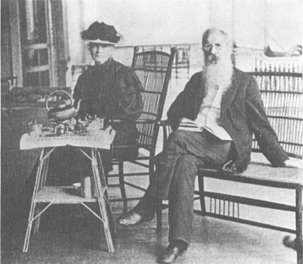
MABEL HUBBARD BELL AND HUSBAND
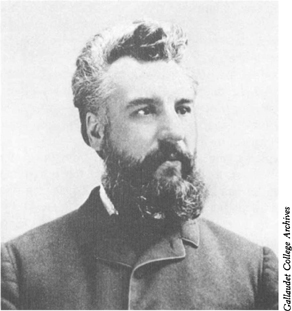
ALEXANDER GRAHAM BELL
After his early, glorious success in applied science, Bell devoted the rest of his life to projects of this kind, including stockbreeding. He looked into hereditary deafness in blue-eyed white cats, and with the purchase of a remote estate in Nova Scotia, he acquired a flock of sheep, which he endeavored for many years, and at great expense, to breed so that they would typically have six nipples and give birth to twins. The project failed but brought Bell into the American Breeders’ Association as the eugenics movement entered its heyday; it thrived on a murky brew of Darwinism, racism, elitism, Mendelian genetics, and social reform.71 When the Breeders’ Association created a section on eugenics “to emphasize the value of superior blood and the menace to society of inferior blood,” Bell agreed to serve.72 His influence was great enough to have the name changed to the American Genetics Association and to propel his son-in-law into its presidency, and he contributed articles to the American Breeders’ Magazine (renamed the Journal of Heredity). Skimming until I found Bell’s “Saving the Six-nippled Breed,” I passed such useful information as “There can be no question that the Nordic race is and has been a superior one,” accompanied, to my relief, by the claim that antipathy to such racist pretensions is itself of evolutionary origin and survival value.73 Bell and other eugenicists subscribed to Social Darwinism—because the fittest survive, those who have survived are fit, and those who have survived well (the rich) are particularly fit. This was not only naturally necessary but morally appropriate.
One result of the eugenics movement was sterilization laws. Another was racial restrictions on immigration, for if undesirables continued to pour into the population, the effect of selectively breeding superior people would be diluted. Before 1880—the year that Bell won the Volta Prize for inventing the telephone—some ten million Europeans had arrived from northern and western Europe. Then, as immigrants increasingly came from southern and eastern Europe, there was a call to reduce the tide. Bell’s voice was clarion: “The only hope for a truly American race lies in the restriction of immigration.”74
Bell took an active interest in census policy. He was responsible, in the 1900 census, for the collection and analysis of data on the blind and the deaf,75 and he urged a new kind of census, “of equal if not of greater importance to the nation.” Every American male between twenty and forty should submit every ten years to a fitness exam by the War Department. Certificates of fitness would be given to those with good health, physical strength and vigor, and freedom from defects disqualifying a man for military service. Certificates of unfitness would be given to the rest, including, presumably, the deaf. Certificates of fitness would have several uses: “Fathers and mothers of marriageable daughters, to say nothing of the daughters themselves, would be anxious to know whether a proposed suitor has or has not received a certificate … and, if the persons are disqualified, might demand to know the reason.” The government would favor those certified fit in appointments and positions generally, and “salaries derived from appropriations of public money should be as much as possible expended upon healthy persons who are contributing to the production of the healthy and strong in the community.” Since many educated deaf were employed in the civil service and in state-supported residential schools, such a plan would be particularly hard on the deaf.76 In the same spirit as Bell’s proposal, some eugenicists urged that those certified unfit be prevented from reproducing. For example, the Mississippi secretary of state urged the legislature to “enact laws compelling all male defectives and male deficients … to undergo vasectomy. The law should also include normal males who marry either deficients or defectives.”77
Bell published a warning in 1920 that Americans were committing race suicide, for “children of foreign-born parents are increasing at a much greater rate than the children of native-born parents—and the position is sufficiently grave for serious consideration.” As selective immigration laws had been only partially successful, he argued, restriction on marriage or childbearing might be necessary: “It is now felt that the interests of the race demand that the best should marry and have large families and that any restrictions on reproduction should apply to the worst rather than the best.”
Bell was opposed, however, to laws forbidding marriage of the deaf and other undesirables (as he called them). “This would not produce the desired improvement,” he wrote, “for even were we to go to the extreme length of killing off the undesirables altogether, so that they could not propagate their kind … it would diminish the production of the undesirables without increasing the production of the desirables.”78
Bell specifically engaged the issue of eugenics and the deaf beginning in the 1880s. Sign language and the residential schools were creating a deaf community, he warned, in which the deaf intermarried and reproduced, a situation fraught with danger to the rest of the society.79 He sounded the alarm in a Memoir Upon the Formation of a Deaf Variety of the Human Race, presented to the National Academy of Sciences among other national organizations, and later printed for even wider dissemination. Reviewing enrollment records for two thousand pupils admitted to the American Asylum up to 1877, Bell found that two-thirds of them had at least one schoolmate with the same surname. He also examined six school reports listing deaf relatives and found that about thirty percent of pupils had them. If this were true for the whole country, he estimated that ten thousand deaf-mutes belonged to families containing more than one. Since there are, then, familial patterns of deafness, “It is to be feared that the intermarriage of such persons would be attended by calamitous results to their offspring.” The congenitally deaf without deaf relatives also run a risk in marrying, as do the adventitiously deaf with deaf relatives, so all in all, Bell estimated, there were twenty thousand deaf “at risk.”
Now, in fact, he argued, the records show that the deaf do intermarry: the American school reported that half its pupils’ marriages were with another deaf person, while the average at five institutions was eighty percent. Only the Clarke school had a policy of “preventing such marriages as far as possible.” When two congenitally deaf persons marry, Bell reasoned, and some of their children marry congenitally deaf, and then some of theirs do, and so on, the proportion of deaf children born of such marriages will increase from generation to generation until nearly all their children will be born deaf. These families “would then constitute a variety of the human race in which deafness would be the rule rather than the exception.”
In his recommendations, Bell considered repressive and preventive measures. Under the first heading, a law prohibiting the deaf from marriage might only promote deaf children born out of wedlock. A law prohibiting just the congenitally deaf from marrying “would go a long way towards checking the evil,” but it is difficult to prove whether a person was born deaf or not. “Legislation forbidding the intermarriage of persons belonging to families containing more than one deaf-mute would be more practical. This would cover the intermarriage of hearing parents belonging to such families,” but more data are needed before we can justify the passage of such an act, he said.
Thus, for the present, Bell found that preventive measures must suffice. “We commence our efforts on behalf of the deaf-mute by changing his social environment.” Residential schools should be closed and the deaf educated in small day schools. Coeducation with hearing children would be the ideal “but this is not practicable to any great extent.” Sign language should be banished and deaf teachers shunned.80
The memoir received wide newspaper coverage. A story appeared in the Washington Evening Star that was telegraphed to all parts of the United States, stating that Bell had submitted a plan to Congress asking for laws restricting the marriage of deaf-mutes. A Bell apologist, biographer, and employee, Fred DeLand, gives this explanation: Bell’s address was published by Congress among the memoirs of the Academy. An AP reporter saw it on a congressman’s desk, thought it was a memorial (a petition), not a memoir, dealing with compulsory marriage laws, and wrote the story.81
Whatever Bell’s intention, his actions led many to believe that there would be, or already were, laws prohibiting deaf marriage. Sir Francis Galton stated that Bell’s memoir showed how easily a marked variety of mankind might be established permanently by a system of selection extending throughout two or three generations, and he concluded that legislative agencies “were sure to become aroused against unions that are likely to have hereditary effects harmful to the nation.”82 Proposals to segregate the congenitally deaf were made, as were counterproposals to allow them freedom as long as they did not reproduce.83 A noted deaf author believed Bell had “brought before Congress a motion to prohibit marriages among the deaf. But his arguments were considered unsound.”84 At the World’s Congress of the Deaf in 1893, a French delegate stated that in his country the deaf favored intermarriage, and he criticized the “erroneous theories of Professor Bell who would have a law passed preventing marriage between deaf-mutes.”85 A deaf Rochester couple felt constrained to announce in the local paper after the birth of their hearing child that neither parent was born mute and wished this stated “as the laws of the state forbid persons born mutes to be joined in marriage.”86 According to the rector of the All-Angels Mission to the Deaf in Baltimore at the time of Bell’s memoir, news of it spread like wildfire among parents of the deaf, “their family physicians, and among surgeons generally throughout the world, and suggested to them a senseless and cruel procedure—the sterilization of children born deaf.”87 He came to know many deaf couples who were childless and unhappy as a result of having been sterilized in infancy; he laid the blame on Bell.
In 1907, at the eighth convention of the National Association of the Deaf, the president announced that Bell’s committee on eugenics of the American Stockbreeders’ Association was drafting a bill to restrict matrimony among: (1) persons mentally, morally, or physically defective; (2) criminals; (3) immature children; (4) people of plainly incompatible dispositions; (5) consumptives; (6) persons suffering from functional disorders; (7) the deaf and dumb. The bill was to be presented to the legislatures of all the states and the committee would disseminate scientific literature on the subject to pave the way for its passage.88 The convention elected a committee to meet with Bell “in indignant protest against thus grouping the deaf with the outcast and unclean” and interfering with their happiness, but Bell protested he knew nothing about it and had always deprecated legislative interference with marriages of the deaf.89
A 1912 report from the eugenics section of the Breeders’ Association, however, cites Bell’s census of blind and deaf persons and lists a similar set of “socially unfit” classes, including the deaf, whose supply should, if possible, “be eliminated from the human stock.”90 The section drafted a model sterilization law to be applied to these classes; it was designed to satisfy the courts while purging the United States of its “burden of undesirable germ-plasm.” By the time of World War I, sixteen states had such sterilization laws in force.91
Of the many rebuttals to Bell’s Memoir by the deaf, I will mention three. William Chamberlain, who had taught Bell sign language, objected that “the persistence with which the memoir returns to legislative interference suggests the hearty support its author would give to such measures if they were passable.” True, Bell equivocates on the subject, Chamberlin wrote, but the proposal should have been rejected right from the start; Bell’s failure to do so created uncertainty among the deaf about their rights. The memoir recommends ending the employment of deaf teachers. Naturally the deaf resent an attempt to interfere with their employment. The memoir belittles the combined system of education, incorporating both sign and speech, and insists on “pure” oralism, but “the combined system takes all and educates them by means of such methods as are adapted to their individual cases. The oral system picks and chooses, rejecting a large percent of applicants as incapable or weak-minded who are simply average deaf people and who, sent to combined schools, turn out very well.”92
Dudley George, a Gallaudet graduate and deaf teacher, affirmed at the World’s Congress of the Deaf that deaf parents generally have hearing children: in the schools for the deaf it is a matter of remark if a pupil has a deaf parent but not if four have a hearing one. He pointed out that when the deaf marry the hearing, they may still have a deaf child. And if they have one, “they know how to raise it, where to find the schools that will train the head, hand and heart, elevating it to a condition equal to many hearing people and superior to uneducated hearing people.”93 Deaf marriages in which both partners are deaf are the happiest. Hearing persons willing to marry someone deaf are commonly inferior to their spouse morally, socially, or intellectually, or seek the alliance for reasons other than love.
F. L. Seliney, president of the Empire State Association of Deaf-Mutes, reported that over 2,000 admissions to schools for the deaf in New York State yielded only 18 students whose parents were deaf, less than one percent. Examining comparable data for all admissions to thirty-five institutions over more than half a century, he found 215 children with deaf parents, out of nearly 17,000 enrollments, an incidence of slightly more than one percent. Moreover, 83 of these had only one deaf parent, so the incidence attributable to deaf intermarriage is three-quarters of one percent. “The deaf do not understand why, since their marriages are the least among the circumstances producing deafness, they should be singled out as transgressors in chief and the demolition of their schools, association, and newspapers advocated.”94
Seliney was right: the tables of data in Bell’s memoir show that only one percent of the pupils in his sample had two deaf parents. Thus a total elimination of deaf intermarriages would have reduced the student population of the American School over more than fifty years by 25—that is, from 2, 106 to 2, 081. It is highly unlikely that Bell, a devotee of statistical analysis, was unaware of the trifling size of the issue over which so much controversy raged, so we may infer that he raised it for another reason. Bell’s census data show, for example, that the disease which impaired his mother’s hearing and his wife’s, scarlet fever, was responsible for nearly ten times as many deaf pupils as all congenital causes.95 Why not wage war on scarlet fever? Because the goal of this campaign was none other than the one he had pursued for many decades before the memoir: he aimed to break up the deaf community by banishing sign, residential schools, the silent press, deaf organizations, and other activities that led to their congregation. Bell invoked the specter of a deaf variety of human being mainly to add urgency to banishing sign and residential schools, and that is one reason why he preferred these so-called preventive measures to the direct repressive measure of interdicting deaf marriage.
This explanation of Bell’s program simply drives our search for motives beneath the surface. Why should Bell have wished to eradicate sign, deaf schools, deaf teachers? He would have been baffled by the question. His family’s lives were predicated on the deaf “passing” among the hearing, on assimilation, on denial. If there was indeed a large fellowship of the deaf with a common language, mutual aid and support, a common culture, organizations, newspapers, and so on, then a terrible crime had been committed when his mother and, to a lesser degree, his wife, were condemned to a life of solitude; then his family’s focus on speech for three generations seemed more like an obsession.
What we have learned about heredity and the deaf in the hundred years since Bell’s memoir supports the position of the deaf on this issue. One contemporary geneticist calls it a “serious misconception” that marriage between the deaf should be discouraged.96 First of all, the vast majority of deaf children have hearing parents, for most deafness comes from adventitious causes such as contagious disease, and even most genetic deafness occurs in children of hearing parents. The reason for this is that a child who is deaf because he carries two recessive genes for deafness received one from each of his parents, which means they are hearing carriers of the gene. It follows that it would take thousands of years before preventing childbirth in the deaf would reduce the frequency of these recessive genes in the population, because most carriers are hearing, not deaf. Even if we could weed out these genes we might not want to: many genes have multiple effects, some of them salutary.97
There are in fact thirty to forty recessive genes that will cause deafness in a child who receives two of the same kind. Thus two parents, each of whom is congenitally deaf, will in all likelihood have a hearing child because they are probably carrying different pairs of recessive genes. There are, however, certain genes associated with deafness that are called dominant because possessing just one will make a person deaf; there are no carriers of the gene who are not deaf. But in this case it generally doesn’t matter whether the deaf parent with the dominant gene marries a hearing or a deaf person, for each of his children will have a fifty-fifty chance of inheriting the dominant gene in any event.
There are, however, issues logically prior to the practical effect of interfering with deaf marriage. Bell presupposed, first, that deafness is a defect to be avoided rather than a characteristic of a variety of humankind; and he presupposed, second, that society’s interest in avoiding that defect outweighed deaf people’s interest in compatible marriage choice and childbearing. For someone who believed the Italians were adulterating the American racial stock, it was inconceivable that the deaf were not. This was so clear that Bell assumed that the outrage of the deaf and their friends must reflect some misunderstanding, and he welcomed an invitation to address the deaf directly at Gallaudet College. “It is the duty of every good man and every good woman,” Bell told them, “to remember that children follow marriage, and I am sure there is no one among the deaf who desires to have his affliction handed down to his children…. I therefore hold before you as the ideal marriage, a marriage with a hearing person.”98 This amounted to urging the students to forgo marriage altogether, for nearly all the hearing people they knew who understood them and their kind had deaf relatives, and Bell enjoined them from those marriages as well, since they were as likely to transmit deafness as the students’ preferred pairing with another deaf person.
Ironically, among those present for Bell’s address was George Sanders, one of Bell’s first students and the one who stayed with him the longest. Sanders did not view his deafness as an affliction nor did he think he would have to remain childless if he were to marry Lucy Swett, the young deaf woman who had captured his heart, one of Thomas Brown’s relatives from Henniker, New Hampshire. “George will marry a deaf girl anyway,” Lucy said. “Why not me?”99
Because of his keen commitment to assimilation of the deaf, Bell began a highly successful campaign in the year of his marriage, 1877, to develop small day schools for the deaf on the model of the Boston School for Deaf-Mutes, renamed the Horace Mann School in that year. Various plans for educating the deaf among the hearing had been tried before; Arrowsmith had described the failure of his deaf brother’s education in the common schools in the preface to his translation of Epée,100 and Blanchet’s and Graser’s enterprises of this kind had failed, but none of these experiments had the features Bell desired. He wanted to minimize contact among the deaf. Thus, ideally, each school should consist of just a few pupils—it should really be a class. And to maximize contact with the hearing, the class should meet in a hearing school; although total integration could not work, there should be common play and common instruction in a few select subjects, such as drawing.
Bell soon became involved with a plan to create day classes on a large scale in Wisconsin. The tide of immigration had brought there many Germans acquainted with the oralist movement of deaf education in Germany. A few encouraged a teacher of articulation for deaf-mutes to open a small private school, which grew from four pupils to seventeen the first year. It was both a boarding and a day school and was conducted initially in German. Several philanthropic German immigrants formed an association to sponsor indigent deaf children at the school, and they ultimately created a permanent organization called the Wisconsin Phonological Institute with over one hundred members. Next, the W.P.I, hired a public-school teacher and opened the Milwaukee Day School for Improved Education of Deaf-Mutes, which, according to the prospectus, would teach children “by the pure oral or German articulation method.” The W.P.I. had a Department of Propaganda that published various pro-oral pamphlets, including Bell’s Memoir on the Formation of a Deaf Variety of the Human Race, which helped to arouse public sentiment against the state residential school at Delavan. That pamphlet urged the adoption of the oral method in all schools for the deaf and the creation of day schools throughout the state. It included a draft law to that effect.
The W.P.I. then arranged an exhibition of the pupils from the first day school: in attendance were the governor, a committee of the legislature, the Milwaukee School Board and the Chamber of Commerce. Shortly thereafter, much as Governor Bullock had done in Massachusetts, Governor Smith called the attention of the legislature to the W.P.I. proposal, and the Milwaukee School Board prepared a bill giving itself the authority to establish day schools with state aid on the model of the Boston Day School for Deaf-Mutes. The bill, however, failed to pass the legislature in 1881 and again, despite intense lobbying, the following year.101 In response, the W.P.I. called a meeting in the senate chambers to support integrating deaf-mute instruction in the public schools; it was held under the august auspices of the National Education Association, and three oralists spoke: the principal of the Nebraska school, Bell, and J. C. Gordon, soon to head the articulation department at Gallaudet. Also present were a number of experienced educators of the deaf who stopped off on return from a conference in Minnesota, most notable among them Bell’s arch opponent, Edward Miner Gallaudet.
Bell urged the day-school plan because it would allow deaf children to mingle with their hearing peers, to live at home, and to escape the evils of sign language and hence to avoid intermarriage. In order to train teachers, a course in articulation would be added to the curriculum at the state normal school. All teachers could benefit by this, Bell said. Articulation should be taught in all schools, hearing and deaf; there was an urgent need to preserve the purity of the English tongue, which was degenerating as a result of the foreign influx.
Gallaudet took the rostrum to denounce widespread erroneous beliefs concerning the deaf: namely, all deaf children can learn speech; oral schools receive all pupils; the best oral results cannot be obtained where the sign language is employed; signs can be banished from schools for the deaf; orally educated deaf are more fully restored to society than manually educated deaf; sign language is an imperfect and crude means of conveying thought; and orally educated deaf will not associate with each other after graduation. The principal of the American School rose to stress this last observation: there is no point to forced dispersion of the deaf in small day schools, for as soon as they graduate, in Germany as in America, they congregate and intermarry. Bell moved that a section of the N.E.A. be created to deal with the education of the deaf, and the meeting was adjourned.102
A new governor proposed the day-school bill once again; Bell came from Washington and spent two weeks explaining and defending its provisions to the legislature. Before he left, he presented each lawmaker with a copy of an open letter strongly urging its passage. In an appeal to their hearts, he emphasized the numbers of deaf children not then in school; in an appeal to their pride, he said Wisconsin would be the first state in the nation to have a day-school plan. He cited the rights of motherhood: the deaf child should eat and sleep in his own home, under his mother’s care. He warned of the dangers of deaf congregation at Delavan. He pointed to the success of oralism in the fatherland: “All the deaf-mutes of Germany are taught to speak” (shades of Horace Mann!). The legislature wavered but passed the law.103
Bell was called back to Madison some years later when the W.P.I. tried to amend the law to require the state to allow the formation of day classes (it had stopped authorizing them), to double the budgets of those classes, and to limit their size by law to four or five pupils. The amendment also provided that “for the purpose of obviating the tendency to the formation of a deaf variety of the human species, congenital deaf-mutes of the opposite sexes shall be kept apart as much as possible, and that marriage between them be discouraged on account of its liability, under the law of heredity, to result in deaf-mute offspring.”104 Bell went on strenuous speaking tours around the state in support of the amendment. By the turn of the century, Wisconsin had fifteen day schools for the deaf and Bell had proclaimed the Wisconsin system to be “the most important movement of the century for the benefit of the deaf.”105
The next major day-school movement began in Chicago, where Bell offered advice, lobbied, drafted legislation, and made personal appearances. With his help, the local parents’ association succeeded not only in winning state aid for day schools and in installing their man as superintendent, but also in ousting the principal of the state residential school, who was insufficiently oralist for their taste. Ironically, that was Philip Gillett, the first principal to take a strong oralist stand (at Gallaudet’s Conference of Principals in 1867) and a consistent supporter of the movement. He was replaced by J. C. Gordon, who came from Gallaudet College and banished all classroom signing at the Illinois school. Gordon was also the first head of the N.E.A. section on Deaf, Blind and Feebleminded, created at Bell’s instigation.106 To honor Bell for his contribution to these developments, Chicago named an oral day school after him. The deaf community, however, opposed the bill, and when it passed, they opposed the school board’s decision to make the day schools “pure oral.”107
Over several decades, Bell aided many more such day-school programs: in Michigan, Maine, Connecticut, California…. He wrote letters, gave advice, made trips, hired educators to tour the states and lobby legislators and school principals.108 The Michigan day-school law, which required Bell’s energetic support for passage, went further than its predecessor in Wisconsin and specified: “The oral system shall be used exclusively but if, after nine months’ trial, any child shall be unable to learn by the oral method, no further expense shall be incurred in the attempt to educate it.”109Day classes continued to open around the nation. Bell believed that deaf children could now be transformed into hearing ones while quite young and, by the turn of the century, “special teaching would be a matter only of the first few years of life.”110 By 1913, there were seventy day schools—more than the number of residential schools—but their pupils constituted only thirteen percent of the deaf student population.111
The arguments of deaf leaders and educators against these day-school programs went largely unheeded. They protested the inadequate qualifications of the teachers, who were recruited without any specific training for or experience in educating the deaf. They decried the exclusion of sign from the classroom, which deprived most pupils of education in their primary language. Since no one at home and only a few pupils at school could use manual language, the children would be communicatively isolated. Unlike their counterparts at the state residential school, they could not learn from the older students. Tardiness and absenteeism would be higher in the day class. No trade could be taught there. Pupils with diverse abilities must be taught together because of the small enrollments. Eventually the pupils would go to the state residential school in any case to receive high school education, and there they would congregate, use sign, make deaf friends—all of which the day-school movement aimed to prevent. Because the deaf children could not make themselves intelligible to the hearing children and the hearing did not learn to sign, “the deaf of the day schools do not and cannot play with the hearing,” one deaf writer explained. “When they leave they are drawn to the society of their own kind and the purpose of the day-school is defeated.”112 In the light of these arguments, it is doubtful whether the recent wave of de-institutionalization in the United States, which has swept the deaf out of their residential schools and the insane and retarded out of their asylums, will prove to have been of service to the deaf. Any activity that classes the deaf as defective members of the English-speaking community and misses the essential social and linguistic character of the deaf minority is liable to harm the very people it aims to help.
Bell placed assimilation into the hearing world above the mental development and professional training of the deaf. “If we have the mental condition of the child alone in view,” Bell wrote, “without reference to language, no language will reach the mind like the language of signs.”113 But that could not be the main view because “the main object of the education of the deaf is to fit them to live in the world of hearing-speaking people.”114 When the conference of principals meeting in Minnesota placed on its agenda the question “What is the importance of speech to the deaf?” Bell was flabbergasted: “I am astonished. I am pained…. What is the object of the education of the deaf and dumb if it is not to set them in communication with the world?”115
GALLAUDET: That is one object but a small part of it.
BELL: That is one object and the greatest of all objects.
Gallaudet and Bell would lock horns on this issue in testifying before the the British Royal Commission, in promoting professional organizations, and in addressing congressional committees on appropriations.
The Royal Commission was created by the Crown in 1884 about the time that Bell and Gallaudet debated in Madison; initially it was charged with investigating the education of the blind and feebleminded, but an influential barrister, member of Parliament, and father of a deaf girl, St. John Ackers, managed to have himself appointed to the commission and to have its scope enlarged. Something of a British Gardiner Greene Hubbard, Ackers had set out from England a decade earlier to discover for himself the best method of educating his daughter. He visited the Clarke school, the New York Institution for the Improved Instruction of Deaf and Dumb (now the Lexington School), the American School, Bell’s private school in Boston, and the Horace Mann School, and yet other schools in Washington and Philadelphia. Then he visited schools in Germany and France in company with a hired interpreter, and finally he visited many schools in Great Britain. In the end, he decided he would like his daughter to speak, although she had been deafened by fever at only a few months of age, and he hired a teacher from the Horace Mann School. Ackers became, in Gallaudet’s terms, a rabid oralist (Edward had sat next to him at the congress of teachers of the deaf that met in Milan in 1880).116 “I would entreat all interested in the success of the German system,” Ackers wrote in the Clarke school report, “to unite together resolutely to refuse admission into their schools of any who can converse by signs.”117 Some years before joining the commission Ackers also published a pamphlet entitled Deaf Not Dumb. The chairman of the commission was hardly more impartial; a few months after it began its investigation, he opened a new wing of the Manchester school for the deaf with the claim that “if only the education of children were begun at an early age, in 99 cases out of 100 the deaf and dumb could be taught to speak by the oral system.”118 No one on the commission was an expert on teaching the deaf. In short, the coupling of deaf issues with those of the blind and feebleminded, ensuring a medical model, and the makeup of the commission left little doubt it would favor Bell’s philosophy over Gallaudet’s and Clerc’s.119
Gallaudet and Bell were the key witnesses before the commission, the former invited as leader of the profession of teaching the deaf in the United States, the latter as the leading advocate of oralism, and probably the second most famous Briton alive. Although bitterly opposed in educational philosophy, the two had many traits in common. Each had a deaf mother and a highly successful father in whose work he followed. At twenty-seven, Gallaudet had been made president of the first college for the deaf in history; Bell had invented the telephone at twenty-nine. Gallaudet was ten years older than Bell and slimmer, but equally forceful and eloquent. Both were used to getting their own way. Relations between the two men were largely cordial until this time; over the next five years they deteriorated, and the last decade of the century was marked by their open warfare, in part over the issue of deaf teachers. Gallaudet’s views placed him on a middle ground between Clerc and Bell. He had, after all, launched the movement that brought articulation training into the residential schools. He had coined the term “combined system” and aggressively espoused its cause—oral instruction for those who could profit, sign for the rest. But he was vigorously opposed to banishing sign. It was not that he wished to safeguard the signing community; like Bell, he opposed intermarriage of the deaf and even their organizations. It was rather that he believed education of the deaf in spoken language was impossible. “The great body of intelligent instructors,” he wrote, “… are agreed that no error could be greater than to expect all deaf children to succeed in learning to speak. The supporters of pure oralism from the days of Heinicke to the present time have hugged this delusion to their hearts and, as a consequence, the education of hundreds and thousands of deaf children in Germany, France and Italy, who have been cruelly stretched on the Procrustean bed of a single method, has been more or less of a failure.”120
Gallaudet went off to England not to gather knowledge, as his father did, but to impart it, not on behalf of the deaf in America but on behalf of those in Great Britain, not at the request of his countrymen, but at that of the British government. The headmasters of the three dozen schools for the deaf in England gave a magnificent dinner for him, “to atone,” in the words of the toastmaster, “for their lack of hospitality to his father.”121 Gallaudet addressed the commission twice and answered their questions for ten hours. Bell appeared separately on four occasions, urging that all instruction of the deaf must be in speech, as in the German schools. He argued for dispersing the deaf (“decentralization”), for government certification of teachers, inspection of schools, and payment based on results, aid for apprenticing deaf students, and noninterference in teacher training.122All the issues on which Bell and the deaf were opposed were discussed: oralism, heredity, deaf association, day schools.
The report of the commission was called a victory by both sides. It begins by citing testimony in the four-volume transcript, including a statement that signs tend to isolate the deaf, with the result that they “are not at all competent witnesses as to which is the best system; those that have lived in cages all their lives are so much attached to the cage that they have no desire to fly outside. The children themselves may prefer the sign system as more natural to them and the parents of poor children are sometimes indifferent and careless.”123 This presumably explains the absence of deaf members on the commission. It came out in favor of a plan much like that adopted by Gallaudet’s Conference of Principals in 1867: “All children should be, for the first year at least, instructed in the oral system”; those who cannot profit should then be taught manually. The first school for the deaf to open in England after the report adopted the combined system, although, according to Gallaudet, the directors were offered a private gift if it were made “pure oral.”124
The developments that culminated in open warfare between Gallaudet and Bell and the division of the profession into two hostile camps began in this way. Shortly before the Royal Commission began hearings, the director of the Wisconsin Phonological Institute suggested to Bell a national organization for advocacy of oralism modeled after his own. Gallaudet proposed instead that the Convention of American Instructors of the Deaf create an oral section,125 and so it came to pass. This did not satisfy Bell, however, since the balance of power in the organization was held by deaf teachers (who naturally opposed pure oralism and favored the combined system), so he urged a separate association of speech teachers, offering $25,000 to launch it. Sixty-two teachers, acting at his instigation, announced to the convention the formation of the American Association to Promote the Teaching of Speech to the Deaf. Bell was shortly elected president, and Hubbard vice-president.126 This was, effectively, a revolt against Gallaudet’s leadership and he hated to see the convention split into two camps. In retrospect, the split was inevitable from the opening of the convention, when Gallaudet, suave, courteous, dapper, took the podium and, looking down at his fierce, rumpled, and handsome opponent, said, “Deafness, once a calamity, has become through education little more than a serious inconvenience,” and stopping to brush his bald pate, he added, “something like baldness in fly time.”127
The speech association launched a series of annual summer meetings and began a long and active career expanding its membership (only a third were teachers), publishing, lobbying, and generally promoting pure oralism. With the $10,000 Bell had received with the Volta Prize for inventing the telephone he founded the Volta Laboratory. That laboratory improved on Edison’s phonograph, among other inventions, and became rich. Thanks to the telephone, however, Bell was already a millionaire (in an era when there were few), so he sold his rights to the gramophone for $200,000, which he placed in trust for a bureau for the dissemination of the oralist literature that had grown out of his research on heredity. Three years after founding the A.A.P.T.S.D., Bell had a neoclassical building constructed in Washington, D.C., for this Volta Bureau, which eventually merged with the Association itself. The Association Review was renamed the Volta Review.128
The conflict between the two leaders and their organizations came to a head at a meeting of the convention in Flint, Michigan, in 1895. Gallaudet had been working to merge the two groups and had received what he thought was encouragement from Bell, especially when Bell announced the next head of the speech association would be the moderate Philip Gillett, who had been bumped by the Chicago parents’ group.129 But then Gillett urged postponement of the merger, which Gallaudet termed a “bootlicking surrender of his independence to Bell.”
Convinced that reconciliation could never be achieved, Gallaudet went to the podium at Flint and delivered an address excoriating Bell. He charged that Bell and his collaborators “had worked with partisan spirit and purpose calculated to engender serious if not permanent antagonism in the profession.” He charged Bell with trying to seize the space allocated to the convention at the Columbian Exposition and use it for the speech association. He charged Bell with working in the Conference of Principals to overthrow the combined system. He said that his own efforts to merge all teachers into one broad strong organization had failed because of “one man, outside the profession, to whom the promotion of speech teaching was of more interest than all things else concerning the deaf.”130
Gallaudet concluded that the narrow platform of the speech association, its meager achievements, and Bell’s express preference that it should be sustained by promoters rather than teachers justified “those who are merely teachers and not capitalists” in scorning the A.A.P.T.S.D.
According to one witness, it was the interpreter’s starting at one end of a long platform and walking slowly to the other, while laboriously fingerspelling the full name of the speech association, that brought on the open clash between the two men. As the interpreter reached the end of the platform, everyone was smiling, there were some audible titters, and Bell was enraged—he was not used to being a laughingstock. The instant Gallaudet finished his paper, Bell was on his feet demanding to be heard. His temper had gotten the better of him and he raved. After a moment or two, the head of the Ontario school went up to the platform, lifted his hands, interrupting Bell, and signed, “Let us have peace.” Then, turning to the crowded hall, he asked those present to join him in a request to Dr. Bell and Gallaudet to shake hands and forget their differences. For a long tense moment neither man moved; but at last they simultaneously stepped forward and the tips of their fingers met in a frigid handshake. That was the last time Bell ever attended a meeting of the convention and never again did the two men meet in amity.131
One of Gallaudet’s most serious grievances was Bell’s vocal opposition before the United States Congress to the establishment of a teacher-training department at Gallaudet College. Since the college’s opening in mid-century, more than half its graduates had gone into the teaching profession. In addition, the New York, Pennsylvania, and Ohio schools, among others, also produced deaf teachers. It was deaf teachers who had founded the Florida school, the New Mexico school, the Kansas school, and numerous others—two dozen in all.132 Many more taught in these schools and some had developed widely used teaching materials. Some had published learned articles and appeared on the international deaf stage, shaping the future of their profession worldwide.133
As the number of institutions for the deaf and the demand for deaf teachers grew, so too did the desire to found programs to train teachers. At mid-century there were only twelve schools for the deaf in the United States with 1, 500 pupils, all taught manually, and 100 teachers, of whom nearly half were deaf. By the turn of the century, the American population had nearly doubled and there was a fivefold increase in deaf pupils and schools and a sixfold increase in instructors.134 The Hartford, New York, Ohio, and Iowa schools among others served informally to train deaf teachers just as the Paris institution had trained Clerc. But in 1890, shortly after Bell had formed his speech association and in part as a response to it, Edward Miner Gallaudet placed an item of $5,000 in his annual budget request to Congress for the purpose of creating a formal teacher-training department in his school.
Gallaudet envisioned training sophisticated teachers who would be preferred as superintendents of the large residential schools and would therefore be in a position to dominate educational policy.135 He informed Bell of his budget request and invited him to give an address to the department once founded; he understood Bell to have agreed. A few weeks later Gallaudet wrote in his diary: “I learned last night … that Graham Bell has asked for a hearing before the Appropriations Committee to [disapprove of] our normal school scheme. Shame!”136 Gallaudet rushed to see Bell and discovered that he was exercised at the prospect of the college training deaf teachers—they could only impede the oralist movement. Gallaudet promised that he would admit only hearing students to the normal department, but Bell thought he might not keep his word, or the policy would be rescinded by his successors. Moreover, if Gallaudet succeeded in joining a national normal school to the deaf college, he would have created a citadel of the combined system right in the nation’s capital. So Bell appeared before the House Appropriations Committee for thirty minutes to protest. He gave many reasons for his opposition. This is a proposal to train deaf teachers of the deaf, he said, but a teacher should be in possession of all his faculties. Moreover, the field for deaf teachers was diminishing. When he had come to America, nearly half of all teachers of the deaf were deaf themselves, whereas now, twenty years later, the fraction was one-quarter. This was because of increasing attention to articulation; deaf teachers cannot teach articulation, and sign comes into use. Finally, Gallaudet College could not admit both points of view in the training program, oral and manual, since oral advocates claimed that the teacher’s mere knowledge of sign was detrimental because it tempted him to use sign instead of English.137
Despite Bell’s testimony, the House committee approved Gallaudet’s request and sent it to its counterpart in the Senate. “Bell was not satisfied with the muddle he had already made by meddling in affairs that did not concern him,” Gallaudet fumed, “and he wrote letters to all the schools and institutions in the country that were so worded as to misguide those not informed and also contained several untruths that were untruths to his knowledge [concerning admissions of deaf students].”138 The two men appeared before the Senate committee; each had two minutes. Bell presented a list of twenty-one schools opposed to the appropriation—oral schools, most of them day schools. He urged the committee to amend the measure to give Gallaudet $3,000 to open an articulation department. The legislators struck the appropriation entirely, but friends of the college on the conference committee put through the Bell amendment. Gallaudet took the money to hire an articulation teacher, then created the normal department anyway, securing six fellowships from his board. In the fall, seven hearing students entered for the one-year postgraduate course—including manual and oral methods of teaching the deaf. The college itself continued as before to prepare those deaf students who planned to pursue a career in teaching.139
Bell was dismayed, and his first response was to campaign for the creation of a counterpart oral department of teacher training: “The public agitation for an Oral Department at the National College should be continued. There is no harm in letting President Gallaudet have this idea that a fight is imminent in Congress, as the dread of a conflict that may injure the College and lead to a still further curtailment of his appropriations may operate as an element in inducing him to do better justice to oral work. Our program I think should be, first, public agitation concerning the relation of the National College to the oral schools of the country—public agitation now; second, private discussion to elaborate a practicable scheme to establish a separate school for the higher education of the deaf by the oral method.”140 On calmer reflection, Bell had the speech association back a normal department at the Clarke school, which had previously trained teachers primarily for its own needs.141
Gallaudet won the day, but Bell was right about the rise of oralism and the commensurate drop in opportunities for deaf teachers. The fraction of pupils taught with English as the vehicle rose from near zero in 1870 to half at the turn of the century to nearly all by World War I and ever since.142The fraction of deaf teachers fell from nearly half at mid-century, to one-quarter when Bell testified, to one-fifth by World War I, to an eighth in the 1960s.143 And most of these were in the South, teaching manual trades in just a few schools. Things had indeed changed since the days of Laurent Clerc. At the Convention of American Instructors of the Deaf in 1890 there was this characteristic exchange:
DR. BURT: A teacher in a pure oral school who understands the sign language is out of place…. He might demoralize the school in a very short time. Only insofar as he would suppress his inclination to use sign could he be useful….
CHAIR: I would like to hear from a deaf educator.
J. S. LONG: The Chinese women bind their babies’ feet to make them small; the Flathead Indians bind their babies’ heads to make them flat. And the people who prevent the sign language being used in the education of the deaf … are denying the deaf their free mental growth through natural expression of their ideas, and are in the same class of criminals.144
Modern studies in multilingual countries such as Canada show that excluding minority teachers and their language from the schools and thus attempting to force the assimilation of minority children carries heavy penalties. Educators become disciplinarians as they pursue the aggressive steps required to stop the child from using his or her primary language—grades are lowered, physical punishment is inflicted, friends are separated—and the school becomes a place of incarceration. An Alsatian student: “When I was in primary school it was forbidden to speak Alsatian both in and out of class. Children were punished if they were caught.” An Arab student: “In my boarding school the nuns forced us to speak French to one another, even when we were playing. We had a special dog collar that every violator of the rule had to wear.” A deaf student: “I resented having my lessons hurled at me. It seemed as if all the words, for which I never cared a tinker’s damn, were invented for the sole purpose of harassing and tormenting me…. How I hated my teacher, my school, the whole creation.”145 In this kind of environment the minority pupil generally makes little progress and many drop out of school before graduating. As a result, educators and legislators in many countries have turned to some form of bilingual education, which, by providing some instruction in the pupil’s primary language, implicitly reaffirms his or her linguistic and social identity. It encourages the development of two language repertories, and the evidence is that such children have a decided intellectual advantage over their monolingual peers.146
If benevolent authority is demeaning, misguided, and self-defeating, as Laurent Clerc contended so eloquently, if it is out of step with the morality of our nation, why is the education of the deaf one of the few social institutions that resist officially the fundamental principles of our society? It is easy to identify the reason. If the deaf community had major responsibility for the education of the deaf, they would overhaul it: the sign language would play a much larger role, and deaf teachers would be hired in much larger numbers, often instead of hearing teachers of lesser or equal qualifications. And what might happen then? Why, deaf students would have the freedom to choose the teaching profession and to emulate Jean Massieu. Deaf children would have role models, just as Clerc and countless others had Massieu as a model. Education might be enhanced, not only because of more ready communication between teacher and pupil, but also because deaf teachers can be expected to have a particularly sympathetic interest in the results of their teaching, to be particularly good at matching instruction to their pupils’ abilities, to be particularly ready to spend time with them.
“We do not discuss deafness vicariously,” a deaf teacher wrote recently, “but from direct experience. We are able to recreate scenes that actually occurred when we sought employment, when we pursued graduate work, when a salesman came into our homes. We teach students to develop a perspective and sense of reality about deafness. We are able to say and do things that will not have the same effect when coming from a hearing teacher. If students indulge in self-pity, for example, I say, ‘Let’s make a poster with the words I AM DEAF and I’ll give you a cup and you can go out and beg.’ If this came from a hearing person, their response might be, ‘What the hell do you know about our problems?’ I should not be here defending deaf teachers, I should be singing their praises. Beyond their duties in the classroom and the work they keep doing long after the bell has rung, they often act as parent substitutes because many deaf students are unable to satisfy their emotional needs at home, since their parents cannot communicate with them.”147
There is, however, one serious argument against the deaf teacher to which the hearing majority clings and which we need to examine; it is Bell’s argument: the deaf teacher generally cannot help the student learn oral language and will use sign with him instead.
I have just reasoned that this is not a choice for the majority community to make, that the deaf community must set its own priorities. But there is good reason to believe that, even if the deaf community embraced the oralist goal, even if the aim is above all to give the signing child a mastery of English, even then it is not appropriate to exclude deaf teachers. Here is the reason.
For the last hundred years or so, the general assumption has been that if the deaf child uses sign extensively, if deaf teachers using American Sign Language as the vehicle of instruction are employed, the child’s acquisition of spoken and written English will be impaired—if only by reducing his opportunities to use them. However, the findings of recent research concerning the structure and processing of language invite us to take a fresh look at that assumption.148 First we ask, Do the structures of manual and oral language have nothing in common, so that mastery of the one cannot facilitate mastery of the other? To the extent that language is a sensory and motor skill, manual and oral languages are quite different, but to the extent that language is a cognitive ability, they must be quite similar. Is most of understanding a sentence, be it lipread or heard, in the eye (or ear), or is most of understanding a sentence in the mind? Linguistic inquiry has shown us that manual language has principles of word formation and principles of sentence construction just as oral language does, and this has led us to a conception of language that is more abstract than speaking and listening, or signing and seeing sign.149 So we answer that language is a capacity of the mind and thus the two languages have much in common despite the difference in the way they are transmitted. It seems as though man’s biological capacity for language will out one way or the other, through the little articulators of the mouth or through the larger articulators of the hands and limbs.150
Now, recent psycholinguistic research has uncovered a parallel fact: much of the knowledge required to understand and produce a spoken or written sentence is not peculiar to the particular language in which the sentence is communicated. Alexander Graham Bell himself presaged these findings when he wrote: “Let speech teachers realize that intelligibility is almost entirely due to context.”151 He said, correctly, I believe, that there were three requisites to good lipreading. First, the child’s eye must be trained to recognize the visible movements of the vocal organs. Second, he must know which words look alike, so that a given movement suggests a group of words from which he can make his choice, guided by context. Third, he must know the structure of the English language, which will assist him in verifying his choices made from inspection and context. But the fact that escaped Bell and subsequent oralist teachers is that the great guide in identifying a spoken word from context is the sense of the sentence, the meaning that the speaker is trying to convey and the listener to grasp.
Now, to interpret a sentence, to arrive at its sense, we depend not only on our knowledge of the meanings and structural roles of the words, we also depend on our knowledge about life—knowledge that is not specific to the particular language in which the sentence is communicated, knowledge that comes from general acculturation. Would a person commit an action like the one I understood? Can it even be done in principle? Would the person being talked about be likely to do it? Interpreting a spoken sentence requires us to bring this practical knowledge to bear alongside the grammatical possibilities and the word possibilities suggested by lipreading. So we start with the plan to teach the child to distinguish movements of the vocal organs and we end by finding that he needs a knowledge of everyday affairs—of human and physical relationships—before he can choose among the possibilities evoked by lipreading, and thus make sense of the sentence.
There is nearly universal agreement that if we should choose a language to give most deaf children a ready knowledge of life around them, manual language is the easiest and most effective—that is just why it is prohibited, because the child tends to use it at every opportunity. Virtually everyone, including Bell, agrees that spoken or written English is a poor choice of language to use with most deaf if the goal is rapid, facile communication to obtain intellectual development. So if using spoken or written English depends on a sensory and motor skill that needs practice, if understanding an English sentence is mainly a matter of visual or auditory discriminations and producing a sentence mainly a matter of moving the lips or the hand, then every opportunity to practice is sought, and deaf teachers can be less helpful than hearing ones in extending that practice, at least when it comes to speech. But if using spoken or written English depends on abstract linguistic abilities and practical knowledge, then the best classroom instruction may be provided by deaf and hearing teachers who use American Sign Language as the vehicle of instruction. This will give the deaf child the intellectual abilities that bear the burden of composing and comprehending a sentence—to which must be added, of course, a knowledge of the particulars of English.
Thus, the goal of leading the deaf child to a mastery of spoken and written English—only one goal among many—may best be realized through the child’s preferred mode of manual communication. To the extent that the linguistic knowledge and the world knowledge required to communicate are more general than the particular language of communication, communicating in sign may significantly enhance communicating in English. And if that is so, then there is no reason to exclude deaf teachers even in this domain and every reason—moral, social, educational—to include them. Indeed, it is the hearing who must demonstrate their good faith and their capacity to work alongside the deaf teachers by working to acquire their language.