

SEVEN

The events that led to the founding of the education of the deaf in the New World began in 1805, a dozen years before my arrival here, when a beautiful and gifted child named Alice was born into the family of a leading New England physician, Mason Cogswell. At about the same time, the Cogswells’ neighbor, Thomas Gallaudet, who was to become my lifelong collaborator and friend, was graduated from Yale, while I, on the other side of the Atlantic, was graduated from the National Institution for Deaf-Mutes. Two years later, Alice contracted spotted fever and became deaf, and the abbé Sicard promoted me to the post of Massieu’s teaching assistant. At the end of Alice’s first decade, while her mind lay dormant in silence, her father received an honorary M.D.; her neighbor Gallaudet was appointed tutor at Yale; and I, twenty-five, yearned for my own opportunity for greatness. Unaware as yet of Alice or Mason or Thomas, I thought that my opportunity lay—in the passion of youth I believed it exclusively lay—in the frozen wastes of Russia.
About the time of my graduation, the princess Maria Feodorovna, mother of Czar Alexander I and the protector of science, arts, and welfare in Russia, had founded a school for the deaf in the Palace of Paulowsky, their summer residence, and appointed as director a Polish priest, a certain Abbé Sigmund, trained in Epée’s methods at the Vienna school under the abbé Storck. There is evidence that this early solicitude for the Russian deaf was not entirely disinterested. First, Alexander’s own hearing was impaired; he had been deaf in his left ear since early childhood, which was why he always turned his head in conversation, and with age he began to lose hearing in his right ear as well.1 Second, the czar had no recognized heirs, but he had, in fact, a deaf son, Count Machwitz, who was sent to Paris and became my pupil. I was told he was the natural son of the czar but he could well have been the rightful heir to the throne.2 In any event, the dowager empress took a keen interest in the education of the deaf and wrote a letter to Abbé Sicard, praising the abbé Sigmund for teaching her deaf subjects to calculate, write, and even read aloud intelligibly, but criticizing him for failing to give them ideas of God and religion. She asked Sicard if he would train a replacement, preferably someone whose native language was Russian, and inquired what other qualifications he would like his latest disciple to have.3 In response, the abbé Sicard sent her a copy of his recently published Theory of Signs, which concerned none of these matters, and a letter proposing a friend of his, Jean-Baptiste Jauffret, as her new director. Since Jauffret knew little of the deaf or sign language, I was to accompany him as his éminence grise, much as Massieu had originally served Sicard.4
Some months later Sicard called me to his office to tell me that the empress had agreed to his proposition (elation!) but had provided funds for only one person (despair!). That person must, of course, be M. Jauffret. It did not occur to me to ask why, if only one person could go, it had to be an incompetent hearing man rather than a competent deaf one, and I was beside myself. How could I know that I was destined for other, greater things?
It was not long after this that I received my first American pupil, a harbinger of what was to come. Until Thomas Gallaudet and I opened the first school for the deaf in the United States, most American deaf had no school to go to or, like little Alice Cogswell, were mascots in hearing schools; only a very few from rich families, like Charles Green and the three Bolling children, were sent to schools for the deaf in Europe. One of these privileged few, a cousin of the Bollings’ and, like them, descended from the Indian princess Pocahontas, was sent to Saint-Jacques and to me. His name was John St. George Randolph, and the uncle who adopted him at his father’s death was the famous Senator John Randolph from Virginia. A friend and supporter of James Monroe, the senator had asked the future president, who was then on his way to the Court of Saint James’s, to place his nephew in a school for the deaf in England. Monroe had the fourteen-year-old boy enrolled in the Braidwood academy, but after St. George had made little progress in two years (and none in acquiring speech), he was sent to the abbé Sicard instead.5
He was one of the handsomest young men I ever saw, with flashing black eyes and dark curls. Since he had some knowledge of English, he made rapid progress in French and in a few months achieved a creditable standing in his class. The two ambitions of a Virginia boy, he explained to me, were to be a good orator and a good shot on the wing. He thought the first was foreclosed when he was born deaf but, though he was too deaf to hear the whirr of a partridge’s wings and unable to utter a command to a pointer, he had once killed five partridges and a hare with a total of eight shots. He spent his Sundays with the American consul in Paris and hunted on the consul’s estate in the Loire Valley. When the consul was recalled in 1814, he took St. George Randolph with him.
I will anticipate my visit, some years later, to the Pennsylvania Institution for the Deaf, in order to tell you what I learned there about St. George’s fate after his return to the United States: he had become a patient at the Philadelphia Hospital for the Insane. I hastened to visit him there and obtained permission to take him for a walk. As we strolled down Walnut Street talking of old times, I asked gently what had happened to give him such trouble. At first he would not tell me, but on my urging he said that a year after his return from France he had made the acquaintance of a beautiful young lady, daughter of wealthy parents in Virginia, that he had succeeded in gaining her affection and in obtaining her promise of marriage, but that afterward she had changed her mind and refused to ratify the engagement on the plea that he was deaf and dumb. The broken engagement was, St. George said in the French idiom, a “thunderbolt,” and when he learned that another had married his beloved, he was overwhelmed with so much sorrow that he became deranged.
Soon after our conversation, he was placed in the Maryland hospital at Baltimore and remained there for twenty-five years. You must not conclude that he was very ill; I do not think so. Since none of the patients knew our language, he was isolated; since none of the doctors knew it, no one was competent to judge the quality of his mind; with the passing of years he increasingly adjusted to his bizarre situation and no doubt seemed increasingly bizarre himself. Finally, a good Christian from Charlottesville managed to get him out of the institution and into his home. St. George had a horse, attended church with his guardian, read extensively in English and French, and was something of a local celebrity, with many tales to tell of his famous uncle and the politics of the day. He died a few years ago, the last of the Randolphs, and is buried in the churchyard at Charlottesville, in an unmarked grave. His life would have worked out differently, had he stayed among the deaf.6
In the year that St. George returned to America, Thomas Gallaudet was graduated from Andover and gave Alice her first lessons, Alice was enrolled in Lydia Sigourney’s new school, and the Allies invaded Paris, dispatching Napoleon to administer the Mediterranean island of Elba and restoring the Bourbon monarchy. Since the final coalition against Napoleon had also included England, where the Bourbons had taken refuge, Sicard could now contemplate a trip to London in search of fame and funds to mollify his creditors. “I will go and spend at least a month there, maybe two,” Sicard wrote to a friend during the celebration of the Allied entry into Paris. “I will take Massieu and another pupil who surpasses him. We will put on some public demonstrations. I am assured that what would be found wanting in Paris will be warmly received in London. I hope to gain the wherewithal to alleviate some part of my present troubles.”7
He was to make the journey ahead of schedule. Acting on signs of public dissatisfaction with the monarchy, Napoleon left Elba for France with a thousand soldiers, only eleven months after his fall. From the first to the twentieth of March, he sped from village to village, right to Notre Dame, spurred onward by general acclaim. “I will follow all your advice,” Sicard wrote to Baron De Gérando as Napoleon was in mid-course toward Paris. “I have given away all the medals from royalty and the crosses and the honoraria, I have returned unopened the little package bearing the seal of the adorable princess.”*8 In the following weeks (while, in Hartford, Mason Cogswell convened a meeting to found the first American school for the deaf and Thomas Gallaudet agreed to go to Europe to learn how to educate them), Louis XVIII fled to Ghent, and the abbé Sicard fled to London with Massieu, me, and a young pupil, Goddard, in tow.
We arrived at the end of May 1815.9 The Argyle Room, at Little Argyle and Oxford streets, was reserved, and handbills were printed announcing a series of six lecture demonstrations, during the second and third weeks of June.10 The public response was overwhelming. The prestigious Quarterly Review said: “That the deaf and dumb who have never been taught to utter articulate sounds may acquire a perfect command of a system of written and manual signs is certain…. The quickness and intelligence displayed by the pupils who accompanied the abbé Sicard … must remove the doubts of the most skeptical.”11
A large and distinguished audience—including the duchess of Wellington, the duke of Orléans, † and members of both houses of Parliament—pressed into the lecture hall at every exhibition, so a second series of six lectures and finally even a third were announced.12 A secretary transcribed the proceedings at these exhibitions, mainly pompous lectures by Sicard and questions from the audience addressed to Massieu and me designed to test the niceness of our discrimination and to display that of the questioner.13
The ambassador of Austria asked me what difference I found between the abbé de l’Epée and the abbé Sicard. I replied that the former invented the method of instructing us but left much to be done; the latter had greatly improved the work. “Had there been no Abbé de l’Epée there would have been no Abbé Sicard; let honor, glory, and eternal gratitude therefore be awarded these friends of humanity.”14 A certain marquise asked if the deaf and dumb were unhappy. I replied: “He who never had anything has never lost anything; and he who never lost anything has no loss to regret. Consequently, the deaf and dumb who have never spoken have never lost either hearing or speech, and therefore cannot lament either the one or the other. And he who has nothing to lament cannot be unhappy; consequently, the deaf and dumb are not unhappy. Besides, it is a great consolation for them to be able to replace hearing by writing and speech by signs.”15
Massieu’s bons mots flowed more readily from his hands than ever I recall.16 Some were simply literal translations from our language which struck hearing people who did not know it as marvelously insightful. Others were the product of Massieu’s own genius.
—What is eternity?
—A day without yesterday or tomorrow, a line that has no end.
—What is a difficulty?
—A possibility with an obstacle.
Sir James Mackintosh asked the wily and treacherous question: “Does God reason?”
—Man reasons because he doubts; he deliberates, he decides. God is omniscient; He never doubts; therefore, He never reasons.
“What difference do you find between English women and French women?” we were asked. I answered candidly: “The English ladies are in general tall, handsome, well-shaped. The beauty of their complexion is particularly remarkable. But I beg their pardon for saying that, in general, they are somewhat deficient when it comes to deportment and elegance. If their shape and the regularity of their features are often preferable to those of Parisian ladies, still how inferior they are with respect to carriage and taste in dressing.” Q: “You seem frank.” A: “It’s the privilege of a man of nature.” (Massieu and I shook with laughter over that later.) Q: “Would you object to marrying an English lady?” A: “As much an English as a French one.” Q: “Why so?” A: “Because I am not rich enough to support a wife and children.”17 Happily my fortunes were to improve.
You may wonder why three educated deaf Frenchmen were the object of such great curiosity and astonishment in London when there were several schools for the deaf in England and the largest of them in that very city on the Old Kent Road. I suspect the reason was this: unfortunately for the English deaf, Britain had never been part of the Napoleonic empire; thus the abbé de l’Epée’s methods had never taken root there, and despite the growing infiltration of sign into the British schools, most instruction, under the sway of the Braidwoods, was still provided in English.
A group of us went to visit the asylum directed by Dr. Joseph Watson, who told Abbé Sicard that speech was peculiarly useful for the deaf poor, because they were placed in factories and speech enabled them to communicate more readily with their masters. Sicard allowed this motive of convenience but argued that when it came to opening the minds of the deaf with the aim of giving them the same rank in society they would have had were they not deprived of hearing and speech, his own experience showed that nothing could replace the natural language of the deaf, the language of signs, “of which all languages spoken or written are no more to them than translations.”18 After this exchange, we went into the dining room, where I noticed some pupils signing and engaged them in conversation in pantomime and sign. Presently one hundred fifty faces were beaming at me with expressions of surprise and pleasure; Dr. Watson assured us that the pupils were never allowed to sign in class.
Soon after, at the close of one of our public lectures, Mr. Gallaudet was introduced to me for the first time by Abbé Sicard. He explained that he had come to England from America in order to learn from the Braidwood family their method of educating the deaf, so that he might found the first school for the deaf in his native land. So far, he had found the Braidwoods secretive and unaccommodating, and he feared for the success of his mission.
Gallaudet was not bathed in light when he entered the room; I saw no harbinger of the great events to come, only a tentative, self-effacing man, dressed mainly in black, who said little. His eyes said a great deal more: candor, humility, determination, excitement, fatigue—their very message when we met nearly a year later in a Paris café, for we earnestly invited him to come to Paris, assuring him that he would be welcome to visit our school and attend our daily lessons.19
During the course of our lectures, an order issued by Napoleon’s minister of the interior recalled us peremptorily to Paris, but it reached us after Waterloo, and Louis XVIII was returned to the Tuileries by the time we regained the capital.20 In the months that followed, I was promoted to instructor of the senior class,21 but I was increasingly restive at Saint-Jacques. For one thing, despite the promotion, I continued to receive the same salary—five hundred francs annually, equivalent to the cost of sending a pupil to Saint-Jacques for one year (I had never received a raise in nine years of teaching at Saint-Jacques!)—and my protest to the administrative board went unheeded.22 The London trip and its accolades had reinforced my desire to travel, and increasingly I resented the loss of the Russian opportunity. Even the food at our school had grown particularly distasteful, after changes in the kitchen staff.23
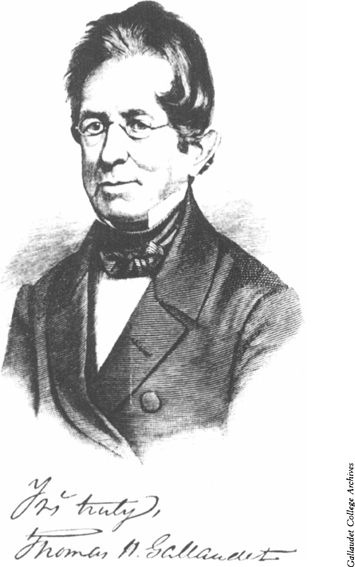
THE REVEREND THOMAS HOPKINS GALLAUDET
Such was my position when, after six futile months in Edinburgh, entreating the instruction there that he had been refused in London, Thomas Gallaudet left by way of London for Paris, where he arrived in mid-February 1816.24 After his death, I found among Thomas’s papers the torn remnant of a paper tablecloth (of the kind used in many French cafés) on which he had conducted his first conversation, in broken French, with Jean Massieu.25 Thomas begins by apologizing for arriving late: he had to go to church in town. He thanks Sicard and Massieu “in the name of the poor deaf-mutes of America.” He asks for private lessons and proposes seventy francs a month payment; “I would offer more but my expenses are paid by charitable contributions.” Massieu agrees: “Clerc and I will take turns giving you lessons.” Apparently the lessons began on the spot, for Thomas has listed nearly a dozen tenses for several French auxiliary verbs, and next to each appears a little notation of the appropriate methodical sign. Massieu worries in writing that it will be difficult to rework all this for English grammar and they make a date to start Thomas’s private instruction a few days later.
I have found such a record of my first meeting with Thomas, too.26 We discussed our families in English—mine broken; I had taken a few lessons before going to London.27 I said: “I have one brother and two sisters but they are not deaf.” Thomas asked if I read the Bible (“I know it by heart, since Sicard is a priest,” I answered in French), and I asked if the Americans loved Napoleon (“We do not know much of the politics of Europe,” he answered). “There is a great deal of wickedness in this city,” Thomas told me. “Particularly among the women. I am very sorry to see so many fine young girls going to destruction.” We discussed Sicard’s age and the trades of the deaf and dumb. I taught Thomas a few signs (GOOD, BETTER, BEST; MAN, WOMAN, FRIEND). I tried to explain the difference between French Sign Language and manual French but I didn’t do it very well; the former I called “natural,” the latter “conventional.” That could hardly be helpful, since all societies’ languages are natural and they all involve conventions. Much of our conversation at that meeting and the many to follow, however, concerned life in America and especially the people and events in Hartford that had led up to our fateful encounter.
I have thought so often about those events, how easily history might have veered onto another course, that I scarcely remember which scenes in my memory I witnessed myself, which ones Thomas described, and which I reconstructed later, living among these people. If the personages in my story seem more lifelike for that, so much the better. I will let them speak for themselves in the scenes I witnessed and those I did not, so certain am I now of the principles of their characters and the circumstances of their lives. First, Mason Cogswell, the man to whom redounds inestimable credit for organizing the first philanthropic institution in the United States, our school for the deaf. Like Epée, when Mason was personally touched by deafness, he understood at once the great social issue that transcended his own concerns, and he acted upon that understanding.
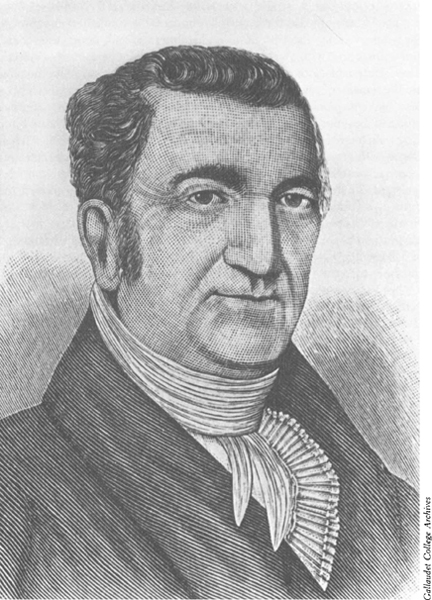
DR. MASON FITCH COGSWELL
MASON COGSWELL’S HOME, HARTFORD, CONNECTICUT, 1807. A large company is assembled at the Cogswells’ dinner table. Sunlight pours through the windows facing Prospect Street and suffuses the dark wood table, chairs, and wainscotting with a warm glow. Stripes of sunlight lie across the embroidered white tablecloth and glimmer on burnished pewterware. On the table are the remains of several roast chickens, baked peppers, pudding, blackberry pies, tankards of cider, and pieces of maple sugar—all from the Cogswell property. Beaming at the assembly from the head of the table is Mason Fitch Cogswell, forty-six, a tall, thin, handsome man with close-cut thick brown hair tinged with gray, a high forehead, and large brown eyes with a penetrating gaze. He wears a high-necked frilly white shirt, a long waistcoat, and knee breeches, silk stockings, white-top boots. This is decidedly old-fashioned, the dress of his father’s generation, but Mason Fitch Cogswell is old school, courtly, mild mannered, the beloved physician of Hartford, easy, gracious. He might often be seen on Village Street or on Main, striding briskly to the next of a dozen daily calls, the skirts of his long overcoat flying in the wind. At this moment he is holding his wife’s hand under the table and, by cocking his head to one side, pretending to give his full attention to the Reverend Nathan Strong on his left, who is reading from his eulogy to the Reverend James Cogswell, Mason’s father, deceased some three months past in his eighty-eighth year.
Mary Cogswell, the daughter of Colonel William Ledyard, who was treacherously slain with his own sword in the act of surrendering to the British at Groton, is widely admired in Hartford society for her good common sense, calm judgment, and propriety.28 Because she is a woman, her major sphere of influence is her home, and there she excels in her devotion to others and in gracefulness, which helps to make the Cogswell house a center of culture and refined life.
On her right sits the Cogswells’ neighbor, Peter Gallaudet, a diminutive merchant who had moved to Hartford from Philadelphia some seven years before with eight children; he now has twelve and his wife, at his side, looks appropriately exhausted. As his name suggests, Peter Gallaudet’s heritage is French. His grandfather, Pierre Elisée Gallaudet, a doctor, left La Rochelle in the early 1690s in the great exodus of French Protestants caused by the revocation of the Edict of Nantes; he became founder of New Rochelle in New York. No less distinguished, Peter has served in the Continental Army, and acted as secretary to George Washington.29 Like Mason Cogswell, he is old school. Moreover, at the age of thirty-seven, having lived without religion, he had made a public profession of faith, and as a result there is more Bible-reading in the family and prayer and churchgoing and exhortation to goodness than is typical of Protestant homes.
While his son Thomas and I were together in Europe, Peter Gallaudet moved his family to New York, then Philadelphia, and they finally settled in Washington, where he took a job with the Treasury Department, and founded the Washington Manual Labor School and Male Orphan Asylum. Those who believe, as I do, that nurture as well as blood make the man will not be surprised that Thomas, eldest of his twelve children, often sought out as a young man for guidance and comfort by his brothers and sisters, was destined to become the pastor of a flock and the principal of a school.30
At the foot of the table, next to Mrs. Gallaudet, a woman of clear intellect and deep piety, we find one of Mason Cogswell’s intellectual friends, probably Joel Barlow, a fellow member of the Hartford Wits—America’s first literary coterie, which gained its name from attempting to cure the current taste for bombast with large doses of bitter satire. Then come two medical students (at this time there was no medical school in the state—that of Yale College would not open for another five years, when they offered Mason the chair of surgery—and licensing required two years with a reputable physician after college, or three years if the student had not attended college) and, finally, the circle is completed by the Reverend Nathan Strong, a large man whose thick gray hair flows down over his shoulders. He has keen eyes and lips thinly drawn under a hooked nose.
Strong was one of the best-known divines in the country. A scholar, he had published his sermons, several theology books, and an evangelical magazine. His language was forcible and plain, his general tenor as a preacher solemn and evangelical. The principles of his religion were robustly Calvinistic: original sin, eternal election, justification by faith alone, the necessity of special grace in conversion, the saint’s perseverance in holiness unto eternal life.31 When he died, the year of my arrival in America, it was said that there were more communicants at the sacramental table of his Center Church than at any other in the whole state;32 they included the Cogswells, the Gallaudets, and indeed all the first families of Hartford.
It would be hard to overestimate the importance of the meetinghouse, as the church was called, in the life of a New England town, more important even than the church in a French village. A town might lack a center or a tavern but it surely had its place of worship and this was its point of reckoning. The meetinghouse was also the town hall, and it was the center of social life. No doubt this arose because every dispute or division among the Puritan settlers gave rise to a new town, which was at once a unit of civil and religious organization. The first duty of a new settlement was to organize a church on a plan called Puritan. The adults affirmed the experience that made them professing Christians, they chose or simply recognized someone suitable to be pastor, and they covenanted to hold the faith, obey divine law, and observe the ordinances they legislated. Center Church was, as its full name affirmed, Hartford’s First Church of Christ.
Nowadays the puritanical strain in New England has been diluted by immigration and democratization, but when I came to Connecticut its austerity, mortification, and asceticism were astonishing to one from a nation where the needs of this life and those of the next had had a millennium in which to come to terms. New Englanders were intelligent and industrious, yes, but also with rare exceptions (Mason was one; I’ll explain why later) they wore penitential scowls and were sadly alike in dress, manners, and pursuits. Their daughters and wives were cheerless, self-effacing. Their food was boiled or roasted but not prepared; sauces would have been a wicked indulgence, no doubt. They drank little wine but much rum. Education meant divinity, law, medicine. To enjoy works of the imagination was considered an idle waste of time, somewhat sinful. They built their churches on the same model as their barns. They worked hard on their stony soil and read hard in their stony books of doctrine. Here is a stanza from their favorite hymn:
Conceived in sin, O woeful state!
Before we draw our breath,
The first young pulse begins to beat
Iniquity and death.33
No deaf man has lived who has not encountered hypocrisy, but that of these latter-day Puritans knew no bounds. Reverend Strong, for example, engaged extensively in the distillery business while preaching temperance. When his firm failed, the minister shut himself up in his house to avoid the sheriff, who sought to serve him a writ, but on Sundays, when no writ could be served, he sallied forth to preach before his congregation. It was said of him that when in the pulpit it seemed he ought never to leave it and when out of it that he ought never to go into it.34 One of his characteristically pointed remarks concerned a fellow divine, Reverend Flint, pastor of Hartford’s Second Church of Christ, which had split off from Strong’s congregation some decades earlier. At a church meeting someone had suggested that it was hardly fitting for Strong, their pastor, to be engaged in the manufacture and sale of liquor. “Oh,” said Strong, “we are all congregationalists in the business working together. Brother Perkins here grows the grain, I distill it, and Brother Flint drinks it.”
Now, as Reverend Strong draws his eulogy sonorously to a close, Mason nods his head and speaks. “My father’s was a life of afflictions,” he says. “Some Christians fear for their salvation because their lives were blessed with ease”—his eyes say he is speaking of his own fears—“but my father had suffered so much at Christ’s bidding that he dared believe in his election to eternal grace.” It is true. James Cogswell had suffered greatly during his long life. A member of the fourth generation of Cogswells in New England, he had experienced religion when he was fifteen, a youth in Say brook, and was considered a very promising young man—a scholar, a good logician, a graceful speaker. When Canterbury Parish asked the president of Yale to recommend a minister, he said he knew none better than James. And indeed, at first the parish found him amiable, dignified in the pulpit, conciliatory in private, and they voted a call to settle him. He married Alice Fitch, descended from the famous hero of the Pequot war, James Mason, and took two pupils into his family, Naphthali Daggett and Benedict Arnold. (The former became president of Yale College, the latter, the brilliant Revolutionary general and then infamous traitor. The astonishing influence of the clergy in New England to this day is in good part explained by this practice of taking promising young men into their homes and fitting them for college.)
Alas, presently it became clear that James favored centralized church government, did not insist on the personal experience of conversion, and allowed unconverted sons and daughters of parishioners into the church; a segment of the congregation, a majority, walked out.35 In the end, the Separatist movement was crushed in Canterbury as elsewhere, but James’s congregation was greatly reduced and, unable to pay his salary, dismissed him.
Some Yale alumni put James up for the presidency of the college, but he was not selected, and the following year he was called to Scotland Parish, in Windham County, to replace their pastor, recently deceased.36 In less than three months his wife, Alice, died in her forties, and her daughter followed her, only twenty-three. Then the youngest child, Septimus, died, age four. That left the oldest son, James, who was to become a surgeon in the Revolutionary Army; the second son, Sam, at Yale; and Mason at home. Mason’s father, though suffering from headaches, luminous flashes, and loss of temper, troubled by his tendency to tell jokes and stories, harassed in money matters (the diminishing height of his woodpile was an accurate gauge of the diminishing love of his parishioners), and alarmed by the growth of infidelity, antifederalism, and the course of the revolution in France, nevertheless soon remarried. Martha Devotion, the widow of his predecessor at Scotland Parish, had a son in local politics and three daughters. One daughter, also named Martha, was married to Governor Huntington*—of course he was just a lawyer in those days—and Mason was sent off to Norwich to live with his family and be fitted for Yale.
It had to be Yale: it was nearby, Mason’s father and two brothers had gone there, President Daggett was a friend of the family, and the school was an orthodox expression of religion in education. It was organized on the lines of the Trinity; three professors: divinity, mathematics, philosophy. Three tutors. Three principles: industry, frugality, rectitude. Three shabby buildings on a barren common that the students called the Brick Prison. Mason entered at fifteen and graduated valedictorian and youngest member of his class in 1780.
When he left Yale, Mason joined his brother James at Stamford, where he was examining surgeon of volunteers,37 then went with him to New York to pursue his training in surgery at Soldiers’ Hospital. But a new set of misfortunes soon befell the family. Mason’s brother Sam lost his son to some childhood disease,38 and then died himself in an accident.39 Two years later his brother James died. The Reverend James Cogswell had now lost a wife and four children, and only Mason remained. The next few years brought still other bereavements. Mason’s adoptive sister, James’s stepdaughter, died and the governor was not long in following her. The loss of her daughter and son-in-law was too much for Martha Devotion to bear and James found himself a widower again. He married a third time after a suitable delay—one of his parishioners—and continued to preach despite failing voice and a dwindling congregation that found his obstinacy and ill-temper offensive. Of course he was ill-tempered; they would not hire an assistant for him in his declining years, they would not allow him to retire with provision, finally they would not even pay him. In the end, his last remaining son brought him to Hartford to die. Mason reported that, on his father’s last day, he asked him, “Do you know me, father?” There was no response. Then the son asked: “Do you know the Lord Jesus Christ?” The aged face brightened with confidence, even joy, and the father replied: “I do know Him: He is my God and my Savior.”40
I found among Mason Cogswell’s papers a diary he kept of a month’s trip from New York to Scotland Parish, where he joined his father’s Thanksgiving Day table.41 Along the way the reader encounters many of the important figures in Mason’s life, who would also shape Alice’s and my own, and the diary reveals the kindness, sensitivity, and urbanity of its twenty-seven-year-old author, so it takes its place in my narrative here. The first two pages are missing and the third page starts “went to bed and slept luxuriously after supping plenteously on sweetmeats and cream pompion pie,*and bridal kisses.” Evidently, he had been at a wedding.
Then comes a date, “Friday, 14th”—it was in fact November 14, 1788, the bitter cold winter in which, across the Atlantic, Epée went without a fire in his room so he could clothe the poor deaf in his charge: “Slept late in the morning on account of the wedding—made several morning calls—wished the bride more joy—got my horse shod and set out for Norwalk where I made a cousinly visit.” The next day, “Rode to Greenfield,” he says, “and breakfasted with Mr. Dwight.” This is Timothy Dwight, the famous “pastor of Greenfield Hill” and grandson of the leading New England preacher Jonathan Edwards; he was soon to become president of Yale College, where we later met. “Stayed much longer than I had intended.” It was well known that the charms of Dwight’s conversation, like those of the Ancient Mariner, could hold even a wedding guest fast. Still, before the day is too advanced, Mason has been ferried across the Housatonic: “The last part of the ride,” he says, “was solitary, as it was evening; but it was the better calculated for reflection.”
The next morning, at New Haven, he attends divine service and “in the afternoon my old place of worship, the Chapel, was honored with my presence—where I was highly entertained with a sermon from Dr. Edwards, from these words: ‘In the day thou eatest thereof, thou shalt surely die.’ The discourse was accompanied with good music.” Mason was a great music-lover, played the flute, and had led a church choir in Stamford, before moving to New York. “Spent the evening at Dr. Stiles’s” (the current president of Yale).
Mason spends “Monday, 17th” visiting old friends, and on Tuesday he sets out for Hartford with a former schoolmate. There were no steamboats in those days, of course, no railroads, not even the Hartford Turnpike—so called from its turnstile of pikes every ten miles to ensure payment of the ten-cent toll—and the two young riders must make their way through North Haven and thence to Wallingford, where they spend the night. The next day they breakfast at Durham, dine at Middletown, and head due north along the Connecticut River Valley, some twenty miles across at Hartford, with its great fields of corn and tobacco. They reach Hartford about sunset. At the time it had about three hundred houses and some three thousand inhabitants, but it was a much more bustling center than these numbers imply, since it was the gateway to the upper Connecticut River Valley—flat-bottomed scows carried trade as far north as the Canadian border—and a staging and supply center for immigrants pushing westward.
“As soon as our horses were attended, we repaired to Col. Wadsworth’s,” Mason writes. Jeremiah Wadsworth was the richest and most influential man in Hartford, indeed in all of Connecticut. As a young businessman he had profited vastly by the trade with the West Indies, but his real wealth was acquired in his capacity as commissary-general of the Continental Army and of the French auxiliary army. Most Revolutionary officers were bankrupt, owing to the bankruptcy of the Continental treasury after the war, but Jeremiah had gone to France and presented his accounts to a government that could pay. His house occupied a full block between Prospect Street, where the Cogswells and Gallaudets later lived, and Main Street, the principal thoroughfare of Hartford, the site now of the Wadsworth Atheneum, America’s first art museum.
In the diary, Mason describes Daniel Wadsworth, Colonel Wadsworth’s son, a lifelong semi-invalid and dilettante who later became a member of the committee sponsoring Gallaudet’s trip to Europe. “He is a strange youth. With his pockets full of money he had rather at any time sit down at home betwixt his two sisters and by some new act of tenderness call forth their affection toward him than to be in the best and most fashionable company at the gaming table, or at any place where he can spend his money in an honorable and polite way.” Mason’s underlining makes clear he is speaking tongue-in-cheek of fashion. “‘Tis true as it is strange, and furthermore he is warmly attached to the principles of virtue and morality, and really he is not ashamed of his God.”
Mason arrives at his father’s house in Scotland Parish two days later, at sunset. “The tear of pleasure glittered” in James Cogswell’s eye as he embraced his son, and when the time for evening worship comes, the “old gentleman,” as the journal tells us, “prayed with unusual fervency and affection.”
After spending Thanksgiving and a few days following with his father, Mason rides to Norwich. “At about half past eight, I arrived at Gov. Huntington’s, my former home, and the manner in which I was welcomed made it as much so as ever.” Samuel Huntington was a man with swarthy complexion, a vivid and penetrating eye, moderate, circumspect, never angry or unkind, who put more emphasis on comfort and convenience in his home, to hear Mason tell it, than on splendor. The Huntingtons’ warm hospitality had made their house a center of attraction for young people in Norwich—games in the parlor, dancing till curfew, and so on. I think it was this atmosphere during his formative years that gave Mason an uncommon measure of humanity for the son of an ascetic, cheerless New England preacher.
Mason’s ten miles’ ride that morning is not an excuse from Sunday worship and he “attended divine service both A.M. and P.M. and heard two metaphysical discourses from Mr. King; on the whole was well pleased with them—thought, however, he was a little out of his latitude.” In the evening he makes a call at the home of Mr. Ward Woodbridge—a successful merchant who would also become a member of Gallaudet’s sponsoring committee—where the two daughters of the household are as glad to see him as he is to see them and “paid more attention to me than to all the other gentlemen in the room.”
I come now to the last two pages of the diary, which are torn. I can make out a social hour, a farewell at Colonel Wadsworth’s, and the fact that Mason has been lodged the night at Reverend Strong’s, where he “attended to Mrs. Strong’s case” and had a long and friendly conversation—about settling in Hartford. The next day he makes his way to New Haven, and the last day, now mid-December, finds him again at Timothy Dwight’s. There, he is “in the midst of a smiling circle” full of “cheerful and instructive” talk. There are four young ladies under Mr. Dwight’s tuition: “the expression of each was uncommonly fine—a loveliness of disposition, a benevolence of heart, and a sprightliness of thought were discernible in every eye.”42
The diary ends with this gracious appreciation of womanhood. Mason was not a disinterested observer, his journey being in some measure a quest for a companion, but it was ten years before he would meet the woman with whom he would share his life and love to his last day.43 By the time of the dinner, they had been married seven years and had four children. I imagine Mary Cogswell signaling the Negro servant Lydia to bring the three eldest so they might be presented to the company. Lydia, sometimes called Lyd, was the daughter of an African tribal chieftain, and she had been a slave. Mason had met her at the boardinghouse where he lived when he moved to Hartford in 1789, and had cured her of lockjaw after several doctors had given up. When she died, after thirty years with the family, she left Mason’s children the money she had saved and her heavy silver watch chain.44
The oldest Cogswell child, Mary, is only six, but her large dark-brown eyes are surely fixed on the company with the frankness and directness always to be found in her gaze. Later, she grew tall and dignified and became the mother of three young men herself. Two years younger is gentle Elizabeth, who seemed to live for the comfort and happiness of those she loved. With strangers she was always calm and reserved, with friends she was all enthusiasm and feeling. And finally, but two years old at the time, comes smiling, intelligent, animated Alice, such a child as the poet had in mind when he wrote, “heaven lies about us in our infancy.”
The only son in the family, named after his father, is less than a year old and remains in the nursery; laughter-loving Catherine will come four years later.45 Now here’s a curious fact: I have outlived them all, parents and children, all but the last. I have watched the young grow into adults—or, rather, we shared those years, became friends, they learned my language, moved in my deaf circle, and suddenly they were adults. I have seen childhood reserve mature into studiousness and decline into self-absorption; childhood playfulness become youthful gaiety and then inconsequence; soft, fleshy skin draw firm then loosen again into pleats and jowls. Six times I have watched the gravediggers hollowing out a space in the loam and clay of the Connecticut River Valley and a Cogswell lowered into the ground. I am the record-keeper, the witness, though at one time I was also a participant. If my life has not yet ended, it must be—for no reason at all, or so I can tell this story.
Mason sat with Reverend Strong at many a deathbed. He also delivered many a baby; he was considered the best obstetrician in the state. Physician and minister were the two key professionals in every New England town, and Hartford, though larger than most, with four thousand inhabitants, was no exception. Thus Mason was widely known among the citizenry for his sympathy with the sick, and among the members of his profession for his skill. Said a colleague: “He performed all the great operations with inimitable dexterity and a coolness nothing could disturb.”46Fellow surgeons marveled at his neatness and dispatch (I suppose accuracy was taken for granted). One reported his amputating a leg at the thigh in forty seconds.
In 1810 the Connecticut Medical Society conferred on Mason an honorary M.D. and two years later elected him its president; he was reelected ten times in succession. That same year Yale offered him the chair of obstetrics and surgery at its new school of medicine, but by then Mason had decided to found a school of his own, for deaf children, and felt he must stay in Hartford.47 Some years after I arrived, Yale, too, awarded Mason the M.D.
At the dinner, as I imagine it, after the children have gone, Joel Barlow presents Mason with a gift: bound proofs of a collection of poems called The Echo, to which Mason was a contributor, the last publication, I believe, of the Hartford Wits.
The writing of the collection had begun, according to the preface, in “a moment of literary sportiveness at a time when pedantry, affectation and bombast pervaded most of the pieces published in the gazettes.” The first piece, a parody of an inflated description of a thunderstorm, was originally published in 1791 in the American Mercury, which had been founded by Barlow only seven years before.48 It caused a stir and the authors realized that they could aim their shafts at more worthy targets: what the preface calls “the hideous morality of revolutionary madness” spawned in France. Jefferson was called, as I remember, “the great sire of stories past belief” and his literary and scientific interests roundly ridiculed.49 There were a score of pieces in all; when the Mercury became too democratic for the authors’ tastes they published in the Courantinstead.50
In addition to Barlow, the original four Wits included a physician, an aide to General George Washington, and a justice of the supreme court.51Mason was counted among the “Later Wits,” who joined after the War of Independence. The president of Yale, Timothy Dwight, and his brother Theodore, a publisher, were in their number, as were a future governor and two linguists.52
The Wits have held my attention because I find in them the key to much of Mason Cogswell’s character.53 They were the minority to which he belonged—a rich, powerful minority to be sure, but one that was well on the way to being overwhelmed by the time I arrived. Of Puritan ancestry and rearing, with all the Puritan’s earnest devotion to intellect, they exercised learned or genteel professions. They were fond of good food and drink, the arts, politics. Of course, they were conservative. That is, Federalist. They wanted a strong central government, encouragement of commerce, attention to the needs of merchants and landholders, and a well-ordered society. They distrusted the capacity of most people to govern themselves except through the guidance and authority of the superior classes, and their paternalism extended to the deaf, who were inferior in their eyes because of their poverty, lack of education, and lack of hearing.
It was not long after the dinner I have imagined that the light in Alice Cogswell’s beautiful hazel eyes flickered and nearly went out. When she recovered from the spotted fever, her father said, she could not hear her mother’s sobs, nor his prayers at her bedside, nor her sisters playing outside her window. For a little while her speech persisted: “Mommy cry,” she said, and “ol’ Lyd.”54 But then, as the vivid landscape in her window paled with the coming of winter, and all the riot of color drained out of the trees with the running sap, so her speech was drawn off and she was shrouded in silence.
“I cried, ‘My God, why hast Thou forsaken me?’” Mason said, “And Reverend Strong reproved me: ‘Are you then blameless?’ And I thought, ‘No, but what have I done to deserve such condemnation from my Maker?’ I cried, too, from rage at my own impotence; I had liberated so many other children from illness and could do nothing for my own.”
“I awoke one morning,” Alice told me years later, “remarked the utter stillness and fell back to sleep. A long time passed; occasionally, I would half-awaken and see in a dense fog a jumbled form in the doorway or, as if through muslin, my mother’s familiar face hovering over me. Always there was quiet. My father had a chaise drawn by the family horse, ‘old Bob.’ One day I saw them approach from my window but though the wheels turned they did not squeal, the carriage advanced without a rattle, old Bob’s hooves struck the ground silently and steam rose from his nostrils when he whinnied—again, without a sound. I think it was then I realized, vaguely, that nothing seemed to sound anymore. I was a child of two and a half—I did not understand what that might mean. I simply accepted it. Time passed, I recovered, but my speech and hearing did not.” Of the following months she recalled little except the various tortures to which she was subjected by doctors, including her father. They poured salt water into her ears, and oil of cream. They bled her, leeched her, physicked her, and finally gave way to despair. Some years later they brought her an ear trumpet, with which she could hear the church bell but little more.55
The worst was yet to come. It became painfully evident to Mason (and to the Gallaudets, for their son Theodore was Alice’s age) that Alice’s mind was not developing normally. Although she was in the midst of a highly cultivated society she understood little that went on around her. Her two older sisters learned the signs she gradually developed and introduced a few of their own. Mason and Mary learned some, too, and made awkward efforts at expressive pantomime; they no doubt brought the art to new heights among the normally stolid Puritans but at such a cost of energy and devotion that only the most essential messages (and the most insignificant ones) were communicated.
THE GALLAUDET GARDEN, 1813. Theodore Gallaudet, eight, comes running around the side of the house (he’s the fox) with brother Edward and three Cogswells—Mason, Alice, and Elizabeth, six, eight, and ten (the hounds)—in hot pursuit.56 Thomas Hopkins Gallaudet, home from studies at Andover Theological Seminary, stands under an elm tree watching Alice. What he beholds is a disabled hearing child, not a healthy deaf one, a child who needs a new language in which to learn about the world, grasp the thoughts of others and share her own. Not yet understanding such matters, the young theology student decides to teach her to spell H-A-T.
Thomas was not tall—five and a half feet—and there was something frail, even womanly, about his bearing. He had a placid oval face with darkish complexion and expressive dark gray eyes that rolled at you over his spectacles. His nose was straight, his lips large, and his teeth and gums visible when he spoke. His voice was soft and his manner unprepossessing.57 But what a gift he had for communication! He had a natural talent for pantomime, and could convey even complex ideas by facial expression alone. Once when Colonel John Trumbull* was visiting the American Asylum, Thomas asked him to select any historical event that would make a striking canvas and offered to communicate it solely by expression and posture to a pupil, admittedly one who was particularly apt. This pupil—George Loring, I think it was, who went on to become a deaf educator himself—was not only intelligent but expressive. The play of his features showed clearly whether he was following at each moment or not.
Trumbull said: “Tell him that Brutus (Lucius Junius) condemned his two sons to death for resisting his authority and violating his orders.” Now it was understood that the chosen event could come from any portion of history, sacred or profane, ancient or modern, but must be previously known to the pupil, as it was in this case. Gallaudet folded his arms to keep himself from signing and gazed eastward while undulating his head, as if looking across and beyond the Atlantic Ocean, to denote that the event happened on the Eastern Continent. This took the subject out of the range of American history, at least. Then he rolled his eyes upward and backward and leaned his head backward, as if looking far back in time past to denote that the event was of quite ancient date. He then conveyed the aquiline nose of the Romans by stretching and centering the remarkably supple muscles of his face.
By his countenance, attitude, and manner he conveyed an individual of high authority, commanding others whom he expected to obey him. Then he appeared to be giving an order to many persons and threatening punishment to those who might resist—even the punishment of death. Next, to indicate a lapse of time, he portrayed sleeping during the night and waking in the morning, several times over. Then he looked with deep interest and surprise as if at a single person brought before him and his face showed fury at the violation of his order. Then looking at another guilty person near him, he denoted two offenders.
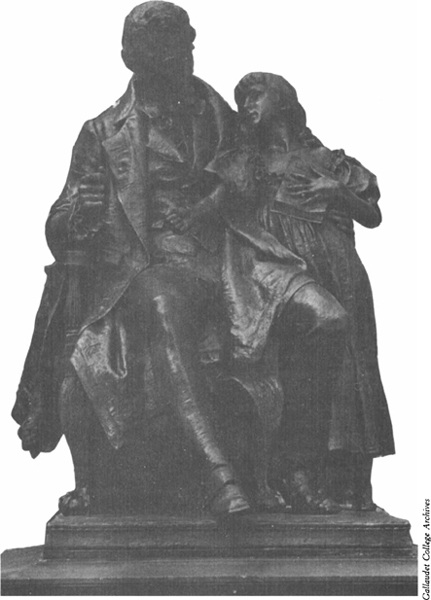
ALICE COGSWELL AND THOMAS HOPKINS GALLAUDET
(STATUE BY DANIEL CHESTER FRENCH)
Exhibiting grave deliberation, then hesitation accompanied with strong conflicting emotions—he knows not what to feel or what to do. Looking at one of the persons and then the other as a father would look—he is a distressed parent. His bearing alternated repeatedly between the inflexible commander and the loving father. At length, the father yields, and the stern principle of justice as expressed in his countenance and manner prevails. His look and action denote the passing of the sentence of death on the offenders and ordering them away to execution. The pupil had been impatient for some time to show he understood; given leave, he wrote on his slate a complete account of the story of Brutus and his two sons.
Gallaudet repeated this feat on several occasions: on one, he was Noah building his ark; on another, Abraham sacrificing his son; on a third, Washington entering Trenton. And so on. So gifted was he at facial expression that he contrived a facespelling alphabet to replace the fingerspelled alphabet: a was denoted by awe, b by boldness, c by curiosity, d by despair, and so forth. Despair, eagerness, awe, and fear spelled deaf.58
Now Thomas’s skills developed with experience, but they were augured the day he decided to teach Alice to write H-A-T. I imagine him dressed as New England men did early in this century: the tall stovepipe hat had replaced the broad brim and men wore tighter-fitting clothes with pantaloons instead of breeches, a frilled shirtfront, and a black long-tailed coat. Hats are playthings for children and I can easily picture Alice, wearing a full ruffled dress, long blond curls surrounding her cherubic face, holding Thomas’s hat, trying it on, while Thomas fetches a stick to write the letters in the dirt.
Where does the magic of belief in youth, of love for youth, of thorough and undying sympathy with the hearts of youth that Thomas had, where does it come from, how is it nourished? He whom Thomas admired most possessed it, too: “a little child shall lead them.” Thomas had a spirit purified by physical weakness and delicacy of health. He had a distrust of self and a full trust in God. He came from a home in which piety and study were valued. So much so, indeed, that he spent only two years in preparing for college before entering the sophomore class at Yale. He was to graduate with highest honors before he was eighteen, the youngest in his class,59 and was one of six to give a commencement oration, which I found among his papers. It is written in the clear, well-rounded hand he retained all his life, and was carefully enveloped in a cover of marble paper secured with a pink-and-white ribbon—neatness and order he retained lifelong as well. Its title is equally reflective of his character: “The Increase in Luxury in Connecticut and Its Destructive Consequences.”60
In the autumn following graduation, Thomas entered upon the study of law in the firm of the Honorable Chauncy Goodrich, who later became mayor of Hartford and deputy-governor, but I suspect he was uninspired, for at the close of his first year there he resigned and returned to Yale.61For the next two years, he read English literature and wrote; he kept a little notebook of “Prayers, Meditations, and Reflections” that makes it clear he was much preoccupied with personal religion: with skepticism, temptation, and the struggle for faith. His New Year’s resolutions for 1808 included: to pray morning, noon, and night in private; to be kinder to his parents and brothers and sisters; to be less indolent, less self-indulgent with food and drink. His Master’s oration, delivered in the fall of 1808, On Ambition as a Motive in Education, spurned the love of praise in favor of Christian humility.62 Shortly after delivering it, he accepted a position as tutor at Yale.
The struggles within Thomas’s Puritan soul became increasingly acute: “I know that I am walking in the way that leads to eternal perdition,” he wrote at the end of 1808; and the following spring, with health and spirits enfeebled: “If He should see fit to restore me to health and strength of body and a capability of studying, I will devote myself to the ministry of the Gospel.”
The fall of 1810 arrived without the improvement of health and spirits he so dearly desired, and Thomas decided to pursue some trade that would keep him in the open air and prove less demanding for his eyes and his mind: he became a Yankee trader. It was the heyday of the tin peddler with his pack filled with tinware, pins, needles, scissors, combs, children’s books, cotton stuffs. As many as thirty might originate in a single town and fan out over the South and West. Thomas accepted a commission from a New York commercial house and traveled through Ohio and Kentucky on horseback. He returned in much improved health, and, determined to start a career in business, he took a job as a clerk.63
It soon became apparent, however, that Thomas was no more suited to business than to law, and we find him next, in 1812, enrolled at Andover Theological Seminary. He wants to preach and to spend his life in the service of his fellow man, but the specific field of endeavor is unknown. Then, midway through his two-year course, the man and the cause meet as Thomas scratches the letters H-A-T on the ground while Alice looks on in puzzlement. To show that the two go together, he places the hat on the ground next to the word and points to them alternately over and over while imitating the action of donning his hat. Alice seems to understand. To test her, Thomas rubs out the letters with his shoe and scratches them again a few feet away. Alice picks up the hat and places it on its new label. Thomas runs, overjoyed, to the Cogswell home to announce his success.
Whether Thomas really taught Alice anything on this occasion does not matter. What does is that he began to take a consuming interest in deafness, and induced Mason to enroll Alice in the school to be opened by the poetess Lydia Huntley Sigourney.64
HARTFORD, 1814. ALICE AT LYDIA SIGOURNEY’S SCHOOL. In front of the class, a diminutive lady with flaxen curls, only twenty-three but on her way to becoming the most popular poetess in America ever. Her first published work, written in 1815, was entitled Moral Pieces in Prose and Verse; the last was a book of “educational remembrances,” Letters of Life, which came out after her death four years ago: between the two she wrote two thousand contributions to periodicals and fifty volumes of verse, essays, travel pieces, fiction. She was flattered by Poe and patronized by Whittier; she was translated into many languages, met Queen Victoria, received gifts from the rulers of Prussia and France. Oh, she had her critics: Jane Carlyle* described her visitor as “beplastered with rouge and pomatum—bare-necked at an age which left certainty far behind—with long ringlets that never grew where they hung … all glistening in black satin as if she were an apothecary’s puff for black sticking plaster and staring her eyes out to give them animation.”65 Asked to write an entry on her for Female Poets of America, Horace Greeley complained to the editor: “I shall try to plaster over Mrs. Sigourney but you know how bad the job is. As it won’t do to say a word of her real history, how will it be possible to say anything?”66
I will come to her real history. Now the dozen or so girls in the class are bent over their composition books; Alice carries hers up to Lydia, flags her attention, and hands her the book, signing TEACH-ME. Once when she did this, her teacher responded with a “poetic effusion,” as she liked to call her verses.67 (Alice called them SHORT-LINES.) The poem is addressed to a friend whom she had intended to meet after school but …
Slate and books and maps appear,
And many a dear one cries,
“Please tell us whence that river sprang,
And where these mountains rise,
And when that blind, old monarch reign’d,
And who was king before,
And stay a little after five,
And tell us something more.”
And then our darling Alice comes,
And who unmov’d can view
The glance of that imploring eye,
“Oh! teach me something, too.…”
Alice’s book is open to an alphabetical list of words… congress, constitution, cotton, Cuba … that have come up during the history lessons. Lydia places a chair for Alice next to her desk facing the pupils—she will first conduct the weekly examination, a favorite exercise with the class. “KING EAT STUPID TOO-MUCH EELS, WHO?” Alice signs and all hands go up. “Nancy?” “Which king ate too many eels—Henry II!” “Very good.” And so on. “If only you could have seen the play of naïveté, irony, and love that would radiate from Alice’s beautiful eyes on these occasions,” Lydia once told me.
After Alice had tested the other students, her teacher tested her by pointing to words in her composition book for Alice to define. This she would do with descriptions, definitions, or little stories—historical, biographical, scriptural—that she had learned related to each word. Her recitation was a mixture of her own home sign, pantomime, and fingerspelling with the two-handed British manual alphabet, which she had learned I know not where. The other pupils (all hearing) had learned the alphabet and many of her signs, and they would translate her answers as she went along (which no doubt aided the teacher as well). This is all quite charming as a supplement to education, which it was for the hearing children, but it was no substitute for the education that Alice needed. Lydia said Alice was a genius in perceptiveness, imagination, intellect, and the desire for knowledge. So she must have been to learn much under these circumstances.
Perhaps six months after school began, in the winter of 1815, Alice produced her first literary effort—at least, the first I can find. The pupils were writing letters to the teacher and Alice would not be satisfied until she, too, could be Lydia’s correspondent. Her topics for this letter were the illumination on the return of peace,* Lydia’s lack of family, and her lessons in history and geography. (As she wrote, Napoleon was leaving Elba for Paris and Sicard, Massieu, and I were leaving Paris for London.)
“The world—all peace.—Now am I glad.—Many candles in windows.—Shine bright on snow.—Houses most beautiful.—Friends at my home that night, and one baby.
“Sorry is Alice—you have no brother—no sister.—My sisters, three,—my brothers, one.—They are beautiful.—Sorry am I you never had any.—My father and my mother.—Much I love all.
“Girls, fifteen in school.—You teach.—You write, and give letters.—
Cleopatra I learn—great queen face very handsome—say to maid,—bring basket—figs—asp bite arm—swell—die.
“Xerxes, proud king—very many soldiers—go to fight Greeks—come back creeping—many men killed.
“Zones, five;—one warm, all people faint; two very cold—two half hot, half cold—temperate.”68
The “Sweet Singer of Hartford,” as Lydia was called, was fascinated—even obsessed—with the blind, the deaf, and the dumb as subjects of poetry and objects of charity. She corresponded with Dr. Samuel Gridley Howe, head of the institution for the blind in Boston, and contributed to the keep of Julia Brace, a deaf, dumb, and blind girl who spent her adult life at our school. She wrote a poem, “The Marriage of the Deaf and Dumb,” beginning “No word! no sound! But yet a solemn rite / Proceedeth through the festive lighted hall,”69 and another called “Prayers of the Deaf and Dumb.”70
In Lydia’s posthumous Letters of Life there is this poem about Alice, whose “look of bliss” is offered as the answer to a question put to Massieu and me in London: Are the deaf and dumb unhappy? Lydia’s reply, addressed to Alice:71
Oh, could the kind inquirer gaze
Upon thy brow with gladness fraught,
Its smile, like inspiration’s rays,
Would give the answer to his thought
And could he see thy sportive grace
Soft blending with submission due,
And note thy bosom’s tenderness
To every just emotion true;
Or, when some new idea glows
On the pure altar of the mind,
Behold the exulting tear that flows,
In silent ecstasy refined;
Thine active life, thy look of bliss,
The sparkling of thy magic eye,
Would all his skeptic doubts dismiss
And bid him lay his pity by …
I suppose lavish sentimentality may be excused a poetess who lived in an age that valued it so highly, but what I do not excuse is her idealizing the condition of the deaf. Placing them above all other men (or Alice above all other women) in purity and beauty sets the deaf apart as surely as a refusal to communicate with them.
Lydia’s critics did not see an innocent foible in her preposterously romantic descriptions of her childhood, her family, and herself, but rather thought it self-serving hypocrisy; I feel the same about her “effusions” on the deaf. Let me explain. The facts were that the “court of shorn velvet intersected by two paved avenues” at the house where Lydia claimed to have grown up was perhaps twelve feet in length and she was the daughter of the gardener, not the owner, and never occupied the “suites of rooms” she glowingly described. The fact was that the image promulgated of a loving wife nestled by the family hearth, pouring forth her effusions in a moment’s respite from a mother’s labors, was false. There was no love between her and her desiccated merchant husband and she despised his daughters by a prior marriage. In vain she repeatedly asked him for a separation. He upbraided her in a letter I have seen for “her lust of praise, which like the appetite of the cormorant is not to be satisfied,” for her “apparently unconquerable passion of displaying herself.”72 Her only son, Andrew, turned violently against her before dying of consumption.
These terrible realities—low birth, unhappy marriage, frustrated motherhood—drove her to new heights of fantasizing. Lydia loved Alice partly because the child’s isolation corresponded to her own. Turned in on herself, forswearing men and the world, feasting on her own sensibility, the poetess tried desperately to represent that isolation yielded richness of inner experience for Alice and for herself. The deaf and dumb, like the dead, commune directly with God, needing no language. Their isolation is ennobling, like that of the poetess.73 This is self-love in disguise, and thatis using deaf people for one’s own ends. Beware the myth of nobility as you beware the myth of deviance. Deaf Joseph, who was really the wronged count of Solar all along—youth, purity, honesty, nobility personified. To arouse sympathy, he must be a pure victim of injustice; hence he must be pure. Deaf Alice, “a tear of exquisite feeling glistening in her eye,” because her “peculiar misfortune opened for her new avenues to tenderness and sympathy”74—so said Lydia. Where in literature are the deaf seen truly, with deafness just one condition of their lives, acting in concert with deaf and hearing people, not living as isolates?
Mason had not stood idly by until the opportunity afforded by Lydia Sigourney’s school presented itself in the fall of 1814. Concerned with his daughter’s slowed development he had, three years earlier, conceived some grand designs befitting a loving parent, a great physician, and a New England Puritan.
Mason loved books; he had probably the best personal library in the state and it was his practice to spend several hours every evening quietly reading. He obtained a copy of Francis Green’s description of Braidwood’s academy in Edinburgh, published in London in 1783. He also bought the translation of Epée’s major work, which Green had prepared after his change of heart in favor of sign and published in London in 1801, the Method of Educating the Deaf and Dumb Confirmed by Long Experience.75 Both works held the promise of restoring speech where it had been lost and Epée’s opened the astonishing vista of an alternate means of communicating with, and hence educating, the deaf. To his everlasting glory, Mason’s first instinct was not to hire a teacher to educate Alice following one or another scheme, but rather, like Epée, to seek a social solution, to help the deaf as a class. He saw at once that the great challenge was not to make Alice speak but to find a way to educate all the Alices of the new nation.
He had little doubt that there was a social need, although it might be difficult to determine its character and dimensions. The deaf were scattered and outcast, not highly visible. Alice had no deaf friends. Yet he had heard of the Gilbert family in Hebron, with a dozen or so children, half of them deaf and dumb. Sylvester Gilbert was a lawyer and the town clerk, and had served with Samuel Huntington on the second electoral college from Connecticut.76 There must be other such families.
In June 1811—Alice was not quite six—Mason wrote to Reverend Abel Flint, the bibulous pastor of the other Congregational church in Hartford, asking him to persuade the General Association of Congregational ministers in Connecticut, of which he was the treasurer, to conduct a census of the deaf. “How many there are…of what age, of what sex, whether they were born so or became so by disease…I make this request in behalf of Mr. Gilbert and myself.”77 The association agreed to make the necessary inquiries before their next annual meeting.78
Then, two months before the meeting of the association, Mason happened on a remarkably timely notice in the evening newspaper. The errant grandson of Thomas Braidwood, who had fled his post as director of Braid-wood’s academy in Edinburgh as his creditors closed in, was now in Washington and was planning to pursue his profession of instructing the deaf. Unaware of Braidwood’s unsavory past, Mason saw an act of Providence in his coming to America just as the need for a special instructor to create a school was becoming apparent. He wrote to him the next morning.
“You may be surprised to receive the address of a stranger, who has no other knowledge of you except what he obtained from a paragraph in the National Intelligencer.…I have a daughter, who belongs to the class of unfortunate beings which has claimed so much of your solicitude and attention.…Since her sickness I have felt the importance of establishing a school for the instruction of the deaf and dumb.…Allow me, Sir, to inquire if you have determined on the favored spot which shall be the theater of your future labors? Or whether you intend visiting the various States, before you fix upon any place in which to commence your benevolent work?”79
Meanwhile, however, Colonel William Bolling, of Goochland County, Virginia, whose brothers and sister had attended Braidwood’s academy with Francis Green’s son Charles, had likewise learned of John Braidwood’s arrival in Washington and had written at once to invite him to his home with a view also to aiding him in his future plans. Colonel Bolling had a deaf son and a deaf daughter and was loath to send them overseas. Braidwood went to Bolling Hall, described the American branch of the family enterprise that he would soon open in Baltimore, invited Colonel Bolling to join the other sponsoring parents, and received a six-hundred-dollar deposit toward the tuition of the colonel’s son. They parted with the understanding that Braidwood would keep the colonel informed on the progress of the school and let him know when to bring his son to Baltimore, presumably the first of July. Soon after, Mason’s letter arrived, but by then Braidwood, as Colonel Bolling later testified, was on a spending and drinking spree, moving in high style from Washington to Baltimore to Philadelphia until the colonel’s deposit ran out (there were no other sponsoring parents—that was a lie) and a substantial debt was incurred. Braidwood fled to New York, where he was pursued, arrested for debt, and put in jail. Thus Mason (fortunately for Alice and all the American deaf) received no reply to his letter.80
The General Association met in June and heard the census results: eighty-four deaf and dumb had been counted in Connecticut. Mason then estimated that there must be some four hundred in New England and two thousand in the United States. Of course, only a much smaller number were of school age and fewer yet could attend a school in Hartford, even if the costs were subsidized. Still, an American asylum for the deaf was clearly needed!
I do not know why Mason let several years pass before acting decisively on this information but, for one thing, the opinion that there might be enough deaf people in the United States to warrant opening a school was widely considered extravagant. Few people could recall having met more than one or two deaf people, and it strained credulity to hear talk of thousands. For another, I suspect Mason was waiting for Thomas to finish theological seminary. Among Thomas’s papers are letters from Andover schoolmates adverting to his interest in the deaf.81 And among Mason’s I found a letter from a wealthy parent of a deaf child to whom Gallaudet had written while in seminary, asking whether the father would contribute to sending someone abroad to learn methods of educating the deaf.82 Thomas was graduated from Andover just as Alice was enrolled in Lydia Sigourney’s new school, in the fall of 1814. In the ensuing winter, Thomas devoted much of his time to instructing Alice.
The following spring, Mason assembled a group of sponsors in his home. First, General Nathaniel Terry, a prominent Hartford citizen, later mayor, who (gossip had it) was so quick-tempered he could fell a man to earth without stopping to think, but was often accompanied on the street by a flock of children, who knew only the sunny side of his nature.83 Then there was Terry’s brother-in-law, Daniel Wadsworth, since his father’s death, Connecticut’s sole millionaire. A fragile man with an exaggerated dread of drafts, he arrived at the meeting, Thomas told me, in a big yellow coach in which he had installed a stove and a smokestack.84 Only five people in Hartford were rich enough to have coaches and three of them were at this meeting: Terry, and Wadsworth, and the merchant Ward Woodbridge.85 There were four other prominent businessmen, as well as Reverend Strong, who opened the meeting with a prayer, and Thomas and Mason. After considerable discussion, the group agreed to seek a competent person who would be sent overseas to learn European methods of educating the deaf, thence to return to direct a school they would found in Hartford. “If it is our duty to instill divine truth in the minds of children as soon as they are able to receive it; if we are bound by the injunction of Christ to convey the glad news of salvation to every creature under heaven, then we fail to obey this injunction if we neglect to make His name known to the poor deaf and dumb.”86
Mason Cogswell and Ward Woodbridge were appointed a committee to find a suitable teacher and to raise subscriptions to meet the expense of the trip. Gallaudet was everyone’s first choice and within a week he formally assented.87 Sufficient funds were as quickly raised. Three weeks later, Thomas was packed and ready to go; equipped with a few letters of introduction, he planned to spend some weeks, or months if need be, observing methods of instruction at the London Asylum for the Deaf and Dumb, directed by Joseph Watson, Braidwood’s nephew. Thomas made his way to New York and obtained passage on the Mexico (destination, Liverpool).
Bad weather delayed the ship’s departure and Thomas made several valuable contacts among the passengers that yielded letters of introduction “of the very first value, to friends of respectability in Liverpool and London.”88 He also met a man and his deaf son, “who had been deaf for ten years and converses principally with his fingers using nearly our alphabet.” All these contacts and letters “dropped into my hands without seeking,” Thomas wrote. “Trust in the Lord with all thine heart and lean not to thine own understanding.”
Five days and the ship had not budged from port. Thomas had a presentiment of difficulties to come: “I have such a constant conception of the mutability and uncertainty of earthly things,” he wrote in a letter to Mason, “that I go forward resolved, with God’s help, to do my duty, yet, all the while deeming it not a very improbable event that for some mysterious tho’ wise purpose, He may perhaps cast a deep, tho’ I trust only temporary, shade over our favorite undertaking.
Thomas also wrote to nine-year-old Alice: “In a few days I shall go into the ship. If God keeps me from all danger, I shall be in England in a few weeks. You must not forget what you told me you would do every morning and evening. Pray to God that he will keep me alive and safe and bring me back again to Hartford. Pray to him to blot out all your past sins, all that you have done wrong, all that you have thought wrong, all that you have felt wrong.…I hope when I come back to teach you much about the Bible, and about God, and Christ, and the world where we shall all be after we die. I hope God will keep you alive till I come back but if He should take your soul into the other world, I pray him to receive you into heaven, where you may be always good and happy.”89
A month later, Thomas was in Liverpool. There he visited the school for the blind and then made his way to London through the verdant June countryside. “It has a delicacy and grace,” he wrote, “that surpasses anything of the kind in our country.”90 At Leicester, about mid-course, he visited a famous divine; in Birmingham he visited the school for the deaf. In a decade it would be directed by a disciple of the abbé de l’Epée, but when Thomas arrived it had only recently been opened with a grandson and namesake of Thomas Braidwood as instructor and twenty pupils.91Braidwood, whose brother was then in jail in New York, suggested that Gallaudet also visit the small Braidwood school at Hackney, near London, which had moved there from Edinburgh and was now run by his widowed mother.92 The next day Thomas traveled to Oxford and the day after arrived in London.
It is said that Dr. Webster* remarked while in London that his constant and predominant feeling was that of wonder at its enormous extent: fourteen thousand streets, two hundred thousand houses, fifteen hundred places of public worship, three millions of human beings—all crowded within the space of seven miles square.93 Gallaudet was aghast at the poverty and vice: in a letter to Daniel Wadsworth he mused on the good that would have been done if part of the vast sum expended on Saint Paul’s needless expanse had been devoted instead to the relief of the thirty thousand beggars thronging the city streets.94
THE CITY TAVERN, LONDON, THE SECOND MONDAY IN JULY 1815. The trustees of the London Asylum for the Deaf and Dumb, led by the Reverend John Townsend, have adjourned their meeting in the committee room and are mounting the sweeping staircase to the second-floor ballroom, where a meeting of the subscribers to the fund for the asylum awaits them to hear their report and to vote on the admission of new applicants.95 Only sixteen charity cases can be taken but seventy-three applicants line the stairs. As the committee in velvet cloaks and ruffles press their advance, shabbily clad parents push their children in the way, imploring their attention. Those who can speak cry, “Sir, sir!” Those who cannot just wave the tickets that give the details of their circumstances and their claim on charity.
The doors to the ballroom open, revealing His Royal Highness, the duke of Gloucester, patron of the asylum, in the chair, flanked by the marquis of Buckingham, president, and Mr. Wilberforce and others, vice-presidents. The president proposes the health of the patron and speaks at length on the benefits conferred on the community—indeed, on all mankind—by the patronage of His Royal Highness to an institution such as this, where human beings are rescued from a condition too painful to contemplate. His Royal Highness, in returning thanks, contrasts the condition of the taught and the untaught deaf and dumb. Forty pupils are then presented who exhibit specimens of their writing, arithmetic, and speech, leaving no doubt, in the words of the president, that they have been raised by education from mere automata to the condition of intelligent, moral, and religious beings. On the bishop of Oxford’s health being drunk, His Lordship congratulates the friends of humanity on participating in the refined pleasure of relieving such objects of compassion. The president describes the particulars of sixteen such objects in most affecting terms and the body votes the slate for admission. Contributions amounting to seven hundred pounds are received.
Thomas is there at Reverend Townsend’s suggestion. The Friday before, he had gone to see him, armed with letters of introduction from fellow pastors in New York and Liverpool, to explain the reason for his voyage. “He expressed an active willingness to do everything in his power to promote my full access to the asylum but spoke of certain difficulties,” Thomas wrote.96 In particular Dr. Watson required assurances that Thomas would not use what he learned for profit in England, and that he would devote enough effort and time to do credit to Dr. Watson’s name. At the tavern, Thomas sends in to the committee room a paper he has drawn up “setting forth the importance of a school for the deaf and dumb in New England,” accompanied by numerous letters of recommendation from Hartford and London. Shortly, he has a response. “They appointed a [sub]committee to confer with the teacher, Mr. Watson,” Thomas wrote to Mason the next day “and in a few days, I shall know the result. It will, I doubt not, be favorable.”97
Since he kept a diary in London, Thomas himself can describe what followed his application to the London Asylum, beginning with his meeting the abbé Sicard, who was, quite fortuitously, in the capital at the same time.98
“Saturday, July 8th, I visited the secretary of the abbé Sicard, Mr. Sievrac, and introduced myself to him. He was in a room with the abbé and two of his pupils, Massieu and Clerc. Mr. Townsend made the secretary acquainted with my object in visiting Europe and also showed him some of my credentials. He immediately said that every facility would be granted me at Paris, that I could regularly attend the school of the deaf and dumb, and also see the private instruction of the abbé who devotes a portion of his time to those who wish to acquire his art, for the sake of using it in their country. He afterwards introduced me to the abbé who confirmed all that his secretary had told me. It is the abbé’s secretary who is his interpreter. From him, I received a ticket which gives me gratuitous access to all the remaining lectures of the abbé during his residence in London.
“Monday 10th, at two o’clock I went to the abbé Sicard’s lecture in the Argyle room. His lecture, which was in French, lasted more than an hour. Afterward there was an exhibition of the talents and acquirements of his pupils, Massieu and Clerc. Many questions were put to them by the company, which they answered with great dispatch and propriety [with chalk on two large blackboards].99 The bishop of London was present as were several of the nobility, among whom was the duchess of Wellington. Among other questions, the following was put [in French]: ‘What is education?’ Clerc replied, ‘Education is the care which is taken to cultivate the minds of youths, to elevate their hearts and to give them the knowledge of the sciences and of that which is necessary to teach them to conduct themselves well in the world.’
“Wednesday, 26th. In the forenoon I went with the Reverend Mr. Townsend to the manufacturing establishment of the asylum for the deaf and dumb, where I saw several of these unfortunates, in different apartments, engaged in shoemaking, tailoring, and printing. We afterwards proceeded to the asylum, where I was introduced to Dr. Watson. I spent a little while in his school.
“His pupils, both male and female, were all in one large room and appeared to be industriously employed under the care of several assistants. Mr. Townsend, Dr. Watson and myself afterward returned to the committee room, where [Watson stated] some difficulties which stood in the way of my having access to his school. These, so far as I could understand them, appeared to arise from the apprehension that I might not be willing to devote the necessary time and patience to the acquisition of the art, and that some of his pupils, or rather his assistants, might take offense at seeing a stranger receive the benefits of the establishment in so much shorter a period of time than had been required of them. He mentioned that four or five years was the customary length of time which his students devoted to his school, and that those who became qualified as instructors received their knowledge and skill, not so much from any private instruction or lectures of his own, as from taking charge of an uninstructed pupil and conducting him regularly through the several stages of his improvement. And I rather inferred, from what he said, that he thought it would be required of me to pursue this course. He distinctly disclaimed any intention of receiving a pecuniary remuneration for any assistance which his school might afford me.
“On my part, I observed that my motive [was] benevolence and not individual gain or emolument; … that I was willing to place myself under his complete care and trust and discretion for six weeks or two months [so he could judge] the time it might be necessary for me to spend at his school; [but] that I wished for a conclusive answer to my request as soon as convenient, as my expenses were considerable and their increase was diminishing the fund in America which could afford relief … to the unfortunate deaf and dumb of which we had great numbers in our country.
“Friday, 28th. This morning I visited the asylum, and by Dr. Watson’s invitation, spent an hour among his pupils. I was much gratified with the proficiency which many of them appeared to have made. Among other questions which I proposed to one of the boys who appeared to be about sixteen years of age, was the following: ‘What do you think of the Son of God, Jesus Christ?’ He wrote on his slate without the least hesitancy, ‘I think his Son, Jesus Christ, is the friend of all penitential sinners (“and,” this conjunction he omitted, but I inserted it and he assented to the correctness of so doing) and deserves to be adored and loved for his great kindness.’ … Before I left the Asylum I had a few minutes’ conversation with Dr. Watson on the subject of my admission into his school. He alluded to Mr. Braidwood, grandson of the original teacher of the deaf and dumb at Edinburgh, being in America and suggested the expediency of his being some way or other employed in the asylum in Connecticut. To this suggestion, of course, I gave no assent. [Colonel Bolling had advanced John Braidwood another six hundred dollars to pay his way out of jail in New York, and in repayment Braidwood had agreed to move into his sponsor’s Virginia home to tutor his two deaf children. By the time of Dr. Watson’s suggestion to Gallaudet, however, Braidwood had fallen into his former ways. Under renewed threat of debtor’s prison, he slipped off into the night, to reappear shortly in New York attempting once more to start a school.100]
“Friday, August 11th. This morning I received a [report from the] chairman of the subcommittee:
“‘Resolved, That after mature deliberation, taking into view the due discipline of the asylum, and the proper time required to qualify an effective instructor of the deaf and dumb: The auditors, in conjunction with Dr. Watson, beg to recommend the committee to allow Mr. Gallaudet to be received into the asylum for one month upon liking, with the view that on the expiration of that period he shall be engaged as an assistant for three years on the usual terms with power to Dr. Watson to release him from his engagement sooner if it should appear that Mr. Gallaudet is qualified before the end of that time.’
“During the day I consulted with three judicious friends [who] unanimously gave it as their opinion, that I ought not to accept such terms and advised me to make application to the Asylum for the Deaf and Dumb at Edinburgh.
“Saturday, 12th. I called on Mr. Parnell, one of the subcommittee, [and] informed him that I thought the conditions stated in the report placed me too much in the power of Dr. Watson inasmuch as the duty of an assistant, if I rightly understood it, was to conduct the pupils step by step through their several gradations of improvement, which of course would very much retard my progress in the art; for after having made myself fully acquainted with one stage of the progress I must still wait for the pupil before I could advance to the succeeding stage.… I observed that I thought it a very unequal bargain; … that perhaps I ought to possess some power of judging in my own case, as every motive, both of duty and interest, would constrain me to wish to be fully qualified before I return to my own country.
“Tuesday, 15th. Dr. Watson informed me that it is expected of his assistants, and would be of me, to be in the school from seven o’clock in the morning till eight in the evening and also with the pupils in their hours of recreation. He observed that the first employment of an assistant is to teach the pupils penmanship. This I remarked would be a part of the principal difficulty that I had anticipated and would serve to illustrate it. For it showed that I might be familiar both with the theory and practice of certain stages of his pupils’ improvements and yet be detained from advancing until they also should become familiar with them. This I observed would be a useless sacrifice of time on my part.”
Thomas felt himself not a little trapped. To stay three years under Watson, most of the time engaged in menial work, was unthinkable. To abandon his plan for training, undesirable. In a letter to Mason, he gave his evaluation:
“Dr. Watson, I must say, from the very first has conducted toward me with a cautious reserve that I did not expect, and suggested certain plans which I thought interfered a little with my right of private judgment, not to say with my feelings of delicacy and honor. For instance, he alluded to the Mr. Braidwood, who is now in America, and suggests the expediency of his being associated with me in the school at Hartford. On this I need make no remarks. He also urged quite strongly the scheme of my carrying one of his assistants to America with me. How could I do this? How could I at present (not having heard a word from you) pledge myself to bear the expenses of an assistant across the water, and also that he should be supported when he arrived here. Besides, I knew not the character or talents of his assistants, and a more formidable objection still was the fear lest my plans of instruction and government might clash with this assistant’s. He would be wedded to Dr. Watson’s mode.
“I should wish, and I yet hope, to combine the peculiar advantages of both the French and English modes of instruction. For there are considerable differences between them. Well, Dr. Watson saw that I was bent upon acquiring the art myself and of pursuing my own plans of conduct. He now began to talk of difficulties in the way of my admission into the institution.… He invited me, to be sure, to visit the school and look among the pupils. He promised to give me any information in his power and to solve if possible any difficulties I had found in his art. But although I feel thankful to him for these civilities yet he must have known that I never could think of visiting his school, day after day, in the character of a mere visitor. I should soon have rendered myself obnoxious to him and to his assistants by the ardor of my curiosity and the frequency of my intercourse with his pupils. No, I wanted a definite arrangement with him of some kind or other that would have enabled me for several months, perhaps more than a year, to have become familiar with the theory and practice of his art. I offered him a remuneration for any services of this kind, but he declined it.
“He always talked of the length of time that would be necessary to acquire his art and generally spoke of four or five years. He alluded also to the difficulty of introducing me into the school in any other character than that of an assistant and for any short period of time, inasmuch as doing otherwise would create disaffection among his assistants, who engage to stay with him five years.… If I comply with the subcommittee’s report, I must bind myself to labor for Dr. Watson three whole years, be subject to his complete disposal of me during that time, have no hope of freedom unless he please (and all his feelings of interest would lead him to detain me in order to make his art appear as difficult and important as possible), and what is worse than all, be continually retarded and cramped in my progress, because I should be obliged to wait for the progress of the pupils whom I might instruct. Besides, when am I to avail myself of the abbé Sicard’s kindness? During these years? No; Dr. Watson would not consent to this. Afterwards? Then four or five years must elapse from the time when I left you to my return. This is too monstrous a sacrifice of time and patience and money.
“Again, is it generous to place me thus absolutely at Dr. Watson’s disposal to say when I am qualified? Shall I be treated like a mere apprentice, whom his master must chain by indentures lest he make his escape? Is no confidence to be placed in my own judgment and integrity? The more I think of this proposed arrangement the more I dislike it, and I already begin to look for some other way in which Providence may guide me to the accomplishment of my wishes.… I ought to have observed that a salary of 35 pounds per annum (with my board), for the first year and something more for the next is offered me, if I become Dr. Watson’s assistant. This would be well earned in toiling for him from morning till night with only one-half day’s recreation in the week allowed me!!! Think, my dear sir, what a wound my feelings have received in all this business. Think how we used to speak before I left you of the ready welcome and the cheerful assistance that I should receive here. Compare that with what has happened. You can easily fill up the picture.…
“I hope to leave London for Edinburgh next week. I shall have the best letters of introduction, and I hope Providence will see fit to smile upon my visit there.…”101
DUGALD STEWART’S HOUSE, EDINBURGH, SEPTEMBER 1815. The city has a breathtaking natural site—three rocky ledges suspended over deep ravines. From the center of the old town, on the slope of castle rock, rises the castle, nearly four hundred feet above the level of the sea. In its shadow stands a narrow old house of three stories. On the third floor, there is a book-lined study, with shelves reaching from floor to ceiling on all sides but one, where Dugald Stewart, the leader of Scottish philosophers, professor emeritus at the University of Edinburgh, sits with his back to the tall windows. Stewart has spent much of his career seeking the laws of consciousness that explain the nature and operation of the human mind. Perhaps for this reason, there is scant hair on the top of his head, but all his other features are generous to a fault: bushy eyebrows, a full nose, a deep-lined fleshy face, a double chin. They radiate dignity, modesty, intelligence, and kindness.102
The conversation opens with introductions: Gallaudet has read Stewart’s account of a boy born blind and deaf.103 He himself has examined a rather similar case, Julia Brace (who was eight years old and living in Glastonbury, not far from Hartford).104
The philosopher states that the subject of his essay, James Mitchell, had been born deaf and blind in 1795, the sixth of seven children.105 His mother soon discovered that he did not turn toward light or awaken at a loud noise. Julia Brace, Thomas explains, lost her sight and hearing when she was four and a half, after a bout of typhus. For a short time, she retained the use of speech; “she continued to say prayers, utter the names of friends, ask for what she wanted, utter profanities when crossed, but by the time I saw her she spoke nothing more than two or three inarticulate sounds.” The two men go on comparing the two deaf-blind children for a long time. Finally, Stewart asks Thomas what has brought him to Edinburgh. When he learns that Thomas seeks admission to Braidwood’s academy, the philosopher launches into a scathing attack on oralism, “which should rank only a little higher than the art of training starlings and parrots.” Stewart accuses Wallis of misleading his successors, such as Braidwood, calls the Scotsman’s pupils much inferior to Sicard’s, and claims that speech teachers are perfectly aware of the difference between vocalizing and education but persevere in teaching articulation because a credulous public takes that as the measure of their success. As the light falls and lamps are set out, Thomas reviews the frustrations he has endured in Edinburgh, as recorded in his diary:
“Monday, August 28th. I delivered [a letter] to J. F. Gordon Esq., one of the secretaries of the Asylum for the Deaf and Dumb, on whom I called and explained the object of my visit to Edinburgh. He took me into his school, where I spent a little while [with the principal, Mr. Kinniburgh]. He expressed the strongest wish to render me every assistance in his power, but observed that he was under bond to Mr. Thomas Braidwood, instructor of the deaf and dumb at Birmingham, not to communicate his art to any person for seven years, four of which had now expired. Tomorrow I expect to see him and Mr. Gordon again and converse with them on the subject. The result of this and some subsequent conversations, was that I had better write Mr. Braidwood to endeavor to persuade him to release the institution from the obligation of the bond.
“Monday, September 4th. I have this day written to Mr. Thomas Braidwood of Birmingham, soliciting his consent that Mr. Kinniburgh may communicate with me what he may see fit to do of his mode of instructing deaf-mutes.… It seems that Mr. Kinniburgh met with a disappointment somewhat similar to my own in his application to the London Asylum a few years ago, that he then applied to Mr. Braidwood, who made it a condition of instructing him that he should not communicate his art to any person for seven years. Sad monopoly of the resources of Charity!!!
“Saturday, September 16th. Today I received a letter from Mr. Braidwood. In it he declines giving a direct answer to my application until he has consulted with his mother, who also possesses the art, and is, as he observes, ‘at an advanced age, still dependent upon her own emotions, in this so arduous an undertaking.’ He further observes, ‘Dr. Watson was instructed in this art by my grandfather and my father—and has reaped most of the advantages resulting from their genius and abilities—you will therefore not I trust accuse me of illiberality if in giving or withholding my consent in a circumstance of this nature, I should first take the advice of my friends—at the same time believe me my best wishes are for an arrangement which may enable you to accomplish your benevolent design.’
“Friday, September 22nd. I this day received a letter from Mr. Braidwood in which he says, ‘I feel it my duty, with the concurring opinion of my friends, to give a decided negative to your request.’ He afterwards assigns as the reason for this the circumstance of his brother’s being in America and refers me to him, with the firm conviction that liberal encouragement on the part of my countrymen will be followed by the most strenuous exertions of his brother to deserve it.”
Thomas next wrote to Farquhar Gordon, one of the secretaries of the asylum, giving him the substance of Thomas Braidwood’s letter and inquiring whether the committee might not be induced to think that the bond had no bearing, in that in the original intention of the parties, it had no reference to a foreign country. On October 10, Mr. Gordon returned from the country and promised to consult the committee in due course.
While Thomas waited in suspense, Alice wrote him a letter which, reminding him of the goal he was striving for, helped to fend off discouragement. It also reflected the progress she was making in English, though it required a word of explanation from her father first.106
“As soon as I knew of Mr. Upson’s* sailing I proposed to Alice to write you by him. She readily consented, but she was at a loss what to write. I told her to write the story Miss Huntley [later Mrs. Sigourney] related to her from Mr. Colt—the circumstances I will relate, that you may the better understand it: Mr. Peter Colt, from Patterson, was lately here on a visit; he told her [Mrs. Sigourney] something that had happened to him when he was a little boy. It seems he had a very thick head of white curled hair; a clergyman who was visiting his mamma took a fancy to it for the purpose of making himself a wig; his mamma refused at first, but after a little urging, ‘talk long’ as Alice calls it, she consented, and the hair was cut off and the wig made. You will observe that the conversation between his mamma and the preacher is somewhat in the form of a dialogue. Miss Huntley communicated the story to her by signs. Miss Huntley, as you will perceive by Alice’s letter, is in Norwich, on a visit. The letter is all [Alice’s] own, without any assistance or correction.
“My Dear Sir:—I remember story Miss Huntley was tell me. Old many years Mr. Colt little boy Name man Peter Colt very much curls little boy hair Oh! very beautiful mama lap little boy comb curl love to see O beautiful. Morning long man preacher coat black come bow ask mama give little boy hair make wigs very beautiful preacher give, mama no preacher yes oh yes talk long man say come back little boy sisors cut hair white hair curls all in heap make wig preacher am very much glad proud little—little boy head very cold mama tie handkerchief warm, tears no more mama very sorry. I hope my hair never cut make wigs—This morning study all in school away Geography all beautiful a school all very beautiful very still very good noise no—the Play no, Miss Huntley work and two go Norwich all school come not—me very sorry come back little while—O all very glad,—O beautiful—I love you very much—”
Thomas’s diary goes on:
“October 25th. I have just received from Mr. Gordon the minutes of the committee with a decision on my application. ‘Mr. Gordon had stated to Mr. Gallaudet [that] there was an obstacle, and an insuperable one he feared, to complying with his request—four years ago Mr. Braidwood of London had entered into a Contract by which he agreed to instruct Mr. Kinniburgh gratuitously upon condition that he would not communicate the same directly or indirectly to any individual for the space of seven years … under the penalty of 1000 pounds sterling. [The committee finds] that from the terms of the bond it does not appear to them possible to comply with Mr. Gallaudet’s request which they all deeply regret.’ Our projects are often thwarted by Providence on account of our sins. Ah! if mine have contributed to these difficulties most deeply would I lament the injury which I have thus done the poor deaf and dumb. Can I make them any recompense? With God’s blessing it will be in devoting myself more faithfully to their relief. I long to be surrounded with them in my native land; to be their instructor, their guide, their friend, their father. How much is yet to be done before this can be accomplished.…”
How strange it seems now that Gallaudet should have seen in these developments the thwarting of his projects rather than the accomplishment of the Lord’s: clearly, events were leading him inexorably away from the British capital and toward the French. If Thomas had not been such a dyed-in-the-wool federalist, as were his sponsors, fearing what was French as revolutionary, he would have swum more effortlessly in the stream of history. Even now he hesitated to take the plunge across the Channel.
“November 10th. As the political state of France is apparently in a very unsettled state, and as the season of the year is considerably advanced, I have concluded to spend a few months in Edinburgh.… I shall attend the lectures of Dr. Brown on the Philosophy of the Human Mind.… I shall read the abbé Sicard’s treatises on the instruction of deaf-mutes and endeavor also to acquire a greater familiarity with the French language than I now have.… And by the spring it will probably be determined what the state of France will be, so that I can decide with more safety than at present on the expediency of going thither or not.
“February 3rd. This day at one o’clock Mr. Kinniburgh had a public examination of his pupils in Corris’ rooms, at which nearly seven hundred persons were present. His Grace the duke of Buccleuch was in the chair and near him others of the nobility and much of the clergy of the city.… Among other illustrations of the progress of the pupils I noticed the following. Someone was called upon to define thumb—The reply was ‘The short strong finger answering to the other four.’ [A student named Turner was asked to define ‘believe, eternity, and anger.’] ‘Believe is to give credit to. He who loves God and believes the gospel is a Christian. Eternal is everlasting—God is eternal—The world will not be eternal but have an end. I am lost of thinking about eternity. Anger is a great uneasiness which we feel whenever we receive any injury either real or imaginary. It is not right to be angry.’ Some questions in Arithmetic were proposed to the pupils and answered.… The Lord’s prayer was repeated by several of the pupils and also some lines of poetry. Several compositions were also read.… The definitions were good, the composition quite interesting and ingenious, the communication of signs very partial and imperfect, and the articulation not of such a kind as to lead me to form a very favorable idea of this branch of the instruction of the deaf and dumb.”107
Thomas spent a fortnight, on his way to Paris, in the British capital, and there sought out the editor of the Christian Observer, the organ of evangelical Anglicans, which reported on benevolent reforms and the signs of the approaching millennium and was much admired among New England ministers. Thomas had a letter of introduction from the English writer Hannah More, a frequent contributor, dear to American evangelicals because of her moral fiction and her reforming zeal.108 The editor was Zachary Macaulay, father of the great English historian; he had led in the formation of the Anti-Slavery Society, the Missionary Society, and the Society for the Suppression of Vice; and he and Thomas became close friends.109 During the Sunday they spent together at his country home, Thomas described in detail his months of frustration in Britain and his fresh hopes for France. Not long after, Watson, Gordon, and Kinniburgh received a searing rebuke in the pages of the Christian Observer: “We are grieved and mortified to find that neither in London nor Edinburgh did Dr. Gallaudet meet with that encouragement which his benevolent purpose merited.” Macaulay accused his compatriots of a “niggardly and exclusive spirit.… We should as soon have expected a churlish refusal of vaccine virus to our Trans-Atlantic brethren as a moment’s doubt or hesitation in communicating to them the blessed art of making the dumb to speak and the deaf to hear.”110 J. F. Gordon cried “No fair!” in a later issue of the journal: the Scots “would have been glad to give Mr. Gallaudet the desired information,” but for Kinniburgh’s thousand-pound bond to Dr. Watson.111 Not surprisingly, Watson then wrote to the journal to defend himself: he disclaimed all knowledge of any obligation and bond!—adding that you cannot become an instructor of the deaf and dumb by interning for a scant few months. To which Macaulay replied, Surely that is not the only way to acquire knowledge.112
On arriving in Paris, Thomas took a furnished room not far from our school, in the Faubourg Saint-Germain near the abbey where Sicard had been imprisoned some twenty years earlier. “I hire my room of the landlady,” he wrote to Mason, “procure my breakfast from the porter who brings it to me after purchasing and cooking the articles that I need, have my room cleaned and bed made by his wife, and dine and sup at a restaurant in the neighborhood.”113 Thus snug in the City of Light, was Thomas comfortable and enthusiastic? Not a bit of it. “It is a lonely way of life. I am quite sick of it,” he wrote after only a week. “There is no domestic comfort in it. But it’s the way in which half Paris lives.… I daresay you are often thinking what a delightful excursion I must be making and what a rich feast of novelty I must have continually spread before me. It is far otherwise.” Thomas abstained from “public amusements” entirely, and “were it not that I thought my usefulness might be diminished by my returning home ignorant of what all travellers speak of, I would not put myself out of the way to see one of the wonders of this wonderful city.” The letter closes with a paragraph bemoaning the depravity of my countrymen: “You read it, my dear sir, you talk of it and of your own privileges in Connecticut but you don’t realize these things—you cannot without being an eye-witness to them—Oh how this poor heathen people want the Bible and the Sabbath! Will my own country ever lose them through its corruption and vice? My heart bleeds at the possibility of this.” Heathen people, indeed!
When Thomas first came to the rue Saint-Jacques he had every reason to expect a warm welcome; after all, Abbé Sicard had invited him. He was not disappointed: “The abbé promised me every facility and invited me to attend his public lecture on Saturday next,” he recorded in his diary. Thomas much enjoyed the lecture and was struck by one of Massieu’s bons mots in particular. Asked to define “insouciance,” my friend and teacher replied in sign: “the neutral zone between like and dislike.”
Thomas and Sicard agreed that he would attend the abbé three days a week for instruction. (Do I need to add that, although the abbé was in considerable financial difficulty, there was never any question of charging for this instruction.) In addition, he would attend the regular classes each day from 10:30 to 12:30, beginning with the lowest, taught by the abbé Huilard, and working his way up to mine. He described the school and his reactions in a letter to Alice.
“You have written to me that you want me to come back in one year. I want very much to go back to Hartford, and to begin to instruct you and the other deaf and dumb children. But I shall stay here some time. I do not know how long. I must learn all that Abbé Sicard can teach me. Then I shall be able to teach you in the best way.
“I have seen the abbé Sicard and Massieu and Clerc, two of his scholars. In the little book which I send you, you will see their pictures. When you write me again, tell me what you think of them.
“Do you think you can learn the French alphabet on the fingers? Try. Perhaps it will be the one that I shall use.
“The school for the Deaf and Dumb here is a very large building of stone. In front of it is a large yard, and behind it a fine garden. There are nearly ninety scholars, boys and girls. I have seen the lowest class several times. There are fifteen boys in it. The master is a Romish clergyman. He is more than fifty years old.
“In the room are a number of large blackboards, on which the scholars write with chalk. I wrote on these boards and talked with the boys. They understood me very well. One told me he was from the same country as I. But he was mistaken. He was from Guadeloupe, an island in the West Indies. Another said he was from the United States, from Georgia. They are taught about God and Jesus Christ, and some of them can read the Bible very well.
“Do you learn any new verses in the Bible and any hymns or psalms? And do you often think about God? Do you pray to Him to make you good, and to make you ready to go to Heaven when you die? Do not forget to do this every morning and evening.…
“You must write me long letters. I put your last letter into French and showed it to Clerc. He loved to read it. Do not be afraid to write. You write very well and you will improve by writing.
“Give my love to your Mama and Papa and all the family. I shall remember what you wished me in your last letter to give the deaf and dumb scholars—your love.
“P.S. All the streets in Paris are paved with round stone. It is not easy to walk fast. And when it rains the streets are very muddy. And there are no sidewalks. Everybody must take great care that the chaises and coaches do not run over them. I had rather live in Hartford than Paris. You would be sorry to see the Sabbath kept so badly in Paris. Most of the shops are open, and people buy and sell goods. And the theaters are all open, and but few people go to church, particularly in the afternoon. How much we ought to be sorry for such a people, and to thank God that it is not so in Connecticut.”114
After ten days or so, Thomas progressed to the next class, Massieu’s. He sat next to Massieu while he taught some fifteen pupils the French names of objects and qualities, both physical and mental, the divisions of time, of the earth, of the waters, and the like, together with short sentences—all by signs. “This is very improving to me,” Thomas wrote to Mason.115 “I imitate all Massieu’s pantomimes,” (he means signing) “and watch the manner in which his pupils catch his ideas.… I have often thought how you would wish to see me making all sorts of gestures and faces. But I am now convinced of the utility of this language of pantomime to a certain extent.”
After lunch Thomas went to Massieu’s room or mine for lessons in manual French.116 After a few weeks, “I have already learned the signs of most of the tenses of the verbs in all their moods and in all their varieties, of the articles … of many adjectives, pronouns and prepositions.” (Bébian’s reforms were a decade away and we were still using Epée’s methodical signs in the institution’s classes.) “Don’t be alarmed at this system of signs,” he tried to reassure Mason. “A great deal of it is truly valuable and will very much accelerate the progress of my scholars.”
As the weeks wore on, Thomas settled into a routine. Mornings, he spent attending our classes, afternoons receiving lessons in sign, evenings reading and studying French. On the weekend, he preached to an English-speaking congregation at the Chapel of the Oratory, thus initiating the services of the American Chapel in Paris. His fifteen sermons were afterward published in London and Hartford,117 to the applause of, among others, the Christian Observer—“He appears to have drunk from the pure streams of Christianity;”—and Hannah More: “Your discourses are of a very superior cast.… I was charmed and deeply affected with the sweet letter of my dear little dumb correspondent,” she added.118 Alice had written to More thanking her for her contribution to the school fund, and to Thomas with news from the home he so dearly missed:
“You 1 year come back do do do. Dr. Webster said no no no you 3 year come back no. Me I am very much glad you give me letter O beautiful me very glad you my give letter. Miss Huntley I love you very much. Ago day my tooth ache my father pull out me very afraid. Me my book life of Washington me read O beautiful I love you my book.—Miss Huntley school none 3 months.… Next Monday yes school, very glad. I thank you my book to me given. O beautiful my book.—When you come back kiss you. Love give my deaf and Dumb school. I love you very much.”119
Gallaudet’s American collaborators had not been idle. The nine members of the sponsoring committee and fifty-four others had made contributions ranging from $8 to $100—$2, 340 in all.120 Daniel Wadsworth made a handsome gift; so did the children of Miss Lydia Huntley’s school, and Governor John Cotton Smith. Then Mason and others petitioned the state government for an act of incorporation for “the Connecticut Asylum for the Education and Instruction of Deaf and Dumb Persons,”121 and they held their first meeting, as required by charter, in the State House in Hartford.122
Knowing as yet little of the puritanical way of thought, I was puzzled and disappointed by Thomas’s apparent indifference to the splendor that surrounded him in Paris. It was then, and remains now, the capital of the world: the treasures of art and science, the ornaments and needs of the intellectual and refined community of the world were in her keeping. One particularly glorious spring day, I called at Thomas’s quarters and urged that our Saturday lesson in sign take place in the Tuileries. We strolled leisurely to the Seine, a glistening ribbon of royal blue in the late morning sun; we crossed at the Pont Neuf, which had vaulted its stately way past the Ile de la Cité for more than two centuries; and we proceeded along the quay near the Royal Palace: Louis XVIII was in residence and may have looked down on us as Louis XV may have looked down on Pereire and Azy d’Etavigny, come to the palace to appear before the Academy of Sciences. We entered the royal gardens and stood in the Place du Carrousel, where Napoleon had erected his arch of triumph, copied from Constantine’s. Before us lay the vast prospect in which nature had been perfectly proportioned by art. We looked down the central avenue of the Tuileries: water jetted upward in a stream from two basins, one near, one far, and descended in a spray of silvery particles that scattered among the leaves of orange trees bordering the avenue. Our line of sight continued across the grand Place de la Concorde, constructed by Louis XV, and up the great avenue des Champs-Elysées to the crest, where work on the Arch of Triumph had already begun. The public buildings of Paris with their elegant beige façades and ornate balconies rose in the neighborhood, and in the foreground, marble gods and goddesses regarded us vacantly from their partially concealed places amidst the foliage.
In the middle of the garden were numerous dancing parties of Parisian young men and women. The dancers had joined hands to form a circle and were singing as the circle slowly turned. Shopkeepers and their wives, peasants in from the country, schoolchildren, an occasional redcoat (a remnant of the British occupation)—all these strolled by. I was reminded of the magnificent treasures that were displayed just behind me in the Louvre, but the knowledge that they had been plundered by the British, leaving long blank spaces of dirty blue walls, and the distracted and fatigued air of my pupil discouraged me from proposing a tour. Instead we retired to a little restaurant I knew on the Right Bank that specialized in the cuisine of my native region, coq au vin, potatoes Lyonnaise, and the like.
These efforts to bring Thomas to his senses were unsuccessful: after only two months in Paris, his homesickness was getting the better of him. “How much longer must I stay?” he asked me in frustration.123 I answered that it would take him six months to gain a tolerably good knowledge of signs, and a year to be well qualified in the method of instruction. And then he did a most astonishing and momentous thing: he urged me to leave Paris and go with him to Hartford in Connecticut.124 “You will be a living proof that what has been believed impossible—the education of those born deaf—is indeed possible,” he argued. “You will teach sign language as a near-native, which I cannot. You can guide me in arranging the instruction, aid me in providing it, serve as a model for the pupils, and create enthusiasm for education among the uneducated deaf!” Whose head would not be turned by such a preacher! Yet—to leave my recently widowed mother, my friends, to abandon Massieu and break with Sicard—not to establish myself in a great capital such as London or St. Petersburg but in an Indian-infested frontier village in the New World! My hard-won French never to serve me again; my primitive English and pantomime initially my only means of communicating; no cafés, no galleries, palaces, gardens, fountains; no libraries, museums, no croissants, no cuisine, no tasteful clothes, no taste; no Catholic church, no absolution from sin but only sanctimoniousness—No! No! No!
But you know already: we do not choose to make history, history chooses to make us. I was a teacher of the deaf, there was none in America. I was an educated man born deaf, there was none in America. I was the teacher of the senior class of the mother school for all deaf education. A hearing American had come to France to bring back enlightenment for my deaf brothers and sisters. I was his guide and his friend, now I must be his collaborator and his interlocutor. I told Thomas I would go if the abbé Sicard gave me leave for three years and if my mother approved. Thomas wrote to my master:
“…I am fully sensible, Reverend Sir, that in asking you to part with so faithful and valuable a pupil, I solicit, on your part, a great sacrifice; and I should have but little hope of succeeding in my request, were I not satisfied that the interest of humanity in the western world will plead strongly with you in my behalf. To these interests, in Europe, your life and genius have been devoted, and I can assure you the pleasure which I should feel in transmitting, from your hands, so great a blessing to my countrymen would only be equaled by their gratitude in receiving it. They are by no means ignorant of your justly acquired reputation, and could I thus commence the establishment in New England for the the instruction of the deaf and dumb, under your auspices, the name of Sicard would be as dear to America as it now is to France.…”125
Before Abbé Sicard could refuse Thomas’s request, I went to see him. At the end of our conversation, he gave me the sheet of paper on which it had taken place:126
“I am very grateful to you, my dear master,” I began, “for the kindness which you have always shown me; I shall be still more obliged if you will please give me permission to go to America with Mr. Gallauted [sic]. This journey will be very advantageous to me in several respects: I shall have the pleasure of seeing that beautiful country, and of acquiring valuable knowledge; I shall be able to master the English language; I shall receive a salary of 2500 francs with board, lodging, washing, fires and lights [this was five times what I was earning];127 after three years’ engagement I shall be free to return to France with an award of 7500 francs.
“I dare think that you will consider this arrangement an honorable one and more advantageous than I shall be able to obtain if I continue here.—The day of departure is fixed for the beginning of July.—If you approve of my voyage across the ocean, I will leave the day after tomorrow, or Monday, for Lyon, to take leave of my relatives, and I will return in time to embark. Mr. Bébian might take advantage of my absence to obtain what he has for sometime been proposing to ask [a position as a teacher].
“You have secured many advantages to M. Jauffret [the Russian post], and to Mlle. Duler and to many others. I hope you will have the goodness to do as well for me.”
“I can do without you,” Abbé Sicard replied, “and I would be disposed to favor anything that would promote your welfare, even if you were essential to me, but you ask of me something which would cause your eternal misery.
“You have the happiness, as well as I and all your family, of being born in the Catholic, Apostolic, Roman religion and you wish to go to a country where this, the only true religion, the only one which leads to eternal salvation, is proscribed, forbidden.… You will be obliged to teach the children the Anglican religion, the Protestant religion, whose ministers are not true ministers. You know that all the considerations of fortune … ought not to outweigh the advantages of religion, which alone can assure us of eternal happiness. This is the only obstacle to your project.… You ought to tell [Mr. Gallaudet] that you feel obliged to be true to your religion, as he feels obliged to be true to his.—I will allow you to go and take advice of your family, but I forewarn you; I shall write to them and inform them of the danger, if they should permit you to follow out your project. You would lose your faith, you would embrace a false religion, instead of the true; and they will do what they may judge most suitable for you. But I must tell you that if they allow you the fatal liberty of going to a heretical country, where you would be forever lost, I shall forever deplore your fate, and forever regret the labor and the pains I have taken to make of you a good Christian and a good Catholic.
“As I feel obliged to write all this to your good mother, I hand back what you have written to me and what I have answered you, that you may send it to them and that they may decide, with full knowledge, on your temporal and eternal fate.”
I thought that my mother would understand the necessity of my going as I did, and so I consented to Thomas’s pleas to start making arrangements for the trip: the ship, the Mary Augusta, was due to leave Le Havre for New York in less than three weeks! I went home on the first of June; my mother was expecting me, having received a letter from Abbé Sicard the day before. She pleaded with me to stay in France, but to no purpose, for I told her that my resolution was taken. And so she gave her consent, though with much reluctance, and said she would pray to God every day for my safety through the intercession of the Holy Virgin. I bade her, my sisters and brothers and friends adieu and returned to Paris.
At Saint-Jacques I went again to see Sicard, whose first words were: “You are hastening me toward the grave. Give up this folly.”
“I am really troubled, my dear master,” I wrote. “It is painful, I assure you, to leave you; but we must take courage and pray to God to give us the needful strength. Alas, it is too late to give up the journey. My fare in the diligence was paid yesterday. I should lose 70 francs. I have ordered clothing for 300 francs.”
“I will pay for the fare and the clothing.”
“The tailor has already cut them out. This morning I called on M. Viscount de Montmorency;* he gave me the same approval as did M. De Gérando.”
“Then it must be so.”
“He required of me that I should remain faithful to my religion, to my country, to my king. I have promised this. I renew the promise more specially to you, my dear master, and I pray God to grant you the strength needed for this cruel parting. The viscount will give me letters to respectable clerics of his acquaintance in New York.”
“Since M. de Montmorency will give you introductions to Catholic clergy, I yield; but my dear child, will you indeed be firm in the religion which I have taught you? Can I count on your promises in this respect? Can I rest easy on this essential point? Will you be faithful in the holy observances of our religion? Will you, among Protestants, have the opportunity for those holy observances? Will you know the festivals of our holy religion? Will you know when Lent comes, the Easter Season, the fasting days? How will you learn them? Will you dare to abstain from meat on the prescribed days, Friday and Saturday? Answer my questions frankly. Your father is no longer living; I am more than ever such a one to you; you must pardon my anxiety.”128
I swore to the abbé that I would keep the faith, observe the holidays. The interview lasted a long time. I watched the sun descend behind the gardens of the institution, cast a few mournful rays through the French windows of the abbé’s apartment, and set. “You will find me buried when you return,” he said. I denied it. Had I dreamed that I would never again live in my native land, that I would marry in America, raise my children here, and die here, I doubt I would have left France. “This is not au revoir,” my master said, “but adieu.” And with a sigh of resignation, he took a fresh sheet of paper and wrote to the bishop of Boston:
“Sir, The extreme desire to procure for the unfortunate deaf-mutes [who are citizens] of the country in which you dwell and fulfill so worthily the mission of the holy apostles, the happiness of knowing our holy religion leads me to a sacrifice which would exceed human strength. I send to the United States the best taught of my pupils, a deaf-mute, whom my art has restored to society and to religion. [He has] the great talent of teaching, and he alone was accustomed to prepare the pupils … for their first communion and for confirmation. This good and interesting young man goes with an ecclesiastic belonging to the Anglican religion, but he shall be obliged to teach nothing contrary to the Catholic religion, he shall stop where that divine religion stops, he shall himself observe all its practices.…
“He carries with him the regrets of his pupils and of the whole establishment. He was its glory and honor.… To console myself for his departure, I love to think of him as the Apostle of the Deaf-Mutes of the New World.… He will make his confessions in writing on a large sheet of paper with a half margin; writing his faults on the right of the sheet, and the confessor will write his reproofs and his exhortations on the left. He is slightly acquainted with the English language, and as he learns anything with extreme ease, he will acquire it without assistance.”129
Sicard then sent the following note of acquiescence to Gallaudet: “I give Clerc my approval with conditions he will explain to you. I hope, sir, that you will be pleased with me. It is with pleasure that I make the sacrifice you have asked of me.”130
“Les jeux sont faits,” I exulted to Thomas the same evening. “The die is cast!” We discussed the terms of a contract, which was drawn up a few days later.131 It provided that I would instruct the deaf for six hours each weekday, three hours on Saturday, and not at all on Sundays and on holidays. I would teach “grammar, language, arithmetic, the globe, geography, history; the Old Testament as contained in the Bible, and the New Testament including the life of Jesus Christ, the Acts of the Apostles, the Epistles of Saint Paul, Saint John, Saint Peter, and Saint Jude. He is not to be called upon to teach anything contrary to the Roman Catholic religion which he professes, and in which faith he desires to live and die. Mr. Gallaudet, as head of the institution, will take charge of all matters of religious teaching which may not be in accordance with this faith …” Mr. Gallaudet would defray all my traveling expenses from Paris to Hartford, and pay me an annual salary of 2, 500 francs.
I went to say farewell to Massieu, my friend for twenty years. At first he was businesslike: if we can secure your post for Bébian, the school may yet be saved. If not … The administration now only coddles Sicard; they no longer listen to him. Then he stopped flailing his arms, his shoulders drooped as he reached into his huge patch pockets, his eyes became moist, and he handed me—a watch! I still have it.
When I went to say goodbye to my pupils, there took place a painful scene I have never forgotten. I will remember each of you, I said, my eyes brimming and my arms tingling, gooseflesh. Then Alexander Machwitz, tears in his eyes, took hold of me, signing with his free hand that I could not depart, that I must not, scolding me, asking why had I kept it a secret. I apologized as well as I could—I had thought it best to wait and be sure. “You don’t care for us. You never cared for us. You are the false sourd-muet, everyone calls you fake!” And more ranting … In the end there was no reasoning with him, he would not release me. He held me fast, this thirteen year-old boy, despite my struggles to disentangle myself. It was absurd, it was embarrassing, it was hurtful. I wanted to hurl at him the accumulated pain and fear of a dozen farewells, it is MY LIFE, MY FREEDOM, MY CHANCE! My rage exploded. I flung him to the ground, and ran away. When Sicard wrote to me in Hartford the following summer he mentioned that the incident had sent Machwitz to bed for many months. Then he and Massieu were drawn quite close, it seems, by their shared loss, and Machwitz recovered.132
Of course, I could not know this happy outcome at the time. Added to Sicard’s protestations and my mother’s reluctance, Machwitz’s outburst made me waver. Then a second letter came from Alice, in response to Thomas’s last from Edinburgh.133 “Do you remember how I tried to make you understand why Christ died?” he had written her. “I hope you do not forget to pray to God every morning and evening.” Alice’s tender conscience—she was eleven and had little experience of religious exhortation—was more disturbed by Thomas’s appeal than he had a right to expect. “I am very much afraid God think me very wicked and bad heart,” she wrote. “I am not good heart. I wish good heart, so very want, not I am feeling bad, very sorry. All people men and women little wicked and very bad heart. I am very sorry.… God made me Deaf and Dumb. Perhaps me very bad, I hear not. Me perhaps blind and Deaf and Dumb I hope not.” (She had been to see Julia Brace with Mason.) “God Jesus christ know best and God make all. I think every day all all all men and woman children and baby Beast dead and sick fever very many. God made me Deaf and Dumb I was a little child 2 year old Spotted fever. God make so Deaf and Dumb. I love very much God Jesus Christ all all all Best. God Jesus Christ very Beautiful. I don’t know reading Holy bible. I am very sorry. Books all very many Best me think reading Best Holy Bible. I wish and very want read. I know and did not. I am very sorry.”
This was what it was all about—what Epée struggled for, what Sicard had even lately affirmed as his great fear for my mission, the raison d’ětre for Thomas’s odyssey—the saving of souls. Not the fraternity of man (which includes education), not justice, certainly not the needs of the state, nor even the temporal needs of the individual. And I grew ashamed. Epée had dared defy the Church, the courts, the accepted wisdom of his time. Massieu had snatched Sicard from the Reign of Terror and had addressed the National Assembly. Was I then to quail before my own noble calling, apostle to the deaf in the New World? And where was my faith in the deaf and in their desire to cast off the shroud of darkness that enveloped them? If I passed them the torch of language, would they not then prove able on their own to use it to illuminate their lives?
We made the day’s journey to Le Havre in mid-June and while we waited to board our ship, Thomas wrote to Mason to announce the grand news of his return.134 “Tomorrow I expect to sail from this port in the Mary Augusta, Capt. Hall, for New York in company with Mr. S.V.S. Wilder, Mr. Upson’s particular friend, and a Mr. Clerc.…Yes, my dear friend, Providence has most kindly provided for my speedy and successful return by furnishing me with the most accomplished pupil of the abbé Sicard and one, too, who is not less recommended by the probity and sweetness of his character …than by his rare talents. He already understands a good deal of English, we shall work hard together on the passage in order that he may acquire more, and a few months in America will quite make him master of it.”
The passport that I tendered at the head of the gangway asked all civil and military officers, friends and allies of France, to let pass one Laurent Clerc, thirty, 1 meter 73, chestnut hair, blue eyes, large nose, high forehead, average mouth, round chin, oval face, dark skin. Soon, the ship slipped her moorings and came about, the Channel wind violently flapping her vast expanse of sail.135
*Probably the daughter of Louis XVI, the duchess of Angoulěme.
† Later King Louis-Philippe.
*Samuel Huntington, signer of the Declaration of Independence and governor of Connecticut, 1786-1796.
*Pumpkin pie.
*(1756-1843), distinguished portrait painter (called “Colonel” Trumbull by his contemporaries).
*English woman of letters (1801-1866), wife of Thomas Carlyle.
*When the Senate formally ended the War of 1812, by ratifying the Treaty of Ghent in 1815, a relieved populace placed candles in their windows.
*Noah Webster (1758-1843), lexicographer and Hartford Wit.
*A friend in the export business.
*Mathieu de Montmorency was a member of the administrative board at “Saint-Jacques.”