
Part III
In this part . . .
In this part, you start working with the records of Jesus’s life. You explore the stories of his infancy in the Bible and find out whether wise men and shepherds were really present at his birth. You also find out about Jesus’s brothers and sisters. You see how we know next to nothing about Jesus’s childhood and how later Christian authors wrote apocryphal gospels to fill the gaps. Then you dive into the meat of the gospels — you see how Jesus’s ministry started, you meet his close companions, and you follow him as he travels around the Galilee teaching and doing all kinds of amazing things. All the while, you’re discovering how to navigate these gospel stories with the historical “rules of the road” to arrive at what Jesus may have actually done.
Chapter 9
In This Chapter
● Exploring Jesus’s family tree
● Checking out stories of Jesus’s birth and upbringing
● Meeting Jesus’s brothers and sisters
● Hearing the infancy stories that didn’t make it into the Bible
The gospel accounts of Jesus’s birth are some of the most well-known stories of his life, and they’re some of the most beloved. Every Christmas, families put their manger scenes beneath the tree, and kids in oversized togas stumble through the streets of Bethlehem in their school gyms looking for a room in the inn. Carol music in elevators and shopping malls reminds us of the shepherds and the three kings so relentlessly that we find ourselves wishing for at least one silent night before Christmas actually rolls around.
But as familiar as Jesus’s birth story may seem to be, the facts of his early life are actually quite difficult to establish, and our earliest sources often give contradictory accounts. So, in this chapter, you discover what historians think about both the gospel stories and the later apocryphal tales of Jesus’s family, birth, and childhood. See Chapter 2 for more information about Jesus’s life according to the gospels and Chapter 5 for more about the apocryphal sources.
The earliest gospel, the gospel of Mark, doesn’t say a word about Jesus’s birth or childhood. For some reason, Mark drops readers right into the middle of Jesus’s life, when he’s about to begin his ministry. John’s gospel isn’t much help either. He starts “in the beginning,” but for him that means the beginning of the world!
John then skips right into the story of Jesus’s work as an adult. For these reasons, you won’t see either Mark’s or John’s gospels popping up too often in this chapter.
Beginning with Jesus's Family Background
Before the gospels of Matthew and Luke ever say anything about Jesus’s birth, they provide a good amount of information on Jesus’s conception and family background, as you discover in the following sections. But as you’ll see, little of this information is historically reliable. The gospel authors are composing these stories to indicate Jesus’s significance. They use
● The literary conventions of royal and divine birth stories to put Jesus in the company of kings, emperors, and gods
● The Jewish scriptures to provide prophecies of his coming
● Their own artistry to construct overtures to their gospels that sound all of their major themes
While this may make it sound as if the infancy stories aren’t worth too much as historical sources, that isn’t quite true. A few elements are plausible, and even the bits that aren’t likely reveal the interests of the author and help you distinguish what’s historical and what’s added throughout the gospel.
Mary, Joseph, and Jesus's conception
Both the gospel of Matthew and the gospel of Luke note that Jesus’s parents were Mary and Joseph. Both also narrate that Mary was engaged but not married to Joseph when she got pregnant.
But the accounts of they discover this startling news differ slightly.
In Matthew’s gospel, Joseph is so troubled when he finds out that his fiancee is pregnant that he wants to divorce her (back then, when two people were engaged, they were in a kind of contract, so a bill of divorce would have been necessary). Because he’s such a good guy, he wants to break it off quietly rather than humiliate her in public. But before he can do that, Joseph receives a revelation in a dream that the pregnancy is God’s work. The angel that delivers this revelation also says that this unusual birth fulfills Isaiah’s prophecy that “the virgin will be with child and bear a son, and they shall name him Immanuel, which means ‘God with us’” (in the Greek version of Isaiah 7:14; Matthew 1:18-25). Calmed by the angel’s message,
Joseph goes through with the marriage. To confirm that the child isn’t Joseph’s, the author says that Joseph didn’t have relations with Mary until after Jesus was born (Matthew 1:25).
● Luke’s gospel also portrays Mary as a virgin when she conceives Jesus. But this time, the angel comes to her (rather than Joseph), and tells her of God’s plan before the conception. Like Joseph (and perhaps with even greater reason!), she’s upset and wonders how in the world she could be pregnant; after all, she knows that she has never slept with a man. But the angel reassures her that God’s behind it. Mary consents, saying, “May it be done to me according to your word” (Luke 1:26-38).
How much of this information is historical? Well, think of it this way: Historians call things facts only if they can be proven (flip to Chapter 3 for the historian working rules). The gospel accounts corroborate Jesus’s parents’ names and the unusual circumstances of his conception. But beyond that, you can’t really demonstrate the virginal conception and the role of God in Jesus’s birth. However, this doesn’t mean that these events didn’t happen or don’t signify anything; it simply means that they can’t be proven. What is historical, on the other hand, is that the authors of Matthew and Luke wanted to communicate something through these details. They tried to explain Jesus’s unique nature, and the stories of the virginal conception were the best ways to articulate what they believed (that Jesus was the son of God and the heir to the promises to David).
Jesus's connection to past generations
The gospels of Matthew and Luke expand beyond Jesus’s parents and offer family trees for Joseph. The two genealogies differ a lot from each other, but one of the things that they agree on is that
Joseph the carpenter?
Many people think that Jesus's father, Joseph, was a carpenter, but the truth is that carpentry was probably Jesus's trade. Mark's gospel says that Jesus's acquaintances took offense to his teaching and asked each other, "Where did this guy get all this [teaching]? What is the wisdom that's been given to him and these deeds of power being done through his hands? Isn't this guy the carpenter, the son of Mary and the brother of James and Joses and Judas and Simon? And are not his sisters here with us?" (Mark 6:2-3).
When Matthew edited Mark's gospel into his own, he changed this text. He apparently was sensitive to the fact that Jesus would be insulted in this way and that the father of Jesus was mentioned nowhere. In his gospel, Matthew notes the people of Nazareth saying, "Isn't this guy the son of the carpenter?" (Matthew 13:54-55). And from that point on, Joseph became a carpenter.
Joseph is a descendent of David, one of the great kings of the past (Matthew 1:20; Luke 1:27, 32-33; Paul agrees with this tradition in Romans 1:3). This claim is important to know because God had promised David that he would always have a descendent on the throne (2 Samuel 7:8-16). This promise was the root of some Jews’ hopes in the first century that God would fulfill the promise through an anointed one (messiah in Hebrew and christos in Greek). When the two gospels include David in the genealogy, what they’re saying is that Jesus is the promised Davidic messiah. (See Chapter 7 for more on messianic speculation.)
Because Matthew and Luke make it quite clear that Joseph had nothing to do with Jesus’s conception, it may seem strange to hear them claim that Jesus is a descendent of David through Joseph. It sounds odd because people today tend to think biologically, whereas Matthew and Luke thought theologically. For them, Jesus is human and has a unique relationship to God, which obviously isn’t a biological claim (try testing for that in a modern lab!). So, the best way they can express this mystery is through a virginal mother (to explain his relationship with God). The gospels can still call Joseph Jesus’s father because in that time, as long as a man agreed to raise a child, that child was considered his legitimate descendent — even if there was no biological relation.
Jesus’s link to David and the messianic promise is especially clear in Matthew’s genealogy at the opening of his gospel (Matthew 1:1-17). Now, I know what you’re thinking: Genealogies have to be the most boring things to read — how long can you stay interested with “Abraham begat Isaac, and Isaac begat Jacob,” and so on for more than 30 generations?
But remember that genealogies are the original Bible code, which makes them a lot more interesting than they appear. To crack the code and discover what the authors are trying to reveal about who Jesus is, you want to look at the structure of the genealogies and the people whom the author chooses to include. I give you clues on how to do this in the following sections.
Adding up Matthew’s numbers and scanning his names
Matthew breaks his genealogy into three parts of 14. He includes 14 generations from Abraham (the first patriarch of the Jews) to the great King David; 14 generations from David to the Babylonian Exile (when the Davidic line was exterminated); and 14 generations from the exile to Jesus (Matthew 1:17).
If you break each group of 14 into two parts, Jesus is at the head of the seventh set of seven generations. Seven is one of those symbolic numbers, representing completion or fulfillment (think seven days in a week). That means that Jesus stands at the moment when history itself will be fulfilled.
So if the point is seven sevens, why does Matthew group the generations in 14s? Well, this is where it really gets interesting. The Hebrew language uses the letters of its alphabet to do double duty as numbers (there were no “Arabic numerals” yet). So, you can actually “count” the letters of Hebrew words and come up with a sum. Guess whose name adds up to 14? David! It’s like the messianic promise is embedded in Jesus’s gene pool.
The number 14 obviously matters to Matthew because in the second set of 14, he even leaves out four kings of Judah catalogued in the earlier biblical book of 1 Chronicles in order to get the magic number (1 Chronicles 3:10-12 adds Ahaziah, Joash, and Amaziah after Joram, and adds Jehoiakim after Joash; compare that to Matthew 1:1-17). Historical accuracy is less important to him than the Davidic framework of Jesus’s family tree.
The names in Matthew’s genealogy are a kind of code, too. For example, Matthew adds the names of five mothers alongside the names of their partners. What all these women (including Mary) have in common is that every one of them hooked up with her partner in an unusual way. (Check out the nearby sidebar “The women in Matthew’s genealogy” for more information on these gals.)
The women in Matthew's genealogy
Five women became a part of Matthew's version of Jesus's family tree under somewhat unusual circumstances:
● Tamar married Judah's first son. When that man died, Judah sent his second son to her so they could conceive a child for the dead man (a tradition called "levirate marriage"). When the second son died too, Judah decided not to risk his third son, even though the law said he should. So Tamar tricked Judah into sleeping with her himself so that she could conceive a child for her first husband (Genesis 38).
● Rahab was a Canaanite prostitute who enabled Jewish spies to sneak into Jericho and thus conquer it (Joshua 2).
● Ruth was a Gentile, Moabite woman, whose fidelity to her Jewish mother-inlaw attracted positive attention from a Jewish male relative named Boaz (Ruth 1-4).
● David had his way with Bathsheba, the wife of Uriah, and then when she wound up pregnant, he made sure that Uriah would die on the battlefield so that he could take Bathsheba as one of his many wives and pretend that she had conceived legitimately (2 Samuel 11-12).
● Mary conceives Jesus "by the holy spirit" rather than by Joseph (Matthew 1:18-25).
Calculating the dates of Jesus's conception and birth
In 527 CE, a Roman abbot named Dionysius Exiguus calculated that Jesus had been conceived on March 25 in the 754th year after the founding of the city of Rome (ab urbe condita, or AUC, which means "from the founding of the city"). By that point, Christians controlled the western calendar, so they changed the all-important "year 1" from the date of Rome's founding to the date of Jesus's conception, and 754 AUC became 1 AD (anno domini, "year of the Lord"). Years "before Christ" were designated with BC.
However, because the Roman calendars that the abbot was using were a bit inconsistent, he actually got the date wrong. We now know that Herod the Great died in 4 BCE, so if Matthew and Luke were right that Jesus was born during Herod's reign (Matthew 2; Luke 1:5), Jesus was actually born four years before Christ!
The March 25 incarnation date was selected so that Jesus's birth nine months later would fall near the winter solstice, when the days begin to lengthen. The reason for this placement is biblical rather than historical: John's gospel reports John the Baptist's final words to be, "He [Jesus] must increase, I must decrease" (John 3:30). So, Christians set Jesus's nativity on the day that the light begins to increase in the world and John the Baptist's feast on June 24, near the summer solstice, when the days begin to shorten (see also John 1:3-9 and Luke 1:36).
Comparing Luke's list to Matthew’s list
Luke’s genealogy (Luke 3:23-37) is completely different than Matthew’s. There are no references to the number 14 and there are no women (sorry gals!). Luke has 56 generations to Matthew’s 41. Here’s another important difference: Instead of tracing Jesus to Abraham like Matthew does, Luke traces Jesus to Adam, the first man. Luke’s arrangement of the family tree shows how Jesus is significant for the whole human race. Matthew, on the other hand, wants to make clear that Jesus is the promised messiah of Israel.
So which one of these lists is historical? Actually, it’s unlikely that either one is accurate. When your two chief witnesses diverge from each other so much and differ from earlier Jewish records, it becomes difficult to determine which one, if any, is true. However, the authors aren’t really organizing these family trees in order to give a history lesson. They want to use these lists to show who Jesus is, why he’s significant, and whom he has come to save.
Chapter 9: Examining Jesus's Family and Early Life 135
Delving into Jesus's Birth and Childhood
The gospels of Matthew and Luke have some similarities in telling the story of Jesus’s birth and childhood. However, they also differ on the details of some important events, such as why Jesus was born in Bethlehem, and they frame the story of Jesus’s birth in completely different ways, as you find out in the following sections.
Jesus's birthplace and hometown
Both Matthew and Luke agree that Jesus was born in Bethlehem, which is in Judea, near Jerusalem (where David was from and therefore where David’s heir was expected to be born; see Micah 5:1). Both of these gospel authors also agree that Jesus grew up in a little hick town called Nazareth, which is in the northern part of the country (the Galilee). It’s somewhat embarrassing for Jesus to have grown up here because it really was “Nowheresville,” and in that time people expected the famous to come from somewhere famous.
Even though the gospels have these few similarities, they differ otherwise. For instance, consider this important set of differences regarding why Jesus was born in Bethlehem:
● The gospel of Matthew gives the impression that Mary and Joseph have always lived in Bethlehem, and that’s why Jesus was born there. And, according to the author of Matthew, the reason that the family ends up in Nazareth is because the southern Herods are so dangerous.
● The gospel of Luke, by contrast, says Mary and Joseph lived in Nazareth all along, went down to Bethlehem only because the Roman Emperor decreed that everyone return to their ancestral birthplaces to enroll in a census, and returned home after Jesus’s birth.
Out of all these hometown and birthplace details, the Nazareth connection seems to be the most reliable piece of evidence to historians because Matthew and Luke both report it, and they do so even though it’s potentially embarrassing to Jesus. In fact, most scholars think that Nazareth is probably where Jesus was born, too, because outside the infancy narratives in Matthew and Luke, all four gospels presume that he’s a Galilean or Nazarene (see Mark 1:9 and 6:1; John 1:45-56 and 7:41-42; Matthew 13:54, 57; Luke 4:16, 23-24). On top of that, the Bethlehem link clearly serves the purpose of painting Jesus as the promised messiah, which naturally raises historians’ suspicions about the historical accuracy of the claim.
The nativity stories
The differences between Matthew and Luke continue in the birth stories. In fact, about the only detail that the two gospels have in common is that Jesus was born in Bethlehem. Apart from that, they each have different ways of signifying who Jesus was. Matthew focuses on Jesus’s political identity as the true king of the Jews, and Luke emphasizes how Jesus is the savior of the entire world. I explain both nativity stories in the following sections.
Matthew’s story: Fright and flight
In Matthew’s account of the nativity story (Matthew 2:1-23), a star in the heavens attracts the attention of some astrologers from the east (see the nearby sidebar, “Wise men from the east,” for more about these guys). The Persians, Medes, and Babylonians were well-known in the ancient world for their skills at astrology and dream interpretation. Because it was also a common belief that heavenly signs accompanied the births of great kings, the author of Matthew includes such a story.
Landing in Jerusalem, the astrologers (who are also known as the Magi, from the Greek magoi or “magician”) went straight to the palace of King Herod the Great (flip to Chapters 7 and 8 for background on him). They presumed that if a little prince had been born, he must be the son of the current king. Only Herod had no newborn, and he was none too happy to hear that a rival claimant to his throne had been born! Feigning interest in the child, he asked the Magi to return to him after they had found the boy (whom he secretly planned to kill). When the Magi got wind of Herod’s plan through a dream, they went home by a different route. The enraged king then slaughtered all the boys who were less than 2 years old.
Luckily, thanks to another timely revelatory dream for Joseph, the holy family escaped the angry Herod in the nick of time and fled to Egypt (I discuss some apocryphal legends about this escape later in this chapter). The family stayed there until Joseph learned in a final dream that it was safe to return (talk about instant messaging!). All in all, it’s a pretty bloody and terrifying story — not the version pictured on your average Hallmark Christmas card.
Luke’s account: Silent night
In Luke’s nativity story (Luke 2:1-20), Jesus is born in a stable and placed in a humble feeding trough, with animals all around — no hint of kings and wise men and expensive gifts here! In fact, Jesus’s only visitors in Luke’s account were shepherds — not exactly your most lucrative profession in antiquity. However, the scene is idyllic and peaceful, with angels singing in the heavens. It couldn’t be more different from Matthew’s frightening and eventful version.
Wise men from the east
Matthew's gospel mentions that astrologers from the east visit Jesus in Bethlehem (Matthew 2:1-12). These men saw an unusual star to their west and traveled to its source, believing that a new king had been born.
Matthew's gospel doesn't say how many wise men visited, and it doesn't call them kings. The Eastern Orthodox tradition thought it was 12 Magi, but in the Western Church it was only 3 Magi, probably based on the assumption that because there were three gifts of gold, frankincense, and myrrh, there were three men. These three Magi became kings by virtue of other Bible verses that were thought to allude to this event, such as Psalm 72:10-11, which says, "The kings of Tarshish and of the Isles will bring tribute; the kings of Sheba and Seba will bring gifts; all kings will pay him homage; all peoples will serve him."
By the seventh and eighth centuries, the kings who had visited Jesus had names and races. The kingly gift of gold came from the old, white King Melchior; the priestly gift of fragrant frankincense came from the clean-shaven, young, and ruddy-faced Caspar (or Gaspar); the myrrh, a medicinal and burial ointment, came from the dark, heavily bearded Balthasar.
Even though this event is widely known among Christians, it's unlikely that it actually happened; it's quite implausible and it's reported in only one gospel. But once again, what's more important than its historicity is its symbolism: The author of Matthew's gospel uses the story to tell readers that Jesus, the King of the Jews, will be King of the Gentiles as well — a messiah not just for Judea but for the world. And these Gentiles "got it," while King Herod didn't.
Luke’s account also is unique in that he stages the entire birth story as two parallel plots comparing Jesus and John the Baptist. John’s birth is announced first (Luke 1:5-25), and then Jesus’s (Luke 1:26-38). John’s birth, circumcision, and young life are recounted (Luke 1:57-80), and then Jesus’s nativity, circumcision, and youth are narrated (Luke 2:1-21). At the center of these paired stories is an encounter between Elizabeth, the mother of John, and Mary, the mother of Jesus (Luke 1:39-56), whom the author presents as relatives (Luke 1:36). Historically speaking, it’s unlikely that Mary and Elizabeth were related. Only one gospel narrates it, for starters.
But more importantly, the whole narrative is heavily designed to make Jesus’s connection with and superiority to John clear (see Chapter 10 for the gospel authors’ sensitivity about this issue). It looks as if that need rather than history is controlling the account.
Comparing the messages
Matthew’s plot focuses on the clash between King Jesus and King Herod. The following details show that Jesus, not Herod, is the true heir to the throne:
● The groups of 14 in the genealogy (flip to “Jesus’s connection to past generations” earlier in this chapter)
● The Bethlehem birth
● The sign of the star resting over Jesus’s birthplace rather than Herod’s palace
● Herod’s reaction to the threat
And to top it all off, Herod wasn’t even a Davidic descendent; in fact, he was only a second-generation convert to Judaism and a close collaborator with Roman occupation forces (Chapters 7 and 8 tell that story). So, it was pretty easy to challenge his rule.
Luke’s plot, on the other hand, focuses on the struggle between the humble savior and the powerful Roman emperor. Jesus may be a Davidic descendent, but this king was born in a rural backwater to a poor teenager. Luke contrasts these modest origins to the Roman Emperor Augustus, who annexes Judea and throws his weight around, enrolling everybody so that he can tax them while claiming to be their savior. However, while Augustus is certainly more powerful than Jesus, the author of Luke’s gospel presents Jesus as the true savior of the world. Because God’s power to lift the lowly is at work in him, he is more powerful than the Roman emperor.
What’s historical when it comes to the nativity stories? Very little. The star at Jesus’s birth in Matthew’s gospel clearly fulfills a Jewish messianic prophecy that “a star will advance from Jacob and a scepter will arise from Israel” (Numbers 24:17). That leads historians to be suspicious that scripture rather than a historical event has spawned the gospel account. Herod did kill some of his own children, but there’s no record outside Matthew’s gospel that he killed all of his subjects’ sons under 2 years old. Also, Herod died in 4 BCE, and the census Luke mentions didn’t occur until 6 CE, so both details can’t be true. The infancy accounts are like overtures to the gospel symphony: They set up the main themes about Jesus that the authors wanted to convey. They’re theological words (or theologoumena) rather than historical words; they’re meant to convey the deep significance of Jesus, not simply the shallow facts.
The escape to Egypt
Matthew adds a story unique to his gospel about how the holy family escapes Herod’s slaughter of the baby boys by rushing off to Egypt and hanging out there for a couple of years, until Herod the Great dies (see the earlier section “Matthew’s story: Fright and flight”). We don’t hear a thing about what happens during those years. All that seems to matter to Matthew is that the holy family is exiled in Egypt for a time, and then is able to return home.
Matthew uses this vignette not so much to narrate the details of Jesus’s infancy, but to declare who he thinks Jesus is. In this short story, for example, Jesus relives the experiences of the Jewish people. They had been in Egypt and then they were freed from a cruel king to enter a covenant and a land that had been promised by God (Exodus through Joshua). The Jewish people had also suffered the Babylonian Exile, when their leaders were taken to a foreign land as slaves, only to return to the Promised Land several decades later (Isaiah 45-66; Ezra through Nehemiah). Jesus relives this exile as well — and all as a toddler! This story is Matthew’s way of saying that Jesus fulfills Jewish hopes.
Did these events really happen? Historians tend to be skeptical when a story is so saturated with allusions to prior stories and biblical heroes.
Jesus's upbringing
Only Luke reports on Jesus’s childhood, and even then, it isn’t much. One description that Luke includes is that Jesus “grew and became strong, filled with wisdom; and the favor of God was upon him” (Luke 2:40).
Luke also mentions that, at age 12, Jesus was accidentally left behind by his parents when they were visiting Jerusalem for the Passover festival (Luke 2:41-52). When they returned to Jerusalem to search for him, they found him in the Jewish Temple, teaching the teachers! The source of his wisdom became a little clearer when he responded to his mother, “Did you not know that I must be in my Father’s house?” It’s his special relationship to God, his “father,” that gives him his unique and extraordinary wisdom.
Few scholars think that this event is historical. After all, Luke is the only witness, and the story is contrived to demonstrate that Jesus’s unique wisdom comes from his special relationship to God.
Chronicling Jesus's Brothers and Sisters
We never hear about any brothers and sisters of Jesus in the infancy narratives that I describe earlier in this chapter. There is, however, one oblique reference that Joseph didn’t have sex with Mary until Jesus was born (Matthew 1:25). That doesn’t prove that they had additional children after Jesus. However, regular references to the brothers and even the sisters of Jesus are scattered throughout the New Testament, and the simplest way to understand these references is that these children were born to Joseph and Mary. It’s only later, with the developing teaching on the perpetual virginity of Mary, that the presence of these brothers and sisters will become problematic (see the later section “Developing the doctrine of the Virgin Mary”).
James, the most prominent brother
The earliest reference to a sibling of Jesus is in the apostle Paul’s letters, which date to about 20-30 years after Jesus’s death. Paul mentions one of Jesus’s brothers, James, and indicates that he’s a major leader of the Jerusalem Christian community (Galatians 1:18-2:14; 1 Corinthians 9:4-5; 15:7). It’s also clear that Paul disagrees deeply with James. Paul doesn’t think that new Christians should have to follow the Jewish law regarding such things as circumcision and dietary laws, and James apparently does.
Acts of the Apostles, written a couple of decades after Paul, reports that Jesus’s family was part of the earliest post-resurrection community (Acts 1:14) and features James as the leader of the Jerusalem Church (Acts 12:17; 15:13-21; 21:17-26). It suggests that Paul and James came to an agreement about the Jewish law.
The first-century Jewish historian Josephus also mentions James. He explains that Ananus, a rash man whom the Roman procurator Albinus had foolishly appointed high priest, did the following:
[He assembled] the Sanhedrin of judges, and brought before them the brother of Jesus, who was called Christ, whose name was James, and some others, and when he had formed an accusation against them as breakers of the law, he delivered them to be stoned.
—Josephus, Jewish Antiquities 20.9.1
According to Josephus, the Jerusalem Jews were upset by the execution of James in 62 CE because they didn’t think the act was just. So, Josephus corroborates that Jesus had a brother named James who was well-known in Jerusalem for his piety.
Marginalizing the brothers and sisters in the gospels
When the gospel authors sat down to write their gospels, the brothers and sisters of Jesus were barely mentioned. In fact, in Mark’s gospel, Jesus’s relatives are presented quite negatively. For instance, when Jesus returns home and is surrounded by crowds, they come to seize him because they think he’s lost his mind (Mark 3:20-21). And when his mother and brothers (and sisters, in some early manuscripts) arrive they stand outside (Mark 3:31-32; Matthew 12:46-47; Luke 8:20). When he’s told that they are there:
[Jesus] said to them in reply, “Who are my mother and brothers?” And looking around at those seated in the circle he said, “Here are my mother and my brothers. Whoever does the will of God is my brother and sister and mother. ”
—Mark 3:31-35
The bone box of James: A hoax or the real McCoy?
In October 2002, the magazine Biblical Archaeology Review announced that a stone bone box (also called an ossuary), which was owned by Oded Golan, a private Israeli collector, had once contained the bones of James, the brother of Jesus. The box had an Aramaic inscription on the side that said, "James, son of Joseph, brother of Jesus." (The figure here shows some bone boxes from the same time with fancier decoration and lids than the simple, flat-topped ossuary of James.) There was great excitement over this ossuary because there are so few genuine physical artifacts from the first century that correlate to details in the gospels. People thought this might be the real McCoy, even though the names James, Joseph, and Jesus were so common that this cluster could have applied to many men at any given time in the first century.
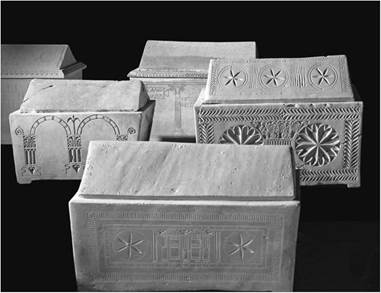
But the bone box soon proved to be a hoax. The box itself was definitely a first-century ossuary. But the inscription "brother of Jesus" appears to be written in an entirely different hand. Even more incriminating was the fact that the collector had engraving tools in his home as well as materials to add a patina (a coating of dust and organic material) to the inscription to make it look like it had been inscribed long ago. In 2003, the Israel Antiquities Authority appointed 14 scholars to determine the authenticity of the artifact, and 13 of them declared it a hoax.
Ouch! Why is Jesus’s family portrayed so badly? It may be because they came to believe in Jesus only after the resurrection, not during the tougher times of his life. The gospel of John says outright that “his brothers did not believe in him” (John 7:1-13) and transfers responsibility for Mary’s care from Jesus to the unnamed “beloved disciple” at the foot of the cross, as if the brothers no longer existed (John 19:26-27)!
Matthew and Luke clean up the family feud in their gospels. If you read their accounts of Jesus’s interactions with his brothers, there’s barely a hint of sibling rivalry.
● In Matthew 13:54-58, the only thing reported is the view of the Nazareth villagers, that Jesus is “just” Mary and the carpenter’s son, the brother of James, Joseph (Joses in the gospel of Mark), Simon, Judas, and of some unnamed sisters. The closest the author comes to criticizing the brothers is to keep part of Jesus’s rebuke from Mark’s gospel: “A prophet is not without honor except in his native place and in his own house” (Mark 6:4 also says “among his own kin,” which Matthew drops).
● The author of the gospel of Luke and Acts of the Apostles cleans up the family feud even more. Mary is portrayed very positively (Luke 1-2), Jesus’s rebuke about his rejection doesn’t mention his kin or his house (Luke 4:24), and Mary and the brothers seem to be among Jesus’s followers, especially after the resurrection (Luke 8:19-21; Acts 1:14).
The differences over the role of Jesus’s brothers may indicate political disputes in the early Church. By the time the gospels were penned, the Jewish form of Christianity that James represented had fallen out of favor, the Christian community in Jerusalem had dispersed under persecution, and Jerusalem itself had been destroyed. The Jerusalem community, and the kind of Christian faith James advocated, had become a distant memory, replaced by the teaching of other apostles in distant communities. Still, the memory of the brothers’ early roles remained powerful enough that the Letters of James and Jude made it into the New Testament because people thought they could be traced to Jesus’s brothers.
Filling the Gaps in Jesus’s Early Life in Later Centuries
As the gospels began to circulate in the late first and early second centuries, inquiring minds wanted to know more about some of the gaps in the tales of Jesus’s infancy and childhood. Were his divine powers apparent as a child? And what was Jesus’s childhood like? They began to tell stories, and some of them, namely the apocryphal texts in the following sections, have survived.
These apocryphal infancy tales were written after the gospels to address developing beliefs and to entertain curious minds. The stories are sometimes appalling, infrequently edifying, and always entertaining. It isn’t too difficult to see why they didn’t make the cut when Christians were binding their Bibles. And in terms of their historical value, it’s basically nil — they’re too late and too dependent on prior gospels, legendary additions, and later beliefs.
Developing the doctrine of the Virgin Mary
A gospel called the Protvogospel of James began to circulate in the mid-second century. This story is mostly about what happened before Jesus’s adult life (hence the prefix “proto” or “first” gospel).
In March of 2007, the Discovery Channel (US), Vision Canada, and C4/UK aired a film titled The Lost Tomb of Jesus, which was produced by Oscar winner James Cameron (Titanic) and directed by journalist Simcha Jacobovici. The film features details of ten bone boxes (or ossuaries) that were discovered in a tomb in 1980, during the excavation for a condo complex in East Talpiyot, south of Jerusalem. Six of the bone boxes bear the inscribed names of the persons whose bones used to be inside: Yeshua (Jesus) son of Yehosef (Joseph), Marya (Mary), Matya (Matthew), Yosah (not Yoseh or Jose, as the filmmakers claim), Yehuda (Judas) son of Yeshua (Jesus), and "[remains] of Mariamne also called Mara" (or possibly "of Mariamne and Martha").
Cameron and Jacobovici used statistics, DNA sampling, and other forensic techniques to argue that there's a 1 in 600 chance that the names found on the inscriptions weren't the family of Jesus. While each name is extremely common, the film argues that it's the combination of these particular names that's decisive. Statistics sound impressive, but if they're based on faulty assumptions, they lose all their power. And there are at least three faulty assumptions at work here:
● That Jesus's poor family from Nazareth could have afforded a nice family tomb and would have built it so far away from home: Only the wealthy could afford rock-cut tombs and reburials in ossuaries. The poor, by contrast, were usually buried in trench graves, like those we dig today. On the rare occasions that someone was buried away from their home turf, their place of origin was usually inscribed on the ossuary, but none of the ossuaries in the Talpiyot tomb bear such inscriptions. This grave was for a well-off Judean clan, not the relatives of a poor man from Nazareth.
That Mariamne refers to Mary Magdalene: Cameron and Jacobovici reach ahead three centuries to the apocryphal Acts of Philip to find a reference to a woman that's spelled "Mariamne." But in the Acts of Philip, she's Mary the sister of Martha (see Luke 10:39; John 11:2, 12:3), not Mary from Magdala. The gospels, written in Greek, always call that Mary "Maria [or Mariam] the Magdalene" rather than "Mariamene" or "Mariamne." Quite frankly, the Ist-century gospels are more likely to have the name right than a 4th-century text that was written in Asia Minor and survives only in a 14th-century copy. The filmmakers take "Mariamne" as a unique spelling that's only ever been used of Mary Magdalene. But it was a common Greek spelling of the name Mary; it's spelled this way on at least 20 other known ossuaries in Israel. And despite how common it is, it's never used of Mary Magdalene, even in the Acts of Philip.
● That the bone box of "James, son of Joseph, brother of Jesus," publicized by Jacobovici (and others) in 2002, came from this tomb: It's true that there was a tenth ossuary found during the excavation of the Talpiyot tomb in 1980 that has since been misplaced. But Amos Kloner, the archaeologist who excavated the Talpiyot tomb and actually saw the tenth ossuary, reported that it wasn't inscribed. As for the bone box of James, the origin of that box is unknown because it was bought on the antiquities market. And, in fact, the part of the inscription reading "brother of Jesus" was most likely a recent addition (see the earlier sidebar "The bone box of James: A hoax or the real McCoy?").
The idea that Mariamne is Jesus's wife is based on two arguments: DNA testing of residue found in Jesus's and Mariamne's ossuaries revealed that the individuals didn't share a mother, and if they aren't maternally related, they must be married. Because this tomb was plundered in antiquity and anybody's DNA could have found its way in there, we have no proof that the residue in the ossuary is from the bones buried there. Plus, just because two people don't share a mother doesn't guarantee that they're married! They could be a stepbrother and stepsister, aunt and nephew (through her brother), and so on.
Apart from the problems with the statistics and other assumptions, it doesn't help the movie's premise that the Jesus ossuary is the least decorated and that the name is scratched in pretty hastily, while the ossuaries of Judas (Jesus's son) and Mariamne are very carefully inscribed and decorated. Wouldn't you expect Jesus's ossuary to be the nicest?
So, the plot is really more about Mary than it is about Jesus. By this point in time, the belief that Jesus was divine had developed to such a degree that his birth from a human mother had become difficult to explain. The divine was thought to be immaterial, eternal, and uncorruptible, so people wondered how a divine child could come to life in a material, temporal, and corruptible woman.
The Protogospel of James put people’s minds at ease with its story of Mary’s life and Jesus’s birth. According to this gospel, for example, Mary had been conceived without sin by her barren mother, Hannah. Grateful that her prayer for a child had been answered, Hannah made the baby’s room a little sanctuary so that the infant would remain pure, and then she shipped little Mary off to the Jerusalem Temple so that the priests could protect her sanctity.
As menstruation approached, however, the priests knew she couldn’t remain at the Temple (flip to Chapter 7 for purity rules at the Temple). So, they sought an appropriate husband. When the old man Joseph appeared with his adult sons, a dove landed on his walking staff, marking him as God’s choice for Mary. (In later iconography, it bloomed with flowers instead, as people combined this story with the account of the great priest Aaron’s flowering staff in Numbers 17:16-26.) Then Mary became pregnant miraculously and, finding a cave, gave birth to Jesus in a flash of light. What follows is one of the most curious scenes in Christian literature: The attending midwife attempted to insert her finger into Mary’s vagina to test whether her hymen had been broken by the birth (of course it had never been broken in intercourse either). The midwife’s hand then burst into flame until she repented her sin of putting God to the test.
This story, unlike the Biblical gospels, explains that Mary miraculously remains a virgin through the birth process and then through the rest of her life. After all, Joseph is too old to want sex, and he already has sons from a prior marriage. Even though this story never made it into the Bible, it has been popular in Christian tradition and art for 1,800 years. The “perpetual virginity of Mary” also remains the official teaching of the Roman Catholic Church, which treats both scripture and subsequent tradition as expressions of divine revelation.
Describing Jesus's infancy in Egypt
Matthew’s gospel reports that Jesus’s family spent some time in Egypt until it was safe to return to Palestine (see the earlier section, “The escape to Egypt,” for more information). Early Christians wondered what life was like for the family while they were there.
The Arabic Infancy Gospel fills in that gap in the sixth century CE. According to this gospel, when the family arrived in Egypt, the chief Egyptian idol announced that God had entered the country, and then it promptly destroyed itself. As the holy family traveled through the country, every town had some demoniac or mute bride or leper or impotent bridegroom who was cured by kissing the baby Jesus or touching his bathwater. This tradition displays a common tendency in the apocryphal gospels to take details from gospel accounts of the adult Jesus and write them back into his infancy.
Portraying a powerful child
The Arabic Infancy Gospel tells similar tales of Jesus’s childhood in Nazareth: Lepers are cured, dead children are raised, and petitioners bathe in Jesus’s bathwater.
In this gospel, as well as in the much earlier Infancy Gospel of Thomas on which it is based (mid-second century CE), the story gets even more interesting as Jesus gets older. For instance:
● Jesus molds animals and birds out of clay and makes them come to life (see Genesis 2:7; the Qur’an picks up this story in 5:110).
● He tags along on Joseph’s carpentry calls and fixes all his dad’s mistakes.
● Playmates run away from him, and so Jesus turns them into sheep so he can play as if he’s their shepherd.
● He resurrects a dead boy to avoid blame for the boy’s death.
In this story, Jesus’s playmate falls from the roof and dies. The boy’s parents blame Jesus, so he resurrects the dead boy long enough to get himself off the hook.
Later in the gospel, things take a darker turn. It seems that everyone who bothers the powerful child lives to regret it, if indeed they live at all. A would-be bully is struck dead. Adults who accuse him are blinded. A harsh teacher flogs young Jesus, and he’s toast At that point, Mary and Joseph decide to home-school Jesus, until he sneaks out and wows the Jerusalem teachers at age 12 (this one detail corresponds to the earlier account in Luke 2:41-52, which the author certainly knew). But, when he reaches adolescence, he realizes that he must hide his powers until he can manage them properly as an adult.