
Chapter 10
In This Chapter
● Introducing John the Baptist
● Doing battle with the Devil
● Meeting Jesus’s closest companions
● Preaching to sinners on their own turf
The historical Jesus emerged from the anonymity of his Galilean hometown sometime in the late 20s CE. Trained as a woodworker, he left his family and trade behind in Nazareth and arrived on the banks of the Jordan River to be washed by the charismatic prophet and purifier, John the Baptist. That moment in the gospels marks his first public step as the leader of a new movement.
In this chapter, you join Jesus at the Jordan and in the desert, follow him around the Sea of Galilee as he gathers a band of supporters, and watch him meet with all the wrong kinds of people.
Meeting John the Baptist
All four gospels tell the story of a man named John who began to baptize people in the Jordan River. Luke 3:1 adds that his ministry began in the fifteenth year of the reign of Emperor Tiberius (approximately 28/29 CE). In the gospels of Mark and Matthew, Jesus is one of the people he baptizes. Given its location at the inauguration of Jesus’s mission, the story of the baptism introduces important ideas about who the gospel authors believe Jesus is — and who John the Baptist is, too.
Rinsing off sins in the river
Many Jewish people in the time of Jesus washed themselves ritually in special baths that cleansed them from typical activities or occurrences that were believed to defile a person. Such activities included ejaculation, menstruation, childbirth, or preparing a corpse for burial. There was nothing wrong with these activities at all; folks simply needed to wash and wait a period of time to purify themselves afterward. And as far as we can tell, they needed to purify themselves after some of these activities only if they were going to the Temple (Chapter 7 has more on these purity practices).
John’s baptisms as reported in the gospels are similar to these purifying baths, but also different. How? Consider these features:
● John’s baptisms didn’t cleanse you from the normal human defilements but instead represented your repentance and commitment to a conversion or change of lifestyle (some other Jewish groups may have understood their ritual baths in this way, like the people who compiled the Dead Sea Scrolls).
● You didn’t dunk yourself (the Greek verb baptidzo means “to dip or dunk”), which you would do in the ritual baths; instead you had to seek out John and his companions to do it.
● John’s baptism occurred at the Jordan River out in the wilderness — not in the ritual baths that dotted Jewish villages.
Baptism was an unusual thing to do at the time, but it was apparently so characteristic of John that he’s called “the baptizer” by the gospel authors and by Josephus, a contemporary Jewish historian (see the later sidebar, “Josephus’s account of John the Baptist,” for more information). Jesus and the movement that followed him picked up the baptism practice from John. By the time the gospels were written, the early Christians were speaking of two baptisms: the baptism of water practiced by John and the baptism by the Holy Spirit/fire practiced in Jesus’s name (Mark 1:8; Matthew 3:11; Luke 3:16; John 1:26-27, 33).
The fact that Jesus needed something from John (rather than the other way around) was a little awkward for the gospel authors. To them, it raised questions: Does this mean that John is the greater guy, because Jesus comes to him to be baptized? Does it mean that John is the greater guy because he’s the first to baptize? Does it mean that he’s greater because Jesus’s teachings echo his?
Each of the gospels solves these problems by making John less significant than Jesus. Jesus’s significance is crystal clear when he rises from the water in Mark, Matthew, and Luke’s gospels and the heavenly voice declares, “This is my beloved son,” meaning Jesus of course, not John (Mark 1:10-11; Matthew 3:16-17; Luke 3:21-22). In the gospel of John, the Baptist never baptizes Jesus. However, he does testify to him, calling him:
● “The one whose sandal strap I am unworthy to untie” (John 1:27; see Mark 1:7)
● “The one . . . who ranks ahead of me because he was before me” (John 1:30)
● The one on whom he saw the spirit come down and remain (John 1:33; see Mark 1:10 || Matthew 3:16 || Luke 3:22)
Even Q and the special Lukan material weigh in on this issue (Q 7:28; 16:16; you can find the special Lukan material in Luke 1:11-17, 41-45, 76-79). These explanations are most likely later additions to the awkward historical fact that all four gospels report: that Jesus got his start with John the Baptist’s baptism.
Did John the Baptist use a cave?
In August 2004, British archaeologist Shimon Gibson announced that he had excavated a cave (with the help of American archaeologist James Tabor) 2 1/2 miles south of Jerusalem, where he claimed that John the Baptist had immersed or anointed his disciples. The cave had been carved some 500-800 years before Jesus's time and had long been used as a purification site by local Jews, as the 250,000 shards from small pots (which may have been used to hold oil or water) and the foot-shaped niche attest. The following are a couple of reasons that Gibson thought John must have baptized here:
● The cave is near Ein Kerem, a village traditionally associated with John the Baptist.
● Several carvings were found inside the cave, including one of a man with unruly hair and a spotted tunic (a convention for depicting animal hide, such as camel's skin). The camel's skin clothes match the gospel description of the Baptist (Mark 1:6). The unruly hair only fits him if you imagine that John not only didn't drink alcohol (Luke 1:15) but, like a full-fledged Nazirite, avoided both alcohol and cutting his hair (see Numbers 6:1-21 for a description of the Nazirites and their special vows).
● A carving of a head was found near the cave entrance. This carving could possibly be a depiction of John's head, which was severed by Herod Antipas and served on a platter (Mark 6:27-28).
The evidence seems a bit sketchy, so experts believe that it isn't very likely that the cave was actually used by John. Besides, all of our sources, including those from the Jewish historian Josephus, suggest that John was baptizing whole bodies (not just feet) out in the open and drawing large crowds. Our sources also note that John was arrested by Herod Antipas, who ruled in the Galilee and in Perea, north of Jerusalem and east of the Jordan River. But Ein Kerem is actually in Jerusalem. And, finally, the carvings date from the Byzantine period some 300-400 years after John's time.
Acting as the messenger of the messiah
The gospel authors do a kind of “extreme makeover” of the historical John. They rewrite his probable role as a popular Baptist and possible mentor of Jesus, making him instead the herald for Jesus — a kind of second fiddle who came first. For the gospel authors, John ushers in the messianic age — and the messiah is Jesus. The gospel authors use earlier Jewish scripture to make clear just who John is (while maintaining that Jesus is greater). For instance, consider these references:
● The Jewish prophet Isaiah had said centuries before, “A voice cries out: ‘In the desert, prepare the way of the Lord; Make straight in the wilderness a highway for our God’” (Isaiah 40:3). All the gospel authors believe that John is this voice, and so they cite that passage of Isaiah to make it clear.
● The gospels of Mark, Matthew, and Luke also cite the prophet Malachi: “Look, I send my messenger to prepare the way before me” (Malachi 3:1). Refer to Mark 1:2, Matthew 11:10, and Luke 1:76; 7:27 to see these references.
Some Jews in Jesus’s day thought that messenger would be Elijah, the great miracle-working prophet of Israel’s past who had been whisked off to heaven when the sweet chariot had swung low (2 Kings 2:1-18). Malachi himself says, “See, I will send to you Elijah the prophet, before the day of the Lord comes” (Malachi 4:5, which is 3:23-24 in the Hebrew text). The gospel authors, on the other hand, turn John into the returned Elijah; John even wears clothes of camel’s hair and leather like Elijah (2 Kings 1:8).
How exactly did John usher in the day of Jesus? In the following sections, you find out that John preached, started a movement that survived him, and met his end much like Jesus did later.
Paving the way for Jesus's final act
John paves the way for Jesus through his preaching. He warns everyone to “Repent, for the kingdom of the heavens is near” (Matthew 3:2). Mark, Matthew, and Luke agree that John urged religious conversion with a sense of urgency that’s typical of end-times preaching. They also agree with the Jewish historian Josephus that John drew tremendous crowds — apparently in greater numbers than Jesus later would. After all, Herod Antipas killed John because he was worried about these crowds, but he didn’t kill Jesus (see the later sidebar, “Josephus’s account of John the Baptist”).
Mark and Matthew say that Jesus’s first public words were just like John’s (Mark 1:15; Matthew 4:17). And, as awkward as it was to admit, all four gospels note that Jesus inaugurates his ministry from some sort of starting point under John. One gospel author even says that Jesus practiced John’s water baptism for a time (John 3:22, 26; 4:1). However, he then corrects himself to say that Jesus wasn’t baptizing — only his disciples were (John 4:2).
Enduring arrest and execution
John is Jesus’s forerunner in another more unfortunate way. Like Jesus, John is arrested by the ruler and executed. The gospels offer one reason for the arrest: John accused the Jewish ruler Herod Antipas of adultery for marrying his brother Philip’s wife Herodias. The gospels actually got this all wrong. Herodias’s first husband wasn’t Philip, but rather another brother, Herod Boethus, and her daughter’s name was Salome (Mark mistakenly calls the daughter Herodias in 6:22). Check out Figure 10-1 for a family tree and Chapters 7 and 8 for more on the Herods.
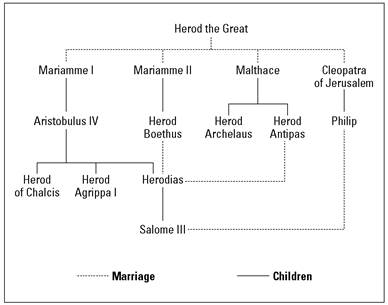
Figure 10-1: A partial family tree of Herod the Great.
According to the gospels of Mark and Matthew, Herod Antipas beheaded John because Herodias’s daughter seduced him into it (Mark 6:17-29; Matthew 14:3-12). The Jewish historian Josephus, on the other hand, offers a different reason for the execution — and it’s probably more accurate (see the nearby sidebar, “Josephus’s account of John the Baptist,” for details).
Josephus's account of John the Baptist
The Jewish historian Josephus wrote two important books: an account of the First Jewish Revolt in 66-74 CE (which is aptly named, The Jewish War, or Warfor short) and a later account of the long and venerable history of the Jews (which is called Jewish Antiquities, or Antiquities for short, c. 93 CE). In JewishAntiquities, Josephus covers everything from the creation of the world down to his own time. He includes a story about Herod Antipas's defeat by the Nabatean King Aretas IV, the father of Antipas's first wife whom Antipas had jilted when he married Herodias. Within this story, Josephus recounts how some of the Jews believed that Antipas's defeat was divine vengeance for his murder of John the Baptist.
Like the gospels, Josephus says John was a good man who urged justice and baptized those who were committed to its practice. Unlike the gospels, however, Josephus says that Antipas killed John because John was a powerful speaker, and he feared that John might turn his sizeable following against Antipas in a revolt (JewishAntiquities, 18.5.2). Even though Josephus mentions that Herodias switched husbands, he never says that John preached about it, and he doesn't mention Jesus here at all.
Sharing converts
Like Jesus, John had a lot of followers. They helped him baptize and they listened to his teachings, and some may have joined the Jesus movement (John 1:35-42). You hear about John’s disciples later in the gospel because John sends them to find out whether Jesus really is the promised one — apparently, John isn’t so sure! (Matthew 11:2-6 and Luke 7:18-23). These disciples bury John’s remains when Herod Antipas beheads him (Mark 6:29; Matthew 14:12).
John’s disciples traveled around the Mediterranean after his death to share water baptism with others. In contrast, the followers of Jesus were practicing both John’s baptism by water and Jesus’s baptism by the Holy Spirit (Mark 1:8; Matthew 3:11; Luke 3:16; John 1:26-27, 33). From the early Christian vantage point, John’s baptism alone didn’t cut it. So Jesus’s followers nudged John’s followers to take the final plunge and accept Jesus’s baptism as well (Acts 18:24-26; 19:1-7). And they’re still trying to do this in the gospels by presenting John as the runner-up to Jesus.
Battling the Devil in the Desert
Immediately after being baptized, the spirit of God drives Jesus into the wilderness where he’s tempted by Satan. Mark reports that he was in the wilderness for 40 days and that angels ministered to him — which may mean that they fed him (Mark 1:12-13). Matthew and Luke, on the other hand, alter the story by saying that Jesus fasted for the whole 40 days (talk about being hungry!). They also add sayings material from Q detailing the three temptations that Jesus endured (Q 4:1-13). For more details on Q, flip to Chapter 5.
The gospel authors craft the temptation scenes to demonstrate Jesus’s status as the son of God capable of defeating not just human needs like hunger, but the power of Satan as well. They depict Jesus deflecting each temptation with God’s own words (see Table 10-1).
|
Table 10-1 The Temptations of Jesus |
|
|
Satan's Temptation |
Jesus's Response |
|
Can you turn stones to bread? (Matthew 4:3-4; Luke 4:3-4) |
Man doesn't live by bread alone (Deuteronomy 8:3). |
|
Will God's angels save you if you plunge from the parapet of the Temple? (Matthew 4:5-7; Luke 4:9-12) |
Don't put the Lord your God to the test (Deuteronomy 6:16). |
|
Will you worship Satan to get all kingdoms of the world? (Matthew 4:8-10; Luke 4:5-8) |
The Lord, your God, shall you worship; him alone shall you serve (Deuteronomy 6:13). |
The gospel of John doesn’t include Jesus’s scene with Satan at all.
It saves Jesus’s decisive defeat of “the ruler of this world” for the end of the story, when Jesus defeats death (John 12:31-32).
You have two independent sources — Mark and Q — that tell the story of Satan and Jesus. However, the heavy references to scripture and the fact that these sources differ and there were no eyewitnesses suggest that the early Christians were once again trying to present something more than history, something deeper than details.
Gathering Companions
After the encounter with the Baptist movement and after Mark, Matthew, and Luke’s desert battle with the devil, the first public task Jesus performs in practically all four gospels is calling people to follow him (Luke delays this a little bit). The gospels report that Jesus had a large group of disciples, which is a term that applies to anyone who followed him. Out of that large group, 12 men are singled out by name. Also mentioned are several women who accompany Jesus from his first days in the Galilee.
Naming the Twelve
It seems likely that Jesus picked 12 followers during his lifetime. The gospels don’t explain why Jesus picked these particular guys, and they don’t agree about how early in the movement’s history they became the core group. But nevertheless, the gospels of Mark and John, which are independent witnesses to the historical Jesus, refer frequently to “the Twelve” (Mark 9:35; 10:32; 11:11; John 6:67-71; 20:24). The author of Luke’s gospel usually relies on Mark for his information, but one of Luke’s names in his list of the Twelve is different, which may mean that the author had a different and independent list. Paul mentions the Twelve (1 Corinthians 15:5), and there’s also a Q saying about them (see Chapter 5 for more about Q). So, we have five independent sources for these men.
Here’s a list of the disciples who are usually considered “the Twelve,” listed in order of the earliest list in the gospel of Mark:
● Peter: He was a fisherman from Capernaum (John says Bethsaida). He’s also often called Simon, Simon Peter, or Cephas. (Cephas comes from the Aramaic for “rock,” and Peter comes from the Greek equivalent for the same.)
● Andrew: He was Peter’s brother and fishing partner; John’s gospel says that Andrew was first a disciple of John the Baptist.
● James: He was son of Zebedee and a fisherman from Capernaum. He’s called “James the Great” in later tradition.
● John: He was James’s brother and partner in the family fishing business. And maybe because they’re so brazen, in Mark, Jesus gives the two brothers the name Boanerges, which is a Greek form of the Aramaic “sons of thunder” (Mark 10:35-45).
● Philip: He was from Bethsaida, another town on the coast of the Sea of Galilee.
● Bartholomew: This member of the Twelve doesn’t get a lot of press. There simply aren’t any stories about him apart from the list of the Twelve. Since the ninth century CE, some people have wondered if he’s the Nathanael mentioned in John 1:45-51 and 21:2. Why? Because Nathanael is a normal first name and Bartholomew was more likely a surname (the Greek is based on the Aramaic Bar-Talmai, which means “son of Talmai”).
● Matthew: He’s called a toll collector in Matthew’s gospel. This reference solves the problem in Mark that the toll collector Levi is called (Mark 2:13-17) but never listed among the Twelve (Mark 3:13-19).
● Thomas: Thomas, or “twin” in Aramaic, is called “doubting Thomas” because he doubted Jesus’s resurrection until he could touch Jesus’s wounds himself (John 20:24-29). He’s also called Didymus Thomas (which is like saying “twin” twice in both Greek and Aramaic).
● James: This man, who was the son of Alphaeus, was called in later tradition “James the Less” — not to be confused with James the Great or James brother of Jesus (James was obviously a popular name at the time!).
● Simon: He was called “the Cananean” (which means “zealous” or “jealous” in Aramaic) in Matthew and Mark and “the Zealot” (the Greek equivalent of the same) in Luke.
● Thaddeus: There’s a bit of controversy when it comes to this 11th disciple. In Mark and Matthew, he’s called Thaddeus. Luke, on the other hand, calls this man Jude, son of James.
● Judas Iscariot: He’s the one who betrayed Jesus to the authorities (so he’s always put last on lists of the Twelve!).
The differences in the various lists suggest that, by the time the gospels were written, the importance of the Twelve had begun to wane. After all, if they or the communities they founded were still potent, their names would be firmly entrenched and well-known to the gospel authors.
The Twelve disciples’ importance may have been dwindling because of their deaths, because of changing leadership patterns in the church, or simply because traditions about the lesser-known ones had been lost. Another reason the Twelve as a group may not have loomed so large at the end of the first century CE has to do with their role. The gospels report that their job was to preach to Israel (Matthew 10:5-6) and to judge the 12 tribes of Israel at the end of time (Q 22:30). But by the late first century, when the gospels are composed, the message is no longer being preached just to Israel, and the end of time seems indefinitely delayed.
Admitting the female companions
Several women accompanied Jesus from the beginning of his public ministry in the Galilee. The gospel authors seem a little reluctant to report this fact, however, and so they don’t provide very many details. Their embarrassment makes it likely that these women were in fact there. In the following sections, I explain how different gospels cover the presence of women and describe their role, and I look at a particularly special woman: Mary Magdalene.
Mark, Matthew, and John: Saving the best for last
Mark’s gospel is the first, and he doesn’t mention that women followed Jesus until the end of the story, when Jesus has just died. At this point, Mark says:
And there were women watching from a distance, among them Mary Magdalene, and Mary the mother of James the younger and Joses, and Salome, who followed him when he was in Galilee and ministered to him, and many other [women] who had come up together with him to Jerusalem.
—Mark 15:40-41
Now that Jesus is dead and gone, we’re suddenly introduced to women who have been with Jesus throughout the previous 15 chapters of the gospel! Matthew also saves any reference to the women until Jesus has breathed his last breath (Matthew 27:55-56). Neither Mark nor Matthew calls any of the women a mathetria (“disciple”), but both do say that they “followed” and “served” Jesus, typical actions of disciples.
John’s gospel is like these two. He doesn’t mention Mary Magdalene until Jesus’s death, and in any case Jesus’s mother and his “beloved disciple” are the most important figures there (John 19:25-27). Jesus does have a long encounter with a Samaritan woman earlier in John’s gospel, but she doesn’t follow Jesus on the road (John 4:4-42; the story of the adulterous woman in John 7:53-8:11 isn’t in the earliest manuscripts of the gospels). The same is true for the sibling trio of Mary, Martha, and Lazarus — they seem to be groupies of the “stay-at-home” type (John 11:1-44; 12:1-7; Luke also gives that impression in Luke 10:38-42, although he doesn’t mention Lazarus).
Luke: Putting the Women in their place — early on
The author of Luke, who generally tries to improve on prior gospels by writing “a more orderly” account (Luke 1:3), puts Jesus’s female followers in the correct place — earlier in the gospel while Jesus is still in the Galilee. Remember, Mark and Matthew admit that the women were there then, but never mention them at that point in the story. The author of Luke straightens that out by mentioning them at the right moment. Soon after Luke introduces his list of the Twelve male disciples (Luke 6:12-16), he says:
And soon afterwards he went on through the cities and villages preaching and bringing the good news of the kingdom of God, and the Twelve were with him, and some women who had been cured of evil spirits and illnesses, Mary called Magdalene from whom seven demons had gone out, and Joanna wife of Chuza, Herod’s steward, and Susanna and many others, who provided for them out of their resources.
—Luke 8:1-3
What’s Luke up to here? Some think he’s sensitive about women hitting the road with Jesus (much like Mark was). After all, women didn’t usually travel and eat with unrelated men. No doubt some conservative folks wondered what exactly those women were doing in the group. So to make sure people didn’t get the wrong idea, Luke made the women grateful, wealthy, well-heeled, and thus above reproach. After all, this is the only place where any gospel says that Mary Magdalene was possessed — of seven demons, no less
Mary Magdalene: How she became history's holy harlot
Christian tradition and art depict Mary Magdalene as a prostitute who repented of her evil ways and followed Jesus. That's why Christian outreach services for unwed mothers and prostitutes are often named after her. But this tradition has no basis in the canonical gospels. These works tell us almost nothing about Mary, except that she isn't affiliated with any man (the name "Magdalene" isn't a family name; it was given to her because of the town from which she hails).
So why was she transformed into a prostitute? There could be several reasons, including these:
● Luke introduces her immediately after the story of the sinful woman who anoints Jesus's feet (Luke 7:36-8:2), and because so few women are mentioned in the gospels people assumed that it was the same woman.
● In John's gospel, a woman named Mary anoints Jesus's feet just before his arrest; she isn't a sinner, and she isn't Mary Magdalene, but people tend to confuse the few women named Mary, especially because they all seem to anoint Jesus's feet (John 12:1-8). Even more confusing is the fact that Mary Magdalene is the one who goes to anoint Jesus's body after his death — you can see why people may have become confused (Mark 16:1-8).
● The gospels of Mark, Matthew, and Luke report the apparently common slur that Jesus hung out with "tax collectors and sinners," and "sinners" could include prostitutes and adulterers. Add to that the story of Jesus's encounter with the adulteress that was later tacked on to John's gospel (John 7:53-8:11), and you can see why any woman who hung out with Jesus might be lumped into the "loose women" category.
● Mary Magdalene was a prominent figure in the early Gnostic Christian communities (see Chapter 5 for more on the Gnostics). In their Gospel of Philip and Gospel of Mary Magdalene she's portrayed as the disciple Jesus loved most, the one he privileged with special revelation (the metaphor of a divine and definitely asexual kiss is used for that special knowledge). The Gnostics were targeted as heretics by other Christian communities starting in the second century CE. These "mainstream" Christians may have turned Mary into a sinful, sexualized woman in order to strip the heretical Gnostic heroine of her power in people's eyes.
● A few centuries after Jesus, virginity had become so celebrated that stories of penitent sinners were all the rage — and Mary Magdalene became one.
(Mark 16:9 is a late addition to that gospel and is probably based on Luke 8:2). That would make her pretty darn grateful to Jesus, dedicated to him not because she’s a loose woman but because she’s happy to be whole again. It’s ironic that later tradition would make Mary Magdalene a prostitute, given how intent the gospels are to avoid that impression (see the nearby sidebar, “Mary Magdalene: How she became history’s holy harlot,” for more information).
Witnessing the death, burial, and resurrection
The primary role of the female disciples in the story of Jesus is to testify to those events that were the crux of the gospel message — the death of Jesus on the cross, his burial in a tomb, and his resurrection two days later. The fact that the female disciples rather than the men performed this role isn’t unusual. The men had all scattered in fear for their lives. Female followers, on the other hand, wouldn’t have been so conspicuous to the wary Romans. And on top of that, women in first-century Jewish culture were often the ones who lamented the dead and prepared bodies for burial.
All four gospels mention women at the cross and tomb (see Table 10-2), and while Mary Magdalene is on every list, the other names differ. That makes it very difficult to reconstruct exactly who was there, apart from Mary Magdalene.
|
Table 10-2 The Women at the Cross and Tomb |
||||||
|
Event |
Mark 15:40-16:8 |
Matthew 27:55- 28:10 |
Luke 8:1-3; 23:49-24:11 |
John 19:25-20:18 |
||
|
Cross |
Mary Magdalene, Mary mother of James the younger and Joses, Salome, and many others |
Mary Magdalene, Mary mother of James and Joseph, mother of the sons of Zebedee, and many others |
Women who had followed from Galilee |
Jesus's mother, Jesus's mother's sister (may be same person as Mary wife of Clopas), and Mary Magdalene |
||
|
Burial |
Mary Magdalene and Mary mother of Joses James, |
Mary Magdalene and "the other Mary (probably Mary and Salome the mother of Jamesand Joseph who's mentioned five verses before) |
Women who had followed from Galilee |
None |
||
|
Event Mark 15:40-16:8 |
Matthew27:55- 28:10 |
Luke 8:1-3; 23:49-24:11 |
John 19:25-20:18 |
|||
|
Resurrection Mary Magdalene, Mary mother of |
Mary Magdalene and "the other Mary" |
Mary Magdalene, Joanna (wife of Chuza), Mary mother of James,and many others |
Mary Magdalene |
|||
Looking at the special case of Mary Magdalene
Of all the female followers, Mary Magdalene is mentioned most regularly across the gospels, and she’s almost always at the head of the list. This is most likely due to her prominence among the women during Jesus’s life and to the fact that she was the first witness to his resurrection. Despite the rumors, however, it most likely isn’t because she and Jesus were married (see the nearby sidebar “Was Mary Magdalene Mrs. Jesus?”).
Hanging Out with the Wrong Crowd
Like John the Baptist, Jesus inaugurated his public ministry by preaching repentance (Mark 1:3-4; 15; Matthew 3:2; 4:17). But it quickly became clear that Jesus’s brand of repentance wasn’t only the fire and brimstone, “ax to the root of the tree” tirade that John was famous for. Instead, Jesus preached repentance by meeting sinners on their own turf, eating and drinking with them (the contrast between John and Jesus is made as early as Q 7:33-35). As Mark’s Jesus puts it, “Those who are strong don’t need a doctor, but those who are sick; I have come not to call the righteous, but the sinners” (Mark 2:17). And more often than not, they give him a better reception than the righteous folks do anyway (Mark 2:13-17; Matthew 22:1-14; Luke 7:36-50; 15:1-32).
In the gospels of Mark, Matthew, and Luke, Jesus is frequently criticized for hanging out with the wrong kinds of people, namely toll collectors and sinners (Mark 2:13-17; Matthew 9:9-13; Luke 5:27-32; Luke 15; Mark 7:1-13). Jesus’s practice of eating and drinking with sinners was a problem with some conservative folks who had a different idea of how a “religious guy” should behave. In fact, it presented quite the contrast to his mentor, John the Baptist, who barely ate at all — just those tasty, honey-glazed locusts! (Mark 1:6). In Luke’s gospel, you find out that John will be a teetotaler (someone who doesn’t drink alcohol) before he’s even born (Luke 1:15). The sayings source Q confirms the adult Baptist’s teetotalism, saying that he neither ate food nor drank wine (Q 7:31-35). Jesus, by contrast, “came eating and drinking,” and people called him “a glutton and a drunkard, a friend of tax collectors and sinners.” John’s disciples fasted, while Jesus’s didn’t (Mark 2:18-22). John abstained while Jesus partied. In Jesus’s practice and preaching, a different age had dawned.
Was Mary Magdalene Mrs. Jesus?
Given the intimate relationship between Jesus and Mary Magdalene at the moment of the resurrection, particularly in John's gospel (John 20:1-18), many people have wondered if there was more to the pairing than the gospels let on. The idea that Jesus and Mary were married has been especially popular in literature and in the entertainment industry with books and films such as Nikos Kazantzakis's novel The Last Temptation of Chrisf (1955), Dan Brown's novel The Da Vinci Code (2003), and the TV documentary The Lost Tomb of Jesus (2007). Using the following historical ground rules from Chapter 3, you can evaluate how likely the Mrs. Jesus scenario is:
● Eyewitness testimony must be in multiple, early sources: No early sources say Jesus and Mary were married, and one even suggests that Jesus promoted celibacy (Matthew 19:10-12). Paul seems to know that Jesus wasn't married, though, because when he argues that he could travel with a wife like "the other apostles and the brothers of the Lord and Cephas [Peter]," Jesus is conspicuously missing from the list of husbands (1 Corinthians 9:5; though admittedly, this is an argument from silence). And even though the later Gnostic gospels say that Jesus and Mary kissed, they never say that it's a sexual kiss or that Jesus and Mary were married. These later gospels I refer to include the Gospel of Mary Magdalene and the Gospel of Philip (see Chapter 5 for more about these sources).
● Embarrassing things are more likely to be true: Jesus traveled with women and it made the gospel authors a little nervous, but they explain it for the reader (even if they delay mentioning it). If Jesus and Mary had been married, the fact that she traveled with him wouldn't have been unusual at all, and it wouldn't have required all those textual acrobatics. It may have been a little strange for a Jewish man not to marry, but we know of Jewish groups that practiced celibacy during Jesus's time (like the Essenes; see Chapter 7). Unusual and awkward things that get reported anyway make traditions more credible, not less.
In the end, the canonical gospels respect Mary Magdalene for her witness to the Christian faith. The modern novels and films can only imagine her to be significant if she's married and has children, as if her sexual relationship with Jesus rather than her testimony were her chief claim to fame.