
Part IV
In this part . . .
The story of Jesus’s death is central to the gospel accounts. In fact, the earliest gospel, Mark, devotes a full third of its pages to Jesus’s final week in Jerusalem. When the authors invest so much energy in their account, it’s clear that they have a lot at stake in the outcome. So it’s all the more important to ask the question that motivates this book: How well do the gospel stories about Jesus’s death and resurrection stand up to historical scrutiny?
In this part, I show you the power pyramid in Palestine so you can see who had it out for Jesus and why. I explain who the gospel writers thought Jesus’s enemies were, and I give you the chance to evaluate this testimony against history. Also in this part are the facts regarding the gruesome Roman practice of crucifixion. I give you an up-close look at Jesus’s last week and his arrest and execution. Finally, I tell the stories of Jesus’s resurrection from the dead and trace how that event transformed Christian beliefs about Jesus in the first 500 years of Christianity.
Chapter 13
In This Chapter
● Exposing the power dynamics in Palestine
● Discovering the Roman rulers’ concerns
● Sifting through the objections of different Jewish groups
● Surveying the disappointment of Jesus’s family and friends
● Considering Jesus’s ultimate opponent
As most folks know, the story of Jesus ends badly. After being betrayed by one of his closest friends and abandoned by the others, Jesus was tortured and executed by an alliance of Jewish aristocrats and the Roman prefect in Jerusalem sometime around 30-32 CE. His death by crucifixion is one of the most reliable historical details of his life. So, any account of his life must paint a plausible picture of why this charismatic teacher and healer was viewed as a threat.
In this chapter, you discover the power pyramid in Jesus’s time, you unearth each power player’s motives for opposing or eliminating Jesus, you investigate the concerns that his own family and friends had about him, and you ponder why the gospel authors shift the blame to the wrong people when they tell the story of Jesus.
Scanning the Power Pyramid in Palestine
The gospels give the impression that several Jewish groups — the Pharisees, the scribes, the priests, the elders, the Sadducees, and the high priest — teamed up to take Jesus out. They all conspired to test him, trap him, arrest him, and turn him over to the Romans. This conspiracy makes it seem like all these groups had equal power and shared motives, and that the ruling Romans or Herodians were governed by them. However, that wasn’t the case.
The historical picture flips that impression upside down. Society was organized hierarchically, like a pyramid. Needless to say, the Roman Emperor Tiberius was on top (see Chapter 6 for more on him). Below him were two parallel pyramids in Palestine, the southern and the northern (see Chapters 7 and 8 for more about the politics in these regions). Here’s the lowdown on these two regions:
● The southern pyramid of Judea-Samaria-Idumea: After 6 CE, Judea, Samaria, and Idumea came under the jurisdiction of a Roman prefect (see Chapters 6 and 8). The prefect picked a Jew to serve as high priest, who was the closest thing the south had to a native leader. The high priest worked with the local aristocrats, a group that included the Sadducees, the elders, and some of the wealthy priestly families. These groups employed a police force, toll collectors, scribes, and various other bureaucrats to run things.
The Pharisees, another group that had been politically powerful in the past, were largely sidelined by this arrangement. They had opposed the Sadducees during the Hasmonean period (164-37 BCE), so when Rome sidled up to the Sadducees and aristocrats, the Pharisees were on the losing side of the equation. They had to content themselves with trying to shape popular piety and practice in Judea. (There’s more on each of these groups later in the chapter.)
● The northern pyramid of Galilee-Perea: Regions with relatively effective Jewish client kings, like Galilee-Perea under the tetrarch Herod Antipas, weren’t directly annexed and administered by Rome, but they fell under Rome’s political umbrella. Like the Judean high priest, Herod had his own cohort of soldiers, scribes, and toll collectors to do his bidding.
In both regions, the common people made up the vast majority — perhaps 85-95 percent of the population. Jesus came from this stratum of the northern pyramid in the Galilee. In the south, the politically marginalized Pharisees worked in this stratum as well.
At the bottom of the pyramid in both regions were the landless and impoverished. Check out the whole power pyramid in Figure 13-1.
The interests of the gospel authors shaped their portraits of Jesus’s enemies, so that the gospel versions of who’s who in the power pyramid differ from Figure 13-1. Because of this, the gospels are, at best, opaque windows into the historical Jesus’s actual enemies and the actual causes of his death (I take up the death of Jesus in Chapter 14).
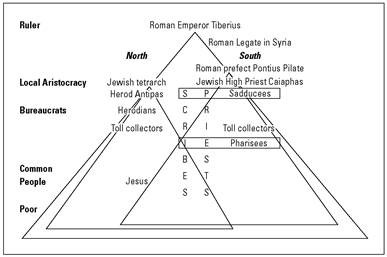
Figure 13-1: The power pyramid during Jesus’s ministry.
Forty years or so after Jesus’s death, right about the time the gospel authors began to write their stories, the Romans destroyed the Jerusalem Temple during a Jewish revolt (see Chapter 8 for more on this uprising). Gone was the Temple, gone was the need for a high priest, and gone was most of the Jerusalem aristocracy. With the Jewish leadership in the penalty box (or actually, out of the game entirely), the Pharisees and their heirs stepped into the leadership vacuum. Their interpretation of Jewish tradition gradually became a dominant voice, and these events had an impact on the gospel stories. For example:
● The Pharisees loom larger as Jesus’s opponents than they likely were in his life, because they were the gospel authors’ opponents (John 12:42; see also John 9:13-41).
● The members of the Jerusalem aristocracy, who played an important role in the historical Jesus’s death, are also blamed for the destruction of the Temple (the gospels tie the execution of Jesus to the destruction of the Temple).
● The Roman role in Jesus’s death is reduced in order to highlight the inner-Jewish issues, to differentiate Christians from the recently rebellious Jews, and to position Jesus as a victim of conquered Judaism rather than an enemy of victorious Rome.
Starting at the Top: The Romans
It’s a safe bet that the people who actually executed Jesus can be counted among his opponents. So the central question is: What threat did Jesus actually pose to Rome? After all, according to the gospels of Mark, Matthew, and Luke, he spent most of his time in the Galilee, and the Romans weren’t in charge there. In the following sections, I explain how the Romans used crucifixion in their empire, and I examine the threat that Jesus posed to them.
The reasons for Roman crucifixion
Two certain facts about the historical Jesus are established independently by Christian, Jewish, and Roman sources: Jesus was crucified and only the Romans could crucify. Whatever picture we paint of Jesus’s opponents has to fit that backdrop.
The Romans reserved crucifixion for those subjects who were not Roman citizens and who were seen as enemies of Rome, either because of banditry, murder, or outright treason. Crucifixion wasn’t a private or swift affair. The accused criminal was stripped naked and hung or nailed onto a crossbeam immediately outside one of the main city gates. It usually took hours, if not days, for the accused to die. This event was a kind of living Roman billboard that advertised what would happen if anyone else tried to take on Rome (see Chapter 14 for more on Jesus’s crucifixion).
The threat Jesus posed
If Jesus was killed by Rome as a warning to other would-be bandits and rebels, does that mean that he was one himself? Was that the threat he posed? Not necessarily.
The gospels say that Jesus was killed during Passover, one of the three great annual pilgrimage festivals (check out Chapters 2 and 7 for more on Passover and festivals). The pilgrimages drew huge crowds to Jerusalem to celebrate the liberation of Israel from Egypt (Exodus 1-15). In that context, setting off a crowd wouldn’t take much. And surely Rome wouldn’t need much provocation to step in and quell the unrest. If enough people so much as hoped that Jesus might be ushering in God’s reign — which they seemed to do when Jesus entered Jerusalem (Mark 11:1-10; John 12:12-19) — Rome’s prefect, Pontius Pilate, would have intervened with force to make an example of the would-be messiah.
The interesting historical question is whether Jesus himself encouraged the crowds to hail him as the messiah. His core teaching was that God’s kingdom was coming soon and that it alone offered true justice, peace, and good news to the people (see Chapter 11 for more on Jesus’s teachings). If Rome knew what Jesus was saying, they would not have been amused. But did Jesus think that the reign of God was his to usher in? Did he promote rebellion against Rome?
These questions would be tough to square with the gospels. Various traditions of a nonviolent Jesus occur in multiple sources (Q, Mark, John) and literary forms (miracle story, controversy stories, and sayings). In fact, the gospels go to great lengths to convey that Jesus wasn’t interested in attacking Rome and seizing earthly power. For example, the gospels do the following:
● They show Jesus rejecting worldly power in the temptation scene (Matthew 4:8-10 II Luke 4:5-8).
● They present him teaching people to love their enemies (Matthew 5:43-48 II Luke 6:27-28, 32-36).
● They tell how he redefined “messiah” as someone who would suffer and die (Mark 8:31-38), not as someone who would gain territory and power (Mark 10:35-45).
● They show him healing a centurion’s servant (Q 7:1-10), dining with toll collectors (Mark 2:13-17), and supporting Roman taxes (though the support is cleverly qualified; Mark 12:13-17).
● They contrast him to the political rebel Barabbas whom Pontius Pilate released instead (Mark 15:6-14; John 18:39-40).
Also important is the fact that nobody made a move on Jesus until that one fateful Passover in Jerusalem. The tetrarch Herod Antipas never arrested him, so he clearly didn’t view Jesus as a political threat. If you accept the chronology of Jesus’s ministry in John’s gospel, you know that Jesus visited Jerusalem for the pilgrimage festivals several times — and the Romans never once seized him on those earlier trips. Even the Romans apparently didn’t view him as a threat until the crowd began to view him as their liberator. And when they arrested him, they arrested only him, not his followers. Had his movement been violent, Rome would have killed them all.
Many Christians over the past two millennia have preached, taught, and believed that the entire Jewish people killed Christ. They read Matthew’s gospel, where the crowd cries, “His blood be on us and on our children” (Matthew 27:25) as a perpetual curse and a sentence that they had an obligation to execute. But this reading just doesn’t make any historical sense. If Rome’s reason to execute Jesus wasn’t what he said or did but what the Jewish crowd hoped he would do, the gospel’s portrait of bloodthirsty Jewish crowds crying for Jesus’s crucifixion quickly evaporates. The crowds were, in a sense, responsible for Jesus’s death, but it was because they supported him, not because they opposed him. What deterrent power would Rome’s crucifixion of Jesus have had if the Jewish crowds themselves had asked for it? None! Instead, the crowds were essentially the targets of the crucifixion as much as Jesus was.
Near the Center of Power: The Sadducees
The Sadducees were a group of priestly and lay aristocrats who were close to the pinnacle of local power in Judea during Jesus’s life. The Sadducees were characterized by their political role, their economic status, and their particular religious beliefs. They opposed Jesus on all these grounds, as you find out in the following sections.
Aristocratic allegiances
The Sadducees originated some time during the Hasmonean monarchy as opponents of the Pharisees (see Chapter 7). Their fortunes had waxed and waned depending on who was in power.
When Herod the Great assumed the throne in 37 BCE, for example, he marginalized and intimidated them, preferring to appoint non-Judean Jews to sensitive positions, such as the high priesthood, so that his appointees would be beholden to him rather than to powerful local families.
However, the Roman annexation of 6 CE led to a newfound respect for the Sadducees. They became Rome’s allies in the region and the customary candidate pool for its high priests (such as Annas and Caiaphas, for example; see John 18:13-14, 19-24).
The Jewish historian Josephus wasn’t very fond of the Sadducees. In fact, in his works, he notes that the common people didn’t admire the Sadducees either; he says they were “the first men” (meaning the leading citizens), were always arguing amongst themselves, and had “the confidence of the wealthy alone,” the wealthy being a group made up largely of themselves (Jewish Antiquities 13.10.6; 18.1.4; Jewish War 2.8.14). According to Josephus, the Pharisees were much more popular (he would say that, because he claimed to be one!). That popularity could be threatening for the Sadducees, because anyone who challenged their religious authority or who brought on social change threatened a power pyramid from which they benefited.
The term “Sadducee” is used sparingly in the gospels, but the sorts of people who composed that group are heavily featured in the Jerusalem scenes. For instance, according to Mark, Matthew, and Luke, soon after Jesus enters Jerusalem, he comes under attack by the “chief priests” and the “elders” (Mark 11:18, 27; Matthew 21:23;
Luke 19:47; 20:1). Luke adds references to the “rulers” (Luke 23:13, 35; 24:20) and to the “first men” (Luke 19:47). These references are reminiscent of Josephus’s description of the Sadducees. They challenge Jesus’s authority, they plot his arrest, they try him themselves and then accuse him before Pontius Pilate, and they mock him at the cross. Josephus independently confirms this scenario when he says that Pilate crucified Jesus “when he heard him accused by the first men among us” (Jewish Antiquities 18.3.3; see Chapter 5).
It isn’t clear that these chief priests, elders, rulers, and first men in the gospels were all Sadducees. They didn’t necessarily share Sadducean religious beliefs, so when the gospels present these folks conspiring against Jesus for religious reasons, they’re oversimplifying the situation. The groups did share political alliances and economic interests, which is why they didn’t want anyone upsetting the apple cart.
The chief priests featured as Jesus’s opponents were just a small, leading group of priests. They didn’t represent or reflect the interests of all Jewish priests in the region. Priests were sprinkled across the economic spectrum (refer to Figure 13-1). Most lived in Judea to be near the Temple, but others were scattered throughout the country (Mark 1:44; Luke 1:5). In his book, Against Apion, Josephus reports that there were 20,000 Jewish priests in total, which, if true, would be perhaps 4 percent of the overall population (Against Apion 2.8).
Conservative religious beliefs
The Sadducees didn’t only play a political and an economic role — they were also a religious group. They were Jewish and considered themselves guardians of the Jewish tradition, but they did have some beliefs that differed from other Jewish groups. Josephus tells more about the Sadducees’ beliefs than the gospels do, but given his bias against them, you want to be careful when swallowing the bait. Josephus says, for instance, that the Sadducees
● Rejected the Pharisees’ “traditions of the elders” (these traditions aren’t in the Torah but are often interpretations of Torah commands).
● Believed in human free will, not in fate or divine providence. This belief is tough to square with God’s frequent interventions in the Torah, so Josephus must be oversimplifying.
● Accepted only the Torah as normative, not the prophets or writings. This meant that they rejected the Pharisees’ belief in the resurrection of the dead, which was based on the Pharisees’ interpretations of scriptures in the prophets and the writings (such as 1 Samuel 2:6; Isaiah 26:19; Job 19:26; Daniel 12:1-3).
In the gospels, the Sadducees take only one shot at Jesus, and it’s a doctrinal challenge. They didn’t believe in the resurrection of the dead, and Jesus (and the Pharisees) did. So they posed a hypothetical scenario that in their minds made belief in resurrection absurd (Mark 12:18-27). A man dies childless, so according to the Jewish law of levirate marriage his brother marries the widow to produce an heir for the dead husband (Deuteronomy 25:5). When he dies, another brother steps in, and so on until seven brothers have died, followed by the wife. The Sadducees ask, “In the resurrection, whose wife will she be?” Jesus replies that the joke’s on them because risen bodies are more like angels than humans, so marriage is irrelevant to them. But more importantly, Jesus argues that resurrection is grounded in the Torah and not in later tradition (he refers to the burning bush story in Exodus 3:6, where God calls himself the God of Abraham, Isaac, and Jacob — as if those great Israelite patriarchs were still alive).The upshot of the gospel argument is that the Sadducees aren’t as expert as they think.
Did this exchange between the Sadducees and Jesus really happen? Well, for starters, it’s only in one source — Mark — and in one literary form — the controversy story. But it would be an odd thing for later Christians to introduce, because the Sadducees had ceased to exist at the time Mark was likely writing. According to the rule of discontinuity, a tradition is more reliable if it’s clear that the early Christians had no reason to add it. On that same principle, no later Christian group uses the burning bush story to “prove” the resurrection — further recommending that the evangelists didn’t make it up. Finally, this teaching about the resurrection is coherent with Q sayings about a final banquet or judgment at which the dead and living would appear (Q 11:31-32; 13:28-29).
So, while there’s only one source for this encounter with the Sadducees, several other criteria are satisfied, making it likely.
Singling out the Scribes
Out of all the Jewish groups that opposed Jesus on religious grounds, the scribes were the odd men out. Why? They weren’t a religious group! It would be like saying that a holy man came to town and all the notary publics started taking faith-based swipes at him. The more likely historical scenario is that only some of these scribes had it in for Jesus, as you find out in the following sections.
A scribe's role in the first century
As the name suggests, scribes were writers in the societies that had low literacy rates (perhaps 5 to 7 percent of the general population could read and write). The scribes in first-century Palestine weren’t necessarily religious experts at all. They weren’t all trained in the Torah or in Jewish ethics. The scribes operated at all social levels, from rural villages to Herod Antipas’s capital in Tiberias to the Jerusalem Temple (refer to Figure 13-1 to see where they stood in terms of power). Where the scribes worked determined what they wrote. Here’s a rundown of their duties:
● Your average village scribe wrote everything from marriage contracts to loan records.
● The scribes working in administrative centers copied court decisions, council minutes, commercial contracts, and other such records that would be kept on file at a public building.
● The scribes working at the highest echelons, like in Herod’s court, would compose official records, histories, diplomatic correspondence, and literature.
● The scribes who were trained in religious texts and traditions would have a close knowledge of Jewish scripture and law, and they composed a good bit of it themselves.
Historically, scribes were more of a mixed lot than the synoptic gospels of Matthew, Mark, and Luke portray. The earliest manuscripts of John’s gospel don’t mention scribes at all.
The gospels' proverbial pests
The scribes are out to get Jesus pretty early on in Mark’s gospel. Several come up to the Galilee from Jerusalem to investigate him (Mark 3:22; 7:1, 5), but some local scribes also challenge his authority (Mark 1:22; 2:6, 16). In the Galilee, the scribes are most often paired with the Pharisees (see the next section for more about the Pharisees). At one point, Mark actually says that some of them belong to the Pharisaic group (Mark 2:16).
After Jesus gets to Jerusalem, scribes are mentioned in league with Jesus’s aristocratic opponents, such as with the chief priests and elders (see Mark 11:18, 27; 12:35, 38; 14:1, 43, 53; 15:1, 31).
Together, they convict Jesus on the charge of blasphemy (viewing his authority equal to God’s), which the scribes had already once convicted him of in Mark 2:6-7.
Matthew generally doesn’t like the scribes either. He occasionally adds scribes to Mark’s negative stories about the Pharisees, whom he liked even less (Matthew 12:38 II Mark 8:11). Matthew even changes Mark’s single sympathetic portrait of a scribe into a hostile exchange with a Pharisaic lawyer (Matthew 22:34-35 || Mark 12:28). However, Matthew did mention Christian scribes, so apparently they weren’t all bad (Matthew 13:52; 23:34). Luke also mentions the scribes as Jesus’s enemies (Luke 9:22; 19:47; 20:1, 19; 22:2, 54, 66; 23:1, 10).
The free hand that the gospel authors take when selecting opponents for any given scene tells you that we aren’t operating with historical episodes here, but instead with animosities and religious positions that have grown and changed since the time of Jesus. Historically, unlike the aristocrats, the scribes had no power to do anything to Jesus. They derived their power from those they worked for.
Up for Debate: The Pharisees
The Pharisees enjoyed political power during the Hasmonean period in 164-37 BCE, but by Jesus’s time the Roman prefects and the Sadducees had largely sidelined them (I discuss these groups earlier in this chapter). Some of the Pharisees were aristocratic and prominent, but the majority of them during Jesus’s life exercised power only by virtue of their broad appeal to the common people. That’s the same segment of the population that the historical Jesus sought to influence, so you find Jesus and the Pharisees scuffling frequently over points of law. But the gospel authors transform these historical scuffles into serious battles that lead directly to Jesus’s death, for reasons that I explain in the following sections.
The Pharisees' different interpretation of the Torah
The Pharisees were fairly liberal when it came to their interpretation of scripture. The gospels denounce their traditions as so many additional “heavy burdens” that people had to bear (Q 11:46). But the Pharisees viewed these practices as paths to purity, which was now available not just to priests but to all Jews. And in any case, Jesus’s positions on the law often looked even heavier (see Figure 13-2). The Pharisees admitted that their practices weren’t in the Torah; instead they were post-biblical “traditions of the elders” that were worth passing on (Mark 7:3, 5; Josephus, Jewish Antiquities 13.10.6). In the same way, Jesus would claim an authority beyond Mosaic law — although in his case, the authority is himself!
The Pharisees didn’t consider their rules binding on Jews. They only considered them binding on those people who joined their group. The gospels, on the other hand, picture the Pharisees in just the opposite way, as harsh judges of anyone who wasn’t as righteous as they were. The gospels make it sound like the Pharisees flat-out opposed Jesus on every interpretation of the law.
But the historical picture is actually more three-dimensional: The Pharisees probably disagreed with Jesus on some points of law and agreed with him on others (see the next section).
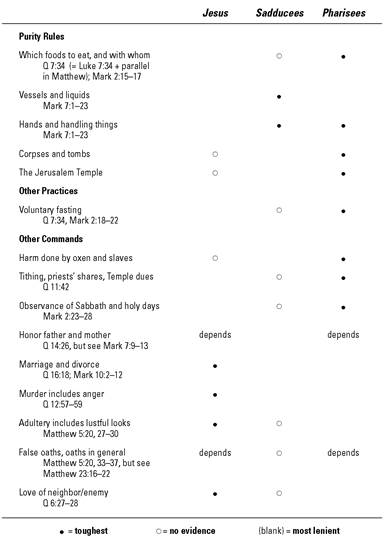
Figure 13-2: Comparing the practices of Jesus, the Sadducees, and the Pharisees.
The issues with the gospels' portrayal of the Pharisees
The gospel portraits of the Pharisees suffer from the same problem as the scribes (whom I discuss earlier in this chapter): From one gospel to the next, parallel stories often feature different opponents. For instance, on at least four occasions Matthew copied a story about scribes from Mark, but he changed the scribes to Pharisees. To see for yourself, compare:
● Matthew 9:11 with Mark 2:16
● Matthew 9:34 and 12:34 with Mark 3:22
● Matthew 21:45 with Mark 11:27 and 12:12
● Matthew 22:34-35 with Mark 12:28
And John’s gospel doesn’t even mention chief priests, scribes, and elders. In his gospel, the Pharisees are the ruling Jews (John 9:13-22; 12:42)!
Another reason for the gospels’ enmity with the Pharisees is that the Pharisees shared a lot of interests with the historical Jesus and early Christians. In fact, they were largely courting the same audience, at least at first. Here’s a list of some of the similarities between Jesus and the Pharisees:
● Both the historical Jesus and the Pharisees cared deeply about God, Temple, and Torah.
● Both apparently believed in the resurrection of the dead (Josephus, Jewish War 2.8.14; Jewish Antiquities 18.1.3; implied in Mark 12:18-27; see Acts 23:6-9).
● Both cared about ethical practice, but they sometimes differed on the details (see the preceding section).
Rabbinic Judaism, which gradually became the dominant form of Judaism after the destruction of the Temple, traced its origins to the Pharisees. In their books, you find the rabbis often disagreeing with each other. That kind of conversation, full of wit and learning and occasional rancor, is the sort of debate that the historical Jesus most likely had with the Pharisees. The dialogue occurs because the law matters, not because scripture is being rejected.
The shifting targets of the gospel authors’ wrath make their stories about Jesus’s opponents tough to confirm. On top of that, the gospels’ characterization of the Pharisees’ teaching is highly argumentative and anachronistic and therefore not completely reliable; it’s more continuous with the early church than discontinuous (see
Chapter 3 for more on the rules of historicity). Besides, if the Pharisees were as bitterly opposed to Jesus as the gospels say, why do some of them join the early Christian movement (Philippians 3:5; Acts 15:5)?
The general notion that some Pharisees opposed Jesus is plausible enough, however, because quarrelsome Pharisees are mentioned in multiple sources and types of stories. Most of the historical Pharisees lived in Judea, so their opposition to Jesus likely took place there and was written into the Galilean period of Jesus’s ministry by Mark. Otherwise, you’d have to imagine that the Pharisees, who by and large lived in Judea, made multiple trips to the Galilee just to take on this religious upstart. One additional piece of evidence in favor of this view is that the gospel of John, which mentions Pharisees 20 times, always places them in Judea. In the synoptic gospels, the Pharisees pretty much drop off the stage after the real pursuit of Jesus begins in Jerusalem, which reflects the historical fact that they probably had nothing to do with his death.
Evading the Herodians
Mark’s gospel mentions the Herodians twice. These folks plot with the Pharisees to put Jesus to death before he has really done anything controversial (Mark 3:6; Matthew 12:14 and Luke 6:11 both drop the Herodians). They reemerge only one other time in the gospels, and once again they’re conspiring with the Pharisees to trap Jesus. This time, they challenge Jesus directly with a question about whether the Jews should pay taxes to Caesar (Mark 12:13-17; Luke 20:20-26 has the story but again drops the Herodians).
It isn’t clear who these Herodians are, and it’s even less clear whether they were really out to get Jesus. The best guess is that they were partisans or even high-level bureaucrats and servants who worked for Herod Antipas, tetrarch of the Galilee and Perea of the northern power pyramid (see Chapter 7 for more on Herod Antipas).
One thing we do know for sure is that Herod Antipas never went after Jesus, as he did against John the Baptist. Apparently, Jesus didn’t threaten Herod as much as John did. After all, it’s simply too difficult to imagine that the guy at the peak of the northern power pyramid failed to act against a political threat. So, that means we can assume that Jesus wasn’t actually a threat. He wasn’t perceived as messiah up north, he wasn’t challenging the economic and political status quo substantially, and he wasn’t drawing massive crowds like John had.
Alienating Relatives, Neighbors, and Disciples
People don’t usually think of Jesus’s relatives as his opponents, but several hints in the gospels indicate that they weren’t always in his corner. Sure, his mother Mary and father Joseph are praised in the stories of Jesus’s infancy, but these infancy accounts are latecomers to the gospel story and historically aren’t very reliable (Matthew 1-2; Luke 1-2; see Chapter 9 for more on Jesus’s infancy and family).
The other books that mention Mary in a positive light are equally late. For example, Luke’s second volume, The Acts of the Apostles, places Mary with the surviving 11 of the Twelve disciples in the Upper Room after Jesus’s death (Acts 1:14). John’s gospel places her at both Jesus’s first great sign where he turns water to wine (John 2:1-12) and at the beginning of his last sign — the cross and resurrection (John 19:25-37).
If you play the history game, the earlier sources matter more. And it’s in these early sources that Jesus’s family, neighbors, and disciples get the worst press.
Turning away from family
The earliest sources, Q and Mark, paint a relatively negative portrait of Jesus’s family. In both sources, this negative portrait functions to underscore that the only family that counts is the family of God.
Missing family meals
Mark recounts that when Jesus went home, such a huge crowd gathered that “they were unable even to eat bread” (Mark 3:20). When Jesus’s relatives heard of this, they set out to seize him because they thought that he was out of his mind (Mark 3:21). It sounds even worse when you discover that the Greek verb Mark uses for “seize” is the same one he uses for the guys who haul Jesus off to jail in Mark 14:43-50. No wonder this is one of only three passages in Mark that neither Matthew nor Luke pick up (especially the way they praise Jesus’s parents in their infancy stories)! It isn’t clear who these relatives are, but the mother, brothers, and sisters are introduced a few verses later (Mark 3:31-35).
Gaining new friends and family
Jesus teaches that you must love him or God more than your own family (Q 12:49-53 and 14:25-33; Mark 10:17-22). In fact, there’s a story about how Jesus rejects biological kin in favor of the fictive family of disciples sitting at his feet, whose members do the will of Jesus and God (Mark 3:31-35; John 15:14 paints the disciples as friends rather than family). It seems pretty clear in these early sources that Jesus’s biological family was outside his inner circle during his adult life. That impression is strengthened when you take into account that Jesus made Capernaum rather than his hometown of Nazareth his base camp.
The slighting of Jesus’s family members in the gospels is all the more interesting because they played such a huge role after his death. Jesus’s brother James, for example, was an early leader of the Jerusalem Church, renowned among the Jews for his piety (see Chapter 9 for more on this James). And the portrait of Jesus’s mother improves in later gospel material.
Offending the hometown crowd
Besides alienating his family, Jesus offended the people he grew up with. A story in Mark recounts how his fellow Nazarenes took offense to his wisdom and healings, as if he were overstepping his humble roots (Mark 6:1-6). Jesus considers the offense and raises them one, saying, “A prophet is not without honor, except in his own country, and among his own relatives, and in his own house.” Slam dunk! Luke adds that the townsfolk didn’t take the insult well and tried to throw Jesus off a cliff (Luke 4:28-30).
Scandalizing the disciples
Jesus even occasionally shocked and insulted the disciples. For instance:
● When Peter tried to convince Jesus that he didn’t have to die, Jesus called him Satan (Mark 8:33); and as insults go, it doesn’t get much worse than that!
● Judas, a member of the Twelve, took so much offense at Jesus that he decided to hand him over to the authorities (Mark 14:10-11), which ties him to Satan, too (John 6:70-71).
● When Jesus teaches in John’s gospel that he’s the “bread of life” that his disciples must eat, many of his disciples are shocked by the metaphor and can’t accept it, so they leave Jesus and return to their former ways of life (John 6:60-66).
The Ultimate Opponent in the Gospels: Satan
There’s one final opponent of Jesus that historians don’t usually mention because he can’t be proven. But in the gospel authors’ worldview, this opponent is the mother of them all. Call him Satan, Beelzebul, or the prince of darkness — he’s the force behind the opposition to Jesus. He’s the invisible power pyramid lurking beneath the visible authorities that are arrayed against Jesus.
In some ways, the discussion of the exorcisms and even healings in Chapter 12 fits in this chapter. In those stories, Jesus demonstrates a power over evil, illness, and death in the same way that he bests his earthly opponents in the examples in this chapter. In fact, when the gospel authors say a lawyer or Pharisee sets out to “test” Jesus, they’re using the same word in Greek that’s used of Satan in the temptation scene (Matthew 4:1; 19:3; 22:18, 35). But Jesus survives all of these tests, ultimately defeating Satan’s death grip by dying and rising from the dead (John 12:31-33; 16:11).