
Chapter 17
In This Chapter
● Tracing the earliest images of Jesus
● Tracking trends from the Middle Ages to the Enlightenment
● Exposing the impact of modern portraits
The Christian belief that God became human through Jesus gave artists permission to depict the divine. In fact, to Christians, the age-old commandment against creating images of God (Exodus 20:4-6) seemed to have been broken by God when Christ became subject to the limitations of human word and human flesh. Artists rose to the challenge of depicting the human and divine nature of Jesus. They shaped belief and practice even while belief and practice shaped them. These artists produced so many works that it’s sometimes difficult to understand Western and Byzantine art if you don’t know anything about Jesus. (Byzantine art is the art of the eastern Roman or Byzantine Empire, 330-1461 CE.) But never fear, I explain all that you need to know. In this chapter, you see why early Christians wanted images of Christ, you discover how they reshaped their ideal man over the centuries, and you meet some of the modern faces of Christ in art.
Exploring Early Images of Jesus
Today we have no surviving portraits of Jesus of Nazareth. No one thought to draw or paint his face or body during his life or in the decades after his death — and if they did, those paintings or drawings haven’t survived.
After his death and as belief in Jesus grew and devotion to him expanded, the desire to see and touch Christ increased. And because the gospels didn’t even describe him, early Christian imagination had to fill the gap. Christian writers thought that Jesus must have been ugly because they were so convinced that Isaiah 53 prophesied their suffering messiah (“He had no form or beauty that we should look at him, and no appearance that we should find him pleasing,” Isaiah 53:2-3). But Christian artists tended to depict him more favorably. In the following sections, I introduce you to the first images produced by these early Christians.
Depicting Jesus in wall art
Some of the earliest images of Jesus aren’t really portraits. Instead, they’re symbols that were scratched into or painted on walls in places like Rome and Carthage, North Africa (see the nearby sidebar, “What’s in a name? Christograms,” for more about symbols). These images of things such as anchors, doves, palm or olive branches, and fish were associated with Jesus’s ministry and his victory (life over death), and they provided early, simple graphics that gave Christians an idea of who Jesus was.
In addition to simple graphics, more elaborate images called frescoes, which were painted in wet plaster in the Roman catacombs, offer the first representations of gospel stories and interpretations of the Jewish scriptures in light of Jesus.
Connecting Jesus to an unusual symbol
An early graffito (a drawing or writing scratched into a wall) from a guard room in the imperial palace on the Palatine Hill in Rome around 200 CE showed a man worshipping a crucified, donkey-headed figure. The inscription said, “Alexamenos worships his god.”
This graffito was most likely the work of a pagan soldier mocking Christians, but the choice of the donkey isn’t entirely his. Christians themselves used the donkey (of all creatures!) as a symbol of their humble God. Whether depicting his birth in a stable or showing him entering Jerusalem, the donkey (rather than the lion, eagle, stag, or bull) was Jesus’s mount. And in some images, the donkey appears alone with the inscription, “Our Lord, Jesus Christ, son of God.”
How did the donkey become a symbol associated with Jesus? Early Christians tied Jesus to passages in the Jewish scriptures in which the pagan prophet Balaam’s donkey recognized a divine messenger standing in the road in front of him and stopped dead in his tracks. After beating the poor beast, Balaam finally saw the angel, too.
This prompted Balaam to utter a messianic blessing on Israel (Numbers 22:22-35). In the same way, the Christians (who were frequently humbled and mocked by the powerful pagans of their day for worshipping a crucified criminal as God) felt vindicated for recognizing God’s messiah. The donkey was thus a symbol of them and of Christ as well as a symbol of their hope that one day the rest of the pagans would see things as they did, just as Balaam had.
What's in a name? Christograms
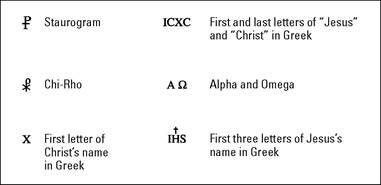
Despite how it sounds, the term "Christogram" doesn't refer to an Internet prayer chain or a holy man showing up on your birthday to sing you a hymn. On the contrary, these are symbols used to designate Christ's name. Here's a list of the most common symbols:
● Staurogram: This symbol is a Latin cross with a looped top. According to Lactantius (a Christian teacher of rhetoric and tutor for Constantine's son Crispus), this was the sign that Constantine fought under (On the Deaths of the Persecutors 44.5).
● Chi-Rho: This Christogram was named for the first two Greek letters of the name "Christ." According to Eusebius, this is the sign that Constantine put on his flag (Life of Constantine 28-31).
● An “X": Contrary to popular belief, the "X" in "Xmas" isn't crossing out Christ; it's simply shortening his title to its first letter.
● Acronym of Jesus's name in Greek: Eastern Christians lengthened the abbreviation of the name "Christ" (see the previous Christograms) by combining the first and last letters each of "Jesus" and "Christ." Sometimes a line is drawn over each pair to make the acronym clear.
● The first and last letters of the Greek alphabet: The alphaand the omega symbolize how Christ is the origin (John 1:1-3) and goal of creation (Revelation 19-22). In the Book of Revelation, Jesus is actually called "the Alpha and the Omega" (Revelation 1:8; 21:6; 22:13).
● The first three letters of Jesus's name in Greek: The second letter is an eta (a Greek letter with a long "a" sound), but it's transliterated with the Latin "H." The use of the "H" in the trio of letters led to some backronyms (new meanings for old acronyms) over the years. Some of these backronyms include Constantine's In Hoc Signo ("In this sign [conquer]"), Iesus Hominum Salvator("Jesus, Savior of men,"), and the Jesuits Catholic religious order, lesum Habemus Socium ("We have Jesus for our companion").
Seeing salvation in catacombs
In the mid-third century, Roman Christians began burying their dead in underground chambers, called catacombs, outside of Rome (they didn’t follow the custom of cremation because they believed in bodily resurrection). Forty such catacombs have been discovered. Many of them preserve frescoes that include the image of Jesus.
The most common scenes in these catacomb frescoes are the miracles of Jesus, such as turning water into wine at Cana (John 2), multiplying the loaves and fishes (Mark 6:34-44; 8:1-9), and the raising of the dead (Luke 7:11-17; John 11:1-44). They depict Jesus’s power over nature, life, and death — talk about an important and appropriate theme in a burial chamber!
Another common theme in these Roman catacombs is the power of Christian faith over pagan belief. This power is often depicted by the visit of the wise men or Magi (Matthew 2:1-12; see Chapter 9). In Matthew’s gospel, they’re the pagan guys who travel all the way to Judea from “the east” (probably Babylon) to pay homage to the “King of the Jews,” Jesus.
Making a case for Jesus by adapting pagan art
Many early Christian images of Jesus grew out of the culture wars of the Roman Empire in 200-400 CE. Among other things, these images gave artists a chance to indicate:
● How Jesus was divine and human (see Chapter 15 for more about the Christological controversies)
● Which god or gods they found most compelling
● How loyal they were to God versus the Roman emperor
You can think of these Christian images as a kind of marketing campaign. What they were trying to do was make a case for Christ — a case that in the end was remarkably successful.
Touching the sick with healing hands
Among the earliest motifs in the art of Christ were pictures of his healings. These pictures of Jesus touching the sick with his hand or wand surrounded stone caskets carved for the wealthy. They clearly hoped that the healer of others could raise them to eternal life.
The wizard wand that Jesus used predates Harry Potter by a couple of millennia. In fact, you start to see it in the hands of sorcerers in the art of Egypt 2,000 years before Christ. The Jews had long claimed that their leaders were more powerful than the pagan magicians (see Exodus 5-12; 1 Kings 18; Daniel 1:19-20; 2:24-28; 4:18-19; 5:7-12). Christians took up this belief, offering people a God who was not only more powerful than their gods but who also cared about their every ailment. Not even the great Greek healing god Asclepius was portrayed touching the ill like Jesus was.
Favoring androgyny
A striking feature of Christian art is the androgynous (both male and female) image favored for Christ. In early art, Jesus is often portrayed as cleanshaven and youthful, but he also often has wide hips, long hair, and breasts. Some of these same portraits (the sixth century Arian baptistery in Ravenna, for example) also show the naked Christ with male genitalia. So it’s clear that he isn’t a woman but is instead more of a hermaphrodite. This idea may go back to a first-century belief that in Christ “there is neither male nor female” (Galatians 3:28) because Christ restored people to what humans were originally meant to be (Genesis 1:26-27).
These effeminate portraits of Jesus echo and contrast the images of other gods. For instance:
● Apollo was also portrayed with breasts, long hair, and a boyish form to emphasize his fruitfulness and fertility. Transfer these effeminate features to Christ, and he becomes the new source of fertility. By giving Jesus feminine features, the artists make Jesus powerful and the Roman gods impotent at the same time.
● A youthful Jesus holding a lamb takes the place of the buff, naked Hercules, who’s holding the skin of the Nemean lion. The great labors of Hercules look pretty feeble if a little shepherd boy can outdo him. (Figure 17-1 shows Jesus as a shepherd.)
Not all the images of Jesus are effeminate. He’s also often pictured with the manly features of Jupiter, the king of the gods: dark hair and beard, a broad forehead, and a halo of light around his face. He’s also often sitting on a high-backed throne. The artist is asserting that Jesus has taken over Jupiter’s role.
Dressing Jesus in the emperor's clothes
In the fourth century, Roman emperors patronized Christianity and often portrayed themselves alongside Christ. This imperial sponsorship of Christianity altered the nature of Christian art. The art could now be public and monumental — it no longer had to be hidden in catacombs (as I describe earlier in this chapter).
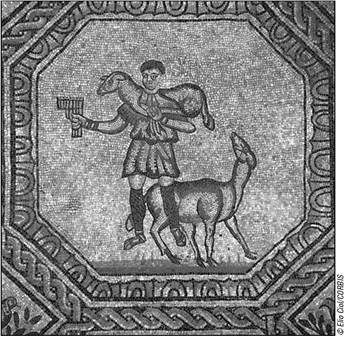
Figure 17-1: Jesus as the Good Shepherd from a mosaic at the Basilica of Aquileia in Italy.
It’s customary to assume that the roles of Christ and emperor fused from this point on. The conventional wisdom is that Jesus began to be portrayed as a kind of cosmic king who authorized the rule of emperors. One popular example of the cosmic king image was the Pantocrator (“ruler of all”), found in paintings, mosaics, sculpture, and illuminated manuscripts of the Bible (see Figure 17-2).
At the same time, however, some Christian artists undermined imperial imagery. For example:
● They painted Jesus in a philosopher’s toga with a scroll in his hand (rather than in military garb with a weapon in hand).
● They presented Jesus entering Jerusalem sidesaddle on a donkey rather than astride a horse like an emperor.
● They depicted him as cleanshaven with long hair even though emperors typically were represented with a beard and short hair.
It’s easy enough to see how the imperial presentation of Jesus was a good marketing move for an imperial patron. It identifies the ruler with divine power, almost authorizing his rule. So why did some people paint other very un-imperial images of Jesus — images that actively toyed with imperial trappings? Perhaps to keep their rulers humble (they weren’t God, after all!) and to remind them that they, too, would be judged by a king with very different values.
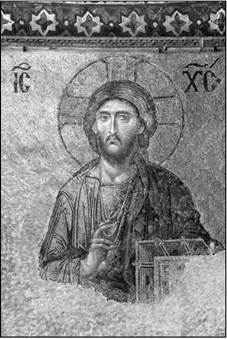
Figure 17-2: A bust of Christ, ruler of all, from Hagia Sophia in Istanbul.
Praying with icons
In the mid-100s CE, Christians began to take over the icon art form from the Egyptians and Romans. An Egyptian and Roman icon was a portrait of a god painted on a panel of wood that was set up in temples or domestic shrines. The Christian icon, which depicted a divine or saintly figure or a biblical scene, was painted in the same manner, and was hung at first in homes and later in churches.
At first, many Christians found it controversial to borrow this pagan art form. After all, icons were idolatrous and were used at home where bishops couldn’t control them. Also, these Christians thought that an icon could easily become a fetish, which is an item that’s accorded power in itself, rather than a prayer aid. These concerns regarding the icon resurfaced in the Byzantine Empire during the 700s and 800s CE and in the Reformation in Europe during the 1500s CE. Despite the concerns, the Christian icon has survived, particularly in Eastern Orthodox Christianity, as one of the most important genres of devotional art.
Changing Images of Christ through the Ages
The figure of Christ portrayed in art represents the ideals of the artists and their patrons. So as cultural ideals shifted throughout history, so too did the portraits of Christ.
Desiring images directly from Jesus
In the late fourth century, and continuing into the Middle Ages, a special set of Jesus images surfaced. These images were impressions of his face or body that people thought Jesus himself had made. These impressions, called “true images” by some people, upstaged other icons because they were thought to come directly from God:
● The Mandylion of Edessa: The Mandylion was a cloth that was supposedly sent by Jesus himself to King Abgar of Edessa (located in southeastern Turkey, in the old Roman province of Mesopotamia). Miracles were attributed to this cloth, including the healing of Abgar himself, so it became a revered icon in the East and the West. Word of it began to circulate in the late fourth century, but the image has since been lost.
● The Veronica: The Veronica was originally thought to be a self-portrait that Jesus had allegedly given to the woman he cured of a hemorrhage (Mark 5:25-34). The woman’s name, Berenike (Veronica in Latin), was transferred to the image (the name may have also come from vera icon, or “true image”). The portrait emerged in Rome in the 12th century, and pilgrims came by the thousands to see it. Within a century, the story had changed: A woman named Veronica actually wiped Jesus’s bloodied face with a cloth as he carried his cross to Golgotha, and later she found his face imprinted on it. The fluidity of the story and the rather late appearance of the relic lead historians to believe that it isn’t actually a “true image.”
● The Shroud of Turin: The Shroud of Turin is the reputed burial cloth of Jesus that bears an image of a crucified man. The cloth first emerged in 1357. Like the Veronica, the late appearance of the relic as well as the results of scientific testing lead many historians to the conclusion that the Shroud of Turin isn’t authentic (see Chapter 5).
The ongoing popularity of the Shroud of Turin and the Veronica in Western devotional practice attests to the dual desires to touch both an image of Christ and his suffering.
Emphasizing Jesus's suffering
Jesus’s death on the cross is one of the most familiar artistic expressions in Christian art, but it wasn’t always so popular. In fact, it was one of the last images to catch on. This is because the earliest Christians, often victims of persecution themselves, preferred to emphasize Jesus’s power and triumph rather than his tortured death (I discuss early images of Jesus earlier in this chapter).
This preference began to change in the 1200s CE. The Cistercian monk Bernard of Clairvaux (1090-1153 CE) and the friar Francis of Assisi (1182-1226 CE) laid the groundwork for this change by emphasizing the humanity and suffering of Christ. They urged a kind of affective spirituality to evoke human compassion for Jesus. Their work caused the following vignettes of Jesus’s suffering to become an integral part of Christian art up to the present day:
● The scourging, mocking, and crowning with thorns (Mark 14:65; 15:15-20); an example is Hieronymus Bosch, The Crowning with Thorns, 1490-1500.
● The Ecce Homo scene (Latin for “behold the man”), when Pontius Pilate presents the scourged Jesus to the crowd (John 19:5); an example is Correggio, Christ presented to the People (Ecce Homo), 1525-1530.
● The way of the cross, or Jesus’s walk to the place of crucifixion (Luke 23:26-31; see Chapters 14 and 20); an example is Ridolfo Ghirlandaio, The Procession to Calvary, 1505.
The crucifixion (Matthew 27:32-55 and Luke 23:32-49); an example is Anonymous, Crucifixion window, the cathedral of Notre Dame de Chartres, 12th century.
● The deposition of Jesus’s body from the cross (Mark 15:46); an example is Unknown French master, The Deposition (ivory, the Louvre), 1300.
The Pieta, when Jesus’s dead body is placed in his mother Mary’s arms (not narrated in scripture, but based on Mary’s presence at the foot of the cross in John 19:25-27). Perhaps the most famous Pieta is Michelangelo’s in St. Peter’s Basilica in Vatican City (1498-1499). Mary’s sorrow is the focus of a key image in Spanish art, the Mater Dolorosa (mother of sorrows).
● The group lamentation over the dead Jesus, which is an expansion on scripture. See Figure 17-3, where Andrea Mantegna portrays Jesus’s human flesh from the angle of his lowly feet in The Lamentation over the Dead Christ, c. 1490.
● The entombment (Mark 15:40-47); an example is Masters of Dirc van Delf, The Entombment (illuminated manuscript, the Getty), 1405-1410.
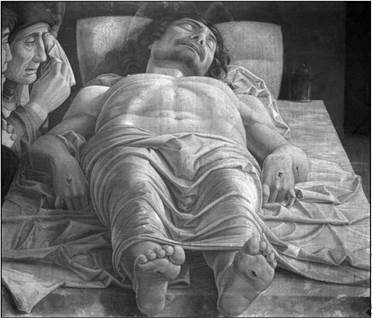
Figure 17-3: Andrea Mantegna’s painting The Lamentation over the Dead Christ (c. 1490).
Focusing on divine love
Many images of Jesus emphasize the beauty of his body in art that evokes love rather than pity. This emphasis is especially prominent in the graceful Renaissance nudes of the baptism, crucifixion, and resurrection scenes painted from the 1400s to the 1600s.
For example, in one painting by Titian called Noli me Tangere, 1510-1515 (see Figure 17-4), Jesus delicately avoids Mary Magdalene’s touch (John 20:11-18). In another, he offers body and blood for the nourishment of believers (Mark 14:17-31; an example is Giovanni Bellini, The Blood of the Redeemer, 1460-1465). Such images aren’t erotic or cannibalistic. Instead, they offer Jesus as the only object of love that can truly satisfy the human spirit. As the North African Bishop Augustine said (in his autobiographical book Confessions 1.1, c. 397-398 CE), “You have made us for yourself, O God, and our hearts are restless until they rest in You.”
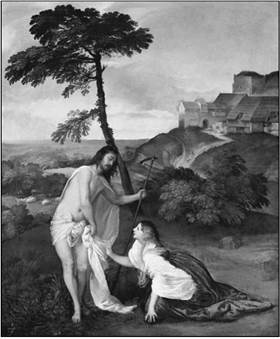
Figure 17-4: Titian’s painting Nole me Tangere, 1510-1515.
Depicting Jesus as philosopher and poet
The Enlightenment preferences for reason and science spawned the quest for the historical Jesus (see Chapter 4) and, in the 17th and 18th centuries, prompted artists to portray Jesus as a somewhat passionless philosopher. Many in this era could no longer accept that Jesus was divine and performed miracles. So, they took what was left — Jesus’s teachings — and painted their portraits from that. Jesus became a kind of super-Socrates — a teacher of universal truth and morals. Favorite scenes from his life include the child Jesus teaching the teachers in the Jerusalem Temple (Luke 2:46-50) and the Sermon on the Mount (Matthew 5-7).
This, in turn, prompted a romantic reaction in the 19th century, when artists tried to capture the mystery of Jesus’s divinity in terms that modern minds could grasp. That means that the artists wouldn’t focus on miracles. Instead, romantic paintings often portray Jesus at moments of doubt, struggle, or personal reflection, such as the temptations in the wilderness (Luke 4:1-13) or the agony in the garden (Mark 14:32-42; an example is Heinrich Hofmann’s Christ in the Garden of Gethsemane, 1890). Jesus was depicted as an inspiring spirit whose integrity and authenticity, even in the face of temptation and death, were what made him divine. He was seen as the ideal human, the model of what everyone might be.
Updating Appearances in the Last Century
In more recent art (1900 to today), the Christs of earlier centuries who brought coherence to whole cultures have shattered into fragments that no longer offer a common hero or God.
Restoring the Jewish Jesus
The persecution of Jews culminating in the Holocaust in Europe (1938-1945) prompted an artistic response. For example, Marc Chagall, the Russian Jewish painter (1887-1985), composed White Crucifixion in 1938. In this painting, Chagall portrayed a Jewish Jesus who was wrapped in a Jewish prayer shawl, crucified on the cross, and surrounded by various scenes of terror. The sufferings of later Jews surrounding him are identified with the sufferings of Jesus, the one Jew in whose name so much of the violence was produced. A painting like this isn’t a statement of Christian faith, of course; instead it’s a prophetic challenge to empathy and identification and a prophetic indictment of religious violence.
Mobilizing believers in times of crisis
The power of Christian imagery was weakened during the Enlightenment and its aftermath, but it could still serve to mobilize sentiment in times of national crisis. For example, in Warner Sallman’s World War II propaganda poster, The Christmas Story (part of his “War Cry” series of 1942), an American GI is reading his New Testament in a beam of heavenly light that passes through the scene of the Christmas creche. The “War Cry” here isn’t violent or bloodthirsty. The American war effort is instead cloaked in the values of humility and peace that the creche evokes.
In the anti-American propaganda poster from occupied France called Assassin (1943; see Figure 17-5), a terrified European girl is menaced by a leering, larger-than-life U.S. President Franklin D. Roosevelt. The girl is aligned with the cross as she looks to the heavens for salvation from American evil.
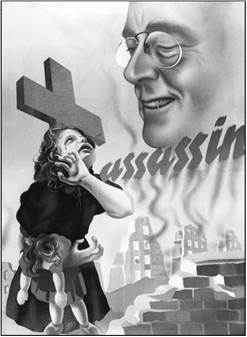
Figure 17-5: A Nazi propaganda poster in occupied France called Assassin, 1943.
Portraying a distant God
The skepticism of the 19th century and the horrors of the 20th century led many artists to despair both of God and humans. For those who still believed in Christianity, obstacles to faith remained. The following pieces were created during this dark time:
Holman Hunt’s The Light of the World (1900-1904): This painting depicts Jesus knocking on a door in the dead of night. The garden is filled with weeds and the door is bound shut with vines. Like Siegfried Reinhardt’s Light (1959), which depicts Christ enlightening the scene but surrounded by people who are oblivious to him, Christ is still present, but the world remains locked in darkness or preoccupied with other things.
Salvador Dali's Christ of Saint John of the Cross (1951):
This painting was Dali’s response to the bombing of Hiroshima in 1945. In the painting, you’re looking down on a monumental crucified Christ who’s suspended in the heavens and who’s looking down on the world. With arms outstretched on the cross, he embraces a fragile world. This is a beautiful, transcendent, and mystical Christ who’s near and yet far.
Globalizing the image gallery
People around the globe have remade the image of Christ into one they recognize. He takes the face of those who believe in him. For example, consider the following global images:
● U.S. artist DeVon Cunningham’s Black Christ, in the apse dome of St. Cecilia Catholic Church in inner-city Detroit, surrounded by figures from all races and religions (1968)
● U.S. artist Janet McKenzie’s Jesus of the People, which depicts an androgynous African Jesus with Native American and Eastern symbols (2000)
● Monika Liu Ho-Peh’s Chinese Christ in The Stilling of the Tempest (c. 1950s)
● Australian aboriginal Miriam Rose Ungunmerr-Baumann’s abstract Stations of the Cross
● The Nicaraguan images of Christ raising the murdered peasants of Solentiname
Picturing a Palestinian Jew
An interesting image of Jesus was recreated in 2002 through a combination of forensic anthropology, computer imaging, and old-fashioned painting. Medical artist Richard Neave reconstructed the facial features of a first-century Palestinian skull for a BBC and CNN television special and turned the computer images over to a painter. The final result, titled 1st Century Semitic Man by Donato Giancola, presents an image of a typical man in Jesus’s world.
Giancola’s image of Jesus is quite a contrast to the fair-skinned, slender-nosed, long-haired Jesus typical of Western art. (For an example of the more fair-skinned Jesus, see the chiseled features of Bartolomeo Pinelli’s Head of Christ in Figure 17-6.) Giancola’s portrait shows the impact of the quest for a more historical Jesus on the conventions of Christian art. The pale skin, delicate bone structure, and straight hair of the idealized European man are gone. In its place is a portrait based on archaeological evidence that presents a more plausible face for a first-century Jewish man.
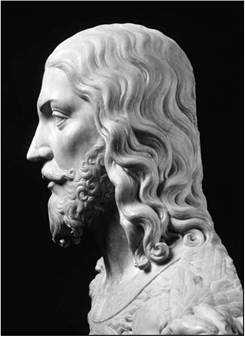
Figure 17-6: Bartolomeo Pinelli’s Head of Christ (1832).