
Chapter 18
In This Chapter
● Understanding the factors involved in making films about Jesus
● Exploring Jesus in silent, epic, musical, scandal, and classic films
ollywood gets a lot of bad press from some Christians (like the hoopla about the film The Da Vinci Code in 2006). So, you may be surprised to find out that films about Jesus have been a staple of cinema since film’s earliest days. Over the past 110-plus years, more than 120 movies have been made about Jesus’s life, with countless other films modeling their protagonists on Christlike figures (for example, Denys Arcand’s Jesus de Montreal, 1989).
One of the reasons for the popularity of Jesus films is that the story has a guaranteed audience. Even though directors have difficulty appealing to everyone in that audience, the sheer interest in Christianity has led many a producer to cough up the cash. The commercial success of Mel Gibson’s The Passion of the Christ (2004) has only reinforced this tendency.
In this chapter, you explore filmmakers’ first attempts to make Jesus movies, you find out how the genre expanded into epic form in the 1950s and 1960s, and you discover the more recent films that scandalized and inspired audiences.
You can look up information about films mentioned in this chapter at The Internet Movie Database (www.imdb.com).
Getting from the Gospels to the Big Screen
People have been imagining, writing, and acting out the gospel stories since the days of the first preachers. By 1895, when Auguste and Louis Lumiere showed the first public movie in the basement of the Grand Cafe in Paris, a filmmaker aspiring to tell the tale of Jesus had a lot to play with and a lot of choices to make.
Setting the stage
Dramatic performances of Jesus’s life date at least to the Middle Ages, when a humanistic impulse inspired all kinds of affective interest in Jesus’s human life and suffering. People wanted to feel Jesus’s suffering on the cross, so they mimed his final steps to Golgotha on the anniversary of his death and popularized the crucifix (the cross with Jesus’s body on it). In medieval art, there was an explosion of interest in images of Jesus’s birth in a stable and his death on the cross. (See Chapters 16 and 17 and the nearby sidebar, “The play’s the thing: Jesus in theater,” for more details.)
The tradition continued with the actors and acrobats of the traveling circuses in 19th-and 20th-century England and America. These folks traveled all over while performing spectacles from the Bible and from history in their stunning opening-night extravaganzas. They didn’t act out the life and death of Jesus, though — even with the resurrection, that wouldn’t have made for a very fun opening night at the circus.
Instead, circuses like Ringling Brothers produced elaborate plays about Solomon and the Queen of Sheba, the fall of Babylon, and Jerusalem and the Crusades. The sheer spectacle of these performances certainly influenced the elaborate stagings of later directors, such as Cecil B. DeMille (see the later section, “Watching the silent spectacles,” for more information regarding DeMille). How? The exotic animals, the resplendent costumes, the abundance of actors, the special effects, and the catastrophic nature of the plots had become familiar to generations of circusgoers. So, people expected their public entertainment to be at least that good, and if movies were going to succeed, they couldn’t afford to disappoint.
The play's the thing: Jesus in theater
In the Middle Ages, Lenten processions blossomed into full-blown passion plays that dramatized the suffering and death of Jesus. The first passion play was staged in Montecassino, Italy, in the 1100s. Other well-known performances were embedded in the great 14th century mystery cycles (sets of 24 to 48 pageants, or scenes, from the Bible performed over the course of one or more days) in Britain and the passion plays in Bavaria. In fact, the Bavarian town of Oberammergau has been producing a passion play every ten years or so since 1633. The early passion plays often used a variety of special effects to make the passion realistic, including hidden animal bladders filled with blood that could be squirted out at the appropriate moments. These plays also featured the Jews (rather than the Romans) as Jesus's executioners, which often tragically kindled anti-Jewish violence after the performances were over.
Today, the passion play is still a feature of Holy Week (the week before Easter in the Christian calendar when Jesus's death and resurrection are celebrated). Examples of contemporary passion plays include the Philippine Payson, the Mexican Representacion de la Pasion, the Brazilian Paixao de Cristo, and the Dutch Passiespelen. There are also various versions in Australia, the United States, and Canada.
Considering different factors when telling the story of Jesus in film
The gospels don’t make for very good screenplays. They’re episodic, which means that they move from scene to scene without a lot of plot development or clues about the characters’ motivations. Also unhelpful is the fact that whole parts of the story are often missing, and where the gospels overlap, they often differ. (Find out more about the gospels in Chapter 2.)
So, if a filmmaker wants to create a feature-length movie out of these texts, she has to decide whether she’ll use one gospel or a harmonized version of all of them. She also has to decide whether to supplement the gospels with outside sources, such as the apocryphal Christian gospels (see Chapter 5) or scenes from 2,000 years of Christian art (see Chapters 16 and 17).
After deciding on the material she’ll use, a filmmaker then has to determine which art forms and techniques she’ll need. Cinema directors use many of the traditional arts, including the following:
● Drama (in the characterizations, plot, and editing)
● Literature (in the scriptwriting and source material)
● Music (in the soundtrack)
● Painting (in scene design and composition, perspective, camera angle, and zoom)
Each of these elements, plus the moving quality of the medium, presents a range of choices to the director. For example, certain important scenes like the removal of Jesus’s body from the cross might include actionless frames that mimic the composition of famous still paintings, as Nicolas Ray’s 1961 movie King of Kings mimics the pieta (the dead Jesus in Mary’s arms; I discuss this film later in the chapter), or as John T. Coyle and Irving Pichel’s 1954 Jesus character in Day of Triumph mimics a painting of Jesus by Louis Jambor (see Figure 18-1). Mel Gibson chose to incorporate a lot of apocryphal material about the Veronica and the tortures of Jesus from a 19th century woman’s meditations to supplement the gospel accounts in his 2004 movie, The Passion of the Christ (you can read more about this film later in the chapter).
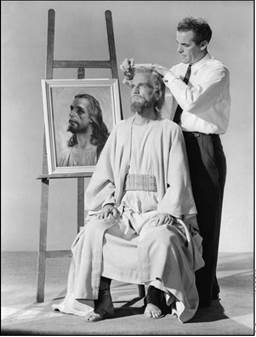
Figure 18-1: An actor in the movie Day of Triumph is made up based on Louis Jambor’s portrait Jesus of Nazareth.
A director’s beliefs about Jesus also impacts his movie. For example, if he believes that the gospels are literally true, he may present them differently than a director who’s an atheist. However, movies have to pay for themselves and turn a profit, so the filmmaker must play to the sensibilities of the viewers as well. For example, Gibson’s The Passion of the Christ caught so much flack in prescreenings for its anti-Jewish features that some of them were removed from the final cut, such as when the Jewish crowd cries out “His blood be on us and on our children!” from Matthew 27:25 (the crowd still shouts it in Aramaic, but the English subtitle was removed).
Screening the Savior
Movies about Jesus span a huge range when it comes to length, format, and tone. They range from a few minutes to several hours, from silent movies to musicals, and from the ridiculous to the sublime.
Watching the silent spectacles
The period of silent films from 1895 until the debut of talking pictures in 1927 produced more than 15 Jesus films. The first was a five-minute film produced in Paris titled Lear Passion, or The Passion of Christ (1897). Unfortunately, no copies of it survive.
The silent films that followed also focused on the passion, but many of these tried to reproduce passion plays from particular parts of the world, such as The Horitz Passion Play (1897) and The Mystery of the Passion Play of Oberammergau (1898), which was ironically shot on the roof of Manhattan’s Grand Central Palace Hotel.
The following films, which were all produced in the United States, are the longest and most significant of the silent Jesus films:
● From the Manger to the Cross (1912): This film, directed by Sidney Olcott, ran 60 minutes, which was fairly long considering the year that it was released. Unlike the earlier silent films, this one took Jesus from the cradle to the grave, as you might suspect from the title. In this way, it was more like the gospels than the medieval passion plays (which mostly focused on the passion). It was also one of the first films shot on location in Egypt and Palestine.
● Intolerance (1916): This three-and-a-half-hour epic directed by D. W. Griffith includes the story of Christ as only one of four interwoven plots about human cruelty and intolerance. Intolerance still ranks as one of the most ambitious Jesus films for its sheer scope and spectacle (it includes a Fall of Babylon more spectacular than the 19th century circuses could ever stage). Through analogy, Griffith likens the Pharisees of Jesus’s day to the prohibitionists of his own time.
● The King of Kings (1927): This colossal film directed by Cecil B. DeMille opens with a memorable scene of the prostitute Mary Magdalene entertaining her clients amid tigers and fan-wielding slaves and then leaping onto her zebra-driven chariot to confront the man who has “stolen” Judas from her (Judas was her only attractive customer in DeMille’s telling). The moment she sees Jesus, seven demons (the seven deadly sins) emerge from her and evaporate (the only part of this that’s remotely Biblical is the reference to seven demons quitting her; see Luke 8:2). This exorcism leaves her calm and in search of a little more clothing. Mary isn’t a prostitute in the gospels, but in the Jesus films she usually is (see Chapter 10 for more on Mary).
After Mary’s grand entrance, this two-hour silent film covers the adult life of Jesus in a reverential way, accompanied by stills of Biblical quotations and religious music. The crucifixion scene is filmed from a great distance (called long shot) with a massive crowd and little movement, almost like a classical painting by Gustave Dore or Rubens (DeMille consciously imitated some 300 famous paintings in his scene compositions). The film was immensely successful, partly because DeMille worked hard during filming to placate potential critics by employing religious advisors and praying on set.
Painting Jesus on an epic scale
Cecil B. DeMille’s The King of Kings was so wildly popular and so widely seen that few filmmakers attempted another Jesus film for a couple of decades. There were, however, several films in which Jesus was an important prop, but he was hardly shown. These films include Quo Vadis (l951), The Robe (1953), Ben-Hur (1959), and Barabbas (1962).
DeMille died in 1959, and with his passing a new generation of filmmakers was emboldened to step into the Jesus genre once again.
At that time, new inventions in sound and film technology offered opportunities to present the story of Jesus in new ways.
So, two epic American films about Jesus were produced in the 1960s. Even though these films — King of Kings (1961) and The Greatest Story Ever Told (1965) — were not very successful, they’re still significant because of their sheer scope and their attempts to break in important ways with the somewhat pious conventions of the past. A third epic, Jesus of Nazareth (1977), which was made for television in 1977, fared much better.
King of Kings (1961)
Nicholas Ray (director) and Samuel Bronston (producer) shot King of Kings in Spain. The movie ran more than three hours long, and Ray added all sorts of unhistorical material to tie the plot together. For example, he added the centurion Lucius, who’s present at Jesus’s birth, youth, childhood, and death. In fact, in the movie, Lucius even acts as Jesus’s defense attorney!
Ray removed a lot of Jesus’s conflict with Jewish authorities, but he also took out the prophetic elements that would have made Jesus seem more Jewish himself. Ray’s Jesus, teen heartthrob Jeffrey Hunter, was a bit of a distraction, and the reduction of Jesus’s teaching to the Sermon on the Mount made it tough to see why anyone would want to kill Jesus. On top of all these complaints, Ray offered very little of the miraculous or divine, so the movie ended up offending a lot of Christians.
The Greatest Story Ever Told (1965)
George Stevens’ The Greatest Story Ever Told hit theaters in 1965. With an all-star cast and panoramic scenes shot in Colorado and Utah (like his classic western, Shane), the film takes the prize for the most expensive Jesus film ever. It took a whopping $20 million to produce. But, unfortunately for Stevens, it was also a box office dud. Critics chalked the failure up to the four-hour-plus length, the overwhelming scenery and music, and the baggage that the all-star cast inevitably brought from other movies they had been in.
Jesus of Nazareth (1977)
Franco Zeffirelli’s multipart television miniseries on the life of Jesus, Jesus of Nazareth, was the most widely marketed Jesus movie of all time (though John Heyman’s 1979 film Jesus, which was promoted internationally by Campus Crusade for Christ, may give it a run for the money).
Zeffirelli drew his Jesus from all four gospels, so this savior was immediately familiar to the audience. The film was also notable for its positive presentation of Judaism. Zeffirelli wanted to teach his audience. He wanted to use the character of Jesus to remind them of core values, but he wanted to do this without provoking or alienating his audience too much. So, Zeffirelli’s Jesus isn’t so transcendent as to be mysterious, nor is he so radical as to be irritating. He’s kind of middle-of-the-road. The film avoids the sentimentality and anachronisms of the other Jesus epics, presenting the first Jesus who could actually be a first-century Jew.
Viewing the musical Messiah
The youth culture of the 1960s, its appetite for rewriting the rules, and the arrival of rock spawned two 1960s theatrical musicals about Jesus’s life. Both were turned into films that were released a month apart in the 1970s.
Jesus Christ Superstar (1973)
In 1973, Norman Jewison took Jesus Christ Superstar, the Broadway musical by Andrew Lloyd Webber and Tim Rice, to the Negev desert. The movie focused on the passion, much like the earliest Jesus films. But unlike those films, Superstar highlighted Judas as Jesus’s antagonist. Some would even say that Judas had the better part, which helped offset charges that the movie was racist (Jewison cast an African American Judas against a white Jesus).
The Jesus in this film rarely teaches, never heals, and doesn’t seem to rise. But, even though a pious Christian can’t find much of the Christ of faith in this movie, there are a few great songs. The soundtrack made double what the film made, with classics such as Mary Magdalene’s “I Don’t Know How to Love Him,” Jesus’s “Gethsemane,” and Judas’s “Superstar.”
The Jewish leaders in Superstar are presented as cold, calculating, and completely in charge of Jesus’s execution. In fact, in a troubling historical reversal, the High Priest Caiaphas deliberates about a “permanent solution” to the Jesus problem in language that echoes Hitler’s “final solution” to the Jewish problem.
Godspett (1973)
David Greene’s Godspell combined elements of musical comedy, vaudeville, and puppetry, presenting Jesus and his flower-child followers in the familiar setting of New York City. Even though the elements and setting make the movie sound flaky, it was actually a pretty close retelling of the gospels of Matthew and Luke, as its title suggests (after all, its name plays with the word “gospel” as if the movie is a new one; it isn’t named after Jesus, like so many of the others). Godspell included more teaching, healing, and discipleship content than other films that focused on the passion.
The movie painted Jesus as a kind of superstar — he even had Superman’s “S” stitched on his chest. But this superman was clearly a clown. And that motif has a long pedigree — starting with Paul preaching the “foolishness of the cross” (1 Corinthians 1:17-2:16; see Chapter 15). For all the clowning around, though, Greene’s Jesus casts a spell over the movie’s cast. And that spell is strong enough to keep them dancing even after he’s been crucified on a junkyard fence.
Scandalizing audiences
Serious and even pious Jesus movies continued to be made in the 1970s and 1980s, such as Zeffirelli’s Jesus of Nazareth (1977) and John Krish and Peter Sykes’ Jesus (1979). But a new trend began to emerge as well in this post-Vietnam, post-Watergate world — one that challenged Christian authority and piety through humor and fantasy. The films presented in this section caused quite a stir when they were released, but for different reasons.
Monty Python’s Life of Brian (1979)
It’s tough to pull off a satirical comedy about the life and death of Jesus, but Terry Jones and the Monty Python crew managed to do it with Life of Brian. They skirted potential offensiveness by making the whole movie a case of mistaken identity (the main character is Brian Cohen; the real Jesus was born next door). In fact, the film was actually less a satire about Jesus than a parody of the older epic Jesus films. But many still perceived it as an attack on Jesus.
Life of Brian, produced with some financial backing from ex-Beatle George Harrison, has some classic scenes, including the following:
● The Sermon on the Mount spoof (Brian hears “Blessed are the cheese makers” rather than “Blessed are the peacemakers”)
● The final shot of dozens of crucified people singing the ditty, “Always look on the bright side of life”
The Last Temptation of Christ (1988)
Martin Scorsese’s film, The Last Temptation of Christ, was set for scandal long before it hit the theaters. Based on a 1955 novel by Nikos Kazantzakis (which got him excommunicated from the Greek Orthodox Church), the film is a modern reflection on the human nature of Jesus. The plot presents Jesus as a neurotic man confused about his identity and mission, whose last temptation on the cross was to marry Mary Magdalene and settle down to a normal life.
Unlike more recent films, such as The Da Vinci Code (2006) and the Discovery Channel’s The Lost Tomb of Jesus (2007), Kazantzakis’s book and Scorsese’s film never presented the marriage of Jesus and Mary as historical, but rather as a fantasy sequence. When combined with Peter Gabriel’s global soundtrack and the most realistic crucifixion scene to date, that sequence stripped away the sentimentalized Hollywood conventions and engaged the viewer with Jesus. The trouble was that a lot of people were already devoted to a different kind of Christ.
The Passion of the Christ (2004)
Mel Gibson’s The Passion of the Christ is the latest in a series of movies focusing on the end of Jesus’s life. In the tradition of medieval passion plays, this newest passion film dramatizes the pain and suffering of Jesus. Its intent was not only to increase empathy for Jesus, but also to show how much suffering Jesus could take. Jesus’s sheer endurance of two hours of torture revealed his uniqueness, proved his divinity, and communicated the saving power of his wounds. It also provided a powerful image of Jesus for communities that had likewise endured great suffering.
Despite its good intentions, this film fits with the other scandal films — only the scandal it gave was to a different audience. The film presented itself as the most historical one yet, using Aramaic and Latin for the dialogue (although the Roman auxiliary troops surely would have spoken Greek; see Chapter 8). But several of the scenes aren’t out of the gospels or history at all. Instead, they come from the writings of a 19th-century mystic, Anne Catherine Emmerich. And the movie’s presentation of Jewish responsibility for Jesus’s death — even to the point of having Satan walk among the Jews — contradicts the best historical reconstructions and understandably angered many Christians and Jews (see Chapter 14).
The Da Vinci Code (2006)
Ron Howard directed The Da Vinci Code as an adaptation of Dan Brown’s bestselling novel by the same name. The movie isn’t technically a Jesus film; it doesn’t attempt to reproduce the life of the historical Jesus. Instead, it’s a modern tale about a Harvard University symbologist, Robert Langdon, who stumbles onto the secret of the “Holy Grail.” With the help of Parisian cryptographer Sophie Neveu, he discovers that the Grail isn’t the cup from which Jesus drank wine at the Last Supper. Instead, the true secret of the grail (spoiler alert — don’t keep reading if you want to be surprised when you read the book!) is that it’s the bloodline of Jesus, begun in the womb of Jesus’s wife Mary Magdalene and protected ever since by a secret order called the Priory of Sion against the murderous intent of Roman Catholic operatives.
The film was scandalous to many Catholics for its negative portrait of Catholic groups and for the way that it sexualizes Jesus and Mary Magdalene’s relationship. As for the many historical problems with this admittedly fictional tale, check out Chapters 5 and 10.
Classic films about Jesus
Every person who’s into Jesus films has his or her own favorites, but scholars and film critics have identified two particular movies as the best of breed.
The Gospel According to St. Matthew (1964)
Directed by the Italian Communist and homosexual Pier Paolo Pasolini, The Gospel According to St. Matthew is widely regarded by religious and secular critics as the best and most poetic of the Jesus films. Pasolini picked Matthew’s gospel because he found in it a Jesus who was aggressive, even angry, but nonviolent and revolutionary in his social views and committed to human concerns. Pasolini shot the film in black and white in the poor villages of southern Italy with nonprofessional actors, and he used dialogue exclusively from the gospel of Matthew and the book of Isaiah. He also edited it so that it had the character of a sacred pageant like the medieval passion plays. In other words, the film is a sequence of unrelated scenes that seem less like drama and more like prayer.
The Messiah (1975)
Roberto Rossellini’s neorealist film, The Messiah, which employed nonprofessional actors, tried to present Jesus’s life in an objective light. Rossellini wanted to explore Jesus’s particular and enduring wisdom. To do so, he included more of Jesus’s teaching and less of the miracles and drama. That means the story is episodic, like the earliest films, with less attention to filling the gaps in the plot. However this format had the effect of accentuating the blame on the Jews because they’re the ones who were challenged by the teaching. Because he was conscious of film’s ability to create spectacles, Rossellini studiously avoided a showy display and favored a more serene, austere presentation.