
Part II

In this part . . .
Are you ready to take a trip back in time to the world of Jesus? In this part, I help you scan the sequence of empires that had run Jesus’s country for a couple of centuries, especially the newly arrived Roman Empire. I also give you the lowdown on Jewish society so that you get an idea of who their leaders were, what they believed, what religious texts they read, and how they lived. I close out this part with a chapter on how Rome kept a handle on its unruly territory and how the Jewish people reacted to the presence of an occupying empire.
Chapter 6
In This Chapter
● Surveying the string of empires in the Near East
● Examining the plots for imperial Roman power
● Introducing the Romans from the gospels
Jesus was born into the Roman Empire, and his history can’t be told apart from it. This isn’t only because Rome controlled Jesus’s homeland (Palestine), picked its high priests, and ultimately executed Jesus. It’s also because Rome’s propaganda and promises of peace and prosperity shaped the role of Jesus during his life and the memory of him after his death. Just before Jesus’s birth, the Romans had begun to make their emperors gods and to promote the empire as the source of order, peace, and a better life. The gospel authors had a different vision. For them, only God could offer true justice and peace, and only Jesus could bring that to this world.
In this chapter, you survey the empires that ruled Palestine, uncover why Rome valued the region, follow the rise of the Roman Empire, and meet the Romans mentioned in the gospels.
Witnessing a Succession of Empires before Rome
The Romans weren’t the first empire to conquer Judea, Samaria, and the Galilee — the region where Jesus lived. In fact, the Jewish people in those regions had endured more than 500 years of imperial control almost without interruption before the first Roman legions came even close to the Near East. The area was strategically significant to all these empires; it gave them access to the great civilizations to the east (Mesopotamia and Persia) and the south (Egypt). Meanwhile, for the locals, the experience of foreign rule and the memory of political independence stoked their hope that God would one day restore their autonomy. Many would view Jesus as the agent of that divine intervention.
The Assyrian Empire
The first invasion of the region occurred in 722 BCE. The Assyrian Empire, based in modern-day northern Iraq, had set its sights on the fertile Nile River delta in Egypt. However, two Israelite kingdoms, Israel and Judah, were in the way of its takeover. So, of course, Assyria went after them both. The northern kingdom of Israel resisted Assyria and was completely destroyed. The southern kingdom of Judah, on the other hand, allied itself with Assyria. For their efforts, the kingdom of Judah was forced to become a vassal state (basically this meant that they had to do what Assyria wanted and pay them a lot of annual tribute money for the “privilege” of protection). That assured their survival for the time being.
The Neo-Babylonian Empire
After the Assyrians, the Neo-Babylonian Empire in southern Iraq rolled through the region (626-539 BCE). There had been several powerful Babylonian dynasties in the past, but none had been as ambitious as this one. Like Assyria, it too had its eyes set on Egypt. The Egyptian Pharaoh Neco II didn’t waver; he marched right out to stop the Babylonians. The Judean King Josiah got in the Pharaoh’s way at Megiddo and was killed, either because he was siding with Babylon or because Neco couldn’t trust his loyalty (2 Kings 23:29-30, 2 Chronicles 35:20-25). Either way, Josiah’s successor, Jehoakim, took the hint and sided with Egypt.
At first, it looked like the right move: The Babylonians tried to attack Egypt and failed, retreating back to Babylon to lick their wounds. But when the Babylonians returned in 597 BCE, they got their revenge. They besieged Jerusalem and forced it to pay tribute. Ten years later, in 587 BCE, they destroyed the city, razed its Temple to the ground, and exiled the Jerusalem elite to Babylon.
The Persian Empire
The Neo-Babylonian Empire in modern-day Iraq was soon displaced by the Persian Empire of modern-day Iran. The Persian king Cyrus and his Achaemenid dynasty had a more lenient and pragmatic view of the conquered peoples, however. They let all exiles return to their homelands and even subsidized their rebuilding efforts. But, of course, Cyrus’s reasoning wasn’t to be Mr. Nice Guy. No, he was being lenient on the principle that he could squeeze more out of the exiles if they were prosperous. Some of the Jewish elite returned to Judah and began re-creating their traditions and scriptures.
Alexander the Great
Alexander the Great of Greece managed to defeat the Persians in 331 BCE and take over their holdings, establishing the Hellenistic Empire. (Hellene is the Greek word for “Greeks.”). Alexander was fond of drinking, which may have led to his early death at age 33 (it was either that or a virus, which isn’t nearly as sensational). After his death, his empire eventually broke into three parts, with centers in Greece as well as in the strategic cities of Alexandria in Egypt (controlling the Nile River basin) and Antioch in Syria (controlling access from the Mediterranean to Mesopotamia). The Greek center was ruled by Antigonus, the Egyptian center by Ptolemy, and the Syrian by Seleucus. The people in Judah and the Galilee fell first under the Ptolemaic kingdom of Egypt, and then under the Seleucid kingdom of Antioch. It was under these Hellenistic kingdoms that the Hebrew name for Judah became Judea, the Greek spelling.
The Jews broke free of Seleucid control for about 100 years (from 164-63 BCE) and were ruled by a native Jewish dynasty, the Hasmoneans. But the ties between the Seleucid kingdom and the Hasmonean kingdom weren’t completely severed. The Jewish kings and queens, ruling from Jerusalem, were always forming alliances with one empire or another for political, military, diplomatic, and economic reasons (flip to Chapter 7 for more information). They should have been forging alliances with each other, however, because it was a civil war between warring branches of the family that paved the way for Rome’s entrance into the region.
The Romans Are Coming!
The Romans Are Coming!
With the Seleucid Empire weak and the Jewish Hasmonean kingdom split by civil war, the next empire to take over the region was the Roman Empire. (Technically, Rome wasn’t an empire at all when its legions first entered Jerusalem. It was still a republic, meaning that an elite group of leading men representing all of Rome made political decisions rather than a single dictator.)
By 100 BCE, Rome’s army controlled most of Spain, southern France, all of Italy and Greece, the west coast of Turkey and a portion of its southern coast, as well the tip of Africa closest to Sicily. But Rome’s sights were set on bigger prizes in all directions, and the ambitions of its leading men to expand Rome’s territory made the concentration of power in fewer hands that much more attractive. For Judea and the Galilee, this would mean not only that they would fall into Roman hands, but also that they would be governed from a distance by an emperor with unparalleled power.
Entering Jerusalem with Pompey
Even though the Romans controlled most of the northern coast of the Mediterranean Sea, they wanted to control more. Why? Well, for starters, Rome had a lot of hungry mouths to feed (Rome wasn’t a small city!), and assuring an adequate grain supply required control of a more fertile region than Rome currently had access to. Like Assyria and Babylon before it (see the earlier section on previous empires ruling the Near East), Rome was drawn to the eastern Mediterranean and Egypt, where the ancient river valleys enabled the production of a steady supply of food. Trouble was, pirates controlled the seas and foreign kings controlled the land.
The fact that Rome had scads of ambitious young men seeking to advance their fortunes and careers through military exploits also explains the Roman thirst for expansion. In 67 BCE, for instance, a 39-year-old general named Pompey was sent to subdue the pirates in the eastern Mediterranean. Almost single-handedly, he was responsible for bringing the Near East into the Roman orbit, and his political ascendancy set the stage for the rise of the Roman emperors.
Pompey enjoyed a reputation as a successful general. But this gleaming reputation was built to some extent on being in the right place at the right time. For example, in 71 BCE, Pompey slaughtered the last of the rebels in Spartacus’s celebrated slave revolt (remember the film?) and took all the credit even though a compatriot had really done all the dirty work.
After a term as consul in Rome (71-70 BCE), Pompey was eager to demonstrate that he deserved an even greater reputation. The pirate problem mentioned earlier in the section gave him that opportunity, and he took the following trek:
● With 500 ships and a 120,000-man infantry, Pompey cleared the sea of pirates within three months (67-66 BCE).
● After being rewarded by the Roman Senate with greater power, he proceeded to Asia Minor, where he took credit for the final defeat of the King of Pontus, who had been severely weakened by Pompey’s predecessor, Lucullus (65-63 BCE).
● He turned south to the weakened Seleucid Empire in Antioch, which he promptly claimed as a province of Rome (64 BCE).
● After taking over Antioch, the small Hasmonean kingdom of Judea hardly presented Pompey a challenge. It was split by civil war, with one brother (Aristobulus II) holed up in Jerusalem and the other brother (Hyrcanus II) seeking Pompey’s help. Pompey sided with Hyrcanus. The capital city of Jerusalem held out for three months, but Pompey eventually penetrated its walls and marched right into the Holy of Holies in the Jerusalem Temple (the Holy of Holies was the central part of the Temple where only the high priest was allowed). At this point, the conquest of Jerusalem was complete. Hyrcanus II was allowed to remain the high priest and was later given the political role of ethnarch (which means “ruler of the people”), but the Romans never allowed him to be a king. Rome was making the rules now.
The impact of Pompey’s sweep of the eastern Mediterranean was felt for centuries. Being the administrative genius that he was, he established a system of governance and tax collection that left local elites in charge where possible, thus sparing Rome the responsibility of direct supervision (except, of course, in its prized imperial provinces). Rome got money, land, grain and other goods, slaves, and the security of buffer states on its frontiers. Jesus was born in one of these Roman buffer states. Subject to Roman administration and taxes, his message of another kind of kingdom resonated with people chafing under the rule of Rome and its local allies.
Seizing imperial control with Julius Caesar
The Roman Senate was nervous about the growing power of men like Pompey. The senators tried to undercut the power of three important leaders by stalling on veterans’ benefits for their soldiers and the like, but the remedy backfired. The Senate’s attack drove the three rivals together. Pompey and two other great generals, Crassus and Julius Caesar, secretly formed an unofficial triumvirate (a political regime that’s ruled by three powerful people) that took effective control of the government in 60 BCE. The days of the Roman republic were numbered; some would say it ended that year.
All three members of the First Triumvirate had high ambitions, but in the end it was Caesar who won out. Crassus was killed battling the Parthians in the east in 53 BCE. In 49 BCE, Caesar returned from the Gallic Wars and crossed the Rubicon River in northeastern Italy to have an all-out civil war with Pompey for control of the empire. Caesar chased Pompey first to Greece and then to Egypt, where in 48 BCE an assassin ended Pompey’s life. At that time, Caesar returned to Rome as Imperator, which meant that he was the supreme and unparalleled commander of Rome.
Caesar, like Pompey before him, was an able administrator. He consolidated Roman control by creating colonies of retired veterans and poor civilians who extended Roman practices into the provinces, including the Near East. Caesar worked to reduce the debts and eliminate the interest payments of Roman citizens. He even held spectacular festivals and games for their entertainment. In the east, the Hasmonean ethnarch Hyrcanus II had supported Caesar and was rewarded with privileges like the control of Jerusalem and certain tax breaks and religious privileges. But he and all the other petty kings were really riding a political roller coaster during those years as they tried to pick the winning side.
Caesar’s authority didn’t last long, however. He set his sights on expanding the empire eastward into the regions that were once controlled by Alexander the Great but were now controlled by the Parthians (in modern-day Iran). In 44 BCE, just three days before he was due to set sail, 60 conspirators surrounded Caesar at a meeting and stabbed him to death. (Yes, just like in Shakespeare’s play!)
Consolidating the empire with Octavian
Where Julius Caesar failed, his adopted nephew, Octavian, succeeded. He stepped into the political vacuum created by Caesar’s death, building his power slowly and ruthlessly and then managing his imperial role with much greater sensitivity to Rome’s traditions of shared governance. As a result, he remained on the imperial throne much longer; he was emperor when Jesus was born. He approved the takeover of Judea when it became a Roman province in 6 CE, which meant that there would be a Roman prefect in charge of Jerusalem 25 years later when Jesus was arrested and tried.
Octavian’s rise to power in the Second Triumvirate
In 43 BCE, Octavian, Caesar’s right-hand man, Mark Antony, and another general by the name of Lepidus collaborated to create the Second Triumvirate. This triumvirate, unlike the first, was authorized by the Senate. Power over the empire was largely divided between Octavian and Antony, who cemented their alliance when Antony married Octavian’s sister, Octavia, in 40 BCE. Lepidus got Spain and Africa, but in 36 BCE Octavian accused him of attempted rebellion and forced him into exile. Like an episode of Survivor, it was down to two men.
The alliance soon fell apart, partly because of the men’s competing ambitions in the Near East and also because of Antony’s competing love interest with the last Ptolemy in Egypt, Cleopatra VII. Octavia was humiliated, and their marriage ended in 32 BCE. Because Octavian wanted to avenge his sister and secure control of Egypt and the east, he declared war on Cleopatra. In 31 BCE, he defeated Antony and Cleopatra at the naval Battle of Actium in northwestern Greece. The two lovers escaped to Alexandria, where they committed suicide. Octavian then declared Egypt an imperial province, and began to consolidate his power as the unrivaled ruler of the entire empire (see a map of the Roman Empire in Figure 6-1).
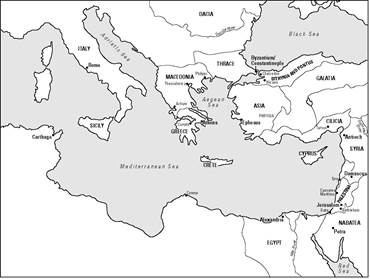
Figure 6-1: The Roman Empire in 30 BCE.
Octavian’s governance of the Roman Empire
As ruler, Octavian established a new form of Roman government, a principate in which he was the “first man.” A principate is basically a government in which one citizen was understood to be first (princeps) among all the others. Octavian understood, as his uncle Julius Caesar had not, that the republican form of government was traditional and revered and couldn’t be easily discarded. So far in the Roman republic, elites had governed through institutions such as the Senate and free elections. The power-hungry Octavian couldn’t allow that kind of control, but neither could he risk eradicating it and alienating the aristocracy. So he set out on a careful (and crafty!) campaign to increase his power while appearing to restore republican institutions and conservative, family values.
In 27 BCE, Octavian accepted the title “Augustus,” which was a traditional term with religious overtones that established his preeminence. Through coins and statues, as well as temples and festivals in the provinces (though not in Rome), Augustus cultivated the notion that he — along with the gods — was responsible for the blessings that people enjoyed. It’s no accident that the New Testament authors portrayed Jesus in a similar way. They didn’t call him “Augustus,” but they spoke of natural signs that accompanied his birth (like Matthew’s star in 2:2), and some presented him as a kind of cosmic ruler responsible for the creation and restoration of the world (Philippians 2:5-11; John 1:1-5; Revelation 21:1-8).
Augustus also established an effective system to administer his empire. He divided the provinces into the following two types:
● Imperial provinces: These key regions were governed by legates (Roman military officers from the senatorial class who controlled legions, army units of 5,000 to 6,000 men) who were appointed directly by Augustus. Egypt and Syria, because of their strategic significance, were two such imperial provinces. (Egypt produced a great deal of grain that Rome needed and controlled sea trade to Arabia and India. Syria controlled the land route to Mesopotamia and the Far East.) When Rome took over direct control of Judea/Samaria in 6 CE, regions were absorbed into the imperial province of Syria but were given their own local governor, the Roman prefect.
● Public (or senatorial) provinces: These provinces were of somewhat lesser importance. They fell under the authority of the republican institution (the Senate). The more significant provinces were assigned to proconsuls (former consuls in Rome — the highest appointed office in the Empire — who then were sent out to govern provinces). Public provinces in the Near East during Jesus’s lifetime included Macedonia and Cyprus.
Many parts of the Augustan empire fell under the umbrella of the imperial provinces but were allowed to retain their local rulers. In this case, those rulers became client kings of Rome. They enjoyed some measure of autonomy as long as they did Rome’s bidding and kept the peace. But if they were incompetent, Rome would step in to assume direct control. (This happened in the Jewish kingdom after Herod the Great died in 4 BCE; see Chapter 8 for more info.)
The death of a ruler: Transitioning to Tiberius
Augustus died in 14 CE from a brief illness; one biographer said that it was some sort of bowel ailment. Before he died, he had designated his stepson Tiberius to succeed him. Tiberius held the office until his own death in 37 CE. While there were intrigues in the capital city of Rome involving the elimination of his relatives and rivals, Tiberius managed most provinces well, including Judea.
Meeting the Romans Mentioned in the Gospels
All of the gospel writers mentioned the Romans during the trial and execution of Jesus (which was pretty unavoidable considering the Romans were responsible for it). But Luke also started his story with a reference to Rome. In the following sections, I introduce a few Romans who appear in the gospels.
Augustus
Augustus, the emperor of Rome from 31 BCE to 14 CE, appears early on in Luke’s narrative of Jesus’s infancy. In his story, he said Augustus decreed that “the whole world should be enrolled” for tax purposes (Luke 2:1). What Luke meant by “enrolled” was that a census had to be taken so that Rome would know just how many heads to tax. In Luke’s view, every man had to travel to his ancestral home, so that’s why Joseph and Mary traveled from Nazareth in the north to Bethlehem in the south, the ancestral home of Joseph’s Davidic clan, where Jesus was subsequently born.
There are some historical problems with this census:
● There’s no record that Augustus ever ordered an empire-wide enrollment.
● There was no need for a census at that time because Judea and the Galilee weren’t Roman provinces.
● There was no precedent for enrolling outside the place that people actually lived and no rule that the entire family had to go along for the ride.
Luke was wrong on the details but keen on his main point: The infant about to be born in a provincial backwater would rival the emperor in offering true salvation and peace.
Quirinius
In his infancy narrative (Luke 2:2), Luke mentioned Quirinius, the provincial governor of Syria. Luke said that Jesus was born during Quirinius’s rule. This declaration presents a historical problem: Quirinius was the imperial legate in Syria from 6-9 CE, but both Luke and Matthew say that Jesus was born while Herod the Great was still king — and Herod died in 4 BCE. Both of these claims can’t be right! But you don’t want to miss the forest for the trees. The purpose of Luke’s setup, even if his historical details are wrong, is to contrast the kingdoms of Jesus and Rome. Luke used Rome as a backdrop so that Jesus’s significance as the true ruler, the true source of salvation, would stand out clearly. Rome promised these things, but in Luke’s view, only Jesus delivered them.
Tiberius
Luke discussed Augustus’s successor, the Emperor Tiberius, when he shifted from the infancy narrative to the account of Jesus’s adult life. In Chapter 3 of his gospel, Luke introduced John the Baptist, who introduced Jesus. Here’s how Luke presented John:
In the fifteenth year of the rule of Tiberius Caesar, when Pontius Pilate was prefect of Judea and Herod was tetrarch of Galilee, and his brother Philip tetrarch of the region of Ituraea and Trachonitis, and Lysanias was tetrarch of Abilene, during the high priesthood of Annas and Caiaphas, the word of God came to John, son of Zechariah, in the desert.
—Luke 3:1-2
Luke’s list moves down the imperial hierarchy from the emperor to the local Roman governor to the local client kings and finally to the Jewish high priests selected by Rome. Luke’s historical setting isn’t innocent, but instead makes a point. As with Augustus earlier in this chapter, Luke was saying that Jesus would compete with these characters as a new kind of ruler, and John would be his herald.
Pontius Pilate and the missus
All four of the gospels recount stories of Pontius Pilate, the Roman prefect of Judea who presided over Jesus’s trial and execution (Matthew 27:1-2, 11-31; Mark 15-20; Luke 23:1-25;
John 18:28-19:16). In Matthew’s gospel, Pilate’s wife also makes a brief cameo appearance (Matthew 27:19) — a story that expands dramatically in later legends (you can read more about the Pilates in Chapter 14).
Roman soldiers
Roman soldiers make occasional appearances in the gospels. The largest cohort is in Jerusalem when Jesus is arrested, tried, and executed. They flog him, mock him, take him out to the crucifixion site, and crucify him (Matthew 27:1-28:15; Mark 15; Luke 23; John 18:28-19:42). In Matthew’s gospel, the Roman soldiers also post a guard outside Jesus’s tomb to prevent the disciples from stealing the body (Matthew 27:62-66; 28:11-15). Find out more about the crucifixion in Chapter 14.
A few solitary Roman soldiers pop up in more positive contexts:
● The legionaries who go to John for baptism (Luke 3:14)
● The centurion (the commanding officer of a century, which is a unit of 100 soldiers) who asked Jesus to cure his slave (Matthew 8:5-13; Luke 7:1-10)
● The centurion at the foot of the cross who testified that “Truly, this man was a son of God” (Mark 15:39; Matthew 27:54)